

Chronos: Learning the Language of Time Series
Open accessThe DOI matches its DataCite record; 95 of the 95 references it cites were found in a registry or an index; none of the 21 sources its claims cite is checked for support yet.
Abstract
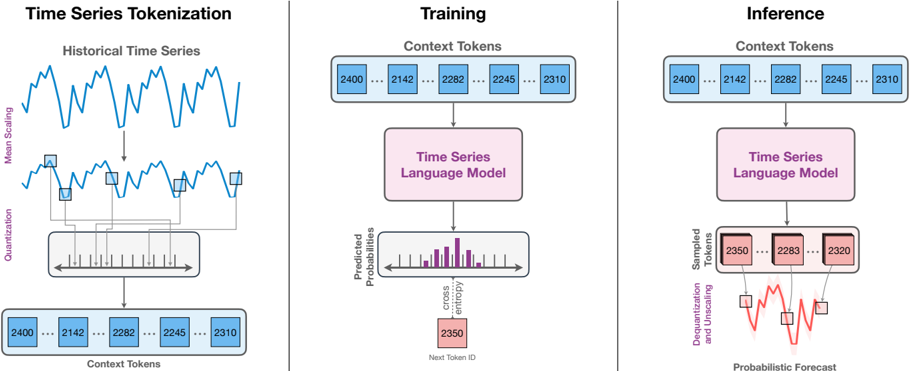
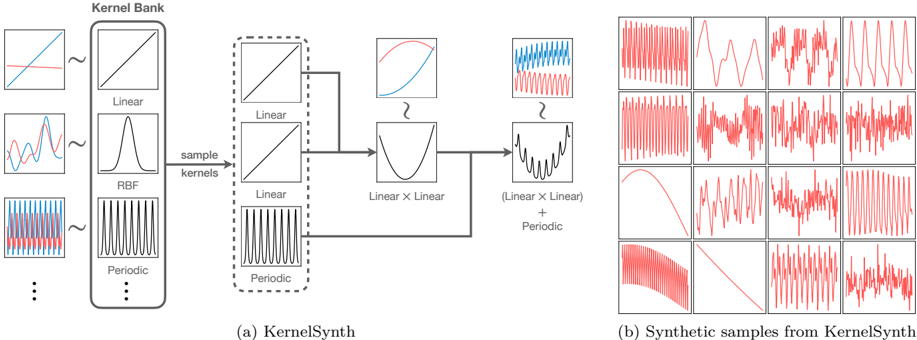
We introduce Chronos, a simple yet effective framework for pretrained probabilistic time series models. Chronos tokenizes time series values using scaling and quantization into a fixed vocabulary and trains existing transformer-based language model architectures on these tokenized time series via the cross-entropy loss. We pretrained Chronos models based on the T5 family (ranging from 20M to 710M parameters) on a large collection of publicly available datasets, complemented by a synthetic dataset that we generated via Gaussian processes to improve generalization. In a comprehensive benchmark consisting of 42 datasets, and comprising both classical local models and deep learning methods, we show that Chronos models: (a) significantly outperform other methods on datasets that were part of the training corpus; and (b) have comparable and occasionally superior zero-shot performance on new datasets, relative to methods that were trained specifically on them. Our results demonstrate that Chronos models can leverage time series data from diverse domains to improve zero-shot accuracy on unseen forecasting tasks, positioning pretrained models as a viable tool to greatly simplify forecasting pipelines.
Overview
CoChat Summary
TL;DR
Chronos adapts language-model architectures to probabilistic time series forecasting by scaling and quantizing values into tokens and training T5/GPT-2 models with cross-entropy. Across 42 benchmark datasets, it achieves strong in-domain and zero-shot forecasting, often matching or beating task-specific models.
Key findings
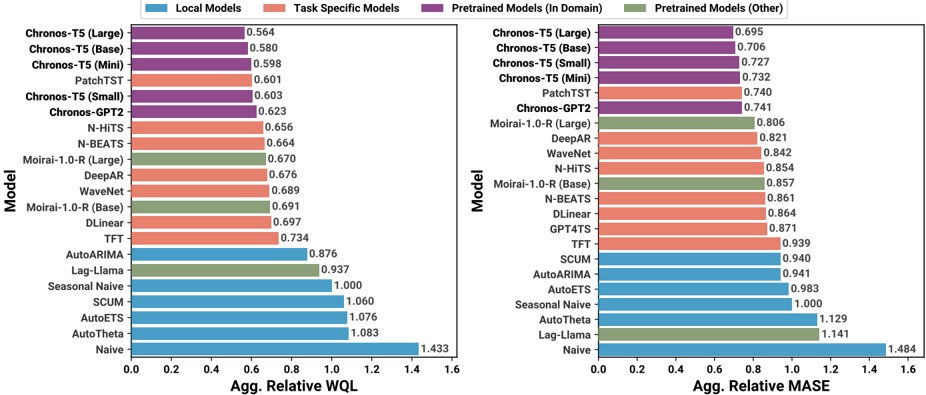
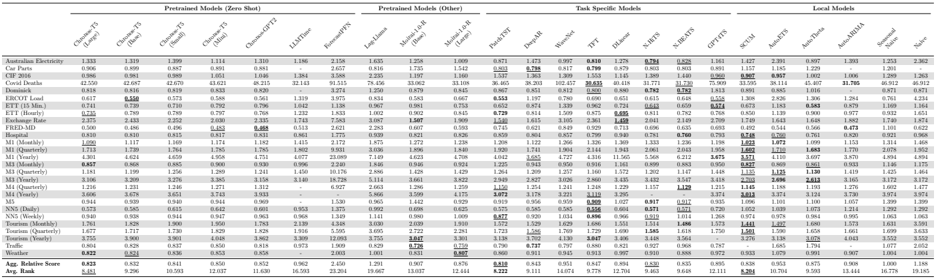
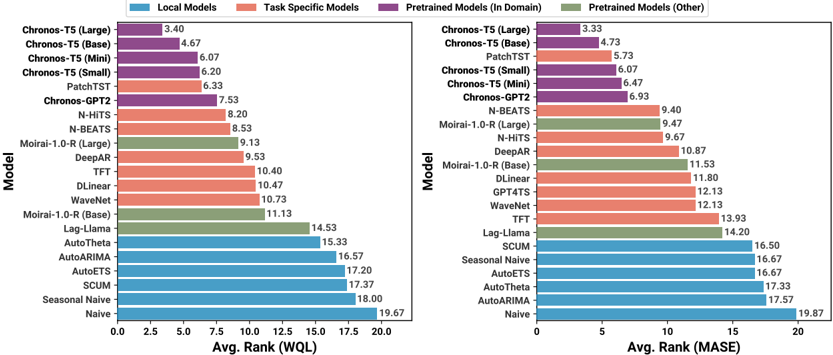
- On in-domain Benchmark I (15 datasets), Chronos-T5 Base/Large obtain the best aggregated relative scores: WQL 0.580/0.564 and MASE 0.706/0.695 versus Seasonal Naive 1.000, outperforming local, task-specific, and other pretrained baselines.
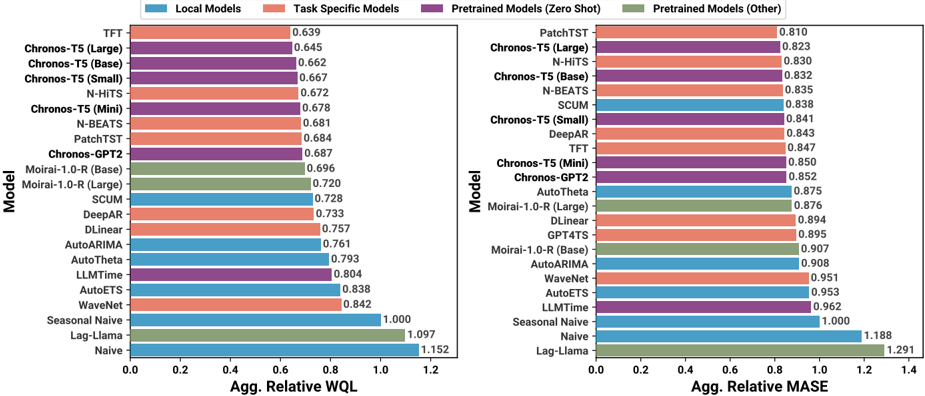
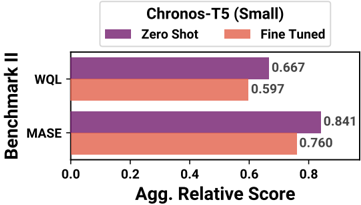
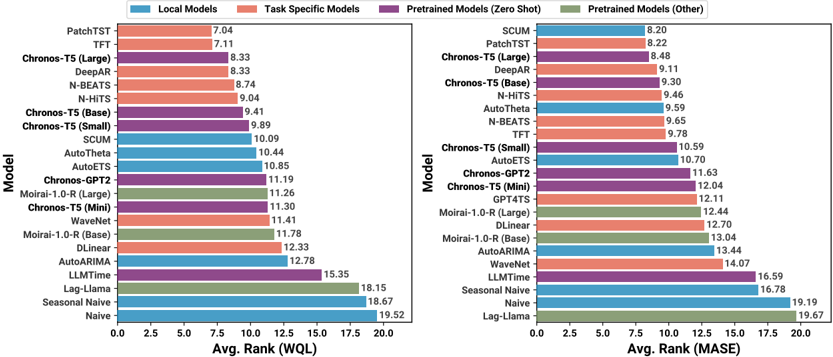
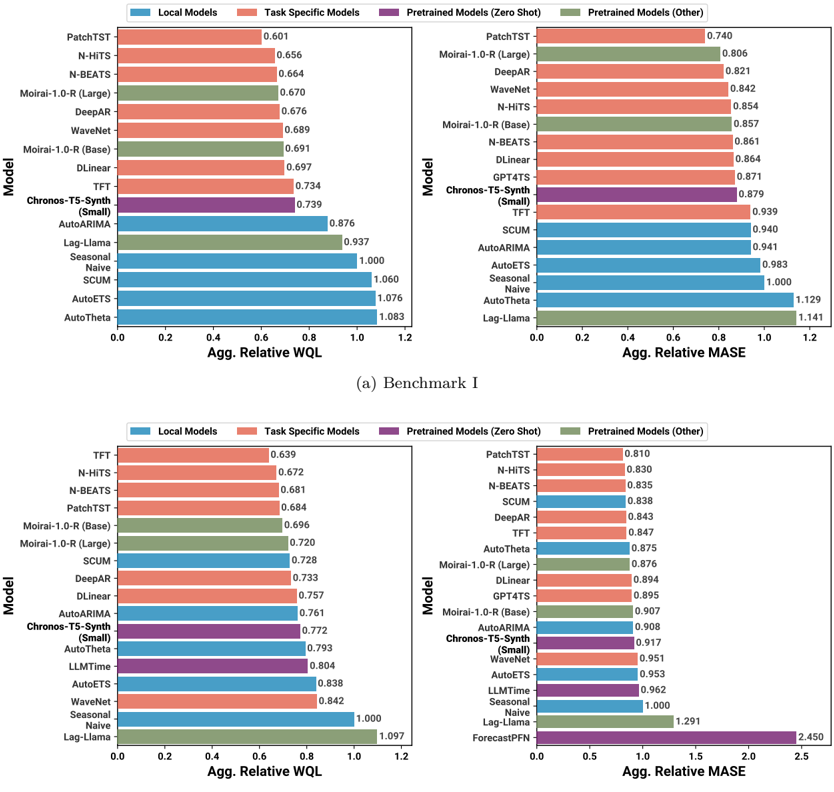
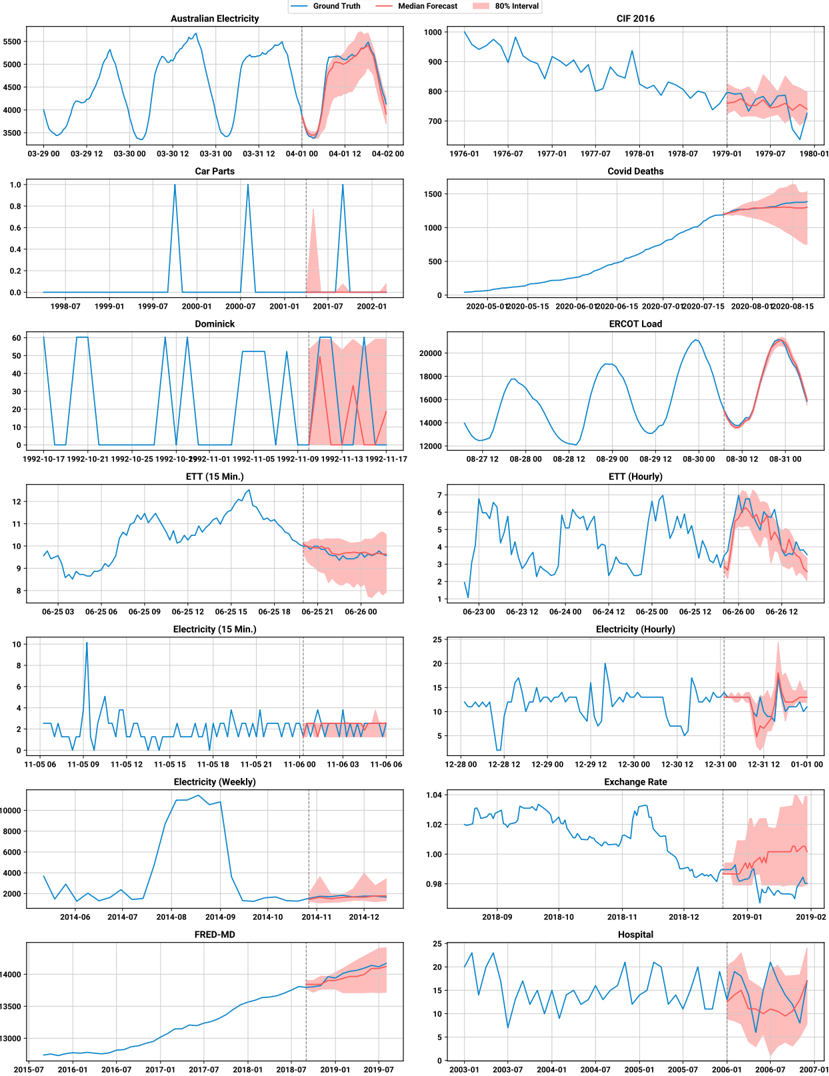
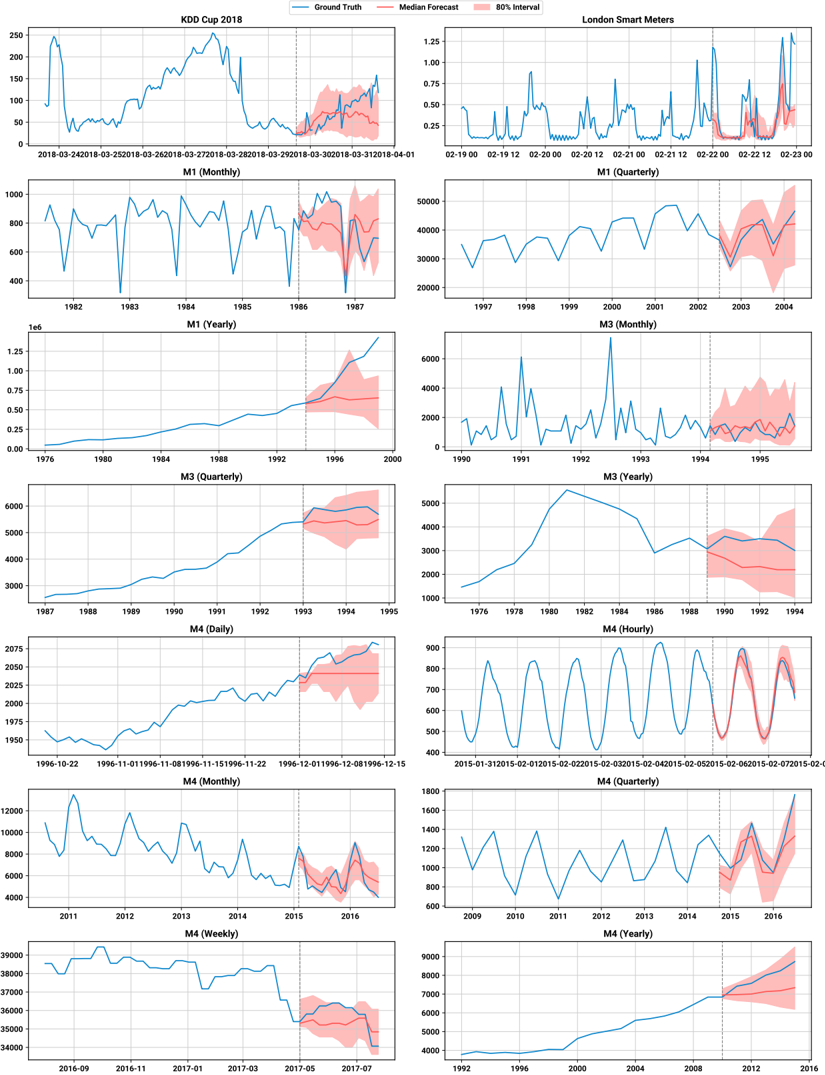
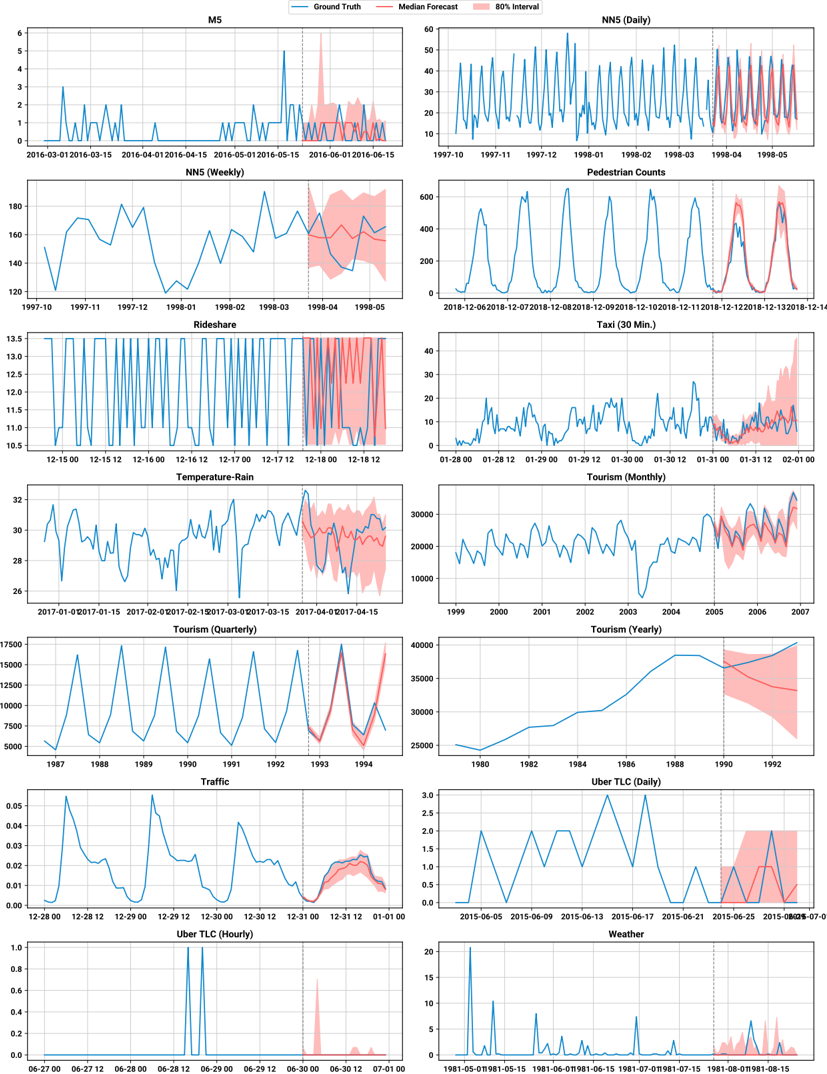
- On zero-shot Benchmark II (27 datasets), Chronos models rank 2nd–4th on WQL and Chronos-T5 Large ranks 2nd on MASE; aggregated relative WQL is 0.645 (Large), 0.662 (Base), 0.667 (Small), 0.678 (Mini), and MASE is 0.823, 0.832, 0.841, 0.850 versus Seasonal Naive 1.000. Fine-tuned Chronos-T5 Small becomes the best model on Benchmark II.
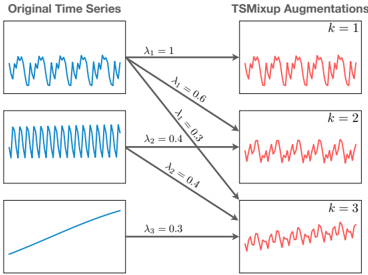
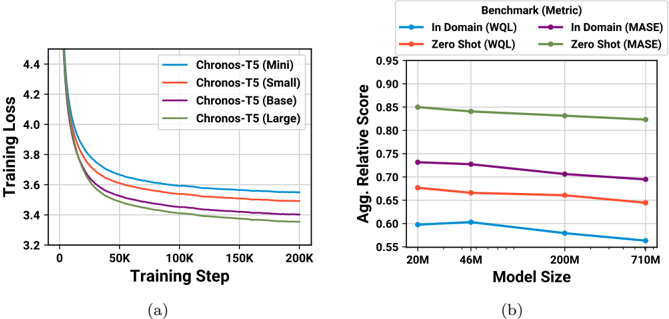
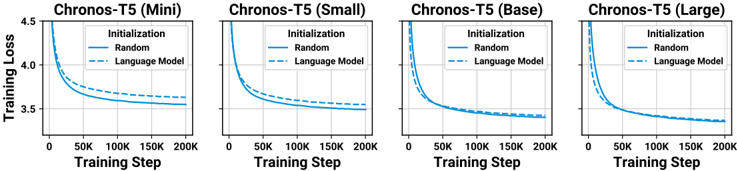
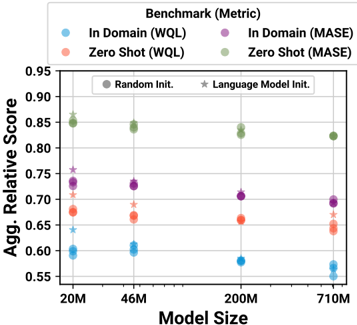
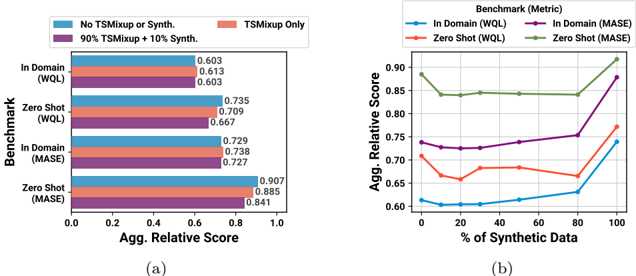
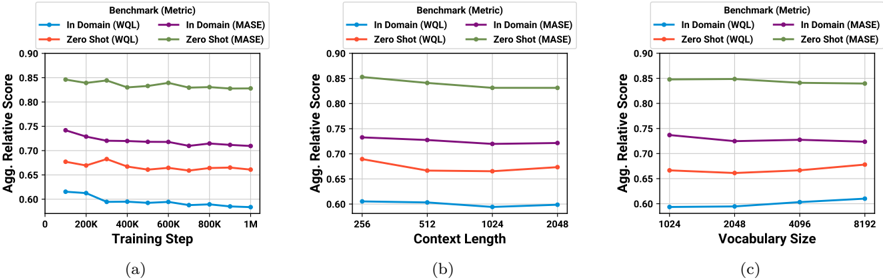
- Ablations show performance improves with model size; language-model-weight initialization offers little/no advantage over random initialization; TSMixup improves zero-shot performance; about 10% KernelSynth synthetic data is best; context length up to 1024 helps; larger vocabulary improves MASE but WQL deteriorates.
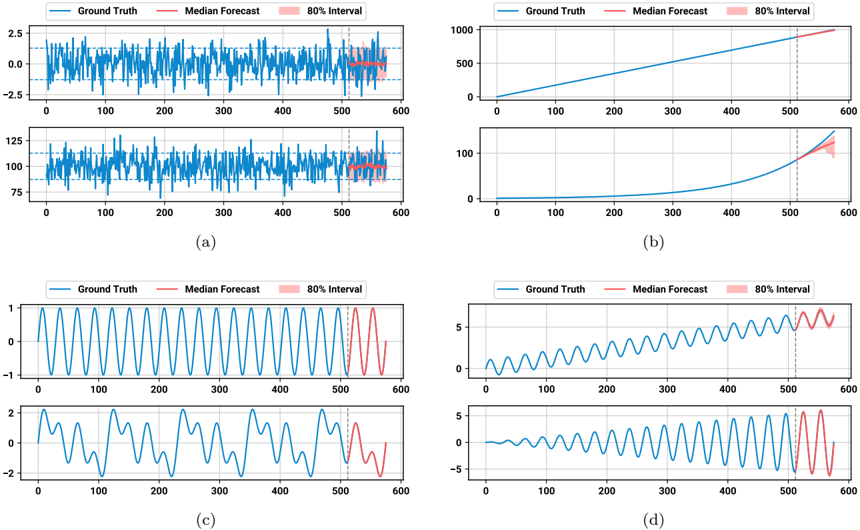
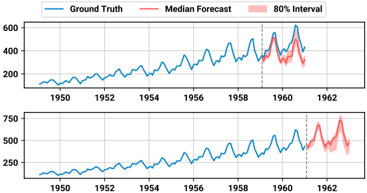
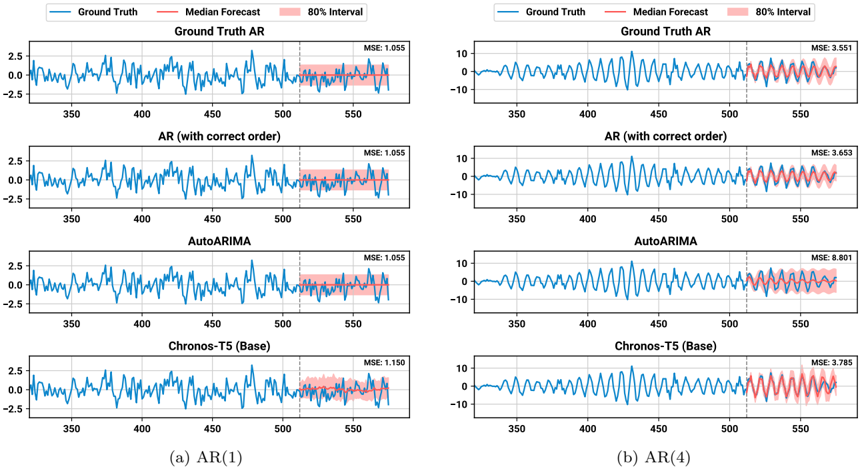
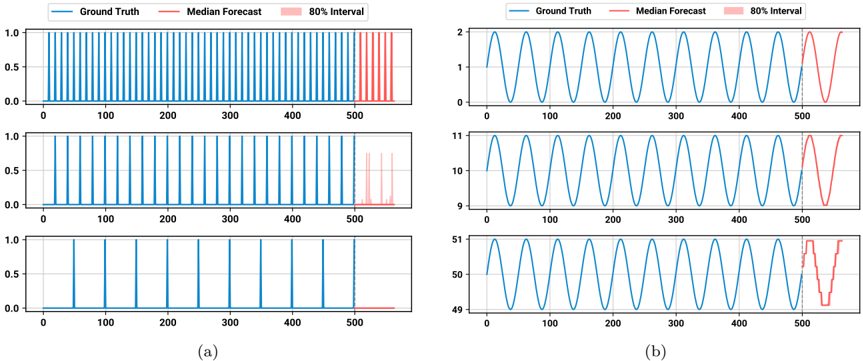
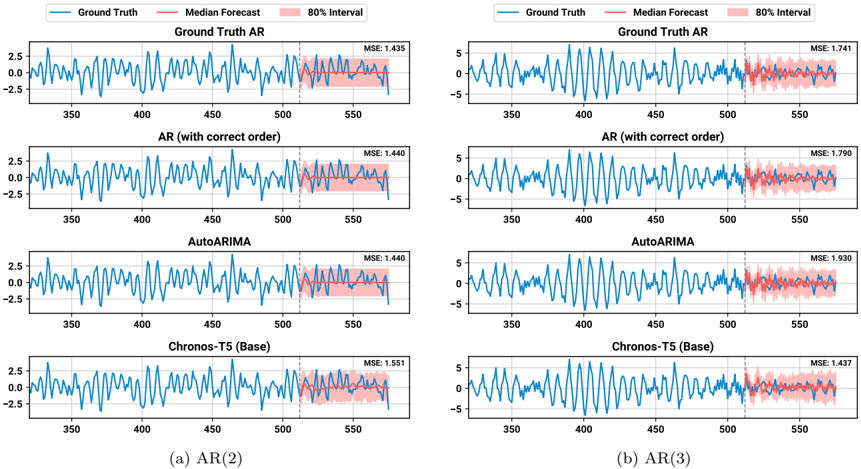
- Qualitatively, Chronos handles Gaussian noise, seasonality, additive/multiplicative trend+seasonality, and AR processes, but struggles with exponential trends and underestimates trend when context is short.
Methods
- Chronos mean-scales time series, uniformly quantizes values into B=4094 bins plus PAD/EOS (V_ts=4096), and trains off-the-shelf transformer language models with categorical cross-entropy; forecasts are produced by autoregressively sampling token paths and dequantizing/unscaling them.
- Training used 55 datasets total: 13 pretraining-only, 15 Benchmark I in-domain, and 27 Benchmark II zero-shot; 28 training datasets comprised about 890K univariate series and approximately 84B observations/tokens. Models included T5 Mini 20M, Small 46M, Base 200M, Large 710M, and GPT-2 90M, trained with 10M TSMixup augmentations plus 1M KernelSynth GP synthetic series, context length 512, prediction length 64, and 200K AdamW steps.
- Evaluation used 42 benchmark datasets with WQL (9 quantiles) and MASE; relative scores versus Seasonal Naive were aggregated by geometric mean and compared against local, task-specific, and pretrained baselines, plus a fine-tuning experiment on Benchmark II.
Limitations
- The paper states tokenization limits: representable values are in [-15s, 15s] where s is the mean absolute scale; small s relative to range causes overflow, while large s relative to variance causes precision loss. It also notes poor exponential-trend forecasts, trend underestimation with short context, and that categorical cross-entropy is not distance-aware; ordinal modeling is left as future work.
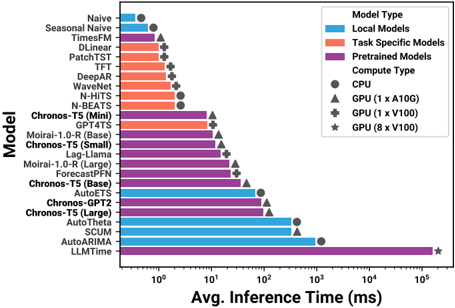
- The paper states scope limits: only univariate, uniformly spaced forecasting is studied; exogenous covariates, multivariate forecasting, and irregular sampling are not handled. Larger models were not explored due to slow inference, inference is slower than task-specific models, evaluation lacks enough high-frequency datasets to study long contexts, and public time series data remain limited.
- Text-evident: the zero-shot comparison may favor Moirai-1.0-R because many Benchmark II datasets were part of its pretraining corpus, as the paper notes; Chronos also ignores time and frequency information by design.
Model-written summary. Check it against the paper before relying on it.
Integrity signals
Registry
Cites
Statistics
Figures

Verification
Claims the paper makes
0 Valid · 4 Not valid · 14 Not checked · 146 Own results and interpretations
A result the paper reports from its own data — it cites no other source for it, so there is none to check. The quote shows it is in the paper.
In the paper
“Between the two baseline pretrained models studied in this experiment, Moirai-1.0-Rclearly outperforms Lag-Llama.”
§ Chronos: Learning the Language of Time Series > 5.5 Main Results
boosted- Asserted: passes — The authors put it forward as true.
- Checkable: passes — It can be checked against evidence.
- Load-bearing: unclear — It is unclear whether the paper’s conclusions depend on it.
- Based: passes — The paper gives a reason why it holds.
A result the paper reports from its own data — it cites no other source for it, so there is none to check. The quote shows it is in the paper.
In the paper
“Unsurprisingly, the training loss improves with the model capacity, as shown in Figure 7a.”
§ Chronos: Learning the Language of Time Series > Model size.
plainstates a cause- Asserted: passes — The authors put it forward as true.
- Checkable: passes — It can be checked against evidence.
- Load-bearing: unclear — It is unclear whether the paper’s conclusions depend on it.
- Based: passes — The paper gives a reason why it holds.
A result the paper reports from its own data — it cites no other source for it, so there is none to check. The quote shows it is in the paper.
In the paper
“Our comprehensive evaluation across 42 datasets establishes Chronos as a benchmark for both in-domain and zero-shot forecasting, surpassing both traditional models and task-specific deep learning approaches.”
§ Chronos: Learning the Language of Time Series > Time Series Tokenization Training Inference
plain- Asserted: passes — The authors put it forward as true.
- Checkable: passes — It can be checked against evidence.
- Load-bearing: passes — The paper’s conclusions depend on it.
- Based: passes — The paper gives a reason why it holds.
A result the paper reports from its own data — it cites no other source for it, so there is none to check. The quote shows it is in the paper.
In the paper
“consistent improvement is observed around the 10% synthetic data proportion.”
§ Chronos: Learning the Language of Time Series > Model size.
plainstates an association- Asserted: passes — The authors put it forward as true.
- Checkable: passes — It can be checked against evidence.
- Load-bearing: unclear — It is unclear whether the paper’s conclusions depend on it.
- Based: passes — The paper gives a reason why it holds.
A result the paper states — it cites no source for it, so there is none to check. The quote shows it is in the paper.
In the paper
“Further increasing the proportion of synthetic data tends to worsen performance.”
§ Chronos: Learning the Language of Time Series > Model size.
hedgedstates a possible cause- Asserted: passes — The authors put it forward as true.
- Checkable: passes — It can be checked against evidence.
- Load-bearing: unclear — It is unclear whether the paper’s conclusions depend on it.
- Based: passes — The paper gives a reason why it holds.
- Rests on an assumption not shown here.
94 more claims
Create a free account to see all 164 claims and to verify the 17 references still open.
- It may state two separate claims as one. 42
- Probably not a substantial claim. 30
Self-check
Percentages, sums and reported differences re-computed from the paper’s own numbers.
Each contradiction between two passages listed here was confirmed by an independent check.
Rated minor: it would not touch a result — a value no result rests on, a p-value that stays on the same side of the significance level, or a conflict that is clerical, resolved elsewhere in the paper, or outside its own findings.
In the paper
§ Chronos: Learning the Language of Time Series > Additional information
“Dominick (Godahewa et al., 2021) contains weekly time series representing the profit of individual stock keeping units from a retailer.”
§ Chronos: Learning the Language of Time Series > Covid Deaths
“Dominick retail 1D 100014 201 296 399 8”
Rated minor: it would not touch a result — a value no result rests on, a p-value that stays on the same side of the significance level, or a conflict that is clerical, resolved elsewhere in the paper, or outside its own findings.
In the paper
§ Chronos: Learning the Language of Time Series > C Baselines
“We considered a total of 17 baseline methods for benchmarking Chronos.”
§ Chronos: Learning the Language of Time Series > Chronos-GPT2 Chronos-T5 (Mini)
“Figure: Naive, SeasonalNaive, AutoETS, Auto-Theta, SCUM, AutoARIMA, DeepAR, TFT, PatchTST, DLinear, WaveNet, N-BEATS, N-HiTS, GPT4TS, Lag-Llama, Moirai-1.evaluationAll the above, LLMTime and ForecastPFN”
Citations
Cites
Exploring the Limits of Transfer Learning with a Unified Text-to-Text Transformer
Raffel, C., Shazeer, N., Roberts, A., Lee, K., Narang, S., Matena, M., Zhou, Y., Li, W., & Liu, P. J. (2019) · arXiv · doi:10.48550/arxiv.1910.10683 · Cited by 31,859
LoRA: Low-Rank Adaptation of Large Language Models
Hu, E. J., Shen, Y., Wallis, P., Allen-Zhu, Z., Li, Y., Wang, S., Wang, L., & Chen, W. (2021) · arXiv · doi:10.48550/arxiv.2106.09685 · Cited by 13,453
LightGBM: A Highly Efficient Gradient Boosting Decision Tree
(2017) · HAL · Cited by 10,512
Lewis, M., Liu, Y., Goyal, N., Ghazvininejad, M., Mohamed, A., Levy, O., Stoyanov, V., & Zettlemoyer, L. (2020) · Proceedings of the 58th Annual Meeting of the Association for Computational Linguistics · doi:10.18653/v1/2020.acl-main.703 · Cited by 8,821
Lewis, M., Liu, Y., Goyal, N., Ghazvininejad, M., Mohamed, A., Levy, O., Stoyanov, V., & Zettlemoyer, L. (2019) · arXiv · doi:10.48550/arxiv.1910.13461 · Cited by 8,816
Transformers: State-of-the-Art Natural Language Processing
Wolf, T., Debut, L., Sanh, V., Chaumond, J., Delangue, C., Moi, A., Cistac, P., Rault, T., Louf, R., Funtowicz, M., et al. (2020) · Proceedings of the 2020 Conference on Empirical Methods in Natural Language Processing: System Demonstrations · doi:10.18653/v1/2020.emnlp-demos.6 · Cited by 8,741
Informer: Beyond Efficient Transformer for Long Sequence Time-Series Forecasting
Zhou, H., Zhang, S., Peng, J., Zhang, S., Li, J., Xiong, H., & Zhang, W. (2021) · Proceedings of the AAAI Conference on Artificial Intelligence · doi:10.1609/aaai.v35i12.17325 · Cited by 7,752
mixup: Beyond Empirical Risk Minimization
Zhang, H., Cisse, M., Dauphin, Y. N., & Lopez-Paz, D. (2017) · arXiv · doi:10.48550/arxiv.1710.09412 · Cited by 5,831
Strictly Proper Scoring Rules, Prediction, and Estimation
Gneiting, T., & Raftery, A. E. (2007) · Journal of the American Statistical Association · doi:10.1198/016214506000001437 · Cited by 5,793
Another look at measures of forecast accuracy
Hyndman, R. J., & Koehler, A. B. (2006) · International Journal of Forecasting · doi:10.1016/j.ijforecast.2006.03.001 · Cited by 5,757
Research works printed but not linked: 8
- George Athanasopoulos, Rob J. Hyndman, Haiyan Song, and Doris C. Wu. The tourism forecasting compe- tition. International Journal of Forecasting, 27(3):822-844, 2011.
- Tom B. Brown, Benjamin Mann, Nick Ryder, Melanie Subbiah, Jared Kaplan, Prafulla Dhariwal, Arvind Neelakantan, Pranav Shyam, Girish Sastry, Amanda Askell, Sandhini Agarwal, Ariel Herbert-Voss, Gretchen Krueger, Tom Henighan, Rewon Child, Aditya Ramesh, Daniel M. Ziegler, Jeffrey Wu, Clemens Winter, Christopher Hesse, Mark Chen, Eric Sigler, Mateusz Litwin, Scott Gray, Benjamin Chess, Jack Clark, Christopher Berner, Sam McCandlish, Alec Radford, Ilya Sutskever, and Dario Amodei. Language models are few-shot learners. In Advances in Neural Information Processing Systems, 2020. 2, 3, 4
- Rob Hyndman, Anne B Koehler, J Keith Ord, and Ralph D Snyder. Forecasting with exponential smoothing: the state space approach. Springer Science & Business Media, 2008. 3, 9
- Alec Radford, Jeffrey Wu, Rewon Child, David Luan, Dario Amodei, Ilya Sutskever, et al. Language models are unsupervised multitask learners. OpenAI blog, 1(8):9, 2019. 4, 6
- Yaniv Romano, Evan Patterson, and Emmanuel Candes. Conformalized quantile regression. Advances in neural information processing systems, 32, 2019.
- Kai Ming Ting and Ian H Witten. Stacking bagged and dagged models. In Proceedings of the Fourteenth International Conference on Machine Learning, 1997. 20
- Ashish Vaswani, Noam Shazeer, Niki Parmar, Jakob Uszkoreit, Llion Jones, Aidan N. Gomez, Lukasz Kaiser, and Illia Polosukhin. Attention Is All You Need. In Advances in Neural Information Processing Systems, 2017.
- Yun Zhou, Liwen You, Wenzhen Zhu, and Panpan Xu. Improving time series forecasting with mixup data augmentation. In ECML PKDD 2023 International Workshop on Machine Learning for Irregular Time Series, 2023b. 7
Cited by
Items 1,601–1,700 of 2,048
From Jumps to Signatures: A Generative Method for Temporal Point ProcessesPreprint
Cariou-Kotlarek, N., & Lampos, V. (2026) · arXiv · doi:10.48550/arxiv.2607.06652
“Since evaluation metrics can differ substantially in scale across datasets, we report the relative score computed as a 2-step process (see also [1, 13, 22]).”
Zhao, Y. (2026) · arXiv · doi:10.48550/arxiv.2611.09259
“Chronos provides existing context for pretrained time-series forecasting [63], while DT-GPT provides context for clinical trajectory modelling [64].”
Nakajima, T., & Tsutsumida, N. (2026) · The international archives of the photogrammetry, remote sensing and spatial information sciences/International archives of the photogrammetry, remote sensing and spatial information sciences · doi:10.5194/isprs-archives-l-4-w1-2026-181-2026
A policy-text-enhanced decomposition-fusion forecasting framework for carbon pricePreprint
Guo, Y., Wang, H., Allaoui, H., Li, W., & Boulaksil, Y. (2026) · SSRN Electronic Journal · doi:10.2139/ssrn.6906934
Self-citationFew-Shot Probe Card Fault Diagnosis Using a Time-Series Foundation Model
Bejani, M., Mauri, M., Appello, D., & Mariani, S. (2026) · International Electronic Conference on Sensors and Applications (ECSA) · doi:10.3390/engproc2026163012
ACET: An Adaptive Component Extraction and Tokenization Framework for Time Series Forecasting
Cai, J., Yin, T., Wang, J., Wang, C., Zhao, Y., Ma, Y., & Liu, M. (2025) · Conference proceedings/Conference proceedings - IEEE International Conference on Systems, Man, and Cybernetics · doi:10.1109/smc58881.2025.11343366
“The discretization encoding method enables LLMs to forecast tokenization results by segmenting continuous numerical data into intervals using specialized encoding schemes while capturing their variation patterns [14].”
Jiang, S., Zhang, W., & Pan, H. (2026) · Engineering Research Express · doi:10.1088/2631-8695/aea5e8
“A pre-trained Transformer backbone, initialized from the public Chronos-T5-tiny checkpoint [25], is employed for adaptation to industrial monitoring data using lightweight adapters [27].”
Östlund, L. (2024) · KTH Publication Database DiVA (KTH Royal Institute of Technology)
Loss-Guided Pretraining Data Selection for Time-Series Foundation ModelsPreprint
Li, Y., Song, S., & Wang, J. (2026) · arXiv · doi:10.48550/arxiv.2609.37255
“The pretraining data mainly comes from the Chronos data collection (Ansari et al., 2024) and LOTSA (Woo et al., 2024).”
InfluentialMüller, K., Ruhland, T., Guimarães, C., Kaiser, J. H., & Franchi, N. (2026) · IEEE Open Journal of the Communications Society · doi:10.1109/ojcoms.2026.3672750
Series-wise Cross-validation for Global Time Series ForecastingPreprint
Cerqueira, V., Oliveira, M., & Roque, L. (2026) · arXiv · doi:10.48550/arxiv.2611.08252
DES-JEPA: Learning a Shared Vocabulary for High-Dimensional Discrete Event SequencesPreprint
Math, H., Forstenhäusler, M., & Anagnostopoulos, C. B. (2026) · arXiv · doi:10.48550/arxiv.2610.38445
“Concurrent work on temporal foundation models (TFMs) treats a sequence as a continuous-valued signal and pretrains a shared numerical value that lives on a comparable scale [5, 6].”
Redundancy-Aware Sensor Array Optimization for Electronic Nose Classification
Zhu, H., Zhou, X., Hao, Z., Chae, D., Teng, X., & Li, H. (2026) · ACM International Conference on Information and Knowledge Management (CIKM) · doi:10.1145/3799682.3839944
“We compare with TSelect [24], ECP and ECS [6], mutual information (MI), and mRMR [25].”
MeteoFormer: The Accuracy–Faithfulness Trade-Off of Built-In Attention in Meteorological Forecasting
Ashimova, M., Tashatov, N., & Serek, A. (2026) · Forecasting · doi:10.3390/forecast8060106
Park, H., & Park, J. W. (2026) · Asia-pacific Journal of Convergent Research Interchange · doi:10.47116/apjcri.2026.09.13
Correction-space Cross-variate Interaction for Test-time Adaptation in Time Series Forecasting
Deng, Y., Pechenizkiy, M., & Deng, S. (2026) · arXiv · doi:10.48550/arxiv.2609.34638
“Extending correction-space interaction to irregular feedback delays and alternative interfaces, including time-series foundation models such as MOIRAI [Woo et al., 2024] and Chronos [Ansari et al., 2024], is an interesting direction.”
Yang, S., Liu, Z., Han, T., Fei, B., Ling, F., Bai, L., Liu, C., Ji, X., Shi, Z., & Zou, Z. (2026) · arXiv · doi:10.48550/arxiv.2607.13101
“More recently, Transformer-based methods have enabled more flexible factorized modeling of time-variable interactions via attention mechanisms [11]–[13], [58], [59].”
Yang, S., Liu, Z., Han, T., Fei, B., Bai, L., Liu, C., Zou, Z., Ji, X., Ouyang, W., & Shi, Z. (2026) · arXiv · doi:10.48550/arxiv.2609.22217
“Notably, we significantly outperformed SOTA forecast methods, including WSSM [15], iTransformer [59], Corrformer [3], and Chronos2 [60], in the 48h-72h fixed-window setting.”
Multimodal Masked Diffusion Autoencoder for Modeling Impaired DrivingPreprint
Gideon, J., Gupta, A., Applegate-Kenton, M., Battel, K., Rowell, T. J., Gomez, P. R., Dees, L., Sumner, E. S., Balachandran, A., & Rosman, G. (2026) · arXiv · doi:10.48550/arxiv.2611.23211
“Beyond driving, diffusion enables imputation of multivariate time-series [3, 71, 85]; time-series foundation models [5, 21, 32] focus on univariate series and do not leverage geometric relations between signals.”
Morpheus-2.0: Multiscale Probabilistic Forecasting with Dual-Axis AttentionPreprint
Aakriti, Cherukumalli, M., Patil, P., Tsepenekas, L., Varshney, A., Liu, P., Fons, E., & Potluru, V. K. (2026) · arXiv · doi:10.48550/arxiv.2610.24321
“Time-series foundation models (TSFMs) offer a different paradigm: pretraining on heterogeneous series lets one model transfer across domains with little or no task-specific optimization (Ansari et al., 2024; Das et al., 2024; Woo et al., 2024; Cohen et al., 2025).”
In-Context Inpainting for Time Series ForecastingPreprint
Nguyen, T., Nguyen, D., de Morais, R. F. A. B., & Tran, T. (2026) · arXiv · doi:10.48550/arxiv.2608.23855
“Early work adapted LLMs: Chronos [1] and Time-LLM [8] tokenise time series via quantization or text encoding, but such methods often struggle with the “modality gap” between continuous numerical data and discrete text tokens [16].”
Representation Learning for Precision Risk Stratification in Paediatric Medicine
Jingteng, L. (2026) · UCL Discovery (University College London)
Su, T., Zou, Z., Lu, Q., Zhang, F., Luo, A.-L., Kong, X., & Li, M. (2025) · arXiv · doi:10.48550/arxiv.2507.10986
“Chronos [ Ansari et al. , 2024 ] converts time series data into token sequences, leveraging language model architectures, pre-training on large-scale heterogeneous datasets, and data augmentation techniques to enhance generalization, demonstrating excellent zero-shot prediction performance.”
Continuous Horizon ForecastingPreprint
Wolff, M., Zackrone, E., Taieb, S. B., Mahoney, M. W., & Olivares, K. G. (2026) · arXiv · doi:10.48550/arxiv.2611.13228
Self-citationPredicting Energy Demands of Retail Stores—Can Deep Learning Help?
Szabados, L., & Obadovics, C. (2025) · Economics World · doi:10.17265/2328-7144/2025.01.001
Study of the possibility of using basic models for forecasting time series
Семерикова, К. А. (2024) · Electronic scientific archive of UrFU (Ural Federal University)
LightGTS-Cov: Covariate-Enhanced Time Series ForecastingPreprint
Shang, Y., Yao, Z., Jin, N., Qiu, X., Zhang, H., & Yang, B. (2026) · arXiv · doi:10.48550/arxiv.2602.10412
“…(Das et al., 2024) and Timer (Liu et al., 2024b) adopt decoder-only Trans-former formulations with next-token prediction objectives, while Chronos (Ansari et al., 2024) discretizes real-valued series via scaling and quantization and performs language-model-style prediction in the token space.”
InfluentialVETime: Vision Enhanced Zero-Shot Time Series Anomaly DetectionPreprint
Yang, Y., Lan, T., Gao, Y., Lu, Y., An, L., He, W., Wang, M., Liu, C., & Zhang, C. (2026) · arXiv · doi:10.48550/arxiv.2602.16681
“…our method against three primary settings: (1) Zero-Shot TSFMs , which include TimeRCD (Lan et al., 2025), DADA (Shentu et al., 2024a), TS-Pulse (Ekambaram et al., 2025), MOMENT (Goswami et al., 2024), TimesFM (Das et al., 2024), Chronos (Ansari et al., 2024), and TimeMOE (Shi et al., 2024)).”
InfluentialTimeRadar: A Domain-Rotatable Foundation Model for Time Series Anomaly DetectionPreprint
He, H., Qiao, H., Chen, Y., Yi, K., & Pang, G. (2026) · arXiv · doi:10.48550/arxiv.2602.19068
“As the angle decreases, the distinction becomes increasingly pronounced, making the anomalies easier to identify.”
InfluentialStreaming Drilling Report Generation with Live Segmentation and Multimodal Text Generation
Sengupta, S., Buiting, S., Khair, A. E., Khaouja, I., Shaaban, Y. S., & Benzine, A. (2025) · IEEE International Conference on Big Data (BigData) · doi:10.1109/bigdata66926.2025.11400980
“Dedicated time-series foundation models (e.g., Chronos [17], Moirai [18], MOMENT [19],) excel at forecasting and representation learning, yet are not built for streaming, segmentation-triggered text generation.”
A Load Forecasting Method Based on Large Language Model Considering Numerical-Text SeparationPreprint
Sun, B., Yang, J., Li, P., Hao, Y. U., Ji, H., Song, G., & Zhao, J. (2026) · doi:10.46855/energy-proceedings-12174
Boehm, L., Smith, K. E., & Smith, A. O. (2026) · International Conference on Artificial Intelligence, Computer, Data Sciences and Applications (ACDSA) · doi:10.1109/acdsa67686.2026.11468234
“The Chronos framework builds on this by tokenizing time series values into a fixed vocabulary and training a T5-based language model architecture, achieving strong performance in probabilistic forecasting [11].”
Non-Stationarity in the Embedding Space of Time Series Foundation ModelsPreprint
Choi, J., Shook, B., & Dubrawski, A. W. (2026) · arXiv · doi:10.48550/arxiv.2604.16428
“Time series foundation models (TSFMs) are increasingly used as generic feature extractors in various down-stream tasks (Ansari et al., 2024; 2025; Goswami et al., 2024; Auer et al., 2025; Talukder et al., 2024; Liang et al., 2024).”
Li, D., Liu, J., Chen, J., Chen, Z., He, G., Zheng, P., Zhang, X., & Li, W. (2026) · Chinese Journal of Mechanical Engineering · doi:10.1016/j.cjme.2026.100298
Self-citationDeRegiME: Deep Regime Mixtures for Probabilistic Forecasting under Distribution ShiftPreprint
Wood, K., Zohren, S., & Roberts, S. (2026) · arXiv · doi:10.48550/arxiv.2605.19231
“…since Theorem 2 holds for any PSD kernel, and pairing the regime-mixing head with channel-mixing backbones [Liu et al., 2023] or time-series foundation models [Ansari et al., 2024, Goswami et al., 2024, Das et al., 2024, Woo et al., 2024] to amortise the regime parameters ( 𝜏 𝑟 𝑟 ) across…”
Unicorn: Scaling High-Dimensional Time Series Forecasting via Universal Correlation ModelingPreprint
Yuan, H., Song, Y., Wang, Y., & Yang, X. (2026) · arXiv · doi:10.48550/arxiv.2605.30376
“Typical architectures include decoder-only [5, 39, 16, 33, 14, 1], encoder-only [9, 29], and encoder-decoder models [8].”
Self-citationNeog, A., Fatemi, S., Sawhney, M., Mehrab, K. S., Pradhan, A., McAfee, B., Marchisin, E., Daw, A., Ladwig, R., Carey, C. C., et al. (2026) · ACM SIGKDD Conference on Knowledge Discovery and Data Mining (KDD) · doi:10.1145/3770855.3819024
UC-Search: Risk-Aware Test-Time Search for Delayed Constrained Time-Series ControlPreprint
Wang, X. (2026) · arXiv · doi:10.48550/arxiv.2606.25274
Jayachandiran, U., & Giridharan, J. (2026) · Research Square · doi:10.21203/rs.3.rs-10306663/v1
Cherif, A. (2026) · arXiv · doi:10.48550/arxiv.2607.19383
“…wins are real, but they are driven by the many weakly-trended series in typical corpora, not by a superior handling of the trended ones, and they coexist with a specific, reproducible weakness on strong trends that the model developers themselves noted anecdotally [1] and that we quantify.”
InfluentialYang, Y., Nie, T., & Li, X. (2026) · Journal of Dynamics Monitoring and Diagnostics · doi:10.37965/jdmd.2026.1589
SAGE: Variate-Wise Semantic Augmentation for Vision-Language Time Series ForecastingPreprint
Fan, H., & Le, X. (2026) · arXiv · doi:10.48550/arxiv.2608.26829
Assessing Covariate-Informed Grid Load Forecasting with a Time-Series Foundation Model
Pendyala, V., Fu, Y., Yan, W., & Virani, N. (2026) · International Joint Conference on Neural Networks (IJCNN) · doi:10.1109/ijcnn69854.2026.11728686
Tabasi, H., & Gupta, G. (2026) · SSRN Electronic Journal · doi:10.2139/ssrn.7415960
Chen, Z., Huang, X., Zhen, D., Liu, M., Jiang, Z., & Zhang, D. (2026) · International Conference on Large Models and Intelligent Agent Technologies (LMIAT) · doi:10.1109/lmiat70705.2026.11682258
“Despite sophisticated feature extraction, standard backbones expose a critical bottleneck during the anomaly score aggregation phase [11],[12],[14].”
From Persistence to Foundation Models: A Critical Look at Zero-Shot Solar Forecasting
Yang, D. (2026) · Artificial Intelligence for the Earth Systems · doi:10.1175/aies-d-26-0057.1
Liu, Q., & Shan, B. (2026) · SSRN Electronic Journal · doi:10.2139/ssrn.7465198
Lin, X., & JunLong, T. (2026) · Energy and AI · doi:10.1016/j.egyai.2026.100914
WaveTLM: Reliable Time-Series Language Modeling through Task CompilationPreprint
Chen, J., Zhu, B., Pan, H., & Chen, Y. (2026) · arXiv · doi:10.48550/arxiv.2609.18812
LLM-Generated Feature Pools for Time Series Anomaly DetectionPreprint
Hili, Y. A. E., Tiomoko, M., & Ancourt, C. (2026) · arXiv · doi:10.48550/arxiv.2609.21801
“Pretrained foundation models and deep detectors have advanced quickly and are among the strongest entries on this benchmark [1, 6, 8].”
Beyond Average Error through Oracle-Informed Stress Tests for Time-Series ForecastingPreprint
Lin, X., Zuo, R., Xu, S., Tan, Q., Lin, H., & Zhang, X.-P. (2026) · arXiv · doi:10.48550/arxiv.2609.22820
“It spans linear, recurrent, multiscale, Transformer, and pretrained designs (Zeng et al., 2023; Nie et al., 2023; Liu et al., 2024a; Ansari et al., 2024; Das et al., 2024; Woo et al., 2024); specifications are in Appendix J. Discovery and held-out confirmation.”
Self-citationAn Inter-variable Relationship-Aware Mixture-of-Experts Model for Stock Closing-Price PredictionPreprint
Chen, Z., Liu, B., Ye, P.-G., Lv, Y., & Zheng, J. (2026) · Research Square · doi:10.21203/rs.3.rs-10860609/v1
EXAONE Demand 1.0: A Time Series Foundation Model for Demand ForecastingPreprint
Lee, S., Han, S., Seo, J., Kang, J., Lee, J., Lim, T. Y., Kang, D., Choi, H., Kim, M., Yoo, S., et al. (2026) · arXiv · doi:10.48550/arxiv.2609.30880
Towards Universal Representation-Based Process ControlPreprint
Choi, J., Kim, T., & Dubrawski, A. (2026) · arXiv · doi:10.48550/arxiv.2609.30790
“( Ansari et al., 2024; 2025; Goswami et al., 2024; Woo et al., 2024; Liu et al., 2024; Auer et al., 2025) Several works have explored the use of learned representations for downstream tasks such as anomaly detection or change-point detection (Tonekaboni et al., 2021; Liang et al., 2024; Wehner et…”
Volatility-Clustering Adaptation for Financial Time SeriesPreprint
Nguyen, M., Nguyen, M. H., Nguyen, H. H., Do, V. D., & Lê, H. (2026) · arXiv · doi:10.48550/arxiv.2609.37715
“Lag-Llama (Rasul et al., 2023), TimesFM (Das et al., 2024), Moirai (Woo et al., 2024), MOMENT (Goswami et al., 2024), and Chronos (Ansari et al., 2024) are pre-trained on large heterogeneous corpora and applied zero-shot across domains, using the same weights without modeling domain-specific…”
InfluentialCORD: Learning Reusable Degradation Representations Across Heterogeneous Physical SystemsPreprint
Li, H., & Zeng, Z. (2026) · arXiv · doi:10.48550/arxiv.2609.39784
“Forecasting models address variation in frequency, variate structure, and distribution through universal, decoder-based, or generative pretraining (Woo et al., 2024; Das et al., 2024; Ansari et al., 2024; Liu et al., 2024b; Shi et al., 2025).”
A Comprehensive Benchmark Of Source-Free Universal Domain Adaptation On Time Series Representations
Mussard, R., Pacheco, F., Bérar, M., Honeiné, P., & Gasso, G. (2026) · Machine learning for signal processing ... · doi:10.1109/mlsp68619.2026.11772600
“Chronos [10] adapts the T5 language model to time series forecasting by quantizing observations into discrete scalar to-kens and training autoregressively on a large corpus of real and synthetic time series.”
What Does an Observability Foundation Model Know?Preprint
Mavani, D. D., Atri, R., & Ji, T. (2026) · arXiv · doi:10.48550/arxiv.2610.05577
“…models and observability TSFMs differ in pretraining objective and use: Chronos and TimesFM cast broad-domain forecasting as autoregressive prediction, whereas MOMENT is a general-purpose encoder trained with masked reconstruction [Ansari et al., 2024, Das et al., 2024, Goswami et al., 2024].”
Lan, T., Gao, Y., Lu, Y., An, X., Wang, M., Pan, Y., He, W., & Zhang, C. (2026) · arXiv · doi:10.48550/arxiv.2610.06180
“TimesFM, Chronos, Moirai, and Toto target zero-shot forecasting, and MOMENT covers forecasting, classification, imputation, and anomaly detection with one pretrained model [2, 4, 5, 7, 15].”
On the Encoding of Calendar Features in Covariate-Informed Time Series Foundation ModelsPreprint
Kreusel, A., Beichter, M., Nikoltchovska, A., Schäfer, B., Mikut, R., Zahn, F., & Hagenmeyer, V. (2026) · arXiv · doi:10.48550/arxiv.2610.13676
Bourgeat, M. (2026) · arXiv · doi:10.48550/arxiv.2610.13208
“Pretrained time-series foundation models (TSFMs) have recently emerged as general-purpose models for zero-and few-shot forecasting across heterogeneous domains [Ansari et al., 2024, Das et al., 2024, Rasul et al., 2024, Woo et al., 2024, Goswami et al., 2024, Ekambaram et al., 2024].”
Liu, Q., & Shan, B. (2026) · SSRN Electronic Journal · doi:10.2139/ssrn.7611053
Zhu, H., & Fang, Y. (2026) · Information · doi:10.3390/info17101025
Calibrating Time Series Classification via Hierarchical Stochastic Bayesian Attention
Xin, C., Wang, P., Hou, Y., & Xin, C. (2026) · International Conference of Data and Information Systems (DIS) · doi:10.1109/dis72268.2026.11725779
“As the applications of time series analysis become increasingly widespread, foundation models in the time series domain have also achieved breakthroughs, including MOMENT[17], Chronos[19], and TimesFM[20].”
Structure-Aware Time-Series Representation Learning for Real-Time Student Engagement Recognition
Chen, F., Dong, L., Su, Y., Xiang, Y., & Wang, Z. (2026) · International Joint Conference on Neural Networks (IJCNN) · doi:10.1109/ijcnn69854.2026.11729016
“Inspired by recent advances in time-series foundation models [7], [8], we adopt Mantis [9], a lightweight pretrained time-series model, as the backbone encoder.”
WhatIf-Bench: Benchmarking Intervention-Aware Time Series ForecastingPreprint
Ashok, A., Parmar, M., Goyal, P., Mishra, B. D., Li, C., Rish, I., Drouin, A., Yoon, J., & Pfister, T. (2026) · arXiv · doi:10.48550/arxiv.2610.26582
Distilling Multi-Teacher Scoring Principles for Unsupervised Time Series Anomaly DetectionPreprint
조동찬, Han, J., Hwang, J., Min, C., Kim, M., & Jung, N. (2026) · arXiv · doi:10.48550/arxiv.2610.29063
“For the zero-shot transfer setting in Table 4, we compare AnoMix-ZS against six pretrained time-series foundation models: MOMENT [42], TimesFM [45], Chronos [46], MOIRAI [47], Lag-Llama [48], and DADA [49].”
DISC: Domain-Integrated Similarity Cost for Time-Series DatasetPreprint
Liu, Y.-K., Chen, H., Dernoncourt, F., & Rossi, R. A. (2026) · arXiv · doi:10.48550/arxiv.2610.31288
“As time-series research has expanded, dedicated resources have been developed for classification [6], anomaly detection [7], forecasting [8]–[10], and foundation-model development [11]– [13].”
Du, H., Xie, Z., Zhen, G., Kou, G., Liu, G., Tan, Y., Tao, W., Xu, Y., & Yang, C. (2026) · arXiv · doi:10.48550/arxiv.2610.33788
Zhang, G., Chen, J., Ma, H., Jiang, S., Wang, X., Lin, F., & Xu, W. (2026) · Neurocomputing · doi:10.1016/j.neucom.2026.135505
Toure, M. D., Pham, Q. H., Zemouri, M. R., Stephens, D. A., Vouligny, L., & Gagnon, M. (2026) · arXiv · doi:10.48550/arxiv.2610.39043
“For time series, TimesFM, Chronos, and Moirai provide pretrained forecasters that transfer across datasets (Das et al., 2024; Ansari et al., 2024; Woo et al., 2024), while MOMENT extends representation reuse to tasks beyond forecasting (Goswami et al., 2024).”
When Prediction Shapes the Future: A BlueSky Agenda for Reflexive Time Series AnalysisPreprint
Xie, T., Zhang, Y., & Cheung, Y. (2026) · arXiv · doi:10.48550/arxiv.2611.02511
“…meth-ods now train forecasts to drive actions rather than serve as terminal outputs [1], [20], [21], foundation models lower barriers to deploying such forecasters across domains [22], [23], and agentic systems make the loop persistent by executing actions and storing outcomes in memory [5].”
Maggio, L. G. D., Ruiz-Sarrio, J. E., & Daviu, J. A. A. (2026) · International Conference on Electrical Machines (ICEM) · doi:10.1109/icem68283.2026.11757540
“However, native time-series foundation models pre-trained on large datasets are now available [27], [28], suggesting anomaly detection in zero-shot or with limited fine-tuning without relying on labeled failures.”
Li, Y., Shao, Z., Diao, B., An, Z., Xu, Y., Cheng, X., & Wang, F. (2026) · arXiv · doi:10.48550/arxiv.2611.00945
“Pretrained baselines include MOMENT, Chronos, TimesFM, Lag-Llama, TimeRCD, and TSPulse (Goswami et al., 2024; Ansari et al., 2024; Das et al., 2024; Rasul et al., 2024; Lan et al., 2026; Ekambaram et al., 2026).”
Cross-Domain Joint-Embedding Pretraining For Heterogeneous Industrial Time SeriesPreprint
Rico, J. A., Raghavan, N., & Jayavelu, S. (2026) · arXiv · doi:10.48550/arxiv.2611.02489
“Moreover, several large pretrained models [7], [8], [9] are limited to forecasting tasks.”
Decouple to Reuse: Fine-Grained Knowledge Augmentation for Time Series Foundation ModelsPreprint
Wu, Y., Liu, Q., Guo, Y., Su, W., Li, J., Xu, P., Chen, X., Yue, Y., & Liang, Y. (2026) · arXiv · doi:10.48550/arxiv.2611.05993
Big Models, Small Gains: Frozen Forecasters as Classifiers on MONSTERPreprint
Jain, R., kar, R., Bhadane, C., & Patil, N. (2026) · arXiv · doi:10.48550/arxiv.2611.06988
“On five of the six datasets, each pretrained model beats its random-weight copy in every fold, by up to 23 points (Chronos-Bolt on UCIActivity at 1%).”
InfluentialMeyer, T. (2026) · SHAREOK (University of Oklahoma; University of Central Oklahoma)
Wan, K., Li, J., Zhang, C., Lu, Y., & Feng, J. (2026) · Expert Systems with Applications · doi:10.1016/j.eswa.2026.135057
StatPrompt-LLM: A Lightweight Statistical Refinement for Foundation-Style Time-Series ForecastingPreprint
Sinha, A., & Tsou, V. W. (2026) · arXiv · doi:10.48550/arxiv.2611.12974
“In parallel, time-series-specific foundation models such as Chronos, MOMENT, and TimesFM investigate large-scale pretraining directly for temporal data, through approaches such as value tokenisation, masked reconstruction, and decoder-only forecasting pretraining [1, 3, 2].”
Post, F. (2026) · TUbilio (Technical University of Darmstadt) · doi:10.26083/tuda-8606
TimeSeek: Multi-Task and Multi-Domain Pretraining for Generalized Time Series Analytics
Chen, P., Wang, Y., Rao, Z., Shu, Y., Qiu, Y., Chen, Y., Pan, L., Yang, B., & Guo, C. (2026) · IEEE Transactions on Pattern Analysis and Machine Intelligence · doi:10.1109/tpami.2026.3755119
“For correlation modeling, most TSFMs [10]– [13], [16] adopt a channel-independent approach, overlooking the intrinsic correlations between channels.”
InfluentialSelf-citationSevere but Harmless: Stress-Testing Shift Severity for Frozen Time-Series ForecastersPreprint
Bishi, K. R., Okonkwo, D., & Okunoye, A. (2026) · arXiv · doi:10.48550/arxiv.2611.21562
“Chronos discretizes series into a language-modeling vocabulary [1], TimesFM trains a decoder-only forecaster on a large corpus [2], and Moirai and MO-MENT extend this model class with universal multivariate and open masked-reconstruction pretraining [3], [4].”
Evaluating Uncertainty Calibration in Probabilistic Time Series Foundation ModelsPreprint
Decker, T., & Tresp, V. (2026) · arXiv · doi:10.48550/arxiv.2611.03592
“Pretrained on large and heterogeneous collections of time series, they can often be applied in a zero-shot manner to unseen datasets, frequencies, and domains while remaining competitive with specialized forecasting systems [5, 42, 12].”
ChronoGraph: A Real-World Graph-Based Multivariate Time Series DatasetPreprint
Lutu, A. C., Pintilie, I., Burceanu, E., & Manolache, A. (2025) · arXiv · doi:10.48550/arxiv.2509.04449
“Foundation models for time series (e.g., Chronos, TabPFN-TS [16, 17]) extend fore-∗”
(2024) · Slovenian KDD Conference on Data Mining and Data Warehouses (SiKDD) · doi:10.70314/is.2024.sikdd.6
How does a GPT perform in Forecasting Severe Respiratory Disease Hospitalizations?
Albrecht, S., Kim, A. C., Madelino, J. A., Dost, K., Zhu, J., Broderick, D. T. J., Poonawala-Lohani, N., Jamison, S., Rasanathan, D., Stanley, A., et al. (2025) · International Conference on Neural Information Processing · doi:10.24135/iconip1
Time-GPT and LLM-Based Methods for Enhanced Demand Forecasting in Retail: A Comparative Study
Altay, Y., Akarsu, C. H., & Küçükdeniz, T. (2025) · International Conference on Industrial Engineering and Operations Management (IEOM) · doi:10.46254/eu08.20250259
Does Scaling Law Apply in Time Series Forecasting?Preprint
Li, Z., Chen, L., & Tang, Y. (2025) · arXiv · doi:10.48550/arxiv.2505.10172
Yang, R., Mao, Y., Yan, H., Wei, Z., Li, J., & Pan, J. (2025) · The Journal of Supercomputing · doi:10.1007/s11227-025-08115-8
“Chronos [39], built upon a pre-trained language model, employs a fixed-word-list discretization approach to represent time series and trains language modeling objectives using the T5 architecture, achieving favorable generalization performance.”
Quintero, S. (2025) · DSpace@MIT (Massachusetts Institute of Technology)
Abramov, V. V. (2025) · Portuguese National Funding Agency for Science, Research and Technology (RCAAP Project by FCT)
Short-Term Electricity Price Forecasting for Flexibility Trading
HORNEK, T. (2025) · Open Repository and Bibliography (University of Luxembourg)
Estrategias de aprendizaje profundo para el pronóstico de la criminalidad en múltiples regiones
Solís, M., & Calvo-Valverde, L.-A. (2026) · Revista Tecnología en Marcha · doi:10.18845/tm.v39i5.8494
Intelligent Predictive Frameworks Under Data Scarcity And Uncertainty
Emon, S. H. (2025) · scholarworks - UTEP (The University of Texas at El Paso)
Ayinbangre, G. A., Adashu, D. J., & Ayariga, S. A. (2026) · Research Square · doi:10.21203/rs.3.rs-9898745/v1
AZ AI-ALAPÚ IDŐSORELEMZÉS LEHETŐSÉGEI ÉS KORLÁTAI A MODERN PÉNZÜGYI DÖNTÉSHOZATALBAN
ZILAHY, B., & Zsarnay, I. G. (2026) · Pécsi Egyetemi Archívum (University of Pécs) · doi:10.15170/xviippn-tk-ktk-2026-17
Unified Zero-Shot Time Series Forecasting: A Darts FoundationPreprint
Dai, Z., Bader, D., & Gysi, A. (2026) · arXiv · doi:10.48550/arxiv.2606.27438
“…al., 2024; Goswami et al., 2024), time series foundation models (TSFMs) (Garza & Mergenthaler-Canseco, 2023; Goswami et al., 2024; Woo et al., 2024; Ansari et al., 2024; Das et al., 2024; Auer et al., 2025; Ansari et al., 2025; Graf et al., 2025; Wen et al., 2026; Fu et al., 2026) capture diverse…”
Säätietoja hyödyntävien koneoppimismallien vertailu kaukolämpöverkkojen kulutuksen ennustamisessa
Heinonen, N. (2026) · Aaltodoc (Aalto University)
Metadata
- Authors
- Ansari, A. F., Stella, L., Turkmen, C., Zhang, X., Mercado, P., Shen, H., Shchur, O., Rangapuram, S. S., Arango, S. P., Kapoor, S., Zschiegner, J., Maddix, D. C., Wang, H., Mahoney, M. W., Torkkola, K., Wilson, A. G., Bohlke-Schneider, M., & Wang, Y.
- Affiliations
- Amazon (United States) (US)
- University of California San Diego (US)
- University of Freiburg (DE)
- Rutgers, The State University of New Jersey (US)
- ORCID
- Venue
- arXiv
- Publisher
- arXiv
- Published
- 2024
- ISSN
- 2835-8856 (ISSN-L)
- arXiv
- 2403.07815
- OpenAlex
- W4392781393
- Cited by
- 2,046
- References
- 92
- Citations by year
- 2026: 1398 · 2025: 520 · 2024: 126
- FWCI
- 245.30
- Type
- journal article
- Language
- en
- Open access
- diamond
- openreview.net
- Licence
- Locations
- Transactions on machine learning research (publishedVersion, cc-by)
- arXiv (submittedVersion, public-domain)
- Topics
- Physical Sciences › Computer Science › Signal Processing › Time Series Analysis and Forecasting
- Social Sciences › Decision Sciences › Management Science and Operations Research › Forecasting Techniques and Applications
- Social Sciences › Decision Sciences › Management Science and Operations Research › Stock Market Forecasting Methods
- Keywords
- time series forecasting, transformer language models, T5, zero-shot forecasting, Chronos
About these checks
Registry, retraction, Cites and statistics results are computed, not judged, with one exception: a printed reference that no index lists is read once by a model before it counts as a citation error. Claims are extracted by a model and kept only when their quote appears verbatim in the text; each cited source is then checked, with a model’s help, for whether it says what the claim relies on. Those verdicts can be wrong — read the claim’s quote and the cited source before relying on one.
A language model drew the claims from the paper on 2026-11-28, under version 3 of the claim definition (model deepseek-v4.1-flash, prompt extract-v3).
A second model labelled each claim on 2026-11-28 (model jev-1.13-20260917, definition revision gold-guideline-v0.2).
Statistics and arithmetic are recomputed, not judged.
Confidence bands are shown only for fields calibrated on our annotated test set. None is calibrated yet, so no band is shown.
What counts as a claim ›How we measure confidence ›How we check this ›
Are you an author, or do you see a problem with this page? Request a review
Data sources
Bibliographic data: Semantic Scholar, OpenAlex, Crossref.
Contains information from the Semantic Scholar Academic Graph Datasets, made available under the ODC Attribution License (ODC-BY 1.0).
Semantic Scholar’s data is described in: Kinney, R., et al. (2023). The Semantic Scholar Open Data Platform. arXiv:2301.10140.
