

Global anthropogenic emissions of particulate matter including black carbon
Open accessPublished version of a preprint
The DOI matches its Crossref record; 224 of the 226 references it cites were found in a registry or an index.
Abstract
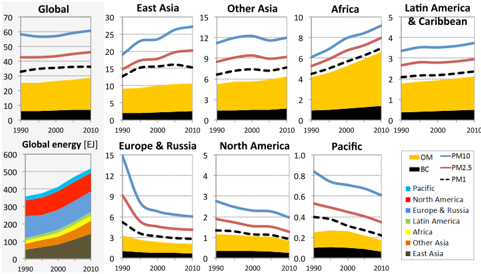
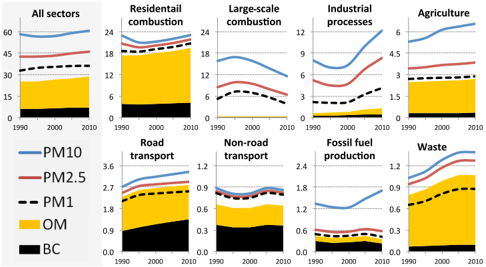
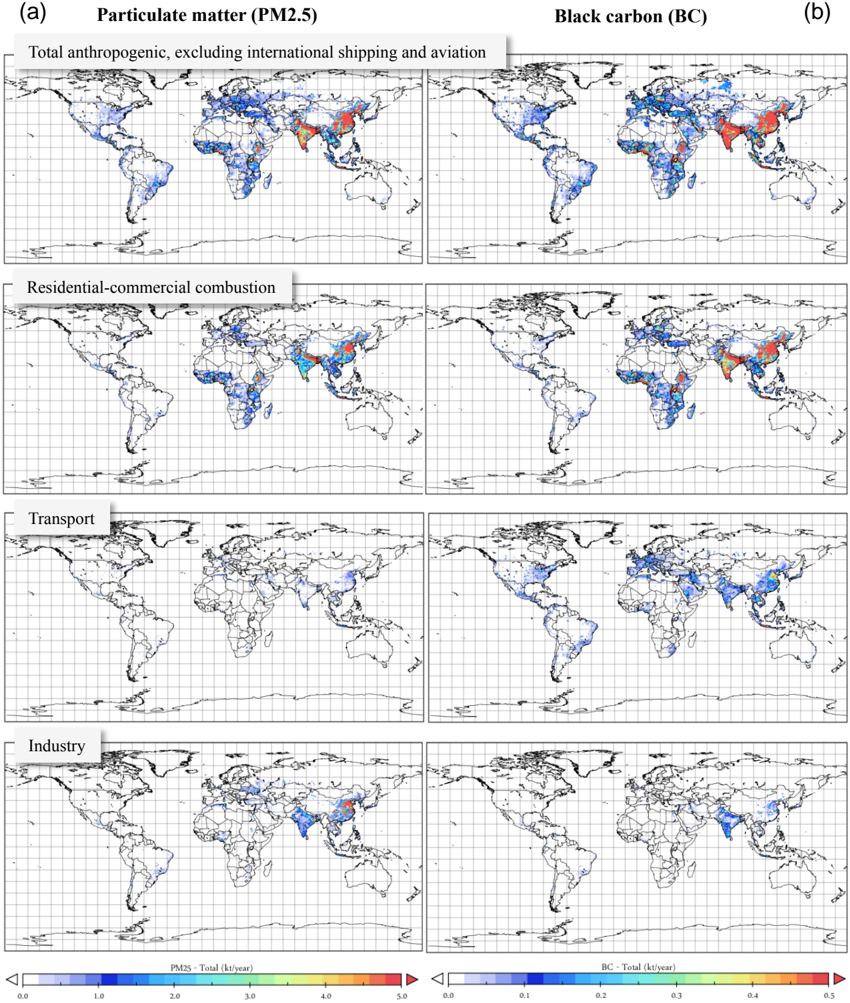
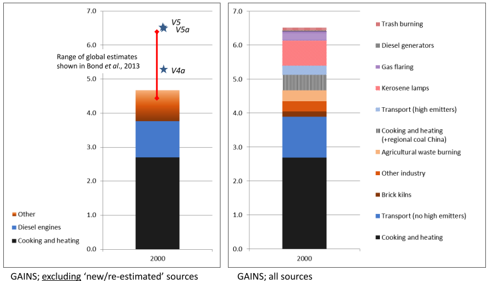
This paper presents a comprehensive assessment of historical (1990–2010) global anthropogenic particulate matter (PM) emissions including the consistent and harmonized calculation of mass-based size distribution (PM1, PM2. 5, PM10), as well as primary carbonaceous aerosols including black carbon (BC) and organic carbon (OC). The estimates were developed with the integrated assessment model GAINS, where source- and region-specific technology characteristics are explicitly included. This assessment includes a number of previously unaccounted or often misallocated emission sources, i.e. kerosene lamps, gas flaring, diesel generators, refuse burning; some of them were reported in the past for selected regions or in the context of a particular pollutant or sector but not included as part of a total estimate. Spatially, emissions were calculated for 172 source regions (as well as international shipping), presented for 25 global regions, and allocated to 0.5° × 0.5° longitude–latitude grids. No independent estimates of emissions from forest fires and savannah burning are provided and neither windblown dust nor unpaved roads emissions are included. We estimate that global emissions of PM have not changed significantly between 1990 and 2010, showing a strong decoupling from the global increase in energy consumption and, consequently, CO2 emissions, but there are significantly different regional trends, with a particularly strong increase in East Asia and Africa and a strong decline in Europe, North America, and the Pacific region. This in turn resulted in important changes in the spatial pattern of PM burden, e.g. European, North American, and Pacific contributions to global emissions dropped from nearly 30 % in 1990 to well below 15 % in 2010, while Asia's contribution grew from just over 50 % to nearly two-thirds of the global total in 2010. For all PM species considered, Asian sources represented over 60 % of the global anthropogenic total, and residential combustion was the most important sector, contributing about 60 % for BC and OC, 45 % for PM2. 5, and less than 40 % for PM10, where large combustion sources and industrial processes are equally important. Global anthropogenic emissions of BC were estimated at about 6.6 and 7.2 Tg in 2000 and 2010, respectively, and represent about 15 % of PM2. 5 but for some sources reach nearly 50 %, i.e. for the transport sector. Our global BC numbers are higher than previously published owing primarily to the inclusion of new sources. This PM estimate fills the gap in emission data and emission source characterization required in air quality and climate modelling studies and health impact assessments at a regional and global level, as it includes both carbonaceous and non-carbonaceous constituents of primary particulate matter emissions. The developed emission dataset has been used in several regional and global atmospheric transport and climate model simulations within the ECLIPSE (Evaluating the Climate and Air Quality Impacts of Short-Lived Pollutants) project and beyond, serves better parameterization of the global integrated assessment models with respect to representation of black carbon and organic carbon emissions, and built a basis for recently published global particulate number estimates.
Overview
The claims and statistics of this paper haven’t been checked yet.
Free: it reads the open-access text and checks the first 5 claims that cite a source we can check. Create a free account to check every claim.
Integrity signals
Registry
Cites
Statistics
Figures
Verification
Claims the paper makes
The claims and statistics of this paper haven’t been checked yet.
Free: it reads the open-access text and checks the first 5 claims that cite a source we can check. Create a free account to check every claim.
Claims other papers make about this one
Each is checked against this paper’s own text: does it say what the citing paper says it does?
The source backs part of the claim, not all of it — or backs it for a different population, condition or comparison.
In the citing paper
“specifically, it contributes 11% to total global particulate matter <2.5 µm (PM2.5) emissions and 6–7% to total global black carbon (BC) emissions31,32.”
From Potential for future reductions of global GHG and air pollutants from circular waste management systems (2022) · cites this paper as [32]
Experimental — accuracy not yet measuredThe source backs part of the claim, not all of it — or backs it for a different population, condition or comparison.
In the citing paper
“However, comparing CH4 emissions from MSW in the Eclipse_V5a32 to this study, we can see that the estimate in the latter is 6% higher.”
From Potential for future reductions of global GHG and air pollutants from circular waste management systems (2022) · cites this paper as [32]
Experimental — accuracy not yet measuredThe cited source says what the claim attributes to it.
In the citing paper
“In contrast, our results for particulate matter are 60% higher than those from ref. 32.”
From Potential for future reductions of global GHG and air pollutants from circular waste management systems (2022) · cites this paper as [32]
The cited source says what the claim attributes to it.
In the citing paper
“and 57% higher than the estimate of ref. 32”
From Potential for future reductions of global GHG and air pollutants from circular waste management systems (2022) · cites this paper as [32]
Self-check
Percentages, sums and reported differences re-computed from the paper’s own numbers.
The self-check needs the paper’s full text.
Citations
Cites
Lim, S. S., Vos, T., Flaxman, A. D., Danaei, G., Shibuya, K., Adair-Rohani, H., AlMazroa, M. A., Amann, M., Anderson, H. R., Andrews, K. G., et al. (2012) · The Lancet · doi:10.1016/s0140-6736(12)61766-8 · Cited by 11,805 · cited 1×
“There is well-documented evidence that exposure to PM results in adverse effects on human health (e.g., Anenberg et al., 2012; Lim et al., 2012; WHO, 2004).”
BackgroundAtmospheric Chemistry and Physics: From Air Pollution to Climate Change
Seinfeld, J. H., Pandis, S. N., & Noone, K. (1998) · Physics Today · doi:10.1063/1.882420 · Cited by 8,731
The representative concentration pathways: an overview
van Vuuren, D. P., Edmonds, J., Kainuma, M., Riahi, K., Thomson, A., Hibbard, K., Hurtt, G. C., Kram, T., Krey, V., Lamarque, J.-F., et al. (2011) · Climatic Change · doi:10.1007/s10584-011-0148-z · Cited by 7,741 · cited 1×
“The data originates from a study by Lee et al. (2009) and were used in the development of the RCPs (Van Vuuren et al., 2011).”
MethodRiahi, K., van Vuuren, D. P., Kriegler, E., Edmonds, J., O’Neill, B. C., Fujimori, S., Bauer, N., Calvin, K., Dellink, R., Fricko, O., et al. (2017) · Global Environmental Change · doi:10.1016/j.gloenvcha.2016.05.009 · Cited by 6,607
Self-citationBounding the role of black carbon in the climate system: A scientific assessment
Bond, T. C., Doherty, S. J., Fahey, D. W., Forster, P. M., Berntsen, T., DeAngelo, B. J., Flanner, M. G., Ghan, S., Kärcher, B., Koch, D., et al. (2013) · Journal of Geophysical Research: Atmospheres · doi:10.1002/jgrd.50171 · Cited by 6,385
Self-citationEmission of trace gases and aerosols from biomass burning
Andreae, M. O., & Merlet, P. (2001) · Global Biogeochemical Cycles · doi:10.1029/2000gb001382 · Cited by 3,902
(2010) · doi:10.5194/acp-10-11707-2010 · Cited by 2,859
A new scenario framework for climate change research: the concept of shared socioeconomic pathways
O’Neill, B. C., Kriegler, E., Riahi, K., Ebi, K. L., Hallegatte, S., Carter, T. R., Mathur, R., & van Vuuren, D. P. (2014) · Climatic Change · doi:10.1007/s10584-013-0905-2 · Cited by 2,716 · cited 1×
“Furthermore, elements of the ECLIPSE data have been part of the contribution towards improved representation of carbonaceous aerosols in the large-scale integrated assessment models used in the development of the shared socio-economic pathways (SSPs) (O’Neill et al., 2014; Rao et al., 2017; Riahi et al., 2017).”
MethodA technology‐based global inventory of black and organic carbon emissions from combustion
Bond, T. C., Streets, D. G., Yarber, K. F., Nelson, S. M., Woo, J., & Klimont, Z. (2004) · Journal of Geophysical Research: Atmospheres · doi:10.1029/2003jd003697 · Cited by 2,393
Self-citationLamarque, J.-F., Bond, T. C., Eyring, V., Granier, C., Heil, A., Klimont, Z., Lee, D., Liousse, C., Mieville, A., Owen, B., et al. (2010) · Atmospheric Chemistry and Physics · doi:10.5194/acp-10-7017-2010 · Cited by 2,105 · cited 2×
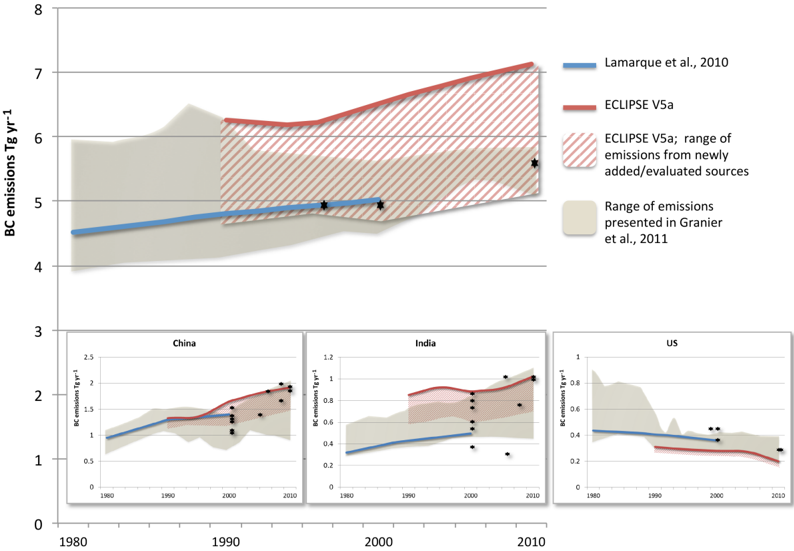
“GAINS is comparable with the RCP input (Lamarque et al., 2010) for 19901995, while for the last decade is consistently higher or at the top of the range, which in Granier et al. (2011) is”
Self-citation
Research works printed but not linked: 9
- 61. Desai, S., Dubey, A., Joshi, B. L., Sen, M., Shariff, A., and Vanne- man, R.: Human Development in India: Challenges for a Society in Transition, Oxford University Press, New Delhi, India, 2010.
- 82. GEA: Global Energy Assessment: Toward a Sustainable Future, Cambridge University Press, UK, 2012.
- 147. Lawson, D. R.: (On-Road) Mobile Source Emissions and Mitigation Potential, Workshop on Addressing Black Carbon and Ozone as Short-Lived Climate Forcers, Chapel Hill, North Carolina, US, 3-4 March 2010.
- 168. Maíz, P.: Experiencias en Medición de Emisiones en Hornos para Manufactura Artesanal de Ladrillos en Mexico, available at: http://www.inecc.gob.mx/descargas/dgcenica/2012_ladrilleras_ pon_s4_pmaiz_eng.pdf (last access: 4 July 2017), a presentation at: Workshop on public policies to mitigate environmental impact of artisanal brick production, Guanajuato, Mexico, 4-6 September 2012.
- 182. NEA: A Year in Review: Fiscal Year 2011/2012, Nepal Electricity Authority (NEA), Kathmandu, 2012.
- 219. Riahi, K., Dentener, F., Gielen, D., Grubler, A., Jewell, J., Klimont, Z., Krey, V., McCollum, D., Pachauri, S., Rao, S., van Ruijven, B., van Vuuren, D. P., and Wilson, C.: Chapter 17 -Energy Pathways for Sustainable Development, in Global Energy As- sessment -Toward a Sustainable Future, 1203-1306, Cambridge University Press, Cambridge, UK and New York, NY, USA and the International Institute for Applied Systems Analysis, Lax- enburg, Austria, available at: www.globalenergyassessment.org (last access: 4 July 2017), 2012.
- 227. Schilderman, T. and Mason, K.: Using residues as fuel in small- scale brickmaking, in Proceedings of the 11th International Con- ference on Non-conventional Materials and Technologies (NOC- MAT 2009), Bath, UK, 6-9 September 2009.
- 234. Shafizadeh, K., Niemeier, D., and Eisinger, D. S.: Gross Emit- ting Vehicles: A Review of the Literature, Caltrans Air Quality Project, US Davis, 2004.
- 270. US EPA: Compilation of Air Pollutant Emission Factors -Volume I: Stationary Point and Area Sources. AP-42 5th Edition, US Environmental Protection Agency (US EPA), Springfield, VA, 1995.
Cited by
Items 301–400 of 967
Manousakas, M. I., Popovicheva, O., Evangeliou, N., Diapouli, E., Sitnikov, N., Shonija, N. K., & Eleftheriadis, K. (2020) · Tellus B · doi:10.1080/16000889.2020.1803708 · Cited by 25
“OC shows similar maxima as for EC indicating large impact from the Northern Siberian flaring regions throughout the whole year, as these sources are more or less constant (Klimont et al., 2017).”
BackgroundZhao, W., Zhao, Y., Ma, M., Chang, M., & Duan, L. (2021) · Environmental Pollution · doi:10.1016/j.envpol.2021.117974 · Cited by 25
Capturing economic and social value from hydrocarbon gas flaring: evaluation of the issues
Romsom, E., & McPhail, K. (2021) · Working Paper Series · doi:10.35188/unu-wider/2021/939-6 · Cited by 24
Yttri, K. E., Bäcklund, A., Conen, F., Eckhardt, S., Evangeliou, N., Fiebig, M., Kasper‐Giebl, A., Gold, A. R., Gundersen, H., Myhre, C. L., et al. (2024) · Atmospheric chemistry and physics · doi:10.5194/acp-24-2731-2024 · Cited by 25
“The ECLIPSEv6b dataset provides emission data at 5-year intervals.”
MethodInfluentialLiu, J., Andersson, A., Zhong, G., Geng, X., Ding, P., Zhu, S., Cheng, Z., Zakaria, M. P., Bong, C. W., Li, J., et al. (2020) · The Science of The Total Environment · doi:10.1016/j.scitotenv.2020.140359 · Cited by 24
Wu, J., Kong, S., Yan, Y., Yao, L., Yan, Q., Liu, D., Shen, G., Zhang, X., & Qi, S. (2022) · Atmospheric Environment · doi:10.1016/j.atmosenv.2022.119082 · Cited by 26
A Numerical Study of Reducing O3 and Pm2.5 Simultaneously in Taiwan
Chuang, M., Chou, C. C. ‐., Lin, C., Lee, J.-H., Lin, W.-C., Chen, Y., Chang, C.-C., Lee, C., Kong, S. S.-K., & Lin, T.-H. (2022) · Journal of Environmental Management · doi:10.1016/j.jenvman.2022.115614 · Cited by 25
Harni, S., Saarikoski, S., Kuula, J., Helin, A., Aurela, M., Niemi, J. V., Kousa, A., Rönkkö, T., & Timonen, H. (2022) · Atmospheric Environment · doi:10.1016/j.atmosenv.2022.119419 · Cited by 24
Fang, W., Andersson, A., Lee, M., Zheng, M., Du, K., Kim, S., Holmstrand, H., & Gustafsson, Ö. (2023) · npj Climate and Atmospheric Science · doi:10.1038/s41612-023-00438-8 · Cited by 24
Dynamic Changes of Composition of Particulate Matter Emissions during Residential Biomass Combustion
Chen, P., Li, Y., Zhang, Y., Xue, C., Hopke, P. K., & Li, X. (2023) · Environmental Science & Technology · doi:10.1021/acs.est.3c05412 · Cited by 25
Verma, A., Ranga, V., & Vishwakarma, D. K. (2024) · Environmental Monitoring and Assessment · doi:10.1007/s10661-024-12455-y · Cited by 26
“It predominantly stems from combustion processes, particularly emissions from vehicles, as well as the combustion of fossil fuels in power plants and industrial facilities (Klimont et al., 2017).”
Kiran, V. R., Ratnam, M. V., Murthy, B. V. K., Kant, Y., Prasad, P., Raman, M. R., Rao, S. V. B., Kumar, T. V. L., & Maitra, A. (2019) · Environmental Pollution · doi:10.1016/j.envpol.2019.07.100 · Cited by 24
Ramachandran, S., Rajesh, T. A., & Cherian, R. (2021) · Atmospheric Research · doi:10.1016/j.atmosres.2021.105573 · Cited by 24
Exposure Risk of Global Surface O3 During the Boreal Spring Season
Zhou, Y., Duan, W., Chen, Y., Yi, J., Wang, B., Di, Y., & He, C. (2022) · Exposure and Health · doi:10.1007/s12403-022-00463-7 · Cited by 24
The contribution of emission sources to the future air pollution disease burden in China
Conibear, L., Reddington, C. L. S., Silver, B. J., Arnold, S. R., Turnock, S. T., Klimont, Z., & Spracklen, D. V. (2022) · Environmental Research Letters · doi:10.1088/1748-9326/ac6f6f · Cited by 24
“The future emission scenarios covered 2020–2050 and used the Evaluating the Climate and Air Quality Impacts of Short-Lived Pollutants (ECLIPSE) emissions version 6b (Stohl et al 2015, Klimont et al 2017, 2022).”
MethodSelf-citationComparing the Radiative Forcings of the Anthropogenic Aerosol Emissions From Chile and Mexico
Miinalainen, T., Kokkola, H., Lehtinen, K. E. J., & Kühn, T. (2021) · Journal of Geophysical Research Atmospheres · doi:10.1029/2020jd033364 · Cited by 24
Drivers of air pollution variability during second wave of COVID-19 in Delhi, India
Saharan, U. S., Kumar, R., Tripathy, P., Sateesh, M., Garg, J., Sharma, S. K., & Mandal, T. K. (2021) · Urban Climate · doi:10.1016/j.uclim.2021.101059 · Cited by 24
Guo, Y., Du, E., Li, B., Xia, N., Wu, X., & VRIES, W. D. (2023) · Journal of Cleaner Production · doi:10.1016/j.jclepro.2023.137872 · Cited by 25
Increased contribution of biomass burning to haze events in Shanghai since China’s clean air actions
Fang, W., Evangeliou, N., Eckhardt, S., Xing, J., Zhang, H., Xiao, H., Zhao, M., & Kim, S. (2023) · Communications Earth & Environment · doi:10.1038/s43247-023-00979-z · Cited by 23
Uncertainties in source allocation of carbonaceous aerosols in a Mediterranean region
Navarro-Barboza, H., Pandolfi, M., Guevara, M., Enciso, S., Tena, C., Via, M., Yus-Díez, J., Reche, C., Pérez, N., Alástuey, A., et al. (2023) · Environment International · doi:10.1016/j.envint.2023.108252 · Cited by 25
Black carbon emissions inventory and scenario analysis for Pakistan
Mir, K. A., Purohit, P., Ijaz, M. H., Babar, Z. B., & Mehmood, S. (2023) · Environmental Pollution · doi:10.1016/j.envpol.2023.122745 · Cited by 23
Self-citationLongitudinal Study of Air Pollutants in Indian Metropolises: Seasonal Patterns and Urban Variability
Sharma, M., Singh, K., Gautam, A. S., & Gautam, S. (2024) · Aerosol Science and Engineering · doi:10.1007/s41810-024-00262-4 · Cited by 23
Ezani, E., Dhandapani, S., Heal, M. R., Praveena, S. M., Khan, M. F., & Ramly, Z. T. A. (2021) · Atmosphere · doi:10.3390/atmos12060784 · Cited by 25
“It has been assessed that, globally, 24% and 60% of anthropogenic BC emissions are from transportation and residential combustion fuels, respectively in sub-urban areas [12].”
BackgroundStudy of mixing ratios of SO2 in a tropical rural environment in south India
Renuka, K., Gadhavi, H., Jayaraman, A., Rao, S. V. B., & Lal, S. (2020) · Journal of Earth System Science · doi:10.1007/s12040-020-1366-4 · Cited by 22
Kumar, P., Beig, G., Sahu, S. K., Yadav, R., Maji, S., Singh, V., & Bamniya, B. R. (2023) · Atmospheric Environment · doi:10.1016/j.atmosenv.2023.119750 · Cited by 22
Kangas, L., Kukkonen, J., Kauhaniemi, M., Riikonen, K., Sofiev, M. A., Kousa, A., Niemi, J. V., & Karppinen, A. (2024) · Atmospheric chemistry and physics · doi:10.5194/acp-24-1489-2024 · Cited by 22
“However, the total amount of RWC emissions has nevertheless been significant in part of the Nordic cities, due to either many RWC-heated detached houses or the heating of larger blocks of flats by RWC (Kukkonen et al., 2020).”
InfluentialMangaraj, P., Sahu, S. K., & Beig, G. (2024) · Urban Climate · doi:10.1016/j.uclim.2024.101928 · Cited by 23
Projection of near-future anthropogenic PM2.5 over India using statistical approach
Upadhyay, A., Dey, S., Goyal, P., & Dash, S. (2018) · Atmospheric Environment · doi:10.1016/j.atmosenv.2018.05.025 · Cited by 22
“This is consistent with other studies showing a large increase in AOD over India in the last decade that can be attributed to rising anthropogenic sources (Dey and Di Girolamo, 2011; Krishna Moorthy et al., 2013) as opposed to a global decreasing trend (Mishchenko et al., 2007).”
ResultEvangeliou, N., Thompson, R. L., Eckhardt, S., & Stohl, A. (2018) · Atmospheric chemistry and physics · doi:10.5194/acp-18-15307-2018 · Cited by 24
“In the present study, the emission inventories ECLIPSE (Evaluating the CLimate and Air Quality ImPacts of ShortlivEd Pollutants) version 5 (Klimont et al., 2017) (available here: http://www.iiasa.ac.at/web/home/ research/researchPrograms/air/Global_emissions.html, last access: 15 November 2016),…”
MethodWu, B., Xuan, K., Shen, X., Zhao, Q., Shi, Y., Kong, L., Hu, J., Li, X., Zhang, H., Cao, X., et al. (2021) · The Science of The Total Environment · doi:10.1016/j.scitotenv.2021.151300 · Cited by 22
Zamora, L. M., Kahn, R. A., Evangeliou, N., Zwaaftink, C. G., & Huebert, K. B. (2022) · Atmospheric chemistry and physics · doi:10.5194/acp-22-12269-2022 · Cited by 26
“1s; Giglio et al., 2013), following Klimont et al. (2017) but with updated emissions factors (Zbigniew Klimont, personal communication, 2019).”
BackgroundRapid hydrolysis of NO 2 at High Ionic Strengths of Deliquesced Aerosol Particles
Gen, M., Zheng, H., Sun, Y., Xu, W., Ma, N., Su, H., Cheng, Y., Wang, S., Xing, J., Zhang, S., et al. (2024) · Environmental Science & Technology · doi:10.1021/acs.est.3c08810 · Cited by 21
Atmospheric black carbon in the climate system
Gustafsson, Ö., Budhavant, K. B., Navinya, C., Clarke, S., Dreyfus, G., Gong, X., Klimont, Z., Klingmüller, K., Kim, S.-W., Lelieveld, J., et al. (2026) · Nature Reviews Earth & Environment · doi:10.1038/s43017-026-00773-3 · Cited by 22
“They also suggest that about 80% of emissions originate in Asia and Africa 12,14,15,54 , with the GFED showing strong emissions from open fires, especially in sub-Saharan Africa, Southeast Asia and Australia, and additional emissions in central Siberia, South Asia, northeast China and South America…”
InfluentialSelf-citationWu, K. M., Liu, X., Dai, H., Zhang, S., Zhou, Z., Ma, T., Guo, C., He, X., & Fang, Y. R. (2022) · Frontiers in Environmental Science · doi:10.3389/fenvs.2022.1006142 · Cited by 21
“It has been widely used to assess the co-benefits reduction strategies of carbon mitigation and air pollution control policies (Klimont et al., 2017).”
MethodDey, S., Ghosh, P., Rawat, P., Choudhary, N., Rai, A., Meena, R., Mandal, T. K., Mao, J., Jia, S., Rastogi, N., et al. (2023) · The Science of The Total Environment · doi:10.1016/j.scitotenv.2023.164872 · Cited by 21
Tradeoffs between air pollution mitigation and meteorological response in India
Upadhyay, A., Dey, S., Chowdhury, S., Kumar, R., & Goyal, P. (2020) · Scientific Reports · doi:10.1038/s41598-020-71607-5 · Cited by 22
Qin, Y., Zhou, M., Pan, D., Klimont, Z., Gingerich, D. B., Mauzerall, D. L., Zhao, L., He, G., & Bielicki, J. M. (2021) · Environmental Science & Technology · doi:10.1021/acs.est.1c03685 · Cited by 21
Self-citationKrecl, P., Oukawa, G. Y., Charres, I., Targino, A. C., Grauer, A. F., & Silva, D. C. E. (2022) · The Science of The Total Environment · doi:10.1016/j.scitotenv.2022.156332 · Cited by 24
Compliance with 2021 WHO air quality guidelines across Europe will require radical measures
Bowdalo, D., Petetin, H., Jorba, O., Guevara, M., Soret, A., Bojović, D., Terrado, M., Querol, X., & García‐Pando, C. P. (2021) · Environmental Research Letters · doi:10.1088/1748-9326/ac44c7 · Cited by 20
Nagar, P. K., & Sharma, M. (2022) · Urban Climate · doi:10.1016/j.uclim.2022.101084 · Cited by 24
Tsyro, S. G., Aas, W., Colette, A., Andersson, C., Bessagnet, B., Ciarelli, G., Couvidat, F., Cuvelier, K., Manders, A., Mar, K. A., et al. (2022) · Atmospheric chemistry and physics · doi:10.5194/acp-22-7207-2022 · Cited by 20
“Emission estimates are associated with uncertainties due to missing or incomplete information or limited understanding with respect to activity data, emission factors, source locations, etc. (Klimont et al., 2017).”
BackgroundMethodInfluentialHistorical air pollutant emissions and future sustainable pathways of global cement plants
Yan, X., Tong, D., Cao, Z., Chen, C., Guo, Y., Xu, R., Qin, X., Fu, Y., Liu, Y., Zheng, D., et al. (2024) · Resources Conservation and Recycling · doi:10.1016/j.resconrec.2024.107896 · Cited by 20
Malik, A., Aggarwal, S. G., Sinha, P. R., Kondo, Y., & Ohata, S. (2024) · Atmospheric Pollution Research · doi:10.1016/j.apr.2024.102325 · Cited by 22
Modeling the contribution of leads to sea spray aerosol in the high Arctic
Lapere, R., Marelle, L., Rampal, P., Brodeau, L., Melsheimer, C., Spreen, G., & Thomas, J. L. (2024) · Atmospheric chemistry and physics · doi:10.5194/acp-24-12107-2024 · Cited by 20
Arif, M., Kumar, R., Kumar, R., & Zusman, E. (2019) · The Science of The Total Environment · doi:10.1016/j.scitotenv.2019.134358 · Cited by 20
Paunu, V.-V., Karvosenoja, N., Segersson, D., López-Aparicio, S., Nielsen, O.-K., Plejdrup, M. S., Þorsteinsson, Þ., Vo, D. T., Kuenen, J. J. P., van der Gon, H. D., et al. (2024) · Earth system science data · doi:10.5194/essd-16-1453-2024 · Cited by 20
Guizzardi, D., Crippa, M., Butler, T. M., Keating, T. J., Wu, R., Kaminski, J. W., Kuenen, J. J. P., Kurokawa, J., Chatani, S., Morikawa, T., et al. (2025) · Earth system science data · doi:10.5194/essd-17-5915-2025 · Cited by 19
Self-citationCan better technologies avoid all air pollution damages to the global economy?
Chantret, F., Château, J., Dellink, R., Durand-Lasserve, O., & Lanzi, E. (2020) · Climatic Change · doi:10.1007/s10584-019-02631-2 · Cited by 19
A Review of Progress in Constraining Global Black Carbon Climate Effects
Everett, J. T., Newton, E. N., & Odum, M. M. (2022) · Earth Systems and Environment · doi:10.1007/s41748-022-00313-1 · Cited by 19
“Figure 2 presents the range of BC emissions from ECLIPSE V5a between 1990 and 2010, and compares results to emission estimates developed in support of AR5 conducted by Lamarque et al.”
BackgroundMethodInfluentialDimitropoulou, E., Hendrick, F., Friedrich, M. M., Tack, F., Pinardi, G., Merlaud, A., Fayt, C., Hermans, C., Fierens, F., & Roozendaël, M. V. (2022) · Atmospheric measurement techniques · doi:10.5194/amt-15-4503-2022 · Cited by 19
Climate change mitigation costs reduction caused by socioeconomic-technological transitions
Fujimori, S., Oshiro, K., Hasegawa, T., Takakura, J., & Ueda, K. (2023) · npj Climate Action · doi:10.1038/s44168-023-00041-w · Cited by 23
Thongsame, W., Henze, D. K., Kumar, R., Barth, M. C., & Pfister, G. G. (2024) · Atmospheric Environment X · doi:10.1016/j.aeaoa.2024.100282 · Cited by 30
Cholakian, A., Beekmann, M., Coll, I., Ciarelli, G., & Colette, A. (2019) · Atmospheric chemistry and physics · doi:10.5194/acp-19-13209-2019 · Cited by 21
“Anthropogenic emissions (base year 2010) are taken from the ECLIPSEv4a inventory (Amann et al., 2013; Klimont et al., 2013, 2017), and the biogenic emissions are calculated with MEGAN (Model of Emissions of Gases and Aerosols from Nature; Guenther et al., 2006).”
MethodSahu, S. K., Chen, L., Liu, S., Ding, D., & Xing, J. (2020) · Chemosphere · doi:10.1016/j.chemosphere.2020.126832 · Cited by 19
Yarlagadda, B., Smith, S. J., Mignone, B. K., Mallapragada, D. S., Randles, C. A., & Sampedro, J. (2021) · Energy and Climate Change · doi:10.1016/j.egycc.2021.100067 · Cited by 21
Lund, M. T., Myhre, G., Skeie, R. B., Samset, B. H., & Klimont, Z. (2023) · Atmospheric chemistry and physics · doi:10.5194/acp-23-6647-2023 · Cited by 21
“2018; SCPRC, 2018), emissions of sulfur dioxide (SO2) and then nitrogen oxide (NOx) in China have declined rapidly (Klimont et al., 2013, 2017; Tong et al., 2020; Zheng et al., 2018).”
BackgroundSelf-citationEmission factors for SLCP emissions from residential wood combustion in the Nordic countries
Kindbom, K., Mawdsley, I., Nielsen, O.-K., Saarinen, K., Jónsson, K., & Aasestad, K. (2017) · TemaNord · doi:10.6027/tn2017-570 · Cited by 18
“In Table 28 emission measurement results from this project are briefly compared to published data in Klimont et al. (2016), Savolahti et al. (2016) and in Andersen & Hvidberg (2017).”
BackgroundMethodResultInfluentialModelling the coupled mercury-halogen-ozone cycle in the central Arctic during spring
Ahmed, S., Thomas, J. L., Angot, H., Dommergue, A., Archer, S. D., Bariteau, L., Beck, I., Benavent, N., Blechschmidt, A., Blomquist, B. W., et al. (2023) · Elementa Science of the Anthropocene · doi:10.1525/elementa.2022.00129 · Cited by 22
Katiyar, A., Nayak, D. K., Nagar, P. K., Singh, D. P., Sharma, M., & Kota, S. H. (2023) · The Science of The Total Environment · doi:10.1016/j.scitotenv.2023.169232 · Cited by 18
Song, S.-K., Shon, Z., Choi, Y., Son, Y.-B., Kang, M., Han, S.-B., & Bae, M. (2019) · Chemosphere · doi:10.1016/j.chemosphere.2019.02.152 · Cited by 18
Gregorič, A., Drinovec, L., Ježek, I., Vaupotič, J., Lenarčič, M., Grauf, D., Wang, L., Mole, M., Stanič, S., & Močnik, G. (2020) · Atmospheric chemistry and physics · doi:10.5194/acp-20-14139-2020 · Cited by 18
Survey-based inventory for atmospheric emissions from residential combustion in Vietnam
Huy, L. N., Oanh, N. T. K., Phuc, N. H., & Nhung, C. P. (2020) · Environmental Science and Pollution Research · doi:10.1007/s11356-020-11067-6 · Cited by 18
“2013; Kurokawa and Ohara 2019) but also globally (Bond et al. 2004; Klimont et al. 2017; Crippa et al. 2020).”
BackgroundRoy, S., Lam, Y. F., Hung, N. T., & Chan, J. C. L. (2021) · Sustainable Development · doi:10.1002/sd.2203 · Cited by 18
Aman, N., Manomaiphiboon, K., Suwattiga, P., Assareh, N., Limpaseni, W., Suwanathada, P., Soonsin, V., & Wang, Y. (2022) · Environmental Monitoring and Assessment · doi:10.1007/s10661-022-09880-2 · Cited by 18
Aman, N., Manomaiphiboon, K., Pala-En, N., Kokkaew, E., Boonyoo, T., Pattaramunikul, S., Devkota, B., & Chotamonsak, C. (2020) · International Journal of Environmental Research and Public Health · doi:10.3390/ijerph17249499 · Cited by 18
“(2017) [58], it was found that the PM2.”
BackgroundAdhikary, M., Saikia, N., Purohit, P., Canudas‐Romo, V., & Schöpp, W. (2024) · GeoHealth · doi:10.1029/2023gh000968 · Cited by 17
“The GAINS model assesses strategies that reduce emissions of multiple air pollutants and greenhouse gases at the least cost and minimize their harmful effects on human health, ecosystems and climate change (Amann et al., 2011, 2020; Klimont et al., 2017).”
Self-citationLi, Q., Yang, Z., Li, X., Ding, S., & Du, F. (2019) · Aerosol and Air Quality Research · doi:10.4209/aaqr.2019.07.0368 · Cited by 17
“, 2017a) that plays a critical role in their environmental and human health effects (Kulmala et al., 2004; West et al., 2016; Tian et al., 2018; Klimont et al., 2017).”
Hidden black carbon air pollution in hilly rural areas—a case study of Dinaric depression
Glojek, K., Gregorič, A., Aerosol d.o.o., L., Močnik, G., Cuesta-Mosquera, A. P., Wiedensohler, A., Drinovec, L., & Ogrin, M. (2020) · European Journal of Geography · doi:10.48088/ejg.k.glo.11.2.105.122 · Cited by 17
“However, due to technological advancements and legislation, eBC emissions from traffic are declining, whereas emissions from biomass burning are still largely unregulated in most European countries (Briggs and Long, 2016; Klimont et al., 2017).”
BackgroundTemporal Variability of Equivalent Black Carbon Components in Atmospheric Air in Southern Poland
Zioła, N., Błaszczak, B., & Klejnowski, K. (2021) · Atmosphere · doi:10.3390/atmos12010119 · Cited by 17
“On the other hand, the role of residential combustion, which is not currently regulated in most European countries, is increasing [33,37].”
BackgroundEffect of restricted emissions during Covid-19 lockdown on air quality in Rabat - Morocco
(2020) · Global NEST Journal · doi:10.30955/gnj.003431 · Cited by 17
“5 could be due to its greater contribution from anthropogenic sources (Klimont et al., 2017).”
BackgroundThomas, D. C., Christensen, J. H., Maßling, A., Pernov, J., & Skov, H. (2021) · Atmospheric Environment · doi:10.1016/j.atmosenv.2021.118853 · Cited by 17
Korhonen, K., Kristensen, T. B., Falk, J., Malmborg, V., Eriksson, A. C., Gren, L., Novakovic, M., Shamun, S., Karjalainen, P., Markkula, L., et al. (2022) · Atmospheric chemistry and physics · doi:10.5194/acp-22-1615-2022 · Cited by 17
Aerosol models from the AERONET database: application to surface reflectance validation
Roger, J., Vermote, E. F., Skakun, S. V., Murphy, E., Dubovik, О., Kalecinski, N. I., Korgo, B., Justice, C., & HOLBEN, B. N. (2022) · Atmospheric measurement techniques · doi:10.5194/amt-15-1123-2022 · Cited by 18
Shift in Peaks of PAH‐Associated Health Risks From East Asia to South Asia and Africa in the Future
Lou, S., Shrivastava, M., Ding, A., Easter, R. C., Fast, J. D., Rasch, P. J., Shen, H., Simonich, S. L. M., Smith, S. J., Tao, S., et al. (2023) · Earth s Future · doi:10.1029/2022ef003185 · Cited by 19
Klimkaitė, L., Liveikis, T., Kaspute, G., Armalytė, J., & Aldonytė, R. (2023) · Future Microbiology · doi:10.2217/fmb-2022-0258 · Cited by 16
Loughlin, D. H., Barron, A. R., Chettri, C. B., O'Meara, A., Sarmiento, L., Dong, D., McCollum, D. L., Showalter, S., Beach, R., Bistline, J. E. T., et al. (2024) · Energy and Climate Change · doi:10.1016/j.egycc.2024.100165 · Cited by 16
“The relationship between these components and direct PM 2.5 is complicated [23].”
InfluentialDasadhikari, K., Eastham, S. D., Allroggen, F., Speth, R. L., & Barrett, S. R. H. (2019) · Atmospheric Environment · doi:10.1016/j.atmosenv.2019.116916 · Cited by 17
Leaitch, W. R., Kodros, J. K., Willis, M. D., Hanna, S., Schulz, H., Andrews, E. J., Bozem, H., Burkart, J., Hoor, P. M., Kolonjari, F., et al. (2020) · Atmospheric chemistry and physics · doi:10.5194/acp-20-10545-2020 · Cited by 16
Wiinikka, H., Hage, F. S., Ramasse, Q. M., & Tóth, P. (2020) · Carbon · doi:10.1016/j.carbon.2020.12.004 · Cited by 16
Importance of Supersaturation in Arctic Black Carbon Simulations
Matsui, H., & Liu, M. (2021) · Journal of Climate · doi:10.1175/jcli-d-20-0994.1 · Cited by 17
Screening for New Pathways in Atmospheric Oxidation Chemistry with Automated Mechanism Generation
Barber, V. P., Green, W. H., & Kroll, J. H. (2021) · The Journal of Physical Chemistry A · doi:10.1021/acs.jpca.1c04297 · Cited by 16
Malik, A., & Aggarwal, S. G. (2021) · Asian Journal of Atmospheric Environment · doi:10.5572/ajae.2021.044 · Cited by 16
“Various emission inventories (Klimont et al. , 2017; Paliw-al et al. , 2016; Wang et al. , 2012; Bond et al. , 2007) have also found both countries to be the largest contributors to global BC aerosols.”
BackgroundQian, Y., Li, J., Chen, X., Chen, H., Yang, W., Du, H., Pan, X., Tang, X., Wang, W., Zhu, L., et al. (2021) · Geoscientific model development · doi:10.5194/gmd-14-7573-2021 · Cited by 18
Mapping the dependence of black carbon radiative forcing on emission region and season
Räisänen, P., Merikanto, J., Makkonen, R., Savolahti, M., Kirkevåg, A., Sand, M., Seland, Ø., & Partanen, A. (2022) · Atmospheric chemistry and physics · doi:10.5194/acp-22-11579-2022 · Cited by 18
Kanaya, Y., Yamaji, K., Miyakawa, T., Taketani, F., Zhu, C., Choi, Y., Ikeda, K., Tanimoto, H., Yamada, D., Narita, D., et al. (2021) · Scientific Reports · doi:10.1038/s41598-021-02518-2 · Cited by 16
Self-citationThe Energy Modeling Forum (EMF)-30 study on short-lived climate forcers: introduction and overview
Smith, S. J., Klimont, Z., Drouet, L., Harmsen, M. J. H. M., Luderer, G., Riahi, K., van Vuuren, D. P., & Weyant, J. P. (2020) · Climatic Change · doi:10.1007/s10584-020-02938-5 · Cited by 17
“These sectors were chosen because they comprise the bulk of global anthropogenic black carbon emissions (3/4 of the global emissions in Klimont et al. 2017), are the target of many national and regional policies across the globe, and are represented explicitly in the models used in this analysis.”
BackgroundMethodSelf-citationImpact of Particulate Matter-Centric Clean Air Action Plans on Ozone Concentrations in India
Gupta, M., Nayak, D. K., & Kota, S. H. (2023) · ACS Earth and Space Chemistry · doi:10.1021/acsearthspacechem.2c00397 · Cited by 15
Assessing the impacts and feasibility of emissions reduction scenarios in the Po Valley
Colombo, L., Marongiu, A., Malvestiti, G., Fossati, G., Angelino, E., Lazzarini, M., Gurrieri, G. L., Pillon, S., & Lanzani, G. G. (2023) · Frontiers in Environmental Science · doi:10.3389/fenvs.2023.1240816 · Cited by 15
Chauhan, P. K., Tiwari, S., Gupta, D. K., Kumar, A., Pratap, V., & Singh, A. K. (2024) · Atmospheric Pollution Research · doi:10.1016/j.apr.2024.102061 · Cited by 15
Mitigation of non-CO 2 greenhouse gases from Indian agriculture sector
Patange, O., Purohit, P., Avashia, V., Klimont, Z., & GARG, A. K. (2024) · Environmental Research Letters · doi:10.1088/1748-9326/ad4e4e · Cited by 16
“Recent studies from Europe (Klimont and Winiwarter 2015, Klimont et al 2017) and China (Bai et al 2019) indicate that agricultural NH 3 emissions have emerged as a major contributor to the formation of fine particulate matter (PM 2.5 ) resulting in air pollution and health hazards for the local…”
BackgroundInfluentialSelf-citationThe nexus of transportation, the built environment, air pollution and health
Khreis, H., Williams, H., Abdollahpour, S. S., van den Bosch, M. A., Mudu, P., Tainio, M., Poom, A., Sohrabi, S., & Hankey, S. (2024) · Cities & Health · doi:10.1080/23748834.2024.2376389 · Cited by 15
van Caspel, W. E., Klimont, Z., Heyes, C., & Fagerli, H. (2024) · Atmospheric chemistry and physics · doi:10.5194/acp-24-11545-2024 · Cited by 16
Self-citationLiu, Y., Liu, G., Yousaf, B., Zhang, J., & Li, Z. (2020) · Ecotoxicology and Environmental Safety · doi:10.1016/j.ecoenv.2020.110888 · Cited by 15
Choi, W. J., Jung, B., Lee, D., Kang, H., Kim, H., & Hong, H. (2021) · Applied Sciences · doi:10.3390/app112110003 · Cited by 16
“5 is not only emitted naturally as solids and particle mixtures in a droplet state but also originates from fixed emission sources such as factories and mobile emission sources such as vehicles [9,20].”
BackgroundDust dominates the summer melting of glacier ablation zones on the northeastern Tibetan Plateau
Li, Y., Kang, S., Zhang, X., Li, C., Chen, J., Qin, X., Shao, L., & Tian, L. (2022) · The Science of The Total Environment · doi:10.1016/j.scitotenv.2022.159214 · Cited by 15
The Influence of Emissions from Maritime Transport on Air Quality in the Strait of Gibraltar (Spain)
Durán-Grados, V., Rodríguez-Moreno, R., Calderay-Cayetano, F., Amado-Sánchez, Y., Pájaro-Velázquez, E., Nunes, R. A. O., Alvim-Ferraz, M. C. M., Sousa, S. I. V., & Moreno-Gutiérrez, J. (2022) · Sustainability · doi:10.3390/su141912507 · Cited by 15
“Approximately 13%, 12%, and about 3–4% of total global emissions of NOx, SOx [11], and PM [12], respectively, are emitted by ships.”
BackgroundMiinalainen, T., Kokkola, H., Lipponen, A., Hyvärinen, A., Soni, V. K., Lehtinen, K. E. J., & Kühn, T. (2023) · Atmospheric chemistry and physics · doi:10.5194/acp-23-3471-2023 · Cited by 19
Fink, L., Karl, M., Matthias, V., Oppo, S., Kranenburg, R., Kuenen, J. J. P., Jütterström, S., Moldanová, J., Majamäki, E., & Jalkanen, J.-P. (2023) · Atmospheric chemistry and physics · doi:10.5194/acp-23-10163-2023 · Cited by 17
“Furthermore, according to Klimont et al. (2017), the proportion of international shipping’s particulate matter primary emissions to global anthropogenic emissions is between 3 % and 4 %, which is comparable to road traffic.”
BackgroundGlobal progress toward soot-free diesel vehicles in 2019
Miller, J., & Jin, L. (2019) · doi:10.13140/rg.2.2.13146.29127 · Cited by 15
Alvim, D. S., Chiquetto, J. B., D’Amelio, M. T. S., Khalid, B., Herdies, D. L., Pendharkar, J. K., Corrêa, S. M., Figueroa, S. N., Frassoni, A., Capistrano, V., et al. (2021) · Remote Sensing · doi:10.3390/rs13112231 · Cited by 15
Metadata
- Authors
- Klimont, Z., Kupiainen, K., Heyes, C., Purohit, P., Cofala, J., Rafaj, P., Borken-Kleefeld, J., & Schöpp, W.
- Affiliations
- International Institute for Applied Systems Analysis (AT)
- Corresponding author
- Klimont, Zbigniew
- Venue
- Atmospheric Chemistry and Physics
- Publisher
- Copernicus GmbH
- Published
- 2017-07-17
- Volume
- 17
- Issue
- 14
- Pages
- 8681-8723
- ISSN
- 1680-7316 (ISSN-L)
- 1680-7324
- OpenAlex
- W2537132227
- Cited by
- 878
- References
- 226
- Citations by year
- 2026: 59 · 2025: 84 · 2024: 80 · 2023: 108 · 2022: 143 · 2021: 165 · 2020: 90 · 2019: 65 · 2018: 48 · 2017: 26
- FWCI
- 36.31
- Type
- journal article
- Language
- en
- Open access
- gold
- doi.org
- Licence
- Locations
- Atmospheric chemistry and physics (publishedVersion, cc-by)
- IIASA PURE (International Institute of Applied Systems Analysis) (acceptedVersion)
- IIASA PURE (International Institute of Applied Systems Analysis) (submittedVersion)
- DOAJ (DOAJ: Directory of Open Access Journals) (submittedVersion, cc-by-sa)
- Zenodo (CERN European Organization for Nuclear Research) (submittedVersion, cc-by)
- Funders
- Seventh Framework Programme (282688)
- Topics
- Physical Sciences › Earth and Planetary Sciences › Atmospheric Science › Atmospheric chemistry and aerosols
- Physical Sciences › Environmental Science › Health, Toxicology and Mutagenesis › Air Quality and Health Impacts
- Physical Sciences › Environmental Science › Environmental Engineering › Maritime Transport Emissions and Efficiency
- Keywords
- black carbon, organic carbon, PM2.5, PM10, PM1, size distribution, residential combustion, kerosene lamps, gas flaring, diesel generator, waste burning, GAINS model, East Asia
About these checks
Registry, retraction, Cites and statistics results are computed, not judged, with one exception: a printed reference that no index lists is read once by a model before it counts as a citation error. Claims are extracted by a model and kept only when their quote appears verbatim in the text; each cited source is then checked, with a model’s help, for whether it says what the claim relies on. Those verdicts can be wrong — read the claim’s quote and the cited source before relying on one.
Statistics and arithmetic are recomputed, not judged.
Confidence bands are shown only for fields calibrated on our annotated test set. None is calibrated yet, so no band is shown.
What counts as a claim ›How we measure confidence ›How we check this ›
Are you an author, or do you see a problem with this page? Request a review
Data sources
Bibliographic data: Semantic Scholar, OpenAlex, Crossref.
Contains information from the Semantic Scholar Academic Graph Datasets, made available under the ODC Attribution License (ODC-BY 1.0).
Semantic Scholar’s data is described in: Kinney, R., et al. (2023). The Semantic Scholar Open Data Platform. arXiv:2301.10140.
