

Global anthropogenic emissions of particulate matter including black carbon
Open accessPublished version of a preprint
The DOI matches its Crossref record; 224 of the 226 references it cites were found in a registry or an index.
Abstract
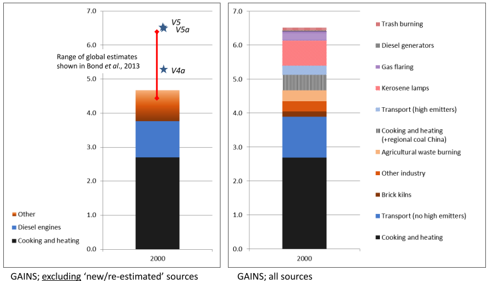
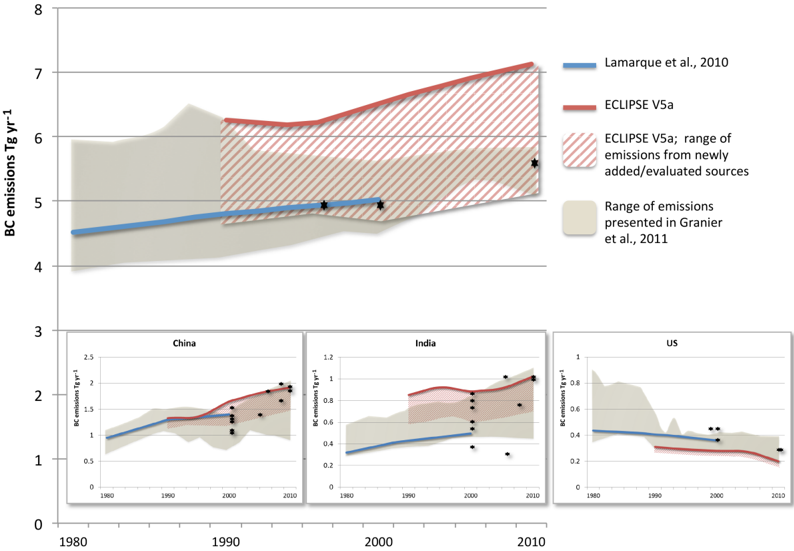
This paper presents a comprehensive assessment of historical (1990–2010) global anthropogenic particulate matter (PM) emissions including the consistent and harmonized calculation of mass-based size distribution (PM1, PM2. 5, PM10), as well as primary carbonaceous aerosols including black carbon (BC) and organic carbon (OC). The estimates were developed with the integrated assessment model GAINS, where source- and region-specific technology characteristics are explicitly included. This assessment includes a number of previously unaccounted or often misallocated emission sources, i.e. kerosene lamps, gas flaring, diesel generators, refuse burning; some of them were reported in the past for selected regions or in the context of a particular pollutant or sector but not included as part of a total estimate. Spatially, emissions were calculated for 172 source regions (as well as international shipping), presented for 25 global regions, and allocated to 0.5° × 0.5° longitude–latitude grids. No independent estimates of emissions from forest fires and savannah burning are provided and neither windblown dust nor unpaved roads emissions are included. We estimate that global emissions of PM have not changed significantly between 1990 and 2010, showing a strong decoupling from the global increase in energy consumption and, consequently, CO2 emissions, but there are significantly different regional trends, with a particularly strong increase in East Asia and Africa and a strong decline in Europe, North America, and the Pacific region. This in turn resulted in important changes in the spatial pattern of PM burden, e.g. European, North American, and Pacific contributions to global emissions dropped from nearly 30 % in 1990 to well below 15 % in 2010, while Asia's contribution grew from just over 50 % to nearly two-thirds of the global total in 2010. For all PM species considered, Asian sources represented over 60 % of the global anthropogenic total, and residential combustion was the most important sector, contributing about 60 % for BC and OC, 45 % for PM2. 5, and less than 40 % for PM10, where large combustion sources and industrial processes are equally important. Global anthropogenic emissions of BC were estimated at about 6.6 and 7.2 Tg in 2000 and 2010, respectively, and represent about 15 % of PM2. 5 but for some sources reach nearly 50 %, i.e. for the transport sector. Our global BC numbers are higher than previously published owing primarily to the inclusion of new sources. This PM estimate fills the gap in emission data and emission source characterization required in air quality and climate modelling studies and health impact assessments at a regional and global level, as it includes both carbonaceous and non-carbonaceous constituents of primary particulate matter emissions. The developed emission dataset has been used in several regional and global atmospheric transport and climate model simulations within the ECLIPSE (Evaluating the Climate and Air Quality Impacts of Short-Lived Pollutants) project and beyond, serves better parameterization of the global integrated assessment models with respect to representation of black carbon and organic carbon emissions, and built a basis for recently published global particulate number estimates.
Overview
The claims and statistics of this paper haven’t been checked yet.
Free: it reads the open-access text and checks the first 5 claims that cite a source we can check. Create a free account to check every claim.
Integrity signals
Registry
Cites
Statistics
Figures
Verification
Claims the paper makes
The claims and statistics of this paper haven’t been checked yet.
Free: it reads the open-access text and checks the first 5 claims that cite a source we can check. Create a free account to check every claim.
Claims other papers make about this one
Each is checked against this paper’s own text: does it say what the citing paper says it does?
The source backs part of the claim, not all of it — or backs it for a different population, condition or comparison.
In the citing paper
“specifically, it contributes 11% to total global particulate matter <2.5 µm (PM2.5) emissions and 6–7% to total global black carbon (BC) emissions31,32.”
From Potential for future reductions of global GHG and air pollutants from circular waste management systems (2022) · cites this paper as [32]
Experimental — accuracy not yet measuredThe source backs part of the claim, not all of it — or backs it for a different population, condition or comparison.
In the citing paper
“However, comparing CH4 emissions from MSW in the Eclipse_V5a32 to this study, we can see that the estimate in the latter is 6% higher.”
From Potential for future reductions of global GHG and air pollutants from circular waste management systems (2022) · cites this paper as [32]
Experimental — accuracy not yet measuredThe cited source says what the claim attributes to it.
In the citing paper
“In contrast, our results for particulate matter are 60% higher than those from ref. 32.”
From Potential for future reductions of global GHG and air pollutants from circular waste management systems (2022) · cites this paper as [32]
The cited source says what the claim attributes to it.
In the citing paper
“and 57% higher than the estimate of ref. 32”
From Potential for future reductions of global GHG and air pollutants from circular waste management systems (2022) · cites this paper as [32]
Self-check
Percentages, sums and reported differences re-computed from the paper’s own numbers.
The self-check needs the paper’s full text.
Citations
Cites
Lim, S. S., Vos, T., Flaxman, A. D., Danaei, G., Shibuya, K., Adair-Rohani, H., AlMazroa, M. A., Amann, M., Anderson, H. R., Andrews, K. G., et al. (2012) · The Lancet · doi:10.1016/s0140-6736(12)61766-8 · Cited by 11,805 · cited 1×
“There is well-documented evidence that exposure to PM results in adverse effects on human health (e.g., Anenberg et al., 2012; Lim et al., 2012; WHO, 2004).”
BackgroundAtmospheric Chemistry and Physics: From Air Pollution to Climate Change
Seinfeld, J. H., Pandis, S. N., & Noone, K. (1998) · Physics Today · doi:10.1063/1.882420 · Cited by 8,731
The representative concentration pathways: an overview
van Vuuren, D. P., Edmonds, J., Kainuma, M., Riahi, K., Thomson, A., Hibbard, K., Hurtt, G. C., Kram, T., Krey, V., Lamarque, J.-F., et al. (2011) · Climatic Change · doi:10.1007/s10584-011-0148-z · Cited by 7,741 · cited 1×
“The data originates from a study by Lee et al. (2009) and were used in the development of the RCPs (Van Vuuren et al., 2011).”
MethodRiahi, K., van Vuuren, D. P., Kriegler, E., Edmonds, J., O’Neill, B. C., Fujimori, S., Bauer, N., Calvin, K., Dellink, R., Fricko, O., et al. (2017) · Global Environmental Change · doi:10.1016/j.gloenvcha.2016.05.009 · Cited by 6,607
Self-citationBounding the role of black carbon in the climate system: A scientific assessment
Bond, T. C., Doherty, S. J., Fahey, D. W., Forster, P. M., Berntsen, T., DeAngelo, B. J., Flanner, M. G., Ghan, S., Kärcher, B., Koch, D., et al. (2013) · Journal of Geophysical Research: Atmospheres · doi:10.1002/jgrd.50171 · Cited by 6,385
Self-citationEmission of trace gases and aerosols from biomass burning
Andreae, M. O., & Merlet, P. (2001) · Global Biogeochemical Cycles · doi:10.1029/2000gb001382 · Cited by 3,902
(2010) · doi:10.5194/acp-10-11707-2010 · Cited by 2,859
A new scenario framework for climate change research: the concept of shared socioeconomic pathways
O’Neill, B. C., Kriegler, E., Riahi, K., Ebi, K. L., Hallegatte, S., Carter, T. R., Mathur, R., & van Vuuren, D. P. (2014) · Climatic Change · doi:10.1007/s10584-013-0905-2 · Cited by 2,716 · cited 1×
“Furthermore, elements of the ECLIPSE data have been part of the contribution towards improved representation of carbonaceous aerosols in the large-scale integrated assessment models used in the development of the shared socio-economic pathways (SSPs) (O’Neill et al., 2014; Rao et al., 2017; Riahi et al., 2017).”
MethodA technology‐based global inventory of black and organic carbon emissions from combustion
Bond, T. C., Streets, D. G., Yarber, K. F., Nelson, S. M., Woo, J., & Klimont, Z. (2004) · Journal of Geophysical Research: Atmospheres · doi:10.1029/2003jd003697 · Cited by 2,393
Self-citationLamarque, J.-F., Bond, T. C., Eyring, V., Granier, C., Heil, A., Klimont, Z., Lee, D., Liousse, C., Mieville, A., Owen, B., et al. (2010) · Atmospheric Chemistry and Physics · doi:10.5194/acp-10-7017-2010 · Cited by 2,105 · cited 2×
“GAINS is comparable with the RCP input (Lamarque et al., 2010) for 19901995, while for the last decade is consistently higher or at the top of the range, which in Granier et al. (2011) is”
Self-citation
Research works printed but not linked: 9
- 61. Desai, S., Dubey, A., Joshi, B. L., Sen, M., Shariff, A., and Vanne- man, R.: Human Development in India: Challenges for a Society in Transition, Oxford University Press, New Delhi, India, 2010.
- 82. GEA: Global Energy Assessment: Toward a Sustainable Future, Cambridge University Press, UK, 2012.
- 147. Lawson, D. R.: (On-Road) Mobile Source Emissions and Mitigation Potential, Workshop on Addressing Black Carbon and Ozone as Short-Lived Climate Forcers, Chapel Hill, North Carolina, US, 3-4 March 2010.
- 168. Maíz, P.: Experiencias en Medición de Emisiones en Hornos para Manufactura Artesanal de Ladrillos en Mexico, available at: http://www.inecc.gob.mx/descargas/dgcenica/2012_ladrilleras_ pon_s4_pmaiz_eng.pdf (last access: 4 July 2017), a presentation at: Workshop on public policies to mitigate environmental impact of artisanal brick production, Guanajuato, Mexico, 4-6 September 2012.
- 182. NEA: A Year in Review: Fiscal Year 2011/2012, Nepal Electricity Authority (NEA), Kathmandu, 2012.
- 219. Riahi, K., Dentener, F., Gielen, D., Grubler, A., Jewell, J., Klimont, Z., Krey, V., McCollum, D., Pachauri, S., Rao, S., van Ruijven, B., van Vuuren, D. P., and Wilson, C.: Chapter 17 -Energy Pathways for Sustainable Development, in Global Energy As- sessment -Toward a Sustainable Future, 1203-1306, Cambridge University Press, Cambridge, UK and New York, NY, USA and the International Institute for Applied Systems Analysis, Lax- enburg, Austria, available at: www.globalenergyassessment.org (last access: 4 July 2017), 2012.
- 227. Schilderman, T. and Mason, K.: Using residues as fuel in small- scale brickmaking, in Proceedings of the 11th International Con- ference on Non-conventional Materials and Technologies (NOC- MAT 2009), Bath, UK, 6-9 September 2009.
- 234. Shafizadeh, K., Niemeier, D., and Eisinger, D. S.: Gross Emit- ting Vehicles: A Review of the Literature, Caltrans Air Quality Project, US Davis, 2004.
- 270. US EPA: Compilation of Air Pollutant Emission Factors -Volume I: Stationary Point and Area Sources. AP-42 5th Edition, US Environmental Protection Agency (US EPA), Springfield, VA, 1995.
Cited by
Items 601–700 of 967
Pekel, F., Uzu, G., Weber, S., Kranenburg, R., Tokaya, J. P., Schaap, M., Dominutti, P., Favez, O., Jaffrezo, J., & Timmermans, R. M. A. (2025) · Atmospheric Environment X · doi:10.1016/j.aeaoa.2025.100339 · Cited by 3
Purohit, P. (2018) · Nature Sustainability · doi:10.1038/s41893-017-0012-x · Cited by 3
Self-citationKurokawa, J., & Ohara, T. (2019) · doi:10.5194/acp-2019-1122-supplement · Cited by 3
McDuffie, E. E., Smith, S. J., O’Rourke, P., Tibrewal, K., Venkataraman, C., Marais, E. A., Zheng, B., Crippa, M., Brauer, M. D., & Martin, R. V. (2020) · doi:10.5194/essd-2020-103-supplement · Cited by 3
Méndez-Astudillo, J., & Caetano, E. (2023) · Atmosphere · doi:10.3390/atmos14030596 · Cited by 2
Sector-, Season-, and Country-Specific NO2-Associated Health Benefits from NOx Emission Reductions
Wiecko, P., Henze, D. K., & Nawaz, M. O. (2025) · ACS ES&T Air · doi:10.1021/acsestair.5c00012 · Cited by 2
Global health benefits of policies to reduce on-road vehicle pollution through 2040
Jin, L., Benoit, J., Nawaz, M. O., Rodrigues, P. F., Wiecko, P., Miller, J. A., Alvarez, G., Henze, D. K., Osipova, L., & Anenberg, S. C. (2025) · Environmental Research Letters · doi:10.1088/1748-9326/adcd87 · Cited by 2
“Emissions from other non-road anthropogenic sectors come from ECLIPSE v6b (Klimont et al 2017).”
Large differences between UK black carbon emission factors
Brighty, A. M., Staffell, I., & ApSimon, H. M. (2025) · Carbon Balance and Management · doi:10.1186/s13021-025-00306-3 · Cited by 2
Evaluation of Meteorological Variables’ Effects on PM10 Concentrations in Riyadh, Saudi Arabia
Bazeyad, A. Y., Bjaili, A. A., Alkhadher, S. A. A., Sidek, L. M., Kurniawan, T. A., & Alharbi, H. A. (2025) · Advances in Meteorology · doi:10.1155/adme/6613775 · Cited by 2
Black carbon emissions in Jordan: national inventory, climate and health implications (2022–2050)
Al-Shurafat, A. W., Abdulla, F. A., Sharafat, A. A., & Ghawanmeh, A. (2025) · Environmental Research Communications · doi:10.1088/2515-7620/ae1660 · Cited by 2
Yoo, M., Cho, J., Sung, M., Lee, S., Kim, M., Ramu, A. G., Chung, H., Choi, J., Lee, T., Park, J., et al. (2025) · Journal of Environmental Sciences · doi:10.1016/j.jes.2025.10.034 · Cited by 2
Regional climate imprints of recent historical changes in anthropogenic Near Term Climate Forcers
Santos-Espeso, A., Ageitos, M. G., Ortega, P., García‐Pando, C. P., Donat, M. G., Samsó, M., & Tomas, S. L. (2025) · Earth System Dynamics · doi:10.5194/esd-16-2161-2025 · Cited by 2
“By representing these real life processes the models are able to capture possible feedbacks and indirect impacts of the applied forcings, which makes them suitable for the purpose of this study (Huijnen et al., 2010; Yukimoto et al., 2019; Mulcahy et al., 2020; Wu et al., 2020).”
Limiting warming by CO2 and methane mitigation in an expanded scenario space
Weber, K., Knutti, R., Brun, L., & Brunner, C. (2026) · Communications Earth & Environment · doi:10.1038/s43247-026-03832-1 · Cited by 3
“…of FaIR Because there is a history of regulating combustion-related emissions of air pollutantsand decoupling them from CO 2 emissions 11,68,69 ,weinclude the option of f x ; CO 2 s ð t Þ for the seven SLCFs in the sectoral categories Energy production, Industry, Transportation,…”
Artificial intelligence–driven air quality mapping and forecasting for extreme PM2.5 events
Rautela, K. S., Upadhyay, M., Goyal, M. K., & Taigor, S. (2026) · Physics and Chemistry of the Earth Parts A/B/C · doi:10.1016/j.pce.2026.104459 · Cited by 2
Mishra, S., Lim, S., & Cho, I. (2026) · Earth-Science Reviews · doi:10.1016/j.earscirev.2026.105578 · Cited by 2
Shlipak, K. K., Mamo, T., Hill, L. D., Abera, A., Blair, J., Asfaw, A., Diner, D. J., & Hasheminassab, S. (2026) · ACS ES&T Air · doi:10.1021/acsestair.6c00140 · Cited by 2
Heintzenberg, J., Birmili, W., Hellack, B., Merkel, M., Spindler, G., Tuch, T., Weinhold, K., & Wiedensohler, A. (2020) · Atmospheric chemistry and physics · doi:10.5194/acp-20-10967-2020 · Cited by 2
“Even higher uncertainties in PM emissions might come from super-emitting vehicles that are not considered in this database (Klimont et al., 2017).”
BackgroundBelykh, L. I., & Maksimova, M. A. (2022) · IOP Conference Series Earth and Environmental Science · doi:10.1088/1755-1315/1061/1/012003 · Cited by 2
“One of these factors is air pollution with carcinogenic substances [3,4].”
BackgroundJeong, G., Baker, B., Campbell, P., Saylor, R., Pan, L., Bhattacharjee, P. S., Smith, S. J., Tong, D., & Tang, Y. (2023) · Atmosphere · doi:10.3390/atmos14020234 · Cited by 3
İSTANBUL'DA KENTSEL ARKA PLANDA ATMOSFERIK SIYAH KARBON KONSANTRASYON DEĞIŞIMININ DEĞERLENDIRILMESI
Çolak, Z., Onat, B., Coşgun, M. S., Uzun, B., Ayvaz, C., Kuzu, S. L., Yavuz, E., Çetin, H., Fidan, Z., & Şahin, Ü. A. (2024) · Journal of Anatolian Environmental and Animal Sciences · doi:10.35229/jaes.1561066 · Cited by 2
Long term emission and simulation on air quality from residential coal burning in China
Qin, Y., Xiao, T., Zhang, W., Kong, S., Zhang, Y., Gao, Q., Shu, Y., Li, H., & Wang, H. (2025) · Environmental Research Communications · doi:10.1088/2515-7620/adb241 · Cited by 2
Atmospheric particulates and microplastics
Marina-Montes, C., & Abás, E. (2025) · Elsevier eBooks · doi:10.1016/b978-0-443-22210-8.00014-6 · Cited by 2
Mitigating Aerosol Emissions Can Effectively Offset Climate Warming Impacts on Snowmelt
Xing, Y., Yan, S., Chen, Y., Lin, Y., Hou, Y., Zhou, Y., Wu, D., He, C., Zhang, D., Wang, X., et al. (2025) · Environmental Science & Technology · doi:10.1021/acs.est.5c00213 · Cited by 2
Global distribution and warming effect of brown carbon from shipping emissions
Sun, Y., Deng, J., Zhang, F., Hu, W., Zhang, Y., Chen, Y., Xiao, Y., Cui, L., Liu, Y., Zhao, J., et al. (2025) · Carbon Research · doi:10.1007/s44246-025-00212-w · Cited by 2
Navinya, C., Kapoor, T. S., Gupta, A. K., Haswani, D., Raman, R. S., Kumari, J., Khan, M. S., Habib, G., Venkataraman, C., & Phuleria, H. C. (2025) · Journal of Geophysical Research Atmospheres · doi:10.1029/2025jd044270 · Cited by 2
“…Emission inventory in Asia (REAS) (Kurokawa & Ohara, 2020), Evaluating the Climate and Air Quality Impacts of Short‐Lived Pollutants (ECLIPSE) (Klimont et al., 2017), Community Emissions Data System (CEDS) (McDuffie et al., 2020), and Speciated Multipollutant Generator (SMoG‐2015) (Pandey et…”
A Substantial Approach to Predict Air Quality Using LVQ Neural Network
Sanober, S., & Rani, K. U. (2021) · Lecture notes in networks and systems · doi:10.1007/978-981-16-1941-0_52 · Cited by 2
Black Carbon Evolution at WMO/GAW Station Mt. Waliguan China and Contribution Area from 1994 to 2017
Pu, D., Meng, R.-Q., Wu, H., & Zhen, F. (2022) · Atmosphere · doi:10.3390/atmos13040534 · Cited by 2
Sunarno, S., Purwanto, P., & Warsito, B. (2022) · Jurnal Pendidikan IPA Indonesia · doi:10.15294/jpii.v11i2.33224 · Cited by 2
Global and Regional Energy and Employment Transition Implied by Climate Policy PledgesPreprint
Garaffa, R., Weitzel, M., Vandyck, T., Keramidas, K., Dowling, P., Fosse, F., Tchung-Ming, S., Ana, D. V., Ruß, P., Schade, B., et al. (2022) · SSRN Electronic Journal · doi:10.2139/ssrn.4141955 · Cited by 2
Zanatta, M., Bonasoni, P., Calzolari, F., Cristofanelli, P., Eckhardt, S., Evangeliou, N., Magnani, C., Perfetti, C., Putero, D., Renzi, L., et al. (2026) · Earth System Science Data Discussions · doi:10.5194/essd-2026-211 · Cited by 2
The Effect of Household Energy Use on Residential Indoor Air Pollution in South East Nigeria
Agbo, K. E. (2022) · AVRUG-bulletin/Afrika Focus · doi:10.1163/2031356x-35020009 · Cited by 1
Santoso, M., Atanacio, A. J., Manohar, M., Pastuović, Ž., Lestiani, D. D., Kurniawati, S., Damastuti, E., Kusmartini, I., Atmodjo, D. P. D., Sari, D. K., et al. (2022) · AIP conference proceedings · doi:10.1063/5.0110115 · Cited by 1
Fink, L., Karl, M., Matthias, V., Weigelt, A., Irjala, M., & Simonen, P. (2024) · Toxics · doi:10.3390/toxics12060432 · Cited by 1
“According to Klimont et al. [5], the proportion of international shipping’s particulate matter primary emissions to global anthropogenic emissions is between 3% and 4%, which is comparable to road traffic.”
BackgroundÇevresel Sorunların İnsan Sağlığına, Ekonomiye ve Dünyaya Verdiği Zararların Analizi
Sağlam, A. (2024) · Kadim Akademi SBD · doi:10.55805/kadimsbd.1553015 · Cited by 1
Clean Air and Climate Solutions for ASEAN
United Nations Environment Programme (2025) · United Nations Environment Programme eBooks · doi:10.59117/20.500.11822/47268 · Cited by 4
The warming effect of black carbon must be reassessed in light of observational constraints
Myhre, G., Samset, B. H., Stjern, C. W., Hodnebrog, Ø., Kramer, R. J., Smith, C., Andrews, T., Boucher, O., Faluvegi, G., Forster, P. M. D. F., et al. (2025) · Cell Reports Sustainability · doi:10.1016/j.crsus.2025.100428 · Cited by 3
Jun, J., Shim, J., Seo, S.-J., Park, J., & Byun, M. (2025) · Journal of Korean Society for Atmospheric Environment · doi:10.5572/kosae.2025.41.3.462 · Cited by 1
Radiative Forcing of Aerosol Emissions Under Alternative Wood Use Scenarios in Finland
Tikka, A., Irfan, M., Mielonen, T., Kokkola, H., Hartikainen, A. H., Sippula, O., & Kilpeläinen, A. (2025) · GCB Bioenergy · doi:10.1111/gcbb.70041 · Cited by 2
“The baseline simulation scenario was driven by the ECLIPSEv6b emission inventory, which projects global emission changes under current legislation (CLE) (Klimont et al. 2017).”
InfluentialPM2.5 Episodes in Central Taiwan Under Weak Southwesterly Winds in Spring
Chuang, M., Chou, C. C. ‐., Lin, C., Lee, J.-H., Lin, W.-C., Li, M.-H., & Chen, W. (2025) · Aerosol and Air Quality Research · doi:10.1007/s44408-025-00063-5 · Cited by 1
“For anthropogenic emissions, the Multiresolution Emission Inventory of China (MEIC) (Li et al. 2017) and the Evaluating the Climate and Air Quality Impacts of Short-Lived Pollutants (ECLIPSE) v5a dataset (Klimont et al. 2017) were used for China and outside China, respectively.”
Wang, Z., Li, S., Huang, A., Zhu, X., Wang, T., Zhuang, B., Li, M., & Wu, R. (2025) · Atmospheric Environment · doi:10.1016/j.atmosenv.2025.121687 · Cited by 1
Zhang, Z., Yan, D., Guo, H., Zhao, Z., Yan, J., & Tang, P. T. P. (2025) · IEEE Journal of Selected Topics in Applied Earth Observations and Remote Sensing · doi:10.1109/jstars.2025.3637385 · Cited by 1
Attribution of Black Carbon Variability in China (2000–2019) from a Perspective of Machine Learning
Fan, R., Ma, Y., Jin, S., Liu, B., Li, Y., & Gong, W. Y. (2025) · Atmosphere · doi:10.3390/atmos16121378 · Cited by 1
Air Pollution and Health Burden in India Quantified Using the AEIM-India Emission Inventory
Lund, M. T., Sahu, S. K., Chowdhury, S., Myhre, G., Johansen, A. N., Mangaraj, P., Dey, S., Samset, B. H., & Staniaszek, Z. (2025) · ACS ES&T Air · doi:10.1021/acsestair.5c00171 · Cited by 1
Contribution of Mining and Industrial Activities to Air Pollution in Zambia: A Review
Chipoka, E., Musanshi, M. C., & Jabbi, E. S. (2025) · European Journal of Theoretical and Applied Sciences · doi:10.59324/ejtas.2025.3(6).18 · Cited by 1
Xu, R., Lao, Q., Chen, C., Zhou, X., & Chen, F. (2025) · Atmospheric Environment · doi:10.1016/j.atmosenv.2025.121768 · Cited by 1
City-produced and transported black carbon: Synergy of in-situ optical measurements and modeling
Hey, M., Minderytė, A., Ugboma, E. A., Evangeliou, N., Eckhardt, S., Pisso, I., Byčenkienė, S., & Stachlewska, I. S. (2026) · Atmospheric Research · doi:10.1016/j.atmosres.2025.108731 · Cited by 1
Exceptional high AOD over Svalbard in summer 2019: a multi-instrumental approach
Herrero-Anta, S., Eckhardt, S., Evangeliou, N., Gilardoni, S., Graßl, S., Heslin-Rees, D., Kazadzis, S., Kouremeti, N., Krejčí, R., Mateos, D., et al. (2026) · Atmospheric Chemistry and Physics · doi:10.5194/acp-26-1435-2026 · Cited by 1
“S1 in the Supplement).”
Omokpariola, D. O. (2026) · Air Quality Atmosphere & Health · doi:10.1007/s11869-026-01944-3 · Cited by 1
Geospatial association between aerosols and its short-lived precursors over South Asia
Baranwal, H., Mukherjee, S., Vishwakarma, Y. K., Singh, R. S., & Banerjee, T. (2026) · Remote Sensing Applications Society and Environment · doi:10.1016/j.rsase.2026.101962 · Cited by 1
Tian, Z., Wang, L., Liu, S., Yao, C., Lu, T., Zou, W., Yin, Z., He, Y., Li, L., Zhang, B., et al. (2026) · Atmospheric chemistry and physics · doi:10.5194/acp-26-4231-2026 · Cited by 2
“…technology, particularly lidar, has become a powerful tool for aerosol research due to its high spatiotemporal resolution and detection sensitivity (Li et al., 2019; Lopatin et al., 2013; Che et al., 2019; Wang et al., 2019; Weinzierl et al., 2011; Denjean et al., 2016; Córdoba-Jabonero et al.,…”
Yinhe, D., Shu, Y., Sun, H., Liu, S., Ma, Z., Höglund-Isaksson, L., & Gao, Q. (2026) · Atmosphere · doi:10.3390/atmos17040419 · Cited by 1
A National Emission Inventory of Major Air Pollutants and Greenhouse Gases in Thailand
Junpen, A., Garivait, S., Thao, P. T. B., Cheewaphongphan, P., Kamnoet, O., Boonman, A., & Roemmontri, J. (2026) · Environments · doi:10.3390/environments13050244 · Cited by 1
Shi, Z., Cui, Y., Wang, M., Wu, J., Yang, X., Xu, M., Niu, Z., & Yang, Y. (2026) · Environmental Science & Technology · doi:10.1021/acs.est.6c02455 · Cited by 1
Global ammonia emission inversion in 2022 via assimilating IASI observations
Chen, M., Zhang, W., Han, W., Xia, J., & Jin, J. (2026) · npj Clean Air · doi:10.1038/s44407-026-00072-7 · Cited by 1
Toxicity-informed control of global PM2.5 emissions
Zheng, H., Wang, S. S., Li, X., Li, Q., Wu, D., Klimont, Z., Zhao, D., Huang, L., Dong, Z., Wu, Q., et al. (2026) · National Science Review · doi:10.1093/nsr/nwag301 · Cited by 1
“Given the pronounced global heterogeneity in energy and industrial structure and socioeconomic development, the dominant contributors to PM 2.5 differed markedly across regions and countries [27 ,28 ].”
InfluentialSelf-citationChina's Contribution to Arctic Black Carbon Declined From 2009 to 2022
Deng, Y.-G., Ikeda, K., Tanimoto, H., Andrews, E., Chan, T., Krejčí, R., Heslin-Rees, D., Backman, J., Hyvärinen, A., & Sharma, S. (2026) · Earth's Future · doi:10.1029/2025ef007441 · Cited by 1
“1.2; Bey et al., 2001; Ikeda et al., 2017) coupled with the Evaluating of the Climate and Air Quality Impacts of Short‐Lived Pollutants version 6b (ECLIPSEv6b) anthropogenic emission inventory (Klimont et al., 2017).”
InfluentialZhang, J. M., Jin, L., Xu, X., Neyestani, S. E., Zhang, X., Ho, T., Zhang, J., Butler, J., Preble, C. V., Kirchstetter, T. W., et al. (2026) · ACS ES&T Air · doi:10.1021/acsestair.6c00105 · Cited by 1
Choudhary, S., Lal, S., & Verma, S. (2026) · Next Energy · doi:10.1016/j.nxener.2026.100728 · Cited by 2
Lin, B., Jiang, H., Li, T., Li, T., Zhang, Z., Tang, J., Zhu, S., Cheng, Z., Geng, X., 莫扬之, et al. (2026) · Environmental Science & Technology · doi:10.1021/acs.est.6c00449 · Cited by 1
Ofori, S., & Maduka, O. (2019) · AAS Open Research · doi:10.12688/aasopenres.12937.1 · Cited by 1
日本国内大規模固定発生源の業種別・施設種別・燃料種別大気汚染物質排出インベントリの構築
茶谷, 聡., Cheewaphongphan, P., 伸治, 小., 潔, 田., 山地, 一., & 昭憲, 高. (2019) · Journal of Japan Society of Air Pollution · doi:10.11298/taiki.54.62 · Cited by 1
Modelling the Temporal and Spatial Allocation of Emission Data
Matthias, V., Arndt, J. A., Aulinger, A., Bieser, J., & Quante, M. (2019) · Springer proceedings in complexity · doi:10.1007/978-3-030-22055-6_30 · Cited by 1
Cherian, A. (2022) · Wiley eBooks · doi:10.1002/9781119771616.ch5 · Cited by 1
Effect of COVID-19 Response Policy on Air Quality: A Study in South China Context
Jin, X., Xu, H., Guo, M., Luo, J., Deng, Q., Yu, Y., Wu, J., Ren, H., Hu, X., Fan, L., et al. (2022) · Atmosphere · doi:10.3390/atmos13050842 · Cited by 1
“PM10 are emitted principally from traffic, industrial processes, construction work and dust entrainment [81,82], whose decrease can presumably reflect the decrease in traffic density and industrial activities (PM2.”
BackgroundAnthropogenic Emissions Inventories of Air Pollutants
Granier, C., Liousse, C., McDonald, B., & Middleton, P. B. (2023) · Springer eBooks · doi:10.1007/978-981-15-2527-8_5-1 · Cited by 1
Rose, N. L., Roberts, S., & Gałuszka, A. (2023) · Springer eBooks · doi:10.1007/978-3-031-25910-4_248 · Cited by 1
Зеленов, В. В., & Апарина, Е. В. (2023) · Химическая физика · doi:10.31857/s0207401x23010144 · Cited by 1
Geophysical Effects of Strong Fires in a Megalopolis Conditions: Observation Results
Spivak, A. A., Krasheninnikov, A. V., Rybnov, S., Rybnov, Y. S., Riabova, S. A., Soloviev, S. P., & Тихонова, А. В. (2024) · Izvestiya Atmospheric and Oceanic Physics · doi:10.1134/s0001433824700786 · Cited by 1
“This is one of the significant sources of emissions into the atmosphere of harmful gas impurities and aerosols, which are taken into account in the aerosol balance of the atmosphere ( Atmosfera , 1991; Atmospheric…, 2017; Klimont et al., 2017).”
Blazsek, S., Lima, G. D. C., & Gil‐Alana, L. A. (2025) · Applied Economics Letters · doi:10.1080/13504851.2025.2485276 · Cited by 1
Aerosols and global change in the Pyrenees: A dustier atmosphere in the warmest scenario?
Pey, J., Bandrés, J., Valero-Garces, B. L., & López‐Moreno, J. I. (2025) · Mètode: Revista de difusió de la investigació de la Universitat de Valencia · doi:10.7203/metode.15.30380 · Cited by 1
Future Developments Without Targeted Policies
Environment, U. (2019) · Cambridge University Press eBooks · doi:10.1017/9781108627146.027 · Cited by 1
“5 million premature deaths for 2040 (IEA 2016), and the ECLIPSE V5a scenario estimate of 7 million premature deaths for 2050 (Stohl et al. 2015; Klimont et al. 2017) spanning the range in the literature.”
BackgroundMethodInfluentialGuyot, G., Olofson, F., Tunved, P., Gourbeyre, C., Fevbre, G., Dupuy, R. G., Bernard, C., Ancellet, G. M., Law, K. S., Quennehen, B., et al. (2017) · doi:10.5194/acp-2017-672 · Cited by 1
Fleming, L. T. (2019) · eScholarship (California Digital Library) · Cited by 2
Crippa, M., Guizzardi, D., Muntean, M., Schaaf, E., Dentener, F. J., van Aardenne, J. A., Monni, S., Doering, U., Olivier, J. G. J., Pagliari, V., et al. (2018) · doi:10.5194/essd-2018-31-supplement · Cited by 1
Xu, Z., & Wu, Y. (2022) · SSRN Electronic Journal · doi:10.2139/ssrn.4192470 · Cited by 1
The economic consequences of air pollution policies in Arctic Council countries: A sectoral analysis
Valriberas, D. O., Lanzi, E., Klimont, Z., & Dingenen, R. V. (2023) · OECD environment working papers · doi:10.1787/19875eaf-en · Cited by 2
Self-citationTuel, A., Thomas, K., & Thiry, L. (2024) · arXiv (Cornell University) · doi:10.48550/arxiv.2406.06183 · Cited by 1
“Few measurements are also available to estimate BC emission factors, and most are representative of well-operated flares with no visible BC plumes (Pederstad et al., 2015; Allen et al., 2016; Klimont et al., 2017).”
BackgroundNavarro, A., & Camilo, J. (2017)
Modélisation des particules : Participation à Eurodelta et étude au voisinage d'une raffinerie
Raffort, V. (2017) · theses.fr (ABES) · doi:10.70675/26d95be3ze8e9z4c14z987ez56039be1dc04
Magnetické částice v imisích z oblasti Moravskoslezských Beskyd
Kantor, P. B. (2017) · DSpace VŠB-TUO (VŠB-TUO)
Song, S.-K., Shon, Z., Choi, Y., Son, Y.-B., Kang, M., Han, S.-B., & Bae, M. (2018) · doi:10.5194/acp-2018-322
Technology-based past and future emission inventories for the transportation sector
Liu, L. (2017) · Illinois Digital Environment for Access to Learning and Scholarship (University of Illinois at Urbana-Champaign)
Size and compositional dependent effects of marine aerosol on cloud condensation nuclei
Fossum, K. N. (2018) · Arrow@dit (Dublin Institute of Technology) · doi:10.13025/16897
Sinchi Chaca, W. F., & Vera Romero, G. D. C. (2019) · AXIOMA · doi:10.26621/xv21.2019.12.a04.pucesi.2550.6684
Economic impacts of climate mitigation:Health co-benefits and agricultural impacts.
de Estívariz, J. S. M. (2019) · Communities in ADDI (University of the Basque Country)
Yamasaki, J., Ikaga, T., & Itsubo, N. (2020) · Journal of Environmental Engineering (Transactions of AIJ) · doi:10.3130/aije.85.67
Mineralogy-based global anthropogenic combustion-iron emission inventory
Rathod, S. (2019) · Illinois Digital Environment for Access to Learning and Scholarship (University of Illinois at Urbana-Champaign)
Sea Ice Sources of Sea Salt Aerosols in Polar Regions
Huang, J. (2018) · ResearchWorks at the University of Washington (University of Washington)
Sources of variability in short-lived climate pollutants and their effect on climate
Rowlinson, M. (2019) · White Rose eTheses Online (University of Leeds, The University of Sheffield, University of York)
Flaring emissions in Africa: distribution, evolution and comparison with current inventories
Doumbia, T., Liousse, C., Keita, S., Granier, L., Granier, C., & Elvidge, C. D. (2018) · HAL
NOVEL RECOMMENDATIONS OF UIC FOR CALCULATION OF CARBON CONTENT IN RAILWAY INFRASTRUCTURE
Pavelkić, V. M. (2020)
Effect of lockdown on air pollutants during COVID – 19 over Hyderabad
Polisetty, V. R. (2020) · Indian Journal of Science and Technology · doi:10.17485/ijst/v13i32.1411
“5 during study period may be due to its greater contribution from anthropogenic sources (21).”
BackgroundPääkkö, E., Mäkelä, K., Saikkonen, A., Tynys, S., Anttonen, M., Johansson, P., Kumpula, J., Mikkola, K., Norokorpi, Y., Suominen, O., et al. (2019) · Jukuri (Natural Resources Institute Finland (Luke))
(2021) · Earth system science data · doi:10.5194/essd-2020-348-rc1
(2021) · Earth system science data · doi:10.5194/essd-2020-348-rc2
Fæhn, T., Bachner, G., Beach, R., Château, J., Fujimori, S., Ghosh, M., Hamdi-Chérif, M., Lanzi, E., Paltsev, S., Vandyck, T., et al. (2020) · Lirias · doi:10.13140/rg.2.2.22290.81606
Baumstark, L. (2021) · Geoscientific model development · doi:10.5194/gmd-2021-85-ac2
Baumstark, L. (2021) · Geoscientific model development · doi:10.5194/gmd-2021-85-ac1
Baumstark, L., Bauer, N., Benke, F., et al. (2021) · Geoscientific model development · doi:10.5194/gmd-2021-85-cec1
Metadata
- Authors
- Klimont, Z., Kupiainen, K., Heyes, C., Purohit, P., Cofala, J., Rafaj, P., Borken-Kleefeld, J., & Schöpp, W.
- Affiliations
- International Institute for Applied Systems Analysis (AT)
- Corresponding author
- Klimont, Zbigniew
- Venue
- Atmospheric Chemistry and Physics
- Publisher
- Copernicus GmbH
- Published
- 2017-07-17
- Volume
- 17
- Issue
- 14
- Pages
- 8681-8723
- ISSN
- 1680-7316 (ISSN-L)
- 1680-7324
- OpenAlex
- W2537132227
- Cited by
- 878
- References
- 226
- Citations by year
- 2026: 59 · 2025: 84 · 2024: 80 · 2023: 108 · 2022: 143 · 2021: 165 · 2020: 90 · 2019: 65 · 2018: 48 · 2017: 26
- FWCI
- 36.31
- Type
- journal article
- Language
- en
- Open access
- gold
- doi.org
- Licence
- Locations
- Atmospheric chemistry and physics (publishedVersion, cc-by)
- IIASA PURE (International Institute of Applied Systems Analysis) (acceptedVersion)
- IIASA PURE (International Institute of Applied Systems Analysis) (submittedVersion)
- DOAJ (DOAJ: Directory of Open Access Journals) (submittedVersion, cc-by-sa)
- Zenodo (CERN European Organization for Nuclear Research) (submittedVersion, cc-by)
- Funders
- Seventh Framework Programme (282688)
- Topics
- Physical Sciences › Earth and Planetary Sciences › Atmospheric Science › Atmospheric chemistry and aerosols
- Physical Sciences › Environmental Science › Health, Toxicology and Mutagenesis › Air Quality and Health Impacts
- Physical Sciences › Environmental Science › Environmental Engineering › Maritime Transport Emissions and Efficiency
- Keywords
- black carbon, organic carbon, PM2.5, PM10, PM1, size distribution, residential combustion, kerosene lamps, gas flaring, diesel generator, waste burning, GAINS model, East Asia
About these checks
Registry, retraction, Cites and statistics results are computed, not judged, with one exception: a printed reference that no index lists is read once by a model before it counts as a citation error. Claims are extracted by a model and kept only when their quote appears verbatim in the text; each cited source is then checked, with a model’s help, for whether it says what the claim relies on. Those verdicts can be wrong — read the claim’s quote and the cited source before relying on one.
Statistics and arithmetic are recomputed, not judged.
Confidence bands are shown only for fields calibrated on our annotated test set. None is calibrated yet, so no band is shown.
What counts as a claim ›How we measure confidence ›How we check this ›
Are you an author, or do you see a problem with this page? Request a review
Data sources
Bibliographic data: Semantic Scholar, OpenAlex, Crossref.
Contains information from the Semantic Scholar Academic Graph Datasets, made available under the ODC Attribution License (ODC-BY 1.0).
Semantic Scholar’s data is described in: Kinney, R., et al. (2023). The Semantic Scholar Open Data Platform. arXiv:2301.10140.
