

Global anthropogenic emissions of particulate matter including black carbon
Open accessPublished version of a preprint
The DOI matches its Crossref record; 224 of the 226 references it cites were found in a registry or an index.
Abstract
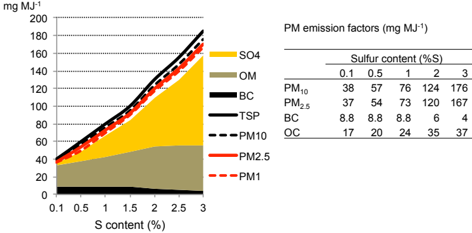
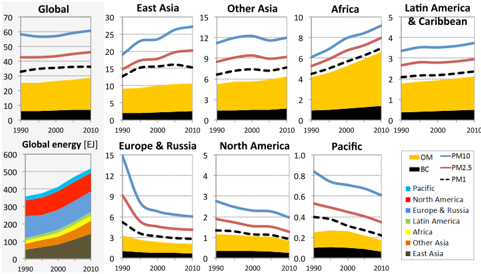
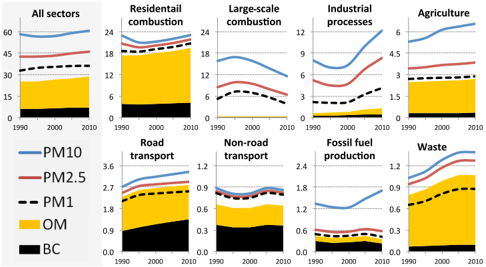
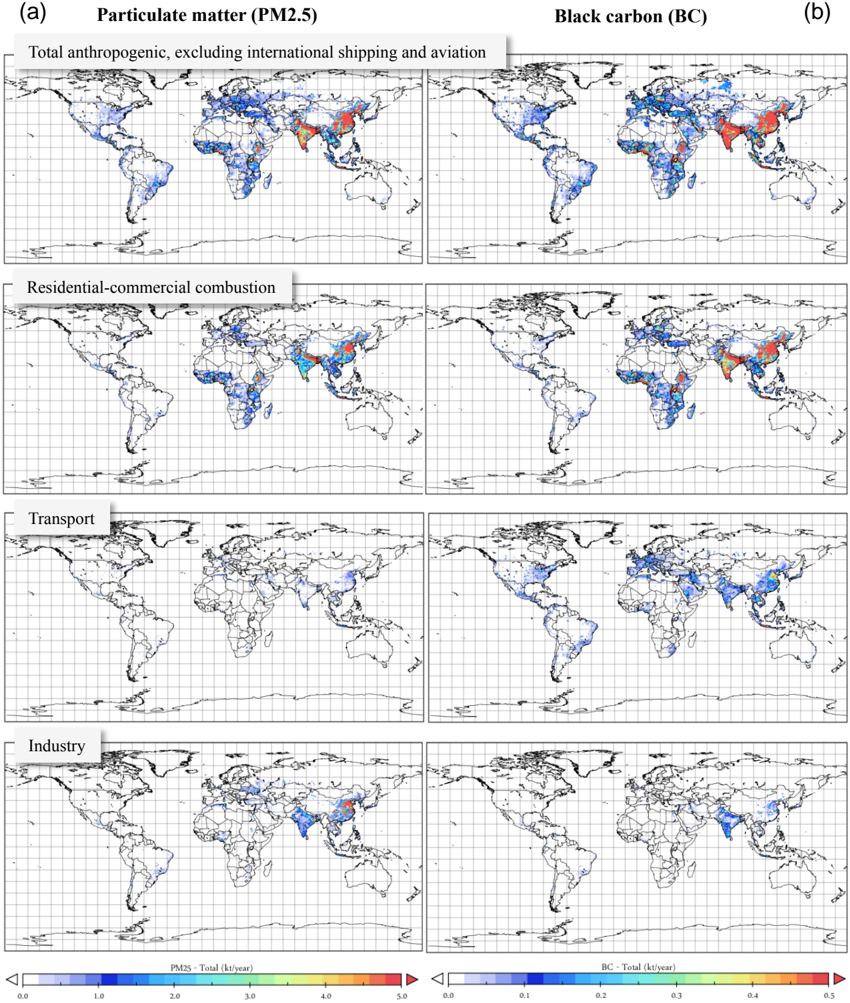
This paper presents a comprehensive assessment of historical (1990–2010) global anthropogenic particulate matter (PM) emissions including the consistent and harmonized calculation of mass-based size distribution (PM1, PM2. 5, PM10), as well as primary carbonaceous aerosols including black carbon (BC) and organic carbon (OC). The estimates were developed with the integrated assessment model GAINS, where source- and region-specific technology characteristics are explicitly included. This assessment includes a number of previously unaccounted or often misallocated emission sources, i.e. kerosene lamps, gas flaring, diesel generators, refuse burning; some of them were reported in the past for selected regions or in the context of a particular pollutant or sector but not included as part of a total estimate. Spatially, emissions were calculated for 172 source regions (as well as international shipping), presented for 25 global regions, and allocated to 0.5° × 0.5° longitude–latitude grids. No independent estimates of emissions from forest fires and savannah burning are provided and neither windblown dust nor unpaved roads emissions are included. We estimate that global emissions of PM have not changed significantly between 1990 and 2010, showing a strong decoupling from the global increase in energy consumption and, consequently, CO2 emissions, but there are significantly different regional trends, with a particularly strong increase in East Asia and Africa and a strong decline in Europe, North America, and the Pacific region. This in turn resulted in important changes in the spatial pattern of PM burden, e.g. European, North American, and Pacific contributions to global emissions dropped from nearly 30 % in 1990 to well below 15 % in 2010, while Asia's contribution grew from just over 50 % to nearly two-thirds of the global total in 2010. For all PM species considered, Asian sources represented over 60 % of the global anthropogenic total, and residential combustion was the most important sector, contributing about 60 % for BC and OC, 45 % for PM2. 5, and less than 40 % for PM10, where large combustion sources and industrial processes are equally important. Global anthropogenic emissions of BC were estimated at about 6.6 and 7.2 Tg in 2000 and 2010, respectively, and represent about 15 % of PM2. 5 but for some sources reach nearly 50 %, i.e. for the transport sector. Our global BC numbers are higher than previously published owing primarily to the inclusion of new sources. This PM estimate fills the gap in emission data and emission source characterization required in air quality and climate modelling studies and health impact assessments at a regional and global level, as it includes both carbonaceous and non-carbonaceous constituents of primary particulate matter emissions. The developed emission dataset has been used in several regional and global atmospheric transport and climate model simulations within the ECLIPSE (Evaluating the Climate and Air Quality Impacts of Short-Lived Pollutants) project and beyond, serves better parameterization of the global integrated assessment models with respect to representation of black carbon and organic carbon emissions, and built a basis for recently published global particulate number estimates.
Overview
The claims and statistics of this paper haven’t been checked yet.
Free: it reads the open-access text and checks the first 5 claims that cite a source we can check. Create a free account to check every claim.
Integrity signals
Registry
Cites
Statistics
Figures
Verification
Claims the paper makes
The claims and statistics of this paper haven’t been checked yet.
Free: it reads the open-access text and checks the first 5 claims that cite a source we can check. Create a free account to check every claim.
Claims other papers make about this one
Each is checked against this paper’s own text: does it say what the citing paper says it does?
The source backs part of the claim, not all of it — or backs it for a different population, condition or comparison.
In the citing paper
“specifically, it contributes 11% to total global particulate matter <2.5 µm (PM2.5) emissions and 6–7% to total global black carbon (BC) emissions31,32.”
From Potential for future reductions of global GHG and air pollutants from circular waste management systems (2022) · cites this paper as [32]
Experimental — accuracy not yet measuredThe source backs part of the claim, not all of it — or backs it for a different population, condition or comparison.
In the citing paper
“However, comparing CH4 emissions from MSW in the Eclipse_V5a32 to this study, we can see that the estimate in the latter is 6% higher.”
From Potential for future reductions of global GHG and air pollutants from circular waste management systems (2022) · cites this paper as [32]
Experimental — accuracy not yet measuredThe cited source says what the claim attributes to it.
In the citing paper
“In contrast, our results for particulate matter are 60% higher than those from ref. 32.”
From Potential for future reductions of global GHG and air pollutants from circular waste management systems (2022) · cites this paper as [32]
The cited source says what the claim attributes to it.
In the citing paper
“and 57% higher than the estimate of ref. 32”
From Potential for future reductions of global GHG and air pollutants from circular waste management systems (2022) · cites this paper as [32]
Self-check
Percentages, sums and reported differences re-computed from the paper’s own numbers.
The self-check needs the paper’s full text.
Citations
Cites
Lim, S. S., Vos, T., Flaxman, A. D., Danaei, G., Shibuya, K., Adair-Rohani, H., AlMazroa, M. A., Amann, M., Anderson, H. R., Andrews, K. G., et al. (2012) · The Lancet · doi:10.1016/s0140-6736(12)61766-8 · Cited by 11,805 · cited 1×
“There is well-documented evidence that exposure to PM results in adverse effects on human health (e.g., Anenberg et al., 2012; Lim et al., 2012; WHO, 2004).”
BackgroundAtmospheric Chemistry and Physics: From Air Pollution to Climate Change
Seinfeld, J. H., Pandis, S. N., & Noone, K. (1998) · Physics Today · doi:10.1063/1.882420 · Cited by 8,731
The representative concentration pathways: an overview
van Vuuren, D. P., Edmonds, J., Kainuma, M., Riahi, K., Thomson, A., Hibbard, K., Hurtt, G. C., Kram, T., Krey, V., Lamarque, J.-F., et al. (2011) · Climatic Change · doi:10.1007/s10584-011-0148-z · Cited by 7,741 · cited 1×
“The data originates from a study by Lee et al. (2009) and were used in the development of the RCPs (Van Vuuren et al., 2011).”
MethodRiahi, K., van Vuuren, D. P., Kriegler, E., Edmonds, J., O’Neill, B. C., Fujimori, S., Bauer, N., Calvin, K., Dellink, R., Fricko, O., et al. (2017) · Global Environmental Change · doi:10.1016/j.gloenvcha.2016.05.009 · Cited by 6,607
Self-citationBounding the role of black carbon in the climate system: A scientific assessment
Bond, T. C., Doherty, S. J., Fahey, D. W., Forster, P. M., Berntsen, T., DeAngelo, B. J., Flanner, M. G., Ghan, S., Kärcher, B., Koch, D., et al. (2013) · Journal of Geophysical Research: Atmospheres · doi:10.1002/jgrd.50171 · Cited by 6,385
Self-citationEmission of trace gases and aerosols from biomass burning
Andreae, M. O., & Merlet, P. (2001) · Global Biogeochemical Cycles · doi:10.1029/2000gb001382 · Cited by 3,902
(2010) · doi:10.5194/acp-10-11707-2010 · Cited by 2,859
A new scenario framework for climate change research: the concept of shared socioeconomic pathways
O’Neill, B. C., Kriegler, E., Riahi, K., Ebi, K. L., Hallegatte, S., Carter, T. R., Mathur, R., & van Vuuren, D. P. (2014) · Climatic Change · doi:10.1007/s10584-013-0905-2 · Cited by 2,716 · cited 1×
“Furthermore, elements of the ECLIPSE data have been part of the contribution towards improved representation of carbonaceous aerosols in the large-scale integrated assessment models used in the development of the shared socio-economic pathways (SSPs) (O’Neill et al., 2014; Rao et al., 2017; Riahi et al., 2017).”
MethodA technology‐based global inventory of black and organic carbon emissions from combustion
Bond, T. C., Streets, D. G., Yarber, K. F., Nelson, S. M., Woo, J., & Klimont, Z. (2004) · Journal of Geophysical Research: Atmospheres · doi:10.1029/2003jd003697 · Cited by 2,393
Self-citationLamarque, J.-F., Bond, T. C., Eyring, V., Granier, C., Heil, A., Klimont, Z., Lee, D., Liousse, C., Mieville, A., Owen, B., et al. (2010) · Atmospheric Chemistry and Physics · doi:10.5194/acp-10-7017-2010 · Cited by 2,105 · cited 2×
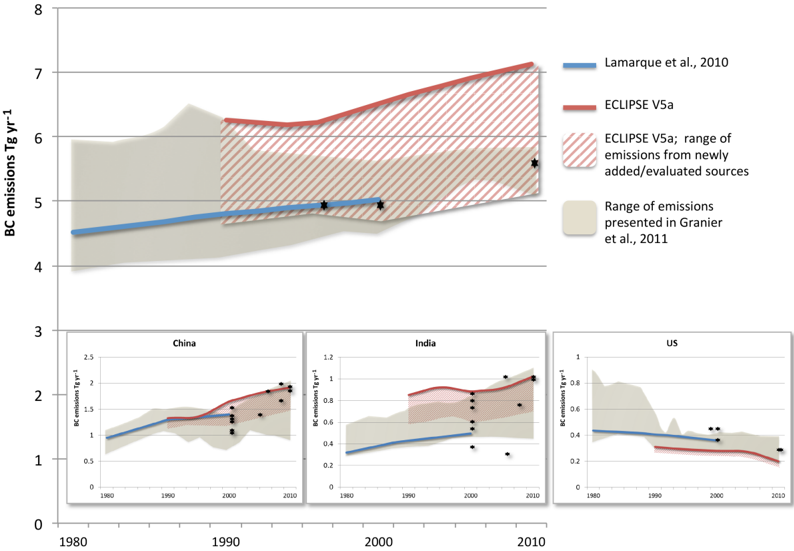
“GAINS is comparable with the RCP input (Lamarque et al., 2010) for 19901995, while for the last decade is consistently higher or at the top of the range, which in Granier et al. (2011) is”
Self-citation
Research works printed but not linked: 9
- 61. Desai, S., Dubey, A., Joshi, B. L., Sen, M., Shariff, A., and Vanne- man, R.: Human Development in India: Challenges for a Society in Transition, Oxford University Press, New Delhi, India, 2010.
- 82. GEA: Global Energy Assessment: Toward a Sustainable Future, Cambridge University Press, UK, 2012.
- 147. Lawson, D. R.: (On-Road) Mobile Source Emissions and Mitigation Potential, Workshop on Addressing Black Carbon and Ozone as Short-Lived Climate Forcers, Chapel Hill, North Carolina, US, 3-4 March 2010.
- 168. Maíz, P.: Experiencias en Medición de Emisiones en Hornos para Manufactura Artesanal de Ladrillos en Mexico, available at: http://www.inecc.gob.mx/descargas/dgcenica/2012_ladrilleras_ pon_s4_pmaiz_eng.pdf (last access: 4 July 2017), a presentation at: Workshop on public policies to mitigate environmental impact of artisanal brick production, Guanajuato, Mexico, 4-6 September 2012.
- 182. NEA: A Year in Review: Fiscal Year 2011/2012, Nepal Electricity Authority (NEA), Kathmandu, 2012.
- 219. Riahi, K., Dentener, F., Gielen, D., Grubler, A., Jewell, J., Klimont, Z., Krey, V., McCollum, D., Pachauri, S., Rao, S., van Ruijven, B., van Vuuren, D. P., and Wilson, C.: Chapter 17 -Energy Pathways for Sustainable Development, in Global Energy As- sessment -Toward a Sustainable Future, 1203-1306, Cambridge University Press, Cambridge, UK and New York, NY, USA and the International Institute for Applied Systems Analysis, Lax- enburg, Austria, available at: www.globalenergyassessment.org (last access: 4 July 2017), 2012.
- 227. Schilderman, T. and Mason, K.: Using residues as fuel in small- scale brickmaking, in Proceedings of the 11th International Con- ference on Non-conventional Materials and Technologies (NOC- MAT 2009), Bath, UK, 6-9 September 2009.
- 234. Shafizadeh, K., Niemeier, D., and Eisinger, D. S.: Gross Emit- ting Vehicles: A Review of the Literature, Caltrans Air Quality Project, US Davis, 2004.
- 270. US EPA: Compilation of Air Pollutant Emission Factors -Volume I: Stationary Point and Area Sources. AP-42 5th Edition, US Environmental Protection Agency (US EPA), Springfield, VA, 1995.
Cited by
Items 501–600 of 967
Zabukovec, A., Ancellet, G. M., Penner, I. E., Arshinov, M., Kozlov, V., Pelon, J. R., Paris, J.-D., Kokhanenko, G., Balin, Y. S., Чернов, Д. Г., et al. (2021) · Atmosphere · doi:10.3390/atmos12020244 · Cited by 7
“The location of flaring sources is based on the anthropogenic emissions ECLIPSEv4 data-set (Evaluating the Climate and Air Quality Impacts of Short-Lived pollutants) described in [49].”
BackgroundAerosol and precursor gas emissions
Bond, T. C., & Scott, C. E. (2022) · Elsevier eBooks · doi:10.1016/b978-0-12-819766-0.00006-7 · Cited by 10
Piano, A., Segatori, C., Millo, F., Pesce, F. C., & Vassallo, A. L. (2022) · SAE International Journal of Engines · doi:10.4271/03-16-05-0038 · Cited by 7
Deng, Y.-G., Tanimoto, H., Ikeda, K., Kameyama, S., Okamoto, S., Jung, J., Yoon, Y. J., Yang, E. J., & Kang, S.-H. (2024) · Atmospheric Chemistry and Physics · doi:10.5194/acp-24-6339-2024 · Cited by 4
The regional temperature implications of strong air quality measures
Aamaas, B., Berntsen, T. K., & Samset, B. H. (2019) · Atmospheric chemistry and physics · doi:10.5194/acp-19-15235-2019 · Cited by 7
“The analysis in this paper is based on emission pathways from the ECLIPSE emission project (Klimont et al., 2017, 2019).”
MethodData Assimilation of AOD and Estimation of Surface Particulate Matters over the Arctic
Han, K. M., Jung, C. H., Park, R., Park, S.-Y., Lee, S., Kulmala, M., Petäjä, T., Karasiński, G., Sobolewski, P. S., Yoon, Y. J., et al. (2021) · Applied Sciences · doi:10.3390/app11041959 · Cited by 7
“5, the anthropogenic emissions were taken into account from the Evaluating the Climate and Air Quality Impacts of Short-lived Pollutants (ECLIPSE) v4a emission inventories based on the CLE scenario [66].”
MethodAir pollution health and economic co-benefits of keeping warming below 2 °C in India
Sarkar, D., Imam, F., Kumar, A., Purohit, P., Kiesewetter, G., Klimont, Z., Chowdhury, S., Pozzer, A., & Dey, S. (2025) · npj Clean Air · doi:10.1038/s44407-025-00031-8 · Cited by 6
Self-citationShu, Y., Li, Y., Ya-zhen, W., Feng, X., Xu, S., Wang, Y., Ma, T., Chen, J., Gao, J., Zhang, S., et al. (2025) · Advances in Climate Change Research · doi:10.1016/j.accre.2025.03.010 · Cited by 6
Quantifying Fire‐Driven Dust Emissions Using a Global Aerosol Model
Wagner, R., & Schepanski, K. (2025) · Journal of Advances in Modeling Earth Systems · doi:10.1029/2024ms004466 · Cited by 6
“…Knippertz & Todd, 2012; Tegen & Schepanski, 2009), and black carbon (BC), released by various combustion processes of carbonaceous substances (e.g., Klimont et al., 2017; Wang et al., 2014), are two aerosol particles widely emitted over land surfaces with partly opposing impacts on the radiation…”
Characteristics of aerosols and planetary boundary layer dynamics during biomass burning season
Shahid, M. Z., Shahzad, M. I., Jaweria, S., Javed, S., Zaib, S., & Shahid, I. (2025) · Natural Hazards · doi:10.1007/s11069-025-07295-z · Cited by 6
“Anthropogenic organic carbon and black carbon emissions are derived from a global data set (Klimont et al. 2017).”
Hayes, F., Sharps, K., van Caspel, W. E., Klimont, Z., Heyes, C., & Fagerli, H. (2025) · Environmental Pollution · doi:10.1016/j.envpol.2025.126654 · Cited by 6
Self-citationBalogh, B. S., Csákó, Z., Nyiri, Z., Berlinger, B., Molnár, M., Major, I., Gergely, V., & Szigeti, T. (2025) · Atmospheric Environment · doi:10.1016/j.atmosenv.2025.121399 · Cited by 6
He, X., Zeng, J., Wu, Q., Ma, Q., Zhang, J., Fu, L., & Ge, X. (2025) · Process Safety and Environmental Protection · doi:10.1016/j.psep.2025.107759 · Cited by 6
Anthropogenic Emissions Inventories of Air Pollutants
Granier, C., Liousse, C., McDonald, B., & Middleton, P. B. (2023) · Springer eBooks · doi:10.1007/978-981-15-2760-9_5 · Cited by 8
Is atmospheric pathway a significant contributor to microplastics in the marine environment?
Habibi, N., Uddin, S., Behbehani, M., & Lee, J. (2023) · Emerging contaminants · doi:10.1016/j.emcon.2023.100297 · Cited by 7
Vento, E., Hartikainen, A. H., Tikka, A., Lamberg, H., Sippula, O., & Kilpeläinen, A. (2024) · Biomass and Bioenergy · doi:10.1016/j.biombioe.2024.107156 · Cited by 6
Zhao, Y., Sun, H., Kim, Y., Shu, Y., Wang, H., Lĭ, H., & Deng, Y. (2025) · Atmospheric Environment X · doi:10.1016/j.aeaoa.2025.100316 · Cited by 6
Solarin, S. A., Gil‐Alana, L. A., Goenechea, M., & Martin-Valmayor, M. (2025) · Renewable and Sustainable Energy Reviews · doi:10.1016/j.rser.2024.115327 · Cited by 6
Humbert, A., Schröder, L., Schultz, T., Müller, R., Neckel, N., Helm, V., Zindler, R., Eleftheriadis, K., Salzano, R., & Salvatori, R. (2020) · Remote Sensing · doi:10.3390/rs12223793 · Cited by 6
“For long term trends in BC, global emissions were estimated to grow by about 15% by 2010 compared to 1990 [50].”
BackgroundLogesh, B., Karthik, V., Bhaskar, B. V., Ebenezer, E., & Kumar, M. A. (2023) · Environmental Monitoring and Assessment · doi:10.1007/s10661-023-11957-5 · Cited by 6
“BC emission has been biased in global as well as regional emission inventories by a magnitude of 2–3 times due to the adoption of erroneous / highly uncertain emission factors (Klimont et al., 2017; Pali-wal et al., 2016; Sahu et al., 2008).”
BackgroundOdediran, E. T., Adeniran, J. A., & Yusuf, R. O. (2024) · Environmental Quality Management · doi:10.1002/tqem.22215 · Cited by 6
Messori, G., van Wees, D., Pausata, F. S. R., Navarro, J. C. A., Hannachi, A., & Dentener, F. J. (2018) · Tellus B · doi:10.1080/16000889.2018.1468704 · Cited by 7
“…control simulation with prescribed historic aerosol emissions and GHG concentrations as used in the IPCC AR5 report (IPCC, 2013); 2) a future (2037–2066) simulation based on the MFR aerosol scenario (Cofala et al., 2007; Klimont et al., 2016) and Representative Concentration Pathway 4.5 (RCP4.”
MethodInfluentialJeong, J. I., & Park, R. J. (2019) · Atmosphere · doi:10.3390/atmos10120790 · Cited by 6
Vallack, H. W., Olawoyin, O. O., Hicks, W. K., Kuylenstierna, J., & Emberson, L. D. (2020) · Atmospheric Pollution Research · doi:10.1016/j.apr.2020.05.023 · Cited by 7
The climate impacts of current black carbon and organic carbon emissions
Aamaas, B., Lund, M. T., Myhre, G., Samset, B. H., Stjern, C. W., & Kallbekken, S. (2018) · BIBSYS Brage (BIBSYS (Norway)) · Cited by 7
Recyclable Waste Identification Using CNN Image Recognition and Gaussian ClusteringPreprint
Wang, Y., Zhao, W. K., Xu, J., & Hong, R. (2020) · arXiv (Cornell University) · doi:10.48550/arxiv.2011.01353 · Cited by 12
“The report details further reduction potentials for the next decades, with global reductions of fossil fuel consumption of about 80% being suggested [6, 7].”
BackgroundSource apportionment of PM2.5 episodes in the Taichung metropolitan area, Taiwan
Chuang, M., Chou, C. C. ‐., Lin, C., Lin, W.-C., Lee, J.-H., Li, M.-H., Chen, W., Chang, C.-C., Liu, C., & Chen, Y. (2024) · Atmospheric Research · doi:10.1016/j.atmosres.2024.107666 · Cited by 5
Cheng, K., Zhong, Y., Li, X., Li, S., Ayitken, M., Zhang, W., & Liu, X. (2024) · Atmospheric Pollution Research · doi:10.1016/j.apr.2024.102381 · Cited by 5
İm, U., Tsigaridis, K., Bauer, S. E., Shindell, D. T., Olivié, D., Wilson, S., Sørensen, L. L., Langen, P. L., & Eckhardt, S. (2025) · Environmental Research Climate · doi:10.1088/2752-5295/adb3c0 · Cited by 6
“The ECLIPSE V6b emissions dataset is a further evolution of the scenarios established in the EU funded ECLIPSE project (Stohl et al 2015, Klimont et al 2017).”
Tang, L., Qian, S., Wan, R., Lv, S., Li, J., Zhang, J., Shuai, W., Qi, S., Wang, P., Qu, J., et al. (2025) · Journal of Environmental Management · doi:10.1016/j.jenvman.2025.125900 · Cited by 5
Reconstructing top-down global black carbon emissions using remote sensing and models
Wang, S., Guan, L., Cohen, J. B., & Qin, K. (2025) · Atmospheric Pollution Research · doi:10.1016/j.apr.2025.102633 · Cited by 5
Unprecedented shifts in aerosol pollution sources in China under a decade of clean air actions
Fang, W., Evangeliou, N., Eckhardt, S., Xiao, H., & Li, H. (2025) · Communications Earth & Environment · doi:10.1038/s43247-025-02487-8 · Cited by 6
“Posterior emissions may be affected by several uncertainties, including potential misestimations of sectoral emissions in the EIs 4,23,25 , inaccuracies in wild fi re estimates 45 , the relatively large standard deviation of the numerical model and uncertainties in the atmospheric transport model 28…”
Beyond boundaries: the combined threats of air pollution and rising surface temperatures
Weil, T. A., Tighe, R. M., & Birnbaum, L. S. (2025) · Environment International · doi:10.1016/j.envint.2025.109841 · Cited by 7
Peng, X., Fu, N., Wang, J., Chen, Y., Mao, K., Zhang, L., Qin, Y., Ye, J., Du, W., Zhang, P., et al. (2025) · Journal of Environmental Management · doi:10.1016/j.jenvman.2025.127680 · Cited by 5
Mahowald, N. M., Li, L., Ageitos, M. G., Miller, R. L., García‐Pando, C. P., Ginoux, P. A., Obiso, V., Brodrick, P. G., Clark, R. N., Desboeufs, K., et al. (2026) · Global Biogeochemical Cycles · doi:10.1029/2025gb009033 · Cited by 5
Modeling nitrogen deposition in global forests
Schwede, D., Simpson, D. M., Dentener, F. J., Du, E., & VRIES, W. D. (2023) · Elsevier eBooks · doi:10.1016/b978-0-323-91140-5.00009-9 · Cited by 5
Local and NON-LOCAL source apportionment of black carbon and combustion generated PM2.5
Rodríguez, J., Villalobos, A. M., Castro-Molinare, J., & Jorquera, H. (2024) · Environmental Pollution · doi:10.1016/j.envpol.2024.123568 · Cited by 6
O’Neill, C., Slater, J., Sychareun, V., Vongxay, V., Soulideth, B., Malley, C. S., Archer, D., & Kuylenstierna, J. (2024) · Environmental Research Communications · doi:10.1088/2515-7620/ad359b · Cited by 5
Sensitivity of Wintertime Arctic Black Carbon to Removal Processes and Regional Alaskan Sources
Ioannidis, E., Law, K. S., Raut, J., Marelle, L., Onishi, T., Andrews, E. J., Ohata, S., Mori, T., Morris, S. M., Kondo, Y., et al. (2025) · Journal of Geophysical Research Atmospheres · doi:10.1029/2024jd042885 · Cited by 5
“…and Air Quality Impacts of Short‐Lived Pollutants version 6 (ECLIPSE v6b) inventory, with a resolution of 50 km are used in the simulations at quasi‐hemispheric and regional scale for winter 2013–2014 (Amann et al., 2011; Höglund‐Isaksson et al., 2020; Klimont et al., 2017; Whaley et al., 2022).”
Self-citationKrecl, P., Parra, Á., Targino, A. C., & Cipoli, Y. A. (2020) · Transportation Research Part D Transport and Environment · doi:10.1016/j.trd.2020.102602 · Cited by 5
Venkatraman, K., Bhaskar, B. V., & Kesarkar, A. P. (2021) · Aerosol Science and Engineering · doi:10.1007/s41810-021-00100-x · Cited by 5
Bůzek, F., Čejková, B., Jačková, I., Seibert, R., Čuřík, J., Veselovský, F., & Petrash, D. A. (2022) · Atmospheric Environment · doi:10.1016/j.atmosenv.2022.119556 · Cited by 6
Nonlinear impacts of future anthropogenic aerosol emissions on Arctic warming
Dobričić, S., Pozzoli, L., Vignati, E., Dingenen, R. V., Wilson, J., Russo, S., & Klimont, Z. (2018) · Environmental Research Letters · doi:10.1088/1748-9326/aaf8ee · Cited by 5
“Very similar AOD reduction and anticyclone over the Pacific Ocean appear in CCL compared to BCL (supplementary figure S6), due to the reduced SO2 emissions from using less fossil fuel (Klimont et al 2017).”
BackgroundSelf-citationKinase, T., Taketani, F., Takigawa, M., Zhu, C., Kim, Y., Mordovskoi, P., & Kanaya, Y. (2025) · Atmospheric Chemistry and Physics · doi:10.5194/acp-25-143-2025 · Cited by 4
“ECLIPSE (Evaluating the Climate and Air Quality Impacts of Short-Lived Pollutants) version 6b (Klimont et al., 2017) with downwind atmospheric BC observations (Kanaya et al., 2020), while other bottom-up inventories might result in a factor of ~2 overestimation.”
Impact of Anthropogenic Emission Estimates on Air Quality and Human Health Effects
Salah, H., Ying, X., Partha, D. B., Mariscal, N., Wang, L., Tilmes, S., Tang, W., & Huang, Y. (2025) · GeoHealth · doi:10.1029/2024gh001223 · Cited by 4
“All major air pollutants and greenhouse gases from Kyoto Protocol are included in GAINS, with emissions estimates provided for 200 country‐regions (Klimont et al., 2017; Stohl et al., 2015).”
InfluentialBlack carbon and its radiative effect with role in Urban Heat Island (UHI) over India: a review
Sunayana, Singh, N., & Mandal, P. (2025) · Asian Journal of Atmospheric Environment · doi:10.1007/s44273-025-00062-3 · Cited by 4
“(Klimont et al., 2017).”
Yu, N., Yoo, H.-J., Oh, S., Choi, Y., Lee, S., Kim, S., & Lim, S. (2025) · Atmospheric chemistry and physics · doi:10.5194/acp-25-15263-2025 · Cited by 4
“…in BC emissions in North America and Europe (Eckhardt et al., 2023), whereas more recent estimates indicate a sustained increase in Asian emissions over the past two decades in ECLIPSE (Evaluating the Climate and Air Quality Impact of Short-Lived Pollutants) inventory (Klimont et al., 2017).”
Vicente, E. D., Charres, I., Cipoli, Y. A., Calvo, A., Fraile, R., Candeias, C., Rocha, F. T., Galindo, N., Yubero, E., & Alves, C. A. (2025) · Environmental Pollution · doi:10.1016/j.envpol.2025.127510 · Cited by 4
Microstructure-Mediated Electron Transfer Dominates the Photoconversion of NO 2 to HONO on Soot
Lai, S., Yang, S., Zheng, J., Li, F., Na, H., Yang, W., & Han, C. S. (2026) · Journal of the American Chemical Society · doi:10.1021/jacs.5c23020 · Cited by 4
Sun, H., Wang, J., Liu, W., Ruan, L., Yang, Z., Ma, X., Chen, X., Xu, L., Du, L., Liu, Q., et al. (2026) · Journal of Hazardous Materials · doi:10.1016/j.jhazmat.2026.141877 · Cited by 4
Gidarakou, M., Papayannis, A. D., Mylonaki, M., Kralli, E., Eleftheratos, K., Fountoulakis, I., Zografou, O., Diapouli, E., Gini, M. I., Vratolis, S., et al. (2026) · Atmospheric chemistry and physics · doi:10.5194/acp-26-4313-2026 · Cited by 4
“Anthropogenic BC sources were derived from the ECLIPSEv6 inventory (Klimont et al., 2017) (e.g., transport, industry, domestic combustion), while biomass burning used GFEDv4 (Giglio et al., 2013).”
Wong, A. Y. H., Eastham, S. D., Monier, E., & Selin, N. E. (2026) · Geoscientific model development · doi:10.5194/gmd-19-3335-2026 · Cited by 4
Muyemeki, L., Burger, R. P., Piketh, S., Rafaj, P., & Kiesewetter, G. (2022) · Air Quality Atmosphere & Health · doi:10.1007/s11869-022-01242-8 · Cited by 4
Self-citationRen, A., Kume, S., Fujiwara, M., & Nakano, S. (2024) · Carbon Trends · doi:10.1016/j.cartre.2024.100433 · Cited by 4
Wu, P.-C., Wen, H., Huang, K., Huang, S., & Liang, M.-C. (2025) · Environmental Research · doi:10.1016/j.envres.2025.121661 · Cited by 4
Kuniyal, J. C., Bawari, A., Chaudhary, S., Sharma, A., & Pande, B. (2025) · Air Quality Atmosphere & Health · doi:10.1007/s11869-025-01727-2 · Cited by 4
“Globally, BC emissions emitted are estimated to be between 4800 to 7200 Gg yr −1 (Bond et al. 2013; Klimont et al. 2017; Kang et al. 2020; Ningobam et al. 2020; Panicker et al. 2021).”
Diesel generator exhaust emissions: Chemical characterization and cytotoxicity in bladder spheroids
Fakhri, N., Yehya, A., Kawak, M. E., Fadel, M., Farah, E., Oikonomou, K., Sciare, J., Courcot, D., Ledoux, F., Afif, C., et al. (2025) · Atmospheric Pollution Research · doi:10.1016/j.apr.2025.102571 · Cited by 5
A Global Emission Inventory of Particulate Phosphorus From Fertilizer Production and Handling
Rathod, S., & Hamilton, D. S. (2025) · Global Biogeochemical Cycles · doi:10.1029/2025gb008555 · Cited by 4
“The Greenhouse Gas–Air Pollution Interactions and Synergies (GAINS) inventory (Amann et al., 2011; Klimont et al., 2017) estimates present‐day global fertilizer production (sum of nitrogen, phosphorus, and potassium) emissions to about 260 Gg PM 10 /yr (195 Gg PM 2.5 /yr), with storage and handling…”
InfluentialAssessing BC and CO emissions from China using EMeRGe aircraft observations and WRF/CMAQ modelling
Ha, P. T. M., Kanaya, Y., Yamaji, K., Itahashi, S., Chatani, S., Sekiya, T., Hernández, M. D. A., Burrows, J. P., Schlager, H., Lichtenstern, M., et al. (2025) · Atmospheric chemistry and physics · doi:10.5194/acp-25-13429-2025 · Cited by 4
Calassou, G., Foucher, P., & Léon, J. (2024) · Atmospheric measurement techniques · doi:10.5194/amt-17-57-2024 · Cited by 4
“2) is located to the east of the steelmaking industry and moves northeastward The landscape is heterogeneous, being a mix of residential housing and fields”
BackgroundYan, Q., Liu, X., Kong, S., Zhang, W., Gao, Q., Zhang, Y., Li, H., Wang, H., Xiao, T., & Li, J. (2024) · Environmental Pollution · doi:10.1016/j.envpol.2024.124641 · Cited by 4
Hundal, R. A., Annadate, S., Cesari, R., Collalti, A., Maione, M., & Cristofanelli, P. (2024) · The Science of The Total Environment · doi:10.1016/j.scitotenv.2024.177713 · Cited by 4
Microparticles in the Atmosphere from Lithospheric Sources of Technogenic Origin
Адушкин, В. В., & Soloviev, S. P. (2021) · Izvestiya Physics of the Solid Earth · doi:10.1134/s1069351321050025 · Cited by 4
“Assessments of black carbon emissions based on the model presented in Klimont et al. (2017) contained the following values: 6600 thousand tons in 2000 and 7200 thousand tons in 2010.”
BackgroundMalá, Z., Loskot, J., Bušovský, D., Bezdíček, Z., Komárek, J., & Ziembik, Z. (2022) · Environmental Science and Pollution Research · doi:10.1007/s11356-022-23862-4 · Cited by 4
El fracaso del desarrollo y la opción por el buen vivir
Macías, A. M., & García, Y. L. S. (2022) · Ediciones Comunicación Científica eBooks · doi:10.52501/cc.034 · Cited by 4
Virtual sensor-based proxy for black carbon estimation in IoT platforms
Ferrer-Cid, P., Paredes-Ahumada, J., Barceló-Ordinas, J. M., & García-Vidal, J. (2024) · Internet of Things · doi:10.1016/j.iot.2024.101284 · Cited by 5
Mobile monitoring reveals the importance of non-vehicular particulate matter sources in London
Wilson, S., Farren, N. J., Wilde, S. E., Wagner, R. L., Lee, J. D., Padilla, L. E., Slater, G., Peters, D. R., & Carslaw, D. C. (2024) · Environmental Science Processes & Impacts · doi:10.1039/d4em00552j · Cited by 4
Raclavská, H., Kantor, P., Růžičková, J., Kucbel, M., Švédová, B., Slamová, K., Flodrová, Š., & Juchelková, D. (2021) · Applied Sciences · doi:10.3390/app11114980 · Cited by 5
Ajay, P., Pathak, B., Bhuyan, P., Solmon, F., & Giorgi, F. M. (2021) · Climate Research · doi:10.3354/cr01671 · Cited by 4
Piedrahita, R. (2017) · CU Scholar (University of Colorado Boulder) · Cited by 4
Crippa, M., Guizzardi, D., Butler, T. M., Keating, T. J., Wu, R., Kaminski, J. W., Kuenen, J. J. P., Kurokawa, J., Chatani, S., Morikawa, T., et al. (2023) · doi:10.5194/essd-2022-442-supplement · Cited by 4
Self-citationYttri, K. E., Bäcklund, A., Conen, F., Eckhardt, S., Evangeliou, N., Fiebig, M., Kasper‐Giebl, A., Gold, A. R., Gundersen, H., Myhre, C. L., et al. (2023) · doi:10.5194/egusphere-2023-615 · Cited by 4
Zhu, A., Kan, H., Shi, X., Zeng, Y., & Ji, J. S. (2024) · The Journals of Gerontology Series A · doi:10.1093/gerona/glae302 · Cited by 3
Abriantoro, A. P., & Simanjuntak, M. R. A. (2025) · Jurnal PenSil · doi:10.21009/jpensil.v14i1.50676 · Cited by 3
Radiocarbon Fingerprinting Black Carbon Source History in the Himalayas
Wang, M., Wang, H., Xu, B., Li, Z., Zhao, H., Li, J., Cui, A., Zhu, S., & Li, J. (2025) · Geophysical Research Letters · doi:10.1029/2024gl113764 · Cited by 3
“Supporting Information may be found in the online version of this article. et al., 2004; Dickerson et al., 2002; Klimont et al., 2017; Lu et al., 2011; Ohara et al., 2007; Paliwal et al., 2016; Pandey et al., 2014; Reddy & Ven-kataraman, 2002a, 2002b; Sahu et al., 2008; summarized in Table S1 in…”
Bawari, A., Kuniyal, J. C., Chaudhary, S., Lata, R., & Pande, B. (2025) · Journal of Atmospheric and Solar-Terrestrial Physics · doi:10.1016/j.jastp.2025.106487 · Cited by 3
Rodríguez, J., & Jorquera, H. (2025) · Atmospheric Pollution Research · doi:10.1016/j.apr.2025.102674 · Cited by 3
Current major sources of black carbon aerosols over Delhi: Implications to health risks
Kumar, V., Singh, A., Joshi, S., Pani, S. K., Singh, K., & Rastogi, N. (2025) · Atmospheric Pollution Research · doi:10.1016/j.apr.2025.102697 · Cited by 3
Gadhavi, H., Arora, A., Jain, C. D., Sha, M. K., Hase, F., Frey, M., Ramachandran, S., & Jayaraman, A. (2025) · Atmospheric measurement techniques · doi:10.5194/amt-18-4497-2025 · Cited by 3
Padhi, A., Satheesh Chandran, P. R., & Fadnavis, S. (2025) · Atmospheric Pollution Research · doi:10.1016/j.apr.2025.102765 · Cited by 3
Global Wildland Fire Emissions of Full-Volatility Organic Compounds from 1997 to 2023
Huang, L., Zhao, B., He, Y.-L., Chang, X., Ma, M., Yin, D., Wu, Q., & wang, S. (2025) · Environmental Science & Technology · doi:10.1021/acs.est.5c10217 · Cited by 3
Surdu, M., Calmer, R., Timarac-Popovic, J., Penn, T., Luhmann, N., Hiesberger, J., Vukićević, V., Démolis, E. A., Favre, L., Dönmez, B., et al. (2026) · Science Advances · doi:10.1126/sciadv.aeb2254 · Cited by 5
Matt, F., & Burkhart, J. F. (2018) · Geophysical Research Letters · doi:10.1002/2018gl077133 · Cited by 3
“Wet and dry deposition rates of BC are modeled with the Flexible Particle Dispersion Model (Stohl et al., 1998, 2005; Stohl & Thomson, 1999; details given in supporting information; Amann et al., 2011; Doherty et al., 2014; Klimont et al., 2017; Stohl et al., 2015; van der Werf et al., 2010).”
MethodHEALTH IMPACTS OF PM2.5 AND NO2 SHIP-RELATED AIR POLLUTION IN MATOSINHOS MUNICIPALITY, PORTUGAL
Nunes, R. A. O., Alvim-Ferraz, M. C. M., Martins, F. G., Jalkanen, J.-P., Majamäki, E., & Sousa, S. I. V. (2021) · WIT transactions on ecology and the environment · doi:10.2495/air210201 · Cited by 3
PM2.5 episodes in northern Taiwan under southerly winds in late winter
Chuang, M., Chou, C. C. ‐., Lin, C., Lee, J.-H., Lin, W.-C., Li, M.-H., Chen, S.-W., & Chang, S.-H. (2024) · Atmospheric Research · doi:10.1016/j.atmosres.2024.107686 · Cited by 3
Black Carbon in Climate Studies: A Bibliometric Analysis of Research Trends and Topics
Chen, C., Liang, Y., Chen, Z., Zou, C., & Shi, Z. (2024) · Sustainability · doi:10.3390/su16208945 · Cited by 3
Khoziainova, D. A., Popovicheva, O., Chichaeva, M., Kovach, R. G., Slobodyan, V. Y., & Kasimov, N. S. (2024) · Izvestiya Atmospheric and Oceanic Physics · doi:10.1134/s0001433824700506 · Cited by 3
“5 emissions; for the transport sector, this value reaches 50% (Klimont et al., 2017).”
InfluentialFang, C., Zhu, B., Chen, P., Qian, P., Wang, D., Zhang, Y., Lu, C., & Liao, H. (2025) · Journal of Climate · doi:10.1175/jcli-d-24-0067.1 · Cited by 4
Jain, Y., Kumar, V., Garaga, R., & Kota, S. H. (2025) · Environmental Pollution · doi:10.1016/j.envpol.2025.126223 · Cited by 3
Arora, A., Gadhavi, H., Ramachandran, S., & Rajesh, T. A. (2025) · Atmospheric Environment · doi:10.1016/j.atmosenv.2025.121367 · Cited by 3
Tatsumi, K., & Diep, N. T. H. (2025) · Data · doi:10.3390/data10090151 · Cited by 3
The Epidemiological and Toxicological Intersection of Air Pollution and Dementia
Kotha, S., Kuo, G., Kammula, S. V., Shi, L., Zhang, X., Liu, P. F., & Mao, X. (2025) · Reviews of Environmental Contamination and Toxicology · doi:10.1007/s44169-025-00092-6 · Cited by 4
“Once in the bloodstream, lead crosses the blood–brain barrier by mimicking calcium, accumulating in the brain and potentially causing neurotoxic effects (Klimont et al. 2017).”
Clusius, P. S., Baykara, M., Xavier, C., Zhou, P., Tyree, J., Foreback, B., Äijälä, M., Graeffe, F., Petäjä, T., Kulmala, M., et al. (2026) · Atmospheric chemistry and physics · doi:10.5194/acp-26-1967-2026 · Cited by 4
“) using the H SO − NH chemistry (Besel et al., 2020), where the cluster stabilities are based on energies calculated with DLPNO-CCSD(T)/aug-cc-pVTZ// ω B97X-D/6-31++G level of theory .”
Nielsen, J. B., Yum, K. K., & Pedersen, E. (2019) · Proceedings of the Institution of Mechanical Engineers Part M Journal of Engineering for the Maritime Environment · doi:10.1177/1475090219881930 · Cited by 3
“Although shipping is an efficient mode of transport generally using less fuel for a given transport work than other modes of transport, shipping emissions make up a significant fraction of the global CO2, NOx, SOx and particulate matter (PM) emissions[1, 2, 3, 4].”
BackgroundSeay, B., Adetona, A. M., Sarofim, M. C., & Kolian, M. J. (2020) · Earth s Future · doi:10.1029/2020ef001493 · Cited by 3
“5 and BC, respectively (Klimont et al., 2017).”
Emission inventory point source visualization on Google Earth and integrated with HYSPLIT model
Ortínez, A., Ruiz-Suárez, L. G., Ortega, E., García-Reynoso, J. A., Peralta, O., Gaona, A. L., Castro, T. G., & Arroyo, A. (2020) · Atmósfera · doi:10.20937/atm.52834 · Cited by 3
“This is the case for national criteria pollutants (SINEA, 2015), SLCPs (UNEP-CCAC, 2016) and the GHG national emissions inventories of Mexico (INECC, 2015).”
BackgroundInfluentialGhosh, S., & Verma, S. (2022) · Atmospheric Research · doi:10.1016/j.atmosres.2022.106504 · Cited by 3
Reduction potentials for particulate emissions from household energy in India
Lam, N. L., Goel, V., Blasdel, M., Xu, L., Ruiz-Mercado, I., Ozaltun, B., Aoudi, L., Whitacre, J. V., & Bond, T. C. (2023) · Environmental Research Letters · doi:10.1088/1748-9326/acc7ba · Cited by 3
“They will also assist in realizing commitments to reduce greenhouse emissions [4].”
BackgroundBhattacharyya, T., Bhattacharyya, T., Chatterjee, A., Das, S. K., & Singh, S. (2023) · Atmosphere · doi:10.3390/atmos14071102 · Cited by 3
“The anthropogenic plumes generated by biomass burning or vehicular exhaust contain black carbon (BC) as one of the significant components [162,163].”
BackgroundEffect of “black carbon” on antimony accumulation in traffic-loaded topsoil
Doušová, B., Bůzek, F., Machovič, V., Lhotka, M., & Vojtíšek-Lom, M. (2024) · The Science of The Total Environment · doi:10.1016/j.scitotenv.2024.173132 · Cited by 3
Metadata
- Authors
- Klimont, Z., Kupiainen, K., Heyes, C., Purohit, P., Cofala, J., Rafaj, P., Borken-Kleefeld, J., & Schöpp, W.
- Affiliations
- International Institute for Applied Systems Analysis (AT)
- Corresponding author
- Klimont, Zbigniew
- Venue
- Atmospheric Chemistry and Physics
- Publisher
- Copernicus GmbH
- Published
- 2017-07-17
- Volume
- 17
- Issue
- 14
- Pages
- 8681-8723
- ISSN
- 1680-7316 (ISSN-L)
- 1680-7324
- OpenAlex
- W2537132227
- Cited by
- 878
- References
- 226
- Citations by year
- 2026: 59 · 2025: 84 · 2024: 80 · 2023: 108 · 2022: 143 · 2021: 165 · 2020: 90 · 2019: 65 · 2018: 48 · 2017: 26
- FWCI
- 36.31
- Type
- journal article
- Language
- en
- Open access
- gold
- doi.org
- Licence
- Locations
- Atmospheric chemistry and physics (publishedVersion, cc-by)
- IIASA PURE (International Institute of Applied Systems Analysis) (acceptedVersion)
- IIASA PURE (International Institute of Applied Systems Analysis) (submittedVersion)
- DOAJ (DOAJ: Directory of Open Access Journals) (submittedVersion, cc-by-sa)
- Zenodo (CERN European Organization for Nuclear Research) (submittedVersion, cc-by)
- Funders
- Seventh Framework Programme (282688)
- Topics
- Physical Sciences › Earth and Planetary Sciences › Atmospheric Science › Atmospheric chemistry and aerosols
- Physical Sciences › Environmental Science › Health, Toxicology and Mutagenesis › Air Quality and Health Impacts
- Physical Sciences › Environmental Science › Environmental Engineering › Maritime Transport Emissions and Efficiency
- Keywords
- black carbon, organic carbon, PM2.5, PM10, PM1, size distribution, residential combustion, kerosene lamps, gas flaring, diesel generator, waste burning, GAINS model, East Asia
About these checks
Registry, retraction, Cites and statistics results are computed, not judged, with one exception: a printed reference that no index lists is read once by a model before it counts as a citation error. Claims are extracted by a model and kept only when their quote appears verbatim in the text; each cited source is then checked, with a model’s help, for whether it says what the claim relies on. Those verdicts can be wrong — read the claim’s quote and the cited source before relying on one.
Statistics and arithmetic are recomputed, not judged.
Confidence bands are shown only for fields calibrated on our annotated test set. None is calibrated yet, so no band is shown.
What counts as a claim ›How we measure confidence ›How we check this ›
Are you an author, or do you see a problem with this page? Request a review
Data sources
Bibliographic data: Semantic Scholar, OpenAlex, Crossref.
Contains information from the Semantic Scholar Academic Graph Datasets, made available under the ODC Attribution License (ODC-BY 1.0).
Semantic Scholar’s data is described in: Kinney, R., et al. (2023). The Semantic Scholar Open Data Platform. arXiv:2301.10140.
