

Global anthropogenic emissions of particulate matter including black carbon
Open accessPublished version of a preprint
The DOI matches its Crossref record; 224 of the 226 references it cites were found in a registry or an index.
Abstract
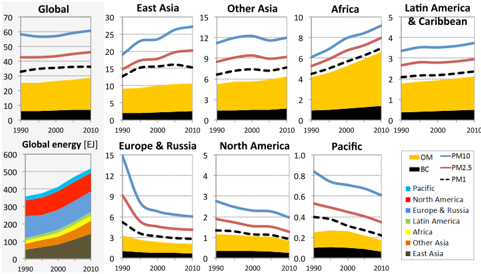
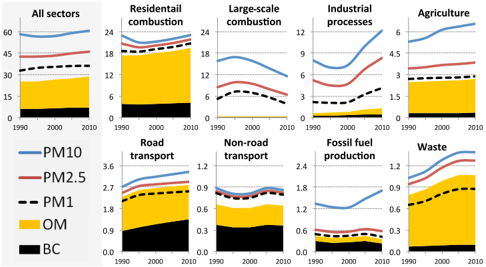
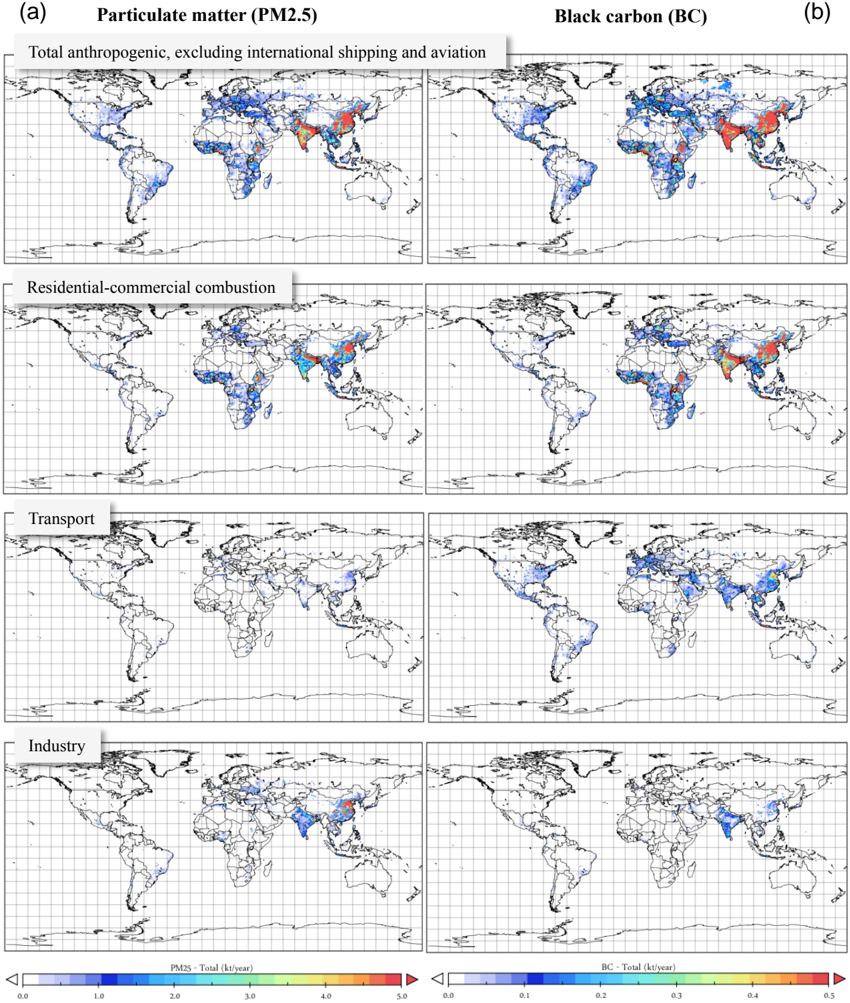
This paper presents a comprehensive assessment of historical (1990–2010) global anthropogenic particulate matter (PM) emissions including the consistent and harmonized calculation of mass-based size distribution (PM1, PM2. 5, PM10), as well as primary carbonaceous aerosols including black carbon (BC) and organic carbon (OC). The estimates were developed with the integrated assessment model GAINS, where source- and region-specific technology characteristics are explicitly included. This assessment includes a number of previously unaccounted or often misallocated emission sources, i.e. kerosene lamps, gas flaring, diesel generators, refuse burning; some of them were reported in the past for selected regions or in the context of a particular pollutant or sector but not included as part of a total estimate. Spatially, emissions were calculated for 172 source regions (as well as international shipping), presented for 25 global regions, and allocated to 0.5° × 0.5° longitude–latitude grids. No independent estimates of emissions from forest fires and savannah burning are provided and neither windblown dust nor unpaved roads emissions are included. We estimate that global emissions of PM have not changed significantly between 1990 and 2010, showing a strong decoupling from the global increase in energy consumption and, consequently, CO2 emissions, but there are significantly different regional trends, with a particularly strong increase in East Asia and Africa and a strong decline in Europe, North America, and the Pacific region. This in turn resulted in important changes in the spatial pattern of PM burden, e.g. European, North American, and Pacific contributions to global emissions dropped from nearly 30 % in 1990 to well below 15 % in 2010, while Asia's contribution grew from just over 50 % to nearly two-thirds of the global total in 2010. For all PM species considered, Asian sources represented over 60 % of the global anthropogenic total, and residential combustion was the most important sector, contributing about 60 % for BC and OC, 45 % for PM2. 5, and less than 40 % for PM10, where large combustion sources and industrial processes are equally important. Global anthropogenic emissions of BC were estimated at about 6.6 and 7.2 Tg in 2000 and 2010, respectively, and represent about 15 % of PM2. 5 but for some sources reach nearly 50 %, i.e. for the transport sector. Our global BC numbers are higher than previously published owing primarily to the inclusion of new sources. This PM estimate fills the gap in emission data and emission source characterization required in air quality and climate modelling studies and health impact assessments at a regional and global level, as it includes both carbonaceous and non-carbonaceous constituents of primary particulate matter emissions. The developed emission dataset has been used in several regional and global atmospheric transport and climate model simulations within the ECLIPSE (Evaluating the Climate and Air Quality Impacts of Short-Lived Pollutants) project and beyond, serves better parameterization of the global integrated assessment models with respect to representation of black carbon and organic carbon emissions, and built a basis for recently published global particulate number estimates.
Overview
The claims and statistics of this paper haven’t been checked yet.
Free: it reads the open-access text and checks the first 5 claims that cite a source we can check. Create a free account to check every claim.
Integrity signals
Registry
Cites
Statistics
Figures
Verification
Claims the paper makes
The claims and statistics of this paper haven’t been checked yet.
Free: it reads the open-access text and checks the first 5 claims that cite a source we can check. Create a free account to check every claim.
Claims other papers make about this one
Each is checked against this paper’s own text: does it say what the citing paper says it does?
The source backs part of the claim, not all of it — or backs it for a different population, condition or comparison.
In the citing paper
“specifically, it contributes 11% to total global particulate matter <2.5 µm (PM2.5) emissions and 6–7% to total global black carbon (BC) emissions31,32.”
From Potential for future reductions of global GHG and air pollutants from circular waste management systems (2022) · cites this paper as [32]
Experimental — accuracy not yet measuredThe source backs part of the claim, not all of it — or backs it for a different population, condition or comparison.
In the citing paper
“However, comparing CH4 emissions from MSW in the Eclipse_V5a32 to this study, we can see that the estimate in the latter is 6% higher.”
From Potential for future reductions of global GHG and air pollutants from circular waste management systems (2022) · cites this paper as [32]
Experimental — accuracy not yet measuredThe cited source says what the claim attributes to it.
In the citing paper
“In contrast, our results for particulate matter are 60% higher than those from ref. 32.”
From Potential for future reductions of global GHG and air pollutants from circular waste management systems (2022) · cites this paper as [32]
The cited source says what the claim attributes to it.
In the citing paper
“and 57% higher than the estimate of ref. 32”
From Potential for future reductions of global GHG and air pollutants from circular waste management systems (2022) · cites this paper as [32]
Self-check
Percentages, sums and reported differences re-computed from the paper’s own numbers.
The self-check needs the paper’s full text.
Citations
Cites
Lim, S. S., Vos, T., Flaxman, A. D., Danaei, G., Shibuya, K., Adair-Rohani, H., AlMazroa, M. A., Amann, M., Anderson, H. R., Andrews, K. G., et al. (2012) · The Lancet · doi:10.1016/s0140-6736(12)61766-8 · Cited by 11,805 · cited 1×
“There is well-documented evidence that exposure to PM results in adverse effects on human health (e.g., Anenberg et al., 2012; Lim et al., 2012; WHO, 2004).”
BackgroundAtmospheric Chemistry and Physics: From Air Pollution to Climate Change
Seinfeld, J. H., Pandis, S. N., & Noone, K. (1998) · Physics Today · doi:10.1063/1.882420 · Cited by 8,731
The representative concentration pathways: an overview
van Vuuren, D. P., Edmonds, J., Kainuma, M., Riahi, K., Thomson, A., Hibbard, K., Hurtt, G. C., Kram, T., Krey, V., Lamarque, J.-F., et al. (2011) · Climatic Change · doi:10.1007/s10584-011-0148-z · Cited by 7,741 · cited 1×
“The data originates from a study by Lee et al. (2009) and were used in the development of the RCPs (Van Vuuren et al., 2011).”
MethodRiahi, K., van Vuuren, D. P., Kriegler, E., Edmonds, J., O’Neill, B. C., Fujimori, S., Bauer, N., Calvin, K., Dellink, R., Fricko, O., et al. (2017) · Global Environmental Change · doi:10.1016/j.gloenvcha.2016.05.009 · Cited by 6,607
Self-citationBounding the role of black carbon in the climate system: A scientific assessment
Bond, T. C., Doherty, S. J., Fahey, D. W., Forster, P. M., Berntsen, T., DeAngelo, B. J., Flanner, M. G., Ghan, S., Kärcher, B., Koch, D., et al. (2013) · Journal of Geophysical Research: Atmospheres · doi:10.1002/jgrd.50171 · Cited by 6,385
Self-citationEmission of trace gases and aerosols from biomass burning
Andreae, M. O., & Merlet, P. (2001) · Global Biogeochemical Cycles · doi:10.1029/2000gb001382 · Cited by 3,902
(2010) · doi:10.5194/acp-10-11707-2010 · Cited by 2,859
A new scenario framework for climate change research: the concept of shared socioeconomic pathways
O’Neill, B. C., Kriegler, E., Riahi, K., Ebi, K. L., Hallegatte, S., Carter, T. R., Mathur, R., & van Vuuren, D. P. (2014) · Climatic Change · doi:10.1007/s10584-013-0905-2 · Cited by 2,716 · cited 1×
“Furthermore, elements of the ECLIPSE data have been part of the contribution towards improved representation of carbonaceous aerosols in the large-scale integrated assessment models used in the development of the shared socio-economic pathways (SSPs) (O’Neill et al., 2014; Rao et al., 2017; Riahi et al., 2017).”
MethodA technology‐based global inventory of black and organic carbon emissions from combustion
Bond, T. C., Streets, D. G., Yarber, K. F., Nelson, S. M., Woo, J., & Klimont, Z. (2004) · Journal of Geophysical Research: Atmospheres · doi:10.1029/2003jd003697 · Cited by 2,393
Self-citationLamarque, J.-F., Bond, T. C., Eyring, V., Granier, C., Heil, A., Klimont, Z., Lee, D., Liousse, C., Mieville, A., Owen, B., et al. (2010) · Atmospheric Chemistry and Physics · doi:10.5194/acp-10-7017-2010 · Cited by 2,105 · cited 2×
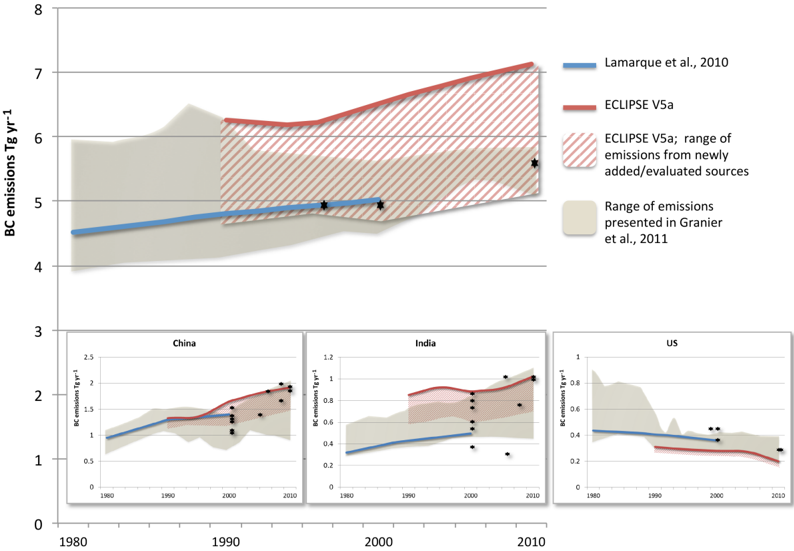
“GAINS is comparable with the RCP input (Lamarque et al., 2010) for 19901995, while for the last decade is consistently higher or at the top of the range, which in Granier et al. (2011) is”
Self-citation
Research works printed but not linked: 9
- 61. Desai, S., Dubey, A., Joshi, B. L., Sen, M., Shariff, A., and Vanne- man, R.: Human Development in India: Challenges for a Society in Transition, Oxford University Press, New Delhi, India, 2010.
- 82. GEA: Global Energy Assessment: Toward a Sustainable Future, Cambridge University Press, UK, 2012.
- 147. Lawson, D. R.: (On-Road) Mobile Source Emissions and Mitigation Potential, Workshop on Addressing Black Carbon and Ozone as Short-Lived Climate Forcers, Chapel Hill, North Carolina, US, 3-4 March 2010.
- 168. Maíz, P.: Experiencias en Medición de Emisiones en Hornos para Manufactura Artesanal de Ladrillos en Mexico, available at: http://www.inecc.gob.mx/descargas/dgcenica/2012_ladrilleras_ pon_s4_pmaiz_eng.pdf (last access: 4 July 2017), a presentation at: Workshop on public policies to mitigate environmental impact of artisanal brick production, Guanajuato, Mexico, 4-6 September 2012.
- 182. NEA: A Year in Review: Fiscal Year 2011/2012, Nepal Electricity Authority (NEA), Kathmandu, 2012.
- 219. Riahi, K., Dentener, F., Gielen, D., Grubler, A., Jewell, J., Klimont, Z., Krey, V., McCollum, D., Pachauri, S., Rao, S., van Ruijven, B., van Vuuren, D. P., and Wilson, C.: Chapter 17 -Energy Pathways for Sustainable Development, in Global Energy As- sessment -Toward a Sustainable Future, 1203-1306, Cambridge University Press, Cambridge, UK and New York, NY, USA and the International Institute for Applied Systems Analysis, Lax- enburg, Austria, available at: www.globalenergyassessment.org (last access: 4 July 2017), 2012.
- 227. Schilderman, T. and Mason, K.: Using residues as fuel in small- scale brickmaking, in Proceedings of the 11th International Con- ference on Non-conventional Materials and Technologies (NOC- MAT 2009), Bath, UK, 6-9 September 2009.
- 234. Shafizadeh, K., Niemeier, D., and Eisinger, D. S.: Gross Emit- ting Vehicles: A Review of the Literature, Caltrans Air Quality Project, US Davis, 2004.
- 270. US EPA: Compilation of Air Pollutant Emission Factors -Volume I: Stationary Point and Area Sources. AP-42 5th Edition, US Environmental Protection Agency (US EPA), Springfield, VA, 1995.
Cited by
Items 201–300 of 967
Fadel, M., Ledoux, F., Seigneur, M., Oikonomou, K., Sciare, J., Courcot, D., & Afif, C. (2022) · Environmental Research · doi:10.1016/j.envres.2022.113032 · Cited by 43
Effectiveness of India’s Bharat Stage mitigation measures in reducing vehicular emissions
Gajbhiye, M. D., Sandhiya, L., Kumar, N., Bhattacharya, S., & Nishad, S. N. (2023) · Transportation Research Part D Transport and Environment · doi:10.1016/j.trd.2022.103603 · Cited by 41
Road transport emissions in EDGAR (Emissions Database for Global Atmospheric Research)
Lekaki, D., Kastori, M., Papadimitriou, G., Mellios, G., Guizzardi, D., Muntean, M., Crippa, M., Oreggioni, G. D., & Ntziachristos, L. D. (2024) · Atmospheric Environment · doi:10.1016/j.atmosenv.2024.120422 · Cited by 41
Bran, S. H., Macatangay, R. C., Chotamonsak, C., Chantara, S., & Surapipith, V. (2024) · Atmospheric Environment · doi:10.1016/j.atmosenv.2024.120613 · Cited by 49
Health impacts of biomass burning aerosols: Relation to oxidative stress and inflammation
Pardo, M., Li, C., Zimmermann, R., & Rudich, Y. (2024) · Aerosol Science and Technology · doi:10.1080/02786826.2024.2379551 · Cited by 42
Huang, J., Jaeglé, L., & Shah, V. P. (2018) · Atmospheric chemistry and physics · doi:10.5194/acp-18-16253-2018 · Cited by 41
“GEOS-Chem also underestimates CALIOP aerosol extinction over northern Russia, which could be due to missing sources of aerosols and their precursors from gas flaring in the region (Li et al., 2016; Klimont et al., 2017; Xu et al., 2017).”
BackgroundEmission inventory for on-road traffic fleets in Greater Yangon, Myanmar
Huy, L. N., Oanh, N. T. K., Htut, T. T., & Hlaing, O. M. T. (2019) · Atmospheric Pollution Research · doi:10.1016/j.apr.2019.12.021 · Cited by 41
Kypridemos, C., Puzzolo, E., Aamaas, B., Hyseni, L., Shupler, M. S., Aunan, K., & Pope, D. P. (2020) · Environmental Health Perspectives · doi:10.1289/ehp4899 · Cited by 45
Black carbon emissions from flaring in Russia in the period 2012–2017
Böttcher, K., Paunu, V.-V., Kupiainen, K., Zhizhin, M. N., Matveev, A., Savolahti, M., Klimont, Z., Väätäinen, S., Lamberg, H., & Karvosenoja, N. (2021) · Atmospheric Environment · doi:10.1016/j.atmosenv.2021.118390 · Cited by 43
Self-citationAerosols heat up the Himalayan climate
Ramachandran, S., Rupakheti, M., Cherian, R., & Lawrence, M. G. (2023) · The Science of The Total Environment · doi:10.1016/j.scitotenv.2023.164733 · Cited by 40
Mangaraj, P., Sahu, S. K., Beig, G., & Samala, B. K. (2022) · Journal of Cleaner Production · doi:10.1016/j.jclepro.2022.132209 · Cited by 40
Bhattarai, H., Tai, A. P. K., Martin, M. V., & Yung, D. H. Y. (2023) · The Science of The Total Environment · doi:10.1016/j.scitotenv.2023.167759 · Cited by 40
Persistent Hot Spot Detection and Characterisation Using SLSTR
Caseiro, A., Rücker, G., Tiemann, J., Leimbach, D., Lorenz, E., Frauenberger, O., & Kaiser, J. W. (2018) · Remote Sensing · doi:10.3390/rs10071118 · Cited by 39
Motos, G., Corbin, J. C., Schmale, J., Modini, R. L., Bertó, M., Kupiszewski, P., Baltensperger, U., & Beer, M. G. (2020) · Geophysical Research Letters · doi:10.1029/2020gl088011 · Cited by 39
“BC forms during the incomplete combustion of fossil and biogenic fuels and mainly originates from anthropogenic sources (Klimont et al., 2017).”
BackgroundYan, X., Zang, Z., Zhao, C., & Letu, H. (2021) · Environment International · doi:10.1016/j.envint.2021.106392 · Cited by 39
Air Pollution and Health – A Science-Policy Initiative
Academy of Science of South Africa, Brazilian Academy of Sciences, German National Academy of Sciences Leopoldina, U. S. National Academy of Medicine, & U. S. National Academy of Sciences (2019) · Annals of Global Health · doi:10.5334/aogh.2656 · Cited by 46
Bran, S. H., Macatangay, R. C., Surapipith, V., Chotamonsak, C., Chantara, S., Han, Z., & Li, J. (2022) · Atmospheric Research · doi:10.1016/j.atmosres.2022.106303 · Cited by 42
Identifying Key Sources for Air Pollution and CO 2 Emission Co-control in China
Zheng, Y., Cao, W., Zhao, H., Chen, C., Lei, Y., Feng, Y., Qi, Z., Wang, Y., Wang, X., Xue, W., et al. (2024) · Environmental Science & Technology · doi:10.1021/acs.est.4c03299 · Cited by 44
Kuula, J., Friman, M., Helin, A., Niemi, J. V., Aurela, M., Timonen, H., & Saarikoski, S. (2020) · Journal of Aerosol Science · doi:10.1016/j.jaerosci.2020.105671 · Cited by 39
Malley, C. S., Hicks, K., Kulyenstierna, J. C. I., Michalopoulou, E., Molotoks, A., Slater, J., Heaps, C. G., Ulloa, S., Veysey, J., Shindell, D. T., et al. (2021) · Environmental Research Communications · doi:10.1088/2515-7620/ac0af9 · Cited by 42
Siberian Arctic black carbon: gas flaring and wildfire impact
Popovicheva, O., Evangeliou, N., Kobelev, V. O., Chichaeva, M., Eleftheriadis, K., Gregorič, A., & Kasimov, N. S. (2022) · Atmospheric chemistry and physics · doi:10.5194/acp-22-5983-2022 · Cited by 41
Upadhyay, A., Dey, S., & Goyal, P. (2019) · Atmospheric Environment · doi:10.1016/j.atmosenv.2019.117182 · Cited by 38
Long-term health impact assessment of total PM2.5 in Europe during the 1990–2015 period
Ciarelli, G., Colette, A., Schucht, S., Beekmann, M., Andersson, C., Manders, A., Mircea, M., Tsyro, S. G., Fagerli, H., Ortiz, A. G., et al. (2019) · Atmospheric Environment X · doi:10.1016/j.aeaoa.2019.100032 · Cited by 47
Feng, H., & Zou, B. (2019) · Remote Sensing of Environment · doi:10.1016/j.rse.2019.111299 · Cited by 38
Puliafito, S. E., Bolaño-Ortiz, T. R., Fernández, R. P., Berná, L., Pascual-Flores, R. M., Urquiza, J., Lopez-Noreña, A., & Tames, M. F. (2021) · Earth system science data · doi:10.5194/essd-13-5027-2021 · Cited by 44
Impact of shipping emissions on air pollution and pollutant deposition over the Barents Sea
Raut, J., Law, K. S., Onishi, T., Daskalakis, N., & Marelle, L. (2022) · Environmental Pollution · doi:10.1016/j.envpol.2022.118832 · Cited by 38
Black carbon emissions and reduction potential in China: 2015–2050
Wang, W., Khanna, N. Z., Lin, J., & Liu, X. (2022) · Journal of Environmental Management · doi:10.1016/j.jenvman.2022.117087 · Cited by 37
Narita, D., Gavrilyeva, T. N., & Isaev, A. (2020) · Polar Science · doi:10.1016/j.polar.2020.100573 · Cited by 36
The hadal zone is an important and heterogeneous sink of black carbon in the ocean
Zhang, X., Xu, Y., Xiao, W., Zhao, M., Wang, Z., Wang, X., Xu, L., Luo, M., Li, X., Fang, J., et al. (2022) · Communications Earth & Environment · doi:10.1038/s43247-022-00351-7 · Cited by 37
Jacal, S., Straubinger, F. B., Benjamin, E. O., & Buchenrieder, G. R. (2022) · Energy Sustainable Development/Energy for sustainable development · doi:10.1016/j.esd.2022.07.007 · Cited by 36
Sensitivity of black carbon concentrations and climate impact to aging and scavenging in OsloCTM2–M7
Lund, M. T., Berntsen, T. K., & Samset, B. H. (2017) · Atmospheric chemistry and physics · doi:10.5194/acp-17-6003-2017 · Cited by 36
“…the ECLIPSEv4 inventory developed with the GAINS model (Amman et al. 2011) as part of the activities under the ECLIPSE project funded by the European Commission 7 th Framework (Amann et al., 2011; Klimont et al., 2009; Klimont et al., 2016) (available upon request from http://eclipse.nilu.no/).”
Bartz, W., Górka, M., Rybak, J., Rutkowski, R., & Stojanowska, A. (2021) · Chemosphere · doi:10.1016/j.chemosphere.2021.130454 · Cited by 35
Guevara, M., Enciso, S., Tena, C., Jorba, O., Dellaert, S., van der Gon, H. D., & García‐Pando, C. P. (2024) · Earth system science data · doi:10.5194/essd-16-337-2024 · Cited by 35
“…a proxy emission value for each fuel type was estimated using country-and fuel-specific emission factors from the Greenhouse Gas–Air Pollution Interactions and Synergies (GAINS) model at the International Institute for Applied Systems Analysis (IIASA) (Amann et al., 2011; Klimont et al., 2017).”
MethodBasnet, S., Hartikainen, A. H., Virkkula, A., Yli‐Pirilä, P., Kortelainen, M., Suhonen, H., Kilpeläinen, L., Ihalainen, M., Väätäinen, S., Louhisalmi, J., et al. (2024) · Atmospheric chemistry and physics · doi:10.5194/acp-24-3197-2024 · Cited by 35
Do Regional Aerosols Contribute to the Riverine Export of Dissolved Black Carbon?
Jones, M. W., Quine, T. A., de Rezende, C. E., Dittmar, T., Johnson, B. T. T., Manecki, M., Marques, J. S. J., & Aragão, L. E. O. C. (2017) · Journal of Geophysical Research Biogeosciences · doi:10.1002/2017jg004126 · Cited by 35
“In the fire-adapted Cerrado (savannah) biome that occupies a large portion of the interior of Brazil, the natural fire regime has been amplified by the expansion of cropland and pasture (Klink & Machado, 2005; Oliveira & Marquis, 2002; Pivello, 2011).”
BackgroundTrends in Air Pollution in Europe, 2000–2019
Aas, W., Fagerli, H., Alástuey, A., Cavalli, F., Degórska, A., Feigenspan, S., Brenna, H., Gliß, J., Heinesen, D., Hueglin, C., et al. (2024) · Aerosol and Air Quality Research · doi:10.4209/aaqr.230237 · Cited by 34
“The speciation of PM emissions into emissions of elemental carbon (EC), primary organic aerosol (POA), and remaining primary particle matter (remPPM) components was based on ECLIPSE v6b emission data (Klimont et al. , 2017).”
MethodSimulation of black carbon in snow and its climate impact in the Canadian Global Climate Model
Namazi, M., von Salzen, K., & Cole, J. N. S. (2015) · Atmospheric chemistry and physics · doi:10.5194/acp-15-10887-2015 · Cited by 38
Ge, Y., Vieno, M., Stevenson, D. S., Wind, P., & Heal, M. R. (2022) · Atmospheric chemistry and physics · doi:10.5194/acp-22-8343-2022 · Cited by 34
“5, and primary coarse particulate matter (PMco) (Klimont et al., 2017) at a horizontal resolution of 0.”
BackgroundMahato, D. K., Sankar, T. K., Ambade, B., Mohammad, F., Soleiman, A. A., & Gautam, S. (2023) · Aerosol Science and Engineering · doi:10.1007/s41810-023-00184-7 · Cited by 34
“The incomplete combustion of carbon-based fuels releases BC and particular matters (PM 2.5 ) (Klimont et al., 2017).”
BackgroundInfluentialEvangeliou, N., Shevchenko, V. P., Yttri, K. E., Eckhardt, S., Sollum, E., Сергеевич, П. О., Kobelev, V. O., Коробов, В. П., Lobanov, A. A., Starodymova, D. P., et al. (2018) · Atmospheric chemistry and physics · doi:10.5194/acp-18-963-2018 · Cited by 37
“In the present study, the ECLIPSE (Evaluating the Climate and Air Quality Impacts of Short-Lived Pollutants) version 5 emission inventory (Klimont et al., 2017; Stohl et al., 2015) was used (http://www.”
BackgroundMethodInfluentialConstraining the uncertainty in emissions over India with a regional air quality model evaluation
Karambelas, A., Holloway, T., Kiesewetter, G., & Heyes, C. (2017) · Atmospheric Environment · doi:10.1016/j.atmosenv.2017.11.052 · Cited by 33
Self-citationFlaring emissions in Africa: Distribution, evolution and comparison with current inventories
Doumbia, T., Liousse, C., Keita, S., Granier, L., Granier, C., Elvidge, C. D., Elguindi, N., & Law, K. S. (2018) · Atmospheric Environment · doi:10.1016/j.atmosenv.2018.11.006 · Cited by 33
Characteristics of aerosols from swine farms: A review of the past two-decade progress
Liu, T., Li, G., Liu, Z., Xi, L., Ma, W., & Gao, X. (2023) · Environment International · doi:10.1016/j.envint.2023.108074 · Cited by 35
Mukherjee, S., & Kumar, M. (2021) · The Science of The Total Environment · doi:10.1016/j.scitotenv.2020.144711 · Cited by 32
Giani, P., Anav, A., Marco, A. D., Feng, Z., & Crippa, P. (2020) · Environmental Research Letters · doi:10.1088/1748-9326/ab7f0f · Cited by 32
The impact of cyclic fuels on the formation and structure of soot
Salamanca, M., Botero, M. L., Martin, J. W., Dreyer, J. A. H., Akroyd, J., & Kraft, M. (2020) · Combustion and Flame · doi:10.1016/j.combustflame.2020.04.026 · Cited by 32
“Particulate matter emissions from incomplete combustion of hydrocarbons contribute to climate change [6, 44] and have adverse effects on human health [3, 49].”
BackgroundAsian Emissions Explain Much of the Arctic Black Carbon Events
Backman, J., Schmeisser, L., & Asmi, E. (2021) · Geophysical Research Letters · doi:10.1029/2020gl091913 · Cited by 32
“These include anthropogenic BC and PM10 emissions from the ECLIPSE (Evaluating the CLimate and Air Quality ImPacts of ShortlivEd Pollutants) v5 emission inventory (Klimont et al., 2017) and BC emissions from Savanna, Boreal, Temperate forests, tropical deforestation, peat and agricultural fires from the Global Fire Em…”
BackgroundLiu, A., Yi, J., Ding, X., Deng, J., Wu, D., Huo, Y., Jiang, J., Li, Q. X., & Chen, J. (2022) · Journal of Hazardous Materials · doi:10.1016/j.jhazmat.2022.128221 · Cited by 32
Rare-Earth Elements and Heavy Metals in Atmospheric Particulate Matter in an Urban Area
Rabha, S., Subramanyam, K. S. V., Sawant, S. S., & Saikia, B. K. (2022) · ACS Earth and Space Chemistry · doi:10.1021/acsearthspacechem.2c00009 · Cited by 33
Sources of Organic Aerosol in China from 2005 to 2019: A Modeling Analysis
Zheng, H., Chang, X., Wang, S., Li, S., Zhao, B., Dong, Z., Ding, D., Jiang, Y., Huang, G., Huang, C. Y., et al. (2023) · Environmental Science & Technology · doi:10.1021/acs.est.2c08315 · Cited by 32
The long-term relationship between emissions and economic growth for SO 2 , CO 2 , and BC
Ru, M., Shindell, D. T., Seltzer, K. M., Tao, S., & Zhong, Q. (2018) · Environmental Research Letters · doi:10.1088/1748-9326/aaece2 · Cited by 33
“…the Emission Database for Global Atmospheric Research (EDGAR; Crippa et al 2018), the evaluating the climate and air quality impacts of short-lived pollutants (ECLIPSE) dataset (Stohl et al 2015, Klimont et al 2017), and the community emissions data system (CEDS) dataset (Hoesly et al 2018).”
BackgroundOdo, D. B., Yang, I. A., Dey, S., Hammer, M. S., van Donkelaar, A., Martin, R. V., Dong, G.-H., Yang, B.-Y., Hystad, P., & Knibbs, L. D. (2023) · Environmental Research · doi:10.1016/j.envres.2023.115734 · Cited by 31
Ni, J., Jin, J., Wang, Y., Li, B., Wu, Q., Chen, Y., Du, S., Li, Y., & He, C. (2023) · Geography and sustainability · doi:10.1016/j.geosus.2023.09.008 · Cited by 31
Global radiative effects of solid fuel cookstove aerosol emissions
Huang, Y., Unger, N., Storelvmo, T., Harper, K., Zheng, Y., & Heyes, C. (2018) · Atmospheric chemistry and physics · doi:10.5194/acp-18-5219-2018 · Cited by 34
“Global anthropogenic emissions are from the IIASA (International Institute for Applied System Analysis) Greenhouse Gas-Air Pollution Interactions and Synergies (GAINS) integrated assessment model ECLIPSE V5a (Evaluating the Climate and Air Quality Impacts of Short-lived Pollutants version 5a) for the year 2010 (Amann…”
MethodSelf-citationYue, H., Worrell, E., & Crijns-Graus, W. H. J. (2020) · Applied Energy · doi:10.1016/j.apenergy.2020.116241 · Cited by 32
“on the ECLIPSE V5a database [35] developed by the International Institute for Applied Systems Analysis (IIASA).”
MethodImpacts of Global Solid Biofuel Stove Emissions on Ambient Air Quality and Human Health
Huang, Y., Partha, D. B., Harper, K., & Heyes, C. (2021) · GeoHealth · doi:10.1029/2020gh000362 · Cited by 32
“Global anthropogenic emissions for CAM5-Chem simulations are from the IIASA GAINS (International Institute for Applied Systems Analysis Greenhouse Gas-Air Pollution Interactions and Synergies) ECLIPSE V5a (Evaluating the Climate and Air Quality Impacts of Short-lived Pollutants version 5a) inventory for the year 2010…”
MethodSelf-citationWhat caused a record high PM 10 episode in northern Europe in October 2020?
Zwaaftink, C. G., Aas, W., Eckhardt, S., Evangeliou, N., Hamer, P., Johnsrud, M., Kylling, A., Platt, S. M., Stebel, K., Uggerud, H. T., et al. (2022) · Atmospheric chemistry and physics · doi:10.5194/acp-22-3789-2022 · Cited by 32
Etuman, A. E., & Coll, I. (2018) · Geoscientific model development · doi:10.5194/gmd-11-5085-2018 · Cited by 31
“In Europe in particular, some cities are associated with the massive use of passenger cars (and sometimes even diesel fuel), which further increases their potential for the emission of air pollutants.”
BackgroundInfluentialFuture climatic drivers and their effect on PM 10 components in Europe and the Mediterranean Sea
Cholakian, A., Colette, A., Coll, I., Ciarelli, G., & Beekmann, M. (2019) · Atmospheric chemistry and physics · doi:10.5194/acp-19-4459-2019 · Cited by 33
Wang, Y., Li, X., Shi, Z., Huang, L. Q., Li, J., Zhang, H., Ying, Q., Wang, M., Ding, D., Zhang, X., et al. (2021) · Resources Conservation and Recycling · doi:10.1016/j.resconrec.2021.105620 · Cited by 30
Stathopoulos, V. K., Evangeliou, N., Stohl, A., Vratolis, S., Matsoukas, C., & Eleftheriadis, K. (2021) · Geophysical Research Letters · doi:10.1029/2021gl092876 · Cited by 30
COVID-19 lockdown closures of emissions sources in India: Lessons for air quality and climate policy
Tibrewal, K., & Venkataraman, C. (2021) · Journal of Environmental Management · doi:10.1016/j.jenvman.2021.114079 · Cited by 30
Papanikolaou, C., Papayannis, A. D., Mylonaki, M., Foskinis, R., Kokkalis, P., Liakakou, E., Stavroulas, I., Σουπιωνά, Ο., HATZIANASTASSIOU, N., Gavrouzou, M., et al. (2022) · Atmosphere · doi:10.3390/atmos13010094 · Cited by 30
Belis, C. A., Dingenen, R. V., Klimont, Z., & Dentener, F. J. (2022) · Journal of Environmental Management · doi:10.1016/j.jenvman.2022.115738 · Cited by 32
Self-citationHuy, L. N., Winijkul, E., & Oanh, N. T. K. (2021) · The Science of The Total Environment · doi:10.1016/j.scitotenv.2021.147311 · Cited by 30
The interplay between energy technologies and human health: Implications for energy transition
Sadegh Seddighi, K., Anthony, E. J., Seddighi, H., & Johnsson, F. (2023) · Energy Reports · doi:10.1016/j.egyr.2023.04.351 · Cited by 35
Zheng, H., Li, S., Jiang, Y., Dong, Z., Yin, D., Zhao, B., Wu, Q., Liu, K., Zhang, S., Wu, Y., et al. (2024) · Environment International · doi:10.1016/j.envint.2024.108470 · Cited by 29
Investigation of aerosol black carbon over semi-urban and urban locations in south-western India
Kolhe, A. R., Aher, G. R., Ralegankar, S. D., & Safai, P. D. (2018) · Atmospheric Pollution Research · doi:10.1016/j.apr.2018.04.010 · Cited by 29
Fæhn, T., Bachner, G., Beach, R., Château, J., Fujimori, S., Ghosh, M., Hamdi-Chérif, M., Lanzi, E., Paltsev, S., Vandyck, T., et al. (2020) · Journal of Global Economic Analysis · doi:10.21642/jgea.050106af · Cited by 30
“In addition to its contribution to global GHG emissions, Klimont et al. (2017) estimate that agriculture accounted for 10.5% of global anthropogenic emissions of particulate matter (PM) less than or equal to 10 micrometers in diameter (PM10), 8.0% of PM2.”
BackgroundInfluentialArctic tropospheric ozone: assessment of current knowledge and model performance
Whaley, C. H., Law, K. S., Hjorth, J. L., Skov, H., Arnold, S. R., Langner, J., Pernov, J. B., Bergeron, G., Bourgeois, I., Christensen, J. H., et al. (2023) · Atmospheric Chemistry and Physics · doi:10.5194/acp-23-637-2023 · Cited by 28
Ooi, M. C. G., Chuang, M., Fu, J. S., Kong, S. S.-K., Huang, W.-S., Wang, S., Pimonsree, S., Chan, A., Pani, S. K., & Lin, N. (2021) · Atmospheric chemistry and physics · doi:10.5194/acp-21-12521-2021 · Cited by 31
Shaw, J. T., Foulds, A., Wilde, S. E., Barker, P., Squires, F., Lee, J. D., Purvis, R. M., Burton, R., Colfescu, I., Mobbs, S. D., et al. (2023) · Atmospheric chemistry and physics · doi:10.5194/acp-23-1491-2023 · Cited by 32
Das, S., Roy, A., Masiwal, R., Mandal, M., Popek, R., Chakraborty, M., Prasad, D., Chyliński, F., Awasthi, A., & Sarkar, A. (2023) · Sustainability · doi:10.3390/su152014894 · Cited by 28
Global Kerosene Subsidies: An Obstacle to Energy Efficiency and Development
Mills, E. (2017) · World Development · doi:10.1016/j.worlddev.2017.05.036 · Cited by 28
“…does not consider the important greenhouse forcing effect of black carbon, a particularly important emission from inefficiently burned kerosene that significantly amplifies the global warming potential stemming from the associated carbon dioxide emissions (Lam et al., 2012; Klimont et al., 2016).”
BackgroundNguyen, G. T. H., Shimadera, H., Uranishi, K., Matsuo, T., & Kondo, A. (2020) · Atmospheric Environment · doi:10.1016/j.atmosenv.2020.117398 · Cited by 28
Singh, B. P., Eldesoky, G. E., Kumar, P., Chandra, P., Islam, M. A., & Rahman, S. (2022) · Frontiers in Environmental Science · doi:10.3389/fenvs.2021.784959 · Cited by 29
“This led to a general reduction of anthropogenic PM pollution (Klimont et al., 2017).”
BackgroundCellulose in atmospheric particulate matter at rural and urban sites across France and Switzerland
Brighty, A. M., Jacob, V., Uzu, G., Borlaza, L. J. S., Conil, S., Hueglin, C., Grange, S. K., Favez, O., Trébuchon, C., & Jaffrezo, J. (2022) · Atmospheric chemistry and physics · doi:10.5194/acp-22-6021-2022 · Cited by 27
“Indeed, it has been hypothesised that our current understanding does not account for a number of hidden sources and processes of PM (Karagulian et al., 2015; Wagenbrenner et al., 2017; Klimont et al., 2017).”
BackgroundInfluentialMalik, A., Aggarwal, S. G., Ohata, S., Mori, T., Kondo, Y., Sinha, P. R., Patel, P., Kumar, B., Singh, K., Soni, D., et al. (2022) · Aerosol and Air Quality Research · doi:10.4209/aaqr.220128 · Cited by 27
Liu, J., Zhou, W., Yang, J., Ren, H., Zakeri, B., Tong, D., Guo, Y. J., Klimont, Z., Zhu, T., Tang, X., et al. (2022) · Climatic Change · doi:10.1007/s10584-022-03413-z · Cited by 27
“The database on the emission factors in China was originally constructed in the GAINS-Asia project and is being updated by integrating new research evidence on the emission factors and control measures of coal-fired power plants, industrial production, and residential combustion sources from Chinese local measurement…”
MethodSelf-citationStriving for Clean Air: Air Pollution and Public Health in South Asia
Bank, W. (2022) · World Bank, Washington, DC eBooks · doi:10.1596/38417 · Cited by 51
Romshoo, B., Bhat, M. A., & Habib, G. (2023) · Atmospheric Environment · doi:10.1016/j.atmosenv.2023.119734 · Cited by 29
Yang, T., Shu, Y., Zhang, S., Wang, H., Zhu, J., & Wang, F. (2023) · Energy · doi:10.1016/j.energy.2023.127899 · Cited by 29
Li, S., Zhang, H., Wang, Z., & Chen, Y. (2023) · Aerosol and Air Quality Research · doi:10.4209/aaqr.220336 · Cited by 29
Chen, J., Jiang, H., Chen, X., Wang, J., Huang, D. S., Lian, C., Wang, W., Ammann, M., Bao, F., Chen, C., et al. (2023) · Environmental Science & Technology Letters · doi:10.1021/acs.estlett.3c00624 · Cited by 27
Modelling hydrologic impacts of light absorbing aerosol deposition on snow at the catchment scale
Matt, F., Burkhart, J. F., & Pietikäinen, J. (2018) · Hydrology and earth system sciences · doi:10.5194/hess-22-179-2018 · Cited by 26
“Following Krinner et al. (2006), we apply a maximum surface layer thickness of 8 mm. Krinner et al. (2006) suggests this value based on observations of 1 cm thick dirty layers in alpine firn cores used to identify summer horizons.”
InfluentialIkeda, K., Tanimoto, H., Kanaya, Y., & Taketani, F. (2022) · Environmental Science Atmospheres · doi:10.1039/d1ea00051a · Cited by 29
Vernooij, R., Winiger, P., Wooster, M. J., Strydom, T., Poulain, L., Dusek, U., Grosvenor, M. J., Roberts, G., Schutgens, N. A. J., & van der Werf, G. R. (2022) · Atmospheric measurement techniques · doi:10.5194/amt-15-4271-2022 · Cited by 28
“Landscape fires, also referred to as “biomass burning ́” (BB), are a substantial source of greenhouse gases (GHG) and aerosol emissions to the atmosphere (Akagi et al., 2011; Klimont et al., 2017), the latter being responsible for large uncertainties in radiative forcing (Myhre et al.”
BackgroundOpinion: The importance of historical and paleoclimate aerosol radiative effects
Mahowald, N. M., Li, L., Albani, S., Hamilton, D. S., & Kok, J. F. (2024) · Atmospheric chemistry and physics · doi:10.5194/acp-24-533-2024 · Cited by 30
“…emission dataset but do not necessarily aim to include the uncertainty due to emission uncertainties (Hoesly et al., 2018; Bellouin et al., 2020; Thornhill et al., 2021; Pin-cus et al., 2016), which are especially large in preindustrial or paleoclimate climates (Li et al., 2019; Kok et al., 2023).”
BackgroundCastesana, P. S., Resquin, M. D., Huneeus, N., Puliafito, S. E., Darras, S., Gómez, D. R., Granier, C., Osses, M., Rojas, N. Y., & Dawidowski, L. E. (2022) · Earth system science data · doi:10.5194/essd-14-271-2022 · Cited by 29
Adaptation of Black Carbon Footprint Concept Would Accelerate Mitigation of Global Warming
Timonen, H., Karjalainen, P., Aalto, P., Saarikoski, S., Mylläri, F., Karvosenoja, N., Jalava, P., Asmi, E., Aakko-Saksa, P. T., Saukkonen, N., et al. (2019) · Environmental Science & Technology · doi:10.1021/acs.est.9b05586 · Cited by 26
Towards climate services for European cities: Lessons learnt from the Copernicus project Urban SIS
Gidhagen, L., Olsson, J., Amorim, J. H., Asker, C., Belušić, D., Carvalho, A. C., Engardt, M., Hundecha, Y., Körnich, H., Lind, P., et al. (2019) · Urban Climate · doi:10.1016/j.uclim.2019.100549 · Cited by 25
Bolaño-Ortiz, T. R., Puliafito, S. E., Berná, L., Pascual-Flores, R. M., Urquiza, J., & Caicedo, Y. C. (2020) · Sustainability · doi:10.3390/su12208661 · Cited by 27
Duarte, E. D. S. F., Franke, P., Lange, A. C., Friese, E., Lopes, F., da Silva, J. J., dos Reis, J. S., Landulfo, E., Silva, C. M. S. E., Elbern, H., et al. (2020) · Atmospheric Pollution Research · doi:10.1016/j.apr.2020.12.006 · Cited by 27
Aerosol-modulated heat stress in the present and future climate of India
Dey, S., Choudhary, R. K., Upadhyay, A., & Dash, S. (2021) · Environmental Research Letters · doi:10.1088/1748-9326/ac3530 · Cited by 26
“…emission, which assumes complete enforcement of the current legislation in the future, and ‘mitigation’ emission, which assumes a reduction of the shortlived climate pollutants (SLCPs)—to achieve climate benefits along with air quality improvement (Stohl et al 2015, Klimont et al 2017).”
BackgroundLi, Y., Zhang, Z., & Xing, Y. (2022) · Atmosphere · doi:10.3390/atmos13010104 · Cited by 27
“They also include some intercontinental inventories, such as the Transport and Chemical Evolution over the Pacific (TRACE-P) [21], Intercontinental Chemical Transport Experiment-Phase B (INTEX-B) [26], MIX for MICS-Asia (Model Inter-Comparison Study for Asia) [27], Hemispheric Transport of Air Pollution (HTAP) [28], a…”
BackgroundDecreasing trends of ammonia emissions over Europe seen from remote sensing and inverse modelling
Tichý, O., Eckhardt, S., Balkanski, Y. J., Hauglustaine, D. A., & Evangeliou, N. (2023) · Atmospheric chemistry and physics · doi:10.5194/acp-23-15235-2023 · Cited by 27
Advancing global aerosol simulations with size-segregated anthropogenic particle number emissions
Xausa, F., Paasonen, P., Makkonen, R., Arshinov, M., Ding, A., van der Gon, H. D., Kerminen, V., & Kulmala, M. (2018) · Atmospheric chemistry and physics · doi:10.5194/acp-18-10039-2018 · Cited by 26
“, 2016), in which the activity measures and emission abatement technology shares are based on the ECLIPSE version 5 inventory (Klimont et al., 2017) developed within the EU FP7 ECLIPSE project (Stohl et al.”
MethodShen, G., Du, W., Zhuo, S., Yu, J., & Tao, S. (2018) · Environmental Science & Policy · doi:10.1016/j.envsci.2018.12.003 · Cited by 25
Yue, H., Huang, Q., He, C., Zhang, X., & Fang, Z. (2019) · Journal of Cleaner Production · doi:10.1016/j.jclepro.2019.119887 · Cited by 25
Anthropogenic impact on the atmospheric microbiome
Archer, S. D. J., & Pointing, S. B. (2020) · Nature Microbiology · doi:10.1038/s41564-019-0650-z · Cited by 25
Metadata
- Authors
- Klimont, Z., Kupiainen, K., Heyes, C., Purohit, P., Cofala, J., Rafaj, P., Borken-Kleefeld, J., & Schöpp, W.
- Affiliations
- International Institute for Applied Systems Analysis (AT)
- Corresponding author
- Klimont, Zbigniew
- Venue
- Atmospheric Chemistry and Physics
- Publisher
- Copernicus GmbH
- Published
- 2017-07-17
- Volume
- 17
- Issue
- 14
- Pages
- 8681-8723
- ISSN
- 1680-7316 (ISSN-L)
- 1680-7324
- OpenAlex
- W2537132227
- Cited by
- 878
- References
- 226
- Citations by year
- 2026: 59 · 2025: 84 · 2024: 80 · 2023: 108 · 2022: 143 · 2021: 165 · 2020: 90 · 2019: 65 · 2018: 48 · 2017: 26
- FWCI
- 36.31
- Type
- journal article
- Language
- en
- Open access
- gold
- doi.org
- Licence
- Locations
- Atmospheric chemistry and physics (publishedVersion, cc-by)
- IIASA PURE (International Institute of Applied Systems Analysis) (acceptedVersion)
- IIASA PURE (International Institute of Applied Systems Analysis) (submittedVersion)
- DOAJ (DOAJ: Directory of Open Access Journals) (submittedVersion, cc-by-sa)
- Zenodo (CERN European Organization for Nuclear Research) (submittedVersion, cc-by)
- Funders
- Seventh Framework Programme (282688)
- Topics
- Physical Sciences › Earth and Planetary Sciences › Atmospheric Science › Atmospheric chemistry and aerosols
- Physical Sciences › Environmental Science › Health, Toxicology and Mutagenesis › Air Quality and Health Impacts
- Physical Sciences › Environmental Science › Environmental Engineering › Maritime Transport Emissions and Efficiency
- Keywords
- black carbon, organic carbon, PM2.5, PM10, PM1, size distribution, residential combustion, kerosene lamps, gas flaring, diesel generator, waste burning, GAINS model, East Asia
About these checks
Registry, retraction, Cites and statistics results are computed, not judged, with one exception: a printed reference that no index lists is read once by a model before it counts as a citation error. Claims are extracted by a model and kept only when their quote appears verbatim in the text; each cited source is then checked, with a model’s help, for whether it says what the claim relies on. Those verdicts can be wrong — read the claim’s quote and the cited source before relying on one.
Statistics and arithmetic are recomputed, not judged.
Confidence bands are shown only for fields calibrated on our annotated test set. None is calibrated yet, so no band is shown.
What counts as a claim ›How we measure confidence ›How we check this ›
Are you an author, or do you see a problem with this page? Request a review
Data sources
Bibliographic data: Semantic Scholar, OpenAlex, Crossref.
Contains information from the Semantic Scholar Academic Graph Datasets, made available under the ODC Attribution License (ODC-BY 1.0).
Semantic Scholar’s data is described in: Kinney, R., et al. (2023). The Semantic Scholar Open Data Platform. arXiv:2301.10140.
