

Global anthropogenic emissions of particulate matter including black carbon
Open accessPublished version of a preprint
The DOI matches its Crossref record; 224 of the 226 references it cites were found in a registry or an index.
Abstract
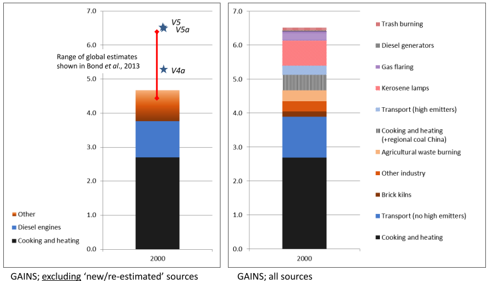
This paper presents a comprehensive assessment of historical (1990–2010) global anthropogenic particulate matter (PM) emissions including the consistent and harmonized calculation of mass-based size distribution (PM1, PM2. 5, PM10), as well as primary carbonaceous aerosols including black carbon (BC) and organic carbon (OC). The estimates were developed with the integrated assessment model GAINS, where source- and region-specific technology characteristics are explicitly included. This assessment includes a number of previously unaccounted or often misallocated emission sources, i.e. kerosene lamps, gas flaring, diesel generators, refuse burning; some of them were reported in the past for selected regions or in the context of a particular pollutant or sector but not included as part of a total estimate. Spatially, emissions were calculated for 172 source regions (as well as international shipping), presented for 25 global regions, and allocated to 0.5° × 0.5° longitude–latitude grids. No independent estimates of emissions from forest fires and savannah burning are provided and neither windblown dust nor unpaved roads emissions are included. We estimate that global emissions of PM have not changed significantly between 1990 and 2010, showing a strong decoupling from the global increase in energy consumption and, consequently, CO2 emissions, but there are significantly different regional trends, with a particularly strong increase in East Asia and Africa and a strong decline in Europe, North America, and the Pacific region. This in turn resulted in important changes in the spatial pattern of PM burden, e.g. European, North American, and Pacific contributions to global emissions dropped from nearly 30 % in 1990 to well below 15 % in 2010, while Asia's contribution grew from just over 50 % to nearly two-thirds of the global total in 2010. For all PM species considered, Asian sources represented over 60 % of the global anthropogenic total, and residential combustion was the most important sector, contributing about 60 % for BC and OC, 45 % for PM2. 5, and less than 40 % for PM10, where large combustion sources and industrial processes are equally important. Global anthropogenic emissions of BC were estimated at about 6.6 and 7.2 Tg in 2000 and 2010, respectively, and represent about 15 % of PM2. 5 but for some sources reach nearly 50 %, i.e. for the transport sector. Our global BC numbers are higher than previously published owing primarily to the inclusion of new sources. This PM estimate fills the gap in emission data and emission source characterization required in air quality and climate modelling studies and health impact assessments at a regional and global level, as it includes both carbonaceous and non-carbonaceous constituents of primary particulate matter emissions. The developed emission dataset has been used in several regional and global atmospheric transport and climate model simulations within the ECLIPSE (Evaluating the Climate and Air Quality Impacts of Short-Lived Pollutants) project and beyond, serves better parameterization of the global integrated assessment models with respect to representation of black carbon and organic carbon emissions, and built a basis for recently published global particulate number estimates.
Overview
The claims and statistics of this paper haven’t been checked yet.
Free: it reads the open-access text and checks the first 5 claims that cite a source we can check. Create a free account to check every claim.
Integrity signals
Registry
Cites
Statistics
Figures
Verification
Claims the paper makes
The claims and statistics of this paper haven’t been checked yet.
Free: it reads the open-access text and checks the first 5 claims that cite a source we can check. Create a free account to check every claim.
Claims other papers make about this one
Each is checked against this paper’s own text: does it say what the citing paper says it does?
The source backs part of the claim, not all of it — or backs it for a different population, condition or comparison.
In the citing paper
“specifically, it contributes 11% to total global particulate matter <2.5 µm (PM2.5) emissions and 6–7% to total global black carbon (BC) emissions31,32.”
From Potential for future reductions of global GHG and air pollutants from circular waste management systems (2022) · cites this paper as [32]
Experimental — accuracy not yet measuredThe source backs part of the claim, not all of it — or backs it for a different population, condition or comparison.
In the citing paper
“However, comparing CH4 emissions from MSW in the Eclipse_V5a32 to this study, we can see that the estimate in the latter is 6% higher.”
From Potential for future reductions of global GHG and air pollutants from circular waste management systems (2022) · cites this paper as [32]
Experimental — accuracy not yet measuredThe cited source says what the claim attributes to it.
In the citing paper
“In contrast, our results for particulate matter are 60% higher than those from ref. 32.”
From Potential for future reductions of global GHG and air pollutants from circular waste management systems (2022) · cites this paper as [32]
The cited source says what the claim attributes to it.
In the citing paper
“and 57% higher than the estimate of ref. 32”
From Potential for future reductions of global GHG and air pollutants from circular waste management systems (2022) · cites this paper as [32]
Self-check
Percentages, sums and reported differences re-computed from the paper’s own numbers.
The self-check needs the paper’s full text.
Citations
Cites
Lim, S. S., Vos, T., Flaxman, A. D., Danaei, G., Shibuya, K., Adair-Rohani, H., AlMazroa, M. A., Amann, M., Anderson, H. R., Andrews, K. G., et al. (2012) · The Lancet · doi:10.1016/s0140-6736(12)61766-8 · Cited by 11,805 · cited 1×
“There is well-documented evidence that exposure to PM results in adverse effects on human health (e.g., Anenberg et al., 2012; Lim et al., 2012; WHO, 2004).”
BackgroundAtmospheric Chemistry and Physics: From Air Pollution to Climate Change
Seinfeld, J. H., Pandis, S. N., & Noone, K. (1998) · Physics Today · doi:10.1063/1.882420 · Cited by 8,731
The representative concentration pathways: an overview
van Vuuren, D. P., Edmonds, J., Kainuma, M., Riahi, K., Thomson, A., Hibbard, K., Hurtt, G. C., Kram, T., Krey, V., Lamarque, J.-F., et al. (2011) · Climatic Change · doi:10.1007/s10584-011-0148-z · Cited by 7,741 · cited 1×
“The data originates from a study by Lee et al. (2009) and were used in the development of the RCPs (Van Vuuren et al., 2011).”
MethodRiahi, K., van Vuuren, D. P., Kriegler, E., Edmonds, J., O’Neill, B. C., Fujimori, S., Bauer, N., Calvin, K., Dellink, R., Fricko, O., et al. (2017) · Global Environmental Change · doi:10.1016/j.gloenvcha.2016.05.009 · Cited by 6,607
Self-citationBounding the role of black carbon in the climate system: A scientific assessment
Bond, T. C., Doherty, S. J., Fahey, D. W., Forster, P. M., Berntsen, T., DeAngelo, B. J., Flanner, M. G., Ghan, S., Kärcher, B., Koch, D., et al. (2013) · Journal of Geophysical Research: Atmospheres · doi:10.1002/jgrd.50171 · Cited by 6,385
Self-citationEmission of trace gases and aerosols from biomass burning
Andreae, M. O., & Merlet, P. (2001) · Global Biogeochemical Cycles · doi:10.1029/2000gb001382 · Cited by 3,902
(2010) · doi:10.5194/acp-10-11707-2010 · Cited by 2,859
A new scenario framework for climate change research: the concept of shared socioeconomic pathways
O’Neill, B. C., Kriegler, E., Riahi, K., Ebi, K. L., Hallegatte, S., Carter, T. R., Mathur, R., & van Vuuren, D. P. (2014) · Climatic Change · doi:10.1007/s10584-013-0905-2 · Cited by 2,716 · cited 1×
“Furthermore, elements of the ECLIPSE data have been part of the contribution towards improved representation of carbonaceous aerosols in the large-scale integrated assessment models used in the development of the shared socio-economic pathways (SSPs) (O’Neill et al., 2014; Rao et al., 2017; Riahi et al., 2017).”
MethodA technology‐based global inventory of black and organic carbon emissions from combustion
Bond, T. C., Streets, D. G., Yarber, K. F., Nelson, S. M., Woo, J., & Klimont, Z. (2004) · Journal of Geophysical Research: Atmospheres · doi:10.1029/2003jd003697 · Cited by 2,393
Self-citationLamarque, J.-F., Bond, T. C., Eyring, V., Granier, C., Heil, A., Klimont, Z., Lee, D., Liousse, C., Mieville, A., Owen, B., et al. (2010) · Atmospheric Chemistry and Physics · doi:10.5194/acp-10-7017-2010 · Cited by 2,105 · cited 2×
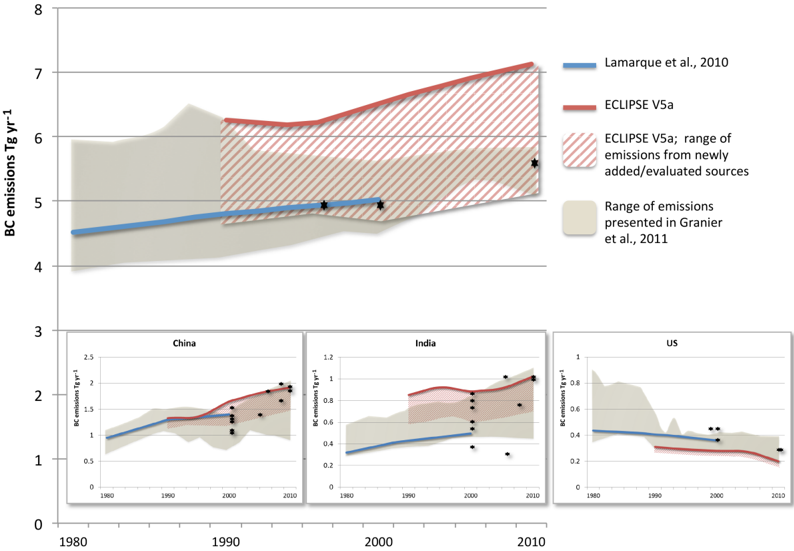
“GAINS is comparable with the RCP input (Lamarque et al., 2010) for 19901995, while for the last decade is consistently higher or at the top of the range, which in Granier et al. (2011) is”
Self-citation
Research works printed but not linked: 9
- 61. Desai, S., Dubey, A., Joshi, B. L., Sen, M., Shariff, A., and Vanne- man, R.: Human Development in India: Challenges for a Society in Transition, Oxford University Press, New Delhi, India, 2010.
- 82. GEA: Global Energy Assessment: Toward a Sustainable Future, Cambridge University Press, UK, 2012.
- 147. Lawson, D. R.: (On-Road) Mobile Source Emissions and Mitigation Potential, Workshop on Addressing Black Carbon and Ozone as Short-Lived Climate Forcers, Chapel Hill, North Carolina, US, 3-4 March 2010.
- 168. Maíz, P.: Experiencias en Medición de Emisiones en Hornos para Manufactura Artesanal de Ladrillos en Mexico, available at: http://www.inecc.gob.mx/descargas/dgcenica/2012_ladrilleras_ pon_s4_pmaiz_eng.pdf (last access: 4 July 2017), a presentation at: Workshop on public policies to mitigate environmental impact of artisanal brick production, Guanajuato, Mexico, 4-6 September 2012.
- 182. NEA: A Year in Review: Fiscal Year 2011/2012, Nepal Electricity Authority (NEA), Kathmandu, 2012.
- 219. Riahi, K., Dentener, F., Gielen, D., Grubler, A., Jewell, J., Klimont, Z., Krey, V., McCollum, D., Pachauri, S., Rao, S., van Ruijven, B., van Vuuren, D. P., and Wilson, C.: Chapter 17 -Energy Pathways for Sustainable Development, in Global Energy As- sessment -Toward a Sustainable Future, 1203-1306, Cambridge University Press, Cambridge, UK and New York, NY, USA and the International Institute for Applied Systems Analysis, Lax- enburg, Austria, available at: www.globalenergyassessment.org (last access: 4 July 2017), 2012.
- 227. Schilderman, T. and Mason, K.: Using residues as fuel in small- scale brickmaking, in Proceedings of the 11th International Con- ference on Non-conventional Materials and Technologies (NOC- MAT 2009), Bath, UK, 6-9 September 2009.
- 234. Shafizadeh, K., Niemeier, D., and Eisinger, D. S.: Gross Emit- ting Vehicles: A Review of the Literature, Caltrans Air Quality Project, US Davis, 2004.
- 270. US EPA: Compilation of Air Pollutant Emission Factors -Volume I: Stationary Point and Area Sources. AP-42 5th Edition, US Environmental Protection Agency (US EPA), Springfield, VA, 1995.
Cited by
Items 801–900 of 967
Saarikoski, S. (2021) · Atmospheric chemistry and physics · doi:10.5194/acp-2021-231-ac1
(2021) · Atmospheric chemistry and physics · doi:10.5194/acp-2021-111-rc2
McCarty, J. L., Aalto, J., Paunu, V.-V., et al. (2021) · Biogeosciences · doi:10.5194/bg-2021-83-rc3
(2021) · Geoscientific model development · doi:10.5194/gmd-2021-166-rc1
Geels, C. (2021) · Atmospheric chemistry and physics · doi:10.5194/acp-2020-1274-ac2
(2021) · Geoscientific model development · doi:10.5194/gmd-2021-201-rc1
Ge, Y. (2022) · Atmospheric chemistry and physics · doi:10.5194/acp-2022-82-ac2
Vernooij, R. (2022) · Atmospheric measurement techniques · doi:10.5194/amt-2022-77-ac1
(2022) · Atmospheric chemistry and physics · doi:10.5194/acp-2022-295-rc2
(2022) · Atmospheric chemistry and physics · doi:10.5194/acp-2022-295-rc1
Ge, Y. (2022) · Atmospheric chemistry and physics · doi:10.5194/acp-2022-82-ac1
(2022) · Atmospheric chemistry and physics · doi:10.5194/acp-2022-288-rc1
(2022) · Atmospheric chemistry and physics · doi:10.5194/acp-2022-288-rc2
Zamora, L. M. (2022) · Atmospheric chemistry and physics · doi:10.5194/acp-2022-124-ac1
Miao, J., He, C., Zhang, P., & Wei, W. (2020) · doi:10.46855/energy-proceedings-6829
(2022) · Atmospheric chemistry and physics · doi:10.5194/acp-2022-295-rc3
(2022) · Geoscientific model development · doi:10.5194/gmd-2022-103-rc2
Author response to referee comments - acp-2021-1059
Smith, S. J. (2022) · Atmospheric chemistry and physics · doi:10.5194/acp-2021-1059-ac1
Räisänen, P. (2022) · Atmospheric chemistry and physics · doi:10.5194/acp-2022-288-ac1
Räisänen, P. (2022) · Atmospheric chemistry and physics · doi:10.5194/acp-2022-288-ac2
Pricing carbon emissions reduces health inequities from air pollution exposurePreprint
Huang, X., Srikrishnan, V., Lamontagne, J., Keller, K. M., & Peng, W. (2022) · doi:10.1002/essoar.10512176.1
Pricing carbon emissions reduces health inequities from air pollution exposurePreprint
Huang, X., Srikrishnan, V., Lamontagne, J., Keller, K. M., & Peng, W. (2022) · doi:10.1002/essoar.10512176.2
Atkinson, W. (2022) · Geoscientific model development · doi:10.5194/gmd-2022-103-ac1
Quaas, J. (2022) · Atmospheric chemistry and physics · doi:10.5194/acp-2022-295-ac3
Quaas, J. (2022) · Atmospheric chemistry and physics · doi:10.5194/acp-2022-295-ac1
Quaas, J. (2022) · Atmospheric chemistry and physics · doi:10.5194/acp-2022-295-ac2
(2022) · Atmospheric chemistry and physics · doi:10.5194/acp-2022-513-rc1
(2022) · Atmospheric chemistry and physics · doi:10.5194/acp-2022-319-rc2
Alföldy, B. (2022) · Atmospheric measurement techniques · doi:10.5194/amt-2022-53-ac2
Alföldy, B. (2022) · Atmospheric measurement techniques · doi:10.5194/amt-2022-53-ac1
Author response to referee comments
Miinalainen, T. (2022) · Atmospheric chemistry and physics · doi:10.5194/acp-2022-513-ac1
(2022) · Atmospheric chemistry and physics · doi:10.5194/acp-2022-679-rc1
Whaley, C. H. (2022) · Atmospheric chemistry and physics · doi:10.5194/acp-2022-319-ac2
Reviewer Comment on acp-2022-639
(2022) · Atmospheric chemistry and physics · doi:10.5194/acp-2022-639-rc2
Lund, M. T. (2023) · Atmospheric chemistry and physics · doi:10.5194/acp-2022-639-ac2
Lund, M. T. (2023) · Atmospheric chemistry and physics · doi:10.5194/acp-2022-639-ac1
(2023) · Atmospheric chemistry and physics · doi:10.5194/acp-2022-776-rc2
(2023) · Atmospheric chemistry and physics · doi:10.5194/acp-2022-776-rc1
Belis, C. A. (2023) · Atmospheric chemistry and physics · doi:10.5194/acp-2022-776-ac1
Saleem, S., Hamid, S., Jilani, A. B., Malik, S., & Khatak, S. M. (2023) · Journal of Islamic International Medical College · doi:10.57234/jiimc.june23.1495
Heslin‐Rees, D. (2023) · doi:10.5194/egusphere-2023-940-ac1
Heslin‐Rees, D. (2023) · doi:10.5194/egusphere-2023-940-ac2
Flood, V. A. (2023) · doi:10.5194/egusphere-2023-1161-ac1
Yttri, K. E. (2023) · doi:10.5194/egusphere-2023-615-ac1
Yttri, K. E. (2023) · doi:10.5194/egusphere-2023-615-ac2
Sahu, S. K. (2023) · doi:10.5194/essd-2023-310-ac2
Comment on egusphere-2023-1194
Kangas, L. (2023) · doi:10.5194/egusphere-2023-1194-ac1
Quantifying national household air pollution (HAP) exposure to PM2.5 in rural and urban areas
Mohajeri, N., Hsu, S.-C., Milner, J., Taylor, J., Kiesewetter, G., Guðmundsson, Á., Kennard, H., Hamilton, I., & Davies, M. (2023) · Journal of Physics Conference Series · doi:10.1088/1742-6596/2600/10/102012
“The following data are used for the prediction: (i) Fuel Use and stove types [9-10]; (ii) Ambient PM 2.5 concentrations for rural and urban areas [11]; (iii) Heating degree days for rural and urban areas [12], (iv) GNI classification from World Bank [13], (v) Education index which is a component of…”
InfluentialRanjan, R. K. (2023) · doi:10.5194/egusphere-2023-702-ac2
Ranjan, R. K. (2023) · doi:10.5194/egusphere-2023-702-ac1
(2023) · Earth system science data · doi:10.5194/essd-2023-366-rc2
Basnet, S. (2024) · doi:10.5194/egusphere-2023-2228-ac3
Basnet, S. (2024) · doi:10.5194/egusphere-2023-2228-ac2
Basnet, S. (2024) · doi:10.5194/egusphere-2023-2228-ac1
Comment on egusphere-2023-2764
Kinase, T., Taketani, F., Takigawa, M., et al. (2024) · doi:10.5194/egusphere-2023-2764-cc1
Deng, Y. (2024) · doi:10.5194/egusphere-2023-2315-ac6
PM 2.5 emission from the coal combustion in the Polish residential sector. State and outlooks
Zasina, D., & Kargulewicz, I. (2023) · Ochrona Środowiska i Zasobów Naturalnych · doi:10.2478/oszn-2023-0019
Velazquez-Garcia, A. (2024) · Aerosol Research · doi:10.5194/ar-2024-5-ac1
Velazquez-Garcia, A. (2024) · Aerosol Research · doi:10.5194/ar-2024-5-ac2
Menut, L. (2024) · Wiley eBooks · doi:10.1002/9781394284191.refs
Твердые продукты захвата NO2 и O3 на покрытии из метановой сажи
Eganov, A. A., Кардонский, Д. А., Сулименков, И. В., Козловский, В. И., Aparina, E. V., & Zelenov, V. V. (2023) · Химическая физика · doi:10.31857/s0207401x23040064
Qiu, H. (2024) · Applied and Computational Engineering · doi:10.54254/2755-2721/58/20240730
Air Pollution as a Risk Factor Affecting Human Health and Economic Costs
(2024) · Frontiers research topics · doi:10.3389/978-2-8325-4914-8
Velasco, E., Retama, A., & Stratoulias, D. (2024) · SpringerBriefs in earth system sciences · doi:10.1007/978-3-031-69088-4_6
Nuclear Waste Tank Emission Contributions to Particle Size Distribution
Matthews, B. H., & Noble, S. (2025) · Health Physics · doi:10.1097/hp.0000000000001952
The Environmental Evaluation of the Sp. Opi – Babatan Saudagar – Srijabo Road
Armo, A. A. S., Wijaya, H., Sutejo, Y., Saloma, Juniah, R., & Fathunnisa (2025) · Cantilever Jurnal Penelitian dan Kajian Bidang Teknik Sipil · doi:10.35139/cantilever.v13i2.345
Study on black carbon concentrations and potential sources across DKI Jakarta during the wet season
Qatrunnada, K. M., Abdillah, H., & Lestari, P. (2025) · IOP Conference Series Earth and Environmental Science · doi:10.1088/1755-1315/1448/1/012005
Ren, J., Wang, H., Tan, Y., Wang, W., Zhu, B., Zhao, T., Lin, W., Liu, D., Shen, L., & Shi, S. (2025) · Atmospheric Research · doi:10.1016/j.atmosres.2025.108067
Temmerman, G. D. (2022) · EDP Sciences eBooks · doi:10.3917/edp.colle.2022.01.0053
Climate Change Impacts on Occupational Toxins, and Its Health Effects
Saad‐Hussein, A., Samir, A. M., Zawilla, N. H., Amr, M. M., Al-Batanony, M. A., Zayet, H. H., Mahdy-Abdallah, H., & Fouad, M. M. (2025) · Springer eBooks · doi:10.1007/978-981-96-3416-3_3 · Cited by 1
Gadhavi, H. (2025) · Atmospheric measurement techniques · doi:10.5194/amt-2024-167-ac2
Mishra, M., Das, T., & Boopathy, R. (2025) · Springer eBooks · doi:10.1007/978-3-031-84408-9_11
Bouchriti, Y., Haddou, M. A., Achbani, A., Rida, J., Sine, H., Lkoul, A., & Kabbachi, B. (2025) · E3S Web of Conferences · doi:10.1051/e3sconf/202563201009
The effects of anthropogenic dust on fine particulate matter in Beijing-Tianjin-Hebei region
Lv, J., Mao, Y., & Liao, H. (2025) · Atmospheric Pollution Research · doi:10.1016/j.apr.2025.102701
Frohn, L. M., Bak, J. L., Brandt, J. G., Christensen, J. H., Gyldenkærne, S., & Geels, C. (2025) · Atmosphere · doi:10.3390/atmos16080966
Mbienda, A. J. K., Lontio, S. L. M., Guenang, G. M., Yemih, P. D., & Vondou, D. A. (2025) · International Journal of Climatology · doi:10.1002/joc.70103
“5 dust emission module, while for car-bonaceous and sulphate aerosols, emission inventories are the Evaluation of short-lived pollutants' impacts on climate and air quality (EECLIPSE, Klimont et al. (2017)).”
Wei-si, J., Shao-fei, K., Yingying, Y., Wu, J. F., & Huang, Z. (2025) · Earth Science-Journal of China University of Geosciences · doi:10.3799/dqkx.2025.170
Tikka, A. (2025) · Dissertationes Forestales · doi:10.14214/df.378
The Effects of Particulate Matter on Global Crop Yields
Wolffe, M. (2023) · Lancaster EPrints (Lancaster University) · doi:10.17635/lancaster/thesis/2189
Papanikolaou, C.-A. (2023) · DSpace - NTUA (National Technical University of Athens) · doi:10.26240/heal.ntua.24985
Constraining black carbon emission inventories with observations
Sun, T. (2019) · Illinois Digital Environment for Access to Learning and Scholarship (University of Illinois at Urbana-Champaign)
Sirovátka, J. (2018) · DSpace VŠB-TUO (VŠB-TUO)
Air Pollution in Asia and the Pacific. Science-based solutions
Mar, K. A. (2019) · Publication Database GFZ (GFZ German Research Centre for Geosciences)
Schmidt, C. A. (2020) · Unipub UB Graz (Universität Graz)
Anthropogenic emissions and uncertainties of GHGs and BC: Deliverable 2.8
Winiwarter, W., Lindl, F., Kaltenegger, K., Warnecke, L., Höglund-Isaksson, L., Gomez Sanabria, A., Purohit, P., & Klimont, Z. (2024) · IIASA PURE (International Institute of Applied Systems Analysis) · Cited by 1
Self-citationRathod, S. D., Pierce, J. R., Bond, T. C., Denning, A. S., Fischer, E. V., & Scott, R. P. (2022) · Digital Collections of Colorado (Colorado State University) · doi:10.25675/3.05204
Metadata
- Authors
- Klimont, Z., Kupiainen, K., Heyes, C., Purohit, P., Cofala, J., Rafaj, P., Borken-Kleefeld, J., & Schöpp, W.
- Affiliations
- International Institute for Applied Systems Analysis (AT)
- Corresponding author
- Klimont, Zbigniew
- Venue
- Atmospheric Chemistry and Physics
- Publisher
- Copernicus GmbH
- Published
- 2017-07-17
- Volume
- 17
- Issue
- 14
- Pages
- 8681-8723
- ISSN
- 1680-7316 (ISSN-L)
- 1680-7324
- OpenAlex
- W2537132227
- Cited by
- 878
- References
- 226
- Citations by year
- 2026: 59 · 2025: 84 · 2024: 80 · 2023: 108 · 2022: 143 · 2021: 165 · 2020: 90 · 2019: 65 · 2018: 48 · 2017: 26
- FWCI
- 36.31
- Type
- journal article
- Language
- en
- Open access
- gold
- doi.org
- Licence
- Locations
- Atmospheric chemistry and physics (publishedVersion, cc-by)
- IIASA PURE (International Institute of Applied Systems Analysis) (acceptedVersion)
- IIASA PURE (International Institute of Applied Systems Analysis) (submittedVersion)
- DOAJ (DOAJ: Directory of Open Access Journals) (submittedVersion, cc-by-sa)
- Zenodo (CERN European Organization for Nuclear Research) (submittedVersion, cc-by)
- Funders
- Seventh Framework Programme (282688)
- Topics
- Physical Sciences › Earth and Planetary Sciences › Atmospheric Science › Atmospheric chemistry and aerosols
- Physical Sciences › Environmental Science › Health, Toxicology and Mutagenesis › Air Quality and Health Impacts
- Physical Sciences › Environmental Science › Environmental Engineering › Maritime Transport Emissions and Efficiency
- Keywords
- black carbon, organic carbon, PM2.5, PM10, PM1, size distribution, residential combustion, kerosene lamps, gas flaring, diesel generator, waste burning, GAINS model, East Asia
About these checks
Registry, retraction, Cites and statistics results are computed, not judged, with one exception: a printed reference that no index lists is read once by a model before it counts as a citation error. Claims are extracted by a model and kept only when their quote appears verbatim in the text; each cited source is then checked, with a model’s help, for whether it says what the claim relies on. Those verdicts can be wrong — read the claim’s quote and the cited source before relying on one.
Statistics and arithmetic are recomputed, not judged.
Confidence bands are shown only for fields calibrated on our annotated test set. None is calibrated yet, so no band is shown.
What counts as a claim ›How we measure confidence ›How we check this ›
Are you an author, or do you see a problem with this page? Request a review
Data sources
Bibliographic data: Semantic Scholar, OpenAlex, Crossref.
Contains information from the Semantic Scholar Academic Graph Datasets, made available under the ODC Attribution License (ODC-BY 1.0).
Semantic Scholar’s data is described in: Kinney, R., et al. (2023). The Semantic Scholar Open Data Platform. arXiv:2301.10140.
