

Physical and chemical characterization of biochars derived from different agricultural residues
Open accessPublished version of a preprint
The DOI matches its Crossref record; 55 of the 55 references it cites were found in a registry or an index.
Abstract
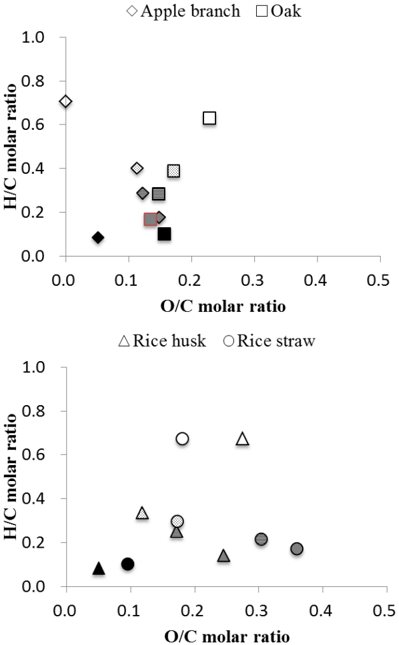
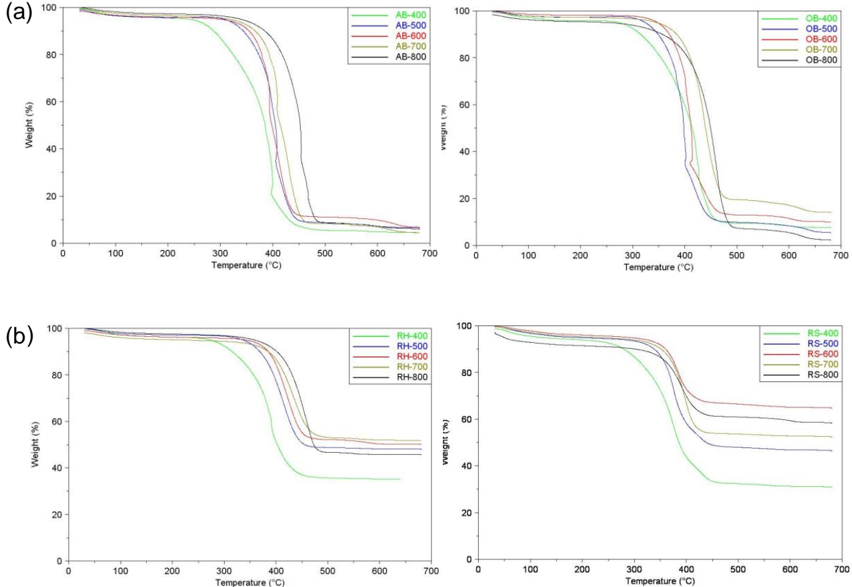
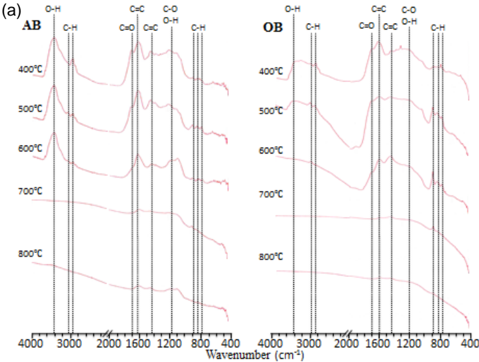
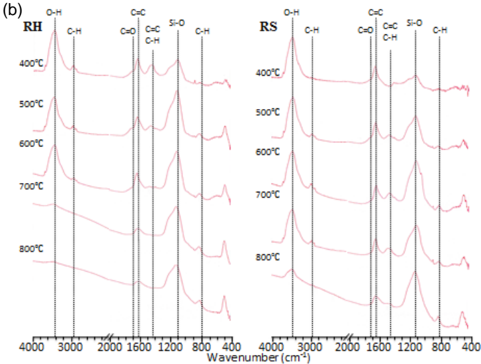
Biochar is widely recognized as an efficient tool for carbon sequestration and soil fertility. The understanding of its chemical and physical properties, which are strongly related to the type of the initial material used and pyrolysis conditions, is crucial to identify the most suitable application of biochar in soil. A selection of organic wastes with different characteristics (e.g., rice husk (RH), rice straw (RS), wood chips of apple tree (Malus pumila) (AB), and oak tree (Quercus serrata) (OB)) were pyrolyzed at different temperatures (400, 500, 600, 700, and 800 °C) in order to optimize the physicochemical properties of biochar as a soil amendment. Low-temperature pyrolysis produced high biochar yields; in contrast, high-temperature pyrolysis led to biochars with a high C content, large surface area, and high adsorption characteristics. Biochar obtained at 600 °C leads to a high recalcitrant character, whereas that obtained at 400 °C retains volatile and easily labile compounds. The biochar obtained from rice materials (RH and RS) showed a high yield and unique chemical properties because of the incorporation of silica elements into its chemical structure. The biochar obtained from wood materials (AB and OB) showed high carbon content and a high absorption character.
Overview
The claims and statistics of this paper haven’t been checked yet.
Free: it reads the open-access text and checks the first 5 claims that cite a source we can check. Create a free account to check every claim.
Integrity signals
Registry
Cites
Statistics
Figures
Verification
Claims the paper makes
The claims and statistics of this paper haven’t been checked yet.
Free: it reads the open-access text and checks the first 5 claims that cite a source we can check. Create a free account to check every claim.
Claims other papers make about this one
Each is checked against this paper’s own text: does it say what the citing paper says it does?
The source backs part of the claim, not all of it — or backs it for a different population, condition or comparison.
In the citing paper
“Higher temperatures, such as above 500 °C, produce biochar with a high C content, lower volatile matter, higher pH, large specific surface area and higher micropore volume.”
From Comparing straw, compost, and biochar regarding their suitability as agricultural soil amendments to affect soil structure, nutrient leaching, microbial communities, and the fate of pesticides (2021) · cites this paper as Jindo et al., 2014
Experimental — accuracy not yet measuredThe cited source says what the claim attributes to it.
In the citing paper
“The pyrolysis temperature is strongly correlated with changes in the structure and physicochemical properties of biochar”
From Biochar physicochemical properties: pyrolysis temperature and feedstock kind effects (2020) · cites this paper as Jindo et al. 2014
Self-check
Percentages, sums and reported differences re-computed from the paper’s own numbers.
The self-check needs the paper’s full text.
Citations
Cites
Characteristics of hemicellulose, cellulose and lignin pyrolysis
Yang, H., Yan, R., Chen, H., Lee, D. H., & Zheng, C. (2007) · Fuel · doi:10.1016/j.fuel.2006.12.013 · Cited by 8,155 · cited 1×
“Yang et al. (2007) and Khodadad et al. (2011) found that the biochar derived from wood Biogeosciences, 11, 6613–6621, 2014 www.biogeosciences.net/11/6613/2014/ Fig.”
BackgroundBiochar effects on soil biota – A review
Lehmann, J., Rillig, M. C., Thies, J., Masiello, C. A., Hockaday, W. C., & Crowley, D. (2011) · Soil Biology and Biochemistry · doi:10.1016/j.soilbio.2011.04.022 · Cited by 5,074
The forms of alkalis in the biochar produced from crop residues at different temperatures
Yuan, J.-H., Xu, R.-K., & Zhang, H. (2011) · Bioresource Technology · doi:10.1016/j.biortech.2010.11.018 · Cited by 2,029
Lehmann, J. (2007) · Frontiers in Ecology and the Environment · doi:10.1890/1540-9295(2007)5[381:bitb]2.0.co;2 · Cited by 1,714
Beesley, L., Moreno-Jiménez, E., Gomez-Eyles, J. L., Harris, E., Robinson, B., & Sizmur, T. (2011) · Environmental Pollution · doi:10.1016/j.envpol.2011.07.023 · Cited by 1,610 · cited 2×
“In addition to the studies on the use of biochar for carbon sequestration, a number of reports have focused on alternative applications of biochar for the improvement of soil fertility, plant growth, and decontamination of pollutants such as pesticides, heavy metals, and hydrocarbons (Beesley et al., 2011; Cabrera et…”
BackgroundPositive and negative carbon mineralization priming effects among a variety of biochar-amended soils
Zimmerman, A. R., Gao, B., & Ahn, M.-Y. (2011) · Soil Biology and Biochemistry · doi:10.1016/j.soilbio.2011.02.005 · Cited by 1,438
Review of the stability of biochar in soils: predictability of O:C molar ratios
Spokas, K. A. (2010) · Carbon Management · doi:10.4155/cmt.10.32 · Cited by 1,160
Characterization of biochars to evaluate recalcitrance and agronomic performance
Enders, A., Hanley, K., Whitman, T., Joseph, S., & Lehmann, J. (2012) · Bioresource Technology · doi:10.1016/j.biortech.2012.03.022 · Cited by 1,113 · cited 3×
“Among the different biochar types, woody biochars (AB and OB) showed a larger change in the volatile content from 400 to 800 ◦C than non-woody biochars (RS and RH), as previously observed (Enders et al., 2012).”
BackgroundResultInfluentialEffect of Low-Temperature Pyrolysis Conditions on Biochar for Agricultural Use
Gaskin, J. W., Steiner, C., Harris, K., Das, K. C., & Bibens, B. (2008) · Transactions of the ASABE · doi:10.13031/2013.25409 · Cited by 1,015
Characterisation and evaluation of biochars for their application as a soil amendment
Singh, B., Singh, B. P., & Cowie, A. L. (2010) · Soil Research · doi:10.1071/sr10058 · Cited by 991 · cited 2×
“that of wood (Eucalyptus) biochar (Singh et al., 2010), while the treatment of soil with woodchip biochar results in higher saturated hydraulic conductivities than that treated with manure-based biochar (Lei and Zhang, 2012).”
Background
Cited by
Items 901–958 of 958
Evaluating Nitrogen and Phosphorus Dynamics Influenced by Animal Manure Biochar in Eutric Cambisol
Dzvene, A. R., Chiduza, C., & Mnkeni, P. N. S. (2026) · Journal of soil science and plant nutrition · doi:10.1007/s42729-026-03092-0
Sembodo, B. S. T., Isyatirrodhiyah, K., & Salsabila, V. (2026) · Advanced materials research · doi:10.4028/p-eo5upo
Abolodje, O. D., Egbuchunam, T. O., Fayomi, C., Okieimen, F. E., Okuo, J., & Oyovwi, S. (2026) · Springer eBooks · doi:10.1007/978-3-032-10614-8_7
Gupta, S. S., Prasad, R., Chakraborty, D., & Ray, P. (2026) · Frontiers in Environmental Chemistry · doi:10.3389/fenvc.2026.1773001
Технический анализ биоугля, полученного из жмыха масличного рапса
Волков, Д. М., & Попов, А. М. (2026) · Izvestia Orenburg State Agrarian University
AMEWOUAME, K. J.-M., Kaga, T. T., & N., S. K. (2026) · Journal of Applied and Natural Science · doi:10.31018/jans.v18i1.7261
Tarnpradab, T. (2016) · Institutional Repositories DataBase (IRDB)
Chauhan, P. K., Tomar, S., Srivastava, S., Chaturvedi, A., Sikarwar, R. L. S., Singh, B., & Kozma, D. E. (2026) · Springer eBooks · doi:10.1007/978-3-032-16746-0_7
Etude des procédés de sorption des métaux lourds par le biochar
Mannaï, I. (2021) · theses.fr (ABES) · doi:10.70675/0b8ca984zc9bdz437azac8az6a9b4fd1a43e
din, M. M. U., Qayyum, M. F., Alghanem, S. M. S., Rizwan, M., Alhaithloul, H. A. S., Amin, M. A., & Rehman, R. A. (2026) · International Journal of Phytoremediation · doi:10.1080/15226514.2026.2659861
Chhaya, Bag, R., & Narayan, O. P. (2026) · Chemical Engineering Science · doi:10.1016/j.ces.2026.124076
Gizaw, A., Gonfa, T., Hailu, A. A., Adeniyi, O. D., & Goli, J. (2026) · Euro-Mediterranean Journal for Environmental Integration · doi:10.1007/s41207-026-01141-9
Biochar sustainable aspects in agriculture and environment
Sahoo, D. K., Satish, M., Nampoothiri, N. K., & Maity, S. (2026) · Elsevier eBooks · doi:10.1016/b978-0-443-29865-3.00012-1
Kommarla, R., Narale, P. D., & Seveda, M. S. (2026) · Biomass Conversion and Biorefinery · doi:10.1007/s13399-026-07167-x
The effect of different growing media on the nutritional values and growing of edible flowers
Yılmaz, G. (2026) · BMC Plant Biology · doi:10.1186/s12870-026-09005-8
Baba, M. E., Nartey, E. K., Dowuona, G. N., Abekoe, M. K., Yeboah, E., Akumah, A. M., & Eduah, J. O. (2026) · Environmental Progress & Sustainable Energy · doi:10.1002/ep.70425
Murda, R. A., Pasaribu, T. V. U. B., Wahyuningrum, M., Zen, M. R., Maulana, S., Rinaldi, N., Maulana, M. I., Munawaroh, K., Lizardi, F., & Faedloni, A. A. S. (2026) · Molekul · doi:10.20884/1.jm.2026.21.1.14411
SAH, U., & Manjhi, J. (2026) · International Journal For Multidisciplinary Research · doi:10.36948/ijfmr.2026.v08i03.80718
Ncibi, C., Sanz, F. J. E., Pozzobon, V., & Lâjili, M. (2026) · Chemistry Africa · doi:10.1007/s42250-026-01742-5
Al-Hadhrami, A., Blackburn, D., Al-Wardy, M., Janke, R. R., & Al‐Ismaily, S. (2026) · Journal of soil science and plant nutrition · doi:10.1007/s42729-026-03182-z
Experimental and Machine Learning-Based Assessment of Thermal Conductivity in Biochar-Amended Soils
Ramineni, S. K. A., Song, Z., Tiwary, K., Garg, A., Satyam, N. D., & Zhussupbekov, A. (2026) · Indian geotechnical journal · doi:10.1007/s40098-026-01572-9
Influence of Reaction Temperature and Heating Rate on the Pyrolysis Products of Rice Husk
Sen, R., Ko, H., Choi, J., Back, S., & Oh, S. C. (2026) · Applied Sciences · doi:10.3390/app16136683
Hilda, P. S. (2026) · Digilib Repository Unila (Lampung University)
Exploring the Role of Rice Straw Biochar in Sustainable Agriculture and Environmental Health
Upadhayay, H., Gupta, S., Jain, S., & Solanki, M. (2026) · Nature Environment and Pollution Technology · doi:10.46488/nept.2026.v25i03.b4399
Alipoursarbani, M., Asadi, H., & Abendroth, C. (2026) · The Science of The Total Environment · doi:10.1016/j.scitotenv.2026.182041
Biochar for Improving Soil Quality and Carbon Cycling
Islam, M. Z. A., Aonti, A. J., Sabikunnahar, Sohel, M. M. K., & Hossain, A. (2026) · Springer eBooks · doi:10.1007/978-3-032-19855-6_3
Ratanakul, S. (2026) · International Journal of Agriculture and Nutrition · doi:10.33545/26646064.2026.v8.i5a.712
Parmar, P., & Meikap, B. C. (2026) · BioEnergy Research · doi:10.1007/s12155-026-11040-0
da Silva, M. R. F., de Queiroz, M. E. L. R., Neves, A. A., da Silva, A. A., Oliveira, A. F., Miranda, L. D. L., Souza, R. A. R., Rodrigues, A. A. Z., & da Rocha, J. G. (2026) · Processes · doi:10.3390/pr14162626
Mendes, K. F., & de Sousa, R. N. (2026) · Directory of Open access Books (OAPEN Foundation)
Thennakoon, T. M. D. G., Awanthi, M. G. G., Dissanayaka, N. S., Udumann, S. S., Nuwarapaksha, T. D., & Atapattu, A. J. (2026) · Frontiers in Sustainable Food Systems · doi:10.3389/fsufs.2026.1899786
Modeling and analysis of oil-palm biomass (opb) pyrolysis
Ayesh, Q. D. Y. (2022) · UMP Institutional Repository (Universiti Malaysia Pahang)
ジゾクテキ ナ イナサク ノ タメノ モミガラ スミチュウ ノ ケイソ カキュウセイ ノ キョウカ
Olanrewaju, J. S., & オランレワジュ, ジ. セ. (2024) · Institutional Repositories DataBase (IRDB)
Rounas, R., Laurén, A., Pumpanen, J., & Palviainen, M. (2026) · GCB Bioenergy · doi:10.1111/gcbb.70180
Letsoalo, L. M., Mugwedi, L., & Moyo, H. P. (2026) · Environmental Quality Management · doi:10.1002/tqem.70460
Namee, J., Maruekaratinplang, S., Putthasri, V., & Chotbancha, E. (2025) · Agriculture & Technology RMUTI Journal
บุตรนันท์, ส., ดวงภักดี, จ., ชั้นน้อย, เ., ทิมสุกใส, พ., ทุมแสน, บ., & วิตยากร, ป. (2019) · Journal of Science and Technology, Ubon Ratchathani University
Micro- and nano-engineering of porous biochar/activated carbon from Calotropis gigantea leaves
Sahu, A., Kumar, A., Saha, P., Sen, S., & Mishra, S. C. (2026) · Elsevier eBooks · doi:10.1016/b978-0-443-33553-2.00012-6
19F NMR as a tool for the rapid evaluation of PFAS removal with activated carbon
Felix, E. G. (2026) · Nottingham ePrints (University of Nottingham)
Isnainiyah, N. S., Nelumbium, T. P., Wijaksana, F. F., Andreas, P., & Nurdian, Y. (2023) · Jurnal Abditani
Sekhar, M. (2025) · American Journal of AI Digital Transformation and Regenerative Pharmacist
Jayarathna, N., Dharmakeerthi, R. S., & Igalavithana, A. D. (2026) · Journal of the National Science Foundation of Sri Lanka · doi:10.4038/jnsfsr.v54i3.12704
Maldou, C., Tsamoutsoglou, K., Ghadraoui, A. E., Kurniawan, T. A., Badi, N., Alghamdi, S. A., Alsharari, A. M., Almasoudi, A. S., Aldosari, F. M., Manfo, T. A., et al. (2026) · Frontiers in Sustainable Food Systems · doi:10.3389/fsufs.2026.1941820
Bivareh, M., Mahmoudi, N., Younesi, H., & Safari, O. (2026) · Scientific Reports · doi:10.1038/s41598-026-76192-7
Islamova, S. I., Karaeva, J. V., Timofeeva, S. S., Марфин, Е. А., Marfin, M., Mishina, N. N., Анатольевна, Т. С., Semenov, E. I., & Mingaleev, D. N. (2026) · Molecules · doi:10.3390/molecules31203717
What feedstock controls in biochar: mineral content and composition rather than carbon aromaticity
Tiwary, K., Garg, A., Boi, F., Yuan, L., & Sang, G. (2026) · Materials chemistry and physics. · doi:10.1016/j.macse.2026.100090
Dagium, V. G., PABIONA, M. G., Alovera, C. S., & Melencion, A. (2026) · International Journal of Scientific and Research Publications · doi:10.29322/ijsrp.16.09.2026.p17726
Petersen, H. I., Anand, A., Kaushal, P., Jakobsen, R., Blinkenberg, K. H., Rudra, A., & Sanei, H. (2026) · International Journal of Coal Geology · doi:10.1016/j.coal.2026.105128
Role of biochar in climate change mitigation: A comprehensive review
Chutia, M., Doley, K., Chamuah, B., Patgiri, D., Gogoi, B., Goswami, P., Chamuah, R., Ingti, T., Paswan, H., Thakur, B., et al. (2026) · International Journal of Research in Agronomy · doi:10.33545/2618060x.2026.v9.i10si.7070
Olawore, A. S., Oladosu, K. O., Wong, K. Y., Kareem, M. W., Kolawole, M. Y., Saidu, N. S., & Adesope, W. A. (2026) · BioEnergy Research · doi:10.1007/s12155-026-11069-1
Zhou, H., Guo, J., Wang, J., & Liu, H. (2026) · Frontiers in Plant Science · doi:10.3389/fpls.2026.1801904
Gao, Y., Fei, L., Shen, F., Peng, Y., Jiang, Y., Fan, Q., & Zhou, Y. (2026) · European Journal of Agronomy · doi:10.1016/j.eja.2026.128412
Development of a green reductant for high-temperature smelting
Velde, K. (2025) · Boloka Institutional Repository (North-west University)
Hidayat, W., Amelia, F. M., Prasetia, H., Febryano, I. G., Park, B., & Haryanto, A. (2026) · Lesnoy Zhurnal (Forestry Journal) · doi:10.37482/0536-1036-2026-5-152-166
Rossi, L., Ceciliani, F., & Reggi, S. (2025) · Archivio Istituzionale della Ricerca (Universita Degli Studi Di Milano)
Fallah, N., Pang, Z., Lin, Z., Lin, W., Mbuya, S. N., Abubakar, A. Y., Fabrice, K. M. A., & Zhang, H. (2023) · doi:10.3389/fpls.2023.1271490.s008
Metadata
- Authors
- Jindo, K., Mizumoto, H., Sawada, Y., Sanchez-Monedero, M. A., & Sonoki, T.
- Affiliations
- Consejo Superior de Investigaciones Científicas (ES)
- Hirosaki University (JP)
- Institute of Industrial Science, The University of Tokyo (JP)
- Corresponding author
- Jindo, K.
- Venue
- Biogeosciences
- Publisher
- Copernicus GmbH
- Published
- 2014-12-01
- Volume
- 11
- Issue
- 23
- Pages
- 6613-6621
- ISSN
- 1726-4170 (ISSN-L)
- 1726-4189
- OpenAlex
- W2144553596
- Cited by
- 822
- References
- 54
- Citations by year
- 2026: 64 · 2025: 80 · 2024: 83 · 2023: 87 · 2022: 82 · 2021: 98 · 2020: 116 · 2019: 72 · 2018: 64 · 2017: 43 · 2016: 25 · 2015: 8
- FWCI
- 13.15
- Type
- journal article
- Language
- en
- Open access
- gold
- doi.org
- Licence
- Locations
- Biogeosciences (publishedVersion, cc-by)
- DIGITAL.CSIC (Spanish National Research Council (CSIC)) (submittedVersion, cc-by)
- DOAJ (DOAJ: Directory of Open Access Journals) (submittedVersion, cc-by-sa)
- Funders
- Japan Society for the Promotion of Science
- Consejo Superior de Investigaciones Científicas
- Topics
- Physical Sciences › Energy › Fuel Technology › Thermochemical Biomass Conversion Processes
- Life Sciences › Agricultural and Biological Sciences › Soil Science › Soil Carbon and Nitrogen Dynamics
- Physical Sciences › Environmental Science › Water Science and Technology › Adsorption and biosorption for pollutant removal
- Keywords
- biochar, agricultural residues, pyrolysis temperature, rice husk, rice straw, oak wood chips, soil amendment, carbon sequestration, biochar yield, surface area, adsorption, recalcitrant carbon, silica incorporation, organic waste valorization
About these checks
Registry, retraction, Cites and statistics results are computed, not judged, with one exception: a printed reference that no index lists is read once by a model before it counts as a citation error. Claims are extracted by a model and kept only when their quote appears verbatim in the text; each cited source is then checked, with a model’s help, for whether it says what the claim relies on. Those verdicts can be wrong — read the claim’s quote and the cited source before relying on one.
Statistics and arithmetic are recomputed, not judged.
Confidence bands are shown only for fields calibrated on our annotated test set. None is calibrated yet, so no band is shown.
What counts as a claim ›How we measure confidence ›How we check this ›
Are you an author, or do you see a problem with this page? Request a review
Data sources
Bibliographic data: Semantic Scholar, OpenAlex, Crossref.
Contains information from the Semantic Scholar Academic Graph Datasets, made available under the ODC Attribution License (ODC-BY 1.0).
Semantic Scholar’s data is described in: Kinney, R., et al. (2023). The Semantic Scholar Open Data Platform. arXiv:2301.10140.
