

A Review on Competency-Based Succession Planning at Higher Education Institution in Malaysia
Open accessThe DOI matches its Crossref record; 53 of the 58 references it cites were found in a registry or an index; 1 of the 51 sources its claims cite were checked for support.
Abstract
This conceptual paper highlights the necessity to have a proper workforce and succession planning in place in order to have the right leadership in the right place at the right time. Leaders who are incompetent or exhausted may impose adverse impacts on the effectiveness of succession planning. Nowadays, leaders face complex challenges than those in the past with increasing workloads and responsibilities to ensure that organisational agendas are sustained. Competent and skilled leaders are needed to carry out this task. Therefore, an organisation should be proactive and strategise for future performance through succession planning. This study proposes a model of competency-based succession planning in higher education institutions by reviewing the literature that focuses on the relationship between individual competency, training, personality trait, and organisational culture.
Overview
CoChat Summary
## TL;DR
This is a conceptual literature review proposing a competency-based succession planning framework for Malaysian higher education institutions. It argues that succession planning effectiveness depends heavily on individual competency, with training, personality traits, and organisational culture shaping the talent pool.
## Key findings
- The paper identifies individual competency as central to succession planning in higher education, especially for identifying and selecting talent for leadership pipelines.
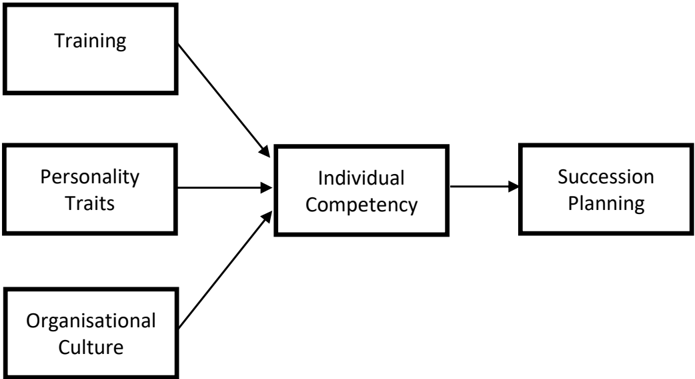
- It proposes a framework in which individual competency mediates the relationship between training, personality characteristics, and organisational culture and succession planning.
- The paper states that AKEPT has identified five leadership competency groups: personnel effectiveness, cognitive, leadership, impact and influence, and achievements and actions.
- It reports that Malaysia’s public higher education sector has 136 key leadership positions in total: 88 Vice Chancellor & Deputy Vice Chancellor, 1 Director General of Higher Education Department, 2 Deputy Director General of Higher Education Department, 1 Director General of Polytechnic & Community Colleges, 4 Deputy Director General of Polytechnic & Community Colleges, 20 Registrar, and 20 Bursar.
## Methods
- Design: Conceptual paper / literature review; it “reviews studies in the literature” related to individual competency and succession planning.
- Data/sample: No original sample or dataset; the paper synthesizes prior studies on succession planning, competencies, training, personality traits, and organisational culture.
- Analysis: Narrative review and conceptual integration, leading to a proposed competency-based succession planning model.
## Limitations
- The paper does not report any original empirical data, sample size, or statistical tests; this is evident from the text.
- It does not present an explicit limitations section; this is evident from the text.
- Because it is a conceptual review, its conclusions are based on literature synthesis rather than direct measurement of outcomes; this is evident from the text.
Model-written summary. Check it against the paper before relying on it.
Integrity signals
Registry
Cites
Statistics
Figures
Verification
Claims the paper makes
1 Valid · 0 Not valid · 36 Not checked · 11 Own results and interpretations
Every source the paper cites for this claim was checked and supports it.
In the paper
“AKEPT has identified the required framework of higher education leadership competencies (Mohamed Jais et al., 2021). The competencies consist of five main groups: (1) personnel effectiveness, (2) cognitive, (3) leadership, (4) impact and influence, and (5) achievements and actions.”
What the sources say
- Supportedcites Mohamed Jais et al., 2021 matched to “Talent Management in Higher Education Institutions: Developing Leadership Competencies” (2021) source
The Findings section states that 'AKEPT have identified that the higher education leadership competency framework consists of five main clusters: personnel effectiveness, cognition, leading, impact and influence, and achievement and action', matching the claim's five groups (the citing wording 'cognitive', 'leadership', 'achievements and actions' is a light paraphrase of 'cognition', 'leading', 'achievement and action'). The Abstract and Conclusion repeat the same five clusters, and Section 3.1 confirms AKEPT as the setting whose Leadership Competency and Instrument Committee derived them via focus group discussion and interviews. (LLM, conf=0.92)
plain- Asserted: passes — The authors put it forward as true.
- Checkable: passes — It can be checked against evidence.
- Load-bearing: passes — The paper’s conclusions depend on it.
- Based: passes — The paper gives a reason why it holds.
- Supported
In the paper
“Based on the Administrators in Higher Education Annual Report (CUPA-HR, 2019), the median age for each category of university leaders is more than 50 years.”
What the sources say
- Not matchedcites CUPA-HR, 2019
An author–year citation the paper’s reference list doesn’t settle. We don’t search these by name.
plain- Asserted: passes — The authors put it forward as true.
- Checkable: passes — It can be checked against evidence.
- Load-bearing: passes — The paper’s conclusions depend on it.
- Based: passes — The paper gives a reason why it holds.
- Not matched
None of the sources cited for this claim could be matched to a paper, so there is nothing to check it against.
In the paper
“However, the emphasis on succession planning is inconsistent in public sector organisations and higher education (Bano, 2018; Jaladdin, 2009).”
What the sources say
- Not matchedcites Bano, 2018
An author–year citation the paper’s reference list doesn’t settle. We don’t search these by name.
- Not matchedcites Jaladdin, 2009
An author–year citation the paper’s reference list doesn’t settle. We don’t search these by name.
plain- Asserted: passes — The authors put it forward as true.
- Checkable: passes — It can be checked against evidence.
- Load-bearing: passes — The paper’s conclusions depend on it.
- Based: passes — The paper gives a reason why it holds.
- Not matched
In the paper
“Given the departure of the baby boomer generation in higher education, specifically in community colleges, this situation is predictive of an alarming leadership gap (Claybourne et al., 2020).”
What the sources say
- Not matchedcites Claybourne et al., 2020
An author–year citation the paper’s reference list doesn’t settle. We don’t search these by name.
plainstates an association- Asserted: passes — The authors put it forward as true.
- Checkable: passes — It can be checked against evidence.
- Load-bearing: passes — The paper’s conclusions depend on it.
- Based: passes — The paper gives a reason why it holds.
- Not matched
In the paper
“Having effective succession planning in place can significantly reduce the risk operational instability and organization performance during leadership transition, particularly when it comes to strategic issues in education, as far as appointing the rightful candidate to hold academic manager positions is concerned. This usually happens at the end of tenure, long absence, or appointment vacancy (Ab”
What the sources say
- Not checked — no full text of the sourcecites Abdullah et al., 2009 matched to “Succession Planning in Malaysian Institution of Higher Education” (2009) source
plainstates a cause- Asserted: passes — The authors put it forward as true.
- Checkable: passes — It can be checked against evidence.
- Load-bearing: passes — The paper’s conclusions depend on it.
- Based: passes — The paper gives a reason why it holds.
15 more claims
Create a free account to see all 48 claims and to verify the 5 references still open.
- Probably not a substantial claim. 18
- It may state two separate claims as one. 18
Citations
Cites
KRISTOF, A. L. (1996) · Personnel Psychology · doi:10.1111/j.1744-6570.1996.tb01790.x · Cited by 4,831 · cited 2×
“With the complementary approach, employees provide skills, knowledge, and abilities needed by employers, while employers provide resources and opportunities to employees (Kristofbrown et al., 2005; Kristof, 1996).”
BackgroundPersonality trait structure as a human universal.
McCrae, R. R., & Costa, P. T. (1997) · American Psychologist · doi:10.1037/0003-066x.52.5.509 · Cited by 4,234 · cited 1×
“Personality traits are pervasive and enduring styles of thought, emotional expression, and behaviour that account for individual differences (McCrae & Costa, 1997).”
BackgroundCorporate Culture and Performance
Kotter, J. P., & Heskett, J. L. (1992) · Cited by 3,367
Organizational Culture and Leadership; 5th edition
Schein, E. H. (2017) · Cited by 1,988
Competencies in the 21st century
Boyatzis, R. E. (2008) · Journal of Management Development · doi:10.1108/02621710810840730 · Cited by 1,194
Organization change: theory and practice
(2014) · Choice Reviews Online · doi:10.5860/choice.51-4533 · Cited by 1,037
Competency based management: a review of systems and approaches
Draganidis, F., & Mentzas, G. (2006) · Information Management & Computer Security · doi:10.1108/09685220610648373 · Cited by 464 · cited 1×
“…competencies for managing human resources and key human resource activities such as recruitment and selection, training and development, performance appraisal, and career development, so that performance contributes efficiently and effectively to organisational results (Draganidis & Mentzas, 2006).”
BackgroundCorporate culture and organizational performance
Kim Jean Lee, S., & Yu, K. (2004) · Journal of Managerial Psychology · doi:10.1108/02683940410537927 · Cited by 405 · cited 1×
“In addition, Lee & Yu (2004) argued that relatively little research discusses the relationship between organisational culture and organisational performance or competencies.”
BackgroundCorporate Culture and Performance
Hui-xin, Y. (2006) · Commercial Research · Cited by 309
Transfer of training: A review and new insights
Cheng, E. W. L., & Hampson, I. (2008) · International Journal of Management Reviews · doi:10.1111/j.1468-2370.2007.00230.x · Cited by 286 · cited 1×
“However, Cheng & Hampson (2008) argued that the effect of training is not guaranteed to improve work performance.”
BackgroundDeveloping your leadership pipeline.
Conger, J. A., & Fulmer, R. M. (2003) · PubMed · Cited by 277
Sung, S. Y., & Choi, J. N. (2018) · Human Resource Management · doi:10.1002/hrm.21909 · Cited by 166 · cited 1×
“The focus is on various activities that can directly or indirectly either improve inherent capabilities or assist in developing required competencies (Ravichandran & Mishra, 2018; Sung & Choi, 2018).”
BackgroundAligning strategic human resource management and person–environment fit
Werbel, J. D., & DeMarie, S. M. (2005) · Human Resource Management Review · doi:10.1016/j.hrmr.2005.10.001 · Cited by 152 · cited 1×
“Some studies have indicated that organisational culture significantly affects individual competence (Gorenak & Ferjan, 2015; Werbel & DeMarie, 2005).”
BackgroundJackson, N. C., & Dunn‐Jensen, L. M. (2021) · Business Horizons · doi:10.1016/j.bushor.2020.11.008 · Cited by 149 · cited 1×
“Nevertheless, the role of the Human Resource Department (HRD) is still relevant and important in ensuring that HRD can leverage past expertise in leadership succession planning that must also include future competencies and requisite levels of innovation (Jackson & Dunn-Jensen, 2021).”
BackgroundCompetency mapping in project management: An action research study in an engineering company
Takey, S. M., & Carvalho, M. M. D. (2015) · International Journal of Project Management · doi:10.1016/j.ijproman.2014.10.013 · Cited by 141 · cited 1×
“Furthermore, Takey & Carvalho (2015) argued that competencies refer to the ability to mobilise, integrate, and transfer knowledge, skills, and resources to reach or surpass the configured performance in work assignments, adding economic and social values to the organisation and the individual.”
BackgroundPreparing Higher Education Leaders: A Conceptual, Strategic, and Operational Approach
Gigliotti, R. A., & Ruben, B. D. (2017) · Journal of Leadership Education · doi:10.12806/v16/i1/t1 · Cited by 119 · cited 1×
“Studies have argued that leadership in HEIs is not similar to other organisations since it represents a unique set of leadership challenges (Anderson, 2015; Gigliotti & Ruben, 2017).”
BackgroundHRD interventions, employee competencies and organizational effectiveness: an empirical study
Potnuru, R. K. G., & Sahoo, C. K. (2016) · European Journal of Training and Development · doi:10.1108/ejtd-02-2016-0008 · Cited by 113 · cited 1×
“…exhausted, which may harm the organisation with ripple effects across other administrators, faculties, researchers, and students (Morris & Laipple, 2015) Potnuru & Sahoo (2016) asserted that there is a positive relationship between human resource development interventions and employee competencies.”
BackgroundHigher Education Leadership Competencies: Quantitatively Refining a Qualitative Model
Smith, Z. A., & Wolverton, M. (2010) · Journal of Leadership & Organizational Studies · doi:10.1177/1548051809348018 · Cited by 104 · cited 1×
“In fact, Smith & Wolverton (2010) argued that the members of a higher education institution are often operating in an environment that has little supervision but have a powerful voice in significant institutional decisions.”
BackgroundLeadership Context for the Twenty‐First Century
Boggs, G. R. (2003) · New Directions for Community Colleges · doi:10.1002/cc.118 · Cited by 92 · cited 1×
“According to Boggs (2003), the top leadership positions at HEIs are traditionally developed over the ranks as administrators and management of faculty.”
BackgroundMorris, T. L., & Laipple, J. S. (2015) · Journal of Higher Education Policy and Management · doi:10.1080/1360080x.2015.1019125 · Cited by 91 · cited 2×
“Losing promising people or retaining less competent leaders is bad for the organisation and affects the morale of everyone with whom they work (Morris & Laipple, 2015).”
BackgroundUnderstanding succession planning as a combating strategy for turnover intentions
Ali, Z., & Mehreen, A. (2019) · Journal of Advances in Management Research · doi:10.1108/jamr-09-2018-0076 · Cited by 81 · cited 1×
“Ali & Mehreen (2019) empirically investigated the relationship between succession planning and worker performance in the service sector.”
BackgroundSalman, M., Ganie, S. A., & Saleem, I. (2020) · Management and Labour Studies · doi:10.1177/0258042x20939014 · Cited by 75 · cited 2×
“Furthermore, organisations need well-planned human resource development (HRD) programmes, such as on- and off-the-job training, job rotation, and educational programmes and seminars to improve and develop employee competency (Salman et al., 2020).”
BackgroundEncyclopedia of Business and Professional Ethics
Kaptein, M., Constantinescu, M., Poff, D. C., et al. (2017) · Springer eBooks · doi:10.1007/978-3-319-23514-1 · Cited by 68
Yenney, C. B. (2018) · Journal of Student Affairs Research and Practice · doi:10.1080/19496591.2018.1421205 · Cited by 66
CHALLENGES AND EVOLUTION OF HIGHER EDUCATION IN MALAYSIA
Zain, N. M., Aspah, V., Abdullah, N., & Ebrahimi, M. (2017) · UMRAN - International Journal of Islamic and Civilizational Studies · doi:10.11113/umran2017.4n1-1.207 · Cited by 64 · cited 1×
“Higher education institutions (HEIs) in Malaysia play an essential role in ensuring the preparation of programmes and development of graduates to increase job marketability in the future (Zain et al., 2017).”
BackgroundDepartment chair leadership: Exploring the role’s demands and tensions
Kruse, S. D. (2022) · Educational Management Administration & Leadership · doi:10.1177/1741143220953601 · Cited by 46 · cited 1×
“This challenge is ever changing due to the landscape of HEIs, department chairs face increasing demands for competency across all aspects of their job duties, and the problems they face become more difficult (Baker et al., 2019; Kruse, 2020; Patton, 2020).”
BackgroundMahmood, R., Hee, O. C., Yin, O. S., & Hamli, M. S. H. (2018) · International Journal of Academic Research in Business and Social Sciences · doi:10.6007/ijarbss/v8-i7/4410 · Cited by 45 · cited 1×
“Finally, it is concluded that there is a link between organisational performance and competence (Mahmood et al., 2018; Otoo, 2019; Salman et al., 2020).”
BackgroundPatching Up the “Leaking Leadership Pipeline”: Fostering Mid-career Faculty Succession Management
Baker, V. L., Lunsford, L. G., & Pifer, M. J. (2019) · Research in Higher Education · doi:10.1007/s11162-018-9528-9 · Cited by 41 · cited 1×
“This challenge is ever changing due to the landscape of HEIs, department chairs face increasing demands for competency across all aspects of their job duties, and the problems they face become more difficult (Baker et al., 2019; Kruse, 2020; Patton, 2020).”
BackgroundSrikanth, P. B., & Jomon, M. G. (2018) · The International Journal of Human Resource Management · doi:10.1080/09585192.2018.1474937 · Cited by 38 · cited 2×
“Researchers and practitioners are increasingly agreeing that work experiences influence learning by improving managerial competencies (Srikanth & Jomon, 2020).”
Background(2017) · Journal of Management Policy and Practice · Cited by 30
Barton, A. (2019) · Christian Higher Education · doi:10.1080/15363759.2018.1554353 · Cited by 30 · cited 3×
“This is due to the complex landscape, resulting in a higher frequency of senior level administrators in higher education retiring or deciding to leave their posts (Barton, 2019; Claybourne et al., 2020).”
BackgroundInfluentialHASSAN, S. N. U., & SIDDIQUI, D. A. (2020) · International Journal of Human Resource Studies · doi:10.5296/ijhrs.v10i2.16339 · Cited by 30 · cited 1×
“According to Hassan & Siddiqui (2020), succession planning improves employee commitment and motivation and decreases the impact of layoffs and fosters a diverse range of bright and competent human assets within the company.”
BackgroundThe influence of organizational values on competencies of managers
Gorenak, M., & Ferjan, M. (2015) · E+M Ekonomie a Management · doi:10.15240/tul/001/2015-1-006 · Cited by 28 · cited 1×
“Some studies have indicated that organisational culture significantly affects individual competence (Gorenak & Ferjan, 2015; Werbel & DeMarie, 2005).”
BackgroundAnderson, L. E. (2015) · ScholarWorks (Walden University) · Cited by 25
Kaur, S., & Kaur, G. (2021) · Employee Relations: The International Journal · doi:10.1108/er-05-2020-0216 · Cited by 25 · cited 1×
“Meanwhile, employees’ competencies are enhanced through training and development initiatives (Kaur & Kaur, 2020).”
BackgroundTalent Management in Higher Education Institutions: Developing Leadership Competencies
Roha Mohamed Jais, I., Yahaya, N., & K Ghani, E. (2021) · Journal of Education and e-Learning Research · doi:10.20448/journal.509.2021.81.8.15 · Cited by 24 · cited 2×
“To acquire such abilities, one must possess leadership competencies (Mohamed Jais et al., 2021; Srikanth & Jomon, 2020).”
BackgroundA model of succession planning for mental health nurse practitioners
Hampel, S., Procter, N., & Deuter, K. (2010) · International Journal of Mental Health Nursing · doi:10.1111/j.1447-0349.2010.00668.x · Cited by 23
The Relationship between National Culture and Succession Planning in Malaysian Public Universities
Ahmad, A. R., Keerio, N., Jameel, A. S., & Karem, M. A. (2020) · Journal of Education and e-Learning Research · doi:10.20448/journal.509.2020.73.242.249 · Cited by 20 · cited 4×
“This is depicted in Figure 1. n and Nazia (2019) Keerio and Ahmad (2019) ✓ ✓ ✓ Ahmad , Ming, et al. (2020) ✓ ✓ Ahmad et al. (2020) ✓ Ahmad and Keerio (2020) ✓ ✓ ✓ ✓ ✓ ✓ Ahmad et al. (2020) ✓ ✓ Bano (2020) ✓ Curren t studie s by resear cher Individ ual Compe tency ✓ Tarinin g ✓ Person ality…”
BackgroundInfluentialAli, Z., & Mehreen, A. (2019) · Evidence-based HRM: a Global Forum for Empirical Scholarship · doi:10.1108/ebhrm-11-2018-0069 · Cited by 19 · cited 1×
“In today’s marketplaces, a successful successor ensures that the business remains stable and viable (Ali & Mehreen, 2020; Santora & Bozer, 2015).”
BackgroundSuccession Planning in Malaysian Institution of Higher Education
Abdullah, Z., Samah, S. A. A., Jusoff, K., & Isa, P. M. (2009) · International Education Studies · doi:10.5539/ies.v2n1p129 · Cited by 17 · cited 3×
“This usually happens at the end of tenure, long absence, or appointment vacancy (Abdullah et al., 2009).”
BackgroundPlanning for Succession: Preparing Faculty for the Kinesiology Department Head Role
Tietjen-Smith, T., Hersman, B., & Block, B. A. (2020) · Quest · doi:10.1080/00336297.2020.1761842 · Cited by 16 · cited 3×
“The department head must be agile and flexible, able to competently deal with multiple issues arising with upper administration, fellow faculty, staff, and alumni (Tietjen-Smith et al., 2020).”
BackgroundEffective Strategy for Succession Planning in Higher Education Institutions
Ahmad, A. R., Ming, T. Z., & Sapry, H. R. M. (2020) · Journal of Education and e-Learning Research · doi:10.20448/journal.509.2020.72.203.208 · Cited by 15 · cited 4×
“This is depicted in Figure 1. n and Nazia (2019) Keerio and Ahmad (2019) ✓ ✓ ✓ Ahmad , Ming, et al. (2020) ✓ ✓ Ahmad et al. (2020) ✓ Ahmad and Keerio (2020) ✓ ✓ ✓ ✓ ✓ ✓ Ahmad et al. (2020) ✓ ✓ Bano (2020) ✓ Curren t studie s by resear cher Individ ual Compe tency ✓ Tarinin g ✓ Person ality…”
BackgroundInfluentialSantora, J. C., & Bozer, G. (2015) · Strategic HR Review · doi:10.1108/shr-09-2015-0069 · Cited by 14 · cited 1×
“In today’s marketplaces, a successful successor ensures that the business remains stable and viable (Ali & Mehreen, 2020; Santora & Bozer, 2015).”
BackgroundIshak, A. K., & Kamil, B. A. M. (2016) · Universiti Utara Malaysia Institutional Repository (Universiti Utara Malaysia) · Cited by 14
The Transpiring Journey of Competence Based Human Resource Management: A Literature Review
Ganie, S. A., & Saleem, I. (2018) · International Journal of Management Studies · doi:10.18843/ijms/v5i3(7)/03 · Cited by 10 · cited 1×
“It is a relatively novel approach and an important strategic business tool that focuses on competencies that support the integration of HR activities and processes with organisational strategies, goals, and values (Ganie & Saleem, 2018).”
Background(2017) · Journal of Techno Social · Cited by 9
The Relationship Between Succession Planning and Career Development
Julia, J. (2009) · UUM Electronic Theses and Dissertation [eTheses] (Northern University of Malaysia) · Cited by 7
(2015) · Brunel University Research Archive (BURA) (Brunel University London) · Cited by 5
(2019) · International Journal of Engineering and Advanced Technology · doi:10.35940/ijeat.a1356.109119 · Cited by 4 · cited 1×
“Organisational culture typically involves defining shared values, principles, and expectations within an institution that an individual has (Abd Rahman & Nazia, 2019).”
BackgroundSuccession Planning Strategy for Non-Academic Staff at Malaysian Public Universities
Ahmad*, A. R., Kaya, K. A. M., Isa, K., Soon, N. K., & Omar, S. S. (2018) · The Journal of Social Sciences Research · doi:10.32861/jssr.spi2.600.604 · Cited by 4 · cited 4×
“In fact, leadership characteristics also influence effective succession planning in the public sector and HEIs (Ahmad et al., 2018; Ishak & Kamil, 2016).”
BackgroundInfluentialTalukdar, A. (2015) · J. for Global Business Advancement · doi:10.1504/jgba.2015.067269 · Cited by 3 · cited 1×
“The integration of a competency model with human resource systems has a substantial impact on organisational performance as well as the efficacy of the HR function (Talukdar, 2015).”
Background(2016) · Cited by 2
(2020) · ScholarWorks (Walden University) · Cited by 2
Research works printed but not linked: 1
- Abbassi, S., & Hollman, K. (2000). 'Turnover The Real Bottom Line Consequences of Turnover.' Public Personnel Management , 29 (3), 333 -342. http://sites.jmu.edu/wpcontent/blogs.dir/774/files/2016/10/Public-Personnel-Management-2000-Abbasi-33342-1.pdf
Cited by
Alebiosu, J. O., Paul, S. O., Atolagbe, T. M., & Esitse, D. A. (2023) · Heliyon · doi:10.1016/j.heliyon.2022.e12785 · Cited by 40
“This is contrary to the findings of [37] who suggested that leaders who are inept or fatigued may have a negative influence on succession planning’s efficacy.”
ResultSuccession planning in higher education: A systematic literature review (2012–2022)
Hoque, K. E., & Zheng, C. (2024) · Human Resources Management and Services · doi:10.18282/hrms.v6i1.3391 · Cited by 34
“In addition, the imperfection of the system of job evaluation affects to a certain extent the assessment of the quantity and quality of successor needs, which in turn affects the development, training, and assessment of successors (Ghazali et al., 2021).”
BackgroundKeerio, N., & Ahmad, A. R. (2023) · Journal of Applied Research in Higher Education · doi:10.1108/jarhe-03-2023-0112 · Cited by 16
تأثير التفكير الأبتكارى على متطلبات التعاقب القيادى " دراسة ميدانية علي قطاع الطيران المدنى "
حنا, م. ج. س. ع., الرب, س. م. ج., & عوض, ا. أ. (2023) · المجلة العلمية للدراسات التجارية والبيئية · doi:10.21608/jces.2023.304425 · Cited by 1
Zebua, A., Lase, D., Zega, Y., et al. (2023) · Tuhenori Jurnal Ilmiah Multidisiplin · doi:10.62138/tuhenori.v1i1.9 · Cited by 1
“Ghazali et al. (2021) menggarisbawahi pentingnya menggabungkan pendekatan berbasis kompetensi dalam perencanaan suksesi.”
Background
Metadata
- Authors
- Ghazali, M. T., Abdul Rahman, S. A., & Abd. Ghani, M.
- Affiliations
- Sultan Zainal Abidin University (MY)
- Venue
- International Journal of Academic Research in Business and Social Sciences
- Published
- 2021-09-28
- Volume
- 11
- Issue
- 9
- ISSN
- 2222-6990 (ISSN-L)
- OpenAlex
- W3203242851
- Cited by
- 11
- References
- 58
- Citations by year
- 2026: 2 · 2025: 2 · 2024: 1 · 2023: 6
- FWCI
- 1.70
- Type
- journal article
- Language
- en
- Open access
- diamond
- doi.org
- Licence
- cc-by
- Locations
- International Journal of Academic Research in Business and Social Sciences (publishedVersion, cc-by)
- Funders
- Division of Human Resource Development
- Topics
- Social Sciences › Business, Management and Accounting › Organizational Behavior and Human Resource Management › Human Resource and Talent Management
- Social Sciences › Business, Management and Accounting › Organizational Behavior and Human Resource Management › Competency Development and Evaluation
- Social Sciences › Business, Management and Accounting › Strategy and Management › Leadership and Management in Organizations
- Keywords
- higher education institutions, academic leadership, leadership succession, talent development, personality traits, organizational culture, training, Malaysian higher education
About these checks
Registry, retraction, Cites and statistics results are computed, not judged, with one exception: a printed reference that no index lists is read once by a model before it counts as a citation error. Claims are extracted by a model and kept only when their quote appears verbatim in the text; each cited source is then checked, with a model’s help, for whether it says what the claim relies on. Those verdicts can be wrong — read the claim’s quote and the cited source before relying on one.
A language model drew the claims from the paper on 2026-10-11, under version 3 of the claim definition (model deepseek-v4.1-flash, prompt extract-v3).
A second model labelled each claim on 2026-10-11 (model jev-1.13-20260917, definition revision gold-guideline-v0.2).
Cited sources are checked with a language model’s help (qwen3.8-omni-flash).
Statistics and arithmetic are recomputed, not judged.
Confidence bands are shown only for fields calibrated on our annotated test set. None is calibrated yet, so no band is shown.
What counts as a claim ›How we measure confidence ›How we check this ›
Are you an author, or do you see a problem with this page? Request a review
Data sources
Bibliographic data: Semantic Scholar, OpenAlex, Crossref.
Contains information from the Semantic Scholar Academic Graph Datasets, made available under the ODC Attribution License (ODC-BY 1.0).
Semantic Scholar’s data is described in: Kinney, R., et al. (2023). The Semantic Scholar Open Data Platform. arXiv:2301.10140.
