

A statistical test suite for random and pseudorandom number generators for cryptographic applications
Open accessThe DOI matches its Crossref record; 33 of the 34 references it cites were found in a registry or an index; none of the 14 sources its claims cite is checked for support yet.
Abstract
The Information Technology Laboratory (ITL) at the National Institute of Standards and Technology (NIST) promotes the U.S. economy and public welfare by providing technical leadership for the nation's measurement and standards infrastructure. ITL develops tests, test methods, reference data, proof of concept implementations, and technical analysis to advance the development and productive use of information technology. ITL's responsibilities include the development of technical, physical, administrative, and management standards and guidelines for the cost-effective security and privacy of sensitive unclassified information in Federal computer systems.
Overview
CoChat Summary
TL;DR
This NIST Special Publication 800-22 Revision 1a presents a suite of 15 statistical tests for evaluating whether binary sequences produced by random or pseudorandom number generators are suitable for cryptographic applications. It provides test purposes, mathematical descriptions, examples, and guidance for interpreting P-values, while cautioning that statistical testing is only a first step and cannot replace cryptanalysis.
Key findings
- The suite consists of 15 tests: Frequency (Monobit), Frequency within a Block, Runs, Longest Run of Ones, Binary Matrix Rank, Discrete Fourier Transform (Spectral), Non-overlapping Template Matching, Overlapping Template Matching, Maurer’s “Universal Statistical,” Linear Complexity, Serial, Approximate Entropy, Cumulative Sums, Random Excursions, and Random Excursions Variant. The Frequency test is recommended first because it supplies the most basic evidence of non-randomness.
- Each test uses the null hypothesis \(H_0\) that the sequence is random; if P-value \(\ge \alpha\), the sequence is accepted as random, and if P-value \(<\alpha\), it is rejected. Examples use \(\alpha=0.01\), and NIST recommends \(\alpha\) in the range [0.001, 0.01].
- The document states that no finite set of statistical tests is “complete,” that statistical testing cannot absolutely certify a generator, and that statistical testing cannot serve as a substitute for cryptanalysis.
- Sample data files are 1,000,000 bits (binary expansions of \(e\), \(\pi\), \(\sqrt{2}\), \(\sqrt{3}\), and a G-SHA-1 sequence); reported example P-values include Frequency for \(\pi\) = 0.578211, for \(e\) = 0.953749, and for G-SHA-1 = 0.604458.
Methods
- Design: The NIST Statistical Test Suite is an ANSI C reference implementation of 15 tests; each test defines a test statistic, a reference distribution (e.g., normal, half-normal, chi-square), a P-value, and a decision rule at the 1% level.
- Data or sample: Tests apply to binary sequences from hardware or software RNGs/PRNGs; sample files are 1,000,000 bits, while many worked examples use small illustrative lengths such as \(n=100\).
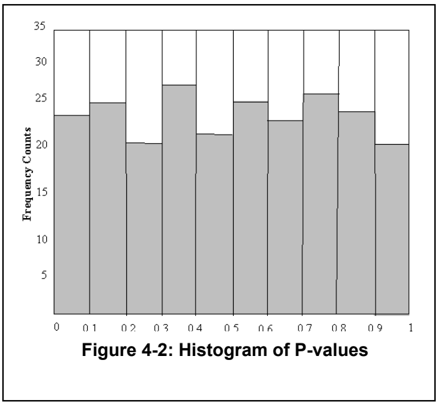
- Main analysis: For each sequence, P-values are computed and compared to \(\alpha\); empirical interpretation examines the proportion of sequences passing a test and the uniformity of P-values. A multiple-test dependence study applied 161 test P-values to Blum-Blum-Shub sequences of length 1,000,000 and used principal components/factor analysis, concluding there was no large redundancy among tests.
Limitations
- The paper states that no set of statistical tests can absolutely certify a generator as appropriate, that statistical testing cannot substitute for cryptanalysis, and that generator design and cryptanalysis are outside its scope.
- The paper states that many examples use small sample sizes for illustration only, e.g., \(n=10\), where the normal approximation is not really applicable; many tests rely on asymptotic reference distributions for large \(n\) (order \(10^3\) to \(10^7\)), and input parameter constraints apply.
- The text makes evident additional limitations: numerical precision can degrade for large incomplete gamma parameter \(a\); Maurer’s variance approximation can make the test 2.67 times more permissive than theoretically admitted; Random Excursions is discontinued if \(J<500\); and multiple tests can yield contradictory conclusions, as in the Random Excursions example where one state gave a non-random result while seven states gave random results.
Model-written summary. Check it against the paper before relying on it.
Integrity signals
Registry
Cites
Statistics
Figures

Verification
Claims the paper makes
0 Valid · 1 Not valid · 11 Not checked · 13 Own results and interpretations
A result the paper reports from its own data — it cites no other source for it, so there is none to check. The quote shows it is in the paper.
In the paper
“The asymptotic distribution of ( Ln -µ n ) / σ n along the sequence of even or odd values of n is that of a discrete random variable obtained via a mixture of two geometric random variables (one of them taking only negative values). Strictly speaking, the asymptotic distribution as such does not exist.”
A result the paper reports from its own data — it cites no other source for it, so there is none to check. The quote shows it is in the paper.
In the paper
“However, no set of statistical tests can absolutely certify a generator as appropriate for usage in a particular application, i.e., statistical testing cannot serve as a substitute for cryptanalysis.”
A result the paper reports from its own data — it cites no other source for it, so there is none to check. The quote shows it is in the paper.
In the paper
“This graph showed that there is no large redundancy among our tests.”
In the paper
“Ueli Maurer of the Department of Computer Science at Princeton University introduced this test in 1992. Maurer's test statistic relates closely to the per-bit entropy of the stream, which its author asserts is 'the correct quality measure for a secret-key source in a cryptographic application.'”
What the sources say
- Not matchedcites Maurer
This doesn’t read as a citation we can look up.
- Not matched
What the paper did — it cites no source for this, so there is none to check. The quote shows it is in the paper.
In the paper
“The test rejects the randomness hypothesis immediately if J is too small, i.e., if the following P-value is small:”
20 more claims
Create a free account to see all 25 claims and every source verdict.
Claims other papers make about this one
Each is checked against this paper’s own text: does it say what the citing paper says it does?
The source backs part of the claim, not all of it — or backs it for a different population, condition or comparison.
In the citing paper
“However, the latest version 2.1.2 [1], released in 2014, does not incorporate several modifications.”
From Checking the quality of approximation of p-values in statistical tests for random number generators by using a three-level test (2019) · cites this paper as [1]
Experimental — accuracy not yet measuredThe source backs part of the claim, not all of it — or backs it for a different population, condition or comparison.
In the citing paper
“The NIST test suite consists of 15 statistical tests for randomness of bit sequences, and its result is a list of 188 p -values.”
From Checking the quality of approximation of p-values in statistical tests for random number generators by using a three-level test (2019) · cites this paper as [1]
Experimental — accuracy not yet measuredThe cited source says what the claim attributes to it.
In the citing paper
“Note that the current implementation of the NIST test suite uses one-level or two-level tests, differently from the above experiments”
From Checking the quality of approximation of p-values in statistical tests for random number generators by using a three-level test (2019) · cites this paper as [1]
The cited source says what the claim attributes to it.
In the citing paper
“NIST SP-800.22 statistical test suite [90] and Die-hard test suite [91] and Test U01 [92] and AIS31 [93] are most common statistical test suites to evaluate their RNGs by researchers.”
From True Random Number Generators Using Electrical Noise (2019) · cites this paper as [90]
Self-check
Percentages, sums and reported differences re-computed from the paper’s own numbers.
Each contradiction between two passages listed here was confirmed by an independent check.
Rated minor: it would not touch a result — a value no result rests on, a p-value that stays on the same side of the significance level, or a conflict that is clerical, resolved elsewhere in the paper, or outside its own findings.
In the paper
§ 2.3.8 Example
“(input) τ = 0.02 (processing) π = 0.42 (processing) Vn(obs) = 52 (output) P-value = 0.500798 (conclusion) Since P-value ≥ 0.01 , accept the sequence as random.”
§ 2.3.4 Test Description
“If it can be shown that π -1 ≥τ , then the 2 Runs test need not be performed (i.e., the test should not have been run because of a failure to pass test 1, the Frequency (Monobit) test). If the test is not applicable, then the P-value is set to 0.0000.”
Rated minor: it would not touch a result — a value no result rests on, a p-value that stays on the same side of the significance level, or a conflict that is clerical, resolved elsewhere in the paper, or outside its own findings.
In the paper
§ 2.7.4 Test Description
“| 8-10 | 010 (hit) | 2 | 110 | 1 |”
§ 2.7.4 Test Description
“For the above example, if m = 3 and the template B = 001, then the examination proceeds as follows:”
Rated minor: it would not touch a result — a value no result rests on, a p-value that stays on the same side of the significance level, or a conflict that is clerical, resolved elsewhere in the paper, or outside its own findings.
In the paper
§ 2.9.3 Test Statistic and Reference Distribution
“f n : The sum of the log2 distances between matching Lbit templates, i.e., the sum of the number of digits in the distance between Lbit templates.”
§ 3.9 Maurer's 'Universal Statistical' Test
“Then it averages over all the expansion lengths by the number of test blocks.”
Rated minor: it would not touch a result — a value no result rests on, a p-value that stays on the same side of the significance level, or a conflict that is clerical, resolved elsewhere in the paper, or outside its own findings.
In the paper
§ Input Parameters:
“The parameters p , q and s are not fixed in code; thus, the user will not be able to reconstruct the original sequence because these values will vary (i.e., they are dependent on the system time).”
§ Input Parameters:
“The input parameters have been fixed so the code will reproduce the same results.”
Rated minor: it would not touch a result — a value no result rests on, a p-value that stays on the same side of the significance level, or a conflict that is clerical, resolved elsewhere in the paper, or outside its own findings.
In the paper
§ 5.5.2 Global Parameters
“| MAXNUMOFTEMPLATES | 40 | Non-overlapping Templates Test | | NUMOFTESTS | 16 | Max number of tests | | NUMOFGENERATORS | 12 | Max number of PRNGs |”
§ A.2 Configuration Information
“| 2. | #define MAXNUMOFTEMPLATES | 148 | | 3. | #define NUMOFTESTS | 15 | | 4. | #define NUMOFGENERATORS | 10 |”
2 more findings
Create a free account to see every finding of this check.
Citations
Cites
Handbook of Mathematical Functions
McQuarrie, D. A. (1966) · American Journal of Physics · doi:10.1119/1.1972842 · Cited by 40,433
Numerical recipes in C: the art of scientific computing
(1993) · Choice Reviews Online · doi:10.5860/choice.30-5638 · Cited by 17,933
Rayward-Smith, V. J. (1991) · Journal of the Operational Research Society · doi:10.1057/jors.1991.155 · Cited by 16,821
Handbook of applied cryptography
(1997) · Choice Reviews Online · doi:10.5860/choice.34-4512 · Cited by 10,357
Handbook of Mathematical Functions
(2018) · A Century of Excellence in MEASUREMENTS, STANDARDS, and TECHNOLOGY · doi:10.1201/9781351069397-39 · Cited by 9,062
A universal algorithm for sequential data compression
Ziv, J., & Lempel, A. (1977) · IEEE Transactions on Information Theory · doi:10.1109/tit.1977.1055714 · Cited by 5,456
The Art of Computer Programming
Worlton, W. J. (1968) · Nuclear Science and Engineering · doi:10.13182/nse68-a19548 · Cited by 2,251
Handbook of Applied Cryptography
Menezes, A. J., van Oorschot, P. C., & Vanstone, S. A. (2018) · CRC Press eBooks · doi:10.1201/9780429466335 · Cited by 1,770
Numerical Recipes in C-The Art of Scientific Computing.
G., W., Press, W. H., Flannery, B. P., Teukolsky, S. A., & Vetterling, W. T. (1989) · Mathematics of Computation · doi:10.2307/2008673 · Cited by 1,513
The Fourier Transform and its Applications
Cattermole, K. W. (1965) · Electronics and Power · doi:10.1049/ep.1965.0268 · Cited by 1,417
Cited by
Items 1,101–1,200 of 3,620
Designing multi-dimensional logistic map with fixed-point finite precision
Munir, F., Zia, M., & Mahmood, H. (2019) · Nonlinear Dynamics · doi:10.1007/s11071-019-05112-4 · Cited by 14
“We use well-known NIST statistical tests in order to analyze the randomness of chaotic trajectories generated using the proposed MDLM method in the finite phase space.”
MethodInfluentialMERCAT: A Metric for the Evaluation and Reconsideration of Certificate Authority Trustworthiness
Heinl, M. P., Giehl, A., Wiedermann, N., et al. (2019) · doi:10.1145/3338466.3358917 · Cited by 15
Design of a Dynamic Parameter-Controlled Chaotic-PRNG in a 65 nm CMOS process
Paul, P. S., Sadia, M., & Hasan, M. S. (2020) · IEEE Dallas Circuits and Systems Conference (DCAS) · doi:10.1109/dcas51144.2020.9330647 · Cited by 15
“National Institute of Standards and Technology (NIST) test suite offers 15 statistical tests to measure the randomness in a sequence [5].”
BackgroundStoller, S., & Campbell, K. A. (2021) · Entropy · doi:10.3390/e23030371 · Cited by 15
Security analysis of reversible logic cryptography design with LFSR key on 32-bit microcontroller
Vinoth Raj, R., Janakiraman, S., Rajagopalan, S., & Amirtharajan, R. (2021) · Microprocessors and Microsystems · doi:10.1016/j.micpro.2021.104265 · Cited by 20
FastZIP: faster and more secure zero-interaction pairing
Fomichev, M., Hesse, J., Almon, L., Lippert, T., Han, J. Y., & Hollick, M. (2021) · International Conference on Mobile Systems, Applications, and Services · doi:10.1145/3458864.3467883 · Cited by 23
“We notice that many ZIP schemes use previous versions of NIST statistical tests [33] to find entropy biases, reporting results for only passed tests, without further investigation [26, 27, 48].”
MethodA lossless secret image sharing scheme using a larger finite field
Hu, W., Wu, T., Chen, Y., et al. (2021) · Multimedia Tools and Applications · doi:10.1007/s11042-021-11104-7 · Cited by 15
Construction and application of new high-order polynomial chaotic maps
Zang, H., Zhao, X., & Wei, X. (2021) · Nonlinear Dynamics · doi:10.1007/s11071-021-06982-3 · Cited by 15
A High-Quality Entropy Source Using van der Waals Heterojunction for True Random Number Generation
Abraham, N., Watanabe, K., Taniguchi, T., & Majumdar, K. (2022) · ACS Nano · doi:10.1021/acsnano.1c11084 · Cited by 19
Merah, L., Chaib, N., Lorenz, P., & Adda, A.-P. (2022) · Nonlinear Dynamics · doi:10.1007/s11071-022-07824-6 · Cited by 15
The Rabbit Stream Cipher - Design and Security Analysis
Boesgaard, M., Pedersen, T. B., Petersen, M. V., & Zenner, E. (2004) · Cited by 15
Randomness Quality of CI Chaotic Generators: Applications to Internet Security
Bahi, J. M., Fang, X., Guyeux, C., et al. (2010) · doi:10.1109/internet.2010.30 · Cited by 15
True random number generation in block memories of reconfigurable devices
Güneysu, T. E. (2010) · International Conference on Field-Programmable Technology (FPT) · doi:10.1109/fpt.2010.5681499 · Cited by 19
FPGA based TRNG using automatic calibration
Haller, I., Suciu, A., & Cret, O. A. (2009) · IEEE International Conference on Intelligent Computer Communication and Processing (ICCP) · doi:10.1109/iccp.2009.5284733 · Cited by 17
“The generated streams were tested using two test suites, TestU01 and NIST.”
MethodOptimization of the Security-Performance Tradeoff in RC4 Encryption Algorithm
Jindal, P., & Singh, B. (2016) · Wireless Personal Communications · doi:10.1007/s11277-016-3603-3 · Cited by 18
“Ran-domness analysis is performed by performing statistical tests using National Institute of Standards and Technology Statistical Test Suite (NIST STS) on RC4 keystream [13].”
MethodZheng, Y., Cao, Y., & Chang, C.-H. (2016) · Asian Hardware Oriented Security and Trust Symposium (AsianHOST) · doi:10.1109/asianhost.2016.7835551 · Cited by 15
“The cryptographic randomness of the proposed PUF is evaluated by the NIST test [17].”
MethodKey generation for plain text in stream cipher via bi-objective evolutionary computing
Krishna, G. J., Ravi, V., & Bhattu, S. N. (2018) · Applied Soft Computing · doi:10.1016/j.asoc.2018.05.025 · Cited by 15
Random Number Generation Using Inertial Measurement Unit Signals for On-Body IoT Devices
Sun, Y., & Lo, B. P. L. (2018) · Living in the Internet of Things: Cybersecurity of the IoT · doi:10.1049/cp.2018.0028 · Cited by 17
Lightweight Hardware Based Secure Authentication Scheme for Fog Computing
Huang, B., Cheng, X., Cao, Y., & Zhang, L. (2018) · IEEE/ACM Symposium on Edge Computing (SEC) · doi:10.1109/sec.2018.00059 · Cited by 17
“The input challenge is permuted with the feedback response of the PUF, and the reliability of LB-PUF can be controlled by the number of loop cycles.”
BackgroundMethodInfluentialReDCrypt: Real-Time Privacy-Preserving Deep Learning Inference in Clouds Using FPGAs
Rouhani, B. D., Hussain, S. U., Lauter, K., & Koushanfar, F. (2018) · ACM Transactions on Reconfigurable Technology and Systems · doi:10.1145/3242899 · Cited by 14
“The entropy of the implemented RNG on our evaluation platform is thoroughly evaluated by National Institute of Standards and Technology (NIST) battery of randomness tests [33].”
MethodPaul, B., Trivedi, G., Pidanič, J., & Němec, Z. (2019) · International Conference Radioelektronika · doi:10.1109/radioelek.2019.8733468 · Cited by 19
Joint block and stream cipher based on a modified skew tent map
Qumsieh, R., Farajallah, M., & Hamamreh, R. A. (2019) · Multimedia Tools and Applications · doi:10.1007/s11042-019-08112-z · Cited by 16
“To evaluate the proposed algorithm, the well-known NIST test suite are used [54], this test includes 15 test to validate the random behavior of the tested bits.”
MethodResultA self-synchronized chaotic image encryption scheme
Daneshgar, A., & Khadem, B. (2015) · Signal Processing Image Communication · doi:10.1016/j.image.2015.06.005 · Cited by 17
Obtaining Statistically Random Information From Silicon Physical Unclonable Functions
Yin, C.-E., & Qu, G. (2014) · IEEE Transactions on Emerging Topics in Computing · doi:10.1109/tetc.2014.2316497 · Cited by 15
Tsouri, G. R., & Wilczewski, J. (2011) · International Symposium on Applied Sciences in Biomedical and Communication Technologies · doi:10.1145/2093698.2093851 · Cited by 15
“3 presents the results of applying the NIST Randomness Test Suite [15] to all generated bit sequences.”
MethodInfluentialDesign and implementation of chaos based true random number generator on FPGA
Koyuncu, İ., Özcerit, A. T., Pehlivan, İ., & Avaroğlu, E. (2014) · Signal Processing and Communications Applications Conference (SIU) · doi:10.1109/siu.2014.6830209 · Cited by 17
A new perturbation method to the Tent map and its application
Wang, X., & Wang, L.-L. (2011) · Chinese Physics B · doi:10.1088/1674-1056/20/5/050509 · Cited by 16
Evaluating Quality of Chaotic Pseudo-Random Generators: Application to Information HidingPreprint
Bahi, J. M., Fang, X., Guyeux, C., & Wang, Q. (2011) · arXiv (Cornell University) · doi:10.48550/arxiv.1112.1201 · Cited by 15
Concept Drift Aware Wireless Key Generation in Dynamic LiFi Networks
Mahalal, E., Hasan, E., Ismail, M., Wu, Z.-Y., Fouda, M. M., Fadlullah, Z. M., & Kato, N. (2024) · IEEE Open Journal of the Communications Society · doi:10.1109/ojcoms.2024.3524497 · Cited by 18
Meng, F., Wu, G., & Zhang, J. (2025) · Journal of King Saud University Computer and Information Sciences · doi:10.1007/s44443-025-00163-7 · Cited by 22
High-Speed Random-Channel Cryptography in Multimode Fibers
Sampson, R., Wen, H., Huang, B., Correa, R. A., Bromberg, Y., Cao, H. W., & Li, G. (2021) · IEEE photonics journal · doi:10.1109/jphot.2021.3049253 · Cited by 14
“Furthermore, QKD is currently a costly and complicated solution [15].”
MethodInfluentialPhysical layer secret key generation using discrete wavelet packet transform
Kumar, M. S., Ramanathan, R., Jayakumar, M., et al. (2021) · Ad Hoc Networks · doi:10.1016/j.adhoc.2021.102523 · Cited by 14
Micco, L. D., Antonelli, M., & Rosso, O. A. (2021) · Entropy · doi:10.3390/e23060671 · Cited by 19
“The NIST SP 800-22 test suite [43] consists of 15 statistical randomness tests that are applied to binary data stream files.”
MethodA New and Efficient Scheme for Improving the Digitized Chaotic Systems From Dynamical Degradation
Merah, L., Lorenz, P., & Adda, A.-P. (2021) · IEEE Access · doi:10.1109/access.2021.3089913 · Cited by 14
“The NIST test suite was developed by the National Institute of Standards and Technology [44], the DieHard test suite elaborated by Robert G. Brown who published his first test suite CD-ROM [45].”
MethodOn the effects of biased quantum random numbers on the initialization of artificial neural networks
Heese, R., Wolter, M., Mücke, S., Franken, L., & Piatkowski, N. (2024) · Machine Learning · doi:10.1007/s10994-023-06490-y · Cited by 22
“For the sake of completeness, we also analyze the binary random numbers from the B-QRNG and the QRNG, respectively, with the NIST Statistical Test Suite for the validation of random number generators (Rukhin et al., 2010, NIST, 2010).”
BackgroundMethodInfluentialDesign and Implementation of a Secure RISC-V Microprocessor
Stangherlin, K., & Sachdev, M. (2022) · IEEE Transactions on Very Large Scale Integration (VLSI) Systems · doi:10.1109/tvlsi.2022.3203307 · Cited by 19
A Fully Configurable PUF Using Dynamic Variations of Resistive Crossbar Arrays
Li, J., Cui, Y., Wang, C., Gu, C., & Liu, W. (2022) · IEEE Transactions on Nanotechnology · doi:10.1109/tnano.2022.3221372 · Cited by 20
“The randomness of a PUF can be further evaluated by NIST SP800-22 statistical test suite [33] and autocorrelation function (ACF) test.”
MethodA Reconfigurable LDO-Assisted Physically Unclonable Function Achieving a Zero-BER With 14% Masking
Park, J., & Sim, J. (2023) · IEEE Transactions on Circuits and Systems I Regular Papers · doi:10.1109/tcsi.2023.3275577 · Cited by 14
“The NIST SP 800-22 and NIST SP 800-90B tests were also applied to verify the randomness [31].”
MethodFPGA-Based Implementation of an Underwater Quantum Key Distribution System With BB84 Protocol
Kebapçı, B., Levent, V. E., Ergin, S., et al. (2023) · IEEE photonics journal · doi:10.1109/jphot.2023.3287493 · Cited by 14
“The randomness of data generated keys are verified according to [20].”
BackgroundWindarta, S., Suryadi, S., Ramli, K., Lestari, A. A., Wildan, W., Pranggono, B., & Wardhani, R. W. (2023) · IEEE Access · doi:10.1109/access.2023.3301128 · Cited by 18
“6) We perform a randomness property assessment of all proposed hash algorithms using seven cryptographic randomness tests and fifteen tests from the NIST Statistical Test Suite (STS).”
MethodInfluentialİnce, E., Karakaya, B., & Türk, M. (2024) · Multimedia Tools and Applications · doi:10.1007/s11042-023-17972-5 · Cited by 15
“During the testing phase, different statistical analyses are applied using the NIST SP 800 − 22 Statistical Test Suite [40], which consists of 16 tests developed by NIST.”
The new approach of Rijndael key schedule
Sulaiman, S., Muda, Z., & Juremi, J. B. (2012) · International Conference on Cyber Security, Cyber Warfare and Digital Forensic (CyberSec) · doi:10.1109/cybersec.2012.6246100 · Cited by 14
“The frequency test is performed using NIST Statistical Test (from NIST test package) that focus on proportion of zeroes and ones with the purpose to determine whether the number of zeroes and ones are approximately the same in the sequence as would be expected for a truly random [14].”
MethodImage forgery detection in contourlet transform domain based on new chaotic cellular automata
Barani, M. J., Ayubi, P., Jalili, F., Valandar, M. Y., & Azariyun, E. (2015) · Security and Communication Networks · doi:10.1002/sec.1365 · Cited by 14
“The proposed PRNG has been tested with NIST statistical test suites for inspection of the randomness, whose results show that the produced sequence is random.”
MethodInfluentialIovane, G., Amorosia, A., Benedetto, E., & Lamponi, G. (2015) · Journal of Discrete Mathematical Sciences and Cryptography · doi:10.1080/09720529.2014.894311 · Cited by 14
“According to this definition, a sequence is considered random when the P-value is greater than 0.01 [29].”
BackgroundMethodInfluentialA new design of dynamic S-Box based on two chaotic maps
Zaïbi, G., Peyrard, F., Kachouri, A., et al. (2010) · ACS/IEEE International Conference on Computer Systems and Applications · doi:10.1109/aiccsa.2010.5586946 · Cited by 14
Simulation of Multi-bit Extraction for Fast Random Bit Generation Using a Chaotic Laser
Li, N., Pan, W., Xiang, S., Zhao, Q., & Zhang, L. (2014) · IEEE Photonics Technology Letters · doi:10.1109/lpt.2014.2341623 · Cited by 14
“statistical test suite provided by the National Institute of Standard Technology (NIST), known as NIST Special Publication 800-22 (NIST SP 800-22) [23].”
MethodNovel Zaslavsky map based pseudorandom bit generation scheme
Stoyanov, B. P., & Kordov, K. (2014) · Applied Mathematical Sciences · doi:10.12988/ams.2014.410879 · Cited by 16
Generating efficient and high-quality pseudo-random behavior on Automata Processors
Wadden, J., Brunelle, N., Wang, K., El-Hadedy, M., Robins, G., Stan, M. R., & Kevin Skadron, Y. (2016) · IEEE International Conference on Computer Design: VLSI in Computers and Processors (ICCD) · doi:10.1109/iccd.2016.7753349 · Cited by 14
“The most comprehensive and stringent collection tests are the BigCrush test battery from TestU01 suite [5], which includes the functionality of the Knuth tests [6], DIEHARD [7], and the NIST statistical test suite [8].”
MethodOn the Entropy of Oscillator-Based True Random Number Generators
Ma, Y., Lin, J., & Jing, J. (2017) · Lecture notes in computer science · doi:10.1007/978-3-319-52153-4_10 · Cited by 14
A Physical Encryption Scheme for Low-Power Wireless M2M Devices: a Dynamic Key Approach
Noura, H., Melki, R., Chehab, A., & Mansour, M. M. (2018) · Mobile Networks and Applications · doi:10.1007/s11036-018-1151-7 · Cited by 14
“For this purpose, the empirical NIST statistical test [27] is applied on 100 sequences of one million bits, produced with 100 different secret keys and Nonces to validate the security of the proposed dynamic-key derivation scheme.”
MethodModified AES Cipher Round and Key Schedule
Reyes, E. M. D. L., Sison, A. M., & Medina, R. P. (2019) · Indonesian Journal of Electrical Engineering and Informatics (IJEEI) · doi:10.52549/ijeei.v7i1.652 · Cited by 37
Enabling Ubiquitous Hardware Security via Energy-Efficient Primitives and Systems : (Invited Paper)
Alioto, M., & Taneja, S. (2019) · Custom Integrated Circuits Conference · doi:10.1109/cicc.2019.8780123 · Cited by 18
“autocorrelation function for bit spatial correlation, 0/1 output bias, NIST randomness tests [22].”
BackgroundMethodLightweight Dynamic Group Rekeying for Low-Power Wireless Networks in IIoT
Uchiteleva, E., Refaey, A., & Shami, A. A. (2020) · IEEE Internet of Things Journal · doi:10.1109/jiot.2020.2974839 · Cited by 16
True Random Number Generator (TRNG) for Secure Communications in the Era of IoT
Ji, Z., Brown, J., & Zhang, J. (2020) · China Semiconductor Technology International Conference (CSTIC) · doi:10.1109/cstic49141.2020.9282535 · Cited by 20
Utilizing true periodic orbits in chaos-based cryptography
Öztürk, İ., & Kılıç, R. (2021) · Nonlinear Dynamics · doi:10.1007/s11071-021-06235-3 · Cited by 16
A chaotic framework and its application in image encryption
Roy, M., Chakraborty, S., & Mali, K. (2021) · Multimedia Tools and Applications · doi:10.1007/s11042-021-10839-7 · Cited by 14
“Now, to test the proposed pseudorandom bit generator, the well-known National Institute of Standards and Technology (NIST) statistical test suit is used [47].”
MethodXu, X., & Chen, S. (2021) · Entropy · doi:10.3390/e23040456 · Cited by 15
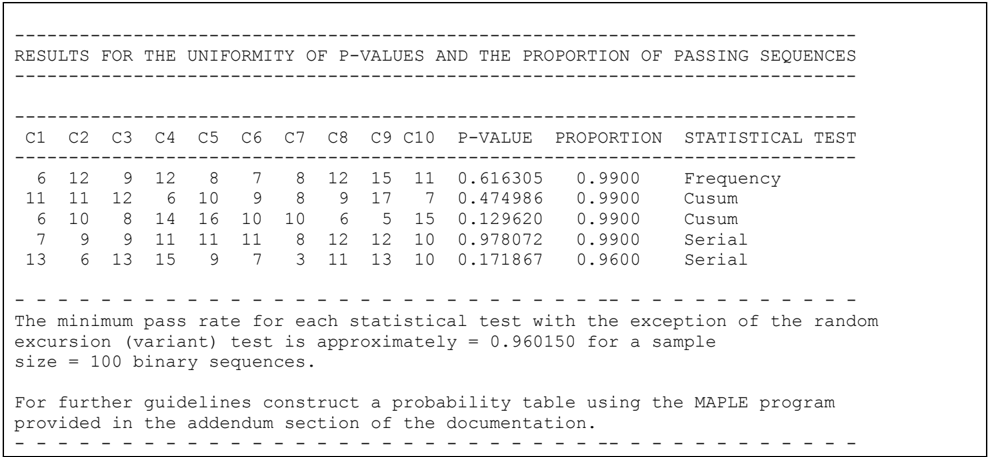
“According to [59], the minimum pass rate of each subset is 96 percent.”
BackgroundMethodCan Deep Learning Break a True Random Number Generator?
Yu, Y., Moraitis, M., & Dubrova, E. (2021) · IEEE Transactions on Circuits & Systems II Express Briefs · doi:10.1109/tcsii.2021.3066338 · Cited by 18
“We verified that all the designs, as well as the modified bitstreams derived from them, pass all the NIST SP 800-22 [15] statistical tests.”
MethodRezk, A. A., Madian, A. H., Radwan, A. G., & Soliman, A. M. (2021) · IEEE Access · doi:10.1109/access.2021.3086044 · Cited by 14
“Themodified Lorenz is implemented using the design in [12], which can past all the NIST tests [50].”
MethodHow to Test the Randomness From the Wireless Channel for Security?
Qu, Z., Zhao, S., Xu, J., Lu, Z., & Liu, Y. (2021) · IEEE Transactions on Information Forensics and Security · doi:10.1109/tifs.2021.3092051 · Cited by 16
Anandakumar, N. N., Hashmi, M., & Sanadhya, S. K. (2022) · IET Circuits Devices & Systems · doi:10.1049/cds2.12111 · Cited by 14
Sayed, W. S., Roshdy, M., Said, L. A., Herencsár, N., & Radwan, A. G. (2022) · Fractal and Fractional · doi:10.3390/fractalfract6080432 · Cited by 16
High Performance Parallel Pseudorandom Number Generator on Cellular Automata
Levina, A. B., Mukhamedjanov, D., Bogaevskiy, D. V., Lyakhov, P. A., Valueva, M. V., & Kaplun, D. (2022) · Symmetry · doi:10.3390/sym14091869 · Cited by 20
An image layered scrambling encryption algorithm based on a novel discrete chaotic map
Tang, J., Zhang, Z., Chen, P., Zhang, F., Ni, H., & Huang, Z. (2022) · IET Image Processing · doi:10.1049/ipr2.12651 · Cited by 16
Programming with Mathematica®: An Introduction
Wellin, P. R. (2009) · Cambridge University Press eBooks · doi:10.1017/cbo9780511972942 · Cited by 14
A Novel Attack on a FPGA based True Random Number Generator
Johnson, A. P., Chakraborty, R. S., & Mukhopadhyay, D. (2015) · doi:10.1145/2818362.2818368 · Cited by 16
“Statistical analysis for the random bitstream generated was performed using the NIST Statistical Test Suite [8].”
MethodLi, P., Wang, Y., Wang, A., & Wang, B. (2012) · IEEE Journal of Selected Topics in Quantum Electronics · doi:10.1109/jstqe.2012.2219298 · Cited by 17
“5 shows a typical result of NIST tests, where blue squares and black circles represent the P -value and passed proportion of each tests, respectively.”
MethodInfluentialEvaluation of delay PUFs on CMOS 65 nm technology
Cherif, Z., Danger, J., Lozac'H, F., et al. (2013) · doi:10.1145/2487726.2487730 · Cited by 14
Real-Time Testing of True Random Number Generators Through Dynamic Reconfiguration
Hotoleanu, D., Cret, O. A., Suciu, A., Györfi, T., & Văcariu, L. (2010) · Euromicro Conference on Digital System Design (DSD) · doi:10.1109/dsd.2010.56 · Cited by 15
“The best known statistical test suites are NIST [2], Diehard [3], TestU01 [4] and AIS [5], where NIST can be considered the most popular.”
BackgroundMethodOn the combination of self-organized systems to generate pseudo-random numbers
Karimi, H., Hosseini, S. M., & Jahan, M. V. (2012) · Information Sciences · doi:10.1016/j.ins.2012.09.029 · Cited by 14
Patterns in stock market movements tested as random number generators
Doyle, J. R., & Chen, C. H. (2012) · European Journal of Operational Research · doi:10.1016/j.ejor.2012.11.057 · Cited by 20
A performance metric for discrete-time chaos-based truly random number generators
Beirami, A., Nejati, H., & Massoud, Y. (2008) · IEEE International Midwest Symposium on Circuits and Systems (MWSCAS) · doi:10.1109/mwscas.2008.4616754 · Cited by 14
Ring oscillator based random number generator utilizing wake-up time uncertainty
Nakura, T., Ikeda, M., & Asada, K. (2009) · IEEE Asian Solid-State Circuits Conference (A-SSCC) · doi:10.1109/asscc.2009.5357194 · Cited by 15
Random Binary Sequences in Telecommunications
Šajić, S., Maletić, N., Todorović, B. M., & Šunjevarić, M. (2013) · Journal of Electrical Engineering · doi:10.2478/jee-2013-0033 · Cited by 15
Digital Forensic Science: Issues, Methods, and Challenges
Roussev, V. (2016) · Synthesis lectures on information security, privacy, and trust · doi:10.2200/s00738ed1v01y201610spt019 · Cited by 32
A Secure Chaos-based Image Cryptosystem with an Improved Sine Key Generator
Oğraş, H., & Türk, M. (2016) · American Journal of Signal Processing · Cited by 14
Astronomical random numbers for quantum foundations experiments
Leung, C., Brown, A. E., Nguyen, H., Friedman, A. S., Kaiser, D. I., & Gallicchio, J. R. (2018) · Physical Review A · doi:10.1103/physreva.97.042120 · Cited by 17
“The NIST Statistical Test Suite [47] provides a deviceindependent statistical approach to evaluate the quality of the output of any random number generator given a sufficiently large number of bits.”
BackgroundInfluentialDesigning ECG-based physical unclonable function for security of wearable devices
Yin, S., Bae, C., Kim, S. J., et al. (2017) · doi:10.1109/embc.2017.8037613 · Cited by 14
A Closer Look at the Delay-Chain based TRNG
Grujić, M., Rožić, V., Yang, B., et al. (2018) · IEEE International Symposium on Circuits and Systems proceedings · doi:10.1109/iscas.2018.8351222 · Cited by 14
“NIST 800-22 [1]) but also to have an accompanying stochastic model that is used for estimating the unpredictability of the output [2].”
MethodUtilizing Hopfield Neural Network for Pseudo-Random Number Generator
Hameed, S. M., & Ali, L. M. M. (2018) · IEEE/ACS International Conference on Computer Systems and Applications (AICCSA) · doi:10.1109/aiccsa.2018.8612890 · Cited by 14
“National Institute of Standards and Technology (NIST) statistical test [12] that involves 15 tests is used to evaluate the randomness of the proposed PRNG, which is compared against the work proposed in [2].”
MethodKhan, N. A., Qureshi, M. A., Hameed, T., et al. (2020) · Communications in Theoretical Physics · doi:10.1088/1572-9494/abb7d1 · Cited by 14
“The system solution results were tested via NIST-800-22 [ 31 ] , a rigorous statistical test used in chaotic systems to investigate the consistency of RNG [ 31 ] via the calculation of P-values.”
MethodDesign and Implementation of Novel BRISI Lightweight Cipher for Resource Constrained Devices
G, K. K. V., & Rai, C. S. (2021) · Microprocessors and Microsystems · doi:10.1016/j.micpro.2021.104267 · Cited by 14
Heuristic search of (semi-)bent functions based on cellular automata
Mariot, L., Saletta, M., Leporati, A., & Manzoni, L. (2022) · Natural Computing · doi:10.1007/s11047-022-09885-3 · Cited by 14
Selective video encryption using chaotic system in the SHVC extension
Hamidouche, W., Farajallah, M., Raulet, M., Olivier Déforges, A., & Assad, S. E. (2015) · IEEE International Conference on Acoustics Speech and Signal Processing · doi:10.1109/icassp.2015.7178273 · Cited by 15
“It should be noted that the considered chaotic generator has passed all the tests including those of the national institute of standards and technology [16].”
BackgroundPellicer-Lostao, C., & López‐Ruiz, R. (2008) · Lecture notes in computer science · doi:10.1007/978-3-540-69848-7_62 · Cited by 17
Parallel implementation of the NIST Statistical Test Suite
Suciu, A., Nagy, I., Marton, K., & Pinca, I. (2010) · IEEE International Conference on Intelligent Computer Communication and Processing (ICCP) · doi:10.1109/iccp.2010.5606412 · Cited by 14
“After carrying out a comprehensive investigation of known statistical tests for random and pseudorandom generators, the US National Institute of Standards and Technology (NIST) published its results and recommendations for practical usage in [1].”
MethodA image encryption scheme based on dynamical perturbation and linear feedback shift register
Tong, X., Zhang, M., Wang, Z., & Liu, Y. (2014) · Nonlinear Dynamics · doi:10.1007/s11071-014-1564-1 · Cited by 14
Automated design of a lightweight block cipher with Genetic Programming
Polimón, J., Hernandez-Castro, J. C., Tapiador, J., & Ribagorda, A. (2008) · International Journal of Knowledge-based and Intelligent Engineering Systems · doi:10.3233/kes-2008-12102 · Cited by 16
Efficient Access Control for Wireless Sensor Data
Sorniotti, A., Molva, R. A., Gomez, L., Trefois, C., Laube, A., & Scaglioso, P. (2009) · International Journal of Wireless Information Networks · doi:10.1007/s10776-009-0102-4 · Cited by 15
Elastic block ciphers: the basic design
Cook, D. L., Keromytis, A. D., & Yung, M. M. (2007) · ACM Asia Conference on Computer and Communications Security (ASIA CCS) · doi:10.1145/1229285.1229324 · Cited by 16
Vašková, A., López-Ongil, C., Millán, E. S., et al. (2011) · IEEE International On-Line Testing Symposium (IOLTS) · doi:10.1109/iolts.2011.5993835 · Cited by 14
“There are solutions for this measurement, based on software application of different statistical tests [1] [2].”
MethodError Analysis of NIST SP 800-22 Test Suite
Chen, D., Chen, H., Fan, L., & Luo, K. (2023) · IEEE Transactions on Information Forensics and Security · doi:10.1109/tifs.2023.3287391 · Cited by 14
A Shared Secret Key Generation between Vehicle and Roadside Based Preprocessing Method
Sudarsono, A., Yuliana, M., & Kristalina, P. (2019) · International Conference on Computer Engineering, Network, and Intelligent Multimedia (CENIM) · doi:10.1109/cenim48368.2019.8973286 · Cited by 13
“The adoption of some techniques of measured RSS values for increasing correlation, processing quantization, correcting mismatched error bits key stream by information reconciliation and improving the randomness by privacy amplification is able to maintain key generation rate (KGR), reduce key disagreement rate (KDR),…”
MethodOgras, H. (2021) · Cogent Engineering · doi:10.1080/23311916.2021.1940638 · Cited by 13
“NIST consists of fifteen tests (Rukhin et al., 2001) and each test produces a p -value which is a real number in [0, 1].”
Luo, Y., Zhang, J., Hao, J., & Zhao, X. (2023) · IEEE Transactions on Circuits & Systems II Express Briefs · doi:10.1109/tcsii.2023.3288036 · Cited by 16
“To quantitatively evaluate the randomness of the fabricated prototype chips, two widely-accepted NIST test tools are exploited, which are Pub SP 800-22 [18] and Pub SP 800-90B [19].”
MethodImage encryption-compression method via encryption based sparse decomposition
Ghaffari, A. (2023) · Multimedia Tools and Applications · doi:10.1007/s11042-023-16163-6 · Cited by 14
Yang, Y., Cheng, F.-E., Jiang, D., Zhou, Y., Shi, W., & Liao, X. (2023) · Physica Scripta · doi:10.1088/1402-4896/acf52d · Cited by 14
An Efficient Audio Encryption Scheme Based on Elliptic Curve over Finite Fields
Rehman, H. U., Hazzazi, M. M., Shah, T., Bassfar, Z., & Shah, D. (2023) · Mathematics · doi:10.3390/math11183824 · Cited by 17
黄, L.-L. 丽. H., 马, Y.-H. 衍. M., & 李, C. 创. L. (2023) · Chinese Physics B · doi:10.1088/1674-1056/acf9e7 · Cited by 13
Akgül, A., Mustafa, Y. A. Z., & Emi̇n, B. (2025) · Integration · doi:10.1016/j.vlsi.2025.102355 · Cited by 13
Metadata
- Authors
- Bassham, L. E., Rukhin, A. L., Soto, J., Nechvatal, J. R., Smid, M. E., Barker, E. B., Leigh, S. D., Levenson, M., Vangel, M., Banks, D. L., Heckert, N. A., Dray, J. F., & Vo, S.
- Affiliations
- National Institute of Standards and Technology (US)
- Venue
- NIST Special Publication 800-22 Revision 1a
- Published
- 2010
- OpenAlex
- W1517403092
- Semantic Scholar
- 961fc0f6c68303cde94a28fdb24e6eaf3ef040b4
- Cited by
- 3,617
- References
- 34
- Citations by year
- 2026: 128 · 2025: 205 · 2024: 192 · 2023: 208 · 2022: 166 · 2021: 291 · 2020: 290 · 2019: 250 · 2018: 254 · 2017: 207 · 2016: 183 · 2015: 184 · 2014: 201 · 2013: 155 · 2012: 139
- Type
- report
- Language
- en
- Open access
- gold
- doi.org
- Topics
- Physical Sciences › Computer Science › Artificial Intelligence › Cryptographic Implementations and Security
- Physical Sciences › Mathematics › Discrete Mathematics and Combinatorics › Coding theory and cryptography
- Physical Sciences › Computer Science › Computer Vision and Pattern Recognition › Chaos-based Image/Signal Encryption
- Keywords
- random number generators, pseudorandom number generators, cryptographic randomness, NIST SP 800-22, randomness testing
About these checks
Registry, retraction, Cites and statistics results are computed, not judged, with one exception: a printed reference that no index lists is read once by a model before it counts as a citation error. Claims are extracted by a model and kept only when their quote appears verbatim in the text; each cited source is then checked, with a model’s help, for whether it says what the claim relies on. Those verdicts can be wrong — read the claim’s quote and the cited source before relying on one.
A language model drew the claims from the paper on 2026-09-27 (prompt extract-v2).
Statistics and arithmetic are recomputed, not judged.
Confidence bands are shown only for fields calibrated on our annotated test set. None is calibrated yet, so no band is shown.
What counts as a claim ›How we measure confidence ›How we check this ›
Are you an author, or do you see a problem with this page? Request a review
Data sources
Bibliographic data: Semantic Scholar, OpenAlex, Crossref.
Contains information from the Semantic Scholar Academic Graph Datasets, made available under the ODC Attribution License (ODC-BY 1.0).
Semantic Scholar’s data is described in: Kinney, R., et al. (2023). The Semantic Scholar Open Data Platform. arXiv:2301.10140.
