

A statistical test suite for random and pseudorandom number generators for cryptographic applications
Open accessThe DOI matches its Crossref record; 33 of the 34 references it cites were found in a registry or an index; none of the 14 sources its claims cite is checked for support yet.
Abstract
The Information Technology Laboratory (ITL) at the National Institute of Standards and Technology (NIST) promotes the U.S. economy and public welfare by providing technical leadership for the nation's measurement and standards infrastructure. ITL develops tests, test methods, reference data, proof of concept implementations, and technical analysis to advance the development and productive use of information technology. ITL's responsibilities include the development of technical, physical, administrative, and management standards and guidelines for the cost-effective security and privacy of sensitive unclassified information in Federal computer systems.
Overview
CoChat Summary
TL;DR
This NIST Special Publication 800-22 Revision 1a presents a suite of 15 statistical tests for evaluating whether binary sequences produced by random or pseudorandom number generators are suitable for cryptographic applications. It provides test purposes, mathematical descriptions, examples, and guidance for interpreting P-values, while cautioning that statistical testing is only a first step and cannot replace cryptanalysis.
Key findings
- The suite consists of 15 tests: Frequency (Monobit), Frequency within a Block, Runs, Longest Run of Ones, Binary Matrix Rank, Discrete Fourier Transform (Spectral), Non-overlapping Template Matching, Overlapping Template Matching, Maurer’s “Universal Statistical,” Linear Complexity, Serial, Approximate Entropy, Cumulative Sums, Random Excursions, and Random Excursions Variant. The Frequency test is recommended first because it supplies the most basic evidence of non-randomness.
- Each test uses the null hypothesis \(H_0\) that the sequence is random; if P-value \(\ge \alpha\), the sequence is accepted as random, and if P-value \(<\alpha\), it is rejected. Examples use \(\alpha=0.01\), and NIST recommends \(\alpha\) in the range [0.001, 0.01].
- The document states that no finite set of statistical tests is “complete,” that statistical testing cannot absolutely certify a generator, and that statistical testing cannot serve as a substitute for cryptanalysis.
- Sample data files are 1,000,000 bits (binary expansions of \(e\), \(\pi\), \(\sqrt{2}\), \(\sqrt{3}\), and a G-SHA-1 sequence); reported example P-values include Frequency for \(\pi\) = 0.578211, for \(e\) = 0.953749, and for G-SHA-1 = 0.604458.
Methods
- Design: The NIST Statistical Test Suite is an ANSI C reference implementation of 15 tests; each test defines a test statistic, a reference distribution (e.g., normal, half-normal, chi-square), a P-value, and a decision rule at the 1% level.
- Data or sample: Tests apply to binary sequences from hardware or software RNGs/PRNGs; sample files are 1,000,000 bits, while many worked examples use small illustrative lengths such as \(n=100\).
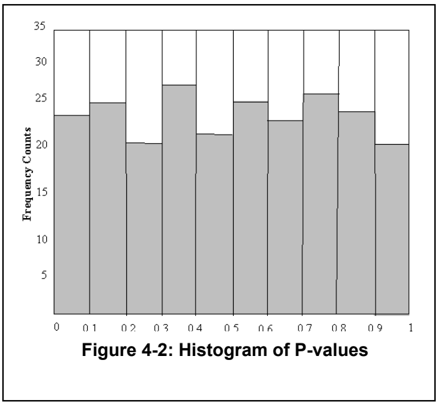
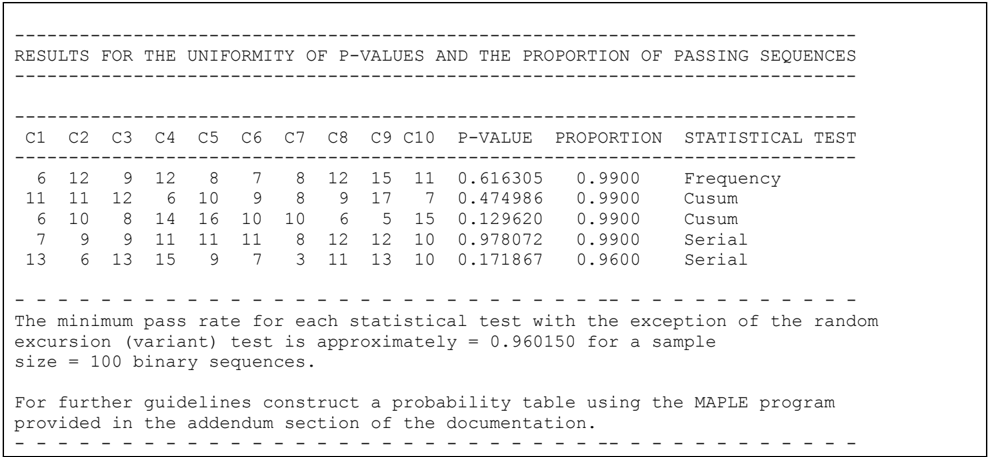
- Main analysis: For each sequence, P-values are computed and compared to \(\alpha\); empirical interpretation examines the proportion of sequences passing a test and the uniformity of P-values. A multiple-test dependence study applied 161 test P-values to Blum-Blum-Shub sequences of length 1,000,000 and used principal components/factor analysis, concluding there was no large redundancy among tests.
Limitations
- The paper states that no set of statistical tests can absolutely certify a generator as appropriate, that statistical testing cannot substitute for cryptanalysis, and that generator design and cryptanalysis are outside its scope.
- The paper states that many examples use small sample sizes for illustration only, e.g., \(n=10\), where the normal approximation is not really applicable; many tests rely on asymptotic reference distributions for large \(n\) (order \(10^3\) to \(10^7\)), and input parameter constraints apply.
- The text makes evident additional limitations: numerical precision can degrade for large incomplete gamma parameter \(a\); Maurer’s variance approximation can make the test 2.67 times more permissive than theoretically admitted; Random Excursions is discontinued if \(J<500\); and multiple tests can yield contradictory conclusions, as in the Random Excursions example where one state gave a non-random result while seven states gave random results.
Model-written summary. Check it against the paper before relying on it.
Integrity signals
Registry
Cites
Statistics
Figures

Verification
Claims the paper makes
0 Valid · 1 Not valid · 11 Not checked · 13 Own results and interpretations
A result the paper reports from its own data — it cites no other source for it, so there is none to check. The quote shows it is in the paper.
In the paper
“The asymptotic distribution of ( Ln -µ n ) / σ n along the sequence of even or odd values of n is that of a discrete random variable obtained via a mixture of two geometric random variables (one of them taking only negative values). Strictly speaking, the asymptotic distribution as such does not exist.”
A result the paper reports from its own data — it cites no other source for it, so there is none to check. The quote shows it is in the paper.
In the paper
“However, no set of statistical tests can absolutely certify a generator as appropriate for usage in a particular application, i.e., statistical testing cannot serve as a substitute for cryptanalysis.”
A result the paper reports from its own data — it cites no other source for it, so there is none to check. The quote shows it is in the paper.
In the paper
“This graph showed that there is no large redundancy among our tests.”
In the paper
“Ueli Maurer of the Department of Computer Science at Princeton University introduced this test in 1992. Maurer's test statistic relates closely to the per-bit entropy of the stream, which its author asserts is 'the correct quality measure for a secret-key source in a cryptographic application.'”
What the sources say
- Not matchedcites Maurer
This doesn’t read as a citation we can look up.
- Not matched
What the paper did — it cites no source for this, so there is none to check. The quote shows it is in the paper.
In the paper
“The test rejects the randomness hypothesis immediately if J is too small, i.e., if the following P-value is small:”
20 more claims
Create a free account to see all 25 claims and every source verdict.
Claims other papers make about this one
Each is checked against this paper’s own text: does it say what the citing paper says it does?
The source backs part of the claim, not all of it — or backs it for a different population, condition or comparison.
In the citing paper
“However, the latest version 2.1.2 [1], released in 2014, does not incorporate several modifications.”
From Checking the quality of approximation of p-values in statistical tests for random number generators by using a three-level test (2019) · cites this paper as [1]
Experimental — accuracy not yet measuredThe source backs part of the claim, not all of it — or backs it for a different population, condition or comparison.
In the citing paper
“The NIST test suite consists of 15 statistical tests for randomness of bit sequences, and its result is a list of 188 p -values.”
From Checking the quality of approximation of p-values in statistical tests for random number generators by using a three-level test (2019) · cites this paper as [1]
Experimental — accuracy not yet measuredThe cited source says what the claim attributes to it.
In the citing paper
“Note that the current implementation of the NIST test suite uses one-level or two-level tests, differently from the above experiments”
From Checking the quality of approximation of p-values in statistical tests for random number generators by using a three-level test (2019) · cites this paper as [1]
The cited source says what the claim attributes to it.
In the citing paper
“NIST SP-800.22 statistical test suite [90] and Die-hard test suite [91] and Test U01 [92] and AIS31 [93] are most common statistical test suites to evaluate their RNGs by researchers.”
From True Random Number Generators Using Electrical Noise (2019) · cites this paper as [90]
Self-check
Percentages, sums and reported differences re-computed from the paper’s own numbers.
Each contradiction between two passages listed here was confirmed by an independent check.
Rated minor: it would not touch a result — a value no result rests on, a p-value that stays on the same side of the significance level, or a conflict that is clerical, resolved elsewhere in the paper, or outside its own findings.
In the paper
§ 2.3.8 Example
“(input) τ = 0.02 (processing) π = 0.42 (processing) Vn(obs) = 52 (output) P-value = 0.500798 (conclusion) Since P-value ≥ 0.01 , accept the sequence as random.”
§ 2.3.4 Test Description
“If it can be shown that π -1 ≥τ , then the 2 Runs test need not be performed (i.e., the test should not have been run because of a failure to pass test 1, the Frequency (Monobit) test). If the test is not applicable, then the P-value is set to 0.0000.”
Rated minor: it would not touch a result — a value no result rests on, a p-value that stays on the same side of the significance level, or a conflict that is clerical, resolved elsewhere in the paper, or outside its own findings.
In the paper
§ 2.7.4 Test Description
“| 8-10 | 010 (hit) | 2 | 110 | 1 |”
§ 2.7.4 Test Description
“For the above example, if m = 3 and the template B = 001, then the examination proceeds as follows:”
Rated minor: it would not touch a result — a value no result rests on, a p-value that stays on the same side of the significance level, or a conflict that is clerical, resolved elsewhere in the paper, or outside its own findings.
In the paper
§ 2.9.3 Test Statistic and Reference Distribution
“f n : The sum of the log2 distances between matching Lbit templates, i.e., the sum of the number of digits in the distance between Lbit templates.”
§ 3.9 Maurer's 'Universal Statistical' Test
“Then it averages over all the expansion lengths by the number of test blocks.”
Rated minor: it would not touch a result — a value no result rests on, a p-value that stays on the same side of the significance level, or a conflict that is clerical, resolved elsewhere in the paper, or outside its own findings.
In the paper
§ Input Parameters:
“The parameters p , q and s are not fixed in code; thus, the user will not be able to reconstruct the original sequence because these values will vary (i.e., they are dependent on the system time).”
§ Input Parameters:
“The input parameters have been fixed so the code will reproduce the same results.”
Rated minor: it would not touch a result — a value no result rests on, a p-value that stays on the same side of the significance level, or a conflict that is clerical, resolved elsewhere in the paper, or outside its own findings.
In the paper
§ 5.5.2 Global Parameters
“| MAXNUMOFTEMPLATES | 40 | Non-overlapping Templates Test | | NUMOFTESTS | 16 | Max number of tests | | NUMOFGENERATORS | 12 | Max number of PRNGs |”
§ A.2 Configuration Information
“| 2. | #define MAXNUMOFTEMPLATES | 148 | | 3. | #define NUMOFTESTS | 15 | | 4. | #define NUMOFGENERATORS | 10 |”
2 more findings
Create a free account to see every finding of this check.
Citations
Cites
Handbook of Mathematical Functions
McQuarrie, D. A. (1966) · American Journal of Physics · doi:10.1119/1.1972842 · Cited by 40,433
Numerical recipes in C: the art of scientific computing
(1993) · Choice Reviews Online · doi:10.5860/choice.30-5638 · Cited by 17,933
Rayward-Smith, V. J. (1991) · Journal of the Operational Research Society · doi:10.1057/jors.1991.155 · Cited by 16,821
Handbook of applied cryptography
(1997) · Choice Reviews Online · doi:10.5860/choice.34-4512 · Cited by 10,357
Handbook of Mathematical Functions
(2018) · A Century of Excellence in MEASUREMENTS, STANDARDS, and TECHNOLOGY · doi:10.1201/9781351069397-39 · Cited by 9,062
A universal algorithm for sequential data compression
Ziv, J., & Lempel, A. (1977) · IEEE Transactions on Information Theory · doi:10.1109/tit.1977.1055714 · Cited by 5,456
The Art of Computer Programming
Worlton, W. J. (1968) · Nuclear Science and Engineering · doi:10.13182/nse68-a19548 · Cited by 2,251
Handbook of Applied Cryptography
Menezes, A. J., van Oorschot, P. C., & Vanstone, S. A. (2018) · CRC Press eBooks · doi:10.1201/9780429466335 · Cited by 1,770
Numerical Recipes in C-The Art of Scientific Computing.
G., W., Press, W. H., Flannery, B. P., Teukolsky, S. A., & Vetterling, W. T. (1989) · Mathematics of Computation · doi:10.2307/2008673 · Cited by 1,513
The Fourier Transform and its Applications
Cattermole, K. W. (1965) · Electronics and Power · doi:10.1049/ep.1965.0268 · Cited by 1,417
Cited by
Items 601–700 of 3,620
FPGA Hardware Co-Simulation of Image Encryption Using Stream Cipher Based on Chaotic Maps
Hasan, F. S., & Saffo, M. A. (2020) · Sensing and Imaging · doi:10.1007/s11220-020-00301-7 · Cited by 34
“The National Institute of Standards and Technology (NIST) [31] are utilized to examine the randomness of proposed PRBGs.”
MethodA generalized framework for elliptic curves based PRNG and its utilization in image encryption
AbdElHaleem, S. H., Abd–El–Hafiz, S. K., & Radwan, A. G. (2022) · Scientific Reports · doi:10.1038/s41598-022-17045-x · Cited by 34
Sala, R. D., & Scotti, G. (2023) · IEEE Access · doi:10.1109/access.2023.3304901 · Cited by 37
“This solution is effective and the obtained random sequence is able to pass National Institute of Standards and Technology (NIST) [73], [74] tests also under environmental variations.”
BackgroundMethodConstructing n-dimensional discrete non-degenerate hyperchaotic maps using QR decomposition
Fan, C., & Ding, Q. (2023) · Chaos Solitons & Fractals · doi:10.1016/j.chaos.2023.113915 · Cited by 33
On Independence and Sensitivity of Statistical Randomness Tests
Turan, M. S., Doğanaksoy, A., & Boztaş, S. (2008) · Lecture notes in computer science · doi:10.1007/978-3-540-85912-3_2 · Cited by 32
“Overlapping and Non-overlapping template matching tests [ 1 ] only consider the number of occurrences of pre-specified templates in the sequence.”
BackgroundMethodInfluentialRandom numbers from metastability and thermal noise
Ranasinghe, D. C., Lim, D., Devadas, S., Abbott, D., & Cole, P. H. (2005) · Electronics Letters · doi:10.1049/el:20051559 · Cited by 29
“A detailed discussion of these tests and their interpretations can be found in [8].”
BackgroundMethodInfluentialRahman, M. T., Hosey, A., Guo, Z., et al. (2017) · Journal of Hardware and Systems Security · doi:10.1007/s41635-017-0012-3 · Cited by 32
“Randomness NIST test suite [23, 29] is used to evaluate the randomness of bit streams obtained from ISSI SRAM (https://www.xilinx.com/support/documentation/boards and kits/ug130.pdf).”
MethodA Lightweight Pseudorandom Number Generator for Securing the Internet of Things
Orue, A. B., Encinas, L. H., Munoz, A. M., et al. (2017) · IEEE Access · doi:10.1109/access.2017.2774105 · Cited by 32
“NIST Lightweight Cryptography Workshop.”
MethodInfluentialA novel parallel image encryption algorithm based on chaos
Çavuşoğlu, Ü., & Kaçar, S. (2019) · Cluster Computing · doi:10.1007/s10586-018-02895-w · Cited by 37
“In this section, chaos-based RNG design is first implemented for use in the newly developed encryption algorithm and randomness tests of NIST-800-22 [32] are applied to the obtained random bit sequences.”
MethodNonlinear topological symmetry protection in a dissipative system
Coen, S., Garbin, B., Xu, G., Quinn, L., Goldman, N., Oppo, G., Erkintalo, M. J., Murdoch, S. G., & Fatome, J. (2024) · Nature Communications · doi:10.1038/s41467-023-44640-x · Cited by 40
Semi-device-independent quantum random number generator with a broadband squeezed state of light
Cheng, J., Liang, S., Qin, J., Li, J., Yan, Z., Jia, X., Xie, C., & Peng, K. (2024) · npj Quantum Information · doi:10.1038/s41534-024-00814-z · Cited by 37
A Novel Fibonacci-Sequence-Based Chaotification Model for Enhancing Chaos in 1-D Maps
Nazish, M., & Banday, M. T. (2024) · IEEE Internet of Things Journal · doi:10.1109/jiot.2024.3450547 · Cited by 34
Evaluation of Randomness Test Results for Short Sequences
Sulak, F., Doğanaksoy, A., Ege, B., et al. (2010) · Lecture notes in computer science · doi:10.1007/978-3-642-15874-2_27 · Cited by 31
“We choose m = 8 and use the same categories, as NIST suggested [2].”
BackgroundMethodInfluentialPhysically Unclonable Functions (PUFs): Applications, Models, and Future Directions
Wachsmann, C., & Sadeghi, A. (2014) · Synthesis lectures on information security, privacy, and trust · doi:10.2200/s00622ed1v01y201412spt012 · Cited by 32
Suryanto, Y., Suryadi, S., & Ramli, K. (2016) · Multimedia Tools and Applications · doi:10.1007/s11042-016-3954-5 · Cited by 34
Agresti, I., Poderini, D., Guerini, L., Mancusi, M., Carvacho, G., Aolita, L., Cavalcanti, D., Chaves, R., & Sciarrino, F. (2020) · Communications Physics · doi:10.1038/s42005-020-0375-6 · Cited by 36
“task, since the available tests can only verify the absence of specific patterns, which may go undetected but still be known to an adversary [3].”
BackgroundInfluentialQuantum random number generators with entanglement for public randomness testing
Jacak, J. E., Jacak, W. A., Donderowicz, W. A., & Jacak, L. (2020) · Scientific Reports · doi:10.1038/s41598-019-56706-2 · Cited by 43
“An infringement of ideally nondeterministic character of quantum random number generator process by inevitable imperfections of physical implementation, may pave a trace for the determinism, in the form of long-range classical correlations, which are very difficult to be detected by conventionally used randomness test…”
BackgroundFPGA based generic RO TRNG architecture for image confusion
Sivaraman, R., Rajagopalan, S., & Amirtharajan, R. (2020) · Multimedia Tools and Applications · doi:10.1007/s11042-019-08592-z · Cited by 32
Smart expansion of target key for more handlers to access multimedia counting-based secret sharing
Gutub, A., & Alkhodaidi, T. M. (2020) · Multimedia Tools and Applications · doi:10.1007/s11042-020-08695-y · Cited by 31
“The purpose of using this test is to check if that the number of runs as expected in a random sequence or not [33].”
BackgroundInfluentialSklivanitis, G., Pelekanakis, K., Yildirim, S. A., et al. (2021) · Underwater Communications and Networking Conference (UComms) · doi:10.1109/ucomms50339.2021.9598159 · Cited by 31
Vatalaro, M., Rose, R. D., Lanuzza, M., & Crupi, F. (2022) · IEEE Journal of Solid-State Circuits · doi:10.1109/jssc.2022.3151229 · Cited by 32
Fang, Y., Li, S., Deng, Y., Li, Y., & Chen, G. (2022) · IEEE Transactions on Industrial Electronics · doi:10.1109/tie.2022.3174294 · Cited by 32
Lu, Y., Gong, M., Gan, Z., Chai, X., Cao, L., & Wang, B. (2023) · Chaos Solitons & Fractals · doi:10.1016/j.chaos.2023.113449 · Cited by 32
A2U2: A stream cipher for printed electronics RFID tags
David, M., Ranasinghe, D. C., & Larsen, T. (2011) · IEEE International Conference on RFID · doi:10.1109/rfid.2011.5764619 · Cited by 46
“In order to evaluate its output, we used the Statistical Test Suite developed by the National Institute of Standards and Technology (NIST) [38].”
MethodOptimizing Speed of a True Random Number Generator in FPGA by Spectral Analysis
Wold, K., & Petrović, S. V. (2009) · International Conference on Computer Sciences and Convergence Information Technology · doi:10.1109/iccit.2009.95 · Cited by 32
“The NIST and DIEHARD tests cannot distinguish between true randomness and good pseudo randomness.”
MethodInfluentialRHS-TRNG: A Resilient High-Speed True Random Number Generator Based on STT-MTJ Device
Fu, S., Li, T., Zhang, C., Li, H., Ma, S., Zhang, J., Zhang, R., & Wu, L. (2023) · IEEE Transactions on Very Large Scale Integration (VLSI) Systems · doi:10.1109/tvlsi.2023.3298327 · Cited by 36
“The National Institute of Standards and Technology (NIST) SP 800–22 rev.1a Test [54] is used to test whether a set of binary bit sequences satisfies statistical randomness; it is often used to test the random number generation quality of RNGs.”
MethodLightweight Hybrid Entropy Source True Random Number Generator Based on Jitter and Metastability
Yang, S., Liang, H., Hu, R., Yao, L., Huang, Z., Yi, M., & Lu, Y. (2024) · IEEE Transactions on Circuits & Systems II Express Briefs · doi:10.1109/tcsii.2024.3363015 · Cited by 43
“The quality of random number sequences is demonstrated in detail with the help of tools such as the randomness test suite published by the National Institute of Standards and Technology [10], [11], [12] and random digraphs.”
MethodJi’e, M., Peng, H., Duan, S., et al. (2024) · IEEE Transactions on Very Large Scale Integration (VLSI) Systems · doi:10.1109/tvlsi.2024.3361889 · Cited by 30
Collision-based flexible image encryption algorithm
Zhou, Q., & Liao, X. (2011) · Journal of Systems and Software · doi:10.1016/j.jss.2011.08.032 · Cited by 31
IoT: Source of test challenges
Marinissen, E. J., Zorian, Y., Konijnenburg, M., Huang, C.-T., Hsieh, P.-H., Cockburn, P., Delvaux, J., Rožić, V., Yang, B., Singelée, D., et al. (2016) · IEEE European Test Symposium (ETS) · doi:10.1109/ets.2016.7519331 · Cited by 31
“The NIST test suite [11] is frequently used to detect nonuniformities in TRNGs, but should be adopted with care when applied to PUFs.”
MethodLightweight Anonymous Authentication Protocols for RFID Systems
Chen, M., Chen, S., & Fang, Y. M. (2017) · IEEE/ACM Transactions on Networking · doi:10.1109/tnet.2016.2631517 · Cited by 30
Pseudo Random Number Generation Using LSTMs and Irrational Numbers
Jeong, Y.-S., Oh, K.-J., Cho, C.-K., & Choi, H. (2018) · IEEE International Conference on Big Data and Smart Computing (BigComp) · doi:10.1109/bigcomp.2018.00091 · Cited by 36
“With the trained LSTMs, we test our proposed system using NIST PRNG test module [16].”
MethodPseudo-Random Number Generation Using Generative Adversarial Networks
Bernardi, M. D., Khouzani, M. H. R., & Malacaria, P. (2019) · Lecture notes in computer science · doi:10.1007/978-3-030-13453-2_15 · Cited by 29
“For example, assuming arbitrarily that s = 10, we would have Data = [10 , 0] , [10 , 1] , [10 , 2] , ...”
MethodRETRACTED ARTICLE: Adaptive computing-based biometric security for intelligent medical applications
Wu, W., Pirbhulal, S., & Li, G. (2018) · Neural Computing and Applications · doi:10.1007/s00521-018-3855-9 · Cited by 30
RetractedImprovement of (n, n)-multi-secret image sharing schemes based on Boolean operations
Kabirirad, S., & Eslami, Z. (2019) · Journal of Information Security and Applications · doi:10.1016/j.jisa.2019.03.018 · Cited by 38
An Analysis of DCM-Based True Random Number Generator
Fujieda, N., Takeda, M., & Ichikawa, S. (2019) · IEEE Transactions on Circuits & Systems II Express Briefs · doi:10.1109/tcsii.2019.2926555 · Cited by 35
“Finally, the frequency pairs that passed diehard tests in 3B/3B or 3B/1B are tested by the NIST SP 800–22 test suite [6], which is stricter than the diehard test.”
MethodThermal Brownian Motion of Skyrmion for True Random Number Generation
Yao, Y., Chen, X., Kang, W., Zhang, Y., & Zhao, W. S. (2020) · IEEE Transactions on Electron Devices · doi:10.1109/ted.2020.2989420 · Cited by 36
“to 4.39 𝜇�. Further, the quality of our random numbers is evaluated by the NIST suite. The NIST suite is a statistical package which focuses on the non-randomness possibly existing in the tested data [50]. The test can only be performed normally if the “0” and “1” in the ASCII sequence are evenly distributed, that is,…”
MethodInfluentialA physical memristor-based chaotic system and its application in colour image encryption scheme
Das, P., & Mandal, S. (2023) · Physica Scripta · doi:10.1088/1402-4896/ad033f · Cited by 30
Hagerstrom, A. M., Murphy, T. E., & Roy, R. (2015) · Proceedings of the National Academy of Sciences · doi:10.1073/pnas.1506600112 · Cited by 35
Image encryption based on new one-dimensional chaotic map
Elabady, N. F., Abdalkader, H. M., Moussa, M., & Sabbeh, S. F. (2014) · doi:10.1109/icengtechnol.2014.7016811 · Cited by 33
“To overcome this problem, [11] proposed a novel color image encryption algorithm based on chaos.”
MethodInfluentialAre electroencephalogram (EEG) signals pseudo-random number generators?
Chen, G. (2014) · Journal of Computational and Applied Mathematics · doi:10.1016/j.cam.2014.02.028 · Cited by 30
“gov/rng/) [5,6] as a means of detecting nonrandomness in binary bit sequences.”
MethodFPGA implementation of chaotic pseudo-random bit generators
Dąbal, P., & Pelka, R. (2012) · International Conference Mixed Design of Integrated Circuits and Systems · Cited by 36
Dynamic secret key generation exploiting Ultra-wideband wireless channel characteristics
Huang, J., & Jiang, T. (2015) · IEEE Wireless Communications and Networking Conference · doi:10.1109/wcnc.2015.7127724 · Cited by 30
“Hence we employ a widely used randomness test suit NIST to verify the randomness of our generated secret key bits [23].”
MethodHussain, S. U., Majzoobi, M., & Koushanfar, F. (2016) · IEEE Transactions on Multi-Scale Computing Systems · doi:10.1109/tmscs.2016.2519902 · Cited by 35
“The randomness test module incorporates seven tests from the NIST test suite [34] listed in Section 3.”
MethodInfluentialA Quantum Random Number Generator Based on the 100-Mbit/s Poisson Photocount Statistics
Balygin, K. A., Zaitsev, V. Y., Klimov, A. N., Kulik, S. P., & Molotkov, S. N. (2018) · Journal of Experimental and Theoretical Physics · doi:10.1134/s1063776118060018 · Cited by 33
Joint Image Compression and Encryption Using IWT with SPIHT, Kd-Tree and Chaotic Maps
Nasrullah, Sang, J., Akbar, M. A., Cai, B., Xiang, H., & Hu, H. (2018) · Applied Sciences · doi:10.3390/app8101963 · Cited by 36
“NIST tests SP800-22 are used to detect the randomness of the sequence [43].”
MethodA Chaos-Based Pseudo Random Number Generator Using Timing-Based Reseeding Method
Li, C.-Y., Chen, J.-S., & Chang, T. (2006) · IEEE International Symposium on Circuits and Systems proceedings · doi:10.1109/iscas.2006.1693325 · Cited by 31
Trends in Data Protection and Encryption Technologies
Mulder, V., Mermoud, A., Lenders, V., & Tellenbach, B. (2023) · Springer eBooks · doi:10.1007/978-3-031-33386-6 · Cited by 66
Gandla, S., Yoon, J., Yang, C., Lee, H., Park, W., & Kim, S. (2024) · Nature Communications · doi:10.1038/s41467-024-51756-1 · Cited by 43
Yao, M., Chen, Z., Deng, H., Wu, X., Liu, T., & Cao, C. (2024) · Nonlinear Dynamics · doi:10.1007/s11071-024-10334-2 · Cited by 38
Park, S., Choi, S., Lee, J., Kim, M., Park, J.-Y., & Yoo, H. (2016) · Digest of technical papers/Digest of technical papers - IEEE International Solid-State Circuits Conference · doi:10.1109/isscc.2016.7418003 · Cited by 29
Nano-Intrinsic True Random Number Generation: A Device to Data Study
Kim, J., Nili, H., Truong, N. D., Ahmed, T., Yang, J., Jeong, D. S., Sriram, S., Ranasinghe, D. C., Ippolito, S. J., Chun, H., et al. (2019) · IEEE Transactions on Circuits and Systems I Regular Papers · doi:10.1109/tcsi.2019.2895045 · Cited by 33
Metastability-Induced TRNG Architecture on FPGA
Sivaraman, R., Rajagopalan, S., Sridevi, A., Rayappan, J. B. B., Annamalai, M. P. V., & Amirtharajan, R. (2019) · Iranian Journal of Science and Technology Transactions of Electrical Engineering · doi:10.1007/s40998-019-00234-2 · Cited by 29
“NIST SP 800-22 standard (Bassham et al. 2010) observes that if the P value is greater than or equal to 0.”
BackgroundConsistency in Monte Carlo Uncertainty Analyses
Jamroz, B. F., & Williams, D. F. (2020) · Metrologia · doi:10.1088/1681-7575/aba5aa · Cited by 29
Accelerometer-Based Key Generation and Distribution Method for Wearable IoT Devices
Sun, F., Zang, W., Huang, H., Farkhatdinov, I., & Li, Y. (2020) · IEEE Internet of Things Journal · doi:10.1109/jiot.2020.3014646 · Cited by 35
Deep Learning-Based Security Verification for a Random Number Generator Using White Chaos
Cai, L., Zhang, J., Sang, L., Gong, L., Wang, L., Wang, A., & Wang, Y. (2020) · Entropy · doi:10.3390/e22101134 · Cited by 33
“i f ti l, t I i l lic ti 8 i [19] is employed for evaluating random numbers extracted from the LC-RNG.”
MethodAn Image Encryption Scheme Using a 1D Chaotic Double Section Skew Tent Map
Elmanfaloty, R. A., & Abou-Bakr, E. (2020) · Complexity · doi:10.1155/2020/7647421 · Cited by 32
A Lightweight True Random Number Generator for Root of Trust Applications
Rajski, J., Trawka, M., Tyszer, J., & Włodarczak, B. (2023) · IEEE Transactions on Computer-Aided Design of Integrated Circuits and Systems · doi:10.1109/tcad.2023.3237957 · Cited by 36
“NIST Test Suite SP800-22 [4] consists of 15 test cases that capture various types of nonrandomness in a tested sequence.”
BackgroundMethodChosen-IV Statistical Attacks on eStream Ciphers.
Saarinen, M.-J. O. (2006) · International Conference on Security and Cryptography · Cited by 35
A randomness test for block ciphers
Katos, V. (2004) · Applied Mathematics and Computation · doi:10.1016/j.amc.2003.12.122 · Cited by 33
“Statistical tests for randomness [1–3] are of a particular interest in cryptography, since they are one of the approaches for assessing the cryptographic strength of a cipher.”
BackgroundOn the Numerical Accuracy of Spreadsheets
Almiron, M. G., Lopes, B., Oliveira, A. L. C., Medeiros, A. C., & Frery, A. C. (2010) · Journal of Statistical Software · doi:10.18637/jss.v034.i04 · Cited by 30
“Marsaglia’s Diehard tests (Marsaglia 1995) and the NIST Random Number Generation standard (Rukhin et al. 2008) are some of the tools available for such assessment.”
MethodA true random number generator using ring oscillators and SHA-256 as post-processing
Łoza, S., & Matuszewski, Ł. (2014) · International Conference on Signals and Electronic Systems · doi:10.1109/icses.2014.6948739 · Cited by 33
Johnson, A. P., Patranabis, S., Chakraborty, R. S., & Mukhopadhyay, D. (2017) · Microprocessors and Microsystems · doi:10.1016/j.micpro.2017.06.005 · Cited by 31
“We also performed NIST statistical tests [23] on the output samples produced after the attacks.”
MethodRevista de Matemática: Teoría y Aplicaciones
Grigorieva, E. V., Бондаренко, Н. В., Khailov, E. N., et al. (2013) · Cited by 29
Security Beyond CMOS: Fundamentals, Applications, and Roadmap
Rahman, F., Shakya, B., Xu, X., Forte, D. J., & Tehranipoor, M. M. (2017) · IEEE Transactions on Very Large Scale Integration (VLSI) Systems · doi:10.1109/tvlsi.2017.2742943 · Cited by 30
“More often than not, the problem with entropy sources is that although they might be “intuitively random,” statistical test, such as the NIST Test Suite [26], DieHARD [27], run on the output of the TRNG show a certain level of bias and predictability, especially under different environmental conditions and determinist…”
BackgroundPandey, A., Singh, B., Saini, B. S., & Sood, N. (2018) · Journal of Applied Biomedicine · doi:10.1016/j.bbe.2018.11.012 · Cited by 34
Further Analysis of PRNG-Based Key Derivation Functions
McGinthy, J. M., & Michaels, A. J. (2019) · IEEE Access · doi:10.1109/access.2019.2928768 · Cited by 35
An oscillator-based true random number generator with jitter amplifier
Amaki, T., Hashimoto, M., & Onoye, T. (2011) · IEEE International Symposium on Circuits and Systems proceedings · doi:10.1109/iscas.2011.5937668 · Cited by 34
On-the-Fly Evaluation of FPGA-Based True Random Number Generator
Santoro, R., Sentieys, O., & Roy, S. (2009) · IEEE Computer Society Annual Symposium on VLSI · doi:10.1109/isvlsi.2009.33 · Cited by 37
Chapter 3 Uniform Random Number Generation
L’Ecuyer, P. (2006) · Handbooks in operations research and management science · doi:10.1016/s0927-0507(06)13003-0 · Cited by 62
High performance physical random number generator
Tsoi, K. H., Leung, K. H., & Leong, P. H. W. (2007) · IET Computers & Digital Techniques · doi:10.1049/iet-cdt:20050173 · Cited by 37
Chatterjee, B., Das, D., Maity, S., et al. (2018) · arXiv (Cornell University) · doi:10.48550/arxiv.1805.01374 · Cited by 29
“For the simulations shown in this paper, the NIST recommended random bits [37], [38] are used to generate the features within a range of (μ± 3σ), as shown in Table I.”
MethodMansingka, A. S., Zidan, M. A., Barakat, M. L., Radwan, A. G., & Salama, K. N. (2013) · Microelectronics Journal · doi:10.1016/j.mejo.2013.06.007 · Cited by 31
“In particular, systems illustrated in this paper are implemented as PRNGs and the output is shown to pass the NIST SP. 800-22 test suite [40] to indicate statistical randomness.”
MethodNtalianis, K., & Tsapatsoulis, N. (2015) · IEEE Transactions on Emerging Topics in Computing · doi:10.1109/tetc.2015.2400135 · Cited by 29
“A more exhaustive and formal analysis of the proposed scheme was achieved through the NIST test suite [65] for random numbers, which is the state of art in tests for randomness.”
BackgroundMethodValenzuela-Valdés, J. F., López-Gordo, M. A., Padilla, P., Padilla, J. L., & Minguillón, J. (2017) · IEEE Communications Magazine · doi:10.1109/mcom.2017.1600633cm · Cited by 28
Random Number Generation by Differential Read of Stochastic Switching in Spin-Transfer Torque Memory
Carboni, R., Chen, W., Siddik, M., Harms, J., Lyle, A., Kula, W., Sandhu, G. S., & Ielmini, D. (2018) · IEEE Electron Device Letters · doi:10.1109/led.2018.2833543 · Cited by 31
“The new RNG concept is finally validated against the NIST SP-800-22 test suite [25], with no post-processing.”
MethodPractical True Random Number Generator Using CMOS Image Sensor Dark Noise
Park, B. K., Park, H., Kim, Y., Kang, J.-S., Yeom, Y., Ye, C., Moon, S., & Han, S.-W. (2019) · IEEE Access · doi:10.1109/access.2019.2926825 · Cited by 32
Lightweight secure image encryption scheme based on chaotic differential equation
Javeed, A., Shah, T., & Attaullah, A. (2020) · Chinese Journal of Physics · doi:10.1016/j.cjph.2020.04.008 · Cited by 29
Musanna, F., Dangwal, D., & Kumar, S. (2020) · Multimedia Tools and Applications · doi:10.1007/s11042-020-09034-x · Cited by 27
Acikkapi, M. S., & Özkaynak, F. (2020) · IEEE Access · doi:10.1109/access.2020.3046470 · Cited by 33
“General design approach for chaos-based entropy pool [33].”
BackgroundMethodInfluentialAn Image Encryption Algorithm Using Logistic Map with Plaintext-Related Parameter Values
Oravec, J., Ovseník, Ľ., & Papaj, J. (2021) · Entropy · doi:10.3390/e23111373 · Cited by 35
A Color Image Encryption Scheme Combining Hyperchaos and Genetic Codes
Nazir, H., Bajwa, I. S., Abdullah, S., Kazmi, R., & Samiullah, M. (2022) · IEEE Access · doi:10.1109/access.2022.3143096 · Cited by 34
“We have also applied NIST SP800-22 test suit [66], [12] on chaotic sequences produced by 4D-hyperchaotic system to assess the randomness. p values > ( α = 0 .”
MethodLyapunov Exponent Enhancement in Chaotic Maps with Uniform Distribution Modulo One Transformation
Ablay, G. (2022) · Chaos Theory and Applications · doi:10.51537/chaos.1069002 · Cited by 31
Liu, S., Kwon, J., Bessler, P. W., Cardwell, S., Schuman, C. D., Smith, J. D., Aimone, J. B., Misra, S., & Incorvia, J. A. C. (2022) · IEEE Journal on Exploratory Solid-State Computational Devices and Circuits · doi:10.1109/jxcdc.2022.3231550 · Cited by 29
“4(a)–(c) shows a kernel density estimation of a distribution of random numbers generated to perform the NIST uniformity test for the quality of random numbers [40].”
MethodGao, X., Wang, H., Dong, H., Shao, J., Shao, Y., & Zhang, L. (2023) · ACS Applied Materials & Interfaces · doi:10.1021/acsami.3c02193 · Cited by 28
EPCGen2 Pseudorandom Number Generators: Analysis of J3Gen
Peinado, A., Munilla, J., & Fúster-Sabater, A. (2014) · Sensors · doi:10.3390/s140406500 · Cited by 28
“…very difficult to give a mathematical proof that a PRNG is indeed secure, we gain confidence by subjecting it to a variety of statistical tests designed to detect the specific characteristics expected of random sequences (we refer the reader to [31] for a comprehensive collection of randomness tests).”
BackgroundCycle Lengths and Correlation Properties of Finite Precision Chaotic Maps
Öztürk, İ., & Kılıç, R. (2014) · International Journal of Bifurcation and Chaos · doi:10.1142/s0218127414501077 · Cited by 29
Least Significant Bit Steganography using Hitzl-Zele Chaotic Map
Kordov, K., & Stoyanov, B. P. (2017) · International Journal of Electronics and Telecommunications · doi:10.1515/eletel-2017-0061 · Cited by 29
Entropy harvesting from physical sensors
Hennebert, C., Hossayni, H., & Lauradoux, C. (2013) · ACM Conference on Security and Privacy in Wireless and Mobile Networks (WiSec) · doi:10.1145/2462096.2462122 · Cited by 28
“These tests are not to be mistaken with the NIST statistical tests suite [18] which are made to test if a bit-string is conformed or not to some characteristics of an independent and identically distributed (i.”
BackgroundCryptographic pseudo-random sequences from the chaotic Hénon map
Suneel, M. (2009) · Sadhana · doi:10.1007/s12046-009-0040-y · Cited by 31
New European Schemes for Signature, Integrity and Encryption (NESSIE): A Status Report
Preneel, B. (2002) · Lecture notes in computer science · doi:10.1007/3-540-45664-3_21 · Cited by 32
Robust, low-cost, auditable random number generation for embedded system security
Lampert, B., Wahby, R. S., Leonard, S., & Levis, P. (2016) · Proceedings of the 14th ACM Conference on Embedded Networked Sensor Systems CD-ROM · doi:10.1145/2994551.2994568 · Cited by 27
“In contrast, other randomness test suites [8, 42] are designed for processed bitstreams.”
BackgroundApplication of 2D Materials in Hardware Security for Internet‐of‐Things: Progress and Perspective
Xiang, H., Chien, Y., Shi, Y., & Ang, K. (2022) · Small Structures · doi:10.1002/sstr.202200060 · Cited by 28
“[51,52] Conventional practical demonstrations of TRNG using silicon are based on jitter, metastability of cross-coupled inverters, and discrete-and analog-time chaos.”
BackgroundMethodInfluential(2014) · Informatica · Cited by 26
Chaos Based Mixed Keystream Generation for Voice Data Encryption
Ahmad, M. (2012) · International Journal on Cryptography and Information Security · doi:10.5121/ijcis.2012.2104 · Cited by 27
New Statistical Randomness Tests Based on Length of Runs
Doğanaksoy, A., Sulak, F., Uğuz, M., Şeker, O., & AKCENGİZ, Z. (2015) · Mathematical Problems in Engineering · doi:10.1155/2015/626408 · Cited by 30
FPGA Hardware Acceleration of Monte Carlo Simulations for the Ising Model
Ortega-Zamorano, F., Montemurro, M. A., Cannas, S. A., Jerez, J. M., & Franco, L. (2015) · IEEE Transactions on Parallel and Distributed Systems · doi:10.1109/tpds.2015.2505725 · Cited by 28
Lightweight TRNG Based on Multiphase Timing of Bistables
Wieczorek, P. Z. (2016) · IEEE Transactions on Circuits and Systems I: Regular Papers · doi:10.1109/tcsi.2016.2555248 · Cited by 27
Iovane, G., Bisogni, C., Maio, L. D., & Nappi, M. (2018) · IEEE Transactions on Sustainable Computing · doi:10.1109/tsusc.2018.2793466 · Cited by 27
“To testify the randomness of the generated keys, we have done some statistical analysis on a sample of 100 face generated codes coming from the procedure according to [14], [24] using statistical tests supplied by NIST [33].”
MethodA hybrid chaotic map for communication security applications
Abdullah, H. A., Abdullah, H. N., & Al‐Jawher, W. A. M. (2019) · International Journal of Communication Systems · doi:10.1002/dac.4236 · Cited by 30
“X̂Ŷ − XY 1⁄4 Ye1 þ Xe2: (21) According to Equations (19) to (21), the difference error can also be represented by Equation (22): e1 nþ1 ð Þ 1⁄4 −a X̂nŶ n − XnYn − X̂(2)n − X 2 n − Ŷ (2)n þ Y (2)n − b Ẑ(2)n − Z(2)n þ u1n; (22)”
Metadata
- Authors
- Bassham, L. E., Rukhin, A. L., Soto, J., Nechvatal, J. R., Smid, M. E., Barker, E. B., Leigh, S. D., Levenson, M., Vangel, M., Banks, D. L., Heckert, N. A., Dray, J. F., & Vo, S.
- Affiliations
- National Institute of Standards and Technology (US)
- Venue
- NIST Special Publication 800-22 Revision 1a
- Published
- 2010
- OpenAlex
- W1517403092
- Semantic Scholar
- 961fc0f6c68303cde94a28fdb24e6eaf3ef040b4
- Cited by
- 3,617
- References
- 34
- Citations by year
- 2026: 128 · 2025: 205 · 2024: 192 · 2023: 208 · 2022: 166 · 2021: 291 · 2020: 290 · 2019: 250 · 2018: 254 · 2017: 207 · 2016: 183 · 2015: 184 · 2014: 201 · 2013: 155 · 2012: 139
- Type
- report
- Language
- en
- Open access
- gold
- doi.org
- Topics
- Physical Sciences › Computer Science › Artificial Intelligence › Cryptographic Implementations and Security
- Physical Sciences › Mathematics › Discrete Mathematics and Combinatorics › Coding theory and cryptography
- Physical Sciences › Computer Science › Computer Vision and Pattern Recognition › Chaos-based Image/Signal Encryption
- Keywords
- random number generators, pseudorandom number generators, cryptographic randomness, NIST SP 800-22, randomness testing
About these checks
Registry, retraction, Cites and statistics results are computed, not judged, with one exception: a printed reference that no index lists is read once by a model before it counts as a citation error. Claims are extracted by a model and kept only when their quote appears verbatim in the text; each cited source is then checked, with a model’s help, for whether it says what the claim relies on. Those verdicts can be wrong — read the claim’s quote and the cited source before relying on one.
A language model drew the claims from the paper on 2026-09-27 (prompt extract-v2).
Statistics and arithmetic are recomputed, not judged.
Confidence bands are shown only for fields calibrated on our annotated test set. None is calibrated yet, so no band is shown.
What counts as a claim ›How we measure confidence ›How we check this ›
Are you an author, or do you see a problem with this page? Request a review
Data sources
Bibliographic data: Semantic Scholar, OpenAlex, Crossref.
Contains information from the Semantic Scholar Academic Graph Datasets, made available under the ODC Attribution License (ODC-BY 1.0).
Semantic Scholar’s data is described in: Kinney, R., et al. (2023). The Semantic Scholar Open Data Platform. arXiv:2301.10140.
