

A statistical test suite for random and pseudorandom number generators for cryptographic applications
Open accessThe DOI matches its Crossref record; 33 of the 34 references it cites were found in a registry or an index; none of the 14 sources its claims cite is checked for support yet.
Abstract
The Information Technology Laboratory (ITL) at the National Institute of Standards and Technology (NIST) promotes the U.S. economy and public welfare by providing technical leadership for the nation's measurement and standards infrastructure. ITL develops tests, test methods, reference data, proof of concept implementations, and technical analysis to advance the development and productive use of information technology. ITL's responsibilities include the development of technical, physical, administrative, and management standards and guidelines for the cost-effective security and privacy of sensitive unclassified information in Federal computer systems.
Overview
CoChat Summary
TL;DR
This NIST Special Publication 800-22 Revision 1a presents a suite of 15 statistical tests for evaluating whether binary sequences produced by random or pseudorandom number generators are suitable for cryptographic applications. It provides test purposes, mathematical descriptions, examples, and guidance for interpreting P-values, while cautioning that statistical testing is only a first step and cannot replace cryptanalysis.
Key findings
- The suite consists of 15 tests: Frequency (Monobit), Frequency within a Block, Runs, Longest Run of Ones, Binary Matrix Rank, Discrete Fourier Transform (Spectral), Non-overlapping Template Matching, Overlapping Template Matching, Maurer’s “Universal Statistical,” Linear Complexity, Serial, Approximate Entropy, Cumulative Sums, Random Excursions, and Random Excursions Variant. The Frequency test is recommended first because it supplies the most basic evidence of non-randomness.
- Each test uses the null hypothesis \(H_0\) that the sequence is random; if P-value \(\ge \alpha\), the sequence is accepted as random, and if P-value \(<\alpha\), it is rejected. Examples use \(\alpha=0.01\), and NIST recommends \(\alpha\) in the range [0.001, 0.01].
- The document states that no finite set of statistical tests is “complete,” that statistical testing cannot absolutely certify a generator, and that statistical testing cannot serve as a substitute for cryptanalysis.
- Sample data files are 1,000,000 bits (binary expansions of \(e\), \(\pi\), \(\sqrt{2}\), \(\sqrt{3}\), and a G-SHA-1 sequence); reported example P-values include Frequency for \(\pi\) = 0.578211, for \(e\) = 0.953749, and for G-SHA-1 = 0.604458.
Methods
- Design: The NIST Statistical Test Suite is an ANSI C reference implementation of 15 tests; each test defines a test statistic, a reference distribution (e.g., normal, half-normal, chi-square), a P-value, and a decision rule at the 1% level.
- Data or sample: Tests apply to binary sequences from hardware or software RNGs/PRNGs; sample files are 1,000,000 bits, while many worked examples use small illustrative lengths such as \(n=100\).
- Main analysis: For each sequence, P-values are computed and compared to \(\alpha\); empirical interpretation examines the proportion of sequences passing a test and the uniformity of P-values. A multiple-test dependence study applied 161 test P-values to Blum-Blum-Shub sequences of length 1,000,000 and used principal components/factor analysis, concluding there was no large redundancy among tests.
Limitations
- The paper states that no set of statistical tests can absolutely certify a generator as appropriate, that statistical testing cannot substitute for cryptanalysis, and that generator design and cryptanalysis are outside its scope.
- The paper states that many examples use small sample sizes for illustration only, e.g., \(n=10\), where the normal approximation is not really applicable; many tests rely on asymptotic reference distributions for large \(n\) (order \(10^3\) to \(10^7\)), and input parameter constraints apply.
- The text makes evident additional limitations: numerical precision can degrade for large incomplete gamma parameter \(a\); Maurer’s variance approximation can make the test 2.67 times more permissive than theoretically admitted; Random Excursions is discontinued if \(J<500\); and multiple tests can yield contradictory conclusions, as in the Random Excursions example where one state gave a non-random result while seven states gave random results.
Model-written summary. Check it against the paper before relying on it.
Integrity signals
Registry
Cites
Statistics
Figures

Verification
Claims the paper makes
0 Valid · 1 Not valid · 11 Not checked · 13 Own results and interpretations
A result the paper reports from its own data — it cites no other source for it, so there is none to check. The quote shows it is in the paper.
In the paper
“The asymptotic distribution of ( Ln -µ n ) / σ n along the sequence of even or odd values of n is that of a discrete random variable obtained via a mixture of two geometric random variables (one of them taking only negative values). Strictly speaking, the asymptotic distribution as such does not exist.”
A result the paper reports from its own data — it cites no other source for it, so there is none to check. The quote shows it is in the paper.
In the paper
“However, no set of statistical tests can absolutely certify a generator as appropriate for usage in a particular application, i.e., statistical testing cannot serve as a substitute for cryptanalysis.”
A result the paper reports from its own data — it cites no other source for it, so there is none to check. The quote shows it is in the paper.
In the paper
“This graph showed that there is no large redundancy among our tests.”
In the paper
“Ueli Maurer of the Department of Computer Science at Princeton University introduced this test in 1992. Maurer's test statistic relates closely to the per-bit entropy of the stream, which its author asserts is 'the correct quality measure for a secret-key source in a cryptographic application.'”
What the sources say
- Not matchedcites Maurer
This doesn’t read as a citation we can look up.
- Not matched
What the paper did — it cites no source for this, so there is none to check. The quote shows it is in the paper.
In the paper
“The test rejects the randomness hypothesis immediately if J is too small, i.e., if the following P-value is small:”
20 more claims
Create a free account to see all 25 claims and every source verdict.
Claims other papers make about this one
Each is checked against this paper’s own text: does it say what the citing paper says it does?
The source backs part of the claim, not all of it — or backs it for a different population, condition or comparison.
In the citing paper
“However, the latest version 2.1.2 [1], released in 2014, does not incorporate several modifications.”
From Checking the quality of approximation of p-values in statistical tests for random number generators by using a three-level test (2019) · cites this paper as [1]
Experimental — accuracy not yet measuredThe source backs part of the claim, not all of it — or backs it for a different population, condition or comparison.
In the citing paper
“The NIST test suite consists of 15 statistical tests for randomness of bit sequences, and its result is a list of 188 p -values.”
From Checking the quality of approximation of p-values in statistical tests for random number generators by using a three-level test (2019) · cites this paper as [1]
Experimental — accuracy not yet measuredThe cited source says what the claim attributes to it.
In the citing paper
“Note that the current implementation of the NIST test suite uses one-level or two-level tests, differently from the above experiments”
From Checking the quality of approximation of p-values in statistical tests for random number generators by using a three-level test (2019) · cites this paper as [1]
The cited source says what the claim attributes to it.
In the citing paper
“NIST SP-800.22 statistical test suite [90] and Die-hard test suite [91] and Test U01 [92] and AIS31 [93] are most common statistical test suites to evaluate their RNGs by researchers.”
From True Random Number Generators Using Electrical Noise (2019) · cites this paper as [90]
Self-check
Percentages, sums and reported differences re-computed from the paper’s own numbers.
Each contradiction between two passages listed here was confirmed by an independent check.
Rated minor: it would not touch a result — a value no result rests on, a p-value that stays on the same side of the significance level, or a conflict that is clerical, resolved elsewhere in the paper, or outside its own findings.
In the paper
§ 2.3.8 Example
“(input) τ = 0.02 (processing) π = 0.42 (processing) Vn(obs) = 52 (output) P-value = 0.500798 (conclusion) Since P-value ≥ 0.01 , accept the sequence as random.”
§ 2.3.4 Test Description
“If it can be shown that π -1 ≥τ , then the 2 Runs test need not be performed (i.e., the test should not have been run because of a failure to pass test 1, the Frequency (Monobit) test). If the test is not applicable, then the P-value is set to 0.0000.”
Rated minor: it would not touch a result — a value no result rests on, a p-value that stays on the same side of the significance level, or a conflict that is clerical, resolved elsewhere in the paper, or outside its own findings.
In the paper
§ 2.7.4 Test Description
“| 8-10 | 010 (hit) | 2 | 110 | 1 |”
§ 2.7.4 Test Description
“For the above example, if m = 3 and the template B = 001, then the examination proceeds as follows:”
Rated minor: it would not touch a result — a value no result rests on, a p-value that stays on the same side of the significance level, or a conflict that is clerical, resolved elsewhere in the paper, or outside its own findings.
In the paper
§ 2.9.3 Test Statistic and Reference Distribution
“f n : The sum of the log2 distances between matching Lbit templates, i.e., the sum of the number of digits in the distance between Lbit templates.”
§ 3.9 Maurer's 'Universal Statistical' Test
“Then it averages over all the expansion lengths by the number of test blocks.”
Rated minor: it would not touch a result — a value no result rests on, a p-value that stays on the same side of the significance level, or a conflict that is clerical, resolved elsewhere in the paper, or outside its own findings.
In the paper
§ Input Parameters:
“The parameters p , q and s are not fixed in code; thus, the user will not be able to reconstruct the original sequence because these values will vary (i.e., they are dependent on the system time).”
§ Input Parameters:
“The input parameters have been fixed so the code will reproduce the same results.”
Rated minor: it would not touch a result — a value no result rests on, a p-value that stays on the same side of the significance level, or a conflict that is clerical, resolved elsewhere in the paper, or outside its own findings.
In the paper
§ 5.5.2 Global Parameters
“| MAXNUMOFTEMPLATES | 40 | Non-overlapping Templates Test | | NUMOFTESTS | 16 | Max number of tests | | NUMOFGENERATORS | 12 | Max number of PRNGs |”
§ A.2 Configuration Information
“| 2. | #define MAXNUMOFTEMPLATES | 148 | | 3. | #define NUMOFTESTS | 15 | | 4. | #define NUMOFGENERATORS | 10 |”
2 more findings
Create a free account to see every finding of this check.
Citations
Cites
Handbook of Mathematical Functions
McQuarrie, D. A. (1966) · American Journal of Physics · doi:10.1119/1.1972842 · Cited by 40,433
Numerical recipes in C: the art of scientific computing
(1993) · Choice Reviews Online · doi:10.5860/choice.30-5638 · Cited by 17,933
Rayward-Smith, V. J. (1991) · Journal of the Operational Research Society · doi:10.1057/jors.1991.155 · Cited by 16,821
Handbook of applied cryptography
(1997) · Choice Reviews Online · doi:10.5860/choice.34-4512 · Cited by 10,357
Handbook of Mathematical Functions
(2018) · A Century of Excellence in MEASUREMENTS, STANDARDS, and TECHNOLOGY · doi:10.1201/9781351069397-39 · Cited by 9,062
A universal algorithm for sequential data compression
Ziv, J., & Lempel, A. (1977) · IEEE Transactions on Information Theory · doi:10.1109/tit.1977.1055714 · Cited by 5,456
The Art of Computer Programming
Worlton, W. J. (1968) · Nuclear Science and Engineering · doi:10.13182/nse68-a19548 · Cited by 2,251
Handbook of Applied Cryptography
Menezes, A. J., van Oorschot, P. C., & Vanstone, S. A. (2018) · CRC Press eBooks · doi:10.1201/9780429466335 · Cited by 1,770
Numerical Recipes in C-The Art of Scientific Computing.
G., W., Press, W. H., Flannery, B. P., Teukolsky, S. A., & Vetterling, W. T. (1989) · Mathematics of Computation · doi:10.2307/2008673 · Cited by 1,513
The Fourier Transform and its Applications
Cattermole, K. W. (1965) · Electronics and Power · doi:10.1049/ep.1965.0268 · Cited by 1,417
Cited by
Items 1,001–1,100 of 3,620
Complex dynamics of a new multiscroll memristive neural network
Chen, Y., Lai, Q., Zhang, Y., Erkan, U., & Toktaş, A. (2024) · Nonlinear Dynamics · doi:10.1007/s11071-024-09466-2 · Cited by 19
“The test pass rate of greater than 0.9628 is regarded as passed [29].”
InfluentialWeak key analysis for chaotic cipher based on randomness properties
Yin, R., Wang, J., Yuan, J., Shan, X., & Wang, X. (2012) · Science China Information Sciences · doi:10.1007/s11432-011-4401-x · Cited by 17
“在本文中 , 我们采用广泛认可的由美国标准与技术研究 院 (national institute of standards and technology, NIST ) 提出的随机性统计检验工具 [22] .”
Random walks and random numbers from supercontinuum generation
Wetzel, B., Blow, K. J., Turitsyn, S. K., Millot, G., Larger, L., & Dudley, J. M. (2012) · Optics Express · doi:10.1364/oe.20.011143 · Cited by 18
Chaos-based encryption of biomedical EEG signals using random quantization technique
Ahmad, M., Farooq, O., Datta, S., Sohail, S. S., Vyas, A. L., & Mulvaney, D. J. (2011) · International Conference on Biomedical Engineering and Informatics (BMEI) · doi:10.1109/bmei.2011.6098594 · Cited by 18
“01, as required for cryptographic applications [14] and a p-value is produced that corresponds to the probability that the sequence under test is random.”
BackgroundMethodA CMOS realization of double-scroll chaotic circuit and its application to random number generation
Demirkol, A. Ş., Özoğuz, S., Tavas, V., & Kılınç, S. (2008) · IEEE International Symposium on Circuits and Systems proceedings · doi:10.1109/iscas.2008.4541932 · Cited by 18
Behavioral model of TRNG based on oscillator rings implemented in FPGA
Wold, K., & Petrović, S. V. (2011) · IEEE International Symposium on Design and Diagnostics of Electronic Circuits & Systems (DDECS) · doi:10.1109/ddecs.2011.5783072 · Cited by 21
“In order to verify the TRNG output, statistical test suites such as NIST 800-22 [1] and DIEHARD [2] are used.”
MethodA universal method for improving the dynamical degradation of a digital chaotic system
Liu, L., & Miao, S. (2015) · Physica Scripta · doi:10.1088/0031-8949/90/8/085205 · Cited by 17
Rahman, F., Forte, D. J., & Tehranipoor, M. M. (2016) · IEEE International Reliability Physics Symposium proceedings · doi:10.1109/irps.2016.7574542 · Cited by 27
“Such true randomness can be checked using statistical tests (e.g. NIST Test Suite [14]).”
MethodA random number generator for low power cryptographic application
Lan, J., Goh, W. L., Kong, Z. H., & Yeo, K. S. (2010) · International SoC Design Conference · doi:10.1109/socdc.2010.5682906 · Cited by 18
Exploring active manipulation attacks on the TERO random number generator
Cao, Y., Rožić, V., Yang, B., Balasch, J., & Verbauwhede, I. M. R. (2016) · IEEE International Midwest Symposium on Circuits and Systems (MWSCAS) · doi:10.1109/mwscas.2016.7870007 · Cited by 23
“We evaluated our implemented TERO TRNG with the statistical test suite from NIST SP800-22 [9].”
MethodCertifiably Biased: An In-Depth Analysis of a Common Criteria EAL4+ Certified TRNG
Hurley-Smith, D., & Hernandez-Castro, J. C. (2017) · IEEE Transactions on Information Forensics and Security · doi:10.1109/tifs.2017.2777342 · Cited by 17
“[8], [22] applied to 64MB datasets • ENT [9] applied to 64MB and 1MB datasets • XOR mask test conducted over all datasets A matrix providing an overview of the tests performed on each dataset can be seen in Table II.”
BackgroundMethodRandomness Test to Solve Discrete Fourier Transform Test Problems
IWASAKI, A., & Umeno, K. (2018) · IEICE Transactions on Fundamentals of Electronics Communications and Computer Sciences · doi:10.1587/transfun.e101.a.1204 · Cited by 18
Combined and Robust SNOW-ZUC Algorithm Based on Chaotic System
Madani, M., & Tanougast, C. (2018) · International Conference on Cyber Security and Protection of Digital Services (Cyber Security) · doi:10.1109/cybersecpods.2018.8560677 · Cited by 17
“It is also resistant against linear, differential, and statistical attacks as proved by the NIST tests.”
MethodInfluentialTowards Integrating True Random Number Generation in Coherent Optical Transceivers
Milovančev, D., Vokić, N., Pacher, C., Khan, I., Marquardt, C., Boxleitner, W., Hübel, H., & Schrenk, B. (2020) · IEEE Journal of Selected Topics in Quantum Electronics · doi:10.1109/jstqe.2020.3004206 · Cited by 17
“As a sanity check for the extraction process we run the complete NIST SP800-22-rev1a randomness test suite [27] before randomness extraction and after extraction.”
MethodAuto-Calibrated Ring Oscillator TRNG Based on Jitter Accumulation
Prada-Delgado, M. Á., Martínez-Gómez, C., & Baturone, I. (2020) · IEEE International Symposium on Circuits and Systems proceedings · doi:10.1109/iscas45731.2020.9180598 · Cited by 21
Extracting random numbers from quantum tunnelling through a single diode
Bernardo Gavito, R., Bağcı, İ. E., Roberts, J., et al. (2017) · Lancaster EPrints (Lancaster University) · Cited by 17
Bipolar Random Spike and Bipolar Random Number Generation by Two Magnetic Tunnel Junctions
Lv, Y., Zink, B. R., & Wang, J. (2022) · IEEE Transactions on Electron Devices · doi:10.1109/ted.2022.3144117 · Cited by 21
Neural Synchronization by Mutual Learning Using Genetic Approach for Secure Key Generation
Santhanalakshmi, S., Sudarshan, T. S. B., & Patra, G. K. (2012) · Communications in computer and information science · doi:10.1007/978-3-642-34135-9_41 · Cited by 17
A Simple PLL-Based True Random Number Generator for Embedded Digital Systems
Drutarovský, M., Šimka, M., Fischer, V., & Celle, F. (2004) · Cited by 17
Lamar: A New Pseudorandom Number Generator Evolved by Means of Genetic Programming
Lamenca-Martinez, C., Hernandez-Castro, J. C., Tapiador, J., & Ribagorda, A. (2006) · Lecture notes in computer science · doi:10.1007/11844297_86 · Cited by 20
Improving random number generators by chaotic iterations application in data hiding
Guyeux, C., Wang, Q., & Bahi, J. M. (2010) · International Conference on Computer Application and System Modeling · doi:10.1109/iccasm.2010.5622199 · Cited by 17
“This novel generator has successfully passed the NIST (National Institute of Standards and Technology of the U.S. Government) battery of tests [10].”
MethodSecret key generation exploiting Ultra-wideband indoor wireless channel characteristics
Huang, J., & Jiang, T. (2014) · Security and Communication Networks · doi:10.1002/sec.1178 · Cited by 17
Encrypted Information Hiding using Audio Steganography and Audio Cryptography
Sinha, N., Bhowmick, A., & Bhamidipati, K. (2015) · Cited by 17
High performance true random number generator based on FPGA block RAMs
Györfi, T., Cret, O. A., & Suciu, A. (2009) · IEEE International Parallel and Distributed Processing Symposium (IPDPS) · doi:10.1109/ipdps.2009.5161207 · Cited by 18
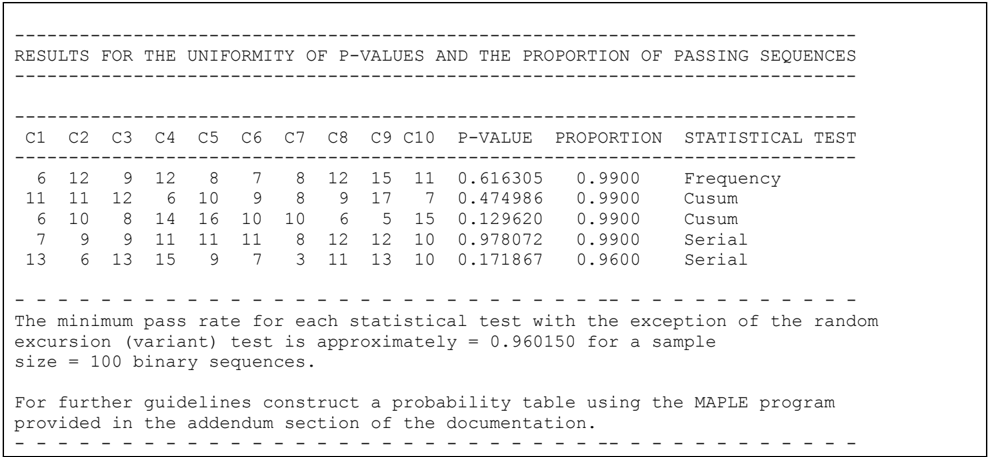
“APPENDIX A. – NIST STATISTICAL TEST RESULTS ------------------------------------------------------------------------------ RESULTS FOR THE UNIFORMITY OF P-VALUES AND THE PROPORTION OF PASSING SEQUENCES ------------------------------------------------------------------------------ --------------------------------------…”
MethodInfluentialA New DNA Based Approach of Generating Key Dependent Mix Columns Transformation
AL-Wattar, A. H., Mahmod, R., Zukarnain, Z. A., & Udzir, N. (2015) · International journal of Computer Networks & Communications · doi:10.5121/ijcnc.2015.7208 · Cited by 18
Strongest AES with S-Boxes Bank and Dynamic Key MDS Matrix (SDK-AES)
Ahmed, F., & Elkamchouchi, D. H. (2013) · International Journal of Computer and Communication Engineering · doi:10.7763/ijcce.2013.v2.242 · Cited by 18
FPGA Hardware Co-simulation of New Chaos-Based Stream Cipher Based on Lozi Map
Merah, L., Ali-Pacha, A., Hadj-Said, N., Mecheri, B., & Dellassi, M. (2018) · International Journal of Engineering and Technology · doi:10.7763/ijet.2017.v9.1010 · Cited by 19
Poli, S., Callegari, S., Rovatti, R., & Setti, G. (2004) · IEEE International Symposium on Circuits and Systems proceedings · doi:10.1109/iscas.2004.1329071 · Cited by 18
A chaos-based fully digital 120 MHz pseudo random number generator
Yang, H.-T., Huang, J.-R., & Chang, T. (2005) · IEEE Asia Pacific Conference on Circuits and Systems (APCCAS) · doi:10.1109/apccas.2004.1412769 · Cited by 18
Enhancing Data Security through Machine Learning-based Key Generation and Encryption
Saini, A., & Sehrawat, R. (2024) · Engineering Technology & Applied Science Research · doi:10.48084/etasr.7181 · Cited by 21
“Certain NIST tests, like the binary rank test, the overlapping template, the universal statistical test, and the linear complexity test, were not performed, as they require longer sizes of binary digits up to 10 6 to satisfy the randomness requirements [24].”
MethodA New ShiftColumn Transformation: An Enhancement of Rijndael Key Scheduling
Sulaiman, S., & Muda, J. J. Z. (2012) · International Journal of Cyber-Security and Digital Forensics · Cited by 22
Transparent insertion of latency-oblivious logic onto FPGAs
Hung, E., Todman, T., & Luk, W. W. (2014) · International Conference on Field Programmable Logic and Applications (FPL) · doi:10.1109/fpl.2014.6927497 · Cited by 16
True Random Number Generation using Latency Variations of Commercial MRAM Chips
Ferdaus, F., Talukder, B. M. S. B., Sadi, M., & Rahman, M. T. (2021) · International Symposium on Quality Electronic Design (ISQED) · doi:10.1109/isqed51717.2021.9424346 · Cited by 19
“III-D, over the test data sequence), the most frequently used and well-accepted NIST statistical test suite (STS) [40] is used.”
MethodSecret Key Generation Based on 3D Spatial Angles for UAV Communications
Lin, K., Ji, Z., Zhang, Y., et al. (2021) · IEEE Wireless Communications and Networking Conference · doi:10.1109/wcnc49053.2021.9417510 · Cited by 16
“A statistical test suite provided by National Institute of Standards and Technology (NIST) is widely used to verify the randomness of the generated keys [18].”
MethodDesign and Implementation of Chao-Cryptic Architecture on FPGA for Secure Audio Communication
Sowmya, B., Padmapriya, V. M., Sivaraman, R., Amirtharajan, R., Rajagopalan, S., & Upadhyay, H. N. (2021) · Lecture notes in networks and systems · doi:10.1007/978-981-15-9774-9_13 · Cited by 16
Fine with “1234”? An Analysis of SMS One-Time Password Randomness in Android Apps
Ma, S., Li, J., Kim, H., et al. (2021) · IEEE/ACM International Conference on Software Engineering (ICSE) · doi:10.1109/icse43902.2021.00148 · Cited by 16
RRAM Random Number Generator Based on Train of Pulses
Yang, B., Arumí, D., Manich, S., Gómez‐Pau, Á., Rodriguez-Montanes, R., González, M. B., Campabadal, F., & Fang, L. (2021) · Electronics · doi:10.3390/electronics10151831 · Cited by 17
“To assess the performance of the proposal, the National Institute of Standards and Technology randomness tests (NIST SP800-22) were used to evaluate the stochasticity of the bitstreams [27].”
MethodDesign and Analysis of Reconfigurable Cryptographic Primitives: TRNG and PUF
Kumar, V., Tripathy, S., & Mathew, J. (2021) · Journal of Hardware and Systems Security · doi:10.1007/s41635-021-00120-6 · Cited by 18
“NIST statistical test suite [40] is one of such commonly used methods.”
MethodSouza, C. E. C., Moreno, D., Chaves, D. P. B., & Pimentel, C. J. L. (2022) · IEEE Transactions on Instrumentation and Measurement · doi:10.1109/tim.2022.3197774 · Cited by 15
Liu, Z., Li, F., Li, Z., & Luo, B. (2022) · ACM SIGSAC Conference on Computer and Communications Security (CCS) · doi:10.1145/3548606.3560678 · Cited by 28
An Improved Absolute-Cosine Chaotification Model and Its Simple Application in PRNG
Zhang, F., Tang, J., Zhang, Z., Huang, Z., & Huang, T. (2023) · IEEE Access · doi:10.1109/access.2023.3282370 · Cited by 17
“To verify the practical performance of the proposed PRNG, we examine the randomness of the generated pseudo-random numbers by using NIST [31] and TestU01 [32].”
MethodLearned pseudo-random number generator: WGAN-GP for generating statistically robust random numbers
Okada, K., Endo, K., Yasuoka, K., & Kurabayashi, S. (2023) · PLoS ONE · doi:10.1371/journal.pone.0287025 · Cited by 29
“A PRNG is validated through a statistical test suite, such as NIST SP 800-22rev1a (NIST test suite) [30, 31], which is commonly used to evaluate the robustness and fairness of the generated random numbers and consists of 15 statistical tests.”
A Family of 1D Chaotic Maps without Equilibria
Lawnik, M., Moysis, L., & VOLOS, C. K. (2023) · Symmetry · doi:10.3390/sym15071311 · Cited by 17
Cao, Y., Liu, W., Zheng, Y., Chen, S., Ye, J., Qian, L., & Chang, C.-H. (2023) · IEEE Transactions on Circuits and Systems I Regular Papers · doi:10.1109/tcsi.2023.3316890 · Cited by 19
Dubovskiy, A., Criss, T., Valli, A. S. E., Rehm, L., Kent, A. D., & Haas, A. (2024) · IEEE Magnetics Letters · doi:10.1109/lmag.2024.3416091 · Cited by 22
“We tested the resulting bitstreams using the National Institute of Standards and Technology (NIST) statistical test suite [Bassham 2010].”
MethodLahraoui, Y., Lazaar, S., Amal, Y., & Nitaj, A. (2024) · Cryptography · doi:10.3390/cryptography8020023 · Cited by 20
True Random Number Generator Based on Chaotic Oscillation of a Tunable Double‐Well MEMS Resonator
Wu, J., Sun, H., & Zhou, G. (2024) · Small · doi:10.1002/smll.202403755 · Cited by 16
A survey on reversible watermarking techniques for relational databases
Iftikhar, S., Kamran, M., & Anwar, Z. (2015) · Security and Communication Networks · doi:10.1002/sec.1196 · Cited by 16
“Tuple or feature is selected based on difference expansion in difference expansion watermarking (DEW) technique [10], on GA defined objective function in difference expansion watermarking based on genetic algorithm (GADEW) technique [29], on predictor and hash in Prediction error Expansion watermarking (PE1) technique…”
BackgroundInfluentialDesign and implementation of coupled chaotic maps in watermarking
Behnia, S., Ahadpour, S., & Ayubi, P. (2014) · Applied Soft Computing · doi:10.1016/j.asoc.2014.03.022 · Cited by 17
Recycling random numbers in the stochastic simulation algorithm
Yates, C. A., & Klingbeil, G. (2013) · The Journal of Chemical Physics · doi:10.1063/1.4792207 · Cited by 18
An improved scheme of IPI-based entity identifier generation for securing body sensor networks
Hong, T., Bao, S., Zhang, Y., et al. (2011) · doi:10.1109/iembs.2011.6090366 · Cited by 16
FPGA Design of an Open-Loop True Random Number Generator
Lozac'H, F., Ben-Romdhane, M., Graba, T., & Danger, J. (2013) · Euromicro Conference on Digital System Design (DSD) · doi:10.1109/dsd.2013.73 · Cited by 25
Unpredictable random number generator based on mobile sensors
Suciu, A., Lebu, D., & Marton, K. (2011) · IEEE International Conference on Intelligent Computer Communication and Processing (ICCP) · doi:10.1109/iccp.2011.6047913 · Cited by 16
“All the described sensors are configurable in terms of their update notification rate, and each of them can be provided with a notification rate in the range [1] [4], where 1 is the fastest and 4 is the slowest rate.”
BackgroundCurrent based PUF Exploiting Random Variations in SRAM Cells
Zhang, F., Yang, S., Plusquellic, J., et al. (2016) · Design, Automation, and Test in Europe · doi:10.3850/9783981537079_0791 · Cited by 16
“According to [11], when applied significance level α = 0.”
BackgroundMethodGaeini, A., Mirghadri, A., Jandaghı, G., & Keshavarzi, B. (2016) · International Journal of Information Technology and Computer Science · doi:10.5815/ijitcs.2016.09.04 · Cited by 16
“NIST test are given as an example for AES256 [29].”
MethodReconfigurable side channel attack resistant true random number generator
Bahadur, V., Selvakumar, D., Vijendran, & Sobha, P. M. (2016) · IEEE International Conference on VLSI Systems, Architecture, Technology and Applications (VLSI SATA) · doi:10.1109/vlsi-sata.2016.7593048 · Cited by 18
Oğraş, H., & Türk, M. (2016) · Journal of Information Security · doi:10.4236/jis.2017.81003 · Cited by 16
Designing of quantum random number generator (QRNG) for security application
Siswanto, M., & Rudiyanto, B. (2017) · International Conference on Science in Information Technology · doi:10.1109/icsitech.2017.8257124 · Cited by 16
FPGA Implementation of a Chaos Based PRNG Targetting Secret Communication
Hobincu, R., & Datcu, O. (2018) · International Symposium on Electronics and Telecommunications (ISETC) · doi:10.1109/isetc.2018.8583863 · Cited by 19
Architectural Optimization of Parallel Authenticated Encryption Algorithm for Satellite Application
Pirzada, S. J. H., Murtaza, A., Xu, T., & Liu, J. (2020) · IEEE Access · doi:10.1109/access.2020.2978665 · Cited by 19
One-Dimensional Pseudo-Chaotic Sequences Based on the Discrete Arnold’s Cat Map Over ℤ₃ᵐ
Souza, C. E. C., Chaves, D. P. B., & Pimentel, C. J. L. (2020) · IEEE Transactions on Circuits & Systems II Express Briefs · doi:10.1109/tcsii.2020.3010477 · Cited by 18
“The statistical properties of the obtained binary sequence are analyzed with the NIST statistical test suite version SP80022 [13].”
MethodInfluentialIC Random Number Generator Exploiting Two Simultaneous Metastable Events of Tetrahedral Oscillators
Gunay, R., & Ergün, S. (2020) · IEEE Transactions on Circuits & Systems II Express Briefs · doi:10.1109/tcsii.2020.3012869 · Cited by 18
Analysis of Ring-Oscillator-based True Random Number Generator on FPGAs
Choi, S., Shin, Y., & Yoo, H. (2021) · International Conference on Electronics, Information, and Communication (ICEIC) · doi:10.1109/iceic51217.2021.9369714 · Cited by 18
“NIST SP 800-22 test evaluates randomness of bit sequences and provides the proportion of bit sequences that pass the test [5] as output.”
BackgroundMethodInfluentialOnuki, K., Cho, K., Horio, Y., & Miyano, T. (2022) · IEEE Transactions on Circuits and Systems I Regular Papers · doi:10.1109/tcsi.2022.3140762 · Cited by 18
A chaotic stream cipher based on symbolic dynamic description and synchronization
Abderrahim, N. W., Benmansour, F. Z., & Seddiki, O. (2014) · Nonlinear Dynamics · doi:10.1007/s11071-014-1432-z · Cited by 18
“We have used the NIST SP 800-22 standard tests, published by American National Institution of Standard and Technology Information [33], for this purpose.”
MethodPseudorandom number generators based on random covers for finite groups
Marquardt, P., Svaba, P., & van Trung, T. (2011) · Designs Codes and Cryptography · doi:10.1007/s10623-011-9485-1 · Cited by 19
“To begin with we make a brief description of the strategy for statistical analysis of a random number generator by the NIST test, see [11].”
MethodLee, P., Chen, Y., Pei, S., & Chen, Y.-Y. (2004) · Computer Physics Communications · doi:10.1016/j.cpc.2004.04.001 · Cited by 18
Evolving Cryptographic Pseudorandom Number Generators
Picek, S., Šišejković, D., Rožić, V., Yang, B., Jakobović, D., & Mentens, N. (2016) · Lecture notes in computer science · doi:10.1007/978-3-319-45823-6_57 · Cited by 21
Genetic algorithm based key sequence generation for cipher system
Sudeepa, K. B., Aithal, G., Rajinikanth, V., & Satapathy, S. C. (2020) · Pattern Recognition Letters · doi:10.1016/j.patrec.2020.03.015 · Cited by 20
Security of Ubiquitous Computing Systems: Selected Topics
Avoine, G., & Hernandez-Castro, J. C. (2021) · Springer eBooks · doi:10.1007/978-3-030-10591-4 · Cited by 24
Chizari, H., & Lupu, E. (2019) · IEEE Transactions on Dependable and Secure Computing · doi:10.1109/tdsc.2019.2921773 · Cited by 21
“tical tests have been proposed. A combination of randomness test algorithms is called a randomness suite or a battery of tests. The most used batteries of tests in randomness assessment are: NIST STS [38] and Dieharder [43]. A randomness suite usually needs a large set of random numbers for its tests. For instance, in…”
MethodInfluentialLai, Y., Yao, C.-Y., Yang, S.-H., Wu, Y.-W., & Liu, T.-T. (2021) · IEEE Transactions on Circuits and Systems I Regular Papers · doi:10.1109/tcsi.2021.3098018 · Cited by 17
Modified AES Cipher Round and Key Schedule
Reyes, E. M. D. L., Sison, A. M., & Medina, R. P. (2019) · Indonesian Journal of Electrical Engineering and Informatics (IJEEI) · doi:10.11591/ijeei.v7i1.652 · Cited by 16
True hardware random number generation implemented in the 32-nm SOI POWER7+ processor
Liberty, J. S., Barrera, A., Boerstler, D., Chadwick, T. B., Cottier, S. R., Hofstee, H. P., Rosser, J. A., & Tsai, M. L. (2013) · IBM Journal of Research and Development · doi:10.1147/jrd.2013.2279599 · Cited by 19
A new pseudorandom bit generator using compounded chaotic tent maps
Cristina, D. A., Boriga, R. E., & Răcuciu, C. (2012) · International Conference on Communications (COMM) · doi:10.1109/iccomm.2012.6262542 · Cited by 16
A Novel Chaotic Encryption Scheme based on Pseudorandom Bit PaddingPreprint
Ahadpour, S., Sadra, Y., & ArastehFard, Z. (2012) · arXiv (Cornell University) · doi:10.48550/arxiv.1201.1449 · Cited by 19
Slipetskyy, R. (2011) · BIBSYS Brage (BIBSYS (Norway)) · Cited by 16
Pawlowski, M., Jara, A., & Ogorzalek, M. (2015) · Sensors · doi:10.3390/s151026838 · Cited by 15
Chaos-based cryptography for cloud computing
Tobin, P., Tobin, L., McKeever, M., et al. (2016) · Irish Signals and Systems Conference · doi:10.1109/issc.2016.7528457 · Cited by 15
“The cryptographic strength of the OTP was evaluated by the National Institute of Standards and Technology (NIST) suite of tests [13].”
MethodA New Chaotic Map for Secure Transmission
Abdullah, H. A., & Abdullah, H. N. (2018) · TELKOMNIKA (Telecommunication Computing Electronics and Control) · doi:10.12928/telkomnika.v16i3.8545 · Cited by 15
“The following tests are implemented on sequence of 20,000 bits of output from the generator [13-15]: a.”
MethodCipher Modification Against Steganalysis Based on NIST Tests
Korzhik, V. I., Cuong, N. D., & Morales-Luna, G. B. (2019) · Conference of Open Innovations Association (FRUCT) · doi:10.23919/fruct.2019.8711958 · Cited by 15
Ming, H., Hu, H., Lv, F., & Yu, R. (2022) · Nonlinear Dynamics · doi:10.1007/s11071-022-07838-0 · Cited by 18
“To evaluate the randomness of the proposed RNG, we use the standard randomness analysis tool which is called NIST SP800-22 tests suite.”
MethodColor Image Encryption Based on 2D Hyperchaotic Sine Couple Map and Block Scrambling
Chen, T., Huang, T., Zhang, Z., Lü, M., & Tang, J. (2024) · IEEE Access · doi:10.1109/access.2024.3432876 · Cited by 19
Boya, B. F. B. A., Kengne, J., Nanfak, A., Muni, S. S., Nkapkop, J. D. D., Kenmoé, G. D., & Babenko, L. K. (2024) · Franklin Open · doi:10.1016/j.fraope.2024.100210 · Cited by 19
Scrutinizing WPA2 password generating algorithms in wireless routers
Lorente, E. N., Meijer, C., & Verdult, R. (2015) · Cited by 15
Chaos-based encryption for fractal image coding
Yuen, C.-H., & Wong, K. (2012) · Chinese Physics B · doi:10.1088/1674-1056/21/1/010502 · Cited by 16
A non-autonomous IC chaotic oscillator and its application for random bit generation
Özoğuz, S., & Ergün, S. (2006) · European Conference on Circuit Theory and Design · doi:10.1109/ecctd.2005.1523019 · Cited by 16
“Moreover, we have also experimentally verified that the binary data obtained from the chaotic circuit pass the tests of NIST full random number test suite [9].”
MethodLightweight Authentication Protocol for Low-Cost RFID Tags
Dusart, P., & Sinaly, T. (2013) · Lecture notes in computer science · doi:10.1007/978-3-642-38530-8_9 · Cited by 15
Chaotic oscillation and random-number generation based on nanoscale optical-energy transfer
Naruse, M., Kim, S.-J., Aono, M., Hori, H., & Ohtsu, M. (2014) · Scientific Reports · doi:10.1038/srep06039 · Cited by 17
“yes. Two failures are deemed acceptable in this particular case because the acceptable interval is determined to be in the 99.73% range of normal distribution. For details, see section 4.2.1 of Ref. [39]. 14 The solid, dashed, dotted, and dot-dashed curves in Fig. 4b show the frequency of the FIPS-test failure for the…”
BackgroundInfluentialA hardware efficient chaotic ring oscillator based true random number generator
Çiçek, İ., & Dündar, G. (2011) · IEEE International Conference on Electronics, Circuits and Systems (ICECS) · doi:10.1109/icecs.2011.6122305 · Cited by 17
“Approximate entropy test is used to check the regularity statistics which quantifies the unpredictability of generated bits describing the likelihood that similar patterns of bits will not be followed by additional similar bits [10], [11].”
BackgroundMethodLow-cost implementations of on-the-fly tests for random number generators
Veljković, F., Rožić, V., & Verbauwhede, I. M. R. (2012) · Design, Automation, and Test in Europe · doi:10.5555/2492708.2492948 · Cited by 19
A TRNG exploiting multi-source physical data
Gaglio, V., Paola, A. D., Ortolani, M., et al. (2010) · doi:10.1145/1868630.1868646 · Cited by 15
An Efficient Quasigroup Block Cipher
Battey, M., & Parakh, A. (2012) · Wireless Personal Communications · doi:10.1007/s11277-012-0959-x · Cited by 16
Audio codec identification from coded and transcoded audios
Hiçsönmez, S., Sencar, H. T., & Avcıbaş, İ. (2013) · Digital Signal Processing · doi:10.1016/j.dsp.2013.04.005 · Cited by 15
Chaotic cryptographic scheme and its randomness evaluation
Stoyanov, B. P. (2012) · AIP conference proceedings · doi:10.1063/1.4758983 · Cited by 16
Modelling of Currency Exchange Rates Using a Binary Representation
Stasiak, M. D. (2016) · Advances in intelligent systems and computing · doi:10.1007/978-3-319-46592-0_13 · Cited by 15
Emitter-coupled pair chaotic generator circuit
Evangelista, J. V. C., Artiles, J. A. P., Chaves, D. P. B., & Pimentel, C. J. L. (2017) · AEU - International Journal of Electronics and Communications · doi:10.1016/j.aeue.2017.04.029 · Cited by 15
Ortiz‐Martin, L., Picazo‐Sanchez, P., Lopez, P. P., & Tapiador, J. (2018) · Entropy · doi:10.3390/e20020094 · Cited by 16
“Some of these observations have been already raised in [12], in which the authors pointed out the need to perform a more sound assessment of the quality of the generated keys using larger datasets and additional randomness tests.”
BackgroundMethodInfluentialColor image encryption method based on 2D-variational mode decomposition
Kang, S., Liang, Y., Wang, Y., & Микулович, В. И. (2019) · Multimedia Tools and Applications · doi:10.1007/s11042-018-7129-4 · Cited by 16
Development of Niederreiter hybrid crypto-code structure on flawed codes
Yevseiev, S., Tsyhanenko, O., Havrylova, A., Guzhva, V. A., Мілов, О. В., Москаленко, В. В., Opirskyy, I., Рома, О. М., Tomashevsky, B., & Shmatko, O. (2019) · Eastern-European Journal of Enterprise Technologies · doi:10.15587/1729-4061.2019.156620 · Cited by 21
“Today, the testing methodology proposed by NIST is the most common among developers of cryptographic information security tools [27].”
Method
Metadata
- Authors
- Bassham, L. E., Rukhin, A. L., Soto, J., Nechvatal, J. R., Smid, M. E., Barker, E. B., Leigh, S. D., Levenson, M., Vangel, M., Banks, D. L., Heckert, N. A., Dray, J. F., & Vo, S.
- Affiliations
- National Institute of Standards and Technology (US)
- Venue
- NIST Special Publication 800-22 Revision 1a
- Published
- 2010
- OpenAlex
- W1517403092
- Semantic Scholar
- 961fc0f6c68303cde94a28fdb24e6eaf3ef040b4
- Cited by
- 3,617
- References
- 34
- Citations by year
- 2026: 128 · 2025: 205 · 2024: 192 · 2023: 208 · 2022: 166 · 2021: 291 · 2020: 290 · 2019: 250 · 2018: 254 · 2017: 207 · 2016: 183 · 2015: 184 · 2014: 201 · 2013: 155 · 2012: 139
- Type
- report
- Language
- en
- Open access
- gold
- doi.org
- Topics
- Physical Sciences › Computer Science › Artificial Intelligence › Cryptographic Implementations and Security
- Physical Sciences › Mathematics › Discrete Mathematics and Combinatorics › Coding theory and cryptography
- Physical Sciences › Computer Science › Computer Vision and Pattern Recognition › Chaos-based Image/Signal Encryption
- Keywords
- random number generators, pseudorandom number generators, cryptographic randomness, NIST SP 800-22, randomness testing
About these checks
Registry, retraction, Cites and statistics results are computed, not judged, with one exception: a printed reference that no index lists is read once by a model before it counts as a citation error. Claims are extracted by a model and kept only when their quote appears verbatim in the text; each cited source is then checked, with a model’s help, for whether it says what the claim relies on. Those verdicts can be wrong — read the claim’s quote and the cited source before relying on one.
A language model drew the claims from the paper on 2026-09-27 (prompt extract-v2).
Statistics and arithmetic are recomputed, not judged.
Confidence bands are shown only for fields calibrated on our annotated test set. None is calibrated yet, so no band is shown.
What counts as a claim ›How we measure confidence ›How we check this ›
Are you an author, or do you see a problem with this page? Request a review
Data sources
Bibliographic data: Semantic Scholar, OpenAlex, Crossref.
Contains information from the Semantic Scholar Academic Graph Datasets, made available under the ODC Attribution License (ODC-BY 1.0).
Semantic Scholar’s data is described in: Kinney, R., et al. (2023). The Semantic Scholar Open Data Platform. arXiv:2301.10140.
