

A statistical test suite for random and pseudorandom number generators for cryptographic applications
Open accessThe DOI matches its Crossref record; 33 of the 34 references it cites were found in a registry or an index; none of the 14 sources its claims cite is checked for support yet.
Abstract
The Information Technology Laboratory (ITL) at the National Institute of Standards and Technology (NIST) promotes the U.S. economy and public welfare by providing technical leadership for the nation's measurement and standards infrastructure. ITL develops tests, test methods, reference data, proof of concept implementations, and technical analysis to advance the development and productive use of information technology. ITL's responsibilities include the development of technical, physical, administrative, and management standards and guidelines for the cost-effective security and privacy of sensitive unclassified information in Federal computer systems.
Overview
CoChat Summary
TL;DR
This NIST Special Publication 800-22 Revision 1a presents a suite of 15 statistical tests for evaluating whether binary sequences produced by random or pseudorandom number generators are suitable for cryptographic applications. It provides test purposes, mathematical descriptions, examples, and guidance for interpreting P-values, while cautioning that statistical testing is only a first step and cannot replace cryptanalysis.
Key findings
- The suite consists of 15 tests: Frequency (Monobit), Frequency within a Block, Runs, Longest Run of Ones, Binary Matrix Rank, Discrete Fourier Transform (Spectral), Non-overlapping Template Matching, Overlapping Template Matching, Maurer’s “Universal Statistical,” Linear Complexity, Serial, Approximate Entropy, Cumulative Sums, Random Excursions, and Random Excursions Variant. The Frequency test is recommended first because it supplies the most basic evidence of non-randomness.
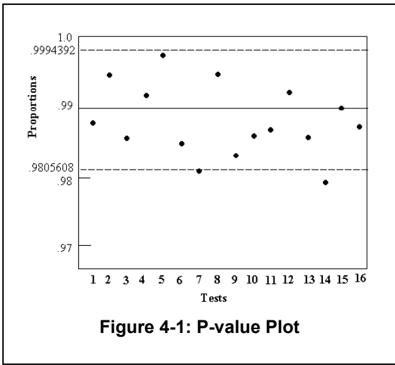
- Each test uses the null hypothesis \(H_0\) that the sequence is random; if P-value \(\ge \alpha\), the sequence is accepted as random, and if P-value \(<\alpha\), it is rejected. Examples use \(\alpha=0.01\), and NIST recommends \(\alpha\) in the range [0.001, 0.01].
- The document states that no finite set of statistical tests is “complete,” that statistical testing cannot absolutely certify a generator, and that statistical testing cannot serve as a substitute for cryptanalysis.
- Sample data files are 1,000,000 bits (binary expansions of \(e\), \(\pi\), \(\sqrt{2}\), \(\sqrt{3}\), and a G-SHA-1 sequence); reported example P-values include Frequency for \(\pi\) = 0.578211, for \(e\) = 0.953749, and for G-SHA-1 = 0.604458.
Methods
- Design: The NIST Statistical Test Suite is an ANSI C reference implementation of 15 tests; each test defines a test statistic, a reference distribution (e.g., normal, half-normal, chi-square), a P-value, and a decision rule at the 1% level.
- Data or sample: Tests apply to binary sequences from hardware or software RNGs/PRNGs; sample files are 1,000,000 bits, while many worked examples use small illustrative lengths such as \(n=100\).
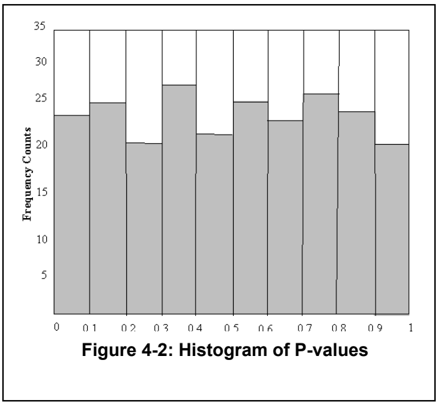
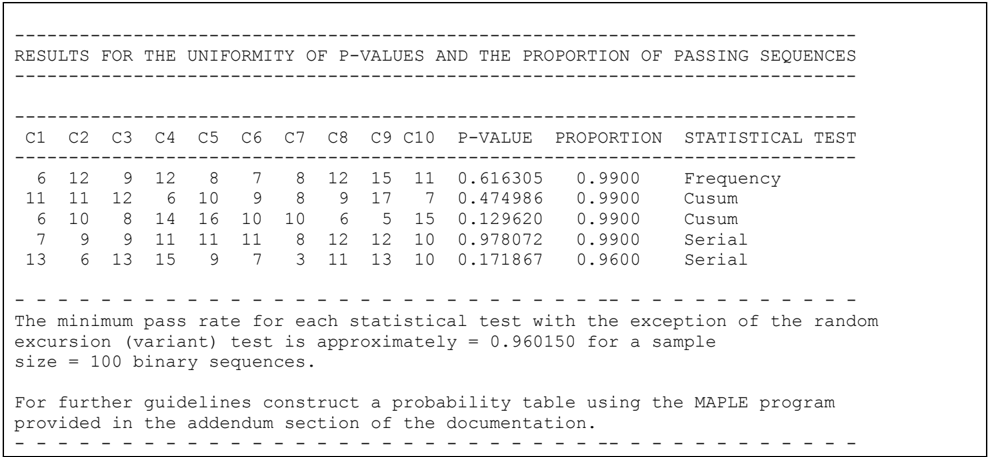
- Main analysis: For each sequence, P-values are computed and compared to \(\alpha\); empirical interpretation examines the proportion of sequences passing a test and the uniformity of P-values. A multiple-test dependence study applied 161 test P-values to Blum-Blum-Shub sequences of length 1,000,000 and used principal components/factor analysis, concluding there was no large redundancy among tests.
Limitations
- The paper states that no set of statistical tests can absolutely certify a generator as appropriate, that statistical testing cannot substitute for cryptanalysis, and that generator design and cryptanalysis are outside its scope.
- The paper states that many examples use small sample sizes for illustration only, e.g., \(n=10\), where the normal approximation is not really applicable; many tests rely on asymptotic reference distributions for large \(n\) (order \(10^3\) to \(10^7\)), and input parameter constraints apply.
- The text makes evident additional limitations: numerical precision can degrade for large incomplete gamma parameter \(a\); Maurer’s variance approximation can make the test 2.67 times more permissive than theoretically admitted; Random Excursions is discontinued if \(J<500\); and multiple tests can yield contradictory conclusions, as in the Random Excursions example where one state gave a non-random result while seven states gave random results.
Model-written summary. Check it against the paper before relying on it.
Integrity signals
Registry
Cites
Statistics
Figures

Verification
Claims the paper makes
0 Valid · 1 Not valid · 11 Not checked · 13 Own results and interpretations
A result the paper reports from its own data — it cites no other source for it, so there is none to check. The quote shows it is in the paper.
In the paper
“The asymptotic distribution of ( Ln -µ n ) / σ n along the sequence of even or odd values of n is that of a discrete random variable obtained via a mixture of two geometric random variables (one of them taking only negative values). Strictly speaking, the asymptotic distribution as such does not exist.”
A result the paper reports from its own data — it cites no other source for it, so there is none to check. The quote shows it is in the paper.
In the paper
“However, no set of statistical tests can absolutely certify a generator as appropriate for usage in a particular application, i.e., statistical testing cannot serve as a substitute for cryptanalysis.”
A result the paper reports from its own data — it cites no other source for it, so there is none to check. The quote shows it is in the paper.
In the paper
“This graph showed that there is no large redundancy among our tests.”
In the paper
“Ueli Maurer of the Department of Computer Science at Princeton University introduced this test in 1992. Maurer's test statistic relates closely to the per-bit entropy of the stream, which its author asserts is 'the correct quality measure for a secret-key source in a cryptographic application.'”
What the sources say
- Not matchedcites Maurer
This doesn’t read as a citation we can look up.
- Not matched
What the paper did — it cites no source for this, so there is none to check. The quote shows it is in the paper.
In the paper
“The test rejects the randomness hypothesis immediately if J is too small, i.e., if the following P-value is small:”
20 more claims
Create a free account to see all 25 claims and every source verdict.
Claims other papers make about this one
Each is checked against this paper’s own text: does it say what the citing paper says it does?
The source backs part of the claim, not all of it — or backs it for a different population, condition or comparison.
In the citing paper
“However, the latest version 2.1.2 [1], released in 2014, does not incorporate several modifications.”
From Checking the quality of approximation of p-values in statistical tests for random number generators by using a three-level test (2019) · cites this paper as [1]
Experimental — accuracy not yet measuredThe source backs part of the claim, not all of it — or backs it for a different population, condition or comparison.
In the citing paper
“The NIST test suite consists of 15 statistical tests for randomness of bit sequences, and its result is a list of 188 p -values.”
From Checking the quality of approximation of p-values in statistical tests for random number generators by using a three-level test (2019) · cites this paper as [1]
Experimental — accuracy not yet measuredThe cited source says what the claim attributes to it.
In the citing paper
“Note that the current implementation of the NIST test suite uses one-level or two-level tests, differently from the above experiments”
From Checking the quality of approximation of p-values in statistical tests for random number generators by using a three-level test (2019) · cites this paper as [1]
The cited source says what the claim attributes to it.
In the citing paper
“NIST SP-800.22 statistical test suite [90] and Die-hard test suite [91] and Test U01 [92] and AIS31 [93] are most common statistical test suites to evaluate their RNGs by researchers.”
From True Random Number Generators Using Electrical Noise (2019) · cites this paper as [90]
Self-check
Percentages, sums and reported differences re-computed from the paper’s own numbers.
Each contradiction between two passages listed here was confirmed by an independent check.
Rated minor: it would not touch a result — a value no result rests on, a p-value that stays on the same side of the significance level, or a conflict that is clerical, resolved elsewhere in the paper, or outside its own findings.
In the paper
§ 2.3.8 Example
“(input) τ = 0.02 (processing) π = 0.42 (processing) Vn(obs) = 52 (output) P-value = 0.500798 (conclusion) Since P-value ≥ 0.01 , accept the sequence as random.”
§ 2.3.4 Test Description
“If it can be shown that π -1 ≥τ , then the 2 Runs test need not be performed (i.e., the test should not have been run because of a failure to pass test 1, the Frequency (Monobit) test). If the test is not applicable, then the P-value is set to 0.0000.”
Rated minor: it would not touch a result — a value no result rests on, a p-value that stays on the same side of the significance level, or a conflict that is clerical, resolved elsewhere in the paper, or outside its own findings.
In the paper
§ 2.7.4 Test Description
“| 8-10 | 010 (hit) | 2 | 110 | 1 |”
§ 2.7.4 Test Description
“For the above example, if m = 3 and the template B = 001, then the examination proceeds as follows:”
Rated minor: it would not touch a result — a value no result rests on, a p-value that stays on the same side of the significance level, or a conflict that is clerical, resolved elsewhere in the paper, or outside its own findings.
In the paper
§ 2.9.3 Test Statistic and Reference Distribution
“f n : The sum of the log2 distances between matching Lbit templates, i.e., the sum of the number of digits in the distance between Lbit templates.”
§ 3.9 Maurer's 'Universal Statistical' Test
“Then it averages over all the expansion lengths by the number of test blocks.”
Rated minor: it would not touch a result — a value no result rests on, a p-value that stays on the same side of the significance level, or a conflict that is clerical, resolved elsewhere in the paper, or outside its own findings.
In the paper
§ Input Parameters:
“The parameters p , q and s are not fixed in code; thus, the user will not be able to reconstruct the original sequence because these values will vary (i.e., they are dependent on the system time).”
§ Input Parameters:
“The input parameters have been fixed so the code will reproduce the same results.”
Rated minor: it would not touch a result — a value no result rests on, a p-value that stays on the same side of the significance level, or a conflict that is clerical, resolved elsewhere in the paper, or outside its own findings.
In the paper
§ 5.5.2 Global Parameters
“| MAXNUMOFTEMPLATES | 40 | Non-overlapping Templates Test | | NUMOFTESTS | 16 | Max number of tests | | NUMOFGENERATORS | 12 | Max number of PRNGs |”
§ A.2 Configuration Information
“| 2. | #define MAXNUMOFTEMPLATES | 148 | | 3. | #define NUMOFTESTS | 15 | | 4. | #define NUMOFGENERATORS | 10 |”
2 more findings
Create a free account to see every finding of this check.
Citations
Cites
Handbook of Mathematical Functions
McQuarrie, D. A. (1966) · American Journal of Physics · doi:10.1119/1.1972842 · Cited by 40,433
Numerical recipes in C: the art of scientific computing
(1993) · Choice Reviews Online · doi:10.5860/choice.30-5638 · Cited by 17,933
Rayward-Smith, V. J. (1991) · Journal of the Operational Research Society · doi:10.1057/jors.1991.155 · Cited by 16,821
Handbook of applied cryptography
(1997) · Choice Reviews Online · doi:10.5860/choice.34-4512 · Cited by 10,357
Handbook of Mathematical Functions
(2018) · A Century of Excellence in MEASUREMENTS, STANDARDS, and TECHNOLOGY · doi:10.1201/9781351069397-39 · Cited by 9,062
A universal algorithm for sequential data compression
Ziv, J., & Lempel, A. (1977) · IEEE Transactions on Information Theory · doi:10.1109/tit.1977.1055714 · Cited by 5,456
The Art of Computer Programming
Worlton, W. J. (1968) · Nuclear Science and Engineering · doi:10.13182/nse68-a19548 · Cited by 2,251
Handbook of Applied Cryptography
Menezes, A. J., van Oorschot, P. C., & Vanstone, S. A. (2018) · CRC Press eBooks · doi:10.1201/9780429466335 · Cited by 1,770
Numerical Recipes in C-The Art of Scientific Computing.
G., W., Press, W. H., Flannery, B. P., Teukolsky, S. A., & Vetterling, W. T. (1989) · Mathematics of Computation · doi:10.2307/2008673 · Cited by 1,513
The Fourier Transform and its Applications
Cattermole, K. W. (1965) · Electronics and Power · doi:10.1049/ep.1965.0268 · Cited by 1,417
Cited by
Items 1,401–1,500 of 3,620
Randomness of a combined TRNG based on the ring oscillator sampling method
Jessa, M., & Jaworski, M. (2010) · ICSES 2010 International Conference on Signals and Electronic Circuits · Cited by 15
An Efficient PRBG Based on Chaotic Map and Engel Continued Fractions
Masmoudi, A., Puech, W., & Bouhlel, M. S. (2010) · Journal of Software Engineering and Applications · doi:10.4236/jsea.2010.312133 · Cited by 10
“The detailed description of all 16 tests of NIST suite can be found in [21].”
BackgroundMethodA novel image encryption method based on chaotic maps
Fard, E. B., & Atani, R. E. (2013) · International Conference on Computer and Knowledge Engineering · doi:10.1109/iccke.2013.6682835 · Cited by 10
Attack on a Chaos-Based Random Number Generator Using Anticipating Synchronization
Yeniçeri, R., Kılınç, S., & Yalcin, M. E. (2015) · International Journal of Bifurcation and Chaos · doi:10.1142/s0218127415500212 · Cited by 11
Secure random number generation in wireless sensor networks
Re, G. L., Milazzo, F., & Ortolani, M. (2014) · Concurrency and Computation Practice and Experience · doi:10.1002/cpe.3311 · Cited by 11
Elliptic curve based key generation for symmetric encryption
Vigila, S. M. C., & Muneeswaran, K. (2011) · doi:10.1109/icsccn.2011.6024664 · Cited by 10
“Table 3 lists the values of entropy and correlation between two adjacent pixels computations for the plain and cipher images are carried out using the procedure given in [1-5].”
MethodGENERATING CHAOTIC SECURE SEQUENCES USING TENT MAP AND A RUNNING-KEY APPROACH
Vlad, A., Luca, A., Hodea, O., et al. (2013) · Cited by 10
High speed and secure variable probability Pseudo/True Random Number Generator using FPGA
Marghescu, A., Svasta, P. M., & Simion, E. (2015) · IEEE International Symposium for Design and Technology in Electronic Packaging (SIITME) · doi:10.1109/siitme.2015.7342347 · Cited by 10
Strong Zero-knowledge Authentication Based on Virtual Passwords
Asimi, Y., Amghar, A., Asimi, A., & Sadqi, Y. (2016) · International journal of network security · doi:10.6633/ijns.201607.18(4).01 · Cited by 10
Pseudo-random number generator based on fuzzy logic
Anikin, I. V., & Alnajjar, K. (2016) · International Siberian Conference on Control and Communications · doi:10.1109/sibcon.2016.7491667 · Cited by 10
“We used following irreducible polynomials of LFSRs in the the studied generator: 89868483 1 1)( xxxxxP ++++= 9791 2 1)( xxxP ++= We proved in [3] that the period of the suggeted FRNG is 5055 21 101080797.9 ≥×=⋅= TTTS Also, it has been proven that the sequence which is generated by FRNG passed all the randomness tests…”
MethodInfluentialPermutation techniques based on discrete chaos and their utilization in image encryption
Abd–El–Hafiz, S. K., AbdElHaleem, S. H., & Radwan, A. G. (2016) · International Conference on Electrical Engineering/Electronics, Computer, Telecommunications and Information Technology (ECTI-CON) · doi:10.1109/ecticon.2016.7561265 · Cited by 11
“Table VII shows sample NIST results [21] where the three algorithms succeeded in all tests.”
Hybrid CMOS-OxRAM RNG circuits
Sahay, S., Suri, M., Kumar, A., & Parmar, V. (2016) · IEEE International Conference on Nanotechnology (IEEE-NANO) · doi:10.1109/nano.2016.7751437 · Cited by 12
“applications such as cryptography or stochastic computing, we performed some well-known statistical tests such as the probability distribution, covariance/correlation, chi-square test and serial spectral test [20], [21] on the distributions”
MethodMasmoudi, A., Puech, W., & Bouhlel, M. S. (2010) · HAL · Cited by 9
A Study of Power Supply Variation as a Source of Random Noise
Tehranipoor, F., Karimian, N., Yan, W. Q., & Chandy, J. A. (2017) · International Conference on VLSI Design · doi:10.1109/vlsid.2017.24 · Cited by 14
“Our FFT metric from the NIST test [9] gives values that range from 0.”
BackgroundMethodInfluentialSecure FPGA as a Service — Towards Secure Data Processing by Physicalizing the Cloud
Will, M. A., & Ko, R. K. L. (2017) · doi:10.1109/trustcom/bigdatase/icess.2017.270 · Cited by 10
“Both designs used less than a few hundred slices, and passed tests for random number generation [48].”
MethodImplementation of a quantum random number generator based on the optimal clustering of photocounts
Balygin, K. A., Zaitsev, V. Y., Klimov, A. N., Kulik, S. P., & Molotkov, S. N. (2017) · Journal of Experimental and Theoretical Physics Letters · doi:10.1134/s0021364017190043 · Cited by 12
Fast and secure random number generation using low-cost EEG and pseudo random number generator
Gavas, R. D., & Navalyal, G. U. (2017) · International Conference On Smart Technologies For Smart Nation (SmartTechCon) · doi:10.1109/smarttechcon.2017.8358398 · Cited by 10
“the randomness tests from the NIST test suite [24], [25].”
MethodRandom number generation using decimal cellular automata
Bhattacharjee, K., & Das, S. K. (2019) · Communications in Nonlinear Science and Numerical Simulation · doi:10.1016/j.cnsns.2019.104878 · Cited by 12
Image Encryption in IoT Devices Using DNA and Hyperchaotic Neural Network
Rarhi, K., & Saha, S. (2019) · Lecture notes in networks and systems · doi:10.1007/978-981-13-9574-1_15 · Cited by 12
Sivaraman, R., Sridevi, A., Rajagopalan, S., Janakiraman, S., & Amirtharajan, R. (2019) · International Conference on Computer Communication and Informatics (ICCCI) · doi:10.1109/iccci.2019.8822072 · Cited by 10
Quantum Random Number Generation
Kollmitzer, C., Petscharnig, S., Suda, M., & Mehić, M. (2020) · Quantum science and technology · doi:10.1007/978-3-319-72596-3_2 · Cited by 11
Harnessing Uncertainty in Photoresistor Sensor for True Random Number Generation in IoT Devices
Degada, A., & Thapliyal, H. (2020) · International Conference on Consumer Electronics · doi:10.1109/icce46568.2020.9042967 · Cited by 10
“We used the US based National Institute of Standard and Technology (NIST) recommended Statistical Test Suite (STS), also known as NIST SP 800-22 as a measure of randomness [15].”
MethodLow-Complexity and Reliable Transforms for Physical Unclonable Functions
Günlü, O., & Schaefer, R. F. (2020) · IEEE International Conference on Acoustics Speech and Signal Processing · doi:10.1109/icassp40776.2020.9053107 · Cited by 10
“The bit sequences generated with the ST pass most of the randomness tests, which is considered to be an acceptable result [22].”
BackgroundMethodArchitectural Supports for Block Ciphers in a RISC CPU Core by Instruction Overloading
Choi, P., Kong, W., Kim, J.-H., et al. (2021) · IEEE Transactions on Computers · doi:10.1109/tc.2021.3050515 · Cited by 10
“We used true random number generators (TRNGs) of [38], whose generated random sequences passed the National Institute of Standards and Technology (NIST) random test suites [39].”
MethodPIONEER—a Prototype for the Internet of Things Based on an Extendable EPC Gen2 RFID Tag
Groß, H., Wenger, E., Martín, H., & Hutter, M. (2014) · Lecture notes in computer science · doi:10.1007/978-3-319-13066-8_4 · Cited by 10
“The statistical test of NIST [45] has been applied to 100 traces of 10 bits.”
MethodA New PRNG Hardware Architecture Based on an Exponential Chaotic Map
Cardoso, M. B. R., Silva, S. S. D., Nardo, L. G., Passos, R. M., Nepomuceno, E. G., & Arias-García, J. (2021) · IEEE International Symposium on Circuits and Systems proceedings · doi:10.1109/iscas51556.2021.9401653 · Cited by 14
Domain Isolation in FPGA-Accelerated Cloud and Data Center Applications
Mbongue, J. M., Saha, S. K., & Bobda, C. (2021) · ACM Great Lakes Symposium on VLSI (GLSVLSI) · doi:10.1145/3453688.3461527 · Cited by 10
Image block generation from block-based SMRT in colour image encryption and its performance analysis
Ikbal, F., & Gopikakumari, R. (2021) · Journal of King Saud University - Computer and Information Sciences · doi:10.1016/j.jksuci.2021.08.026 · Cited by 11
Permutation-Based Frame Synchronisation Method for Short Packet Communication Systems
Фауре, Е. В., Shcherba, A., & Stupka, B. (2021) · IEEE International Conference on Intelligent Data Acquisition and Advanced Computing Systems: Technology and Applications (IDAACS) · doi:10.1109/idaacs53288.2021.9660996 · Cited by 10
Artificial Intelligence for the Design of Symmetric Cryptographic Primitives
Mariot, L., Jakobović, D., Bäck, T., & Hernandez-Castro, J. C. (2022) · Lecture notes in computer science · doi:10.1007/978-3-030-98795-4_1 · Cited by 15
Optical quantum random number generators: a comparative study
Guillán-Lorenzo, O., Costas, M. T., Outerelo, D. Á., Díaz-Otero, F. J., & García-Escartín, J. C. (2023) · Optical and Quantum Electronics · doi:10.1007/s11082-022-04396-y · Cited by 11
Study on the Statistical Test for String Pseudorandom Number Generators
Min, L., Hao, L., & Zhang, L. (2013) · Lecture notes in computer science · doi:10.1007/978-3-642-38786-9_32 · Cited by 10
Ergün, S., & Özoğuz, S. (2005) · Lecture notes in computer science · doi:10.1007/11569596_23 · Cited by 11
Statistical Analysis of the Chaos-Driven Elliptic Curve Pseudo-random Number Generators
Reyad, O., & Kotulski, Z. (2014) · Communications in computer and information science · doi:10.1007/978-3-662-44893-9_4 · Cited by 9
Designing Chaotic Mathematical Circuits for Solving Practical Problems
Lozi, R. (2014) · Machine Intelligence Research · doi:10.1007/s11633-014-0839-9 · Cited by 10
“To evaluate the random property of these generators, the set of National Institute of Standards and Technology (NIST) tests([21]) have been used.”
MethodSuresh, V., & Burleson, W. P. (2012) · International Symposium on Quality Electronic Design (ISQED) · doi:10.1109/isqed.2012.6187509 · Cited by 12
Novel bilateral-diffusion image encryption algorithm with compound chaos and LFSR
Tong, X. (2012) · The Imaging Science Journal · doi:10.1179/1743131x11y.0000000042 · Cited by 10
FPGA implementation and evaluation of two cryptographically secure hybrid cellular automata
Dogaru, I., & Dogaru, R. (2014) · International Conference on Communications (COMM) · doi:10.1109/iccomm.2014.6866740 · Cited by 10
“In order to prove and certify the cryptographic efficiency for a pseudo-random number generator, the standard battery of NIST statistical tests [1] is frequently used.”
MethodA one-way coupled chaotic map lattice based self-synchronizing stream cipher
Wang, S., Hu, G. X., & Zhou, H. (2013) · Communications in Nonlinear Science and Numerical Simulation · doi:10.1016/j.cnsns.2013.08.024 · Cited by 9
A keyed hash function based on the modified coupled chaotic map lattice
Li, D., Hu, G., & Wang, S. (2011) · Communications in Nonlinear Science and Numerical Simulation · doi:10.1016/j.cnsns.2011.10.030 · Cited by 10
High-Density Physical Random Number Generator Using Spin Signals in Multidomain Ferromagnetic Layer
Chun, S., Lee, S., Hara, M., Park, W., & Kim, S.-J. (2015) · Advances in Condensed Matter Physics · doi:10.1155/2015/251819 · Cited by 11
“There aremanywell-known statistical test suites such as NIST 800-22 [27, 28], FIPS 1402 [29], and Diehard [30].”
Girardin, V., & Regnault, P. (2015) · Annals of the Institute of Statistical Mathematics · doi:10.1007/s10463-014-0501-x · Cited by 9
Cryptanalysis of the stream cipher BEAN
Ågren, M., & Hell, M. (2011) · International Conference on Security of Information and Networks (SIN) · doi:10.1145/2070425.2070432 · Cited by 10
A new fuzzy logic based pseudo-random bit generator for secure DS-CDMA systems
El-Khawy, S. E., Lotfy, M. A., & Ali, A. H. (2005) · doi:10.1109/nrsc.2005.194022 · Cited by 10
Utilizing LFSR and Feistel networks in image encryption
AbdElHaleem, S. H., Radwan, A. G., & Abd–El–Hafiz, S. K. (2013) · IEEE International Conference on Electronics, Circuits and Systems (ICECS) · doi:10.1109/icecs.2013.6815486 · Cited by 10
“NIST Statistical Test Suite NIST suite is a group of 15 different tests designed to investigate the randomness of the encrypted image [14].”
BackgroundA Random Number Generator Using Ring Oscillators and SHA-256 as Post-Processing
Łoza, S., Matuszewski, Ł., & Jessa, M. (2015) · International Journal of Electronics and Telecommunications · doi:10.1515/eletel-2015-0026 · Cited by 10
“To assess the minimal number of source generators of CRBG with SHA-256 as post-processing “A statistical Test Suite for Random and Pseudo-Random Number Generators for Cryptographic Applications”, document 800-22 prepared by the National Institute of Standards and Technology (NIST) was used [47].”
MethodChen, X., Li, B., Wang, Y., Liu, Y., & Yang, H. (2016) · IEEE Transactions on Circuits & Systems II Express Briefs · doi:10.1109/tcsii.2016.2530095 · Cited by 11
“All the NIST tests are passed, indicating that the generated random numbers are of good randomness.”
MethodPRNGs for Masking Applications and Their Mapping to Evolvable Hardware
Picek, S., Yang, B., Rožić, V., et al. (2017) · Lecture notes in computer science · doi:10.1007/978-3-319-54669-8_13 · Cited by 10
A New Advanced Cryptographic Algorithm System for Binary Codes by Means of Mathematical Equation
Shohieb, S. M., Ksasy, M. S., Takieldeen, A. E., & Eltengy, A. H. (2018) · ICIC Express Letters · Cited by 12
Evaluation Criteria for Physical Random Number Generators
Schindler, W. (2008) · Springer eBooks · doi:10.1007/978-0-387-71817-0_3 · Cited by 12
“e.g., [27, 31, 32, 38 ] developed for a different purpose, namely for testing pseudorandom numbers for stochastic simulations), even if they have been generated by (in our sense) weak DRNGs.”
BackgroundDLMS / COSEM protocol security evaluation
Weith, L. L. (2014) · TU/e Research Portal · Cited by 10
Practical quantum random number generator based on sampling vacuum fluctuationsPreprint
Zhou, Q., Valivarthi, R., John, C., & Tittel, W. (2017) · arXiv (Cornell University) · doi:10.48550/arxiv.1703.00559 · Cited by 10
“01 as suggested by the test suite [38], implying that one out of one hundred tests is expected to fail even if the random numbers being tested are generated by a fair random generator.”
MethodA Study on Energy Harvesters for Physical Unclonable Functions and Random Number Generation
Aponte-Bezares, E. E. (2017) · VTechWorks (Virginia Tech) · Cited by 10
Image cipher applications using the elliptical curve and chaos
Silva-García, V. M., Flores-Carapia, R., Rentería-Márquez, C., Luna-Benoso, B., & Chimal-Eguía, J. C. (2020) · International Journal of Applied Mathematics and Computer Science · doi:10.34768/amcs-2020-0029 · Cited by 9
“(Rukhin et al., 2010).”
BackgroundSHAH: Hash Function Based on Irregularly Decimated Chaotic Map
Todorova, M., Stoyanov, B., Szczypiorski, K., & Kordov, K. (2018) · International Journal of Electronics and Telecommunications · doi:10.24425/123546 · Cited by 9
A refined sine-derived chaotic map for securing medical image encryption in telemedicine
Belazi, A., & Mabrouk, A. B. (2025) · Computers in Biology and Medicine · doi:10.1016/j.compbiomed.2025.110667 · Cited by 13
A survey of methods for encrypted network traffic fingerprinting
Yu, S., & Won, Y. (2022) · Mathematical Biosciences & Engineering · doi:10.3934/mbe.2023101 · Cited by 13
“Based on the test features of NIST SP 800-22 “A Statistical Test Suite for Random and Pseudorandom Number Generators for Cryptographic Applications,” features were extracted, and the TLS version, cipher suite, and encryption algorithm were predicted [50].”
MethodA chaos-metastability TRNG for natively flexible IGZO circuits
Gołofit, K., Wieczorek, P. Z., & Pilarz, M. (2023) · AEU - International Journal of Electronics and Communications · doi:10.1016/j.aeue.2023.154835 · Cited by 11
Sarıkaya, M. S., Naser, Y. H. E., Kaçar, S., Yazıcı, İ., & Derdiyok, A. (2024) · Symmetry · doi:10.3390/sym16111435 · Cited by 10
Field-Programmable Gate Array-Based True Random Number Generator Using Capacitive Oscillators
Hajduk, Z. (2024) · Electronics · doi:10.3390/electronics13234819 · Cited by 9
“The system depicted Table 1 shows the results of the NIST SP800-22 statistical test [41] and the TRNG throughput (TP) for di ff erent temperatures of the FPGA die.”
A Lightweight Cryptographic Framework Based on Hybrid Cellular Automata for IoT Applications
Hasan, A., & Hashem, M. M. A. (2024) · IEEE Access · doi:10.1109/access.2024.3519673 · Cited by 14
“Additionally, the NIST Test [33] and DIEHARD [34] test were performed over the proposed algorithm.”
Qian, Y., Zheng, J., & Hu, H. (2024) · Nonlinear Dynamics · doi:10.1007/s11071-024-10406-3 · Cited by 11
Pham, D.-H., & Vu, M. T. (2025) · Mathematics · doi:10.3390/math13060923 · Cited by 9
Web‐Like Silver Nanowire Networks via Marangoni‐Induced Self‐Assembly for Physically Unclonable Tags
Kim, Y. A., Moon, C., Kim, S., & Lim, B. (2025) · Advanced Functional Materials · doi:10.1002/adfm.202508556 · Cited by 11
“[62] Due to the limited number of extracted bits compared to the 10 6 bits required to perform all 15 statistical tests in the SP-800 test suite, only a subset of the tests was applied ( Table 1 ).”
Irfan, M., & Khan, M. A. (2025) · Cogent Engineering · doi:10.1080/23311916.2025.2558751 · Cited by 21
Novel Pseudorandom Number Generation Using Variant Logic Framework
Zheng, J. (2018) · Springer eBooks · doi:10.1007/978-981-13-2282-2_18 · Cited by 10
Stochastic Computer Simulation
Henderson, S. G., & Nelson, B. L. (2006) · Elsevier eBooks · Cited by 13
Human voice extracted biometric features: What can be used for
Sadkhan, S. B., Al-Shukur, B. K., & Mattar, A. K. (2017) · doi:10.1109/crcsit.2017.7965543 · Cited by 9
“1) Statistical comparison between method's keys :To evaluate proposed methods of extracting biometric voice features, we will use the NIST (The National Institute of Standards and Technology) test package [24] to analyze and compare results of the Max method as shown in Table III.”
MethodAn FPGA-Based Architecture of True Random Number Generator for Network Security Applications
Stanchieri, G. D. P., Marcellis, A. D., Faccio, M., & Palange, E. (2018) · IEEE International Symposium on Circuits and Systems proceedings · doi:10.1109/iscas.2018.8351376 · Cited by 10
“Successively, the NIST test Suite, one of the most used approach that executes fifteen different tests, has been taken into consideration [22-24].”
MethodPost-Processing-Free Multi-Bit Extraction From Chaotic Laser Diode With CFBG Feedback
Wang, L., Wang, D., Li, P., Guo, Y., Zhao, T., Wang, Y., & Wang, A. (2018) · IEEE Photonics Technology Letters · doi:10.1109/lpt.2018.2852309 · Cited by 10
“Furthermore, we employed a more stringent industry-standard statistical test suite, namely NIST, to evaluate the statistical randomness of extracted random numbers [17].”
MethodTayade, P. P., & Perumal, V. (2018) · Lecture notes in electrical engineering · doi:10.1007/978-981-10-8663-2_14 · Cited by 9
Highly Parallel Seedless Random Number Generation from Arbitrary Thread Schedule Reconstruction
Aguilar, E., Dancel, J., Mamaud, D., et al. (2019) · IEEE International Conference on Big Knowledge (ICBK) · doi:10.1109/icbk.2019.00009 · Cited by 9
“To keep track of the N observation threads, an atomic snapshot [61] must be used.”
MethodReview of Current Ransomware Detection Techniques
Davies, S. R. H., Macfarlane, R., & Buchanan, W. J. (2021) · International Conference on Engineering and Emerging Technologies (ICEET) · doi:10.1109/iceet53442.2021.9659643 · Cited by 16
12-nm Stable Pre-Amplifier Physical Unclonable Function With Self-Destruct Capability
Hunt-Schroeder, E., & Xia, T. (2023) · IEEE Transactions on Very Large Scale Integration (VLSI) Systems · doi:10.1109/tvlsi.2023.3244860 · Cited by 9
“of array data is sent through the NIST software suites [24] for evaluation.”
MethodPerformance Comparison of Hybrid Encryption Models
Aswin, P. J., Jain, K., & Aragona, R. (2023) · International Conference on Augmented Intelligence and Sustainable Systems (ICAISS) · doi:10.1109/icaiss58487.2023.10250698 · Cited by 9
“In their paper published in the NIST Special Publication series (SP 800-22), Andrew Rukhin and colleagues introduced the NIST statistical testing suite for evaluating generators of random and pseudo-random numbers used in cryptography [24].”
BackgroundMethodInfluentialLet wavelet authenticate and tent-map encrypt: a sacred connect against a secret nexus
Manikandan, V., Raj, V., Janakiraman, S., Sivaraman, R., & Amirtharajan, R. (2024) · Soft Computing · doi:10.1007/s00500-023-09580-0 · Cited by 10
“NIST SP 800-22 is a type of test suite to evaluate the randomness of a random number generator (Es-Sabry et al. 2020; Bassham et al. 2010).”
Maicke, A., Arzate, J. D., Liu, S., Kwon, J., Smith, J. D., Aimone, J. B., Misra, S., Schuman, C. D., Cardwell, S., & Incorvia, J. A. C. (2024) · Nanotechnology · doi:10.1088/1361-6528/ad3b01 · Cited by 13
Ramar, R., Vaidyanathan, S. V., Akgül, A., et al. (2024) · Scientia Iranica · doi:10.24200/sci.2024.63254.8303 · Cited by 9
“The test package is described in detail in the article given in Reference [32].”
MethodFrançois, M., Defour, D., & Berthomé, P. (2014) · Lecture notes in computer science · doi:10.1007/978-3-319-06089-7_16 · Cited by 13
Manipulating Manufacturing Variations for Better Silicon-Based Physically Unclonable Functions
Forte, D. J., & Srivastava, A. (2012) · IEEE Computer Society Annual Symposium on VLSI · doi:10.1109/isvlsi.2012.28 · Cited by 9
Studying the pseudo random number generator of a low-cost RFID tag
Merhi, M., Hernandez-Castro, J. C., & Lopez, P. P. (2011) · IEEE International Conference on RFID Technology and Applications (RFID-TA) · doi:10.1109/rfid-ta.2011.6068666 · Cited by 14
“This comprises a set of statistical tests for detecting deviations of a binary sequence from randomness [10].”
Detect LSB Steganography with Bit Plane Randomness Tests
Chen, X., Sun, F. J., & Sun, W. (2006) · World Congress on Intelligent Control and Automation · doi:10.1109/wcica.2006.1714020 · Cited by 9
“All the statistical tests we used are present in Tab1, detail information of these tests can be found in [13] and [14].”
BackgroundMethodInfluentialAnalysis of chaotic behavior in pipelined analog to digital converters
Fatemi-Behbahani, E., Farshidi, E., & Ansari-Asl, K. (2015) · AEU - International Journal of Electronics and Communications · doi:10.1016/j.aeue.2015.12.008 · Cited by 11
RAW 2014: Random Number Generators on FPGAs
Raitza, M., Vogt, M., Hochberger, C., & Pionteck, T. (2015) · ACM Transactions on Reconfigurable Technology and Systems · doi:10.1145/2807699 · Cited by 10
“In one case, it failed because of a low pass rate of 78 of 100; in the other case, it failed due to a low distribution of the 100 runs yielding an unusable p value (a value for the likelihood of a result [Bassham III 2010]).”
BackgroundThe Method and Criterion for Quality Assessment of Random Number Sequences
Фауре, Е. В., Shcherba, A., & Рудницький, В. М. (2016) · Cybernetics and Systems Analysis · doi:10.1007/s10559-016-9824-3 · Cited by 11
“A wide range of tests and criteria is applied to the analysis of PRN sequences [3–6]; many of them are implemented in specialized applied test packages (DIEHARD [7], NIST [8], TestU01 [9], etc.).”
BackgroundNew cellular automata-based image cryptosystem and a novel non-parametric pixel randomness test
Jeyaram, B., Radha, R., & Raghavan, R. (2016) · Security and Communication Networks · doi:10.1002/sec.1542 · Cited by 9
“In the literature already, there are different tests for checking randomness for one-dimensional (1D) data [17].”
BackgroundEEG-Based Random Number Generators
Nguyen, D., Tran, D., Ma, W., & Nguyen, K. (2017) · Lecture notes in computer science · doi:10.1007/978-3-319-64701-2_18 · Cited by 11
Signature attractor based pseudorandom generation algorithm
Kordov, K. (2015) · Advanced Studies in Theoretical Physics · doi:10.12988/astp.2015.517 · Cited by 9
An Efficient Lightweight Stream Cipher Algorithm for Wireless Networks
Maity, S., Sinha, K., & Sinha, B. P. (2017) · IEEE Wireless Communications and Networking Conference · doi:10.1109/wcnc.2017.7925562 · Cited by 9
“Among these, the NIST statistical test suite [2] is the most widely used one in the field of cryptography, which we have used for comparing the randomness of the LPRGA with that”
BackgroundMethodInfluentialZero-bias true random number generator using LFSR-based scrambler
Mao, W., Li, Y., Heng, C.-H., & Lian, Y. (2017) · IEEE International Symposium on Circuits and Systems proceedings · doi:10.1109/iscas.2017.8050474 · Cited by 9
New modified map for digital image encryption and its performance
Suryadi, M., Irsan, M. Y. T., & Satria, Y. (2017) · Journal of Physics Conference Series · doi:10.1088/1742-6596/893/1/012050 · Cited by 11
A random number generator for lightweight authentication protocols: xorshiftR+
Çabuk, U. C., Aydın, Ö., & Dalkılıç, G. (2017) · TURKISH JOURNAL OF ELECTRICAL ENGINEERING & COMPUTER SCIENCES · doi:10.3906/elk-1703-361 · Cited by 11
“The ones we refer to are the Diehard battery of Marsaglia [4]; TestU01 suite of L’ecuyer and Simard [5], which consists of 6 test batteries; and the NIST test suite having 15 tests [6].”
MethodJiteurtragool, N., Masayoshi, T., & San-Um, W. (2018) · Entropy · doi:10.3390/e20020136 · Cited by 10
“Although there are a variety of statistical tests, the NIST SP800-22 test suite [27] is the statistical test most widely used to investigate the randomness of the output sequence from the TRBG.”
MethodThe impact of discharge inversion effect on learning SRAM power-up statistics
Liao, Z., Amariucai, G. T., Wong, R. K. W., et al. (2017) · Asian Hardware Oriented Security and Trust Symposium (AsianHOST) · doi:10.1109/asianhost.2017.8353991 · Cited by 9
Liang, W., Bu, K., Li, K., et al. (2018) · Annual Computer Security Applications Conference · doi:10.1145/3274694.3274695 · Cited by 9
Oak, R., Rahalkar, C., & Gujar, D. (2019) · ACM SIGSAC Conference on Computer and Communications Security (CCS) · doi:10.1145/3319535.3363265 · Cited by 9
Gong, M., Zhang, H., Wang, C., et al. (2020) · Microelectronics Journal · doi:10.1016/j.mejo.2020.104844 · Cited by 9
High rate true random number generator using beta radiation
Park, K. H., Park, S. M., Choi, B. G., et al. (2020) · AIP conference proceedings · doi:10.1063/5.0031879 · Cited by 9
A Lightweight Memory Access Pattern Obfuscation Framework for NVM
Che, Y., Yang, Y., Awad, A., et al. (2020) · IEEE Computer Architecture Letters · doi:10.1109/lca.2020.3041484 · Cited by 9
“Following [8], we utilize the NIST [13] test suit to evaluate the memory accesses sequences’ randomness.”
MethodReconciliation based key exchange schemes using lattices: a review
Dabra, V., Bala, A., & Kumari, S. (2021) · Telecommunication Systems · doi:10.1007/s11235-021-00759-0 · Cited by 9
“The author proved the randomness of the signal value using the NIST statistical test suite [26] for a random number.”
Method
Metadata
- Authors
- Bassham, L. E., Rukhin, A. L., Soto, J., Nechvatal, J. R., Smid, M. E., Barker, E. B., Leigh, S. D., Levenson, M., Vangel, M., Banks, D. L., Heckert, N. A., Dray, J. F., & Vo, S.
- Affiliations
- National Institute of Standards and Technology (US)
- Venue
- NIST Special Publication 800-22 Revision 1a
- Published
- 2010
- OpenAlex
- W1517403092
- Semantic Scholar
- 961fc0f6c68303cde94a28fdb24e6eaf3ef040b4
- Cited by
- 3,617
- References
- 34
- Citations by year
- 2026: 128 · 2025: 205 · 2024: 192 · 2023: 208 · 2022: 166 · 2021: 291 · 2020: 290 · 2019: 250 · 2018: 254 · 2017: 207 · 2016: 183 · 2015: 184 · 2014: 201 · 2013: 155 · 2012: 139
- Type
- report
- Language
- en
- Open access
- gold
- doi.org
- Topics
- Physical Sciences › Computer Science › Artificial Intelligence › Cryptographic Implementations and Security
- Physical Sciences › Mathematics › Discrete Mathematics and Combinatorics › Coding theory and cryptography
- Physical Sciences › Computer Science › Computer Vision and Pattern Recognition › Chaos-based Image/Signal Encryption
- Keywords
- random number generators, pseudorandom number generators, cryptographic randomness, NIST SP 800-22, randomness testing
About these checks
Registry, retraction, Cites and statistics results are computed, not judged, with one exception: a printed reference that no index lists is read once by a model before it counts as a citation error. Claims are extracted by a model and kept only when their quote appears verbatim in the text; each cited source is then checked, with a model’s help, for whether it says what the claim relies on. Those verdicts can be wrong — read the claim’s quote and the cited source before relying on one.
A language model drew the claims from the paper on 2026-09-27 (prompt extract-v2).
Statistics and arithmetic are recomputed, not judged.
Confidence bands are shown only for fields calibrated on our annotated test set. None is calibrated yet, so no band is shown.
What counts as a claim ›How we measure confidence ›How we check this ›
Are you an author, or do you see a problem with this page? Request a review
Data sources
Bibliographic data: Semantic Scholar, OpenAlex, Crossref.
Contains information from the Semantic Scholar Academic Graph Datasets, made available under the ODC Attribution License (ODC-BY 1.0).
Semantic Scholar’s data is described in: Kinney, R., et al. (2023). The Semantic Scholar Open Data Platform. arXiv:2301.10140.
