

A statistical test suite for random and pseudorandom number generators for cryptographic applications
Open accessThe DOI matches its Crossref record; 33 of the 34 references it cites were found in a registry or an index; none of the 14 sources its claims cite is checked for support yet.
Abstract
The Information Technology Laboratory (ITL) at the National Institute of Standards and Technology (NIST) promotes the U.S. economy and public welfare by providing technical leadership for the nation's measurement and standards infrastructure. ITL develops tests, test methods, reference data, proof of concept implementations, and technical analysis to advance the development and productive use of information technology. ITL's responsibilities include the development of technical, physical, administrative, and management standards and guidelines for the cost-effective security and privacy of sensitive unclassified information in Federal computer systems.
Overview
CoChat Summary
TL;DR
This NIST Special Publication 800-22 Revision 1a presents a suite of 15 statistical tests for evaluating whether binary sequences produced by random or pseudorandom number generators are suitable for cryptographic applications. It provides test purposes, mathematical descriptions, examples, and guidance for interpreting P-values, while cautioning that statistical testing is only a first step and cannot replace cryptanalysis.
Key findings
- The suite consists of 15 tests: Frequency (Monobit), Frequency within a Block, Runs, Longest Run of Ones, Binary Matrix Rank, Discrete Fourier Transform (Spectral), Non-overlapping Template Matching, Overlapping Template Matching, Maurer’s “Universal Statistical,” Linear Complexity, Serial, Approximate Entropy, Cumulative Sums, Random Excursions, and Random Excursions Variant. The Frequency test is recommended first because it supplies the most basic evidence of non-randomness.
- Each test uses the null hypothesis \(H_0\) that the sequence is random; if P-value \(\ge \alpha\), the sequence is accepted as random, and if P-value \(<\alpha\), it is rejected. Examples use \(\alpha=0.01\), and NIST recommends \(\alpha\) in the range [0.001, 0.01].
- The document states that no finite set of statistical tests is “complete,” that statistical testing cannot absolutely certify a generator, and that statistical testing cannot serve as a substitute for cryptanalysis.
- Sample data files are 1,000,000 bits (binary expansions of \(e\), \(\pi\), \(\sqrt{2}\), \(\sqrt{3}\), and a G-SHA-1 sequence); reported example P-values include Frequency for \(\pi\) = 0.578211, for \(e\) = 0.953749, and for G-SHA-1 = 0.604458.
Methods
- Design: The NIST Statistical Test Suite is an ANSI C reference implementation of 15 tests; each test defines a test statistic, a reference distribution (e.g., normal, half-normal, chi-square), a P-value, and a decision rule at the 1% level.
- Data or sample: Tests apply to binary sequences from hardware or software RNGs/PRNGs; sample files are 1,000,000 bits, while many worked examples use small illustrative lengths such as \(n=100\).
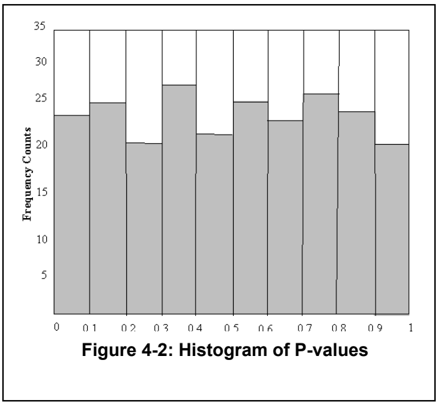
- Main analysis: For each sequence, P-values are computed and compared to \(\alpha\); empirical interpretation examines the proportion of sequences passing a test and the uniformity of P-values. A multiple-test dependence study applied 161 test P-values to Blum-Blum-Shub sequences of length 1,000,000 and used principal components/factor analysis, concluding there was no large redundancy among tests.
Limitations
- The paper states that no set of statistical tests can absolutely certify a generator as appropriate, that statistical testing cannot substitute for cryptanalysis, and that generator design and cryptanalysis are outside its scope.
- The paper states that many examples use small sample sizes for illustration only, e.g., \(n=10\), where the normal approximation is not really applicable; many tests rely on asymptotic reference distributions for large \(n\) (order \(10^3\) to \(10^7\)), and input parameter constraints apply.
- The text makes evident additional limitations: numerical precision can degrade for large incomplete gamma parameter \(a\); Maurer’s variance approximation can make the test 2.67 times more permissive than theoretically admitted; Random Excursions is discontinued if \(J<500\); and multiple tests can yield contradictory conclusions, as in the Random Excursions example where one state gave a non-random result while seven states gave random results.
Model-written summary. Check it against the paper before relying on it.
Integrity signals
Registry
Cites
Statistics
Figures

Verification
Claims the paper makes
0 Valid · 1 Not valid · 11 Not checked · 13 Own results and interpretations
A result the paper reports from its own data — it cites no other source for it, so there is none to check. The quote shows it is in the paper.
In the paper
“The asymptotic distribution of ( Ln -µ n ) / σ n along the sequence of even or odd values of n is that of a discrete random variable obtained via a mixture of two geometric random variables (one of them taking only negative values). Strictly speaking, the asymptotic distribution as such does not exist.”
A result the paper reports from its own data — it cites no other source for it, so there is none to check. The quote shows it is in the paper.
In the paper
“However, no set of statistical tests can absolutely certify a generator as appropriate for usage in a particular application, i.e., statistical testing cannot serve as a substitute for cryptanalysis.”
A result the paper reports from its own data — it cites no other source for it, so there is none to check. The quote shows it is in the paper.
In the paper
“This graph showed that there is no large redundancy among our tests.”
In the paper
“Ueli Maurer of the Department of Computer Science at Princeton University introduced this test in 1992. Maurer's test statistic relates closely to the per-bit entropy of the stream, which its author asserts is 'the correct quality measure for a secret-key source in a cryptographic application.'”
What the sources say
- Not matchedcites Maurer
This doesn’t read as a citation we can look up.
- Not matched
What the paper did — it cites no source for this, so there is none to check. The quote shows it is in the paper.
In the paper
“The test rejects the randomness hypothesis immediately if J is too small, i.e., if the following P-value is small:”
20 more claims
Create a free account to see all 25 claims and every source verdict.
Claims other papers make about this one
Each is checked against this paper’s own text: does it say what the citing paper says it does?
The source backs part of the claim, not all of it — or backs it for a different population, condition or comparison.
In the citing paper
“However, the latest version 2.1.2 [1], released in 2014, does not incorporate several modifications.”
From Checking the quality of approximation of p-values in statistical tests for random number generators by using a three-level test (2019) · cites this paper as [1]
Experimental — accuracy not yet measuredThe source backs part of the claim, not all of it — or backs it for a different population, condition or comparison.
In the citing paper
“The NIST test suite consists of 15 statistical tests for randomness of bit sequences, and its result is a list of 188 p -values.”
From Checking the quality of approximation of p-values in statistical tests for random number generators by using a three-level test (2019) · cites this paper as [1]
Experimental — accuracy not yet measuredThe cited source says what the claim attributes to it.
In the citing paper
“Note that the current implementation of the NIST test suite uses one-level or two-level tests, differently from the above experiments”
From Checking the quality of approximation of p-values in statistical tests for random number generators by using a three-level test (2019) · cites this paper as [1]
The cited source says what the claim attributes to it.
In the citing paper
“NIST SP-800.22 statistical test suite [90] and Die-hard test suite [91] and Test U01 [92] and AIS31 [93] are most common statistical test suites to evaluate their RNGs by researchers.”
From True Random Number Generators Using Electrical Noise (2019) · cites this paper as [90]
Self-check
Percentages, sums and reported differences re-computed from the paper’s own numbers.
Each contradiction between two passages listed here was confirmed by an independent check.
Rated minor: it would not touch a result — a value no result rests on, a p-value that stays on the same side of the significance level, or a conflict that is clerical, resolved elsewhere in the paper, or outside its own findings.
In the paper
§ 2.3.8 Example
“(input) τ = 0.02 (processing) π = 0.42 (processing) Vn(obs) = 52 (output) P-value = 0.500798 (conclusion) Since P-value ≥ 0.01 , accept the sequence as random.”
§ 2.3.4 Test Description
“If it can be shown that π -1 ≥τ , then the 2 Runs test need not be performed (i.e., the test should not have been run because of a failure to pass test 1, the Frequency (Monobit) test). If the test is not applicable, then the P-value is set to 0.0000.”
Rated minor: it would not touch a result — a value no result rests on, a p-value that stays on the same side of the significance level, or a conflict that is clerical, resolved elsewhere in the paper, or outside its own findings.
In the paper
§ 2.7.4 Test Description
“| 8-10 | 010 (hit) | 2 | 110 | 1 |”
§ 2.7.4 Test Description
“For the above example, if m = 3 and the template B = 001, then the examination proceeds as follows:”
Rated minor: it would not touch a result — a value no result rests on, a p-value that stays on the same side of the significance level, or a conflict that is clerical, resolved elsewhere in the paper, or outside its own findings.
In the paper
§ 2.9.3 Test Statistic and Reference Distribution
“f n : The sum of the log2 distances between matching Lbit templates, i.e., the sum of the number of digits in the distance between Lbit templates.”
§ 3.9 Maurer's 'Universal Statistical' Test
“Then it averages over all the expansion lengths by the number of test blocks.”
Rated minor: it would not touch a result — a value no result rests on, a p-value that stays on the same side of the significance level, or a conflict that is clerical, resolved elsewhere in the paper, or outside its own findings.
In the paper
§ Input Parameters:
“The parameters p , q and s are not fixed in code; thus, the user will not be able to reconstruct the original sequence because these values will vary (i.e., they are dependent on the system time).”
§ Input Parameters:
“The input parameters have been fixed so the code will reproduce the same results.”
Rated minor: it would not touch a result — a value no result rests on, a p-value that stays on the same side of the significance level, or a conflict that is clerical, resolved elsewhere in the paper, or outside its own findings.
In the paper
§ 5.5.2 Global Parameters
“| MAXNUMOFTEMPLATES | 40 | Non-overlapping Templates Test | | NUMOFTESTS | 16 | Max number of tests | | NUMOFGENERATORS | 12 | Max number of PRNGs |”
§ A.2 Configuration Information
“| 2. | #define MAXNUMOFTEMPLATES | 148 | | 3. | #define NUMOFTESTS | 15 | | 4. | #define NUMOFGENERATORS | 10 |”
2 more findings
Create a free account to see every finding of this check.
Citations
Cites
Handbook of Mathematical Functions
McQuarrie, D. A. (1966) · American Journal of Physics · doi:10.1119/1.1972842 · Cited by 40,433
Numerical recipes in C: the art of scientific computing
(1993) · Choice Reviews Online · doi:10.5860/choice.30-5638 · Cited by 17,933
Rayward-Smith, V. J. (1991) · Journal of the Operational Research Society · doi:10.1057/jors.1991.155 · Cited by 16,821
Handbook of applied cryptography
(1997) · Choice Reviews Online · doi:10.5860/choice.34-4512 · Cited by 10,357
Handbook of Mathematical Functions
(2018) · A Century of Excellence in MEASUREMENTS, STANDARDS, and TECHNOLOGY · doi:10.1201/9781351069397-39 · Cited by 9,062
A universal algorithm for sequential data compression
Ziv, J., & Lempel, A. (1977) · IEEE Transactions on Information Theory · doi:10.1109/tit.1977.1055714 · Cited by 5,456
The Art of Computer Programming
Worlton, W. J. (1968) · Nuclear Science and Engineering · doi:10.13182/nse68-a19548 · Cited by 2,251
Handbook of Applied Cryptography
Menezes, A. J., van Oorschot, P. C., & Vanstone, S. A. (2018) · CRC Press eBooks · doi:10.1201/9780429466335 · Cited by 1,770
Numerical Recipes in C-The Art of Scientific Computing.
G., W., Press, W. H., Flannery, B. P., Teukolsky, S. A., & Vetterling, W. T. (1989) · Mathematics of Computation · doi:10.2307/2008673 · Cited by 1,513
The Fourier Transform and its Applications
Cattermole, K. W. (1965) · Electronics and Power · doi:10.1049/ep.1965.0268 · Cited by 1,417
Cited by
Items 1,201–1,300 of 3,620
Enhanced quantum image encryption using DNA–QTRNG and Sattolo-RQFT shuffling
Gururaja, T. S., & Praveenkumar, P. (2025) · The Journal of Supercomputing · doi:10.1007/s11227-025-07085-1 · Cited by 15
Feedback control of digital chaotic systems with application to pseudorandom number generator
Deng, Y., Hu, H., & Liu, L. (2015) · International Journal of Modern Physics C · doi:10.1142/s0129183115500229 · Cited by 13
True random number generation on an Atmel AVR microcontroller
Hlavac, J., Lorencz, R., & Hadacek, M. (2010) · 2010 2nd International Conference on Computer Engineering and Technology · doi:10.1109/iccet.2010.5485568 · Cited by 10
Image encryption using HC-128 and HC-256 stream ciphers
Jolfaei, A., Vizandan, A., & Mirghadri, A. (2012) · International Journal of Electronic Security and Digital Forensics · doi:10.1504/ijesdf.2012.045388 · Cited by 17
“The mathematical description of each test can be found at Rukhin et al. (2010). The NIST framework, like many statistical tests, is based on hypothesis testing.”
MethodSecure Memristor-based Main Memory
Kannan, S., Karimi, N., & Sinanoglu, O. (2014) · ACM/IEEE Design Automation Conference (DAC) · doi:10.1145/2593069.2593212 · Cited by 14
“1, we apply NIST randomness tests [17] to data collected using plaintext avalanche and show that no correlation can be determined for use in an Insertion Attack.”
BackgroundMethodInfluentialAnalysis of the Time Series Generated by a New High‐Dimensional Discrete Chaotic System
Wang, C., Fan, C., Feng, K., Huang, X., & Ding, Q. (2018) · Complexity · doi:10.1155/2018/9818520 · Cited by 13
“The NIST SP800 test suite can reflect the statistical properties of the randomness of the pseudo-random sequence [24].”
MethodYeoh, W.-Z., Teh, J. S., & Chern, H. R. (2018) · Multimedia Tools and Applications · doi:10.1007/s11042-018-7015-0 · Cited by 13
“The proposed TRNG successfully passed all the NIST tests as shown in Table 3.”
MethodInfluentialA New Chaotic Map Based Secure and Efficient Pseudo-Random Bit Sequence Generation
Ahmad, M., Doja, M. N., & Beg, M. M. S. (2019) · Communications in computer and information science · doi:10.1007/978-981-13-5826-5_42 · Cited by 18
Multicore implementation and performance analysis of a chaos based LSB steganography technique
Gambhir, G., & Mandal, J. K. (2020) · Microsystem Technologies · doi:10.1007/s00542-020-04762-4 · Cited by 13
Kwon, B., Song, H. C., & Lee, S. (2020) · IEEE Access · doi:10.1109/access.2020.2977827 · Cited by 13
“D) LZ77-compressed data, we used two statistical tests: Frequency Test and Runs Test in [6] that calculate the proportion of zeros and ones and the total number of uninterrupted sequences of identical bits over LZ77-compressed data, respectively.”
MethodSEPAR: A New Lightweight Hybrid Encryption Algorithm with a Novel Design Approach for IoT
Vahi, A., & Jassbi, S. J. (2020) · Wireless Personal Communications · doi:10.1007/s11277-020-07476-y · Cited by 15
“NIST Statistical Test Suite is an important testing suite for randomness analysis [29].”
MethodFPGA implementation of an enhanced chaotic-KASUMI block cipher
Madani, M., & Tanougast, C. (2020) · Microprocessors and Microsystems · doi:10.1016/j.micpro.2020.103644 · Cited by 15
Imran, M., Sorianello, V., Fresi, F., Jalil, B., Romagnoli, M., & Potì, L. (2020) · Optics Communications · doi:10.1016/j.optcom.2020.126736 · Cited by 15
Designing a Secure Environment for IoT Networks Using Lightweight AES Algorithm
Saad, M. A.-S. (2021) · Iraqi Journal of Science · doi:10.24996/ijs.2021.62.8.29 · Cited by 22
Software Design and Experimental Evaluation of a Reduced AES for IoT Applications
Qasaimeh, M., Al‐Qassas, R. S., & Ababneh, M. (2021) · Future Internet · doi:10.3390/fi13110273 · Cited by 19
DroneKey: A Drone-Aided Group-Key Generation Scheme for Large-Scale IoT Networks
Han, D., Li, A., Li, J., et al. (2021) · ACM SIGSAC Conference on Computer and Communications Security (CCS) · doi:10.1145/3460120.3484789 · Cited by 13
“As recommend by NIST [27], we use the runs test for randomness checking and also measure the entropy of generated key bits.”
MethodRegion of Interest Encryption Based on Novel 2D Hyperchaotic Signal and Bagua Coding Algorithm
Chen, T.-H., & Yang, C. (2022) · IEEE Access · doi:10.1109/access.2022.3190851 · Cited by 13
Yang, S.-H., & Liu, T.-T. (2022) · IEEE Transactions on Circuits and Systems I Regular Papers · doi:10.1109/tcsi.2022.3217992 · Cited by 13
Zhang, L., Ma, C., Zhao, Y., & Zhao, W. (2023) · Mathematics · doi:10.3390/math12010084 · Cited by 13
RC4 Stream Cipher with a Random Initial State
Hammood, M. M., Yoshigoe, K., & Sagheer, A. M. (2013) · Lecture notes in electrical engineering · doi:10.1007/978-94-007-6996-0_42 · Cited by 13
Generating High-Quality Random Numbers by Next Nearest-Neighbor Cellular Automata
Ping, P., Xu, F., & Wang, Z. J. (2013) · Advanced materials research · doi:10.4028/www.scientific.net/amr.765-767.1200 · Cited by 13
“NIST Statistical Test Suite Among the numerous standard tests for randomness, a convincing way to show the randomness of the produced sequences is to confront them to the NIST (National Institute of Standards and Technology) Statistical Tests [12].”
BackgroundCryptographic Cloud Computing Environment as a More Trusted Communication Environment
Mohammad, O. K. J., Abbas, S., El-Horbaty, E.-S. M., et al. (2014) · International Journal of Grid and High Performance Computing · doi:10.4018/ijghpc.2014040103 · Cited by 13
A statistical method for detecting on-disk wiped areas
Savoldi, A., Piccinelli, M., & Gubian, P. (2011) · Digital Investigation · doi:10.1016/j.diin.2011.06.005 · Cited by 13
A chess-based chaotic block cipher
AbdElHaleem, S. H., Radwan, A. G., & Abd–El–Hafiz, S. K. (2014) · IEEE International New Circuits and Systems Conference (NEWCAS) · doi:10.1109/newcas.2014.6934068 · Cited by 13
“NIST statistical test suite to measure the randomness of the encrypted image by using [15].”
MethodOh, J., Lee, S., & Yoo, H. (2012) · IEEE Transactions on Very Large Scale Integration (VLSI) Systems · doi:10.1109/tvlsi.2012.2198249 · Cited by 13
“972 pass rate for one-million-bit sequences using the NIST test suite [26] and found no metastable events for target 104 sequences of IIE application [14].”
MethodFully digital 1-D, 2-D and 3-D multiscroll chaos as hardware pseudo random number generators
Mansingka, A. S., Radwan, A. G., & Salama, K. N. (2012) · Conference proceedings · doi:10.1109/mwscas.2012.6292236 · Cited by 13
“800-22 statistical test suite [20].”
Secure and time efficient hash-based message authentication algorithm for wireless sensor networks
Al-Mashhadi, H. M., Abdulwahab, H. B., & Hassan, R. F. (2014) · Global Summit on Computer & Information Technology (GSCIT) · doi:10.1109/gscit.2014.6970116 · Cited by 13
Practical Issues in Implementing TRNGs in FPGAs Based on the Ring Oscillator Sampling Method
Cret, O. A., Suciu, A., & Györfi, T. (2008) · International Symposium on Symbolic and Numeric Algorithms for Scientific Computing (SYNASC) · doi:10.1109/synasc.2008.26 · Cited by 14
Improved Lightweight Pseudo-Random Number Generators for the Low-Cost RFID Tags
Chen, J., Miyaji, A., Satō, H., & Su, C. (2015) · IEEE International Conference on Trust, Security and Privacy in Computing and Communications (TrustCom) · doi:10.1109/trustcom.2015.352 · Cited by 18
Moving window scheme for extracting secret keys in stationary environments
Cheng, L., Li, W., Ma, D., et al. (2016) · IET Communications · doi:10.1049/iet-com.2015.1219 · Cited by 13
Hernandez-Castro, J. C., & Barrero, D. F. (2017) · IEEE Congress on Evolutionary Computation (CEC) · doi:10.1109/cec.2017.7969470 · Cited by 17
“Perhaps the most used is the NIST test suite [1], [2], but others batteries such as Ent [3] or Crypt-X [4] are also widely known.”
MethodTomasi, A., Meneghetti, A., Massari, N., Gasparini, L., Rucatti, D., & Xu, H. (2018) · Journal of Lightwave Technology · doi:10.1109/jlt.2018.2829210 · Cited by 16
Design of a New Chaotic System Based on Van Der Pol Oscillator and Its Encryption Application
He, J., & Cai, J. (2019) · Mathematics · doi:10.3390/math7080743 · Cited by 14
Digital Emulation of a Versatile Memristor With Speech Encryption Application
Tolba, M. F., Sayed, W. S., Fouda, M. E., Saleh, H. H., Al‐Qutayri, M., Mohammad, B. S., & Radwan, A. G. (2019) · IEEE Access · doi:10.1109/access.2019.2957300 · Cited by 13
Secure Image Transmission Based on a Proposed Chaotic Maps
Abdullah, H. A., Abdullah, H. N., Abdullah, H. N., et al. (2020) · Studies in computational intelligence · doi:10.1007/978-3-030-38700-6_4 · Cited by 13
A Strong Physically Unclonable Function With >2⁸⁰ CRPs and <1.4% BER Using Passive ReRAM Technology
Mahmoodi, M. R., Fahimi, Z., Larimian, S., Nili, H., Kim, H., & Strukov, D. B. (2020) · IEEE Solid-State Circuits Letters · doi:10.1109/lssc.2020.3010255 · Cited by 13
Kavulich, J. T., Deren, B. P. V., & Schlosshauer, M. (2020) · Physics Letters A · doi:10.1016/j.physleta.2020.127032 · Cited by 15
Real-time implementation of a chaos based cryptosystem on low-cost hardware
Merah, L., Adnane, A., Ali‐Pacha, A., Ramdani, S., & Hadj-Said, N. (2021) · Iranian Journal of Science and Technology Transactions of Electrical Engineering · doi:10.1007/s40998-021-00433-w · Cited by 15
Sathyanarayana, S. V., Kumar, M. A., & Bhat, K. (2010) · Information Security Journal A Global Perspective · doi:10.1080/19393550903482759 · Cited by 13
The use of delay lines in a ring-oscillator-based combined true random number generator
Jessa, M., & Matuszewski, Ł. (2012) · International Conference on Signals and Electronic Systems · doi:10.1109/icses.2012.6382232 · Cited by 12
“a statistical test, and (2) we examined the distribution of Pvalues computed by the software; that is, we examined the value of T P [17].”
MethodInfluentialA randomness test based on T-codes
Hamano, K., & Yamamoto, H. (2008) · International Symposium on Information Theory and its Applications · doi:10.1109/isita.2008.4895570 · Cited by 13
Randomness Evaluation Framework of Cryptographic Algorithms
Duta, C.-L., Mocanu, B.-C., Vladescu, F.-A., & Gheorghe, L. (2014) · International Journal on Cryptography and Information Security · doi:10.5121/ijcis.2014.4103 · Cited by 18
Shastry, M. C., Nagaraj, N., & Vaidya, P. G. (2006) · arXiv (Cornell University) · doi:10.48550/arxiv.cs/0607069 · Cited by 20
“The details of all the 15 the tests and their interpretation is given in [ 16 ].”
BackgroundMethodHyperchaotic Maps and the Single Neuron Model: A Novel Framework for Chaos-Based Image EncryptionPreprint
Alexan, W., Chen, Y., Por, L. Y., et al. (2023) · Preprints.org · doi:10.20944/preprints202304.0148.v1 · Cited by 13
Enhancement the ChaCha20 Encryption Algorithm Based on Chaotic Maps
Alyas, H. H., & Abdullah, A. A. (2021) · Lecture notes in networks and systems · doi:10.1007/978-981-16-0666-3_10 · Cited by 12
Iatropoulos, A., Moysis, L., Giakoumis, A., et al. (2021) · International Conference on Modern Circuits and Systems Technologies · doi:10.1109/mocast52088.2021.9493422 · Cited by 12
Randomness Testing with Neural Networks
Nagy, I., & Suciu, A. (2021) · IEEE International Conference on Intelligent Computer Communication and Processing (ICCP) · doi:10.1109/iccp53602.2021.9733481 · Cited by 14
SP 800–22 and GM/T 0005–2012 Tests: Clearly Obsolete, Possibly Harmful
Saarinen, M.-J. O. (2022) · IEEE European Symposium on Security and Privacy Workshops (EuroS&PW) · doi:10.1109/eurospw55150.2022.00011 · Cited by 22
“Unfortunately, the results of black-box randomness test suites such as Dieharder [BEB03], Fourmilab ENT [Wal98], and SP 800-22 [RSN + 10] are still being presented as sole evidence of the suitability of Random Number Generators for cryptographic applications.”
BackgroundQSLT: A Quantum‐Based Lightweight Transmission Mechanism against Eavesdropping for IoT Networks
Liu, G., Han, J., Zhou, Y., Liu, T., & Chen, J. (2022) · Wireless Communications and Mobile Computing · doi:10.1155/2022/4809210 · Cited by 17
“the security performance is very relevant to the key randomness [42].”
BackgroundTrue Random Number Generation Capability of a Ring Oscillator PUF for Reconfigurable Devices
Rojas-Muñoz, L. F., Sánchez-Solano, S., Martínez‐Rodríguez, M. C., & Brox, P. (2022) · Electronics · doi:10.3390/electronics11234028 · Cited by 16
He, J., Qiu, W., & Cai, J. (2023) · Journal of Advanced Computational Intelligence and Intelligent Informatics · doi:10.20965/jaciii.2023.p0292 · Cited by 14
Shawky, M. A., Shah, S. T., Abbasi, Q. H., Hussein, M., Imran, M. A., Hasan, S. F., Ansari, S., & Taha, A. (2023) · Sensors · doi:10.3390/s23084104 · Cited by 17
FPGA based implementation of a perturbed Chen oscillator for secure embedded cryptosystems
Kemdoum, F. N., Pone, J. R. M., Bajaj, M., et al. (2024) · Scientific Reports · doi:10.1038/s41598-024-71531-y · Cited by 12
Secure and Fast Aggregation of Financial Data in Cloud-Based Expense Tracking Applications
Corena, J. C., & Ohtsuki, T. O. (2012) · Journal of Network and Systems Management · doi:10.1007/s10922-012-9248-y · Cited by 12
A Process and Temperature Tolerant Oscillator-Based True Random Number Generator
Amaki, T., Hashimoto, M., & Onoye, T. (2014) · IEICE Transactions on Fundamentals of Electronics Communications and Computer Sciences · doi:10.1587/transfun.e97.a.2393 · Cited by 12
Using a Low-Cost Electroencephalogram (EEG) Directly as Random Number Generator
Petchlert, B., & Hasegawa, H. (2014) · IIAI International Conference on Advanced Applied Informatics (IIAI-AAI) · doi:10.1109/iiai-aai.2014.100 · Cited by 12
“Table I A SUMMARY OF THE NIST TESTS FOR THE SEVEN BINARY SEQUENCES GENERATED WITHOUT ENCODING METHOD.”
MethodInfluentialAmsaad, F., Prasad, A., Roychaudhuri, C., et al. (2016) · IEEE International Symposium on Hardware Oriented Security and Trust (HOST) · doi:10.1109/hst.2016.7495580 · Cited by 12
Defeating counterfeiters with microscopic dielets embedded in electronic components
Ralston, P., Fry, D., Suko, S., et al. (2016) · Computer · doi:10.1109/mc.2016.262 · Cited by 12
Zhang, M., & Tong, X. (2017) · Journal of Electronic Imaging · doi:10.1117/1.jei.26.4.043008 · Cited by 12
Al-Moliki, Y. M., Alresheedi, M. T., & Al‐Harthi, Y. (2017) · Electronics Letters · doi:10.1049/el.2017.3525 · Cited by 12
“National Institute of Standards and Technology (NIST) statistical test suite [10] is commonly employed for testing the randomness of the keys provided at the output of random number generators (RNGs).”
BackgroundMethodInfluentialBelkhouja, T., Du, X., Mohamed, A. M. S., Al-Ali, A. K., & Guizani, M. (2018) · Journal of Sensor and Actuator Networks · doi:10.3390/jsan7020021 · Cited by 12
A New Chaos-based Text Encryption to Secure GPS Data
Azzaz, M. S., & Krimil, M. A. (2018) · International Conference on Smart Communications in Network Technologies (SaCoNeT) · doi:10.1109/saconet.2018.8585703 · Cited by 12
Performance Analysis of Enhanced SPECK Algorithm
Lustro, R. A. F., Sison, A. M., & Medina, R. P. (2018) · International Conference on Industrial and Business Engineering (ICIBE) · doi:10.1145/3288155.3288196 · Cited by 12
“Consequently, we studied all the randomness properties in NIST STS [2] and DieHarder version 3.”
MethodInfluentialYet Another Pseudorandom Number Generator
Stoyanov, B. P., Szczypiorski, K., & Kordov, K. (2017) · International Journal of Electronics and Telecommunications · doi:10.1515/eletel-2017-0026 · Cited by 13
0.6–1.2 V, 0.22 pJ/bit True Random Number Generator Based on SAR ADC
Jayaraj, A., Gujarathi, N. N., Venkatesh, I., & Sanyal, A. (2019) · IEEE Transactions on Circuits & Systems II Express Briefs · doi:10.1109/tcsii.2019.2949775 · Cited by 13
“DFT test is one the 15 tests in the NIST statistical randomness suite [11] and detects periodic features in a sequence that would indicate non-white PSD and deviation from randomness.”
MethodCandlestick—The Main Mistake of Economy Research in High Frequency Markets
Stasiak, M. D. (2020) · International Journal of Financial Studies · doi:10.3390/ijfs8040059 · Cited by 12
Quantum tomography benchmarking
Bantysh, B. I., Chernyavskiy, A. Y., & Bogdanov, Y. I. (2021) · Quantum Information Processing · doi:10.1007/s11128-021-03285-9 · Cited by 15
“The analysis of the quality of random number generators is also performed using standardized tests [24].”
MethodPriSE: Slenderized Privacy-Preserving Surveillance as an Edge Service
Fitwi, A., Chen, Y., & Zhu, S. (2020) · IEEE International Conference on Collaboration and Internet Computing (CIC) · doi:10.1109/cic50333.2020.00024 · Cited by 16
“2) NIST Randomness Test Suite: The US NIST has established a test suite to evaluate the randomness of random number generators for cryptographic purposes [23].”
BackgroundMan-in-the-Middle Attack Resistant Secret Key Generation via Channel Randomization
Pan, Y., Xu, Z., Li, M., et al. (2021) · ACM International Symposium on Theory, Algorithmic Foundations, and Protocol Design for Mobile Networks and Mobile Computing (MobiHoc) · doi:10.1145/3466772.3467052 · Cited by 12
A New Approach to the Development of Additive Fibonacci Generators Based on Prime Numbers
Maksymovych, V., Harasymchuk, O., Karpiński, M., et al. (2021) · Electronics · doi:10.3390/electronics10232912 · Cited by 12
Tight Concentrations and Confidence Sequences From the Regret of Universal Portfolio
Orabona, F., & Jun, K.-S. (2023) · IEEE Transactions on Information Theory · doi:10.1109/tit.2023.3330187 · Cited by 88
“…hand, in the information theory literature, the use of compression schemes to test the randomness of a finite string of symbols became a standard strategy [61], [62], [63], [64]; there is even a software package made available by the American National Institute of Standards and Technology [65].”
BackgroundQuantum random number generator on IBM QX
kumar, V., & Praveenkumar, P. (2023) · Journal of Cryptographic Engineering · doi:10.1007/s13389-023-00341-1 · Cited by 15
New Distinguishers Based on Random Mappings against Stream Ciphers
Turan, M. S., Çalık, Ç., Saran, N., & Doğanaksoy, A. (2008) · Lecture notes in computer science · doi:10.1007/978-3-540-85912-3_3 · Cited by 12
“cipher using the Overlapping Template Matching Test from the randomness test suite of NIST [9].”
MethodLi, R. (2015) · IEEE SoutheastCon · doi:10.1109/secon.2015.7132901 · Cited by 15
“The sequences are fed to standard NIST Randomness Test [14], which divides each sequence into 1000 subsequences then run 15 independent tests.”
MethodBabaei, M., & Farhadi, M. (2011) · International Journal of Communications Network and System Sciences · doi:10.4236/ijcns.2011.410074 · Cited by 12
Design theory and method of multivariate hash function
Wang, H., Zhang, H., Wu, Q., et al. (2010) · Science China Information Sciences · doi:10.1007/s11432-010-4062-1 · Cited by 12
“The NIST STS (statistical test suite) [ 23 ] is one of the most authoritative test tools for random and pseudorandom numbers generators for cryptographic applications.”
MethodA study on fast pipelined pseudo-random number generator based on chaotic logistic map
Dąbal, P., & Pelka, R. (2014) · International Symposium on Design and Diagnostics of Electronic Circuits & Systems (DDECS) · doi:10.1109/ddecs.2014.6868789 · Cited by 12
“RESULTS OF STATISTICAL TESTS The statistical tests of the PRNGs have been performed using the NIST SP800-22 package [6] It contains 15 tests.”
MethodInfluentialChan, J. J. M., Thulasiraman, P., Thomas, G., & Thulasiram, R. K. (2016) · Journal of Computer and Communications · doi:10.4236/jcc.2016.44007 · Cited by 13
Experimental channel-based secret key generation with integrated ultra wideband devices
Bulenok, M., Tunaru, I., Biard, L., et al. (2016) · IEEE International Symposium on Personal, Indoor and Mobile Radio Communications (PIMRC) · doi:10.1109/pimrc.2016.7794705 · Cited by 12
Design and Test of Pseudorandom Number Generator Using a Star Network of Lorenz Oscillators
Cho, K., & Miyano, T. (2017) · International Journal of Bifurcation and Chaos · doi:10.1142/s021812741750184x · Cited by 12
A Novel Approach to Generate Symmetric Key in Cryptography Using Genetic Algorithm (GA)
Chunka, C., Goswami, R. S., & Banerjee, S. (2018) · Advances in intelligent systems and computing · doi:10.1007/978-981-13-1951-8_64 · Cited by 12
On the using of Rényi’s quadratic entropy for physical layer key generation
Zhan, F., Zhao, Z., Chen, Y., et al. (2019) · Computer Communications · doi:10.1016/j.comcom.2019.02.001 · Cited by 12
Identification and Restoration of LZ77 Compressed Data Using a Machine Learning Approach
Kwon, B., Gong, M., Huh, J., et al. (2018) · Asia-Pacific Signal and Information Processing Association Annual Summit and Conference (APSIPA ASC) · doi:10.23919/apsipa.2018.8659755 · Cited by 12
“Towards this goal, we apply two statistical tests proposed in [5] to extract features from the input bitstream.”
MethodCourtois, J., Abbas-Turki, L., & Bajard, J.-C. (2019) · IEEE Transactions on Computers · doi:10.1109/tc.2019.2924630 · Cited by 12
“Unfortunately, most of the statistic tests, like NIST’s ones [32], evaluate uniform distribution.”
Novel Randomized Placement for FPGA Based Robust ROPUF with Improved Uniqueness
Chauhan, A. S., Sahula, V., & Mandal, A. S. (2019) · Journal of Electronic Testing · doi:10.1007/s10836-019-05829-5 · Cited by 13
“The randomness of the response is evaluated by applying the NIST statistical test suite [5].”
MethodA lightweight true random number generator using beta radiation for IoT applications
Park, K., Park, S., Choi, B. G., et al. (2020) · ETRI Journal · doi:10.4218/etrij.2020-0119 · Cited by 12
Efficient Post-Processing for Physical-Layer Secure Key Distribution in Fiber
Chen, S., Zhang, L., Hu, W., et al. (2021) · IEEE Photonics Technology Letters · doi:10.1109/lpt.2021.3061129 · Cited by 12
“Keeping error-free and true randomness ensured by the NIST test suite [24], the original and returned KGR are shown in Table II.”
MethodPralon, L., Beltrão, G., Barreto, A., et al. (2021) · Sensors · doi:10.3390/s21051727 · Cited by 12
“A detailed description of the performed tests is out of the scope of the present work, for that purpose, the reader is advised to go to [45].”
BackgroundMethodInfluentialEfficient Hardware Implementation of Large Field-Size Elliptic Curve Cryptographic Processor
Lee, C., Zeghid, M., Sghaier, A., et al. (2022) · IEEE Access · doi:10.1109/access.2022.3141104 · Cited by 12
A tunable quantum random number generator based on a fiber-optical Sagnac interferometer
Argillander, J., Alarcón, A., & XAVIER, G. B. (2022) · Journal of Optics · doi:10.1088/2040-8986/ac68f4 · Cited by 12
“To deem any given test as passed, we form a confidence bound as defined in [12] for the proportion of bitstreams that must yield a p-value p⩾ 10−2 using the for-”
BackgroundMethodInfluentialLugrin, T. (2023) · Springer eBooks · doi:10.1007/978-3-031-33386-6_7 · Cited by 12
Design and Analysis of Digital True Random Number Generator
Yadav, A. (2013) · VCU Scholars Compass (Virginia Commonwealth University) · doi:10.25772/7013-3f54 · Cited by 12
Lin, C. W., & Ghosh, S. (2015) · IEEE International Symposium on Hardware Oriented Security and Trust (HOST) · doi:10.1109/hst.2015.7140232 · Cited by 12
Chaotic block cryptosystem using high precision approaches to tent map
Martínez-Ñonthe, J. A., Castañeda-Solís, A., Díaz-Méndez, A., et al. (2011) · Microelectronic Engineering · doi:10.1016/j.mee.2011.04.005 · Cited by 12
Sowmya, S., & Sathyanarayana, S. V. (2014) · International Conference on Contemporary Computing and Informatics (IC3I) · doi:10.1109/ic3i.2014.7019665 · Cited by 12
“To verify the randomness property of the sequence of elliptic Curve points kiP [29], the tests given by FIPS [19] and NIST [26] are used.”
MethodEvolving ant colony systems in hardware for random number generation
Isaacs, J. C., Watkins, R. K., & Foo, S. Y. (2003) · IEEE Congress on Evolutionary Computation (CEC) · doi:10.1109/cec.2002.1004456 · Cited by 12
A Pseudo-Random Bit Generator Using Three Chaotic Logistic Maps
François, M., & Defour, D. (2013) · HAL · Cited by 15
Enhancing noise sensitivity of embedded SRAMs for robust true random number generation in SoCs
Rahman, M. T., Forte, D. J., Wang, X., & Tehranipoor, M. M. (2016) · Asian Hardware Oriented Security and Trust Symposium (AsianHOST) · doi:10.1109/asianhost.2016.7835559 · Cited by 16
Towards an Effective Secret Key Generation Scheme for Imperfect Channel State Information
Cheng, L., Li, W., Ma, D., et al. (2016) · IEEE International Conference on Trust, Security and Privacy in Computing and Communications / BigDataSE / ISPA (Trustcom/BigDataSE/ISPA) · doi:10.1109/trustcom.2016.0156 · Cited by 12
Yevseiev, S., Ponomarenko, V., Ponomarenko, V., et al. (2017) · Eastern-European Journal of Enterprise Technologies · doi:10.15587/1729-4061.2017.118329 · Cited by 12
“In order to assess stability of crypto-algorithms from various models of cryptosystems, authors suggest performing an express analysis based on the entropy method, applied in the package for statistical study of the random variable NIST STS 822 [39].”
Method
Metadata
- Authors
- Bassham, L. E., Rukhin, A. L., Soto, J., Nechvatal, J. R., Smid, M. E., Barker, E. B., Leigh, S. D., Levenson, M., Vangel, M., Banks, D. L., Heckert, N. A., Dray, J. F., & Vo, S.
- Affiliations
- National Institute of Standards and Technology (US)
- Venue
- NIST Special Publication 800-22 Revision 1a
- Published
- 2010
- OpenAlex
- W1517403092
- Semantic Scholar
- 961fc0f6c68303cde94a28fdb24e6eaf3ef040b4
- Cited by
- 3,617
- References
- 34
- Citations by year
- 2026: 128 · 2025: 205 · 2024: 192 · 2023: 208 · 2022: 166 · 2021: 291 · 2020: 290 · 2019: 250 · 2018: 254 · 2017: 207 · 2016: 183 · 2015: 184 · 2014: 201 · 2013: 155 · 2012: 139
- Type
- report
- Language
- en
- Open access
- gold
- doi.org
- Topics
- Physical Sciences › Computer Science › Artificial Intelligence › Cryptographic Implementations and Security
- Physical Sciences › Mathematics › Discrete Mathematics and Combinatorics › Coding theory and cryptography
- Physical Sciences › Computer Science › Computer Vision and Pattern Recognition › Chaos-based Image/Signal Encryption
- Keywords
- random number generators, pseudorandom number generators, cryptographic randomness, NIST SP 800-22, randomness testing
About these checks
Registry, retraction, Cites and statistics results are computed, not judged, with one exception: a printed reference that no index lists is read once by a model before it counts as a citation error. Claims are extracted by a model and kept only when their quote appears verbatim in the text; each cited source is then checked, with a model’s help, for whether it says what the claim relies on. Those verdicts can be wrong — read the claim’s quote and the cited source before relying on one.
A language model drew the claims from the paper on 2026-09-27 (prompt extract-v2).
Statistics and arithmetic are recomputed, not judged.
Confidence bands are shown only for fields calibrated on our annotated test set. None is calibrated yet, so no band is shown.
What counts as a claim ›How we measure confidence ›How we check this ›
Are you an author, or do you see a problem with this page? Request a review
Data sources
Bibliographic data: Semantic Scholar, OpenAlex, Crossref.
Contains information from the Semantic Scholar Academic Graph Datasets, made available under the ODC Attribution License (ODC-BY 1.0).
Semantic Scholar’s data is described in: Kinney, R., et al. (2023). The Semantic Scholar Open Data Platform. arXiv:2301.10140.
