

A statistical test suite for random and pseudorandom number generators for cryptographic applications
Open accessThe DOI matches its Crossref record; 33 of the 34 references it cites were found in a registry or an index; none of the 14 sources its claims cite is checked for support yet.
Abstract
The Information Technology Laboratory (ITL) at the National Institute of Standards and Technology (NIST) promotes the U.S. economy and public welfare by providing technical leadership for the nation's measurement and standards infrastructure. ITL develops tests, test methods, reference data, proof of concept implementations, and technical analysis to advance the development and productive use of information technology. ITL's responsibilities include the development of technical, physical, administrative, and management standards and guidelines for the cost-effective security and privacy of sensitive unclassified information in Federal computer systems.
Overview
CoChat Summary
TL;DR
This NIST Special Publication 800-22 Revision 1a presents a suite of 15 statistical tests for evaluating whether binary sequences produced by random or pseudorandom number generators are suitable for cryptographic applications. It provides test purposes, mathematical descriptions, examples, and guidance for interpreting P-values, while cautioning that statistical testing is only a first step and cannot replace cryptanalysis.
Key findings
- The suite consists of 15 tests: Frequency (Monobit), Frequency within a Block, Runs, Longest Run of Ones, Binary Matrix Rank, Discrete Fourier Transform (Spectral), Non-overlapping Template Matching, Overlapping Template Matching, Maurer’s “Universal Statistical,” Linear Complexity, Serial, Approximate Entropy, Cumulative Sums, Random Excursions, and Random Excursions Variant. The Frequency test is recommended first because it supplies the most basic evidence of non-randomness.
- Each test uses the null hypothesis \(H_0\) that the sequence is random; if P-value \(\ge \alpha\), the sequence is accepted as random, and if P-value \(<\alpha\), it is rejected. Examples use \(\alpha=0.01\), and NIST recommends \(\alpha\) in the range [0.001, 0.01].
- The document states that no finite set of statistical tests is “complete,” that statistical testing cannot absolutely certify a generator, and that statistical testing cannot serve as a substitute for cryptanalysis.
- Sample data files are 1,000,000 bits (binary expansions of \(e\), \(\pi\), \(\sqrt{2}\), \(\sqrt{3}\), and a G-SHA-1 sequence); reported example P-values include Frequency for \(\pi\) = 0.578211, for \(e\) = 0.953749, and for G-SHA-1 = 0.604458.
Methods
- Design: The NIST Statistical Test Suite is an ANSI C reference implementation of 15 tests; each test defines a test statistic, a reference distribution (e.g., normal, half-normal, chi-square), a P-value, and a decision rule at the 1% level.
- Data or sample: Tests apply to binary sequences from hardware or software RNGs/PRNGs; sample files are 1,000,000 bits, while many worked examples use small illustrative lengths such as \(n=100\).
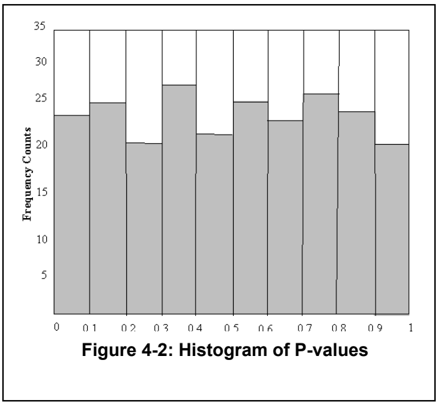
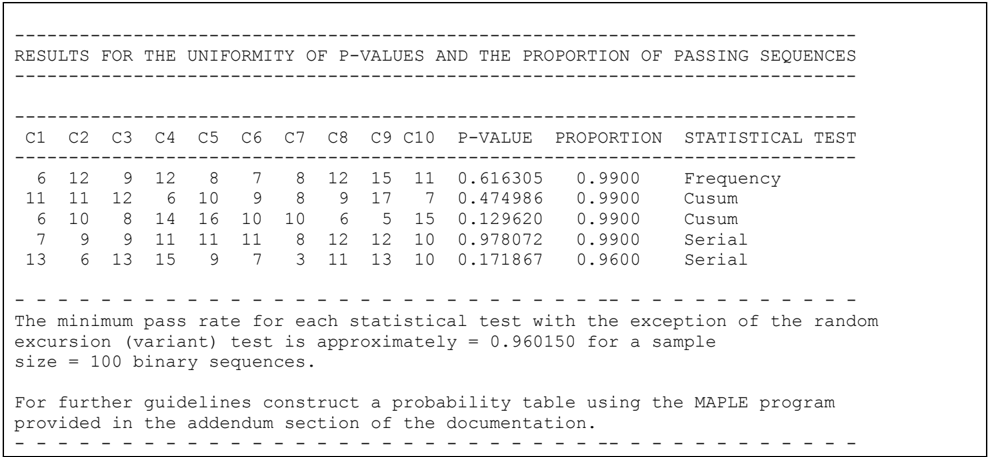
- Main analysis: For each sequence, P-values are computed and compared to \(\alpha\); empirical interpretation examines the proportion of sequences passing a test and the uniformity of P-values. A multiple-test dependence study applied 161 test P-values to Blum-Blum-Shub sequences of length 1,000,000 and used principal components/factor analysis, concluding there was no large redundancy among tests.
Limitations
- The paper states that no set of statistical tests can absolutely certify a generator as appropriate, that statistical testing cannot substitute for cryptanalysis, and that generator design and cryptanalysis are outside its scope.
- The paper states that many examples use small sample sizes for illustration only, e.g., \(n=10\), where the normal approximation is not really applicable; many tests rely on asymptotic reference distributions for large \(n\) (order \(10^3\) to \(10^7\)), and input parameter constraints apply.
- The text makes evident additional limitations: numerical precision can degrade for large incomplete gamma parameter \(a\); Maurer’s variance approximation can make the test 2.67 times more permissive than theoretically admitted; Random Excursions is discontinued if \(J<500\); and multiple tests can yield contradictory conclusions, as in the Random Excursions example where one state gave a non-random result while seven states gave random results.
Model-written summary. Check it against the paper before relying on it.
Integrity signals
Registry
Cites
Statistics
Figures

Verification
Claims the paper makes
0 Valid · 1 Not valid · 11 Not checked · 13 Own results and interpretations
A result the paper reports from its own data — it cites no other source for it, so there is none to check. The quote shows it is in the paper.
In the paper
“The asymptotic distribution of ( Ln -µ n ) / σ n along the sequence of even or odd values of n is that of a discrete random variable obtained via a mixture of two geometric random variables (one of them taking only negative values). Strictly speaking, the asymptotic distribution as such does not exist.”
A result the paper reports from its own data — it cites no other source for it, so there is none to check. The quote shows it is in the paper.
In the paper
“However, no set of statistical tests can absolutely certify a generator as appropriate for usage in a particular application, i.e., statistical testing cannot serve as a substitute for cryptanalysis.”
A result the paper reports from its own data — it cites no other source for it, so there is none to check. The quote shows it is in the paper.
In the paper
“This graph showed that there is no large redundancy among our tests.”
In the paper
“Ueli Maurer of the Department of Computer Science at Princeton University introduced this test in 1992. Maurer's test statistic relates closely to the per-bit entropy of the stream, which its author asserts is 'the correct quality measure for a secret-key source in a cryptographic application.'”
What the sources say
- Not matchedcites Maurer
This doesn’t read as a citation we can look up.
- Not matched
What the paper did — it cites no source for this, so there is none to check. The quote shows it is in the paper.
In the paper
“The test rejects the randomness hypothesis immediately if J is too small, i.e., if the following P-value is small:”
20 more claims
Create a free account to see all 25 claims and every source verdict.
Claims other papers make about this one
Each is checked against this paper’s own text: does it say what the citing paper says it does?
The source backs part of the claim, not all of it — or backs it for a different population, condition or comparison.
In the citing paper
“However, the latest version 2.1.2 [1], released in 2014, does not incorporate several modifications.”
From Checking the quality of approximation of p-values in statistical tests for random number generators by using a three-level test (2019) · cites this paper as [1]
Experimental — accuracy not yet measuredThe source backs part of the claim, not all of it — or backs it for a different population, condition or comparison.
In the citing paper
“The NIST test suite consists of 15 statistical tests for randomness of bit sequences, and its result is a list of 188 p -values.”
From Checking the quality of approximation of p-values in statistical tests for random number generators by using a three-level test (2019) · cites this paper as [1]
Experimental — accuracy not yet measuredThe cited source says what the claim attributes to it.
In the citing paper
“Note that the current implementation of the NIST test suite uses one-level or two-level tests, differently from the above experiments”
From Checking the quality of approximation of p-values in statistical tests for random number generators by using a three-level test (2019) · cites this paper as [1]
The cited source says what the claim attributes to it.
In the citing paper
“NIST SP-800.22 statistical test suite [90] and Die-hard test suite [91] and Test U01 [92] and AIS31 [93] are most common statistical test suites to evaluate their RNGs by researchers.”
From True Random Number Generators Using Electrical Noise (2019) · cites this paper as [90]
Self-check
Percentages, sums and reported differences re-computed from the paper’s own numbers.
Each contradiction between two passages listed here was confirmed by an independent check.
Rated minor: it would not touch a result — a value no result rests on, a p-value that stays on the same side of the significance level, or a conflict that is clerical, resolved elsewhere in the paper, or outside its own findings.
In the paper
§ 2.3.8 Example
“(input) τ = 0.02 (processing) π = 0.42 (processing) Vn(obs) = 52 (output) P-value = 0.500798 (conclusion) Since P-value ≥ 0.01 , accept the sequence as random.”
§ 2.3.4 Test Description
“If it can be shown that π -1 ≥τ , then the 2 Runs test need not be performed (i.e., the test should not have been run because of a failure to pass test 1, the Frequency (Monobit) test). If the test is not applicable, then the P-value is set to 0.0000.”
Rated minor: it would not touch a result — a value no result rests on, a p-value that stays on the same side of the significance level, or a conflict that is clerical, resolved elsewhere in the paper, or outside its own findings.
In the paper
§ 2.7.4 Test Description
“| 8-10 | 010 (hit) | 2 | 110 | 1 |”
§ 2.7.4 Test Description
“For the above example, if m = 3 and the template B = 001, then the examination proceeds as follows:”
Rated minor: it would not touch a result — a value no result rests on, a p-value that stays on the same side of the significance level, or a conflict that is clerical, resolved elsewhere in the paper, or outside its own findings.
In the paper
§ 2.9.3 Test Statistic and Reference Distribution
“f n : The sum of the log2 distances between matching Lbit templates, i.e., the sum of the number of digits in the distance between Lbit templates.”
§ 3.9 Maurer's 'Universal Statistical' Test
“Then it averages over all the expansion lengths by the number of test blocks.”
Rated minor: it would not touch a result — a value no result rests on, a p-value that stays on the same side of the significance level, or a conflict that is clerical, resolved elsewhere in the paper, or outside its own findings.
In the paper
§ Input Parameters:
“The parameters p , q and s are not fixed in code; thus, the user will not be able to reconstruct the original sequence because these values will vary (i.e., they are dependent on the system time).”
§ Input Parameters:
“The input parameters have been fixed so the code will reproduce the same results.”
Rated minor: it would not touch a result — a value no result rests on, a p-value that stays on the same side of the significance level, or a conflict that is clerical, resolved elsewhere in the paper, or outside its own findings.
In the paper
§ 5.5.2 Global Parameters
“| MAXNUMOFTEMPLATES | 40 | Non-overlapping Templates Test | | NUMOFTESTS | 16 | Max number of tests | | NUMOFGENERATORS | 12 | Max number of PRNGs |”
§ A.2 Configuration Information
“| 2. | #define MAXNUMOFTEMPLATES | 148 | | 3. | #define NUMOFTESTS | 15 | | 4. | #define NUMOFGENERATORS | 10 |”
2 more findings
Create a free account to see every finding of this check.
Citations
Cites
Handbook of Mathematical Functions
McQuarrie, D. A. (1966) · American Journal of Physics · doi:10.1119/1.1972842 · Cited by 40,433
Numerical recipes in C: the art of scientific computing
(1993) · Choice Reviews Online · doi:10.5860/choice.30-5638 · Cited by 17,933
Rayward-Smith, V. J. (1991) · Journal of the Operational Research Society · doi:10.1057/jors.1991.155 · Cited by 16,821
Handbook of applied cryptography
(1997) · Choice Reviews Online · doi:10.5860/choice.34-4512 · Cited by 10,357
Handbook of Mathematical Functions
(2018) · A Century of Excellence in MEASUREMENTS, STANDARDS, and TECHNOLOGY · doi:10.1201/9781351069397-39 · Cited by 9,062
A universal algorithm for sequential data compression
Ziv, J., & Lempel, A. (1977) · IEEE Transactions on Information Theory · doi:10.1109/tit.1977.1055714 · Cited by 5,456
The Art of Computer Programming
Worlton, W. J. (1968) · Nuclear Science and Engineering · doi:10.13182/nse68-a19548 · Cited by 2,251
Handbook of Applied Cryptography
Menezes, A. J., van Oorschot, P. C., & Vanstone, S. A. (2018) · CRC Press eBooks · doi:10.1201/9780429466335 · Cited by 1,770
Numerical Recipes in C-The Art of Scientific Computing.
G., W., Press, W. H., Flannery, B. P., Teukolsky, S. A., & Vetterling, W. T. (1989) · Mathematics of Computation · doi:10.2307/2008673 · Cited by 1,513
The Fourier Transform and its Applications
Cattermole, K. W. (1965) · Electronics and Power · doi:10.1049/ep.1965.0268 · Cited by 1,417
Cited by
Items 901–1,000 of 3,620
Quality control of digital PCR assays and platforms
Vynck, M., Vandesompele, J., & Thas, O. (2017) · Analytical and Bioanalytical Chemistry · doi:10.1007/s00216-017-0538-9 · Cited by 21
“0) and the frequency within a block test [21], relying on the residuals of a simple linear regression model to assess the randomness of the residuals.”
BackgroundMethodA SPAD-based random number generator pixel based on the arrival time of photons
Xu, H., Massari, N., Gasparini, L., Meneghetti, A., & Tomasi, A. (2018) · Integration · doi:10.1016/j.vlsi.2018.05.009 · Cited by 19
Hasan, R. S., Tawfeeq, S. K., Mohammed, N. Q., et al. (2017) · Chinese Journal of Physics · doi:10.1016/j.cjph.2017.11.008 · Cited by 20
A $16\times 16$ Pixel Post-Processing Free Quantum Random Number Generator Based on SPADs
Xu, H., Perenzoni, D., Tomasi, A., et al. (2018) · IEEE Transactions on Circuits & Systems II Express Briefs · doi:10.1109/tcsii.2018.2821904 · Cited by 20
Exploiting DRAM Latency Variations for Generating True Random Numbers
Talukder, B. M. S. B., Kerns, J., Ray, B., Morris, T., & Rahman, M. T. (2019) · International Conference on Consumer Electronics · doi:10.1109/icce.2019.8662060 · Cited by 30
“2) NIST Test: We performed the NIST test [31] based on the generated sequence from the test data.”
BackgroundMethodA symmetric D flip-flop based PUF with improved uniqueness
Khan, S., Shah, A. P., Chouhan, S. S., et al. (2020) · Microelectronics Reliability · doi:10.1016/j.microrel.2020.113595 · Cited by 20
“To evaluate the randomness, we have used the PUF responses as input to the NIST randomness test suite [19].”
MethodRandomness Analyses of the Secure Hash Algorithms, SHA-1, SHA-2 and Modified SHA
Al-Odat, Z. A., Abbas, A., & Khan, S. U. (2019) · International Conference on Frontiers of Information Technology (FIT) · doi:10.1109/fit47737.2019.00066 · Cited by 20
Design and implementation of true random number generators based on semiconductor superlattice chaos
Wu, H., Yin, Z., Xie, J., Ding, P., Liu, P., Song, H., Chen, X., Xu, S., Liu, W., & Zhang, Y. (2021) · Microelectronics Journal · doi:10.1016/j.mejo.2021.105119 · Cited by 23
True Random Number Generators in FPGAs
Fischer, V., & Bernard, F. (2011) · Springer eBooks · doi:10.1007/978-94-007-1338-3_5 · Cited by 25
“For a long time, TRNG testing was limited to evaluating the ability of generated sequences to pass a battery of statistical tests (FIPS 140-1 [17], NIST SP 800-22 [43] or DIEHARD [40, 41]).”
BackgroundMore Powerful and Reliable Second-Level Statistical Randomness Tests for NIST SP 800-22
Zhu, S., Ma, Y., Lin, J., Zhuang, J., & Jing, J. (2016) · Lecture notes in computer science · doi:10.1007/978-3-662-53887-6_11 · Cited by 22
Resonance-Based Secure Pairing for Wearables
Wang, W., Yang, L., & Zhang, Q. (2018) · IEEE Transactions on Mobile Computing · doi:10.1109/tmc.2018.2809736 · Cited by 17
“In addition, we employ the standard randomness test suite from NIST [16] to examine the randomness level of secret bits after the reconciliation.”
MethodTruly Random Number Generators Based On a Double-Scroll Attractor
Ergün, S., & Özoğuz, S. (2006) · IEEE International Midwest Symposium on Circuits and Systems (MWSCAS) · doi:10.1109/mwscas.2006.382062 · Cited by 23
Integrated cross-coupled chaos oscillator applied to random number generation
Tavas, V., Demirkol, A. Ş., Özoğuz, S., Zeki, A., & Toker, A. (2009) · IET Circuits Devices & Systems · doi:10.1049/iet-cds:20080144 · Cited by 23
Spectral physical unclonable functions: downscaling randomness with multi-resonant hybrid particles
Sandomirskii, M., Petrova, E. A., Kustov, P., Chizhov, L., Larin, A. O., Bruyère, S., Yaroshenko, V. V., Игоревич, А. Э., Belov, P. A., & Zuev, D. A. (2025) · Nature Communications · doi:10.1038/s41467-025-60121-9 · Cited by 35
A Novel Secure Key Stream Generator Based on Chaotic Multistate Cellular Automata
Zeng, W., Zhang, C., Liang, X., Lin, Y., Xia, J., & Li, Y. (2025) · IEEE Internet of Things Journal · doi:10.1109/jiot.2025.3579516 · Cited by 23
“The standard binary random test toolkit, NIST SP800-22 [50], is utilized to evaluate the proposed key stream generator.”
Novel technique to improve strength of weak arbiter PUF
Pundir, N., Amsaad, F., Choudhury, M., et al. (2017) · Conference proceedings · doi:10.1109/mwscas.2017.8053227 · Cited by 19
“The randomness of the CRPs generated is tested based on the statistical tests suggested by the NIST [4].”
BackgroundMethodAn empirical approach towards characterization of encrypted and unencrypted VoIP traffic
Choudhury, P., Kumar, K. R. P., Nandi, S., & Athithan, G. (2019) · Multimedia Tools and Applications · doi:10.1007/s11042-019-08088-w · Cited by 21
Aziz, H., Gilani, S. M. M., Hussain, I., & Abbas, M. A. (2020) · The European Physical Journal Plus · doi:10.1140/epjp/s13360-020-00917-4 · Cited by 19
“To examine the randomness of the selected range for I ∈ (0, 1) NIST statistical test suite is applied as proposed in [81].”
MethodLow-Autocorrelation Random Number Generator Based on Adiabatic Quantum-Flux-Parametron Logic
Luo, W., Takeuchi, N., Chen, O., & Yoshikawa, N. (2021) · IEEE Transactions on Applied Superconductivity · doi:10.1109/tasc.2021.3070460 · Cited by 23
A Survey of Wearable Devices Pairing Based on Biometric Signals
Pourbemany, J., Zhu, Y., & Bettati, R. (2023) · IEEE Access · doi:10.1109/access.2023.3254499 · Cited by 30
“Some papers use the NIST test suite [168] to estimate the entropy.”
MethodAttacking the Edge-of-Things: A Physical Attack Perspective
Gai, K., Ding, Y., Wang, A., Zhu, L., Choo, K. R., Zhang, Q., & Wang, Z. (2021) · IEEE Internet of Things Journal · doi:10.1109/jiot.2021.3109917 · Cited by 21
2D arcsine and sine combined logistic map for image encryption
Ding, Y., Duan, Z., & Li, S. (2022) · The Visual Computer · doi:10.1007/s00371-022-02426-0 · Cited by 26
A novel conservative chaos driven dynamic DNA coding for image encryption
Patidar, V., & Kaur, G. (2023) · Frontiers in Applied Mathematics and Statistics · doi:10.3389/fams.2022.1100839 · Cited by 28
“We have also tested the randomness of pseudorandom sequences generated in the above-mentioned manner using the NIST test suite [61].”
BackgroundMethodInfluentialA digital-pll-based true random number generator
Liu, C., & McNeill, J. (2005) · Research in Microelectronics and Electronics, 2005 PhD · doi:10.1109/rme.2005.1543017 · Cited by 21
“The quality of the randomness has been verified by the NIST SP800-22 test suite [7] over 2Mbit long sequences.”
MethodA Chaotic Neural Network Based Cryptographic Pseudo-Random Sequence Design
Singla, P., Sachdeva, P., & Ahmad, M. (2014) · doi:10.1109/acct.2014.38 · Cited by 20
A FAST DIGITAL CHAOTIC GENERATOR FOR SECURE COMMUNICATION
CHEN, S.-L., Hwang, T., Chang, S.-M., & Lin, W. (2010) · International Journal of Bifurcation and Chaos · doi:10.1142/s0218127410028136 · Cited by 18
“The randomness of the our system is tested by two test suites, SP800-22 developed by NIST [Rukhin et al., 2001] and TestU01 proposed by L'Ecuyer [L'Ecuyer & Simard, 2007].”
MethodDecorrelating secret bit extraction via channel hopping in body area networks
Yao, L., Ali, S. T., Sivaraman, V., et al. (2012) · IEEE International Symposium on Personal, Indoor and Mobile Radio Communications (PIMRC) · doi:10.1109/pimrc.2012.6362577 · Cited by 19
“We use the approximate entropy metric [16] to evaluate the randomness of the secret keys thus produced.”
MethodPhysical Unclonable Functions: A Primer
Bauer, T. M., & Hamlet, J. (2014) · IEEE Security & Privacy · doi:10.1109/msp.2014.123 · Cited by 21
The Relevance of Statistical Tests in Cryptography
Simion, E. (2015) · IEEE Security & Privacy · doi:10.1109/msp.2015.16 · Cited by 19
A Hardware Efficient Random Number Generator for Nonuniform Distributions with Arbitrary Precision
Schryver, C. D., Schmidt, D., Wehn, N., Korn, E., Marxen, H., Kostiuk, A., & Korn, R. (2012) · International Journal of Reconfigurable Computing · doi:10.1155/2012/675130 · Cited by 19
Random Numbers Generated from Audio and Video Sources
Chen, I.-T. (2013) · Mathematical Problems in Engineering · doi:10.1155/2013/285373 · Cited by 19
A DESIGN OF PSEUDO-RANDOM BIT GENERATOR BASED ON SINGLE CHAOTIC SYSTEM
Wang, X., & Xie, Y.-X. (2012) · International Journal of Modern Physics C · doi:10.1142/s0129183112500246 · Cited by 19
Real-time cryptosystem based on synchronized chaotic systems
Merah, L., Ali‐Pacha, A., & Hadj-Said, N. (2015) · Nonlinear Dynamics · doi:10.1007/s11071-015-2202-2 · Cited by 18
Towards Using Physiological Signals as Cryptographic Keys in Body Area Networks
Altop, D. K., Levi, A. W., & Tuzcu, V. (2015) · International Conference on Pervasive Computing Technologies for Healthcare · doi:10.4108/icst.pervasivehealth.2015.260074 · Cited by 19
Verification of Key Generation from Individual OFDM Subcarrier's Channel Response
Zhang, J., Woods, R., Marshall, A., et al. (2015) · IEEE Globecom Workshops (GC Wkshps) · doi:10.1109/glocomw.2015.7414111 · Cited by 19
“We use National Institute of Standards and Technology (NIST) randomness test suite [27] to verify the randomness of the key sequence, which is also used by many other researchers [9], [10], [12], [13], [18].”
MethodThe Million-Key Question -- Investigating the Origins of RSA Public Keys
Švenda, P., Nemec, M., Sekan, P., et al. (2016) · ARCA (Università Ca' Foscari Venezia) · Cited by 19
Symmetric cryptosystem based on skew tent map
Palacios-Luengas, L., Delgado-Gutiérrez, G., Díaz-Méndez, J. A., & Vázquez‐Medina, R. (2017) · Multimedia Tools and Applications · doi:10.1007/s11042-017-4375-9 · Cited by 18
Efficient Composited de Bruijn Sequence Generators
Yang, B., Mandal, K., Aagaard, M. D., & Gong, G. (2017) · IEEE Transactions on Computers · doi:10.1109/tc.2017.2676763 · Cited by 19
“The NIST test suite SP800-22 for cryptographic applications includes these statistical properties [22].”
MethodIdentifying Encryption Algorithms in ECB and CBC Modes Using Computational Intelligence
de Mello, F. L., & Xexéo, J. A. M. (2018) · JUCS - Journal of Universal Computer Science · doi:10.3217/jucs-024-01-0025 · Cited by 34
Design and testing methodologies for true random number generators towards industry certification
Balasch, J., Bernard, F., Fischer, V., Grujić, M., Laban, M., Petura, O., Rožić, V., van Battum, G., Verbauwhede, I. M. R., Wakker, M., et al. (2018) · IEEE European Test Symposium (ETS) · doi:10.1109/ets.2018.8400697 · Cited by 29
Chaotic Encryption for 10-Gb Ethernet Optical Links
Pérez-Resa, A., Garcia-Bosque, M., Sánchez‐Azqueta, C., & Celma, S. (2018) · IEEE Transactions on Circuits and Systems I Regular Papers · doi:10.1109/tcsi.2018.2867918 · Cited by 21
“6 were subjected to the NIST (National Institute of Standards and Technology) SP 800-22 battery of test [25].”
MethodAn Area Efficient True Random Number Generator Based on Modified Ring Oscillators
Sarkisla, M. A., & Ergün, S. (2018) · IEEE Asia Pacific Conference on Circuits and Systems (APCCAS) · doi:10.1109/apccas.2018.8605697 · Cited by 22
Multi-secret image sharing based on elementary cellular automata with steganography
Azza, A. A., & Lian, S. (2020) · Multimedia Tools and Applications · doi:10.1007/s11042-020-08823-8 · Cited by 19
Kaur, R., & Singh, B. (2021) · Multimedia Tools and Applications · doi:10.1007/s11042-021-10528-5 · Cited by 21
A Complete Key Management Scheme for LoRaWAN v1.1
Chen, X., Lech, M., & Wang, L. (2021) · Sensors · doi:10.3390/s21092962 · Cited by 24
Modular chaotification model with FPGA implementation
Hua, Z., Zhou, B., Zhang, Y., & Zhou, Y. (2021) · Science China Technological Sciences · doi:10.1007/s11431-020-1717-1 · Cited by 20
Mbé, J. H. T., Atchoffo, W. N., Tchitnga, R., et al. (2021) · IEEE Journal of Quantum Electronics · doi:10.1109/jqe.2021.3093902 · Cited by 19
M-RO PUF: A portable pure digital RO PUF based on MUX unit
Yao, L., Liang, H., Han, Q., et al. (2021) · Microelectronics Journal · doi:10.1016/j.mejo.2021.105314 · Cited by 19
Permeability of priming of pop out to expectations
Pascucci, D., Mastropasqua, T., & Turatto, M. (2012) · Journal of Vision · doi:10.1167/12.10.21 · Cited by 19
“As in Experiment 2, the randomness of the chosen sequence was tested with a battery of four tests (Runs test, Frequency test, Monobit test, Approximate entropy test) from the suite of NIST (Rukhin et al., 2001).”
BackgroundMethodInfluentialChaos based PN sequence generator for cryptographic applications
Ahmad, M., & Farooq, O. (2011) · International Conference on Multimedia, Signal Processing and Communication Technologies (IMPACT) · doi:10.1109/mspct.2011.6150443 · Cited by 19
On The Study of EEG-based Cryptographic Key Generation
Nguyen, D., Tran, D., Sharma, D. K., & Ma, W. (2017) · Procedia Computer Science · doi:10.1016/j.procs.2017.08.126 · Cited by 20
On the Entropy of Oscillator-Based True Random Number Generators under Ionizing Radiation
Martín, H., Holgado, P. M., Lopez, P. P., Morilla, Y., & Entrena, L. (2018) · Entropy · doi:10.3390/e20070513 · Cited by 20
“Please note that a random generator passes the NIST tests whether the obtained p-values are uniformly distributed on the interval [0,1].”
MethodInfluentialCook, D. L., Yung, M., & Keromytis, A. D. (2004) · IACR Cryptology ePrint Archive · doi:10.7916/d86w9jzf · Cited by 23
Dual‐metastability FPGA‐based true random number generator
Wieczorek, P. Z. (2013) · Electronics Letters · doi:10.1049/el.2012.4126 · Cited by 18
GAN-based pseudo random number generation optimized through genetic algorithms
Wu, X., Han, Y., Zhang, M., Li, Y., & Cui, S. (2024) · Complex & Intelligent Systems · doi:10.1007/s40747-024-01606-w · Cited by 21
Quasi-ordered plasmonic metasurfaces with unclonable stochastic scattering for secure authentication
Kim, G., Kim, D., Lee, J., Kim, J., Heo, S., Song, Y. M., & Jeong, H. (2025) · Nature Communications · doi:10.1038/s41467-025-61570-y · Cited by 33
Gandla, S., Moon, C., Leem, J. W., Yoon, J., Yun, H. S., Kim, M. S., Kim, D., Lee, S., Yao, Y., Alexandropoulos, D., et al. (2025) · ACS Nano · doi:10.1021/acsnano.5c01917 · Cited by 30
Opoku-Mensah, E., Christopher, A. A., & Boateng, F. O. (2013) · Journals & Books Hosting (International Knowledge Sharing Platform) · Cited by 18
Study on a new chaotic bitwise dynamical system and its FPGA implementation
Wang, Q., Yu, S., Guyeux, C., Bahi, J. M., & Fang, X. (2015) · Chinese Physics B · doi:10.1088/1674-1056/24/6/060503 · Cited by 18
SRAM Circuits for True Random Number Generation Using Intrinsic Bit Instability
Clark, L. T., Medapuram, S. B., & Kadiyala, D. K. (2018) · IEEE Transactions on Very Large Scale Integration (VLSI) Systems · doi:10.1109/tvlsi.2018.2840049 · Cited by 20
“However, simple helper functions were found to allow the NIST tests to pass on the bits generated by arrays that had nearly ½of the bits programmed.”
BackgroundInfluentialJitter-based Adaptive True Random Number Generation for FPGAs in the Cloud
Li, X., Stanwicks, P., Provelengios, G., Tessier, R., & Holcomb, D. E. (2020) · International Conference on Field-Programmable Technology (FPT) · doi:10.1109/icfpt51103.2020.00024 · Cited by 23
“The NIST Statistical Test Suite [15], which is widely used with random number generators, applies a collection of statistical tests and for each test reports whether the sequences of bits are consistent with being random.”
BackgroundMorsali, M., Moaiyeri, M. H., & Rajaei, R. (2022) · Microelectronics Journal · doi:10.1016/j.mejo.2022.105606 · Cited by 18
CLAASP: A Cryptographic Library for the Automated Analysis of Symmetric Primitives
Bellini, E., Gérault, D., Grados, J., Huang, Y. J., Makarim, R. H., Rachidi, M., & Tiwari, S. K. (2024) · Lecture notes in computer science · doi:10.1007/978-3-031-53368-6_19 · Cited by 22
ERSS-RLNC: Efficient and robust secure scheme for random linear network coding
Noura, H., Martin, S., Agha, K. A., & Chahine, K. (2014) · Computer Networks · doi:10.1016/j.comnet.2014.09.013 · Cited by 18
An image encryption system based on generalized discrete maps
Radwan, A. G., Abd–El–Hafiz, S. K., & AbdElHaleem, S. H. (2014) · IEEE International Conference on Electronics, Circuits and Systems (ICECS) · doi:10.1109/icecs.2014.7049977 · Cited by 20
“Finally, NIST statistical test suite is used to measure the randomness of the encrypted image [16].”
MethodGeneralization of the Self-Shrinking Generator in the Galois Field
Tasheva, A., Tasheva, Z., & Milev, A. P. (2011) · Advances in Artificial Intelligence · doi:10.1155/2011/464971 · Cited by 18
Matched Digital PUFs for Low Power Security in Implantable Medical Devices
Xu, T., Wendt, J. B., & Potkonjak, M. (2014) · IEEE International Conference on Healthcare Informatics (ICHI) · doi:10.1109/ichi.2014.12 · Cited by 20
“We implement Von Neumann correction on the final output stream to remove bias before testing the randomness of the output stream using the NIST statistical test suite [28].”
MethodA Novel Pseudo-Random Number Generator for Cryptographic Applications
Vajargah, B. F., & Asghari, R. (2016) · Indian Journal of Science and Technology · doi:10.17485/ijst/2016/v9i6/73922 · Cited by 20
Sudarsono, A., Yuliana, M., Kristalina, P., & Barakbah, A. R. (2018) · International Symposium on Computing and Networking · doi:10.1109/candar.2018.00015 · Cited by 18
“The secrecy of the key is also ensured pass the National Institute of Standard and Technology (NIST) test [13], where we utilized Universal hash function [1] to increase the randomness as indicated by approximately entropy coefficient of decided bits key stream.”
BackgroundMethodInfluentialA spin orbit torque based true random number generator with real-time optimization
Liu, Y., Wang, Z., Li, Z., Wang, X., & Zhao, W. S. (2018) · IEEE International Conference on Nanotechnology (IEEE-NANO) · doi:10.1109/nano.2018.8626347 · Cited by 26
“The NIST suite is a commonly used randomness test tool, which consists of a set of statistical tests for certifying the randomness of a binary sequence [16].”
MethodPhysical Unclonable Function (PUF)-Based e-Cash Transaction Protocol (PUF-Cash)
Calhoun, J., Minwalla, C., Helmich, C., Saqib, F., Che, W., & Plusquellic, J. (2019) · Cryptography · doi:10.3390/cryptography3030018 · Cited by 21
Toward Physically Unclonable Functions From Plasmonics-Enhanced Silicon Disc Resonators
Knechtel, J., Gosciniak, J., Bojesomo, A., Patnaik, S., Sinanoglu, O., & Rasras, M. (2019) · Journal of Lightwave Technology · doi:10.1109/jlt.2019.2920949 · Cited by 24
Sayed, W. S., Radwan, A. G., Fahmy, H. A. H., & El-Sedeek, A.-L. (2020) · Circuits Systems and Signal Processing · doi:10.1007/s00034-020-01424-8 · Cited by 21
Dong, Y., & Zhao, G. (2021) · Chaos Solitons & Fractals · doi:10.1016/j.chaos.2021.111217 · Cited by 19
“However, the randomness of the sequences generated by the system was not tested by the NIST SP800-22 suite [35] which is used as an important standard for judging whether the sequences possess random performance.”
MethodCurtsinger, C., & Berger, E. D. (2013) · ACM SIGARCH Computer Architecture News · doi:10.1145/2490301.2451141 · Cited by 18
Fault Analysis and Evaluation of a True Random Number Generator Embedded in a Processor
Soucarros, M., Clédière, J., Dumas, C., & Elbaz–Vincent, P. (2013) · Journal of Electronic Testing · doi:10.1007/s10836-013-5356-1 · Cited by 22
“This battery was developed by the NIST, its goal being the evaluation of RNGs used in cryptographic applications [31].”
BackgroundMethodHao, L., & Min, L. (2014) · The European Physical Journal Special Topics · doi:10.1140/epjst/e2014-02182-2 · Cited by 18
Delay line length selection in generating fast random numbers with a chaotic laser
Zhang, J., Wang, Y., Xue, L., Hou, J., Zhang, B., Wang, A., & Zhang, M. (2012) · Applied Optics · doi:10.1364/ao.51.001709 · Cited by 18
“From the above analysis, we demonstrate that when the correlation coefficient of chaotic signal is larger than 0.007, all 15 tests in NIST SP 800–22 are not passed.”
MethodInfluential“Book Stack” as a New Statistical Test for Random Numbers
Ryabko, B. Y., & Игоревич, П. А. (2004) · Problems of Information Transmission · doi:10.1023/b:prit.0000024881.86267.b5 · Cited by 18
Efficient Cache Designs for Probabilistically Analysable Real-Time Systems
Kosmidis, L., Abella, J., Quiñones, E., et al. (2013) · IEEE Transactions on Computers · doi:10.1109/tc.2013.182 · Cited by 18
A high speed IC Random Number Generator based on phase noise in ring oscillators
Giiler, U., & Ergün, S. (2010) · IEEE International Symposium on Circuits and Systems proceedings · doi:10.1109/iscas.2010.5537698 · Cited by 19
A New Randomness Test for Bit Sequences
Alcover, P. M., Guillamón, A., & Ruiz, M. D. C. (2013) · Informatica · doi:10.15388/informatica.2013.399 · Cited by 19
Pseudo-Random Number Generation on GP-GPU
Passerat‐Palmbach, J., Mazel, C., & Hill, D. R. C. (2011) · ACM/IEEE/SCS Workshop on Principles of Advanced and Distributed Simulation (PADS) · doi:10.1109/pads.2011.5936751 · Cited by 19
“For instance, cryptographic applications developers ought to base their choice on the NIST test battery [1], whereas simulationists should use TestU01 [2].”
Lightweight Cryptography in Radio Frequency Identification Systems
Lopez, P. P. (2010) · Dialnet (Universidad de la Rioja) · Cited by 19
Efficient deterministic and non-deterministic pseudorandom number generation
Li, J., Zheng, J., & Whitlock, P. A. (2016) · Mathematics and Computers in Simulation · doi:10.1016/j.matcom.2016.07.011 · Cited by 19
κ -Lookback random-based text encryption technique
Al-Muhammed, M. J., & Zitar, R. A. (2017) · Journal of King Saud University - Computer and Information Sciences · doi:10.1016/j.jksuci.2017.10.002 · Cited by 20
Testing efficient market hypothesis in developing Eastern European countries
Tokić, S., Bolfek, B., & Peša, A. R. (2018) · Investment Management and Financial Innovations · doi:10.21511/imfi.15(2).2018.25 · Cited by 18
Power analysis of a chaos-based Random Number Generator for cryptographic security
Pareschi, F., Scotti, G., Giancane, L., Rovatti, R., Setti, G., & Trifiletti, A. (2009) · IEEE International Symposium on Circuits and Systems proceedings · doi:10.1109/iscas.2009.5118398 · Cited by 20
Quantum random number generators and their use in cryptographyPreprint
Stipčević, M. (2011) · arXiv (Cornell University) · doi:10.48550/arxiv.1103.4381 · Cited by 27
“Tests themselves are not perfect: some contain errors discovered latter [ 11 ], [12] or constants of questionable precision obtained by simulation using "trusted" random number generators.”
BackgroundA fast and light stream cipher for smartphones
Vidal, G., Baptista, M. S., & Mancini, H. (2014) · The European Physical Journal Special Topics · doi:10.1140/epjst/e2014-02185-y · Cited by 18
DNA-based random number generation in security circuitry
Gearheart, C. M., Arazi, B., & Rouchka, E. C. (2010) · Biosystems · doi:10.1016/j.biosystems.2010.03.005 · Cited by 17
Efficient and Secure Physical Encryption Scheme for Low-Power Wireless M2M Devices
Noura, H., Melki, R., Chehab, A., Mansour, M. M., & Martin, S. (2018) · 2018 14th International Wireless Communications & Mobile Computing Conference (IWCMC) · doi:10.1109/iwcmc.2018.8450330 · Cited by 17
“To test the randomness of the produced dynamic keys, the empirical NIST statistical test [9] is applied on 100 sequences of one million bits, produced with 100 different secret keys.”
MethodA universal method of chaos cascade and its applications
Fang, Y., Li, Y., & Wang, G. (2021) · Chaos An Interdisciplinary Journal of Nonlinear Science · doi:10.1063/5.0041518 · Cited by 18
Application of a Hyperbolic Tangent Chaotic Map to Random Bit Generation and Image Encryption
Moysis, L., Kafetzis, I. S., VOLOS, C. K., Вадимовна, Т. А., & Бутусов, Д. (2021) · IEEE Conference of Russian Young Researchers in Electrical and Electronic Engineering · doi:10.1109/elconrus51938.2021.9396395 · Cited by 19
“We showed that the produced bitstreams are pseudo-random, which is verified through a series of NIST statistical tests [6].”
MethodA Novel Secure Root Key Updating Scheme for LoRaWANs Based on CTR_AES DRBG 128
Hayati, N. Q., Ramli, K., Windarta, S., & Suryanegara, M. (2022) · IEEE Access · doi:10.1109/access.2022.3150281 · Cited by 23
“Then, the binary file is validated based on 15 parameters in the NIST statistical test suite [58] using Fast_NIST_STS_v6.”
BackgroundMethodURUK 4D DISCRETE CHAOTIC MAP FOR SECURE COMMUNICATION APPLICATIONS
Abdul-Kareem, A. A., & Al‐Jawher, W. A. M. (2022) · Journal Port Science Research · doi:10.36371/port.2022.3.2 · Cited by 17
“The stochastic properties of long binary sequences have been evaluated using a National Institute of Standards and Technology (NIST) test [2, 4, 14].”
MethodXu, C., Zhang, J., Law, M., et al. (2023) · IEEE Transactions on Information Forensics and Security · doi:10.1109/tifs.2023.3263621 · Cited by 17
“1.2) [27].”
InfluentialRaghuvanshi, A., Budhia, M., Patro, K. A. K., & Acharya, B. (2023) · Multimedia Tools and Applications · doi:10.1007/s11042-023-17700-z · Cited by 19
NDSTRNG: Non-Deterministic Sampling-Based True Random Number Generator on SoC FPGA Systems
Chen, Y., Tian, Y., Zhou, R., et al. (2024) · IEEE Transactions on Computers · doi:10.1109/tc.2024.3365955 · Cited by 17
“First, black-box statistical testing is conducted to verify that the output of NDSTRNG exhibits a uniform distribution and possesses favorable statistical characteristics [37].”
BackgroundA hybrid approach to secure and compress data streams in cloud computing environment
Abdo, A., Karamany, T. S., & Yakoub, A. (2024) · Journal of King Saud University - Computer and Information Sciences · doi:10.1016/j.jksuci.2024.101999 · Cited by 17
Metadata
- Authors
- Bassham, L. E., Rukhin, A. L., Soto, J., Nechvatal, J. R., Smid, M. E., Barker, E. B., Leigh, S. D., Levenson, M., Vangel, M., Banks, D. L., Heckert, N. A., Dray, J. F., & Vo, S.
- Affiliations
- National Institute of Standards and Technology (US)
- Venue
- NIST Special Publication 800-22 Revision 1a
- Published
- 2010
- OpenAlex
- W1517403092
- Semantic Scholar
- 961fc0f6c68303cde94a28fdb24e6eaf3ef040b4
- Cited by
- 3,617
- References
- 34
- Citations by year
- 2026: 128 · 2025: 205 · 2024: 192 · 2023: 208 · 2022: 166 · 2021: 291 · 2020: 290 · 2019: 250 · 2018: 254 · 2017: 207 · 2016: 183 · 2015: 184 · 2014: 201 · 2013: 155 · 2012: 139
- Type
- report
- Language
- en
- Open access
- gold
- doi.org
- Topics
- Physical Sciences › Computer Science › Artificial Intelligence › Cryptographic Implementations and Security
- Physical Sciences › Mathematics › Discrete Mathematics and Combinatorics › Coding theory and cryptography
- Physical Sciences › Computer Science › Computer Vision and Pattern Recognition › Chaos-based Image/Signal Encryption
- Keywords
- random number generators, pseudorandom number generators, cryptographic randomness, NIST SP 800-22, randomness testing
About these checks
Registry, retraction, Cites and statistics results are computed, not judged, with one exception: a printed reference that no index lists is read once by a model before it counts as a citation error. Claims are extracted by a model and kept only when their quote appears verbatim in the text; each cited source is then checked, with a model’s help, for whether it says what the claim relies on. Those verdicts can be wrong — read the claim’s quote and the cited source before relying on one.
A language model drew the claims from the paper on 2026-09-27 (prompt extract-v2).
Statistics and arithmetic are recomputed, not judged.
Confidence bands are shown only for fields calibrated on our annotated test set. None is calibrated yet, so no band is shown.
What counts as a claim ›How we measure confidence ›How we check this ›
Are you an author, or do you see a problem with this page? Request a review
Data sources
Bibliographic data: Semantic Scholar, OpenAlex, Crossref.
Contains information from the Semantic Scholar Academic Graph Datasets, made available under the ODC Attribution License (ODC-BY 1.0).
Semantic Scholar’s data is described in: Kinney, R., et al. (2023). The Semantic Scholar Open Data Platform. arXiv:2301.10140.
