

A statistical test suite for random and pseudorandom number generators for cryptographic applications
Open accessThe DOI matches its Crossref record; 33 of the 34 references it cites were found in a registry or an index; none of the 14 sources its claims cite is checked for support yet.
Abstract
The Information Technology Laboratory (ITL) at the National Institute of Standards and Technology (NIST) promotes the U.S. economy and public welfare by providing technical leadership for the nation's measurement and standards infrastructure. ITL develops tests, test methods, reference data, proof of concept implementations, and technical analysis to advance the development and productive use of information technology. ITL's responsibilities include the development of technical, physical, administrative, and management standards and guidelines for the cost-effective security and privacy of sensitive unclassified information in Federal computer systems.
Overview
CoChat Summary
TL;DR
This NIST Special Publication 800-22 Revision 1a presents a suite of 15 statistical tests for evaluating whether binary sequences produced by random or pseudorandom number generators are suitable for cryptographic applications. It provides test purposes, mathematical descriptions, examples, and guidance for interpreting P-values, while cautioning that statistical testing is only a first step and cannot replace cryptanalysis.
Key findings
- The suite consists of 15 tests: Frequency (Monobit), Frequency within a Block, Runs, Longest Run of Ones, Binary Matrix Rank, Discrete Fourier Transform (Spectral), Non-overlapping Template Matching, Overlapping Template Matching, Maurer’s “Universal Statistical,” Linear Complexity, Serial, Approximate Entropy, Cumulative Sums, Random Excursions, and Random Excursions Variant. The Frequency test is recommended first because it supplies the most basic evidence of non-randomness.
- Each test uses the null hypothesis \(H_0\) that the sequence is random; if P-value \(\ge \alpha\), the sequence is accepted as random, and if P-value \(<\alpha\), it is rejected. Examples use \(\alpha=0.01\), and NIST recommends \(\alpha\) in the range [0.001, 0.01].
- The document states that no finite set of statistical tests is “complete,” that statistical testing cannot absolutely certify a generator, and that statistical testing cannot serve as a substitute for cryptanalysis.
- Sample data files are 1,000,000 bits (binary expansions of \(e\), \(\pi\), \(\sqrt{2}\), \(\sqrt{3}\), and a G-SHA-1 sequence); reported example P-values include Frequency for \(\pi\) = 0.578211, for \(e\) = 0.953749, and for G-SHA-1 = 0.604458.
Methods
- Design: The NIST Statistical Test Suite is an ANSI C reference implementation of 15 tests; each test defines a test statistic, a reference distribution (e.g., normal, half-normal, chi-square), a P-value, and a decision rule at the 1% level.
- Data or sample: Tests apply to binary sequences from hardware or software RNGs/PRNGs; sample files are 1,000,000 bits, while many worked examples use small illustrative lengths such as \(n=100\).
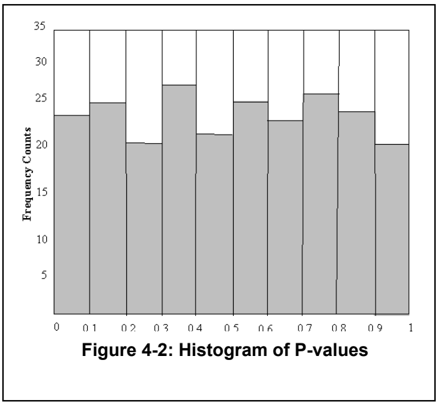
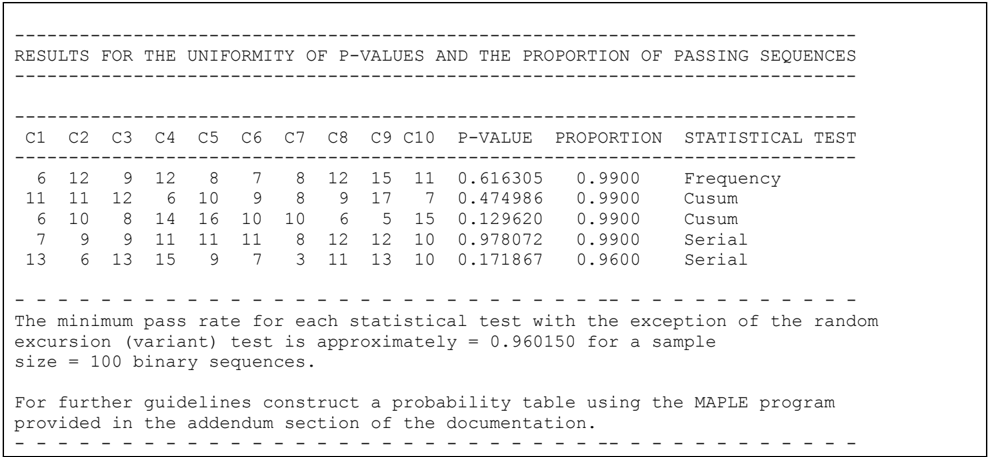
- Main analysis: For each sequence, P-values are computed and compared to \(\alpha\); empirical interpretation examines the proportion of sequences passing a test and the uniformity of P-values. A multiple-test dependence study applied 161 test P-values to Blum-Blum-Shub sequences of length 1,000,000 and used principal components/factor analysis, concluding there was no large redundancy among tests.
Limitations
- The paper states that no set of statistical tests can absolutely certify a generator as appropriate, that statistical testing cannot substitute for cryptanalysis, and that generator design and cryptanalysis are outside its scope.
- The paper states that many examples use small sample sizes for illustration only, e.g., \(n=10\), where the normal approximation is not really applicable; many tests rely on asymptotic reference distributions for large \(n\) (order \(10^3\) to \(10^7\)), and input parameter constraints apply.
- The text makes evident additional limitations: numerical precision can degrade for large incomplete gamma parameter \(a\); Maurer’s variance approximation can make the test 2.67 times more permissive than theoretically admitted; Random Excursions is discontinued if \(J<500\); and multiple tests can yield contradictory conclusions, as in the Random Excursions example where one state gave a non-random result while seven states gave random results.
Model-written summary. Check it against the paper before relying on it.
Integrity signals
Registry
Cites
Statistics
Figures

Verification
Claims the paper makes
0 Valid · 1 Not valid · 11 Not checked · 13 Own results and interpretations
A result the paper reports from its own data — it cites no other source for it, so there is none to check. The quote shows it is in the paper.
In the paper
“The asymptotic distribution of ( Ln -µ n ) / σ n along the sequence of even or odd values of n is that of a discrete random variable obtained via a mixture of two geometric random variables (one of them taking only negative values). Strictly speaking, the asymptotic distribution as such does not exist.”
A result the paper reports from its own data — it cites no other source for it, so there is none to check. The quote shows it is in the paper.
In the paper
“However, no set of statistical tests can absolutely certify a generator as appropriate for usage in a particular application, i.e., statistical testing cannot serve as a substitute for cryptanalysis.”
A result the paper reports from its own data — it cites no other source for it, so there is none to check. The quote shows it is in the paper.
In the paper
“This graph showed that there is no large redundancy among our tests.”
In the paper
“Ueli Maurer of the Department of Computer Science at Princeton University introduced this test in 1992. Maurer's test statistic relates closely to the per-bit entropy of the stream, which its author asserts is 'the correct quality measure for a secret-key source in a cryptographic application.'”
What the sources say
- Not matchedcites Maurer
This doesn’t read as a citation we can look up.
- Not matched
What the paper did — it cites no source for this, so there is none to check. The quote shows it is in the paper.
In the paper
“The test rejects the randomness hypothesis immediately if J is too small, i.e., if the following P-value is small:”
20 more claims
Create a free account to see all 25 claims and every source verdict.
Claims other papers make about this one
Each is checked against this paper’s own text: does it say what the citing paper says it does?
The source backs part of the claim, not all of it — or backs it for a different population, condition or comparison.
In the citing paper
“However, the latest version 2.1.2 [1], released in 2014, does not incorporate several modifications.”
From Checking the quality of approximation of p-values in statistical tests for random number generators by using a three-level test (2019) · cites this paper as [1]
Experimental — accuracy not yet measuredThe source backs part of the claim, not all of it — or backs it for a different population, condition or comparison.
In the citing paper
“The NIST test suite consists of 15 statistical tests for randomness of bit sequences, and its result is a list of 188 p -values.”
From Checking the quality of approximation of p-values in statistical tests for random number generators by using a three-level test (2019) · cites this paper as [1]
Experimental — accuracy not yet measuredThe cited source says what the claim attributes to it.
In the citing paper
“Note that the current implementation of the NIST test suite uses one-level or two-level tests, differently from the above experiments”
From Checking the quality of approximation of p-values in statistical tests for random number generators by using a three-level test (2019) · cites this paper as [1]
The cited source says what the claim attributes to it.
In the citing paper
“NIST SP-800.22 statistical test suite [90] and Die-hard test suite [91] and Test U01 [92] and AIS31 [93] are most common statistical test suites to evaluate their RNGs by researchers.”
From True Random Number Generators Using Electrical Noise (2019) · cites this paper as [90]
Self-check
Percentages, sums and reported differences re-computed from the paper’s own numbers.
Each contradiction between two passages listed here was confirmed by an independent check.
Rated minor: it would not touch a result — a value no result rests on, a p-value that stays on the same side of the significance level, or a conflict that is clerical, resolved elsewhere in the paper, or outside its own findings.
In the paper
§ 2.3.8 Example
“(input) τ = 0.02 (processing) π = 0.42 (processing) Vn(obs) = 52 (output) P-value = 0.500798 (conclusion) Since P-value ≥ 0.01 , accept the sequence as random.”
§ 2.3.4 Test Description
“If it can be shown that π -1 ≥τ , then the 2 Runs test need not be performed (i.e., the test should not have been run because of a failure to pass test 1, the Frequency (Monobit) test). If the test is not applicable, then the P-value is set to 0.0000.”
Rated minor: it would not touch a result — a value no result rests on, a p-value that stays on the same side of the significance level, or a conflict that is clerical, resolved elsewhere in the paper, or outside its own findings.
In the paper
§ 2.7.4 Test Description
“| 8-10 | 010 (hit) | 2 | 110 | 1 |”
§ 2.7.4 Test Description
“For the above example, if m = 3 and the template B = 001, then the examination proceeds as follows:”
Rated minor: it would not touch a result — a value no result rests on, a p-value that stays on the same side of the significance level, or a conflict that is clerical, resolved elsewhere in the paper, or outside its own findings.
In the paper
§ 2.9.3 Test Statistic and Reference Distribution
“f n : The sum of the log2 distances between matching Lbit templates, i.e., the sum of the number of digits in the distance between Lbit templates.”
§ 3.9 Maurer's 'Universal Statistical' Test
“Then it averages over all the expansion lengths by the number of test blocks.”
Rated minor: it would not touch a result — a value no result rests on, a p-value that stays on the same side of the significance level, or a conflict that is clerical, resolved elsewhere in the paper, or outside its own findings.
In the paper
§ Input Parameters:
“The parameters p , q and s are not fixed in code; thus, the user will not be able to reconstruct the original sequence because these values will vary (i.e., they are dependent on the system time).”
§ Input Parameters:
“The input parameters have been fixed so the code will reproduce the same results.”
Rated minor: it would not touch a result — a value no result rests on, a p-value that stays on the same side of the significance level, or a conflict that is clerical, resolved elsewhere in the paper, or outside its own findings.
In the paper
§ 5.5.2 Global Parameters
“| MAXNUMOFTEMPLATES | 40 | Non-overlapping Templates Test | | NUMOFTESTS | 16 | Max number of tests | | NUMOFGENERATORS | 12 | Max number of PRNGs |”
§ A.2 Configuration Information
“| 2. | #define MAXNUMOFTEMPLATES | 148 | | 3. | #define NUMOFTESTS | 15 | | 4. | #define NUMOFGENERATORS | 10 |”
2 more findings
Create a free account to see every finding of this check.
Citations
Cites
Handbook of Mathematical Functions
McQuarrie, D. A. (1966) · American Journal of Physics · doi:10.1119/1.1972842 · Cited by 40,433
Numerical recipes in C: the art of scientific computing
(1993) · Choice Reviews Online · doi:10.5860/choice.30-5638 · Cited by 17,933
Rayward-Smith, V. J. (1991) · Journal of the Operational Research Society · doi:10.1057/jors.1991.155 · Cited by 16,821
Handbook of applied cryptography
(1997) · Choice Reviews Online · doi:10.5860/choice.34-4512 · Cited by 10,357
Handbook of Mathematical Functions
(2018) · A Century of Excellence in MEASUREMENTS, STANDARDS, and TECHNOLOGY · doi:10.1201/9781351069397-39 · Cited by 9,062
A universal algorithm for sequential data compression
Ziv, J., & Lempel, A. (1977) · IEEE Transactions on Information Theory · doi:10.1109/tit.1977.1055714 · Cited by 5,456
The Art of Computer Programming
Worlton, W. J. (1968) · Nuclear Science and Engineering · doi:10.13182/nse68-a19548 · Cited by 2,251
Handbook of Applied Cryptography
Menezes, A. J., van Oorschot, P. C., & Vanstone, S. A. (2018) · CRC Press eBooks · doi:10.1201/9780429466335 · Cited by 1,770
Numerical Recipes in C-The Art of Scientific Computing.
G., W., Press, W. H., Flannery, B. P., Teukolsky, S. A., & Vetterling, W. T. (1989) · Mathematics of Computation · doi:10.2307/2008673 · Cited by 1,513
The Fourier Transform and its Applications
Cattermole, K. W. (1965) · Electronics and Power · doi:10.1049/ep.1965.0268 · Cited by 1,417
Cited by
Items 1,601–1,700 of 3,620
Improving Pseudo random number generator using artificial neural networks
Yayık, A., & Kutlu, Y. (2013) · Signal Processing and Communications Applications Conference (SIU) · doi:10.1109/siu.2013.6531494 · Cited by 8
Pseudo-random streams for distributed and parallel stochastic simulations on GP-GPU
Passerat‐Palmbach, J., Mazel, C., & Hill, D. R. C. (2012) · Journal of Simulation · doi:10.1057/jos.2012.8 · Cited by 9
Design of pseudo random keystream generator using fractals
AbdElHaleem, S. H., Radwan, A. G., & Abd–El–Hafiz, S. K. (2013) · IEEE International Conference on Electronics, Circuits and Systems (ICECS) · doi:10.1109/icecs.2013.6815554 · Cited by 8
“NIST suite is a group of 15 different tests designed to investigate the randomness of a stream of bits [12].”
BackgroundAn oscillator-based true random number generator with process and temperature tolerance
Amaki, T., Hashimoto, M., & Onoye, T. (2015) · Asia and South Pacific Design Automation Conference (ASP-DAC) · doi:10.1109/aspdac.2015.7058918 · Cited by 10
Parallel random number generators for sequences uniformly distributed over any range of integers
Kuehnel, R., Theiler, J. P., & Wang, Y. (2006) · IEEE Transactions on Circuits and Systems I Fundamental Theory and Applications · doi:10.1109/tcsi.2006.877884 · Cited by 9
“random with respect to the previous m bits [ 17 ][18].”
BackgroundMethodResultInfluentialA note on the estimation of string complexity for short strings
Speidel, U. (2009) · International Conference on Information, Communications and Signal Processing (ICICS) · doi:10.1109/icics.2009.5397536 · Cited by 8
Callegari, S., Fabbri, M., & Beirami, A. (2015) · Analog Integrated Circuits and Signal Processing · doi:10.1007/s10470-015-0631-y · Cited by 11
“Technology (NIST) 800-22 suite [37] have also been run to assess the suitability of the entropy source for a TRNG, basing them on 50 streams with 10(6) bits each.”
BackgroundMethodA differential equation method to derive the formulas of the T-complexity and the LZ-complexity
Hamano, K., & Yamamoto, H. (2009) · IEEE International Symposium on Information Theory (ISIT) · doi:10.1109/isit.2009.5205702 · Cited by 8
“In the Lempel-Ziv compression test, which was included in the NIST statistical test suite [9], the distribution of the LZ-complexity for random sequences of length 10(6) is approximated by the normal distribution with mean 69588.”
MethodRAPID-FeinSPN: A Rapid Prototyping Framework for Feistel and SPN-Based Block Ciphers
Khalid, A., Hassan, M., Chattopadhyay, A., & Paul, G. (2013) · Lecture notes in computer science · doi:10.1007/978-3-642-45204-8_13 · Cited by 8
Reliable secret-key binding for physical unclonable functions with transform coding
Günlü, O., İşcan, O., Sidorenko, V. R., et al. (2016) · IEEE Global Conference on Signal and Information Processing · doi:10.1109/globalsip.2016.7905989 · Cited by 8
Ring Oscillators and Hardware Trojan Detection
Kitsos, P., Sklavos, N., & Voyiatzis, A. G. (2017) · Springer eBooks · doi:10.1007/978-3-319-44318-8_9 · Cited by 9
A Dynamic Reseeding DRBG Based on SRAM PUFs
Chen, S., & Li, B. (2016) · International Conference on Cyber-Enabled Distributed Computing and Knowledge Discovery (CyberC) · doi:10.1109/cyberc.2016.18 · Cited by 8
Robust entropy harvester for analogue noise sources in TRNG
Saleem, H., Afzal, S., & Ahmed, N. (2018) · International Bhurban Conference on Applied Sciences and Technology (IBCAST) · doi:10.1109/ibcast.2018.8312256 · Cited by 8
Encrypted Traffic Identification Based on N-gram Entropy and Cumulative Sum Test
Cheng, G., & Hu, Y. (2018) · International Conference on Future Internet Technologies · doi:10.1145/3226052.3226057 · Cited by 8
Randomness analysis on 3D-AES block cipher
Ariffin, S. B., & Yusof, N. A. M. (2017) · International Conference on Natural Computation, Fuzzy Systems and Knowledge Discovery (ICNC-FSKD) · doi:10.1109/fskd.2017.8393289 · Cited by 8
“J. High Density Plaintext (HDP) Data Category V. RESULT DISCUSSION Based on the analysis conducted towards all nine data categories using the NIST Statistical Test Suite, the analysis results are shown in the following Table II.”
MethodInfluentialA Fully Digital Physical Unclonable Function Based Temperature Sensor for Secure Remote Sensing
Cao, Y., Guo, Y., Liu, B., Ge, W., Zhu, M., & Chang, C.-H. (2018) · International Conference on Computer Communications and Networks (ICCCN) · doi:10.1109/icccn.2018.8487347 · Cited by 9
“4) Randomness: The randomness of the coherent PUF based temperature tag is evaluated by the NIST Pub 800 statistical test suite with the recommended settings [29].”
BackgroundMethodInkjet-Printed True Random Number Generator based on Additive Resistor Tuning
Erozan, A. T., Bishnoi, R., Aghassi‐Hagmann, J., & Tahoori, M. B. (2019) · Design, Automation, and Test in Europe · doi:10.23919/date.2019.8715071 · Cited by 9
“National Institute of Standards and Technology - Statistical Test Suite (NIST-STS) contains several tests explained in [26] to evaluate the randomness of the generated bits.”
Sarkar, A., & Singh, B. K. (2019) · Springer eBooks · doi:10.1007/978-3-030-22277-2_31 · Cited by 8
Hashim, A. T., Hasan, A. M., & Abbas, H. M. (2020) · International Journal of Power Electronics and Drive Systems/International Journal of Electrical and Computer Engineering · doi:10.11591/ijece.v10i6.pp6370-6379 · Cited by 8
“The most widely used of National Institute of Standards and Technology (NIST) tests are [25]:”
MethodMUX induced Ring oscillators for encrypted Nano communication via Quantum Dot Cellular Automata
Santhiya Devi, R., Thenmozhi, K., Rayappan, J. B. B., Amirtharajan, R., & Praveenkumar, P. (2020) · Nano Communication Networks · doi:10.1016/j.nancom.2020.100338 · Cited by 8
Modern Encryption Techniques for Cloud Computing Randomness and Performance Testing
El-etriby, S., Mohamed, E., & Abdul-kader, H. S. (2012) · doi:10.13140/2.1.4685.8880 · Cited by 8
Chen, Z., Du, N., Kiani, M., et al. (2021) · IEEE Transactions on Nanotechnology · doi:10.1109/tnano.2021.3135713 · Cited by 8
Survey, taxonomy, and methods of QCA-based design techniques—part II: reliability and security
Fazili, M. M., Shah, M. F., Naz, S. F., et al. (2022) · Semiconductor Science and Technology · doi:10.1088/1361-6641/ac5ec1 · Cited by 8
“The 15 statistical performance tests [63] to evaluate the randomness of an RNG are described in table 9.”
Hénaff, S., Taralova, I., & Lozi, R. (2009) · HAL (Le Centre pour la Communication Scientifique Directe) · Cited by 8
Automation of Statistical Tests on Randomness to Obtain Clearer Conclusion
Haramoto, H. (2009) · Springer eBooks · doi:10.1007/978-3-642-04107-5_26 · Cited by 8
“TestU01 has flexible parameters, and hence is best suitable to implement the adaptive version of statistical tests, unlike DIEHARD and NIST where the sample size is fixed.”
MethodHigh frequency chaos oscillators with applications
Demirkol, A. Ş., Tavas, V., Özoğuz, S., & Toker, A. (2007) · European Conference on Circuit Theory and Design · doi:10.1109/ecctd.2007.4529774 · Cited by 10
“Using the random number test suite of NIST documented in NIST-800-22 [6], we have experimentally verified that bit streams generated by this architecture have good statistical randomness quality.”
BackgroundMethodInfluentialDynamic Hash key‐based stream cipher for secure transmission of real time ECG signal
Pandian, K. K. S., & Ray, K. C. (2016) · Security and Communication Networks · doi:10.1002/sec.1615 · Cited by 8
Optimizing Cryptography in Energy Harvesting Applications
Suslowicz, C., Krishnan, A. S., & Schaumont, P. R. (2017) · doi:10.1145/3139324.3139329 · Cited by 8
True Random Number Generation Based on Environmental Noise Measurements for Military Applications
Bardis, N. G., Марковский, А. П., Doukas, N., & Karadimas, N. V. (2009) · doi:10.13140/2.1.4031.2647 · Cited by 14
A complex linear feedback shift register design for the A5 keystream generator
Sharaf, M., Mansour, H. A., Zayed, H. H., et al. (2005) · doi:10.1109/nrsc.2005.194024 · Cited by 8
A study on occurrence rates per bit for the logistic map over integers
Araki, S., Miyazaki, T., & Uehara, S. (2008) · International Symposium on Information Theory and its Applications · doi:10.1109/isita.2008.4895616 · Cited by 10
“In [8], we set a simple model for a pseudo-random number generator using the logistic map over integers with any precision, and analyzed the randomness for the output sequences by using the NIST random test suites [9].”
MethodA Random Number Generator Based on Isogenies Operations.Preprint
He, D., Chen, J., & Hu, J. (2010) · IACR Cryptology ePrint Archive · Cited by 8
Haramoto, H., & Matsumoto, M. (2019) · Mathematics and Computers in Simulation · doi:10.1016/j.matcom.2018.08.005 · Cited by 7
Silva-Garcia, V. M., Flores-Carapia, R., Gonzalez-Ramirez, M. D., Vega-Alvarado, E., & Villarreal-Cervantes, M. G. (2020) · IEEE Access · doi:10.1109/access.2020.3042475 · Cited by 7
“The Discrete Fourier Transform (DFT) is a test included in the NIST 800-22 standard, for measuring the randomness degree of a binary chain, that is, there are no repetitive zeros-and-ones patterns, one after another [45].”
MethodImage encryption algorithm based on 2D hyper-chaotic system and central dogma of molecular biology
Wang, Q., Zhang, X., & Zhao, X. (2023) · Physica Scripta · doi:10.1088/1402-4896/ace5ee · Cited by 7
AES Security Improvement by Utilizing New Key-Dependent XOR Tables
Lượng, T. T., Cương, N. N., & Vo, B. (2024) · IEEE Access · doi:10.1109/access.2024.3387268 · Cited by 10
Pan, P., Su, Y., Fan, R., et al. (2024) · IEEE Sensors Journal · doi:10.1109/jsen.2024.3439449 · Cited by 7
“We used the National Institute of Standards and Technology (NIST) test suite [36] to measure the randomness of the generated key.”
MethodWang, Y., Chen, B., Gao, W., Ye, B., Niu, C., Wang, W., Zhu, Y., Yu, W., Guo, H., & Shen, J. (2024) · National Science Review · doi:10.1093/nsr/nwae338 · Cited by 10
“A standard practice for evaluating the quality of a true RNG is carried out via a statistical test suite (NIST STS, sp 800–2 2) [51 ].”
FDPUF: Frequency-Domain PUF for Robust Authentication of Edge Devices
Paul, S. D., Dasgupta, A., & Bhunia, S. (2024) · IEEE Transactions on Computer-Aided Design of Integrated Circuits and Systems · doi:10.1109/tcad.2024.3447211 · Cited by 7
“The National Institute of Standards and Technology (NIST) provides the test suite SP 800-22 [33] for this purpose.”
BackgroundEvaluating ASCON Lightweight Encryption Algorithm for Image Encryption
Alghamdi, Y., & Munir, A. (2024) · SN Computer Science · doi:10.1007/s42979-024-03382-3 · Cited by 8
A novel PRNG for fiber optic transmission
Senouci, S., Madoune, S. A., Senouci, M. R., et al. (2025) · Chaos Solitons & Fractals · doi:10.1016/j.chaos.2025.116038 · Cited by 7
Digital In-Memory Compute for Machine Learning Applications With Input and Model Security
Ashok, M., Maji, S., Zhang, X., Cohn, J., & Chandrakasan, A. P. (2025) · IEEE Journal of Solid-State Circuits · doi:10.1109/jssc.2025.3534753 · Cited by 10
Channel-Based Key Generation for Secure Underwater Acoustic Communications
Diamant, R., Casari, P., Ardizzon, F., et al. (2025) · IEEE Transactions on Wireless Communications · doi:10.1109/twc.2025.3548670 · Cited by 7
Optical fibre-based quantum random number generator: stochastic modelling and measurements
Dudek, M., Siudem, G., Kwaśnik, G., Żołnowski, W., & Życzkowski, M. (2025) · Scientific Reports · doi:10.1038/s41598-025-95414-y · Cited by 9
“Later, many other statistical tests were developed and introduced for general use, like, e.g., the NIST Statistical Test Suite 12 , TestU01 13 or dieharder 14 .”
InfluentialImage encryption algorithm based on Zigzag transformation and roulette wheel rotation mechanism
Zhang, X., Liu, Y., Liu, M., & Niu, Y. (2025) · Journal of King Saud University - Computer and Information Sciences · doi:10.1007/s44443-025-00249-2 · Cited by 8
Efficient image encryption using a new model of Chaotic Neural Network
Kadir, A., Azzaz, M. S., Kaibou, R., & Alloun, Y. (2025) · The Journal of Supercomputing · doi:10.1007/s11227-025-07977-2 · Cited by 8
An image encryption scheme using PRESENT-RC4, chaos and secure key generation
Kumar, K., Roy, S., Puri, D., & Kumar, R. (2025) · Scientific Reports · doi:10.1038/s41598-025-26953-7 · Cited by 9
Zeng, W., Zhang, C., Liang, X., Xia, J., Lin, Y., Li, Y., & Qiu, K. (2026) · Journal of Lightwave Technology · doi:10.1109/jlt.2026.3660853 · Cited by 9
SECURE AND LIGHTWEIGHT HARDWARE AUTHENTICATION USING ISOLATED PHYSICAL UNCLONABLE FUNCTION
Shahrak, M. Z. (2016) · Lincoln (University of Nebraska) · Cited by 7
Prokofiev, A. O., Chirkin, A. V., & Bukharov, V. A. (2018) · IEEE Conference of Russian Young Researchers in Electrical and Electronic Engineering · doi:10.1109/eiconrus.2018.8317105 · Cited by 7
Fuzzy logic based Truly Random number generator for high-speed BIST applications
Kumar, G. S., & Saminadan, V. (2019) · Microprocessors and Microsystems · doi:10.1016/j.micpro.2019.04.002 · Cited by 9
A Modified Algorithm for the Logistic Sequence Based on PCA
Liu, C., & Ding, Q. (2020) · IEEE Access · doi:10.1109/access.2020.2978503 · Cited by 7
“01, the binary sequence is accepted as random with a confidence of 99%; otherwise, it is considered as nonrandom [39] and [40].”
BackgroundSecured Session Key-Based E-Health: Biometric Blended with Salp Swarm Protocol in Telecare Portals
Sarkar, A., Dey, J., & Karforma, S. (2020) · Advances in intelligent systems and computing · doi:10.1007/978-981-15-2188-1_56 · Cited by 7
FPGA implementation of PUF based key generator for secure communication in IoT
Boke, A. K., Nakhate, S., & Rajawat, A. (2022) · Integration · doi:10.1016/j.vlsi.2022.12.006 · Cited by 8
True Random Number Generator Based on RRAM-Bias Current Starved Ring Oscillator
Arumí, D., Manich, S., Gómez‐Pau, Á., Rodriguez-Montanes, R., González, M. B., & Campabadal, F. (2023) · IEEE Journal on Exploratory Solid-State Computational Devices and Circuits · doi:10.1109/jxcdc.2023.3320056 · Cited by 10
MeLPUF: Memory-in-Logic PUF Structures for Low-Overhead IC Authentication
Vega, C., SLPSK, P., Paul, S. D., Chatterjee, A., & Bhunia, S. (2023) · IEEE Physical Assurance and Inspection of Electronics (PAINE) · doi:10.1109/paine58317.2023.10317943 · Cited by 10
Prajapati, R. B., & Panchal, S. (2024) · International Journal of Computing and Digital Systems · doi:10.12785/ijcds/150122 · Cited by 10
“It’s crucial to remember that some tests can be further broken down into subtests [10].”
BackgroundPal, S., Mukhopadhyay, J., Pathak, A., Mondal, H., & Mandal, M. K. (2024) · Evolutionary Intelligence · doi:10.1007/s12065-024-00927-6 · Cited by 9
Photon statistics analysis of h-BN quantum emitters with pulsed and continuous-wave excitation
Akbari, H., Jha, P. K., Malinowski, K. L., et al. (2024) · APL Quantum · doi:10.1063/5.0206243 · Cited by 7
“To compare these protocols, we analyzed the random numbers generated using the NIST randomness test [31].”
MethodSeed Renewable Parallel and Real-Time Toeplitz Post-Processing for QRNG
Lin, F., Ge, W., Song, Z., Cui, X., Guo, Y., Guo, X., & Xiao, L. (2024) · Journal of Lightwave Technology · doi:10.1109/jlt.2024.3445327 · Cited by 10
“In order to verify the randomness of the random bits strictly, we firstly collected the output sequences of four channels separately and performed 15 statistical tests using the standard NIST Statistical Test Suite [27].”
Liu, L., Yang, J., Wu, M., Liu, J., Huang, W., Li, Y., & Xu, B. (2025) · Entropy · doi:10.3390/e27010068 · Cited by 8
“The suite includes a total of 15 tests, such as the frequency test, block frequency test, cumulative sums test, and approximate entropy test, which collectively evaluate various aspects of randomness, including uniformity, independence, and unpredictability of sequences [28].”
On the Efficiency of Mathematics in Intrusion Detection: The NetEntropy Case
Goubault-Larrecq, J., & Olivain, J. (2014) · Lecture notes in computer science · doi:10.1007/978-3-319-05302-8_1 · Cited by 7
Constructing Empirical Tests of Randomness
Sýs, M., Švenda, P., Ukrop, M., & Matyáš, V. (2014) · International Conference on Security and Cryptography · doi:10.5220/0005023902290237 · Cited by 7
Smartphone sensors as random bit generators
Loutfi, J., Chehab, A., Elhajj, I. H., et al. (2014) · IEEE/ACS International Conference on Computer Systems and Applications (AICCSA) · doi:10.1109/aiccsa.2014.7073279 · Cited by 7
“Now, the following is a summarized description of the 15 tests used by STS 2.1.1 along with the recommended binary sequence input size and test parameters (if applicable): General variables: • n: The binary sequence size in question • M: Block size (in bits) within n • N: The number of samples in a dataset per chosen…”
BackgroundMethodInfluentialWatching for Weakness in Wild WPANs
Ramsey, B. W., Mullins, B. E., Speers, R., et al. (2013) · IEEE Military Communications Conference (MILCOM) · doi:10.1109/milcom.2013.238 · Cited by 7
“The National Institute of Standards and Technology (NIST), specified several statistical methods for testing the assumption of randomness in binary message sequences [40].”
Method2.87-Gb/s random bit generation based on bandwidth-enhanced chaotic laser
Zhang, 张. Y., Zhang, 张. J., Zhang, 张. M., et al. (2011) · Chinese Optics Letters · doi:10.3788/col20110903.031404 · Cited by 7
“All bit sequences obtained were subjected to full National Institute of Standards and Technology (NIST) test suite([14]) to evaluate the randomness.”
MethodStatistical evaluation of Hidden Markov Models topologies, based on industrial synthetic model
Robles, B. D. V., Avila, M., Duculty, F., et al. (2012) · IFAC Proceedings Volumes · doi:10.3182/20120523-3-ro-2023.00052 · Cited by 7
Hars, L., & Petruska, G. (2012) · EURASIP Journal on Embedded Systems · doi:10.1186/1687-3963-2012-1 · Cited by 7
A Novel Unpredictable Temporal based Pseudo Random Number Generator
Khalique, A., Lone, A. H., & Ashraf, S. S. (2015) · International Journal of Computer Applications · doi:10.5120/20615-3301 · Cited by 7
“Any sequence which satisfies the requirement of passing the corresponding test as specified by NIST test suite [4] has been marked as “ ” in the respective cells.”
BackgroundMethodInfluentialA construction of cryptography system based on quantum neural network
Anh, T. T., Thanh, N. V., & Luong, T. D. (2016) · International Conference on Knowledge and Systems Engineering/Proceedings · doi:10.1109/kse.2016.7758070 · Cited by 7
Bhuin, S., Sweeney, J., Pagliarini, S., Biswas, A. K., & Pileggi, L. (2017) · IEEE/ACM International Symposium on Nanoscale Architectures (NANOARCH) · doi:10.1109/nanoarch.2017.8053738 · Cited by 7
Key Schedule Algorithm using 3-Dimensional Hybrid Cubes for Block Cipher
Mushtaq, M. F., Jamel, S. H., Radhiah, S., et al. (2019) · International Journal of Advanced Computer Science and Applications · doi:10.14569/ijacsa.2019.0100857 · Cited by 7
“01 then it is said to be the random [30].”
BackgroundBentSign: keyed hash algorithm based on bent Boolean function and chaotic attractor
Todorova, M., Stoyanov, B. P., Szczypiorski, K., Graniszewski, W., & Kordov, K. (2019) · Bulletin of the Polish Academy of Sciences Technical Sciences · doi:10.24425/bpasts.2019.129654 · Cited by 7
Hybrid Method as Pseudo-Random Bits Generator
Al-Mhadawi, M. M., & Albahrani, E. A. (2019) · doi:10.1109/cas47993.2019.9075715 · Cited by 7
“This analysis is applied through statistical tests suite NIST [8].”
Method5D Hyper-Chaotic System with Multiple Types of Equilibrium Points
Xu, C., Wu, X., He, Y., & Mo, Y. (2020) · Journal of Shanghai Jiaotong University (Science) · doi:10.1007/s12204-020-2224-x · Cited by 8
High-Throughput Optimizations of AES Algorithm for Satellites
Pirzada, S. J. H., Hasan, M. N., Memon, Z. W., Haris, M., Xu, T., & Jianwei, L. (2020) · International Symposium on Recent Advances in Electrical Engineering (RAEE) · doi:10.1109/raeecs50817.2020.9265688 · Cited by 10
Random Number Generation from Internal LFSR and Fluctuation of Sampling Interval
Masaoka, H., Ichikawa, S., & Fujieda, N. (2021) · IEEJ Transactions on Industry Applications · doi:10.1541/ieejias.141.86 · Cited by 7
Shared memory implementation and performance analysis of LSB steganography based on chaotic tent map
Gambhir, G., & Mandal, J. K. (2021) · Innovations in Systems and Software Engineering · doi:10.1007/s11334-021-00385-8 · Cited by 6
“Tests serial numbers 1 to 4 check for frequency, test serial numbers 5 and 6 check for repetitive patterns, test numbers 7 to 12 are pattern matching tests and test serial numbers 13 to 15 are based on a random walk [15].”
MethodInfluentialSecret Key Generation by Exploiting Traffic Load for Mobile Adhoc Networks
Shibu, K. R., & Sujipramila, R. (2021) · Wireless Personal Communications · doi:10.1007/s11277-021-08311-8 · Cited by 7
“A detailed evaluation of the existing works addresses certain problems, primarily all these techniques find it very hard to obtain a source of randomness [2] for secret key generation.”
BackgroundLiu, Y., Li, B., Zhang, Y., & Zhao, X. (2021) · Electronics · doi:10.3390/electronics10111267 · Cited by 9
Rahman, M., Zhou, L., & Chakrabartty, S. (2022) · IEEE Transactions on Information Forensics and Security · doi:10.1109/tifs.2022.3158089 · Cited by 7
Circuit Implementation and PRNG Applications of Time Delayed Lorenz System
Arıcıoğlu, B., & Kaçar, S. (2021) · Chaos Theory and Applications · doi:10.51537/chaos.976593 · Cited by 7
“For every PRNG, NIST-800-22 statistical tests (Bassham et al. 2010) are performed when the size of the generated bit series are reached 1000000 bits which is required by the NIST tests.”
BackgroundMethodInfluentialRandom Number Generator Based on Discrete Cosine Transform Based Lossy Picture Compression
Yakut, S. (2021) · NATURENGS MTU Journal of Engineering and Natural Sciences Malatya Turgut Ozal University · doi:10.46572/naturengs.1009013 · Cited by 7
NIST-Lite: Randomness Testing of RNGs on an Energy-Constrained Platform
Lee, C.-Y., Bharathi, K., Lansford, J. S., & Khatri, S. P. (2021) · IEEE International Conference on Computer Design: VLSI in Computers and Processors (ICCD) · doi:10.1109/iccd53106.2021.00019 · Cited by 7
Elshoush, H. T. I., Al-Tayeb, B. M., & Obeid, K. T. (2021) · PeerJ Computer Science · doi:10.7717/peerj-cs.812 · Cited by 12
Random bit sequence generation from speckle patterns produced with multimode waveguides
Dias, L. M. S., Silvério, T., Ferreira, R. A. S., et al. (2022) · IET Optoelectronics · doi:10.1049/ote2.12068 · Cited by 7
“Following the NIST guidelines [17], an acceptance rate threshold of 99% was established for each of the tests deployed.”
MethodInfluentialCritical Analysis of Hypothesis Tests in Federal Information Processing Standard (140-2)
Luengo, E. A., Cerna, M. B. L., Villalba, L. J. G., Hernandez-Castro, J. C., & Hurley-Smith, D. (2022) · Entropy · doi:10.3390/e24050613 · Cited by 7
“append(runs_seq(u[i*m:(i+1)*m],m,long)[12]) return stats.”
BackgroundInfluentialMin-entropy estimation for semiconductor superlattice true random number generators
Liu, J., Xie, J., Lu, C., Wu, H., Ding, P., Chen, X., & Feng, H. (2022) · Scientific Reports · doi:10.1038/s41598-022-06815-2 · Cited by 9
“(3) The SSL can operate above room temperature and resist environmental fluctuations and human interference.”
BackgroundExperimental Validation of a Chaotic Jerk Circuit Based True Random Number Generator
Harrison, R. C., Rhea, B. K., Oldag, A. R., Dean, R. N., & Perkins, E. (2022) · Chaos Theory and Applications · doi:10.51537/chaos.1112243 · Cited by 8
Aydın, Ö., & Kösemen, C. (2020) · Pamukkale University Journal of Engineering Sciences · doi:10.5505/pajes.2020.00344 · Cited by 7
“It makes 188 runs for 15 different tests by running certain tests with different parameters [36].”
BackgroundHan, D., Im, D., Park, G., Kim, Y., Song, S., Lee, J., & Yoo, H. (2022) · IEEE International Conference on Artificial Intelligence Circuits and Systems (AICAS) · doi:10.1109/aicas54282.2022.9869960 · Cited by 7
“22 test [13] with a threshold of P-value > 0.01 (significance level).”
BackgroundInfluentialPseudo Random Number Generator Based on Chaos Theory and Artificial Neural Networks
Alloun, Y., Azzaz, M. S., Kifouche, A., et al. (2022) · International Conference on Advanced Electrical Engineering (ICAEE) · doi:10.1109/icaee53772.2022.9962090 · Cited by 7
MRAM Devices to Design Ternary Addressable Physically Unclonable Functions
Rios, M. A., Alam, M., & Cambou, B. (2023) · Electronics · doi:10.3390/electronics12153308 · Cited by 7
A dependable and resource-frugal ring oscillator physically unclonable function
Hossain, F. S., Hossain, N., Tabassum, S., et al. (2024) · International Journal of Electronics · doi:10.1080/00207217.2023.2301227 · Cited by 7
Modified twofish algorithm for increasing security and efficiency in the encryption of video signals
Catalini, G., Chiaraluce, F., Ciccarelli, L., et al. (2004) · Proceedings - International Conference on Image Processing · doi:10.1109/icip.2003.1247014 · Cited by 7
Random Number Generators for Integrated Circuits and FPGAs
Sunar, B., & Schellekens, D. (2009) · Integrated circuits and systems · doi:10.1007/978-0-387-71829-3_6 · Cited by 8
Efficient multicore implementation of an advanced generator of discrete chaotic sequences
Desnos, K., Assad, S. E., Arlicot, A., Pelcat, M., & Ménard, D. (2014) · International Conference for Internet Technology and Secured Transactions · doi:10.1109/icitst.2014.7038770 · Cited by 12
Güler, Ü., & Ergün, S. (2010) · IEEE International Conference on Electronics, Circuits and Systems (ICECS) · doi:10.1109/icecs.2010.5724692 · Cited by 7
Tests of randomness by the gambler’s ruin algorithm
Kim, C., Choe, G. H., & Kim, D. H. (2007) · Applied Mathematics and Computation · doi:10.1016/j.amc.2007.09.060 · Cited by 7
“A test suite [23] was developed by the Computer Security Division and the Statistical Engineering Division at the National Institute of Standards and Technology in USA.”
MethodInfluence of operating conditions on ring oscillator-based entropy sources in FPGAs
Hochberger, C., Li, C., Raitza, M., & Vogt, M. (2012) · International Conference on Field Programmable Logic and Applications (FPL) · doi:10.1109/fpl.2012.6339378 · Cited by 7
“To evaluate the generated random bits we used the wellknown suite of statistical tests described in Special Publication 800-22 [9] The primary weakness of traditional ROs is the low productivity , since the output signal is typically sampled using a very slow clock to keep high entropy per bit.”
Method
Metadata
- Authors
- Bassham, L. E., Rukhin, A. L., Soto, J., Nechvatal, J. R., Smid, M. E., Barker, E. B., Leigh, S. D., Levenson, M., Vangel, M., Banks, D. L., Heckert, N. A., Dray, J. F., & Vo, S.
- Affiliations
- National Institute of Standards and Technology (US)
- Venue
- NIST Special Publication 800-22 Revision 1a
- Published
- 2010
- OpenAlex
- W1517403092
- Semantic Scholar
- 961fc0f6c68303cde94a28fdb24e6eaf3ef040b4
- Cited by
- 3,617
- References
- 34
- Citations by year
- 2026: 128 · 2025: 205 · 2024: 192 · 2023: 208 · 2022: 166 · 2021: 291 · 2020: 290 · 2019: 250 · 2018: 254 · 2017: 207 · 2016: 183 · 2015: 184 · 2014: 201 · 2013: 155 · 2012: 139
- Type
- report
- Language
- en
- Open access
- gold
- doi.org
- Topics
- Physical Sciences › Computer Science › Artificial Intelligence › Cryptographic Implementations and Security
- Physical Sciences › Mathematics › Discrete Mathematics and Combinatorics › Coding theory and cryptography
- Physical Sciences › Computer Science › Computer Vision and Pattern Recognition › Chaos-based Image/Signal Encryption
- Keywords
- random number generators, pseudorandom number generators, cryptographic randomness, NIST SP 800-22, randomness testing
About these checks
Registry, retraction, Cites and statistics results are computed, not judged, with one exception: a printed reference that no index lists is read once by a model before it counts as a citation error. Claims are extracted by a model and kept only when their quote appears verbatim in the text; each cited source is then checked, with a model’s help, for whether it says what the claim relies on. Those verdicts can be wrong — read the claim’s quote and the cited source before relying on one.
A language model drew the claims from the paper on 2026-09-27 (prompt extract-v2).
Statistics and arithmetic are recomputed, not judged.
Confidence bands are shown only for fields calibrated on our annotated test set. None is calibrated yet, so no band is shown.
What counts as a claim ›How we measure confidence ›How we check this ›
Are you an author, or do you see a problem with this page? Request a review
Data sources
Bibliographic data: Semantic Scholar, OpenAlex, Crossref.
Contains information from the Semantic Scholar Academic Graph Datasets, made available under the ODC Attribution License (ODC-BY 1.0).
Semantic Scholar’s data is described in: Kinney, R., et al. (2023). The Semantic Scholar Open Data Platform. arXiv:2301.10140.
