

A statistical test suite for random and pseudorandom number generators for cryptographic applications
Open accessThe DOI matches its Crossref record; 33 of the 34 references it cites were found in a registry or an index; none of the 14 sources its claims cite is checked for support yet.
Abstract
The Information Technology Laboratory (ITL) at the National Institute of Standards and Technology (NIST) promotes the U.S. economy and public welfare by providing technical leadership for the nation's measurement and standards infrastructure. ITL develops tests, test methods, reference data, proof of concept implementations, and technical analysis to advance the development and productive use of information technology. ITL's responsibilities include the development of technical, physical, administrative, and management standards and guidelines for the cost-effective security and privacy of sensitive unclassified information in Federal computer systems.
Overview
CoChat Summary
TL;DR
This NIST Special Publication 800-22 Revision 1a presents a suite of 15 statistical tests for evaluating whether binary sequences produced by random or pseudorandom number generators are suitable for cryptographic applications. It provides test purposes, mathematical descriptions, examples, and guidance for interpreting P-values, while cautioning that statistical testing is only a first step and cannot replace cryptanalysis.
Key findings
- The suite consists of 15 tests: Frequency (Monobit), Frequency within a Block, Runs, Longest Run of Ones, Binary Matrix Rank, Discrete Fourier Transform (Spectral), Non-overlapping Template Matching, Overlapping Template Matching, Maurer’s “Universal Statistical,” Linear Complexity, Serial, Approximate Entropy, Cumulative Sums, Random Excursions, and Random Excursions Variant. The Frequency test is recommended first because it supplies the most basic evidence of non-randomness.
- Each test uses the null hypothesis \(H_0\) that the sequence is random; if P-value \(\ge \alpha\), the sequence is accepted as random, and if P-value \(<\alpha\), it is rejected. Examples use \(\alpha=0.01\), and NIST recommends \(\alpha\) in the range [0.001, 0.01].
- The document states that no finite set of statistical tests is “complete,” that statistical testing cannot absolutely certify a generator, and that statistical testing cannot serve as a substitute for cryptanalysis.
- Sample data files are 1,000,000 bits (binary expansions of \(e\), \(\pi\), \(\sqrt{2}\), \(\sqrt{3}\), and a G-SHA-1 sequence); reported example P-values include Frequency for \(\pi\) = 0.578211, for \(e\) = 0.953749, and for G-SHA-1 = 0.604458.
Methods
- Design: The NIST Statistical Test Suite is an ANSI C reference implementation of 15 tests; each test defines a test statistic, a reference distribution (e.g., normal, half-normal, chi-square), a P-value, and a decision rule at the 1% level.
- Data or sample: Tests apply to binary sequences from hardware or software RNGs/PRNGs; sample files are 1,000,000 bits, while many worked examples use small illustrative lengths such as \(n=100\).
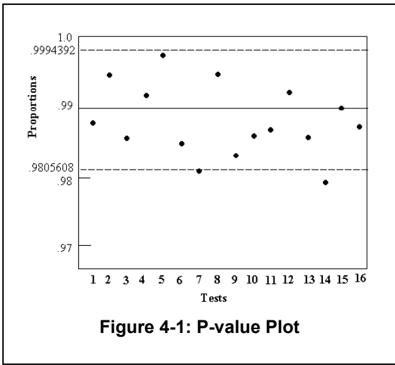
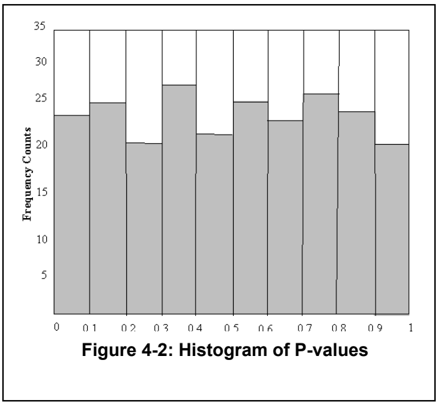
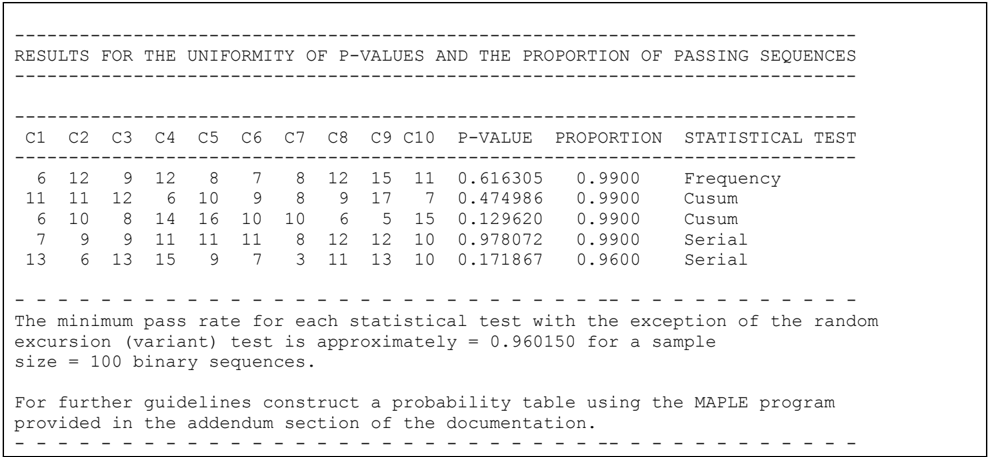
- Main analysis: For each sequence, P-values are computed and compared to \(\alpha\); empirical interpretation examines the proportion of sequences passing a test and the uniformity of P-values. A multiple-test dependence study applied 161 test P-values to Blum-Blum-Shub sequences of length 1,000,000 and used principal components/factor analysis, concluding there was no large redundancy among tests.
Limitations
- The paper states that no set of statistical tests can absolutely certify a generator as appropriate, that statistical testing cannot substitute for cryptanalysis, and that generator design and cryptanalysis are outside its scope.
- The paper states that many examples use small sample sizes for illustration only, e.g., \(n=10\), where the normal approximation is not really applicable; many tests rely on asymptotic reference distributions for large \(n\) (order \(10^3\) to \(10^7\)), and input parameter constraints apply.
- The text makes evident additional limitations: numerical precision can degrade for large incomplete gamma parameter \(a\); Maurer’s variance approximation can make the test 2.67 times more permissive than theoretically admitted; Random Excursions is discontinued if \(J<500\); and multiple tests can yield contradictory conclusions, as in the Random Excursions example where one state gave a non-random result while seven states gave random results.
Model-written summary. Check it against the paper before relying on it.
Integrity signals
Registry
Cites
Statistics
Figures

Verification
Claims the paper makes
0 Valid · 1 Not valid · 11 Not checked · 13 Own results and interpretations
A result the paper reports from its own data — it cites no other source for it, so there is none to check. The quote shows it is in the paper.
In the paper
“The asymptotic distribution of ( Ln -µ n ) / σ n along the sequence of even or odd values of n is that of a discrete random variable obtained via a mixture of two geometric random variables (one of them taking only negative values). Strictly speaking, the asymptotic distribution as such does not exist.”
A result the paper reports from its own data — it cites no other source for it, so there is none to check. The quote shows it is in the paper.
In the paper
“However, no set of statistical tests can absolutely certify a generator as appropriate for usage in a particular application, i.e., statistical testing cannot serve as a substitute for cryptanalysis.”
A result the paper reports from its own data — it cites no other source for it, so there is none to check. The quote shows it is in the paper.
In the paper
“This graph showed that there is no large redundancy among our tests.”
In the paper
“Ueli Maurer of the Department of Computer Science at Princeton University introduced this test in 1992. Maurer's test statistic relates closely to the per-bit entropy of the stream, which its author asserts is 'the correct quality measure for a secret-key source in a cryptographic application.'”
What the sources say
- Not matchedcites Maurer
This doesn’t read as a citation we can look up.
- Not matched
What the paper did — it cites no source for this, so there is none to check. The quote shows it is in the paper.
In the paper
“The test rejects the randomness hypothesis immediately if J is too small, i.e., if the following P-value is small:”
20 more claims
Create a free account to see all 25 claims and every source verdict.
Claims other papers make about this one
Each is checked against this paper’s own text: does it say what the citing paper says it does?
The source backs part of the claim, not all of it — or backs it for a different population, condition or comparison.
In the citing paper
“However, the latest version 2.1.2 [1], released in 2014, does not incorporate several modifications.”
From Checking the quality of approximation of p-values in statistical tests for random number generators by using a three-level test (2019) · cites this paper as [1]
Experimental — accuracy not yet measuredThe source backs part of the claim, not all of it — or backs it for a different population, condition or comparison.
In the citing paper
“The NIST test suite consists of 15 statistical tests for randomness of bit sequences, and its result is a list of 188 p -values.”
From Checking the quality of approximation of p-values in statistical tests for random number generators by using a three-level test (2019) · cites this paper as [1]
Experimental — accuracy not yet measuredThe cited source says what the claim attributes to it.
In the citing paper
“Note that the current implementation of the NIST test suite uses one-level or two-level tests, differently from the above experiments”
From Checking the quality of approximation of p-values in statistical tests for random number generators by using a three-level test (2019) · cites this paper as [1]
The cited source says what the claim attributes to it.
In the citing paper
“NIST SP-800.22 statistical test suite [90] and Die-hard test suite [91] and Test U01 [92] and AIS31 [93] are most common statistical test suites to evaluate their RNGs by researchers.”
From True Random Number Generators Using Electrical Noise (2019) · cites this paper as [90]
Self-check
Percentages, sums and reported differences re-computed from the paper’s own numbers.
Each contradiction between two passages listed here was confirmed by an independent check.
Rated minor: it would not touch a result — a value no result rests on, a p-value that stays on the same side of the significance level, or a conflict that is clerical, resolved elsewhere in the paper, or outside its own findings.
In the paper
§ 2.3.8 Example
“(input) τ = 0.02 (processing) π = 0.42 (processing) Vn(obs) = 52 (output) P-value = 0.500798 (conclusion) Since P-value ≥ 0.01 , accept the sequence as random.”
§ 2.3.4 Test Description
“If it can be shown that π -1 ≥τ , then the 2 Runs test need not be performed (i.e., the test should not have been run because of a failure to pass test 1, the Frequency (Monobit) test). If the test is not applicable, then the P-value is set to 0.0000.”
Rated minor: it would not touch a result — a value no result rests on, a p-value that stays on the same side of the significance level, or a conflict that is clerical, resolved elsewhere in the paper, or outside its own findings.
In the paper
§ 2.7.4 Test Description
“| 8-10 | 010 (hit) | 2 | 110 | 1 |”
§ 2.7.4 Test Description
“For the above example, if m = 3 and the template B = 001, then the examination proceeds as follows:”
Rated minor: it would not touch a result — a value no result rests on, a p-value that stays on the same side of the significance level, or a conflict that is clerical, resolved elsewhere in the paper, or outside its own findings.
In the paper
§ 2.9.3 Test Statistic and Reference Distribution
“f n : The sum of the log2 distances between matching Lbit templates, i.e., the sum of the number of digits in the distance between Lbit templates.”
§ 3.9 Maurer's 'Universal Statistical' Test
“Then it averages over all the expansion lengths by the number of test blocks.”
Rated minor: it would not touch a result — a value no result rests on, a p-value that stays on the same side of the significance level, or a conflict that is clerical, resolved elsewhere in the paper, or outside its own findings.
In the paper
§ Input Parameters:
“The parameters p , q and s are not fixed in code; thus, the user will not be able to reconstruct the original sequence because these values will vary (i.e., they are dependent on the system time).”
§ Input Parameters:
“The input parameters have been fixed so the code will reproduce the same results.”
Rated minor: it would not touch a result — a value no result rests on, a p-value that stays on the same side of the significance level, or a conflict that is clerical, resolved elsewhere in the paper, or outside its own findings.
In the paper
§ 5.5.2 Global Parameters
“| MAXNUMOFTEMPLATES | 40 | Non-overlapping Templates Test | | NUMOFTESTS | 16 | Max number of tests | | NUMOFGENERATORS | 12 | Max number of PRNGs |”
§ A.2 Configuration Information
“| 2. | #define MAXNUMOFTEMPLATES | 148 | | 3. | #define NUMOFTESTS | 15 | | 4. | #define NUMOFGENERATORS | 10 |”
2 more findings
Create a free account to see every finding of this check.
Citations
Cites
Handbook of Mathematical Functions
McQuarrie, D. A. (1966) · American Journal of Physics · doi:10.1119/1.1972842 · Cited by 40,433
Numerical recipes in C: the art of scientific computing
(1993) · Choice Reviews Online · doi:10.5860/choice.30-5638 · Cited by 17,933
Rayward-Smith, V. J. (1991) · Journal of the Operational Research Society · doi:10.1057/jors.1991.155 · Cited by 16,821
Handbook of applied cryptography
(1997) · Choice Reviews Online · doi:10.5860/choice.34-4512 · Cited by 10,357
Handbook of Mathematical Functions
(2018) · A Century of Excellence in MEASUREMENTS, STANDARDS, and TECHNOLOGY · doi:10.1201/9781351069397-39 · Cited by 9,062
A universal algorithm for sequential data compression
Ziv, J., & Lempel, A. (1977) · IEEE Transactions on Information Theory · doi:10.1109/tit.1977.1055714 · Cited by 5,456
The Art of Computer Programming
Worlton, W. J. (1968) · Nuclear Science and Engineering · doi:10.13182/nse68-a19548 · Cited by 2,251
Handbook of Applied Cryptography
Menezes, A. J., van Oorschot, P. C., & Vanstone, S. A. (2018) · CRC Press eBooks · doi:10.1201/9780429466335 · Cited by 1,770
Numerical Recipes in C-The Art of Scientific Computing.
G., W., Press, W. H., Flannery, B. P., Teukolsky, S. A., & Vetterling, W. T. (1989) · Mathematics of Computation · doi:10.2307/2008673 · Cited by 1,513
The Fourier Transform and its Applications
Cattermole, K. W. (1965) · Electronics and Power · doi:10.1049/ep.1965.0268 · Cited by 1,417
Cited by
Items 1,701–1,800 of 3,620
Li, N., Pan, W., Xiang, S., Yan, L., Luo, B., & Zou, X. (2014) · Optik · doi:10.1016/j.ijleo.2014.01.052 · Cited by 7
Discretization of coupled map lattices for a stream cipher
Yin, R., Yuan, J., Yang, Q., et al. (2011) · Tsinghua Science & Technology · doi:10.1016/s1007-0214(11)70035-9 · Cited by 7
Analysis on Lightweight Block Cipher, KTANTAN
Abdullah, N. A. N., Zawawi, N. H. L. A., & Rani, H. A. (2011) · International Conference on Information Assurance and Security (IAS) · doi:10.1109/isias.2011.6122793 · Cited by 7
Composite chaos-based lossless image authentication and tamper localization
Gao, G. (2012) · Multimedia Tools and Applications · doi:10.1007/s11042-012-1329-0 · Cited by 7
A New Approach to Pseudorandom Number Generation
Ankur, Divyanjali, & Pareek, V. (2014) · doi:10.1109/acct.2014.26 · Cited by 6
“But generating random bits is not sufficient there are many statistical tests present which are used to verify the randomness of the generator including NIST (National Institute of Standards and Technology) [3], TestU01 [4], and Diehard [5] etc.”
MethodSecure Broadcast with One-Time Signatures in Controller Area Networks
Groza, B., & Murvay, P.-S. (2011) · International Conference on Availability, Reliability and Security (ARES) · doi:10.1109/ares.2011.62 · Cited by 9
Random Number Generation ingretl
Yalta, A. T., & Schreiber, S. (2012) · Journal of Statistical Software · doi:10.18637/jss.v050.c01 · Cited by 8
Guinee, R. A., & Blaszczyk, M. (2009) · International Conference for Internet Technology and Secured Transactions · doi:10.1109/icitst.2009.5402536 · Cited by 7
An efficient parallel pseudorandom bit generator based on an asymmetric coupled chaotic map lattice
LIANG, R., Tan, X., Zhou, H., & Wang, S. (2015) · Pramana · doi:10.1007/s12043-014-0905-4 · Cited by 7
“To interpret these results of P values , two approaches have been adopted [22]: the examination of the proportion of sequences passing a statistical test and the uniform distribution examination of P values .”
MethodInfluentialAudio random number generator and its application
Chen, I.-T., Tsai, J.-M., & Tzeng, J. (2011) · International Conference on Machine Learning and Cybernetics · doi:10.1109/icmlc.2011.6017002 · Cited by 8
A true random number generator for crypto embedded systems
Thamrin, N. M., Ahmad, I., & Hani, M. K. (2006) · Cited by 7
Permutation Entropy for Random Binary Sequences
Liu, L., Miao, S., Cheng, M., & Gao, X. (2015) · Entropy · doi:10.3390/e17127872 · Cited by 7
Chaotic neural network based pseudo-random sequence generator for cryptographic applications
Lokesh, S., & Kounte, M. R. (2015) · International Conference on Applied and Theoretical Computing and Communication Technology · doi:10.1109/icatcct.2015.7456845 · Cited by 7
“Randomness performance can be verified by the proposed pseudo-random sequence generator, the randomness tests of Statistical Test Suite (STS) by NIST [11] are performed.”
MethodRemote Dynamic Clock Reconfiguration Based Attacks on Internet of Things Applications
Johnson, A. P., Patranabis, S., Chakraborty, R. S., & Mukhopadhyay, D. (2016) · Euromicro Conference on Digital System Design (DSD) · doi:10.1109/dsd.2016.16 · Cited by 8
“We also performed NIST statistical tests [15] on the output samples produced after the attacks.”
MethodApplications and Optimization of Chaotic Maps In Next-G Secure Wireless Communications
El‐Khamy, S. E., Gad, M. M., & Shaaban, S. E. (2005) · IEEE EUROCON - International Conference on Computer as a Tool (EUROCON) · doi:10.1109/eurcon.2005.1629956 · Cited by 7
True Random Number Generator Based on ROPUF Circuit
Buchovecká, S., Lórencz, R., Kodýtek, F., & Buček, J. (2016) · Euromicro Conference on Digital System Design (DSD) · doi:10.1109/dsd.2016.36 · Cited by 13
Post-processing Free Quantum Random Number Generator Based on Avalanche Photodiode Array
Li, Y., Liao, S., Liang, F., Shen, Q., Liang, H., & Peng, C.-Z. (2016) · Chinese Physics Letters · doi:10.1088/0256-307x/33/3/030303 · Cited by 7
Modified AES S-Box Based on Determinant Matrix Algorithm
Computer Science & Information Technology, U. P. M., Juremi, J. B., Mahmod, R., et al. (2017) · International Journal of Advanced Research in Computer Science and Software Engineering · doi:10.23956/ijarcsse/v7i1/01112 · Cited by 7
Fast compact true random number generator based on multiple sampling
Choi, P., Lee, M. ‐., & Kim, D. (2017) · Electronics Letters · doi:10.1049/el.2017.1202 · Cited by 7
Extracting More Entropy for TRNGs Based on Coherent Sampling
Yang, J., Ma, Y., Chen, T., Lin, J., & Jing, J. (2017) · Lecture notes of the Institute for Computer Sciences, Social Informatics and Telecommunications Engineering · doi:10.1007/978-3-319-59608-2_38 · Cited by 11
Clark, L. T., Adams, J. W., & Holbert, K. E. (2017) · Integration · doi:10.1016/j.vlsi.2017.10.001 · Cited by 8
Modelling of Currency Exchange Rates Using a Binary-Temporal Representation
Stasiak, M. D. (2018) · Springer proceedings in business and economics · doi:10.1007/978-3-319-72862-9_8 · Cited by 7
Security Attacks on Physically Unclonable Functions and Possible Countermeasures
Halak, B. (2018) · Springer eBooks · doi:10.1007/978-3-319-76804-5_5 · Cited by 6
A New Stream Cipher Based on Nonlinear Dynamic System
Mannai, O., Becheikh, R., & Rhouma, R. (2018) · European Signal Processing Conference (EUSIPCO) · doi:10.23919/eusipco.2018.8553449 · Cited by 6
Cellular Automata Hardware Implementation
Sirakoulis, G. C. (2018) · Springer eBooks · doi:10.1007/978-1-4939-8700-9_673 · Cited by 8
The benefit of using chaos in key schedule algorithm
Harmouch, Y., & Kouch, R. E. (2019) · Journal of Information Security and Applications · doi:10.1016/j.jisa.2019.02.001 · Cited by 10
Entropy source characterization in HfO2 RRAM for TRNG applications
Pebay-Peyroula, F., Dalgaty, T., & Vianello, E. (2020) · International Conference on Design & Technology of Integrated Systems in Nanoscale Era (DTIS) · doi:10.1109/dtis48698.2020.9081294 · Cited by 9
On testing pseudorandom generators via statistical tests based on the arcsine law
Lorek, P., Łoś, G., Gotfryd, K., & Zagórski, F. (2020) · Journal of Computational and Applied Mathematics · doi:10.1016/j.cam.2020.112968 · Cited by 8
“2 in [9]), but in the introduction it is frankly stated: “It is up to the tester to determine the correct interpretation of the test results”.”
BackgroundVacuum-based quantum random number generator using multi-mode coherent states
Samsonov, E. O., Pervushin, B. E., Ivanova, A. E., Santev, A. A., Egorov, V. I., Kynev, S. M., & Gleim, A. V. (2020) · Quantum Information Processing · doi:10.1007/s11128-020-02813-3 · Cited by 7
“Finally we apply DieHard [22] and NIST [32] statistical tests to assess the randomness of our QRNG.”
MethodOn the Integration of Physically Unclonable Functions into ARM TrustZone Security Technology
Aitchison, C., Buckle, R., Ch'ng, A., Clarke, C., Malley, J., & Halak, B. (2020) · European Conference on Circuit Theory and Design · doi:10.1109/ecctd49232.2020.9218417 · Cited by 7
Garıpcan, A. M., & Erdem, E. (2021) · Informacije MIDEM - Journal of Microelectronics Electronic Components and Materials · doi:10.33180/infmidem2020.402 · Cited by 14
“In the presented study, NIST SP 800-22 statistical randomness test suite [27] is used to verify the statistical sufficiency of PRNG.”
MethodAttacks and Defenses for Single-Stage Residue Number System PRNGs
Vennos, A., George, K. B., & Michaels, A. J. (2021) · IoT · doi:10.3390/iot2030020 · Cited by 9
“…eliminating most TRNGs. Applications of RNGs in non-security arenas, such as Monte Carlo simulation parameters [49] and lattice-based field theory [50], need only adhere to good statistical behaviors, consistent with the tests provided by the NIST RNG test suite [51] and FSU DIEHARD suite [52].”
MethodImage compression–encryption scheme using SPIHT and chaotic systems
Singh, L. D., Waikhom, L. S., Brahma, D., Baruah, P., & Biswas, S. (2021) · Journal of Information Security and Applications · doi:10.1016/j.jisa.2021.103010 · Cited by 8
Melosik, M., & Marszałek, W. (2021) · IEEE Access · doi:10.1109/access.2021.3131969 · Cited by 7
“…that the NIST tests do not examine randomness of the entropy source as a whole, but rather evaluate the statistical (random) properties of a particular binary sequence recorded at a specific time slot and generated under specific conditions, based on an observation of that entropy source [22].”
BackgroundHardware Framework for the Rabbit Stream Cipher
Stefan, D. (2010) · Lecture notes in computer science · doi:10.1007/978-3-642-16342-5_17 · Cited by 7
Triple Pendulum Based Nonlinear Chaos Generator and its Applications in Cryptography
Paul, B., Pal, S., Agrawal, A., & Trivedi, G. (2022) · IEEE Access · doi:10.1109/access.2022.3226515 · Cited by 7
“The proposed chaotic map is tested with existing PRNGs employing standard NIST SP 800 − 22 suite [36] to evaluate and compare its randomness quality, tabulated in Table 2.”
MethodTaxonomy of Data Fragment Classification Techniques
Poisel, R., Rybnicek, M., & Tjoa, S. (2014) · Lecture notes of the Institute for Computer Sciences, Social Informatics and Telecommunications Engineering · doi:10.1007/978-3-319-14289-0_6 · Cited by 7
Papakonstantinou, P. A., Woodruff, D. P., & Yang, G. (2016) · Scientific Reports · doi:10.1038/srep33740 · Cited by 8
“If the amount of extracted bits is insufficient for NIST tests, then start over with an s twice as long.”
MethodInfluentialA true random number generator based on hyperchaos and digital sound
Teh, J. S., Teng, W., & Samsudin, A. (2016) · International Conference on Computer and Information Sciences · doi:10.1109/iccoins.2016.7783225 · Cited by 10
“The proposed TRNG is evaluated using three test suites, the NIST SP 800-22 [14], DIEHARD [15] and ENT [16].”
MethodA High Bit-Rate Shared Key Generator with Time-Frequency Features of Wireless Channels
Sun, S., Wu, Y., Lim, B. S., & Nguyen, H. D. (2017) · Globecom · doi:10.1109/glocom.2017.8254494 · Cited by 7
Javali, C., & Revadigar, G. (2018) · Lecture notes of the Institute for Computer Sciences, Social Informatics and Telecommunications Engineering · doi:10.1007/978-3-030-01701-9_19 · Cited by 7
Stasiak, M. D. (2018) · RePEc: Research Papers in Economics · doi:10.5277/ord180204 · Cited by 7
A Fast Session Key Generation Scheme for LoRaWAN
Chen, X., Wang, J., & Wang, L. (2019) · Australian & New Zealand Control Conference (ANZCC) · doi:10.1109/anzcc47194.2019.8945521 · Cited by 8
“The tests follow the NIST Randomness Guidelines [12].”
MethodSecret Key Extraction from Level Crossings over Unauthenticated Wireless Channels
Mathur, S., Trappe, W. K., Mandayam, N. B., Ye, C., & Reznik, A. (2009) · Springer eBooks · doi:10.1007/978-1-4419-1385-2_9 · Cited by 8
On the Quality and Quantity of Random Decisions in Stochastic Local Search for SAT
Tompkins, D. A. D., & Hoos, H. H. (2006) · Lecture notes in computer science · doi:10.1007/11766247_13 · Cited by 9
“It is often the case that individual sequences of TRNGs fail more tests than individual sequences of PRNGs [20].”
BackgroundMethodChiaraluce, F., Gambi, E., & Spinsante, S. (2005) · ETRI Journal · doi:10.4218/etrij.05.0104.0114 · Cited by 7
Blaszczyk, M., & Guinee, R. A. (2008) · IEEE Military Communications Conference (MILCOM) · doi:10.1109/milcom.2008.4753211 · Cited by 7
“For consideration as a cryptographic module the TRNG was subjected to a series of stochastic tests as per the NIST test suite [6], [7] for randomness attributes.”
BackgroundMethodInfluentialOn the Modeling of Honest Players in Reputation Systems
Zhang, Q., & Yu, T. (2008) · IEEE International Conference on Distributed Computing Systems Workshops (ICDCSW) · doi:10.1109/icdcs.workshops.2008.106 · Cited by 7
Hardware implementation of programmable cellular automata encryption algorithm
Anghelescu, P. (2012) · International Conference on Telecommunications and Signal Processing (TSP) · doi:10.1109/tsp.2012.6256189 · Cited by 7
A Cipher based on 3D Array Block Rotation
Suri, P. R., & Deora, S. S. (2010) · doi:10.13140/rg.2.2.12723.58404 · Cited by 7
Statistical analysis on KATAN Block Cipher
Zawawi, N. H. L. A., Abdullah, N. A. N., & Rani, H. A. (2011) · International Conference on Research and Innovation in Information Systems · doi:10.1109/icriis.2011.6125698 · Cited by 8
Statistical Analysis of Reduced Round Compression Functions of SHA-3 Second Round Candidates.Preprint
Doğanaksoy, A., Ege, B., Koçak, O., & Sulak, F. (2010) · IACR Cryptology ePrint Archive · Cited by 8
The ghost in the machine : don’t let it haunt your software performance measurements
Pieterse, V., & FLATER, D. W. (2014) · doi:10.6028/nist.tn.1830 · Cited by 8
“NIST provides a statistical test suite for random number generators for cryptographic applications [Rukhin et al., 2010]; although the generator need not meet cryptographic requirements, those statistical tests are very relevant and useful.”
BackgroundAn optimization technique on pseudorandom generators based on chaotic iterationsPreprint
Bahi, J. M., Fang, X., & Guyeux, C. (2017) · arXiv (Cornell University) · doi:10.48550/arxiv.1706.08773 · Cited by 7
Design and Architecture of Hardware-based Random Function Security Primitives
Tehranipoor, F. (2017) · OpenCommons - UConn (University of Connecticut) · Cited by 11
Cellular Automata Hardware Implementation
Sirakoulis, G. C. (2018) · Springer eBooks · doi:10.1007/978-3-642-27737-5_673-1 · Cited by 8
NEW CRYPTOGRAPHIC ALGORITHMS FOR ENHANCING SECURITY OF VOICE DATA
Al-Hazaimeh, O. M. (2010) · UUM Electronic Theses and Dissertation [eTheses] (Northern University of Malaysia) · Cited by 7
Vaseghi, B., Mobayen, S., Hashemi, S., & Ma, J. (2025) · Computers in Biology and Medicine · doi:10.1016/j.compbiomed.2025.110470 · Cited by 7
A novel model for 1D chaotic map generation with FPGA implementation and PRNG application
Tang, J., Zhao, Y., Hou, J., Song, W., & Wang, J. (2025) · Nonlinear Dynamics · doi:10.1007/s11071-025-11527-z · Cited by 10
“This suite includes 15 statistical tests, each assessing different characteristics of random sequences [46].”
Ji, J., Min, F., Kang, Y., & Li, J. (2025) · Chaos Solitons & Fractals · doi:10.1016/j.chaos.2025.117080 · Cited by 6
Behavior similar to period-doubling bifurcation in chaotic and hyperchaotic states
Zhang, X., Chen, X., Wang, Q., et al. (2025) · Chaos Solitons & Fractals · doi:10.1016/j.chaos.2025.117152 · Cited by 6
Two-way real time multimedia stream authentication using physical unclonable functions
Shahrak, M. Z., Ye, M., Swaminathan, V., et al. (2016) · IEEE International Workshop on Multimedia Signal Processing (MMSP) · doi:10.1109/mmsp.2016.7813398 · Cited by 6
“2) Randomness Test: We evaluate the randomness of the PUF responses using NIST randomness tests [7], which is a common benchmark used for entropy analysis.”
MethodFeudjio, E. R., Tamba, V. K., Tagne, F. K., Tchendjeu, A. E. T., Djatche, G. P., Biamou, A. L. M., & Fotsin, H. B. (2022) · Transactions of Indian National Academy of Engineering · doi:10.1007/s41403-022-00326-2 · Cited by 6
Characterization of Secret Key Generation in 5G+ Indoor Mobile LiFi Networks
Mahalal, E., Ismail, M., Wu, Z.-Y., et al. (2022) · Globecom · doi:10.1109/globecom48099.2022.10001158 · Cited by 6
“The following metrics are evaluated over space and time: (a) channel probing rate (CPR), (b) key disagreement rate (KDR), (c) key generation rate (KGR), and (d) the ability to pass the NIST randomness tests [19].”
MethodInfluentialNormalized Linearly-Combined Chaotic System: Design, Analysis, Implementation, and Application
Hasan, M. S., Dhungel, A., Paul, P. S., Sadia, M., & Hossain, M. R. (2023) · IEEE Open Journal of the Industrial Electronics Society · doi:10.1109/ojies.2023.3328497 · Cited by 8
“This test suite from the NIST offers 15 statistical subtests to measure the randomness in a sequence [43].”
MethodİNCE, K. (2023) · International Journal of Information Security · doi:10.1007/s10207-023-00783-y · Cited by 13
Alcaraz-Velasco, F., Palomares, J. M., & Olivares, J. (2024) · IEEE Internet of Things Journal · doi:10.1109/jiot.2024.3395543 · Cited by 9
“To use this test with our proposal, 100 sequences of 100 000 bits, as suggested by [23], have been generated.”
MethodSpongePUF: A Modeling Attack Resilient Strong PUF with Scalable Challenge Response Pair
Chen, Z., Sato, T. G., & Shinohara, H. (2024) · IEEE International Symposium on Hardware Oriented Security and Trust (HOST) · doi:10.1109/host55342.2024.10545374 · Cited by 8
New Dimensions for Physical Layer Secret Key Generation: Excursion Lengths-Based Key Generation
Adil, M., Khan, H. U., Arif, M., Nawaz, M. S., & Khan, F. N. (2024) · IEEE Access · doi:10.1109/access.2024.3411556 · Cited by 11
“Assuming the number of bits in agreement are ℵ a and the generated secret key bits be B g , then the KAP is given by 3) RANDOMNESS The randomness of the generated secret key is assessed via the NIST test suite [42].”
MethodA Nonlinear Stream Cipher for Encryption of Test Patterns in Streaming Scan Networks
Rajski, J., Trawka, M., Tyszer, J., & Włodarczak, B. (2024) · IEEE Transactions on Circuits and Systems I Regular Papers · doi:10.1109/tcsi.2024.3447080 · Cited by 11
“The NIST test suite SP800-22 consists of 15 groups of tests [3] aimed at detecting various types of non-randomness in a tested sequence.”
Yadav, A., Mishra, S., & Pathak, A. (2024) · Physica Scripta · doi:10.1088/1402-4896/ad7c02 · Cited by 8
An intelligent and efficient CNN-AES framework for image block encryption with a multi-key approach
Saini, A., & Sehrawat, R. (2024) · Engineering Research Express · doi:10.1088/2631-8695/ada3af · Cited by 11
Design of the New Classic and Quantum Chaotic Maps and Implementation on FPGA
Örs, B., Hematpour, N., & Birgul, O. F. (2025) · Arabian Journal for Science and Engineering · doi:10.1007/s13369-024-09899-2 · Cited by 7
The digital bidirectional function as a hardware security primitive: Architecture and applications
Xu, T., & Potkonjak, M. (2015) · IEEE/ACM International Symposium on Low Power Electronics and Design (ISLPED) · doi:10.1109/islped.2015.7273536 · Cited by 6
Intel® version of STAC-A2 benchmark
Nikolaev, A., Burylov, I., & Salahuddin, S. (2013) · doi:10.1145/2535557.2535566 · Cited by 6
“94 NIST-based p-value of AndersonDarling test [8]”
Secure DS-CDMA spreading codes using fully digital multidimensional multiscroll chaos
Mansingka, A. S., Zidan, M. A., Radwan, A. G., et al. (2013) · Conference proceedings · doi:10.1109/mwscas.2013.6674902 · Cited by 6
“800-22 [27] test results, area utilization and throughput on a Xilinx Virtex 4 XC4VSX35-10FF668 FPGA (30,720 LUTs, 30,720 flip-flops) are shown in Table II using 72 sets of 5,000,000 iterations.”
MethodEnhancement of RC5 for image encryption
Bajaj, N., & Thakur, A. K. (2011) · International Conference on Image Information Processing (ICIIP) · doi:10.1109/iciip.2011.6108973 · Cited by 6
Random number generation system improving simulations of stochastic models of neural cells
Gugała, K., Świetlicka, A., Burdajewicz, M., & Rybarczyk, A. (2013) · Computing · doi:10.1007/s00607-012-0267-z · Cited by 6
“Quality of a random data generated with our system was rated with statistical tests from packets: DIEHARD [7] and SP800-22 [8].”
MethodInfluentialKey generation based on elliptic curve over finite prime field
Vigila, S. M. C., & Muneeswaran, K. (2012) · International Journal of Electronic Security and Digital Forensics · doi:10.1504/ijesdf.2012.045391 · Cited by 6
A simplified approach for designing secure Random Number Generators in HW
Li, X., Shoshan, Y., Fish, A., et al. (2008) · IEEE International Conference on Electronics, Circuits and Systems (ICECS) · doi:10.1109/icecs.2008.4674868 · Cited by 6
Randomness evaluation of stream cipher for secure mobile communication
Ahmad, M., & Izharuddin (2010) · International Conference on Parallel, Distributed and Grid Computing (PDGC) · doi:10.1109/pdgc.2010.5679889 · Cited by 7
“To perform the randomness and statistical analysis of the proposed scheme, we used the statistical test package by the National Institute of Standards and Technology (NIST) [ 11 ].”
BackgroundMethodInfluentialDNA Secret Writing with Laplace Transform
Som, S., & Som, M. (2012) · International Journal of Computer Applications · doi:10.5120/7771-0853 · Cited by 6
“In order to accomplish this Monobit test and Serial Test has been performed [14].”
MethodRandom number generator design using continuous-time chaos
Özdemir, K., Kılınç, S., & Özoğuz, S. (2008) · Signal Processing and Communications Applications Conference (SIU) · doi:10.1109/siu.2008.4632650 · Cited by 7
New Random Generator of a Safe Cryptographic Salt Per Session
Asimi, Y., Amghar, A., Asimi, A., & Sadqi, Y. (2016) · International journal of network security · Cited by 8
RunStream: A High-Level Rapid Prototyping Framework for Stream Ciphers
Khalid, A., Paul, G., Chattopadhyay, A., Abediostad, F., Din, S. I. U., Hassan, M., Biswas, B., & Ravi, P. (2016) · ACM Transactions on Embedded Computing Systems · doi:10.1145/2891412 · Cited by 7
A Pseudo Random Number Generator Based on Chaotic Billiards
Charif, K., Drissi, A., & Guennoun, Z. E. A. (2017) · International journal of network security · doi:10.6633/ijns.201703.19(3).17 · Cited by 6
Design and Implementation of the Components of the Symmetric Cryptographic Algorithm
Ci, Y., Shi, G., Yang, F., et al. (2017) · IEEE International Conference on Data Science in Cyberspace · doi:10.1109/dsc.2017.23 · Cited by 6
Cao, Y., Chang, C.-H., Zheng, W., & Zhao, X. (2018) · IEEE International Symposium on Circuits and Systems proceedings · doi:10.1109/iscas.2018.8351253 · Cited by 7
Omorog, C. D., Gerardo, B. D., & Medina, R. P. (2018) · doi:10.1145/3278252.3278262 · Cited by 6
“The generated bit sequence of BBS-ECPRNG is firstly subjected to statistical analysis using the 15 statistical tests recommended by NIST [29].”
MethodImplementation of honeywords as a codeigniter library for a solution to password-cracking detection
Kusuma, A. B., & Pramadi, Y. R. (2019) · IOP Conference Series Materials Science and Engineering · doi:10.1088/1757-899x/508/1/012134 · Cited by 6
“After the attacker gets the hash value from the password, he can just crack it with a new method that is easier and faster [6] [7] [8] .”
BackgroundMethodSecuring Instant Messages With Hardware-Based Cryptography and Authentication in Browser Extension
Rodrigues, G. A. P., Albuquerque, R. D. O., Alves, G. D. O., de Mendonça, F. L. L., Giozza, W. F., de Sousa, R. T., & Orozco, A. L. S. (2020) · IEEE Access · doi:10.1109/access.2020.2993774 · Cited by 6
Towards Programmable All-Digital True Random Number Generator
Agrawal, R., Bu, L., del Rosario, E., & Kinsy, M. A. (2020) · ACM Great Lakes Symposium on VLSI (GLSVLSI) · doi:10.1145/3386263.3406922 · Cited by 6
Random Number Generator with Long-Range Dependence and Multifractal Behavior Based on Memristor
Téllez, M., Mogollón, J. S. M., López, H., & Suárez, C. A. H. (2020) · Electronics · doi:10.3390/electronics9101607 · Cited by 7
“The IST test bench, described in [49,50] consists of fifteen (15) statistical tests to prove the rando ness of binary (arbitrarily long) sequences produced by rando or pseudo-rando generators based on soft are or hard are, to be i ple ented in applications of infor ation encryption.”
MethodRandom Number Generator Based on Metastabilities of Ring Oscillators and Irregular Sampling
Kaysici, H. I., & Ergün, S. (2020) · IEEE International Conference on Electronics, Circuits and Systems (ICECS) · doi:10.1109/icecs49266.2020.9294910 · Cited by 6
Wang, L., Luo, J., Luo, G., & Gao, Y.-J. (2021) · Journal of Ambient Intelligence and Humanized Computing · doi:10.1007/s12652-021-03097-w · Cited by 6
RetractedSatria, Y., Suryadi, M., & Cahyadi, D. J. (2021) · Journal of Physics Conference Series · doi:10.1088/1742-6596/1821/1/012035 · Cited by 7
Generation of 1 GB full entropy random numbers with the enhanced-NRBG method
Aggarwal, D., Karthick Balaji, R., Ghatikar, R., Chennuri, S., & Banerjee, A. (2023) · Physica Scripta · doi:10.1088/1402-4896/ad0811 · Cited by 6
“We have evaluated the final random bits generated from the Hash-DRBG with different measures of randomness, for example, frequency distribution, auto-correlation and statistical test suite NIST [11, 12].”
MethodStatistical Tests Independence Verification Methods
Kochana, R., Kovalchuk, L., Корченко, О. Г., & Kuchynska, N. (2021) · Procedia Computer Science · doi:10.1016/j.procs.2021.09.038 · Cited by 8
Enhanced design and hardware implementation of a chaos-based block cipher for image protection
Madani, M., Assad, S. E., Dridi, F., & Lozi, R. (2022) · The Journal of Difference Equations and Applications · doi:10.1080/10236198.2022.2069496 · Cited by 6
“Finally, we finish by evaluating its robustness [2,23].”
A Unified System for Encryption and Multi-Secret Image Sharing Using S-box and CRT
Sharobim, B. K., Abd–El–Hafiz, S. K., Sayed, W. S., Said, L. A., & Radwan, A. G. (2022) · International Conference on Automation and Computing (ICAC) · doi:10.1109/icac55051.2022.9911076 · Cited by 6
“length must be greater than 10(6) [17].”
Method
Metadata
- Authors
- Bassham, L. E., Rukhin, A. L., Soto, J., Nechvatal, J. R., Smid, M. E., Barker, E. B., Leigh, S. D., Levenson, M., Vangel, M., Banks, D. L., Heckert, N. A., Dray, J. F., & Vo, S.
- Affiliations
- National Institute of Standards and Technology (US)
- Venue
- NIST Special Publication 800-22 Revision 1a
- Published
- 2010
- OpenAlex
- W1517403092
- Semantic Scholar
- 961fc0f6c68303cde94a28fdb24e6eaf3ef040b4
- Cited by
- 3,617
- References
- 34
- Citations by year
- 2026: 128 · 2025: 205 · 2024: 192 · 2023: 208 · 2022: 166 · 2021: 291 · 2020: 290 · 2019: 250 · 2018: 254 · 2017: 207 · 2016: 183 · 2015: 184 · 2014: 201 · 2013: 155 · 2012: 139
- Type
- report
- Language
- en
- Open access
- gold
- doi.org
- Topics
- Physical Sciences › Computer Science › Artificial Intelligence › Cryptographic Implementations and Security
- Physical Sciences › Mathematics › Discrete Mathematics and Combinatorics › Coding theory and cryptography
- Physical Sciences › Computer Science › Computer Vision and Pattern Recognition › Chaos-based Image/Signal Encryption
- Keywords
- random number generators, pseudorandom number generators, cryptographic randomness, NIST SP 800-22, randomness testing
About these checks
Registry, retraction, Cites and statistics results are computed, not judged, with one exception: a printed reference that no index lists is read once by a model before it counts as a citation error. Claims are extracted by a model and kept only when their quote appears verbatim in the text; each cited source is then checked, with a model’s help, for whether it says what the claim relies on. Those verdicts can be wrong — read the claim’s quote and the cited source before relying on one.
A language model drew the claims from the paper on 2026-09-27 (prompt extract-v2).
Statistics and arithmetic are recomputed, not judged.
Confidence bands are shown only for fields calibrated on our annotated test set. None is calibrated yet, so no band is shown.
What counts as a claim ›How we measure confidence ›How we check this ›
Are you an author, or do you see a problem with this page? Request a review
Data sources
Bibliographic data: Semantic Scholar, OpenAlex, Crossref.
Contains information from the Semantic Scholar Academic Graph Datasets, made available under the ODC Attribution License (ODC-BY 1.0).
Semantic Scholar’s data is described in: Kinney, R., et al. (2023). The Semantic Scholar Open Data Platform. arXiv:2301.10140.
