

Recommendation for block cipher modes of operation: methods and techniques
Open accessThe DOI matches its Crossref record; 4 of the 5 references it cites were found in a registry or an index; none of the 14 sources its claims cite is checked for support yet.
Abstract
Reports on Information Security TechnologyThe Information Technology Laboratory (ITL) at the National Institute of Standards and Technology (NIST) promotes the U.S. economy and public welfare by providing technical leadership for the Nation's measurement and standards infrastructure.ITL develops tests, test methods, reference data, proof of concept implementations, and technical analyses to advance the development and productive use of information technology.ITL's responsibilities include the development of technical, physical, administrative, and management standards and guidelines for the cost-effective security and privacy of sensitive unclassified information in Federal computer systems.This Special Publication 800-series reports on ITL's research, guidance, and outreach efforts in computer security, and its collaborative activities with industry, government, and academic organizations.Certain commercial entities, equipment, or materials may be identified in this document in order to describe an experimental procedure or concept adequately.Such identification is not intended to imply recommendation or endorsement by the National Institute of Standards and Technology, nor is it intended to imply that the entities, materials, or equipment are necessarily the best available for the purpose.
Overview
CoChat Summary
TL;DR
NIST Special Publication 800-38A specifies five confidentiality modes of operation (ECB, CBC, CFB, OFB, and CTR) for use with any FIPS-approved symmetric key block cipher, extending four modes previously defined for DES and adding the CTR mode. It provides mathematical specifications, IV and counter-generation guidance, error-propagation properties, and worked AES example vectors.
Key findings
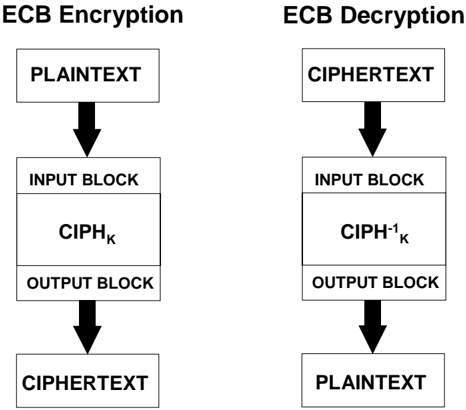
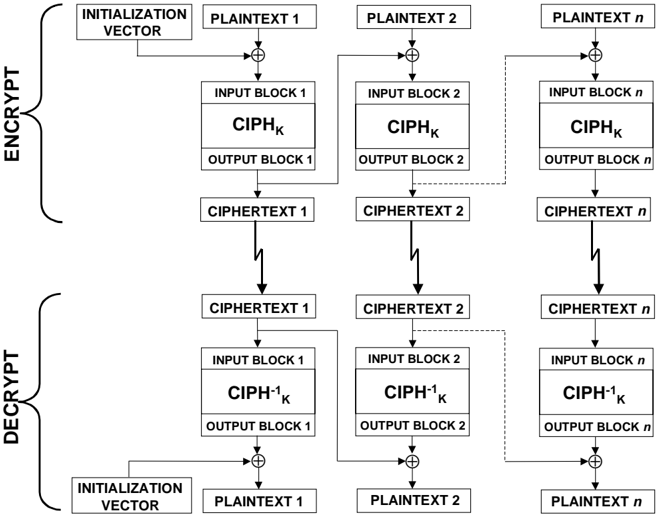
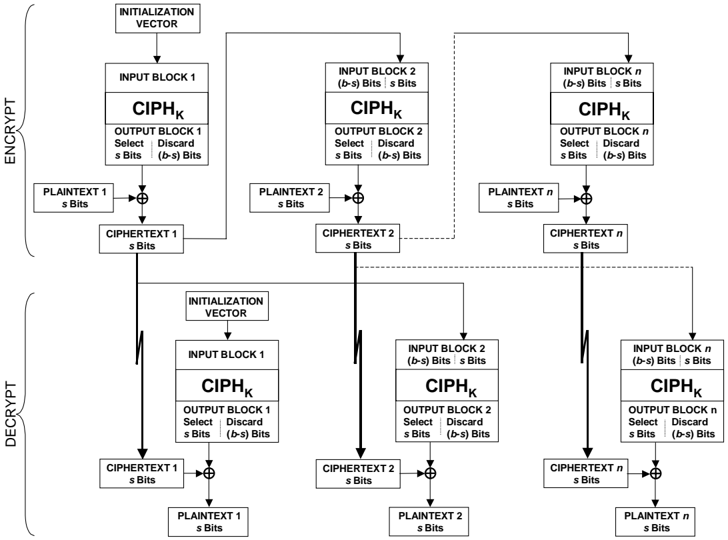
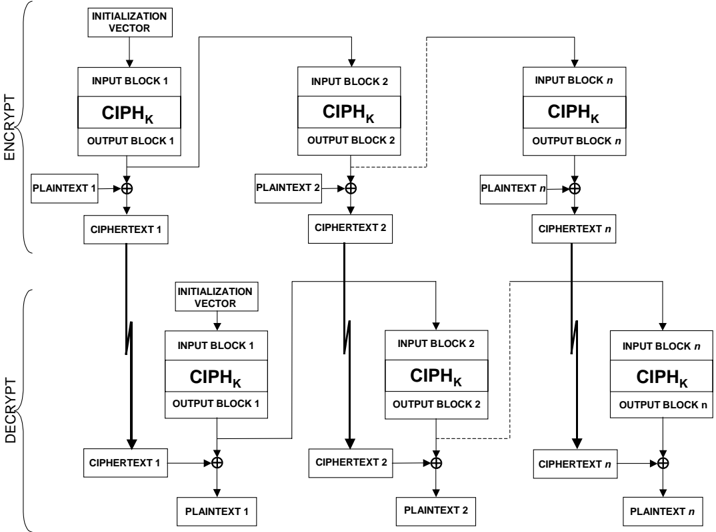
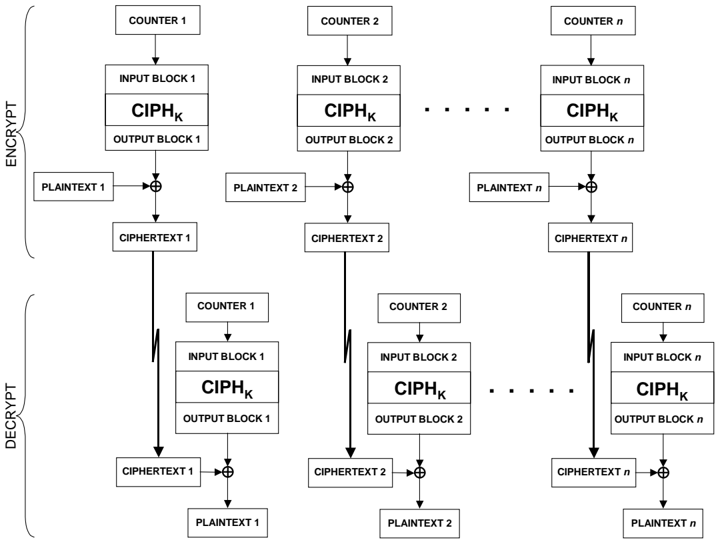
- The recommendation defines five confidentiality modes: Electronic Codebook (ECB), Cipher Block Chaining (CBC), Cipher Feedback (CFB), Output Feedback (OFB), and Counter (CTR), usable with any FIPS-approved block cipher such as AES.
- Three elements are new relative to prior FIPS publications: extension of the four FIPS Pub 81 modes to any FIPS-approved block cipher, revision of their requirements, and specification of the CTR mode.
- Parallelism differs by mode: ECB encryption/decryption and CTR encryption/decryption permit parallel forward/inverse cipher operations; CBC and CFB encryption cannot be parallelized but CBC and CFB decryption can; OFB permits neither, though output blocks can be precomputed if the IV is known.
- Error propagation is mode-dependent: in CFB, OFB, and CTR a ciphertext bit error produces specific bit errors in the same positions; in ECB and CBC it produces random bit errors with an expected rate of fifty percent. CBC errors also affect the succeeding block, and CFB errors affect the next b/s (rounded up) segments.
Methods
- Design: a normative specification document defining each mode's encryption and decryption algorithms mathematically, with descriptions, illustrations, and comments on parallel-processing potential.
- Data/sample: no empirical sample; the document provides worked example vectors for each mode using AES with 128-, 192-, and 256-bit keys, including 1-bit, 8-bit, and 128-bit CFB variants, with a common plaintext string formatted into four 128-bit blocks.
- Analysis: appendices cover padding, counter-block generation (standard incrementing function and initial counter-block choice), IV generation, error properties, Triple DES modes, and AES example vectors.
Limitations
- Stated: the document is neither a standard nor a guideline and is neither mandatory nor binding on Federal agencies; it may be used voluntarily. Formatting of the plaintext, including padding, is outside its scope. It does not provide analogues of the interleaved/pipelined ANSI X9.52 modes (TCBC-I, TCFB-P, TOFB-I).
- Stated: the recommendation assumes a secret, random key has been established among parties, and security depends at minimum on the secrecy of the key.
- Evident from the text: the modes provide confidentiality only; the document repeatedly notes that integrity of the IV or ciphertext is not protected by these modes, leaving decryption vulnerable to deliberate bit-error introduction unless integrity is separately protected.
Model-written summary. Check it against the paper before relying on it.
Integrity signals
Registry
Cites
Statistics
Figures
Verification
Claims the paper makes
0 Valid · 0 Not valid · 11 Not checked · 60 Own results and interpretations
A conclusion the paper draws from its own results — it cites no other source for it, so there is none to check. The quote shows it is in the paper.
In the paper
“In particular, if any plaintext block that is encrypted using a given counter block is known, then the output of the forward cipher function can be determined easily from the associated ciphertext block.”
plainstates a cause- Asserted: passes — The authors put it forward as true.
- Checkable: passes — It can be checked against evidence.
- Load-bearing: passes — The paper’s conclusions depend on it.
- Based: passes — The paper gives a reason why it holds.
A conclusion the paper draws from its own results — it cites no other source for it, so there is none to check. The quote shows it is in the paper.
In the paper
“For both the OFB and CFB modes, a bit error may occur, independently, in any bit position of the affected ciphertext blocks (or segments), with an expected error rate of fifty percent.”
hedgedstates a possible cause- Asserted: passes — The authors put it forward as true.
- Checkable: passes — It can be checked against evidence.
- Load-bearing: unclear — It is unclear whether the paper’s conclusions depend on it.
- Based: unclear — It is unclear why the paper says it holds.
A conclusion the paper draws from its own results — it cites no other source for it, so there is none to check. The quote shows it is in the paper.
In the paper
“In the CFB mode, bit errors in the IV affect, at a minimum, the decryption of the first ciphertext segment, and possibly successive ciphertext segments, depending on the bit position of the rightmost bit error in the IV.”
hedgedstates a cause- Asserted: passes — The authors put it forward as true.
- Checkable: passes — It can be checked against evidence.
- Load-bearing: unclear — It is unclear whether the paper’s conclusions depend on it.
- Based: passes — The paper gives a reason why it holds.
A conclusion the paper draws from its own results — it cites no other source for it, so there is none to check. The quote shows it is in the paper.
In the paper
“A bit error may occur, independently, in any bit position in these decrypted segments, with an expected error rate of fifty percent.”
hedgedstates a possible cause- Asserted: passes — The authors put it forward as true.
- Checkable: passes — It can be checked against evidence.
- Load-bearing: unclear — It is unclear whether the paper’s conclusions depend on it.
- Based: unclear — It is unclear why the paper says it holds.
A conclusion the paper draws from its own results — it cites no other source for it, so there is none to check. The quote shows it is in the paper.
In the paper
“However, if the IV is known, the output blocks can be generated prior to the availability of the plaintext or ciphertext data.”
plainstates a cause- Asserted: passes — The authors put it forward as true.
- Checkable: passes — It can be checked against evidence.
- Load-bearing: unclear — It is unclear whether the paper’s conclusions depend on it.
- Based: passes — The paper gives a reason why it holds.
28 more claims
Create a free account to see all 71 claims and to verify the 3 references still open.
- Probably not a substantial claim. 36
- It may state two separate claims as one. 9
Claims other papers make about this one
Each is checked against this paper’s own text: does it say what the citing paper says it does?
The cited source says what the claim attributes to it.
In the citing paper
“On the other hand, stream ciphers can be constructed by block ciphers using the Counter (CTR) and Output FeedBack (OFB) operation mode [294].”
From Robotics cyber security: vulnerabilities, attacks, countermeasures, and recommendations (2022) · cites this paper as [294]
Self-check
Percentages, sums and reported differences re-computed from the paper’s own numbers.
Each contradiction between two passages listed here was confirmed by an independent check.
Rated minor: it would not touch a result — a value no result rests on, a p-value that stays on the same side of the significance level, or a conflict that is clerical, resolved elsewhere in the paper, or outside its own findings.
In the paper
§ Appendix D: Error Properties
“Table D.1 summarizes the effects of bit errors in a ciphertext block or IV on the decryption of the ciphertext for each of the five confidentiality modes.”
§ Appendix D: Error Properties
“Table D.2: Summary of Effect of Bit Errors on Decryption”
Rated minor: it would not touch a result — a value no result rests on, a p-value that stays on the same side of the significance level, or a conflict that is clerical, resolved elsewhere in the paper, or outside its own findings.
In the paper
§ Appendix E: Modes of Triple DES
“the six modes in this recommendation”
§ 3 Introduction
“This recommendation specifies five confidentiality modes of operation for symmetric key block cipher algorithms”
Citations
Cites
Handbook of applied cryptography
(1997) · Choice Reviews Online · doi:10.5860/choice.34-4512 · Cited by 10,357
Handbook of Applied Cryptography
Menezes, A. J., van Oorschot, P. C., & Vanstone, S. A. (2018) · CRC Press eBooks · doi:10.1201/9781439821916 · Cited by 2,896 · cited 1×
“[5] for information about linear feedback shift registers.”
Advanced Encryption Standard (AES)
National Institute of Standards and Technology (US) (2001) · doi:10.6028/nist.fips.197 · Cited by 642
Data encryption standard (DES)
Biryukov, A., & Cannière, C. (2006) · Encyclopedia of Cryptography and Security · doi:10.1007/0-387-23483-7_94 · Cited by 57
Cited by
Items 201–300 of 709
UMTS security: system architecture and hardware implementation
Kitsos, P., Sklavos, N., & Koufopavlou, O. (2006) · Wireless Communications and Mobile Computing · doi:10.1002/wcm.367 · Cited by 13
Lightweight Dynamic Key-Dependent and Flexible Cipher Scheme for IoT Devices
Noura, H., Chehab, A., & Couturier, R. (2019) · IEEE Wireless Communications and Networking Conference · doi:10.1109/wcnc.2019.8885976 · Cited by 15
Efficient Modular-Pipelined AES Implementation in Counter Mode on ALTERA FPGA
Charot, F., Yahya, E., & Wagner, C. (2003) · Lecture notes in computer science · doi:10.1007/978-3-540-45234-8_28 · Cited by 13
The Camellia Cipher Algorithm and Its Use With IPsec
Kato, A., Moriai, S., & Kanda, M. (2005) · doi:10.17487/rfc4312 · Cited by 13
“Any other consideration related to interaction with IKE is the same as that of the AES cipher.”
Mobilon, E., & Arantes, D. S. (2021) · Microelectronics Journal · doi:10.1016/j.mejo.2021.105229 · Cited by 12
2-Phase Adiabatic Logic for Low-Energy and CPA-Resistant Implantable Medical Devices
Degada, A., & Thapliyal, H. (2022) · IEEE Transactions on Consumer Electronics · doi:10.1109/tce.2022.3141342 · Cited by 12
Kazmi, S. H. A., Qamar, F., Hassan, R. B., & Nisar, K. (2022) · International Symposium on Intelligent Signal Processing and Communication Systems (ISPACS) · doi:10.1109/ispacs57703.2022.10082815 · Cited by 12
On the design and implementation of a RISC processor extension for the KASUMI encryption algorithm
Balderas-Contreras, T., Cumplido, R., & Feregrino-Uribe, C. (2008) · Computers & Electrical Engineering · doi:10.1016/j.compeleceng.2007.11.003 · Cited by 12
Securing GNSS: An End-to-end Feasibility Analysis for the Galileo Open-service
Thomas, C. J., & Paonni, M. (2014) · Joint Research Centre (European Commission) · Cited by 12
Comparative Analysis of Different Implementations of Encryption Algorithms on FPGA Network Cards
Smékal, D., Hajný, J., & Martinásek, Z. (2018) · IFAC-PapersOnLine · doi:10.1016/j.ifacol.2018.07.172 · Cited by 12
Lee, W., Goi, B., & Phan, R. C. ‐. (2018) · Concurrency and Computation Practice and Experience · doi:10.1002/cpe.5048 · Cited by 12
IAR‐CTR and IAR‐CFB: integrity aware real‐time based counter and cipher feedback modes
Hwang, T., & Gope, P. (2015) · Security and Communication Networks · doi:10.1002/sec.1312 · Cited by 12
Kavulich, J. T., Deren, B. P. V., & Schlosshauer, M. (2020) · Physics Letters A · doi:10.1016/j.physleta.2020.127032 · Cited by 15
Secure public instant messaging
Mannan, M. (2005) · doi:10.22215/etd/2005-07740 · Cited by 12
CryptoLLM: Harnessing the Power of LLMs to Detect Cryptographic API Misuse
Baek, H., Lee, M., & Kim, H. (2024) · Lecture notes in computer science · doi:10.1007/978-3-031-70879-4_18 · Cited by 15
Shorter Messages and Faster Post-Quantum Encryption with Round5 on Cortex M
Saarinen, M.-J. O., Bhattacharya, S., García-Morchón, Ó., Rietman, R., Tolhuizen, L. M. G. M., & Zhang, Z. (2019) · Lecture notes in computer science · doi:10.1007/978-3-030-15462-2_7 · Cited by 12
The Snowden Phone: A Comparative Survey of Secure Instant Messaging Mobile Applications
Johansen, C., Mujaj, A., Arshad, H., & Noll, J. (2021) · Security and Communication Networks · doi:10.1155/2021/9965573 · Cited by 21
Accelerating the AES Algorithm using OpenCL
Sanida, T., Sideris, A., & Dasygenis, M. (2020) · International Conference on Modern Circuits and Systems Technologies · doi:10.1109/mocast49295.2020.9200240 · Cited by 11
Degada, A., & Thapliyal, H. (2021) · IEEE Open Journal of Nanotechnology · doi:10.1109/ojnano.2021.3135364 · Cited by 11
A Single-Pass and One-Round Message Authentication Encryption for Limited IoT Devices
Noura, H., Salman, O., Couturier, R., & Chehab, A. (2022) · IEEE Internet of Things Journal · doi:10.1109/jiot.2022.3161192 · Cited by 13
Simple Authentication Method for Vehicle Monitoring IoT Device With Verifiable Data Integrity
Yazid, M., Fahmi, F., Sutanto, E., Setiawan, R., Aripriharta, A., & Aziz, M. (2022) · IEEE Internet of Things Journal · doi:10.1109/jiot.2022.3228926 · Cited by 11
Hwang, T., & Gope, P. (2015) · Security and Communication Networks · doi:10.1002/sec.1388 · Cited by 11
Multiple Streams with Recurrence-Based, Counter-Based, and Splittable Random Number Generators
L’Ecuyer, P., Nadeau-Chamard, O., Chen, Y., & Lebar, J. (2021) · Winter Simulation Conference · doi:10.1109/wsc52266.2021.9715397 · Cited by 15
A lightweight cryptographic system for implantable biosensors
Ghoreishizadeh, S. S., Yalçın, T., Pullini, A., Micheli, G. D., Burleson, W. P., & Carrara, S. (2014) · IEEE Biomedical Circuits and Systems Conference (BioCAS) · doi:10.1109/biocas.2014.6981765 · Cited by 11
Report on the Block Cipher Modes of Operation in the 800-38 Series
Mouha, N., & Dworkin, M. J. (2023) · doi:10.6028/nist.ir.8459.ipd · Cited by 15
Self-citationAn authentication protocol for wearable medical devices
Long, W. J., & Lin, W. (2017) · International Conference & Expo on Emerging Technologies for a Smarter World (CEWIT) · doi:10.1109/cewit.2017.8263140 · Cited by 10
Performance Improvement of Double Data Encryption Standard Algorithm using Parallel Computation
Shorman, A., & Qatawneh, M. (2018) · International Journal of Computer Applications · doi:10.5120/ijca2018916527 · Cited by 10
An Effective Framework of Private Ethereum Blockchain Networks for Smart Grid
Son, D. H., Quynh, T. T. T., Khoa, T. V., Hoang, D. T., Trung, N. L., Hà, N. V., Niyato, D. T., Nguyen, D. N., & Dutkiewicz, E. (2021) · International Conference on Advanced Technologies for Communications · doi:10.1109/atc52653.2021.9598199 · Cited by 13
Gava, J., Moura, N., Lucena, J., da Rocha, V., Garibotti, R., Calazans, N. L. V., Cuenca-Asensi, S., Bastos, R. P., Reis, R. A. L., & Ost, L. C. (2023) · IEEE Transactions on Nuclear Science · doi:10.1109/tns.2023.3253684 · Cited by 11
The five modes AES applications in sounds and images
Huang, C.-W., Yen, C.-L., Chiang, C.-H., Chang, K.-H., & Chang, C.-J. (2010) · International Conference on Information Assurance and Security (IAS) · doi:10.1109/isias.2010.5604181 · Cited by 10
Bitstream Protection in Dynamic Partial Reconfiguration Systems Using Authenticated Encryption
Hori, Y., Katashita, T., Sakane, H., Kenji, T. O. D. A., & Satoh, A. (2013) · IEICE Transactions on Information and Systems · doi:10.1587/transinf.e96.d.2333 · Cited by 10
Li, X., & Hammami, O. (2009) · International Journal of Reconfigurable Computing · doi:10.1155/2009/631490 · Cited by 10
Linking Stam’s Bounds with Generalized Truncation
Mennink, B. (2019) · Lecture notes in computer science · doi:10.1007/978-3-030-12612-4_16 · Cited by 10
PIONEER—a Prototype for the Internet of Things Based on an Extendable EPC Gen2 RFID Tag
Groß, H., Wenger, E., Martín, H., & Hutter, M. (2014) · Lecture notes in computer science · doi:10.1007/978-3-319-13066-8_4 · Cited by 10
Serpent encryption algorithm implementation on Compute Unified Device Architecture (CUDA)
Nazlee, A. M., Hussin, F. A., & Ali, N. B. Z. (2009) · IEEE Student Conference on Research and Development (SCOReD) · doi:10.1109/scored.2009.5443190 · Cited by 11
SPF: A New Family of Efficient Format-Preserving Encryption Algorithms
Chang, D., Ghosh, M., Gupta, K. C., Jati, A., Kumar, A., Moon, D., Ray, I. G., & Sanadhya, S. K. (2017) · Lecture notes in computer science · doi:10.1007/978-3-319-54705-3_5 · Cited by 10
Deposit-Case Attack Against Secure Roaming
Yang, G., Wong, D. S., & Deng, X. (2005) · Lecture notes in computer science · doi:10.1007/11506157_35 · Cited by 10
Duflos, S., Kervella, B., & Gay, V. C. (2007) · International Conference on Networking · doi:10.1109/icn.2007.31 · Cited by 10
Catena: A Memory-Consuming Password-Scrambling FrameworkPreprint
Forler, C., Lucks, S., & Wenzel, J. (2013) · IACR Cryptology ePrint Archive · Cited by 13
Huigens, D., Winter, J., & Niibe, Y. (2024) · doi:10.17487/rfc9580 · Cited by 10
Encrypted Data Reduction: Removing Redundancy from Encrypted Data in Outsourced Storage
Zhao, J., Yang, Z., Li, J., & Lee, P. P. C. (2024) · ACM Transactions on Storage · doi:10.1145/3685278 · Cited by 9
Design and Implementation of Home Network Protocol for Appliance Control Based on IEEE 802.15.4
Ise, M., Ogasahara, Y., Watanabe, K., Hatanaka, M., Onoye, T., Niwamoto, H., Keshi, I., & Shirakawa, I. (2007) · Cited by 9
On the Security of Tweakable Modes of Operation: TBC and TAE
Wang, P., Feng, D., & Wu, W. (2005) · Lecture notes in computer science · doi:10.1007/11556992_20 · Cited by 9
Simple AEAD Hardware Interface (SÆHI) in a SoC: Implementing an On-Chip Keyak/WhirlBob Coprocessor
Saarinen, M.-J. O. (2014) · Workshop on Trustworthy Embedded Devices · doi:10.1145/2666141.2666144 · Cited by 10
The AES application in image using different operation modes
Huang, C.-W., Chiang, C.-H., Yen, C.-L., Chen, Y.-C., Chang, K.-H., & Chang, C.-J. (2010) · IEEE Conference on Industrial Electronics and Applications (ICIEA) · doi:10.1109/iciea.2010.5516912 · Cited by 9
RESENSE: An Innovative, Reconfigurable, Powerful and Energy Efficient WSN Node
Brokalakis, A., Mplemenos, G.-G., Papadopoulos, K. A., & Papaefstathiou, I. (2011) · International Conference on Communications · doi:10.1109/icc.2011.5963499 · Cited by 9
Haq, I. U., Wang, J., & Zhu, Y. (2018) · IEEE Transactions on Consumer Electronics · doi:10.1109/tce.2018.2883778 · Cited by 9
A novel 2D cascade modulation couple hyperchaotic mapping for randomized image encryption
Shakiba, A. (2021) · Multimedia Tools and Applications · doi:10.1007/s11042-021-10584-x · Cited by 10
Using hardware parallelism for reducing power consumption in video streaming applications
Ali, K. M. A., Atitallah, R. B., Fakhfakh, N., & Dekeyser, J. (2015) · International Symposium on Reconfigurable Communication-centric Systems-on-Chip (ReCoSoC) · doi:10.1109/recosoc.2015.7238104 · Cited by 9
Design feasibility study for a 500 Gbits/s advanced encryption standard cipher/decipher engine
Bouhraoua, A. (2010) · IET Computers & Digital Techniques · doi:10.1049/iet-cdt.2009.0023 · Cited by 9
GPU-Assisted AES Encryption Using GCM
Schönberger, G., & Fuß, J. (2011) · Lecture notes in computer science · doi:10.1007/978-3-642-24712-5_16 · Cited by 9
Identity based signcryption for advanced metering infrastructure
Soykan, E. Ü., Ersöz, S. D., & Soykan, G. (2015) · International Istanbul Smart Grids and Cities Congress and Fair (ICSG) · doi:10.1109/sgcf.2015.7354933 · Cited by 9
Parallelization of the AES Algorithm
Burak, D. (2005) · Cited by 9
sPECTRA: A precise framEwork for analyzing CrypTographic vulneRabilities in Android apps
Gajrani, J., Tripathi, M., Laxmi, V., Gaur, M. S., Conti, M., & Rajarajan, M. (2017) · IEEE Consumer Communications and Networking Conference · doi:10.1109/ccnc.2017.7983245 · Cited by 9
A Novel Countermeasure Enhancing Side Channel Immunity in FPGAs
Zafar, Y., & Har, D. (2008) · International Conference on Advances in Circuits, Electronics and Micro-electronics (CENICS) · doi:10.1109/enics.2008.11 · Cited by 9
Leveraging Public-key-based Authentication for the Internet of Things
Thesis, M., & Shafagh, H. (2013) · Cited by 9
Barker, E. B., & Barker, W. C. (2016) · doi:10.6028/nist.sp.800-175a · Cited by 13
Recommendation for Cryptographic Key GenerationPreprint
Barker, E. B., Roginsky, A. L., & Davis, R. (2020) · doi:10.6028/nist.sp.800-133r2-draft · Cited by 10
A Message Authentication and Key Distribution Mechanism Secure Against CAN bus Attack
Cho, A.-R., Jo, H. J., Woo, S., Son, Y. D., & Lee, D. H. (2012) · 정보보호학회논문지 · Cited by 8
A High-Speed Unified Hardware Architecture for AES and the SHA-3 Candidate Grøstl
Rogawski, M., & Gaj, K. (2012) · Euromicro Conference on Digital System Design (DSD) · doi:10.1109/dsd.2012.8 · Cited by 8
High Throughput Parallelization of AES-CTR Algorithm
Tran, N.-P., Lee, M., Hong, S., & Lee, S. (2013) · IEICE Transactions on Information and Systems · doi:10.1587/transinf.e96.d.1685 · Cited by 8
Belkaid, B. M., Lahdir, M., Mehdi, C., & Ameur, S. (2015) · International Conference on Computer Vision and Image Analysis Applications (ICCVIA) · doi:10.1109/iccvia.2015.7351789 · Cited by 8
Parallelization of Encryption Algorithm Based on Chaos System and Neural Networks
Burak, D. (2014) · Lecture notes in computer science · doi:10.1007/978-3-642-55195-6_34 · Cited by 8
Altigani, A., Elsadig, M. A., & Barry, B. I. A. (2016) · Indian Journal of Science and Technology · doi:10.17485/ijst/2016/v9i28/97795 · Cited by 8
High-Level Cryptographic Abstractions
Kane, C., Lin, B., Chand, S., Stoller, S. D., & Liu, Y. A. (2019) · doi:10.1145/3338504.3357343 · Cited by 12
Reconfiguration in Wireless Sensor NeTworks
Leligou, H. C., Redondo, L., Zahariadis, T. B., Retamosa, D. R., Karkazis, P., Papaefstathiou, I., & Voliotis, S. (2010) · International Conference on Developments in eSystems Engineering (DeSE) · doi:10.1109/dese.2010.17 · Cited by 8
Resource Saving AES-CCMP Design with Hybrid Counter Mode Block Chaining - MAC
Doomun, M. R. (2008) · Cited by 8
Performance Evaluation of Security-Throughput Tradeoff with Channel Adaptive Encryption
Jindal, P., & Singh, B. (2012) · International Journal of Computer Network and Information Security · doi:10.5815/ijcnis.2013.01.06 · Cited by 8
How to break XML encryption – automatically
Kupser, D., Mainka, C., Schwenk, J., & Somorovsky, J. (2015) · Cited by 8
RAPID-FeinSPN: A Rapid Prototyping Framework for Feistel and SPN-Based Block Ciphers
Khalid, A., Hassan, M., Chattopadhyay, A., & Paul, G. (2013) · Lecture notes in computer science · doi:10.1007/978-3-642-45204-8_13 · Cited by 8
Cryptanalysis of GlobalPlatform Secure Channel Protocols
Sabt, M., & Traoré, J. (2016) · Lecture notes in computer science · doi:10.1007/978-3-319-49100-4_3 · Cited by 8
Design Exploration of AES Accelerators on FPGAs and GPUs
Conti, V., & Vitabile, S. (2017) · Journal of Telecommunications and Information Technology · doi:10.26636/jtit.2017.1.647 · Cited by 8
High-Throughput Secure AES Computation
Chida, K., Hamada, K., Ikarashi, D., Kikuchi, R., & Benny Pinkas, B. (2018) · doi:10.1145/3267973.3267977 · Cited by 8
An Empirical Study of Cryptographic Libraries for MPI Communications
Naser, A., Gavahi, M., Wu, C., Hoang, V. T., Wang, Z., & Yuan, X. (2019) · IEEE International Conference on Cluster Computing (CLUSTER) · doi:10.1109/cluster.2019.8891033 · Cited by 8
Block Cipher Modes of Operation from a Hardware Implementation Perspective
Chakraborty, D., & Rodríguez‐Henríquez, F. (2008) · Springer eBooks · doi:10.1007/978-0-387-71817-0_12 · Cited by 10
Design and analysis of a public key infrastructure for SBAS data authentication
Neish, A. M., Walter, T., & Powell, J. D. (2019) · NAVIGATION Journal of the Institute of Navigation · doi:10.1002/navi.338 · Cited by 8
Puzzle - an efficient, compression independent video encryption algorithm
Liu, F., & Koenig, H. (2012) · Multimedia Tools and Applications · doi:10.1007/s11042-012-1185-y · Cited by 8
An Architecture for the AES-GCM Security Standard
(2006) · Cited by 8
Recommendation for Block Cipher Modes of Operation: Methods for Format-Preserving Encryption
Dworkin, M. J. (2025) · doi:10.6028/nist.sp.800-38gr1.2pd · Cited by 11
Self-citationData security concurrent with homogeneous by AES algorithm in SSD controller
Fan, L., Luo, J., Liu, H., & Geng, X. (2014) · IEICE Electronics Express · doi:10.1587/elex.11.20140535 · Cited by 7
A Review on NFC for Secure Transaction its Fundamental Challenges and Future Directions
Gupta, K., Bhanodia, P. K., Sethi, K. K., Rajput, S., Patidar, M., & Iyer, V. H. (2024) · IEEE International Conference on Advances in Computing Research on Science Engineering and Technology (ACROSET) · doi:10.1109/acroset62108.2024.10743462 · Cited by 7
Tecnologías IoT para el monitoreo de la calidad del agua en la acuicultura
Medrano, K., Hernández, E., Tejada, R., & Moreno, A. R. (2024) · European Public & Social Innovation Review · doi:10.31637/epsir-2025-929 · Cited by 8
Lightweight Authenticated Encryption for Network-on-Chip Communications
Harttung, J., Franz, E., Moriam, S., & Walther, P. (2019) · ACM Great Lakes Symposium on VLSI (GLSVLSI) · doi:10.1145/3299874.3317990 · Cited by 10
High-Throughput Optimizations of AES Algorithm for Satellites
Pirzada, S. J. H., Hasan, M. N., Memon, Z. W., Haris, M., Xu, T., & Jianwei, L. (2020) · International Symposium on Recent Advances in Electrical Engineering (RAEE) · doi:10.1109/raeecs50817.2020.9265688 · Cited by 10
Ucam: A User-Centric, Blockchain-Based and End-to-End Secure Home IP Camera System
Fan, X., Zhong, Z., Chai, Q., & Guo, D. Y. (2020) · Lecture notes of the Institute for Computer Sciences, Social Informatics and Telecommunications Engineering · doi:10.1007/978-3-030-63095-9_20 · Cited by 7
Implementation of The High-Speed SM4 Cryptographic Algorithm Based On Random Pseudo Rounds
Suo, S., Cui, C., Jian, G., Kuang, X., Yang, Y., Zhao, Y. B., & Huang, K. (2020) · IEEE International Conference on Information Technology, Big Data and Artificial Intelligence (ICIBA) · doi:10.1109/iciba50161.2020.9276502 · Cited by 7
A Survey on Applications of H-Technique: Revisiting Security Analysis of PRP and PRF
Jha, A., & Nandi, M. (2022) · Entropy · doi:10.3390/e24040462 · Cited by 8
Yan, S. Y. (2018) · Springer eBooks · doi:10.1007/978-3-319-72536-9_4 · Cited by 6
AN FPGA IMPLEMENTATION OF THE GPRS ENCRYPTION ALGORITHM 3 (GEA3)
Kitsos, P., GALANIS, M. D., & Koufopavlou, O. (2005) · Journal of Circuits Systems and Computers · doi:10.1142/s0218126605002337 · Cited by 7
An FPGA implementation of 30Gbps security module for GPON systems
Vinh, T. Q., Park, J.-H., Kim, Y.-C., & Kim, K.-O. (2008) · IEEE International Conference on Computer and Information Technology (CIT) · doi:10.1109/cit.2008.4594788 · Cited by 7
Meteosat Images Encryption based on AES and RSA Algorithms
Belkaid, B. M., Lahdir, M., & Mehdi, C. (2015) · International Journal of Advanced Computer Science and Applications · doi:10.14569/ijacsa.2015.060629 · Cited by 7
Evaluating time and throughput at different modes of operation in AES algorithm
Alfadel, M., El-Alfy, E.-S. M., & Kamal, K. M. A. (2017) · doi:10.1109/icitech.2017.8079948 · Cited by 7
A Lightweight AEAD encryption core to secure IoT applications
Nguyen, N. D., Bui, D.-H., & Tran, X. (2020) · IEEE Asia Pacific Conference on Circuits and Systems (APCCAS) · doi:10.1109/apccas50809.2020.9301683 · Cited by 7
Guidelines for Media Sanitization Revision 2 - Draft
Gaithersburg, N., & Hibbard, E. (2025) · doi:10.6028/nist.sp.800-88r2 · Cited by 13
HEAR: Homomorphically Encrypted Allreduce
Chrapek, M., Khalilov, M., & Hoefler, T. (2023) · International Conference for High Performance Computing, Networking, Storage and Analysis (SC) · doi:10.1145/3581784.3607099 · Cited by 11
Low-Cost Concurrent Error Detection for GCM and CCM
Guo, X., & Karri, R. (2014) · Journal of Electronic Testing · doi:10.1007/s10836-014-5494-0 · Cited by 6
Undecryptable symmetric encryption
Martin, T. (2011) · IEEE GCC Conference and Exhibition (GCCCE) · doi:10.1109/ieeegcc.2011.5752504 · Cited by 6
Parallelization of AES Algorithm Using OpenMP
Navalgund, S. S., Desai, A., Ankalgi, K., & Yamanur, H. (2013) · Lecture Notes on Information Theory · doi:10.12720/lnit.1.4.144-147 · Cited by 6
Wu, E. H., Chuang, S.-M., Shih, C., Hsueh, H., Huang, S., & Huang, H. (2017) · Software Practice and Experience · doi:10.1002/spe.2479 · Cited by 6
Quantitative evaluation of chaotic CBC mode of operation
Abidi, A., Wang, Q., Bouallègue, B., Machhout, M., & Guyeux, C. (2016) · International Conference on Advanced Technologies for Signal and Image Processing · doi:10.1109/atsip.2016.7523053 · Cited by 6
Metadata
- Authors
- Dworkin, M. J.
- Affiliations
- National Institute of Standards and Technology (US)
- Corresponding author
- Dworkin, M J
- ORCID
- Dworkin, M J
- Published
- 2001
- OpenAlex
- W112964067
- Cited by
- 746
- References
- 5
- Citations by year
- 2026: 59 · 2025: 38 · 2024: 41 · 2023: 25 · 2022: 33 · 2021: 30 · 2020: 37 · 2019: 44 · 2018: 48 · 2017: 44 · 2016: 34 · 2015: 35 · 2014: 32 · 2013: 31 · 2012: 33
- Type
- report
- Language
- en
- Open access
- gold
- doi.org
- Licence
- public-domain
- Topics
- Physical Sciences › Computer Science › Artificial Intelligence › Cryptographic Implementations and Security
- Physical Sciences › Mathematics › Discrete Mathematics and Combinatorics › Coding theory and cryptography
- Physical Sciences › Computer Science › Information Systems › Cryptography and Residue Arithmetic
- Keywords
- block cipher, modes of operation, encryption modes, NIST standards
About these checks
Registry, retraction, Cites and statistics results are computed, not judged, with one exception: a printed reference that no index lists is read once by a model before it counts as a citation error. Claims are extracted by a model and kept only when their quote appears verbatim in the text; each cited source is then checked, with a model’s help, for whether it says what the claim relies on. Those verdicts can be wrong — read the claim’s quote and the cited source before relying on one.
A language model drew the claims from the paper on 2026-10-21, under version 3 of the claim definition (model deepseek-v4.1-flash, prompt extract-v3).
A second model labelled each claim on 2026-10-21 (model jev-1.13-20260917, definition revision gold-guideline-v0.2).
Statistics and arithmetic are recomputed, not judged.
Confidence bands are shown only for fields calibrated on our annotated test set. None is calibrated yet, so no band is shown.
What counts as a claim ›How we measure confidence ›How we check this ›
Are you an author, or do you see a problem with this page? Request a review
Data sources
Bibliographic data: Semantic Scholar, OpenAlex, Crossref.
Contains information from the Semantic Scholar Academic Graph Datasets, made available under the ODC Attribution License (ODC-BY 1.0).
Semantic Scholar’s data is described in: Kinney, R., et al. (2023). The Semantic Scholar Open Data Platform. arXiv:2301.10140.
