

Recommendation for block cipher modes of operation: methods and techniques
Open accessThe DOI matches its Crossref record; 4 of the 5 references it cites were found in a registry or an index; none of the 14 sources its claims cite is checked for support yet.
Abstract
Reports on Information Security TechnologyThe Information Technology Laboratory (ITL) at the National Institute of Standards and Technology (NIST) promotes the U.S. economy and public welfare by providing technical leadership for the Nation's measurement and standards infrastructure.ITL develops tests, test methods, reference data, proof of concept implementations, and technical analyses to advance the development and productive use of information technology.ITL's responsibilities include the development of technical, physical, administrative, and management standards and guidelines for the cost-effective security and privacy of sensitive unclassified information in Federal computer systems.This Special Publication 800-series reports on ITL's research, guidance, and outreach efforts in computer security, and its collaborative activities with industry, government, and academic organizations.Certain commercial entities, equipment, or materials may be identified in this document in order to describe an experimental procedure or concept adequately.Such identification is not intended to imply recommendation or endorsement by the National Institute of Standards and Technology, nor is it intended to imply that the entities, materials, or equipment are necessarily the best available for the purpose.
Overview
CoChat Summary
TL;DR
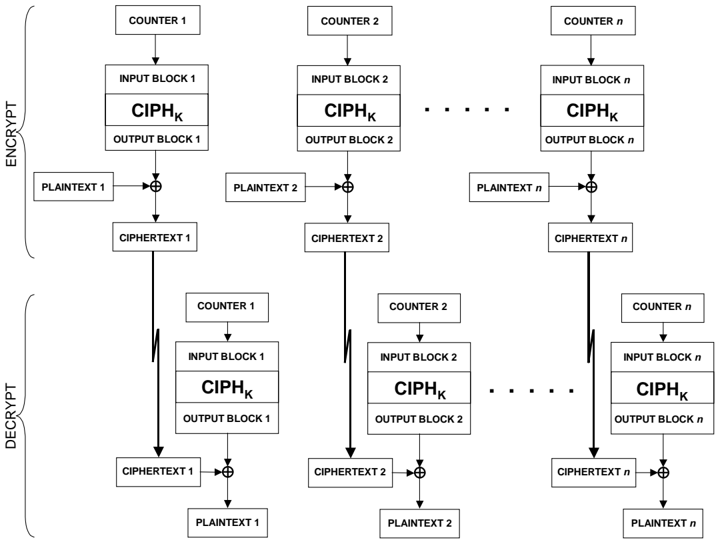
NIST Special Publication 800-38A specifies five confidentiality modes of operation (ECB, CBC, CFB, OFB, and CTR) for use with any FIPS-approved symmetric key block cipher, extending four modes previously defined for DES and adding the CTR mode. It provides mathematical specifications, IV and counter-generation guidance, error-propagation properties, and worked AES example vectors.
Key findings
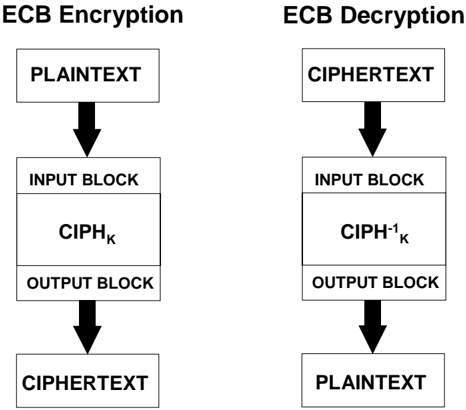
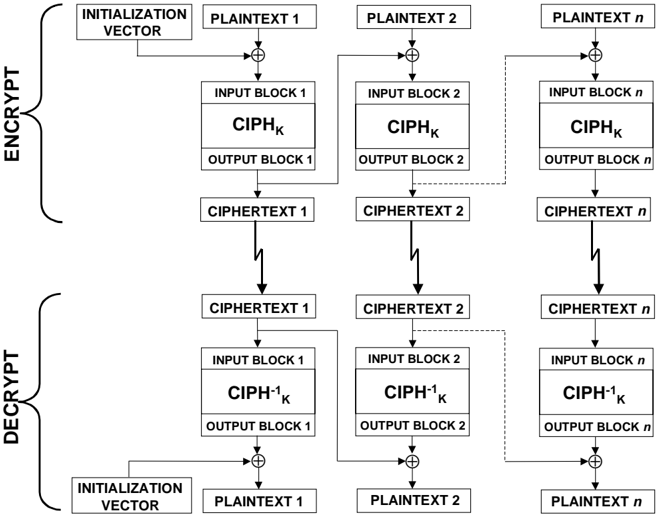
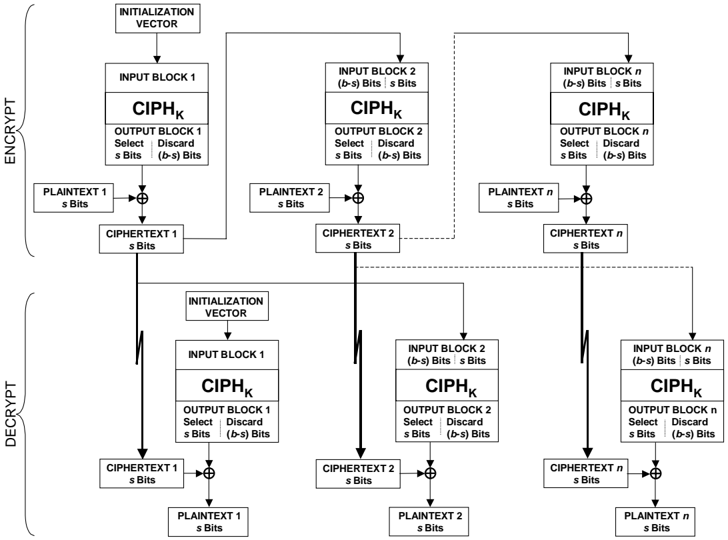
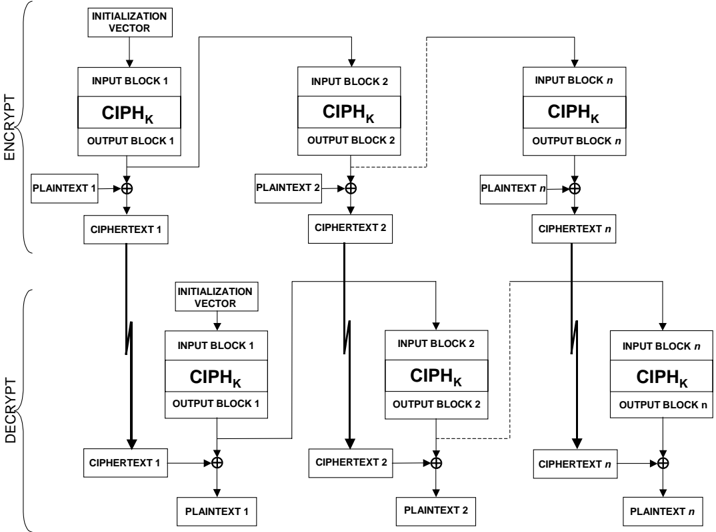
- The recommendation defines five confidentiality modes: Electronic Codebook (ECB), Cipher Block Chaining (CBC), Cipher Feedback (CFB), Output Feedback (OFB), and Counter (CTR), usable with any FIPS-approved block cipher such as AES.
- Three elements are new relative to prior FIPS publications: extension of the four FIPS Pub 81 modes to any FIPS-approved block cipher, revision of their requirements, and specification of the CTR mode.
- Parallelism differs by mode: ECB encryption/decryption and CTR encryption/decryption permit parallel forward/inverse cipher operations; CBC and CFB encryption cannot be parallelized but CBC and CFB decryption can; OFB permits neither, though output blocks can be precomputed if the IV is known.
- Error propagation is mode-dependent: in CFB, OFB, and CTR a ciphertext bit error produces specific bit errors in the same positions; in ECB and CBC it produces random bit errors with an expected rate of fifty percent. CBC errors also affect the succeeding block, and CFB errors affect the next b/s (rounded up) segments.
Methods
- Design: a normative specification document defining each mode's encryption and decryption algorithms mathematically, with descriptions, illustrations, and comments on parallel-processing potential.
- Data/sample: no empirical sample; the document provides worked example vectors for each mode using AES with 128-, 192-, and 256-bit keys, including 1-bit, 8-bit, and 128-bit CFB variants, with a common plaintext string formatted into four 128-bit blocks.
- Analysis: appendices cover padding, counter-block generation (standard incrementing function and initial counter-block choice), IV generation, error properties, Triple DES modes, and AES example vectors.
Limitations
- Stated: the document is neither a standard nor a guideline and is neither mandatory nor binding on Federal agencies; it may be used voluntarily. Formatting of the plaintext, including padding, is outside its scope. It does not provide analogues of the interleaved/pipelined ANSI X9.52 modes (TCBC-I, TCFB-P, TOFB-I).
- Stated: the recommendation assumes a secret, random key has been established among parties, and security depends at minimum on the secrecy of the key.
- Evident from the text: the modes provide confidentiality only; the document repeatedly notes that integrity of the IV or ciphertext is not protected by these modes, leaving decryption vulnerable to deliberate bit-error introduction unless integrity is separately protected.
Model-written summary. Check it against the paper before relying on it.
Integrity signals
Registry
Cites
Statistics
Figures
Verification
Claims the paper makes
0 Valid · 0 Not valid · 11 Not checked · 60 Own results and interpretations
A conclusion the paper draws from its own results — it cites no other source for it, so there is none to check. The quote shows it is in the paper.
In the paper
“In particular, if any plaintext block that is encrypted using a given counter block is known, then the output of the forward cipher function can be determined easily from the associated ciphertext block.”
plainstates a cause- Asserted: passes — The authors put it forward as true.
- Checkable: passes — It can be checked against evidence.
- Load-bearing: passes — The paper’s conclusions depend on it.
- Based: passes — The paper gives a reason why it holds.
A conclusion the paper draws from its own results — it cites no other source for it, so there is none to check. The quote shows it is in the paper.
In the paper
“For both the OFB and CFB modes, a bit error may occur, independently, in any bit position of the affected ciphertext blocks (or segments), with an expected error rate of fifty percent.”
hedgedstates a possible cause- Asserted: passes — The authors put it forward as true.
- Checkable: passes — It can be checked against evidence.
- Load-bearing: unclear — It is unclear whether the paper’s conclusions depend on it.
- Based: unclear — It is unclear why the paper says it holds.
A conclusion the paper draws from its own results — it cites no other source for it, so there is none to check. The quote shows it is in the paper.
In the paper
“In the CFB mode, bit errors in the IV affect, at a minimum, the decryption of the first ciphertext segment, and possibly successive ciphertext segments, depending on the bit position of the rightmost bit error in the IV.”
hedgedstates a cause- Asserted: passes — The authors put it forward as true.
- Checkable: passes — It can be checked against evidence.
- Load-bearing: unclear — It is unclear whether the paper’s conclusions depend on it.
- Based: passes — The paper gives a reason why it holds.
A conclusion the paper draws from its own results — it cites no other source for it, so there is none to check. The quote shows it is in the paper.
In the paper
“A bit error may occur, independently, in any bit position in these decrypted segments, with an expected error rate of fifty percent.”
hedgedstates a possible cause- Asserted: passes — The authors put it forward as true.
- Checkable: passes — It can be checked against evidence.
- Load-bearing: unclear — It is unclear whether the paper’s conclusions depend on it.
- Based: unclear — It is unclear why the paper says it holds.
A conclusion the paper draws from its own results — it cites no other source for it, so there is none to check. The quote shows it is in the paper.
In the paper
“However, if the IV is known, the output blocks can be generated prior to the availability of the plaintext or ciphertext data.”
plainstates a cause- Asserted: passes — The authors put it forward as true.
- Checkable: passes — It can be checked against evidence.
- Load-bearing: unclear — It is unclear whether the paper’s conclusions depend on it.
- Based: passes — The paper gives a reason why it holds.
28 more claims
Create a free account to see all 71 claims and to verify the 3 references still open.
- Probably not a substantial claim. 36
- It may state two separate claims as one. 9
Claims other papers make about this one
Each is checked against this paper’s own text: does it say what the citing paper says it does?
The cited source says what the claim attributes to it.
In the citing paper
“On the other hand, stream ciphers can be constructed by block ciphers using the Counter (CTR) and Output FeedBack (OFB) operation mode [294].”
From Robotics cyber security: vulnerabilities, attacks, countermeasures, and recommendations (2022) · cites this paper as [294]
Self-check
Percentages, sums and reported differences re-computed from the paper’s own numbers.
Each contradiction between two passages listed here was confirmed by an independent check.
Rated minor: it would not touch a result — a value no result rests on, a p-value that stays on the same side of the significance level, or a conflict that is clerical, resolved elsewhere in the paper, or outside its own findings.
In the paper
§ Appendix D: Error Properties
“Table D.1 summarizes the effects of bit errors in a ciphertext block or IV on the decryption of the ciphertext for each of the five confidentiality modes.”
§ Appendix D: Error Properties
“Table D.2: Summary of Effect of Bit Errors on Decryption”
Rated minor: it would not touch a result — a value no result rests on, a p-value that stays on the same side of the significance level, or a conflict that is clerical, resolved elsewhere in the paper, or outside its own findings.
In the paper
§ Appendix E: Modes of Triple DES
“the six modes in this recommendation”
§ 3 Introduction
“This recommendation specifies five confidentiality modes of operation for symmetric key block cipher algorithms”
Citations
Cites
Handbook of applied cryptography
(1997) · Choice Reviews Online · doi:10.5860/choice.34-4512 · Cited by 10,357
Handbook of Applied Cryptography
Menezes, A. J., van Oorschot, P. C., & Vanstone, S. A. (2018) · CRC Press eBooks · doi:10.1201/9781439821916 · Cited by 2,896 · cited 1×
“[5] for information about linear feedback shift registers.”
Advanced Encryption Standard (AES)
National Institute of Standards and Technology (US) (2001) · doi:10.6028/nist.fips.197 · Cited by 642
Data encryption standard (DES)
Biryukov, A., & Cannière, C. (2006) · Encyclopedia of Cryptography and Security · doi:10.1007/0-387-23483-7_94 · Cited by 57
Cited by
(2016) · IACR Cryptology ePrint Archive · Cited by 1,288
IoT: Internet of Threats? A Survey of Practical Security Vulnerabilities in Real IoT Devices
Meneghello, F., Calore, M., Zucchetto, D., Polese, M., & Zanella, A. (2019) · IEEE Internet of Things Journal · doi:10.1109/jiot.2019.2935189 · Cited by 799
Recommendation for block cipher modes of operation: GaloisCounter Mode (GCM) and GMAC
Dworkin, M. J. (2007) · doi:10.6028/nist.sp.800-38d · Cited by 727
Self-citationA Provable-Security Treatment of the Key-Wrap Problem
Rogaway, P., & Shrimpton, T. (2006) · Lecture Notes in Computer Science · doi:10.1007/11761679_23 · Cited by 383
Security for Industrial Communication Systems
Dzung, D., Naedele, M., Von Hoff, T. P., & Crevatin, M. (2005) · Proceedings of the IEEE · doi:10.1109/jproc.2005.849714 · Cited by 386
The Galois/Counter Mode of Operation (GCM)
McGrew, D. A., & Viega, J. (2005) · Cited by 332
Security Flaws Induced by CBC Padding — Applications to SSL, IPSEC, WTLS...
Vaudenay, S. (2002) · Lecture Notes in Computer Science · doi:10.1007/3-540-46035-7_35 · Cited by 321
Robotics cyber security: vulnerabilities, attacks, countermeasures, and recommendations
Yaacoub, J.-P. A., Noura, H. N., Salman, O., & Chehab, A. (2022) · International Journal of Information Security · doi:10.1007/s10207-021-00545-8 · Cited by 320
Dworkin, M. J. (2007) · doi:10.6028/nist.sp.800-38c · Cited by 297
Self-citationOff-the-record communication, or, why not to use PGP
Borisov, N., Goldberg, I., & Brewer, E. (2004) · Proceedings of the 2004 ACM workshop on Privacy in the electronic society · doi:10.1145/1029179.1029200 · Cited by 269
Recommendation for key management: part 1 - general
Barker, E. (2020) · doi:10.6028/nist.sp.800-57pt1r5 · Cited by 271
Parallel random numbers: as easy as 1, 2, 3
Salmon, J. K., Moraes, M. A., Dror, R. O., & Shaw, D. E. (2011) · Proceedings of 2011 International Conference for High Performance Computing, Networking, Storage and Analysis · doi:10.1145/2063384.2063405 · Cited by 227
Collaborative and secure sharing of healthcare data in multi-clouds
Fabian, B., Ermakova, T., & Junghanns, P. (2015) · Information Systems · doi:10.1016/j.is.2014.05.004 · Cited by 223
A survey on lightweight block ciphers for low-resource devices: Comparative study and open issues
Mohd, B. J., Hayajneh, T., & Vasilakos, A. V. (2015) · Journal of Network and Computer Applications · doi:10.1016/j.jnca.2015.09.001 · Cited by 196
Area-throughput trade-offs for fully pipelined 30 to 70 Gbits/s AES processors
Hodjat, A., & Verbauwhede, I. (2006) · IEEE Transactions on Computers · doi:10.1109/tc.2006.49 · Cited by 184
Transitioning the use of cryptographic algorithms and key lengths
Barker, E., & Roginsky, A. (2019) · doi:10.6028/nist.sp.800-131ar2 · Cited by 152
Internet Key Exchange Protocol Version 2 (IKEv2)
Kaufman, C., Hoffman, P., Nir, Y., & Eronen, P. (2010) · doi:10.17487/rfc5996 · Cited by 160
Security flaws in 802.11 data link protocols
Cam-Winget, N., Housley, R., Wagner, D., & Walker, J. (2003) · Communications of the ACM · doi:10.1145/769800.769823 · Cited by 160
The AES-CBC Cipher Algorithm and Its Use with IPsec
Frankel, S. E., Glenn, R. W., & Kelly, S. (2003) · doi:10.17487/rfc3602 · Cited by 155
AEGIS: A Fast Authenticated Encryption Algorithm
Wu, H., & Preneel, B. (2014) · Lecture notes in computer science · doi:10.1007/978-3-662-43414-7_10 · Cited by 158
Bhargavan, K., & Leurent, G. (2016) · ACM SIGSAC Conference on Computer and Communications Security (CCS) · doi:10.1145/2976749.2978423 · Cited by 198
A Survey on the Cryptographic Encryption Algorithms
Faheem, M., Jamel, S. H., Hassan, A., Zahraddeen, A., Shafinaz, N., & Mat, M. (2017) · International Journal of Advanced Computer Science and Applications · doi:10.14569/ijacsa.2017.081141 · Cited by 135
Reconsidering Generic Composition
Namprempre, C., Rogaway, P., & Shrimpton, T. (2014) · Lecture notes in computer science · doi:10.1007/978-3-642-55220-5_15 · Cited by 134
Housley, R. (2004) · doi:10.17487/rfc3686 · Cited by 132
A Privacy Enhanced Authentication Scheme for Telecare Medical Information Systems
Jiang, Q. G., Ma, J., Ma, Z., & Li, G. (2013) · Journal of Medical Systems · doi:10.1007/s10916-012-9897-0 · Cited by 121
ALE: AES-Based Lightweight Authenticated Encryption
Bogdanov, A., Mendel, F., Regazzoni, F., Rijmen, V., & Tischhauser, E. (2014) · Lecture notes in computer science · doi:10.1007/978-3-662-43933-3_23 · Cited by 134
Implementation and Analysis of AES Encryption on GPU
Li, Q., Zhong, C., Zhao, K., Mei, X., & Chu, X. (2012) · 2012 IEEE 14th International Conference on High Performance Computing and Communication & 2012 IEEE 9th International Conference on Embedded Software and Systems · doi:10.1109/hpcc.2012.119 · Cited by 105
Selecting the Advanced Encryption Standard
Burr, W. E. (2003) · IEEE Security & Privacy · doi:10.1109/msecp.2003.1193210 · Cited by 125
One round cipher algorithm for multimedia IoT devices
Noura, H., Chehab, A., Sleem, L., Noura, M., Couturier, R., & Mansour, M. M. (2018) · Multimedia Tools and Applications · doi:10.1007/s11042-018-5660-y · Cited by 118
HCTR: A Variable-Input-Length Enciphering Mode
Wang, P., Feng, D., & Wu, W. (2005) · Lecture notes in computer science · doi:10.1007/11599548_15 · Cited by 121
Securing distributed storage: challenges, techniques, and systems
Kher, V., & Kim, Y. (2005) · Workshop On Storage Security And Survivability · doi:10.1145/1103780.1103783 · Cited by 120
Fast, inexpensive content-addressed storage in foundation
Rhea, S. C., Cox, R., & Pesterev, A. A. (2008) · Cited by 100
Recommendation for Block Cipher Modes of Operation: Methods for Format-Preserving Encryption
Dworkin, M. J. (2016) · doi:10.6028/nist.sp.800-38g · Cited by 125
Self-citationDesign of a parallel AES for graphics hardware using the CUDA framework
Biagio, A. D., Barenghi, A., Agosta, G., & Pelosi, G. (2009) · IEEE International Parallel and Distributed Processing Symposium (IPDPS) · doi:10.1109/ipdps.2009.5161242 · Cited by 101
A survey of confidential data storage and deletion methods
Diesburg, S., & Wang, A.-I. A. (2010) · ACM Computing Surveys · doi:10.1145/1824795.1824797 · Cited by 111
Efficient Padding Oracle Attacks on Cryptographic Hardware
Bardou, R., Focardi, R., Kawamoto, Y., Simionato, L., Steel, G., & Tsay, J.-K. (2012) · Lecture notes in computer science · doi:10.1007/978-3-642-32009-5_36 · Cited by 114
Maddodi, G., Awad, A., Awad, D., Awad, M., & Lee, B. (2018) · Multimedia Tools and Applications · doi:10.1007/s11042-018-5669-2 · Cited by 87
Ciphers Secure against Related-Key Attacks
Lucks, S. (2004) · Lecture notes in computer science · doi:10.1007/978-3-540-25937-4_23 · Cited by 91
Stream-based cipher feedback mode in wireless error channel
Xiao, Y., Chen, H., Du, X., & Guizani, M. (2009) · IEEE Transactions on Wireless Communications · doi:10.1109/twc.2009.071278 · Cited by 82
Kumari, S., Khan, M. K., & Kumar, R. (2013) · Journal of Medical Systems · doi:10.1007/s10916-013-9952-5 · Cited by 80
A survey on OFDM physical layer security
Melki, R., Noura, H. N., Mansour, M. M., & Chehab, A. (2019) · Physical Communication · doi:10.1016/j.phycom.2018.10.008 · Cited by 76
Courses, Content, and Tools for Internet of Things in Computer Science Education
Burd, B., Barker, L. J., Divitini, M., Pérez, F. A. F., Russell, I., Siever, B., & Tudor, L. (2018) · doi:10.1145/3174781.3174788 · Cited by 75
Talos: no more ransomware victims with formal methods
Cimitile, A., Mercaldo, F., Nardone, V., Santone, A., & Visaggio, C. A. (2017) · International Journal of Information Security · doi:10.1007/s10207-017-0398-5 · Cited by 83
A Look Back at "Security Problems in the TCP/IP Protocol Suite"
Bellovin, S. M. (2005) · Annual Computer Security Applications Conference · doi:10.1109/csac.2004.3 · Cited by 70
McKay, K. A., & Cooper, D. A. (2019) · doi:10.6028/nist.sp.800-52r2 · Cited by 97
SPRING: a novel parallel chaos-based image encryption scheme
Lee, W.-K., Phan, R. C.-W., Yap, W.-S., & Goi, B.-M. (2018) · Nonlinear Dynamics · doi:10.1007/s11071-018-4076-6 · Cited by 65
YASIR: A Low-Latency, High-Integrity Security Retrofit for Legacy SCADA Systems
Tsang, P. P., & Smith, S. W. (2008) · IFIP International Federation for Information Processing/IFIP · doi:10.1007/978-0-387-09699-5_29 · Cited by 65
Forsberg, D., Horn, G., Moeller, W.-D., & Niemi, V. (2012) · Wiley eBooks · doi:10.1002/9781118380642 · Cited by 65
Chatterjee, S., Menezes, A., & Sarkar, P. (2012) · Lecture notes in computer science · doi:10.1007/978-3-642-28496-0_18 · Cited by 70
High-Throughput Ring-LWE Cryptoprocessors
Renteria-Mejia, C. P., & Velasco-Medina, J. (2017) · IEEE Transactions on Very Large Scale Integration (VLSI) Systems · doi:10.1109/tvlsi.2017.2697841 · Cited by 65
Cancelable Multi-Biometric Approach Using Fuzzy Extractor and Novel Bit-Wise Encryption
Chang, D., Garg, S., Hasan, M., & Mishra, S. (2020) · IEEE Transactions on Information Forensics and Security · doi:10.1109/tifs.2020.2983250 · Cited by 64
High-throughput programmable cryptocoprocessor
Hodjat, A., & Verbauwhede, I. M. R. (2004) · IEEE Micro · doi:10.1109/mm.2004.11 · Cited by 60
Fast AES Implementation: A High-Throughput Bitsliced Approach
Hajihassani, O., Monfared, S. K., Khasteh, S. H., & Gorgin, S. (2019) · IEEE Transactions on Parallel and Distributed Systems · doi:10.1109/tpds.2019.2911278 · Cited by 60
Hardware implementation of the RC4 stream cipher
Kitsos, P., Kostopoulos, G., Sklavos, N., & Koufopavlou, O. (2006) · IEEE International Midwest Symposium on Circuits and Systems (MWSCAS) · doi:10.1109/mwscas.2003.1562548 · Cited by 68
A 3.84 gbits/s AES crypto coprocessor with modes of operation in a 0.18-μm CMOS technology
Hodjat, A., Hwang, D. D., Lai, B.-C. C., Tiri, K., & Verbauwhede, I. M. R. (2005) · ACM Great Lakes Symposium on VLSI (GLSVLSI) · doi:10.1145/1057661.1057677 · Cited by 59
Secure Spread: An Integrated Architecture for Secure Group Communication
Amir, Y., Nita-Rotaru, C., Stanton, J., & Tsudik, G. (2005) · IEEE Transactions on Dependable and Secure Computing · doi:10.1109/tdsc.2005.39 · Cited by 59
A Public-Key Encryption Scheme with Pseudo-random Ciphertexts
Möller, B. (2004) · Lecture notes in computer science · doi:10.1007/978-3-540-30108-0_21 · Cited by 67
Batina, L., Das, A., Ege, B., Kavun, E. B., Mentens, N., Paar, C., Verbauwhede, I. M. R., & Yalçın, T. (2013) · Lecture notes in computer science · doi:10.1007/978-3-642-41332-2_7 · Cited by 70
Cyber Security for Smart Grid, Cryptography, and Privacy
Iyer, S. (2011) · International Journal of Digital Multimedia Broadcasting · doi:10.1155/2011/372020 · Cited by 55
Forest Fire Prevention, Detection, and Fighting Based on Fuzzy Logic and Wireless Sensor Networks
Toledo‐Castro, J., Caballero‐Gil, P., Rodríguez‐Pérez, N., Santos‐González, I., Hernández‐Goya, C., & Aguasca-Colomo, R. (2018) · Complexity · doi:10.1155/2018/1639715 · Cited by 63
A First-Order DPA Attack Against AES in Counter Mode with Unknown Initial Counter
Jaffe, J. (2007) · Lecture notes in computer science · doi:10.1007/978-3-540-74735-2_1 · Cited by 55
Advanced architectures for high-performance quantum networking
Alshowkan, M., Evans, P. G., Williams, B. P., Rao, N. S. V., Marvinney, C. E., Pai, Y., Lawrie, B. J., Peters, N. A., & Lukens, J. M. (2022) · Journal of Optical Communications and Networking · doi:10.1364/jocn.450201 · Cited by 69
Sharma, A., & Lashkari, A. H. (2024) · Computer Networks · doi:10.1016/j.comnet.2024.110984 · Cited by 80
Deterministic Authenticated-Encryption A Provable-Security Treatment of the Key-Wrap ProblemPreprint
Rogaway, P., & Shrimpton, T. (2007) · IACR Cryptology ePrint Archive · Cited by 70
Duc, G., & Keryell, R. (2006) · Annual Computer Security Applications Conference · doi:10.1109/acsac.2006.21 · Cited by 52
A Polymorphic Advanced Encryption Standard – A Novel Approach
Altigani, A., Hasan, S., Barry, B. I. A., Naserelden, S., Elsadig, M. A., & Elshoush, H. T. I. (2021) · IEEE Access · doi:10.1109/access.2021.3051556 · Cited by 65
DSPs, BRAMs, and a Pinch of Logic: Extended Recipes for AES on FPGAs
Drimer, S., Güneysu, T. E., & Paar, C. (2010) · ACM Transactions on Reconfigurable Technology and Systems · doi:10.1145/1661438.1661441 · Cited by 55
Multi-gigabit GCM-AES Architecture Optimized for FPGAs
Lemsitzer, S., Wolkerstorfer, J., Felber, N., & Brändli, M. (2007) · Lecture notes in computer science · doi:10.1007/978-3-540-74735-2_16 · Cited by 49
A CHALLENGING BUT FEASIBLE BLOCKWISE-ADAPTIVE CHOSEN-PLAINTEXT ATTACK ON SSL
Bard, G. V. (2006) · International Conference on Security and Cryptography · doi:10.5220/0002104100990109 · Cited by 48
Authentication of FPGA Bitstreams: Why and How
Drimer, S. (2007) · Springer eBooks · doi:10.1007/978-3-540-71431-6_7 · Cited by 47
Cao, Y., Liu, W., Qin, L., Liu, B., Chen, S., Ye, J., Xia, X., & Wang, C. (2022) · Entropy · doi:10.3390/e24111566 · Cited by 53
High-Performance Hardware Architectures for Galois Counter Mode
Satoh, A., Sugawara, T., & Aoki, T. (2008) · IEEE Transactions on Computers · doi:10.1109/tc.2008.217 · Cited by 46
Symbolic and Computational Mechanized Verification of the ARINC823 Avionic Protocols
Blanchet, B. (2017) · IEEE Computer Security Foundations Workshop (CSFW) · doi:10.1109/csf.2017.7 · Cited by 61
Bitstream Encryption and Authentication Using AES-GCM in Dynamically Reconfigurable Systems
Hori, Y., Satoh, A., Sakane, H., & Toda, K. (2008) · Lecture notes in computer science · doi:10.1007/978-3-540-89598-5_18 · Cited by 45
Towards 5G-based IoT security analysis against Vo5G eavesdropping
Kwon, S., Park, S., Cho, H.-J., Park, Y., Kim, D., & Yim, K. (2021) · Computing · doi:10.1007/s00607-020-00855-0 · Cited by 43
Comparison of the hardware architectures and FPGA implementations of stream ciphers
Galanis, M. D., Kitsos, P., Kostopoulos, G., Sklavos, N., Koufopavlou, O., & Goutis, C. E. (2005) · Proceedings of the 2004 11th IEEE International Conference on Electronics, Circuits and Systems, 2004. ICECS 2004. · doi:10.1109/icecs.2004.1399745 · Cited by 43
Provable Security Analysis of FIDO2
Barbosa, M., Boldyreva, A., Chen, S., & Warinschi, B. (2021) · Lecture Notes in Computer Science · doi:10.1007/978-3-030-84252-9_5 · Cited by 72
Efficient Client-Side Deduplication of Encrypted Data With Public Auditing in Cloud Storage
Youn, T.-Y., Chang, K.-Y., Rhee, K.-H., & Shin, S. U. (2018) · IEEE Access · doi:10.1109/access.2018.2836328 · Cited by 42
A cancelable biometric identification scheme based on bloom filter and format-preserving encryption
Bansal, V., & Garg, S. (2022) · Journal of King Saud University - Computer and Information Sciences · doi:10.1016/j.jksuci.2022.01.014 · Cited by 47
Cryptography in the Web: The Case of Cryptographic Design Flaws in ASP.NET
Duong, T., & Rizzo, J. (2011) · IEEE Symposium on Security and Privacy (S&P) · doi:10.1109/sp.2011.42 · Cited by 41
Key management and secure software updates in wireless process control environments
Nilsson, D. K., Roosta, T. G., Lindqvist, U., & Valdes, A. (2008) · Wireless Network Security · doi:10.1145/1352533.1352550 · Cited by 41
Obfuscatory obscanturism: Making workload traces of commercially-sensitive systems safe to release
Reiss, C., Wilkes, J., & Hellerstein, J. L. (2012) · IEEE/IFIP Network Operations and Management Symposium (NOMS) · doi:10.1109/noms.2012.6212064 · Cited by 61
Optimizing AES for embedded devices and wireless sensor networks
Didla, S., Ault, A. C., & Bagchi, S. (2008) · doi:10.5555/1390576.1390581 · Cited by 40
Blockcipher-Based Authenticated Encryption: How Small Can We Go?
Chakraborti, A., Iwata, T., Minematsu, K., & Nandi, M. (2017) · Lecture notes in computer science · doi:10.1007/978-3-319-66787-4_14 · Cited by 41
A security design for a general purpose, self-organizing, multihop ad hoc wireless network
Messerges, T. S., Cukier, J., Kevenaar, T. A. M., Puhl, L. C., Struik, R., & Callaway, E. (2003) · Security of ad hoc and Sensor Networks · doi:10.1145/986858.986860 · Cited by 38
An Analysis of LockerGoga Ransomware
Adamov, A., Carlsson, A., & Surmacz, T. (2019) · IEEE East-West Design & Test Symposium (EWDTS) · doi:10.1109/ewdts.2019.8884472 · Cited by 36
Recommendation for cryptographic key generation
Barker, E. B., & Roginsky, A. L. (2019) · doi:10.6028/nist.sp.800-133r1 · Cited by 36
The QARMAv2 Family of Tweakable Block Ciphers
Avanzi, R. M., Banik, S., Dunkelman, O., Eichlseder, M., Ghosh, S., Nageler, M., & Regazzoni, F. (2023) · IACR Transactions on Symmetric Cryptology · doi:10.46586/tosc.v2023.i3.25-73 · Cited by 53
High-speed hardware architectures for authenticated encryption mode GCM
Satoh, A. (2006) · IEEE International Symposium on Circuits and Systems proceedings · doi:10.1109/iscas.2006.1693712 · Cited by 35
High-Speed Parallel Hardware Architecture for Galois Counter Mode
Satoh, A. (2007) · IEEE International Symposium on Circuits and Systems proceedings · doi:10.1109/iscas.2007.378278 · Cited by 35
Recommendation for cryptographic key generation
Barker, E. B., Roginsky, A. L., & Davis, R. (2020) · doi:10.6028/nist.sp.800-133r2 · Cited by 44
A system architecture, processor, and communication protocol for secure implants
Strydis, C., Seepers, R. M., Lopez, P. P., Siskos, D., & Sourdis, I. (2013) · ACM Transactions on Architecture and Code Optimization · doi:10.1145/2541228.2555313 · Cited by 44
Convolutional Neural Network Framework for Encrypted Image Classification in Cloud-Based ITS
Lidkea, V., Mureşan, R., & Al‐Dweik, A. (2020) · IEEE Open Journal of Intelligent Transportation Systems · doi:10.1109/ojits.2020.2996063 · Cited by 36
Mix&Slice: Efficient Access Revocation in the Cloud
Bacis, E., di Vimercati, S. D. C., Foresti, S., Paraboschi, S., Rosa, M., & Samarati, P. (2016) · ACM SIGSAC Conference on Computer and Communications Security (CCS) · doi:10.1145/2976749.2978377 · Cited by 51
Message-Recovery Attacks on Feistel-Based Format Preserving Encryption
Bellare, M., Hoang, V. T., & Tessaro, S. (2016) · ACM SIGSAC Conference on Computer and Communications Security (CCS) · doi:10.1145/2976749.2978390 · Cited by 33
SAEB: A Lightweight Blockcipher-Based AEAD Mode of Operation
Naito, Y., Matsui, M., Sugawara, T., & Suzuki, D. (2018) · IACR Transactions on Cryptographic Hardware and Embedded Systems · doi:10.46586/tches.v2018.i2.192-217 · Cited by 34
Security considerations for incremental hash functions based on pair block chaining
Phan, R. C. ‐., & Wagner, D. A. (2006) · Computers & Security · doi:10.1016/j.cose.2005.12.006 · Cited by 33
Harkins, D. (2008) · doi:10.17487/rfc5297 · Cited by 43
Lightweight security protocols for the Internet of Things
Wu, X.-W., Yang, E.-H., & Wang, J. (2017) · 2017 IEEE 28th Annual International Symposium on Personal, Indoor, and Mobile Radio Communications (PIMRC) · doi:10.1109/pimrc.2017.8292779 · Cited by 32
Message Encryption in Robot Operating System: Collateral Effects of Hardening Mobile Robots
Rodríguez-Lera, F. J., Olivera, V. M., Balsa, J., Guerrero‐Higueras, Á. M., & Fernández, C. (2018) · Frontiers in ICT · doi:10.3389/fict.2018.00002 · Cited by 39
Metadata
- Authors
- Dworkin, M. J.
- Affiliations
- National Institute of Standards and Technology (US)
- Corresponding author
- Dworkin, M J
- ORCID
- Dworkin, M J
- Published
- 2001
- OpenAlex
- W112964067
- Cited by
- 746
- References
- 5
- Citations by year
- 2026: 59 · 2025: 38 · 2024: 41 · 2023: 25 · 2022: 33 · 2021: 30 · 2020: 37 · 2019: 44 · 2018: 48 · 2017: 44 · 2016: 34 · 2015: 35 · 2014: 32 · 2013: 31 · 2012: 33
- Type
- report
- Language
- en
- Open access
- gold
- doi.org
- Licence
- public-domain
- Topics
- Physical Sciences › Computer Science › Artificial Intelligence › Cryptographic Implementations and Security
- Physical Sciences › Mathematics › Discrete Mathematics and Combinatorics › Coding theory and cryptography
- Physical Sciences › Computer Science › Information Systems › Cryptography and Residue Arithmetic
- Keywords
- block cipher, modes of operation, encryption modes, NIST standards
About these checks
Registry, retraction, Cites and statistics results are computed, not judged, with one exception: a printed reference that no index lists is read once by a model before it counts as a citation error. Claims are extracted by a model and kept only when their quote appears verbatim in the text; each cited source is then checked, with a model’s help, for whether it says what the claim relies on. Those verdicts can be wrong — read the claim’s quote and the cited source before relying on one.
A language model drew the claims from the paper on 2026-10-21, under version 3 of the claim definition (model deepseek-v4.1-flash, prompt extract-v3).
A second model labelled each claim on 2026-10-21 (model jev-1.13-20260917, definition revision gold-guideline-v0.2).
Statistics and arithmetic are recomputed, not judged.
Confidence bands are shown only for fields calibrated on our annotated test set. None is calibrated yet, so no band is shown.
What counts as a claim ›How we measure confidence ›How we check this ›
Are you an author, or do you see a problem with this page? Request a review
Data sources
Bibliographic data: Semantic Scholar, OpenAlex, Crossref.
Contains information from the Semantic Scholar Academic Graph Datasets, made available under the ODC Attribution License (ODC-BY 1.0).
Semantic Scholar’s data is described in: Kinney, R., et al. (2023). The Semantic Scholar Open Data Platform. arXiv:2301.10140.
