

Recommendation for block cipher modes of operation: methods and techniques
Open accessThe DOI matches its Crossref record; 4 of the 5 references it cites were found in a registry or an index; none of the 14 sources its claims cite is checked for support yet.
Abstract
Reports on Information Security TechnologyThe Information Technology Laboratory (ITL) at the National Institute of Standards and Technology (NIST) promotes the U.S. economy and public welfare by providing technical leadership for the Nation's measurement and standards infrastructure.ITL develops tests, test methods, reference data, proof of concept implementations, and technical analyses to advance the development and productive use of information technology.ITL's responsibilities include the development of technical, physical, administrative, and management standards and guidelines for the cost-effective security and privacy of sensitive unclassified information in Federal computer systems.This Special Publication 800-series reports on ITL's research, guidance, and outreach efforts in computer security, and its collaborative activities with industry, government, and academic organizations.Certain commercial entities, equipment, or materials may be identified in this document in order to describe an experimental procedure or concept adequately.Such identification is not intended to imply recommendation or endorsement by the National Institute of Standards and Technology, nor is it intended to imply that the entities, materials, or equipment are necessarily the best available for the purpose.
Overview
CoChat Summary
TL;DR
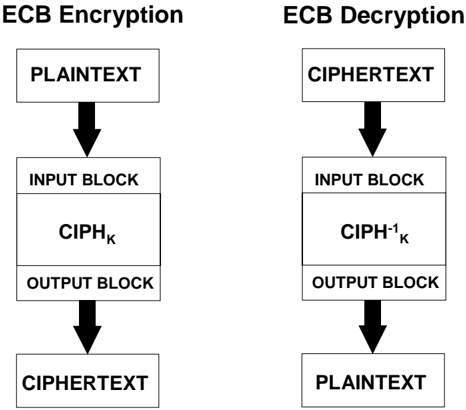
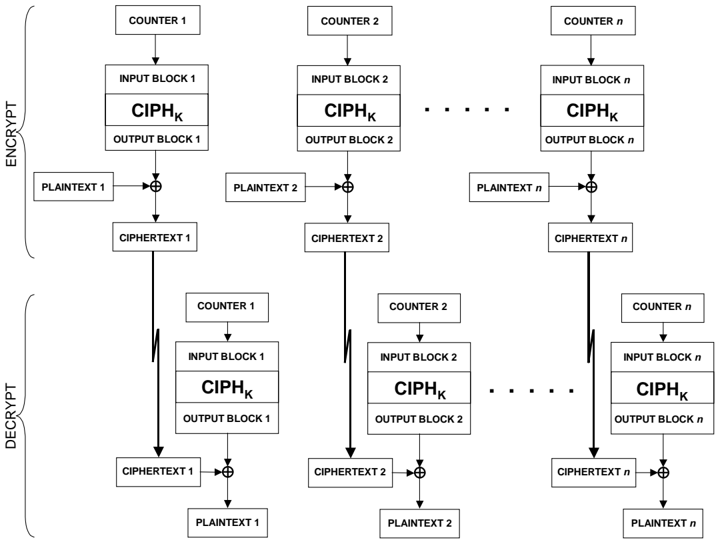
NIST Special Publication 800-38A specifies five confidentiality modes of operation (ECB, CBC, CFB, OFB, and CTR) for use with any FIPS-approved symmetric key block cipher, extending four modes previously defined for DES and adding the CTR mode. It provides mathematical specifications, IV and counter-generation guidance, error-propagation properties, and worked AES example vectors.
Key findings
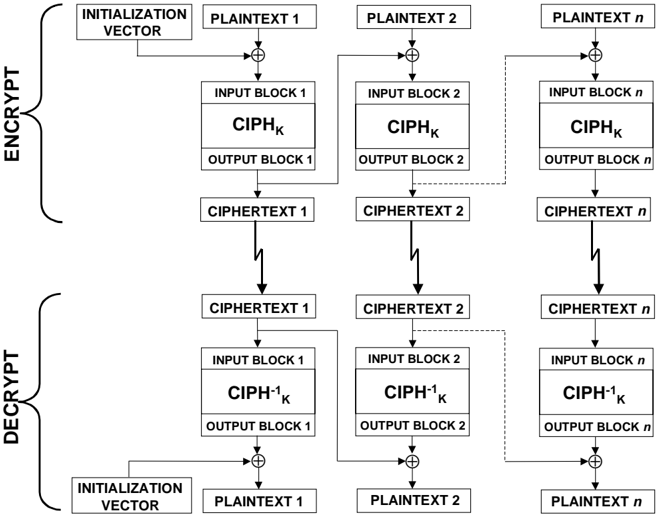
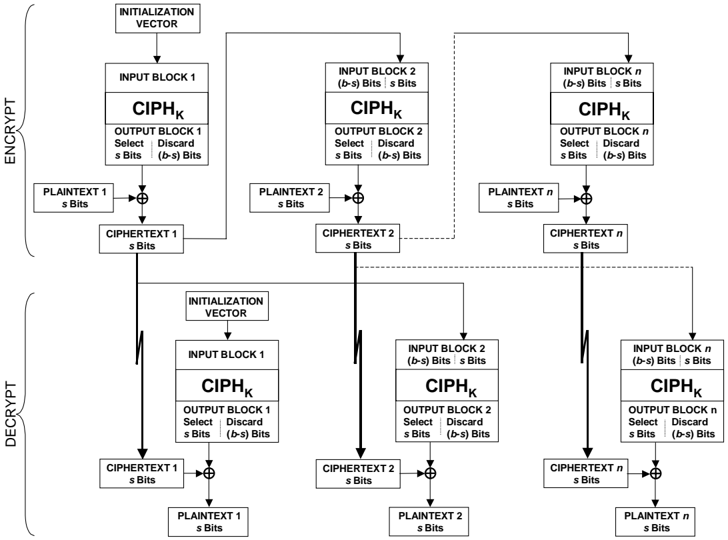
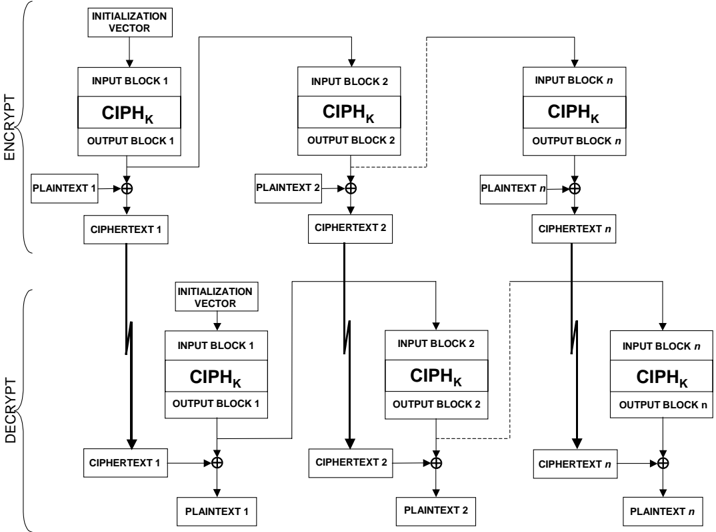
- The recommendation defines five confidentiality modes: Electronic Codebook (ECB), Cipher Block Chaining (CBC), Cipher Feedback (CFB), Output Feedback (OFB), and Counter (CTR), usable with any FIPS-approved block cipher such as AES.
- Three elements are new relative to prior FIPS publications: extension of the four FIPS Pub 81 modes to any FIPS-approved block cipher, revision of their requirements, and specification of the CTR mode.
- Parallelism differs by mode: ECB encryption/decryption and CTR encryption/decryption permit parallel forward/inverse cipher operations; CBC and CFB encryption cannot be parallelized but CBC and CFB decryption can; OFB permits neither, though output blocks can be precomputed if the IV is known.
- Error propagation is mode-dependent: in CFB, OFB, and CTR a ciphertext bit error produces specific bit errors in the same positions; in ECB and CBC it produces random bit errors with an expected rate of fifty percent. CBC errors also affect the succeeding block, and CFB errors affect the next b/s (rounded up) segments.
Methods
- Design: a normative specification document defining each mode's encryption and decryption algorithms mathematically, with descriptions, illustrations, and comments on parallel-processing potential.
- Data/sample: no empirical sample; the document provides worked example vectors for each mode using AES with 128-, 192-, and 256-bit keys, including 1-bit, 8-bit, and 128-bit CFB variants, with a common plaintext string formatted into four 128-bit blocks.
- Analysis: appendices cover padding, counter-block generation (standard incrementing function and initial counter-block choice), IV generation, error properties, Triple DES modes, and AES example vectors.
Limitations
- Stated: the document is neither a standard nor a guideline and is neither mandatory nor binding on Federal agencies; it may be used voluntarily. Formatting of the plaintext, including padding, is outside its scope. It does not provide analogues of the interleaved/pipelined ANSI X9.52 modes (TCBC-I, TCFB-P, TOFB-I).
- Stated: the recommendation assumes a secret, random key has been established among parties, and security depends at minimum on the secrecy of the key.
- Evident from the text: the modes provide confidentiality only; the document repeatedly notes that integrity of the IV or ciphertext is not protected by these modes, leaving decryption vulnerable to deliberate bit-error introduction unless integrity is separately protected.
Model-written summary. Check it against the paper before relying on it.
Integrity signals
Registry
Cites
Statistics
Figures
Verification
Claims the paper makes
0 Valid · 0 Not valid · 11 Not checked · 60 Own results and interpretations
A conclusion the paper draws from its own results — it cites no other source for it, so there is none to check. The quote shows it is in the paper.
In the paper
“In particular, if any plaintext block that is encrypted using a given counter block is known, then the output of the forward cipher function can be determined easily from the associated ciphertext block.”
plainstates a cause- Asserted: passes — The authors put it forward as true.
- Checkable: passes — It can be checked against evidence.
- Load-bearing: passes — The paper’s conclusions depend on it.
- Based: passes — The paper gives a reason why it holds.
A conclusion the paper draws from its own results — it cites no other source for it, so there is none to check. The quote shows it is in the paper.
In the paper
“For both the OFB and CFB modes, a bit error may occur, independently, in any bit position of the affected ciphertext blocks (or segments), with an expected error rate of fifty percent.”
hedgedstates a possible cause- Asserted: passes — The authors put it forward as true.
- Checkable: passes — It can be checked against evidence.
- Load-bearing: unclear — It is unclear whether the paper’s conclusions depend on it.
- Based: unclear — It is unclear why the paper says it holds.
A conclusion the paper draws from its own results — it cites no other source for it, so there is none to check. The quote shows it is in the paper.
In the paper
“In the CFB mode, bit errors in the IV affect, at a minimum, the decryption of the first ciphertext segment, and possibly successive ciphertext segments, depending on the bit position of the rightmost bit error in the IV.”
hedgedstates a cause- Asserted: passes — The authors put it forward as true.
- Checkable: passes — It can be checked against evidence.
- Load-bearing: unclear — It is unclear whether the paper’s conclusions depend on it.
- Based: passes — The paper gives a reason why it holds.
A conclusion the paper draws from its own results — it cites no other source for it, so there is none to check. The quote shows it is in the paper.
In the paper
“A bit error may occur, independently, in any bit position in these decrypted segments, with an expected error rate of fifty percent.”
hedgedstates a possible cause- Asserted: passes — The authors put it forward as true.
- Checkable: passes — It can be checked against evidence.
- Load-bearing: unclear — It is unclear whether the paper’s conclusions depend on it.
- Based: unclear — It is unclear why the paper says it holds.
A conclusion the paper draws from its own results — it cites no other source for it, so there is none to check. The quote shows it is in the paper.
In the paper
“However, if the IV is known, the output blocks can be generated prior to the availability of the plaintext or ciphertext data.”
plainstates a cause- Asserted: passes — The authors put it forward as true.
- Checkable: passes — It can be checked against evidence.
- Load-bearing: unclear — It is unclear whether the paper’s conclusions depend on it.
- Based: passes — The paper gives a reason why it holds.
28 more claims
Create a free account to see all 71 claims and to verify the 3 references still open.
- Probably not a substantial claim. 36
- It may state two separate claims as one. 9
Claims other papers make about this one
Each is checked against this paper’s own text: does it say what the citing paper says it does?
The cited source says what the claim attributes to it.
In the citing paper
“On the other hand, stream ciphers can be constructed by block ciphers using the Counter (CTR) and Output FeedBack (OFB) operation mode [294].”
From Robotics cyber security: vulnerabilities, attacks, countermeasures, and recommendations (2022) · cites this paper as [294]
Self-check
Percentages, sums and reported differences re-computed from the paper’s own numbers.
Each contradiction between two passages listed here was confirmed by an independent check.
Rated minor: it would not touch a result — a value no result rests on, a p-value that stays on the same side of the significance level, or a conflict that is clerical, resolved elsewhere in the paper, or outside its own findings.
In the paper
§ Appendix D: Error Properties
“Table D.1 summarizes the effects of bit errors in a ciphertext block or IV on the decryption of the ciphertext for each of the five confidentiality modes.”
§ Appendix D: Error Properties
“Table D.2: Summary of Effect of Bit Errors on Decryption”
Rated minor: it would not touch a result — a value no result rests on, a p-value that stays on the same side of the significance level, or a conflict that is clerical, resolved elsewhere in the paper, or outside its own findings.
In the paper
§ Appendix E: Modes of Triple DES
“the six modes in this recommendation”
§ 3 Introduction
“This recommendation specifies five confidentiality modes of operation for symmetric key block cipher algorithms”
Citations
Cites
Handbook of applied cryptography
(1997) · Choice Reviews Online · doi:10.5860/choice.34-4512 · Cited by 10,357
Handbook of Applied Cryptography
Menezes, A. J., van Oorschot, P. C., & Vanstone, S. A. (2018) · CRC Press eBooks · doi:10.1201/9781439821916 · Cited by 2,896 · cited 1×
“[5] for information about linear feedback shift registers.”
Advanced Encryption Standard (AES)
National Institute of Standards and Technology (US) (2001) · doi:10.6028/nist.fips.197 · Cited by 642
Data encryption standard (DES)
Biryukov, A., & Cannière, C. (2006) · Encyclopedia of Cryptography and Security · doi:10.1007/0-387-23483-7_94 · Cited by 57
Cited by
Items 101–200 of 709
A Profile for U. S. Federal Cryptographic Key Management Systems
Barker, E. B., Smid, M. E., & Branstad, D. K. (2015) · doi:10.6028/nist.sp.800-152 · Cited by 37
IMCRYPTO: An In-Memory Computing Fabric for AES Encryption and Decryption
Reis, D. A., Geng, H., Niemier, M. T., & Hu, X. S. (2022) · IEEE Transactions on Very Large Scale Integration (VLSI) Systems · doi:10.1109/tvlsi.2022.3157270 · Cited by 43
On Wide-Area IoT Networks, Lightweight Security and Their Applications—A Practical Review
Goulart, A., Chennamaneni, A., Torre, D., Hur, B., & Al-Aboosi, F. Y. (2022) · Electronics · doi:10.3390/electronics11111762 · Cited by 38
Karakra, A., & Alsadeh, A. (2016) · 2016 SAI Computing Conference (SAI) · doi:10.1109/sai.2016.7556103 · Cited by 39
A High-Throughput Low-Power AES Cipher for Network Applications
Lin, S., & Huang, C.-T. (2007) · Asia and South Pacific Design Automation Conference (ASP-DAC) · doi:10.1109/aspdac.2007.358051 · Cited by 30
Prodanovic, R., & Simic, D. (2007) · Journal of Computing and Information Technology · doi:10.2498/cit.1000877 · Cited by 29
A Security Layer for Smartphone-to-Vehicle Communication Over Bluetooth
Dardanelli, A., Maggi, F., Tanelli, M., Zanero, S., Savaresi, S. M., Kochanek, R., & Holz, T. (2013) · IEEE Embedded Systems Letters · doi:10.1109/les.2013.2264594 · Cited by 29
An efficient and secure cipher scheme for images confidentiality preservation
Fawaz, Z., Noura, H., & Mostefaoui, A. (2016) · Signal Processing Image Communication · doi:10.1016/j.image.2016.01.009 · Cited by 37
Comparison of the Hardware Implementation of Stream Ciphers.
Galanis, M. D., Kitsos, P., Kostopoulos, G., Sklavos, N., & Goutis, C. E. (2005) · Cited by 29
Comparison of Authenticated-Encryption schemes in Wireless Sensor Networks
Junior, M. A. S., de Oliveira, B. T., Barreto, P. S. L. M., Margi, C. B., Carvalho, T. C. M. D. B., & Näslund, M. (2011) · Conference on Local Computer Networks · doi:10.1109/lcn.2011.6115506 · Cited by 29
A novel encryption algorithm for high resolution video
Liu, F., & Koenig, H. (2005) · International Workshop on Network and Operating Systems Support for Digital Audio and Video (NOSSDAV) · doi:10.1145/1065983.1066001 · Cited by 29
Practically-exploitable Cryptographic Vulnerabilities in Matrix
Albrecht, M. R., Celi, S., Dowling, B., & Jones, D. L. (2023) · IEEE Symposium on Security and Privacy (S&P) · doi:10.1109/sp46215.2023.10351027 · Cited by 38
Unknown Plaintext Template Attacks
Hanley, N., Tunstall, M., & Marnane, W. P. (2009) · Lecture notes in computer science · doi:10.1007/978-3-642-10838-9_12 · Cited by 28
Hajduczenia, M., Inácio, P. R. M., Silva, H., Freire, M. M., & Monteiro, P. P. (2007) · IEEE Communications Surveys & Tutorials · doi:10.1109/comst.2007.358972 · Cited by 28
A natural language approach to automated cryptanalysis of two-time pads
Mason, J., Watkins, K., Eisner, J. M., & Stubblefield, A. (2006) · ACM SIGSAC Conference on Computer and Communications Security (CCS) · doi:10.1145/1180405.1180435 · Cited by 30
Snader, R., Kravets, R. H., & Harris, A. F. (2016) · Workshop on Wearable Systems and Applications (WearSys) · doi:10.1145/2935643.2935647 · Cited by 27
Hardware architectures for PRESENT block cipher and their FPGA implementations
Pandey, J. G., Goel, T., & Karmakar, A. (2019) · IET Circuits Devices & Systems · doi:10.1049/iet-cds.2018.5273 · Cited by 30
Functional Correctness Proofs of Encryption Algorithms
Duan, J., Hurd, J., Li, G., Owens, S., Slind, K. L., & Zhang, J. (2005) · Lecture notes in computer science · doi:10.1007/11591191_36 · Cited by 27
Energy efficiency of encryption schemes applied to wireless sensor networks
Zhang, X., Heys, H. M., & Li, C. (2011) · Security and Communication Networks · doi:10.1002/sec.375 · Cited by 32
Defeating the Downgrade Attack on Identity Privacy in 5G
Khan, M., Ginzboorg, P., Jarvinen, K. U., & Niemi, V. (2018) · Lecture notes in computer science · doi:10.1007/978-3-030-04762-7_6 · Cited by 38
Cryptographic hash functions : cryptanalysis, design and applications
Gauravaram, P. (2007) · Faculty of Science and Technology; Information Security Institute · Cited by 41
Efficient and secure cipher scheme for multimedia contents
Noura, H., Noura, M., Chehab, A., Mansour, M. M., & Couturier, R. (2018) · Multimedia Tools and Applications · doi:10.1007/s11042-018-6845-0 · Cited by 27
Fundamentals of Symmetric Cryptography
Kumar, S. S., & Wollinger, T. (2006) · Springer eBooks · doi:10.1007/3-540-28428-1_8 · Cited by 30
Transitioning the Use of Cryptographic Algorithms and Key Lengths
Barker, E. B. (2024) · doi:10.6028/nist.sp.800-131ar3.ipd · Cited by 32
On the Security of Two Remote User Authentication Schemes for Telecare Medical Information Systems
Kim, K.-W., & Lee, J.-D. (2014) · Journal of Medical Systems · doi:10.1007/s10916-014-0017-1 · Cited by 25
FAC-V: An FPGA-Based AES Coprocessor for RISC-V
Gomes, T., Sousa, P., Silva, M., Ekpanyapong, M., & Pinto, S. (2022) · Journal of Low Power Electronics and Applications · doi:10.3390/jlpea12040050 · Cited by 25
Pragmatic equivalence and safety checking in Cryptol
Erkök, L., & Matthews, J. (2009) · Programming Languages meets Program Verification · doi:10.1145/1481848.1481860 · Cited by 29
Prevention of Controller Area Network (CAN) Attacks on Electric Autonomous Vehicles
Adly, S., Moro, A., Hammad, S., & Maged, S. A. (2023) · Applied Sciences · doi:10.3390/app13169374 · Cited by 24
Beyond Modes: Building a Secure Record Protocol from a Cryptographic Sponge Permutation
Saarinen, M.-J. O. (2014) · Lecture notes in computer science · doi:10.1007/978-3-319-04852-9_14 · Cited by 26
Authenticated Encryption: Toward Next-Generation Algorithms
Maimuţ, D., & Reyhanitabar, R. (2014) · IEEE Security & Privacy · doi:10.1109/msp.2014.19 · Cited by 24
Comparative study of several operation modes of AES algorithm for encryption ECG biomedical signal
Hameed, M. E., Ibrahim, M. M., Manap, N. B. A., & Attiah, M. L. (2019) · International Journal of Electrical and Computer Engineering (IJECE) · doi:10.11591/ijece.v9i6.pp4850-4859 · Cited by 24
Aldaya, A. C., Sarmiento, A., & Sánchez-Solano, S. (2015) · Journal of Cryptographic Engineering · doi:10.1007/s13389-015-0103-4 · Cited by 30
Bricklayer Attack: A Side-Channel Analysis on the ChaCha Quarter Round
Adomnicăi, A., Fournier, J., & Masson, L. (2017) · Lecture notes in computer science · doi:10.1007/978-3-319-71667-1_4 · Cited by 28
LoRCA: Lightweight round block and stream cipher algorithms for IoV systems
Noura, H., Salman, O., Couturier, R., & Chehab, A. (2021) · Vehicular Communications · doi:10.1016/j.vehcom.2021.100416 · Cited by 25
2Gbit/s Hardware Realizations of RIJNDAEL and SERPENT: A Comparative Analysis
Lutz, A. K., Treichler, J., Gürkaynak, F. K., Kaeslin, H., Basler, G., Erni, A., Reichmuth, S., Rommens, P., Oetiker, S., & Fichtner, W. (2003) · Lecture notes in computer science · doi:10.1007/3-540-36400-5_12 · Cited by 23
Fast Video Encryption Using the H.264 Error Propagation Property for Smart Mobile Devices
Chung, Y., Lee, S.-J., Jeon, T., & Park, D. (2015) · Sensors · doi:10.3390/s150407953 · Cited by 23
StealthGuard: Proofs of Retrievability with Hidden Watchdogs
Azraoui, M., Elkhiyaoui, K., Molva, R. A., & Önen, M. (2014) · Lecture notes in computer science · doi:10.1007/978-3-319-11203-9_14 · Cited by 22
HACLxN: Verified Generic SIMD Crypto (for all your favourite platforms)
Polubelova, M., Bhargavan, K., Protzenko, J., Beurdouche, B., Fromherz, A., Kulatova, N., & Zanella-Béguelin, S. (2020) · IACR Cryptology ePrint Archive · doi:10.1145/3372297.3423352 · Cited by 28
Reviving instruction set randomization
Sinha, K., Kemerlis, V. P., & Sethumadhavan, S. (2017) · IEEE International Symposium on Hardware Oriented Security and Trust (HOST) · doi:10.1109/hst.2017.7951732 · Cited by 22
FPGA-Based Assessment of Midori and Gift Lightweight Block Ciphers
Lara-Nino, C. A., Díaz-Pérez, A., & Morales‐Sandoval, M. (2018) · Lecture notes in computer science · doi:10.1007/978-3-030-01950-1_45 · Cited by 22
Efficient & secure cipher scheme with dynamic key-dependent mode of operation
Noura, H. N., Chehab, A., & Couturier, R. (2019) · Signal Processing: Image Communication · doi:10.1016/j.image.2019.08.005 · Cited by 21
Analysis and Optimization of Advanced Encryption Standard for the Internet of Things
Sultan, I., Javid, B., & Banday, M. T. (2020) · International Conference on Signal Processing and Integrated Networks (SPIN) · doi:10.1109/spin48934.2020.9071380 · Cited by 22
Architectural design features of a programmable high throughput AES coprocessor
Hodjat, A., Schaumont, P. R., & Verbauwhede, I. M. R. (2004) · International Conference on Information Technology: Coding and Computing (ITCC) · doi:10.1109/itcc.2004.1286703 · Cited by 22
Block cipher based security for severely resource-constrained implantable medical devices
Beck, C., Masny, D., Geiselmann, W., & Bretthauer, G. (2011) · International Symposium on Applied Sciences in Biomedical and Communication Technologies · doi:10.1145/2093698.2093760 · Cited by 21
Two RFID Standard-based Security Protocols for Healthcare Environments
Picazo‐Sanchez, P., Bagheri, N., Lopez, P. P., & Tapiador, J. (2013) · Journal of Medical Systems · doi:10.1007/s10916-013-9962-3 · Cited by 23
Physical Layer Encryption for Industrial Ethernet in Gigabit Optical Links
Pérez-Resa, A., Garcia-Bosque, M., Sánchez‐Azqueta, C., & Celma, S. (2018) · IEEE Transactions on Industrial Electronics · doi:10.1109/tie.2018.2847670 · Cited by 24
Design of a fast and robust chaos-based crypto-system for image encryption
Noura, H., Assad, S. E., & Vlădeanu, C. (2010) · International Conference on Communications (COMM) · doi:10.1109/iccomm.2010.5509114 · Cited by 21
Speeding Up AES By Extending a 32 bit Processor Instruction Set
Bertoni, G., Breveglieri, L., Farina, R., & Regazzoni, F. (2006) · IEEE International Conference on Application-specific Systems, Architectures and Processors (ASAP) · doi:10.1109/asap.2006.62 · Cited by 21
Design of An Extremely High Performance Counter Mode AES Reconfigurable Processor
Fu, L. (2006) · International Conference on Embedded Software and Systems · doi:10.1109/icess.2005.43 · Cited by 21
Hardware/Software Cooperative Design Against Power Side-Channel Attacks on IoT Devices
Yang, M., Ahmed, T., Inagaki, S., Sakiyama, K., Li, Y., & Hara–Azumi, Y. (2024) · IEEE Internet of Things Journal · doi:10.1109/jiot.2024.3355417 · Cited by 21
Hardware implementation of elliptic curve digital signature algorithm (ECDSA) on Koblitz curves
Ghanmy, N., Khlif, N., Fourati, L. C., & Kamoun, L. (2012) · International Symposium on Communication Systems, Networks and Digital Signal Processing (CSNDSP) · doi:10.1109/csndsp.2012.6292648 · Cited by 20
Chaos based information hiding and security
Assad, S. E. (2012) · HAL · Cited by 20
Selective Opening Security from Simulatable Data Encapsulation
Heuer, F., & Poettering, B. (2016) · Lecture notes in computer science · doi:10.1007/978-3-662-53890-6_9 · Cited by 20
Key lengths revisited: GPU-based brute force cryptanalysis of DES, 3DES, and PRESENT
Tezcan, C. (2022) · Journal of Systems Architecture · doi:10.1016/j.sysarc.2022.102402 · Cited by 28
Łukowiak, M., Radziszowski, S., Vallino, J. R., & Wood, C. A. (2014) · ACM Transactions on Computing Education · doi:10.1145/2538029 · Cited by 20
64-bit Block ciphers: hardware implementations and comparison analysis
Kitsos, P., Sklavos, N., Galanis, M. D., & Koufopavlou, O. (2004) · Computers & Electrical Engineering · doi:10.1016/j.compeleceng.2004.11.001 · Cited by 20
Bitstream encryption and authentication with AES-GCM in dynamically reconfigurable systems
Hori, Y., Satoh, A., Sakane, H., & Toda, K. (2008) · International Conference on Field Programmable Logic and Applications (FPL) · doi:10.1109/fpl.2008.4629902 · Cited by 20
X-pire! - A digital expiration date for images in social networksPreprint
Backes, J., Michael Backes, A., Dürmuth, M., Gerling, S., & Lorenz, S. (2011) · arXiv (Cornell University) · doi:10.48550/arxiv.1112.2649 · Cited by 20
AES as Error Correction: Cryptosystems for Reliable Communication
Cohen, A., D’Oliveira, R. G. L., Duffy, K. R., Woo, J., & Medard, M. (2023) · IEEE Communications Letters · doi:10.1109/lcomm.2023.3285404 · Cited by 29
Data security against receiver corruptions: SOA security for receivers from simulatable DEMs
Huang, Z., Lai, J., Chen, W., Li, T., & Xiang, Y. (2018) · Information Sciences · doi:10.1016/j.ins.2018.08.059 · Cited by 19
A novel security scheme for Body Area Networks compatible with smart vehicles
Wang, J., Han, K., Alexandridis, A., Žilić, Ž., Pang, Y., Wu, W., Din, S., & Jeon, G. (2018) · Computer Networks · doi:10.1016/j.comnet.2018.07.005 · Cited by 19
Computer Security and the Internet: Tools and Jewels
van Oorschot, P. C. (2020) · Cited by 30
CRUST: Cryptographic Remote Untrusted Storage without Public Keys
Geron, E., & Wool, A. (2007) · International IEEE Security in Storage Workshop (SISW) · doi:10.1109/sisw.2007.4389740 · Cited by 18
Encryption techniques for H.264/AVC videos: A literature review
Tabash, F. K., Izharuddin, M., & Tabash, M. I. (2019) · Journal of Information Security and Applications · doi:10.1016/j.jisa.2019.01.001 · Cited by 22
εpsolute: Efficiently Querying Databases While Providing Differential Privacy
Bogatov, D., Kellaris, G., Kollios, G., Nissim, K., & O’Neill, A. (2021) · ACM SIGSAC Conference on Computer and Communications Security (CCS) · doi:10.1145/3460120.3484786 · Cited by 29
Puzzle – A Novel Video Encryption Algorithm
Liu, F., & Koenig, H. (2005) · Lecture notes in computer science · doi:10.1007/11552055_9 · Cited by 18
Secure and Efficient Initialization and Authentication Protocols for SHIELD
Jin, C., & van Dijk, M. (2017) · IEEE Transactions on Dependable and Secure Computing · doi:10.1109/tdsc.2017.2647950 · Cited by 19
Cheng, P.-Y., Su, Y.-C., & Chao, P. C.-P. (2024) · IEEE Internet of Things Journal · doi:10.1109/jiot.2024.3359714 · Cited by 18
Simulation-based selective opening security for receivers under chosen-ciphertext attacks
Huang, Z., Lai, J., Chen, W., Au, M. H., Peng, Z., & Li, J. (2018) · Designs Codes and Cryptography · doi:10.1007/s10623-018-0530-1 · Cited by 17
An ASIC Implementation of Security Scheme for Body Area Networks
Wang, J., Han, K., Alexandridis, A., Žilić, Ž., Pang, Y., & Lin, J. (2018) · IEEE International Symposium on Circuits and Systems proceedings · doi:10.1109/iscas.2018.8351098 · Cited by 17
The Missing Difference Problem, and Its Applications to Counter Mode Encryption
Leurent, G., & Sibleyras, F. (2018) · Lecture notes in computer science · doi:10.1007/978-3-319-78375-8_24 · Cited by 17
Mansour, I., Chalhoub, G., & Bakhache, B. (2012) · IEEE International Conference on Trust, Security and Privacy in Computing and Communications (TrustCom) · doi:10.1109/trustcom.2012.154 · Cited by 18
Mapping of the AES cryptographic algorithm on a Coarse-Grain reconfigurable array processor
Garcia, A., Bereković, M., & Aa, T. V. (2008) · IEEE International Conference on Application-specific Systems, Architectures and Processors (ASAP) · doi:10.1109/asap.2008.4580186 · Cited by 16
A Novel Chaining Encryption Algorithm for LPWAN IoT Network
Bidgoly, A. J., & Bidgoly, H. J. (2019) · IEEE Sensors Journal · doi:10.1109/jsen.2019.2910850 · Cited by 16
A Decentralized Solution for Web Hosting
Huynh, T. T., Nguyen, T. D., & Hanh, T. (2019) · NAFOSTED Conference on Information and Computer Science (NICS) · doi:10.1109/nics48868.2019.9023837 · Cited by 18
The Security of Ciphertext Stealing
Rogaway, P., Wooding, M., & Zhang, H. (2012) · Lecture notes in computer science · doi:10.1007/978-3-642-34047-5_11 · Cited by 20
Recommendation for Block Cipher Modes of Operation: Methods for Format-Preserving EncryptionPreprint
Dworkin, M. J. (2019) · doi:10.6028/nist.sp.800-38gr1-draft · Cited by 20
Self-citationDesign and Analysis of Querying Encrypted Data in Relational Databases
Canim, M., & Kantarcıoğlu, M. (2007) · Lecture notes in computer science · doi:10.1007/978-3-540-73538-0_14 · Cited by 15
FAST, PARALLEL AND SECURE CRYPTOGRAPHY ALGORITHM USING LORENZ'S ATTRACTOR
Marco, A. G., Martinêz, A. S., & Bruno, O. M. (2010) · International Journal of Modern Physics C · doi:10.1142/s0129183110015166 · Cited by 19
Parallel Execution of AES-CTR Algorithm Using Extended Block Size
Tran, N.-P., Lee, M., Hong, S., & Lee, S. (2011) · IEEE International Conference on Computational Science and Engineering (CSE) · doi:10.1109/cse.2011.43 · Cited by 16
Decrypting live SSH traffic in virtual environments
McLaren, P., Russell, G., Buchanan, W. J., & Tan, Z. (2019) · Digital Investigation · doi:10.1016/j.diin.2019.03.010 · Cited by 21
FPGA Implementations of the RC6 Block Cipher
Beuchat, J.-L. (2003) · Lecture notes in computer science · doi:10.1007/978-3-540-45234-8_11 · Cited by 15
Statistical Characterization of Decryption Errors in Block-Ciphered Systems
Wang, J., Mu, J., Wei, S., Jiang, C., & Beaulieu, N. C. (2015) · IEEE Transactions on Communications · doi:10.1109/tcomm.2015.2474860 · Cited by 14
CLFuzz: Vulnerability Detection of Cryptographic Algorithm Implementation via Semantic-aware Fuzzing
Zhou, Y., Ma, F., Chen, Y., Ren, M., & Jiang, Y. (2023) · ACM Transactions on Software Engineering and Methodology · doi:10.1145/3628160 · Cited by 20
Device-Oriented Group Messaging: A Formal Cryptographic Analysis of Matrix’ Core
Albrecht, M. R., Dowling, B., & Jones, D. L. (2024) · IEEE Symposium on Security and Privacy (S&P) · doi:10.1109/sp54263.2024.00075 · Cited by 19
CRUST: cryptographic remote untrusted storage without public keys
Geron, E., & Wool, A. (2009) · International Journal of Information Security · doi:10.1007/s10207-009-0081-6 · Cited by 14
Elastic-Tweak: A Framework for Short Tweak Tweakable Block Cipher
Chakraborti, A., Datta, N., Jha, A., Mancillas-López, C., Nandi, M., & Sasaki, Y. (2021) · Lecture notes in computer science · doi:10.1007/978-3-030-92518-5_6 · Cited by 14
The Summation-Truncation Hybrid: Reusing Discarded Bits for Free
Gunsing, A., & Mennink, B. (2020) · Lecture notes in computer science · doi:10.1007/978-3-030-56784-2_7 · Cited by 19
MoteAODV – An AODV Implementation for TinyOS 2.0
Backes, W., & Cordasco, J. (2010) · Lecture notes in computer science · doi:10.1007/978-3-642-12368-9_11 · Cited by 16
Random clocking induced DPA attack immunity in FPGAs
Zafar, Y., Park, J., & Har, D. (2010) · IEEE International Conference on Industrial Technology (ICIT) · doi:10.1109/icit.2010.5472570 · Cited by 14
CypherDB: A Novel Architecture for Outsourcing Secure Database Processing
Chen, B. H. K., Cheung, P. Y. S., Cheung, P. Y. K., & Kwok, Y. R. (2015) · IEEE Transactions on Cloud Computing · doi:10.1109/tcc.2015.2511730 · Cited by 14
Small Details Gray Scale Image Encryption Using RC6 Block Cipher
Faragallah, O. S., El‐sayed, H. S., Afifi, A., & El-Zoghdy, S. F. (2021) · Wireless Personal Communications · doi:10.1007/s11277-021-08105-y · Cited by 17
Cryptanalysis and design of block ciphers
Nakahara, J. (2003) · Cited by 15
EPS Confidentiality and Integrity mechanisms Algorithmic ApproachPreprint
Orhanou, G., Hajji, S. E., Bentaleb, Y., & Laassiri, J. (2011) · arXiv (Cornell University) · doi:10.48550/arxiv.1102.5191 · Cited by 14
McGrew, D. A. (2012) · IACR Cryptology ePrint Archive · Cited by 14
A Lightweight ISA Extension for AES and SM4Preprint
Saarinen, M.-J. O. (2020) · arXiv (Cornell University) · doi:10.48550/arxiv.2002.07041 · Cited by 24
Exploration of cryptographic ASIP designs for wireless sensor nodes
Τσεκούρα, Ι., Selimis, G., Hulzink, J., Catthoor, F., Huisken, J., de Groot, H., & Goutis, C. E. (2010) · IEEE International Conference on Electronics, Circuits and Systems (ICECS) · doi:10.1109/icecs.2010.5724640 · Cited by 13
Masoodi, F. S., & Bokhari, M. U. (2019) · Chapman & Hall/CRC eBooks · doi:10.1201/9781351021708-6 · Cited by 13
Practical parallel AES algorithms on cloud for massive users and their performance evaluation
Fei, X., Li, K., Yang, W., & Li, K. (2015) · Concurrency and Computation Practice and Experience · doi:10.1002/cpe.3734 · Cited by 14
The method of ensuring confidentiality and integrity data in cloud computing
Rukavitsyn, A. N., Borisenko, K. A., Kholod, I. I., & Shorov, A. V. (2017) · IEEE International Conference on Soft Computing and Measurements (SCM) · doi:10.1109/scm.2017.7970558 · Cited by 13
Metadata
- Authors
- Dworkin, M. J.
- Affiliations
- National Institute of Standards and Technology (US)
- Corresponding author
- Dworkin, M J
- ORCID
- Dworkin, M J
- Published
- 2001
- OpenAlex
- W112964067
- Cited by
- 746
- References
- 5
- Citations by year
- 2026: 59 · 2025: 38 · 2024: 41 · 2023: 25 · 2022: 33 · 2021: 30 · 2020: 37 · 2019: 44 · 2018: 48 · 2017: 44 · 2016: 34 · 2015: 35 · 2014: 32 · 2013: 31 · 2012: 33
- Type
- report
- Language
- en
- Open access
- gold
- doi.org
- Licence
- public-domain
- Topics
- Physical Sciences › Computer Science › Artificial Intelligence › Cryptographic Implementations and Security
- Physical Sciences › Mathematics › Discrete Mathematics and Combinatorics › Coding theory and cryptography
- Physical Sciences › Computer Science › Information Systems › Cryptography and Residue Arithmetic
- Keywords
- block cipher, modes of operation, encryption modes, NIST standards
About these checks
Registry, retraction, Cites and statistics results are computed, not judged, with one exception: a printed reference that no index lists is read once by a model before it counts as a citation error. Claims are extracted by a model and kept only when their quote appears verbatim in the text; each cited source is then checked, with a model’s help, for whether it says what the claim relies on. Those verdicts can be wrong — read the claim’s quote and the cited source before relying on one.
A language model drew the claims from the paper on 2026-10-21, under version 3 of the claim definition (model deepseek-v4.1-flash, prompt extract-v3).
A second model labelled each claim on 2026-10-21 (model jev-1.13-20260917, definition revision gold-guideline-v0.2).
Statistics and arithmetic are recomputed, not judged.
Confidence bands are shown only for fields calibrated on our annotated test set. None is calibrated yet, so no band is shown.
What counts as a claim ›How we measure confidence ›How we check this ›
Are you an author, or do you see a problem with this page? Request a review
Data sources
Bibliographic data: Semantic Scholar, OpenAlex, Crossref.
Contains information from the Semantic Scholar Academic Graph Datasets, made available under the ODC Attribution License (ODC-BY 1.0).
Semantic Scholar’s data is described in: Kinney, R., et al. (2023). The Semantic Scholar Open Data Platform. arXiv:2301.10140.
