

Recommendation for block cipher modes of operation: methods and techniques
Open accessThe DOI matches its Crossref record; 4 of the 5 references it cites were found in a registry or an index; none of the 14 sources its claims cite is checked for support yet.
Abstract
Reports on Information Security TechnologyThe Information Technology Laboratory (ITL) at the National Institute of Standards and Technology (NIST) promotes the U.S. economy and public welfare by providing technical leadership for the Nation's measurement and standards infrastructure.ITL develops tests, test methods, reference data, proof of concept implementations, and technical analyses to advance the development and productive use of information technology.ITL's responsibilities include the development of technical, physical, administrative, and management standards and guidelines for the cost-effective security and privacy of sensitive unclassified information in Federal computer systems.This Special Publication 800-series reports on ITL's research, guidance, and outreach efforts in computer security, and its collaborative activities with industry, government, and academic organizations.Certain commercial entities, equipment, or materials may be identified in this document in order to describe an experimental procedure or concept adequately.Such identification is not intended to imply recommendation or endorsement by the National Institute of Standards and Technology, nor is it intended to imply that the entities, materials, or equipment are necessarily the best available for the purpose.
Overview
CoChat Summary
TL;DR
NIST Special Publication 800-38A specifies five confidentiality modes of operation (ECB, CBC, CFB, OFB, and CTR) for use with any FIPS-approved symmetric key block cipher, extending four modes previously defined for DES and adding the CTR mode. It provides mathematical specifications, IV and counter-generation guidance, error-propagation properties, and worked AES example vectors.
Key findings
- The recommendation defines five confidentiality modes: Electronic Codebook (ECB), Cipher Block Chaining (CBC), Cipher Feedback (CFB), Output Feedback (OFB), and Counter (CTR), usable with any FIPS-approved block cipher such as AES.
- Three elements are new relative to prior FIPS publications: extension of the four FIPS Pub 81 modes to any FIPS-approved block cipher, revision of their requirements, and specification of the CTR mode.
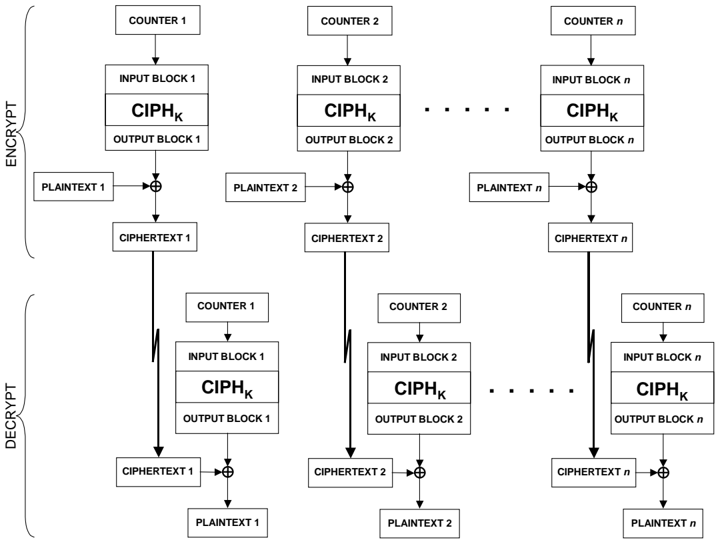
- Parallelism differs by mode: ECB encryption/decryption and CTR encryption/decryption permit parallel forward/inverse cipher operations; CBC and CFB encryption cannot be parallelized but CBC and CFB decryption can; OFB permits neither, though output blocks can be precomputed if the IV is known.
- Error propagation is mode-dependent: in CFB, OFB, and CTR a ciphertext bit error produces specific bit errors in the same positions; in ECB and CBC it produces random bit errors with an expected rate of fifty percent. CBC errors also affect the succeeding block, and CFB errors affect the next b/s (rounded up) segments.
Methods
- Design: a normative specification document defining each mode's encryption and decryption algorithms mathematically, with descriptions, illustrations, and comments on parallel-processing potential.
- Data/sample: no empirical sample; the document provides worked example vectors for each mode using AES with 128-, 192-, and 256-bit keys, including 1-bit, 8-bit, and 128-bit CFB variants, with a common plaintext string formatted into four 128-bit blocks.
- Analysis: appendices cover padding, counter-block generation (standard incrementing function and initial counter-block choice), IV generation, error properties, Triple DES modes, and AES example vectors.
Limitations
- Stated: the document is neither a standard nor a guideline and is neither mandatory nor binding on Federal agencies; it may be used voluntarily. Formatting of the plaintext, including padding, is outside its scope. It does not provide analogues of the interleaved/pipelined ANSI X9.52 modes (TCBC-I, TCFB-P, TOFB-I).
- Stated: the recommendation assumes a secret, random key has been established among parties, and security depends at minimum on the secrecy of the key.
- Evident from the text: the modes provide confidentiality only; the document repeatedly notes that integrity of the IV or ciphertext is not protected by these modes, leaving decryption vulnerable to deliberate bit-error introduction unless integrity is separately protected.
Model-written summary. Check it against the paper before relying on it.
Integrity signals
Registry
Cites
Statistics
Figures
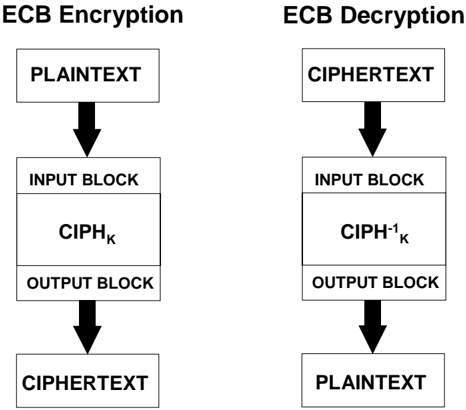
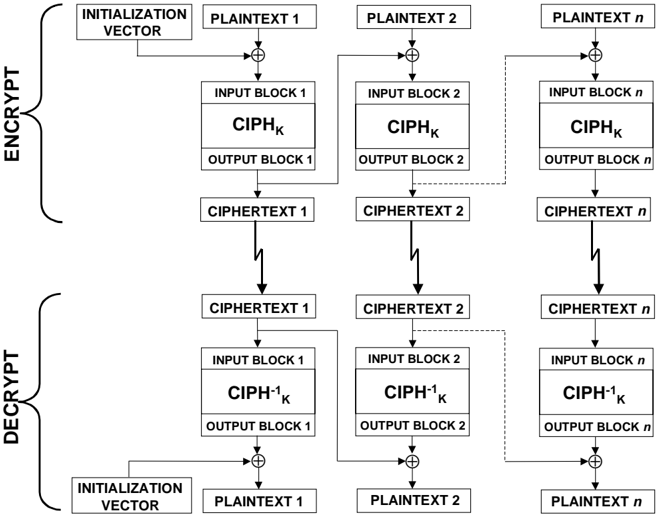
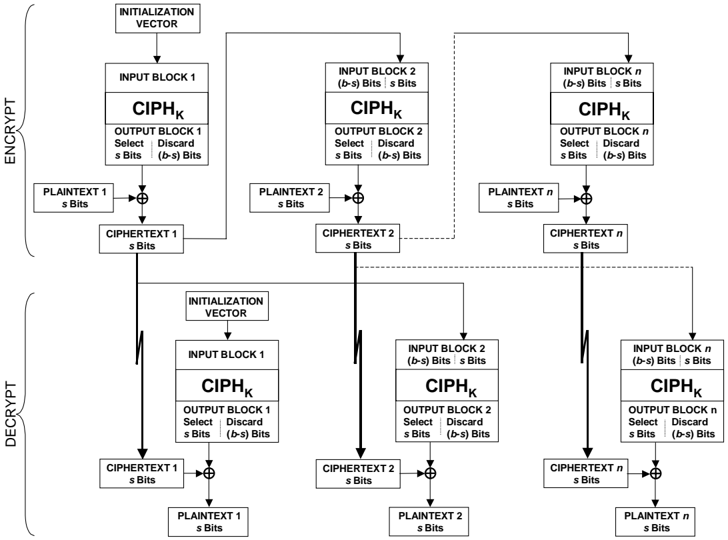
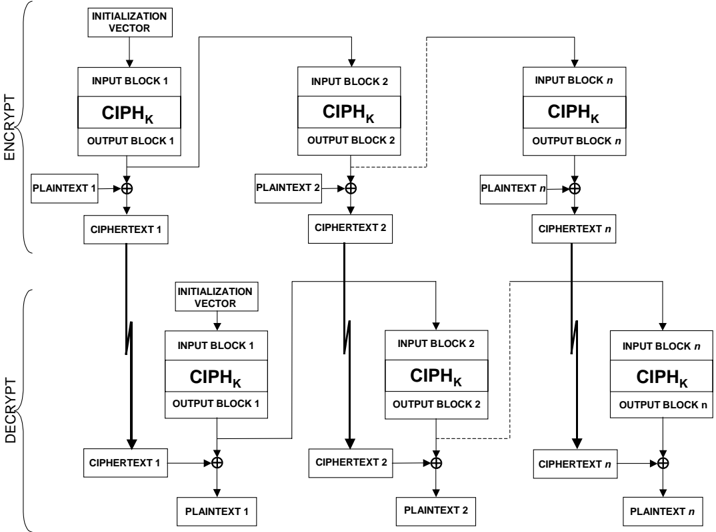
Verification
Claims the paper makes
0 Valid · 0 Not valid · 11 Not checked · 60 Own results and interpretations
A conclusion the paper draws from its own results — it cites no other source for it, so there is none to check. The quote shows it is in the paper.
In the paper
“In particular, if any plaintext block that is encrypted using a given counter block is known, then the output of the forward cipher function can be determined easily from the associated ciphertext block.”
plainstates a cause- Asserted: passes — The authors put it forward as true.
- Checkable: passes — It can be checked against evidence.
- Load-bearing: passes — The paper’s conclusions depend on it.
- Based: passes — The paper gives a reason why it holds.
A conclusion the paper draws from its own results — it cites no other source for it, so there is none to check. The quote shows it is in the paper.
In the paper
“For both the OFB and CFB modes, a bit error may occur, independently, in any bit position of the affected ciphertext blocks (or segments), with an expected error rate of fifty percent.”
hedgedstates a possible cause- Asserted: passes — The authors put it forward as true.
- Checkable: passes — It can be checked against evidence.
- Load-bearing: unclear — It is unclear whether the paper’s conclusions depend on it.
- Based: unclear — It is unclear why the paper says it holds.
A conclusion the paper draws from its own results — it cites no other source for it, so there is none to check. The quote shows it is in the paper.
In the paper
“In the CFB mode, bit errors in the IV affect, at a minimum, the decryption of the first ciphertext segment, and possibly successive ciphertext segments, depending on the bit position of the rightmost bit error in the IV.”
hedgedstates a cause- Asserted: passes — The authors put it forward as true.
- Checkable: passes — It can be checked against evidence.
- Load-bearing: unclear — It is unclear whether the paper’s conclusions depend on it.
- Based: passes — The paper gives a reason why it holds.
A conclusion the paper draws from its own results — it cites no other source for it, so there is none to check. The quote shows it is in the paper.
In the paper
“A bit error may occur, independently, in any bit position in these decrypted segments, with an expected error rate of fifty percent.”
hedgedstates a possible cause- Asserted: passes — The authors put it forward as true.
- Checkable: passes — It can be checked against evidence.
- Load-bearing: unclear — It is unclear whether the paper’s conclusions depend on it.
- Based: unclear — It is unclear why the paper says it holds.
A conclusion the paper draws from its own results — it cites no other source for it, so there is none to check. The quote shows it is in the paper.
In the paper
“However, if the IV is known, the output blocks can be generated prior to the availability of the plaintext or ciphertext data.”
plainstates a cause- Asserted: passes — The authors put it forward as true.
- Checkable: passes — It can be checked against evidence.
- Load-bearing: unclear — It is unclear whether the paper’s conclusions depend on it.
- Based: passes — The paper gives a reason why it holds.
28 more claims
Create a free account to see all 71 claims and to verify the 3 references still open.
- Probably not a substantial claim. 36
- It may state two separate claims as one. 9
Claims other papers make about this one
Each is checked against this paper’s own text: does it say what the citing paper says it does?
The cited source says what the claim attributes to it.
In the citing paper
“On the other hand, stream ciphers can be constructed by block ciphers using the Counter (CTR) and Output FeedBack (OFB) operation mode [294].”
From Robotics cyber security: vulnerabilities, attacks, countermeasures, and recommendations (2022) · cites this paper as [294]
Self-check
Percentages, sums and reported differences re-computed from the paper’s own numbers.
Each contradiction between two passages listed here was confirmed by an independent check.
Rated minor: it would not touch a result — a value no result rests on, a p-value that stays on the same side of the significance level, or a conflict that is clerical, resolved elsewhere in the paper, or outside its own findings.
In the paper
§ Appendix D: Error Properties
“Table D.1 summarizes the effects of bit errors in a ciphertext block or IV on the decryption of the ciphertext for each of the five confidentiality modes.”
§ Appendix D: Error Properties
“Table D.2: Summary of Effect of Bit Errors on Decryption”
Rated minor: it would not touch a result — a value no result rests on, a p-value that stays on the same side of the significance level, or a conflict that is clerical, resolved elsewhere in the paper, or outside its own findings.
In the paper
§ Appendix E: Modes of Triple DES
“the six modes in this recommendation”
§ 3 Introduction
“This recommendation specifies five confidentiality modes of operation for symmetric key block cipher algorithms”
Citations
Cites
Handbook of applied cryptography
(1997) · Choice Reviews Online · doi:10.5860/choice.34-4512 · Cited by 10,357
Handbook of Applied Cryptography
Menezes, A. J., van Oorschot, P. C., & Vanstone, S. A. (2018) · CRC Press eBooks · doi:10.1201/9781439821916 · Cited by 2,896 · cited 1×
“[5] for information about linear feedback shift registers.”
Advanced Encryption Standard (AES)
National Institute of Standards and Technology (US) (2001) · doi:10.6028/nist.fips.197 · Cited by 642
Data encryption standard (DES)
Biryukov, A., & Cannière, C. (2006) · Encyclopedia of Cryptography and Security · doi:10.1007/0-387-23483-7_94 · Cited by 57
Cited by
Items 301–400 of 709
TRESC: Towards redesigning existing symmetric ciphers
Noura, H., Salman, O., Kaaniche, N., Sklavos, N., Chehab, A., & Couturier, R. (2020) · Microprocessors and Microsystems · doi:10.1016/j.micpro.2020.103478 · Cited by 6
Parallelization of Standard Modes of Operation for Symmetric Key Block Ciphers
Bielecki, W., & Burak, D. (2007) · Springer eBooks · doi:10.1007/978-0-387-36503-9_10 · Cited by 6
Implementation of AES as a CMOS core
Liu, L., & Lüke, D. (2004) · Conference proceedings - Canadian Conference on Electrical and Computer Engineering · doi:10.1109/ccece.2003.1226342 · Cited by 6
Combating Spam and Denial-of-Service Attacks with Trusted Puzzle Solvers
Tsang, P. P., & Smith, S. W. (2008) · Springer eBooks · doi:10.1007/978-3-540-79104-1_14 · Cited by 6
Side Channel Attacks on Message Authentication Codes
Okeya, K., & Iwata, T. (2006) · IPSJ Digital Courier · doi:10.2197/ipsjdc.2.478 · Cited by 6
Xiao, S., & Boncelet, C. (2006) · Conference on Information Sciences and Systems · doi:10.1109/ciss.2006.286398 · Cited by 6
Development of an Encryption Algorithm Based on Nonpositional Polynomial Notations
Гакашевич, Б. Р., Nyssanbayeva, S., Kalimoldayev, M., & Magzom, M. (2016) · International Conference on Advanced Materials Science and Environmental Engineering (AMSEE) · doi:10.2991/amsee-16.2016.64 · Cited by 6
Taufik, M., Amin, D., & Saifuddin, M. A. (2020) · AIP conference proceedings · doi:10.1063/5.0003527 · Cited by 6
A Secure IoT Firmware Update Scheme Against SCPA and DoS Attacks
Fan, Y., Wang, M., Li, Y., Hu, K., & Li, M. (2021) · Journal of Computer Science and Technology · doi:10.1007/s11390-020-9831-8 · Cited by 6
Breaking LWC candidates: sESTATE and Elephant in quantum setting
Shi, T., Wu, W., Hu, B., Guan, J., & Wang, S. (2021) · Designs Codes and Cryptography · doi:10.1007/s10623-021-00875-7 · Cited by 7
An Area-Optimized and Power-Efficient CBC-PRESENT and HMAC-PHOTON
Ngo, C. T., Eshraghian, J. K., & Hong, J.-P. (2022) · Electronics · doi:10.3390/electronics11152380 · Cited by 7
Toward Lightweight Cryptography: A Survey
Abujoodeh, M., Tamimi, L., & Tahboub, R. (2023) · IntechOpen eBooks · doi:10.5772/intechopen.109334 · Cited by 13
Evaluation of different cryptographic algorithms on wireless sensor network nodes
Mansour, I., & Chalhoub, G. (2012) · International Conference on Wireless Communications in Underground and Confined Areas (ICWCUCA) · doi:10.1109/icwcuca.2012.6402500 · Cited by 6
Lightweight implementation of SILC, CLOC, AES-JAMBU and COLM authenticated ciphers
Jahanbani, M., Bagheri, N., & Norozi, Z. (2019) · Microprocessors and Microsystems · doi:10.1016/j.micpro.2019.102925 · Cited by 6
On the Design and Performance of Chinese OSCCA-approved Cryptographic Algorithms
Martinkauppi, L. B., Qiu-ping, H., & Ilie, D. (2020) · International Conference on Communications (COMM) · doi:10.1109/comm48946.2020.9142035 · Cited by 6
The Implementation of the Link Security Module in an EPON Access Network
Kim, K.-O., Han, K., & Yoo, T.-W. (2005) · Asia-Pacific Conference on Communications (APCC) · doi:10.1109/apcc.2005.1554006 · Cited by 6
BALSA: Bluetooth Low Energy Application Layer Security Add-on
Ortiz-Yepes, D. A. (2015) · International Workshop Secure Internet Things · doi:10.1109/siot.2015.12 · Cited by 6
Assessment and User Adoption of NFC in Comparison to Other Mobile Payments SystemsPreprint
Issa, H. (2011) · SSRN Electronic Journal · doi:10.2139/ssrn.1910471 · Cited by 6
Ferguson, N., Schneier, B., & Kohno, T. (2015) · Wiley eBooks · doi:10.1002/9781118722367.ch4 · Cited by 6
SUL32C: secure ultra-lightweight 32-bit cipher for IoT devices
Witwit, A. J. H., Fanfakh, A. B. M., & Idrees, A. K. (2025) · The Journal of Supercomputing · doi:10.1007/s11227-025-07448-8 · Cited by 5
A Secure-by-Design Approach to Big Data Analytics Using Databricks and Format-Preserving Encryption
Lagos-Obando, J., Aillapán, G., Fenner, J. L., Bustamante-Mora, A., & Burgos-Lopez, M. Y. (2025) · Applied Sciences · doi:10.3390/app151910356 · Cited by 5
RT-OCFB: Real-Time Based Optimized Cipher Feedback Mode
Hwang, T., & Gope, P. (2015) · Cryptologia · doi:10.1080/01611194.2014.988366 · Cited by 5
Park, B., & Seo, S. C. (2021) · Sensors · doi:10.3390/s21061987 · Cited by 5
How to Formalize Loop Iterations in Cryptographic Protocols Using ProVerif
Mieno, T., Okazaki, H., Arai, K., & Futa, Y. (2024) · IEEE Access · doi:10.1109/access.2024.3368453 · Cited by 7
A Framework for Security Assessment of Android Mobile Banking Applications
Tsobdjou, L. D., Pierre, S., & Quintero, A. (2024) · Computer Networks and Communications · doi:10.37256/cnc.2120243929 · Cited by 8
RAD-FS: Remote Timing and Power SCA Security in DVFS-augmented Ultra-Low-Power Embedded Systems
Dobkin, D., Cever, N., & Levi, I. (2025) · ACM Transactions on Embedded Computing Systems · doi:10.1145/3711836 · Cited by 5
Security Enhanced WISPs: Implementation Challenges
Szekely, A., Höfler, M., Stögbuchner, R., & Aigner, M. (2013) · Springer eBooks · doi:10.1007/978-1-4419-6166-2_11 · Cited by 5
A Low Cost and Inner-round Pipelined Design of ECB-AES-256 Crypto Engine for Solid State Disk
Wu, F., Wang, L., & Wan, J. (2010) · IEEE International Conference on Networking, Architecture and Storage (NAS) · doi:10.1109/nas.2010.40 · Cited by 5
Impact of information security measures on the velocity of big data infrastructures
Dupre, L., & Demchenko, Y. (2016) · International Conference on High Performance Computing & Simulation (HPCS) · doi:10.1109/hpcsim.2016.7568374 · Cited by 5
Evaluation of P2P and cloud computing as platform for exhaustive key search on block ciphers
Yoon, J., Hong, T., Choi, J., Park, C.-Y., Kim, K., & Yu, H. (2018) · Peer-to-Peer Networking and Applications · doi:10.1007/s12083-018-0641-5 · Cited by 5
Side Channel Resistance at a Cost: A Comparison of ARX-Based Authenticated Encryption
Coleman, F. A., Rezvani, B., Sachin, S., & Diehl, W. (2020) · International Conference on Field Programmable Logic and Applications (FPL) · doi:10.1109/fpl50879.2020.00040 · Cited by 8
Security Analysis of Shadowsocks(R) Protocol
Ji, Q., Rao, Z., Chen, M., & Luo, J. (2022) · Security and Communication Networks · doi:10.1155/2022/4862571 · Cited by 5
PicP-MUD: Profiling Information Content of Payloads in MUD Flows for IoT Devices
Pashamokhtari, A., Sivanathan, A., Hamza, A., & Gharakheili, H. H. (2022) · IEEE International Symposium on a World of Wireless, Mobile and Multimedia Networks (WoWMoM) · doi:10.1109/wowmom54355.2022.00081 · Cited by 7
On Security and Energy Efficiency in Android Smartphones
Ferreira, J. F., Santos, B., Oliveira, W., Antunes, N., Cabral, B., & Fernandes, J. P. (2023) · IEEE/ACM International Conference on Mobile Software Engineering and Systems (MOBILESoft) · doi:10.1109/mobilsoft59058.2023.00018 · Cited by 5
Weissbaum, F., & Lugrin, T. (2023) · Springer eBooks · doi:10.1007/978-3-031-33386-6_2 · Cited by 5
Bit‐Sliced Implementation of SM4 and New Performance Records
Miao, X., Li, L., Guo, C. F., Wang, M., & Wang, W. (2023) · IET Information Security · doi:10.1049/2023/1821499 · Cited by 8
Gewehr, C. G. D. A., Moura, N., Luza, L., Bernardon, E., Calazans, N. L. V., Garibotti, R., & Moraes, F. (2024) · IEEE Latin American Symposium on Circuits and Systems (LASCAS) · doi:10.1109/lascas60203.2024.10506132 · Cited by 10
Analysis of a Database and Index Encryption Scheme – Problems and Fixes
Kühn, U. (2006) · Lecture notes in computer science · doi:10.1007/11844662_11 · Cited by 5
Roy, S., & Nene, M. J. (2016) · International Conference on Advanced Computing and Communication Systems (ICACCS) · doi:10.1109/icaccs.2016.7586382 · Cited by 5
Review of a New Distinguishing Attack Using Block Cipher with a Neural Network
Lomte, V. M., & Shinde, A. D. (2014) · Cited by 5
FPGA Implementation of Some Second Round NIST Lightweight Cryptography Candidates
Ovilla-Martínez, B., Mancillas-López, C., Martínez-Herrera, A. F., & Bernal-Gutiérrez, J. A. (2020) · Electronics · doi:10.3390/electronics9111940 · Cited by 5
Mitigating Drawbacks of Logistic Map for Image Encryption Algorithms
Oravec, J., Ovseník, Ľ., Turán, J., & Huszaník, T. (2020) · Computing and Informatics · doi:10.31577/cai_2020_6_1250 · Cited by 6
Haq, M. N. U., & Kumar, N. (2021) · International Review of Applied Sciences and Engineering · doi:10.1556/1848.2021.00317 · Cited by 5
Parallelization of the Discrete Chaotic Block Encryption Algorithm
Burak, D., & Chudzik, M. (2012) · Lecture notes in computer science · doi:10.1007/978-3-642-31500-8_33 · Cited by 5
Suárez, N. R. F., Callicó, G. M., Sarmiento, R., Santana, O., & Abbo, A. A. (2010) · Lecture notes in computer science · doi:10.1007/978-3-642-11802-9_37 · Cited by 5
Adekunle, A. A., & Woodhead, S. R. (2010) · Lecture notes in computer science · doi:10.1007/978-3-642-13315-2_31 · Cited by 5
Jang, H. Y., Shim, J. H., Suk, J. H., Hwang, I. C., & Choi, J. R. (2004) · IEEE International Symposium on Circuits and Systems proceedings · doi:10.1109/iscas.2004.1328829 · Cited by 5
QoS Aware Adaptive Security Scheme for Video Streaming in MANETs
Reza, T. A., & Barbeau, M. (2013) · Lecture notes in computer science · doi:10.1007/978-3-642-37119-6_21 · Cited by 5
Optimal stream-based cipher feedback mode in error channel
Xiao, Y., & Guizani, M. (2005) · Globecom · doi:10.1109/glocom.2005.1577932 · Cited by 5
Unpuzzling Puzzle (analysis of a video encryption algorithm)
Staněk, M., & Staneková, Ľ. (2006) · International Conference on Advanced Information Networking and Applications (AINA) · doi:10.1109/aina.2006.339 · Cited by 5
Duflos, S., Gay, V. C., Kervella, B., & Horlait, É. (2005) · International Conference on Advanced Information Networking and Applications (AINA) · doi:10.1109/aina.2005.222 · Cited by 5
Counter Chain: A New Block Cipher Mode of Operation
El-Semary, A. M., & Azim, M. M. A. (2015) · Journal of Information Processing Systems · doi:10.3745/jips.03.0031 · Cited by 5
Double-Hashing Operation Mode for Encryption
Almuhammadi, S., & Amro, A. (2017) · IEEE Annual Computing and Communication Workshop and Conference (CCWC) · doi:10.1109/ccwc.2017.7868481 · Cited by 5
General Data Format Security Extensions for Biomedical Signals
Daukantas, S., Marozas, V., Drosatos, G., Kaldoudi, E., & Lukoševičius, A. (2017) · World Congress on Medical Physics and Biomedical Engineering, September 7 - 12, 2009, Munich, Germany · doi:10.1007/978-981-10-5122-7_183 · Cited by 5
eSPF: A Family of Format-Preserving Encryption Algorithms Using MDS Matrices
Chang, D., Ghosh, M., Jati, A., Kumar, A., & Sanadhya, S. K. (2017) · Lecture notes in computer science · doi:10.1007/978-3-319-71501-8_8 · Cited by 5
Can You Trust Your Encrypted Cloud?
Dalskov, A., & Orlandi, C. (2018) · ACM Asia Conference on Computer and Communications Security (ASIA CCS) · doi:10.1145/3196494.3196547 · Cited by 5
Analysis of authenticated encryption stream ciphers
Teo, S.-G., ALMashrafi, M. J., Simpson, L. R., & Dawson, E. (2009) · Cited by 5
Requirements for Cryptographic Accordions
Chen, Y. L. (2025) · doi:10.6028/nist.ir.8552 · Cited by 5
(LABGET) Laboratory, L. T. T. U., Saidi, R., Bentahar, T., (LABGET) Laboratory, L. T. T. U., Cherrid, N., Electronic Department, M. B. B.-2. U., Bentahar, A., (LAMIS) Laboratory, L. T. T. U., Mayache, H., & Higher School of Industrial Technologies-Annaba, A.-2. (2020) · International Journal on Electrical Engineering and Informatics · doi:10.15676/ijeei.2020.12.4.13 · Cited by 6
Securing CAN-Based ISO 11783 communications in agricultural vehicles using OPC UA
Brodie, S., & Oksanen, T. (2025) · Computers and Electronics in Agriculture · doi:10.1016/j.compag.2025.110047 · Cited by 6
Exploiting Key and IV Reuse in AES-128: Analyzing Ciphertext Vulnerabilities
Muppuri, P. (2025) · Modern Electronics Devices and Intelligent Communication Systems (MEDCOM) · doi:10.1109/medcom67532.2025.11404830 · Cited by 4
Choi, Y.-R., Jeong, H., & Moon, S. (2026) · Sensors · doi:10.3390/s26072253 · Cited by 4
Design and Implementation of Authenticated Encryption Co-Processors for Satellite Hardware Security
Abdulmonem, M. H., Ismail, A., & Mostafa, H. (2021) · doi:10.1109/icm52667.2021.9664957 · Cited by 4
A Cryptographic Model for the Enhancement of Data Security
Jain, A., & Gupta, H. (2024) · International Conference on Reliability, Infocom Technologies and Optimization (Trends and Future Directions) (ICRITO) · doi:10.1109/icrito61523.2024.10522303 · Cited by 4
Efficient Instances of Docked Double Decker with AES, and Application to Authenticated Encryption
Dobraunig, C., Matusiewicz, K., Mennink, B., & Tereschenko, A. (2025) · Lecture notes in computer science · doi:10.1007/978-3-031-91107-1_3 · Cited by 6
Node Based Interpretative Key Management Framework.
Chaeikar, S. S., Moghaddam, H. S., & Zeidanloo, H. R. (2010) · Security and Management · Cited by 4
Jindal, P. (2012) · International Journal of Security Privacy and Trust Management · doi:10.5121/ijsptm.2012.1502 · Cited by 4
Block RAM Based Design of 8-bit AES Operation Modes
Huang, C.-W., Chen, H.-Y., Yeh, H.-C., & Chang, C.-J. (2012) · Procedia Engineering · doi:10.1016/j.proeng.2012.01.402 · Cited by 4
RunFein: a rapid prototyping framework for Feistel and SPN-based block ciphers
Khalid, A., Hassan, M., Paul, G., & Chattopadhyay, A. (2016) · Journal of Cryptographic Engineering · doi:10.1007/s13389-016-0116-7 · Cited by 4
Lightweight, Dynamic, and Flexible Cipher Scheme for Wireless and Mobile Networks
Noura, H., & Couroussé, D. (2015) · Lecture notes of the Institute for Computer Sciences, Social Informatics and Telecommunications Engineering · doi:10.1007/978-3-319-25067-0_18 · Cited by 4
Combating Control Flow Linearization
Kirsch, J., Jonischkeit, C., Kittel, T., Zarras, A., & Eckert, C. M. (2017) · IFIP advances in information and communication technology · doi:10.1007/978-3-319-58469-0_26 · Cited by 4
Sideris, A., Tsiktsiris, D., Ziouzios, D., & Dasygenis, M. (2018) · Power systems · doi:10.1007/978-3-030-03640-9_5 · Cited by 4
Enhancing Security by Diversifying Instruction Sets
Kemerlis, V. P., Sinha, K., Pappas, V., Sethumadhavan, S., & Keromytis, A. D. (2014) · doi:10.7916/d8v69gqg · Cited by 4
Periodicity Detection of the Substitution Box in the CBC Mode of Operation: Experiment and Study
Alimzhanova, Z., Skublewska‐Paszkowska, M., & Nazarbayev, D. (2023) · IEEE Access · doi:10.1109/access.2023.3295909 · Cited by 4
Kumaki, T., Koide, T., & Fujino, T. (2016) · IEEJ Transactions on Electrical and Electronic Engineering · doi:10.1002/tee.22349 · Cited by 4
Gürkaynak, F. K., Schilling, R., Muehlberghuber, M., Conti, F., Mangard, S., & Benini, L. (2017) · Workshop on Cryptography and Security in Computing Systems (CS2) · doi:10.1145/3031836.3031840 · Cited by 4
Improving the Performance of Multi-Mode SM4 Block Cipher
Hu, G., & Chen, R. (2019) · International Journal of Performability Engineering · doi:10.23940/ijpe.19.10.p4.25892596 · Cited by 4
GPU accelerated 3DES encryption
Altınok, K. F., Peker, A., Tezcan, C., & Temizel, A. (2021) · Concurrency and Computation Practice and Experience · doi:10.1002/cpe.6507 · Cited by 4
Khaddour, M., Wang, Z., & Hammami, O. (2009) · Cited by 4
A study on read-write protection of a digital document by cryptographic techniques
Hatano, Y., Miyazaki, K., & Kaneko, T. (2009) · IEEE International Conference on Mobile Ad-Hoc and Sensor Systems (MASS) · doi:10.1109/mobhoc.2009.5336931 · Cited by 4
An end-to-end hardware approach security for the GPRS
Kitsos, P., Sklavos, N., & Koufopavlou, O. (2005) · IEEE Mediterranean Electrotechnical Conference (MELECON) · doi:10.1109/melcon.2004.1347050 · Cited by 4
The BRUTUS automatic cryptanalytic framework
Saarinen, M.-J. O. (2015) · Journal of Cryptographic Engineering · doi:10.1007/s13389-015-0114-1 · Cited by 4
Evaluating Galois Counter Mode in Link Layer Security Architecture for Wireless Sensor Networks
Jariwala, V. J., & Jinwala, D. C. (2010) · International Journal of Network Security & Its Applications · doi:10.5121/ijnsa.2010.2405 · Cited by 4
Conrad, E., Misenar, S., & Feldman, J. (2014) · Elsevier eBooks · doi:10.1016/b978-0-12-417142-8.00005-4 · Cited by 4
Obfuscation and Encryption for Securing Semiconductor Supply Chain
Guin, U., & Tehranipoor, M. M. (2017) · Springer eBooks · doi:10.1007/978-3-319-49019-9_13 · Cited by 5
An image encryption scheme employing key related skipping
Oravec, J., Turán, J., Ovseník, Ľ., & Huszaník, T. (2018) · Journal of Electrical Engineering · doi:10.2478/jee-2018-0013 · Cited by 4
Physical Layer Encryption using a Vernam CipherPreprint
Mirsky, Y., Fedidat, B., & Haddad, Y. (2019) · arXiv (Cornell University) · doi:10.48550/arxiv.1910.08262 · Cited by 5
A new color image secret sharing protocolPreprint
Farrán, J. I., & Cerezo, D. (2023) · Research Square · doi:10.21203/rs.3.rs-3144967/v1 · Cited by 5
NIST workshop on the requirements for an accordion cipher mode 2024:
Thompson, A., & Turan, M. S. (2024) · doi:10.6028/nist.ir.8537 · Cited by 4
Low power post quantum cryptography on reconfigurable devices for cyber physical system in IoT
Sarkar, A., & Jhamb, M. (2025) · Integration · doi:10.1016/j.vlsi.2025.102636 · Cited by 3
The Parallel CMAC Synthetic Initialization Vector Algorithm Implementation on FPGA
Pirzada, S. J. H., Murtaza, A., Hasan, M. N., Xu, T., & Jianwei, L. (2019) · International Conference on Latest Trends in Electrical Engineering and Computing Technologies (INTELLECT) · doi:10.1109/intellect47034.2019.8954986 · Cited by 3
An Encryption System for Securing Physical Signals
Mirsky, Y., Fedidat, B., & Haddad, Y. (2020) · Lecture notes of the Institute for Computer Sciences, Social Informatics and Telecommunications Engineering · doi:10.1007/978-3-030-63086-7_13 · Cited by 4
Enhancing cryptographic robustness with dual key chaining
Nawaz, M. F., & Nawaz, Y. (2024) · Trends in Computer Science and Information Technology · doi:10.17352/tcsit.000077 · Cited by 3
Improvement in Resilience of AES Design With Reconfigured CFB Mode Against Power Attacks
Singha, T. B., Sanjana, B., Ignatius, T. M., Paily, R. P., & Ahamed, S. R. (2024) · IEEE Transactions on Very Large Scale Integration (VLSI) Systems · doi:10.1109/tvlsi.2024.3422501 · Cited by 3
Round key formation algorithm for symmetric block encryption algorithms
Juraev, G., Xaitmurotovich, B. A., & Boykoziyev (2024) · E3S Web of Conferences · doi:10.1051/e3sconf/202450102007 · Cited by 3
Minimizing performance overhead in memory encryption
Kurdziel, M. T., Łukowiak, M., & Sanfilippo, M. A. (2013) · Journal of Cryptographic Engineering · doi:10.1007/s13389-013-0047-5 · Cited by 3
On Random Read Access in ${\mathsf{OCB}}$
Jha, A., Mancillas-López, C., Nandi, M., & Gupta, S. S. (2019) · IEEE Transactions on Information Theory · doi:10.1109/tit.2019.2925613 · Cited by 3
Secured Data Management and Infrastructures in Smart Aquaculture
Koh, D., Tan, G. S., Xie, E., Tiong, L. H., Khoo, M., & Yap, C. N. (2022) · IEEE International Conference on Data Engineering Workshops (ICDEW) · doi:10.1109/icdew55742.2022.00012 · Cited by 4
Lee, S., Moon, J.-S., Choi, Y.-J., Kim, D., & Lee, S. (2024) · Sensors · doi:10.3390/s24134163 · Cited by 3
Timing filter for counter mode encryption
Ahmed, N. (2013) · National Conference on Information Assurance (NCIA) · doi:10.1109/ncia.2013.6725333 · Cited by 3
Metadata
- Authors
- Dworkin, M. J.
- Affiliations
- National Institute of Standards and Technology (US)
- Corresponding author
- Dworkin, M J
- ORCID
- Dworkin, M J
- Published
- 2001
- OpenAlex
- W112964067
- Cited by
- 746
- References
- 5
- Citations by year
- 2026: 59 · 2025: 38 · 2024: 41 · 2023: 25 · 2022: 33 · 2021: 30 · 2020: 37 · 2019: 44 · 2018: 48 · 2017: 44 · 2016: 34 · 2015: 35 · 2014: 32 · 2013: 31 · 2012: 33
- Type
- report
- Language
- en
- Open access
- gold
- doi.org
- Licence
- public-domain
- Topics
- Physical Sciences › Computer Science › Artificial Intelligence › Cryptographic Implementations and Security
- Physical Sciences › Mathematics › Discrete Mathematics and Combinatorics › Coding theory and cryptography
- Physical Sciences › Computer Science › Information Systems › Cryptography and Residue Arithmetic
- Keywords
- block cipher, modes of operation, encryption modes, NIST standards
About these checks
Registry, retraction, Cites and statistics results are computed, not judged, with one exception: a printed reference that no index lists is read once by a model before it counts as a citation error. Claims are extracted by a model and kept only when their quote appears verbatim in the text; each cited source is then checked, with a model’s help, for whether it says what the claim relies on. Those verdicts can be wrong — read the claim’s quote and the cited source before relying on one.
A language model drew the claims from the paper on 2026-10-21, under version 3 of the claim definition (model deepseek-v4.1-flash, prompt extract-v3).
A second model labelled each claim on 2026-10-21 (model jev-1.13-20260917, definition revision gold-guideline-v0.2).
Statistics and arithmetic are recomputed, not judged.
Confidence bands are shown only for fields calibrated on our annotated test set. None is calibrated yet, so no band is shown.
What counts as a claim ›How we measure confidence ›How we check this ›
Are you an author, or do you see a problem with this page? Request a review
Data sources
Bibliographic data: Semantic Scholar, OpenAlex, Crossref.
Contains information from the Semantic Scholar Academic Graph Datasets, made available under the ODC Attribution License (ODC-BY 1.0).
Semantic Scholar’s data is described in: Kinney, R., et al. (2023). The Semantic Scholar Open Data Platform. arXiv:2301.10140.
