

Recommendation for block cipher modes of operation: methods and techniques
Open accessThe DOI matches its Crossref record; 4 of the 5 references it cites were found in a registry or an index; none of the 14 sources its claims cite is checked for support yet.
Abstract
Reports on Information Security TechnologyThe Information Technology Laboratory (ITL) at the National Institute of Standards and Technology (NIST) promotes the U.S. economy and public welfare by providing technical leadership for the Nation's measurement and standards infrastructure.ITL develops tests, test methods, reference data, proof of concept implementations, and technical analyses to advance the development and productive use of information technology.ITL's responsibilities include the development of technical, physical, administrative, and management standards and guidelines for the cost-effective security and privacy of sensitive unclassified information in Federal computer systems.This Special Publication 800-series reports on ITL's research, guidance, and outreach efforts in computer security, and its collaborative activities with industry, government, and academic organizations.Certain commercial entities, equipment, or materials may be identified in this document in order to describe an experimental procedure or concept adequately.Such identification is not intended to imply recommendation or endorsement by the National Institute of Standards and Technology, nor is it intended to imply that the entities, materials, or equipment are necessarily the best available for the purpose.
Overview
CoChat Summary
TL;DR
NIST Special Publication 800-38A specifies five confidentiality modes of operation (ECB, CBC, CFB, OFB, and CTR) for use with any FIPS-approved symmetric key block cipher, extending four modes previously defined for DES and adding the CTR mode. It provides mathematical specifications, IV and counter-generation guidance, error-propagation properties, and worked AES example vectors.
Key findings
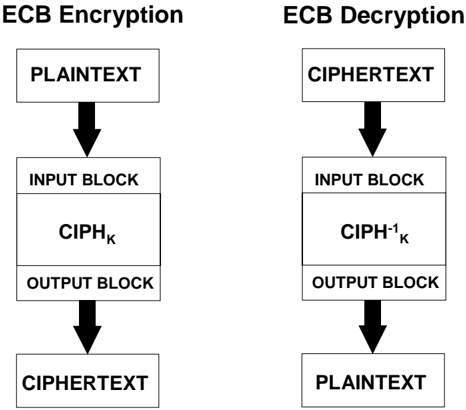
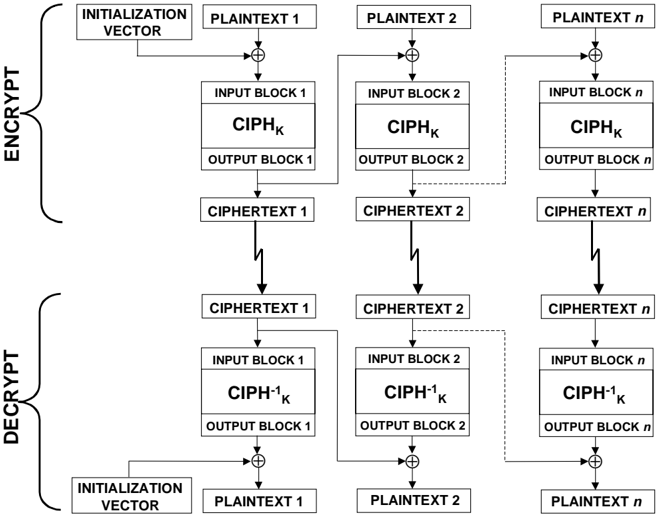
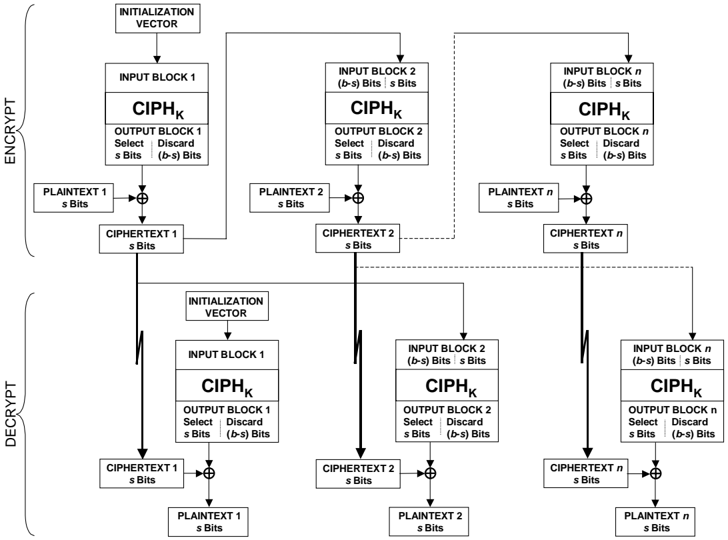
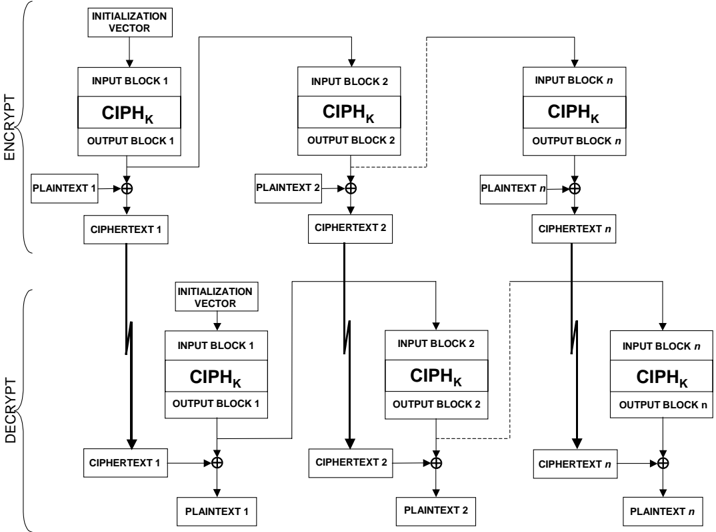
- The recommendation defines five confidentiality modes: Electronic Codebook (ECB), Cipher Block Chaining (CBC), Cipher Feedback (CFB), Output Feedback (OFB), and Counter (CTR), usable with any FIPS-approved block cipher such as AES.
- Three elements are new relative to prior FIPS publications: extension of the four FIPS Pub 81 modes to any FIPS-approved block cipher, revision of their requirements, and specification of the CTR mode.
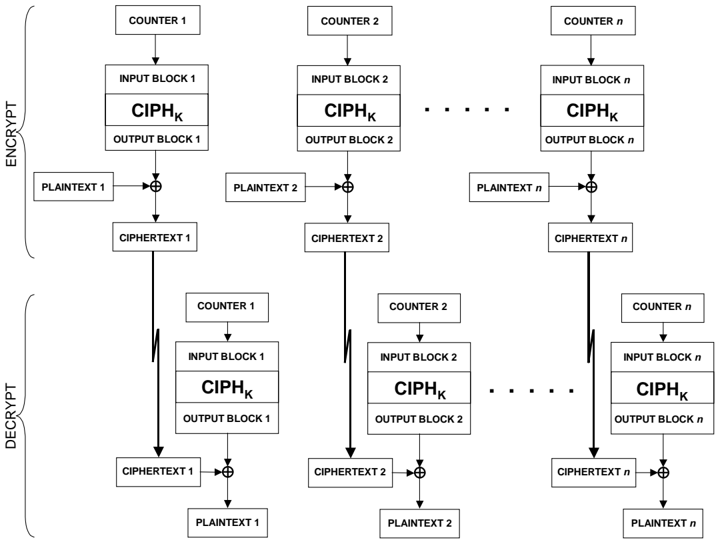
- Parallelism differs by mode: ECB encryption/decryption and CTR encryption/decryption permit parallel forward/inverse cipher operations; CBC and CFB encryption cannot be parallelized but CBC and CFB decryption can; OFB permits neither, though output blocks can be precomputed if the IV is known.
- Error propagation is mode-dependent: in CFB, OFB, and CTR a ciphertext bit error produces specific bit errors in the same positions; in ECB and CBC it produces random bit errors with an expected rate of fifty percent. CBC errors also affect the succeeding block, and CFB errors affect the next b/s (rounded up) segments.
Methods
- Design: a normative specification document defining each mode's encryption and decryption algorithms mathematically, with descriptions, illustrations, and comments on parallel-processing potential.
- Data/sample: no empirical sample; the document provides worked example vectors for each mode using AES with 128-, 192-, and 256-bit keys, including 1-bit, 8-bit, and 128-bit CFB variants, with a common plaintext string formatted into four 128-bit blocks.
- Analysis: appendices cover padding, counter-block generation (standard incrementing function and initial counter-block choice), IV generation, error properties, Triple DES modes, and AES example vectors.
Limitations
- Stated: the document is neither a standard nor a guideline and is neither mandatory nor binding on Federal agencies; it may be used voluntarily. Formatting of the plaintext, including padding, is outside its scope. It does not provide analogues of the interleaved/pipelined ANSI X9.52 modes (TCBC-I, TCFB-P, TOFB-I).
- Stated: the recommendation assumes a secret, random key has been established among parties, and security depends at minimum on the secrecy of the key.
- Evident from the text: the modes provide confidentiality only; the document repeatedly notes that integrity of the IV or ciphertext is not protected by these modes, leaving decryption vulnerable to deliberate bit-error introduction unless integrity is separately protected.
Model-written summary. Check it against the paper before relying on it.
Integrity signals
Registry
Cites
Statistics
Figures
Verification
Claims the paper makes
0 Valid · 0 Not valid · 11 Not checked · 60 Own results and interpretations
A conclusion the paper draws from its own results — it cites no other source for it, so there is none to check. The quote shows it is in the paper.
In the paper
“In particular, if any plaintext block that is encrypted using a given counter block is known, then the output of the forward cipher function can be determined easily from the associated ciphertext block.”
plainstates a cause- Asserted: passes — The authors put it forward as true.
- Checkable: passes — It can be checked against evidence.
- Load-bearing: passes — The paper’s conclusions depend on it.
- Based: passes — The paper gives a reason why it holds.
A conclusion the paper draws from its own results — it cites no other source for it, so there is none to check. The quote shows it is in the paper.
In the paper
“For both the OFB and CFB modes, a bit error may occur, independently, in any bit position of the affected ciphertext blocks (or segments), with an expected error rate of fifty percent.”
hedgedstates a possible cause- Asserted: passes — The authors put it forward as true.
- Checkable: passes — It can be checked against evidence.
- Load-bearing: unclear — It is unclear whether the paper’s conclusions depend on it.
- Based: unclear — It is unclear why the paper says it holds.
A conclusion the paper draws from its own results — it cites no other source for it, so there is none to check. The quote shows it is in the paper.
In the paper
“In the CFB mode, bit errors in the IV affect, at a minimum, the decryption of the first ciphertext segment, and possibly successive ciphertext segments, depending on the bit position of the rightmost bit error in the IV.”
hedgedstates a cause- Asserted: passes — The authors put it forward as true.
- Checkable: passes — It can be checked against evidence.
- Load-bearing: unclear — It is unclear whether the paper’s conclusions depend on it.
- Based: passes — The paper gives a reason why it holds.
A conclusion the paper draws from its own results — it cites no other source for it, so there is none to check. The quote shows it is in the paper.
In the paper
“A bit error may occur, independently, in any bit position in these decrypted segments, with an expected error rate of fifty percent.”
hedgedstates a possible cause- Asserted: passes — The authors put it forward as true.
- Checkable: passes — It can be checked against evidence.
- Load-bearing: unclear — It is unclear whether the paper’s conclusions depend on it.
- Based: unclear — It is unclear why the paper says it holds.
A conclusion the paper draws from its own results — it cites no other source for it, so there is none to check. The quote shows it is in the paper.
In the paper
“However, if the IV is known, the output blocks can be generated prior to the availability of the plaintext or ciphertext data.”
plainstates a cause- Asserted: passes — The authors put it forward as true.
- Checkable: passes — It can be checked against evidence.
- Load-bearing: unclear — It is unclear whether the paper’s conclusions depend on it.
- Based: passes — The paper gives a reason why it holds.
28 more claims
Create a free account to see all 71 claims and to verify the 3 references still open.
- Probably not a substantial claim. 36
- It may state two separate claims as one. 9
Claims other papers make about this one
Each is checked against this paper’s own text: does it say what the citing paper says it does?
The cited source says what the claim attributes to it.
In the citing paper
“On the other hand, stream ciphers can be constructed by block ciphers using the Counter (CTR) and Output FeedBack (OFB) operation mode [294].”
From Robotics cyber security: vulnerabilities, attacks, countermeasures, and recommendations (2022) · cites this paper as [294]
Self-check
Percentages, sums and reported differences re-computed from the paper’s own numbers.
Each contradiction between two passages listed here was confirmed by an independent check.
Rated minor: it would not touch a result — a value no result rests on, a p-value that stays on the same side of the significance level, or a conflict that is clerical, resolved elsewhere in the paper, or outside its own findings.
In the paper
§ Appendix D: Error Properties
“Table D.1 summarizes the effects of bit errors in a ciphertext block or IV on the decryption of the ciphertext for each of the five confidentiality modes.”
§ Appendix D: Error Properties
“Table D.2: Summary of Effect of Bit Errors on Decryption”
Rated minor: it would not touch a result — a value no result rests on, a p-value that stays on the same side of the significance level, or a conflict that is clerical, resolved elsewhere in the paper, or outside its own findings.
In the paper
§ Appendix E: Modes of Triple DES
“the six modes in this recommendation”
§ 3 Introduction
“This recommendation specifies five confidentiality modes of operation for symmetric key block cipher algorithms”
Citations
Cites
Handbook of applied cryptography
(1997) · Choice Reviews Online · doi:10.5860/choice.34-4512 · Cited by 10,357
Handbook of Applied Cryptography
Menezes, A. J., van Oorschot, P. C., & Vanstone, S. A. (2018) · CRC Press eBooks · doi:10.1201/9781439821916 · Cited by 2,896 · cited 1×
“[5] for information about linear feedback shift registers.”
Advanced Encryption Standard (AES)
National Institute of Standards and Technology (US) (2001) · doi:10.6028/nist.fips.197 · Cited by 642
Data encryption standard (DES)
Biryukov, A., & Cannière, C. (2006) · Encyclopedia of Cryptography and Security · doi:10.1007/0-387-23483-7_94 · Cited by 57
Cited by
Items 601–700 of 709
Shams, R. A. (2017) · Daffodil International University Journal of Science and Technology · doi:10.36481/diujst.v12i1.587hvb27
EAES: Extended Advanced Encryption Standard with Extended Security
Azad, A. K., & Mollah, M. Y. (2018) · Advances in Science Technology and Engineering Systems Journal · doi:10.25046/aj030307
Some Studies on the Security and Space Issues and Challenges in Cloud Computing based Data Centers
Rao, N. T., Sekhar, C., Bhattacharyya, D., & Kim, T.-H. (2018) · International Journal of Security and Its Applications · doi:10.14257/ijsia.2018.12.3.01
Validating IGE Mode of Block Cipher from Quantum Adversaries
Kim, S., Lee, J., Choi, R., & Kim, K. (2018)
TWO TIER SECURITY SOLUTION FOR IMPLANTABLE MEDICAL DEVICES
Darji, M. (2016) · Shodhganga
Verifiable Outsourcing of Computations Using Garbled Onions
Dönmez, T. C. M. (2018) · Lecture notes in computer science · doi:10.1007/978-3-030-01141-3_8
Post-Quantum Security of IGE Mode Encryption in Telegram
Lee, J., Kim, S., Lee, S., & Kim, K. (2018) · IEICE Transactions on Fundamentals of Electronics Communications and Computer Sciences · doi:10.1587/transfun.e102.a.148
Efficiency Comparison of Pseudorandom Number Generators Based on Strong Cryptographic Algorithms
Grozov, V., Budko, M. B., Guirik, A. V., & Budko, M. Y. (2018) · International Congress on Ultra Modern Telecommunications and Control Systems and Workshops (ICUMT) · doi:10.1109/icumt.2018.8631223
del Blanco, D. Y. M. (2018) · Buleria (Universidad de León) · doi:10.18002/10612/7959 · Cited by 1
Desmedt, Y. (1998) · Chapman & Hall/CRC applied algorithms and data structures series · doi:10.1201/9781420049503-c39
Khalid, A., Paul, G., & Chattopadhyay, A. (2019) · Computer architecture and design methodologies · doi:10.1007/978-981-10-1070-5_3
Reconsidering Generic Composition.
Namprempre, C., Rogaway, P., & Shrimpton, T. (2014)
Influence of Multiple Encryptions on the Security and Accuracy of Sent and Received Data
(2019) · University of Thi-Qar Journal · doi:10.32792/utq/utj/vol10/2/5
Bulk Mode Encryption Devices Modification for Usage of Quantum Key Distribution
Latinović, N., Al-Atrooshi, H. A. M., Unkašević, T., Peric, M. V., & Veinović, M. Đ. (2019) · Telecommunications Forum (TELFOR) · doi:10.1109/telfor48224.2019.8971354
Productive Client Side Deduplication of Encrypted information in Cloud Storage using Public Auditing
Somnath, K. A., Anil, M. K. N., Tukaram, M. K. V., & Nalawade, V. (2020) · Journal of Emerging Technologies and Innovative Research
Digital Voting Pass: One step towards the digitalization of the entire voting process
Meijer, W., Middendorp, D., Raes, J., & Tubbing, R. (2017) · Research Repository (Delft University of Technology)
The Counter mode with encrypted nonces and its extension to authenticated encryption
Agievich, S. V. (2020) · Математические вопросы криптографии · doi:10.4213/mvk318
Efficient Confidentiality for Network Coded Distributed Storage
Forster, N., Cabrera, J. A., Franz, E., Pfennig, S., & Fitzek, F. H. P. (2020) · Globecom · doi:10.1109/globecom42002.2020.9347955
Secure Evaluation of Knowledge Graph Merging GainPreprint
Eichenberger, L., Cochez, M., Heitmann, B., & Decker, S. (2021) · arXiv (Cornell University) · doi:10.48550/arxiv.2103.00082
Introdução à criptografia para administradores de sistemas com TLS, OpenSSL e Apache mod_ssl
Braga, A. M., & Dahab, R. (2019) · doi:10.5753/sbc.6555.9.5
On Length-Preserving Symmetric Cryptography
Jianwu, Z., Hui, L., & Mingsheng, L. (2007) · Springer eBooks · doi:10.1007/978-1-4020-6266-7_35
Qian, Y., Ye, F., & Chen, H. (2021) · Wiley eBooks · doi:10.1002/9781119244400.ref
Qian, Y., Ye, F., & Chen, H. (2021) · Wiley eBooks · doi:10.1002/9781119244400.ch13
More on Cryptographic Techniques
Qian, Y., Ye, F., & Chen, H. (2021) · Wiley eBooks · doi:10.1002/9781119244400.ch5
Anderson, R. (2020) · Wiley eBooks · doi:10.1002/9781119644682.biblio
Ferguson, N., Schneier, B., & Kohno, T. (2015) · Wiley eBooks · doi:10.1002/9781118722367.biblio
Descripción polinomial de los sistemas de cifrado DES y AES
Méndez, P. S. G. (2011) · doi:10.24275/uami.vm40xr74h
CMVP approved security functions :
Schaffer, K., & Calis, A. (2022) · doi:10.6028/nist.sp.800-140cr1
A System Design Using IoT, IEC61508, IEC61850, and IEEE C37.X to Improve Reliability of Smart Grid
Salpekar, M. (2022) · Lecture notes in electrical engineering · doi:10.1007/978-981-16-8727-3_29
Andrade, V. D., & Zola, W. M. N. (2022) · Anais do Computer on the Beach · doi:10.14210/cotb.v13.p282-289
Primerjava hitrosti simetričnih bločnih šifer
Kompara, M., Jerenko, T., & Hölbl, M. (2020) · Uporabna informatika · doi:10.31449/upinf.vol28.num3.94
Secure Multicast with Source Authentication for the Internet of Things
Martynov, N. (2014) · KTH Publication Database DiVA (KTH Royal Institute of Technology)
Kryptographische Prinzipien und Methoden
Kappes, M. (2022) · Springer eBooks · doi:10.1007/978-3-658-16127-9_2
Estudio y adaptación del algoritmo criptográfico AES para radios cognitivos
Papalotzin, H. C. C. (2019) · doi:10.24275/uami.g158bh37n
High-performance elliptic curve cryptography
Faz-Hernández, A. (2022) · doi:10.47749/t/unicamp.2022.1256761
Leurent, G. (2023) · Wiley eBooks · doi:10.1002/9781394256358.ch5
Efficient Cryptographic Processing Using On-Chip GPUs in System-on-Chip Architectures
Takeda, H., Sugino, E., & Satō, H. (2023) · International Symposium on Computing and Networking Workshops (CANDARW) · doi:10.1109/candarw60564.2023.00022
Counter-Offset mode: A new paradigm in resisting differential cryptanalysis
Nawaz, M. F., & Nawaz, Y. (2024) · Trends in Computer Science and Information Technology · doi:10.17352/tcsit.000078
A Methodology to Evaluate the Security of Block Ciphers Against Neurocryptanalytic Attacks
Andrade, L. J. C., dos Santos, E. B., & de Barros, C. F. (2024) · Lecture notes in networks and systems · doi:10.1007/978-3-031-64650-8_11
AP-EH: An Encryption Hopping Method Based on Action Program Enabled SDN
Zhao, Z., Fan, X., Mao, Q., Xue, H., & Zhao, Q. (2024) · IEEE Access · doi:10.1109/access.2024.3474212 · Cited by 1
Securing FSK-Based Paging System Using Format Preserving Encryption (FPE)
Oh, I., Park, J., Lee, S., Jang, J., & Yim, K. (2024) · Lecture notes on data engineering and communications technologies · doi:10.1007/978-3-031-76452-3_10
STUDY OF THE STATISTICAL SECURITY OF THE AL04 ENCRYPTION ALGORITHM
Хомпыш, А., Kapalova, N. A., Dyusenbayev, D., & Varennikov, V. A. (2024) · Habaršy. Fizika-matematikalyķ ġylymdary seriâsy · doi:10.51889/2959-5894.2024.87.3.014 · Cited by 1
Sundar, S., & Priyadharshini, A. (2024) · International Conference on Emerging Research in Computational Science (ICERCS) · doi:10.1109/icercs63125.2024.10895327 · Cited by 1
In-Vehicle Communication Security
Poudyal, S. (2024) · doi:10.12794/metadc2415890
Parallel implementation of OCB using VAES and GPUs
Pérez-Sarmiento, L. A., & Mancillas-López, C. (2025) · The Journal of Supercomputing · doi:10.1007/s11227-025-07179-w · Cited by 1
Veeramani, K., Gupta, S., & Dhar, A. (2025) · Advances in information security, privacy, and ethics book series · doi:10.4018/979-8-3693-8014-7.ch009
SeGShare: Secure Group File Sharing in the Cloud using Enclaves
Gaud, V. Y. (2025) · International Journal for Research in Applied Science and Engineering Technology · doi:10.22214/ijraset.2025.70327
Uniform Random Number Generators
L’Ecuyer, P. (2025) · Springer eBooks · doi:10.1007/978-3-662-69359-9_736
Tan, Y. C., Tan, W. X., Bajaj, H. S., & Yap, C. N. (2024) · doi:10.1145/3718391.3718422
Deploying a Distributed Data Collection Network for Solar Power Plant Supervision
Trajano, A. F. R., & de Lima, J. L. M. P. (2025) · IEEE Latin Conference on IoT (LCIoT) · doi:10.1109/lciot64881.2025.11118604
Towards a Robust Federated Learning Architecture with Modular Aggregation Strategies
Harasic, M., Laas, R., Lehmann, D., & Paschke, A. (2025) · International Conference on Fog and Mobile Edge Computing (FMEC) · doi:10.1109/fmec65595.2025.11119370
Grijalva, S., Mooney, V. J., III, Lewis, T. M., King, A., Allahverdi, A., Keller, J., Hutto, K., Barrett, R., Holland, B., & Patten, E. (2025) · IEEE Transactions on Industry Applications · doi:10.1109/tia.2025.3606453
Implementation of V2V Communication Security on LoRa-Based Physical Layer Key Generation
Patongai, E. F., Yuliana, M., & Sudarsono, A. (2025) · International Electronics Symposium (IES) · doi:10.1109/ies67184.2025.11160708
Problems of protecting unstructured information on mobile devices
Brovchenko, E. (2025) · Вісник Черкаського державного технологічного університету · doi:10.62660/bcstu/4.2025.25
Deciphering Deception: A Dual Approach to Encryption Algorithm Identification and Truth Detection
Simhadri, S., Raghavendra, & Purushothama, B. R. (2026) · Communications in computer and information science · doi:10.1007/978-3-032-14534-5_20
SwiftOracle: Orthogonality-Driven Private Multipath Validation
Pang, Y., He, A., Hou, W., Teng, Y., Bu, K., Gu, Q., & Ren, K. (2026) · IEEE Transactions on Dependable and Secure Computing · doi:10.1109/tdsc.2026.3661628
Naqiyah, A., Hayati, L. N., & Faradibah, A. (2025) · Jurnal Ilmiah Informatika Komputer · doi:10.35760/ik.2025.v30i3.60
A Comparative Analysis of AES and LWE in Digital Image Encryption
Setiawan, A. N., Kumala, S. D., & Luthfiyah, A. E. (2026) · Griya Journal of Mathematics Education and Application · doi:10.29303/griya.v6i1.1042
Secure File Storage System with Encryption and Role-Based Access
D. Sandhya Rani, B. P., & Banda Architha, M. S. N. (2026) · International Journal of Advanced Research in Science Communication and Technology · doi:10.48175/ijarsct-31809
Caractérisation sécuritaire de circuits basse-consommation face aux attaques par laser
Lacruche, M. (2016) · theses.fr (ABES) · doi:10.70675/f910b9d3zc0e1z4306z95c0z9d23d967cc65
Real-time agricultural image securing system: A selective encryption based approach on edge devices
Alahe, M. A., Chang, Y. K., Gummi, S. R., Kemeshi, J., Won, K., & Yang, X. (2026) · Smart Agricultural Technology · doi:10.1016/j.atech.2026.102076
Adaptive and Reconfigurable Routing Protocol for Efficient Communication in Wireless Sensor Networks
Sudarshan, G. K., & Ganesan, V. (2025) · International Conference on Mathematics, Actuarial Science, Computer Science and Statistics (MACS) · doi:10.1109/macs68476.2025.11453382
Message Prediction Table: Enhancing Robustness Against Replay Attacks in CAN Networks
Zou, J., Miao, H., & Li, X. (2026) · Lecture notes in computer science · doi:10.1007/978-981-95-8417-8_10
Cryptanalysis of symmetric encryption algorithms
Chaigneau, C. (2018) · theses.fr (ABES) · doi:10.70675/48b883c9zae92z4527z9c63z80dd166980a6
Lopes, I. D. C. (2020) · theses.fr (ABES) · doi:10.70675/5d0e7b80z8713z4fa6zae5azace84517c9b9 · Cited by 1
Analyse et traitement des images dans le domaine chiffré
Puteaux, P. (2020) · theses.fr (ABES) · doi:10.70675/fea75605z8385z4290zab17zbff27561d91d
Evaluating the Timeliness of Cryptography for Securing ICS Protocols in Smart Grid
Hettiarachchi, N., Oskouei, S. S., Kariznovi, A., & Mandal, K. (2026) · IEEE Communications Surveys & Tutorials · doi:10.1109/comst.2026.3680907
Cryptographic primitives adapted to connected car requirements
Tehrani, E. (2022) · theses.fr (ABES) · doi:10.70675/0a7a6aadz79f3z4f2bzac46zb93cbfd5e86d
Diri, S., & Kayapınar, Ö. B. (2026) · International Conference on Artificial Intelligence, Computer, Data Sciences and Applications (ACDSA) · doi:10.1109/acdsa67686.2026.11468255
Recommendation for Cryptographic Key Generation
Dang, Q. H. (2026) · doi:10.6028/nist.sp.800-133r3.ipd
AxLEA: Approximate ARX-based Lightweight Encryption Algorithm for Resource Constrained Devices
Vivekananda, G., Thejaswini, P., Nandi, S., & Jose, J. (2026) · ACM Transactions on Embedded Computing Systems · doi:10.1145/3810948
Understanding and Simplifying the UK NCSC Modes GLEVIAN and VIGORNIAN
Mennink, B. (2026) · IACR Communications in Cryptology · doi:10.62056/anxra6qiu
How to Build a Short-Input Random Oracle from Public Random Permutations
Bhaumik, R., Datta, N., Dutta, A., Jha, A., Mandal, S., Mennink, B., Nandi, H., & Shen, Y. (2026) · Lecture notes in computer science · doi:10.1007/978-3-032-25333-0_14
Reimer, L. M., Nissen, L., Starnecker, F., Stepanova, O., Dufour, F., Ney, R., Najem, S. A., Schunkert, H., & Jonas, S. (2026) · JMIR Formative Research · doi:10.2196/77983
Hybrid S-Box and Caesar-Based Polyalphabetic Cipher for Enhanced Lightweight Encryption
Barik, S., Malick, C., Biswas, P., & Kar, N. (2026) · International Conference on Smart Futuristic Technology (SMARTTECH) · doi:10.1109/icsft66733.2026.11506987 · Cited by 1
Hardware Implementation of AES-256 Encryption on FPGA for Real-Time Video Stream Security
Akilandeswari, A. (2026) · International Conference on Trends in Electronics and Informatics (ICOEI) · doi:10.1109/icoei68323.2026.11541675
Lestari, A. A., Suryadi, M., Ramli, K., Gunawan, T. S., Agustina, E. R., Windarta, S., Wildan, W., & Triputra, F. R. (2026) · Journal of King Saud University - Computer and Information Sciences · doi:10.1007/s44443-026-00956-4
DEVELOPMENT AND STUDY OF BLOCK ENCRYPTION ALGORITHM BASED ON CELLULAR AUTOMATA
Ostapov, S., & Diakonenko, B. (2026) · Advanced Information Systems · doi:10.20998/2522-9052.2026.3.12
Experimental Integration of Quantum Key Distribution for Secure 5G Networks
Yu, Y., Takahashi, R., & Tanizawa, Y. (2026) · International Conference on Communications · doi:10.1109/icc59461.2026.11588124
Turan, C. G., Keskin, F., & Işık, G. (2026) · Concurrency and Computation Practice and Experience · doi:10.1002/cpe.70879
Kranas, G. K., Spathoulas, G. P., Loukopoulos, T., & Dadaliaris, A. N. (2026) · Electronics · doi:10.3390/electronics15153251
LISHARK: Lightweight Side Channel Protected Secure Hardware Extension with Re-keying
Chatterjee, S., Chowdhury, S., Chatterjee, U., & Mukhopadhyay, D. (2026) · ACM Transactions on Embedded Computing Systems · doi:10.1145/3834776
Side-Channel Leakage Assessment of an FPGA-Based AES-256 Implementation Using TVLA
Rosa, P., & Waszkiewicz, D. (2026) · Electronics · doi:10.3390/electronics15153306
Mishra, J., Sahay, S. K., Mishra, S., & Pathak, A. (2026) · Computers · doi:10.3390/computers15080479
A Hybrid AES-256 and Multi-Power RSA Framework for Efficient Secure Instant Messaging
Rachmawati, D., & Rahman, M. H. (2026) · International Conference on Smart Computing, IoT and Machine Learning (SIML) · doi:10.1109/siml69834.2026.11621131
Mishra, J., Sahay, S. K., Mishra, S., & Pathak, A. (2026) · Chips · doi:10.3390/chips5030025
Alkhodary, A., & Baktır, S. (2026) · International Conference on Electrical, Computer and Energy Technologies (ICECET) · doi:10.1109/icecet65726.2026.11632440
Fazio, A. (2026) · Springer eBooks · doi:10.1007/978-3-032-30243-4_11
Secure Sudoku Mapping for Dual-Image Reversible Data Hiding
Luyen, C. T. (2026) · Journal of Science and Technology on Information security · doi:10.54654/isj.v2i28.6419
Shagor, M. S. I. (2026) · Research Square · doi:10.21203/rs.3.rs-10812590/v1
Feistel-based Shuffling for Enhancing Security in LSM Storage Systems
Geng, T., & Huang, C. (2026) · International Conference on Computer Communications and Networks (ICCCN) · doi:10.1109/icccn69946.2026.11662914
Recommendation for Block Cipher Modes of Operation
Turan, M. S. (2026) · doi:10.6028/nist.sp.800-38er1.ipd
Ciphertext-only classification of encryption algorithms using deep learning
Alimzhanova, Z., Zharykov, M., Zhunusbayeva, S., Тулешева, Г., & Smatova, G. (2026) · Journal of Intelligent Systems · doi:10.1515/jisys-2025-0372
NETA: Nonce-Free Extended-Block Transform for AES
Gueron, S. (2026) · Advances in intelligent systems and computing · doi:10.1007/978-3-032-27214-0_13
A Proposal for Open Service Authentication Signals and Capabilities for Galileo 2nd Generation
Caparra, G., Broi, G. D., Garcia-Molina, J. A., Risueno, G. L., Wallner, S., Ceccato, M., Moretto, F., Hernandez, I. F., Simon, J., Damy, S., et al. (2026) · ESA Workshop on Satellite Navigation Technologies and European Workshop on GNSS Signals and Signal Processing · doi:10.1109/navitec202669090.2026.11692539
Metadata
- Authors
- Dworkin, M. J.
- Affiliations
- National Institute of Standards and Technology (US)
- Corresponding author
- Dworkin, M J
- ORCID
- Dworkin, M J
- Published
- 2001
- OpenAlex
- W112964067
- Cited by
- 746
- References
- 5
- Citations by year
- 2026: 59 · 2025: 38 · 2024: 41 · 2023: 25 · 2022: 33 · 2021: 30 · 2020: 37 · 2019: 44 · 2018: 48 · 2017: 44 · 2016: 34 · 2015: 35 · 2014: 32 · 2013: 31 · 2012: 33
- Type
- report
- Language
- en
- Open access
- gold
- doi.org
- Licence
- public-domain
- Topics
- Physical Sciences › Computer Science › Artificial Intelligence › Cryptographic Implementations and Security
- Physical Sciences › Mathematics › Discrete Mathematics and Combinatorics › Coding theory and cryptography
- Physical Sciences › Computer Science › Information Systems › Cryptography and Residue Arithmetic
- Keywords
- block cipher, modes of operation, encryption modes, NIST standards
About these checks
Registry, retraction, Cites and statistics results are computed, not judged, with one exception: a printed reference that no index lists is read once by a model before it counts as a citation error. Claims are extracted by a model and kept only when their quote appears verbatim in the text; each cited source is then checked, with a model’s help, for whether it says what the claim relies on. Those verdicts can be wrong — read the claim’s quote and the cited source before relying on one.
A language model drew the claims from the paper on 2026-10-21, under version 3 of the claim definition (model deepseek-v4.1-flash, prompt extract-v3).
A second model labelled each claim on 2026-10-21 (model jev-1.13-20260917, definition revision gold-guideline-v0.2).
Statistics and arithmetic are recomputed, not judged.
Confidence bands are shown only for fields calibrated on our annotated test set. None is calibrated yet, so no band is shown.
What counts as a claim ›How we measure confidence ›How we check this ›
Are you an author, or do you see a problem with this page? Request a review
Data sources
Bibliographic data: Semantic Scholar, OpenAlex, Crossref.
Contains information from the Semantic Scholar Academic Graph Datasets, made available under the ODC Attribution License (ODC-BY 1.0).
Semantic Scholar’s data is described in: Kinney, R., et al. (2023). The Semantic Scholar Open Data Platform. arXiv:2301.10140.
