

Recommendation for block cipher modes of operation: methods and techniques
Open accessThe DOI matches its Crossref record; 4 of the 5 references it cites were found in a registry or an index; none of the 14 sources its claims cite is checked for support yet.
Abstract
Reports on Information Security TechnologyThe Information Technology Laboratory (ITL) at the National Institute of Standards and Technology (NIST) promotes the U.S. economy and public welfare by providing technical leadership for the Nation's measurement and standards infrastructure.ITL develops tests, test methods, reference data, proof of concept implementations, and technical analyses to advance the development and productive use of information technology.ITL's responsibilities include the development of technical, physical, administrative, and management standards and guidelines for the cost-effective security and privacy of sensitive unclassified information in Federal computer systems.This Special Publication 800-series reports on ITL's research, guidance, and outreach efforts in computer security, and its collaborative activities with industry, government, and academic organizations.Certain commercial entities, equipment, or materials may be identified in this document in order to describe an experimental procedure or concept adequately.Such identification is not intended to imply recommendation or endorsement by the National Institute of Standards and Technology, nor is it intended to imply that the entities, materials, or equipment are necessarily the best available for the purpose.
Overview
CoChat Summary
TL;DR
NIST Special Publication 800-38A specifies five confidentiality modes of operation (ECB, CBC, CFB, OFB, and CTR) for use with any FIPS-approved symmetric key block cipher, extending four modes previously defined for DES and adding the CTR mode. It provides mathematical specifications, IV and counter-generation guidance, error-propagation properties, and worked AES example vectors.
Key findings
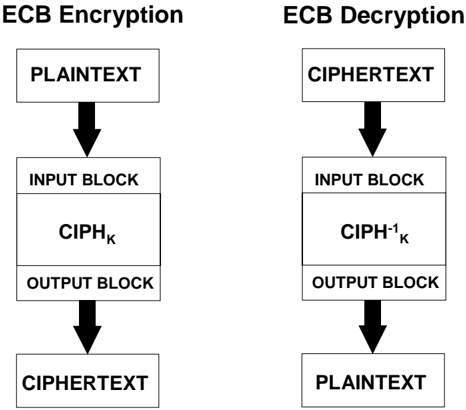
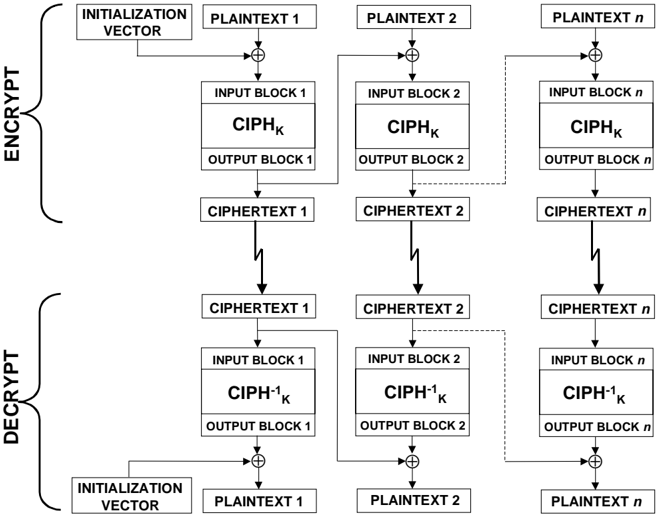
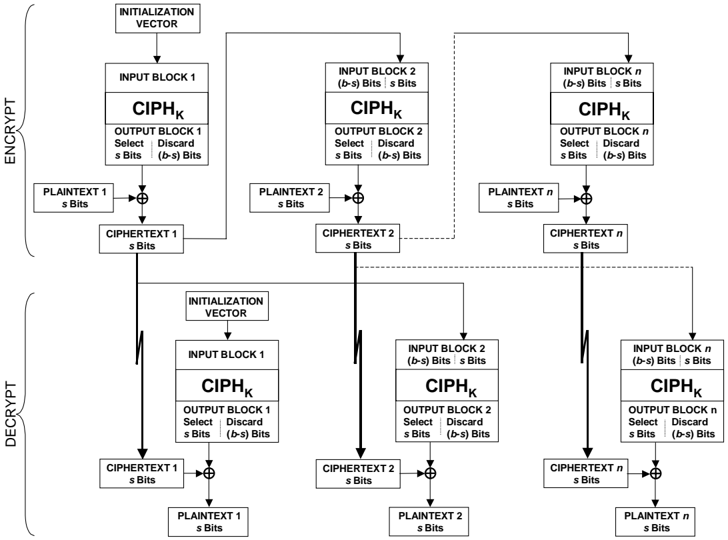
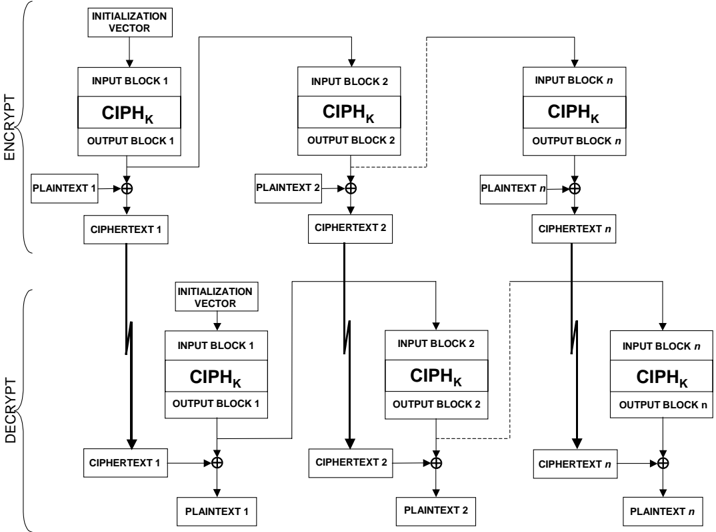
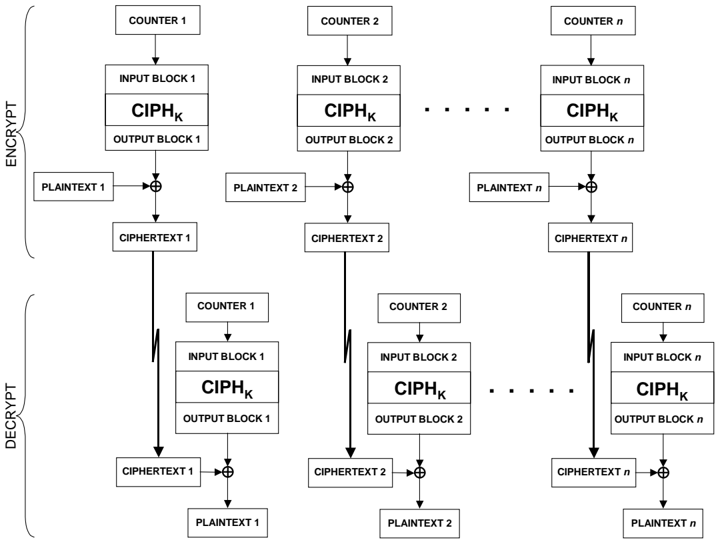
- The recommendation defines five confidentiality modes: Electronic Codebook (ECB), Cipher Block Chaining (CBC), Cipher Feedback (CFB), Output Feedback (OFB), and Counter (CTR), usable with any FIPS-approved block cipher such as AES.
- Three elements are new relative to prior FIPS publications: extension of the four FIPS Pub 81 modes to any FIPS-approved block cipher, revision of their requirements, and specification of the CTR mode.
- Parallelism differs by mode: ECB encryption/decryption and CTR encryption/decryption permit parallel forward/inverse cipher operations; CBC and CFB encryption cannot be parallelized but CBC and CFB decryption can; OFB permits neither, though output blocks can be precomputed if the IV is known.
- Error propagation is mode-dependent: in CFB, OFB, and CTR a ciphertext bit error produces specific bit errors in the same positions; in ECB and CBC it produces random bit errors with an expected rate of fifty percent. CBC errors also affect the succeeding block, and CFB errors affect the next b/s (rounded up) segments.
Methods
- Design: a normative specification document defining each mode's encryption and decryption algorithms mathematically, with descriptions, illustrations, and comments on parallel-processing potential.
- Data/sample: no empirical sample; the document provides worked example vectors for each mode using AES with 128-, 192-, and 256-bit keys, including 1-bit, 8-bit, and 128-bit CFB variants, with a common plaintext string formatted into four 128-bit blocks.
- Analysis: appendices cover padding, counter-block generation (standard incrementing function and initial counter-block choice), IV generation, error properties, Triple DES modes, and AES example vectors.
Limitations
- Stated: the document is neither a standard nor a guideline and is neither mandatory nor binding on Federal agencies; it may be used voluntarily. Formatting of the plaintext, including padding, is outside its scope. It does not provide analogues of the interleaved/pipelined ANSI X9.52 modes (TCBC-I, TCFB-P, TOFB-I).
- Stated: the recommendation assumes a secret, random key has been established among parties, and security depends at minimum on the secrecy of the key.
- Evident from the text: the modes provide confidentiality only; the document repeatedly notes that integrity of the IV or ciphertext is not protected by these modes, leaving decryption vulnerable to deliberate bit-error introduction unless integrity is separately protected.
Model-written summary. Check it against the paper before relying on it.
Integrity signals
Registry
Cites
Statistics
Figures
Verification
Claims the paper makes
0 Valid · 0 Not valid · 11 Not checked · 60 Own results and interpretations
A conclusion the paper draws from its own results — it cites no other source for it, so there is none to check. The quote shows it is in the paper.
In the paper
“In particular, if any plaintext block that is encrypted using a given counter block is known, then the output of the forward cipher function can be determined easily from the associated ciphertext block.”
plainstates a cause- Asserted: passes — The authors put it forward as true.
- Checkable: passes — It can be checked against evidence.
- Load-bearing: passes — The paper’s conclusions depend on it.
- Based: passes — The paper gives a reason why it holds.
A conclusion the paper draws from its own results — it cites no other source for it, so there is none to check. The quote shows it is in the paper.
In the paper
“For both the OFB and CFB modes, a bit error may occur, independently, in any bit position of the affected ciphertext blocks (or segments), with an expected error rate of fifty percent.”
hedgedstates a possible cause- Asserted: passes — The authors put it forward as true.
- Checkable: passes — It can be checked against evidence.
- Load-bearing: unclear — It is unclear whether the paper’s conclusions depend on it.
- Based: unclear — It is unclear why the paper says it holds.
A conclusion the paper draws from its own results — it cites no other source for it, so there is none to check. The quote shows it is in the paper.
In the paper
“In the CFB mode, bit errors in the IV affect, at a minimum, the decryption of the first ciphertext segment, and possibly successive ciphertext segments, depending on the bit position of the rightmost bit error in the IV.”
hedgedstates a cause- Asserted: passes — The authors put it forward as true.
- Checkable: passes — It can be checked against evidence.
- Load-bearing: unclear — It is unclear whether the paper’s conclusions depend on it.
- Based: passes — The paper gives a reason why it holds.
A conclusion the paper draws from its own results — it cites no other source for it, so there is none to check. The quote shows it is in the paper.
In the paper
“A bit error may occur, independently, in any bit position in these decrypted segments, with an expected error rate of fifty percent.”
hedgedstates a possible cause- Asserted: passes — The authors put it forward as true.
- Checkable: passes — It can be checked against evidence.
- Load-bearing: unclear — It is unclear whether the paper’s conclusions depend on it.
- Based: unclear — It is unclear why the paper says it holds.
A conclusion the paper draws from its own results — it cites no other source for it, so there is none to check. The quote shows it is in the paper.
In the paper
“However, if the IV is known, the output blocks can be generated prior to the availability of the plaintext or ciphertext data.”
plainstates a cause- Asserted: passes — The authors put it forward as true.
- Checkable: passes — It can be checked against evidence.
- Load-bearing: unclear — It is unclear whether the paper’s conclusions depend on it.
- Based: passes — The paper gives a reason why it holds.
28 more claims
Create a free account to see all 71 claims and to verify the 3 references still open.
- Probably not a substantial claim. 36
- It may state two separate claims as one. 9
Claims other papers make about this one
Each is checked against this paper’s own text: does it say what the citing paper says it does?
The cited source says what the claim attributes to it.
In the citing paper
“On the other hand, stream ciphers can be constructed by block ciphers using the Counter (CTR) and Output FeedBack (OFB) operation mode [294].”
From Robotics cyber security: vulnerabilities, attacks, countermeasures, and recommendations (2022) · cites this paper as [294]
Self-check
Percentages, sums and reported differences re-computed from the paper’s own numbers.
Each contradiction between two passages listed here was confirmed by an independent check.
Rated minor: it would not touch a result — a value no result rests on, a p-value that stays on the same side of the significance level, or a conflict that is clerical, resolved elsewhere in the paper, or outside its own findings.
In the paper
§ Appendix D: Error Properties
“Table D.1 summarizes the effects of bit errors in a ciphertext block or IV on the decryption of the ciphertext for each of the five confidentiality modes.”
§ Appendix D: Error Properties
“Table D.2: Summary of Effect of Bit Errors on Decryption”
Rated minor: it would not touch a result — a value no result rests on, a p-value that stays on the same side of the significance level, or a conflict that is clerical, resolved elsewhere in the paper, or outside its own findings.
In the paper
§ Appendix E: Modes of Triple DES
“the six modes in this recommendation”
§ 3 Introduction
“This recommendation specifies five confidentiality modes of operation for symmetric key block cipher algorithms”
Citations
Cites
Handbook of applied cryptography
(1997) · Choice Reviews Online · doi:10.5860/choice.34-4512 · Cited by 10,357
Handbook of Applied Cryptography
Menezes, A. J., van Oorschot, P. C., & Vanstone, S. A. (2018) · CRC Press eBooks · doi:10.1201/9781439821916 · Cited by 2,896 · cited 1×
“[5] for information about linear feedback shift registers.”
Advanced Encryption Standard (AES)
National Institute of Standards and Technology (US) (2001) · doi:10.6028/nist.fips.197 · Cited by 642
Data encryption standard (DES)
Biryukov, A., & Cannière, C. (2006) · Encyclopedia of Cryptography and Security · doi:10.1007/0-387-23483-7_94 · Cited by 57
Cited by
Items 501–600 of 709
The Platform Built Based on the Mode operations of AES and the Image Applications
Huang, C.-W., Tu, Y.-H., Liu, S.-H., & Yeh, H.-C. (2011) · International Journal of Modern Education and Computer Science · doi:10.5815/ijmecs.2011.04.01 · Cited by 1
ASCDS: a smartphone confidential data storage scheme
Yang, Z. H., Wang, M., Zhu, L. H., & Yang, H. (2013) · International Journal of Wireless and Mobile Computing · doi:10.1504/ijwmc.2013.057580 · Cited by 1
CFB under sliding-window protocols in error channels
Liang, X., Xiao, Y., Vasilakos, A. V., Deng, H., & Meng, K. (2010) · IEEE Military Communications Conference (MILCOM) · doi:10.1109/milcom.2010.5680161 · Cited by 1
Efficient modeling and implementation of advanced encryption standard using SystemC
Painkras, E. (2005) · IEEE International Symposium on Signal Processing and Information Technology (ISSPIT) · doi:10.1109/isspit.2004.1433694 · Cited by 1
Attie, A., Fadlallah, A., & Raad, M. (2015) · International Conference on Applied Research in Computer Science and Engineering (ICAR) · doi:10.1109/arcse.2015.7338137 · Cited by 1
Cryptographic Tools for Cloud Environments
Alderman, J., Crampton, J., & Martin, K. M. (2015) · Computer communications and networks · doi:10.1007/978-3-319-25988-8_2 · Cited by 1
A fast parallel cryptography algorithm based on AES-NI
Fei, X., Li, K., & Yang, W. (2016) · Journal of Intelligent & Fuzzy Systems · doi:10.3233/jifs-169039 · Cited by 2
Complex Event Processing for Automated Security Event Analysis
Shein, R. (2012) · Auerbach Publications eBooks · doi:10.1201/b11802-29 · Cited by 1
The Definition and Software Performance of Hashstream, a Fast Length-Flexible PRF
Krovetz, T. (2018) · Cryptography · doi:10.3390/cryptography2040031 · Cited by 1
A Challenging but Feasible Blockwise-Adaptive Chosen-Plaintext Attack on SSL.
Bard, G. V. (2006) · Cited by 1
Ransomware Attack using AES Encryption on ECB, CBC and CFB Mode
Antariksa, F. A. (2019) · Jurnal Ilmu Komputer · doi:10.24843/jik.2019.v12.i01.p06 · Cited by 1
A Proposed System for Electric Charging Vehicle Infrastructure
Salpekar, M. (2021) · Lecture notes in electrical engineering · doi:10.1007/978-981-16-1299-2_12 · Cited by 1
Template Attack Against AES in Counter Mode With Unknown Initial Counter
Tienteu, M., Smith, E., Santillan, E. M., Kornegay, K., Harvey, P., Toutsop, O., Yimer, T. M., Morris, V., & Wandji, K. (2023) · IEEE Annual Computing and Communication Workshop and Conference (CCWC) · doi:10.1109/ccwc57344.2023.10099238 · Cited by 1
A Practical Analysis of Techniques for Minting Genetic Information as NFTs in Blockchain Technology
Radovancovici, M., Galiş, D., & Pungilă, C. (2022) · International Symposium on Symbolic and Numeric Algorithms for Scientific Computing (SYNASC) · doi:10.1109/synasc57785.2022.00060 · Cited by 1
MASTERING CLOUD SECURITY: TECHNIQUES AND BEST PRACTICES
Haq, M. N. U., & Sharma, M. K. (2023) · GRF BOOKS · doi:10.52458/9788196869434.2023.eb.grf.ch-07 · Cited by 1
An Approach to Standardize Keys Used in Image Encryption Algorithms
Oravec, J., Ovseník, Ľ., & Andrejčík, S. (2024) · International Conference Radioelektronika · doi:10.1109/radioelektronika61599.2024.10524083 · Cited by 1
A modified RC ‐4 cryptosystems to enhance security by using negative key schedule
Singh, P., Dutta, S., & Pranav, P. (2024) · Security and Privacy · doi:10.1002/spy2.438 · Cited by 1
Performance Evaluation of Block Cipher Algorithms Implementations in ARM Architecture
López-Hernández, L., Cabrera, A. P., Priego, M. D. P., Abiega-L'Eglisse, A. F. D., & Gallegos-García, G. (2024) · International Conference on Electrical, Computer and Energy Technologies (ICECET) · doi:10.1109/icecet61485.2024.10698142 · Cited by 1
Cho, C., Youn, T.-Y., Kim, B., & Cho, H. (2024) · Computer Modeling in Engineering & Sciences · doi:10.32604/cmes.2024.056952 · Cited by 1
Hybrid Cost-Effective Decapsulation of Chips for Successful Laser Fault Injection
Bekar, F., & Bayrakci, A. A. (2024) · doi:10.1109/isctrkiye64784.2024.10779269 · Cited by 1
Park, J.-Y., Kim, S., Lee, W., Kang, B. G., Song, I.-J., Oh, J. H., & Sakurai, K. (2025) · ACM Transactions on Embedded Computing Systems · doi:10.1145/3715961 · Cited by 1
ECP: Coprocessor Architecture to Protect Program Logic Consistency
Gao, Y., Lu, S., Wang, Y., Fan, H., Han, Q., & Li, J. (2025) · Journal of Software Evolution and Process · doi:10.1002/smr.70023 · Cited by 2
Symmetric Key Protocols Including Ciphers
Gebotys, C. H. (2009) · Springer eBooks · doi:10.1007/978-1-4419-1530-6_6 · Cited by 1
Design and implementation of a Chaotic Cipher block chaining mode for image encryption
Hue, T. T. K., Hoang, T. M., & Assad, S. E. (2013) · International Conference on Advanced Technologies for Communications · doi:10.1109/atc.2013.6698102 · Cited by 1
Secure configuration schemes for FPGA-based systems with simple key management
Errandani, A., Doumar, A., & Châtelet, Ė. (2012) · Southern Conference on Programmable Logic (SPL) · doi:10.1109/spl.2012.6211771 · Cited by 1
Model secret sharing schemes in systems transmit video
Sagaydak, D., & Файзуллин, Р. Р. (2013) · Computer Optics · doi:10.18287/0134-2452-2013-37-1-105-112 · Cited by 1
New Efficient Padding Methods Secure Against Padding Oracle Attacks
Kang, H., Park, M., Moon, D., Lee, C., Kim, J., Kim, J., Kim, J., & Hong, S. (2016) · Lecture notes in computer science · doi:10.1007/978-3-319-30840-1_21 · Cited by 1
Wireless sensor node and RFID based safe retrieval of anti-personnel mines
Roy, S., & Nene, M. J. (2016) · International Conference on Advances in Electrical, Electronics, Information, Communication and Bio-Informatics · doi:10.1109/aeeicb.2016.7538341 · Cited by 1
Model of nonconventional encryption algorithm based on nested Feistel network
Nyssanbayeva, S., Kalimoldayev, M., & Magzom, M. (2016) · Open Engineering · doi:10.1515/eng-2016-0030 · Cited by 1
Kaur, T., & Sharma, R. (2013) · International Conference on Image Information Processing (ICIIP) · doi:10.1109/iciip.2013.6707678 · Cited by 1
In-place Logic Obfuscation for Emerging Nonvolatile FPGAs
Chen, Y., Wang, Y., Zhang, W., Chen, Y., & Li, H. H. (2017) · Springer eBooks · doi:10.1007/978-3-319-50057-7_11 · Cited by 1
Lightweight format-compliant encryption algorithm for JPEG 2000 images
Fawaz, Z., Noura, H., & Mostefaoui, A. (2017) · International Wireless Communications and Mobile Computing Conference (IWCMC) · doi:10.1109/iwcmc.2017.7986569 · Cited by 1
Performance analysis of symmetric block cryptosystems on Android platform
Grgić, K., Kovacevic, Z., & Križanović, V. (2017) · International Conference on Smart Systems and Technologies (SST) · doi:10.1109/sst.2017.8188687 · Cited by 1
Polysizemic Encryption: Towards a Variable-Length Output Symmetric-Key Cryptosystem
Hendricks, J., Burke, B., & Gamage, T. T. (2019) · IEEE Annual International Computer Software and Applications Conference (COMPSAC) · doi:10.1109/compsac.2019.10288 · Cited by 1
Repurposing Software Defenses with Specialized Hardware
Sinha, K. (2019) · doi:10.7916/d8-e6tc-kr63 · Cited by 1
Enhanced Scrambled Prime Key Encryption Using Chaos Theory and Steganography
Vedantam, S. S., Devaruppala, K., & Nanduri, R. S. (2019) · Lecture notes on data engineering and communications technologies · doi:10.1007/978-3-030-34080-3_12 · Cited by 1
Security Analysis and Countermeasures of an End-to-End Encryption Scheme of LINE
Isobe, T., & Minematsu, K. (2019) · IEICE Transactions on Fundamentals of Electronics Communications and Computer Sciences · doi:10.1587/transfun.2019eap1041 · Cited by 2
An Efficient Security Scheme for the Internet of Things with Resource-Constrained Devices
Wu, X.-W., Farag, W., Ali, S., & Kulkarni, S. (2019) · IEEE Annual Ubiquitous Computing, Electronics & Mobile Communication Conference (UEMCON) · doi:10.1109/uemcon47517.2019.8993102 · Cited by 2
Decentralized Identifier Distribution for Moving Target Defense and Beyond
Krohmer, D., & Schotten, H. D. (2020) · International Conference on Cyber Situational Awareness, Data Analytics and Assessment (CyberSA) · doi:10.1109/cybersa49311.2020.9139717 · Cited by 1
Design and SystemC Implementation of Chaos-Based Enhancements for the Advanced Encryption Standard
Sbiaa, F., Machhout, M., & Zeghid, M. (2017) · International Conference on Computer Theory and Applications (ICCTA) · doi:10.1109/iccta43079.2017.9497217 · Cited by 1
Revisiting the Security of COMET Authenticated Encryption Scheme
Gueron, S., Jha, A., & Nandi, M. (2021) · Lecture notes in computer science · doi:10.1007/978-3-030-92518-5_1 · Cited by 1
Adams, C. M. (2021) · Springer eBooks · doi:10.1007/978-3-030-81043-6_11 · Cited by 1
Implementation of Lightweight Cryptographic Algorithms in IoT Devices and Sensor Networks
Hassan, A. (2022) · Lecture notes in networks and systems · doi:10.1007/978-3-031-18458-1_10 · Cited by 1
Implementing Cryptographic Primitives in the Symbolic Model
Laud, P. (2011) · Lecture notes in computer science · doi:10.1007/978-3-642-20398-5_20 · Cited by 1
Design of a Password-Based EAP Method
Manganaro, A., Koblensky, M., & Loreti, M. (2008) · Communications in computer and information science · doi:10.1007/978-3-540-88653-2_26 · Cited by 1
The Virtues of Mature and Minimalist Cryptography
Troutman, J. (2008) · IEEE Security & Privacy · doi:10.1109/msp.2008.99 · Cited by 1
Streaming encryption for a secure wavelength and time domain hopped optical network
Chan, H., Hodjat, A., Shi, J. D., Wesel, R. D., & Verbauwhede, I. M. R. (2004) · International Conference on Information Technology: Coding and Computing (ITCC) · doi:10.1109/itcc.2004.1286715 · Cited by 1
A Protocol for Secure Public Instant Messaging (Extended Version)
Mannan, M., & van Oorschot, P. C. (2006) · Cited by 1
Side Channel Analyses of CBC Mode Encryption
Yau, A. K. L. (2009) · OpenGrey (Institut de l'Information Scientifique et Technique) · Cited by 1
Tranformation of CPU-based Applications To Leverage on Graphics Processors using CUDA
Hussin, F. A., Nazlee, A. M., & Ali, N. B. Z. (2011) · Cited by 1
CMVP approved security functions:
Schaffer, K. (2020) · doi:10.6028/nist.sp.800-140c · Cited by 1
Itier, V., Puteaux, P., & Puech, W. (2022) · Wiley eBooks · doi:10.1002/9781119987390.ch4 · Cited by 1
Encryption and Security of Counter Mode
Mennink, B. (2023) · Wiley eBooks · doi:10.1002/9781394256358.ch11 · Cited by 1
Authenticated Encryption on FPGAs from the Reconfigurable Part to the Static Part
Abdellatif, K. M. (2014) · theses.fr (ABES) · doi:10.70675/6ea09c8bz1140z4416z9afez41888dc17ac7 · Cited by 1
Parallel reconfigurable hardware architectures for video processing applications
Ali, K. M. A. (2018) · theses.fr (ABES) · doi:10.70675/d7388d6czb24fz476az802az93b81127a017 · Cited by 1
Machicao, J., Baetens, J. M., Marco, A. G., Bernard De Baets, C., & Bruno, O. M. (2015) · Communications in Nonlinear Science and Numerical Simulation · doi:10.1016/j.cnsns.2015.01.022
DESIGN OF A PASSWORD-BASED AUTHENTICATION METHOD FOR WIRELESS NETWORKS
Manganaro, A., Koblensky, M., & Loreti, M. (2007) · International Conference on Wireless Information Networks and Systems · doi:10.5220/0002147200090016
Counter mode encryption for FNBDT/MELP
Sleezer, R., Daniel, E. J., Raymond, J., Brewer, J., & Teague, K. A. (2003) · IEEE International Midwest Symposium on Circuits and Systems (MWSCAS) · doi:10.1109/mwscas.2002.1187134
Cryptographic Coprocessors for Embedded Systems
Hamilton, M. (2014) · Arrow@dit (Dublin Institute of Technology)
Neyman, S. N., Guritman, S., & Sari, R. P. (2007)
Structural Binary CBC Encryption Mode
Yeh, Y., Huang, T.-Y., & Lin, H.-Y. (2009) · doi:10.6688/jise.2009.25.3.18
Méthodologie de conception automatique pour multiprocesseur sur puce hétérogène
Li, X. (2009) · OpenGrey (Institut de l'Information Scientifique et Technique)
Conventional Cryptographic Primitives
Rijmen, V. (2010) · Springer eBooks · doi:10.1007/978-0-387-73821-5_9
Security of Hash-then-CBC Key Wrapping Revisited
Osaki, Y., & Iwata, T. (2011) · Lecture notes in computer science · doi:10.1007/978-3-642-25516-8_25 · Cited by 1
Design and analysis of an FPGA-based, multi-processor HW-SW system for SCC applications
Fitzgerald, A. F. (2010) · RIT Scholar Works (Rochester Institute of Technology)
Network Adversary Attacks against Secure Encryption Schemes
Gligor, V. D., Parno, B. J., & Shin, J. S. (2015) · IEICE Transactions on Communications · doi:10.1587/transcom.e98.b.267
Alshahrani, A. M., & Walker, S. D. (2014) · International journal of Computer Networks & Communications · doi:10.5121/ijcnc.2014.6208
A study on encryption method in group communication using RSA accumulator
Hatano, Y., Miyazaki, K., & Kaneko, T. (2007) · International Symposium on Communications and Information Technologies · doi:10.1109/iscit.2007.4392244
Efficient Implementation of Crypto Processing Based on Pre_Buffered Key Stream Method
Kang, C., Kim, E.-C., Park, J.-M., & Ryou, J.-C. (2013) · 정보보호학회논문지 · doi:10.13089/jkiisc.2013.23.6.989
Hwang, S., Park, M., Moon, D., Kang, H., Kim, J. S., & Lee, C. (2015) · KIPS Transactions on Computer and Communication Systems · doi:10.3745/ktccs.2015.4.2.73
Designing a universal format for encrypted media
Swaminathan, V., Mitra, S., & Wei, S. (2013) · IEEE International Workshop on Multimedia Signal Processing (MMSP) · doi:10.1109/mmsp.2013.6659265
Efficient File System Level Encryption Mechanism Using HSM
Kang, C., Won, J.-J., Park, S., & Ryou, J.-C. (2013) · 정보보호학회논문지 · doi:10.13089/jkiisc.2013.23.5.849
DC‐balanced perfect classified channel for hiding framing signals
Sawada, J., & Nishi, H. (2013) · IEEJ Transactions on Electrical and Electronic Engineering · doi:10.1002/tee.21904
A Comment to the Intelligent Functions of Different Weight Ciphers
Luo, L., Qin, Z., & Zhou, S. (2009) · Workshop on Knowledge Discovery and Data Mining · doi:10.1109/wkdd.2009.18
Increase Security in DS/CDMA UWB using Hybrid Method of CDMA
Sabbar, B. M., & Taher, U. M. (2014) · International Journal of Computer Applications · doi:10.5120/15571-4156
Stecryption: Multiple Encryption for Secure Image Steganography
Sinha, S., & Bhatnagar, V. (2012)
10-Gigabit Throughput and Low Area for a Hardware Implementation of the Advanced Encryption Standard
Maistri, P., & Leveugle, R. (2011) · Euromicro Conference on Digital System Design (DSD) · doi:10.1109/dsd.2011.37
Xiong, Y., Helander, J., Forin, A., & Yuval, G. (2003)
Customizable cryptographic architecture for government and military communications applications
Kurdziel, M. T., Clements, R., & Dennis, G. R. (2005) · IEEE Military Communications Conference (MILCOM) · doi:10.1109/milcom.2004.1493284
New symmetric key generation algorithm
Naiem, G. F., Elramly, S., Hasan, B. E. M., & Shehata, K. (2009)
Improved Block Cipher Counter Mode of Operation Schemes
Горбенко, І. Д., & Golovashych, S. (2005) · Springer eBooks · doi:10.1007/1-4020-3381-8_16
DESIGNS FOR WIRELESS SENSOR NODES
Τσεκούρα, Ι., Selimis, G., Huiskent, J., & Goutis, C. E. (2010)
Lyapunov Exponent: A Qualitative Ranking of Block Cipher Modes of Operation
Machicao, J., Marco, A. G., & Bruno, O. M. (2013) · Springer proceedings in complexity · doi:10.1007/978-3-319-00395-5_117
A Secure Software Implementation of Nonlinear Advanced Encryption Standard
Prakash, S. V. J. (2013) · IOSR Journal of VLSI and Signal processing · doi:10.9790/4200-0154448
Towards Perfectly Secure and Deniable Communication Using an NFC-Based Key-Exchange Scheme
Bosk, D., Kjellqvist, M., & Buchegger, S. (2015) · Lecture notes in computer science · doi:10.1007/978-3-319-26502-5_6
ABC - A New Framework for Block Ciphers.
Avraham, U., Biham, E., & Dunkelman, O. (2010)
Parametric Prediction Model for Perceived Voice Quality in Secure VoIP
Andersson, M. (2016) · DiVA (Linkoping University)
Securing Multimedia and VoIP Content with the Secure Real-Time Transport Protocol
Michael, O. (2007) · WORLD SCIENTIFIC eBooks · doi:10.1142/9789812770103_0003
An Efficient Leakage Free Countermeasure of AES against Side Channel Attacks
Miyajan, A. (2016) · OpenCommons at University of Connecticut (University of Connecticut)
Analysis and design of authenticated ciphers
Huang, T. (2016) · DR-NTU (Nanyang Technological University) · doi:10.32657/10356/65961
A Unified, Configurable Architecture Implementing Block Cipher Operational Modes
Fayed, M. M., El-Kharashi, M. W., Khan, E. A., & Gebali, F. (2006) · doi:10.1109/itict.2005.1609674
Methodology for used cryptographic key verification in multi Gbit/s encryption systems
Nikolic, D. S., Trifunovic, M., Milicevic, P., Milosav, P., & Peric, M. V. (2016) · Telecommunications Forum (TELFOR) · doi:10.1109/telfor.2016.7818773
Detailed analysis of the AES CTR mode parallel execution using OpenMP
Ketata, R., Kriaa, L., Saidane, L. A., & Chalhoub, G. (2016) · IFIP/IEEE International Conference on Performance Evaluation and Modeling in Wired and Wireless Networks (PEMWN) · doi:10.1109/pemwn.2016.7842901
A Design and Implementation of the Light-Weight Random Number Generator Using Sensors
Kang, H., Yoo, T., Yeom, Y., & Kang, J.-S. (2017) · 한국통신학회논문지 · doi:10.7840/kics.2017.42.2.307
A fail-fast mechanism for authenticated encryption schemes
Gupta, N., & Chang, D. (2016)
Simple yet Assured Tree Encryption (SATE)
Susanto, A. (2016) · International Conference on Data and Software Engineering · doi:10.1109/icodse.2016.7936163
SecCollab - Improving Confidentiality for Existing Cloud-Based Collaborative Editors
Stancu, F.-A., Chiroiu, M., & Rughinis, R. V. (2017) · International Conference on Control Systems and Computer Science · doi:10.1109/cscs.2017.51
Keymill: Side-Channel Resilient Key Generator, A New Concept for SCA-Security by Design
Taha, M. M. I., Reyhani-Masoleh, A., & Schaumont, P. R. (2017) · Lecture notes in computer science · doi:10.1007/978-3-319-69453-5_12 · Cited by 1
Extending Full Disk Encryption for the Future
Brož, M. (2017) · Lecture notes in computer science · doi:10.1007/978-3-319-71075-4_13
Metadata
- Authors
- Dworkin, M. J.
- Affiliations
- National Institute of Standards and Technology (US)
- Corresponding author
- Dworkin, M J
- ORCID
- Dworkin, M J
- Published
- 2001
- OpenAlex
- W112964067
- Cited by
- 746
- References
- 5
- Citations by year
- 2026: 59 · 2025: 38 · 2024: 41 · 2023: 25 · 2022: 33 · 2021: 30 · 2020: 37 · 2019: 44 · 2018: 48 · 2017: 44 · 2016: 34 · 2015: 35 · 2014: 32 · 2013: 31 · 2012: 33
- Type
- report
- Language
- en
- Open access
- gold
- doi.org
- Licence
- public-domain
- Topics
- Physical Sciences › Computer Science › Artificial Intelligence › Cryptographic Implementations and Security
- Physical Sciences › Mathematics › Discrete Mathematics and Combinatorics › Coding theory and cryptography
- Physical Sciences › Computer Science › Information Systems › Cryptography and Residue Arithmetic
- Keywords
- block cipher, modes of operation, encryption modes, NIST standards
About these checks
Registry, retraction, Cites and statistics results are computed, not judged, with one exception: a printed reference that no index lists is read once by a model before it counts as a citation error. Claims are extracted by a model and kept only when their quote appears verbatim in the text; each cited source is then checked, with a model’s help, for whether it says what the claim relies on. Those verdicts can be wrong — read the claim’s quote and the cited source before relying on one.
A language model drew the claims from the paper on 2026-10-21, under version 3 of the claim definition (model deepseek-v4.1-flash, prompt extract-v3).
A second model labelled each claim on 2026-10-21 (model jev-1.13-20260917, definition revision gold-guideline-v0.2).
Statistics and arithmetic are recomputed, not judged.
Confidence bands are shown only for fields calibrated on our annotated test set. None is calibrated yet, so no band is shown.
What counts as a claim ›How we measure confidence ›How we check this ›
Are you an author, or do you see a problem with this page? Request a review
Data sources
Bibliographic data: Semantic Scholar, OpenAlex, Crossref.
Contains information from the Semantic Scholar Academic Graph Datasets, made available under the ODC Attribution License (ODC-BY 1.0).
Semantic Scholar’s data is described in: Kinney, R., et al. (2023). The Semantic Scholar Open Data Platform. arXiv:2301.10140.
