

Recommendation for block cipher modes of operation: methods and techniques
Open accessThe DOI matches its Crossref record; 4 of the 5 references it cites were found in a registry or an index; none of the 14 sources its claims cite is checked for support yet.
Abstract
Reports on Information Security TechnologyThe Information Technology Laboratory (ITL) at the National Institute of Standards and Technology (NIST) promotes the U.S. economy and public welfare by providing technical leadership for the Nation's measurement and standards infrastructure.ITL develops tests, test methods, reference data, proof of concept implementations, and technical analyses to advance the development and productive use of information technology.ITL's responsibilities include the development of technical, physical, administrative, and management standards and guidelines for the cost-effective security and privacy of sensitive unclassified information in Federal computer systems.This Special Publication 800-series reports on ITL's research, guidance, and outreach efforts in computer security, and its collaborative activities with industry, government, and academic organizations.Certain commercial entities, equipment, or materials may be identified in this document in order to describe an experimental procedure or concept adequately.Such identification is not intended to imply recommendation or endorsement by the National Institute of Standards and Technology, nor is it intended to imply that the entities, materials, or equipment are necessarily the best available for the purpose.
Overview
CoChat Summary
TL;DR
NIST Special Publication 800-38A specifies five confidentiality modes of operation (ECB, CBC, CFB, OFB, and CTR) for use with any FIPS-approved symmetric key block cipher, extending four modes previously defined for DES and adding the CTR mode. It provides mathematical specifications, IV and counter-generation guidance, error-propagation properties, and worked AES example vectors.
Key findings
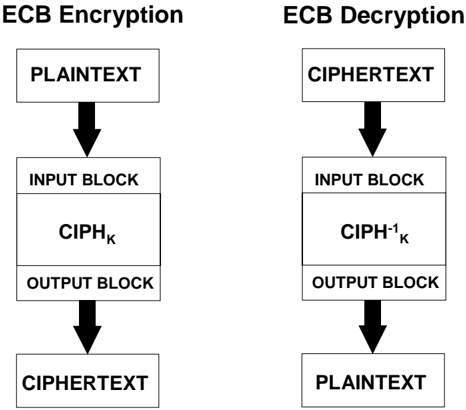
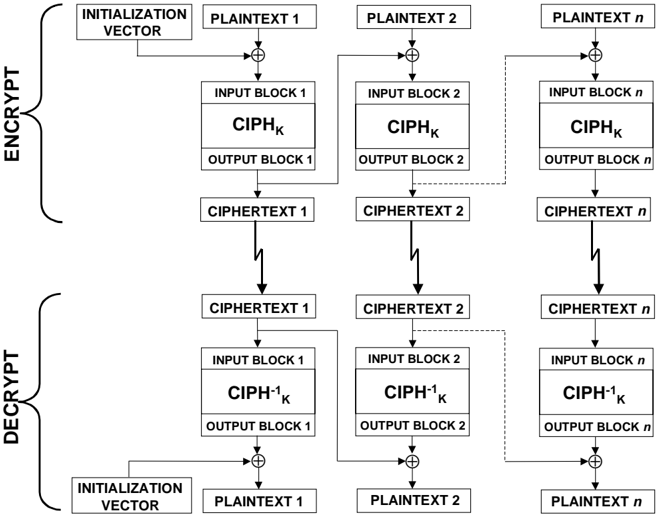
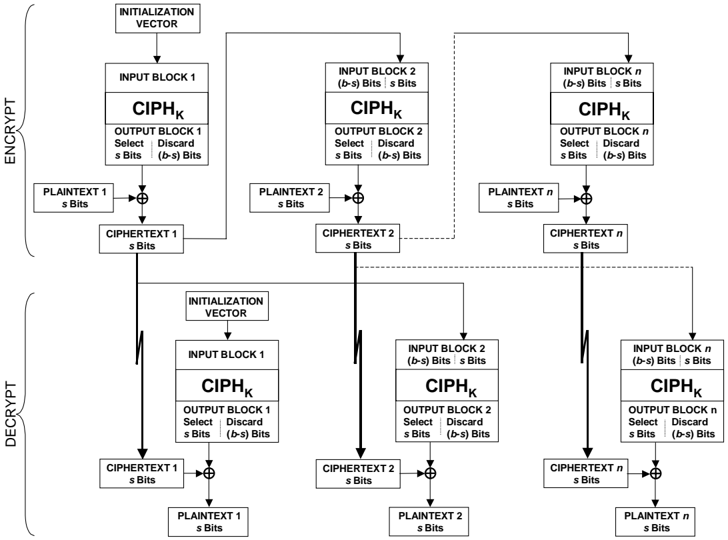
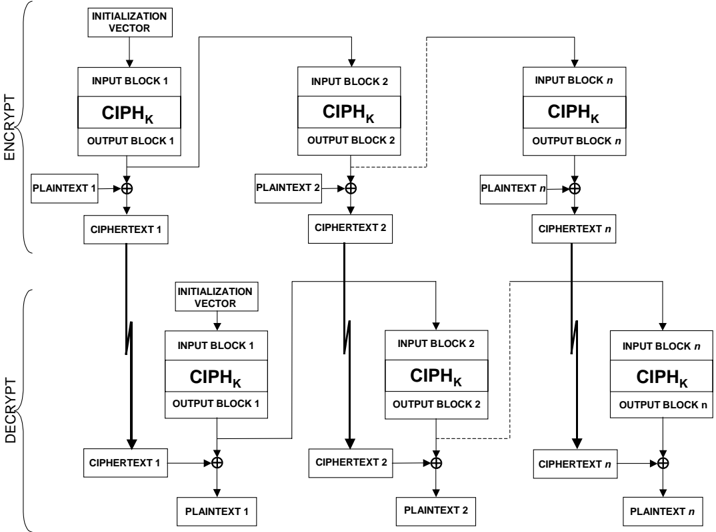
- The recommendation defines five confidentiality modes: Electronic Codebook (ECB), Cipher Block Chaining (CBC), Cipher Feedback (CFB), Output Feedback (OFB), and Counter (CTR), usable with any FIPS-approved block cipher such as AES.
- Three elements are new relative to prior FIPS publications: extension of the four FIPS Pub 81 modes to any FIPS-approved block cipher, revision of their requirements, and specification of the CTR mode.
- Parallelism differs by mode: ECB encryption/decryption and CTR encryption/decryption permit parallel forward/inverse cipher operations; CBC and CFB encryption cannot be parallelized but CBC and CFB decryption can; OFB permits neither, though output blocks can be precomputed if the IV is known.
- Error propagation is mode-dependent: in CFB, OFB, and CTR a ciphertext bit error produces specific bit errors in the same positions; in ECB and CBC it produces random bit errors with an expected rate of fifty percent. CBC errors also affect the succeeding block, and CFB errors affect the next b/s (rounded up) segments.
Methods
- Design: a normative specification document defining each mode's encryption and decryption algorithms mathematically, with descriptions, illustrations, and comments on parallel-processing potential.
- Data/sample: no empirical sample; the document provides worked example vectors for each mode using AES with 128-, 192-, and 256-bit keys, including 1-bit, 8-bit, and 128-bit CFB variants, with a common plaintext string formatted into four 128-bit blocks.
- Analysis: appendices cover padding, counter-block generation (standard incrementing function and initial counter-block choice), IV generation, error properties, Triple DES modes, and AES example vectors.
Limitations
- Stated: the document is neither a standard nor a guideline and is neither mandatory nor binding on Federal agencies; it may be used voluntarily. Formatting of the plaintext, including padding, is outside its scope. It does not provide analogues of the interleaved/pipelined ANSI X9.52 modes (TCBC-I, TCFB-P, TOFB-I).
- Stated: the recommendation assumes a secret, random key has been established among parties, and security depends at minimum on the secrecy of the key.
- Evident from the text: the modes provide confidentiality only; the document repeatedly notes that integrity of the IV or ciphertext is not protected by these modes, leaving decryption vulnerable to deliberate bit-error introduction unless integrity is separately protected.
Model-written summary. Check it against the paper before relying on it.
Integrity signals
Registry
Cites
Statistics
Figures
Verification
Claims the paper makes
0 Valid · 0 Not valid · 11 Not checked · 60 Own results and interpretations
A conclusion the paper draws from its own results — it cites no other source for it, so there is none to check. The quote shows it is in the paper.
In the paper
“In particular, if any plaintext block that is encrypted using a given counter block is known, then the output of the forward cipher function can be determined easily from the associated ciphertext block.”
plainstates a cause- Asserted: passes — The authors put it forward as true.
- Checkable: passes — It can be checked against evidence.
- Load-bearing: passes — The paper’s conclusions depend on it.
- Based: passes — The paper gives a reason why it holds.
A conclusion the paper draws from its own results — it cites no other source for it, so there is none to check. The quote shows it is in the paper.
In the paper
“For both the OFB and CFB modes, a bit error may occur, independently, in any bit position of the affected ciphertext blocks (or segments), with an expected error rate of fifty percent.”
hedgedstates a possible cause- Asserted: passes — The authors put it forward as true.
- Checkable: passes — It can be checked against evidence.
- Load-bearing: unclear — It is unclear whether the paper’s conclusions depend on it.
- Based: unclear — It is unclear why the paper says it holds.
A conclusion the paper draws from its own results — it cites no other source for it, so there is none to check. The quote shows it is in the paper.
In the paper
“In the CFB mode, bit errors in the IV affect, at a minimum, the decryption of the first ciphertext segment, and possibly successive ciphertext segments, depending on the bit position of the rightmost bit error in the IV.”
hedgedstates a cause- Asserted: passes — The authors put it forward as true.
- Checkable: passes — It can be checked against evidence.
- Load-bearing: unclear — It is unclear whether the paper’s conclusions depend on it.
- Based: passes — The paper gives a reason why it holds.
A conclusion the paper draws from its own results — it cites no other source for it, so there is none to check. The quote shows it is in the paper.
In the paper
“A bit error may occur, independently, in any bit position in these decrypted segments, with an expected error rate of fifty percent.”
hedgedstates a possible cause- Asserted: passes — The authors put it forward as true.
- Checkable: passes — It can be checked against evidence.
- Load-bearing: unclear — It is unclear whether the paper’s conclusions depend on it.
- Based: unclear — It is unclear why the paper says it holds.
A conclusion the paper draws from its own results — it cites no other source for it, so there is none to check. The quote shows it is in the paper.
In the paper
“However, if the IV is known, the output blocks can be generated prior to the availability of the plaintext or ciphertext data.”
plainstates a cause- Asserted: passes — The authors put it forward as true.
- Checkable: passes — It can be checked against evidence.
- Load-bearing: unclear — It is unclear whether the paper’s conclusions depend on it.
- Based: passes — The paper gives a reason why it holds.
28 more claims
Create a free account to see all 71 claims and to verify the 3 references still open.
- Probably not a substantial claim. 36
- It may state two separate claims as one. 9
Claims other papers make about this one
Each is checked against this paper’s own text: does it say what the citing paper says it does?
The cited source says what the claim attributes to it.
In the citing paper
“On the other hand, stream ciphers can be constructed by block ciphers using the Counter (CTR) and Output FeedBack (OFB) operation mode [294].”
From Robotics cyber security: vulnerabilities, attacks, countermeasures, and recommendations (2022) · cites this paper as [294]
Self-check
Percentages, sums and reported differences re-computed from the paper’s own numbers.
Each contradiction between two passages listed here was confirmed by an independent check.
Rated minor: it would not touch a result — a value no result rests on, a p-value that stays on the same side of the significance level, or a conflict that is clerical, resolved elsewhere in the paper, or outside its own findings.
In the paper
§ Appendix D: Error Properties
“Table D.1 summarizes the effects of bit errors in a ciphertext block or IV on the decryption of the ciphertext for each of the five confidentiality modes.”
§ Appendix D: Error Properties
“Table D.2: Summary of Effect of Bit Errors on Decryption”
Rated minor: it would not touch a result — a value no result rests on, a p-value that stays on the same side of the significance level, or a conflict that is clerical, resolved elsewhere in the paper, or outside its own findings.
In the paper
§ Appendix E: Modes of Triple DES
“the six modes in this recommendation”
§ 3 Introduction
“This recommendation specifies five confidentiality modes of operation for symmetric key block cipher algorithms”
Citations
Cites
Handbook of applied cryptography
(1997) · Choice Reviews Online · doi:10.5860/choice.34-4512 · Cited by 10,357
Handbook of Applied Cryptography
Menezes, A. J., van Oorschot, P. C., & Vanstone, S. A. (2018) · CRC Press eBooks · doi:10.1201/9781439821916 · Cited by 2,896 · cited 1×
“[5] for information about linear feedback shift registers.”
Advanced Encryption Standard (AES)
National Institute of Standards and Technology (US) (2001) · doi:10.6028/nist.fips.197 · Cited by 642
Data encryption standard (DES)
Biryukov, A., & Cannière, C. (2006) · Encyclopedia of Cryptography and Security · doi:10.1007/0-387-23483-7_94 · Cited by 57
Cited by
Items 401–500 of 709
Protecting Smart Grid and Advanced Metering Infrastructure
Salpekar, M. (2018) · International Conference on I-SMAC (IoT in Social, Mobile, Analytics and Cloud) (I-SMAC) · doi:10.1109/i-smac.2018.8653793 · Cited by 3
A Generalized Format Preserving Encryption Framework Using MDS Matrices
Chang, D., Ghosh, M., Jati, A., Kumar, A., & Sanadhya, S. K. (2019) · Journal of Hardware and Systems Security · doi:10.1007/s41635-019-00065-x · Cited by 3
Performance Evaluation of CAESAR Authenticated Encryption on SROS2
Takemoto, S., Nishida, K., Nozaki, Y., Yoshikawa, M., Honda, S., & Kurachi, R. (2019) · Artificial Intelligence and Cloud Computing Conference (AICCC) · doi:10.1145/3375959.3375976 · Cited by 3
Alimzhanova, Z., Nazarbayev, D., Ayashova, A., & Kaliyeva, A. (2022) · Lecture notes in computer science · doi:10.1007/978-3-031-21967-2_50 · Cited by 3
How Fast Can SM4 be in Software?
Miao, X., Guo, C. F., Wang, M., & Wang, W. (2023) · Lecture notes in computer science · doi:10.1007/978-3-031-26553-2_1 · Cited by 4
Co-designing an FPGA-Accelerated Encryption Library With PYNQ: The Pynqrypt Case Study
Bertolini, R. A., Carloni, F., & Conficconi, D. (2023) · IEEE EUROCON - International Conference on Computer as a Tool (EUROCON) · doi:10.1109/eurocon56442.2023.10198938 · Cited by 4
Engineering Nonlinear Pseudorandom Number Generators
Neves, S., & Araújo, F. (2014) · Lecture notes in computer science · doi:10.1007/978-3-642-55224-3_10 · Cited by 4
A Strategy of Multimedia Reflectors to Encryption and Codification in Real Time
Filho, E. V. D. S., Silva, G. D. S. E., Oliveira, H., Ferreira, A. V. A., de Melo, E. A. G., Tavares, T. A., Motta, G. H. M. B., & Filho, G. L. D. S. (2012) · IEEE International Symposium on Multimedia (ISM) · doi:10.1109/ism.2012.59 · Cited by 3
The efficiency of block ciphers in Galois/Counter Mode in IPsec-based virtual private networks
Uskov, A., & Avagyan, H. (2014) · IEEE International Conference on Electro Information Technology · doi:10.1109/eit.2014.6871757 · Cited by 3
A lightweight security extension for ULE
Noisternig, M., & Collini‐Nocker, B. (2007) · International Workshop on Satellite and Space Communications · doi:10.1109/iwssc.2007.4409424 · Cited by 3
Speeding up Counter Mode in Software and Hardware
Gueron, S., & Krasnov, V. (2014) · International Conference on Information Technology: New Generations · doi:10.1109/itng.2014.32 · Cited by 3
CCSDS Standardization of Security Algorithms for Civil Space Missions
Weiss, H. (2012) · SpaceOps Conference (SpaceOps) · doi:10.2514/6.2012-1285444 · Cited by 3
Magnified Cipher Block Chaining Mode using DES to Ensure Data Security in Cloud Computing
Kumari, D. A., Chandrika, M., & Bharadwaj, B. (2016) · Indian Journal of Science and Technology · doi:10.17485/ijst/2016/v9i17/93029 · Cited by 3
Efficient Bloom filter for network protocols using AES instruction set
Zhang, Y., Zheng, Z., & Zhang, X. (2017) · IET Communications · doi:10.1049/iet-com.2016.0641 · Cited by 3
Efficient configurations for block ciphers with unified ENC/DEC paths
Banik, S., Bogdanov, A., & Regazzoni, F. (2017) · IEEE International Symposium on Hardware Oriented Security and Trust (HOST) · doi:10.1109/hst.2017.7951795 · Cited by 3
Implementation of Security Mechanism in IIoT Systems
Shin, M.-J., Woo, J., Wane, I., Kim, S., & Yu, H. (2018) · Lecture notes in electrical engineering · doi:10.1007/978-981-13-0311-1_30 · Cited by 3
Protecting Instruction Set Randomization from Code Reuse Attacks
Guanciale, R. (2018) · Lecture notes in computer science · doi:10.1007/978-3-030-03638-6_26 · Cited by 3
Towards Symbolic Encryption Schemes
Ahmed, N., Jensen, C. D., & Zenner, E. (2012) · Lecture notes in computer science · doi:10.1007/978-3-642-33167-1_32 · Cited by 3
Blocks as digital entities: A standards perspective
Lyons, P. A., & Kahn, R. E. (2018) · Information Services & Use · doi:10.3233/isu-180021 · Cited by 3
Processing Analysis of Confidential Modes of Operation
Nawaz, Y., Wang, L., & Ammour, K. (2018) · Lecture notes in computer science · doi:10.1007/978-3-030-05345-1_8 · Cited by 3
Cross-domain Autonomous Communication Protocol for Delay Tolerant Networks
Adalier, M., & Burleigh, S. C. (2018) · IEEE National Aerospace and Electronics Conference (NAECON) · doi:10.1109/naecon.2018.8556761 · Cited by 3
Optimized Authentication Algorithm on FPGA for Space-Air-Ground Integrated Network
Pirzada, S. J. H., Xu, T., & Jianwei, L. (2020) · International Conference on Open Source Systems and Technologies (ICOSST) · doi:10.1109/icosst51357.2020.9332928 · Cited by 3
Cryptographic algorithm acceleration using CUDA enabled GPUs in typical system configurations
Bobrov, M. (2010) · RIT Scholar Works (Rochester Institute of Technology) · Cited by 3
Encrypting the Protocol for Carrying Authentication for Network Access (PANA) Attribute-Value Pairs
Yeğin, A., & Cragie, R. (2012) · doi:10.17487/rfc6786 · Cited by 3
An enhanced Blowfish Algorithm based on cylindrical coordinate system and dynamic permutation box
Alabaichi, A. (2014) · UUM Electronic Theses and Dissertation [eTheses] (Northern University of Malaysia) · Cited by 3
An FPGA-based performance comparison of the 64-bit block ciphers
Kitsos, P., Sklavos, N., Galanis, M. D., & Koufopavlou, O. (2004) · World Automation Congress (WAC) · Cited by 3
Symbolic Security Criteria for Blockwise Adaptive Secure Modes of Encryption.Preprint
Meadows, C. A. (2017) · IACR Cryptology ePrint Archive · Cited by 3
Recommendation for Cryptographic Key GenerationPreprint
Barker, E. B. (2019) · doi:10.6028/nist.sp.800-133r1-draft · Cited by 3
Low Energy AES Hardware for Microcontroller
Ekelund, Ø. (2009) · NORA - Norwegian Open Research Archives · Cited by 3
Lightweight Security Solutions for LTE/LTE-A Networks
Hussein, S. (2014) · theses.fr (ABES) · doi:10.70675/21735bf8z49f3z4278z9efez7ac4d6747508 · Cited by 3
Secure and Efficient Block Cipher Mode Design for Parallel Processing and Reliable Security
Vatsavayi, V. K., & Bommireddy, D. R. (2026) · Cryptography · doi:10.3390/cryptography10010013 · Cited by 2
Schwenk, J. (2022) · Information security and cryptography · doi:10.1007/978-3-031-19439-9_2 · Cited by 2
Chin, W., Chen, P.-W., Chou, S.-H., Yang, Y.-H., Chen, P.-Y., & Jiang, T. (2023) · IEEE Internet of Things Journal · doi:10.1109/jiot.2023.3298855 · Cited by 2
Cryptographic API Misuses in Industry: A Case Study on Prevalence and Remediation
de Jesus, J. A., Amaral, L. H. V., & Bonifácio, R. (2025) · Simpósio Brasileiro de Cibersegurança (SBSeg) · doi:10.5753/sbseg_estendido.2025.12030 · Cited by 3
A nano-design of image masking and steganography structure based on quantum technology
Salahov, H., Ahmadpour, S., Navimipour, N. J., Das, J. C., & Rasmi, H. (2025) · Journal of Information Security and Applications · doi:10.1016/j.jisa.2025.104221 · Cited by 2
Quantum artificial intelligence and cryptographic security from a quantum cryptography perspective
Gençoğlu, M. T. (2026) · Discover Quantum Science · doi:10.1007/s44464-026-00008-w · Cited by 3
An effective cipher block scheme based on cellular automata
Molaei, S., Najjar-Ghabel, S., & Farzinvash, L. (2017) · International Conference on Knowledge-Based Engineering and Innovation · doi:10.1109/kbei.2017.8324995 · Cited by 2
A User-Centric Key Management for Cloud Encryption Using Key Derivation Function
Tran, D. N., Tien, X. N., Xuan, T. N., & Viet, P. L. (2024) · Lecture notes in networks and systems · doi:10.1007/978-981-97-5504-2_57 · Cited by 2
An On-Orbit Data Marketplace for Distributed Space Domain Awareness
Gordon, N. G., & Falco, G. J. (2025) · IEEE Access · doi:10.1109/access.2025.3547271 · Cited by 2
Торчинський, Р., Стринадко, М., & Шпатар, П. (2025) · Молодий вчений · doi:10.32839/2304-5809/2025-1-132-5 · Cited by 2
Efficient Memory Side-Channel Protection for Embedding Generation in Machine Learning
Umar, M., Marathe, A. P., Gupta, M. D., Ghosh, S. J., Suh, G. E., & Xiong, W. (2025) · IEEE International Symposium on High-Performance Computer Architecture (HPCA) · doi:10.1109/hpca61900.2025.00041 · Cited by 7
Privacy-aware document retrieval with two-level inverted indexing
Qiao, Y., Ji, S., Wang, C., Shao, J., & Yang, T. (2023) · Information Retrieval · doi:10.1007/s10791-023-09428-z · Cited by 2
Tarhuni, M. A., Ng, S. H., Samsudin, A., & Ng, W. P. (2004) · Asia-Pacific Conference on Communications (APCC) · doi:10.1109/apcc.2003.1274448 · Cited by 2
Chaos-based image encryption using an AONT mode of operation
Rickus, A., Pflüegel, E., & Atkins, N. (2015) · International Conference on Cyber Situational Awareness, Data Analytics and Assessment (CyberSA) · doi:10.1109/cybersa.2015.7166113 · Cited by 4
On Post Decryption Error Pobability in Counter Mode Operation with Explicit Counter Transmittal.
Sattar, F., & Mufti, M. (2009) · Cited by 2
DES-SRAM IP-core: a SRAM embedding DES feature [secure SoC applications]
Labbe, A., Portal, J. M., & Pérez, A. (2004) · IEEE International SOC Conference (SOCC) · doi:10.1109/soc.2003.1241452 · Cited by 2
Improving the Detection of Encrypted Data on Storage Devices
Thurner, S., Grun, M., Schmitt, S., & Baier, H. (2015) · International Conference on IT Security Incident Management and IT Forensics (IMF) · doi:10.1109/imf.2015.12 · Cited by 2
VoIPS: VoIP Secure Encryption VoIP Solution
Wu, C.-Y., Wu, K.-P., Shih, J., & Lee, H.-M. (2011) · Communications in computer and information science · doi:10.1007/978-3-642-23948-9_11 · Cited by 2
Inter Cipher Block Diffusion: A Novel Transformation for Proposed Parallel AES
Srivastava, S., Singh, A. K., & Nandi, G. C. (2012) · Procedia Technology · doi:10.1016/j.protcy.2012.10.106 · Cited by 2
An efficient scheme of authenticated encryption with associated data
Zhang, S., Xing, G., & Yang, Y. (2010) · Chinese Control and Decision Conference (CCDC) · doi:10.1109/ccdc.2010.5498386 · Cited by 2
Cryptographic transforms for a lightweight and efficient DVB link-layer security extension
Noisternig, M. (2012) · IEEE AESS European Conference on Satellite Telecommunications · doi:10.1109/estel.2012.6400097 · Cited by 2
Hussein, S., Noura, H., Martin, S., Boukhatem, L., & Agha, K. A. (2013) · ACM International Conference on Modeling, Analysis and Simulation of Wireless and Mobile Systems (MSWiM) · doi:10.1145/2507924.2507946 · Cited by 2
Bootstrapping trust in networked measurement systems with secure sensors
Jónsson, K. V., & Vigfússon, Ý. (2012) · IEEE Sensors Applications Symposium (SAS) · doi:10.1109/sas.2012.6166284 · Cited by 2
Implementing block cipher on embedded multiprocessors platform
Khaddour, M., Wang, Z., & Hammami, O. (2009) · IEEE International Conference on Multimedia Computing and Systems (ICMCS) · doi:10.1109/mmcs.2009.5256706 · Cited by 2
A Server Based ASR Approach to Automated Cryptanalysis of Two Time Pads in Case of Speech
Khan, L. A., & Baig, M. S. (2008) · International Conference on Information Assurance and Security (IAS) · doi:10.1109/ias.2008.14 · Cited by 2
An enhanced NPA protocol for secure communications in GSM network
Saxena, N., & Chaudhari, N. S. (2013) · International Journal of Security and Networks · doi:10.1504/ijsn.2013.055045 · Cited by 2
Fast time-parallel C-based event-driven RTL simulation
Ahmad, T. B., & Ciesielski, M. J. (2014) · IEEE International Symposium on Design and Diagnostics of Electronic Circuits & Systems (DDECS) · doi:10.1109/ddecs.2014.6868766 · Cited by 2
Perfect Classified Channel retaining DC balance for high-throughput communication
Matsuoka, H., Inoue, K., & Nishi, H. (2008) · International Symposium on Information Theory and its Applications · doi:10.1109/isita.2008.4895602 · Cited by 2
A new approach for encryption system based on block cipher algorithms and logistic function
Sbiaa, F., Baganne, A., Zeghid, M., & Tourki, R. (2015) · International Multi-Conference on Systems, Signals & Devices (SSD) · doi:10.1109/ssd.2015.7348107 · Cited by 2
Chen, B. H. K., Cheung, P. Y. S., Cheung, P. Y. K., & Kwok, Y. R. (2015) · International Conference on Field-Programmable Technology (FPT) · doi:10.1109/fpt.2015.7393116 · Cited by 2
Security Analysis of Generalized Confidentialmodulation for Quantum Communication
Tanaka, H. (2013) · International journal of Computer Networks & Communications · doi:10.5121/ijcnc.2013.5509 · Cited by 2
Lopez, D. L., & Fraga, E. (2016) · SpaceOps Conference (SpaceOps) · doi:10.2514/6.2016-2330 · Cited by 2
Tweakable parallel OFB mode of operation with delayed thread synchronization
Damjanović, B., & Simić, D. (2015) · Security and Communication Networks · doi:10.1002/sec.1404 · Cited by 2
An FPGA implementation of AES with support for counter and feedback modes
Grabowski, J. S., & Youssef, A. (2007) · International Conference on Microelectronics (ICM) · doi:10.1109/icm.2007.4497657 · Cited by 2
Benchmarking Cryptographic Schemes for Securing Public Cloud Storages
Contiu, S., Leblond, E., & Réveillère, L. (2017) · Lecture notes in computer science · doi:10.1007/978-3-319-59665-5_12 · Cited by 2
Providing key diversity for symmetric encryption in ad-hoc wireless networks
Polat, C., Çabuk, U. C., Yildiz, K., & Dalkılıç, G. (2017) · International Conference on Computer Science and Engineering (UBMK) · doi:10.1109/ubmk.2017.8093393 · Cited by 2
Towards End-to-End Data Protection in Low-Power Networks
Mikhalev, V., Gomez, L., Armknecht, F., & Márquez, J. (2017) · Lecture notes in computer science · doi:10.1007/978-3-319-72817-9_1 · Cited by 2
A new authenticated encryption mode for arbitrary block cipher based on universal hash function
Nesterenko, A. Y. (2017) · Математические вопросы криптографии · doi:10.4213/mvk228 · Cited by 2
Chaos Baker-based Image Encryption in Operation Modes
AlZain, M. A. (2018) · INTERNATIONAL JOURNAL OF COMPUTERS & TECHNOLOGY · doi:10.24297/ijct.v17i1.7328 · Cited by 2
Braga, A. M., & Dahab, R. (2015) · doi:10.5753/sbc.9004.8.1 · Cited by 10
KIVR: Committing Authenticated Encryption Using Redundancy and Application to GCM, CCM, and More
Naito, Y., Sasaki, Y., & Sugawara, T. (2024) · Lecture notes in computer science · doi:10.1007/978-3-031-54770-6_13 · Cited by 3
Compatible design of CCMP and OCB AES cipher for wireless LAN security
Shim, J. H., Kwon, T. W., Kim, D. W., Suk, J. H., Choi, Y. H., & Choi, J. R. (2004) · IEEE International SOC Conference (SOCC) · doi:10.1109/soc.2003.1241518 · Cited by 2
Parallelization of Image Encryption Algorithm Based on Game of Life and Chaotic System
Burak, D. (2017) · Lecture notes in computer science · doi:10.1007/978-3-319-59060-8_38 · Cited by 2
Statistical Cipher Feedback of Stream Ciphers
Heys, H. M. (2017) · The Computer Journal · doi:10.1093/comjnl/bxx068 · Cited by 2
A quantum key distribution protocol for rapid denial of service detection
Price, A. B., Rarity, J., & Erven, C. (2020) · EPJ Quantum Technology · doi:10.1140/epjqt/s40507-020-00084-6 · Cited by 34
Performance Evaluation of Symmetric Block Cipher RC6 with ECB and CBC Operation Modes
Sharma, P., & Purohit, R. (2018) · Lecture notes on data engineering and communications technologies · doi:10.1007/978-3-030-03146-6_13 · Cited by 2
Hardware-fingerprint Based Authentication for NFC Devices in Power Grids
Yan, B., Xu, A., Cao, Y., Jiang, Y., Xu, W., & Ji, X. (2019) · IEEE Advanced Information Technology, Electronic and Automation Control Conference (IAEAC) · doi:10.1109/iaeac47372.2019.8997706 · Cited by 2
DPA-Resistant ASIC implementation of AES
Fegran, H. (2015) · BIBSYS Brage (BIBSYS (Norway)) · Cited by 3
Packet processing on a SIMD stream processor
Rai, J. S., Lai, Y., & Byrd, G. T. (2005) · Elsevier eBooks · doi:10.1016/b978-012088476-6/50008-3 · Cited by 2
Conrad, E., Misenar, S., & Feldman, J. (2012) · Elsevier eBooks · doi:10.1016/b978-1-59749-961-3.00006-6 · Cited by 2
Recommendation for Key Management: Part 1 — General Initial Public Draft
Barker, E., & Barker, W. (2025) · doi:10.6028/nist.sp.800-57pt1r6.ipd · Cited by 2
Square Attacks on Reduced-Round FEA-1 and FEA-2
Chauhan, A. K., Kumar, A., & Sanadhya, S. K. (2023) · Lecture notes in computer science · doi:10.1007/978-3-031-44274-2_43 · Cited by 1
Improved Side-Channel Attack on CTR DRBG Using a Clustering Algorithm
Han, J., & Han, D. (2025) · Sensors · doi:10.3390/s25134170 · Cited by 1
Gottschalk, E. (2025) · International Conference on Distributed Computing in Smart Systems and the Internet of Things (DCOSS-IoT) · doi:10.1109/dcoss-iot65416.2025.00134 · Cited by 1
Evaluating Lightweight and Standard Encryption Algorithms for Iot Security and Efficiency
Tambaliuc, G. F., Adamu, Y., & Fazea, Y. (2025) · IEEE International Conference on Computing and Machine Intelligence (ICMI) · doi:10.1109/icmi65310.2025.11141104 · Cited by 1
Patil, K. S., Gutte, V. S., & Gunale, K. G. (2025) · International Conference on Communication and Electronics Systems (ICCES) · doi:10.1109/icces67310.2025.11336308 · Cited by 2
Dynamic Auto-Reconfigurable Protocol for Efficient IoT Communication in Remote WSNs
Sudarshan, G. K., & Ganesan, V. (2025) · International Conference on Mathematics, Actuarial Science, Computer Science and Statistics (MACS) · doi:10.1109/macs68476.2025.11453411 · Cited by 1
Data Storage Security Based on Hardware Uniqueness: Resilience Analysis and Scheme Modernization
Pikuleva, N. I., & Khafizova, A. S. (2026) · Программные системы и вычислительные методы · doi:10.7256/2454-0714.2026.4.82812 · Cited by 1
Implementasi AES ECB dan Hashing MD5/SHA-256 Pada Aplikasi Penyuratan Android
Febriyadi, F., Kurnia, F., Harahap, N. S., Yanto, F., & Pizaini, P. (2023) · Journal of Computer System and Informatics (JoSYC) · doi:10.47065/josyc.v5i1.4505 · Cited by 1
Enhanced MQTT Protocol for Securing Big Data/Hadoop Data Management
Kamoun-Abid, F., & Meddeb-Makhlouf, A. (2026) · Journal of Sensor and Actuator Networks · doi:10.3390/jsan15010022 · Cited by 1
Characterizing Digital DRAM PIM through Modeling and Benchmarking
Siddique, F. A., Guo, D., Abbot, H., Durrer, K., Gholamrezaei, M., Baradaran, M., Ermovick, E., Ahmed, A., Fan, Z., Gul, B., et al. (2026) · ACM Transactions on Architecture and Code Optimization · doi:10.1145/3815581 · Cited by 1
Putri, Z. H. A., Yustraini, Y. A., Ariansyah, R., Nisa, N. C., Wahyuni, E. D., & Putra, A. B. (2025) · Jurnal Nasional Teknologi Informasi dan Aplikasnya · doi:10.24843/jnatia.2025.v03.i03.p26 · Cited by 1
Exploiting modern hardware for secure data management
Kantarcıoğlu, M., & Canim, M. (2011) · Cited by 1
Pleßer, H. E. (2010) · Springer eBooks · doi:10.1007/978-1-4419-5675-0_19 · Cited by 1
FPGA Implementation of AES Co-processor in Counter Mode
Singh, B., Kaur, H., & Monga, H. (2010) · Communications in computer and information science · doi:10.1007/978-3-642-12214-9_85 · Cited by 1
A New Encryption and Hashing Scheme for the Security Architecture for Microprocessors
Platte, J., Dı́az, R. D., & Naroska, E. (2006) · Lecture notes in computer science · doi:10.1007/11909033_11 · Cited by 1
Huang, Y., Leu, F., & Dai, C.-R. (2012) · Lecture notes in computer science · doi:10.1007/978-3-642-32498-7_44 · Cited by 1
An Efficient and Secure Coding-Based Authenticated Encryption Scheme
Meziani, M., & Bansarkhani, R. E. (2013) · Lecture notes in computer science · doi:10.1007/978-3-642-35890-6_4 · Cited by 2
Increase Throughput of CCM Security Mode Using MKP
Zukarnain, Z. A. (2014) · Applied Mathematics · doi:10.4236/am.2014.54055 · Cited by 1
Secure access and management of smart objects with SNMPv3
Zehl, S., & Scheffler, T. (2013) · IEEE International Conference on Consumer Electronics - Berlin (ICCE-Berlin) · doi:10.1109/icce-berlin.2013.6697999 · Cited by 1
Metadata
- Authors
- Dworkin, M. J.
- Affiliations
- National Institute of Standards and Technology (US)
- Corresponding author
- Dworkin, M J
- ORCID
- Dworkin, M J
- Published
- 2001
- OpenAlex
- W112964067
- Cited by
- 746
- References
- 5
- Citations by year
- 2026: 59 · 2025: 38 · 2024: 41 · 2023: 25 · 2022: 33 · 2021: 30 · 2020: 37 · 2019: 44 · 2018: 48 · 2017: 44 · 2016: 34 · 2015: 35 · 2014: 32 · 2013: 31 · 2012: 33
- Type
- report
- Language
- en
- Open access
- gold
- doi.org
- Licence
- public-domain
- Topics
- Physical Sciences › Computer Science › Artificial Intelligence › Cryptographic Implementations and Security
- Physical Sciences › Mathematics › Discrete Mathematics and Combinatorics › Coding theory and cryptography
- Physical Sciences › Computer Science › Information Systems › Cryptography and Residue Arithmetic
- Keywords
- block cipher, modes of operation, encryption modes, NIST standards
About these checks
Registry, retraction, Cites and statistics results are computed, not judged, with one exception: a printed reference that no index lists is read once by a model before it counts as a citation error. Claims are extracted by a model and kept only when their quote appears verbatim in the text; each cited source is then checked, with a model’s help, for whether it says what the claim relies on. Those verdicts can be wrong — read the claim’s quote and the cited source before relying on one.
A language model drew the claims from the paper on 2026-10-21, under version 3 of the claim definition (model deepseek-v4.1-flash, prompt extract-v3).
A second model labelled each claim on 2026-10-21 (model jev-1.13-20260917, definition revision gold-guideline-v0.2).
Statistics and arithmetic are recomputed, not judged.
Confidence bands are shown only for fields calibrated on our annotated test set. None is calibrated yet, so no band is shown.
What counts as a claim ›How we measure confidence ›How we check this ›
Are you an author, or do you see a problem with this page? Request a review
Data sources
Bibliographic data: Semantic Scholar, OpenAlex, Crossref.
Contains information from the Semantic Scholar Academic Graph Datasets, made available under the ODC Attribution License (ODC-BY 1.0).
Semantic Scholar’s data is described in: Kinney, R., et al. (2023). The Semantic Scholar Open Data Platform. arXiv:2301.10140.
