

Seasonal Drought Prediction: Advances, Challenges, and Future Prospects
Open accessThe DOI matches its Crossref record; 388 of the 388 references it cites were found in a registry or an index.
Abstract
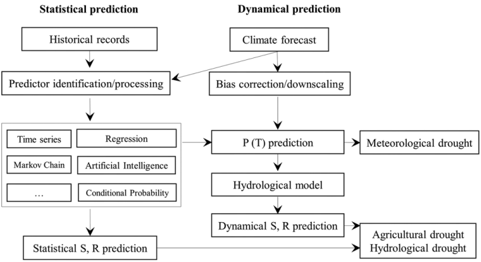
Drought prediction is of critical importance to early warning for drought managements. This review provides a synthesis of drought prediction based on statistical, dynamical, and hybrid methods. Statistical drought prediction is achieved by modeling the relationship between drought indices of interest and a suite of potential predictors, including large‐scale climate indices, local climate variables, and land initial conditions. Dynamical meteorological drought prediction relies on seasonal climate forecast from general circulation models (GCMs), which can be employed to drive hydrological models for agricultural and hydrological drought prediction with the predictability determined by both climate forcings and initial conditions. Challenges still exist in drought prediction at long lead time and under a changing environment resulting from natural and anthropogenic factors. Future research prospects to improve drought prediction include, but are not limited to, high‐quality data assimilation, improved model development with key processes related to drought occurrence, optimal ensemble forecast to select or weight ensembles, and hybrid drought prediction to merge statistical and dynamical forecasts.
Overview
The claims and statistics of this paper haven’t been checked yet.
Free: it reads the open-access text and checks the first 5 claims that cite a source we can check. Create a free account to check every claim.
Integrity signals
Registry
Cites
Statistics
Figures
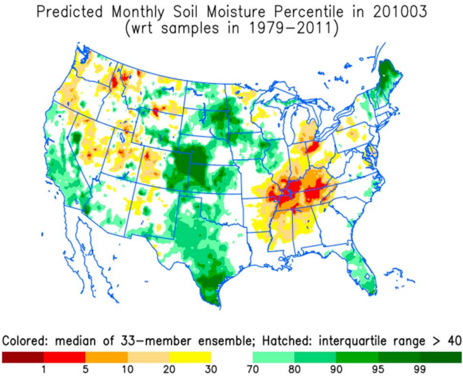
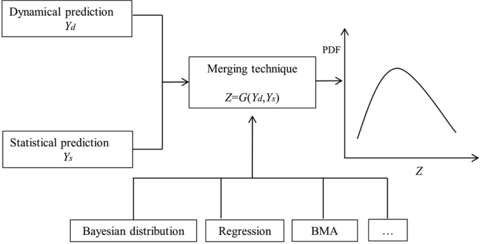
Verification
Claims the paper makes
The claims and statistics of this paper haven’t been checked yet.
Free: it reads the open-access text and checks the first 5 claims that cite a source we can check. Create a free account to check every claim.
Claims other papers make about this one
Each is checked against this paper’s own text: does it say what the citing paper says it does?
The cited source says what the claim attributes to it.
In the citing paper
“Skillful drought predictions with sufficient lead time remain a challenge, due to multiple driving factors across different spatial and temporal scales (Hao et al., 2018) and the complex nature of drought.”
From Artificial intelligence for climate prediction of extremes: State of the art, challenges, and future perspectives (2024) · cites this paper as Hao et al., 2018
Self-check
Percentages, sums and reported differences re-computed from the paper’s own numbers.
The self-check needs the paper’s full text.
Citations
Cites
(1993) · Cited by 7,699
An Introduction to Categorical Data Analysis
Agresti, A. (2007) · Wiley Series in Probability and Statistics · doi:10.1002/0470114754 · Cited by 6,689
Investigating soil moisture–climate interactions in a changing climate: A review
Seneviratne, S. I., Corti, T., Davin, E. L., Hirschi, M., Jaeger, E. B., Lehner, I., Orlowsky, B., & Teuling, A. J. (2010) · Earth-Science Reviews · doi:10.1016/j.earscirev.2010.02.004 · Cited by 5,638 · cited 2×
“…may lead to increased sensible heat flux contributing to a positive feedback between high temperature and drought (Durre et al., 2000; Fischer et al., 2007; Hao, Hao, Singh & Ouyang, 2017; Koster et al., 2009; Lyon & Dole, 1995; Mueller & Seneviratne, 2012; Seneviratne et al., 2010).”
BackgroundThe Global Land Data Assimilation System
Rodell, M., Houser, P. R., Jambor, U., Gottschalck, J., Mitchell, K., Meng, C.-J., Arsenault, K., Cosgrove, B., Radakovich, J., Bosilovich, M., et al. (2004) · Bulletin of the American Meteorological Society · doi:10.1175/bams-85-3-381 · Cited by 5,614 · cited 3×
“…(LDAS) have been developed in recent decades, such as the NLDAS in the United States (Mitchell et al., 2004; Xia, Peters-Lidard, et al., 2014; Xia, Ek, et al., 2014) and the Global Land Data Assimilation System (GLDAS) (Rodell et al., 2004), and they play an important role in drought early warning.”
BackgroundMishra, A. K., & Singh, V. P. (2010) · Journal of Hydrology · doi:10.1016/j.jhydrol.2010.07.012 · Cited by 5,436 · cited 2×
“…of univariate and multivariate drought indicators based on individual or multiple hydroclimatic variables have been developed in past decades (Hao & Singh, 2015; Hayes et al., 2011; Mishra & Singh, 2010; Zargar et al., 2011), such as the Standardized Precipitation Index (SPI) (McKee et al., 1993).”
BackgroundSelf-citationRobust Responses of the Hydrological Cycle to Global Warming
Held, I. M., & Soden, B. J. (2006) · Journal of Climate · doi:10.1175/jcli3990.1 · Cited by 4,959
Drought under global warming: a review
Dai, A. (2011) · WIREs Climate Change · doi:10.1002/wcc.81 · Cited by 3,523 · cited 3×
“Other factors, such as land surface interactions or feedbacks (e.g., reduced soil moisture and increased temperature) may also contribute to the atmospheric anomaly or occurrence of meteorological drought (Dai, 2011; Fernando et al., 2016; Kam, Sheffield, & Wood, 2014b; Koster & Suarez, 1995).”
BackgroundGlobal warming and changes in drought
Trenberth, K. E., Dai, A., van der Schrier, G., Jones, P. D., Barichivich, J., Briffa, K. R., & Sheffield, J. (2014) · Nature Climate Change · doi:10.1038/nclimate2067 · Cited by 3,382 · cited 1×
“Global warming from natural and anthropogenic factors has accelerated the hydrological cycle, resulting in more extremes, including drought, and a strong tendency of the wet areas getting wetter and dry areas getting drier (Dai, 2011; Held & Soden, 2006; Seager et al., 2010; Trenberth et al., 2014).”
BackgroundThe NCEP Climate Forecast System Version 2
Saha, S., Moorthi, S., Wu, X., Wang, J., Nadiga, S., Tripp, P., Behringer, D., Hou, Y.-T., Chuang, H.-Y., Iredell, M., et al. (2014) · Journal of Climate · doi:10.1175/jcli-d-12-00823.1 · Cited by 3,354 · cited 5×
“There are large uncertainties in the precipitation forecast, and skillful climate forecast beyond the 1month lead is still a prevailing challenge (Mcevoy et al., 2015; Saha et al., 2014; Weisheimer et al., 2009; Wood et al., 2015; Yuan et al., 2013).”
BackgroundMethodInfluentialChow, V. T. (2010) · Cited by 3,340
Research works printed but not linked: 12
- 10.1175/1520-0442(2004)017 · doi:10.1175/1520-0442(2004)017
- 10.1175/1520-0442(2002)015 · doi:10.1175/1520-0442(2002)015
- 10.1175/1520-0442(2001)014 · doi:10.1175/1520-0442(2001)014
- 10.1175/1525-7541(2000)001 · doi:10.1175/1525-7541(2000)001
- 10.1175/1520-0442(1995)008 · doi:10.1175/1520-0442(1995)008
- Milly, P., Julio, B., Malin, F., Robert, M., Zbigniew, W., Dennis, P., & Ronald, J. (2007). Stationarity is dead. Ground Water News & Views, 4, 6-8.
- 10.1175/1520-0442(2004)017 · doi:10.1175/1520-0442(2004)017
- Sheffield, J., Wood, E., Lettenmaier, D., & Lipponen, A. (2008). Experimental drought monitoring for Africa. GEWEX News, 8(3), 4-6.
- 10.1175/1525-7541(2003)004 · doi:10.1175/1525-7541(2003)004 · Paper page
- WCRP (2015). Workshop on understanding, modeling and predicting weather and climate extremes, WCRP Report. No.10/2016.
- 10.1175/1520-0442(2004)017 · doi:10.1175/1520-0442(2004)017
- 10.1175/1525-7541(2002)003 · doi:10.1175/1525-7541(2002)003
Cited by
Items 501–600 of 640
Assessing compound drought-heatwave events in Oman using non-stationary copula models
Al-Wardy, M., Zarei, E., Nikoo, M. R., & Al-Balushi, M. (2026) · Journal of Hydrology · doi:10.1016/j.jhydrol.2026.136149 · Cited by 1
Bharghavi, K., Reddy, T. L., Sushmitha, H., Kapa, H., Rajesh, P., & Reddy, K. K. (2026) · Theoretical and Applied Climatology · doi:10.1007/s00704-026-06497-0 · Cited by 1
“Third, spatial variability and optimal predictive lead times of SST–drought teleconnections have not been systematically quantified at the global scale (Hao et al. 2018).”
Ilyas, M., Niaz, R., Persio, L. D., Alshahrani, M., Hassan, A. Q. A., & Almazah, M. M. A. (2026) · Water Resources Management · doi:10.1007/s11269-026-04858-y · Cited by 1
“Future extensions should combine the present framework with climate-model covariates or scenario-based precipitation projections and should validate predictive intervals explicitly.”
Moradian, S., Gharbia, S. S., Sonny, F. Z., Haghighi, A. T., & Olbert, A. I. (2026) · npj Sustainable Agriculture · doi:10.1038/s44264-026-00144-x · Cited by 1
“To mitigate these uncertainties, high-quality data are essential for improving initial conditions, which form the basis for accurate drought projection 131 .”
ANÁLISE DA ASSOCIAÇÃO ENTRE MAPAS DO MONITOR DE SECAS E DADOS CLIMÁTICOS DE SERGIPE
Santos, K. M. S., Albuquerque, T. M. A., & Mendes, L. A. (2021) · Revista Brasileira de Climatologia · doi:10.5380/rbclima.v28i0.73648 · Cited by 1
Engineering Fructan Biosynthesis Against Abiotic Stress
Choudhir, G., & Vasistha, N. K. (2021) · Springer eBooks · doi:10.1007/978-3-030-80674-3_6 · Cited by 1
Machine learning-enabled model-data integration for predicting subsurface water storage
Lu, D., Pierce, E. M., Kao, S., Womble, D. E., Li, L., & Rempe, D. (2022) · OSTI OAI (U.S. Department of Energy Office of Scientific and Technical Information) · Cited by 1
Sử dụng dữ liệu MODIS đa thời gian đánh giá biến động khô hạn tại Tây Nguyên giai đoạn 2001–2020
Thương, T. V., Xuân, C. T., Hiệu, N. T., Tuấn, P. V., & Mởn, D. (2021) · Journal of Hydro-meteorology · doi:10.36335/vnjhm.2022(733).1-14 · Cited by 1
“Trong khi, nhiều nghiên cứu đã chứng minh rằng việc đề xuất hoặc đánh giá biến động hạn hán nên được dựa trên các chỉ số tổng hợp và có nhiều thông số đầu vào, để phản ánh toàn diện các đặc trưng về khô hạn [13].”
Study of rice resistance to water deficiency
Kostylev, P. I., Аксенов, А. В., & Krasnova, E. V. (2022) · Agrarian Bulletin of the · doi:10.32417/1997-4868-2022-216-01-12-20 · Cited by 1
How Predictable is Short-Term Drought in the Northeastern United States?
Carrillo, C. M., Evans, C. P., Belcher, B. N., & Ault, T. R. (2022) · Journal of Hydrometeorology · doi:10.1175/jhm-d-21-0237.1 · Cited by 1
Pokorny, S., Stadnyk, T., & Ali, G. A. (2023) · Journal of Hydrologic Engineering · doi:10.1061/jhyeff.heeng-5833 · Cited by 5
Putranto, B. P. D., Kholik, M. A., & Nugroho, M. A. (2023) · Journal of Intelligent Software Systems · doi:10.26798/jiss.v2i1.931 · Cited by 1
“(SARS-CoV) [lineage B], Middle East Respiratory Syndrome CoV (MERS-CoV) [lineage C], and SARS-CoV-2 [lineage B])[18].”
BackgroundRemote Sensing and Machine Learning Applications for the Assessment of Urban Water Stress: A Review
Jain, J., Choudhary, S., Muñoz‐Arriola, F., & Khare, D. (2023) · Springer water · doi:10.1007/978-3-031-35279-9_3 · Cited by 2
Cheng, G., Huang, G., Tan, Q., Dong, C., & Zhou, X. (2023) · Journal of Hydrology · doi:10.1016/j.jhydrol.2023.130246 · Cited by 1
Zhu, E., Wang, Y., Zhao, Y., & Yuan, X. (2024) · Atmospheric Research · doi:10.1016/j.atmosres.2024.107776 · Cited by 1
MARTÍNEZ-PÉREZ, M. E., Ruiz-Anchondo, T. D. J., Jacobo-Cuéllar, J. L., Parra-Quezada, R. Á., & Hernández-Ochoa, L. (2024) · Notulae Botanicae Horti Agrobotanici Cluj-Napoca · doi:10.15835/nbha52413555 · Cited by 1
Towards a Drought Monitoring, Tracking, and Management Platform Based on Quantitative Indices
Gironás, J., Núñez, M., Vicuna, S. D., Aedo, S., Morales, D., Vargas, J., Guzmán, J. D. D., & Suárez, F. (2025) · Global issues in water policy · doi:10.1007/978-3-031-85040-0_13 · Cited by 1
Vulnerability Assessment of Crop Husbandry due to Drought in North- Western Region of Bangladesh
Rahaman, H., Sarker, M. A. H., Rahman, M. Z., Momin, M., & Raihan, M. L. (2025) · Journal of Environmental Science and Natural Resources · doi:10.3329/jesnr.v14i1.81111 · Cited by 1
“Among these naturally occurring events, drought is considered one of the most devastating and has caused millions of deaths throughout human history (Hao et al., 2018).”
Ochieng, P., Nyandega, I., & Wambua, B. N. (2021) · Research Square · doi:10.21203/rs.3.rs-220061/v1 · Cited by 1
Subseasonal prediction of compound heat and drought eventsPreprint
Wu, R. W.-Y., Büeler, D., Pyrina, M., Day, J. J., Imamovic, A., Humphrey, V., & Domeisen, D. I. V. (2026) · doi:10.5194/egusphere-2026-2465 · Cited by 1
AI-Based Approach for Advancing the Understanding of Spatiotemporal Drought Characteristics
Rastogi, D., Kurte, K. R., Reshniak, V., & Kotevska, O. (2021) · OSTI OAI (U.S. Department of Energy Office of Scientific and Technical Information) · doi:10.2172/1769665
“These indices are generally calculated at aggregate timescales with respect to a reference period with a deficit over a certain period indicating drought (Hao, Singh, and Xia 2018).”
BackgroundPollution, Land Use, Biodiversity, and Health
Haines, A., & Frumkin, H. (2021) · Cambridge University Press eBooks · doi:10.1017/9781108698054.003
지역시민사회의 역량이 지방정부의 정책혁신에 미치는 영향에 관한 연구
김혜정 (2006) · Seoul National University Open Repository (Seoul National University)
Wet and dry period identification method through serial correlation decomposition
Şen, Z. (2021) · Hydrological Sciences Journal · doi:10.1080/02626667.2021.2014498
“Among numerous such studies are Salas et al. (2005), Mishra and Singh (2010), Dai (2011), Barker et al. (2015), Hao et al. (2018), and Konapala and Mishra (2020).”
BackgroundGuo, S. (2022) · doi:10.5194/hess-2021-645-ac2
Guo, S. (2022) · doi:10.5194/hess-2021-645-ac1
Water-Related Risks under Climate Change
Tang, Q., & Leng, G. (2022) · Cambridge University Press eBooks · doi:10.1017/9781108787291.002
Felsche, E. (2021) · Natural hazards and earth system sciences · doi:10.5194/nhess-2021-110-ac2
(2021) · Natural hazards and earth system sciences · doi:10.5194/nhess-2021-110-rc1
(2021) · Natural hazards and earth system sciences · doi:10.5194/nhess-2021-110-rc2
Sycz, J., & Ribbe, L. (2021) · Springer eBooks · doi:10.1007/978-3-030-50653-7_1
Felsche, E. (2021) · Natural hazards and earth system sciences · doi:10.5194/nhess-2021-110-ac1
(2022) · Hydrology and earth system sciences · doi:10.5194/hess-2022-190-rc1
(2022) · Hydrology and earth system sciences · doi:10.5194/hess-2022-190-rc2
(2022) · Hydrology and earth system sciences · doi:10.5194/hess-2022-190-rc3
Forecasts of standardized precipitation index phases over Iran by statistical-dynamical modelsPreprint
Shirvani, A., Landman, W. A., & Bazrafshan, J. (2022) · Research Square · doi:10.21203/rs.3.rs-1793778/v1
Guo, S. (2022) · Hydrology and earth system sciences · doi:10.5194/hess-2022-190-ac3
Guo, S. (2022) · Hydrology and earth system sciences · doi:10.5194/hess-2022-190-ac1
Guo, S. (2022) · Hydrology and earth system sciences · doi:10.5194/hess-2022-190-ac2
郭, 惠., 黄, 伟., 谢, 亭., & Ma, S. (2023) · SCIENTIA SINICA Terrae · doi:10.1360/sste-2022-0248
(2023) · Natural hazards and earth system sciences · doi:10.5194/nhess-2023-63-rc1
Zellou, B. (2023) · Natural hazards and earth system sciences · doi:10.5194/nhess-2023-63-ac2
Assessment of Bangladeshi rice landraces for drought tolerance under controlled environment
Khalequzzaman, M., & Haq, N. (2023) · Bangladesh Rice Journal · doi:10.3329/brj.v26i1.65871
“The drought intensity and severity are very complex and it is dependent on different factors like frequency of rainfall, evaporation and soil moisture (Hao et al., 2018; Oladosu et al., 2019).”
BackgroundFloková, L., & Mikita, T. (2023) · Land · doi:10.3390/land12101937
Al-Mashhadani, A. S., Hassan, S. S. M., Al-Budeiri, M. H., & Matar, A. (2023) · Bionatura · doi:10.21931/rb/2023.08.04.68
Gu, L., Ma, W. Y., Yu, M., Chen, P., & Hou, S. (2024) · Research Square · doi:10.21203/rs.3.rs-4115134/v1
OsWRKY45 Affects the Drought Resistance of Rice
孔, 丽. (2024) · Hans Journal of Agricultural Sciences · doi:10.12677/hjas.2024.144060
Brain, N., Li, Y., Bruijnzeel, L. A., Liu, J., Zhang, J., Otieno, D. O., Khan, M. S., Yang, M., Suba, V. O., Sikuku, L., et al. (2024) · SSRN Electronic Journal · doi:10.2139/ssrn.4853000
Mossad, A., & Abdou, S. H. (2024) · Misr journal of agricultural engineering · doi:10.21608/mjae.2024.301439.1139
“Drought forecasting, particularly for different lead times, remains a challenging task (Hao et al., 2018).”
BackgroundComputational decision intelligence approaches for drought prediction: A review
Pakdaman, M., & Kouhi, M. (2024) · Elsevier eBooks · doi:10.1016/b978-0-443-21475-2.00001-1
Research on Meteorological Drought Risk Prediction in the Daqing River Basin Based on HADGEM3-RA
Lv, M., & Wang, Z. (2024) · Agriculture · doi:10.3390/agriculture14101781
Drought Prediction in Agriculture with Support Vector Neural Networks: Enhancing Accuracy
Patil, M. B., & Adhatrao, A. S. (2024) · Lecture notes in networks and systems · doi:10.1007/978-981-97-5786-2_4
Monitoring drought using explainable statistical machine learning models
Cheung, C., & Ghanta, S. (2024) · Journal of Emerging Investigators · doi:10.59720/23-026
Lai, R. A., Woo, S.-G., Aksüyek, E., Hamzah, L., Alvillar, S., Chandran, K., & Criddle, C. S. (2024) · Bioresource Technology Reports · doi:10.1016/j.biteb.2024.102008
Bazrkar, M. H., Han, H., Abitew, T. A., Park, S., Zamani, N., & Jeong, J. (2024) · Atmosphere · doi:10.3390/atmos15121505
Yang, Z., Tian, J., Zhang, L., Feng, K., Ouyang, Z., & Yan, X. (2025) · SSRN Electronic Journal · doi:10.2139/ssrn.5088791
Impacts of Drought in India and Preparedness for Drought Under Global Warming
Han, J., & Singh, V. P. (2025) · Water science and technology library · doi:10.1007/978-3-031-80520-2_9 · Cited by 1
Self-citationSu, H., Wu, C., Zhou, S., Song, X., Tian, J., Han, X., Zhang, X., & Zhang, T. (2025) · Journal of Hydrology Regional Studies · doi:10.1016/j.ejrh.2025.102312 · Cited by 1
A Geographical Appraisal of Hydrological Drought—A Case Study
Bayati, S., Norouzi-Shokrlu, A., Mardanian, S., & Abdollahi, K. (2025) · Springer geography · doi:10.1007/978-3-031-62376-9_2
Mashuq, M. F., Akther, J., & Das, K. (2024) · IEEE International Conference on Signal Processing, Information, Communication and Systems (SPICSCON) · doi:10.1109/spicscon64195.2024.10941010
“Because droughts have diverse origins and occur at different spatiotemporal scales, climatologists and hydrologists have found it difficult to anticipate when they will occur [4].”
Lap, T. Q. (2025) · International Journal of Environmental Research · doi:10.1007/s41742-025-00781-z
“Recent advancements in climate forecasting and drought anticipation have been relatively sophisticated, but these methods still face limitations (Hao et al. 2018), which partially adds to the uncertainties in simulating climate data (Amiya Basak and Ozgur 2022).”
薛, 凯. (2025) · Journal of Water Resources Research · doi:10.12677/jwrr.2025.142014
Urban Drought for Disaster Risk Reduction
Kirsten, K. L., & Greaves, K. D. (2025) · Springer eBooks · doi:10.1007/978-981-97-4547-0_186-1
Drought impact on urban green space
Oulehlová, A., & Kincl, P. (2025) · Elsevier eBooks · doi:10.1016/b978-0-443-29993-3.00019-9
Doshi, A., & Kim, J. (2024) · Journal of Student Research · doi:10.47611/jsrhs.v13i3.7440
Tian, Y., Zhang, E., Huang, Y., Huang, M., Shi, H., & Chen, H. (2025) · Journal of Atmospheric and Solar-Terrestrial Physics · doi:10.1016/j.jastp.2025.106646
Wang, J., Xia, N., Yang, H. Z., Liang, J., Wang, Z., Wang, Z., Cai, G., & Li, M. (2026) · IEEE Journal of Selected Topics in Applied Earth Observations and Remote Sensing · doi:10.1109/jstars.2026.3723409
“However, due to the uncertainties inherent in drought propagation across systems and regions, time lag features alone cannot fully capture its dynamic processes [43], [44].”
Chere, Z., Kefyalew, A., & Ebrea, M. G. (2025) · Modeling Earth Systems and Environment · doi:10.1007/s40808-025-02629-z
“Long-term abnormalities in large-scale atmospheric circulation patterns brought on by anomalous sea surface temperatures (SSTs) or other distant circumstances are usu - ally the cause of meteorological dryness, also known as precipitation shortfall (Hao et al. 2018).”
Runoff prediction using long short-term memory neural networks with CMADS dataset
Xu, B., Rahman, N. F. A., & Taı, V. C. (2025) · AIP conference proceedings · doi:10.1063/5.0292807
Zhang, Y., Sun, F., Liu, W., Zhang, J., Lai, W., Lin, J., Sun, W., Liu, W., Sun, Z., & Wang, P. (2026) · Hydrology and earth system sciences · doi:10.5194/hess-30-6963-2026
Fashoto, S. G., Mashwama, P. M., Nxumalo, M. N., Akinnuwesi, B. A., Mbunge, E., & Metfula, A. S. (2025) · International Journal of Information Technology · doi:10.1007/s41870-025-02750-3
Applications of Artificial Intelligence and Remote Sensing in Water Resources Management
Farooq, W., Safdar, M., Anjum, H., Shahid, M. A., Mehmood, M. S., Rashid, A., Rauf, A., Rasul, F., Shauket, I., Saddique, N., et al. (2025) · Advances in geospatial technologies book series · doi:10.4018/979-8-3373-6608-1.ch006
Tamaki, Y., & Ishizaki, N. N. (2026) · Journal of Geophysical Research Atmospheres · doi:10.1029/2025jd045718
“The effectiveness of these drought indices varies generally depending on the meteorological and geographical characteristics of each region (Hao et al., 2018).”
Zhang, S., Wang, S., Fu, C., Zhao, B., Xu, J. H., Fu, J., Chen, Y., & Gao, L. (2025) · Carbon Balance and Management · doi:10.1186/s13021-025-00357-6
“As the frequency of extreme events continues to rise [7, 17, 37, 47], their impacts on DOC have become an increasing concern [5, 34, 39, 45].”
Advancing drought understanding and prediction in the Vietnamese Mekong Delta
Zhou, K. (2025) · Enlighten: Theses (The University of Glasgow) · doi:10.5525/gla.thesis.85210
Predicción estacional de sequía meteorológica en Europa
Torres Vázquez, M. Á., Norcheva, A. G., Turco, M., Gómez, J. P. M., & Halifa Marín, A. (2023) · Dialnet (Universidad de la Rioja)
Effects of Different Irrigation Levels on Some Tomato Cultivars
Avuk, U., Akhoundnejad, Y., & ŞİMŞEK, M. (2025) · Akademik Ziraat Dergisi · doi:10.29278/azd.1760165
Review of global climate models used for drought assessment and forecasting
Tayyaba, S., Puppala, H., & Arora, M. K. (2026) · Discover Water · doi:10.1007/s43832-026-00352-z
“Unlike statistical approaches, dynamical drought prediction depends on the GCMs which are extended weather forecasts or climate models that can simulate atmospheric, oceanic, cryospheric, and land surface processes accounting climate change [58].”
Duvan, A., & Yildizel, S. A. (2026) · Atmosphere · doi:10.3390/atmos17020172
Wei, W., Zhong, L., Yan, Z., Wang, Y., & Duan, Y. (2026) · International Journal of Climatology · doi:10.1002/joc.70302
“A variety of statistical approaches have been applied to drought prediction and achieved significant performance (Hao et al. 2018).”
Zhao, X., Hao, Z., Wu, W., Huang, R., Zhang, Y., & Pang, Y. (2026) · International Journal of Climatology · doi:10.1002/joc.70209
“In reality, drought may occur at different timescales (e.g., from the short-term flash drought to the long-term multi-year drought) across different spatial scales (e.g., from local, regional, national, and continental scales to the global scale) (Hao et al. 2018; Xie et al. 2024).”
Self-citationCastaldo, F., Francipane, A., Treppiedi, D., & Noto, L. (2026) · Journal of Hydrology Regional Studies · doi:10.1016/j.ejrh.2026.103271
Earth Observation and machine learning for advanced crop yield forecasting
Büechi, P. E. (2026) · reposiTUm (TU Wien) · doi:10.34726/hss.2026.138303
Mkhwenkwana, A., Matongera, T. N., Blaauw, C., & Mutanga, O. (2026) · SSRN Electronic Journal · doi:10.2139/ssrn.6383088
FFTSF: Revisiting Sub-Seasonal Streamflow Forecasting with Simple Feedforward Network
Ambika, A. K., Tayal, K., & Lu, D. (2025) · IEEE ... International Conference on Data Mining workshops · doi:10.1109/icdmw69685.2025.00101
“For instance, deep learning model based 1-30 day forecasts introduce model complexity which can affect the operational value for water-supply planning, flood early warning, and optimized hydropower generation [18]–[21].”
Villabona, Á., Zapata-Cuello, E., Coronado-Hernández, Ó. E., Pérez-Sánchez, M., & Tejada-Tovar, C. (2026) · Bioresource Technology · doi:10.1016/j.biortech.2026.134435
RetractedMolosiwa, R., Mphale, K., Matlhodi, B., & Mbangiwa, N. C. (2026) · Theoretical and Applied Climatology · doi:10.1007/s00704-026-06154-6 · Cited by 1
An integrated machine learning and decomposition framework for enhanced drought prediction
Gogineni, A., & Chintalacheruvu, M. R. (2026) · Theoretical and Applied Climatology · doi:10.1007/s00704-026-06144-8
Predicting hydrological drought at global scale: an analysis of the CEMS seasonal forecasts
García-Gamero, V., Cammalleri, C., Ceppi, A., Prudhomme, C., Ramos, A., Navarro, J. C. A., & Toreti, A. (2026) · Natural Hazards · doi:10.1007/s11069-025-07751-w
Zhu, Z., Lin, W., Liu, F., Guo, Y., & Li, B. (2026) · Water Resources Management · doi:10.1007/s11269-026-04621-3
Gautron, R. (2022) · theses.fr (ABES) · doi:10.70675/ef772e47z72b7z428az91e0zba483835938b · Cited by 2
Ganivet, E. (2023) · theses.fr (ABES) · doi:10.70675/d8059da1z0cd3z424azb360z9226c0ca9675 · Cited by 3
Liu, X. (2025) · theses.fr (ABES) · doi:10.70675/b46ba15ez5324z4a3bz9962z4bd599ca893f · Cited by 1
Multi-index assessment of flash drought hazards in North Khorasan province, northeastern Iran
Teimouri, M. (2026) · Natural Hazards · doi:10.1007/s11069-026-08066-0
“Such lags have also been documented in northern China and the Mediterranean (Spinoni et al. 2020; Wang et al. 2023).”
Influential
Metadata
- Authors
- Hao, Z., Singh, V. P., & Xia, Y.
- Affiliations
- Beijing Normal University (CN)
- Texas A&M University (US)
- NOAA National Centers for Environmental Prediction (US)
- Corresponding author
- Hao, Zengchao
- Venue
- Reviews of Geophysics
- Publisher
- American Geophysical Union (AGU)
- Published
- 2018-01-27
- Volume
- 56
- Issue
- 1
- Pages
- 108-141
- ISSN
- 0096-1043 (ISSN-L)
- 8755-1209
- 1944-9208
- OpenAlex
- W2784184607
- Semantic Scholar
- e7b1812d8fae2df8f1600e9086c7696ff060c3a8
- Cited by
- 607
- References
- 384
- Citations by year
- 2026: 68 · 2025: 99 · 2024: 97 · 2023: 80 · 2022: 89 · 2021: 81 · 2020: 52 · 2019: 28 · 2018: 12
- FWCI
- 25.31
- Type
- journal article
- Language
- en
- Open access
- hybrid
- doi.org
- Licence
- Locations
- Reviews of Geophysics (publishedVersion, cc-by-nc-nd)
- NOAA Institutional Repository (submittedVersion)
- Funders
- National Natural Science Foundation of China (41601014)
- Topics
- Physical Sciences › Environmental Science › Global and Planetary Change › Hydrology and Drought Analysis
- Physical Sciences › Environmental Science › Global and Planetary Change › Climate variability and models
- Physical Sciences › Environmental Science › Water Science and Technology › Hydrology and Watershed Management Studies
- Keywords
- drought forecasting, drought indices, global climate models, hydrological drought, agricultural drought, climate indices, data assimilation, ensemble forecasting, drought early warning, climate change impacts on drought
About these checks
Registry, retraction, Cites and statistics results are computed, not judged, with one exception: a printed reference that no index lists is read once by a model before it counts as a citation error. Claims are extracted by a model and kept only when their quote appears verbatim in the text; each cited source is then checked, with a model’s help, for whether it says what the claim relies on. Those verdicts can be wrong — read the claim’s quote and the cited source before relying on one.
Statistics and arithmetic are recomputed, not judged.
Confidence bands are shown only for fields calibrated on our annotated test set. None is calibrated yet, so no band is shown.
What counts as a claim ›How we measure confidence ›How we check this ›
Are you an author, or do you see a problem with this page? Request a review
Data sources
Bibliographic data: Semantic Scholar, OpenAlex, Crossref.
Contains information from the Semantic Scholar Academic Graph Datasets, made available under the ODC Attribution License (ODC-BY 1.0).
Semantic Scholar’s data is described in: Kinney, R., et al. (2023). The Semantic Scholar Open Data Platform. arXiv:2301.10140.
