

Conductive Metal–Organic Frameworks with Extra Metallic Sites as an Efficient Electrocatalyst for the Hydrogen Evolution Reaction
Open accessThe DOI matches its Crossref record; 51 of the 52 references it cites were found in a registry or an index.
Abstract
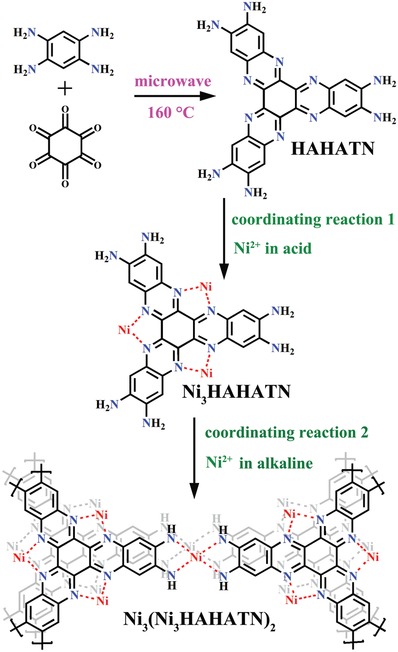
The 2D conductive metal–organic frameworks (MOFs) are expected to be an ideal electrocatalyst due to their high utilization of metal atoms. Exploring a new conjugated ligand with extra active metallic center can further boost the structural advantages of conductive MOFs. In this work, hexaiminohexaazatrinaphthalene (HAHATN) is employed as a conjugated ligand to construct bimetallic sited conductive MOFs (M2 3 (M1 3 ∙HAHATN) 2 ) with an extra M–N 2 moiety. Density functional theory (DFT) calculations demonstrate that the 2D conjugated framework renders M2 3 (M1 3 ∙HAHATN) 2 a high electric conductivity with narrow bandgap (0.19 eV) for electron transfer and a favorable in‐plane porous structure (2.7 nm) for mass transfer. Moreover, the metal atom at the extra M–N 2 moiety has a higher unsaturation degree than that at M–N 4 linkage, resulting in a stronger ability to donate electrons for enhancing electroactivity. These characteristics endow the new conductive MOFs with an enhanced electroactivity for hydrogen evolution reaction (HER) electrocatalysis. Among the series of M2 3 (M1 3 ∙HAHATN) 2 MOF, Ni 3 (Ni 3 ∙HAHATN) 2 nanosheets with the optimal structure exhibit a small overpotential of 115 mV at 10 mA cm −2 , low Tafel slope of (45.6 mV dec −1 ), and promising electrocatalytic stability for HER. This work provides an effective strategy for designing conductive MOFs with a favorable structure for electrocatalysis.
Overview
The claims and statistics of this paper haven’t been checked yet.
Free: it reads the open-access text and checks the first 5 claims that cite a source we can check. Create a free account to check every claim.
Integrity signals
Registry
Cites
Statistics
Figures


Verification
Claims the paper makes
The claims and statistics of this paper haven’t been checked yet.
Free: it reads the open-access text and checks the first 5 claims that cite a source we can check. Create a free account to check every claim.
Claims other papers make about this one
Each is checked against this paper’s own text: does it say what the citing paper says it does?
The cited source doesn’t support the claim as written.
In the citing paper
“The density of states (DOS) calculations reveal that all samples exhibit metallic behavior, as demonstrated by the presence of electronic states crossing the Fermi level, suggesting that these HEA clusters possess excellent electrical conductivity to facilitate electron migration and transport (Figure 5b) [35,36].”
From Synergistic High Entropy and Inductive Effects in Aerogels Accelerate pH‐Universal Hydrogen Evolution (2026) · cites this paper as [36]
Checked by a reasoning model — may be wrong.
Experimental — accuracy not yet measured
Self-check
Percentages, sums and reported differences re-computed from the paper’s own numbers.
The self-check needs the paper’s full text.
Citations
Cites
Trends in the exchange current for hydrogen evolution
Nørskov, J. K., Bligaard, T., Logadottir, A., Kitchin, J. R., Chen, J. G., Pandelov, S., & Stimming, U. (2005) · Journal of The Electrochemical Society · doi:10.1149/1.1856988 · Cited by 6,121
Recent Advances in Electrocatalytic Hydrogen Evolution Using Nanoparticles
Zhu, J., Hu, L., Zhao, P., Lee, L. Y. S., & Wong, K.-Y. (2020) · Chemical Reviews · doi:10.1021/acs.chemrev.9b00248 · Cited by 3,133
Stable Metal–Organic Frameworks: Design, Synthesis, and Applications
Yuan, S., Feng, L., Wang, K., Pang, J., Bosch, M., Lollar, C., Sun, Y., Qin, J., Yang, X., Zhang, P., et al. (2018) · Advanced Materials · doi:10.1002/adma.201704303 · Cited by 2,981
Self-citationConductive MOF electrodes for stable supercapacitors with high areal capacitance
Sheberla, D., Bachman, J. C., Elias, J. S., Sun, C.-J., Shao-Horn, Y., & Dincă, M. (2017) · Nature Materials · doi:10.1038/nmat4766 · Cited by 2,370
Electrically Conductive Porous Metal–Organic Frameworks
Sun, L., Campbell, M. G., & Dincă, M. (2016) · Angewandte Chemie International Edition · doi:10.1002/anie.201506219 · Cited by 1,901
Mesoporous materials for energy conversion and storage devices
Li, W., Liu, J., & Zhao, D. (2016) · Nature Reviews Materials · doi:10.1038/natrevmats.2016.23 · Cited by 1,388
Ultrathin metal-organic framework array for efficient electrocatalytic water splitting
Duan, J., Chen, S., & Zhao, C. (2017) · Nature Communications · doi:10.1038/ncomms15341 · Cited by 1,319
Interwoven Metal-Organic Framework on a Periodic Minimal Surface with Extra-Large Pores
Chen, B., Eddaoudi, M., Hyde, S. T., O'Keeffe, M., & Yaghi, O. M. (2001) · Science · doi:10.1126/science.1056598 · Cited by 1,265
Sheberla, D., Sun, L., Blood-Forsythe, M. A., Er, S., Wade, C. R., Brozek, C. K., Aspuru-Guzik, A., & Dincă, M. (2014) · Journal of the American Chemical Society · doi:10.1021/ja502765n · Cited by 1,168
Campbell, M. G., Sheberla, D., Liu, S. F., Swager, T. M., & Dincă, M. (2015) · Angewandte Chemie International Edition · doi:10.1002/anie.201411854 · Cited by 1,063
Xiao, Z., Wang, Y., Huang, Y.-C., Wei, Z., Dong, C.-L., Ma, J., Shen, S., Li, Y., & Wang, S. (2017) · Energy & Environmental Science · doi:10.1039/c7ee01917c · Cited by 1,063
Jahan, M., Liu, Z., & Loh, K. P. (2013) · Advanced Functional Materials · doi:10.1002/adfm.201300510 · Cited by 1,016
A mini review on nickel-based electrocatalysts for alkaline hydrogen evolution reaction
Gong, M., Wang, D.-Y., Chen, C.-C., Hwang, B.-J., & Dai, H. (2016) · Nano Research · doi:10.1007/s12274-015-0965-x · Cited by 953
Electrochemical oxygen reduction catalysed by Ni3(hexaiminotriphenylene)2
Miner, E. M., Fukushima, T., Sheberla, D., Sun, L., Surendranath, Y., & Dincă, M. (2016) · Nature Communications · doi:10.1038/ncomms10942 · Cited by 710
Hybrid 2D Dual‐Metal–Organic Frameworks for Enhanced Water Oxidation Catalysis
Rui, K., Zhao, G., Chen, Y., Lin, Y., Zhou, Q., Chen, J., Zhu, J., Sun, W., Huang, W., & Dou, S. X. (2018) · Advanced Functional Materials · doi:10.1002/adfm.201801554 · Cited by 692
Self-citationQin, J.-S., Du, D.-Y., Guan, W., Bo, X.-J., Li, Y.-F., Guo, L.-P., Su, Z.-M., Wang, Y.-Y., Lan, Y.-Q., & Zhou, H.-C. (2015) · Journal of the American Chemical Society · doi:10.1021/jacs.5b02688 · Cited by 664
Lu, X. F., Yu, L., & Lou, X. W. (. (2019) · Science Advances · doi:10.1126/sciadv.aav6009 · Cited by 649
Yao, M., Lv, X., Fu, Z., Li, W., Deng, W., Wu, G., & Xu, G. (2017) · Angewandte Chemie International Edition · doi:10.1002/anie.201709558 · Cited by 645
Metal‐Organic Framework‐Based Nanomaterials for Electrocatalysis
Mahmood, A., Guo, W., Tabassum, H., & Zou, R. (2016) · Advanced Energy Materials · doi:10.1002/aenm.201600423 · Cited by 632
Two-Dimensional Metal–Organic Surfaces for Efficient Hydrogen Evolution from Water
Clough, A. J., Yoo, J. W., Mecklenburg, M. H., & Marinescu, S. C. (2015) · Journal of the American Chemical Society · doi:10.1021/ja5116937 · Cited by 629
Conductive two-dimensional metal–organic frameworks as multifunctional materials
Ko, M., Mendecki, L., & Mirica, K. A. (2018) · Chemical Communications · doi:10.1039/c8cc02871k · Cited by 530
Park, J., Lee, M., Feng, D., Huang, Z., Hinckley, A. C., Yakovenko, A., Zou, X., Cui, Y., & Bao, Z. (2018) · Journal of the American Chemical Society · doi:10.1021/jacs.8b06020 · Cited by 505
Metal–Organic Framework Based Catalysts for Hydrogen Evolution
Zhu, B., Zou, R., & Xu, Q. (2018) · Advanced Energy Materials · doi:10.1002/aenm.201801193 · Cited by 484
Dhakshinamoorthy, A., Asiri, A. M., & Garcia, H. (2019) · Advanced Materials · doi:10.1002/adma.201900617 · Cited by 462
Recent Advances for MOF‐Derived Carbon‐Supported Single‐Atom Catalysts
Han, A., Wang, B., Kumar, A., Qin, Y., Jin, J., Wang, X., Yang, C., Dong, B., Jia, Y., Liu, J., et al. (2019) · Small Methods · doi:10.1002/smtd.201800471 · Cited by 451
Lu, X. F., Yu, L., Zhang, J., & Lou, X. W. (. (2019) · Advanced Materials · doi:10.1002/adma.201900699 · Cited by 435
Rational Design of Graphene‐Supported Single Atom Catalysts for Hydrogen Evolution Reaction
Hossain, M. D., Liu, Z., Zhuang, M., Yan, X., Xu, G., Gadre, C. A., Tyagi, A., Abidi, I. H., Sun, C., Wong, H., et al. (2019) · Advanced Energy Materials · doi:10.1002/aenm.201803689 · Cited by 434
Zhou, S., Kong, X., Zheng, B., Huo, F., Strømme, M., & Xu, C. (2019) · ACS Nano · doi:10.1021/acsnano.9b04670 · Cited by 341
Jia, H., Yao, Y., Zhao, J., Gao, Y., Luo, Z., & Du, P. (2018) · Journal of Materials Chemistry A · doi:10.1039/c7ta07978h · Cited by 337
Xu, H., Fei, B., Cai, G., Ha, Y., Liu, J., Jia, H., Zhang, J., Liu, M., & Wu, R. (2020) · Advanced Energy Materials · doi:10.1002/aenm.201902714 · Cited by 332
MOF-derived nanohybrids for electrocatalysis and energy storage: current status and perspectives
Zhang, H., Liu, X., Wu, Y., Guan, C., Cheetham, A. K., & Wang, J. (2018) · Chemical Communications · doi:10.1039/c8cc00789f · Cited by 309
Hollow nanoparticles as emerging electrocatalysts for renewable energy conversion reactions
Park, J., Kwon, T., Kim, J., Jin, H., Kim, H. Y., Kim, B., Joo, S. H., & Lee, K. (2018) · Chemical Society Reviews · doi:10.1039/c8cs00336j · Cited by 288
Dong, R., Zheng, Z., Tranca, D. C., Zhang, J., Chandrasekhar, N., Liu, S., Zhuang, X., Seifert, G., & Feng, X. (2017) · Chemistry – A European Journal · doi:10.1002/chem.201605337 · Cited by 263
Two‐Dimensional Non‐Layered Materials: Synthesis, Properties and Applications
Wang, F., Wang, Z., Shifa, T. A., Wen, Y., Wang, F., Zhan, X., Wang, Q., Xu, K., Huang, Y., Yin, L., et al. (2017) · Advanced Functional Materials · doi:10.1002/adfm.201603254 · Cited by 222
Kuehl, V. A., Yin, J., Duong, P. H. H., Mastorovich, B., Newell, B., Li-Oakey, K. D., Parkinson, B. A., & Hoberg, J. O. (2018) · Journal of the American Chemical Society · doi:10.1021/jacs.8b11482 · Cited by 208
Miner, E. M., Gul, S., Ricke, N. D., Pastor, E., Yano, J., Yachandra, V. K., Van Voorhis, T., & Dincă, M. (2017) · ACS Catalysis · doi:10.1021/acscatal.7b02647 · Cited by 200
Triangular Trinuclear Metal-N4 Complexes with High Electrocatalytic Activity for Oxygen Reduction
Liu, R., von Malotki, C., Arnold, L., Koshino, N., Higashimura, H., Baumgarten, M., & Müllen, K. (2011) · Journal of the American Chemical Society · doi:10.1021/ja203776f · Cited by 192
Lin, H.-W., Senthil Raja, D., Chuah, X.-F., Hsieh, C.-T., Chen, Y.-A., & Lu, S.-Y. (2019) · Applied Catalysis B: Environmental · doi:10.1016/j.apcatb.2019.118023 · Cited by 175
Self-citationBudd, P. M., Ghanem, B. S., Msayib, K. J., McKeown, N. B., & Tattershall, C. E. (2003) · Journal of Materials Chemistry · doi:10.1039/b303996j · Cited by 153
Wang, J., Chen, C. S., & Zhang, Y. (2017) · ACS Sustainable Chemistry & Engineering · doi:10.1021/acssuschemeng.7b03165 · Cited by 144
Self-citationHuang, H., Li, F., Zhang, Y., & Chen, Y. (2019) · Journal of Materials Chemistry A · doi:10.1039/c9ta00040b · Cited by 127
Self-citationSingle‐Atom Catalysts for the Hydrogen Evolution Reaction
Liu, H., Peng, X., & Liu, X. (2018) · ChemElectroChem · doi:10.1002/celc.201800507 · Cited by 124
Bai, J., Huang, H., Li, F., Zhao, Y., Chen, P., Jin, P., Li, S.-N., Yao, H., Zeng, J., & Chen, Y. (2019) · Journal of Materials Chemistry A · doi:10.1039/c9ta08806g · Cited by 113
Self-citationHigh Charge-Carrier Mobility in an Amorphous Hexaazatrinaphthylene Derivative
Kaafarani, B. R., Kondo, T., Yu, J., Zhang, Q., Dattilo, D., Risko, C. M., Jones, S. C., Barlow, S. H., Domercq, B., Amy, F., et al. (2005) · Journal of the American Chemical Society · doi:10.1021/ja0553147 · Cited by 107
Zhang, L., Li, S., Gómez-García, C. J., Ma, H., Zhang, C., Pang, H., & Li, B. (2018) · ACS Applied Materials & Interfaces · doi:10.1021/acsami.8b10447 · Cited by 86
Strong Exchange Coupling in a Trimetallic Radical‐Bridged Cobalt(II)‐Hexaazatrinaphthylene Complex
Moilanen, J. O., Chilton, N. F., Day, B. M., Pugh, T., & Layfield, R. A. (2016) · Angewandte Chemie International Edition · doi:10.1002/anie.201600694 · Cited by 74
Piglosiewicz, I. M., Beckhaus, R., Wittstock, G., Saak, W., & Haase, D. (2007) · Inorganic Chemistry · doi:10.1021/ic701009u · Cited by 70
Liquid-phase selective oxidation catalysis with metal-organic frameworks
Kholdeeva, O. A. (2016) · Catalysis Today · doi:10.1016/j.cattod.2016.06.010 · Cited by 61
Bioinspired Metal Selenolate Polymers with Tunable Mechanistic Pathways for Efficient H 2 Evolution
Downes, C. A., & Marinescu, S. C. (2016) · ACS Catalysis · doi:10.1021/acscatal.6b03161 · Cited by 54
Synthesis and Mesomorphic Behavior of a Donor−Acceptor-Type Hexaazatriphenylene
Chang, T., Wu, B.-R., Chiang, M. Y.-N., Liao, S.-C., Ong, C. W., Hsu, H., & Lin, S.-Y. (2005) · Organic Letters · doi:10.1021/ol051231j · Cited by 53
Zhou, Q., Chen, Z., Zhong, L., Li, X., Sun, R., Feng, J., Wang, G., & Peng, X. (2018) · ChemSusChem · doi:10.1002/cssc.201801044 · Cited by 38
Cited by
Designing MOF Nanoarchitectures for Electrochemical Water Splitting
Zhang, B., Zheng, Y., Ma, T., Yang, C., Peng, Y., Zhou, Z., Zhou, M., Li, S., Wang, Y., & Cheng, C. (2021) · Advanced Materials · doi:10.1002/adma.202006042 · Cited by 596
Wang, M., Dong, R., & Feng, X. (2021) · Chemical Society Reviews · doi:10.1039/d0cs01160f · Cited by 563
A Review of MOFs and Their Composites‐Based Photocatalysts: Synthesis and Applications
Qian, Y., Zhang, F., & Pang, H. (2021) · Advanced Functional Materials · doi:10.1002/adfm.202104231 · Cited by 540
Conductive Metal–Organic Frameworks for Supercapacitors
Niu, L., Wu, T., Chen, M., Yang, L., Yang, J., Wang, Z., Kornyshev, A. A., Jiang, H., Bi, S., & Feng, G. (2022) · Advanced Materials · doi:10.1002/adma.202200999 · Cited by 333
Cheng, W., Zhang, H., Luan, D., & Lou, X. W. (. (2021) · Science Advances · doi:10.1126/sciadv.abg2580 · Cited by 319
“The free energy of hydrogen adsorption (G*H), a critical descriptor for HER activity (9, 16), is calculated to further assess the electrocatalytic activity of saturated Cu1-O4 and unsaturated Cu1-O2 centers.”
Background
Metadata
- Authors
- Huang, H., Zhao, Y., Bai, Y., Li, F., Zhang, Y., & Chen, Y.
- Affiliations
- Shaanxi Normal University (CN)
- Corresponding author
- Zhang, Ying
- Chen, Yu
- Venue
- Advanced Science
- Publisher
- Wiley
- Published
- 2020-03-16
- Volume
- 7
- Issue
- 9
- Pages
- 2000012-2000012
- ISSN
- 2198-3844 (ISSN-L)
- PMC
- PMC7201256
- OpenAlex
- W3011516746
- Cited by
- 335
- References
- 52
- Citations by year
- 2026: 22 · 2025: 57 · 2024: 75 · 2023: 68 · 2022: 59 · 2021: 43 · 2020: 11
- FWCI
- 8.94
- Type
- journal article
- Language
- en
- Open access
- gold
- doi.org
- Licence
- Locations
- Advanced Science (publishedVersion, cc-by)
- PubMed Central (publishedVersion, cc-by)
- PubMed (publishedVersion)
- DOAJ (DOAJ: Directory of Open Access Journals) (submittedVersion, cc-by-sa)
- Funders
- National Natural Science Foundation of China (21173141)
- Natural Science Foundation of Shaanxi Province (2019JQ‐449, 2019JM‐500)
- China Postdoctoral Science Foundation (2018M633453)
- Fundamental Research Funds for the Central Universities (GK201901002)
- Higher Education Discipline Innovation Project (B14041)
- Topics
- Physical Sciences › Energy › Renewable Energy, Sustainability and the Environment › Electrocatalysts for Energy Conversion
- Physical Sciences › Chemistry › Inorganic Chemistry › Metal-Organic Frameworks: Synthesis and Applications
- Physical Sciences › Engineering › Electrical and Electronic Engineering › Fuel Cells and Related Materials
- Keywords
- conductive metal-organic frameworks, hydrogen evolution reaction, electrocatalysis, conjugated ligands, bimetallic MOFs, band gap, electron transfer, electrocatalytic stability, overpotential
About these checks
Registry, retraction, Cites and statistics results are computed, not judged, with one exception: a printed reference that no index lists is read once by a model before it counts as a citation error. Claims are extracted by a model and kept only when their quote appears verbatim in the text; each cited source is then checked, with a model’s help, for whether it says what the claim relies on. Those verdicts can be wrong — read the claim’s quote and the cited source before relying on one.
Statistics and arithmetic are recomputed, not judged.
Confidence bands are shown only for fields calibrated on our annotated test set. None is calibrated yet, so no band is shown.
What counts as a claim ›How we measure confidence ›How we check this ›
Are you an author, or do you see a problem with this page? Request a review
Data sources
Bibliographic data: Semantic Scholar, OpenAlex, Crossref.
Contains information from the Semantic Scholar Academic Graph Datasets, made available under the ODC Attribution License (ODC-BY 1.0).
Semantic Scholar’s data is described in: Kinney, R., et al. (2023). The Semantic Scholar Open Data Platform. arXiv:2301.10140.
