

The DOI matches its Crossref record; 33 of the 33 references it cites were found in a registry or an index; none of the 32 sources its claims cite is checked for support yet.
Microbiomes in Canidae
Open accessAbstract
Because of their range expansion across North America, coyotes (Canis latrans) now occur sympatrically with numerous other predator species, including red foxes (Vulpes vulpes). This raises several interesting ecological questions, including if and how sympatry affects the diet and gut microbiomes of coyotes and red foxes. We examined the gut microbiomes of sympatric populations of coyotes and red foxes within two different National Parks in Virginia, USA, that differ in land use, vegetation, and anthropogenic disturbance: Prince William Forest Park (PRWI) and Manassas National Battlefield Park (MANA). From 2012 to 2017, scat samples from PRWI and MANA were collected and analyzed. Polymerase chain reaction (PCR) amplification of a region of the mitochondrial cytochrome‐b gene followed by restriction enzyme digestion of the PCR product was used to determine the origin of each scat sample. Next‐Generation DNA sequencing of a hypervariable 16S rRNA gene region was used to determine gut microbiome information about the scat samples. There was no evidence for a difference between the gut microbiomes of red foxes in either location, or for a difference between the gut microbiomes of red foxes at either location and coyotes at the location with lower human disturbance, PRWI. However, the gut microbiomes of coyotes at the location with higher anthropogenic disturbances, MANA, revealed a marked change from those found in red foxes at either location and from those in coyotes at the location with lower disturbances. The gut microbiomes of coyotes subjected to greater human impact may provide evidence of dysbiosis, indicative of increased physiological stress and reduced health. We discuss our observations in the context of understanding anthropogenic impacts on coyote and red fox interactions. Our results suggest that physiological stress in the form of human disturbance may play an important role in the composition of the gut microbiome of coyotes, which can affect their overall health.
Overview
CoChat Summary
TL;DR
This study compared gut microbiomes of sympatric coyotes and red foxes in two Virginia national parks with different levels of human disturbance. Coyotes at the more human-disturbed site showed microbiome shifts consistent with dysbiosis, while red foxes did not differ between sites.
Key findings
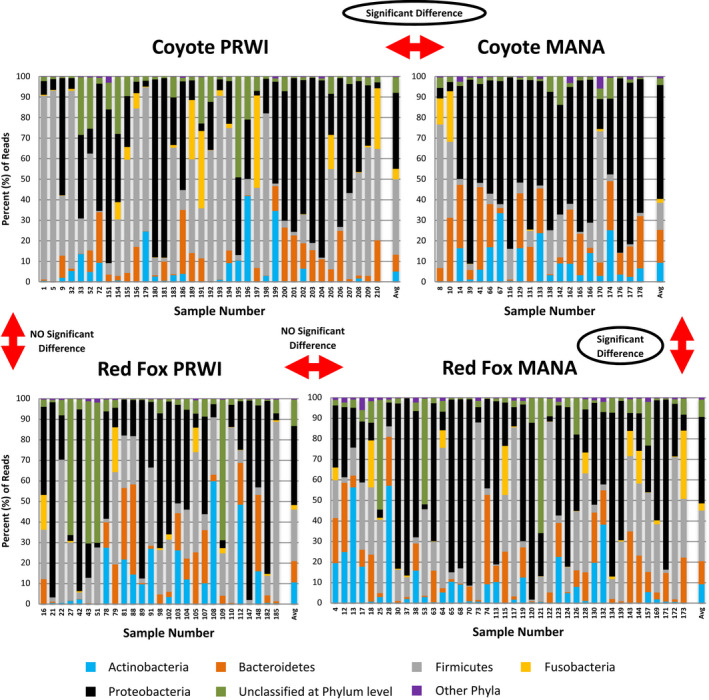
- Coyote gut microbiomes differed significantly between Prince William Forest Park (PRWI) and Manassas National Battlefield Park (MANA) across all three distance measures (MRPP p = .002 for Euclidean, Jaccard, and Sorensen).
- Red fox microbiomes did not differ between parks (p = .956, .881, .871), and PRWI coyotes did not differ from PRWI red foxes (p = .147, .123, .178), but MANA coyotes did differ from MANA red foxes (p = .045, .031, .031).
- MANA coyotes had higher average Proteobacteria (55.47%) and lower Firmicutes (13.27%) than PRWI coyotes (37.01% Proteobacteria, 36.64% Firmicutes), a pattern the authors associate with dysbiosis.
- Microbial species richness differed significantly between sites (p = .001) but not hosts (p = .820); Shannon diversity did not differ significantly between hosts (p = .504) or sites (p = .125).
Methods
- Scat samples were collected from 2012 to 2017 at PRWI (low human disturbance) and MANA (high human disturbance): 264 samples were gathered, 198 underwent DNA isolation, and 161 were successfully PCR-amplified and sequenced, including 58 coyote and 67 red fox samples.
- Canid species were identified using mitochondrial cytochrome-b PCR followed by restriction enzyme digestion, confirmed with mitochondrial d-loop PCR product sizing; gut bacteria were assessed by 16S rRNA V3–V4 amplification and Illumina MiSeq sequencing.
- Sequencing data were analyzed with Illumina’s 16S Metagenomics application against Greengenes at phylum and family levels; MRPP in PC-ORD used Euclidean, Jaccard, and Sorensen distances, and Kruskal–Wallis tests compared Shannon diversity and microbial species richness.
Limitations
- Stated: the authors note it is difficult to know which factors in a complex, interconnected system are causal, resultant, or incidental, and they say their model is not meant to explain all results from wild animals forced into urban habitats.
- Evident: this is an observational scat-based study; 66 of 264 collected samples did not undergo DNA isolation, 37 of 198 failed PCR, and 23 of 161 analyzed samples had unidentified sources.
- Evident: sample sizes were uneven across host/site groups (e.g., 37 PRWI coyotes vs. 21 MANA coyotes; 27 PRWI red foxes vs. 40 MANA red foxes), and the study did not directly measure physiological stress, health, or diet.
Model-written summary. Check it against the paper before relying on it.
Integrity signals
Registry
Cites
Statistics
Figures
Verification
Claims the paper makes
0 Valid · 0 Not valid · 18 Not checked · 68 Own results and interpretations
A result the paper reports from its own data — it cites no other source for it, so there is none to check. The quote shows it is in the paper.
In the paper
“With the PRWI coyote samples, the average percent reads identified to each major bacterial phylum were: 37.01% for Proteobacteria”
§ Microbiomes in Canidae > RESULTS > Coyote gut microbiome results
plain- Asserted: passes — The authors put it forward as true.
- Checkable: passes — It can be checked against evidence.
- Load-bearing: unclear — It is unclear whether the paper’s conclusions depend on it.
- Based: passes — The paper gives a reason why it holds.
A result the paper reports from its own data — it cites no other source for it, so there is none to check. The quote shows it is in the paper.
In the paper
“With the MANA coyote samples, the average percent reads were: 55.47% for Proteobacteria”
§ Microbiomes in Canidae > RESULTS > Coyote gut microbiome results
plain- Asserted: passes — The authors put it forward as true.
- Checkable: passes — It can be checked against evidence.
- Load-bearing: unclear — It is unclear whether the paper’s conclusions depend on it.
- Based: passes — The paper gives a reason why it holds.
A result the paper reports from its own data — it cites no other source for it, so there is none to check. The quote shows it is in the paper.
In the paper
“Microbial species richness significantly different between sites | .001”
§ Microbiomes in Canidae > RESULTS > Coyote gut microbiome results
plain- Asserted: passes — The authors put it forward as true.
- Checkable: passes — It can be checked against evidence.
- Load-bearing: passes — The paper’s conclusions depend on it.
- Based: passes — The paper gives a reason why it holds.
A result the paper reports from its own data — it cites no other source for it, so there is none to check. The quote shows it is in the paper.
In the paper
“The average Shannon diversity was 2.249, while the average number of microbial species in the PRWI red fox scat samples was 182.7.”
§ Microbiomes in Canidae > RESULTS > Red fox gut microbiome results
plain- Asserted: passes — The authors put it forward as true.
- Checkable: passes — It can be checked against evidence.
- Load-bearing: unclear — It is unclear whether the paper’s conclusions depend on it.
- Based: passes — The paper gives a reason why it holds.
A result the paper reports from its own data — it cites no other source for it, so there is none to check. The quote shows it is in the paper.
In the paper
“The average Shannon diversity was 2.405, while the average number of microbial species in the PRWI coyote scat samples was 198.6.”
§ Microbiomes in Canidae > RESULTS > Coyote gut microbiome results
plain- Asserted: passes — The authors put it forward as true.
- Checkable: passes — It can be checked against evidence.
- Load-bearing: unclear — It is unclear whether the paper’s conclusions depend on it.
- Based: passes — The paper gives a reason why it holds.
47 more claims
Create a free account to see all 86 claims and to verify the 31 references still open.
- Probably not a substantial claim. 15
- It may state two separate claims as one. 23
Citations
Cites
Klindworth, A., Pruesse, E., Schweer, T., Peplies, J., Quast, C., Horn, M., & Glöckner, F. O. (2013) · Nucleic Acids Research · doi:10.1093/nar/gks808 · Cited by 8,850
Analysis of Ecological Communities
Anderson, M. J. (2003) · Journal of Experimental Marine Biology and Ecology · doi:10.1016/s0022-0981(03)00091-1 · Cited by 5,086
Proteobacteria: Microbial signature of dysbiosis in gut microbiota
Shin, N.-R., Whon, T. W., & Bae, J.-W. (2015) · Trends in Biotechnology · doi:10.1016/j.tibtech.2015.06.011 · Cited by 3,954
Mesopredator release and avifaunal extinctions in a fragmented system
Crooks, K. R., & Soulé, M. E. (1999) · Nature · doi:10.1038/23028 · Cited by 1,721
The impact of free-ranging domestic cats on wildlife of the United States
Loss, S. R., Will, T., & Marra, P. P. (2013) · Nature Communications · doi:10.1038/ncomms2380 · Cited by 919
The Gastrointestinal Microbiome: A Review
Barko, P. C., McMichael, M. A., Swanson, K. S., & Williams, D. A. (2018) · Journal of Veterinary Internal Medicine · doi:10.1111/jvim.14875 · Cited by 750
Dysbiotic Proteobacteria expansion: a microbial signature of epithelial dysfunction
Litvak, Y., Byndloss, M. X., Tsolis, R. M., & Bäumler, A. J. (2017) · Current Opinion in Microbiology · doi:10.1016/j.mib.2017.07.003 · Cited by 658
(2014) · Cell Host & Microbe · doi:10.1016/j.chom.2014.08.014 · Cited by 536
Ingala, M. R., Simmons, N. B., Wultsch, C., Krampis, K., Speer, K. A., & Perkins, S. L. (2018) · Frontiers in Microbiology · doi:10.3389/fmicb.2018.00803 · Cited by 501
Swanson, K. S., Dowd, S. E., Suchodolski, J. S., Middelbos, I. S., Vester, B. M., Barry, K. A., Nelson, K. E., Torralba, M., Henrissat, B., Coutinho, P. M., et al. (2011) · The ISME Journal · doi:10.1038/ismej.2010.162 · Cited by 420
Gao, X., Cao, Q., Cheng, Y., Zhao, D., Wang, Z., Yang, H., Wu, Q., You, L., Wang, Y., Lin, Y., et al. (2018) · Proceedings of the National Academy of Sciences · doi:10.1073/pnas.1720696115 · Cited by 400
The Microbiome of Animals: Implications for Conservation Biology
Bahrndorff, S., Alemu, T., Alemneh, T., & Lund Nielsen, J. (2016) · International Journal of Genomics · doi:10.1155/2016/5304028 · Cited by 309
Wolves–coyotes–foxes: a cascade among carnivores
Levi, T., & Wilmers, C. C. (2012) · Ecology · doi:10.1890/11-0165.1 · Cited by 293
Covariation of diet and gut microbiome in African megafauna
Kartzinel, T. R., Hsing, J. C., Musili, P. M., Brown, B. R. P., & Pringle, R. M. (2019) · Proceedings of the National Academy of Sciences · doi:10.1073/pnas.1905666116 · Cited by 264
Endogenous Enterobacteriaceae underlie variation in susceptibility to Salmonella infection
Velazquez, E. M., Nguyen, H., Heasley, K. T., Saechao, C. H., Gil, L. M., Rogers, A. W. L., Miller, B. M., Rolston, M. R., Lopez, C. A., Litvak, Y., et al. (2019) · Nature Microbiology · doi:10.1038/s41564-019-0407-8 · Cited by 201
A continental scale trophic cascade from wolves through coyotes to foxes
Newsome, T. M., & Ripple, W. J. (2015) · Journal of Animal Ecology · doi:10.1111/1365-2656.12258 · Cited by 184
Diagnosis and interpretation of intestinal dysbiosis in dogs and cats
Suchodolski, J. S. (2016) · The Veterinary Journal · doi:10.1016/j.tvjl.2016.04.011 · Cited by 179
The functionality of the gastrointestinal microbiome in non-human animals
Hanning, I., & Diaz-Sanchez, S. (2015) · Microbiome · doi:10.1186/s40168-015-0113-6 · Cited by 177
Paxinos, E., McIntosh, C., Ralls, K., & Fleischer, R. (1997) · Molecular Ecology · doi:10.1046/j.1365-294x.1997.00206.x · Cited by 162
RILEY, S. P. D., BROMLEY, C., POPPENGA, R. H., UZAL, F. A., WHITED, L., & SAUVAJOT, R. M. (2007) · The Journal of Wildlife Management · doi:10.2193/2005-615 · Cited by 141
Humans and urban development mediate the sympatry of competing carnivores
Moll, R. J., Cepek, J. D., Lorch, P. D., Dennis, P. M., Robison, T., Millspaugh, J. J., & Montgomery, R. A. (2018) · Urban Ecosystems · doi:10.1007/s11252-018-0758-6 · Cited by 122
Coexistence of coyotes (Canis latrans) and red foxes (Vulpes vulpes) in an urban landscape
Mueller, M. A., Drake, D., & Allen, M. L. (2018) · PLOS ONE · doi:10.1371/journal.pone.0190971 · Cited by 96
Poor health is associated with use of anthropogenic resources in an urban carnivore
Murray, M., Edwards, M. A., Abercrombie, B., & St. Clair, C. C. (2015) · Proceedings of the Royal Society B: Biological Sciences · doi:10.1098/rspb.2015.0009 · Cited by 90
Rossell, C. R., Gorsira, B., & Patch, S. (2005) · Forest Ecology and Management · doi:10.1016/j.foreco.2005.02.035 · Cited by 76
Urbanization and anticoagulant poisons promote immune dysfunction in bobcats
Serieys, L. E. K., Lea, A. J., Epeldegui, M., Armenta, T. C., Moriarty, J., VandeWoude, S., Carver, S., Foley, J., Wayne, R. K., Riley, S. P. D., et al. (2018) · Proceedings of the Royal Society B: Biological Sciences · doi:10.1098/rspb.2017.2533 · Cited by 57
Observations of Coyote‐Cat Interactions
Grubbs, S. E., & Krausman, P. R. (2009) · Journal of Wildlife Management · doi:10.2193/2008-033 · Cited by 54
Cove, M. V., Jones, B. M., Bossert, A. J., Clever, D. R., Dunwoody, R. K., White, B. C., & Jackson, V. L. (2012) · The American Midland Naturalist · doi:10.1674/0003-0031-168.2.456 · Cited by 45
Why do parasitized hosts look different? Resolving the “chicken-egg” dilemma
Blanchet, S., Méjean, L., Bourque, J.-F., Lek, S., Thomas, F., Marcogliese, D. J., Dodson, J. J., & Loot, G. (2009) · Oecologia · doi:10.1007/s00442-008-1272-y · Cited by 39
Coyote colonization of northern Virginia and admixture with Great Lakes wolves
Bozarth, C. A., Hailer, F., Rockwood, L. L., Edwards, C. W., & Maldonado, J. E. (2011) · Journal of Mammalogy · doi:10.1644/10-mamm-a-223.1 · Cited by 29
Land‐use change structures carnivore communities in remaining tallgrass prairie
Wait, K. R., Ricketts, A. M., & Ahlers, A. A. (2018) · The Journal of Wildlife Management · doi:10.1002/jwmg.21492 · Cited by 23
An efficient noninvasive method for discriminating among faeces of sympatric North American canids
Bozarth, C. A., Alva-Campbell, Y. R., Ralls, K., Henry, T. R., Smith, D. A., Westphal, M. F., & Maldonado, J. E. (2010) · Conservation Genetics Resources · doi:10.1007/s12686-010-9215-4 · Cited by 18
Lookingbill, T. R., Schmit, J. P., Tessel, S. M., Suarez‐Rubio, M., & Hilderbrand, R. H. (2014) · Ecological Indicators · doi:10.1016/j.ecolind.2013.12.025 · Cited by 16
Stress, microbiota, and immunity
Hollins, S. L., & Hodgson, D. M. (2019) · Current Opinion in Behavioral Sciences · doi:10.1016/j.cobeha.2019.01.015 · Cited by 16
Research works printed but not linked: 1
- 10.1098/rbsp.2017.2533 · doi:10.1098/rbsp.2017.2533
Cited by
Fecal microbiota of the synanthropic golden jackal (Canis aureus)
Lapid, R., Motro, Y., Craddock, H. A., Khalfin, B., King, R., Bar‐Gal, G. K., & Moran‐Gilad, J. (2023) · Animal Microbiome · doi:10.1186/s42523-023-00259-3 · Cited by 14
Genetics for Furbearer Management and Conservation
Reding, D. M., Sacks, B. N., Latch, E. K., & Piaggio, A. J. (2023) · doi:10.59438/bzwm9451 · Cited by 4
Fecal Microbiota of the Bobcat (Lynx rufus) in a Temperate Forest of Central Mexico
Montes-Carreto, L. M., Espinal-Cárdenas, J. H., Arellano-Hernández, H. D., Guerrero, J. A., & Martínez‐Romero, E. (2026) · Ecologies · doi:10.3390/ecologies7030068
Mosley, I. A., McAllister, P. I., Balasubramanian, S., Auckland, L. D., Light, J. E., & Hamer, S. A. (2026) · Journal of Mammalogy · doi:10.1093/jmammal/gyag096
Metadata
- Authors
- Biles, T. L., Beck, H., & Masters, B. S.
- Affiliations
- Towson University (US)
- Corresponding author
- Beck, Harald
- Venue
- Ecology and Evolution
- Publisher
- Wiley
- Published
- 2021-12
- Volume
- 11
- Issue
- 24
- Pages
- 18531-18539
- ISSN
- 2045-7758 (ISSN-L)
- PMC
- PMC8717330
- OpenAlex
- W4200396249
- Cited by
- 4
- References
- 33
- Citations by year
- 2026: 2 · 2023: 2
- FWCI
- 0.14
- Type
- journal article
- Language
- en
- Open access
- gold
- doi.org
- Licence
- Locations
- Ecology and Evolution (publishedVersion, cc-by)
- PubMed Central (publishedVersion, cc-by)
- PubMed (publishedVersion)
- DOAJ (DOAJ: Directory of Open Access Journals) (submittedVersion, cc-by-sa)
- Funders
- National Park Service (P13AC00443)
- Topics
- Life Sciences › Biochemistry, Genetics and Molecular Biology › Molecular Biology › Gut microbiota and health
- Physical Sciences › Environmental Science › Ecology › Wildlife Ecology and Conservation
- Physical Sciences › Environmental Science › Ecology › Microbial Community Ecology and Physiology
- Keywords
- gut microbiota, coyote, red fox, Canidae, sympatry, human disturbance, anthropogenic impacts, physiological stress, dysbiosis, scat samples, diet, land use, wildlife health, species interactions
About these checks
Registry, retraction, Cites and statistics results are computed, not judged, with one exception: a printed reference that no index lists is read once by a model before it counts as a citation error. Claims are extracted by a model and kept only when their quote appears verbatim in the text; each cited source is then checked, with a model’s help, for whether it says what the claim relies on. Those verdicts can be wrong — read the claim’s quote and the cited source before relying on one.
A language model drew the claims from the paper on 2026-11-14, under version 3 of the claim definition (model deepseek-v4.1-flash, prompt extract-v3).
A second model labelled each claim on 2026-11-14 (model jev-1.13-20260917, definition revision gold-guideline-v0.2).
Statistics and arithmetic are recomputed, not judged.
Confidence bands are shown only for fields calibrated on our annotated test set. None is calibrated yet, so no band is shown.
What counts as a claim ›How we measure confidence ›How we check this ›
Are you an author, or do you see a problem with this page? Request a review
Data sources
Bibliographic data: Semantic Scholar, OpenAlex, Crossref.
Contains information from the Semantic Scholar Academic Graph Datasets, made available under the ODC Attribution License (ODC-BY 1.0).
Semantic Scholar’s data is described in: Kinney, R., et al. (2023). The Semantic Scholar Open Data Platform. arXiv:2301.10140.
