

The DOI matches its Crossref record; 4 of the 4 references it cites were found in a registry or an index.
Holographic duals of evaporating black holes
Abstract
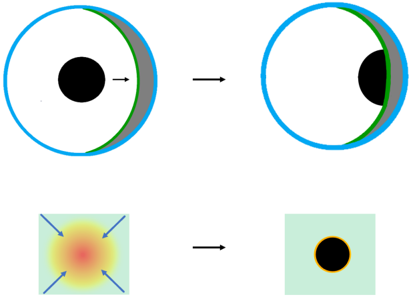
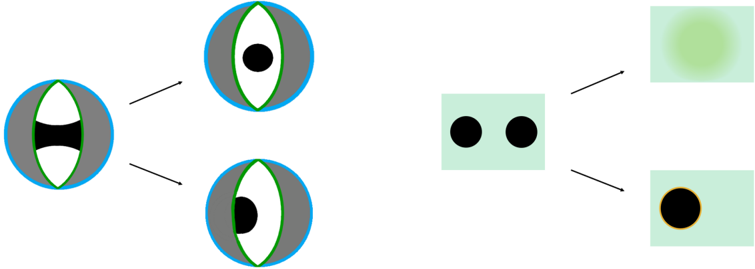
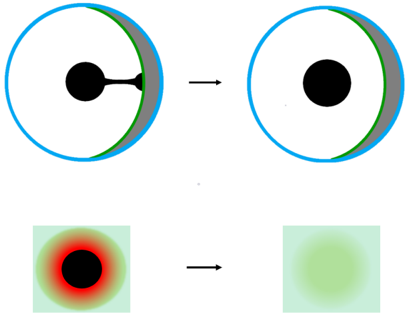
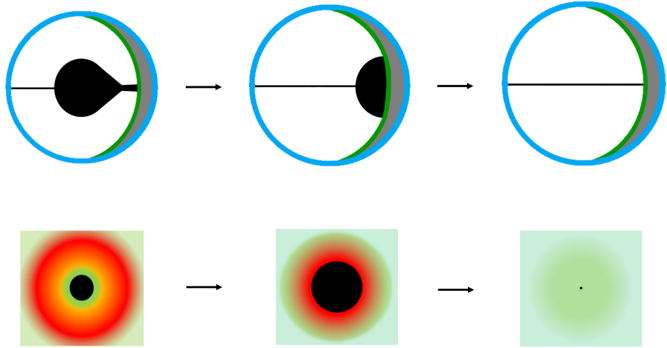
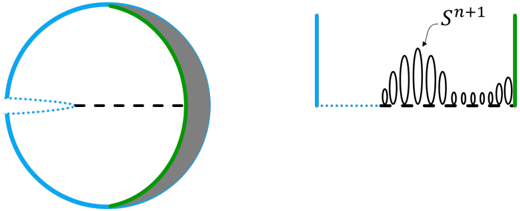
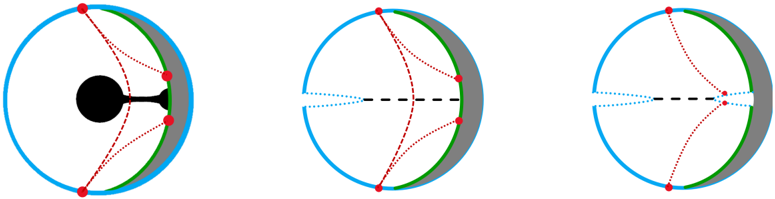
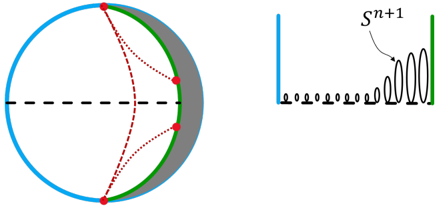
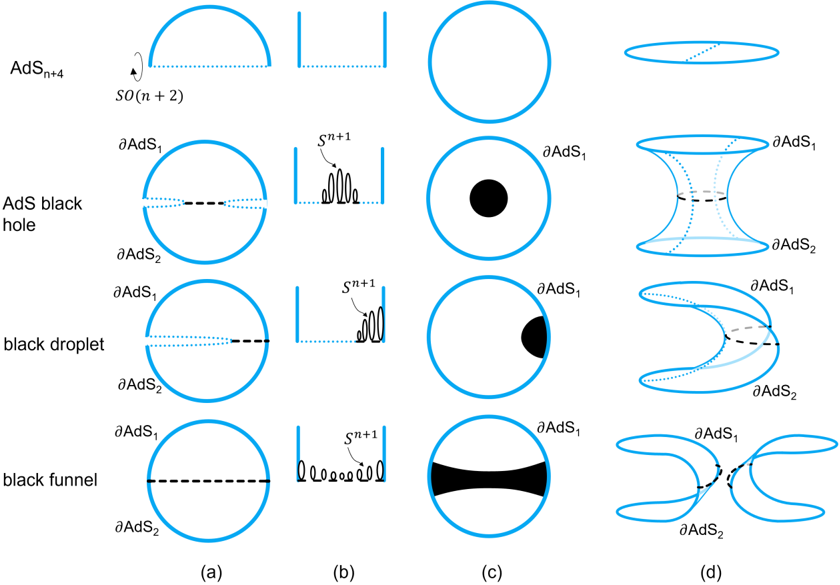
We describe the dynamical evaporation of a black hole as the classical evolution in time of a black hole in an Anti-de Sitter braneworld. A bulk black hole whose horizon intersects the brane yields the classical bulk dual of a black hole coupled to quantum conformal fields. The evaporation of this black hole happens when the bulk horizon slides off the brane, making the horizon on the brane shrink. We use a large-D effective theory of the bulk Einstein equations to solve the time evolution of these systems. With this method, we study the dual evaporation of a variety of black holes interacting with colder radiation baths. We also obtain the dual of the collapse of holographic radiation to form a black hole on the brane. Finally, we discuss the evolution of the Page curve of the radiation in our evaporation setups, with entanglement islands appearing and then shrinking during the decreasing part of the curve.
Overview
The claims and statistics of this paper haven’t been checked yet.
Run the check — free, no account needed. It reads the open-access text and checks the sources it cites.
Integrity signals
Registry
Cites
Statistics
Figures



Verification
Claims the paper makes
The claims and statistics of this paper haven’t been checked yet.
Run the check — free, no account needed. It reads the open-access text and checks the sources it cites.
Claims other papers make about this one
Each is checked against this paper’s own text: does it say what the citing paper says it does?
The source backs part of the claim, not all of it — or backs it for a different population, condition or comparison.
In the citing paper
“However, static braneworld black holes in higher-dimensions have been found numerically, e.g., [67][68][69][70][71][72], and the qualitative argument was shown to have flaws [69].”
From Three-Dimensional Quantum Black Holes: A Primer (2024) · cites this paper as [72]
Experimental — accuracy not yet measuredThe cited source says what the claim attributes to it.
In the citing paper
“In fact, there are several examples of higher-dimensional static braneworld black holes, both analytically and numerically constructed [67][68][69][70][71][72][201][202][203][204][205][206][207][208].”
From Three-Dimensional Quantum Black Holes: A Primer (2024) · cites this paper as [72]
The cited source says what the claim attributes to it.
In the citing paper
“Indeed, while some bulk black holes get stuck on the brane and never shrink ('black droplets') [71] and hence dynamically stable, there are other bulk black solutions that evaporate due to a Gregory-Laflamme instability [72], as originally suggested in [22,34].”
From Three-Dimensional Quantum Black Holes: A Primer (2024) · cites this paper as [72]
The cited source says what the claim attributes to it.
In the citing paper
“According to [72,215], their semi-classical dynamics are always dual to classical Gregory-Laflamme-like dynamics of bulk black holes.”
From Three-Dimensional Quantum Black Holes: A Primer (2024) · cites this paper as [72]
In the citing paper
“There are in fact several examples of evaporating braneworld black holes (see [72] for details).”
From Three-Dimensional Quantum Black Holes: A Primer (2024) · cites this paper as [72]
Self-check
Percentages, sums and reported differences re-computed from the paper’s own numbers.
The self-check needs the paper’s full text.
Citations
Cites
Information in black hole radiation
Page, D. N. (1993) · Physical Review Letters · doi:10.1103/physrevlett.71.3743 · Cited by 1,172 · cited 1×
“Finally, braneworld holography has been revisited in recent times in order to derive the Page curve [34] followed by the entanglement entropy of the radiation emitted by a black”
BackgroundEntanglement wedge reconstruction and the information paradox
Penington, G. (2020) · Journal of High Energy Physics · doi:10.1007/jhep09(2020)002 · Cited by 968 · cited 2×
“In this case, the Page curve drops during the evaporation but, since the evolution stops at a stable uniform funnel, eventually the curve plateaus at a constant value, as in the scenarios in [32, 33, 43, 44].”
BackgroundThe Page curve of Hawking radiation from semiclassical geometry
Almheiri, A., Mahajan, R., Maldacena, J., & Zhao, Y. (2020) · Journal of High Energy Physics · doi:10.1007/jhep03(2020)149 · Cited by 898
The entropy of Hawking radiation
Almheiri, A., Hartman, T., Maldacena, J., Shaghoulian, E., & Tajdini, A. (2021) · Reviews of Modern Physics · doi:10.1103/revmodphys.93.035002 · Cited by 706
Research works printed but not linked: 58
- D. Marolf, M. Rangamani and T. Wiseman, Holographic thermal field theory on curved spacetimes, Class. Quant. Grav. 31 (2014) 063001 [arXiv:1312.0612] [INSPIRE]. · DOI
- T. Tanaka, Classical black hole evaporation in Randall-Sundrum infinite brane world, Prog. Theor. Phys. Suppl. 148 (2003) 307 [gr-qc/0203082] [INSPIRE]. · DOI · Paper page
- R. Emparan, A. Fabbri and N. Kaloper, Quantum black holes as holograms in AdS brane worlds, JHEP 08 (2002) 043 [hep-th/0206155] [INSPIRE]. · DOI · Paper page
- P. Figueras, J. Lucietti and T. Wiseman, Ricci solitons, Ricci flow, and strongly coupled CFT in the Schwarzschild Unruh or Boulware vacua, Class. Quant. Grav. 28 (2011) 215018 [arXiv:1104.4489] [INSPIRE]. · DOI · Paper page
- P. Figueras and T. Wiseman, Gravity and large black holes in Randall-Sundrum II braneworlds, Phys. Rev. Lett. 107 (2011) 081101 [arXiv:1105.2558] [INSPIRE]. · DOI · Paper page
- N. Tanahashi and T. Tanaka, Time-symmetric initial data of large brane-localized black hole in RS-II model, JHEP 03 (2008) 041 [arXiv:0712.3799] [INSPIRE]. · DOI · Paper page
- K. Kashiyama, N. Tanahashi, A. Flachi and T. Tanaka, Quantum back reaction to asymptotically AdS black holes, JHEP 01 (2010) 099 [arXiv:0910.5376] [INSPIRE]. · DOI
- S. Abdolrahimi, C. Cattoën, D.N. Page and S. Yaghoobpour-Tari, Large Randall-Sundrum II Black Holes, Phys. Lett. B 720 (2013) 405 [arXiv:1206.0708] [INSPIRE]. · DOI · Paper page
- S. Abdolrahimi, C. Cattoën, D.N. Page and S. Yaghoobpour-Tari, Spectral methods in general relativity and large Randall-Sundrum II black holes, JCAP 06 (2013) 039 [arXiv:1212.5623] [INSPIRE]. · DOI
- S. Banerjee, U. Danielsson and S. Giri, Dark bubbles and black holes, JHEP 09 (2021) 158 [arXiv:2102.02164] [INSPIRE]. · DOI
- P. Figueras and S. Tunyasuvunakool, CFTs in rotating black hole backgrounds, Class. Quant. Grav. 30 (2013) 125015 [arXiv:1304.1162] [INSPIRE]. · DOI
- W.D. Biggs and J.E. Santos, Rotating Black Holes in Randall-Sundrum II Braneworlds, Phys. Rev. Lett. 128 (2022) 021601 [arXiv:2108.00016] [INSPIRE]. · DOI
- R. Gregory, S.F. Ross and R. Zegers, Classical and quantum gravity of brane black holes, JHEP 09 (2008) 029 [arXiv:0802.2037] [INSPIRE]. · DOI · Paper page
- R. Gregory and R. Laflamme, Black strings and p-branes are unstable, Phys. Rev. Lett. 70 (1993) 2837 [hep-th/9301052] [INSPIRE]. · DOI · Paper page
- A.L. Fitzpatrick, L. Randall and T. Wiseman, On the existence and dynamics of braneworld black holes, JHEP 11 (2006) 033 [hep-th/0608208] [INSPIRE]. · DOI · Paper page
- N. Kaloper, Cutoffs, Stretched Horizons and Black Hole Radiators, Phys. Rev. D 86 (2012) 104052 [arXiv:1203.3455] [INSPIRE]. · DOI
- S. Bhattacharyya, V.E. Hubeny, S. Minwalla and M. Rangamani, Nonlinear Fluid Dynamics from Gravity, JHEP 02 (2008) 045 [arXiv:0712.2456] [INSPIRE]. · DOI
- R. Emparan, T. Harmark, V. Niarchos and N.A. Obers, Essentials of Blackfold Dynamics, JHEP 03 (2010) 063 [arXiv:0910.1601] [INSPIRE]. · DOI
- T. Hirayama and G. Kang, Stable black strings in anti-de Sitter space, Phys. Rev. D 64 (2001) 064010 [hep-th/0104213] [INSPIRE]. · DOI · Paper page
- D. Marolf and J.E. Santos, Phases of Holographic Hawking Radiation on spatially compact spacetimes, JHEP 10 (2019) 250 [arXiv:1906.07681] [INSPIRE]. · DOI
- R. Emparan et al., Black tsunamis and naked singularities in AdS, JHEP 02 (2022) 090 [arXiv:2112.07967] [INSPIRE]. · DOI · Paper page
- D. Licht, R. Suzuki and B. Way, The large D effective theory of black strings in AdS, JHEP 12 (2022) 146 [arXiv:2211.04333] [INSPIRE]. · DOI
- S. Bhattacharyya et al., A membrane paradigm at large D, JHEP 04 (2016) 076 [arXiv:1504.06613] [INSPIRE]. · arXiv
- S. Bhattacharyya, M. Mandlik, S. Minwalla and S. Thakur, A Charged Membrane Paradigm at Large D, JHEP 04 (2016) 128 [arXiv:1511.03432] [INSPIRE]. · arXiv
- Y. Dandekar, S. Mazumdar, S. Minwalla and A. Saha, Unstable ‘black branes’ from scaled membranes at large D, JHEP 2016 (2016) 140 [arXiv:1609.02912]. · DOI
- R. Emparan and C.P. Herzog, Large D limit of Einstein’s equations, Rev. Mod. Phys. 92 (2020) 045005 [arXiv:2003.11394]. · DOI · Paper page
- R. Emparan, R. Suzuki and K. Tanabe, Evolution and End Point of the Black String Instability: Large D Solution, Phys. Rev. Lett. 115 (2015) 091102 [arXiv:1506.06772] [INSPIRE]. · DOI
- T. Andrade, R. Emparan, D. Licht and R. Luna, Black hole collisions, instabilities, and cosmic censorship violation at large D, JHEP 2019 (2019) 99 [arXiv:1908.03424]. · DOI
- R. Luna and M. Sanchez-Garitaonandia, Holographic collisions in large D effective theory, JHEP 02 (2023) 147 [arXiv:2212.14440] [INSPIRE]. · DOI
- D. Wang and M.W. Choptuik, Black hole formation in Randall-Sundrum II braneworlds, Phys. Rev. Lett. 117 (2016) 011102 [arXiv:1604.04832] [INSPIRE]. · DOI
- T. Andrade, R. Emparan and D. Licht, Rotating black holes and black bars at large D, JHEP 09 (2018) 107 [arXiv:1807.01131] [INSPIRE]. · DOI
- T. Andrade et al., Entropy production and entropic attractors in black hole fusion and fission, JHEP 08 (2020) 098 [arXiv:2005.14498] [INSPIRE]. · DOI
- J.E. Santos and B. Way, Black Droplets, JHEP 08 (2014) 072 [arXiv:1405.2078] [INSPIRE]. · DOI
- T. Wiseman, Static axisymmetric vacuum solutions and nonuniform black strings, Class. Quant. Grav. 20 (2003) 1137 [hep-th/0209051] [INSPIRE]. · DOI
- R. Emparan, G.T. Horowitz and R.C. Myers, Exact description of black holes on branes. II. Comparison with BTZ black holes and black strings, JHEP 01 (2000) 021 [hep-th/9912135] [INSPIRE]. · DOI · Paper page
- L. Randall and R. Sundrum, An Alternative to compactification, Phys. Rev. Lett. 83 (1999) 4690 [hep-th/9906064] [INSPIRE]. · DOI · Paper page
- A. Karch and L. Randall, Locally localized gravity, JHEP 05 (2001) 008 [hep-th/0011156] [INSPIRE]. · DOI · Paper page
- L. Lehner and F. Pretorius, Black Strings, Low Viscosity Fluids, and Violation of Cosmic Censorship, Phys. Rev. Lett. 105 (2010) 101102 [arXiv:1006.5960] [INSPIRE]. · DOI
- R. Emparan et al., Phases and Stability of Non-Uniform Black Strings, JHEP 05 (2018) 104 [arXiv:1802.08191] [INSPIRE]. · DOI
- A. Almheiri, N. Engelhardt, D. Marolf and H. Maxfield, The entropy of bulk quantum fields and the entanglement wedge of an evaporating black hole, JHEP 12 (2019) 063 [arXiv:1905.08762] [INSPIRE]. · DOI · Paper page
- T. Hartman and J. Maldacena, Time Evolution of Entanglement Entropy from Black Hole Interiors, JHEP 05 (2013) 014 [arXiv:1303.1080] [INSPIRE]. · DOI · Paper page
- D. Neuenfeld, Homology conditions for RT surfaces in double holography, Class. Quant. Grav. 39 (2022) 075009 [arXiv:2105.01130] [INSPIRE]. · DOI · Paper page
- A. Almheiri, R. Mahajan and J. Maldacena, Islands outside the horizon, arXiv:1910.11077 [https://doi.org/10.48550/arXiv.1910.11077]. · DOI · Paper page
- H.Z. Chen et al., Quantum Extremal Islands Made Easy, Part I: Entanglement on the Brane, JHEP 10 (2020) 166 [arXiv:2006.04851] [INSPIRE]. · DOI
- H.Z. Chen et al., Quantum Extremal Islands Made Easy, Part II: Black Holes on the Brane, JHEP 12 (2020) 025 [arXiv:2010.00018] [INSPIRE]. · DOI · Paper page
- A. Almheiri, R. Mahajan and J.E. Santos, Entanglement islands in higher dimensions, SciPost Phys. 9 (2020) 001 [arXiv:1911.09666] [INSPIRE]. · DOI
- H. Geng and A. Karch, Massive islands, JHEP 09 (2020) 121 [arXiv:2006.02438] [INSPIRE]. · DOI · Paper page
- G. Grimaldi, J. Hernandez and R.C. Myers, Quantum extremal islands made easy. Part IV. Massive black holes on the brane, JHEP 03 (2022) 136 [arXiv:2202.00679] [INSPIRE]. · DOI
- F. Holdt-Sørensen, D.A. McGady and N. Wintergerst, Black hole evaporation and semiclassicality at large D, Phys. Rev. D 102 (2020) 026016 [arXiv:1908.08083]. · DOI
- R. Emparan and M. Martınez, Black string flow, JHEP 2013 (2013) 68 [arXiv:1307.2276]. · DOI
- H. Geng et al., Information Transfer with a Gravitating Bath, SciPost Phys. 10 (2021) 103 [arXiv:2012.04671] [INSPIRE]. · DOI
- H. Geng et al., Inconsistency of islands in theories with long-range gravity, JHEP 01 (2022) 182 [arXiv:2107.03390] [INSPIRE]. · DOI
- H. Geng, S. Lüst, R.K. Mishra and D. Wakeham, Holographic BCFTs and Communicating Black Holes, jhep 08 (2021) 003 [arXiv:2104.07039] [INSPIRE]. · DOI
- R.-X. Miao, Massless Entanglement Island in Wedge Holography, arXiv:2212.07645 [https://doi.org/10.48550/arXiv.2212.07645]. · DOI
- R.-X. Miao, Entanglement island and Page curve in wedge holography, JHEP 03 (2023) 214 [arXiv:2301.06285] [INSPIRE]. · DOI
- S. Colin-Ellerin, V.E. Hubeny, B.E. Niehoff and J. Sorce, Large-d phase transitions in holographic mutual information, JHEP 2020 (2020) 173 [arXiv:1911.06339]. · DOI
- D. Giataganas, N. Pappas and N. Toumbas, Holographic observables at large d, Phys. Rev. D 105 (2022) 026016 [arXiv:2110.14606] [INSPIRE]. · DOI
- E. Sorkin, A Critical dimension in the black string phase transition, Phys. Rev. Lett. 93 (2004) 031601 [hep-th/0402216] [INSPIRE]. · DOI
Cited by
Sorted by citations
Three-Dimensional Quantum Black Holes: A Primer
Panella, E., Pedraza, J. F., & Svesko, A. (2024) · Universe · doi:10.3390/universe10090358 · Cited by 24
Unveiling horizons in quantum critical collapse
Tomašević, M., & Wu, C.-H. (2026) · Journal of High Energy Physics · doi:10.1007/jhep04(2026)151 · Cited by 5
Self-citation
Metadata
- Authors
- Emparan, R., Luna, R., Suzuki, R., Tomašević, M., & Way, B.
- Venue
- Journal of High Energy Physics
- Published
- 2023-05-22
- Volume
- 2023
- Issue
- 5
- ISSN
- 1029-8479
- Cited by
- 24
- References
- 4
- Language
- en
About these checks
Registry, retraction, Cites and statistics results are computed, not judged, with one exception: a printed reference that no index lists is read once by a model before it counts as a citation error. Claims are extracted by a model and kept only when their quote appears verbatim in the text; each cited source is then checked, with a model’s help, for whether it says what the claim relies on. Those verdicts can be wrong — read the claim’s quote and the cited source before relying on one.
Statistics and arithmetic are recomputed, not judged.
Confidence bands are shown only for fields calibrated on our annotated test set. None is calibrated yet, so no band is shown.
What counts as a claim ›How we measure confidence ›How we check this ›
Are you an author, or do you see a problem with this page? Request a review
