

Risk of malignancies in patients with diabetes treated with human insulin or insulin analogues: a cohort study
Open accessThe DOI matches its Crossref record; 30 of the 30 references it cites were found in a registry or an index.
Abstract
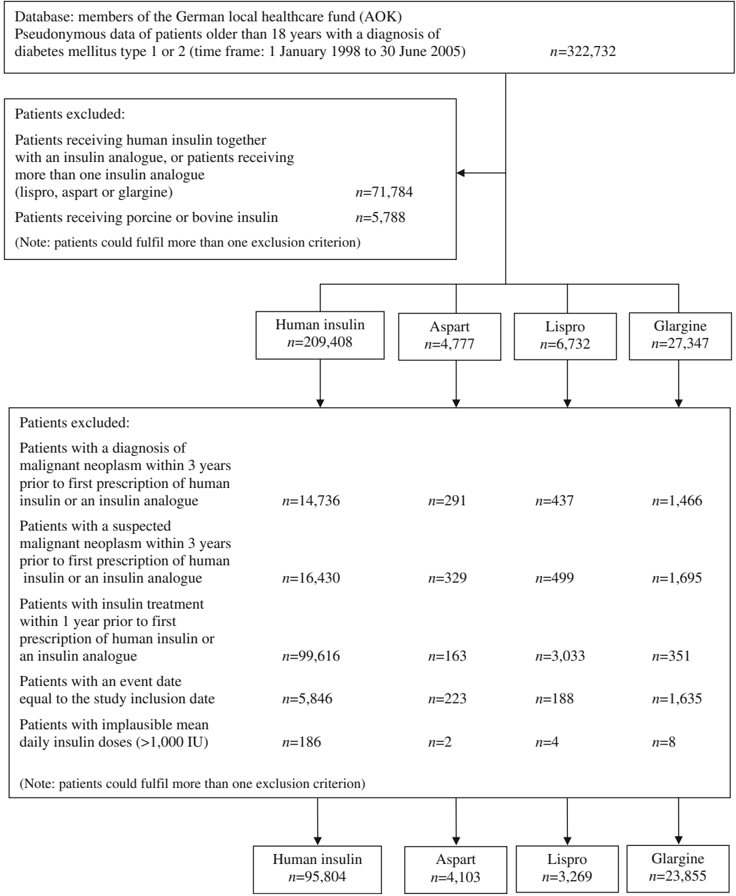
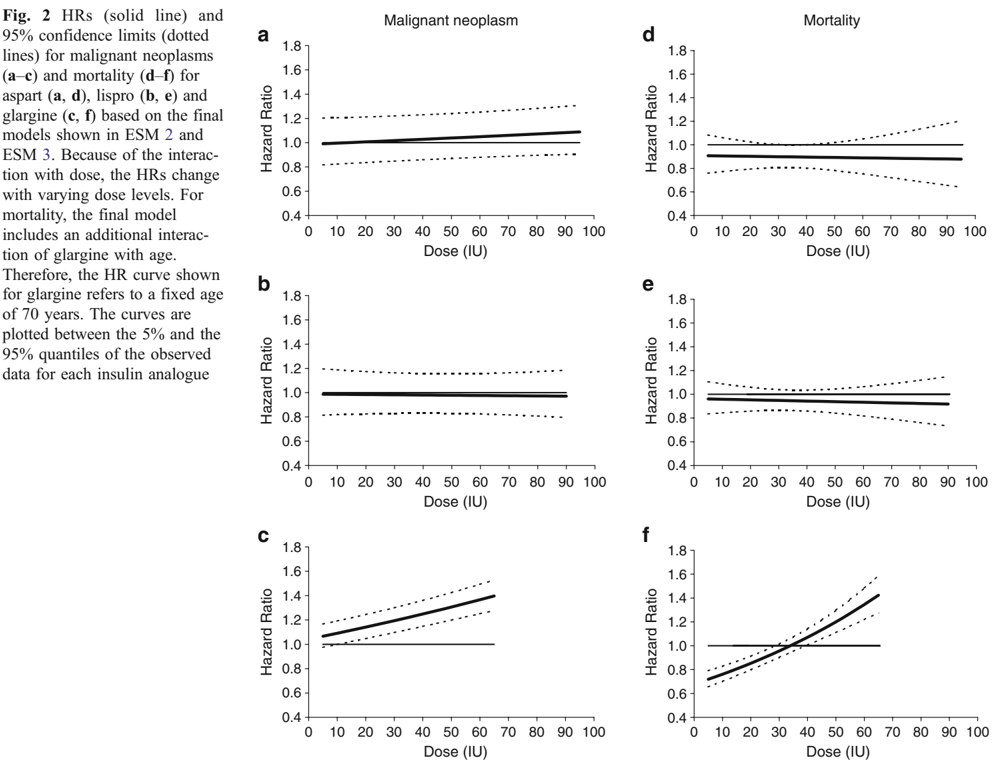
AIMS/HYPOTHESIS: The aim of this cohort study was to investigate the risk of malignant neoplasms and mortality in patients with diabetes treated either with human insulin or with one of three insulin analogues. METHODS: Data were provided by the largest German statutory health insurance fund (time-frame: January 1998 to June 2005 inclusive), on patients without known malignant disease who had received first-time therapy for diabetes mellitus exclusively with human insulin, aspart, lispro or glargine. The primary outcome was the diagnosis of a malignant neoplasm. Data were analysed by multiple Cox regression models adjusting for potential confounders. RESULTS: A total of 127,031 patients were included, with a mean follow-up time of 1.63 (median 1.41, maximum 4.41) years. A positive association between cancer incidence and insulin dose was found for all insulin types. Because patients receiving combined therapy with insulin analogues and human insulin were excluded, the mean daily dose was much lower for glargine than for human insulin, and a slightly lower cancer incidence in the glargine group was found. After adjusting for dose, a dose-dependent increase in cancer risk was found for treatment with glargine compared with human insulin (p < 0.0001): the adjusted HR was 1.09 (95% CI 1.00 to 1.19) for a daily dose of 10 IU, 1.19 (95% CI 1.10 to 1.30) for a daily dose of 30 IU, and 1.31 (95% CI 1.20 to 1.42) for a daily dose of 50 IU. No increased risk was found for aspart (p = 0.30) or lispro (p = 0.96) compared with human insulin. CONCLUSIONS/INTERPRETATION: Considering the overall relationship between insulin dose and cancer, and the lower dose with glargine, the cancer incidence with glargine was higher than expected compared with human insulin. Our results based on observational data support safety concerns surrounding the mitogenic properties of glargine in diabetic patients. Prospective long-term studies are needed to further evaluate the safety of insulin analogues, especially glargine.
Overview
The claims and statistics of this paper haven’t been checked yet.
Free: it reads the open-access text and checks the first 5 claims that cite a source we can check. Create a free account to check every claim.
Integrity signals
Registry
Cites
Statistics
Figures
Verification
Claims the paper makes
The claims and statistics of this paper haven’t been checked yet.
Free: it reads the open-access text and checks the first 5 claims that cite a source we can check. Create a free account to check every claim.
Claims other papers make about this one
Each is checked against this paper’s own text: does it say what the citing paper says it does?
The check wasn’t confident either way, so it gives no verdict — never disputed.
In the citing paper
“Modest survival benefits also have been reported for breast, ovarian, endometrial, prostate, lung, kidney, liver, and earlier stage pancreatic cancers.1791–1800”
From American Association of Clinical Endocrinology Clinical Practice Guideline: Developing a Diabetes Mellitus Comprehensive Care Plan-2022 Update. (2022) · cites this paper as [1799]
Experimental — accuracy not yet measured
Self-check
Percentages, sums and reported differences re-computed from the paper’s own numbers.
The self-check needs the paper’s full text.
Citations
Cites
Regression Models and Life-Tables
Cox, D. R. (1972) · Journal of the Royal Statistical Society Series B: Statistical Methodology · doi:10.1111/j.2517-6161.1972.tb00899.x · Cited by 39,793
Miller, R. G. (1981) · Cited by 3,336
Applied Survival Analysis: Regression Modeling of Time-to-Event Data
Hosmer, D. W., Lemeshow, S. A., & May, S. J. (2008) · Cited by 3,030
Adjusting for multiple testing—when and how?
Bender, R., & Lange, S. (2001) · Journal of Clinical Epidemiology · doi:10.1016/s0895-4356(00)00314-0 · Cited by 3,004 · cited 1×
“As this study was intended to generate hypotheses, we made no adjustments for multiple testing [23].”
MethodSelf-citationMetformin and reduced risk of cancer in diabetic patients
Evans, J. M. M., Donnelly, L. A., Emslie-Smith, A. M., Alessi, D. R., & Morris, A. D. (2005) · BMJ · doi:10.1136/bmj.38415.708634.f7 · Cited by 2,388 · cited 1×
“In particular, we analysed a potential influence of metformin therapy, for which potential effects on cancer incidence have been previously discussed [24].”
BackgroundSurvival Analysis: A Self-Learning Text
Carpenter, M. (1997) · Technometrics · doi:10.1080/00401706.1997.10485091 · Cited by 1,811 · cited 1×
“We checked the proportional hazard assumption graphically by plotting log(-log survival time) versus log survival time and by a formal test based on Schoenfeld residuals [ 22 ].”
MethodApplied Survival Analysis: Regression Modeling of Time‐to‐Event Data
Hosmer, D. W., Lemeshow, S., & May, S. (2008) · Wiley Series in Probability and Statistics · doi:10.1002/9780470258019 · Cited by 1,298
Type-II diabetes and pancreatic cancer: a meta-analysis of 36 studies
Huxley, R., Ansary-Moghaddam, A., Berrington de González, A., Barzi, F., & Woodward, M. (2005) · British Journal of Cancer · doi:10.1038/sj.bjc.6602619 · Cited by 1,105 · cited 1×
“53) has been calculated for endometrial cancer [6, 7].”
BackgroundDiabetes Mellitus and Risk of Colorectal Cancer: A Meta-Analysis
Larsson, S. C., Orsini, N., & Wolk, A. (2005) · JNCI: Journal of the National Cancer Institute · doi:10.1093/jnci/dji375 · Cited by 1,038 · cited 1×
“An OR of 1.82 (95% CI 1.66 to 1.89) has been reported for pancreatic cancer, and an RR of 2.10 (95% CI 1.75 to 2.53) has been calculated for endometrial cancer [6, 7 ]. Similar results have been reported for other cancer entities.”
ResultInfluentialDiabetes mellitus and risk of breast cancer: A meta‐analysis
Larsson, S. C., Mantzoros, C. S., & Wolk, A. (2007) · International Journal of Cancer · doi:10.1002/ijc.22717 · Cited by 875 · cited 1×
“28) for breast cancer [3–5].”
Cited by
Items 301–400 of 616
Li, C., Ford, E. S., Zhao, G., Tsai, J. H., Balluz, L. S., & Giles, W. H. (2012) · Journal of Diabetes and its Complications · doi:10.1016/j.jdiacomp.2011.11.005 · Cited by 23
Gutiérrez‐Salmerón, M. T., Chocarro‐Calvo, A., García-Martínez, J. M., la Vieja, A. D., & García‐Jiménez, C. (2017) · Endocrinología Diabetes y Nutrición · doi:10.1016/j.endinu.2016.10.005 · Cited by 24
Nagel, J. M., Mansmann, U., Wegscheider, K., & Röhmel, J. (2009) · Diabetologia · doi:10.1007/s00125-009-1535-0 · Cited by 22
“[1] support earlier findings that high doses of insulin, reflecting increasing insulin resistance, are associated with an increased risk of cancer.”
InfluentialLong-term insulin glargine therapy in type 2 diabetes mellitus: a focus on cardiovascular outcomes
Donner, T. W., & Joseph, J. J. (2015) · Vascular Health and Risk Management · doi:10.2147/vhrm.s50286 · Cited by 22
Insulin Therapy and Cancer in Type 2 Diabetes
Mannucci, E. (2012) · ISRN Endocrinology · doi:10.5402/2012/240634 · Cited by 26
“Some of the studies did not consider variations of therapy during followup [93], or used inappropriate statistical methods [35].”
BackgroundInfluentialChodick, G., & Zucker, I. (2011) · Women s Health · doi:10.2217/whe.11.4 · Cited by 24
“In a study from Germany, the risk of cancer was positively associated with insulin dose, particularly among users of glargine [84].”
BackgroundAnti-Diabetic Drugs: Cure or Risk Factors for Cancer?
Laskar, J., Bhattacharjee, K., Sengupta, M., & Choudhury, Y. (2018) · Pathology & Oncology Research · doi:10.1007/s12253-018-0402-z · Cited by 23
Risk of Breast Cancer by Individual Insulin Use: An International Multicenter Study
Grimaldi‐Bensouda, L., Cameron, D., Marty, M. E., Barnett, A. H., Penault-Llorca, F. M., Pollak, M., Charbonnel, B. H., Riddle, M. C., Mignot, L., Boivin, J., et al. (2013) · Diabetes Care · doi:10.2337/dc13-0695 · Cited by 25
“50 UI) while only controlling for a limited number of factors (3).”
BackgroundDiabetes Mellitus as a Novel Risk Factor for Gastrointestinal Malignancies
Herrigel, D. J., & Moss, R. A. (2014) · Postgraduate Medicine · doi:10.3810/pgm.2014.10.2825 · Cited by 24
Epidemiological bases and molecular mechanisms linking obesity, diabetes, and cancer
Gutiérrez-Salmerón, M., Chocarro‐Calvo, A., García-Martínez, J. M., la Vieja, A. D., & García‐Jiménez, C. (2017) · Endocrinología Diabetes y Nutrición (English ed ) · doi:10.1016/j.endien.2016.10.002 · Cited by 22
Loh, W. J., North, B. V., Johnston, D. G., & Godsland, I. F. (2010) · Cancer Causes & Control · doi:10.1007/s10552-009-9499-4 · Cited by 25
“this risk was positively associated with insulin dose [41] provide additional support for the relevance of our findings.”
ResultLuca, G., Fallarino, F., Calvitti, M., Mancuso, F., Nastruzzi, C., Arato, I., Falabella, G., Grohmann, U., Becchetti, E., Puccetti, P., et al. (2010) · Transplantation · doi:10.1097/tp.0b013e3181ffb9d2 · Cited by 20
“Moreover, possible risks for malignancies in diabetic patients treated with long-lasting insulin analogues have been recently reported (2).”
BackgroundCancer Specific Mortality in Insulin-Treated Type 2 Diabetes Patients
Ioacără, S., Guja, C., Ionescu-Tirgoviste, C., Fica, S. V., & Roden, M. (2014) · PLoS ONE · doi:10.1371/journal.pone.0093132 · Cited by 19
Therapeutic effects of metformin in breast cancer: involvement of the immune system?
Schott, S., Bierhaus, A., Schütz, F., Beckhove, P., Schneeweiß, A., Sohn, C., & Domschke, C. (2011) · Cancer Immunology Immunotherapy · doi:10.1007/s00262-011-1062-y · Cited by 20
Insulin Analogs and Cancer: A Note of Caution
Janssen, J. A. M. J. L., & Varewijck, A. J. (2014) · Frontiers in Endocrinology · doi:10.3389/fendo.2014.00079 · Cited by 20
Glargine safety, diabetes and cancer
Rendell, M., Aktürk, H. K., & Tella, S. H. (2013) · Expert Opinion on Drug Safety · doi:10.1517/14740338.2013.770469 · Cited by 19
“published an analysis using German Health Insurance Fund data of diabetes patients who initiated insulin for the first time between 1998 and 2005 [23].”
BackgroundMethodDiabetes and risk of tumors: oncologic considerations
Rosta, A. (2011) · Orvosi Hetilap · doi:10.1556/oh.2011.29158 · Cited by 23
High dose glargine alters the expression profiles of microRNAs in pancreatic cancer cells
Li, W., Yuan, Y.-Z., Qiao, M.-M., & Zhang, Y.-P. (2012) · World Journal of Gastroenterology · doi:10.3748/wjg.v18.i21.2630 · Cited by 19
New insulins and insulin therapy
Danne, T., & Bolinder, J. (2011) · International Journal of Clinical Practice · doi:10.1111/j.1742-1241.2010.02576.x · Cited by 19
Grouven, U., Hemkens, L. G., Bender, R., & Sawicki, P. T. (2009) · Diabetologia · doi:10.1007/s00125-009-1582-6 · Cited by 19
“[1] raise a number of questions regarding the analyses in our paper [2]; these analyses, in their opinion, led to confounded measures of association.”
BackgroundSelf-citationControversies in the use of insulin analogues
Werner, H., Weinstein, D., Yehezkel, E., & Laron, Z. (2011) · Expert Opinion on Biological Therapy · doi:10.1517/14712598.2011.540233 · Cited by 18
“[14] in Diabetologia investigated the risk of malignant neoplasms and mortality in patients with diabetes treated either with human insulin or with one of three insulin analogues.”
BackgroundNoda, Y., Kawaguchi, T., Kuromatsu, R., Komukai, S., Nakano, M., Niizeki, T., Koga, H., Kawaguchi, A., & Torimura, T. (2019) · Oncology Letters · doi:10.3892/ol.2019.10285 · Cited by 18
Yang, H., Wu, C.-Y., Powell, J. D., & Lu, K. (2020) · International Journal of Molecular Sciences · doi:10.3390/ijms21114030 · Cited by 20
ter Braak, B., Siezen, C. L. E., Kannegieter, N. M., Koedoot, E., van de Water, B., & van der Laan, J. W. (2014) · Archives of Toxicology · doi:10.1007/s00204-014-1201-2 · Cited by 19
“…use of insulin glargine and the occurrence of any cancer (Andersson et al. 2012; Colhoun 2009; Currie et al. 2009; Kostev 2012; Gerstein et al. 2012), others found an association with (breast) cancer development (Hemkens et al. 2009; mannucci et al. 2010; Jonasson et al. 2009; ruiter et al. 2012).”
BackgroundExpression of GLP-1R protein and its clinical role in intrahepatic cholangiocarcinoma tissues
Chen, B., Zhao, W., Dong, J., & Si-Ma, H. (2014) · Molecular Biology Reports · doi:10.1007/s11033-014-3302-7 · Cited by 19
Baričević-Jones, I., Jones, D. R., Roberts, D. L., Lützen, A., Lundby, A., Worm, J., Hansen, B. F., & Renehan, A. G. (2015) · Carcinogenesis · doi:10.1093/carcin/bgv071 · Cited by 19
Hvid, H., Fels, J. J., Kirk, R. K., Thorup, I., Jensen, H. E., Hansen, B. F., & Oleksiewicz, M. B. (2011) · Toxicologic Pathology · doi:10.1177/0192623311406936 · Cited by 18
“Recent epidemiological studies reported a possible link between the insulin analog glargine and cancer development (Hemkens et al. 2009; Smith and Gale 2009).”
Datta‐Nemdharry, P., Thomson, A., Beynon, J., & Donegan, K. L. (2016) · Pharmacoepidemiology and Drug Safety · doi:10.1002/pds.4092 · Cited by 18
Macháčková, K., Chrudinová, M., Radosavljević, J., Potalitsyn, P., Křížková, K., Fábry, M., Selicharová, I., Collinsová, M., Brzozowski, A. M., Žáková, L., et al. (2018) · Biochemistry · doi:10.1021/acs.biochem.7b01260 · Cited by 18
Lahuri, A. H., Mohd, A., Adnan, R., Abdul Rahim, A., Tajudeen, N. F. W., & Nordin, N. (2021) · Biointerface Research in Applied Chemistry · doi:10.33263/briac123.42004219 · Cited by 29
Tabernacki, T., Wang, L., Kaelber, D. C., Xu, R., & Berger, N. A. (2024) · Cancers · doi:10.3390/cancers16132377 · Cited by 17
“Several studies have suggested that insulin therapy could be associated with elevated cancer risk due to its mitogenic effects, potentially fostering the growth of certain cancer types [13,27–30].”
BackgroundThe Modern Role of Basal Insulin in Advancing Therapy in People With Type 2 Diabetes
Bolli, G. B., Home, P. D., Porcellati, F., Riddle, M. C., Gerstein, H. C., Lucidi, P., Fanelli, C. G., & Owens, D. R. (2025) · Diabetes Care · doi:10.2337/dci24-0104 · Cited by 19
Insulin therapy in diabetes and cancer risk: Current understanding and implications for future study
Gough, S. C. L., Belda-Iniesta, C., Poole, C., Weber, M. M., Russell-Jones, D. L., Hansen, B. F., Mannucci, E., & Tuomilehto, J. O. (2011) · Advances in Therapy · doi:10.1007/s12325-011-0047-8 · Cited by 17
Tseng, C. (2013) · Clinical Genitourinary Cancer · doi:10.1016/j.clgc.2013.04.019 · Cited by 18
Simon, D. (2009) · Diabetologia · doi:10.1007/s00125-009-1572-8 · Cited by 18
“Second, in spite of multiple comparisons and multiple models, we are told that because the study was intended to generate hypotheses, no adjustments were made for multiple testing’ [1], and a paper whose author list includes Bender, a coauthor of the Hemkens et al.”
BackgroundResultInfluentialProliferative and signaling activities of insulin analogues in endometrial cancer cells
Aizen, D., Sarfstein, R., Bruchim, I., Weinstein, D., Laron, Z., & Werner, H. (2015) · Molecular and Cellular Endocrinology · doi:10.1016/j.mce.2015.02.011 · Cited by 18
Varewijck, A. J., Janssen, J. A. M. J. L., Vähätalo, M., Hofland, L. J., Lamberts, S. W. J., & Yki‐Järvinen, H. (2012) · Diabetologia · doi:10.1007/s00125-011-2435-7 · Cited by 18
Design of an Insulin Analog with Enhanced Receptor Binding Selectivity
Zhao, M., Wan, Z., Whittaker, L. J., Xu, B., Phillips, N. B., Katsoyannis, P. G., Ismail‐Beigi, F., Whittaker, J., & Weiss, M. A. (2009) · Journal of Biological Chemistry · doi:10.1074/jbc.m109.028399 · Cited by 17
Gu, Y., Hou, X., Zheng, Y., Wang, C., Zhang, L., Li, J., Huang, Z., Han, M., Bao, Y., Zhong, W., et al. (2016) · International Journal of Environmental Research and Public Health · doi:10.3390/ijerph13060559 · Cited by 17
Role of Probiotics in Pancreatic Cancer Prevention: The Prospects and Challenges
Singhal, B., Mukherjee, A., & Srivastav, S. (2016) · Advances in Bioscience and Biotechnology · doi:10.4236/abb.2016.711045 · Cited by 16
“The increased risk of pancreatic cancer was confirmed by German cohort study published in 2009 [51].”
BackgroundHolden, S. E. (2016) · Endocrine development · doi:10.1159/000439410 · Cited by 17
Glargine and Cancer: Can We Now Suggest Closure?
Owens, D. R. (2012) · Diabetes Care · doi:10.2337/dc12-1968 · Cited by 15
“In September of 2009, four international communications relating to insulin and the risk of cancer were published together (18–21); three were instigated by the European Association for the Study of Diabetes to explore the validity of the first study carried out in Germany (18), which demonstrated a strong correlation…”
BackgroundLan, Z., Lei, Z. M., Yiannikouris, A., Reddy, Y. T., Li, X., Kincaid, H., Eastridge, K., Gadberry, H., Power, C., Xiao, R., et al. (2019) · Cellular and Molecular Life Sciences · doi:10.1007/s00018-019-03249-4 · Cited by 15
Long-acting basal insulin analogs: latest developments and clinical usefulness
Mavrogiannaki, A. N., & Migdalis, I. N. (2012) · Therapeutic Advances in Chronic Disease · doi:10.1177/2040622312454158 · Cited by 16
“In recently published analyses of epidemiological studies investigating the effects of insulin use on cancer risk [Dejgaard et al. 2009; Hemkens et al. 2009; Jonasson et al. 2009; Colhoun et al. 2009; Rosenstock et al. 2009; Home and Lagarenne, 2009; Currie et al. 2009], various results have been…”
BackgroundRaz, I., & Eldor, R. (2012) · Diabetes/Metabolism Research and Reviews · doi:10.1002/dmrr.2265 · Cited by 15
“Another similar ‘doubt’ using observational–epidemiological data has recently been published regarding the long-acting insulin analogue glargine [17].”
BackgroundLiu, X., Wu, H., Zhao, L., Xu, H., Zhang, W., & Xiang, Y. (2017) · European Journal of Gastroenterology & Hepatology · doi:10.1097/meg.0000000000001001 · Cited by 15
Long-term safety and efficacy of insulin degludec in the management of type 2 diabetes
Kerlan, V., Thuillier, P., & Alavi, Z. (2015) · Diabetes Metabolic Syndrome and Obesity · doi:10.2147/dmso.s54953 · Cited by 15
Cao, Y., Li, Y., Kim, J. K., Ren, Y., Himmeldirk, K. B., Liu, Y., Qian, Y., Liu, F., & Chen, X. (2013) · Journal of Molecular Endocrinology · doi:10.1530/jme-12-0171 · Cited by 16
Gillani, S. W., Ansari, I. A., Zaghloul, H. A., Abdul, M. I. M., Sulaiman, S. A. S., Baig, M. R., & Rathore, H. A. (2018) · Journal of Diabetes Research · doi:10.1155/2018/4079087 · Cited by 16
Hemkens, L. G., Bender, R., Grouven, U., & Sawicki, P. T. (2009) · The Lancet · doi:10.1016/s0140-6736(09)62018-3 · Cited by 14
Self-citationGrandhi, N., Liu, L., Wang, M., Thomas, T. S., Schoen, M. W., Sanfilippo, K. M., Gao, F., Colditz, G. A., Carson, K. R., Janakiram, M., et al. (2024) · JNCI Cancer Spectrum · doi:10.1093/jncics/pkae095 · Cited by 13
The latest pharmacotherapy options for type 1 diabetes
Ludvigsson, J. (2013) · Expert Opinion on Pharmacotherapy · doi:10.1517/14656566.2014.855197 · Cited by 14
“Furthermore, long-acting insulin analogues, especially insulin glargine, have been suspected to increase the risk of cancer [51,52] because of increased mitogenic effect and increased binding to the insulin-like growth factor (IGF-1) receptor.”
BackgroundInsulin therapy and cancer risk in diabetes mellitus
Platts, J. K. (2010) · Clinical Medicine · doi:10.7861/clinmedicine.10-5-509 · Cited by 13
Chiu, H.-Y., Chiang, C.-M., Yeh, S.-P., Jong, D., Wu, L., Liu, H.-C., & Chiu, C. (2020) · Oncology Letters · doi:10.3892/ol.2020.12069 · Cited by 14
“Hemkens et al (13) demonstrated that the insulin dose and long‑acting insulin, for example glargine, are associated with a high risk of malignancy.”
Giovagnoli, S., Blasi, P., Luca, G., Fallarino, F., Calvitti, M., Mancuso, F., Ricci, M., Basta, G., Becchetti, E., Rossi, C. R., et al. (2009) · Pharmaceutical Research · doi:10.1007/s11095-009-0017-x · Cited by 13
“Exogenous insulin administration, while enabling rapid and timely control of hyperglycemia, cannot eliminate the risk of developing chronic secondary complications associated with Type 1 diabetes mellitus (T1DM) (1) and, as recently observed, might be associated with serious safety concerns ( 2 ).”
BackgroundPutting Insulin Glargine and Malignancies into Perspective
Ehninger, G., & Schmidt, A. H. (2009) · The Oncologist · doi:10.1634/theoncologist.2009-0206 · Cited by 13
Bustamante-Marin, X. M., Merlino, J. L., Devericks, E. N., Carson, M. S., Hursting, S. D., & Stewart, D. A. (2021) · Frontiers in Endocrinology · doi:10.3389/fendo.2021.632284 · Cited by 12
Mancuso, F., Calvitti, M., Luca, G., Nastruzzi, C., Baroni, T., Mazzitelli, S., Becchetti, E., Arato, I., Boselli, C., Nselel, M. D. N., et al. (2009) · Stem Cells International · doi:10.4061/2010/587213 · Cited by 12
“Moreover, possible risks for malignancies in patients with diabetes treated with human insulin or insulin analogues have recently been reported [2].”
BackgroundMetabolic effect and receptor signalling profile of a non-metabolisable insulin glargine analogue
Ulrich, W., Korn, M., Schmidt, R., Wendrich, T. M., & Tennagels, N. (2014) · Archives of Physiology and Biochemistry · doi:10.3109/13813455.2014.950589 · Cited by 12
“This has led some to propose a link between insulin glargine and cancer related to possible differences in stimulation of IGF1R compared with endogenous insulin (Colhoun & SDRN Epidemiology Group, 2009; Hemkens et al., 2009; Jonasson et al., 2009; Ruiter et al., 2012).”
BackgroundThe path to approval of new drugs for diabetes
Rendell, M. (2013) · Expert Opinion on Drug Safety · doi:10.1517/14740338.2013.770470 · Cited by 12
“A cohort study of 127,000 subjects in a German health insurance database showed a dose-dependent increase in cancer risk in subjects treated with insulin glargine as compared with human insulin [12].”
BackgroundKajüter, H., Geier, A., Wellmann, I., Krieg, V., Fricke, R., Heidinger, O., & Hense, H. (2013) · Bundesgesundheitsblatt - Gesundheitsforschung - Gesundheitsschutz · doi:10.1007/s00103-013-1880-5 · Cited by 12
Looking at the carcinogenicity of human insulin analogues via the intrinsic disorder prism
Redwan, E. M. M. M., Linjawi, M. H., & Uversky, V. N. (2016) · Scientific Reports · doi:10.1038/srep23320 · Cited by 13
(2011) · Wiley eBooks · doi:10.1002/9781119950424.ch5 · Cited by 12
All-Cause and Cause-Specific Mortality among Users of Basal Insulins NPH, Detemir, and Glargine
Strandberg, A. Y., Hoti, F. J., Strandberg, T. E., Christopher, S., Haukka, J. K., & Korhonen, P. A. (2016) · PLoS ONE · doi:10.1371/journal.pone.0151910 · Cited by 13
“[29] On the other hand, the randomized, controlled ORIGIN trial found no significant difference in cancer incidence between glargine and standard care during a follow-up of over 6 years.”
BackgroundPradhan, R., Yin, H., Yu, O. H. Y., & Azoulay, L. (2019) · Drug Safety · doi:10.1007/s40264-019-00892-5 · Cited by 12
Insulin Glargine Controversy: A Tribute to the Editorial Team at Diabetologia
Butler, P. C. (2009) · Diabetes · doi:10.2337/db09-9030 · Cited by 11
“How did the authors have such insight from what we now consider an incomplete dataset obtained by insensitive and nonspecific methods compared with those available to us now? It was clear to the editorial team at Diabetologia that an article recently submitted to that journal was one that fell into a third category (1…”
BackgroundResultThe International Study of Insulin and Cancer
Grimaldi‐Bensouda, L., Marty, M. E., Pollak, M., Cameron, D., Riddle, M. C., Charbonnel, B. H., Barnett, A. H., Boffetta, P., Boivin, J.-F., Evans, M., et al. (2010) · The Lancet · doi:10.1016/s0140-6736(10)61374-8 · Cited by 11
Landgraf, R., Kellerer, M., Aberle, J., Fach, E.-M., Gallwitz, B., Hamann, A., Joost, H., Klein, H., Müller‐Wieland, D., Nauck, M. A., et al. (2018) · Diabetologie und Stoffwechsel · doi:10.1055/a-0598-0475 · Cited by 21
Hyperinsulinaemia and cancer risk: cause and effect?
Kilvert, A., & Fox, C. (2020) · Practical Diabetes · doi:10.1002/pdi.2310 · Cited by 11
Yamada, S., Abe, Inoue, Irie, J., Nojima, Tsuyusaki, Usui, Atsuda, & Yamanouchi, T. (2011) · Diabetes Metabolic Syndrome and Obesity · doi:10.2147/dmso.s21513 · Cited by 13
Yunn, N.-O., Kim, J. J., Kim, Y., Leibiger, I. B., Berggren, P., & Ryu, S. H. (2017) · Pharmacology & Therapeutics · doi:10.1016/j.pharmthera.2017.12.005 · Cited by 12
Gallagher, E. J., Zelenko, Z., Tobin‐Hess, A., Ulrich, W., Tennagels, N., & LeRoith, D. (2016) · Diabetologia · doi:10.1007/s00125-016-4000-x · Cited by 11
“For insulin glargine, this association was initially reported in a retrospective study published by Hemkens et al in 2009 [2].”
ResultSikdar, K. C., Walsh, S. J., Roche, M. M., Jiang, Y., Syrowatka, A., & Collins, K. D. (2013) · Canadian Journal of Public Health · doi:10.1007/bf03405668 · Cited by 10
Risk of cancer in patients receiving insulin glargine
Dawson, L. K., & Hamilton, L. A. (2010) · American Journal of Health-System Pharmacy · doi:10.2146/ajhp100109 · Cited by 10
Jensen, M. H., Hejlesen, O. K., & Vestergaard, P. (2019) · Diabetes/Metabolism Research and Reviews · doi:10.1002/dmrr.3225 · Cited by 12
“In a study by Hemkens et al.[22], a cancer risk increase of 9-31% was found for glargine compared to human insulin.”
BackgroundFloch, J. P. L. (2010) · Diabetes Metabolic Syndrome and Obesity · doi:10.2147/dmsott.s7315 · Cited by 14
McFarlane, S. (2018) · Global Journal of Obesity Diabetes and Metabolic Syndrome · doi:10.17352/2455-8583.000032 · Cited by 12
“on 127,031 patients with diabetes treated with human insulin, aspart, lispro or glargine found that after adjusting for dose, a statistically significant dose-dependent increase in cancer risk was found for treatment with glargine compared with human insulin [44].”
BackgroundLee, Y., & Yeh, C.-H. (2017) · In Vitro Cellular & Developmental Biology - Animal · doi:10.1007/s11626-017-0217-3 · Cited by 11
ter Braak, B., Wink, S., Koedoot, E., Pont, C., Siezen, C. L. E., van der Laan, J. W., & van de Water, B. (2015) · Breast Cancer Research · doi:10.1186/s13058-015-0600-5 · Cited by 10
“These insulin analogues have been used for several decades, but recently some epidemiological studies found a correlation between the use of some of these compounds and cancer occurrence, especially breast cancer [2–5].”
BackgroundLim, S. K., Stember, K. G., He, W. W., Porneala, B., Yelibi, C., Marquis, A., Stürmer, T., Buse, J. B., & Meigs, J. B. (2014) · PLoS ONE · doi:10.1371/journal.pone.0109433 · Cited by 9
“Several studies have shown a correlation between glargine dose and cancer risk [1,22].”
BackgroundSibiya, N. H., Mbatha, B., Ngubane, P. S., & Khathi, A. (2022) · Current Drug Delivery · doi:10.2174/1567201819666220531101203 · Cited by 9
Diabetes and cancer: Could vitamin D provide the link?
Ahmad, S., Chowdhury, T. A., & Boucher, B. J. (2012) · Journal of Diabetes and its Complications · doi:10.1016/j.jdiacomp.2012.10.005 · Cited by 10
Diabetes medications and cancer risk: review of the literature.
Nguyen, Q. P. H., Sanders, L., Michael, A. P., Anderson, S. R., Nguyen, L. D., & Johnson, Z. A. (2012) · PubMed Central · Cited by 17
Role and application of hysterosalpingography and Fallopian tube recanalization.
Mallarini, G., & Saba, L. (2010) · PubMed · Cited by 11
Glucose-lowering therapies and cancer risk: the trials and tribulations of trials and observations
Johnson, J. A., & Yasui, Y. (2010) · Diabetologia · doi:10.1007/s00125-010-1780-2 · Cited by 9
“While this relationship has been suggested for sometime [1–3], the recent surge in attention followed publication of several observational studies from European administrative registries and clinical databases [4–7].”
BackgroundDiabetes: an Overview for Clinical Oncologists
Lee, Y.-N., & Chowdhury, T. A. (2020) · Clinical Oncology · doi:10.1016/j.clon.2020.03.012 · Cited by 8
Cancer biology in diabetes update: Focusing on antidiabetic drugs
Kawakita, E., & Kanasaki, K. (2024) · Journal of Diabetes Investigation · doi:10.1111/jdi.14152 · Cited by 8
“In 2009, two observational studies 8,9 reported that insulin analogs did not increase the risk of cancer incidence, whereas others 10,11 showed the increased risk of cancer occurrence in patients with diabetes treated by insulin glargine compared with human insulin.”
BackgroundSurrogate end‐points in clinical practice: are we providing worse care?
Martin, J. H., & Fay, M. F. (2010) · Internal Medicine Journal · doi:10.1111/j.1445-5994.2010.02248.x · Cited by 8
Reichstetter, S., Castillo, G. M., Lai, M., Nishimoto-Ashfield, A., Banerjee, A. A., Bogdanov, A. A., Jr., Lyubimov, A. V., & Bolotin, E. M. (2011) · Pharmaceutical Research · doi:10.1007/s11095-011-0646-8 · Cited by 9
Effects of insulin and analogues on carcinogen-induced mammary tumours in high-fat-fed rats
Mori, Y., Ko, E., Furrer, R., Lc, Q., Wiber, S. C., Fantus, I. G., Thevis, M., Medline, A., & Giacca, A. (2018) · Endocrine Connections · doi:10.1530/ec-17-0358 · Cited by 8
Placental Transfer of the Insulin Analog Glargine in the Ex Vivo Perfused Placental Cotyledon Model
Kovo, M., Golan, A., Wainstein, J., Matas, Z., Haroutounian, S., & Hoffman, A. (2011) · Endocrine Research · doi:10.3109/07435800.2010.534752 · Cited by 10
Diabetes, Antihyperglycemic Medications and Cancer Risk: Smoke or Fire?
Gallagher, E. J., & LeRoith, D. (2013) · Endocrine Practice · doi:10.4158/ep13190.ra · Cited by 8
Insulin glargine and cancer: cause and effect unproven
Owens, D. R., Rosenstock, J., & Bolli, G. B. (2009) · Practical Diabetes · doi:10.1002/pdi.1388 · Cited by 8
Insufficient evaluation of adverse events is not a proof of safety
Hemkens, L. G., Grouven, U., Bender, R., & Sawicki, P. T. (2010) · Diabetologia · doi:10.1007/s00125-009-1654-7 · Cited by 8
“In principle, recent findings of a potentially increased total cancer risk of 31% during treatment with insulin glargine [2] are fully compatible with the results presented by Home and Lagarenne [1].”
ResultSelf-citationGallagher, E. J., Zelenko, Z., Tobin‐Hess, A., Ulrich, W., Tennagels, N., & LeRoith, D. (2017) · Diabetologia · doi:10.1007/s00125-017-4225-3 · Cited by 8
Insulines lentes aujourd’hui et demain : pour quels besoins non ou mal couverts ?
Monnier, L., & Colette, C. (2014) · Médecine des Maladies Métaboliques · doi:10.1016/s1957-2557(14)70725-4 · Cited by 7
Insulin receptor loss impairs mammary tumorigenesis in mice
Podmore, L., Poloz, Y., Iorio, C., Mouaaz, S., Nixon, K., Smirnov, P., McDonnell, B., Lam, S. H. L., Zhang, B., Tharmapalan, P., et al. (2023) · Cell Reports · doi:10.1016/j.celrep.2023.113251 · Cited by 8
KAZDA, C. M., Slieker, L. J., Ilag, L. L., Byrd, R. A., Rees, T. M., & PRINCE, M. J. (2010) · Diabetes/Metabolism Research and Reviews · doi:10.1002/dmrr.1072 · Cited by 7
“Additionally, the Hemkens study [3] did not demonstrate any increased risk for insulin aspart or insulin lispro.”
BackgroundResultCancer Risk in Type 2 Diabetes
Kong, A. P. S., & Chan, J. C. N. (2012) · Current Diabetes Reports · doi:10.1007/s11892-012-0277-4 · Cited by 7
“cancer risk with insulin glargine compared to human insulin [25] was not supported by subsequent analysis and most likely confounded by hyperglycemia [26, 27].”
BackgroundResultDiabetes, diabetes therapies and cancer: what’s the link?
Seewoodhary, J., & Bain, S. C. (2011) · The British Journal of Diabetes · doi:10.1177/1474651411421024 · Cited by 7
Metadata
- Authors
- Hemkens, L. G., Grouven, U., Bender, R., Günster, C., Gutschmidt, S., Selke, G. W., & Sawicki, P. T.
- Affiliations
- Institute for Quality and Efficiency in Health Care (DE)
- University of Cologne (DE)
- Wissenschaftliches Institut der AOK (DE)
- Corresponding author
- Hemkens, L. G.
- Venue
- Diabetologia
- Published
- 2009-06-30
- Volume
- 52
- Issue
- 9
- Pages
- 1732-1744
- ISSN
- 0012-186X (ISSN-L)
- 1432-0428
- PMC
- PMC2723679
- OpenAlex
- W2108747912
- Cited by
- 607
- References
- 28
- Citations by year
- 2026: 11 · 2025: 4 · 2024: 13 · 2023: 8 · 2022: 9 · 2021: 9 · 2020: 22 · 2019: 18 · 2018: 27 · 2017: 26 · 2016: 21 · 2015: 41 · 2014: 50 · 2013: 66 · 2012: 64
- FWCI
- 37.75
- Type
- journal article
- Language
- en
- Open access
- hybrid
- doi.org
- Licence
- cc-by-nc
- Locations
- Diabetologia (publishedVersion, cc-by-nc)
- PubMed Central (publishedVersion)
- PubMed (publishedVersion)
- Topics
- Life Sciences › Biochemistry, Genetics and Molecular Biology › Molecular Biology › Metabolism, Diabetes, and Cancer
- Health Sciences › Medicine › Endocrinology, Diabetes and Metabolism › Diabetes Management and Research
- Health Sciences › Medicine › Dermatology › Skin Diseases and Diabetes
- Keywords
- diabetes mellitus, insulin analogues, human insulin, glargine, insulin aspart, insulin lispro, cancer risk, cancer, insulin dose, mortality, drug safety
- MeSH terms
- Insulin Glargine, Aged, Aged, 80 and over, Analysis of Variance, Diabetes Mellitus, Diabetes Mellitus, Type 1, Diabetes Mellitus, Type 2, Female, Germany, Humans, Hypoglycemic Agents, Insulin, Insulin Infusion Systems, Male, Middle Aged, Neoplasms, Regression Analysis, Reproducibility of Results, Cohort Studies, Proportional Hazards Models, Patient Selection, Diabetes Complications, Insulin, Long-Acting
About these checks
Registry, retraction, Cites and statistics results are computed, not judged, with one exception: a printed reference that no index lists is read once by a model before it counts as a citation error. Claims are extracted by a model and kept only when their quote appears verbatim in the text; each cited source is then checked, with a model’s help, for whether it says what the claim relies on. Those verdicts can be wrong — read the claim’s quote and the cited source before relying on one.
Statistics and arithmetic are recomputed, not judged.
Confidence bands are shown only for fields calibrated on our annotated test set. None is calibrated yet, so no band is shown.
What counts as a claim ›How we measure confidence ›How we check this ›
Are you an author, or do you see a problem with this page? Request a review
Data sources
Bibliographic data: Semantic Scholar, OpenAlex, Crossref.
Contains information from the Semantic Scholar Academic Graph Datasets, made available under the ODC Attribution License (ODC-BY 1.0).
Semantic Scholar’s data is described in: Kinney, R., et al. (2023). The Semantic Scholar Open Data Platform. arXiv:2301.10140.
