

Risk of malignancies in patients with diabetes treated with human insulin or insulin analogues: a cohort study
Open accessThe DOI matches its Crossref record; 30 of the 30 references it cites were found in a registry or an index.
Abstract
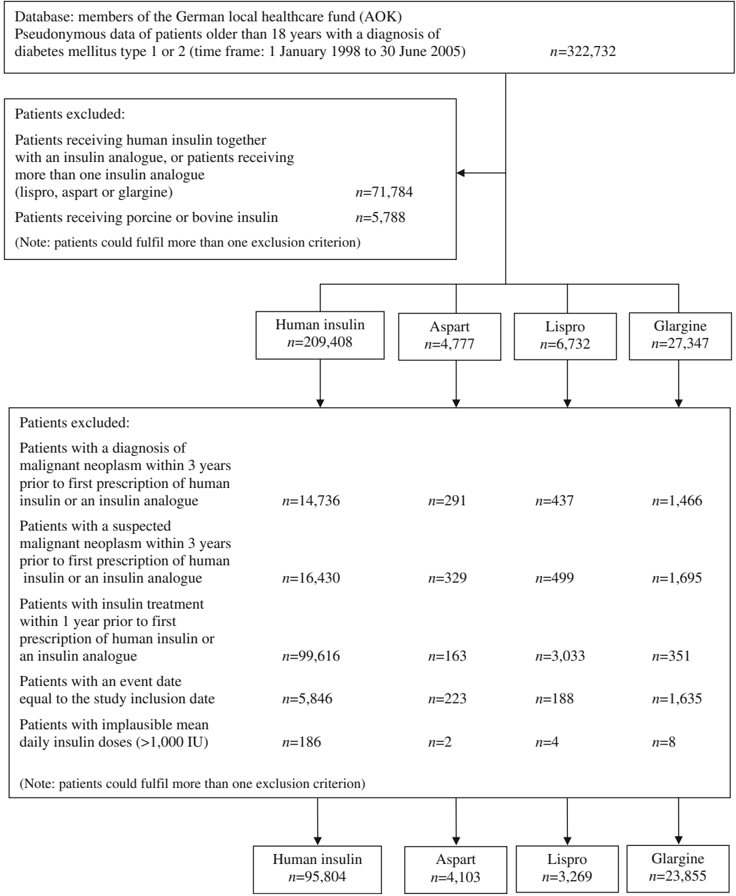
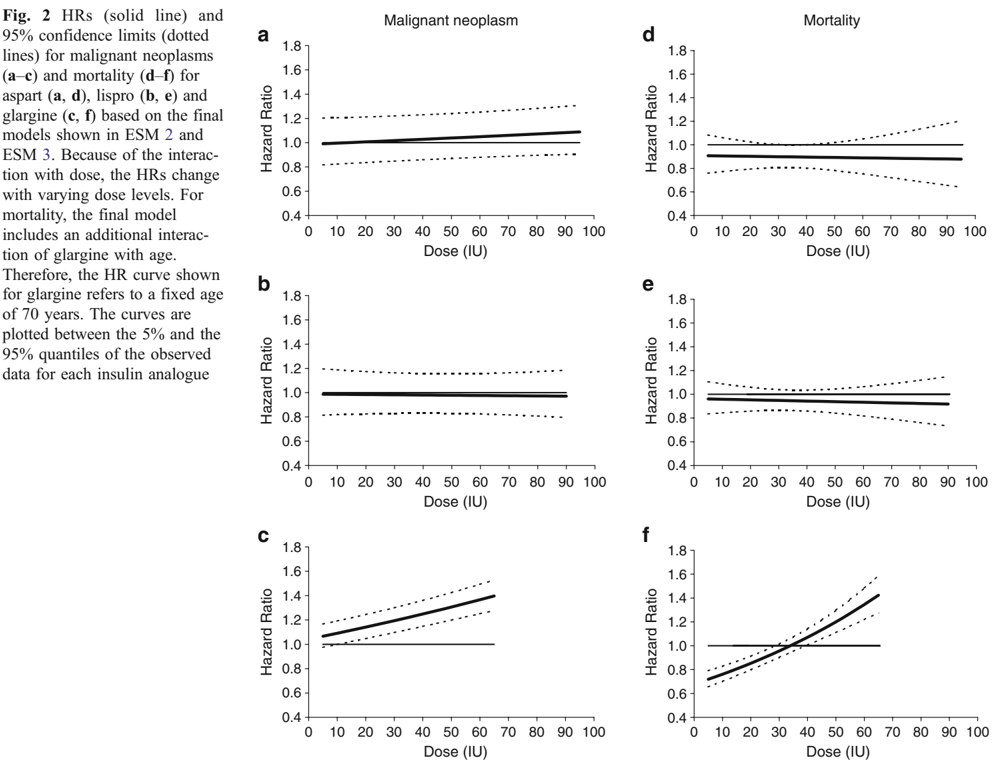
AIMS/HYPOTHESIS: The aim of this cohort study was to investigate the risk of malignant neoplasms and mortality in patients with diabetes treated either with human insulin or with one of three insulin analogues. METHODS: Data were provided by the largest German statutory health insurance fund (time-frame: January 1998 to June 2005 inclusive), on patients without known malignant disease who had received first-time therapy for diabetes mellitus exclusively with human insulin, aspart, lispro or glargine. The primary outcome was the diagnosis of a malignant neoplasm. Data were analysed by multiple Cox regression models adjusting for potential confounders. RESULTS: A total of 127,031 patients were included, with a mean follow-up time of 1.63 (median 1.41, maximum 4.41) years. A positive association between cancer incidence and insulin dose was found for all insulin types. Because patients receiving combined therapy with insulin analogues and human insulin were excluded, the mean daily dose was much lower for glargine than for human insulin, and a slightly lower cancer incidence in the glargine group was found. After adjusting for dose, a dose-dependent increase in cancer risk was found for treatment with glargine compared with human insulin (p < 0.0001): the adjusted HR was 1.09 (95% CI 1.00 to 1.19) for a daily dose of 10 IU, 1.19 (95% CI 1.10 to 1.30) for a daily dose of 30 IU, and 1.31 (95% CI 1.20 to 1.42) for a daily dose of 50 IU. No increased risk was found for aspart (p = 0.30) or lispro (p = 0.96) compared with human insulin. CONCLUSIONS/INTERPRETATION: Considering the overall relationship between insulin dose and cancer, and the lower dose with glargine, the cancer incidence with glargine was higher than expected compared with human insulin. Our results based on observational data support safety concerns surrounding the mitogenic properties of glargine in diabetic patients. Prospective long-term studies are needed to further evaluate the safety of insulin analogues, especially glargine.
Overview
The claims and statistics of this paper haven’t been checked yet.
Free: it reads the open-access text and checks the first 5 claims that cite a source we can check. Create a free account to check every claim.
Integrity signals
Registry
Cites
Statistics
Figures
Verification
Claims the paper makes
The claims and statistics of this paper haven’t been checked yet.
Free: it reads the open-access text and checks the first 5 claims that cite a source we can check. Create a free account to check every claim.
Claims other papers make about this one
Each is checked against this paper’s own text: does it say what the citing paper says it does?
The check wasn’t confident either way, so it gives no verdict — never disputed.
In the citing paper
“Modest survival benefits also have been reported for breast, ovarian, endometrial, prostate, lung, kidney, liver, and earlier stage pancreatic cancers.1791–1800”
From American Association of Clinical Endocrinology Clinical Practice Guideline: Developing a Diabetes Mellitus Comprehensive Care Plan-2022 Update. (2022) · cites this paper as [1799]
Experimental — accuracy not yet measured
Self-check
Percentages, sums and reported differences re-computed from the paper’s own numbers.
The self-check needs the paper’s full text.
Citations
Cites
Regression Models and Life-Tables
Cox, D. R. (1972) · Journal of the Royal Statistical Society Series B: Statistical Methodology · doi:10.1111/j.2517-6161.1972.tb00899.x · Cited by 39,793
Miller, R. G. (1981) · Cited by 3,336
Applied Survival Analysis: Regression Modeling of Time-to-Event Data
Hosmer, D. W., Lemeshow, S. A., & May, S. J. (2008) · Cited by 3,030
Adjusting for multiple testing—when and how?
Bender, R., & Lange, S. (2001) · Journal of Clinical Epidemiology · doi:10.1016/s0895-4356(00)00314-0 · Cited by 3,004 · cited 1×
“As this study was intended to generate hypotheses, we made no adjustments for multiple testing [23].”
MethodSelf-citationMetformin and reduced risk of cancer in diabetic patients
Evans, J. M. M., Donnelly, L. A., Emslie-Smith, A. M., Alessi, D. R., & Morris, A. D. (2005) · BMJ · doi:10.1136/bmj.38415.708634.f7 · Cited by 2,388 · cited 1×
“In particular, we analysed a potential influence of metformin therapy, for which potential effects on cancer incidence have been previously discussed [24].”
BackgroundSurvival Analysis: A Self-Learning Text
Carpenter, M. (1997) · Technometrics · doi:10.1080/00401706.1997.10485091 · Cited by 1,811 · cited 1×
“We checked the proportional hazard assumption graphically by plotting log(-log survival time) versus log survival time and by a formal test based on Schoenfeld residuals [ 22 ].”
MethodApplied Survival Analysis: Regression Modeling of Time‐to‐Event Data
Hosmer, D. W., Lemeshow, S., & May, S. (2008) · Wiley Series in Probability and Statistics · doi:10.1002/9780470258019 · Cited by 1,298
Type-II diabetes and pancreatic cancer: a meta-analysis of 36 studies
Huxley, R., Ansary-Moghaddam, A., Berrington de González, A., Barzi, F., & Woodward, M. (2005) · British Journal of Cancer · doi:10.1038/sj.bjc.6602619 · Cited by 1,105 · cited 1×
“53) has been calculated for endometrial cancer [6, 7].”
BackgroundDiabetes Mellitus and Risk of Colorectal Cancer: A Meta-Analysis
Larsson, S. C., Orsini, N., & Wolk, A. (2005) · JNCI: Journal of the National Cancer Institute · doi:10.1093/jnci/dji375 · Cited by 1,038 · cited 1×
“An OR of 1.82 (95% CI 1.66 to 1.89) has been reported for pancreatic cancer, and an RR of 2.10 (95% CI 1.75 to 2.53) has been calculated for endometrial cancer [6, 7 ]. Similar results have been reported for other cancer entities.”
ResultInfluentialDiabetes mellitus and risk of breast cancer: A meta‐analysis
Larsson, S. C., Mantzoros, C. S., & Wolk, A. (2007) · International Journal of Cancer · doi:10.1002/ijc.22717 · Cited by 875 · cited 1×
“28) for breast cancer [3–5].”
Cited by
Items 601–616 of 616
Understanding the Connection Between Diabetes and Cancer
Sekar, P. K. C., & Veerabathiran, R. (2026) · Springer eBooks · doi:10.1007/978-981-95-5651-9_2
Insulin‐Dependence and Survival in Pancreatic Neuroendocrine Tumors: Results From the US‐NTSG Group
Mirza, M. B., Baechle, J. J., Smith, P. M., Ali, D., Dillhoff, M., Poultsides, G. A., Rocha, F., Cho, C. S., Winslow, E. R., Fields, R. C., et al. (2026) · Journal of Surgical Oncology · doi:10.1002/jso.70174
Insulin Recepto Loss Impairs Mammary Tumourigenesis in Mice
Podmore, L. (2023) · TSpace (University of Toronto)
Foundations of Diabetes Technology
Joshi, D. M., Bhatt, H., & Patel, H. K. (2026) · BENTHAM SCIENCE PUBLISHERS eBooks · doi:10.2174/9798898813635126010006
Diabetes mellitus and neoplastic diseases
Křivanová, A. (2026) · Onkologie · doi:10.36290/xon.2026.021
Bolli, G. B., Home, P., Lepore, M., Riddle, M. C., Porcellati, F., Fanelli, C. G., Lucidi, P., Yki‐Järvinen, H., Becker, R. H. A., & Owens, D. R. (2026) · Diabetes Obesity and Metabolism · doi:10.1111/dom.70751
Lei, D., Wu, J.-H., Zeng, X.-H., Xu, R., Zheng, S.-S., Zhu, X.-J., & Jian-a, Y. (2026) · Urologic Oncology Seminars and Original Investigations · doi:10.1016/j.urolonc.2026.05.024
Guo, Y., Mei, Y., Bongaerts, B. W. C., Metzendorf, M., Fullerton, B., Siebenhofer, A., Jeitler, K., Horvath, K., Semlitsch, T., Berghold, A., et al. (2026) · Cochrane Database of Systematic Reviews · doi:10.1002/14651858.cd012161.pub2
Jayati, T. M., Anggriani, Y., Laksmıtawatı, D. R., & Waspadji, S. (2021) · Health Information Jurnal Penelitian
Tumeurs et organisation du microenvironnement métabolique
Colonnese, A., & Panzironi, R. (2026) · doi:10.68559/lsh.libro.16.fr
Tumoren und die Organisation des metabolischen Mikromilieus
Colonnese, A., & Panzironi, R. (2026) · doi:10.68559/lsh.libro.16.de
Tumors and the organization of the metabolic microenvironment
Colonnese, A., & Panzironi, R. (2026) · doi:10.68559/lsh.libro.16
Tumori e organizzazione del microambiente metabolico
Colonnese, A., & Panzironi, R. (2026) · doi:10.68559/lsh.libro.16.it
Tumores y organización del microambiente metabólico
Colonnese, A., & Panzironi, R. (2026) · doi:10.68559/lsh.libro.16.es
[(R)evolution in pediatric diabetology].
Dorchy, H. (2010) · Revue Medicale de Bruxelles
ANTI-INSULIN RESISTANCE TREATMENTS SUPPRESS HER2+ BREAST CANCER GROWTH VIA ALTERING METABOLISM
Chou, P.-C. (2014) · Digital Commons-TMC (Texas Medical Center)
Metadata
- Authors
- Hemkens, L. G., Grouven, U., Bender, R., Günster, C., Gutschmidt, S., Selke, G. W., & Sawicki, P. T.
- Affiliations
- Institute for Quality and Efficiency in Health Care (DE)
- University of Cologne (DE)
- Wissenschaftliches Institut der AOK (DE)
- Corresponding author
- Hemkens, L. G.
- Venue
- Diabetologia
- Published
- 2009-06-30
- Volume
- 52
- Issue
- 9
- Pages
- 1732-1744
- ISSN
- 0012-186X (ISSN-L)
- 1432-0428
- PMC
- PMC2723679
- OpenAlex
- W2108747912
- Cited by
- 607
- References
- 28
- Citations by year
- 2026: 11 · 2025: 4 · 2024: 13 · 2023: 8 · 2022: 9 · 2021: 9 · 2020: 22 · 2019: 18 · 2018: 27 · 2017: 26 · 2016: 21 · 2015: 41 · 2014: 50 · 2013: 66 · 2012: 64
- FWCI
- 37.75
- Type
- journal article
- Language
- en
- Open access
- hybrid
- doi.org
- Licence
- cc-by-nc
- Locations
- Diabetologia (publishedVersion, cc-by-nc)
- PubMed Central (publishedVersion)
- PubMed (publishedVersion)
- Topics
- Life Sciences › Biochemistry, Genetics and Molecular Biology › Molecular Biology › Metabolism, Diabetes, and Cancer
- Health Sciences › Medicine › Endocrinology, Diabetes and Metabolism › Diabetes Management and Research
- Health Sciences › Medicine › Dermatology › Skin Diseases and Diabetes
- Keywords
- diabetes mellitus, insulin analogues, human insulin, glargine, insulin aspart, insulin lispro, cancer risk, cancer, insulin dose, mortality, drug safety
- MeSH terms
- Insulin Glargine, Aged, Aged, 80 and over, Analysis of Variance, Diabetes Mellitus, Diabetes Mellitus, Type 1, Diabetes Mellitus, Type 2, Female, Germany, Humans, Hypoglycemic Agents, Insulin, Insulin Infusion Systems, Male, Middle Aged, Neoplasms, Regression Analysis, Reproducibility of Results, Cohort Studies, Proportional Hazards Models, Patient Selection, Diabetes Complications, Insulin, Long-Acting
About these checks
Registry, retraction, Cites and statistics results are computed, not judged, with one exception: a printed reference that no index lists is read once by a model before it counts as a citation error. Claims are extracted by a model and kept only when their quote appears verbatim in the text; each cited source is then checked, with a model’s help, for whether it says what the claim relies on. Those verdicts can be wrong — read the claim’s quote and the cited source before relying on one.
Statistics and arithmetic are recomputed, not judged.
Confidence bands are shown only for fields calibrated on our annotated test set. None is calibrated yet, so no band is shown.
What counts as a claim ›How we measure confidence ›How we check this ›
Are you an author, or do you see a problem with this page? Request a review
Data sources
Bibliographic data: Semantic Scholar, OpenAlex, Crossref.
Contains information from the Semantic Scholar Academic Graph Datasets, made available under the ODC Attribution License (ODC-BY 1.0).
Semantic Scholar’s data is described in: Kinney, R., et al. (2023). The Semantic Scholar Open Data Platform. arXiv:2301.10140.
