

Risk of malignancies in patients with diabetes treated with human insulin or insulin analogues: a cohort study
Open accessThe DOI matches its Crossref record; 30 of the 30 references it cites were found in a registry or an index.
Abstract
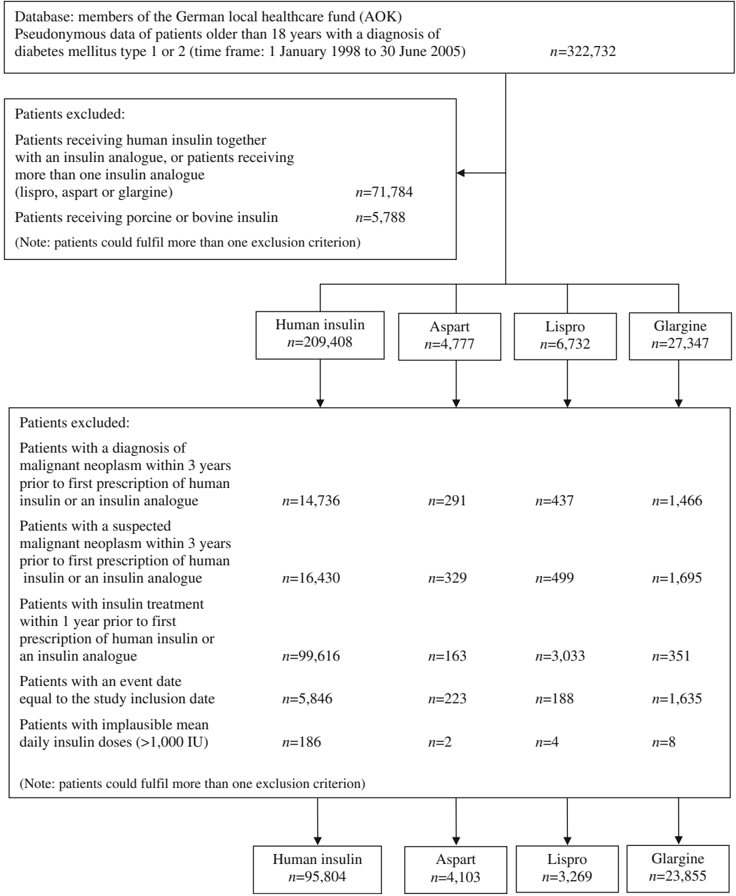
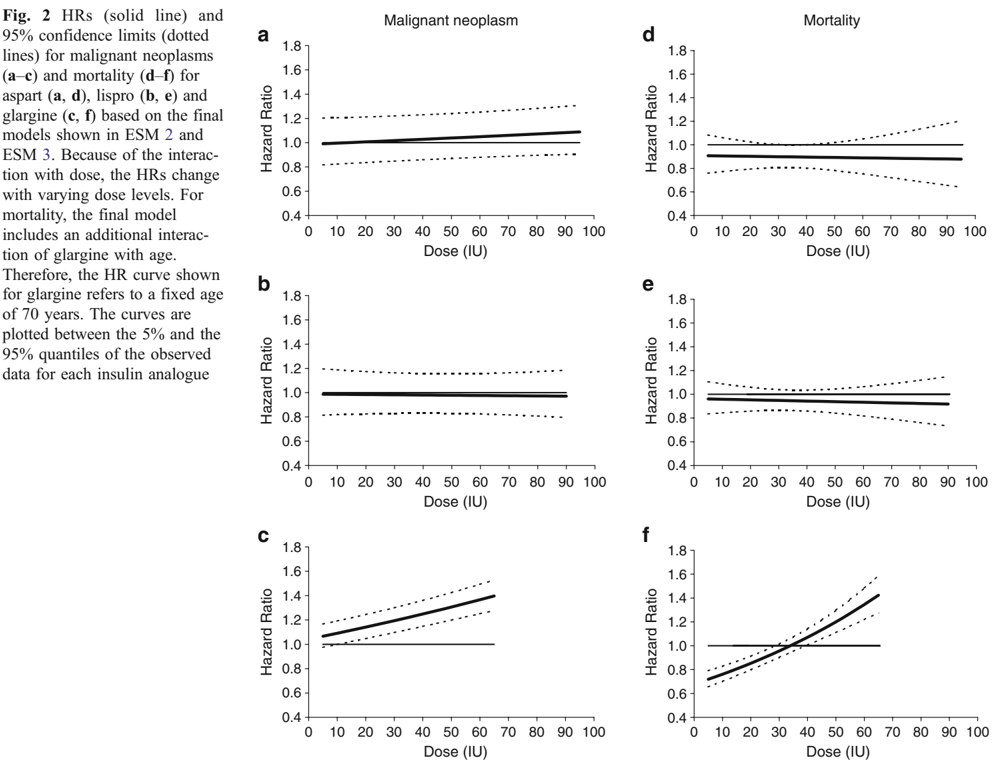
AIMS/HYPOTHESIS: The aim of this cohort study was to investigate the risk of malignant neoplasms and mortality in patients with diabetes treated either with human insulin or with one of three insulin analogues. METHODS: Data were provided by the largest German statutory health insurance fund (time-frame: January 1998 to June 2005 inclusive), on patients without known malignant disease who had received first-time therapy for diabetes mellitus exclusively with human insulin, aspart, lispro or glargine. The primary outcome was the diagnosis of a malignant neoplasm. Data were analysed by multiple Cox regression models adjusting for potential confounders. RESULTS: A total of 127,031 patients were included, with a mean follow-up time of 1.63 (median 1.41, maximum 4.41) years. A positive association between cancer incidence and insulin dose was found for all insulin types. Because patients receiving combined therapy with insulin analogues and human insulin were excluded, the mean daily dose was much lower for glargine than for human insulin, and a slightly lower cancer incidence in the glargine group was found. After adjusting for dose, a dose-dependent increase in cancer risk was found for treatment with glargine compared with human insulin (p < 0.0001): the adjusted HR was 1.09 (95% CI 1.00 to 1.19) for a daily dose of 10 IU, 1.19 (95% CI 1.10 to 1.30) for a daily dose of 30 IU, and 1.31 (95% CI 1.20 to 1.42) for a daily dose of 50 IU. No increased risk was found for aspart (p = 0.30) or lispro (p = 0.96) compared with human insulin. CONCLUSIONS/INTERPRETATION: Considering the overall relationship between insulin dose and cancer, and the lower dose with glargine, the cancer incidence with glargine was higher than expected compared with human insulin. Our results based on observational data support safety concerns surrounding the mitogenic properties of glargine in diabetic patients. Prospective long-term studies are needed to further evaluate the safety of insulin analogues, especially glargine.
Overview
The claims and statistics of this paper haven’t been checked yet.
Free: it reads the open-access text and checks the first 5 claims that cite a source we can check. Create a free account to check every claim.
Integrity signals
Registry
Cites
Statistics
Figures
Verification
Claims the paper makes
The claims and statistics of this paper haven’t been checked yet.
Free: it reads the open-access text and checks the first 5 claims that cite a source we can check. Create a free account to check every claim.
Claims other papers make about this one
Each is checked against this paper’s own text: does it say what the citing paper says it does?
The check wasn’t confident either way, so it gives no verdict — never disputed.
In the citing paper
“Modest survival benefits also have been reported for breast, ovarian, endometrial, prostate, lung, kidney, liver, and earlier stage pancreatic cancers.1791–1800”
From American Association of Clinical Endocrinology Clinical Practice Guideline: Developing a Diabetes Mellitus Comprehensive Care Plan-2022 Update. (2022) · cites this paper as [1799]
Experimental — accuracy not yet measured
Self-check
Percentages, sums and reported differences re-computed from the paper’s own numbers.
The self-check needs the paper’s full text.
Citations
Cites
Regression Models and Life-Tables
Cox, D. R. (1972) · Journal of the Royal Statistical Society Series B: Statistical Methodology · doi:10.1111/j.2517-6161.1972.tb00899.x · Cited by 39,793
Miller, R. G. (1981) · Cited by 3,336
Applied Survival Analysis: Regression Modeling of Time-to-Event Data
Hosmer, D. W., Lemeshow, S. A., & May, S. J. (2008) · Cited by 3,030
Adjusting for multiple testing—when and how?
Bender, R., & Lange, S. (2001) · Journal of Clinical Epidemiology · doi:10.1016/s0895-4356(00)00314-0 · Cited by 3,004 · cited 1×
“As this study was intended to generate hypotheses, we made no adjustments for multiple testing [23].”
MethodSelf-citationMetformin and reduced risk of cancer in diabetic patients
Evans, J. M. M., Donnelly, L. A., Emslie-Smith, A. M., Alessi, D. R., & Morris, A. D. (2005) · BMJ · doi:10.1136/bmj.38415.708634.f7 · Cited by 2,388 · cited 1×
“In particular, we analysed a potential influence of metformin therapy, for which potential effects on cancer incidence have been previously discussed [24].”
BackgroundSurvival Analysis: A Self-Learning Text
Carpenter, M. (1997) · Technometrics · doi:10.1080/00401706.1997.10485091 · Cited by 1,811 · cited 1×
“We checked the proportional hazard assumption graphically by plotting log(-log survival time) versus log survival time and by a formal test based on Schoenfeld residuals [ 22 ].”
MethodApplied Survival Analysis: Regression Modeling of Time‐to‐Event Data
Hosmer, D. W., Lemeshow, S., & May, S. (2008) · Wiley Series in Probability and Statistics · doi:10.1002/9780470258019 · Cited by 1,298
Type-II diabetes and pancreatic cancer: a meta-analysis of 36 studies
Huxley, R., Ansary-Moghaddam, A., Berrington de González, A., Barzi, F., & Woodward, M. (2005) · British Journal of Cancer · doi:10.1038/sj.bjc.6602619 · Cited by 1,105 · cited 1×
“53) has been calculated for endometrial cancer [6, 7].”
BackgroundDiabetes Mellitus and Risk of Colorectal Cancer: A Meta-Analysis
Larsson, S. C., Orsini, N., & Wolk, A. (2005) · JNCI: Journal of the National Cancer Institute · doi:10.1093/jnci/dji375 · Cited by 1,038 · cited 1×
“An OR of 1.82 (95% CI 1.66 to 1.89) has been reported for pancreatic cancer, and an RR of 2.10 (95% CI 1.75 to 2.53) has been calculated for endometrial cancer [6, 7 ]. Similar results have been reported for other cancer entities.”
ResultInfluentialDiabetes mellitus and risk of breast cancer: A meta‐analysis
Larsson, S. C., Mantzoros, C. S., & Wolk, A. (2007) · International Journal of Cancer · doi:10.1002/ijc.22717 · Cited by 875 · cited 1×
“28) for breast cancer [3–5].”
Cited by
Items 201–300 of 616
Rensing, K. L., Bloemendaal, F. M., Weijers, E. M., Richel, D. J., Buller, H. R., Koolwijk, P., van der Loos, C. M., Twickler, T. B., & von der Thüsen, J. H. (2010) · Diabetologia · doi:10.1007/s00125-010-1687-y · Cited by 40
“42) for a daily dose of 50 IU [1].”
BackgroundLiu, S., Li, Y., Lin, T., Fan, X., Liang, Y., & Heemann, U. W. (2010) · Diabetes Research and Clinical Practice · doi:10.1016/j.diabres.2010.11.009 · Cited by 42
“[11] Hemkens LG, Grouven U, Bender R, Günster C, Gutschmidt S, Selke GW, et al.”
BackgroundLind, M., Fahlén, M., Eliasson, B., & Odén, A. (2011) · Primary care diabetes · doi:10.1016/j.pcd.2011.10.004 · Cited by 40
“In recent studies of insulin glargine and its potential association with cancer, information on insulin dose was limited, and exposure time was short or unknown [1–4].”
BackgroundResultInfluentialThe metabolic and mitogenic properties of basal insulin analogues
Tennagels, N., & Ulrich, W. (2013) · Archives of Physiology and Biochemistry · doi:10.3109/13813455.2012.754474 · Cited by 41
“However, the authors then used an unconventional analysis which found that, after adjusting for dose, the overall incidence of cancer was higher in patients taking insulin glargine compared with human insulin (Hemkens et al., 2009).”
BackgroundMethodGarg, S. K. (2010) · Diabetes Technology & Therapeutics · doi:10.1089/dia.2009.0127 · Cited by 38
Metformin: From diabetes to cancer to prolongation of life
Sirtori, C. R., Castiglione, S., & Pavanello, C. (2024) · Pharmacological Research · doi:10.1016/j.phrs.2024.107367 · Cited by 41
Insulin Glargine and Cancer Risk in Patients with Diabetes: A Meta-Analysis
Tang, X., Yang, L., He, Z., & Liu, J. (2012) · PLoS ONE · doi:10.1371/journal.pone.0051814 · Cited by 37
Diabetes therapy and cancer risk
Vigneri, R. (2009) · Nature Reviews Endocrinology · doi:10.1038/nrendo.2009.219 · Cited by 38
Andersson, C., Vaag, A. A., Selmer, C., Schmiegelow, M., Sørensen, R., Lindhardsen, J., Gislason, G., Køber, L., & Torp-Pedersen, C. T. (2012) · BMJ Open · doi:10.1136/bmjopen-2011-000433 · Cited by 38
“Similar, a German study had a significantly longer follow-up time for patients on human insulin than for patients on insulin glargine, which may have contributed to their findings of an increased risk of cancer associated with insulin glargine.(8) In a third Scottish study investigating the risk of cancer as dependent…”
Metformin and cancer: licence to heal?
Papanas, N., Maltezos, E., & Mikhailidis, D. P. (2010) · Expert Opinion on Investigational Drugs · doi:10.1517/13543784.2010.499122 · Cited by 37
“The situation is aggravated if this increase in risk is associated with some antidiabetic drugs [10-13].”
BackgroundInfluentialMüssig, K., Staiger, H., Kantartzis, K., Fritsche, A., Kanz, L., & Häring, H. (2011) · Diabetic Medicine · doi:10.1111/j.1464-5491.2010.03132.x · Cited by 39
Call, R., Grimsley, M., Cadwallader, L., Cialone, L., Hill, M., Hreish, V., King, S., & Riche, D. M. (2010) · Postgraduate Medicine · doi:10.3810/pgm.2010.05.2153 · Cited by 40
“While the overall incidence of cancer is not signifi cantly different, the rate of growth in an existing tumor may be more aggressive under the infl uence of insulin, possibly in a dose-dependent manner, based on results of the German study (Table 1).(5) A long-term, prospective study has evaluated insulin glargine ve…”
ResultCancer with Diabetes: Prevalence, Metabolic Control, and Survival in an Academic Oncology Practice
Karlin, N. J., Dueck, A. C., & Cook, C. B. (2012) · Endocrine Practice · doi:10.4158/ep12128.or · Cited by 38
Report of the JDS/JCA Joint Committee on Diabetes and Cancer
Kasuga, M., Ueki, K., Tajima, N., Noda, M., Ohashi, K., Noto, H., Goto, A., Ogawa, W., Sakai, R., Tsugane, S., et al. (2013) · Diabetology International · doi:10.1007/s13340-013-0121-3 · Cited by 40
Yehezkel, E., Weinstein, D., Simon, M., Sarfstein, R., Laron, Z., & Werner, H. (2010) · Diabetologia · doi:10.1007/s00125-010-1899-1 · Cited by 38
“[19] analysed a data set including 127,031 patients from a German health insurance fund.”
BackgroundThe Metabolic Syndrome and Cancer
Pistrosch, F., & Hanefeld, M. (2013) · Springer eBooks · doi:10.1007/978-3-7091-1331-8_5 · Cited by 36
Long-acting insulin analogs and cancer
Sciacca, L., Vella, V., Frittitta, L., Tumminia, A., Manzella, L., Squatrito, S., Belfiore, A., & Vigneri, R. (2018) · Nutrition Metabolism and Cardiovascular Diseases · doi:10.1016/j.numecd.2018.02.010 · Cited by 38
Novel Metformin-Based Schiff Bases: Synthesis, Characterization, and Antibacterial Evaluation
Al-Qadsy, I., Saeed, W. S., Al-Odayni, A.-B. M., Al-Faqeeh, L. A. S., Alghamdi, A. A. B., & Farooqui, M. N. (2020) · Materials · doi:10.3390/ma13030514 · Cited by 45
Buchs, A. E., & SILVERMAN, B. G. (2011) · Metabolism · doi:10.1016/j.metabol.2011.05.002 · Cited by 37
“Whether long-acting insulin analogues are associated with an increased incidence of cancer evenmore than human insulins is disputed [16-21].”
BackgroundResultHabel, L. A., Danforth, K. N., Quesenberry, C. P., Capra, A. M., Eeden, S. K. V. D., Weiss, N. S., & Ferrara, A. M. (2013) · Diabetes Care · doi:10.2337/dc13-0140 · Cited by 35
Yamada, S., Kawaguchi, A., Kawaguchi, T., Fukushima, N., Kuromatsu, R., Sumie, S., Takata, A., Nakano, M., Satani, M., Tonan, T., et al. (2013) · Hepatology Research · doi:10.1111/hepr.12192 · Cited by 35
Insulin Use Early in the Course of Type 2 Diabetes Mellitus: The ORIGIN Trial
Hanefeld, M., & Bramlage, P. (2013) · Current Diabetes Reports · doi:10.1007/s11892-013-0366-z · Cited by 36
“13) cancer was virtually identical in both treatment arms, a result which questions the value of recent registry studies suggesting increased cancer rates with insulin glargine compared with human insulin [41, 42].”
ResultInsulin, carbohydrate restriction, metabolic syndrome and cancer
Fine, E. J., & Feinman, R. D. (2014) · Expert Review of Endocrinology & Metabolism · doi:10.1586/17446651.2014.960392 · Cited by 39
“As noted above, people with diabetes show increased risk of cancer [55].”
BackgroundInsulin Resistance: Pathophysiology and Rationale for Treatment
Muntoni, S., & Muntoni, S. (2011) · Annals of Nutrition and Metabolism · doi:10.1159/000323395 · Cited by 44
“showed no mitogenic or carcinogenic effect in comparison with human insulin. On the other hand, in DM2 patients treated with human insulin, a German study showed an increasing frequency of malignant neoplasms with increasing insulin dose and, compared with human insulin, this dose-dependent risk was higher for glargin…”
BackgroundVitamin D status and insulin requirements in children and adolescent with type 1 diabetes
Tunç, Ö., Çetinkaya, S. Ç., Kızılgün, M., & Aycan, Z. (2011) · Journal of Pediatric Endocrinology and Metabolism · doi:10.1515/jpem.2011.213 · Cited by 40
“We believe it is important to achieve metabolic control with a lower insulin requirement, especially taking into account the relation between insulin analogues and cancer and increased retinopathy due to the angioneogenetic effect on insulin as reported increasingly in recent years (10, 11) .”
BackgroundSimó, R., Plana‐Ripoll, O., Puente, D., Morros, R., Mundet, X., Vilca, L. M., Hernández, C., Fuentes, I., Procupet, A., Tabernero, J. M., et al. (2013) · PLoS ONE · doi:10.1371/journal.pone.0079968 · Cited by 37
“A significant increased risk for all types of cancer [8], breast cancer in women [9,10,12], and prostate and pancreatic cancer in men [11] has been reported in some studies.”
ResultSafety of antidiabetes medications: An update
Bailey, C. J. (2015) · Clinical Pharmacology & Therapeutics · doi:10.1002/cpt.125 · Cited by 33
Shi, S., He, Y., Koya, D., & Kanasaki, K. (2014) · Journal of Diabetes Investigation · doi:10.1111/jdi.12208 · Cited by 35
“Hemkens et al.(59) reported that, considering the overall relationship between insulin dose”
BackgroundInsulin analogues and cancer risk: the emergence of second-generation studies
Renehan, A. G. (2011) · Diabetologia · doi:10.1007/s00125-011-2352-9 · Cited by 33
Dziemidok, P., Makara‐Studzińska, M., & Jarosz, M. J. (2011) · PubMed · Cited by 40
Insulin and GH–IGF-I axis: endocrine pacer or endocrine disruptor?
Giustina, A., Berardelli, R., Gazzaruso, C., & Mazziotti, G. (2014) · Acta Diabetologica · doi:10.1007/s00592-014-0635-6 · Cited by 34
“Although some studies reported an overall increased cancer risk associated with high doses of insulin glargine [136, 137], at the current time there is still inconclusive”
BackgroundChallenges in the management of people with diabetes and cancer
Chowdhury, T. A., & Jacob, P. (2019) · Diabetic Medicine · doi:10.1111/dme.13919 · Cited by 33
Hyperinsulinemia in Obesity, Inflammation, and Cancer
Zhang, A. M. Y., Wellberg, E. A., Kopp, J. L., & Johnson, J. D. (2021) · Diabetes & Metabolism Journal · doi:10.4093/dmj.2021.0131 · Cited by 36
Glycaemic goals in patients with type 2 diabetes: current status, challenges and recent advances
Khunti, K., & Davies, M. J. (2010) · Diabetes Obesity and Metabolism · doi:10.1111/j.1463-1326.2009.01186.x · Cited by 34
“3 years for insulin glargine), the failure to correct for confounders, including body mass index (BMI), smoking, social status and duration of diabetes, and the lack of data on the type of tumour [101,102].”
BackgroundLucidi, P., Porcellati, F., Candeloro, P., Cioli, P., Andreoli, A. M., Marzotti, S., Schmidt, R., Bolli, G. B., & Fanelli, C. G. (2014) · Nutrition Metabolism and Cardiovascular Diseases · doi:10.1016/j.numecd.2014.02.008 · Cited by 31
Diabetes, insulin treatment, and cancer risk: what is the evidence?
Azar, M., & Lyons, T. J. (2009) · F1000 Medicine Reports · doi:10.3410/m2-4 · Cited by 34
“[12] could not be supported or refuted.”
BackgroundInfluentialCheng, Y., Chen, Y., Zhou, C.-J., Shen, L., Tu, F., Xu, J., & Liu, C. (2019) · Clinics and Research in Hepatology and Gastroenterology · doi:10.1016/j.clinre.2019.06.009 · Cited by 35
Does long-term use of antidiabetic drugs changes cancer risk?
Liu, Y.-C., Nguyen, P.-A., Humayun, A., Chien, S.-C., Yang, H., Asdary, R. N., Syed-Abdul, S., Hsu, M., Moldovan, M. V., Yen, Y., et al. (2019) · Medicine · doi:10.1097/md.0000000000017461 · Cited by 32
“Insulin dose-related cancer incidence has also been reported with glargine, but not with human insulin.([11]) It has also been reported that patients who have solid tumors are more likely to have been taking insulin or insulin secret agogues as compared to oral hypoglycemic drugs.”
BackgroundInfluentialAntidiabetic drugs and risk of cancer
Tokajuk, A., Krzyżanowska-Grycel, E., Tokajuk, A., Grycel, S., Sadowska, A., & Car, H. (2015) · Pharmacological Reports · doi:10.1016/j.pharep.2015.05.005 · Cited by 31
Patorno, E., Garry, E. M., Patrick, A. R., Schneeweiß, S., Gillet, V. G., Zorina, O., Bartels, D. B., & Seeger, J. D. (2015) · Drug Safety · doi:10.1007/s40264-015-0280-1 · Cited by 31
“While it may be reasonable to assume that all cause-mortality is an approximation for cardiovascular mortality in the context of a diabetic population, this assumption might not hold for all-cause mortality as a proxy for cancer-related mortality [41, 64], as shown by two observational studies performed in diabetic po…”
Supramolecular Protein Engineering
Phillips, N. B., Wan, Z., Whittaker, L. J., Hu, S.-Q., Huang, K., Hua, Q. X., Whittaker, J., Ismail‐Beigi, F., & Weiss, M. A. (2010) · Journal of Biological Chemistry · doi:10.1074/jbc.c110.105825 · Cited by 30
Role of Insulin in the Type 2 Diabetes Therapy: Past, Present and Future
Rotella, C. M., Pala, L., & Mannucci, E. (2013) · Intern J Endocrinol Metab · doi:10.5812/ijem.7551 · Cited by 36
Diabetes and cancer: A 2013 synopsis
Buysschaert, M., & Sadikot, S. S. (2013) · Diabetes & Metabolic Syndrome Clinical Research & Reviews · doi:10.1016/j.dsx.2013.08.001 · Cited by 33
Antihyperglycaemic therapies and cancer risk
Lutz, S. Z., Staiger, H., Fritsche, A., & Häring, H. (2014) · Diabetes and Vascular Disease Research · doi:10.1177/1479164114549553 · Cited by 30
Sund, R., Gissler, M., Hakulinen, T. R., & Rosén, M. (2013) · Springer eBooks · doi:10.1007/978-0-387-09834-0_5 · Cited by 36
The female breast and diabetes
Gouveri, E., Παπάνας, Ν., & Maltezos, E. S. (2011) · The Breast · doi:10.1016/j.breast.2011.02.019 · Cited by 33
Monnier, L., Colette, C., Michel, F., Cristol, J., & Owens, D. R. (2011) · Diabetes/Metabolism Research and Reviews · doi:10.1002/dmrr.1174 · Cited by 29
Yang, J., Wang, F., Chen, X., Qiu, S., Cui, L., & Hu, L. (2019) · The American Journal of Chinese Medicine · doi:10.1142/s0192415x19500356 · Cited by 29
New Players for Advanced Prostate Cancer and the Rationalisation of Insulin-Sensitising Medication
Gunter, J. H., Sarkar, P. L., Lubik, A. A., & Nelson, C. C. (2013) · International Journal of Cell Biology · doi:10.1155/2013/834684 · Cited by 31
“AMPK acts as an intracellular energy sensor, responding to fluctuations in the ratio of AMP and ATP.”
Ciaraldi, T. P., & Sasaoka, T. (2010) · Hormone and Metabolic Research · doi:10.1055/s-0030-1267203 · Cited by 31
Liu, C., Liu, Q., Yan, A., Chang, H., Ding, Y., Tao, J., & Qiao, C. (2020) · Cancer Medicine · doi:10.1002/cam4.3029 · Cited by 30
Daily Insulin Dose and Cancer Risk Among Patients With Type 1 Diabetes
Zhong, W., & Mao, Y. (2022) · JAMA Oncology · doi:10.1001/jamaoncol.2022.2960 · Cited by 28
Natalicchio, A., Marrano, N., Montagnani, M., Gallo, M., Faggiano, A., Zatelli, M., Argentiero, A., Re, M. D., D’Oronzo, S., Fogli, S., et al. (2024) · Journal of Endocrinological Investigation · doi:10.1007/s40618-024-02417-z · Cited by 33
Drug–subphenotype interactions for cancer in type 2 diabetes mellitus
Yang, X., Lee, H. M., & Chan, J. C. N. (2015) · Nature Reviews Endocrinology · doi:10.1038/nrendo.2015.37 · Cited by 28
Register-based studies of diabetes
Carstensen, B., & Borch‐Johnsen, K. (2011) · Scandinavian Journal of Public Health · doi:10.1177/1403494811404279 · Cited by 28
“These studies were all based on register data, except the German study [18] which was based on insurance data.”
MethodPettersson, B., Hoffmann, M., Andersson, D., Wändell, P. E., & Levin, L. (2012) · Health Policy · doi:10.1016/j.healthpol.2012.10.008 · Cited by 28
Diabetology and oncology meet in a network model: union is strength
Gallo, M., Gentile, L., Arvat, E., Bertetto, O., & Clemente, G. (2016) · Acta Diabetologica · doi:10.1007/s00592-016-0839-z · Cited by 29
“After the publication of observational cohort studies showing that insulin therapy and glargine in particular was associated with increased cancer risk (particularly breast cancer) [2], a number of epidemiological studies and metaanalyses tried to shed more light on this topic, with conflicting results.”
BackgroundLi, C., Zhao, G., Okoro, C. A., Wen, X., Ford, E. S., & Balluz, L. S. (2013) · Diabetes Care · doi:10.2337/dc12-1432 · Cited by 29
“A German cohort study suggested a dose-response relation such that those taking higher doses of insulin glargine (Lantus) had an increased risk for cancer incidence compared with those prescribed human insulin and that both insulin glargine and human insulin were related to an increased risk of cancer incidence and mo…”
BackgroundUpdate on Safety Issues Related to Antihyperglycemic Therapy
Carpio, G., & Fonseca, V. A. (2014) · Diabetes Spectrum · doi:10.2337/diaspect.27.2.92 · Cited by 34
Higher risk of mortality from lung cancer in Taiwanese people with diabetes
Tseng, C. (2013) · Diabetes Research and Clinical Practice · doi:10.1016/j.diabres.2013.10.019 · Cited by 28
“Patients with diabetes are prone to develop cancer involving pancreas, liver, breast, colorectum, bladder and endometrium [11], and insulin use has been implicated as a risk factor for certain cancers [11,12].”
BackgroundPharmacologic Treatment of Type 2 Diabetes: Injectable Medications
Tran, L., Zielinski, A., Roach, A. H., Jende, J. A., Householder, A. M., Cole, E. E., Atway, S. A., Amornyard, M., Accursi, M. L., Shieh, S. W., et al. (2015) · Annals of Pharmacotherapy · doi:10.1177/1060028015573010 · Cited by 32
Nowak-Sliwinska, P. M., van Beijnum, J. R., Huijbers, E. J. M., Gasull, P. C., Mans, L. A., Bex, A., & Griffioen, A. W. (2018) · British Journal of Cancer · doi:10.1038/s41416-018-0347-8 · Cited by 29
Diabetes mellitus and gastric carcinoma: Is there an association?
Jayaprakash, V., Marimuthu, S. P., Vijayaragavan, P., & Moysich, K. B. (2011) · Journal of Carcinogenesis · doi:10.4103/1477-3163.90481 · Cited by 30
“39-41] Insulin glargine has been shown to have a very high affinity to IGF-1 receptor and also can act as a mitogenic agent, thereby promoting carcinogenesis.”
In support of an early polypharmacy approach to the treatment of type 2 diabetes
Wright, E. E., Stonehouse, A. H., & Cuddihy, R. M. (2010) · Diabetes Obesity and Metabolism · doi:10.1111/j.1463-1326.2010.01255.x · Cited by 27
“other insulins), and glargine dose-dependency for the overall risk of cancer [45,46].”
BackgroundCalip, G. S., Yu, O., Elmore, J. G., & Boudreau, D. M. (2016) · Cancer Causes & Control · doi:10.1007/s10552-016-0744-3 · Cited by 29
Simultaneous basal-bolus delivery of fast-acting insulin and its significance in diabetes management
Qin, G., Gao, Y., Wu, Y., Zhang, S., Qiu, Y., Li, F., & Bai, X. (2011) · Nanomedicine Nanotechnology Biology and Medicine · doi:10.1016/j.nano.2011.05.017 · Cited by 27
Basal Insulin Treatment in Type 2 Diabetes
Hedrington, M. S., Pulliam, L., & Davis, S. N. (2011) · Diabetes Technology & Therapeutics · doi:10.1089/dia.2011.0062 · Cited by 29
“A group of clinical studies assessing the cancer risk of insulin glargine were commissioned across Europe after a German observational study published in Diabetologia analyzed over 127,000 health insurance records and found an increased dosedependent risk of both malignant neoplasms and mortality with insulin glargine…”
Diabetes and skin cancers: Risk factors, molecular mechanisms and impact on prognosis
Dobrică, E.-C., Banciu, L. M., Kipkorir, V., Tabari, M. A. K., Cox, M. J., Kutikuppala, L. V. S., & Găman, M. (2022) · World Journal of Clinical Cases · doi:10.12998/wjcc.v10.i31.11214 · Cited by 28
Non-peptidyl insulin mimetics as a potential antidiabetic agent
Nankar, R. P., & Doble, M. (2013) · Drug Discovery Today · doi:10.1016/j.drudis.2013.04.005 · Cited by 26
Bedinger, D., Goldfine, I. D., Corbin, J., Roell, M. K., & Adams, S. H. (2015) · Journal of Pharmacology and Experimental Therapeutics · doi:10.1124/jpet.114.221309 · Cited by 27
“the mitogenic insulin signaling pathway (Hemkens et al., 2009; Vigneri et al., 2009; Janssen and Varewijck, 2014).”
BackgroundDiabetes and the risk for colorectal cancer
Erbach, M., Mehnert, H., & Schnell, O. (2012) · Journal of Diabetes and its Complications · doi:10.1016/j.jdiacomp.2011.11.003 · Cited by 29
The double trouble of metabolic diseases: the diabetes–cancer link
Tudzarova, S., & Osman, M. A. (2015) · Molecular Biology of the Cell · doi:10.1091/mbc.e14-11-1550 · Cited by 26
“…occurs only in T2D, both T1D and T2D result in the progressive loss of beta-cell mass and function, leading to persistent hyperglycemia and, consequently, oxidative stress, DNA damage, glucotoxicity, and lipotoxicity (Unger, 1995; Unger and Grundy, 1985; Prentki et al., 2002), resulting”
BackgroundGlucose Metabolism Disorders and the Risk of Cancer
Piątkiewicz, P., & Czech, A. (2011) · Archivum Immunologiae et Therapiae Experimentalis · doi:10.1007/s00005-011-0119-0 · Cited by 33
“Disturbing results were observed in the German study (Hemkens et al. 2009).”
ResultSynthetic Insulin Analogs and Their Use in Dogs and Cats
Gilor, C., & Graves, T. K. (2010) · Veterinary Clinics of North America Small Animal Practice · doi:10.1016/j.cvsm.2009.11.001 · Cited by 30
ter Braak, B., Siezen, C. L. E., Speksnijder, E. N., Koedoot, E., STEEG, H. V., Salvatori, D. C. F., van de Water, B., & van der Laan, J. W. (2015) · Breast Cancer Research · doi:10.1186/s13058-015-0518-y · Cited by 29
“While most insulin analogues, including glargine [12-14], were negative in these chronic bioassays, several epidemiological studies showed an increased breast cancer risk [15-18], which could not be observed by others [19-26].”
BackgroundShah, V. N., Moser, E. G., Blau, A., Dhingra, M., & Garg, S. K. (2013) · Diabetes Technology & Therapeutics · doi:10.1089/dia.2013.0228 · Cited by 28
Diabetes, Metformin, and Breast Cancer: Lilac Time?
Goodwin, P. J., Thompson, A. M., & Stambolic, V. (2012) · Journal of Clinical Oncology · doi:10.1200/jco.2012.42.3319 · Cited by 26
Use of Insulin and Mortality from Breast Cancer among Taiwanese Women with Diabetes
Tseng, C.-H. (2015) · Journal of Diabetes Research · doi:10.1155/2015/678756 · Cited by 30
Nagel, J. M., Staffa, J., Renner‐Müller, I., Horst, D. A., Vogeser, M., Langkamp, M., Hoeflich, A., Göke, B., Kolligs, F. T., & Mantzoros, C. S. (2010) · Hormones and Cancer · doi:10.1007/s12672-010-0020-z · Cited by 27
“A recently published observational study in humans suggested an increased risk for cancer with insulin glargine treatment [ 20 ], but these findings have subsequently been questioned by several other studies [18, 19, 21].”
BackgroundResultAlgorithm for the treatment of type 2 diabetes: a position statement of Brazilian Diabetes Society
Lerário, A. C., Chacra, A. R., Netto, A. P., Malerbi, D. A. C., Gross, J. L., de Oliveira, J. E., Gomes, M. B., Santos, R. D., Fonseca, R. M., Betti, R., et al. (2010) · Diabetology & Metabolic Syndrome · doi:10.1186/1758-5996-2-35 · Cited by 50
“No definitve conclusions regarding the association between insulin therapy with glargine [16] and malignancies were established.”
BackgroundBody Mass Index and the Risk of Dementia among Louisiana Low Income Diabetic Patients
Hu, G., Horswell, R. L., Wang, Y., Li, W., Besse, J. A., Xiao, K., Chen, H., Keller, J. N., Heymsfield, S. B., Ryan, D. H., et al. (2012) · PLoS ONE · doi:10.1371/journal.pone.0044537 · Cited by 26
“The method of using the hospital discharge register to diagnose dementia has been used in American and European cohort studies [17–19,24,47,48].”
The need for better insulin therapy
Grunberger, G. (2013) · Diabetes Obesity and Metabolism · doi:10.1111/dom.12061 · Cited by 34
“For many years, among the medical community, there were also concerns about mitogenicity [8,9], which hopefully the Outcome Reduction with Initial Glargine Intervention (ORIGIN) trial [10,11], which showed no increase in cancer risk among insulin users, has put to rest (Table 1) [3].”
BackgroundAssociation of diabetes and cancer mortality in American Indians: the Strong Heart Study
Best, L. G., García‐Esquinas, E., Yeh, J.-L., Yeh, F., Zhang, Y., Lee, E. T., Howard, B. V., Farley, J. H., Welty, T. K., Rhoades, D. A., et al. (2015) · Cancer Causes & Control · doi:10.1007/s10552-015-0648-7 · Cited by 25
“In epidemiologic studies, treatment with insulin [33, 34] or insulin secretagogues [35] has been associated with an increased risk of some cancers, including breast, colon, pancreas, and prostate.”
BackgroundBykov, K., He, M., Franklin, J. M., Garry, E. M., Seeger, J. D., & Patorno, E. (2019) · Diabetes Obesity and Metabolism · doi:10.1111/dom.13766 · Cited by 26
“Additional information of surgery, chemotherapy, radiation, bone marrow transplantation, or palliative care 15 (17) 4 (6) 11 (42)”
BackgroundInfluentialDo we have enough data to confirm the link between antidiabetic drug use and cancer development?
Drzewoski, J., Drozdowska, A., & Śliwińska, A. (2011) · Polskie Archiwum Medycyny Wewnętrznej · doi:10.20452/pamw.1029 · Cited by 28
Glucose control in the older patient: from intensive, to effective and safe
Dominguez, L. J., Paolisso, G., & Barbagallo, M. (2010) · Aging Clinical and Experimental Research · doi:10.1007/bf03337724 · Cited by 28
Insulin glargine and cancer: another side to the story?
Gale, E. A. (2009) · The Lancet · doi:10.1016/s0140-6736(09)61477-x · Cited by 25
Diabetes, insulin use, smoking, and pancreatic cancer mortality in Taiwan
Tseng, C. (2013) · Acta Diabetologica · doi:10.1007/s00592-013-0471-0 · Cited by 24
“Insulin glargine has a sixfold to eightfold higher binding affinity to IGF-1 receptor than human insulin [38] and may increase the risk of some cancers [40].”
BackgroundThe American Diabetes Association Diabetes Research Perspective
Fonseca, V. A., Kirkman, M. S., Darsow, T., & Ratner, R. E. (2012) · Diabetes · doi:10.2337/db12-0435 · Cited by 32
Overcoming Obstacles in Risk Factor Management in Type 2 Diabetes Mellitus
Handelsman, Y., & Jellinger, P. S. (2011) · Journal of Clinical Hypertension · doi:10.1111/j.1751-7176.2011.00490.x · Cited by 24
“A similar situation arose in reports from Germany that seemingly linked the use of insulin glargine with a higher, dose-related incidence of cancer than seen with human insulin.(42) However, subsequent large retrospective cohort studies in the United Kingdom,(43) Scotland,(44) and Sweden(45) failed to confirm this ass…”
ResultVarewijck, A. J., Yki‐Järvinen, H., Schmidt, R., Tennagels, N., & Janssen, J. A. M. J. L. (2013) · Diabetes · doi:10.2337/db12-1773 · Cited by 23
“In another study, IGF-I and GLA more efficiently stimulated phosphatidyl-inositol 3 phosphate (3) production in breast cancer–derived MCF-7 cells as compared with human insulin (22).”
BackgroundResultOverbeek, J. A., van Herk‐Sukel, M. P. P., Vissers, P. A. J., van der Heijden, A. A. W. A., Bronsveld, H. K., Herings, R. M. C., Schmidt, M. K., & Nijpels, G. (2019) · Diabetes Care · doi:10.2337/dc18-2146 · Cited by 23
“Hypertension 284 (5) 166 (11) 53 (14) 113 (10) ,0.”
InfluentialInsulin Glargine and Risk of Cancer: A Meta-Analysis
Du, X., Zhang, R., Xue, Y., Li, D., Cai, J., Zhou, S., Huang, Z., Yu, R., & Liu, Y. (2012) · The International Journal of Biological Markers · doi:10.5301/jbm.2012.9349 · Cited by 24
“Table I shows the basic characteristics of the studies included in the meta-analysis (3, 6, 9-13).”
BackgroundDiabetes and cancer relationships (糖尿病与肿瘤的关联性)
Wang, T., Ning, G., & Bloomgarden, Z. (2013) · Journal of Diabetes · doi:10.1111/1753-0407.12057 · Cited by 21
“Among the previous studies, a German study reported an excess cancer incidence only when the insulin dose was taken into account.(78) A Swedish study reported a greater incidence of breast cancer only, but not of all cancers or any other cancer.”
BackgroundClinical benefits of metformin in gynecologic oncology
Imai, A., Ichigo, S., Matsunami, K., TAKAGI, H., & Yasuda, K. (2015) · Oncology Letters · doi:10.3892/ol.2015.3262 · Cited by 24
Basal insulin analogs: From pathophysiology to therapy. What we see, know, and try to comprehend?
Monnier, L., Colette, C., & Owens, D. R. (2013) · Diabetes & Metabolism · doi:10.1016/j.diabet.2013.09.003 · Cited by 24
Varewijck, A. J., Goudzwaard, J. A., Brugts, M. P., Lamberts, S. W. J., Hofland, L. J., & Janssen, J. A. M. J. L. (2010) · Growth Hormone & IGF Research · doi:10.1016/j.ghir.2010.10.002 · Cited by 25
Svendsen, A. M., Winge, S. B., Zimmermann, M., Lindvig, A. B., Warzecha, C. B., Sajid, W., Horne, M. C., & MEYTS, P. D. (2013) · Biochemical Journal · doi:10.1042/bj20130490 · Cited by 22
Insulin glargine use and breast cancer risk: Associations with cumulative exposure
Peeters, P. J. H. L., Bazelier, M. T., Leufkens, H. G. M., Auvinen, A. P., van Staa, T. P., de Vries, F., & Bruin, M. L. D. (2016) · Acta Oncologica · doi:10.3109/0284186x.2016.1155736 · Cited by 22
“In 2009, a number of observational studies emerged that linked the use of long-acting insulin glargine to an increased cancer incidence among women with type 2 diabetes, in particular breast cancer [3–5].”
Candido, R., Wyne, K. L., & Romoli, E. (2018) · Diabetes Therapy · doi:10.1007/s13300-018-0422-4 · Cited by 30
“More recently, epidemiological studies suggested that insulin glargine might be associated with an increased risk of cancer [69, 70], but this was not confirmed by the ORIGIN trial, which showed that treatment with basal insulin glargine for more than 6 years had a neutral effect on cancers [71].”
Result
Metadata
- Authors
- Hemkens, L. G., Grouven, U., Bender, R., Günster, C., Gutschmidt, S., Selke, G. W., & Sawicki, P. T.
- Affiliations
- Institute for Quality and Efficiency in Health Care (DE)
- University of Cologne (DE)
- Wissenschaftliches Institut der AOK (DE)
- Corresponding author
- Hemkens, L. G.
- Venue
- Diabetologia
- Published
- 2009-06-30
- Volume
- 52
- Issue
- 9
- Pages
- 1732-1744
- ISSN
- 0012-186X (ISSN-L)
- 1432-0428
- PMC
- PMC2723679
- OpenAlex
- W2108747912
- Cited by
- 607
- References
- 28
- Citations by year
- 2026: 11 · 2025: 4 · 2024: 13 · 2023: 8 · 2022: 9 · 2021: 9 · 2020: 22 · 2019: 18 · 2018: 27 · 2017: 26 · 2016: 21 · 2015: 41 · 2014: 50 · 2013: 66 · 2012: 64
- FWCI
- 37.75
- Type
- journal article
- Language
- en
- Open access
- hybrid
- doi.org
- Licence
- cc-by-nc
- Locations
- Diabetologia (publishedVersion, cc-by-nc)
- PubMed Central (publishedVersion)
- PubMed (publishedVersion)
- Topics
- Life Sciences › Biochemistry, Genetics and Molecular Biology › Molecular Biology › Metabolism, Diabetes, and Cancer
- Health Sciences › Medicine › Endocrinology, Diabetes and Metabolism › Diabetes Management and Research
- Health Sciences › Medicine › Dermatology › Skin Diseases and Diabetes
- Keywords
- diabetes mellitus, insulin analogues, human insulin, glargine, insulin aspart, insulin lispro, cancer risk, cancer, insulin dose, mortality, drug safety
- MeSH terms
- Insulin Glargine, Aged, Aged, 80 and over, Analysis of Variance, Diabetes Mellitus, Diabetes Mellitus, Type 1, Diabetes Mellitus, Type 2, Female, Germany, Humans, Hypoglycemic Agents, Insulin, Insulin Infusion Systems, Male, Middle Aged, Neoplasms, Regression Analysis, Reproducibility of Results, Cohort Studies, Proportional Hazards Models, Patient Selection, Diabetes Complications, Insulin, Long-Acting
About these checks
Registry, retraction, Cites and statistics results are computed, not judged, with one exception: a printed reference that no index lists is read once by a model before it counts as a citation error. Claims are extracted by a model and kept only when their quote appears verbatim in the text; each cited source is then checked, with a model’s help, for whether it says what the claim relies on. Those verdicts can be wrong — read the claim’s quote and the cited source before relying on one.
Statistics and arithmetic are recomputed, not judged.
Confidence bands are shown only for fields calibrated on our annotated test set. None is calibrated yet, so no band is shown.
What counts as a claim ›How we measure confidence ›How we check this ›
Are you an author, or do you see a problem with this page? Request a review
Data sources
Bibliographic data: Semantic Scholar, OpenAlex, Crossref.
Contains information from the Semantic Scholar Academic Graph Datasets, made available under the ODC Attribution License (ODC-BY 1.0).
Semantic Scholar’s data is described in: Kinney, R., et al. (2023). The Semantic Scholar Open Data Platform. arXiv:2301.10140.
