

Risk of malignancies in patients with diabetes treated with human insulin or insulin analogues: a cohort study
Open accessThe DOI matches its Crossref record; 30 of the 30 references it cites were found in a registry or an index.
Abstract
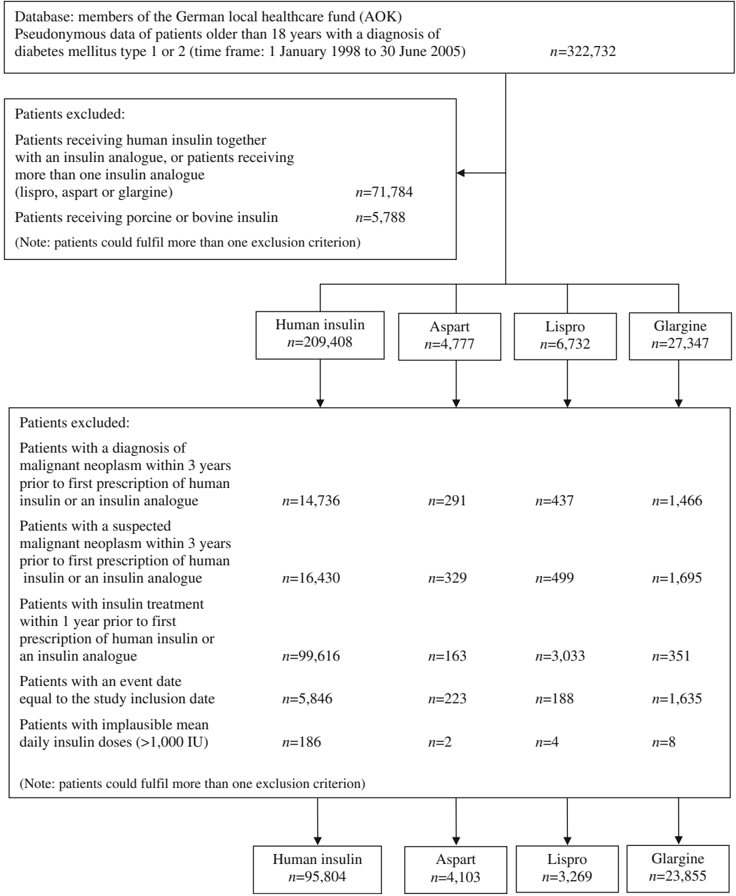
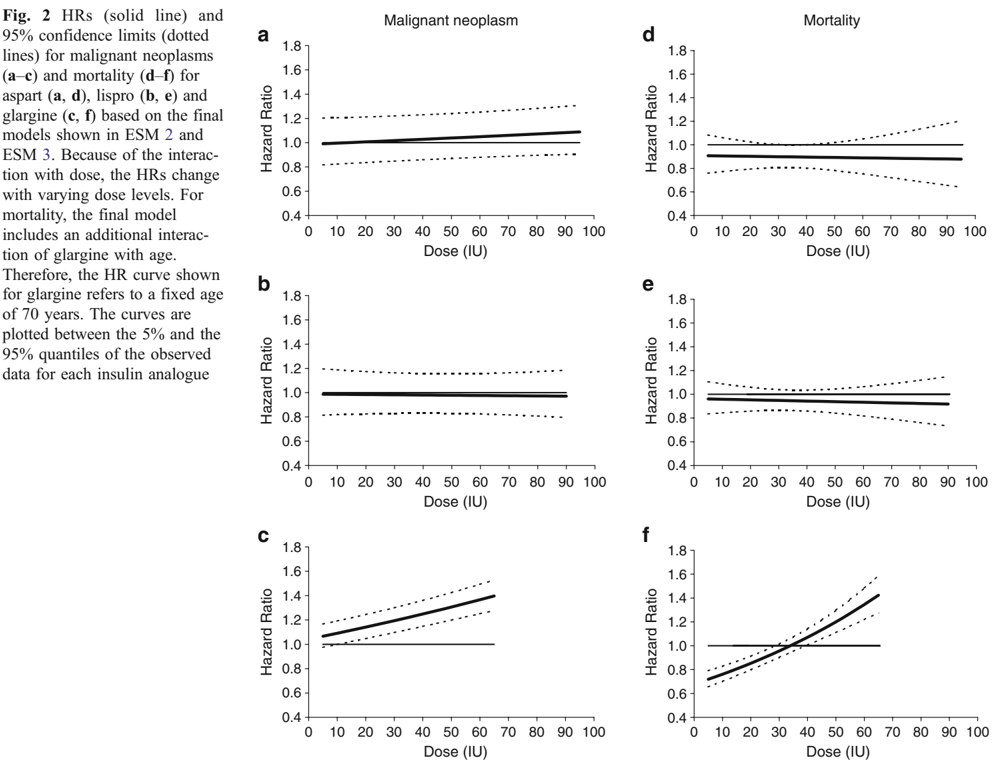
AIMS/HYPOTHESIS: The aim of this cohort study was to investigate the risk of malignant neoplasms and mortality in patients with diabetes treated either with human insulin or with one of three insulin analogues. METHODS: Data were provided by the largest German statutory health insurance fund (time-frame: January 1998 to June 2005 inclusive), on patients without known malignant disease who had received first-time therapy for diabetes mellitus exclusively with human insulin, aspart, lispro or glargine. The primary outcome was the diagnosis of a malignant neoplasm. Data were analysed by multiple Cox regression models adjusting for potential confounders. RESULTS: A total of 127,031 patients were included, with a mean follow-up time of 1.63 (median 1.41, maximum 4.41) years. A positive association between cancer incidence and insulin dose was found for all insulin types. Because patients receiving combined therapy with insulin analogues and human insulin were excluded, the mean daily dose was much lower for glargine than for human insulin, and a slightly lower cancer incidence in the glargine group was found. After adjusting for dose, a dose-dependent increase in cancer risk was found for treatment with glargine compared with human insulin (p < 0.0001): the adjusted HR was 1.09 (95% CI 1.00 to 1.19) for a daily dose of 10 IU, 1.19 (95% CI 1.10 to 1.30) for a daily dose of 30 IU, and 1.31 (95% CI 1.20 to 1.42) for a daily dose of 50 IU. No increased risk was found for aspart (p = 0.30) or lispro (p = 0.96) compared with human insulin. CONCLUSIONS/INTERPRETATION: Considering the overall relationship between insulin dose and cancer, and the lower dose with glargine, the cancer incidence with glargine was higher than expected compared with human insulin. Our results based on observational data support safety concerns surrounding the mitogenic properties of glargine in diabetic patients. Prospective long-term studies are needed to further evaluate the safety of insulin analogues, especially glargine.
Overview
The claims and statistics of this paper haven’t been checked yet.
Free: it reads the open-access text and checks the first 5 claims that cite a source we can check. Create a free account to check every claim.
Integrity signals
Registry
Cites
Statistics
Figures
Verification
Claims the paper makes
The claims and statistics of this paper haven’t been checked yet.
Free: it reads the open-access text and checks the first 5 claims that cite a source we can check. Create a free account to check every claim.
Claims other papers make about this one
Each is checked against this paper’s own text: does it say what the citing paper says it does?
The check wasn’t confident either way, so it gives no verdict — never disputed.
In the citing paper
“Modest survival benefits also have been reported for breast, ovarian, endometrial, prostate, lung, kidney, liver, and earlier stage pancreatic cancers.1791–1800”
From American Association of Clinical Endocrinology Clinical Practice Guideline: Developing a Diabetes Mellitus Comprehensive Care Plan-2022 Update. (2022) · cites this paper as [1799]
Experimental — accuracy not yet measured
Self-check
Percentages, sums and reported differences re-computed from the paper’s own numbers.
The self-check needs the paper’s full text.
Citations
Cites
Regression Models and Life-Tables
Cox, D. R. (1972) · Journal of the Royal Statistical Society Series B: Statistical Methodology · doi:10.1111/j.2517-6161.1972.tb00899.x · Cited by 39,793
Miller, R. G. (1981) · Cited by 3,336
Applied Survival Analysis: Regression Modeling of Time-to-Event Data
Hosmer, D. W., Lemeshow, S. A., & May, S. J. (2008) · Cited by 3,030
Adjusting for multiple testing—when and how?
Bender, R., & Lange, S. (2001) · Journal of Clinical Epidemiology · doi:10.1016/s0895-4356(00)00314-0 · Cited by 3,004 · cited 1×
“As this study was intended to generate hypotheses, we made no adjustments for multiple testing [23].”
MethodSelf-citationMetformin and reduced risk of cancer in diabetic patients
Evans, J. M. M., Donnelly, L. A., Emslie-Smith, A. M., Alessi, D. R., & Morris, A. D. (2005) · BMJ · doi:10.1136/bmj.38415.708634.f7 · Cited by 2,388 · cited 1×
“In particular, we analysed a potential influence of metformin therapy, for which potential effects on cancer incidence have been previously discussed [24].”
BackgroundSurvival Analysis: A Self-Learning Text
Carpenter, M. (1997) · Technometrics · doi:10.1080/00401706.1997.10485091 · Cited by 1,811 · cited 1×
“We checked the proportional hazard assumption graphically by plotting log(-log survival time) versus log survival time and by a formal test based on Schoenfeld residuals [ 22 ].”
MethodApplied Survival Analysis: Regression Modeling of Time‐to‐Event Data
Hosmer, D. W., Lemeshow, S., & May, S. (2008) · Wiley Series in Probability and Statistics · doi:10.1002/9780470258019 · Cited by 1,298
Type-II diabetes and pancreatic cancer: a meta-analysis of 36 studies
Huxley, R., Ansary-Moghaddam, A., Berrington de González, A., Barzi, F., & Woodward, M. (2005) · British Journal of Cancer · doi:10.1038/sj.bjc.6602619 · Cited by 1,105 · cited 1×
“53) has been calculated for endometrial cancer [6, 7].”
BackgroundDiabetes Mellitus and Risk of Colorectal Cancer: A Meta-Analysis
Larsson, S. C., Orsini, N., & Wolk, A. (2005) · JNCI: Journal of the National Cancer Institute · doi:10.1093/jnci/dji375 · Cited by 1,038 · cited 1×
“An OR of 1.82 (95% CI 1.66 to 1.89) has been reported for pancreatic cancer, and an RR of 2.10 (95% CI 1.75 to 2.53) has been calculated for endometrial cancer [6, 7 ]. Similar results have been reported for other cancer entities.”
ResultInfluentialDiabetes mellitus and risk of breast cancer: A meta‐analysis
Larsson, S. C., Mantzoros, C. S., & Wolk, A. (2007) · International Journal of Cancer · doi:10.1002/ijc.22717 · Cited by 875 · cited 1×
“28) for breast cancer [3–5].”
Cited by
Diabetes Mellitus, Fasting Glucose, and Risk of Cause-Specific Death
The Emerging Risk Factors Collaboration (2011) · New England Journal of Medicine · doi:10.1056/nejmoa1008862 · Cited by 2,726
Giovannucci, E., Harlan, D. M., Archer, M. C., Bergenstal, R. M., Gapstur, S. M., Habel, L. A., Pollak, M., Regensteiner, J. G., & Yee, D. (2010) · Diabetes Care · doi:10.2337/dc10-0666 · Cited by 2,366
“Recently, a series of widely publicized epidemiologic analyses examined a possible association between insulin use and/or use of the long-acting insulin analog glargine (91,110,113,114) and an increase in risk of cancer.”
Shared Risk Factors in Cardiovascular Disease and Cancer
Koene, R. J., Prizment, A. E., Blaes, A., & Konety, S. H. (2016) · Circulation · doi:10.1161/circulationaha.115.020406 · Cited by 1,494
“In contrast, a potential increased risk is associated with insulin analogues.(87,88) The general patterns demonstrated across several studies support the hyperinsulinemia hypothesis, where therapies that increase circulating insulin levels increase cancer risk, and those that lower insulin resistance and circulating i…”
ResultDiabetes and Cancer: A Consensus Report
Giovannucci, E., Harlan, D. M., Archer, M. C., Bergenstal, R. M., Gapstur, S. M., Habel, L. A., Pollak, M., Regensteiner, J. G., & Yee, D. (2010) · CA: A Cancer Journal for Clinicians · doi:10.3322/caac.20078 · Cited by 1,055
Belfiore, A., Frasca, F., Pandini, G., Sciacca, L., & Vigneri, R. (2009) · Endocrine Reviews · doi:10.1210/er.2008-0047 · Cited by 1,033
Vigneri, P., Frasca, F., Sciacca, L., Pandini, G., & Vigneri, R. (2009) · Endocrine Related Cancer · doi:10.1677/erc-09-0087 · Cited by 1,009
Metformin and Cancer Risk in Diabetic Patients: A Systematic Review and Meta-analysis
DeCensi, A., Puntoni, M., Goodwin, P., Cazzaniga, M., Gennari, A., Bonanni, B., & Gandini, S. (2010) · Cancer Prevention Research · doi:10.1158/1940-6207.capr-10-0157 · Cited by 918
Obesity and diabetes: the increased risk of cancer and cancer-related mortality
Gallagher, E. J., & LeRoith, D. (2015) · Physiological Reviews · doi:10.1152/physrev.00030.2014 · Cited by 806
“Human registry studies and retrospective cohort studies published in 2011–2012 reported that other insulin analogs may increase the risk of certain cancers, including breast cancer (74, 165, 179).”
BackgroundImmune-mediated antitumor effect by type 2 diabetes drug, metformin
Eikawa, S., Nishida, M., Mizukami, S., Yamazaki, C., Nakayama, E., & Udono, H. (2015) · Proceedings of the National Academy of Sciences · doi:10.1073/pnas.1417636112 · Cited by 557
Blonde, L., Umpierrez, G. E., Reddy, S. S., McGill, J. B., Berga, S. L., Bush, M., Chandrasekaran, S., DeFronzo, R. A., Einhorn, D., Galindo, R. J., et al. (2022) · Endocrine Practice · doi:10.1016/j.eprac.2022.08.002 · Cited by 507
Metformin Associated With Lower Cancer Mortality in Type 2 Diabetes
Landman, G. W. D., Kleefstra, N., van Hateren, K. J. J., Groenier, K. H., Gans, R. O. B., & Bilo, H. J. G. (2010) · Diabetes Care · doi:10.2337/dc09-1380 · Cited by 502
“Much debate has arisen recently after an online publication stated that insulin glargine might be associated with an increased cancer risk (1).”
Impact of untreated obstructive sleep apnea on glucose control in type 2 diabetes
Aronsohn, R. S., Whitmore, H., Van Cauter, E., & Tasali, E. (2010) · American Journal of Respiratory and Critical Care Medicine · doi:10.1164/rccm.200909-1423oc · Cited by 453
“15 context of recent reports discussing a possible link between the use and dose of insulin glargine and cancer risk [2].”
BackgroundJonasson, J. M., Ljung, R., Talbäck, M., Haglund, B., Gudbjörnsdòttir, S., & Steineck, G. (2009) · Diabetologia · doi:10.1007/s00125-009-1444-2 · Cited by 412
“In the light of a report suggesting that insulin glargine (A21Gly,B31Arg,B32Arg human insulin) may increase cancer occurrence [4], the EASD asked us to perform the present study.”
BackgroundThe proliferating role of insulin and insulin-like growth factors in cancer
Gallagher, E. J., & LeRoith, D. (2010) · Trends in Endocrinology & Metabolism · doi:10.1016/j.tem.2010.06.007 · Cited by 380
“Moreover, recent epidemiological studies suggested a link between cancer and the use of exogenous insulin therapy, as well as insulin secretagogues, bringing this issue into the public arena [4,5].”
BackgroundInsulin Receptor Isoforms in Physiology and Disease: An Updated View
Belfiore, A., Malaguarnera, R., Vella, V., Lawrence, M. C., Sciacca, L., Frasca, F., Morrione, A., & Vigneri, R. (2017) · Endocrine Reviews · doi:10.1210/er.2017-00073 · Cited by 375
SDRN Epidemiology Group, & Colhoun, H. M. (2009) · Diabetologia · doi:10.1007/s00125-009-1453-1 · Cited by 393
“[8] was restricted to insulin glargine only users, we also examined effects in insulin glargine only users and non-glargine plus glargine insulin users separately.”
InfluentialReview: Diabetes, Obesity, and Cancer—Pathophysiology and Clinical Implications
Lega, I. C., & Lipscombe, L. L. (2020) · Endocrine Reviews · doi:10.1210/endrev/bnz014 · Cited by 364
Metformin in cancer prevention and therapy.
Kasznicki, J., Śliwińska, A., & Drzewoski, J. (2014) · PubMed · doi:10.3978/j.issn.2305-5839.2014.06.01 · Cited by 316
“Recent publications have also suggested the link between hypoglycemic medications and cancer (8-11).”
BackgroundGrowth hormone, the insulin-like growth factor axis, insulin and cancer risk
Clayton, P. E., Banerjee, I., Murray, P. G., & Renehan, A. G. (2011) · Nature Reviews Endocrinology · doi:10.1038/nrendo.2010.171 · Cited by 364
Minireview: IGF, Insulin, and Cancer
Gallagher, E. J., & LeRoith, D. (2011) · Endocrinology · doi:10.1210/en.2011-0231 · Cited by 349
Hyperinsulinemia in Obesity, Inflammation, and Cancer
Zhang, A. M. Y., Wellberg, E. A., Kopp, J. L., & Johnson, J. D. (2021) · Diabetes & Metabolism Journal · doi:10.4093/dmj.2020.0250 · Cited by 305
Does diabetes therapy influence the risk of cancer?
Smith, U., & Gale, E. A. M. (2009) · Diabetologia · doi:10.1007/s00125-009-1441-5 · Cited by 316
“Insulin dose could only be estimated in terms of the number of insulin prescriptions filled, which meant that a dose–response relationship could not be examined in the same way as in the German study [23], which was based on recorded insulin doses.”
BackgroundResultInfluentialObesity, type 2 diabetes, and cancer: the insulin and IGF connection
Cohen, D. H., & LeRoith, D. (2012) · Endocrine-Related Cancer · doi:10.1530/erc-11-0374 · Cited by 301
“The potential for increased cancer risk in patients treated with insulin analogs became a cause of alarm after a German study showed a dose-dependent increase in cancer risk in patients treated with one such analog, insulin glargine, compared with human insulin (Hemkens et al. 2009).”
Metformin: Multi-faceted protection against cancer
Del Barco, S., Vazquez-Martin, A., Cufí, S., Oliveras-Ferraros, C., Bosch-Barrera, J., Joven, J., Martin-Castillo, B., & Menendez, J. A. (2011) · Oncotarget · doi:10.18632/oncotarget.387 · Cited by 302
“Evidence for this CSCcentered hypothesis underlying breast cancer prevention by metformin is the observation of increased breast cancer risk within 2 years in diabetic women receiving the insulin analog glargine [126-128].”
BackgroundMetformin and cancer: new applications for an old drug
Kourelis, T. V., & Siegel, R. D. (2012) · Medical Oncology · doi:10.1007/s12032-011-9846-7 · Cited by 289
“characteristics of patients [87, 88], leading to allocation bias.”
BackgroundHemmingsen, B., Lund, S. S., Gluud, C., Vaag, A., Almdal, T. P., & Wetterslev, J. (2015) · Cochrane Database of Systematic Reviews · doi:10.1002/14651858.cd008143.pub4 · Cited by 291
Diabetes and cancer: two diseases with obesity as a common risk factor
Garg, S. K., Maurer, H., Reed, K., & Selagamsetty, R. (2014) · Diabetes, Obesity and Metabolism · doi:10.1111/dom.12124 · Cited by 275
“Four observational studies published in Diabetologia examined a possible link between insulin glargine monotherapy and all cancers or breast cancer, with conflicting results [6,8,9,151].”
BackgroundBelfiore, A., & Malaguarnera, R. (2011) · Endocrine-Related Cancer · doi:10.1530/erc-11-0074 · Cited by 272
“However, these data are controversial and difficult to interpret also for the presence of bias and confounders (Colhoun 2009, Hemkens et al. 2009).”
BackgroundAssociation of metformin use with cancer incidence and mortality: A meta-analysis
Zhang, P., Li, H., Tan, X., Chen, L., & Wang, S. (2013) · Cancer Epidemiology · doi:10.1016/j.canep.2012.12.009 · Cited by 270
on behalf of the Diabetes and Cancer Research Consortium, Johnson, J. A., Carstensen, B., Witte, D., Bowker, S. L., Lipscombe, L., & Renehan, A. G. (2012) · Diabetologia · doi:10.1007/s00125-012-2525-1 · Cited by 260
Nucleolus as an emerging hub in maintenance of genome stability and cancer pathogenesis
Lindström, M. S., Jurada, D., Bursac, S., Orsolic, I., Bartek, J., & Volarevic, S. (2018) · Oncogene · doi:10.1038/s41388-017-0121-z · Cited by 238
Insulin resistance and hyperinsulinaemia in the development and progression of cancer
Godsland, I. F. (2010) · Clinical Science · doi:10.1042/cs20090399 · Cited by 231
Danne, T., Phillip, M., Buckingham, B. A., Jarosz-Chobot, P., Saboo, B., Urakami, T., Battelino, T., Hanas, R., & Codner, E. (2018) · Pediatric Diabetes · doi:10.1111/pedi.12718 · Cited by 225
Cardiovascular outcome trials of glucose-lowering drugs or strategies in type 2 diabetes
Holman, R. R., Sourij, H., & Califf, R. M. (2014) · The Lancet · doi:10.1016/s0140-6736(14)60794-7 · Cited by 227
Insulin, insulin receptors, and cancer
Vigneri, R., Goldfine, I. D., & Frittitta, L. (2016) · Journal of Endocrinological Investigation · doi:10.1007/s40618-016-0508-7 · Cited by 216
Preventive therapy for breast cancer: a consensus statement
Cuzick, J., DeCensi, A., Arun, B., Brown, P. H., Castiglione, M., Dunn, B., Forbes, J. F., Glaus, A., Howell, A., von Minckwitz, G., et al. (2011) · The Lancet Oncology · doi:10.1016/s1470-2045(11)70030-4 · Cited by 220
Chen, Y., Wu, F., Saito, E., Lin, Y., Song, M., Luu, H. N., Gupta, P. C., Sawada, N., Tamakoshi, A., Shu, X.-O., et al. (2017) · Diabetologia · doi:10.1007/s00125-017-4229-z · Cited by 206
“metformin) the risk of cancer [23, 49, 50], but our pooled analyses cannot address the influence of specific treatments, due to the lack of data.”
BackgroundHome, P. D. (2012) · Diabetes, Obesity and Metabolism · doi:10.1111/j.1463-1326.2012.01580.x · Cited by 212
“However, interaction with the growth factor receptor and thus mitogenic activity is easier to conceptualize, leading to concentration on comparative analogue properties in this area, and controversy with regard to long-acting insulin analogues with di-basic amino acid extensions to the B-chain [80].”
BackgroundInfluentialCancer, obesity, diabetes, and antidiabetic drugs: is the fog clearing?
Klil-Drori, A. J., Azoulay, L., & Pollak, M. N. (2017) · Nature Reviews Clinical Oncology · doi:10.1038/nrclinonc.2016.120 · Cited by 210
Hemmingsen, B., Lund, S. S., Gluud, C., Vaag, A., Almdal, T. P., & Wetterslev, J. (2013) · Cochrane Database of Systematic Reviews · doi:10.1002/14651858.cd008143.pub3 · Cited by 203
RetractedDiabetes, prediabetes and cancer mortality
for the DECODE Study Group, Zhou, X. H., Qiao, Q., Zethelius, B., Pyörälä, K., Söderberg, S., Pajak, A., Stehouwer, C. D. A., Heine, R. J., Jousilahti, P., et al. (2010) · Diabetologia · doi:10.1007/s00125-010-1796-7 · Cited by 197
“Epidemiological studies have shown that diabetes [1–7] or certain treatments for diabetes may increase the risk [8–10] of developing cancer.”
BackgroundPharmacotherapy of type 2 diabetes: An update
Upadhyay, J., Polyzos, S. A., Perakakis, N., Thakkar, B., Paschou, S. A., Katsiki, N., Underwood, P., Park, K.-H., Seufert, J., Kang, E. S., et al. (2018) · Metabolism · doi:10.1016/j.metabol.2017.08.010 · Cited by 187
Wu, X., He, C., Wu, Y., & Chen, X. (2016) · Biomaterials · doi:10.1016/j.biomaterials.2015.10.016 · Cited by 186
Gestational diabetes: risk factors and recent advances in its genetics and treatment
Petry, C. J. (2010) · British Journal of Nutrition · doi:10.1017/s0007114510001741 · Cited by 180
The Relationship Between Diabetes Mellitus and Cancers and Its Underlying Mechanisms
Zhu, B., & Qu, S. (2022) · Frontiers in Endocrinology · doi:10.3389/fendo.2022.800995 · Cited by 165
“exhibited a dose-dependent increased risk of cancer development (126).”
BackgroundThe Links Between Insulin Resistance, Diabetes, and Cancer
Orgel, E., & Mittelman, S. D. (2013) · Current Diabetes Reports · doi:10.1007/s11892-012-0356-6 · Cited by 162
Cancer occurrence in Danish diabetic patients: duration and insulin effects
Carstensen, B., Witte, D. R., & Friis, S. (2012) · Diabetologia · doi:10.1007/s00125-011-2381-4 · Cited by 167
Yang, X., Ko, G. T. C., So, W. Y., Ma, R. C. W., Yu, L. W. L., Kong, A. P. S., Zhao, H., Chow, C.-C., Tong, P. C. Y., & Chan, J. C. N. (2010) · Diabetes · doi:10.2337/db09-1371 · Cited by 162
“Adding to this confusion, the German study (5) reported that insulin glargine users were at a lower overall risk of cancer than human insulin users after adjusting for age and sex (relative risk 0.”
InfluentialThe effect of environmental chemicals on the tumor microenvironment
Casey, S. C., Vaccari, M., Al-Mulla, F., Al-Temaimi, R., Amedei, A., Barcellos-Hoff, M. H., Brown, D. G., Chapellier, M., Christopher, J., Curran, C. S., et al. (2015) · Carcinogenesis · doi:10.1093/carcin/bgv035 · Cited by 152
Diabetes and cancer: Pathophysiological fundamentals of a ‘dangerous affair’
Cignarelli, A., Genchi, V. A., Caruso, I., Natalicchio, A., Perrini, S., Laviola, L., & Giorgino, F. (2018) · Diabetes Research and Clinical Practice · doi:10.1016/j.diabres.2018.04.002 · Cited by 161
Epidemiological aspects of neoplasms in diabetes
Nicolucci, A. (2010) · Acta Diabetologica · doi:10.1007/s00592-010-0187-3 · Cited by 162
“In a study based on data from a large insurance dataset in Germany, patients treated with human insulin were compared with patients treated with insulin glargine [45].”
BackgroundInsulin glargine and malignancy: an unwarranted alarm
Pocock, S., & Smeeth, L. L. (2009) · The Lancet · doi:10.1016/s0140-6736(09)61307-6 · Cited by 150
Evans, M., Schumm‐Draeger, P. M., Vora, J., & King, A. B. (2011) · Diabetes, Obesity and Metabolism · doi:10.1111/j.1463-1326.2011.01395.x · Cited by 146
“The largest study of 127 031 patients reported an increase in the risk of cancer with higher doses and longer duration of exposure to any insulin and that after adjusting for insulin dose, insulin glargine-treated patients were at highest risk [26].”
BackgroundIntensive glycaemic control and cancer risk in type 2 diabetes: a meta-analysis of major trials
Johnson, J. A., & Bowker, S. L. (2010) · Diabetologia · doi:10.1007/s00125-010-1933-3 · Cited by 157
Insulin treatment in children and adolescents with diabetes
Bangstad, H., Danne, T., Deeb, L. C., Jarosz-Chobot, P. A., Urakami, T., & Hanås, R. (2009) · Pediatric Diabetes · doi:10.1111/j.1399-5448.2009.00578.x · Cited by 160
Combined randomised controlled trial experience of malignancies in studies using insulin glargine
Home, P. D., & Lagarenne, P. (2009) · Diabetologia · doi:10.1007/s00125-009-1530-5 · Cited by 142
“05) [3] 3 (0.”
BackgroundRosenstock, J., Fonseca, V., McGill, J. B., Riddle, M., Hallé, J. P., Hramiak, I., Johnston, P., & Davis, M. (2009) · Diabetologia · doi:10.1007/s00125-009-1452-2 · Cited by 141
Diabetes and cancer (2): evaluating the impact of diabetes on mortality in patients with cancer
Renehan, A. G., Yeh, H., Johnson, J. A., Wild, S. H., Gale, E. A. M., & Møller, H. (2012) · Diabetologia · doi:10.1007/s00125-012-2526-0 · Cited by 142
“20 01 [3 6] (U S A ) N or th C ar ol in a B R F S S C as e– co nt ro l 11 6/ 88 7 F S : 30 vs 29 % D ro pp ed in m ul tiv ar ia te”
BackgroundDiabetes, metformin use, and colon cancer: a population-based cohort study in Taiwan
Tseng, C.-H. (2012) · European Journal of Endocrinology · doi:10.1530/eje-12-0369 · Cited by 132
Defining the pathway to insulin-like growth factor system targeting in cancer
Rosenzweig, S. A., & Atreya, H. S. (2010) · Biochemical Pharmacology · doi:10.1016/j.bcp.2010.06.013 · Cited by 136
“A recent study in Germany comparing diabetic patients taking human insulin, short acting analogs or long-acting glargine insulin revealed a greater than expected increase in cancer incidence in the glargine group compared to those taking human insulin [37].”
Resultvan Staa, T. P., Patel, D., Gallagher, A. M., & Bruin, M. L. D. (2011) · Diabetologia · doi:10.1007/s00125-011-2390-3 · Cited by 128
“registry) [1–4].”
BackgroundDiabetes and Cancer: Is Diabetes Causally Related to Cancer?
Suh, S., & Kim, K.-W. (2011) · Diabetes & Metabolism Journal · doi:10.4093/dmj.2011.35.3.193 · Cited by 120
“The debate about the potential risk of developing cancer associated with insulin use has been ignited by the publication of four observational studies [36-39] in 2009.”
BackgroundKarlstad, O., Linde, J., Vestergaard, P., Hjellvik, V., Bazelier, M., Schmidt, M., Andersen, M., Auvinen, A., Haukka, J., Furu, K., et al. (2013) · Current Drug Safety · doi:10.2174/15680266113136660067 · Cited by 116
“27 cohort studies [25-51] and 15 casecontrol studies (9 nested case-control studies) [52-66] were included in the systematic review.”
BackgroundInfluentialIqbal, M. A., Siddiqui, F. A., Gupta, V., Chattopadhyay, S., Prakasam, G., Kumar, B., Manvati, S., Chaman, N., & Bamezai, R. N. K. (2013) · Molecular Cancer · doi:10.1186/1476-4598-12-72 · Cited by 122
“High levels of endogenous insulin among type-2 diabetics and non-diabetics have also been associated with increased cancer risk in epidemiological studies [21]; with highest risk for liver and pancreatic cancer [22-24].”
Ballotari, P., Vicentini, M., Manicardi, V., Gallo, M., Ranieri, S. C., Greci, M., & Rossi, P. G. (2017) · BMC Cancer · doi:10.1186/s12885-017-3696-4 · Cited by 120
Doses of Insulin and Its Analogues and Cancer Occurrence in Insulin-Treated Type 2 Diabetic Patients
Mannucci, E., Monami, M., Balzi, D., Cresci, B., Pala, L., Melani, C., Lamanna, C., Bracali, I., Bigiarini, M., Barchielli, A., et al. (2010) · Diabetes Care · doi:10.2337/dc10-0476 · Cited by 121
“Furthermore, we observed a dose-dependent association of glargine with incident malignancies, consistent with one previous observation (3).”
BackgroundResultInfluentialInsulin resistance and chronic liver disease
Kawaguchi, T. (2011) · World Journal of Hepatology · doi:10.4254/wjh.v3.i5.99 · Cited by 117
Bolli, G. B., Hahn, A. D., Schmidt, R., Eisenblaetter, T., Dahmen, R., Heise, T., & Becker, R. H. A. (2012) · Diabetes Care · doi:10.2337/dc12-0270 · Cited by 113
“Some controversial registry studies have suggested a possible greater cancer risk in humans using glargine versus nonglargine insulin (18,19).”
BackgroundRuiter, R., Visser, L. E., van Herk‐Sukel, M. P. P., Coebergh, J. W. W., Haak, H. R., Geelhoed-Duijvestijn, P. H. L. M., Straus, S. M. J. M., Herings, R. M. C., & Stricker, B. H. C. (2011) · Diabetologia · doi:10.1007/s00125-011-2312-4 · Cited by 112
“With regard to dose, a dose-dependent relationship has been described for insulin glargine and risk of cancer, but not for other insulin analogues or human insulin [18, 24].”
BackgroundDejgaard, A., Lynggaard, H., Råstam, J., & Thomsen, M. (2009) · Diabetologia · doi:10.1007/s00125-009-1568-4 · Cited by 114
Diabetes and gastric cancer: The potential links
Tseng, C., & Tseng, F.-H. (2014) · World Journal of Gastroenterology · doi:10.3748/wjg.v20.i7.1701 · Cited by 114
Clinical and molecular mechanisms favoring cancer initiation and progression in diabetic patients
Sciacca, L., Vigneri, R., Tumminia, A., Frasca, F., Squatrito, S., Frittitta, L., & Vigneri, P. G. (2013) · Nutrition Metabolism and Cardiovascular Diseases · doi:10.1016/j.numecd.2013.05.006 · Cited by 118
for the DIGAMI 2 Investigators, Mellbin, L., Malmberg, K., Norhammar, A., Wedel, H., & Rydén, L. (2011) · Diabetologia · doi:10.1007/s00125-011-2084-x · Cited by 114
“Exogenous insulin has been related to an increased risk of malignancies in some [11, 12], but not all [13, 14] studies, while metformin has been claimed to be protective in this respect.”
Metabolic Health, Insulin, and Breast Cancer: Why Oncologists Should Care About Insulin
Yee, L. D., Mortimer, J. E., Natarajan, R. D., Dietze, E. C., & Seewaldt, V. L. (2020) · Frontiers in Endocrinology · doi:10.3389/fendo.2020.00058 · Cited by 113
“This is consistent with studies showing that individuals with type-2 diabetes who are treated with insulin have an increased risk for malignancies, including breast cancer (38).”
BackgroundResultDeshpande, R. P., Sharma, S., & Watabe, K. (2020) · Cancers · doi:10.3390/cancers12102983 · Cited by 108
“increased risk of colorectal [210] and skin [211] cancer development.”
BackgroundDiabetes and Cancer—An AACE/ACE Consensus Statement
Handelsman, Y., LeRoith, D., Bloomgarden, Z. T., Dagogo-Jack, S. E., EINHORN, D. F., Garber, A. J., Grunberger, G., Harrell, R. M., Gagel, R. F., Lebovitz, H. E., et al. (2013) · Endocrine Practice · doi:10.4158/ep13248.cs · Cited by 105
“42), respectively, compared with other insulins (121).”
Diabetes mellitus and incidence and mortality of kidney cancer: A meta-analysis
Bao, C., Yang, X., Xu, W., Luo, H., Xu, Z., Su, C., & Qi, X. (2013) · Journal of Diabetes and its Complications · doi:10.1016/j.jdiacomp.2013.01.004 · Cited by 99
The Insulin Receptor: A New Target for Cancer Therapy
Malaguarnera, R., & Belfiore, A. (2011) · Frontiers in Endocrinology · doi:10.3389/fendo.2011.00093 · Cited by 111
“Small molecules with tyrosine kinase inhibitory activity for IGF-IR are also being actively investigated for their possible use in cancer patients.”
BackgroundLong-term effects of insulin glargine on the risk of breast cancer
Suissa, S., Azoulay, L., Dell’Aniello, S., Evans, M., Vora, J. P., & Pollak, M. (2011) · Diabetologia · doi:10.1007/s00125-011-2190-9 · Cited by 103
“The possibility of increased cancer risk in diabetic patients treated with insulin glargine has been addressed in several observational studies [6–10].”
BackgroundFurther Exploration of the Relationship Between Insulin Glargine and Incident Cancer
Morden, N. E., Liu, S. K., Smith, J., Mackenzie, T. A., Skinner, J., & Korc, M. (2011) · Diabetes Care · doi:10.2337/dc11-0699 · Cited by 94
The complexities of obesity and diabetes with the development and progression of pancreatic cancer
Bao, B., Wang, Z., Li, Y., Kong, D., Ali, S., Banerjee, S., Ahmad, A., & Sarkar, F. H. (2011) · Biochimica et Biophysica Acta (BBA) - Reviews on Cancer · doi:10.1016/j.bbcan.2010.11.003 · Cited by 94
“Human insulin users have been found to have an increased risk for the development of cancers including PC [150,151].”
BackgroundBlin, P., Lassalle, R., Dureau‐Pournin, C., Ambrosino, B., Bernard, M., Abouelfath, A., Gin, H., Jeunne, C. L., Pariente, A., Droz‐Perroteau, C., et al. (2012) · Diabetologia · doi:10.1007/s00125-011-2429-5 · Cited by 97
“dependent risk for insulins other than insulin glargine [7].”
BackgroundResultInfluentialType 2 Diabetes and Cancer: What Is the Connection?
Cannata, D., Fierz, Y., Vijayakumar, A., & LeRoith, D. (2010) · Mount Sinai Journal of Medicine: A Journal of Translational and Personalized Medicine · doi:10.1002/msj.20167 · Cited by 91
The impact of diabetes on survival in women with ovarian cancer
Bakhru, A., Buckanovich, R. J., & Griggs, J. J. (2011) · Gynecologic Oncology · doi:10.1016/j.ygyno.2010.12.329 · Cited by 101
Diabetes and cancer II: role of diabetes medications and influence of shared risk factors
Onitilo, A. A., Engel, J. M., Glurich, I., Stankowski, R. V., Williams, G. M., & Doi, S. A. (2012) · Cancer Causes & Control · doi:10.1007/s10552-012-9971-4 · Cited by 89
“Hemkens [47] All types Increased risk with insulin glargine compared to human insulin, dose-dependent”
Evolution of Insulin: From Human to Analog
Tibaldi, J. M. (2014) · The American Journal of Medicine · doi:10.1016/j.amjmed.2014.07.005 · Cited by 107
“Concerns were recently expressed that insulin glargine could increase the incidence of cancer, possibly as a result of an increased affinity ratio for insulin-like growth factor-1 receptors versus insulin receptors, relative to human insulin.(34,36,37) However, these concerns were based on epidemiologic analyses with…”
BackgroundLatest insights into the risk of cancer in diabetes
Noto, H., Goto, A., Tsujimoto, T., Osame, K., & Noda, M. (2013) · Journal of Diabetes Investigation · doi:10.1111/jdi.12068 · Cited by 88
Rethinking the Relationship between Insulin and Cancer
Vigneri, R., Sciacca, L., & Vigneri, P. G. (2020) · Trends in Endocrinology and Metabolism · doi:10.1016/j.tem.2020.05.004 · Cited by 96
Colmers-Gray, I. N., Bowker, S. L., Tjosvold, L., & Johnson, J. A. (2012) · Diabetes & Metabolism · doi:10.1016/j.diabet.2012.08.011 · Cited by 94
An injectable and glucose-sensitive nanogel for controlled insulin release
Wu, Z., Zhang, X., Guo, H., Li, C., & Yu, D. (2012) · Journal of Materials Chemistry · doi:10.1039/c2jm34082h · Cited by 90
Systematic review and meta-analysis of insulin therapy and risk of cancer
Janghorbani, M., Dehghani, M., & Salehi-Marzijarani, M. (2012) · Hormones and Cancer · doi:10.1007/s12672-012-0112-z · Cited by 86
“90) than in European populations (RR01.”
BackgroundInfluentialJoung, K. H., Jeong, J., & Ku, B. J. (2015) · BioMed Research International · doi:10.1155/2015/920618 · Cited by 100
“A significant number of epidemiological studies have suggested that insulin use and daily doses, particularly of the long-acting insulin analog glargine, may be responsible for the association with and strong increase in the risk of cancer [156–160].”
BackgroundBordeleau, L., Yakubovich, N., Dagenais, G. R., Rosenstock, J., Probstfield, J., Chang Yu, P., Ryden, L. E., Pirags, V., Spinas, G. A., Birkeland, K. I., et al. (2014) · Diabetes Care · doi:10.2337/dc13-1468 · Cited by 86
Barriers and solutions to diabetes management: an Indian perspective
Wangnoo, S., Maji, D., Das, A., Rao, P., Moses, A., Sethi, B., Unnikrishnan, A., Kalra, S., Balaji, V, Bantwal, G., et al. (2013) · Indian Journal of Endocrinology and Metabolism · doi:10.4103/2230-8210.113749 · Cited by 66
“[33] Insulin and insulin analogues were also reported to be associated with higher cancer incidence[34] and raised concerns over their mitogenic potential.”
BackgroundMitogenic action of insulin: friend, foe or ‘frenemy’?
Draznin, B. (2009) · Diabetologia · doi:10.1007/s00125-009-1558-6 · Cited by 86
“Suddenly, a few studies in Diabetologia [3–5] describing an association between administration of glargine and higher incidence of cancers have aroused worldwide attention.”
BackgroundDiabetes mellitus: new drugs for a new epidemic
Nicholson, G., & Hall, G. M. (2011) · British Journal of Anaesthesia · doi:10.1093/bja/aer120 · Cited by 97
Kasuga, M., Ueki, K., Tajima, N., Noda, M., Ohashi, K., Noto, H., Goto, A., Ogawa, W., Sakai, R., Tsugane, S., et al. (2013) · Cancer Science · doi:10.1111/cas.12203 · Cited by 89
Diabetes and cancer, common threads and missing links
Hua, F., Yu, J., & Hu, Z. (2016) · Cancer Letters · doi:10.1016/j.canlet.2016.02.006 · Cited by 90
Semlitsch, T., Engler, J., Siebenhofer, A., Jeitler, K., Berghold, A., & Horvath, K. (2020) · Cochrane Database of Systematic Reviews · doi:10.1002/14651858.cd005613.pub4 · Cited by 80
Does Insulin Glargine Increase the Risk of Cancer Compared With Other Basal Insulins?
Fagot, J., Blotière, P., Ricordeau, P., Weill, A., Alla, F., & Allemand, H. (2012) · Diabetes Care · doi:10.2337/dc12-0506 · Cited by 80
Metadata
- Authors
- Hemkens, L. G., Grouven, U., Bender, R., Günster, C., Gutschmidt, S., Selke, G. W., & Sawicki, P. T.
- Affiliations
- Institute for Quality and Efficiency in Health Care (DE)
- University of Cologne (DE)
- Wissenschaftliches Institut der AOK (DE)
- Corresponding author
- Hemkens, L. G.
- Venue
- Diabetologia
- Published
- 2009-06-30
- Volume
- 52
- Issue
- 9
- Pages
- 1732-1744
- ISSN
- 0012-186X (ISSN-L)
- 1432-0428
- PMC
- PMC2723679
- OpenAlex
- W2108747912
- Cited by
- 607
- References
- 28
- Citations by year
- 2026: 11 · 2025: 4 · 2024: 13 · 2023: 8 · 2022: 9 · 2021: 9 · 2020: 22 · 2019: 18 · 2018: 27 · 2017: 26 · 2016: 21 · 2015: 41 · 2014: 50 · 2013: 66 · 2012: 64
- FWCI
- 37.75
- Type
- journal article
- Language
- en
- Open access
- hybrid
- doi.org
- Licence
- cc-by-nc
- Locations
- Diabetologia (publishedVersion, cc-by-nc)
- PubMed Central (publishedVersion)
- PubMed (publishedVersion)
- Topics
- Life Sciences › Biochemistry, Genetics and Molecular Biology › Molecular Biology › Metabolism, Diabetes, and Cancer
- Health Sciences › Medicine › Endocrinology, Diabetes and Metabolism › Diabetes Management and Research
- Health Sciences › Medicine › Dermatology › Skin Diseases and Diabetes
- Keywords
- diabetes mellitus, insulin analogues, human insulin, glargine, insulin aspart, insulin lispro, cancer risk, cancer, insulin dose, mortality, drug safety
- MeSH terms
- Insulin Glargine, Aged, Aged, 80 and over, Analysis of Variance, Diabetes Mellitus, Diabetes Mellitus, Type 1, Diabetes Mellitus, Type 2, Female, Germany, Humans, Hypoglycemic Agents, Insulin, Insulin Infusion Systems, Male, Middle Aged, Neoplasms, Regression Analysis, Reproducibility of Results, Cohort Studies, Proportional Hazards Models, Patient Selection, Diabetes Complications, Insulin, Long-Acting
About these checks
Registry, retraction, Cites and statistics results are computed, not judged, with one exception: a printed reference that no index lists is read once by a model before it counts as a citation error. Claims are extracted by a model and kept only when their quote appears verbatim in the text; each cited source is then checked, with a model’s help, for whether it says what the claim relies on. Those verdicts can be wrong — read the claim’s quote and the cited source before relying on one.
Statistics and arithmetic are recomputed, not judged.
Confidence bands are shown only for fields calibrated on our annotated test set. None is calibrated yet, so no band is shown.
What counts as a claim ›How we measure confidence ›How we check this ›
Are you an author, or do you see a problem with this page? Request a review
Data sources
Bibliographic data: Semantic Scholar, OpenAlex, Crossref.
Contains information from the Semantic Scholar Academic Graph Datasets, made available under the ODC Attribution License (ODC-BY 1.0).
Semantic Scholar’s data is described in: Kinney, R., et al. (2023). The Semantic Scholar Open Data Platform. arXiv:2301.10140.
