

Risk of malignancies in patients with diabetes treated with human insulin or insulin analogues: a cohort study
Open accessThe DOI matches its Crossref record; 30 of the 30 references it cites were found in a registry or an index.
Abstract
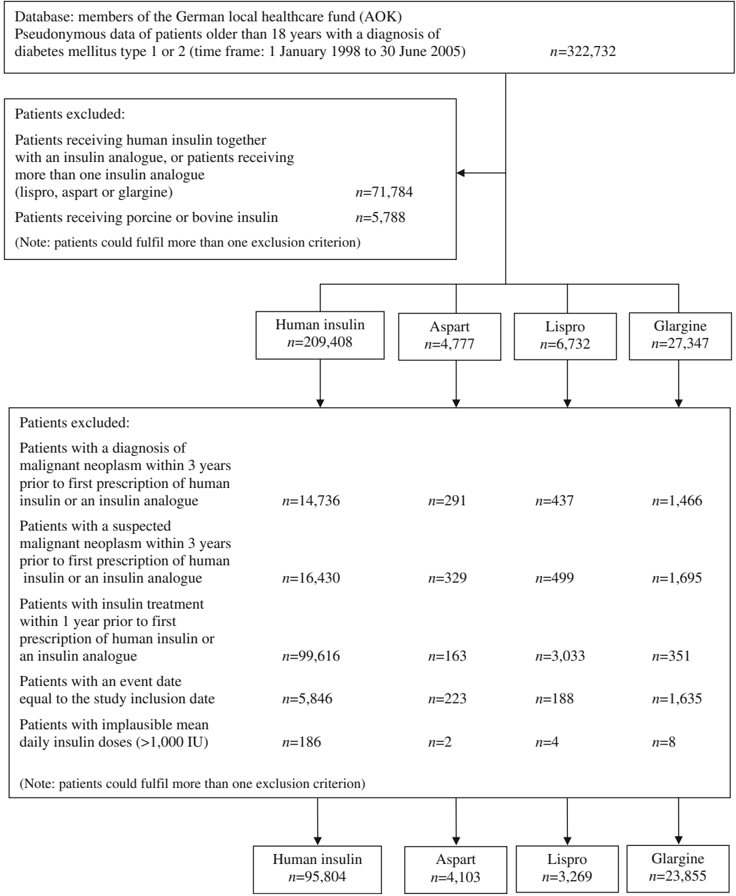
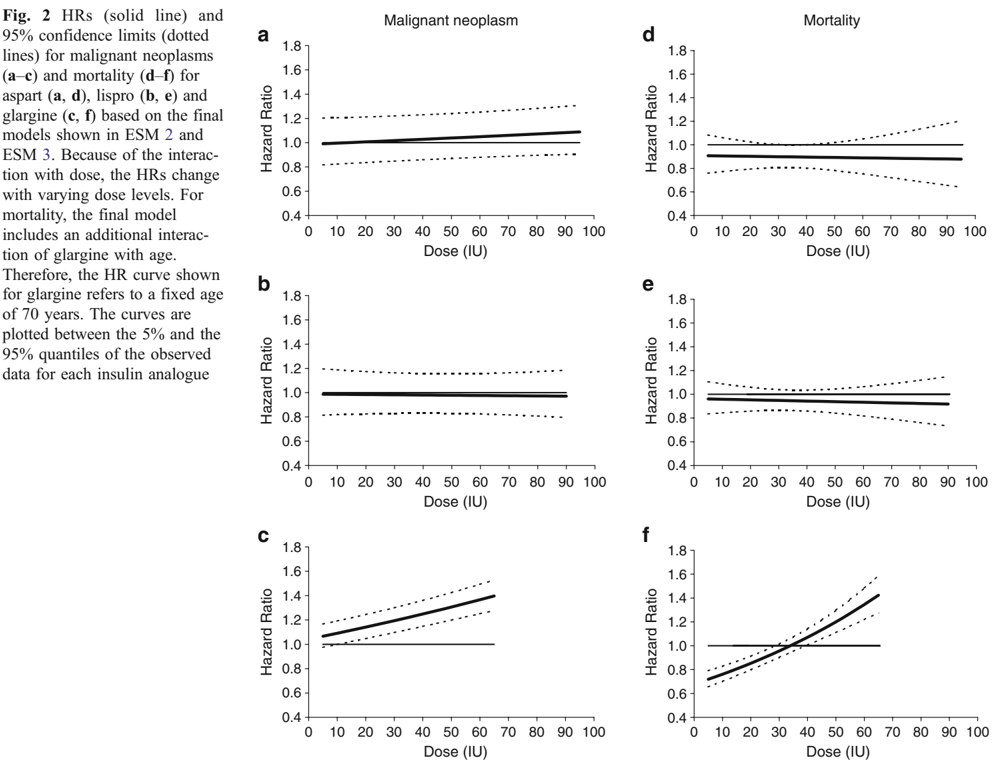
AIMS/HYPOTHESIS: The aim of this cohort study was to investigate the risk of malignant neoplasms and mortality in patients with diabetes treated either with human insulin or with one of three insulin analogues. METHODS: Data were provided by the largest German statutory health insurance fund (time-frame: January 1998 to June 2005 inclusive), on patients without known malignant disease who had received first-time therapy for diabetes mellitus exclusively with human insulin, aspart, lispro or glargine. The primary outcome was the diagnosis of a malignant neoplasm. Data were analysed by multiple Cox regression models adjusting for potential confounders. RESULTS: A total of 127,031 patients were included, with a mean follow-up time of 1.63 (median 1.41, maximum 4.41) years. A positive association between cancer incidence and insulin dose was found for all insulin types. Because patients receiving combined therapy with insulin analogues and human insulin were excluded, the mean daily dose was much lower for glargine than for human insulin, and a slightly lower cancer incidence in the glargine group was found. After adjusting for dose, a dose-dependent increase in cancer risk was found for treatment with glargine compared with human insulin (p < 0.0001): the adjusted HR was 1.09 (95% CI 1.00 to 1.19) for a daily dose of 10 IU, 1.19 (95% CI 1.10 to 1.30) for a daily dose of 30 IU, and 1.31 (95% CI 1.20 to 1.42) for a daily dose of 50 IU. No increased risk was found for aspart (p = 0.30) or lispro (p = 0.96) compared with human insulin. CONCLUSIONS/INTERPRETATION: Considering the overall relationship between insulin dose and cancer, and the lower dose with glargine, the cancer incidence with glargine was higher than expected compared with human insulin. Our results based on observational data support safety concerns surrounding the mitogenic properties of glargine in diabetic patients. Prospective long-term studies are needed to further evaluate the safety of insulin analogues, especially glargine.
Overview
The claims and statistics of this paper haven’t been checked yet.
Free: it reads the open-access text and checks the first 5 claims that cite a source we can check. Create a free account to check every claim.
Integrity signals
Registry
Cites
Statistics
Figures
Verification
Claims the paper makes
The claims and statistics of this paper haven’t been checked yet.
Free: it reads the open-access text and checks the first 5 claims that cite a source we can check. Create a free account to check every claim.
Claims other papers make about this one
Each is checked against this paper’s own text: does it say what the citing paper says it does?
The check wasn’t confident either way, so it gives no verdict — never disputed.
In the citing paper
“Modest survival benefits also have been reported for breast, ovarian, endometrial, prostate, lung, kidney, liver, and earlier stage pancreatic cancers.1791–1800”
From American Association of Clinical Endocrinology Clinical Practice Guideline: Developing a Diabetes Mellitus Comprehensive Care Plan-2022 Update. (2022) · cites this paper as [1799]
Experimental — accuracy not yet measured
Self-check
Percentages, sums and reported differences re-computed from the paper’s own numbers.
The self-check needs the paper’s full text.
Citations
Cites
Regression Models and Life-Tables
Cox, D. R. (1972) · Journal of the Royal Statistical Society Series B: Statistical Methodology · doi:10.1111/j.2517-6161.1972.tb00899.x · Cited by 39,793
Miller, R. G. (1981) · Cited by 3,336
Applied Survival Analysis: Regression Modeling of Time-to-Event Data
Hosmer, D. W., Lemeshow, S. A., & May, S. J. (2008) · Cited by 3,030
Adjusting for multiple testing—when and how?
Bender, R., & Lange, S. (2001) · Journal of Clinical Epidemiology · doi:10.1016/s0895-4356(00)00314-0 · Cited by 3,004 · cited 1×
“As this study was intended to generate hypotheses, we made no adjustments for multiple testing [23].”
MethodSelf-citationMetformin and reduced risk of cancer in diabetic patients
Evans, J. M. M., Donnelly, L. A., Emslie-Smith, A. M., Alessi, D. R., & Morris, A. D. (2005) · BMJ · doi:10.1136/bmj.38415.708634.f7 · Cited by 2,388 · cited 1×
“In particular, we analysed a potential influence of metformin therapy, for which potential effects on cancer incidence have been previously discussed [24].”
BackgroundSurvival Analysis: A Self-Learning Text
Carpenter, M. (1997) · Technometrics · doi:10.1080/00401706.1997.10485091 · Cited by 1,811 · cited 1×
“We checked the proportional hazard assumption graphically by plotting log(-log survival time) versus log survival time and by a formal test based on Schoenfeld residuals [ 22 ].”
MethodApplied Survival Analysis: Regression Modeling of Time‐to‐Event Data
Hosmer, D. W., Lemeshow, S., & May, S. (2008) · Wiley Series in Probability and Statistics · doi:10.1002/9780470258019 · Cited by 1,298
Type-II diabetes and pancreatic cancer: a meta-analysis of 36 studies
Huxley, R., Ansary-Moghaddam, A., Berrington de González, A., Barzi, F., & Woodward, M. (2005) · British Journal of Cancer · doi:10.1038/sj.bjc.6602619 · Cited by 1,105 · cited 1×
“53) has been calculated for endometrial cancer [6, 7].”
BackgroundDiabetes Mellitus and Risk of Colorectal Cancer: A Meta-Analysis
Larsson, S. C., Orsini, N., & Wolk, A. (2005) · JNCI: Journal of the National Cancer Institute · doi:10.1093/jnci/dji375 · Cited by 1,038 · cited 1×
“An OR of 1.82 (95% CI 1.66 to 1.89) has been reported for pancreatic cancer, and an RR of 2.10 (95% CI 1.75 to 2.53) has been calculated for endometrial cancer [6, 7 ]. Similar results have been reported for other cancer entities.”
ResultInfluentialDiabetes mellitus and risk of breast cancer: A meta‐analysis
Larsson, S. C., Mantzoros, C. S., & Wolk, A. (2007) · International Journal of Cancer · doi:10.1002/ijc.22717 · Cited by 875 · cited 1×
“28) for breast cancer [3–5].”
Cited by
Items 101–200 of 616
Metformin in prostate cancer: two for the price of one
Clements, A., Gao, B., Yeap, S. H., Wong, M. K., Ali, S. S., & Gurney, H. (2011) · Annals of Oncology · doi:10.1093/annonc/mdr037 · Cited by 87
“Other studies have found a positive association between cancer incidence and exogenous insulin administration and that this risk may be higher with the use of glargine analogues (as opposed to aspart or lispro insulin analogues) [19].”
BackgroundHemmingsen, B., Lund, S. S., Gluud, C., Vaag, A., Almdal, T., Hemmingsen, C., & Wetterslev, J. (2011) · Cochrane Database of Systematic Reviews · doi:10.1002/14651858.cd008143.pub2 · Cited by 69
RetractedLuo, J., Cao, S., Chen, X., Liu, S., Tan, H. S., Wu, W., & Li, J. (2012) · Biomaterials · doi:10.1016/j.biomaterials.2012.08.041 · Cited by 81
Kawaguchi, T., Taniguchi, E., Morita, Y., Shirachi, M., Tateishi, I., Nagata, E., & Sata, M. (2010) · Liver International · doi:10.1111/j.1478-3231.2009.02191.x · Cited by 80
“Insulin glargine has recently been reported to increase the incidence rate of cancer (39, 46, 47).”
BackgroundChowdhury, T. A. (2010) · QJM · doi:10.1093/qjmed/hcq149 · Cited by 90
“63 years showed a positive association between cancer incidence and insulin dose for all insulin types.(67) After adjusting for dose, a dose-dependent increase in cancer risk was found for treatment with glargine compared with human insulin [HR 1.”
BackgroundRedaniel, M. T., Jeffreys, M., May, M., Ben‐Shlomo, Y., & Martin, R. M. (2012) · Cancer Causes & Control · doi:10.1007/s10552-012-0057-0 · Cited by 83
“Furthermore, it has been suggested that insulin analogues, such as insulin glargine, may be associated with a higher risk of cancer than human insulin [7] in some [10, 11] but not all studies [12].”
BackgroundCancer Biology and Prevention in Diabetes
Srivastava, S. P., & Goodwin, J. E. (2020) · Cells · doi:10.3390/cells9061380 · Cited by 83
“analogue use contributes to diabetes-associated cancers through activation of insulin receptors [36].”
BackgroundPro-angiogenic Role of Insulin: From Physiology to Pathology
Escudero, C., Herlitz, K., Troncoso, F., Guevara, K., Acurio, J., Aguayo, C. R., Godoy, A., & González, M. (2017) · Frontiers in Physiology · doi:10.3389/fphys.2017.00204 · Cited by 84
“…who were Frontiers in Physiology | www.frontiersin.org 9 April 2017 | Volume 8 | Article 204 treated with metformin, an insulin sensitizer, showed a reduced risk of cancer (odds-ratio for any exposure to metformin was 0.79) (Hemkens et al., 2009; Grouven et al., 2010; Rensing et al., 2010).”
BackgroundInfluentialSubcutaneous rapid-acting insulin analogues for diabetic ketoacidosis
Andrade-Castellanos, C. A., Colunga-Lozano, L. E., Delgado-Figueroa, N., & Gonzalez-Padilla, D. A. (2016) · Cochrane Database of Systematic Reviews · doi:10.1002/14651858.cd011281.pub2 · Cited by 71
Importance of Beta Cell Function for the Treatment of Type 2 Diabetes
Saisho, Y. (2014) · Journal of Clinical Medicine · doi:10.3390/jcm3030923 · Cited by 83
“indeed showed a similar increase in risk of cancer or all-cause mortality between insulin glargine and human insulin in their Cox model adjusted for age and sex [47].”
BackgroundInsulin, Insulin Resistance, Obesity, and Cancer
Gallagher, E. J., & LeRoith, D. (2010) · Current Diabetes Reports · doi:10.1007/s11892-010-0101-y · Cited by 87
Block versus Random Amphiphilic Glycopolymer Nanopaticles as Glucose-Responsive Vehicles
Guo, Q., Zhang, T., An, J., Wu, Z., Zhao, Y., Dai, X., Zhang, X., & Li, C. (2015) · Biomacromolecules · doi:10.1021/acs.biomac.5b01020 · Cited by 75
Diabetes mellitus, hyperglycaemia and cancer
Simon, D., & Balkau, B. (2010) · Diabetes & Metabolism · doi:10.1016/j.diabet.2010.04.001 · Cited by 82
The Epidemiology and Molecular Mechanisms Linking Obesity, Diabetes, and Cancer
Ferguson, R. D., Gallagher, E. J., Scheinman, E. J., Damouni, R., & LeRoith, D. (2013) · Vitamins and hormones · doi:10.1016/b978-0-12-416673-8.00010-1 · Cited by 84
Cancer and diabetes: are we ready for prime time?
Smith, U., & Gale, E. A. M. (2010) · Diabetologia · doi:10.1007/s00125-010-1815-8 · Cited by 73
“This happened recently when investigators in diabetes and cancer found that they were exploring much the same territory, a discovery triggered in part by publications in this journal last year [1–5].”
BackgroundNonexperimental Comparative Effectiveness Research Using Linked Healthcare Databases
Stürmer, T., Jonsson Funk, M., Poole, C., & Brookhart, M. A. (2011) · Epidemiology · doi:10.1097/ede.0b013e318212640c · Cited by 73
“Current examples include insulin glargine and angiotensin receptor blockers, which have been suggested to increase risk for malignancies.(34,35) Fortunately in both cases we have obvious comparator drugs that allow us to limit the potential for bias, but we nonetheless need to be careful to avoid flaws in the study de…”
BackgroundWu, J. W., Filion, K. B., Azoulay, L., Doll, M. K., & Suissa, S. (2016) · Diabetes Care · doi:10.2337/dc15-1816 · Cited by 80
“Time-Lag Bias Time-lag bias may have occurred in four studies that compared insulin glargine to human or other (nonbasal) insulin or highest-to-lowest duration of insulin use without adjusting or matching on diabetes duration (7,14,23,28).”
BackgroundYunn, N.-O., Koh, A., 한승민, Lim, J. H., Park, S., Lee, J., Kim, E., Jang, S. K., Berggren, P., & Ryu, S. H. (2015) · Nucleic Acids Research · doi:10.1093/nar/gkv767 · Cited by 74
Tseng, C. (2010) · Gut · doi:10.1136/gut.2010.226522 · Cited by 73
“Insulin use has been shown to be a significant risk factor for some forms of cancer.(30) 31 However, its association with gastric cancer has not been previously investigated.”
BackgroundBut, A., Bruin, M. L. D., Bazelier, M. T., Hjellvik, V., Andersen, M. T., Auvinen, A. P., Starup‐Linde, J., Schmidt, M. K., Furu, K., de Vries, F., et al. (2017) · Diabetologia · doi:10.1007/s00125-017-4312-5 · Cited by 78
van de Poll-Franse, L. V., Haak, H. R., Coebergh, J. W. W., Janssen-Heijnen, M. L. G., & Lemmens, V. E. P. P. (2012) · Diabetologia · doi:10.1007/s00125-012-2555-8 · Cited by 73
“In addition, retrospective, observational studies on diabetic treatment suggest that long-acting insulin glargine (A21Gly, B31Arg,B32Arg human insulin) may increase the risk of cancer [34], whereas biguanide metformin may decrease cancer risk [35, 36] and cancer mortality [37].”
BackgroundDiabetes mellitus: influences on cancer risk
Szablewski, L. (2014) · Diabetes/Metabolism Research and Reviews · doi:10.1002/dmrr.2573 · Cited by 80
Tseng, Y.-H., Tsan, Y.-T., Chan, W.-C., Sheu, W. H.-H., & Chen, P.-C. (2015) · Diabetes Care · doi:10.2337/dc15-0563 · Cited by 67
“low-dose aspirin have a risk reduction in the colorectal cancer incidence (10– 13), whereas insulin and sulfonylureas have been shown to promote cancer development (14,15).”
BackgroundThe Epidemiology of Diabetes and Cancer
Carstensen, B., Jørgensen, M. E., & Friis, S. (2014) · Current Diabetes Reports · doi:10.1007/s11892-014-0535-8 · Cited by 70
A Cohort Study of Metformin and Colorectal Cancer Risk among Patients with Diabetes Mellitus
Bradley, M. C., Ferrara, A. M., Achacoso, N. S., Ehrlich, S. F., Quesenberry, C. P., & Habel, L. A. (2018) · Cancer Epidemiology Biomarkers & Prevention · doi:10.1158/1055-9965.epi-17-0424 · Cited by 67
“Sulfonylurea use, another first line T2DM medication, has been associated with increased cancer risk in some studies (21), as have other medications used to treat T2DM, such as insulin (22, 23) and pioglitazone (21), complicating the interpretation of results of studies of metformin.”
BackgroundVazquez-Martin, A., López-Bonetc, E., Cufí, S., Oliveras-Ferraros, C., Del Barco, S., Martin-Castillo, B., & Menendez, J. A. (2011) · Drug Resistance Updates · doi:10.1016/j.drup.2011.04.003 · Cited by 66
“9% in autopsy data from women over 40 years who did not have known BC during life (Welch and Black, 1997), this reservoir of undetected, pre-invasive BC lesions (or dormant CSCs within DCIS) can also underlie the apparent implausibility of increased BC risk within 2 years among diabetic women receiving the insulin ana…”
BackgroundTargeting IGF-1 signaling pathways in gynecologic malignancies
Bruchim, I., & Werner, H. (2013) · Expert Opinion on Therapeutic Targets · doi:10.1517/14728222.2013.749863 · Cited by 70
“In endometrial cancer, tumor suppressors p53 and BRCA were demonstrated to have an important role in IGF-1R pathway regulation [79,80].”
BackgroundEvolution of Insulin Development: Focus on Key Parameters
Tibaldi, J. M. (2012) · Advances in Therapy · doi:10.1007/s12325-012-0034-8 · Cited by 62
“0001), whereas lispro and aspart did not show an increased risk of cancer [143].”
BackgroundInfluentialClinical utility of insulin and insulin analogs
Şanlioğlu, A. D., Altunbaş, H., Balcı, M. K., Griffith, T. S., & Şanlıoğlu, S. (2013) · Islets · doi:10.4161/isl.24590 · Cited by 73
“67 Since circulating IGF-1 is linked to the development of solid tumors and leukemia, patients using some of the new insulin analogs might be posed to an increased risk for cancer.”
BackgroundCardio-oncology Related to Heart Failure
Blaes, A. H., Prizment, A. E., Koene, R. J., & Konety, S. (2017) · Heart Failure Clinics · doi:10.1016/j.hfc.2016.12.006 · Cited by 70
Goodall, G., Sarpong, E., Hayes, C., & Valentine, W. J. (2009) · BMC Endocrine Disorders · doi:10.1186/1472-6823-9-19 · Cited by 66
“[35] who reported a positive association between cancer incidence (with diagnosis of malignant neoplasm defined as the primary endpoint) and insulin glargine.”
Insulin – Pharmacology, Therapeutic Regimens and Principles of Intensive Insulin Therapy
Donner, T. W., & Sarkar, S. (2015) · Europe PMC (PubMed Central) · Cited by 86
Ptaszynska, A., Cohen, S. M., Messing, E. M., Reilly, T. P., JOHNSSON, E. K., & Johnsson, K. M. (2015) · Diabetes Therapy · doi:10.1007/s13300-015-0128-9 · Cited by 62
“2 years, found no increased breast cancer risk with insulin glargine versus standard therapy [8, 9].”
BackgroundInsulin X10 revisited: a super-mitogenic insulin analogue
Hansen, B. F., Kurtzhals, P., Jensen, A. B., Dejgaard, A., & Russell-Jones, D. L. (2011) · Diabetologia · doi:10.1007/s00125-011-2203-8 · Cited by 64
“The publication of four epidemiological studies in June 2009 highlighted a potential link between insulin glargine (A21Gly,B31Arg,B32Arg human insulin) and an increased incidence of cancer, stirring up an ongoing debate about the long-term clinical safety of insulin analogues [6–9].”
BackgroundDiabetes Mellitus and Colorectal Cancer Risk
Kallergi, A., Chambre, C., Duchemann, B., Fysekidis, M., & Bihan, H. (2015) · Current Colorectal Cancer Reports · doi:10.1007/s11888-015-0274-5 · Cited by 62
Guo, J., Liu, C., Pan, J., & Yang, J. (2022) · Diabetes Research and Clinical Practice · doi:10.1016/j.diabres.2022.109866 · Cited by 64
Attner, B., Landin‐Olsson, M., Lithman, T., Noreen, D., & Olsson, H. L. (2012) · Cancer Causes & Control · doi:10.1007/s10552-012-9946-5 · Cited by 63
Westley, R., & May, F. E. B. (2013) · International Journal of Endocrinology · doi:10.1155/2013/632461 · Cited by 71
“Treatment of diabetes mellitus type 2 patients with the longacting insulin analogue, glargine, was found to be associated with an increased incidence of all cancers compared to natural therapeutic insulin in two studies [176, 177] and in pancreatic and colorectal cancer in a third study [178] whereas in a fourth study…”
BackgroundMetformin and cancer in type 2 diabetes: A systematic review and comprehensive bias evaluation
Farmer, R. E., Ford, D., Forbes, H. J., Chaturvedi, N., Kaplan, R., Smeeth, L., & Bhaskaran, K. (2017) · International Journal of Epidemiology · doi:10.1093/ije/dyx046 · Cited by 59
“Data source Clinical trial 0 (0) 1 (4) 1 (2) Diabetes Registry 2 (9) 4 (17) 6 (13) Insurance database 2 (9) 9 (38) 11 (24) CPRD (or GPRD) 8 (36) 6 (25) 14 (30) Other primary/secondary care database 1 (5) 4 (17) 5 (11) Recruited from hospital/clinic 9 (41) 0 (0) 9 (20) Outcome definition All cancer 5 (23) 16 (67) 21 (4…”
Rutkowski, M. R., Svoronos, N., Perales‐Puchalt, A., & Conejo-Garcia, J. R. (2015) · Advances in cancer research · doi:10.1016/bs.acr.2015.04.011 · Cited by 64
“Epidemiological studies found a higher overall risk of cancer in patients who were on insulin (Hemkens et al., 2009).”
BackgroundGerosuppressant Metformin: less is more
Menendez, J. A., Cufí, S., Oliveras-Ferraros, C., Vellon, L., Joven, J., & Vazquez-Martin, A. (2011) · Aging · doi:10.18632/aging.100316 · Cited by 58
Does Insulin Therapy Promote, Reduce, or Have a Neutral Effect on Cancers?
Gerstein, H. C. (2010) · JAMA · doi:10.1001/jama.2010.60 · Cited by 58
Pan, J., Chen, C., Jin, Y., Fuentes‐Mattei, E., Velázquez-Torres, G., Benito, J. M., Konopleva, M. Y., Andreeff, M., Lee, M., & Yeung, S. J. (2012) · Cell Cycle · doi:10.4161/cc.20770 · Cited by 64
Bronsveld, H. K., ter Braak, B., Karlstad, Ø., Vestergaard, P., Starup‐Linde, J., Bazelier, M. T., Bruin, M. L. D., de Boer, A., Siezen, C. L. E., van de Water, B., et al. (2015) · Breast Cancer Research · doi:10.1186/s13058-015-0611-2 · Cited by 58
“In 2009, the results of four large-scale epidemiological studies were published, raising the concern that insulin analogues, especially insulin glargine, might increase the risk of cancer [4–8].”
Associations between Diabetes Mellitus and Selected Cancers
Pliszka, M., & Szablewski, L. (2024) · International Journal of Molecular Sciences · doi:10.3390/ijms25137476 · Cited by 62
“It was found that a dose-dependent increased risk of cancer is observed with glargine therapy [46].”
BackgroundImplantation of engineered adipocytes suppresses tumor progression in cancer models
Nguyen, H. P., An, K., Ito, Y., Kharbikar, B. N., Sheng, R. R., Paredes, B., Murray, E., Pham, K., Brück, M., Zhou, X., et al. (2025) · Nature Biotechnology · doi:10.1038/s41587-024-02551-2 · Cited by 62
Lin, C.-M., Huang, H.-L., Chu, F.-Y., Fan, H.-C., Chen, H.-A., Chu, D.-M., Wu, L.-W., Wang, C.-C., Chen, W.-L., Lin, S.-H., et al. (2015) · PLOS ONE · doi:10.1371/journal.pone.0125421 · Cited by 55
“Epidemiological studies suggested a higher frequency of malignancy in insulin glargine-treated patients [32,33].”
Backgroundde Bruijn, K. M. J., Ruiter, R., de Keyser, C. E., Hofman, A., Stricker, B. H. C., & van Eijck, C. H. J. (2014) · European Journal of Cancer · doi:10.1016/j.ejca.2014.06.019 · Cited by 62
“metformin) have a protective effect on cancer risk but that certain forms of insulin therapy may increase cancer risk [13–16].”
BackgroundGlargine and detemir: Safety and efficacy profiles of the long-acting basal insulin analogs
King, A. B., & Poon (2010) · Drug Healthcare and Patient Safety · doi:10.2147/dhps.s7301 · Cited by 62
de Souza, A. L. C., Acúrcio, F. D. A., Guerra, A. A., do Nascimento, R. C. R. M., Godman, B., & Diniz, L. M. (2014) · Applied Health Economics and Health Policy · doi:10.1007/s40258-013-0073-6 · Cited by 60
“In addition in 2009, CFT/SUS/MG was informed of the results of studies indicating a higher risk of malignancy in diabetic patients treated with insulin analogues [32, 33].”
BackgroundResultMetformin and cancer in type 2 diabetes: a systematic review and comprehensive bias evaluation
Farmer, R. E., Ford, D., Forbes, H. J., Chaturvedi, N., Kaplan, R. S., Smeeth, L. L., & Bhaskaran, K. (2016) · International Journal of Epidemiology · doi:10.1093/ije/dyw275 · Cited by 60
“Data source Clinical trial 0 (0) 1 (4) 1 (2) Diabetes Registry 2 (9) 4 (17) 6 (13) Insurance database 2 (9) 9 (38) 11 (24) CPRD (or GPRD) 8 (36) 6 (25) 14 (30) Other primary/secondary care database 1 (5) 4 (17) 5 (11) Recruited from hospital/clinic 9 (41) 0 (0) 9 (20) Outcome definition All cancer 5 (23) 16 (67) 21 (4…”
Negrato, C. A., Rafacho, A., Negrato, G., Teixeira, M. F., Araújo, C. A. R., Vieira, L., Silva, C. A., Date, S. K., Demarchi, A. C., & Gomes, M. B. (2010) · Diabetes Research and Clinical Practice · doi:10.1016/j.diabres.2010.03.015 · Cited by 55
Chang, C., Toh, S., Lin, J., Chen, S., Kuo, C.-W., Chuang, L., & Lai, M. (2011) · PLoS ONE · doi:10.1371/journal.pone.0021368 · Cited by 62
“However, at doses greater than 40 IU, users of insulin glargine but not insulin aspart and insulin lispro had a higher risk than individuals using human insulin [6].”
BackgroundResultBiological and biomedical functions of Penta-O-galloyl-d-glucose and its derivatives
Cao, Y., Himmeldirk, K. B., Qian, Y., Ren, Y., Malki, A. M., & Chen, X. (2014) · Journal of Natural Medicines · doi:10.1007/s11418-014-0823-2 · Cited by 57
Gu, Y., Wang, C., Zheng, Y., Hou, X., Mo, Y., Yu, W., Zhang, L., Hu, C., Nan, H., Chen, L., et al. (2013) · PLoS ONE · doi:10.1371/journal.pone.0053411 · Cited by 55
“Some results showed that insulin was associated with an increased cancer risk [3], [4], [5], [6], [7], while others suggested that insulin did not play a role in cancer development [8].”
BackgroundBoone, D. N., & Lee, A. V. (2012) · Critical Reviews™ in Oncogenesis · doi:10.1615/critrevoncog.v17.i2.30 · Cited by 57
Sciacca, L., Moli, R. L., & Vigneri, R. (2012) · Frontiers in Endocrinology · doi:10.3389/fendo.2012.00021 · Cited by 64
Identification of a Small Molecular Insulin Receptor Agonist With Potent Antidiabetes Activity
Qiang, G., Xue, S., Yang, J. J., Du, G., Pang, X., Li, X., Goswami, D., Griffin, P. R., Ortlund, E. A., Chan, C. B., et al. (2014) · Diabetes · doi:10.2337/db13-0334 · Cited by 54
“2A and 5A) because the application of the long-lasting insulin glarine significantly increases cancer risk (39).”
BackgroundDiabetes and Cancer: 5 Years Into the Recent Controversy
Badrick, E., & Renehan, A. G. (2014) · European Journal of Cancer · doi:10.1016/j.ejca.2014.04.032 · Cited by 53
Diabetes, antihyperglycemic medications and cancer risk: smoke or fire?
Gallagher, E. J., & LeRoith, D. (2013) · Current Opinion in Endocrinology, Diabetes & Obesity · doi:10.1097/01.med.0000433065.16918.83 · Cited by 53
“One report suggested that it was related to higher doses of insulin [56].”
BackgroundDiabetes and pancreatic cancer.
Muniraj, T., & Chari, S. T. (2012) · PubMed · Cited by 75
Overall Mortality in Diabetes Mellitus: Where Do We Stand Today?
DAILEY, G. E. (2011) · Diabetes Technology & Therapeutics · doi:10.1089/dia.2011.0019 · Cited by 61
Cancer Risk in Type 2 Diabetes Mellitus: Metabolic Links and Therapeutic Considerations
Sun, G. E. C., & Kashyap, S. R. (2011) · Journal of Nutrition and Metabolism · doi:10.1155/2011/708183 · Cited by 56
Insulin degludec as an ultralong-acting basal insulin once a day: a systematic review
Wang, F., Surh, & Kaur (2012) · Diabetes Metabolic Syndrome and Obesity · doi:10.2147/dmso.s21979 · Cited by 59
Should Side Effects Influence the Selection of Antidiabetic Therapies in Type 2 Diabetes?
Grunberger, G. (2017) · Current Diabetes Reports · doi:10.1007/s11892-017-0853-8 · Cited by 54
New insights into antidiabetic drugs: Possible applications in cancer treatment
Shafiei‐Irannejad, V., Samadi, N., Salehi, R., Yousefi, B., & Zarghami, N. (2017) · Chemical Biology & Drug Design · doi:10.1111/cbdd.13013 · Cited by 54
Diabetes therapy and cancer risk: causal effects and other plausible explanations
Hernández–Díaz, S., & Adami, H. (2010) · Diabetologia · doi:10.1007/s00125-010-1675-2 · Cited by 52
“In another study [8], the risk of cancer overall increased with dose for any type of insulin and, among doses >40 U, users of insulin glargine only had a higher risk than individuals using human insulin.”
Diabetes, Antidiabetic Medications and Cancer Risk in Type 2 Diabetes: Focus on SGLT-2 Inhibitors
Dąbrowski, M. (2021) · International Journal of Molecular Sciences · doi:10.3390/ijms22041680 · Cited by 52
“However, it also indicated a much more significant dosedependent increase in the risk of cancer regardless of the type of insulin used [90].”
BackgroundYang, X., Ma, R. C. W., So, W. Y., Kong, A. P. S., Xu, G., & Chan, J. C. N. (2012) · Diabetes Obesity and Metabolism · doi:10.1111/j.1463-1326.2011.01551.x · Cited by 51
“Despite its obvious nature, drug use indication bias is often not considered in studies that investigate the association between drug use and cancer in diabetes [3,8] giving rise to conflicting results.”
BackgroundInsulins: Past, Present, and Future
Borgoño, C. A., & Zinman, B. (2012) · Endocrinology and Metabolism Clinics of North America · doi:10.1016/j.ecl.2012.03.002 · Cited by 57
Diabetes Mellitus and Increased Risk of Cancer: Focus on Metformin and the Insulin Analogs
McFarland, M. S., & Cripps, R. (2010) · Pharmacotherapy The Journal of Human Pharmacology and Drug Therapy · doi:10.1592/phco.30.11.1159 · Cited by 54
Chiu, C.-C., Huang, C., Chen, Y., Chen, T., Liang, Y. J., Lin, S., Chen, J., Leu, H., & Chan, W. (2013) · Internal Medicine · doi:10.2169/internalmedicine.52.8276 · Cited by 50
Kim, S. A., Shim, W. H., Lee, E. H., Lee, Y. M., Beom, S. H., Kim, E. S., Yoo, J. S., Nam, J. S., Cho, M. H., Park, J. S., et al. (2011) · Diabetes & Metabolism Journal · doi:10.4093/dmj.2011.35.2.159 · Cited by 50
“However, it has been reported in several studies that continuous high doses of insulin are associated with increased risk of cancer [13-15].”
BackgroundMetformin: Its emerging role in oncology
Micić, D., Cvijović, G., Trajković, V., Duntas, L. H., & Polovina, S. P. (2011) · HORMONES · doi:10.14310/horm.2002.1288 · Cited by 57
Cancer Incidence Among Those Initiating Insulin Therapy With Glargine Versus Human NPH Insulin
Stürmer, T., Marquis, M. A., Zhou, H., Meigs, J. B., Lim, S. K., Blonde, L., MacDonald, E. B., Wang, R., LaVange, L. M., Pate, V., et al. (2013) · Diabetes Care · doi:10.2337/dc13-0263 · Cited by 50
Insulin, glucose and the increased risk of cancer in patients with type 2 diabetes
Johnson, J. A., & Pollak, M. (2010) · Diabetologia · doi:10.1007/s00125-010-1855-0 · Cited by 50
“but on the other hand a potential increased cancer risk associated with exogenous insulin [2, 4, 6, 7], insulin analogues [8, 9] and sulfonylurea therapies [2, 4, 7].”
BackgroundTherapeutic molecules against type 2 diabetes: What we have and what are we expecting?
Kumar, A., Bharti, S. K., & Kumar, A. (2017) · Pharmacological Reports · doi:10.1016/j.pharep.2017.04.003 · Cited by 52
Linking type 2 diabetes and gynecological cancer: an introductory overview
Anastasi, E., Filardi, T., Tartaglione, S., Lenzi, A., Angeloni, A., & Morano, S. (2018) · Clinical Chemistry and Laboratory Medicine (CCLM) · doi:10.1515/cclm-2017-0982 · Cited by 54
Chong, C. R., & Chabner, B. A. (2009) · The Oncologist · doi:10.1634/theoncologist.2009-0286 · Cited by 47
Insulin Glargine and Cancer—An Unsubstantiated Allegation
Garg, S. K., Hirsch, I. B., & Skyler, J. S. (2009) · Diabetes Technology & Therapeutics · doi:10.1089/dia.2009.1705 · Cited by 47
“18 The original article submitted was an examination of a German claims database 19 carried out by The Institute for Quality and Efficiency in Health Care (IQWiG), a German group that makes healthcare recommendations and that previously took the position that insulin analogs offer no benefit over…”
InfluentialThe Future of Basal Insulin Supplementation
Simon, A. C. R., & DeVries, J. H. (2011) · Diabetes Technology & Therapeutics · doi:10.1089/dia.2010.0251 · Cited by 46
Durrani, I. A., Bhatti, A., & John, P. C. L. (2021) · Cancer Cell International · doi:10.1186/s12935-021-02040-5 · Cited by 49
Tomas, N. M., Masur, K., Piecha, J. C., Niggemann, B., & Zänker, K. S. (2012) · BMC Research Notes · doi:10.1186/1756-0500-5-214 · Cited by 46
“[37] found that patients treated with human insulin or insulin analogues had a higher incidence of malignant neoplasms than patients who were not treated with insulin.”
BackgroundObesity, diabetes, and cancer: epidemiology, pathophysiology, and potential interventions
Mesquita, L. D. A., Wayerbacher, L. F., Schwartsmann, G., & Gerchman, F. (2023) · Archives of Endocrinology and Metabolism · doi:10.20945/2359-3997000000647 · Cited by 52
Yang, X., So, W., Ronald, C. W., Kong, A. P. S., Xu, G., & Chan, J. C. N. (2012) · Diabetes/Metabolism Research and Reviews · doi:10.1002/dmrr.2287 · Cited by 46
“Associations between use of statins and cancer in epidemiological studies remain inconclusive with reports of increased [71], decreased [72] and neutral [73] risks.”
BackgroundInsulin analogues and cancer risk: cause for concern or cause célèbre?
Pollak, M., & Russell-Jones, D. (2010) · International Journal of Clinical Practice · doi:10.1111/j.1742-1241.2010.02354.x · Cited by 46
The American Diabetes Association Diabetes Research Perspective
Fonseca, V. A., Kirkman, M. S., Darsow, T., & Ratner, R. E. (2012) · Diabetes Care · doi:10.2337/dc12-9001 · Cited by 48
Diabetes and cancer: Epidemiology and potential mechanisms
Joost, H.-G. (2014) · Diabetes and Vascular Disease Research · doi:10.1177/1479164114550813 · Cited by 46
Home, P. (2013) · Diabetes Care · doi:10.2337/dcs13-2002 · Cited by 53
“In one study, which suggested an overall but small benefit of association with insulin glargine use, the data were clearly flawed by the study populations having very different insulin dose use, meaning they were different noncomparable populations for unascertained reasons (32).”
ResultA Review on Thiazolidinediones and Bladder Cancer in Human Studies
Tseng, C. (2014) · Journal of Environmental Science and Health Part C · doi:10.1080/10590501.2014.877645 · Cited by 43
“Insulin glargine, an insulin analog marketed since 2000, has also been warned on its potential risk of cancer [108].”
BackgroundTseng, C. (2011) · Annals of Oncology · doi:10.1093/annonc/mdr334 · Cited by 43
Hansen, B. F., Glendorf, T., Hegelund, A. C., Lundby, A., Lützen, A., Slaaby, R., & Stidsen, C. E. (2012) · PLoS ONE · doi:10.1371/journal.pone.0034274 · Cited by 45
“Increased interest in molecular safety of insulin analogues was stimulated by four epidemiological studies in this Journal in June 2009 [1–4], three of which suggested an association between the use of insulin glargine (glargine) and cancer [1–3].”
BackgroundZazzo, E. D., Feola, A., Zuchegna, C., Romano, A., Donini, C. F., Bartollino, S., Costagliola, C., Frunzio, R., Laccetti, P., Domenico, M. D., et al. (2014) · The Scientific World JOURNAL · doi:10.1155/2014/565839 · Cited by 42
“Over the past decade several studies have shown that insulin therapy may increase the cancer risk [1, 2].”
Hense, H.-W., Kajüter, H., Wellmann, J., & Batzler, W. U. (2011) · Diabetology & Metabolic Syndrome · doi:10.1186/1758-5996-3-15 · Cited by 40
“These drugs, specifically the long acting modality glargine in higher dosages, have been recently suspected of being related to raised cancer risks [2,6,7,11,19].”
BackgroundResultChanging patterns of sexually transmitted infections in India.
Sharma, V., & Khandpur, S. (2004) · PubMed · Cited by 47
Neuhouser, M. L., Till, C., Kristal, A. R., Goodman, P. J., Hoque, A., Platz, E. A., Hsing, A. W., Albanes, D., Parnes, H. L., & Pollak, M. (2010) · Cancer Prevention Research · doi:10.1158/1940-6207.capr-09-0188 · Cited by 46
“Although not definitive, several recent studies have raised the question of increased cancer risk among diabetics who use insulin, in contrast to possibly reduced risk among those who use metformin (69, 70).”
BackgroundLjung, R., Talbäck, M., Haglund, B., Jonasson, J. M., Guðbjörnsdóttir, S., & Steineck, G. (2011) · Acta Oncologica · doi:10.3109/0284186x.2011.558913 · Cited by 43
“558913 study found a decreased risk of all types of cancer among users of insulin glargine before adjusting for insulin dose, after adjustment the risk became increased [4].”
Effect of Elevated Basal Insulin on Cancer Incidence and Mortality in Cancer Incident Patients
Dankner, R. S., Shanik, M. H., Keinan‐Boker, L., Cohen, C., & Chetrit, A. (2012) · Diabetes Care · doi:10.2337/dc11-1513 · Cited by 44
Treatment with Insulin Analog X10 and IGF-1 Increases Growth of Colon Cancer Allografts
Hvid, H., Blouin, M., Birman, E., Damgaard, J., Poulsen, F., Fels, J. J., Fledelius, C., Hansen, B. F., & Pollak, M. (2013) · PLoS ONE · doi:10.1371/journal.pone.0079710 · Cited by 40
“Highly controversial epidemiological studies suggested that therapeutic use of the insulin analog insulin glargine was associated with an increased risk for development of cancer [6,7], but the ORIGIN trial recently provided strong evidence that this is not the case [8].”
BackgroundThe influence of antidiabetic medications on the development and progression of prostate cancer
Hitron, A., Adams, V. R., Talbert, J., & Steinke, D. T. (2012) · Cancer Epidemiology · doi:10.1016/j.canep.2012.02.005 · Cited by 42
“glargine over regular human insulin [28].”
Metadata
- Authors
- Hemkens, L. G., Grouven, U., Bender, R., Günster, C., Gutschmidt, S., Selke, G. W., & Sawicki, P. T.
- Affiliations
- Institute for Quality and Efficiency in Health Care (DE)
- University of Cologne (DE)
- Wissenschaftliches Institut der AOK (DE)
- Corresponding author
- Hemkens, L. G.
- Venue
- Diabetologia
- Published
- 2009-06-30
- Volume
- 52
- Issue
- 9
- Pages
- 1732-1744
- ISSN
- 0012-186X (ISSN-L)
- 1432-0428
- PMC
- PMC2723679
- OpenAlex
- W2108747912
- Cited by
- 607
- References
- 28
- Citations by year
- 2026: 11 · 2025: 4 · 2024: 13 · 2023: 8 · 2022: 9 · 2021: 9 · 2020: 22 · 2019: 18 · 2018: 27 · 2017: 26 · 2016: 21 · 2015: 41 · 2014: 50 · 2013: 66 · 2012: 64
- FWCI
- 37.75
- Type
- journal article
- Language
- en
- Open access
- hybrid
- doi.org
- Licence
- cc-by-nc
- Locations
- Diabetologia (publishedVersion, cc-by-nc)
- PubMed Central (publishedVersion)
- PubMed (publishedVersion)
- Topics
- Life Sciences › Biochemistry, Genetics and Molecular Biology › Molecular Biology › Metabolism, Diabetes, and Cancer
- Health Sciences › Medicine › Endocrinology, Diabetes and Metabolism › Diabetes Management and Research
- Health Sciences › Medicine › Dermatology › Skin Diseases and Diabetes
- Keywords
- diabetes mellitus, insulin analogues, human insulin, glargine, insulin aspart, insulin lispro, cancer risk, cancer, insulin dose, mortality, drug safety
- MeSH terms
- Insulin Glargine, Aged, Aged, 80 and over, Analysis of Variance, Diabetes Mellitus, Diabetes Mellitus, Type 1, Diabetes Mellitus, Type 2, Female, Germany, Humans, Hypoglycemic Agents, Insulin, Insulin Infusion Systems, Male, Middle Aged, Neoplasms, Regression Analysis, Reproducibility of Results, Cohort Studies, Proportional Hazards Models, Patient Selection, Diabetes Complications, Insulin, Long-Acting
About these checks
Registry, retraction, Cites and statistics results are computed, not judged, with one exception: a printed reference that no index lists is read once by a model before it counts as a citation error. Claims are extracted by a model and kept only when their quote appears verbatim in the text; each cited source is then checked, with a model’s help, for whether it says what the claim relies on. Those verdicts can be wrong — read the claim’s quote and the cited source before relying on one.
Statistics and arithmetic are recomputed, not judged.
Confidence bands are shown only for fields calibrated on our annotated test set. None is calibrated yet, so no band is shown.
What counts as a claim ›How we measure confidence ›How we check this ›
Are you an author, or do you see a problem with this page? Request a review
Data sources
Bibliographic data: Semantic Scholar, OpenAlex, Crossref.
Contains information from the Semantic Scholar Academic Graph Datasets, made available under the ODC Attribution License (ODC-BY 1.0).
Semantic Scholar’s data is described in: Kinney, R., et al. (2023). The Semantic Scholar Open Data Platform. arXiv:2301.10140.
