

Risk of malignancies in patients with diabetes treated with human insulin or insulin analogues: a cohort study
Open accessThe DOI matches its Crossref record; 30 of the 30 references it cites were found in a registry or an index.
Abstract
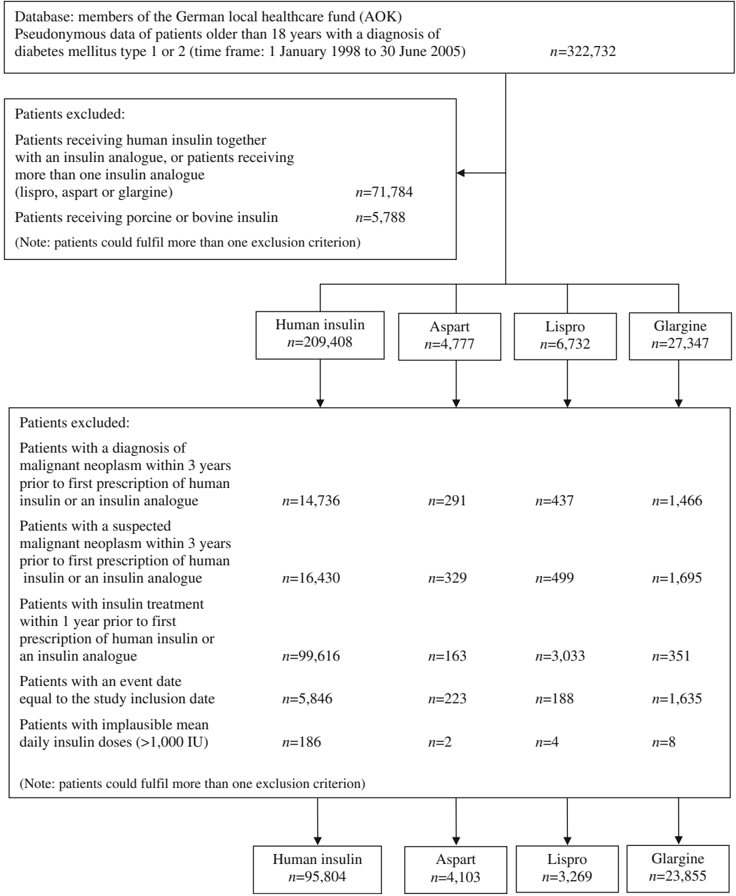
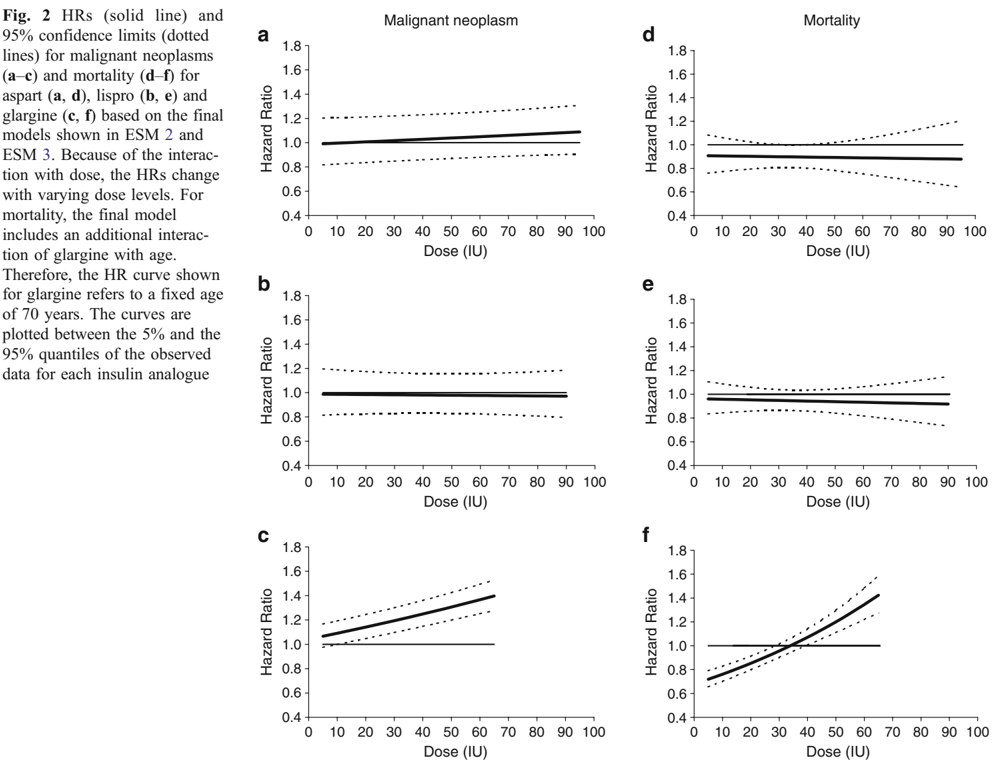
AIMS/HYPOTHESIS: The aim of this cohort study was to investigate the risk of malignant neoplasms and mortality in patients with diabetes treated either with human insulin or with one of three insulin analogues. METHODS: Data were provided by the largest German statutory health insurance fund (time-frame: January 1998 to June 2005 inclusive), on patients without known malignant disease who had received first-time therapy for diabetes mellitus exclusively with human insulin, aspart, lispro or glargine. The primary outcome was the diagnosis of a malignant neoplasm. Data were analysed by multiple Cox regression models adjusting for potential confounders. RESULTS: A total of 127,031 patients were included, with a mean follow-up time of 1.63 (median 1.41, maximum 4.41) years. A positive association between cancer incidence and insulin dose was found for all insulin types. Because patients receiving combined therapy with insulin analogues and human insulin were excluded, the mean daily dose was much lower for glargine than for human insulin, and a slightly lower cancer incidence in the glargine group was found. After adjusting for dose, a dose-dependent increase in cancer risk was found for treatment with glargine compared with human insulin (p < 0.0001): the adjusted HR was 1.09 (95% CI 1.00 to 1.19) for a daily dose of 10 IU, 1.19 (95% CI 1.10 to 1.30) for a daily dose of 30 IU, and 1.31 (95% CI 1.20 to 1.42) for a daily dose of 50 IU. No increased risk was found for aspart (p = 0.30) or lispro (p = 0.96) compared with human insulin. CONCLUSIONS/INTERPRETATION: Considering the overall relationship between insulin dose and cancer, and the lower dose with glargine, the cancer incidence with glargine was higher than expected compared with human insulin. Our results based on observational data support safety concerns surrounding the mitogenic properties of glargine in diabetic patients. Prospective long-term studies are needed to further evaluate the safety of insulin analogues, especially glargine.
Overview
The claims and statistics of this paper haven’t been checked yet.
Free: it reads the open-access text and checks the first 5 claims that cite a source we can check. Create a free account to check every claim.
Integrity signals
Registry
Cites
Statistics
Figures
Verification
Claims the paper makes
The claims and statistics of this paper haven’t been checked yet.
Free: it reads the open-access text and checks the first 5 claims that cite a source we can check. Create a free account to check every claim.
Claims other papers make about this one
Each is checked against this paper’s own text: does it say what the citing paper says it does?
The check wasn’t confident either way, so it gives no verdict — never disputed.
In the citing paper
“Modest survival benefits also have been reported for breast, ovarian, endometrial, prostate, lung, kidney, liver, and earlier stage pancreatic cancers.1791–1800”
From American Association of Clinical Endocrinology Clinical Practice Guideline: Developing a Diabetes Mellitus Comprehensive Care Plan-2022 Update. (2022) · cites this paper as [1799]
Experimental — accuracy not yet measured
Self-check
Percentages, sums and reported differences re-computed from the paper’s own numbers.
The self-check needs the paper’s full text.
Citations
Cites
Regression Models and Life-Tables
Cox, D. R. (1972) · Journal of the Royal Statistical Society Series B: Statistical Methodology · doi:10.1111/j.2517-6161.1972.tb00899.x · Cited by 39,793
Miller, R. G. (1981) · Cited by 3,336
Applied Survival Analysis: Regression Modeling of Time-to-Event Data
Hosmer, D. W., Lemeshow, S. A., & May, S. J. (2008) · Cited by 3,030
Adjusting for multiple testing—when and how?
Bender, R., & Lange, S. (2001) · Journal of Clinical Epidemiology · doi:10.1016/s0895-4356(00)00314-0 · Cited by 3,004 · cited 1×
“As this study was intended to generate hypotheses, we made no adjustments for multiple testing [23].”
MethodSelf-citationMetformin and reduced risk of cancer in diabetic patients
Evans, J. M. M., Donnelly, L. A., Emslie-Smith, A. M., Alessi, D. R., & Morris, A. D. (2005) · BMJ · doi:10.1136/bmj.38415.708634.f7 · Cited by 2,388 · cited 1×
“In particular, we analysed a potential influence of metformin therapy, for which potential effects on cancer incidence have been previously discussed [24].”
BackgroundSurvival Analysis: A Self-Learning Text
Carpenter, M. (1997) · Technometrics · doi:10.1080/00401706.1997.10485091 · Cited by 1,811 · cited 1×
“We checked the proportional hazard assumption graphically by plotting log(-log survival time) versus log survival time and by a formal test based on Schoenfeld residuals [ 22 ].”
MethodApplied Survival Analysis: Regression Modeling of Time‐to‐Event Data
Hosmer, D. W., Lemeshow, S., & May, S. (2008) · Wiley Series in Probability and Statistics · doi:10.1002/9780470258019 · Cited by 1,298
Type-II diabetes and pancreatic cancer: a meta-analysis of 36 studies
Huxley, R., Ansary-Moghaddam, A., Berrington de González, A., Barzi, F., & Woodward, M. (2005) · British Journal of Cancer · doi:10.1038/sj.bjc.6602619 · Cited by 1,105 · cited 1×
“53) has been calculated for endometrial cancer [6, 7].”
BackgroundDiabetes Mellitus and Risk of Colorectal Cancer: A Meta-Analysis
Larsson, S. C., Orsini, N., & Wolk, A. (2005) · JNCI: Journal of the National Cancer Institute · doi:10.1093/jnci/dji375 · Cited by 1,038 · cited 1×
“An OR of 1.82 (95% CI 1.66 to 1.89) has been reported for pancreatic cancer, and an RR of 2.10 (95% CI 1.75 to 2.53) has been calculated for endometrial cancer [6, 7 ]. Similar results have been reported for other cancer entities.”
ResultInfluentialDiabetes mellitus and risk of breast cancer: A meta‐analysis
Larsson, S. C., Mantzoros, C. S., & Wolk, A. (2007) · International Journal of Cancer · doi:10.1002/ijc.22717 · Cited by 875 · cited 1×
“28) for breast cancer [3–5].”
Cited by
Items 401–500 of 616
Insulin receptor membrane retention by a traceable chimeric mutant
Giudice, J., Jares-Erijman, E. A., & Leskow, F. C. (2013) · Cell Communication and Signaling · doi:10.1186/1478-811x-11-45 · Cited by 7
“Furthermore, their cancer risk may be modified by different treatments [20,21] and modified insulin analogues with distinct receptor-binding characteristics showed different mitogenic potencies in cell lines and”
BackgroundGenome-Wide Analyses Identify Filamin-A As a Novel Downstream Target for Insulin and IGF1 Action
Aizen, D., Pasmanik‐Chor, M., Sarfstein, R., Laron, Z., Bruchim, I., & Werner, H. (2018) · Frontiers in Endocrinology · doi:10.3389/fendo.2018.00105 · Cited by 8
Sheng, X., Yao, K., Shao, A., Tu, S., Zhang, X., Chen, T., & Yao, D. (2019) · Frontiers in Endocrinology · doi:10.3389/fendo.2019.00594 · Cited by 7
Lindauer, K., Bartels, T., Scherer, P., & Kabiri, M. (2019) · Toxicologic Pathology · doi:10.1177/0192623319863129 · Cited by 7
Pretta, A., Ziranu, P., Puzzoni, M., Lai, E., Orsi, G., Liscia, N., Molinaro, E., Mariani, S., Riggi, L., Rovesti, G., et al. (2020) · Tumori Journal · doi:10.1177/0300891620976945 · Cited by 7
Impaired glucose metabolism treatment and carcinogenesis
Matyszewski, A., Czarnecka, A. M., Kawecki, M., KORZEŃ, P., SAFIR, I. J., Kukwa, W., & Szczylik, C. A. (2015) · Oncology Letters · doi:10.3892/ol.2015.3324 · Cited by 7
“However, concerning findings were reported from a German retrospective analysis of >127,000 patients (23).”
Dankner, R. S., Balicer, R. D., Boffetta, P., Keinan‐Boker, L., Wallenstein, S. R., Freedman, L. S., Goldfracht, M., Roth, J., Tamler, R., & LeRoith, D. (2012) · BMC Cancer · doi:10.1186/1471-2407-12-364 · Cited by 8
“insulin glargine [8-10], though their methodologies have been seriously challenged [11-14].”
BackgroundValentine, W. J., Curtis, B., Pollock, R. F., Brunt, K. V., Paczkowski, R., Brändle, M., Boye, K. S., & Kendall, D. M. (2015) · Diabetes Research and Clinical Practice · doi:10.1016/j.diabres.2015.04.023 · Cited by 7
“[25–30].”
Hvid, H., Jørgensen, M. S., Blume, N., Slaaby, R., Lützen, A., & Hansen, B. F. (2018) · Diabetologia · doi:10.1007/s00125-018-4684-1 · Cited by 7
Type 2 Diabetes Pharmacoepidemiology Update 2014: Safety Versus Efficacy
Singh, S. (2014) · Current Diabetes Reports · doi:10.1007/s11892-014-0563-4 · Cited by 9
Diabetes therapy and cancer risk: Where do we stand when treating patients?
Sun, G. E. C., Kashyap, S. R., & Nasr, C. E. (2014) · Cleveland Clinic Journal of Medicine · doi:10.3949/ccjm.81a.13140 · Cited by 6
Ghosh, M., Mandal, S., Paul, S., Chakrabarty, S., Roy, A., Chakrabarti, G., & Pradhan, S. K. (2023) · Journal of Drug Delivery Science and Technology · doi:10.1016/j.jddst.2023.104781 · Cited by 6
Ng, E. S. W., Klungel, O. H., Groenwold, R. H. H., & van Staa, T. P. (2015) · Pharmaceutical Statistics · doi:10.1002/pst.1697 · Cited by 7
“In 2009, a major safety alert of insulin glargine was raised by a large German cohort study in which users were found to have increased cancer risks [20].”
BackgroundInsulin therapy: Side effects and their management
Kashi, Z., Akha, O., Borzouei, S., & Bahar, A. (2013) · Clinical Excellence · Cited by 10
Elkin, P. L., Mullin, S., Tetewsky, S. J., Resendez, S. D., McCray, W., Barbi, J. J., & Yendamuri, S. (2022) · Journal of Thoracic and Cardiovascular Surgery · doi:10.1016/j.jtcvs.2022.02.046 · Cited by 6
Lucidi, P., Porcellati, F., Yki‐Järvinen, H., Riddle, M. C., Candeloro, P., Andreoli, A. M., Bolli, G. B., & Fanelli, C. G. (2015) · Diabetes Care · doi:10.2337/dc14-2662 · Cited by 6
“Unmodified insulin glargine has been suggested to confer a higher risk of cancer (3), but prior studies have shown that, at usual doses, an activemetabolite”
BackgroundTreatment options for paediatric diabetes
Verrotti, A., Chiuri, R. M., Blasetti, A., Mohn, A., & Chiarelli, F. (2010) · Expert Opinion on Pharmacotherapy · doi:10.1517/14656566.2010.506479 · Cited by 6
“Some authors [33,34] found that patients using glargine alone had a double risk of breast cancer compared with patients who used other type of insulins.”
BackgroundEdwards, K. L., Riche, D. M., Stroup, J. S., Goldman, J. D., Vellurattil, R. P., Cross, L. B., & Kane, M. P. (2010) · Pharmacotherapy The Journal of Human Pharmacology and Drug Therapy · doi:10.1592/phco.30.9.955 · Cited by 7
“Insulin glargine is an insulin analog that was recently reported in an epidemiologic study to increase cancer risk.(5) To confirm these results, the European Association for the Study of Diabetes”
BackgroundMethodInfluentialAnalogues et dosages d’insuline : le cas général et le cas particulier de la glargine
Agin, A., & Sapin, R. (2010) · Médecine Nucléaire · doi:10.1016/j.mednuc.2010.07.014 · Cited by 6
Biasing Receptor Tyrosine Kinase Signaling Pathways
Watson, J., Arey, B. J., & Alt, A. J. (2014) · Elsevier eBooks · doi:10.1016/b978-0-12-411460-9.00005-7 · Cited by 9
Dual Effect Exhibited by Insulin in Myeloma and Lymphoblastoid Cells
(2021) · Biointerface Research in Applied Chemistry · doi:10.33263/briac123.27152728 · Cited by 6
“In addition, there is also evidence that in patients with type 2 diabetes (T2DM), hypoglycemic therapy using INS and sulfonylureas, as well as INS analogs, increases the risk of malignancy [8,9].”
Análogos de insulina: modificaciones en la estructura, consecuencias moleculares y metabólicas
de Luis, D. A., & Romero, E. (2012) · Medicina de Familia SEMERGEN · doi:10.1016/j.semerg.2012.04.010 · Cited by 14
de Miguel-Yanes, J. M., & Meigs, J. B. (2009) · The Oncologist · doi:10.1634/theoncologist.2009-0278 · Cited by 6
“Hemkens et al.[ 1 ] calculated that a randomized, controlled trial would require about 7,500 patients, according to a crude sample size estimation based on the findings of their study (risk for malignant neoplasms of approximately 5% over 20 months, with a relative risk of 1.3 and a statistical power of 80%) [8].”
BackgroundMethodInfluentialGijo, T. (2015) · The University of Queensland · doi:10.14264/uql.2015.463 · Cited by 6
Ilie, I. R. P., Vonica-Țincu, A. L., Dobrea, C. M., Butucă, A., Frum, A., Morgovan, C., Gligor, F. G., & Ghibu, S. (2024) · Biomedicines · doi:10.3390/biomedicines12102273 · Cited by 5
“Still, some studies suggest a positive association between insulin dose and the risk of malignant neoplasms in diabetes patients; this applies to both human insulin and insulin analogs [71].”
BackgroundObesity, type 2 diabetes and cancers of the digestive system
Cernea, S., Crișan, D., Lăcătușu, C.-M., Zaharia, O., & Gancheva, S. (2026) · Seminars in Cancer Biology · doi:10.1016/j.semcancer.2026.02.003 · Cited by 5
From diabetes to tumor growth: unravelling the impact of glucose-lowering therapies
Modica, R., Liccardi, A., Zamponi, V., Gagliardi, A., Nistor, A., Veroi, G., Arecco, A., Faggiano, A., & Colao, A. (2026) · Endocrine · doi:10.1007/s12020-026-04644-1 · Cited by 5
“…a possible dose-dependent association between insulin glargine and cancer—particu-larly breast cancer but these findings were highly sensitive to statistical adjustment and lacked detailed information on key confounders such as obesity, diabetes duration, and concurrent therapies [146, 147 ].”
Optimizing treatment strategies with insulin glargine in Type 2 diabetes
Owens, D. R. (2012) · Expert Review of Endocrinology & Metabolism · doi:10.1586/eem.12.29 · Cited by 5
Kalra, S. (2017) · Diabetes Therapy · doi:10.1007/s13300-017-0235-x · Cited by 5
Préparations insuliniques au cours de la dernière décennie.
Monnier, L., & Colette, C. (2018) · Médecine des Maladies Métaboliques · doi:10.1016/s1957-2557(18)30034-8 · Cited by 5
Sund, R., & Gissler, M. (2022) · Springer eBooks · doi:10.1007/978-1-4614-6625-3_5-1 · Cited by 6
Juárez-Vázquez, C. I., Gurrola‐Díaz, C. M., Vargas‐Guerrero, B., Domínguez-Rosales, J. A., Rodríguez-Ortiz, J. F., Barros‐Núñez, P., Flores-Martínez, S. E., Sánchez‐Corona, J., & Reynoso, M. A. R. (2018) · PubMed Central · doi:10.22038/ijbms.2018.24867.6185 · Cited by 6
“On the other hand, now it is known that insulin affects the cellular proliferation and differentiation (4), and through epidemiological analysis a consistent association of some insulin analogs with an increased risk of cancer has been demonstrated (5-14).”
BackgroundAntitumor Effects and Mechanisms of Metabolic Syndrome Medications on Hepatocellular Carcinoma
Oura, K., Morishita, A., Tani, J., & Masaki, T. (2022) · Journal of Hepatocellular Carcinoma · doi:10.2147/jhc.s392051 · Cited by 6
Kumar, S. (2020) · Current Research in Diabetes & Obesity Journal · doi:10.19080/crdoj.2020.13.555868 · Cited by 8
(Ultra-)long-acting insulin analogues for people with type 1 diabetes mellitus
Hemmingsen, B., Richter, B., & Metzendorf, M. (2019) · Cochrane Database of Systematic Reviews · doi:10.1002/14651858.cd013498 · Cited by 5
Kwak, S., Forbes, B. E., Lee, Y., Belgi, A., Wade, J. D., & Hossain, M. A. (2010) · International Journal of Peptide Research and Therapeutics · doi:10.1007/s10989-010-9218-8 · Cited by 5
“However, a recent German study of around 127,000 insulin-treated patients from an insurance database, suggested a possible link between insulin glargine and increased risk of developing cancer (Hemkens et al. 2009).”
BackgroundIndia suspends pioglitazone: Is it justified?
SADIKOT, S. M., & Ghosal, S. (2014) · Diabetes & Metabolic Syndrome Clinical Research & Reviews · doi:10.1016/j.dsx.2013.10.020 · Cited by 6
Bloomgarden, Z. T. (2011) · Diabetes Care · doi:10.2337/dc11-0591 · Cited by 5
“(17) identified 127,031 patients exposed for an average of 1.”
BackgroundBartels, T., Wäse, K., Heinrichs, M., Stolte, M., Roome, N. O., Scherer, P., & Lindauer, K. (2016) · Toxicologic Pathology · doi:10.1177/0192623316665721 · Cited by 5
“…suggesting a carcinogenic potential of insulin analogues, in particular insulin glargine (Colhoun et al. 2009; Currie, Poole, and Gale 2009; Hemkens et al. 2009; Jonasson et al. 2009; Rosenstock et al. 2009; Du et al. 2012; Ruiter et al. 2012) accompanied by an editorial (Johnson and Gale,…”
BackgroundThe insulin glargine dilemma: an opportunity for the diabetes community?
Stümvoll, M., & Nawroth, P. P. (2009) · Diabetologia · doi:10.1007/s00125-009-1490-9 · Cited by 5
“[1] receives more attention than it might otherwise deserve.”
BackgroundSubcutaneous rapid-acting insulin analogues for diabetic ketoacidosis
Andrade-Castellanos, C. A., Colunga‐Lozano, L. E., Delgado-Figueroa, N., & González‐Padilla, D. A. (2014) · Cochrane Database of Systematic Reviews · doi:10.1002/14651858.cd011281 · Cited by 5
Cancer risks of anti-hyperglycemic drugs for type 2 diabetes treatment – a clinical appraisal
Vora, J. P., Ray, K. K., Kosiborod, M., Poulter, N. R., Rajagopalan, S., & Leiter, L. A. (2017) · Journal of Diabetes and its Complications · doi:10.1016/j.jdiacomp.2017.06.003 · Cited by 4
Malignancy incidences by glycemic control among diabetic patients
Kobayashi, D., Kuriyama, N., Hirano, K., Takahashi, O., & Noto, H. (2018) · Endocrine Connections · doi:10.1530/ec-18-0355 · Cited by 4
Basal insulin analogues--a review of recent data on efficacy and safety.
John, M. (2011) · PubMed · Cited by 6
Diabetes medications and cancer: A way out of uncertainty
Gallo, M., Esposito, K., & Giugliano, D. (2012) · Diabetes Research and Clinical Practice · doi:10.1016/j.diabres.2012.04.007 · Cited by 4
Insulin analogues display atypical differentiative activities in skin keratinocytes
Zemler, R. S., Weingarten, G., Sarfstein, R., Laron, Z., Werner, H., & Wertheimer, E. (2015) · Archives of Physiology and Biochemistry · doi:10.3109/13813455.2014.1001856 · Cited by 4
“Epidemiological studies performed in recent years have shown an increased risk of cancer in diabetes patients treated with certain long-acting insulin analogues compared with patients injecting regular insulin (Hemkens et al., 2009; Jonasson et al., 2009; Ruiter et al., 2012).”
BackgroundLong-acting Insulin Analogues and Diabetic Retinopathy: A Retrospective Cohort Study
Lin, J.-C., Shau, W., & Lai, M. (2014) · Clinical Therapeutics · doi:10.1016/j.clinthera.2014.06.031 · Cited by 4
Bradley, M. C., Chillarige, Y., Lee, H., Wu, X., Parulekar, S., Wernecke, M., Bright, P. L., Soukup, M., MaCurdy, T. E., Kelman, J. A., et al. (2020) · Diabetes Care · doi:10.2337/dc19-0614 · Cited by 5
Si l'ère des insulines semi-synthétiques et biosynthétiques nous était contée
Monnier, L., Colette, C., & Owens, D. R. (2021) · Médecine des Maladies Métaboliques · doi:10.1016/s1957-2557(21)00178-4 · Cited by 5
Insulin, Insulin Resistance, and Cancer Associations
Lipscombe, L. L. (2011) · Energy balance and cancer · doi:10.1007/978-1-4419-9911-5_5 · Cited by 4
“More recently there has been concern regarding higher cancel risk with long-acting insulins, and in particular insulin glargine [83–87], which has higher insulin receptor binding affinity compared to other insulins [88].”
BackgroundCancer mortality and insulin glargine
Bloomgarden, Z. T., & Handelsman, Y. (2009) · Journal of Diabetes · doi:10.1111/j.1753-0407.2009.00038.x · Cited by 4
Diabetes drugs and the incidence of solid cancers: a survey of the current evidence
Tuccori, M., Convertino, I., Galiulo, M. T., Marino, A., Capogrosso-Sansone, A., & Blandizzi, C. (2017) · Expert Opinion on Drug Safety · doi:10.1080/14740338.2017.1361401 · Cited by 5
Potential Mechanisms Linking Insulin to Cancer
Babichev, Y., Khalid, S., & Fantus, I. G. (2011) · Energy balance and cancer · doi:10.1007/978-1-4419-9911-5_7 · Cited by 4
“In one report from Germany, the use of insulin glargine, one of the two new long acting, “24 h,” insulin analogues, was associated with an increased risk of cancer compared with the use of human insulin [ 58 ].”
BackgroundDualities of interest are not restricted to financial ties to the pharmaceutical industry
Nauck, M. A. (2009) · Diabetologia · doi:10.1007/s00125-009-1603-5 · Cited by 4
“[1] on the risk of malignancy in patients treated with insulin glargine (A21Gly,B31Arg,B32Arg human insulin), published in Diabetologia, received wide attention among physicians, scientists and public media.”
BackgroundInfluentialBadrick, E., Buchan, I. E., & Renehan, A. G. (2012) · Diabetes Care · doi:10.2337/dc11-1901 · Cited by 4
Nguyen, H. P., Sheng, R. R., Murray, E., Ito, Y., Brück, M., Biellak, C., An, K., Lynce, F. C., Dillon, D. A. R., Magbanua, M. J. M., et al. (2023) · bioRxiv (Cold Spring Harbor Laboratory) · doi:10.1101/2023.03.28.534564 · Cited by 4
Kubo, H., Ohgi, K., Otsuka, S., Okawa, Y., Ashida, R., Yamada, M., Kato, Y., Dei, H., Uesaka, K., Notsu, A., et al. (2025) · Annals of Surgery Open · doi:10.1097/as9.0000000000000597 · Cited by 3
“Third, this study did not consider treatments for DM. Insulin has been reported to potentially increase cancer risk, 41 whereas metformin is associated with reduced cancer risk and favorable outcomes.”
Metabolic dysregulation: Its role in diabetes mellitus and cancers
Dai, S., Li, J., Xia, J., Liu, Y., & Li, Y. (2026) · Molecular Aspects of Medicine · doi:10.1016/j.mam.2026.101461 · Cited by 4
The Link Between Diabetes and Cancer: Converging Mechanistic and Epidemiologic Evidence
Lipscombe, L. L., Ali, S., & Lega, I. C. (2026) · Diabetes · doi:10.2337/dbi26-0003 · Cited by 4
Antidiabetikus kezelés, mint újabb lehetőség a daganatok komplex terápiájában
Bánhegyi, R. J., Rus-Gal, P. O., Nagy, Á. K., Martyin, T., Wagner, R. J., Varga, R., & Pikó, B. (2010) · Magyar Onkológia · doi:10.1556/monkol.54.2010.4.5 · Cited by 7
Bešič, N., & Šatej, N. (2013) · BMC Research Notes · doi:10.1186/1756-0500-6-416 · Cited by 3
“Recent epidemiological studies have suggested that some insulin analogues could be associated with an increased risk of cancer [5].”
InfluentialChanneling postmarketing patient data into pharmaceutical regulatory systems
Barbosa, M. D. F. S., & Smith, D. D. (2014) · Drug Discovery Today · doi:10.1016/j.drudis.2014.07.011 · Cited by 3
Co-Managing Patients with Type 1 Diabetes and Cancer
Best, C. J., Thosani, S., Ortiz, M. R., Levesque, C. A., Varghese, S. S., & Lavis, V. R. (2016) · Current Diabetes Reports · doi:10.1007/s11892-016-0766-y · Cited by 6
Insulin, other hypoglycemic drugs, and glucagon
Page, R. C. L. (2011) · Side effects of drugs annual · doi:10.1016/b978-0-444-53741-6.00042-8 · Cited by 4
Cander, S., Gül, Ö. Ö., Dizdar, O. S., Koca, N., Aydın, T., Sarandöl, E., & Ersoy, C. (2017) · Metabolic Syndrome and Related Disorders · doi:10.1089/met.2017.0005 · Cited by 3
“…recent epidemiological studies have suggested that use of insulin glargine (A21Gly, B31Arg, B32Arg human insulin) affects cancer occurrence risk, 13–16 but the U.S. Food and Drug Administration indicated the inadequacies of presented data, study design, and data analysis, which did not have…”
Update on Treatment of Type 1 Diabetes in Childhood
Ludvigsson, J. (2013) · Current Pediatrics Reports · doi:10.1007/s40124-013-0012-x · Cited by 4
Thiazolidinediones/insulin use and cancer risk: Insights from the recent meta-analyses
Simon, D. (2013) · Diabetes & Metabolism · doi:10.1016/j.diabet.2013.01.001 · Cited by 3
Chao, D. T., Shah, N. H., Zeh, H. J., Bahary, N., Whitcomb, D. C., & Brand, R. E. (2015) · Pancreas · doi:10.1097/mpa.0000000000000439 · Cited by 2
“Prior studies have suggested different forms of insulin, and insulin analogs vary in their potential carcinogenicity.(48) The risk of PC among insulin users may also be confounded by clinical (eg, obesity) and subclinical factors, including IGF-gene axis polymorphisms(49) and epidermal growth factor receptors.”
BackgroundRole of insulin in management of type 2 diabetes mellitus
Patil, S. S., Mehta, M., Thakare, V., Shende, S. S., Shirure, P. A., & Swami, O. C. (2017) · International Journal of Research in Medical Sciences · doi:10.18203/2320-6012.ijrms20172422 · Cited by 3
The risk of cancer among insulin glargine users in Lithuania: A retrospective population-based study
Jonušas, J., Drevinskaitė, M., Linkevičiūtė-Ulinskienė, D., Ladukas, A., Patašius, A., Zabulienė, L., & Smailytė, G. (2024) · Open Medicine · doi:10.1515/med-2024-1017 · Cited by 2
“Lastly, our dataset lacks information on the doses of insulin glargine used by patients, which could be a signi fi - cant factor in cancer risk as suggested by Hemkens et al. [17].”
BackgroundInsulin, other hypoglycemic drugs, and glucagon
Page, R. C. (2010) · Side effects of drugs annual · doi:10.1016/s0378-6080(10)32042-3 · Cited by 2
Influence of metformin therapy on breast cancer incidence and prognosis
Popovic, Ð., POPOVIC, L. S., Stokić, E., Tomić-Naglić, D., Mitrović, M., & Kovačev-Zavišić, B. (2012) · Archive of oncology · doi:10.2298/aoo1204062p · Cited by 3
Current european regulatory perspectives on insulin analogues
Enzmann, H. G., & Weise, M. (2011) · Diabetology & Metabolic Syndrome · doi:10.1186/1758-5996-3-14 · Cited by 2
“increased incidence of overall cancer [12], or breast cancer [13] in patients treated with an IA, while other clinical studies failed to find an increase in cancer [14] or the authors concluded that the observed increase in breast cancer reflected allocation bias rather than an effect of insulin glargine [15].”
ResultCarcinogenicity of Biopharmaceuticals
Dempster, M., Siezen, K., ter Braak, B., van den Brink, W., Emerenciana, A., Bellanti, F., Duijnhoven, R. G., Kwa, M., & van der Laan, J. W. (2015) · Springer eBooks · doi:10.1007/978-3-319-22084-0_8 · Cited by 2
The Biology of the Deadly Love Connection Between Obesity, Diabetes, and Breast Cancer
Bao, B., Oraha, A., Ahmad, A., Ali, S. S., Li, Y., Azmi, A. S., Banerjee, S., & Sarkar, F. H. (2012) · Springer eBooks · doi:10.1007/978-1-4614-5647-6_7 · Cited by 2
“shown to have an increased risk for the development of cancers including breast cancer [38, 72, 73, 132].”
BackgroundKASE, N. G. (2013) · Cambridge University Press eBooks · doi:10.1017/cbo9781139003254.021 · Cited by 2
Critical appraisal of the recent data published on the link between insulin and cancer
Ghosal, S., Stephens, J., Deventer, A. V., Mital, V., Jayasinghe, P., Khan, M. A., Setch, L., & Pauly, B. (2011) · Diabetes & Metabolic Syndrome Clinical Research & Reviews · doi:10.1016/j.dsx.2012.03.004 · Cited by 2
Chronic Hepatitis C and Insulin Resistance
Chung, W. J. (2012) · Korean Journal of Gastroenterology · doi:10.4166/kjg.2012.59.4.268 · Cited by 2
The importance of glycemic load of the diet in the development of cancer
Dudziak, K., & Regulska−Ilow, B. (2013) · Postępy Higieny i Medycyny Doświadczalnej · doi:10.5604/17322693.1050032 · Cited by 2
Menéndez, S. A. (2010) · Atención Primaria · doi:10.1016/s0212-6567(10)70005-6 · Cited by 5
Faillie, J., & Bringer, J. (2014) · Médecine des Maladies Métaboliques · doi:10.1016/s1957-2557(14)70833-8 · Cited by 2
A common fallacy of observational medication studies in diabetes
Home, P. D. (2014) · Diabetes Obesity and Metabolism · doi:10.1111/dom.12421 · Cited by 2
“The present study cannot distinguish the hypotheses summarized as: (1) high-dose insulin therapy may lead to increase in cardiovascular risk; (2) increased cardiovascular risk is associated with factors which predispose to prescription of high insulin doses; (3) cardiovascular risk and use of high doses of insulin are…”
ResultA Salutary Tale-Glargine insulin and cancer risk.
Boyle, P. (2009) · PubMed Central · doi:10.3332/ecancer.209.ed5 · Cited by 2
Therapeutics in pediatric diabetes: Insulin and non-insulin approaches
Kim, J., Kim, S. M., Nguyen, H. C. T., & REDONDO, M. J. (2011) · Pharmacological Research · doi:10.1016/j.phrs.2011.08.011 · Cited by 2
Emerging Link between Diabetes and Cancer
Noto, H., Goto, A., Tsujimoto, T., & Noda, M. (2015) · Journal of General and Family Medicine · doi:10.14442/jgfm.16.3_170 · Cited by 2
Park, J., & Yoon, K. (2021) · Stroke revisited · doi:10.1007/978-981-16-5123-6_10 · Cited by 3
de Souza, A. L. C., Acúrcio, F. D. A., Guerra, A. A., do Nascimento, R. C. R. M., Godman, B., & Diniz, L. M. (2014) · Applied Health Economics and Health Policy · doi:10.1007/s40258-014-0113-x · Cited by 2
Insulin, insulin analogues and cancer: no cause for panic
Thomson, G. (2010) · International Journal of Clinical Practice · doi:10.1111/j.1742-1241.2010.02365.x · Cited by 2
New clinical data with metformin therapy in patients with diabetes mellitus
Jermendy, G. (2010) · Orvosi Hetilap · doi:10.1556/oh.2010.29005 · Cited by 3
Monnier, L., & Colette, C. (2011) · Médecine des Maladies Métaboliques · doi:10.1016/s1957-2557(11)70278-4 · Cited by 1
Traitements hypoglycémiants et cancer
Simon, D. (2011) · Médecine des Maladies Métaboliques · doi:10.1016/s1957-2557(11)70185-7 · Cited by 1
Insulin Analogues: Reviewing the Pros and Cons in Managing Diabetes Mellitus
Russell, A. W., Prins, J. B., & Martin, J. H. (2011) · Journal of Pharmacogenomics & Pharmacoproteomics · doi:10.4172/2153-0645.1000106 · Cited by 2
“Further dose-adjusted observational human studies from Germany [25] and Scotland [26] have supported these findings, but not a database review from the United Kingdom [27] nor other manuscripts [19,28,29].”
ResultBeeinflussen Diabetestherapien das Krebsrisiko?
Nagel, J. M. (2012) · Der Diabetologe · doi:10.1007/s11428-012-0865-6 · Cited by 1
Pleyer, L., Kappacher, A., Rosenlechner, S., & Greil, R. (2010) · Springer eBooks · doi:10.1007/978-3-642-01332-4_17 · Cited by 1
Göke, B., de Heer, J., Nagel, J. M., & Göke, R. (2014) · Der Diabetologe · doi:10.1007/s11428-014-1207-7 · Cited by 1
Traitement du diabète et cancer : enquête à propos de deux controverses
Simon, D. (2014) · Médecine des Maladies Métaboliques · doi:10.1016/s1957-2557(14)70834-x · Cited by 1
Therapy of diabetes mellitus and the risk of malignization
Smirnova, O. M., & Иванникова, Е. В. (2012) · Problems of Endocrinology · doi:10.14341/probl201258252-57 · Cited by 1
“[32] при сравнении разных типов инсулина у больных СД2 получили результаты, свидетельствующие об увеличении риска малигнизации при применении инсулина гларгин.”
Kajüter, H., Geier, A., Wellmann, I., Krieg, V., Fricke, R., Heidinger, O., & Hense, H. (2014) · Bundesgesundheitsblatt - Gesundheitsforschung - Gesundheitsschutz · Cited by 1
Supramolecular assembly of Cp1-11 peptide and insulin for rapid-acting formulation
Wang, W., Li, S., Zhao, Z., Zhou, A., Liu, Y., Chen, Y., Lin, M. C., Chen, G., Ding, C., & Li, J. (2017) · Journal of Bioresources and Bioproducts · doi:10.21967/jbb.v2i3.150 · Cited by 1
“However, the strategy of insulin analogues may also have some serious disadvantages, such as increasing cancer risk.(23-26) Thus, we are interested in developing new strategies to prepare rapid-acting insulin formulation by the supramolecular method, as it can release monomeric insulin instead of insulin analogues to…”
BackgroundNoto, H. (2017) · Springer eBooks · doi:10.1007/978-981-10-4376-5_9 · Cited by 1
Metadata
- Authors
- Hemkens, L. G., Grouven, U., Bender, R., Günster, C., Gutschmidt, S., Selke, G. W., & Sawicki, P. T.
- Affiliations
- Institute for Quality and Efficiency in Health Care (DE)
- University of Cologne (DE)
- Wissenschaftliches Institut der AOK (DE)
- Corresponding author
- Hemkens, L. G.
- Venue
- Diabetologia
- Published
- 2009-06-30
- Volume
- 52
- Issue
- 9
- Pages
- 1732-1744
- ISSN
- 0012-186X (ISSN-L)
- 1432-0428
- PMC
- PMC2723679
- OpenAlex
- W2108747912
- Cited by
- 607
- References
- 28
- Citations by year
- 2026: 11 · 2025: 4 · 2024: 13 · 2023: 8 · 2022: 9 · 2021: 9 · 2020: 22 · 2019: 18 · 2018: 27 · 2017: 26 · 2016: 21 · 2015: 41 · 2014: 50 · 2013: 66 · 2012: 64
- FWCI
- 37.75
- Type
- journal article
- Language
- en
- Open access
- hybrid
- doi.org
- Licence
- cc-by-nc
- Locations
- Diabetologia (publishedVersion, cc-by-nc)
- PubMed Central (publishedVersion)
- PubMed (publishedVersion)
- Topics
- Life Sciences › Biochemistry, Genetics and Molecular Biology › Molecular Biology › Metabolism, Diabetes, and Cancer
- Health Sciences › Medicine › Endocrinology, Diabetes and Metabolism › Diabetes Management and Research
- Health Sciences › Medicine › Dermatology › Skin Diseases and Diabetes
- Keywords
- diabetes mellitus, insulin analogues, human insulin, glargine, insulin aspart, insulin lispro, cancer risk, cancer, insulin dose, mortality, drug safety
- MeSH terms
- Insulin Glargine, Aged, Aged, 80 and over, Analysis of Variance, Diabetes Mellitus, Diabetes Mellitus, Type 1, Diabetes Mellitus, Type 2, Female, Germany, Humans, Hypoglycemic Agents, Insulin, Insulin Infusion Systems, Male, Middle Aged, Neoplasms, Regression Analysis, Reproducibility of Results, Cohort Studies, Proportional Hazards Models, Patient Selection, Diabetes Complications, Insulin, Long-Acting
About these checks
Registry, retraction, Cites and statistics results are computed, not judged, with one exception: a printed reference that no index lists is read once by a model before it counts as a citation error. Claims are extracted by a model and kept only when their quote appears verbatim in the text; each cited source is then checked, with a model’s help, for whether it says what the claim relies on. Those verdicts can be wrong — read the claim’s quote and the cited source before relying on one.
Statistics and arithmetic are recomputed, not judged.
Confidence bands are shown only for fields calibrated on our annotated test set. None is calibrated yet, so no band is shown.
What counts as a claim ›How we measure confidence ›How we check this ›
Are you an author, or do you see a problem with this page? Request a review
Data sources
Bibliographic data: Semantic Scholar, OpenAlex, Crossref.
Contains information from the Semantic Scholar Academic Graph Datasets, made available under the ODC Attribution License (ODC-BY 1.0).
Semantic Scholar’s data is described in: Kinney, R., et al. (2023). The Semantic Scholar Open Data Platform. arXiv:2301.10140.
