

Reversal of type 2 diabetes: normalisation of beta cell function in association with decreased pancreas and liver triacylglycerol
Open accessThe DOI matches its Crossref record; 52 of the 52 references it cites were found in a registry or an index.
Abstract
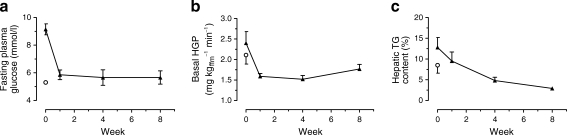
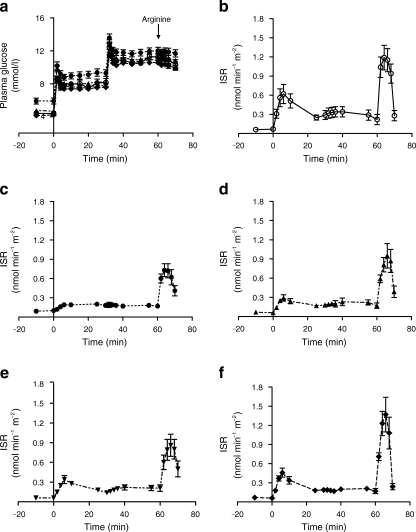
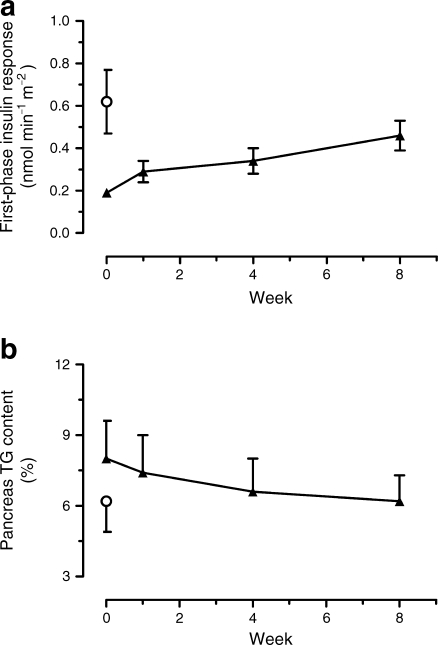
AIMS/HYPOTHESIS: Type 2 diabetes is regarded as inevitably progressive, with irreversible beta cell failure. The hypothesis was tested that both beta cell failure and insulin resistance can be reversed by dietary restriction of energy intake. METHODS: Eleven people with type 2 diabetes (49.5 ± 2.5 years, BMI 33.6 ± 1.2 kg/m(2), nine male and two female) were studied before and after 1, 4 and 8 weeks of a 2.5 MJ (600 kcal)/day diet. Basal hepatic glucose output, hepatic and peripheral insulin sensitivity and beta cell function were measured. Pancreas and liver triacylglycerol content was measured using three-point Dixon magnetic resonance imaging. An age-, sex- and weight-matched group of eight non-diabetic participants was studied. RESULTS: After 1 week of restricted energy intake, fasting plasma glucose normalised in the diabetic group (from 9.2 ± 0.4 to 5.9 ± 0.4 mmol/l; p = 0.003). Insulin suppression of hepatic glucose output improved from 43 ± 4% to 74 ± 5% (p = 0.003 vs baseline; controls 68 ± 5%). Hepatic triacylglycerol content fell from 12.8 ± 2.4% in the diabetic group to 2.9 ± 0.2% by week 8 (p = 0.003). The first-phase insulin response increased during the study period (0.19 ± 0.02 to 0.46 ± 0.07 nmol min(-1) m(-2); p < 0.001) and approached control values (0.62 ± 0.15 nmol min(-1) m(-2); p = 0.42). Maximal insulin response became supranormal at 8 weeks (1.37 ± 0.27 vs controls 1.15 ± 0.18 nmol min(-1) m(-2)). Pancreatic triacylglycerol decreased from 8.0 ± 1.6% to 6.2 ± 1.1% (p = 0.03). CONCLUSIONS/INTERPRETATION: Normalisation of both beta cell function and hepatic insulin sensitivity in type 2 diabetes was achieved by dietary energy restriction alone. This was associated with decreased pancreatic and liver triacylglycerol stores. The abnormalities underlying type 2 diabetes are reversible by reducing dietary energy intake.
Overview
The claims and statistics of this paper haven’t been checked yet.
Free: it reads the open-access text and checks the first 5 claims that cite a source we can check. Create a free account to check every claim.
Integrity signals
Registry
Cites
Statistics
Figures
Verification
Claims the paper makes
The claims and statistics of this paper haven’t been checked yet.
Free: it reads the open-access text and checks the first 5 claims that cite a source we can check. Create a free account to check every claim.
Claims other papers make about this one
Each is checked against this paper’s own text: does it say what the citing paper says it does?
The source backs part of the claim, not all of it — or backs it for a different population, condition or comparison.
In the citing paper
“Previously considered permanent and demanding life-long drug treat ment, type 2 diabetes is now recognised to be a potentially reversible consequence of excessive or abnormal accumulation of body fat (ie, the disease process of obesity). 5”
From 5-year follow-up of the randomised Diabetes Remission Clinical Trial (DiRECT) of continued support for weight loss maintenance in the UK: an extension study (2024) · cites this paper as [5]
Experimental — accuracy not yet measuredThe source backs part of the claim, not all of it — or backs it for a different population, condition or comparison.
In the citing paper
“During an intensive weight loss programme, or early after bariatric surgery, there are already significant improvements in hepatic and muscle insulin sensitivity, and pancreatic first-phase insulin secretion, with rapid loss of ectopic fat from skeletal muscle and liver [2, 3, 6].”
From Diets for weight management in adults with type 2 diabetes: an umbrella review of published meta-analyses and systematic review of trials of diets for diabetes remission (2022) · cites this paper as [6]
Experimental — accuracy not yet measuredThe source backs part of the claim, not all of it — or backs it for a different population, condition or comparison.
In the citing paper
“the twin cycle mechanism, driven by a damaging but reversible accumulation of ectopic fat within the liver and pancreas in susceptible individuals, has now been consistently observed. 6-8”
From Durability of a primary care-led weight-management intervention for remission of type 2 diabetes: 2-year results of the DiRECT open-label, cluster-randomised trial (2019) · cites this paper as [6]
Experimental — accuracy not yet measuredThe source backs part of the claim, not all of it — or backs it for a different population, condition or comparison.
In the citing paper
“Type 2 diabetes is strongly related to weight gain in adult life and accumulation of excess fat within the liver and pancreas.”
From Primary care-led weight management for remission of type 2 diabetes (DiRECT): an open-label, cluster-randomised trial (2018) · cites this paper as [4]
Experimental — accuracy not yet measuredThe cited source says what the claim attributes to it.
In the citing paper
“Although lifestyle interventions393 and weight loss394 reverse T2DM in early stages, when insulin is still secreted, T2DM patients may become dependent on anti-diabetic drugs in later stages.”
From Pancreatic regulation of glucose homeostasis. (2016) · cites this paper as [394]
9 more claims about this paper
Create a free account to see every claim other papers make about this one.
Self-check
Percentages, sums and reported differences re-computed from the paper’s own numbers.
The self-check needs the paper’s full text.
Citations
Cites
The metabolic phenotype in obesity: Fat mass, body fat distribution, and adipose tissue function
Goossens, G. H. (2017) · Obesity Facts · doi:10.1159/000471488 · Cited by 8,481
Turner, R. C., Fox, C., Matthews, McElroy, H. H., Cull, C. A., Holman, R. R., Neil, P., Hadden, D. R., Wright, D., Manley, E., et al. (1998) · The Lancet · Cited by 8,419
Glucose clamp technique: a method for quantifying insulin secretion and resistance.
DeFronzo, R. A., Tobin, J. D., & Andres, R. (1979) · American Journal of Physiology-Endocrinology and Metabolism · doi:10.1152/ajpendo.1979.237.3.e214 · Cited by 7,425 · cited 2×
“An isoglycaemic–hyperinsulinaemic clamp (insulin infusion rate 40 mU m min) was initiated at 0 min [14].”
Methodβ-Cell Deficit and Increased β-Cell Apoptosis in Humans With Type 2 Diabetes
Butler, A. E., Janson, J., Bonner-Weir, S., Ritzel, R., Rizza, R. A., & Butler, P. C. (2003) · Diabetes · doi:10.2337/diabetes.52.1.102 · Cited by 4,011 · cited 1×
“The underlying changes in beta cell function have been well described [3, 4], and beta-cell mass decreases steadily during the course of type 2 diabetes [5, 6].”
BackgroundGupta, A., & Uribarri, J. (2016) · Hormone Research in Paediatrics · doi:10.1159/000444053 · Cited by 4,006
Kahn, S. E. (2003) · Diabetologia · doi:10.1007/s00125-002-1009-0 · Cited by 2,166 · cited 1×
“The underlying changes in beta cell function have been well described [3, 4], and beta-cell mass decreases steadily during the course of type 2 diabetes [5, 6].”
BackgroundWeyer, C., Bogardus, C., Mott, D. M., & Pratley, R. E. (1999) · Journal of Clinical Investigation · doi:10.1172/jci7231 · Cited by 1,940 · cited 2×
“Absence of rapid insulin secretion in response to a rise in plasma glucose is the hallmark of type 2 diabetes [3, 21], and the decline in beta cell function determines the progression towards a need for insulin therapy [2].”
BackgroundU.K. Prospective Diabetes Study Group (1995) · Diabetes · doi:10.2337/diab.44.11.1249 · Cited by 1,923
Szczepaniak, L. S., Nurenberg, P., Leonard, D., Browning, J. D., Reingold, J. S., Grundy, S., Hobbs, H. H., & Dobbins, R. L. (2005) · American Journal of Physiology-Endocrinology and Metabolism · doi:10.1152/ajpendo.00064.2004 · Cited by 1,562 · cited 1×
“It continued to decline throughout the intervention period to reach the normal range for non-obese individuals [20] (2.”
BackgroundRubino, F., Forgione, A., Cummings, D. E., Vix, M., Gnuli, D., Mingrone, G., Castagneto, M., & Marescaux, J. (2006) · Annals of Surgery · doi:10.1097/01.sla.0000224726.61448.1b · Cited by 928 · cited 1×
“concentration follows within days of surgery, long before major weight loss has occurred, and it has become widely assumed that the protective effects of gastrointestinal surgery are mediated by altered secretion of incretin hormones [8, 9].”
BackgroundPetersen, K. F., Dufour, S., Befroy, D., Lehrke, M., Hendler, R. E., & Shulman, G. I. (2005) · Diabetes · doi:10.2337/diabetes.54.3.603 · Cited by 911 · cited 3×
“have previously reported improved liver and no significant change in muscle insulin sensitivity measured by euglycaemic hyperinsulinaemic clamps after 8 weeks of moderate energy restriction in type 2 diabetes [10].”
BackgroundCauter, E. V., Mestrez, F., Sturis, J., & Polonsky, K. S. (1992) · Diabetes · doi:10.2337/diab.41.3.368 · Cited by 890 · cited 1×
“Insulin secretion rate was calculated using a computerised program implementing a regularisation method of deconvolution [17] and using a population model of C-peptide kinetics [18].”
MethodLee, Y., Hirose, H., Ohneda, M., Johnson, J. H., McGarry, J. D., & Unger, R. H. (1994) · Proceedings of the National Academy of Sciences · doi:10.1073/pnas.91.23.10878 · Cited by 836 · cited 1×
“Prior to the onset of spontaneous diabetes in rodents, both total pancreatic fat and islet triacylglycerol content increase sharply [30, 31].”
BackgroundDose-response characteristics for effects of insulin on production and utilization of glucose in man
Rizza, R. A., Mandarino, L. J., & Gerich, J. E. (1981) · American Journal of Physiology-Endocrinology and Metabolism · doi:10.1152/ajpendo.1981.240.6.e630 · Cited by 703 · cited 1×
“Whole-body insulin sensitivity was determined during the last 30 min of the hyperinsulinaemic glucose clamp as whole-body glucose disposal corrected for glucose space and urinary loss [14, 15].”
MethodThree‐point dixon technique for true water/fat decomposition with B0 inhomogeneity correction
Glover, G. H., & Schneider, E. (1991) · Magnetic Resonance in Medicine · doi:10.1002/mrm.1910180211 · Cited by 687 · cited 1×
“The data were analysed in MATLAB (MathWorks, Cambridge, UK) to produce separate fat and water images [19].”
MethodLaferrère, B., Teixeira, J., McGinty, J., Tran, H., Egger, J. R., Colarusso, A., Kovack, B., Bawa, B., Koshy, N., Lee, H., et al. (2008) · The Journal of Clinical Endocrinology & Metabolism · doi:10.1210/jc.2007-2851 · Cited by 682 · cited 1×
“Increased glucagon-like peptide-1 secretion following bariatric surgery compared with a hypocaloric diet has been reported, but the oral glucose load used in the presence of a gastroenterostomy is likely to explain the early rapid rise in both plasma glucose and the incretin, occasionally with the symptoms of early du…”
BackgroundCauter, E. V., Mestrez, F., Sturis, J., et al. (1992) · Diabetes · doi:10.2337/diabetes.41.3.368 · Cited by 643
Rubino, F., Gagner, M., Gentileschi, P., Kini, S., Fukuyama, S., Feng, J., & Diamond, E. (2004) · Annals of Surgery · doi:10.1097/01.sla.0000133117.12646.48 · Cited by 639 · cited 1×
“However, the extent of change in incretins is modest, not always present in type 2 diabetes, and absent after gastric banding [40–43].”
BackgroundGastaldelli, A., Cusi, K., Pettiti, M., Hardies, J., Miyazaki, Y., Berria, R., Buzzigoli, E., Sironi, A. M., Cersosimo, E., Ferrannini, E., et al. (2007) · Gastroenterology · doi:10.1053/j.gastro.2007.04.068 · Cited by 629 · cited 1×
“Fasting plasma glucose concentration is determined by the rate of hepatic glucose production, and hepatic insulin sensitivity is inversely proportional to intrahepatic lipid content [13, 34–36].”
BackgroundHe, S., McPhaul, C., Li, J. Z., Garuti, R., Kinch, L., Grishin, N. V., Cohen, J. C., & Hobbs, H. H. (2010) · Journal of Biological Chemistry · doi:10.1074/jbc.m109.064501 · Cited by 610 · cited 1×
“Finally, the raised liver fat levels despite metabolic normality in some controls can be considered in the light of the recent description of the PNPLA3 gene [46].”
BackgroundKashyap, S., Belfort, R., Gastaldelli, A., Pratipanawatr, T., Berria, R., Pratipanawatr, W., Bajaj, M., Mandarino, L., DeFronzo, R., & Cusi, K. (2003) · Diabetes · doi:10.2337/diabetes.52.10.2461 · Cited by 503 · cited 1×
“Prolonged elevation of plasma fatty acids in humans decreases insulin secretion [25, 26], and it has previously been shown that there is an association between pancreatic fat content and type 2 diabetes [27–29].”
BackgroundDiacylglycerol-mediated insulin resistance
Erion, D. M., & Shulman, G. I. (2010) · Nature Medicine · doi:10.1038/nm0410-400 · Cited by 489 · cited 1×
“However, it is probable that the negative effect on beta cell function is exerted by toxic intermediaries such as diacylglycerol and ceramides, which change rapidly in response to acute metabolic changes [33], rather than by stored triacylglycerol per se, which acts as an index of fatty acid intermediary concentration.”
BackgroundSaisho, Y., Butler, A. E., Meier, J. J., Monchamp, T., Allen‐Auerbach, M., Rizza, R. A., & Butler, P. C. (2007) · Clinical Anatomy · doi:10.1002/ca.20543 · Cited by 479 · cited 1×
“Prolonged elevation of plasma fatty acids in humans decreases insulin secretion [25, 26], and it has previously been shown that there is an association between pancreatic fat content and type 2 diabetes [27–29].”
BackgroundDietary fat and carbohydrates differentially alter insulin sensitivity during caloric restriction
Kirk, E., Reeds, D. N., Finck, B. N., Mayurranjan, M. S., Patterson, B. W., & Klein, S. (2009) · Gastroenterology · doi:10.1053/j.gastro.2009.01.048 · Cited by 440 · cited 1×
“A very low energy intake has been observed to lower liver fat content in healthy obese individuals within days [38].”
BackgroundPancreatic Fat Content and β-Cell Function in Men With and Without Type 2 Diabetes
Tushuizen, M. E., Bunck, M. C., Pouwels, P. J., Bontemps, S., van Waesberghe, J. H. T., Schindhelm, R. K., Mari, A., Heine, R. J., & Diamant, M. (2007) · Diabetes Care · doi:10.2337/dc07-0326 · Cited by 400
Mechanisms of Recovery From Type 2 Diabetes After Malabsorptive Bariatric Surgery
Guidone, C., Manco, M., Valera-Mora, E., Iaconelli, A., Gniuli, D., Mari, A., Nanni, G., Castagneto, M., Calvani, M., & Mingrone, G. (2006) · Diabetes · doi:10.2337/db06-0068 · Cited by 368 · cited 1×
“This twin-cycle hypothesis was informed by observations following bariatric surgery, especially the demonstration that fasting blood glucose concentrations fell within days after biliopancreatic diversion [39].”
MethodInsulin secretion in diabetes mellitus
Pfeifer, M. A., Halter, J. B., & Porte, D. (1981) · The American Journal of Medicine · doi:10.1016/0002-9343(81)90579-9 · Cited by 367 · cited 1×
“Absence of rapid insulin secretion in response to a rise in plasma glucose is the hallmark of type 2 diabetes [3, 21], and the decline in beta cell function determines the progression towards a need for insulin therapy [2].”
BackgroundPathogenesis of type 2 diabetes: tracing the reverse route from cure to cause
Taylor, R. (2008) · Diabetologia · doi:10.1007/s00125-008-1116-7 · Cited by 352 · cited 3×
“excess lipid accumulation in the liver and pancreas [11].”
BackgroundInfluentialSelf-citationKashyap, S. R., Daud, S., Kelly, K. R., Gastaldelli, A., Win, H., Brethauer, S., Kirwan, J. P., & Schauer, P. R. (2010) · International Journal of Obesity · doi:10.1038/ijo.2009.254 · Cited by 274 · cited 1×
“concentration follows within days of surgery, long before major weight loss has occurred, and it has become widely assumed that the protective effects of gastrointestinal surgery are mediated by altered secretion of incretin hormones [8, 9].”
BackgroundTiikkainen, M., Bergholm, R., Vehkavaara, S., Rissanen, A., Häkkinen, A.-M., Tamminen, M., Teramo, K., & Yki-Järvinen, H. (2003) · Diabetes · doi:10.2337/diabetes.52.3.701 · Cited by 271 · cited 1×
“Moderate weight loss has previously been shown to be associated with a fall in intrahepatic fat content [10, 37].”
BackgroundIsbell, J. M., Tamboli, R. A., Hansen, E. N., Saliba, J., Dunn, J. P., Phillips, S. E., Marks-Shulman, P. A., & Abumrad, N. N. (2010) · Diabetes Care · doi:10.2337/dc09-2107 · Cited by 248 · cited 1×
“Little attention has been paid to the potential role of a sudden negative energy balance on glucose metabolism after bariatric surgery, although a recent small study suggested that the improvement in insulin resistance in the first week after surgery can be attributed to negative energy balance alone [44].”
BackgroundIgoillo-Esteve, M., Marselli, L., Cunha, D. A., Ladrière, L., Ortis, F., Grieco, F. A., Dotta, F., Weir, G. C., Marchetti, P., Eizirik, D. L., et al. (2010) · Diabetologia · doi:10.1007/s00125-010-1707-y · Cited by 227 · cited 1×
“It supports the accumulating information on the inhibitory effect of fatty acids on insulin secretion in vitro and in vivo [22–24] and is the first direct evidence in humans that the beta cell defect of type 2 diabetes is reversible by sustained negative energy balance.”
BackgroundCentral Role of Fatty Liver in the Pathogenesis of Insulin Resistance in Obese Adolescents
D'Adamo, E., Cali, A. M. G., Weiss, R., Santoro, N., Pierpont, B., Northrup, V., & Caprio, S. (2010) · Diabetes Care · doi:10.2337/dc10-0284 · Cited by 219 · cited 1×
“Fasting plasma glucose concentration is determined by the rate of hepatic glucose production, and hepatic insulin sensitivity is inversely proportional to intrahepatic lipid content [13, 34–36].”
BackgroundEffects of gastric bypass and gastric banding on glucose kinetics and gut hormone release
Rodieux, F., Giusti, V., D'Alessio, D. A., Suter, M., & Tappy, L. (2008) · Obesity · doi:10.1038/oby.2007.83 · Cited by 216 · cited 1×
“However, the extent of change in incretins is modest, not always present in type 2 diabetes, and absent after gastric banding [40–43].”
BackgroundAbstracts of the IDF Congress in Paris 2003
(2003) · Diabetologia · doi:10.1007/s00125-003-1190-9 · Cited by 211
Fatty acids and glucolipotoxicity in the pathogenesis of Type 2 diabetes
Cnop, M. (2008) · Biochemical Society Transactions · doi:10.1042/bst0360348 · Cited by 208 · cited 1×
“It supports the accumulating information on the inhibitory effect of fatty acids on insulin secretion in vitro and in vivo [22–24] and is the first direct evidence in humans that the beta cell defect of type 2 diabetes is reversible by sustained negative energy balance.”
BackgroundThe Control of Diabetes Mellitus (NIDDM) in the Morbidly Obese with the Greenville Gastric Bypass
PORIES, W. J., CARD, J. F., FLICKINGER, E. G., MEELHEIM, H. D., & SWANSON, M. S. (1987) · Annals of Surgery · doi:10.1097/00000658-198709000-00009 · Cited by 184 · cited 1×
“However, type 2 diabetes is clearly reversible following bariatric surgery [7].”
BackgroundInfluentialISEC: a program to calculate insulin secretion
Hovorka, R., Soons, P. A., & Young, M. A. (1996) · Computer Methods and Programs in Biomedicine · doi:10.1016/0169-2607(96)01755-5 · Cited by 177 · cited 1×
“Insulin secretion rate was calculated using a computerised program implementing a regularisation method of deconvolution [17] and using a population model of C-peptide kinetics [18].”
Methodβ-Cell Mass Dynamics and Islet Cell Plasticity in Human Type 2 Diabetes
Hanley, S. C., Austin, E., Assouline-Thomas, B., Kapeluto, J., Blaichman, J., Moosavi, M., Petropavlovskaia, M., & Rosenberg, L. (2010) · Endocrinology · doi:10.1210/en.2009-1277 · Cited by 156 · cited 1×
“The underlying changes in beta cell function have been well described [3, 4], and beta-cell mass decreases steadily during the course of type 2 diabetes [5, 6].”
BackgroundGLP-1 and Changes in Glucose Tolerance following Gastric Bypass Surgery in Morbidly Obese Subjects
Morínigo, R., Lacy, A. M., Casamitjana, R., Delgado, S., Gomis, R., & Vidal, J. (2006) · Obesity Surgery · doi:10.1381/096089206779319338 · Cited by 145 · cited 1×
“However, the extent of change in incretins is modest, not always present in type 2 diabetes, and absent after gastric banding [40–43].”
BackgroundPancreatic steatosis: harbinger of type 2 diabetes in obese rodents
Lee, Y., Lingvay, I., Szczepaniak, L. S., Ravazzola, M., Orci, L., & Unger, R. H. (2009) · International Journal of Obesity · doi:10.1038/ijo.2009.245 · Cited by 135 · cited 2×
“Animal data suggest that the two variables are linked [31].”
BackgroundInsulin resistance and whole body energy homeostasis in obese adolescents with fatty liver disease
Perseghin, G., Bonfanti, R., Magni, S., Lattuada, G., De Cobelli, F., Canu, T., Esposito, A., Scifo, P., Ntali, G., Costantino, F., et al. (2006) · American Journal of Physiology-Endocrinology and Metabolism · doi:10.1152/ajpendo.00017.2006 · Cited by 113 · cited 1×
“Fasting plasma glucose concentration is determined by the rate of hepatic glucose production, and hepatic insulin sensitivity is inversely proportional to intrahepatic lipid content [13, 34–36].”
BackgroundNielsen, O. H., Henriksen, J. E., Holst, J. J., & Beck-Nielsen, H. (1996) · Metabolism · doi:10.1016/s0026-0495(96)90204-8 · Cited by 106 · cited 1×
“[6′6′-(2)H]glucose (98% enriched; Cambridge Isotope Laboratories, Andover, MA, USA) was used to determine hepatic glucose production [12, 13], and basal rates were calculated during the last 30 min of the 150 min basal period.”
MethodKnop, F. K. (2009) · Diabetologia · doi:10.1007/s00125-009-1511-8 · Cited by 103 · cited 1×
“However, the extent of change in incretins is modest, not always present in type 2 diabetes, and absent after gastric banding [40–43].”
BackgroundNoushmehr, H., D’Amico, E., Farilla, L., Hui, H., Wawrowsky, K. A., Mlynarski, W., Doria, A., Abumrad, N. A., & Perfetti, R. (2005) · Diabetes · doi:10.2337/diabetes.54.2.472 · Cited by 99
Effect of Acute Hyperglycemia on Insulin Secretion in Humans
Toschi, E., Camastra, S., Sironi, A. M., Masoni, A., Gastaldelli, A., Mari, A., Ferrannini, E., & Natali, A. (2002) · Diabetes · doi:10.2337/diabetes.51.2007.s130 · Cited by 82 · cited 1×
“6 mmol/l above baseline) were achieved by a priming glucose dose followed by variable 20% glucose infusion [16].”
MethodRavikumar, B., Gerrard, J., Dalla Man, C., Firbank, M. J., Lane, A., English, P. T., Cobelli, C., & Taylor, R. (2008) · Diabetes · doi:10.2337/db07-1828 · Cited by 75 · cited 1×
“[6′6′-(2)H]glucose (98% enriched; Cambridge Isotope Laboratories, Andover, MA, USA) was used to determine hepatic glucose production [12, 13], and basal rates were calculated during the last 30 min of the 150 min basal period.”
MethodSelf-citationThe cytoprotective actions of long-chain mono-unsaturated fatty acids in pancreatic β-cells
Morgan, N. G., Dhayal, S., Diakogiannaki, E., & Welters, H. J. (2008) · Biochemical Society Transactions · doi:10.1042/bst0360905 · Cited by 54 · cited 1×
“In vitro, chronic saturated fatty acid exposure of beta cells inhibits the acute insulin response to glucose, and removal of fatty acids allows recovery of this response [32].”
BackgroundCarpentier, A. C., Zinman, B., Leung, N. M., Giacca, A., Hanley, A. J., Harris, S. B., Hegele, R. A., & Lewis, G. F. (2003) · Diabetes · doi:10.2337/diabetes.52.6.1485 · Cited by 41 · cited 1×
“Prolonged elevation of plasma fatty acids in humans decreases insulin secretion [ 25 , 26], and it has previously been shown that there is an association between pancreatic fat content and type 2 diabetes [27–29].”
BackgroundPancreatic Fat Content and β-Cell Function in Men With and Without Type 2 Diabetes
Saisho, Y., Butler, A. E., & Butler, P. C. (2008) · Diabetes Care · doi:10.2337/dc08-0044 · Cited by 19
Cited by
DeFronzo, R. A., Ferrannini, E., Groop, L., Henry, R. R., Herman, W. H., Holst, J. J., Hu, F. B., Kahn, C. R., Raz, I., Shulman, G. I., et al. (2015) · Nature Reviews Disease Primers · doi:10.1038/nrdp.2015.19 · Cited by 2,611
Mechanisms for Insulin Resistance: Common Threads and Missing Links
Samuel, V. T., & Shulman, G. I. (2012) · Cell · doi:10.1016/j.cell.2012.02.017 · Cited by 2,294
“But enforced dietary caloric restriction can still rapidly reduce hepatic steatosis in obese patients (Lim et al., 2011; Petersen et al., 2005).”
Lean, M. E., Leslie, W. S., Barnes, A. C., Brosnahan, N., Thom, G., McCombie, L., Peters, C., Zhyzhneuskaya, S., Al-Mrabeh, A., Hollingsworth, K. G., et al. (2018) · The Lancet · doi:10.1016/s0140-6736(17)33102-1 · Cited by 2,095
Self-citationThe pathogenesis of insulin resistance: integrating signaling pathways and substrate flux
Samuel, V. T., & Shulman, G. I. (2016) · Journal of Clinical Investigation · doi:10.1172/jci77812 · Cited by 1,484
“Proof-of-concept studies in rodent models of NALFD and T2D demonstrate that mildly increasing hepatic mitochondrial inefficiency can safely reverse hypertriglyceridemia, ectopic lipid-induced (DAG/nPKC) liver and muscle insulin resistance, steatohepatitis, liver fibrosis, and diabetes, offering a novel therapeutic tar…”
BackgroundInfluentialTimmers, S., Konings, E., Bilet, L., Houtkooper, R. H., van de Weijer, T., Goossens, G. H., Hoeks, J., van der Krieken, S., Ryu, D., Kersten, S., et al. (2011) · Cell Metabolism · doi:10.1016/j.cmet.2011.10.002 · Cited by 1,320
“, 2006), improving insulin sensitivity (Larson-Meyer et al., 2006; Lim et al., 2011), and reducing cardiovascular risk factors (Lefevre et al.”
BackgroundInfluential
Metadata
- Authors
- Lim, E. L., Hollingsworth, K. G., Aribisala, B. S., Chen, M. J., Mathers, J. C., & Taylor, R.
- Affiliations
- Newcastle University (GB)
- Corresponding author
- Taylor, R.
- Venue
- Diabetologia
- Published
- 2011-06-09
- Volume
- 54
- Issue
- 10
- Pages
- 2506-2514
- ISSN
- 0012-186X (ISSN-L)
- 1432-0428
- PMC
- PMC3168743
- OpenAlex
- W2127283831
- Cited by
- 1,164
- References
- 51
- Citations by year
- 2026: 46 · 2025: 60 · 2024: 65 · 2023: 77 · 2022: 109 · 2021: 102 · 2020: 81 · 2019: 77 · 2018: 86 · 2017: 90 · 2016: 77 · 2015: 82 · 2014: 60 · 2013: 77 · 2012: 64
- FWCI
- 68.35
- Type
- journal article
- Language
- en
- Open access
- hybrid
- doi.org
- Licence
- cc-by-nc
- Locations
- Diabetologia (publishedVersion, cc-by-nc)
- Europe PMC (PubMed Central) (publishedVersion, cc-by-nc)
- PubMed Central (publishedVersion, cc-by-nc)
- PubMed (publishedVersion)
- IRIS Research product catalog (Sapienza University of Rome) (submittedVersion)
- Edinburgh Research Explorer (University of Edinburgh) (submittedVersion, other-oa)
- Newcastle University ePrints (Newcastle Univesity) (cc-by-nc)
- Topics
- Health Sciences › Medicine › Endocrinology, Diabetes and Metabolism › Pancreatic function and diabetes
- Health Sciences › Medicine › Endocrinology, Diabetes and Metabolism › Diabetes Treatment and Management
- Health Sciences › Medicine › Endocrinology, Diabetes and Metabolism › Diabetes, Cardiovascular Risks, and Lipoproteins
- Keywords
- type 2 diabetes remission, beta-cell function, caloric restriction, dietary restriction, hepatic insulin sensitivity, hepatic glucose production, liver triacylglycerol, first-phase insulin response, insulin resistance, fasting blood glucose, pancreatic fat content, hepatic fat content, weight loss interventions
- MeSH terms
- Adult, Aged, Blood Glucose, Body Composition, Body Weight, Diabetes Mellitus, Type 2, Female, Glycated Hemoglobin, Humans, Liver, Male, Middle Aged, Pancreas, Triglycerides, Insulin-Secreting Cells
About these checks
Registry, retraction, Cites and statistics results are computed, not judged, with one exception: a printed reference that no index lists is read once by a model before it counts as a citation error. Claims are extracted by a model and kept only when their quote appears verbatim in the text; each cited source is then checked, with a model’s help, for whether it says what the claim relies on. Those verdicts can be wrong — read the claim’s quote and the cited source before relying on one.
Statistics and arithmetic are recomputed, not judged.
Confidence bands are shown only for fields calibrated on our annotated test set. None is calibrated yet, so no band is shown.
What counts as a claim ›How we measure confidence ›How we check this ›
Are you an author, or do you see a problem with this page? Request a review
Data sources
Bibliographic data: Semantic Scholar, OpenAlex, Crossref.
Contains information from the Semantic Scholar Academic Graph Datasets, made available under the ODC Attribution License (ODC-BY 1.0).
Semantic Scholar’s data is described in: Kinney, R., et al. (2023). The Semantic Scholar Open Data Platform. arXiv:2301.10140.
