

Machine learning for the prediction of sepsis: a systematic review and meta-analysis of diagnostic test accuracy
Open accessThe DOI matches its Crossref record; 69 of the 69 references it cites were found in a registry or an index; 40 of the 55 sources its claims cite were checked for support.
Abstract
PURPOSE: Early clinical recognition of sepsis can be challenging. With the advancement of machine learning, promising real-time models to predict sepsis have emerged. We assessed their performance by carrying out a systematic review and meta-analysis. METHODS: A systematic search was performed in PubMed, Embase.com and Scopus. Studies targeting sepsis, severe sepsis or septic shock in any hospital setting were eligible for inclusion. The index test was any supervised machine learning model for real-time prediction of these conditions. Quality of evidence was assessed using the Grading of Recommendations Assessment, Development and Evaluation (GRADE) methodology, with a tailored Quality Assessment of Diagnostic Accuracy Studies (QUADAS-2) checklist to evaluate risk of bias. Models with a reported area under the curve of the receiver operating characteristic (AUROC) metric were meta-analyzed to identify strongest contributors to model performance. RESULTS: After screening, a total of 28 papers were eligible for synthesis, from which 130 models were extracted. The majority of papers were developed in the intensive care unit (ICU, n = 15; 54%), followed by hospital wards (n = 7; 25%), the emergency department (ED, n = 4; 14%) and all of these settings (n = 2; 7%). For the prediction of sepsis, diagnostic test accuracy assessed by the AUROC ranged from 0.68-0.99 in the ICU, to 0.96-0.98 in-hospital and 0.87 to 0.97 in the ED. Varying sepsis definitions limit pooling of the performance across studies. Only three papers clinically implemented models with mixed results. In the multivariate analysis, temperature, lab values, and model type contributed most to model performance. CONCLUSION: This systematic review and meta-analysis show that on retrospective data, individual machine learning models can accurately predict sepsis onset ahead of time. Although they present alternatives to traditional scoring systems, between-study heterogeneity limits the assessment of pooled results. Systematic reporting and clinical implementation studies are needed to bridge the gap between bytes and bedside.
Overview
CoChat Summary
TL;DR
This systematic review and meta-analysis of 28 papers and 130 machine learning models found that models retrospectively predict sepsis with AUROC ranges of 0.68–0.99 in the ICU, 0.96–0.98 in-hospital, and 0.87–0.97 in the ED. Between-study heterogeneity, varying sepsis definitions, and scarce prospective/clinical implementation studies limit pooled assessment and evidence on patient outcomes.
Key findings
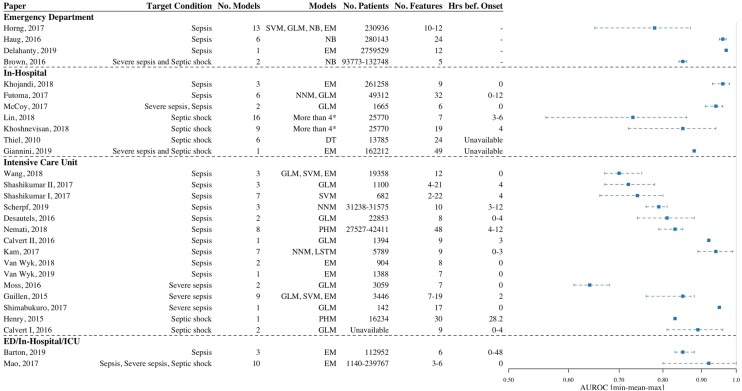
- From 28 eligible papers, 130 models were extracted; most studies were in the ICU (n = 15; 54%), followed by hospital wards (n = 7; 25%), ED (n = 4; 14%), and all settings (n = 2; 7%). Reported AUROCs for sepsis ranged from 0.68–0.99 in the ICU, 0.96–0.98 in-hospital, and 0.87–0.97 in the ED; septic shock predictions ranged from 0.86–0.94 in-hospital and 0.83–0.96 in the ICU.
- All studies reported retrospective diagnostic test accuracy; models were prospectively validated in 2 papers (7%) and clinically implemented in 3 papers (11%), with mixed results.
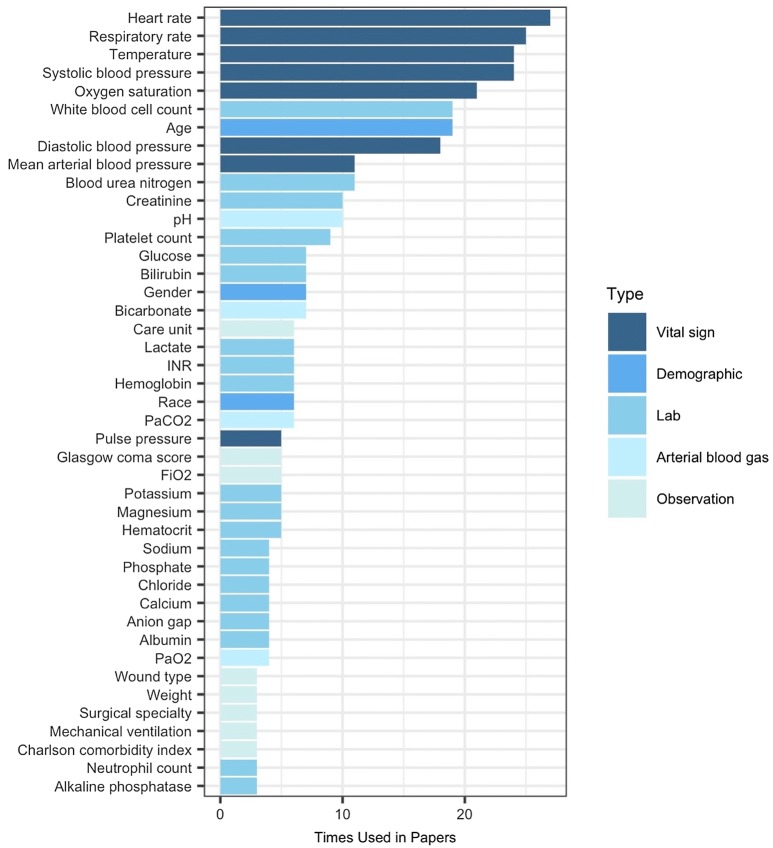
- In the meta-analysis of 111 models, temperature (multivariate coefficient 0.812, p = 0.000), lab values (0.842, p = 0.003), and model type (p = 0.020) contributed most to model performance. Univariate positive contributors included heart rate, respiratory rate, temperature, lab values, arterial blood gas values, and neural networks; negative contributors included the Seymour et al. Sepsis-3 definition, SOFA in the target condition definition, and models other than ensemble methods or neural networks.
- Risk of bias was unclear in 9/28 papers (32%) and high in all others; all papers had unclear risk of bias for the reference standard, and GRADE quality of evidence was low for each hospital setting.
Methods
- Systematic review and meta-analysis conducted per PRISMA-DTA, registered on PROSPERO (CRD42019118716). Searches were run in PubMed, Embase.com, and Scopus up to September 13, 2019, for adult patients in any hospital setting, targeting right-aligned supervised machine learning models predicting sepsis, severe sepsis, or septic shock.
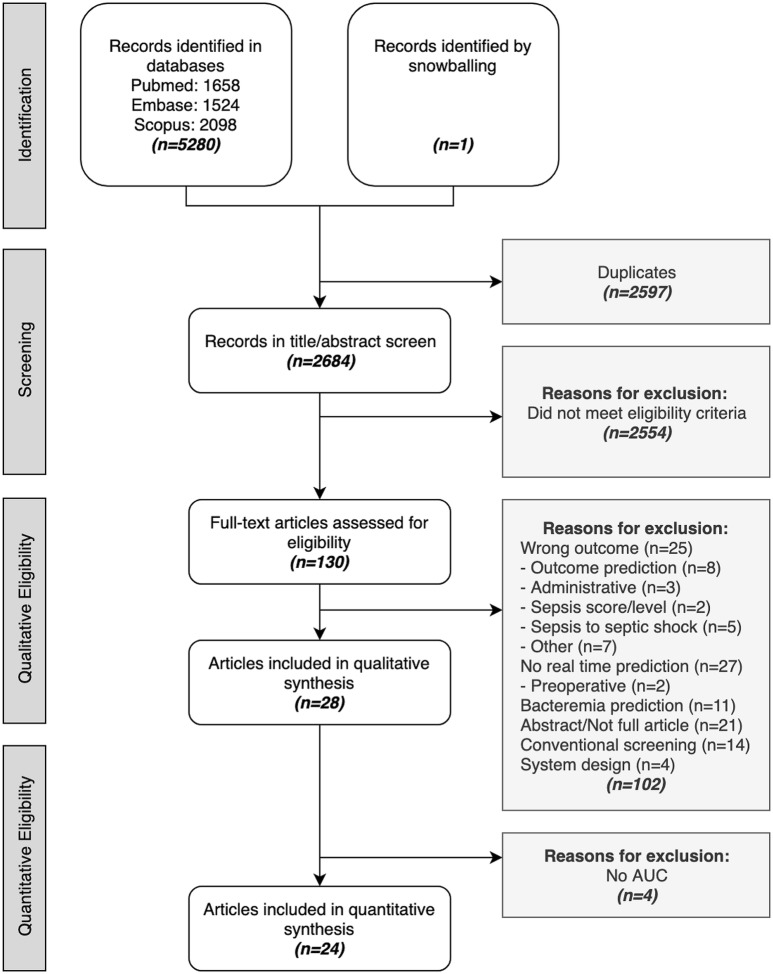
- After screening 2,684 papers, 130 full texts were read and 28 papers met inclusion criteria; 130 models were retrieved. Quality of evidence used GRADE, and risk of bias used a tailored QUADAS-2 checklist combined with an adapted Joanna Briggs Institute checklist.
- Meta-analysis used AUROC as the main metric, logit-transformed; a linear random effect model with a paper-specific random effect accounted for multiple models per paper. After grouping features and removing low-variance or collinear covariates, 39 covariates were analyzed, with backward AIC selection for the multivariate model; analyses were carried out in R.
Limitations
- Paper-stated: AUROC was chosen pragmatically and may underperform with imbalanced datasets; no contingency tables were feasible because necessary data were infrequently reported; few papers reported confidence intervals or standard deviations; heterogeneity in sepsis definitions, settings, and models prevented computing an overall pooled point estimate; there is no gold standard for diagnosing sepsis; high risk of bias and low GRADE evidence.
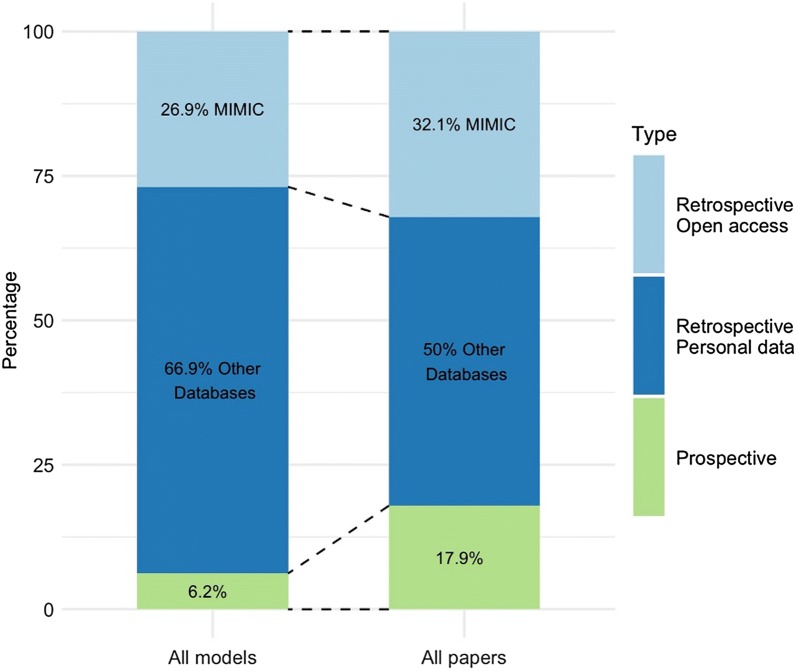
- Paper-stated: all models were developed in the United States, many used the MIMIC database, and no models were developed or validated in middle- or low-income countries; code was not released by any study, and only one paper reported adhering to a reporting standard.
- Evident from the text: only 3 interventional/implementation studies and 2 prospective validation studies were identified, so clinical impact on patient-relevant outcomes remains uncertain; the review is dominated by retrospective diagnostic accuracy studies.
Model-written summary. Check it against the paper before relying on it.
Integrity signals
Registry
Cites
Statistics
Figures
Verification
Claims the paper makes
18 Valid · 6 Not valid · 7 Not checked · 73 Own results and interpretations
The cited sources support only part of this claim — read each source’s verdict below.
In the paper
“Early clinical recognition of sepsis can be challenging.”
- Also stated in: § Introduction · plain
“early recognition can be difficult due to disease complexity in clinical context [9, 10] and heterogeneity of the septic population [11].”
§ Machine learning for the prediction of sepsis: a systematic review and meta-analysis of diagnostic test accuracy > Abstract > Purpose
What the sources say
- Supportedcites [9] Vincent J-L The clinical challenge of sepsis identification and monitoring PLoS Med 2016 13 e1002022 10.1371/journal.pmed.1002022 27187803 PMC4871479 source
The Introduction—The Clinical Problem states that early diagnosis of sepsis remains a challenge for bedside clinicians. The “Diagnosis” of Infection and Sepsis section also explains that diagnosis is not always straightforward, particularly in critically ill patients with comorbidities and other disease processes. (LLM, conf=0.94)
- Could not verifycites [10] Talisa VB Yende S Seymour CW Angus DC Arguing for adaptive clinical trials in sepsis Front Immunol 2018 9 1502 10.3389/fimmu.2018.01502 30002660 PMC6031704 sourceExperimental — accuracy not yet measured
The Introduction and “Sepsis Is Extremely Heterogeneous” section describe patient heterogeneity as a challenge for developing treatments and conducting trials, not for early clinical recognition. Searches for early recognition and diagnosis found no passage addressing whether clinicians have difficulty recognizing sepsis early. (LLM, conf=0.75)
- Could not verifycites [11] de Grooth H-J Postema J Loer SA Unexplained mortality differences between septic shock trials: a systematic analysis of population characteristics and control-group mortality rates Intensive Care Med 2018 44 311 322 10.1007/s00134-018-5134-8 29546535 PMC5861172 sourceExperimental — accuracy not yet measured
The Conclusion describes septic shock as heterogeneous, and the Discussion addresses differences in trial definitions and populations. Neither section addresses whether early clinical recognition of sepsis is challenging; searches for early recognition and diagnostic difficulty found no passage that does. (LLM, conf=0.72)
plainstates a cause- Asserted: passes — The authors put it forward as true.
- Checkable: passes — It can be checked against evidence.
- Load-bearing: passes — The paper’s conclusions depend on it.
- Based: passes — The paper gives a reason why it holds.
- Also stated in: § Introduction · plain
Every source the paper cites for this claim was checked and supports it.
In the paper
“One clinical validation study in the ED showed the machine learning model outperformed manual scoring by nurses and the SIRS criteria when identifying severe sepsis and septic shock [28], the other study made no comparison [29].”
§ Machine learning for the prediction of sepsis: a systematic review and meta-analysis of diagnostic test accuracy > Results > Study characteristics
What the sources say
- Supportedcites [28] Brown SM Jones J Kuttler KG Prospective evaluation of an automated method to identify patients with severe sepsis or septic shock in the emergency department BMC Emerg Med 2016 16 1 7 10.1186/s12873-016-0095-0 27549755 PMC4994262 source
The Overall model performance section (page unavailable) directly compares the ED model with the triage-nurse identification process and a SIRS-derived rule. The model had higher AUC and sensitivity than both for identifying severe sepsis or septic shock, although its false-positive rate was also higher. The paper describes a nurse identification process rather than a formal manual score. (LLM, conf=0.90)
plainstates a cause- Asserted: passes — The authors put it forward as true.
- Checkable: passes — It can be checked against evidence.
- Load-bearing: unclear — It is unclear whether the paper’s conclusions depend on it.
- Based: passes — The paper gives a reason why it holds.
- Supported
The cited sources support only part of this claim — read each source’s verdict below.
In the paper
“very few papers reported they accept data inquiries [32, 35, 47]”
§ Machine learning for the prediction of sepsis: a systematic review and meta-analysis of diagnostic test accuracy > Discussion > Future directions and academic contribution
What the sources say
- Could not verifycites [32] Shimabukuro DW Barton CW Feldman MD Effect of a machine learning-based severe sepsis prediction algorithm on patient survival and hospital length of stay: a randomised clinical trial BMJ Open Respir Res 2017 4 e000234 10.1136/bmjresp-2017-000234 29435343 PMC5687546 sourceExperimental — accuracy not yet measured
The Methods section describes collecting patient data, but the passages from our copy do not say whether the authors accept inquiries or requests for those data. Searches for data availability, data sharing, and requests to the authors found no such statement. This paper also cannot establish how many papers in the citing document’s set reported accepting inquiries. (LLM, conf=0.70)
- Could not verifycites [35] Horng S Sontag DA Halpern Y Creating an automated trigger for sepsis clinical decision support at emergency department triage using machine learning PLoS One 2017 12 e0174708 10.1371/journal.pone.0174708 28384212 PMC5383046 sourceExperimental — accuracy not yet measured
The Data collection and processing section describes the patient data used in the study, but does not say whether the authors accept inquiries or requests for those data. Searches for data inquiries, availability statements, and access requests found no passage addressing that point; the paper also does not assess how many other papers accept inquiries. (LLM, conf=0.72)
- Supportedcites [47] Brown SM Jones J Kuttler KG Prospective evaluation of an automated method to identify patients with severe sepsis or septic shock in the emergency department BMC Emerg Med 2016 16 31 10.1186/s12873-016-0095-0 27549755 PMC4994262 source
The Data availability section says requests for deidentified data will be processed for qualified researchers with appropriate ethics approval and data-use agreements. This supports citing the paper as an example that accepts data inquiries; the statement that very few papers do so is the citing authors’ assessment of the group. (LLM, conf=0.91)
plain- Asserted: passes — The authors put it forward as true.
- Checkable: passes — It can be checked against evidence.
- Load-bearing: unclear — It is unclear whether the paper’s conclusions depend on it.
- Based: passes — The paper gives a reason why it holds.
- Could not verify
The cited sources support only part of this claim — read each source’s verdict below.
In the paper
“Interventional studies using traditional SIRS and SOFA alarm systems have not shown significant changes in clinical outcomes [48–50].”
§ Machine learning for the prediction of sepsis: a systematic review and meta-analysis of diagnostic test accuracy > Discussion > Clinical model performance
What the sources say
- Could not verifycites [48] Nguyen SQ Mwakalindile E Booth JS Automated electronic medical record sepsis detection in the emergency department PeerJ 2014 2 e343 10.7717/peerj.343 24765577 PMC3994640 sourceExperimental — accuracy not yet measured
The Methods (Selection of subjects) say the SIRS-based alerts were evaluated after the fact and were not communicated to clinicians. The Limitations state that the study assessed detection accuracy, not clinical implementation. Our copy does not report an interventional study of SIRS or SOFA alarms or whether such alarms changed clinical outcomes. (LLM, conf=0.79)
- Not checked — no full text of the sourcecites [49] Nelson JL Smith BL Jared JD Younger JG Prospective trial of real-time electronic surveillance to expedite early care of severe sepsis Ann Emerg Med 2011 57 500 504 10.1016/j.annemergmed.2010.12.008 21227543 source
- Partly supportedcites [50] Hooper MH Weavind L Wheeler AP Randomized trial of automated, electronic monitoring to facilitate early detection of sepsis in the intensive care unit Crit Care Med 2012 40 2096 2101 10.1097/CCM.0b013e318250a887 22584763 PMC4451061 sourceExperimental — accuracy not yet measured
The Abstract (Conclusions) and Results report that this modified-SIRS alert trial did not significantly change measured clinical outcomes, including ICU length of stay and mortality. The cited study tested modified SIRS alerts in one ICU; it does not support the sentence’s reference to SOFA alarm systems. (LLM, conf=0.86)
plain- Asserted: passes — The authors put it forward as true.
- Checkable: passes — It can be checked against evidence.
- Load-bearing: passes — The paper’s conclusions depend on it.
- Based: passes — The paper gives a reason why it holds.
- Could not verify
Every source the paper cites for this claim was checked and supports it.
In the paper
“Many studies use ICD coding, which may be an unreliable instrument to identify septic patients [44, 45].”
§ Machine learning for the prediction of sepsis: a systematic review and meta-analysis of diagnostic test accuracy > Discussion > Heterogeneity and pooled performance
What the sources say
- Supportedcites [44] Fleischmann-Struzek C Thomas-Rüddel DO Schettler A Comparing the validity of different ICD coding abstraction strategies for sepsis case identification in German claims data PLoS One 2018 13 e0198847 10.1371/journal.pone.0198847 30059504 PMC6066203 source
The Introduction says sepsis estimates in the US and several European countries are commonly drawn from studies using ICD codes to identify cases. The Results (Validation of ICD code abstraction strategies) show why that identification may be unreliable: some strategies underestimated cases by up to 3.5-fold, while implicit coding produced substantial false positives. (LLM, conf=0.94)
- Supportedcites [45] Bouza C Lopez-Cuadrado T Amate-Blanco JM Use of explicit ICD9-CM codes to identify adult severe sepsis: impacts on epidemiological estimates Crit Care 2016 20 313 10.1186/s13054-016-1497-9 27716355 PMC5047045 source
The Background says population-based severe-sepsis studies commonly use ICD-9-CM codes, but that coding strategies can bias case identification and some combination algorithms have poor specificity. This supports the hedged concern about using ICD coding to identify septic patients, though the paper specifically examines adult severe sepsis. (LLM, conf=0.88)
hedgedstates a possible cause- Asserted: passes — The authors put it forward as true.
- Checkable: passes — It can be checked against evidence.
- Load-bearing: passes — The paper’s conclusions depend on it.
- Based: passes — The paper gives a reason why it holds.
- Supported
45 more claims · 1 with their cited sources checked
Create a free account to see all 104 claims and to verify the 3 references still open.
- Probably not a substantial claim. 31
- It may state two separate claims as one. 31
Claims other papers make about this one
Each is checked against this paper’s own text: does it say what the citing paper says it does?
The source backs part of the claim, not all of it — or backs it for a different population, condition or comparison.
In the citing paper
“For instance, AI models for sepsis prediction can alert clinicians to septic events hours before clinical signs emerge, enabling timely interventions [5].”
From Expectations of Intensive Care Physicians Regarding an AI-Based Decision Support System for Weaning From Continuous Renal Replacement Therapy: Predevelopment Survey Study (2025) · cites this paper as [5]
Experimental — accuracy not yet measuredThe source backs part of the claim, not all of it — or backs it for a different population, condition or comparison.
In the citing paper
“Two prominent examples relevant to critical care are models using readily available EHR data that can accurately predict clinical deterioration and sepsis hours before they occur [28–33]; these models exemplify real-time CDSS that alert clinicians and prompt evaluation, testing, and interventions [33].”
From Use of artificial intelligence in critical care: opportunities and obstacles (2024) · cites this paper as [32]
Experimental — accuracy not yet measuredThe cited source says what the claim attributes to it.
In the citing paper
“Among studies that reported the performance of sepsis prediction model in the ED, AUROCs ranged from 0.87 to 0.97.17”
From Development and validation of a screening tool for sepsis without laboratory results in the emergency department: a machine learning study (2025) · cites this paper as [17]
The cited source says what the claim attributes to it.
In the citing paper
“Despite the rise in competing models and products for early sepsis detection [5], few machine learning models have been implemented as part of clinical care [6-8].”
From Integrating a Machine Learning System Into Clinical Workflows: Qualitative Study (2020) · cites this paper as [5]
In the citing paper
“A recent systematic review demonstrated that ML models can accurately predict onset of sepsis in ICU patients [17].”
From Moving from bytes to bedside: a systematic review on the use of artificial intelligence in the intensive care unit (2021) · cites this paper as [17]
Self-check
Percentages, sums and reported differences re-computed from the paper’s own numbers.
Each contradiction between two passages listed here was confirmed by an independent check.
Rated minor: it would not touch a result — a value no result rests on, a p-value that stays on the same side of the significance level, or a conflict that is clerical, resolved elsewhere in the paper, or outside its own findings.
In the paper
§ Machine learning for the prediction of sepsis: a systematic review and meta-analysis of diagnostic test accuracy > Discussion > Clinical model performance
“Only one study clinically validated their model and showed that these models outperformed nurse triaging and SIRS criteria in the emergency room [47].”
§ Machine learning for the prediction of sepsis: a systematic review and meta-analysis of diagnostic test accuracy > Results > Study characteristics
“Prospective studies included two clinical validation studies (ED and in-hospital) and three interventional studies (in-hospital and ICU).”
Rated minor: it would not touch a result — a value no result rests on, a p-value that stays on the same side of the significance level, or a conflict that is clerical, resolved elsewhere in the paper, or outside its own findings.
In the paper
§ Machine learning for the prediction of sepsis: a systematic review and meta-analysis of diagnostic test accuracy > Results > Study characteristics
“| Prospective design | 1 | 0.25 | 2 | 0.29 | 1 | 0.07 |”
§ Machine learning for the prediction of sepsis: a systematic review and meta-analysis of diagnostic test accuracy > Results > Study characteristics
“The interventional studies included two pre-post implementation studies (in-hospital) [30, 31] and one ICU randomized controlled trial [32].”
Rated minor: it would not touch a result — a value no result rests on, a p-value that stays on the same side of the significance level, or a conflict that is clerical, resolved elsewhere in the paper, or outside its own findings.
In the paper
“| Data granularity | | | | | | | | 1-hourly values | – | – | 6 | 0.14 | 30 | 0.58 | | > 1/hourly values | – | – | 0 | 0.00 | 18 | 0.35 | | Not described | – | – | 31 | 0.72 | 4 | 0.08 |”
§ Machine learning for the prediction of sepsis: a systematic review and meta-analysis of diagnostic test accuracy > Results > Study characteristics
Reported 43 · recomputed 37
Citations
Cites
R: A Language and Environment for Statistical Computing
R Core Team (2025) · doi:10.32614/r.manuals · Cited by 352,181
The third international consensus definitions for sepsis and septic shock (Sepsis-3).
Singer, M., Deutschman, C. S., Seymour, C. W., Shankar-Hari, M., Annane, D., Bauer, M., Bellomo, R., Bernard, G. R., Chiche, J.-D., Coopersmith, C. M., et al. (2016) · JAMA · doi:10.1001/jama.2016.0287 · Cited by 28,250
QUADAS-2: a revised tool for the quality assessment of diagnostic accuracy studies
Whiting, P. F., Rutjes, A. W. S., Westwood, M. E., Mallett, S., Deeks, J. J., Reitsma, J. B., Leeflang, M. M. G., Sterne, J. A. C., Bossuyt, P. M. M., & the QUADAS-2 Group* (2011) · Annals of Internal Medicine · doi:10.7326/0003-4819-155-8-201110180-00009 · Cited by 14,199
Proceedings of the 24th international conference on Machine learning
(2007) · doi:10.1145/1273496 · Cited by 11,630
He, H., & Garcia, E. A. (2009) · IEEE Transactions on Knowledge and Data Engineering · doi:10.1109/tkde.2008.239 · Cited by 10,359
Surviving Sepsis Campaign: International guidelines for management of sepsis and septic shock: 2016.
Rhodes, A., Evans, L. E., Alhazzani, W., Levy, M. M., Antonelli, M., Ferrer, R., Kumar, A., Sevransky, J. E., Sprung, C. L., Nunnally, M. E., et al. (2017) · Intensive Care Medicine · doi:10.1007/s00134-017-4683-6 · Cited by 6,621
Kumar, A., Roberts, D., Wood, K. E., Light, B., Parrillo, J. E., Sharma, S., Suppes, R., Feinstein, D., Zanotti, S., Taiberg, L., et al. (2006) · Critical Care Medicine · doi:10.1097/01.ccm.0000217961.75225.e9 · Cited by 6,109
Seymour, C. W., Liu, V. X., Iwashyna, T. J., Brunkhorst, F. M., Rea, T. D., Scherag, A., Rubenfeld, G., Kahn, J. M., Shankar-Hari, M., Singer, M., et al. (2016) · JAMA · doi:10.1001/jama.2016.0288 · Cited by 3,939
Fleischmann, C., Scherag, A., Adhikari, N. K. J., Hartog, C. S., Tsaganos, T., Schlattmann, P., Angus, D. C., & Reinhart, K. (2016) · American Journal of Respiratory and Critical Care Medicine · doi:10.1164/rccm.201504-0781oc · Cited by 3,548
McInnes, M. D. F., Moher, D., Thombs, B. D., McGrath, T. A., Bossuyt, P. M., and the PRISMA-DTA Group, Clifford, T., Cohen, J. F., Deeks, J. J., Gatsonis, C., et al. (2018) · JAMA · doi:10.1001/jama.2017.19163 · Cited by 3,210
Research works printed but not linked: 3
- Brown SM Jones J Kuttler KG Prospective evaluation of an automated method to identify patients with severe sepsis or septic shock in the emergency department BMC Emerg Med 2016 16 31 10.1186/s12873-016-0095-0 27549755 PMC4994262 · DOI · Paper page
- Giannini HM Ginestra JC Chivers C A machine learning algorithm to predict severe sepsis and septic shock: development, implementation, and impact on clinical practice Crit Care Med 2019 10.1097/CCM.0000000000003891 31389839 PMC8635476 · DOI · Paper page
- Mao Q Jay M Hoffman JL Multicentre validation of a sepsis prediction algorithm using only vital sign data in the emergency department, general ward and ICU BMJ Open 2018 8 e017833 10.1136/bmjopen-2017-017833 29374661 PMC5829820 · DOI · Paper page
Cited by
Items 301–400 of 752
Huang, A. A., & Huang, S. Y. (2022) · Research Square · doi:10.21203/rs.3.rs-2075948/v1 · Cited by 8
Xu, Z., Hu, Y., Shao, X., Shi, T., Yang, J., Wan, Q., & Liu, Y. (2024) · Cardiology · doi:10.1159/000538639 · Cited by 15
Jiang, S., Xu, J., Ke, C., & Huang, P. (2024) · BMC Infectious Diseases · doi:10.1186/s12879-024-09421-x · Cited by 8
“Currently, machine learning methods based on admission data or real-time data have been able to predict the risk of sepsis during hospitalization with a high degree of accuracy [23, 24].”
BackgroundDeep learning models for ICU readmission prediction: a systematic review and meta-analysis
Koumantakis, E., Remoundou, K., Colombi, N., Fava, C., Roussaki, I. G., Visconti, A., & Berchialla, P. (2025) · Critical Care · doi:10.1186/s13054-025-05642-x · Cited by 11
“To perform the meta-analyses, we used the “rma” function from the “metafor” R package (version 4.8.0) [25], after applying a logit transformation [26].”
InfluentialUgwu, G. C., Jalali, F., Liu, G., Li, G., Langendijk, J. A., & Alizadeh, B. Z. (2025) · Radiotherapy and Oncology · doi:10.1016/j.radonc.2025.111350 · Cited by 7
Borges-Sa, M., Giglio, A., Aranda, M., Socías, A., del Castillo, A., Pruenza, C., Hernández, G. N., Cerdá, S., Socías, L., Estrada, V., et al. (2026) · Journal of Clinical Medicine · doi:10.3390/jcm15020855 · Cited by 8
“Sepsis detection was triggered through six independent clinical systems, further improving case capture and reducing detection bias [16,17].”
Krach, S. K., & Corcoran, S. (2023) · Contemporary School Psychology · doi:10.1007/s40688-023-00455-7 · Cited by 11
“Meta-analyses of machine learning studies where AI are asked to make clinical judgements have demonstrated surprising levels of accuracy for both psychological diagnoses (Lee et al., 2018) and medical diagnoses (Fleuren et al., 2020; Krittanawong, et al., 2020).”
Zheng, F., Wang, L., Pang, Y., Chen, Z., Lu, Y., Yang, Y., & Wu, J. (2023) · Biomedical Signal Processing and Control · doi:10.1016/j.bspc.2023.105146 · Cited by 8
Mahyoub, M. A., Yadav, R. R., Doughetry, K., & Shukla, A. (2023) · Frontiers in Medicine · doi:10.3389/fmed.2023.1284081 · Cited by 12
Mollura, M., Chicco, D., Paglialonga, A., & Barbieri, R. (2024) · PLOS Digital Health · doi:10.1371/journal.pdig.0000459 · Cited by 7
Glucocorticoid therapy for sepsis in the AI era: a survey on current and future approaches
Liang, C., Pan, S., Wu, W., Chen, F., Zhang, C., Zhou, C., Gao, Y., Ruan, X., Quan, S., Zhao, Q., et al. (2024) · Computational and Structural Biotechnology Journal · doi:10.1016/j.csbj.2024.04.020 · Cited by 7
“The partial quantification of physicians ’ diagnostic and therapeutic experiences through AI has revolutionized the diagnosis and treatment of a wide array of diseases in recent years, sepsis being a salient example [75].”
BackgroundZhang, S., Shao, Z., Yi, H., et al. (2024) · Gland Surgery · doi:10.21037/gs-24-110 · Cited by 7
“The eXtreme Gradient Boosting (XGBoost) model is a machine learning technology that can efficiently and flexibly process missing data and build accurate prediction models with weak prediction models (23).”
BackgroundStrehlow, M. C., Alvarez, A., Blomkalns, A. L., Caretta‐Weyer, H. A., Gharahbaghian, L., Imler, D. L., Khan, A., Lee, M. O., Lobo, V. E., Newberry, J. A., et al. (2024) · Academic Emergency Medicine · doi:10.1111/acem.14962 · Cited by 11
“13,18,104,105 106-108 Several health systems are adopting AI-driven tools to sift through existing medical records, amalgamating these historical data with the patient's current signs and symptoms.”
Assessment of the timeliness and robustness for predicting adult sepsis
Guan, Y., Wang, X., Chen, X., Yi, D., Chen, L., & Jiang, X. (2021) · iScience · doi:10.1016/j.isci.2021.102106 · Cited by 7
Tyagi, N., & Bhushan, B. (2023) · Springer eBooks · doi:10.1007/978-3-031-22922-0_5 · Cited by 12
Liu, Y., Bu, L., Chao, Y., & Wang, H. (2022) · Cellular and Molecular Biology · doi:10.14715/cmb/2022.68.11.9 · Cited by 7
Garstman, A. G., Rivero, C. R., & Onland, W. (2023) · Applied Sciences · doi:10.3390/app13169049 · Cited by 11
Machine learning predicts sepsis deterioration trajectories.
Zhang, R., Long, F., Zhao, Z., Wu, J., Tan, R., Xu, W., Li, L., Long, Y., & Qu, H. (2026) · NPJ Digital Medicine · doi:10.1038/s41746-026-02565-x · Cited by 6
“In recent years, machine-learning techniques have made signi fi cant advances in clinical prediction 9,10 .”
Popoff, B., Cabon, S., Cuggia, M., Bouzillé, G., & Clavier, T. (2025) · JMIR Medical Informatics · doi:10.2196/63709 · Cited by 6
“For instance, AI models for sepsis prediction can alert clinicians to septic events hours before clinical signs emerge, enabling timely interventions [5].”
Artificial Intelligence in the Clinical Laboratory
Baron, J. M. (2022) · Clinics in Laboratory Medicine · doi:10.1016/j.cll.2022.09.002 · Cited by 7
Large Language Model–Based Critical Care Big Data Deployment and Extraction: Descriptive Analysis
Zhong-bao, Y., Xu, S.-S., Liu, X., Xu, N., Chen, Y., Wang, S., Miao, M.-Y., Hou, M., Liu, S., Zhou, Y., et al. (2025) · JMIR Medical Informatics · doi:10.2196/63216 · Cited by 7
“The gap between data science and clinical science hinders harnessing big data to improve ICU care [13,14].”
Bug Wars: Artificial Intelligence Strikes Back in Sepsis Management
Barkas, G. I., Dimeas, I. E., & Kotsiou, O. S. (2025) · Diagnostics · doi:10.3390/diagnostics15151890 · Cited by 8
“…adoption remains limited, mainly due to the restricted generalizability of current models, most of which are developed and validated on retrospective, homogeneous, or single-center datasets, thus limiting their utility across diverse patient populations and healthcare environments [21,43,109].”
Artificial Intelligence in Hematopoietic Stem Cell Transplantation Care and Complication Management
Turki, A. T., Mussetti, A., Scheidler, K. M., Kehrmann, J., Crivello, P., Hosch, R., Nensa, F., & Polizzi, S. (2025) · Acta Haematologica · doi:10.1159/000547767 · Cited by 10
“While the majority of machine learning models for alloHCT patients address specific use cases, there has also been an attempt to use ensemble models to predict sepsis and guide clinical decision-making across a broader range of infectious conditions [62] (Table 2).”
Wenner, A.-K., Andereggen, L., & Luedi, M. M. (2025) · International Journal of Molecular Sciences · doi:10.3390/ijms262412043 · Cited by 9
“As an example, machine-learning models trained on hemodynamic patterns and supplemented with preoperative risk profiles could enable earlier identification of sepsis or delirium compared to conventional monitoring [65,66].”
Song, Y., Huang, H., Ma, J., Xing, R. S., Song, Y., Li, L., Zhou, J., & Ou, C. (2024) · Nursing in Critical Care · doi:10.1111/nicc.13201 · Cited by 10
“6,7 The patients in the ED are at an exceptionally high risk of sepsis and are the critical target population.”
Machine Learning and Antibiotic Management
Maviglia, R., Michi, T., Passaro, D., Raggi, V., Bocci, M. G., Piervincenzi, E., Mercurio, G., Lucente, M., & Murri, R. (2022) · Antibiotics · doi:10.3390/antibiotics11030304 · Cited by 6
Chen, Q., Tang, B., Song, J., Jiang, Y., Zhao, X., Ruan, Y., Zhao, F., Wu, G., Chen, T., & He, J. (2022) · BMC Medical Informatics and Decision Making · doi:10.1186/s12911-022-01803-y · Cited by 8
“In contrast, advanced machine learning techniques are suited to deal with this voluminous data and complex relationships among physiological variables [13].”
BackgroundSaab, A., Khalil, C. A., Jammal, M., Saikali, M., & Lamy, J.-B. (2022) · Journal of Patient Safety · doi:10.1097/pts.0000000000001069 · Cited by 10
A review about COVID-19 in the MENA region: environmental concerns and machine learning applications
Meskher, H., Belhouari, S. B., Thakur, A. K., Sathyamurthy, R., Singh, P., Khelfaoui, I., & Saidur, R. (2022) · Environmental Science and Pollution Research · doi:10.1007/s11356-022-23392-z · Cited by 6
“For example, if you were playing chess against a computer, you may win every time at first; but, the machine will continue to defeat the opponent after a few games until the opponent never wins (Fleuren et al. 2020; Vabalas et al. 2019; Guezzaz et al. 2021).”
BackgroundKnowledge and data-driven prediction of organ failure in critical care patients
Ma, X., Wang, M., Lin, S., Zhang, Y., Zhang, Y., Ouyang, W., & Liu, X. (2023) · Health Information Science and Systems · doi:10.1007/s13755-023-00210-5 · Cited by 6
“Although according to previous reports [40], only 6.2% of the models used prospective research data, while the remaining models used retrospective data, prospective research should be encouraged.”
InfluentialDing, R., Rong, F., Han, X. G., & Wang, L. (2023) · International World Wide Web Conference (WWW) · doi:10.1145/3543507.3583989 · Cited by 8
“Existing machine learning methods for early sepsis recognition usually input EMR variables and output a binary label on whether sepsis would occur [6, 34].”
BackgroundChildren are small adults (when properly normalized): Transferrable/generalizable sepsis prediction
Marassi, C., Socia, D., Larie, D., An, G. C., & Cockrell, R. C. (2023) · Surgery Open Science · doi:10.1016/j.sopen.2023.09.013 · Cited by 8
“Specifically, pediatric sepsis has a significant health impact world-wide [4], with well-defined differences in the clinical trajectories seen in these patients compared to adults [5,6].”
BackgroundWilliams, C. Y. K., Edinburgh, T., Elbers, P., Thoral, P., & Ercole, A. (2024) · PLoS ONE · doi:10.1371/journal.pone.0304133 · Cited by 6
Self-citationMachine learning-based analysis of hyperspectral images for automated sepsis diagnosisPreprint
Dietrich, M., Seidlitz, S., Schreck, N., Wiesenfarth, M., Godau, P., Tizabi, M. D., Sellner, J., Marx, S., Knödler, S., Allers, M. M., et al. (2021) · arXiv (Cornell University) · doi:10.48550/arxiv.2106.08445 · Cited by 18
“Recent studies have investigated diagnosing and predicting sepsis from digital patient data including laboratory, vital, genetic and molecular data and health history [5, 6, 7, 8].”
BackgroundMachine Learning: A Potential Therapeutic Tool to Facilitate Neonatal Therapeutic Decision Making
Tang, B., Li, Q., Liu, H., Zheng, Y., Wu, Y., van den Anker, J. N., Hao, G., & Zhao, W. (2024) · Pediatric Drugs · doi:10.1007/s40272-024-00638-6 · Cited by 8
Weizman, O., Hamzi, K., Henry, P., Schurtz, G., Hauguel‐Moreau, M., Trimaille, A., Bédossa, M., Dib, J.-C., Attou, S., Boukertouta, T., et al. (2024) · European Heart Journal - Digital Health · doi:10.1093/ehjdh/ztae098 · Cited by 10
“7,8 However, risk stratification using ML techniques in CICU has been poorly evaluated.”
Human performance evaluation of a pediatric artificial intelligence sepsis model
Kandaswamy, S., Muthu, N., Braykov, N. P., Carter, R., Blanco, R., Bui, T. T., Orenstein, E. W., & Mai, M. V. (2025) · Journal of the American Medical Informatics Association · doi:10.1093/jamia/ocaf106 · Cited by 9
Critical Appraisal Tools for Evaluating Artificial Intelligence in Clinical Studies: Scoping Review
Cabello, J. B., García, V. R., Torralba, M., Fernandez, M. M., Ubeda, M., Ansuategi, E., Ramos-Ruperto, L., Emparanza, J. I., Urreta, I., Iglesias, M. T., et al. (2025) · Journal of Medical Internet Research · doi:10.2196/77110 · Cited by 14
“…approaches are being used in clinical and health care settings, for example, to make diagnoses [5], identify cancers on imaging [6,7], assess prognosis [8], develop and test treatments, and create a diverse ecosystem of chatbots [7, 9] that are currently a promising cutting edge in health care.”
Yu, S., Tang, W., De, Z., Shen, F., Wang, A., Chen, H., Chen, H., Zhang, F., Li, X., Li, Y., et al. (2025) · The Italian Journal of Pediatrics/Italian journal of pediatrics · doi:10.1186/s13052-025-02149-7 · Cited by 5
“For example, researchers recently found that models using ML algorithms were able to predict severe infection with high accuracy [18–21].”
Papapanagiotou, I., Karalis, A., Kokkoris, S., Vrettou, C. S., Kampouropoulou, O., Giannopoulou, V., Golemati, S., Kotanidou, A. N., Papapanagiotou, S., Dimopoulou, I., et al. (2026) · International Journal of Medical Informatics · doi:10.1016/j.ijmedinf.2026.106420 · Cited by 9
Rincon, T., Raffa, J. D., Celi, L. A., Badawi, O., Johnson, A. E. W., Pollard, T., Deliberato, R. O., & Pierce, J. D. (2023) · International Journal of Nursing Studies · doi:10.1016/j.ijnurstu.2023.104529 · Cited by 7
Loots, F. J., Smits, M., Jenniskens, K., Leeuwenberg, A., Giesen, P. H. J., Ramerman, L., Verheij, R. A., van Zanten, A. R. H., & Venekamp, R. P. (2023) · PLoS ONE · doi:10.1371/journal.pone.0294557 · Cited by 7
Development and validation of a machine learning-based model for post-sepsis frailty
Yeo, H. J., Noh, D., Kim, T. H., Jang, J. H., Lee, Y. S., Park, S., Moon, J. Y., Jeon, K., Oh, D. K., Lee, S. Y., et al. (2024) · ERJ Open Research · doi:10.1183/23120541.00166-2024 · Cited by 7
“Machine learning approaches in sepsis have been principally used to predict sepsis onset, treatment response, outcomes and phenotype classification [26 – 31].”
MethodThiboud, P.-E., François, Q., Faure, C., Chaufferin, G., Arribe, B., & Ettahar, N. (2025) · Diagnostics · doi:10.3390/diagnostics15030302 · Cited by 6
Zhang, X., Liu, J., Cao, Y., Wang, W. T., Lin, H., & Yu, Y. (2025) · Translational Oncology · doi:10.1016/j.tranon.2025.102306 · Cited by 6
“The selection of algorithms is often subject to researchers ’ personal preferences and biases, introducing a degree of subjectivity [42,43].”
Wangueu, L. T., Kassa-Sombo, A., Ilango, G., Gaborit, C., Si‐Tahar, M., Grammatico‐Guillon, L., & Guillon, A. (2025) · Medical Decision Making · doi:10.1177/0272989x251337314 · Cited by 5
“41 Medical decision makers usually have a poor adherence to results popping out from a ‘‘black box’’ model.”
de Hond, T. A. P., Niemantsverdriet, M. S. A., van Solinge, W. W., Oosterheert, J. J., Haitjema, S., & Kaasjager, K. A. H. (2022) · Clinical Microbiology and Infection · doi:10.1016/j.cmi.2022.03.029 · Cited by 5
Shan, R., Yang, J. J., Kuo, A., Lee, R. J., Hu, X., Boyle, N. G., & Do, D. H. (2022) · Resuscitation · doi:10.1016/j.resuscitation.2022.07.026 · Cited by 6
Starolis, M. W., Zaydman, M. A., & Liesman, R. M. (2023) · Clinics in Laboratory Medicine · doi:10.1016/j.cll.2023.10.009 · Cited by 6
Prediction of Cochlear Implant Fitting by Machine Learning Techniques
Koyama, H., Kashio, A., & Yamasoba, T. (2024) · Otology & Neurotology · doi:10.1097/mao.0000000000004205 · Cited by 6
Artificial intelligence (AI) and medical microbiology: A narrative review
Gurajala, S. (2024) · Indian Journal of Microbiology Research · doi:10.18231/j.ijmr.2024.029 · Cited by 13
Chattu, V. K., Sunil, T., Santaji, S., Desai, V., Garg, L., Nurtazina, A., Allahverdipour, H., & Pandi-Perumal, S. R. (2021) · Sleep and Vigilance · doi:10.1007/s41782-021-00149-1 · Cited by 5
Jeddah, D., Chen, O., Lipsky, A. M., Forgacs, A., Celniker, G., Lilly, C. M., & Pessach, I. M. (2021) · Healthcare Informatics Research · doi:10.4258/hir.2021.27.3.241 · Cited by 6
Li, F., Zhang, Y., Bocheng, Y., Zhang, Z., Fan, Y., Wang, L., Cheng, M., Yan, P., & Zhao, W. (2022) · PeerJ · doi:10.7717/peerj.12997 · Cited by 6
“Despite great advances in the therapeutic strategies of sepsis (Fleuren et al., 2020; Papafilippou et al., 2021; Uffen et al., 2021), the mortality of patients with sepsis remains to be discouraging (Grebenchikov & Kuzovlev, 2021).”
BackgroundLi, X., Liu, C., Wang, X., Mao, Z., Yi, H., & Zhou, F. (2022) · International Journal of General Medicine · doi:10.2147/ijgm.s348797 · Cited by 6
“learning.(22,26,27) Microbial cultures are still the gold standard for diagnosing sepsis, but the results are generally available after several days.”
BackgroundKamineni, M., Ötleş, E., Oh, J., Rao, K. K., Young, V. B., Li, B. Y., West, L. R., Hooper, D. C., Shenoy, E. S., Guttag, J. V., et al. (2022) · Infection Control and Hospital Epidemiology · doi:10.1017/ice.2022.218 · Cited by 5
Le, J. P., Shashikumar, S. P., Malhotra, A., Nemati, S., & Wardi, G. (2023) · Critical Care Clinics · doi:10.1016/j.ccc.2023.02.003 · Cited by 7
EARLY PREDICTION OF UNEXPECTED LATENT SHOCK IN THE EMERGENCY DEPARTMENT USING VITAL SIGNS
Chang, H., Jung, W., Ha, J., Yu, J. Y., Heo, S., Lee, G. T., Park, J. E., Lee, S. U., Hwang, S. Y., Yoon, H. J., et al. (2023) · Shock · doi:10.1097/shk.0000000000002181 · Cited by 7
“8AUROC at 3 h before shock and showed better performance than traditional tools, such as shock index or adjusted shock index, using sequential vital signs in the ED (11,12).”
BackgroundMethodSufriyana, H., Wu, Y., & Su, E. C. (2021) · Research Square · doi:10.21203/rs.3.pex-1637/v1 · Cited by 7
Human and machine learning pipelines for responsible clinical prediction using high-dimensional dataPreprint
Sufriyana, H., Wu, Y., & Su, E. C. (2021) · Research Square · doi:10.21203/rs.3.pex-1655/v1 · Cited by 5
Wu, X., Hu, F., Zhang, T., Pan, Y., He, J., Zhang, R., Zhou, H., & Shi, H. (2025) · Scientific Reports · doi:10.1038/s41598-025-10119-6 · Cited by 4
“In recent years, the application of machine learning (ML) techniques in the medical field has expanded rapidly, numerous ML models have been developed for sepsis prediction, demonstrating high sensitivity and specificity 13 .”
Early detection of ICU-acquired infections using high-frequency electronic health record data
Varkila, M. R. J., Lancia, G., van Smeden, M., Bonten, M. J. M., Spitoni, C., & Cremer, O. L. (2025) · BMC Medical Informatics and Decision Making · doi:10.1186/s12911-025-03031-6 · Cited by 7
“Our findings are in accordance with previous studies that have demonstrated that machine learning methods can achieve good accuracy in sepsis detection, albeit at prediction windows of hours rather than days [1, 2, 18, 19].”
InfluentialKandaswamy, S., Orenstein, E. W., Muthu, N., McCarter, A., Braykov, N. P., Beus, J. M., Ray, E., Senior, T., Brown, S., Carter, R., et al. (2025) · Journal of the American Medical Informatics Association · doi:10.1093/jamia/ocaf105 · Cited by 5
Luo, X., Kan, X., Wang, D., Shi, Y., Zhu, S., Chen, Z., Wang, C., Zhu, W., Wang, X., & Sun, W. (2025) · Journal of International Medical Research · doi:10.1177/03000605251362991 · Cited by 6
Al-Juhani, A. A., Desoky, R. M., Iskander, Z., Alshehri, K., Alshehri, A., Almuhaimid, A. A., Alharbi, N. L., Mominah, R. H., Al-Humoud, F. M., & Desoky, A. (2025) · Cureus · doi:10.7759/cureus.89882 · Cited by 8
“It seems that these systems function best when they are integrated into a therapeutic setting that is encouraging and offers training, feedback, and multidisciplinary ownership [40].”
Shao, H., Chen, H., & Wang, X. (2025) · Infection and Drug Resistance · doi:10.2147/idr.s533904 · Cited by 4
“12,13 Specifically, Fleuren et al systematically demonstrated the utility of ML models (eg, random forests, gradient boosting) in sepsis prediction, achieving pooled AUCs of 0.82–0.88 16 These findings suggest that ML holds substantial promise for broad applications in the prediction and management…”
InfluentialMishra, L., Ramaswamy, S. M., McCallum‐Hee, B. I., Wright, K., Croxford, R., Nagaraj, S. B., & Anstey, M. (2025) · BMJ Health & Care Informatics · doi:10.1136/bmjhci-2024-101354 · Cited by 8
“Fleuren et al 18 conducted a systematic review and meta-analysis of 28 studies, evaluating 130 ML models for real-time sepsis diagnosis.”
Barbati, C., Viviani, L., Vecchio, R., Arzilli, G., Angelis, L. D., Baglivo, F., Sacchi, L., Bellazzi, R., Rizzo, C., & Odone, A. (2025) · Artificial Intelligence in Medicine · doi:10.1016/j.artmed.2025.103321 · Cited by 11
Yadgarov, M. Y., Rebrova, O. Y., Бондоевич, Б. Л., Polyakov, P. A., Kadantseva, K., Yakovlev, A., Grechko, A. V., & Likhvantsev, V. V. (2026) · Journal of Clinical Medicine · doi:10.3390/jcm15020777 · Cited by 6
Wang, K., Xiong, H., Zhu, Y., Zhou, Y., & Kang, Y. (2026) · Scientific Reports · doi:10.1038/s41598-026-46063-2 · Cited by 8
“While many machine learning models have been developed to predict sepsis mortality 28 , our focus on predicting a dynamic trajectory aligns with the strategic move toward identifying actionable subphenotypes 29 .”
Dewitte, K., Scheurwegs, E., van Ierssel, S. H., Jansens, H., Dams, K., & Roelant, E. (2022) · International Journal of Emergency Medicine · doi:10.1186/s12245-022-00472-y · Cited by 4
“To get accredited, a product should achieve the MTS IT specification and update its software within the timeframes outlined by MTS. Interestingly, machine learning algorithms are being developed that could accurately predict sepsis ahead of time [26–28].”
MethodSokolski, M., Trenson, S., Reszka, K., et al. (2024) · Cardiology Journal · doi:10.5603/cj.98489 · Cited by 4
Lin, M.-Y., Chi, H.-Y., & Chao, W. (2024) · Digital Health · doi:10.1177/20552076241289732 · Cited by 5
“40 In contrast, the moving feature window with the daily data is practically to be landed to provide the daily prediction.”
BackgroundBinary and Ternary Human Gait Phase Classification Using Machine Learning Algorithms
Mekni, A., Narayan, J., & Gritli, H. (2024) · International Conference on Innovation and Intelligence for Informatics, Computing, and Technologies (3ICT) · doi:10.1109/3ict64318.2024.10824331 · Cited by 4
“In classification models, training datasets serve as the foundation for constructing ML models capable of categorizing or classifying new samples [17], [18].”
Rowan, N. J. (2025) · The Science of The Total Environment · doi:10.1016/j.scitotenv.2025.179018 · Cited by 9
Interpretive machine learning predicts short-term mortality risk in elderly sepsis patients
Zhu, X., Jiang, Z.-M., Xiao, L., Lv, Z.-W., Tian, J., & Su, F. (2025) · Frontiers in Physiology · doi:10.3389/fphys.2025.1549138 · Cited by 9
Development and validation of a prediction model for in‐hospital mortality in patients with sepsis
Shi, W., Xie, M., Mao, E., Yang, Z., Zhang, Q., Chen, E., Ni, T., Chen, E., & Chen, Y. (2025) · Nursing in Critical Care · doi:10.1111/nicc.70015 · Cited by 7
Rajmohan, R., Kumar, T. A., Julie, E. G., et al. (2022) · International Journal of Uncertainty Fuzziness and Knowledge-Based Systems · doi:10.1142/s0218488522400013 · Cited by 4
Unlocking the Potential of Artificial Intelligence (AI) for Healthcare
Kaur, P., Mack, A. A., Patel, N., Pal, A., Singh, R., Michaud, A., & Mulflur, M. (2023) · Artificial intelligence · doi:10.5772/intechopen.111489 · Cited by 8
Price Expectations for Financial Markets: Randomness and Signal Detection
Silver, S. D., Rašeta, M., & Bazarova, A. (2022) · Chaos Solitons & Fractals · doi:10.1016/j.chaos.2023.113718 · Cited by 5
Lydia, E. L., Althubiti, S. A., Anupama, C. S. S., & Kumar, K. V. (2023) · Smart innovation, systems and technologies · doi:10.1007/978-981-99-6706-3_31 · Cited by 5
Emergency Department Triage Hospitalization Prediction Based on Machine Learning and Rule Extraction
Sulaiman, W. A., Nicolaou, A., Prentza, N., Stylianides, C., Panayides, A. S., Constantinou, I. P., Antoniou, Z. C., Kakas, A. C., Kyriacou, E. C., Palazis, L., et al. (2023) · IEEE EMBS Special Topic Conference on Data Science and Engineering in Healthcare, Medicine and Biology · doi:10.1109/ieeeconf58974.2023.10405176 · Cited by 4
“Moreover, while this study is based on a large single-center database, the performance of the methodologies utilized in this investigation may change in other healthcare contexts due to inter-study heterogeneity, which makes systematic result aggregation problematic [8].”
MethodRivera, S. C., Liu, X., Chan, A., Denniston, A. K., Calvert, M., y CONSORT-AI, G. D. T. S.-A., y CONSORT-AI, G. D. S.-A., & y CONSORT-AI, G. D. C. S.-A. (2024) · Revista Panamericana de Salud Pública · doi:10.26633/rpsp.2024.12 · Cited by 8
Brouwer, L., Cunney, R., & Drew, R. J. (2024) · European Journal of Pediatrics · doi:10.1007/s00431-024-05441-6 · Cited by 4
“Despite a low PPV, these models are thought to be able to make a valuable contribution to the clinical decision-making process [12–14].”
BackgroundSong, H., Wang, X., Wu, R., & Liu, W. (2024) · La radiologia medica · doi:10.1007/s11547-024-01825-8 · Cited by 5
“It also is of great practical and social significance in a clinic [18, 19].”
Khalfallah, H. B., Jelassi, M., Jacques Demongeot, A., & Saoud, N. B. B. (2025) · Computation · doi:10.3390/computation13010008 · Cited by 4
Kou, Y., Tian, Y., Ha, Y., Wang, S., Sun, X., Lv, S., Luo, B., Yang, Y., & Qin, L. (2025) · Journal of Inflammation Research · doi:10.2147/jir.s505813 · Cited by 7
Yang, L., Xuan, R., Xu, D., Sang, A., Zhang, J., Zhang, Y., Ye, X., & Li, X. (2025) · Frontiers in Immunology · doi:10.3389/fimmu.2025.1526174 · Cited by 4
“Machine learning models can predict the occurrence and progression of sepsis based on patients ’ gene expression data (60).”
Yuan, K.-C., Tsai, L.-W., Lai, K., Teng, S.-T., Lo, Y.-S., & Peng, S. (2021) · Diagnostics · doi:10.3390/diagnostics11101844 · Cited by 6
Carcò, D., Markovic, U., Castorina, P., Iachelli, V., Pace, T., Guardo, P., Amato, G., Galbo, F., Scire, P., & Moschetti, G. (2022) · Journal of Clinical Medicine · doi:10.3390/jcm11020312 · Cited by 4
Why algorithmic speed can be more important than algorithmic accuracy
Mainz, J. T., Munch, L. A., Bjerring, J. C., & Godtfredsen, S. J. (2022) · Clinical Ethics · doi:10.1177/14777509221138750 · Cited by 6
“18 In fact, some sepsis detection models can detect onset of sepsis several hours before human doctors, and, as we saw above, this advantage in decisional speed can make the whole difference between life and death for the patient concerned.”
BackgroundWang, M., Shi, Y., Pan, X., Wang, B., Lu, B., & Ouyang, J. (2023) · Infection and Drug Resistance · doi:10.2147/idr.s427790 · Cited by 4
“7 Therefore, it is necessary to develop a model with good predictive accuracy for the mortality of patients with septic shock.”
BackgroundApplication of AI in Sepsis: Citation Network Analysis and Evidence Synthesis
Wu, M., Islam, M. M., Poly, T. N., & Lin, M. (2024) · Interactive Journal of Medical Research · doi:10.2196/54490 · Cited by 4
“In recent times, AI models have seen widespread application in the prediction of sepsis and have shown superior performance compared with conventional statistical methods [9,10].”
BackgroundA Machine Learning Understanding of Sepsis
Shetty, M., Alex, S. M., Moni, M., Edathadathil, F., Prasanna, P., Menon, V., Menon, V. P., Athri, P., & Srinivasa, G. (2021) · Annual International Conference of the IEEE Engineering in Medicine and Biology Society (EMBC) · doi:10.1109/embc46164.2021.9629558 · Cited by 4
“learning models to support decision making [16], we use data collected and provided by the Amrita Institute of Medical Sciences (AIMS) hospital in our study.”
MethodZhang, Y., Kong, X., Zhang, J., & Wang, X. (2022) · Computational and Mathematical Methods in Medicine · doi:10.1155/2022/5682599 · Cited by 4
RetractedArtificial intelligence on the doorstep of the laboratory
Evgina, S. A., Gusev, A. V., Shamanskiy, M. B., & Godkov, M. A. (2022) · Laboratory Service · doi:10.17116/labs20221102118 · Cited by 5
Graça, L. D., Padrini, L., Moraes, R., Rodrigues, A., Fernandes, H., de Lima, A. B., & Taminato, M. (2023) · medRxiv · doi:10.1101/2023.02.08.23285446 · Cited by 4
“…of different types of variables; b) the use of precision predictive analytics c) optimization of the use of resources; d) improvement of medical and nursing clinical nursing decision-making process; e) the unexplored potential for medical and nursing automated systems implementation 42-43 .”
MethodMultimodal Artificial Intelligence for Precision Critical Care: A Scoping Review
Yang, M., Shi, N., Chen, H., Po, E. Y. P., Ng, P. Y., Lai, P. C. K., Wu, Y.-C., & Fong, D. Y. T. (2026) · Health Data Science · doi:10.34133/hds.0356 · Cited by 3
“…in critical care focus on addressing specific clinical tasks using a single data modality, such as using structured EHR data for sepsis prediction [ 9 ], patient subphenotyping [ 10 , 11 ], or medication dosing optimization [ 12 , 13 ], and utilizing medical imaging, such as MRI for neurological…”
Parrallel LSTM-DNN Fusion Model for Early Prediction of Sepsis in Intensive Care Units
Elmerahi, H. A., Atmani, B., Barigou, F., Khemliche, B., Errouane, B., & Bousmaha, M. (2024) · International Conference on Embedded & Distributed Systems (EDiS) · doi:10.1109/edis63605.2024.10783411 · Cited by 6
Predicting Sepsis Onset with Deep Federated Learning
Mondrejevski, L., Azzopardi, D., & Miliou, I. (2024) · Communications in computer and information science · doi:10.1007/978-3-031-74640-6_6 · Cited by 4
Metadata
- Authors
- Fleuren, L. M., Klausch, T. L. T., Zwager, C. L., Schoonmade, L. J., Guo, T., Roggeveen, L. F., Swart, E. L., Girbes, A. R. J., Thoral, P., Ercole, A., Hoogendoorn, M., & Elbers, P. W. G.
- Affiliations
- Amsterdam Cardiovascular Sciences (NL)
- Vrije Universiteit Amsterdam (NL)
- University of Cambridge (GB)
- European Society of Intensive Care Medicine (BE)
- Corresponding author
- Fleuren, Lucas M.
- ORCID
- Venue
- Intensive Care Medicine
- Published
- 2020-01-21
- Volume
- 46
- Issue
- 3
- Pages
- 383-400
- ISSN
- 0342-4642 (ISSN-L)
- 1432-1238
- PMC
- PMC7067741
- OpenAlex
- W2992764683
- Semantic Scholar
- b47dffe8e582aff39c5ee2bd5b6f4628a53641b0
- Cited by
- 755
- References
- 68
- Citations by year
- 2026: 142 · 2025: 142 · 2024: 130 · 2023: 124 · 2022: 118 · 2021: 75 · 2020: 24
- FWCI
- 12.43
- Type
- journal article
- Language
- en
- Open access
- hybrid
- doi.org
- Licence
- cc-by-nc
- creativecommons.org/licenses/by-nc/4.0 (tdm)
- creativecommons.org/licenses/by-nc/4.0 (vor)
- Locations
- Intensive Care Medicine (publishedVersion, cc-by-nc)
- PubMed Central (publishedVersion, cc-by-nc)
- PubMed (publishedVersion)
- Pure Amsterdam UMC (publishedVersion, cc-by)
- Amsterdam UMC (VU Amsterdam) - Institutional Repository (publishedVersion, other-oa)
- VU Research Portal (publishedVersion, other-oa)
- Apollo (University of Cambridge) (submittedVersion)
- Apollo (University of Cambridge) (submittedVersion, cc-by-nc)
- Data Archiving and Networked Services (DANS) (submittedVersion, other-oa)
- Apollo
- Topics
- Health Sciences › Medicine › Critical Care and Intensive Care Medicine › Sepsis Diagnosis and Treatment
- Physical Sciences › Computer Science › Artificial Intelligence › Machine Learning in Healthcare
- Health Sciences › Health Professions › Health Information Management › Artificial Intelligence in Healthcare
- Keywords
- sepsis prediction, machine learning, diagnostic accuracy, septic shock, severe sepsis, area under the curve, intensive care unit, emergency department, sepsis definitions, clinical implementation
- MeSH terms
- Machine Learning, Diagnostic Tests, Routine, Humans, Retrospective Studies, Shock, Septic, Sepsis
About these checks
Registry, retraction, Cites and statistics results are computed, not judged, with one exception: a printed reference that no index lists is read once by a model before it counts as a citation error. Claims are extracted by a model and kept only when their quote appears verbatim in the text; each cited source is then checked, with a model’s help, for whether it says what the claim relies on. Those verdicts can be wrong — read the claim’s quote and the cited source before relying on one.
The claim verdicts this report counts are experimental: their accuracy is not yet measured.
A language model drew the claims from the paper on 2026-10-23, under version 3 of the claim definition (model deepseek-v4.1-flash, prompt extract-v3).
A second model labelled each claim on 2026-10-23 (model jev-1.13-20260917, definition revision gold-guideline-v0.2).
Cited sources are checked with a language model’s help (gpt-6-sol).
Statistics and arithmetic are recomputed, not judged.
Confidence bands are shown only for fields calibrated on our annotated test set. None is calibrated yet, so no band is shown.
What counts as a claim ›How we measure confidence ›How we check this ›
Are you an author, or do you see a problem with this page? Request a review
Data sources
Bibliographic data: Semantic Scholar, OpenAlex, Crossref.
Contains information from the Semantic Scholar Academic Graph Datasets, made available under the ODC Attribution License (ODC-BY 1.0).
Semantic Scholar’s data is described in: Kinney, R., et al. (2023). The Semantic Scholar Open Data Platform. arXiv:2301.10140.
