

Action and behavior: a free-energy formulation
Open accessThe DOI matches its Crossref record; 102 of the 102 references it cites were found in a registry or an index; 10 of the 63 sources its claims cite were checked for support.
Abstract
We have previously tried to explain perceptual inference and learning under a free-energy principle that pursues Helmholtz's agenda to understand the brain in terms of energy minimization. It is fairly easy to show that making inferences about the causes of sensory data can be cast as the minimization of a free-energy bound on the likelihood of sensory inputs, given an internal model of how they were caused. In this article, we consider what would happen if the data themselves were sampled to minimize this bound. It transpires that the ensuing active sampling or inference is mandated by ergodic arguments based on the very existence of adaptive agents. Furthermore, it accounts for many aspects of motor behavior; from retinal stabilization to goal-seeking. In particular, it suggests that motor control can be understood as fulfilling prior expectations about proprioceptive sensations. This formulation can explain why adaptive behavior emerges in biological agents and suggests a simple alternative to optimal control theory. We illustrate these points using simulations of oculomotor control and then apply to same principles to cued and goal-directed movements. In short, the free-energy formulation may provide an alternative perspective on the motor control that places it in an intimate relationship with perception.
Overview
CoChat Summary
## TL;DR
This paper argues that action, like perception, can be understood as minimizing free energy: agents do not select actions by reward maximization, but by fulfilling prior expectations about the sensory consequences of movement. Through simple simulations, it shows that this framework can produce retinal stabilization, intended movements, multimodal reaching, goal-directed behavior, and learned autonomous trajectories.
## Key findings
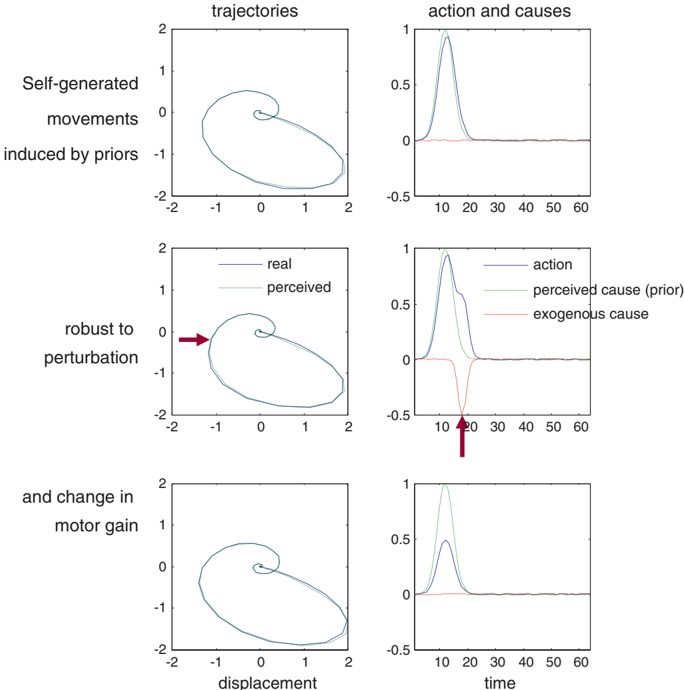
- Action can be cast as the suppression of sensory prediction error: the paper states that “the only thing that action can affect is the prediction error at the sensory level,” and that movement is driven by sensory prediction errors rather than explicit motor commands.
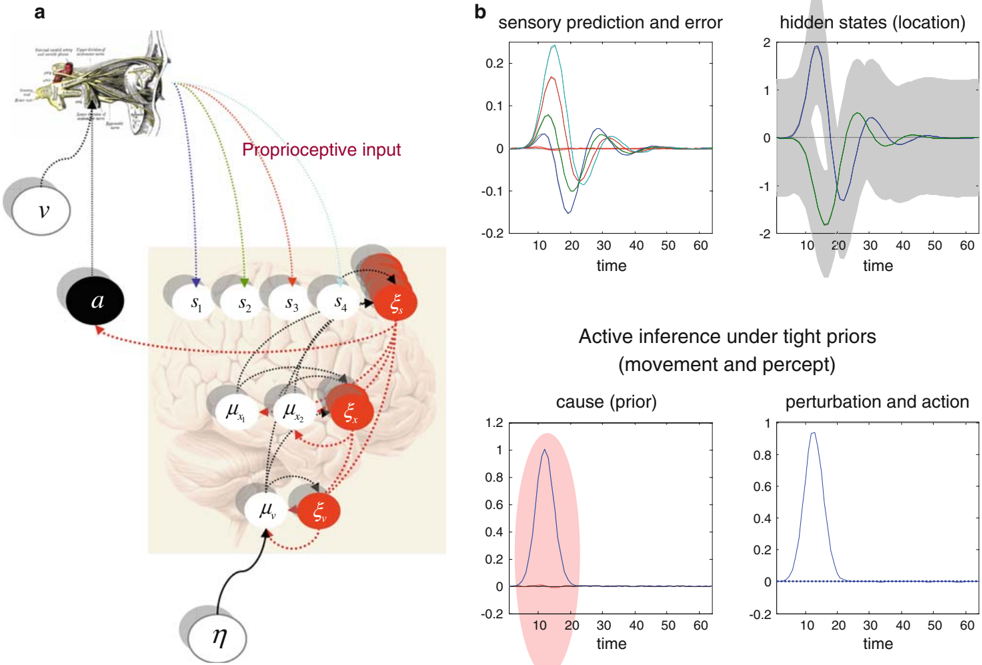
- In oculomotor simulations, tight priors on perturbations led to action that “countered almost immediately” the stimulus motion, while flat priors produced perceived motion; the paper reports a 6×6 = 36-channel sensory array in one retinal simulation.
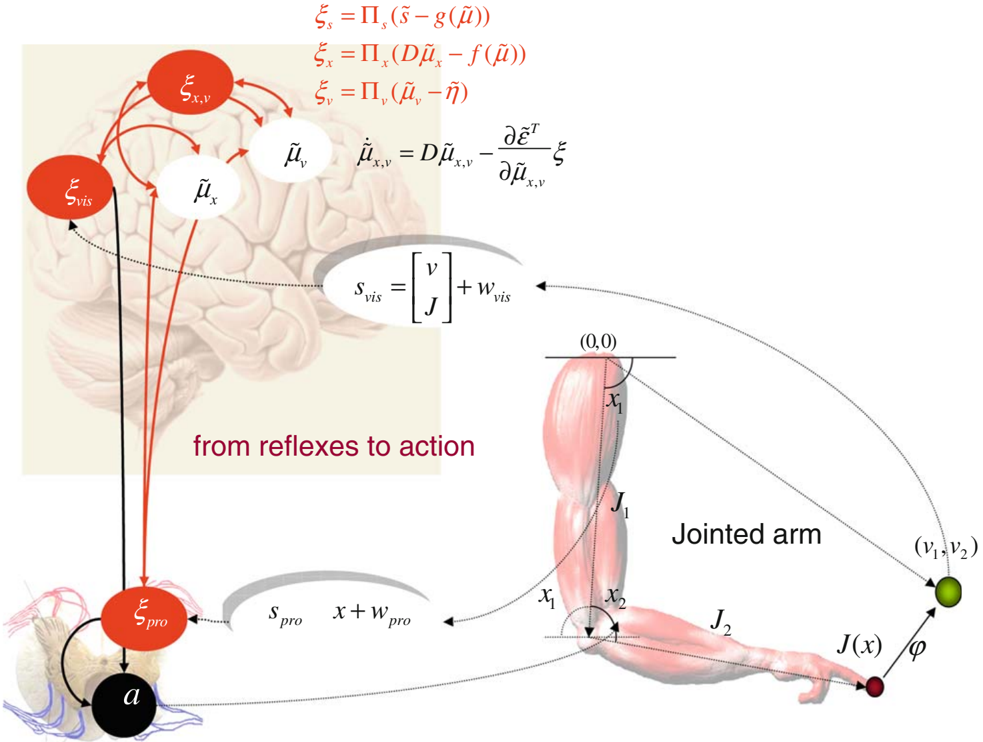
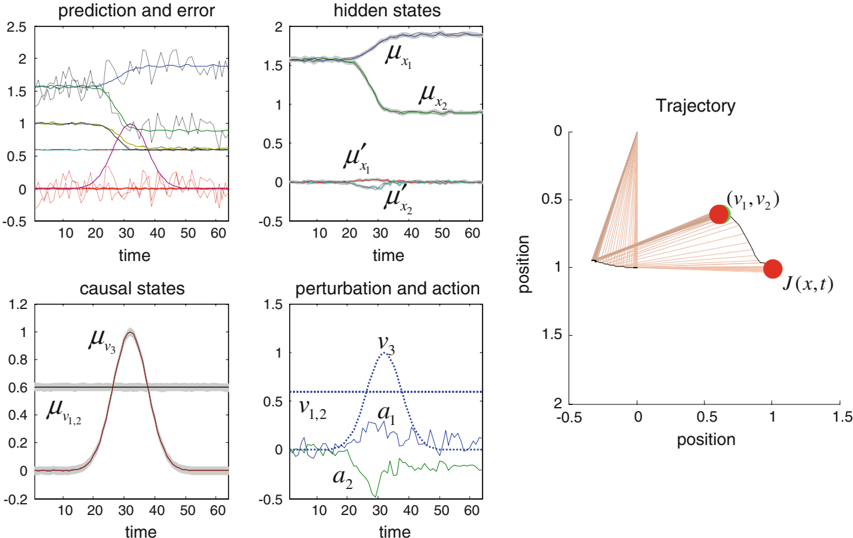
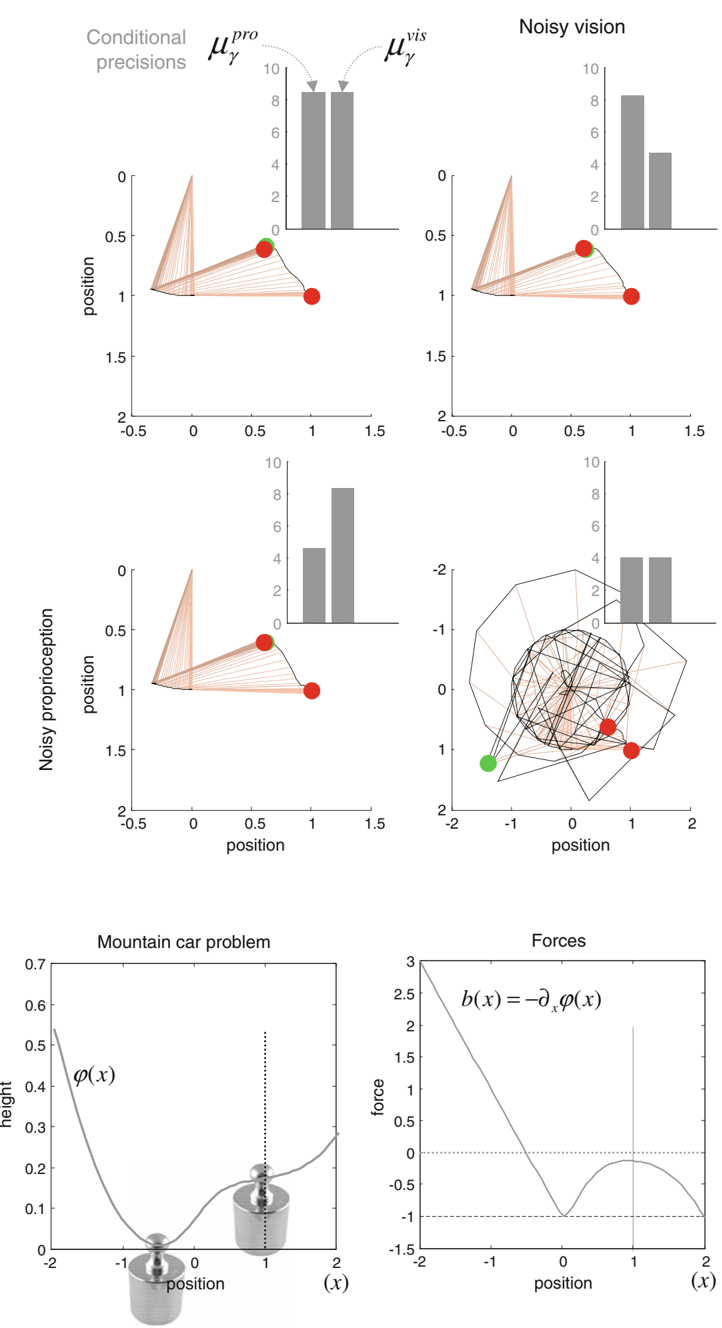
- In the cued reaching simulations, behavior was robust to sensory noise: proprioceptive noise alone could be compensated by vision, visual noise alone by proprioception, but when both modalities were noisy, reaching was compromised.
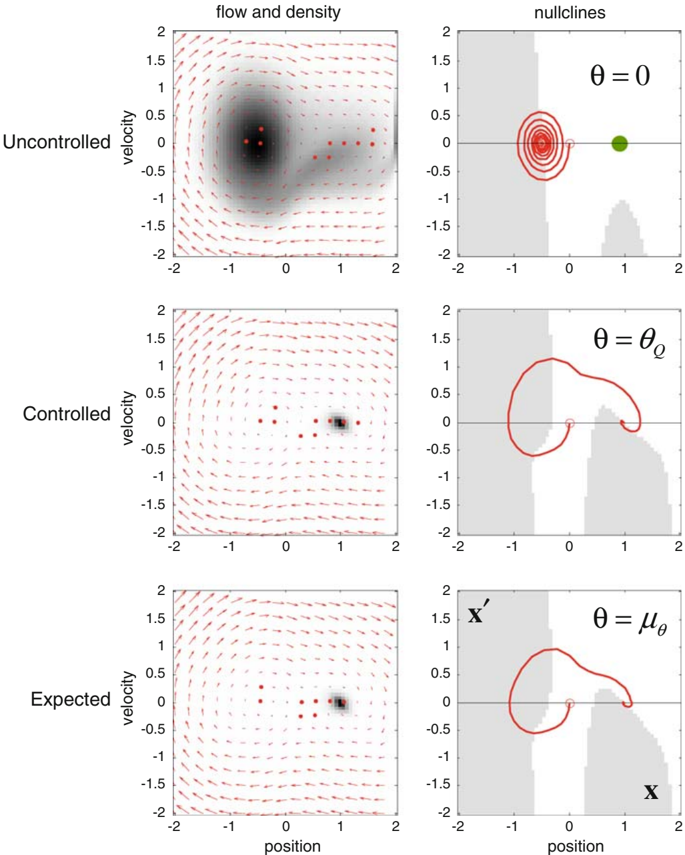
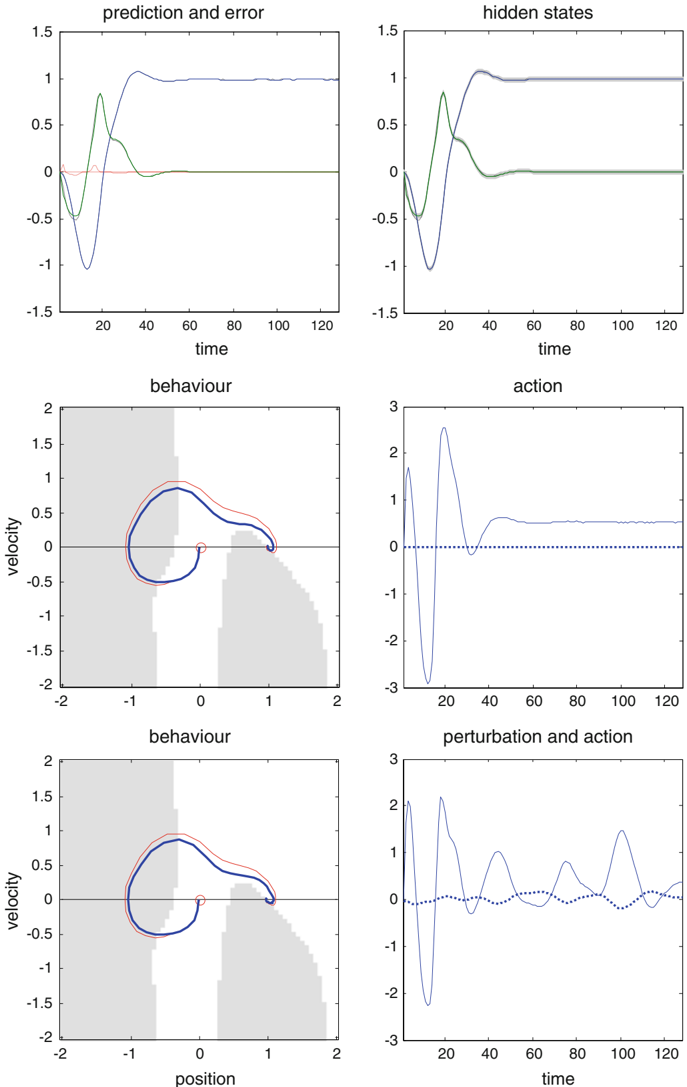
- In the goal-directed “mountain-car” simulation, the agent learned the controlled dynamics over 16 trials, and after learning it produced the required circuitous trajectory to the target; the paper notes that after 16 trials the parameters “converged roughly” to the control environment.
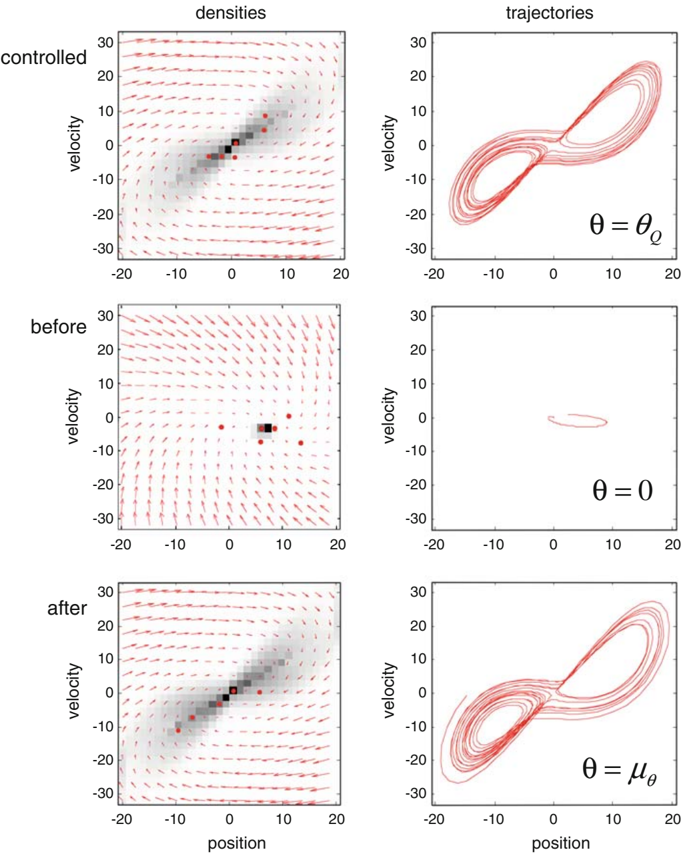
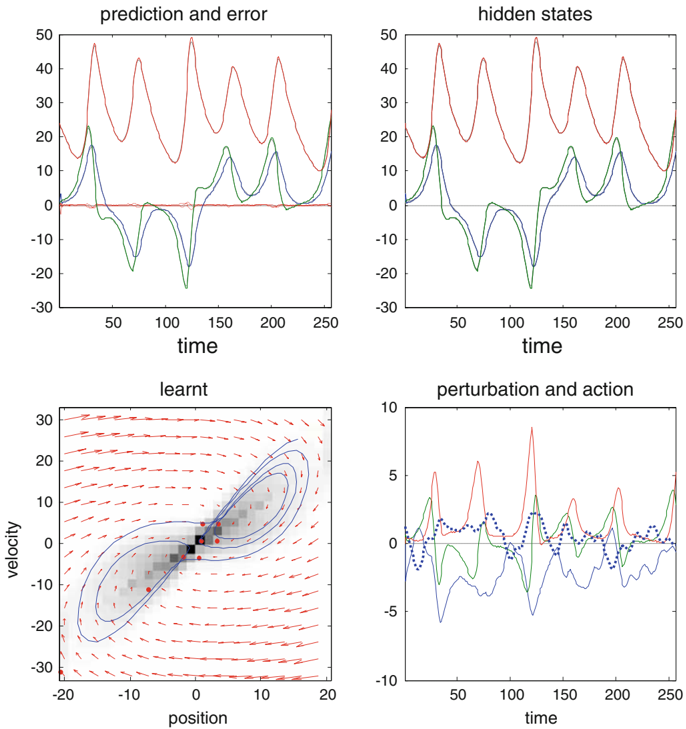
- In the autonomous-behavior simulation, after 16 trials of 512 time-bins, the agent learned to expect a Lorenz attractor and then continued to follow that learned trajectory even under perturbations, showing robustness to exogenous forces.
## Methods
- The paper is a theoretical and simulation study framed around the free-energy principle and active inference, with action and perception implemented through gradient descent on free energy under Gaussian/Laplace assumptions.
- It uses several toy dynamical systems: retinal stabilization/oculomotor control, two-joint arm reaching, the mountain-car problem, and a Lorenz-attractor learning task; one learning example uses 16 trials of 32 s time-bins, and another uses 16 trials of 512 time-bins.
- Analysis is based on generalized coordinates of motion, prediction errors, and variational (free-energy) updates of conditional expectations and precisions; the paper reports that all simulations were implemented with a single Matlab routine, `spm_ADEM.m`.
## Limitations
- The paper itself states that the simulations are simple and that many motor-control and sensorimotor issues are only addressed “superficially,” with the examples used mainly to “impart the intuitions behind active inference.”
- The text repeatedly says that some claims rely on simplifying assumptions, including Gaussian/Laplace approximations, generalized-state truncation, and assumptions about diffeomorphic sensory mappings (stated in the paper).
- Evident from the text: the results are based on idealized simulations and toy environments rather than empirical experiments on biological agents or neural recordings.
Model-written summary. Check it against the paper before relying on it.
Integrity signals
Registry
Cites
Statistics
Figures
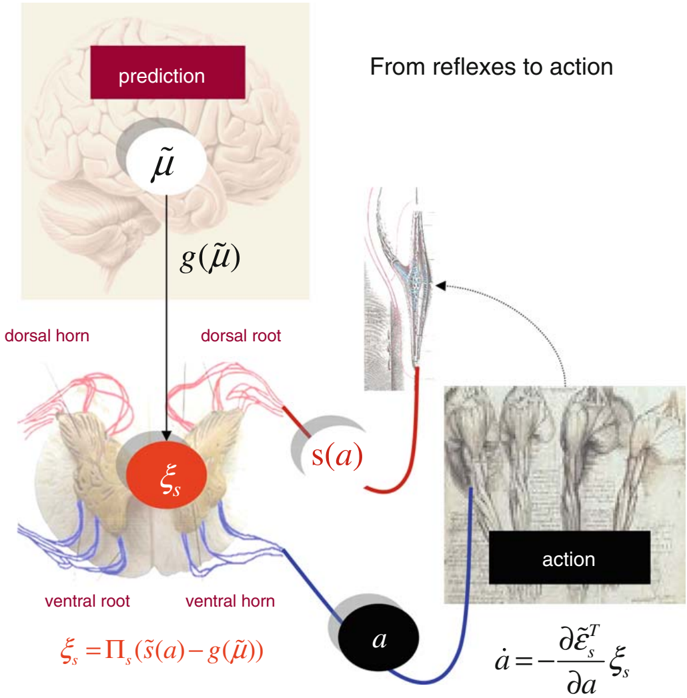
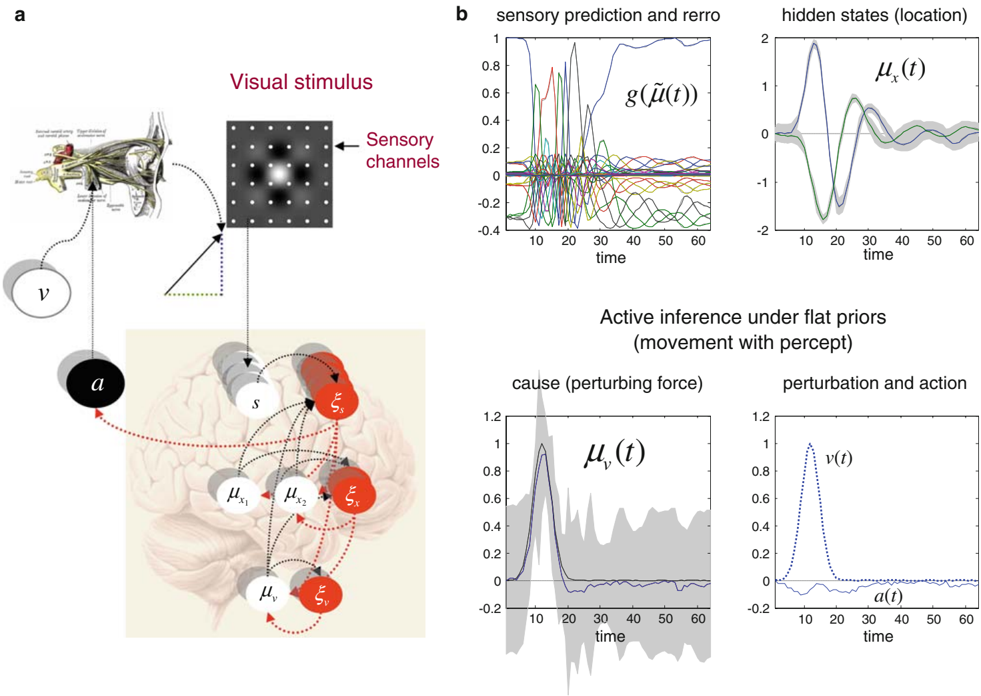
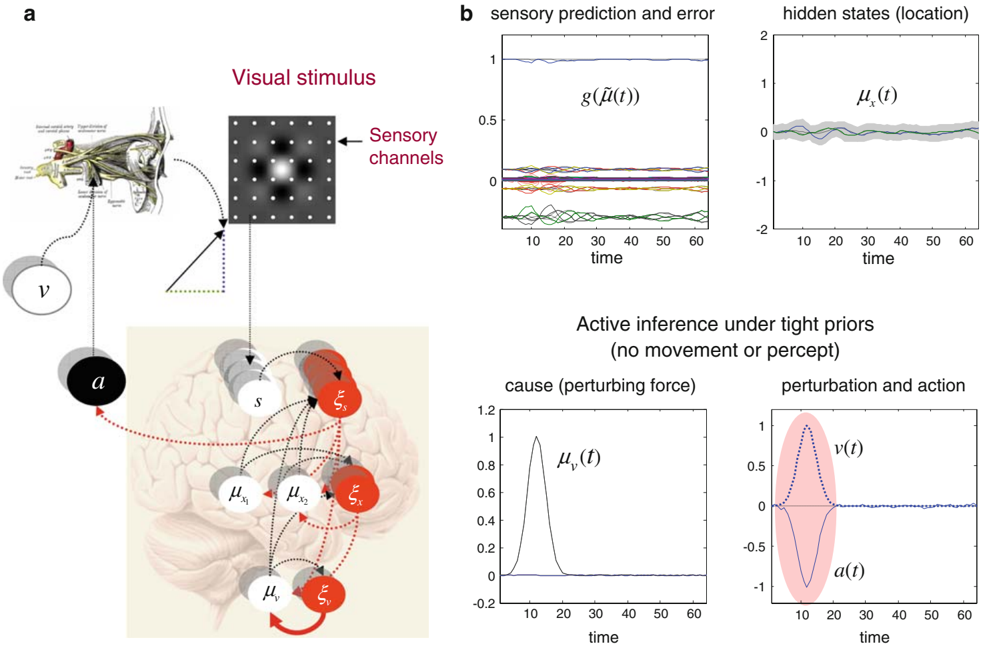
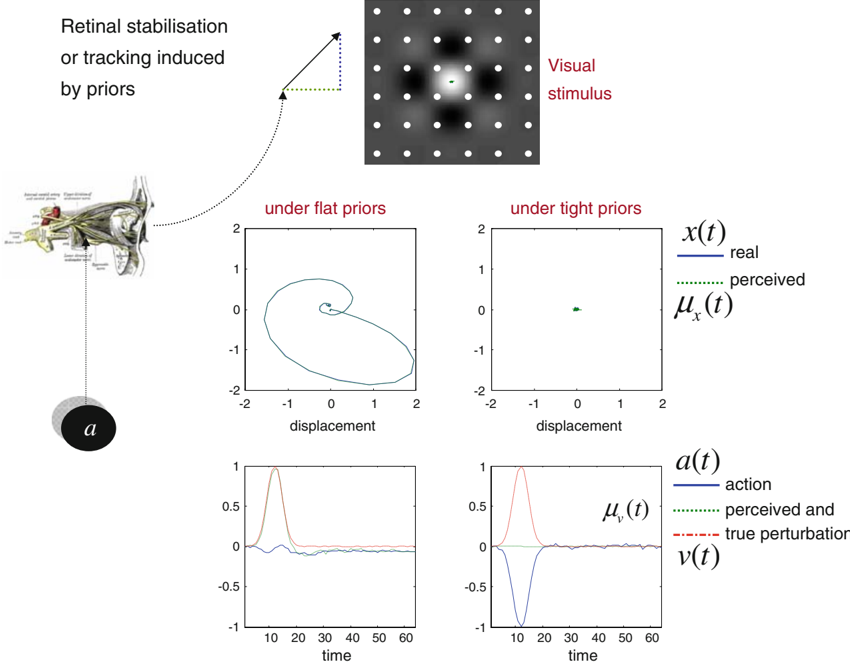
Verification
Claims the paper makes
10 Valid · 3 Not valid · 32 Not checked · 265 Own results and interpretations
The cited sources support only part of this claim — read each source’s verdict below.
In the paper
“This mixture of weighted error variance is related formally to phenomenological cost functions proposed to account for movement trajectories (cf.Todorov and Jordan 1998;Nakano et al. 1999;Berret et al. 2008).”
§ Action and behavior: a free-energy formulation > 3.1 Motor control and prediction errors
What the sources say
- Not checked — no full text of the sourcecites Todorov and Jordan 1998 matched to “Smoothness Maximization Along a Predefined Path Accurately Predicts the Speed Profiles of Complex Arm Movements” (1998) source
- Not checked — no full text of the sourcecites Nakano et al. 1999 matched to “Quantitative Examinations of Internal Representations for Arm Trajectory Planning: Minimum Commanded Torque Change Model” (1999) source
- Partly supportedcites Berret et al. 2008 matched to “The Inactivation Principle: Mathematical Solutions Minimizing the Absolute Work and Biological Implications for the Planning of Arm Movements” (2008) sourceExperimental — accuracy not yet measured
The Results (Theoretical Analysis; page unavailable) propose an integral cost combining absolute work with a weighted comfort term to model arm movements. The Introduction describes variance-based models separately, but our copy does not establish a formal relationship between weighted error variance and the paper’s cost function. (LLM, conf=0.82)
plainstates an association- Asserted: passes — The authors put it forward as true.
- Checkable: passes — It can be checked against evidence.
- Load-bearing: unclear — It is unclear whether the paper’s conclusions depend on it.
- Based: passes — The paper gives a reason why it holds.
The cited sources support only part of this claim — read each source’s verdict below.
In the paper
“Furthermore, this perspective on dopaminergic function fits comfortably with a gating role for dopamine (O'Reilly et al. 2002) in selecting the percepts that guide action (Redgrave et al. 1999).”
§ Action and behavior: a free-energy formulation > 7.1 Active inference and optimal control
What the sources say
- Not checked — no full text of the sourcecites O'Reilly et al. 2002 matched to “Prefrontal cortex and dynamic categorization tasks: representational organization and neuromodulatory control” (2002) source
- Partly supportedcites Redgrave et al. 1999 matched to “The basal ganglia: a vertebrate solution to the selection problem?” (1999) sourceExperimental — accuracy not yet measured
In “Dopaminergic regulation of switching” (pp. 13–14), the paper proposes that dopamine helps interrupt and reprioritize behavioral selections in response to salient stimuli. That supports a role in selecting actions guided by stimuli, but not the more specific claim that dopamine selects percepts. “NEW PERSPECTIVES” (p. 16) distinguishes selection for access to motor or cognitive resources from perception itself. (LLM, conf=0.84)
plainstates an association- Asserted: passes — The authors put it forward as true.
- Checkable: passes — It can be checked against evidence.
- Load-bearing: unclear — It is unclear whether the paper’s conclusions depend on it.
- Based: passes — The paper gives a reason why it holds.
The cited sources support only part of this claim — read each source’s verdict below.
In the paper
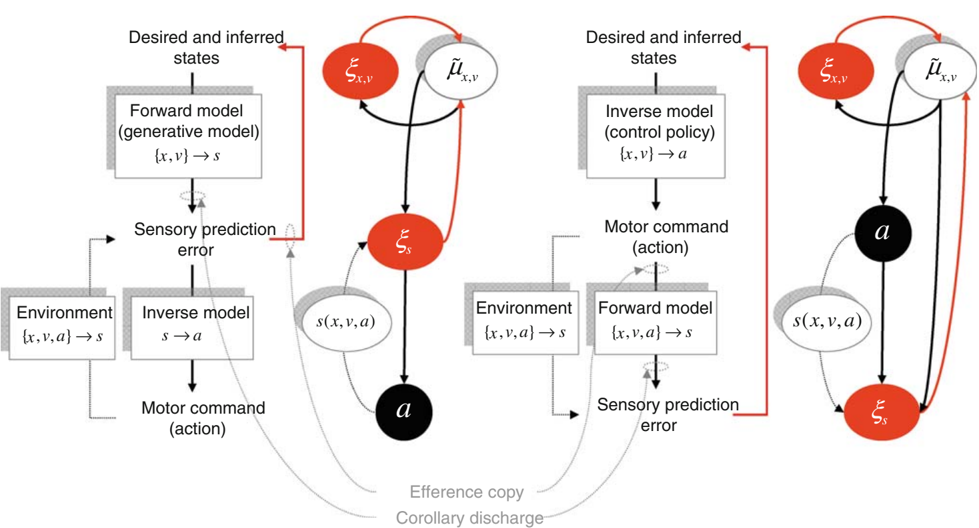
“Indeed, the motor plant is probably one of the most important aspects of the environment for predicting sensory input (see Grafton and Hamilton 2007).”
§ Action and behavior: a free-energy formulation > 7.3 Forward models in motor control
What the sources say
- Partly supportedcites Grafton and Hamilton 2007 matched to “Evidence for a distributed hierarchy of action representation in the brain” (2007) sourceExperimental — accuracy not yet measured
Section 4, “Computational models” (page unavailable), says forward models predict the motor plant’s state and turn motor commands into expected sensory consequences. It does not characterize the motor plant as an aspect of the environment or rank it among the most important factors for predicting sensory input. (LLM, conf=0.83)
hedgedstates an association- Asserted: passes — The authors put it forward as true.
- Checkable: passes — It can be checked against evidence.
- Load-bearing: unclear — It is unclear whether the paper’s conclusions depend on it.
- Based: passes — The paper gives a reason why it holds.
- Partly supported
A result the paper states — it cites no source for it, so there is none to check. The quote shows it is in the paper.
In the paper
“In other words, the image is stabilized in accordance with the prior expectation of no movement.”
§ Action and behavior: a free-energy formulation > 4.1.1 Retinal stabilization and oculomotor reflexes
plainstates a cause- Asserted: passes — The authors put it forward as true.
- Checkable: passes — It can be checked against evidence.
- Load-bearing: passes — The paper’s conclusions depend on it.
- Based: passes — The paper gives a reason why it holds.
- Rests on 3 assumptions not shown here.
A result the paper states — it cites no source for it, so there is none to check. The quote shows it is in the paper.
In the paper
“By manipulating its prior expectations on these perturbations, v(t), we can elicit very different behaviors from the agent.”
§ Action and behavior: a free-energy formulation > 4.1.1 Retinal stabilization and oculomotor reflexes
plainstates a cause- Asserted: passes — The authors put it forward as true.
- Checkable: passes — It can be checked against evidence.
- Load-bearing: passes — The paper’s conclusions depend on it.
- Based: passes — The paper gives a reason why it holds.
- Rests on 3 assumptions not shown here.
181 more claims
Create a free account to see all 310 claims and to verify the 1 reference still open.
- Probably not a substantial claim. 67
- It may state two separate claims as one. 67
- The quote only partly states this claim. 2
- Borderline: one of the tests for a substantial claim is unclear. 1
Claims other papers make about this one
Each is checked against this paper’s own text: does it say what the citing paper says it does?
The source backs part of the claim, not all of it — or backs it for a different population, condition or comparison.
In the citing paper
“The free energy principle (Friston et al. 2010; Badcock et al. 2019) thus casts control theoretic ‘essential variables’ in terms of high precision prior expectations.”
From Consciousness in active inference: Deep self-models, other minds, and the challenge of psychedelic-induced ego-dissolution (2021) · cites this paper as Friston et al. 2010
Experimental — accuracy not yet measuredThe source backs part of the claim, not all of it — or backs it for a different population, condition or comparison.
In the citing paper
“Given a chosen time window, accumulated log evidence could be approximated by the integral of free energy, a quantity known as “free action” (Friston K. et al., 2010).”
From Allostatic Self-efficacy: A Metacognitive Theory of Dyshomeostasis-Induced Fatigue and Depression (2016) · cites this paper as Friston K. et al., 2010
Experimental — accuracy not yet measuredThe cited source says what the claim attributes to it.
In the citing paper
“Also, if predictive models are continually probed by control signals that attempt to confirm the currently dominant model via active inference [21], the framework naturally accommodates the phasic physiological changes that accompany RHI induction [58,59] when these changes are taken to reflect altered autonomic control.”
From Interoceptive inference, emotion, and the embodied self (2013) · cites this paper as [21]
Experimental — accuracy not yet measuredThe cited source says what the claim attributes to it.
In the citing paper
“Thus, perception and action operate synergistically to minimise prediction errors and optimise our internal representations of the environment.”
From The depressed brain: an evolutionary systems theory (2017) · cites this paper as [11]
The cited source says what the claim attributes to it.
In the citing paper
“In the neurosciences, this is known as active inference [60, 61, 62].”
From The free energy principle made simpler but not too simple (2023) · cites this paper as [60]
4 more claims about this paper
Create a free account to see every claim other papers make about this one.
Citations
Cites
Rescorla, R. A. (1972) · Medical Entomology and Zoology · Cited by 9,661
A neural substrate of prediction and reward
Schultz, W., Dayan, P., & Montague, P. R. (1997) · Science · doi:10.1126/science.275.5306.1593 · Cited by 9,388 · cited 1×
“may call for a reappraisal of reinforcement learning as an explanation for behavior and, in particular, the role of dopamine in coding unpredicted reward (Montague et al. 1995; Schultz et al. 1997; Doya 2002): If dopamine encodes precision through its classical neuromodulatory effects (cf., Yu and Dayan 2005) how can…”
BackgroundWatkins, C. J. C. H., & Dayan, P. (1992) · Machine Learning · doi:10.1007/bf00992698 · Cited by 9,083
The free-energy principle: a unified brain theory?
Friston, K. (2010) · Nature Reviews Neuroscience · doi:10.1038/nrn2787 · Cited by 8,120
Self-citationAutopoiesis and Cognition: The Realization of the Living
Maturana, H. R., & Varela, F. J. (1980) · Boston Studies in the Philosophy and History of Science · doi:10.1007/978-94-009-8947-4 · Cited by 5,815
Emergence of simple-cell receptive field properties by learning a sparse code for natural images
Olshausen, B. A., & Field, D. J. (1996) · Nature · doi:10.1038/381607a0 · Cited by 5,694 · cited 1×
“This appeals to the principle of maximum information transfer (Linsker 1990), which has been very useful in understanding the emergence of things like receptive fields (e.g., Olshausen and Field 1996 ).”
BackgroundRao, R. P. N., & Ballard, D. H. (1999) · Nature Neuroscience · doi:10.1038/4580 · Cited by 5,483 · cited 4×
“The idea that the brain uses hierarchical inference has been established for years (Mumford 1992; Rao and Ballard 1998; Friston 2005; Friston et al. 2006) and provides a nice explanation for the hierarchical organization of cortical systems.”
BackgroundInfluentialA theory of cortical responses.
Friston, K. (2005) · Philosophical Transactions of the Royal Society B: Biological Sciences · doi:10.1098/rstb.2005.1622 · Cited by 4,578 · cited 6×
“Please see Friston et al. (2008) for a fuller description of the scheme implied by these circuit diagrams.”
BackgroundMethodInfluentialSelf-citationClassical conditioning II: Current research and theory.
Black, A. H., & Prokasy, W. F. (1972) · Appleton-Century-Crofts eBooks · Cited by 4,449
Watkins, C. J. C. H., & Dayan, P. (1992) · Machine Learning · doi:10.1023/a:1022676722315 · Cited by 3,907
Research works printed but not linked: 2
- 55. MacKay DJC (1995) Free-energy minimization algorithm for decoding and cryptoanalysis. Electron Lett 31:445-447
- 89. Watkins CJCH, Dayan P (1992) Q-learning. Mach Learn 8:279-292
Cited by
Items 401–500 of 847
Premises for digital twins reporting on Atlantic salmon wellbeing
Giske, J., Dumitru, M. L., Enberg, K., Folkedal, O., Handeland, S. O., Higginson, A. D., Opdal, A. F., Rønnestad, I., Salvanes, A. G. V., Vollset, K. W., et al. (2025) · Behavioural Processes · doi:10.1016/j.beproc.2025.105163 · Cited by 14
Poublan‐Couzardot, A., & Talmi, D. (2024) · Annals of the New York Academy of Sciences · doi:10.1111/nyas.15141 · Cited by 15
“9,21 The fish jumps back into the water, and now its observations match those predicted by its evolved generative models.”
BackgroundBayesian mechanics of perceptual inference and motor control in the brain
Kim, C. S. (2021) · Biological Cybernetics · doi:10.1007/s00422-021-00859-9 · Cited by 12
“However, the neural observer is not aware of how the sensory streams are effectuated by the agent’s motion in the environment (Friston et al. 2010c).”
BackgroundMethodInfluentialActive inference with function learning for robot body perception
Lanillos, P., & Cheng, G. (2018) · mediaTUM (Technical University of Munich) · Cited by 13
Active Inference and Epistemic Value in Graphical Models
van de Laar, T., Koudahl, M., van Erp, B., & de Vries, B. (2022) · Frontiers in Robotics and AI · doi:10.3389/frobt.2022.794464 · Cited by 15
“Because the future is unobserved (by definition), the agent includes prior beliefs2 about desired outcomes in its model and infers a policy that prescribes a sequence of future controls.3 The corollary of the FEP that includes action is referred to as Active Inference (AIF) (Friston et al., 2010).”
BackgroundInfluentialLimongi, R., Pérez, F. J., Modroño, C., & González–Mora, J. L. (2016) · Frontiers in Human Neuroscience · doi:10.3389/fnhum.2016.00276 · Cited by 11
“The above discussion motivates a broader interpretation consistent with a current theory of active inference, behavioral control, and homeostatic control systems (Friston et al., 2010, 2011; Adams et al., 2013; Clark, 2013; Shipp et al., 2013; Pezzulo et al., 2015).”
The Imbalanced Plasticity Hypothesis of Schizophrenia-Related Psychosis: A Predictive Perspective
Guterman, Y., Ataria, Y., & Silverstein, S. M. (2021) · Cognitive Affective & Behavioral Neuroscience · doi:10.3758/s13415-021-00911-y · Cited by 10
“Within the PC framework, attention is typically conceived of as reflecting the enhancing of postsynaptic gain of PEs as a positive function of their actual (exogenous attention) or expected (endogenous attention) precision (Feldman & Friston, 2010; Hohwy, 2012).”
BackgroundInfluentialResonating Minds—Emergent Collaboration Through Hierarchical Active Inference
Pöppel, J., Kahl, S., & Kopp, S. (2021) · Cognitive Computation · doi:10.1007/s12559-021-09960-4 · Cited by 14
“The generative process is inverted to predict next actions and, thus, attenuate prediction errors [14].”
BackgroundHeins, N., Pomp, J., Kluger, D. S., Trempler, I., Zentgraf, K., Raab, M., & Schubotz, R. I. (2020) · Frontiers in Neuroscience · doi:10.3389/fnins.2020.00483 · Cited by 15
“In particular, we expected activity in primary auditory cortex to be more attenuated for GAS as compared to BAS, based on the notion that effective sensory attenuation results from a prediction of sensory action effects (Wolpert et al., 1995; Miall and Wolpert, 1996; Friston et al., 2010; Schröger et al., 2015b).”
BackgroundA Hybrid Human-Neurorobotics Approach to Primary Intersubjectivity via Active Inference
Chame, H. F., Ahmadi, A., & Tani, J. (2020) · Frontiers in Psychology · doi:10.3389/fpsyg.2020.584869 · Cited by 15
“Free energy principle theory was initially proposed as a unifying framework in brain science (Friston, 2010).”
BackgroundCommentary: Brain, Mind, World: Predictive Coding, Neo-Kantianism, and Transcendental Idealism
Piekarski, M. (2017) · Frontiers in Psychology · doi:10.3389/fpsyg.2017.02077 · Cited by 11
In Case of Doubt, One Follows One's Self: The Implicit Guidance of the Embodied Self-Avatar
Boban, L., Boulic, R., & Herbelin, B. (2024) · IEEE Transactions on Visualization and Computer Graphics · doi:10.1109/tvcg.2024.3372042 · Cited by 12
“This hypothesis draws from the active inference theory, which posits that actions contribute to the overall goal of reducing prediction errors [23, 44].”
BackgroundUnderstanding music and aging through the lens of Bayesian inference
Heng, G. J., Zhang, J., Bonetti, L., Lim, W. P. H., Vuust, P., Agres, K., & Chen, S. A. (2024) · Neuroscience & Biobehavioral Reviews · doi:10.1016/j.neubiorev.2024.105768 · Cited by 10
“Flexible response to a stochastic environment is crucial to survival (Friston, 2010).”
InfluentialAmbient smart environments: affordances, allostasis, and wellbeing
White, B., & Miller, M. (2024) · Synthese · doi:10.1007/s11229-024-04679-9 · Cited by 11
“According to the AIF, the fundamental imperative of the embodied brain is to minimise the surprise of its own sensory states relative to those expectations in the generative model (Friston, 2010 ; Parr & Friston, 2019 ; Parr et al., 2022).”
InfluentialDesire and Motivation in Predictive Processing: An Ecological-Enactive Perspective
Kiverstein, J. D., Miller, M. M., & Rietveld, E. (2024) · Review of Philosophy and Psychology · doi:10.1007/s13164-024-00757-6 · Cited by 14
“Reward and utility is conceptualized as the consequences of action the agent predicts they would sense (through exteroceptive and interoceptive channels), were they to act (Friston et al. 2009, 2010, 2012, 2014; Wiese 2017).”
Goekoop, R., & de Kleijn, R. (2021) · Entropy · doi:10.3390/e23121701 · Cited by 9
“The predicted outcome of certain actions is then a prerequisite for such actions to be selected as the policies that are most likely to suppress prediction errors across trials [20,80].”
BackgroundL’esprit predictif : introduction à la théorie du cerveau bayésien
Bottemanne, H., Longuet, Y., & Gauld, C. (2022) · L Encéphale · doi:10.1016/j.encep.2021.09.011 · Cited by 27
Functional Gait Disorders: Clinical presentations, Phenotypes and Implications for treatment
Issak, S., Kanaan, R., Nielsen, G., Fini, N. A., & Williams, G. (2023) · Brain Injury · doi:10.1080/02699052.2023.2165158 · Cited by 8
“The Bayesian model proposes that the aim of normal movement is to minimize the prediction errors at each level of control (19).”
BackgroundMonitoring the past and choosing the future: the prefrontal cortical influences on voluntary action
Phillips, H. N., Cope, T., Hughes, L. E., Zhang, J., & Rowe, J. B. (2018) · Scientific Reports · doi:10.1038/s41598-018-25127-y · Cited by 9
The dark room problem in predictive processing and active inference, a legacy of cognitivism?
Baltieri, M., & Buckley, C. L. (2019) · Conference on Artificial Life (ALIFE) · doi:10.1162/isal_a_00137 · Cited by 19
“…hyperparameters γ encoding properties about precisions π z , π z (cid:48) , π w , one gets The free energy then becomes: and action, ˙ a = − ∂F/∂a (Friston et al., 2010; Buckley et al., 2017), as: where we use the fact that an implicit model in terms of reflex arcs (Friston, 2011) is embodied by…”
BackgroundMethodInfluentialA Neuropsychoanalytic Perspective
Solms, M. (2019) · Psychoanalytic Inquiry · doi:10.1080/07351690.2019.1671126 · Cited by 9
Pollard-Wright, H. (2020) · Communicative & Integrative Biology · doi:10.1080/19420889.2020.1846922 · Cited by 11
“The actions and perception by mind (as an ‘observing ego’) minimize the same prediction error [24].”
How particular is the physics of the free energy principle?
Aguilera, M., Millidge, B., Tschantz, A., & Buckley, C. L. (2021) · Physics of Life Reviews · doi:10.1016/j.plrev.2021.11.001 · Cited by 104
“Furthermore, the FEP has been defended based on singular claims about its explanatory power, suggesting that it reveals novel insights among fundamental psychological concepts such as memory, attention, value, reinforcement, and salience [7] and unifies different aspects of motor behaviour and perception, from retinal…”
BackgroundKahl, S., & Kopp, S. (2023) · Philosophical Transactions of the Royal Society B Biological Sciences · doi:10.1098/rstb.2021.0474 · Cited by 15
“The model consists of a hierarchyof nested generative sensorimotor perception and action processes andis based on the free-energy principle with active inference [46,47,51].”
BackgroundMethodWhat does it mean to predict one's own utterances?
Meyer, A. S., & Hagoort, P. (2013) · Behavioral and Brain Sciences · doi:10.1017/s0140525x12002786 · Cited by 14
Vers un modèle du développement des dimensions de la mentalisation a l’adolescence
Badoud, D., Speranza, M., & Debbané, M. (2016) · Revue québécoise de psychologie · doi:10.7202/1040160ar · Cited by 18
Nonmodular architectures of cognitive systems based on active inference
Baltieri, M., & Buckley, C. L. (2019) · Sussex Research Online (University of Sussex) · Cited by 10
Motor Program Transformation of Throwing Dart from the Third-Person Perspective
Тумялис, А. В., Smirnov, A. S., Fadeev, K. A., Alikovskaia, T., Khoroshikh, P. P., Sergievich, A., & Golokhvast, K. S. (2020) · Brain Sciences · doi:10.3390/brainsci10010055 · Cited by 10
“According to the predictive coding account [27], brain develops a prediction model about sensory inputs, trying to maximize model evidence and to suppress the deviation from this model, defined as a prediction error or a surprise.”
BackgroundOlasagasti, I., & Giraud, A. (2020) · eLife · doi:10.7554/elife.44516 · Cited by 10
Herrmann‐Pillath, C. (2020) · Economics and Philosophy · doi:10.1017/s0266267120000371 · Cited by 10
Towards Augmented Reality-driven Human-City Interaction: Current Research and Future ChallengesPreprint
Lee, L.-H., Braud, T., Hosio, S., & Hui, P. (2020) · arXiv.org · doi:10.48550/arxiv.2007.09207 · Cited by 11
“Knowing that human users are very skillful at the physical world using their body [56], the users can become a part of the windows, icons, menus, and pointers (WIMP) [57].”
BackgroundRL with KL penalties is better viewed as Bayesian inference
Korbak, T., Perez, E., & Buckley, C. (2022) · Findings of the Association for Computational Linguistics: EMNLP 2022 · doi:10.18653/v1/2022.findings-emnlp.77 · Cited by 8
Suppression and omission effects in auditory predictive processing—Two of the same?
Tast, V., Schröger, E., & Widmann, A. (2024) · European Journal of Neuroscience · doi:10.1111/ejn.16393 · Cited by 9
“In general, intended effects of own actions are regarded as powerful and reliable sources of predictions (Brown et al., 2013; Friston et al., 2010).”
Human-Robot Kinaesthetic Interactions Based on the Free-Energy Principle
Sawada, H., Ohata, W., & Tani, J. (2024) · IEEE Transactions on Systems Man and Cybernetics Systems · doi:10.1109/tsmc.2024.3481251 · Cited by 14
“We presume that these situations can be well explained by predictive coding [11] and active inference [12], [13], [14], based on the free-energy principle [8].”
Dynamic planning in hierarchical active inference
Priorelli, M., & Stoianov, I. P. (2025) · Neural Networks · doi:10.1016/j.neunet.2024.107075 · Cited by 11
A predictive coding model of gaze shifts and the underlying neurophysiology
Spratling, M. (2017) · Visual Cognition · doi:10.1080/13506285.2017.1336141 · Cited by 7
“…actions are executed once planned.1 The actions planned by the proposed model could well be executed through error minimization, using predictive coding, as advocated in the previous work (Adams et al., 2013; Friston et al., 2010, 2011, 2012; Perrinet et al., 2014), but this is not considered here.”
MethodExtended Predictive Minds: do Markov Blankets Matter?
Facchin, M. (2021) · Review of Philosophy and Psychology · doi:10.1007/s13164-021-00607-9 · Cited by 15
Deane, G. (2022) · Artificial Life · doi:10.1162/artl_a_00368 · Cited by 9
“As such, a movement occurs as a result of predicting the expected proprioceptive consequences associated with it (Friston et al., 2010).”
BackgroundMethodIntention-based predictive information modulates auditory deviance processing
Widmann, A., & Schröger, E. (2022) · Frontiers in Neuroscience · doi:10.3389/fnins.2022.995119 · Cited by 11
“Confidence Frontiers in Neuroscience 11 frontiersin.org (precision) can be modulated by attention (Feldman and Friston, 2010) and by active inference induced by actions (Friston et al., 2010; Brown et al., 2013).”
BackgroundInfluentialDynamic Inference by Model Reduction
Priorelli, M., & Stoianov, I. P. (2025) · IEEE Transactions on Pattern Analysis and Machine Intelligence · doi:10.1109/tpami.2025.3595670 · Cited by 7
“Recent advances in Bayesian model reduction have led to innovative, biologically plausible approaches to actively infer the state of affairs of the world and perform planning with continuous signals.”
InfluentialMulti-layer Cortical Learning Algorithms
Agrawal, P., & Franklin, S. (2014) · IEEE Symposium on Computational Intelligence, Cognitive Algorithms, Mind, and Brain (CCMB) · doi:10.1109/ccmb.2014.7020707 · Cited by 12
“The idea of using predictive coding in HPCM was inspired by the work of Karl Friston et al. [7] [8] [9] in formalizing the brain as a system trying to minimize a quantity called 'free-energy'.”
MethodAre forward models enough to explain self-monitoring? Insights from patients and eye movements
Hartsuiker, R. J. (2013) · Behavioral and Brain Sciences · doi:10.1017/s0140525x12002749 · Cited by 9
Integrative Collision Avoidance Within RNN-Driven Many-Joint Robot Arms
Otte, S., Hofmaier, L., & Butz, M. V. (2018) · Lecture notes in computer science · doi:10.1007/978-3-030-01424-7_73 · Cited by 8
Lindig-León, C., Gottwald, S., & Braun, D. A. (2019) · Frontiers in Neuroscience · doi:10.3389/fnins.2019.01230 · Cited by 11
“…models of perception-action systems (McKelvey and Palfrey, 1995; Mckelvey and Palfrey, 1998; Mattsson and Weibull, 2002; Sims, 2003; Körding and Wolpert, 2004; Still, 2009; Todorov, 2009; Feldman and Friston, 2010; Friston, 2010; Friston et al., 2010; Tishby and Polani, 2011; Kappen et al., 2012).”
Towards Augmented Reality-driven Human-City Interaction: Current Research and Future Challenges.Preprint
Lee, L., Braud, T., Hosio, S. J., & Hui, P. (2020) · arXiv (Cornell University) · Cited by 13
Waking and Dreaming Consciousness: Neurobiological and Functional Considerations
Hobson, J. A., & Friston, K. J. (2018) · Elsevier eBooks · doi:10.1016/b978-0-12-809324-5.21972-x · Cited by 10
Self-citationAre Generative Models Structural Representations?
Facchin, M. (2021) · Minds and Machines · doi:10.1007/s11023-021-09559-6 · Cited by 14
“But since these aspects tend to boil down to PP (see Friston, 2009; 2010), I do not think I need to explicitly discuss the free energy principle here.”
BackgroundPriors and proprioceptive predictions
Parr, T., Ramstead, M. J. D., & Friston, K. J. (2025) · Current Opinion in Behavioral Sciences · doi:10.1016/j.cobeha.2025.101509 · Cited by 13
Self-citationThe Double-Slit Experiment Is Already Happening in the Brain
Tqemaladze, J. (2026) · Longevity Horizon · doi:10.65649/nwcw7m47 · Cited by 13
“It seeks to predict the consequences of actions and to minimize prediction error through movement (Friston et al., 2010).”
Macerollo, A., Limousin, P. D., Korlipara, P., Foltynie, T., Edwards, M. J., & Kilner, J. M. (2019) · Frontiers in Neurology · doi:10.3389/fneur.2019.01001 · Cited by 7
Self-citationSlow but flexible or fast but rigid? Discrete and continuous processes compared
Priorelli, M., & Stoianov, I. P. (2024) · Heliyon · doi:10.1016/j.heliyon.2024.e39129 · Cited by 9
“This process – known as self-evidencing – allows implementing goal-directed behavior through VFE minimization, keeping the agent in predictable and safer spaces [17].”
BackgroundInfluentialExplaining institutional technology
Potts, J., Dopfer, K., & Tulloh, B. (2025) · European Economic Review · doi:10.1016/j.euroecorev.2025.104968 · Cited by 6
Human impedance modulation to improve visuo-haptic perception
Cheng, X., Shen, S., Ivanova, E., Carboni, G., Takagi, A., & Burdet, E. (2025) · PLoS Computational Biology · doi:10.1371/journal.pcbi.1013042 · Cited by 14
“Furthermore, while sophisticated algorithms have been developed for such active inference e.g. [29], the experimental results were well predicted through the simple OIE model.”
Dynamic causal modelling of immune heterogeneity
Parr, T., Bhat, A., Zeidman, P., Goel, A., Billig, A. J., Moran, R., & Friston, K. J. (2021) · Scientific Reports · doi:10.1038/s41598-021-91011-x · Cited by 9
Self-citationPuviani, L., & Rama, S. (2016) · Scientific Reports · doi:10.1038/srep28991 · Cited by 7
“We argue such a model could be represented by the so called predictive coding model (and its version applied to action learning; active inference) [42, 43, 44, 45].”
BackgroundMethodA System Computational Model of Implicit Emotional Learning
Puviani, L., & Rama, S. (2016) · Frontiers in Computational Neuroscience · doi:10.3389/fncom.2016.00054 · Cited by 7
“…in general, such as the probabilistic (Bayesian) “perception” and “action” learning models (i.e., the predictive coding (PC) (Friston, 2003, 2008) and active inference model (Friston et al., 2009, 2010), assume that coding behavioral responses involves the computation of a prediction error.”
BackgroundBeing a Beast Machine: The Origins of Selfhood in Control-Oriented Interoceptive Inference
Seth, A. K. (2019) · Oxford University Press eBooks · doi:10.1093/oso/9780190662813.003.0018 · Cited by 13
Jung, M., Kim, J., & Kim, K. K. (2020) · PLoS ONE · doi:10.1371/journal.pone.0239322 · Cited by 11
“In this context, our results may seem contradictory to the previous findings, however, it is necessary to consider the role of proprioception associated with strong BOI [39].”
ResultWilliams, D. G. (2018) · Apollo (University of Cambridge) · doi:10.17863/cam.33386 · Cited by 17
Apathy is Associated with Reduced Precision of Prior Beliefs about Action OutcomesPreprint
Hezemans, F. H., Wolpe, N., & Rowe, J. B. (2019) · bioRxiv (Cold Spring Harbor Laboratory) · doi:10.1101/672113 · Cited by 7
“Prediction error can be minimized in two ways: passively, by changing predictions to better fit the sensory inputs (perceptual inference), or actively, by performing actions to change the sensory input itself (active inference; Adams, Shipp, & Friston, 2013; Friston et al., 2010).”
InfluentialActive inference, morphogenesis, and computational psychiatryPreprint
Pio‐Lopez, L., Kuchling, F., Tung, A., et al. (2022) · doi:10.31234/osf.io/4gp6c · Cited by 7
How to grow a self: development of self-representation in the Bayesian brain
Wozniak, M. M. (2024) · Frontiers in Human Neuroscience · doi:10.3389/fnhum.2024.1441931 · Cited by 18
Resilience phenotypes derived from an active inference account of allostasis
Harrison, L., Gracias, A. J., Friston, K. J., & Buckwalter, J. G. (2025) · Frontiers in Behavioral Neuroscience · doi:10.3389/fnbeh.2025.1524722 · Cited by 12
“4 Free energy and active inference: a review The FEP is an information-theoretic construct that provides an optimization target, the minimization of surprise, by which self-organizing agents maintain a (far from equilibrium) steady state within their dynamic environment (Friston, 2010, 2012).”
InfluentialSelf-citationDeep Active Inference for Pixel-Based Discrete Control: Evaluation on the Car Racing Problem
van Hoeffelen, N. T. A., & Lanillos, P. (2021) · Communications in computer and information science · doi:10.1007/978-3-030-93736-2_60 · Cited by 7
Volpi, N. C., Greaves, M., Trendafilov, D., Salge, C., Pezzulo, G., & Polani, D. (2023) · PLoS Computational Biology · doi:10.1371/journal.pcbi.1010810 · Cited by 8
Nenadalová, J., & Řezníček, D. (2024) · Religion Brain & Behavior · doi:10.1080/2153599x.2024.2305460 · Cited by 11
“…2008), the human brain is a domain-general machine, constantly making guesses about the most probable occurrences of affairs in the outside world as well as within our bodies and comparing these guesses with incoming sensorial evidence in a hier-archic feedback-loop manner (Friston et al., 2010).”
Carving teleology at its joints
Beni, M. D., & Friston, K. J. (2024) · Synthese · doi:10.1007/s11229-024-04660-6 · Cited by 7
“…between different kinds of goal-directedness, our proposal also speaks to the cyber-netic approaches to goal-directedness; especially as the FEP offers a modern expression of fundamental cybernetic concepts such as homeostasis and control (Buckley et al., 2017; Friston et al., 2010; Seth, 2014).”
Self-citationMalekzadeh, P., & Plataniotis, K. N. (2024) · Neural Computation · doi:10.1162/neco_a_01698 · Cited by 13
Transparency in Human-Machine Mutual Action
Saito, H., Horie, A., Maekawa, A., Matsubara, S., Wakisaka, S., Kashino, Z., Kasahara, S., & İnami, M. (2021) · Journal of Robotics and Mechatronics · doi:10.20965/jrm.2021.p0987 · Cited by 8
Inference of affordances and active motor control in simulated agents
Scholz, F., Gumbsch, C., Otte, S., & Butz, M. V. (2022) · Frontiers in Neurorobotics · doi:10.3389/fnbot.2022.881673 · Cited by 8
“We can see this in the formal definition of surprise for a sensory state s (Friston et al., 2010): − log p(s | m) = − log ∫ ϑ p(s,ϑ | m) dϑ (2) where m is the model or the living thing itself, and ϑ are all environmental states, including states that are not fully observable to the living thing.”
BackgroundInfluentialFetal brain activity and the free energy principle
Miyagi, Y., Hata, T., & Miyake, T. (2023) · Journal of Perinatal Medicine · doi:10.1515/jpm-2023-0092 · Cited by 6
Active Inference With Empathy Mechanism for Socially Behaved Artificial Agents in Diverse Situations
Matsumura, T., Esaki, K., Shao, Y., Yoshimura, C., & Mizuno, H. (2024) · Artificial Life · doi:10.1162/artl_a_00416 · Cited by 13
“We now mathematically describe the FEP and active inference.”
BackgroundMethodInfluentialThe importance of highlighting the role of the self in hypnotherapy and hypnosis
Eason, A. D., & Parris, B. A. (2024) · Complementary Therapies in Clinical Practice · doi:10.1016/j.ctcp.2023.101810 · Cited by 6
Non‐coalescence of nonidentical droplets in oil under a DC electric field
Huang, X., Chen, M., Huang, Y., Luo, X., Teng, L., Xiao, L., & Li, J. (2024) · AIChE Journal · doi:10.1002/aic.18462 · Cited by 6
Pezzulo, G., Donnarumma, F., Iodice, P., Prevete, R., & Dindo, H. (2015) · Physics of Life Reviews · doi:10.1016/j.plrev.2015.01.021 · Cited by 6
“According to two leading theories of motor control, optimal feedback control [21] and active inference [22], the motor system can be conceptualized as a (hierarchical) generative model, which encodes a (probabilistic) mapping between “task goals” specified at a higher level (e.”
BackgroundDisorders of music processing in dementia
Benhamou, E., & Warren, J. D. (2020) · Elsevier eBooks · doi:10.1016/b978-0-12-817422-7.00004-3 · Cited by 7
Minimizing Relative Entropy in Hierarchical Predictive Coding
Kwisthout, J. (2014) · Lecture notes in computer science · doi:10.1007/978-3-319-11433-0_17 · Cited by 10
“This is referred to as active inference in the HPC literature [15].”
BackgroundA predictive coding account of OCDPreprint
Moore, P. J. (2015) · arXiv (Cornell University) · doi:10.48550/arxiv.1504.06732 · Cited by 11
“In the first devaluation test, both the OCD group and the control group behaved in a similar way: they (2)The driver’s behaviour can be seen as a manifestation of active inference, a unified account of both action and perception motivated by the free energy principle [63][64].”
BackgroundFrom unconscious inference to the beholder's share: predictive perception and human experiencePreprint
Seth, A. K. (2017) · PsyArXiv (OSF Preprints) · doi:10.31234/osf.io/zvbkp · Cited by 7
Multimodal VAE Active Inference Controller
Meo, C., & Lanillos, P. (2021) · IEEE/RSJ International Conference on Intelligent Robots and Systems (IROS) · doi:10.1109/iros51168.2021.9636394 · Cited by 36
“We use the definition of the F based on [12], where the action is implicit within the observation model x(a).”
MethodHarris, D., Arthur, T., Wilson, M., Gallais, B. L., Parsons, T. D., Dill, A., & Vine, S. (2025) · Biological Cybernetics · doi:10.1007/s00422-025-01006-4 · Cited by 6
“…systems approaches like the Free Energy Principle (FEP) and Active Inference , which similarly conceptualise the goal of a cognitive-behavioural system as the minimization of internal entropy (or ‘free energy’) and an increase in prediction success (Friston 2009; Friston et al. 2010; Clark 2013).”
Towards a theory of biological intelligence
Trapp, S., Friston, K. J., Schröger, E., & Parr, T. (2025) · New Ideas in Psychology · doi:10.1016/j.newideapsych.2025.101156 · Cited by 6
Self-citationInformational embodiment: Computational role of information structure in codes and robots
Pitti, A., Austin, M., Nakajima, K., & Kuniyoshi, Y. (2025) · Physics of Life Reviews · doi:10.1016/j.plrev.2025.03.018 · Cited by 8
The Pleasure Principle as a Tool for Scientific Forecasting of Human Self-Evolution
Argonov, V. Y. (2014) · Journal of Ethics and Emerging Technologies · doi:10.55613/jeet.v24i2.22 · Cited by 7
Webb, B. H. (2019) · Oxford University Press eBooks · doi:10.1093/oso/9780190662813.003.0019 · Cited by 5
Philippsen, A. K., Tsuji, S., & Nagai, Y. (2022) · Frontiers in Neurorobotics · doi:10.3389/fnbot.2022.856184 · Cited by 9
The police hunch: the Bayesian brain, active inference, and the free energy principle in action
Stubbs, G., & Friston, K. J. (2024) · Frontiers in Psychology · doi:10.3389/fpsyg.2024.1368265 · Cited by 7
“FEP suggests that living organisms, including the brain, strive to minimize the difference between their internal model of the world and the sensory inputs they receive (Friston, 2010 (Friston et al., 2016).”
BackgroundSelf-citationToward mechanistic models of action-oriented and detached cognition
Pezzulo, G. (2016) · Behavioral and Brain Sciences · doi:10.1017/s0140525x15001648 · Cited by 5
Havas, J. D., Ito, S., Haggard, P., & Gomi, H. (2018) · Frontiers in Behavioral Neuroscience · doi:10.3389/fnbeh.2018.00113 · Cited by 5
“Both classical and recent models of voluntary action assume a crucial role of ‘‘follow-up’’ reflex servo mechanisms (Marsden et al., 1976; Friston et al., 2010).”
BackgroundNormativity of Predictions: A New Research Perspective
Piekarski, M. (2019) · Frontiers in Psychology · doi:10.3389/fpsyg.2019.01710 · Cited by 9
“…(FEP) which suggests that all biological systems are driven to minimize information-theoretic “free energy,” which he understands as the difference between an organism’s predictions about its sensory inputs and the sensations it actually encounters (Friston, 2010; Friston et al., 2012a).”
BackgroundInfluentialPredictive coding: Neuroscience and art
Wolf, J. (2020) · Progress in brain research · doi:10.1016/bs.pbr.2020.06.018 · Cited by 6
Variational Free Energy and Economics Optimizing With Biases and Bounded Rationality
Henriksen, M. (2020) · Frontiers in Psychology · doi:10.3389/fpsyg.2020.549187 · Cited by 11
Variational free energy, individual fitness, and population dynamics under acute stress
Ueltzhöffer, K. J., Costa, L. D., & Friston, K. J. (2021) · Physics of Life Reviews · doi:10.1016/j.plrev.2021.04.005 · Cited by 8
Self-citationAdaptive Manual Control: a Predictive Coding Approach
Terenzi, L., Zaal, P. M. T., Pool, D. M., & Mulder, M. (2022) · AIAA SciTech Forum · doi:10.2514/6.2022-2448 · Cited by 5
“The PC theory, which is very formal in nature, is further explained by Friston in a series of papers [24, 25].”
BackgroundInferring an Observer’s Prediction Strategy in Sequence Learning Experiments
Uppal, A., Ferdinand, V., & Marzen, S. (2020) · Entropy · doi:10.3390/e22080896 · Cited by 5
“Cognitive systems leverage prediction to interface with the external world [1] and to internally process information within the brain [2,3].”
BackgroundBeing a beast machine: The origins of selfhood in control-oriented interoceptive inferencePreprint
Seth, A. K. (2018) · doi:10.31234/osf.io/vg5da · Cited by 6
On Kalman-Bucy filters, linear quadratic control and active inferencePreprint
Baltieri, M., & Buckley, C. L. (2020) · arXiv (Cornell University) · doi:10.48550/arxiv.2005.06269 · Cited by 17
“In the last few years, active inference has also been introduced in computational and cognitive neuroscience as a theory to describe brain functioning in terms of (approximate Bayesian) inference and control [38, 35, 40, 39, 78].”
BackgroundMethodInfluentialActive Strategies for Multisensory Conflict Suppression in the Virtual Hand IllusionPreprint
Lanillos, P., Franklin, S., Maselli, A., & Franklin, D. W. (2020) · bioRxiv (Cold Spring Harbor Laboratory) · doi:10.1101/2020.07.08.191304 · Cited by 5
Body illusions for mental health: a systematic reviewPreprint
Matamala-Gomez, M., Maselli, A., Malighetti, C., Realdon, O., Mantovani, F., & Riva, G. (2020) · PsyArXiv (OSF Preprints) · doi:10.31234/osf.io/mk69x · Cited by 10
Riva, G. (2020) · Springer eBooks · doi:10.1007/978-3-319-98390-5_34-1 · Cited by 9
Metadata
- Authors
- Friston, K. J., Daunizeau, J., Kilner, J., & Kiebel, S. J.
- Affiliations
- Wellcome Centre for Human Neuroimaging (GB)
- Corresponding author
- Friston, Karl J.
- Venue
- Biological Cybernetics
- Published
- 2010-02-11
- Volume
- 102
- Issue
- 3
- Pages
- 227-260
- ISSN
- 0340-1200 (ISSN-L)
- 1432-0770
- OpenAlex
- W2130195834
- Semantic Scholar
- 407bb3034daac0fb4fba3d4c09ef3a26dfbfcf5f
- Cited by
- 866
- References
- 100
- Citations by year
- 2026: 32 · 2025: 65 · 2024: 64 · 2023: 77 · 2022: 63 · 2021: 79 · 2020: 67 · 2019: 56 · 2018: 67 · 2017: 51 · 2016: 36 · 2015: 39 · 2014: 34 · 2013: 33 · 2012: 29
- FWCI
- 18.62
- Type
- journal article
- Language
- en
- Open access
- hybrid
- doi.org
- Licence
- cc-by-nc
- Locations
- Biological Cybernetics (publishedVersion, cc-by-nc)
- PubMed (publishedVersion)
- UCL Discovery (University College London) (submittedVersion)
- Max Planck Digital Library (submittedVersion)
- MPG.PuRe (Max Planck Society) (submittedVersion)
- Topics
- Life Sciences › Neuroscience › Cognitive Neuroscience › Embodied and Extended Cognition
- Social Sciences › Psychology › Social Psychology › Action Observation and Synchronization
- Life Sciences › Neuroscience › Cognitive Neuroscience › Motor Control and Adaptation
- Keywords
- free energy principle, active sampling, perceptual inference, motor control, oculomotor control, goal-directed movement, proprioception, perceptual learning
- MeSH terms
- Afferent Pathways, Animals, Bayes Theorem, Behavior, Brain, Computer Simulation, Humans, Learning, Models, Neurological
About these checks
Registry, retraction, Cites and statistics results are computed, not judged, with one exception: a printed reference that no index lists is read once by a model before it counts as a citation error. Claims are extracted by a model and kept only when their quote appears verbatim in the text; each cited source is then checked, with a model’s help, for whether it says what the claim relies on. Those verdicts can be wrong — read the claim’s quote and the cited source before relying on one.
The claim verdicts this report counts are experimental: their accuracy is not yet measured.
A language model drew the claims from the paper on 2026-10-10, under version 3 of the claim definition (model deepseek-v4.1-flash, prompt extract-v3).
A second model labelled each claim on 2026-10-10 (model jev-1.13-20260917, definition revision gold-guideline-v0.2).
Cited sources are checked with a language model’s help (gpt-6-sol).
Statistics and arithmetic are recomputed, not judged.
Confidence bands are shown only for fields calibrated on our annotated test set. None is calibrated yet, so no band is shown.
What counts as a claim ›How we measure confidence ›How we check this ›
Are you an author, or do you see a problem with this page? Request a review
Data sources
Bibliographic data: Semantic Scholar, OpenAlex, Crossref.
Contains information from the Semantic Scholar Academic Graph Datasets, made available under the ODC Attribution License (ODC-BY 1.0).
Semantic Scholar’s data is described in: Kinney, R., et al. (2023). The Semantic Scholar Open Data Platform. arXiv:2301.10140.
