

Action and behavior: a free-energy formulation
Open accessThe DOI matches its Crossref record; 102 of the 102 references it cites were found in a registry or an index; 10 of the 63 sources its claims cite were checked for support.
Abstract
We have previously tried to explain perceptual inference and learning under a free-energy principle that pursues Helmholtz's agenda to understand the brain in terms of energy minimization. It is fairly easy to show that making inferences about the causes of sensory data can be cast as the minimization of a free-energy bound on the likelihood of sensory inputs, given an internal model of how they were caused. In this article, we consider what would happen if the data themselves were sampled to minimize this bound. It transpires that the ensuing active sampling or inference is mandated by ergodic arguments based on the very existence of adaptive agents. Furthermore, it accounts for many aspects of motor behavior; from retinal stabilization to goal-seeking. In particular, it suggests that motor control can be understood as fulfilling prior expectations about proprioceptive sensations. This formulation can explain why adaptive behavior emerges in biological agents and suggests a simple alternative to optimal control theory. We illustrate these points using simulations of oculomotor control and then apply to same principles to cued and goal-directed movements. In short, the free-energy formulation may provide an alternative perspective on the motor control that places it in an intimate relationship with perception.
Overview
CoChat Summary
## TL;DR
This paper argues that action, like perception, can be understood as minimizing free energy: agents do not select actions by reward maximization, but by fulfilling prior expectations about the sensory consequences of movement. Through simple simulations, it shows that this framework can produce retinal stabilization, intended movements, multimodal reaching, goal-directed behavior, and learned autonomous trajectories.
## Key findings
- Action can be cast as the suppression of sensory prediction error: the paper states that “the only thing that action can affect is the prediction error at the sensory level,” and that movement is driven by sensory prediction errors rather than explicit motor commands.
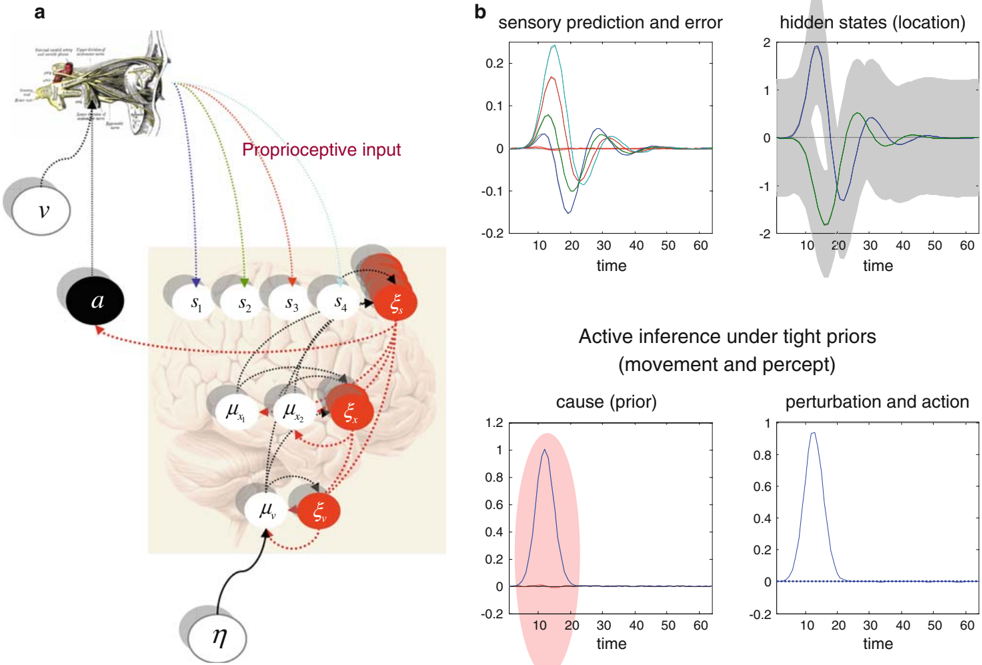
- In oculomotor simulations, tight priors on perturbations led to action that “countered almost immediately” the stimulus motion, while flat priors produced perceived motion; the paper reports a 6×6 = 36-channel sensory array in one retinal simulation.
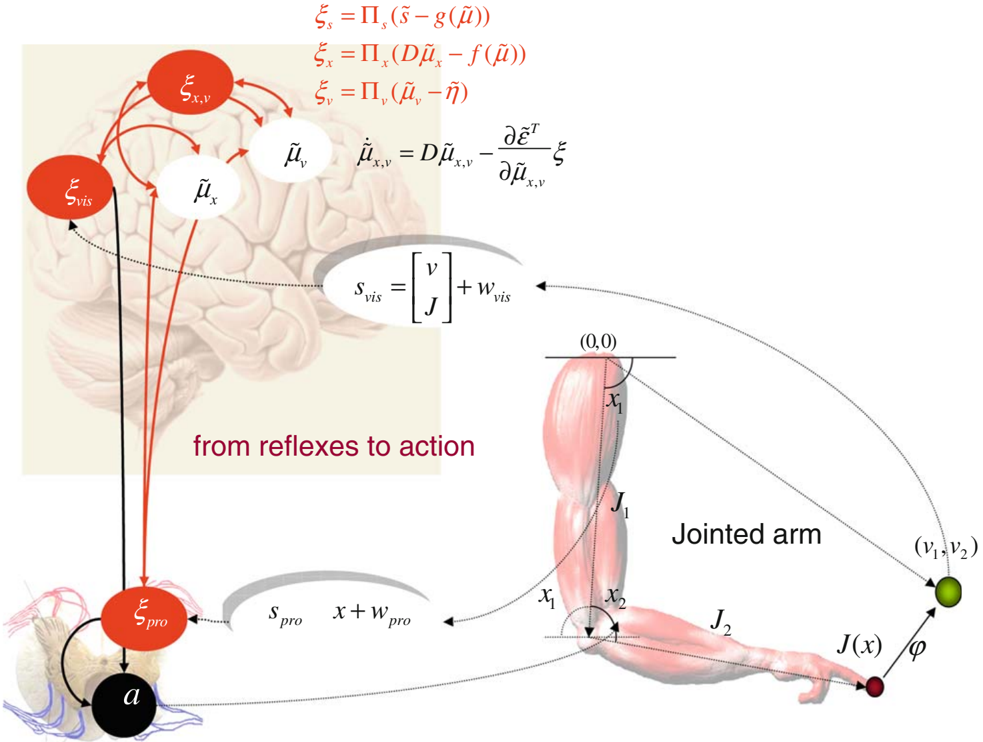
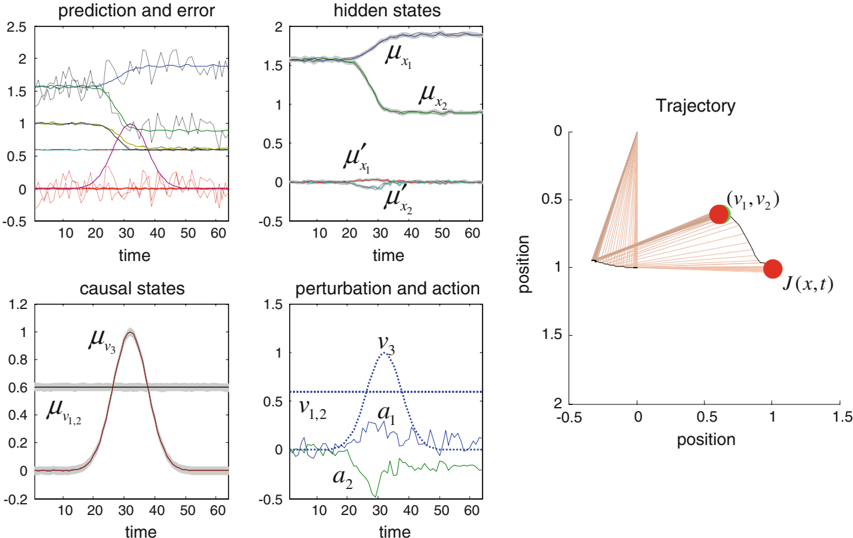
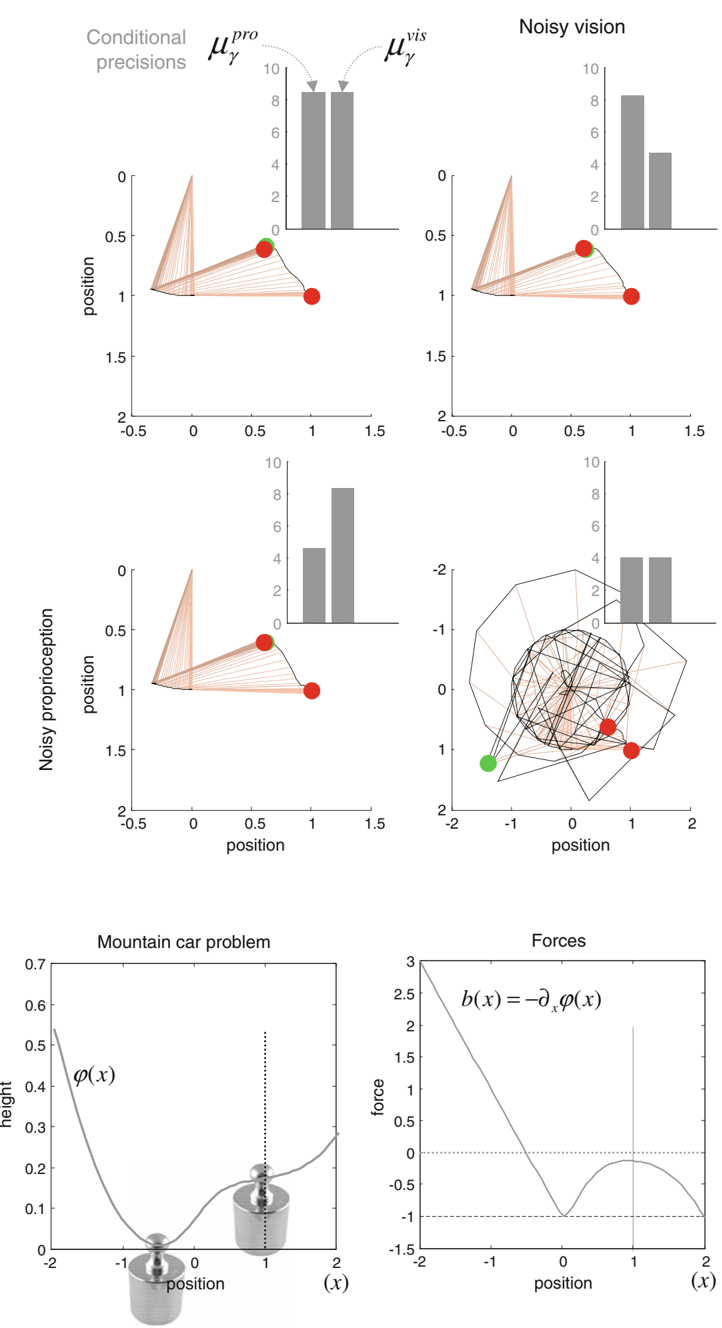
- In the cued reaching simulations, behavior was robust to sensory noise: proprioceptive noise alone could be compensated by vision, visual noise alone by proprioception, but when both modalities were noisy, reaching was compromised.
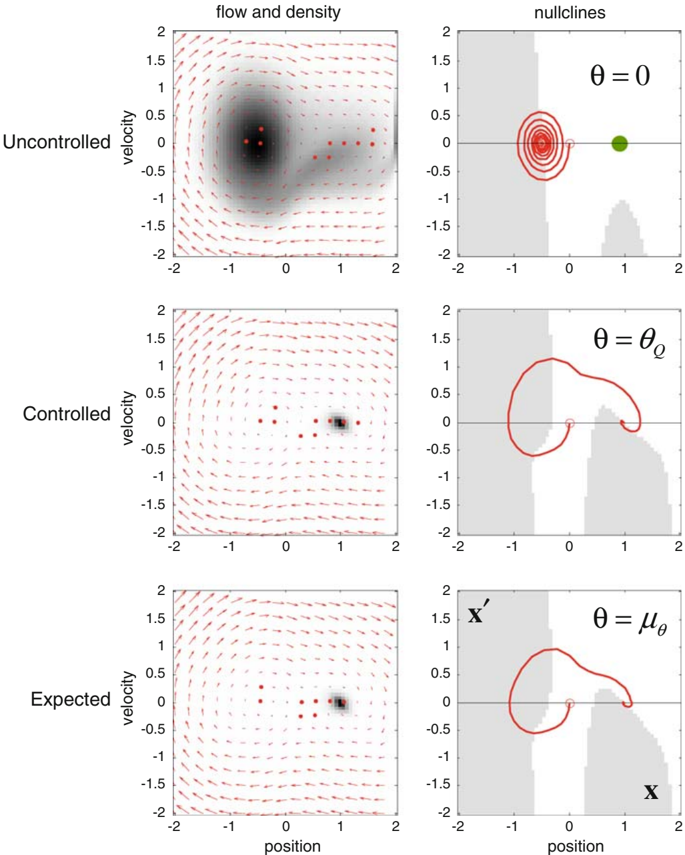
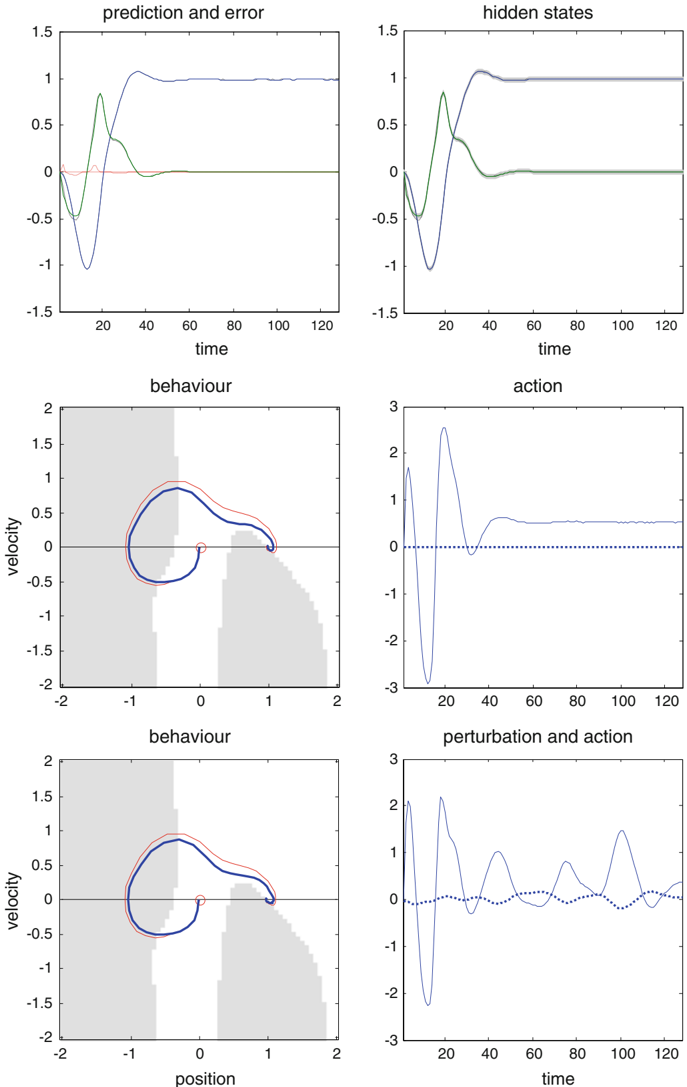
- In the goal-directed “mountain-car” simulation, the agent learned the controlled dynamics over 16 trials, and after learning it produced the required circuitous trajectory to the target; the paper notes that after 16 trials the parameters “converged roughly” to the control environment.
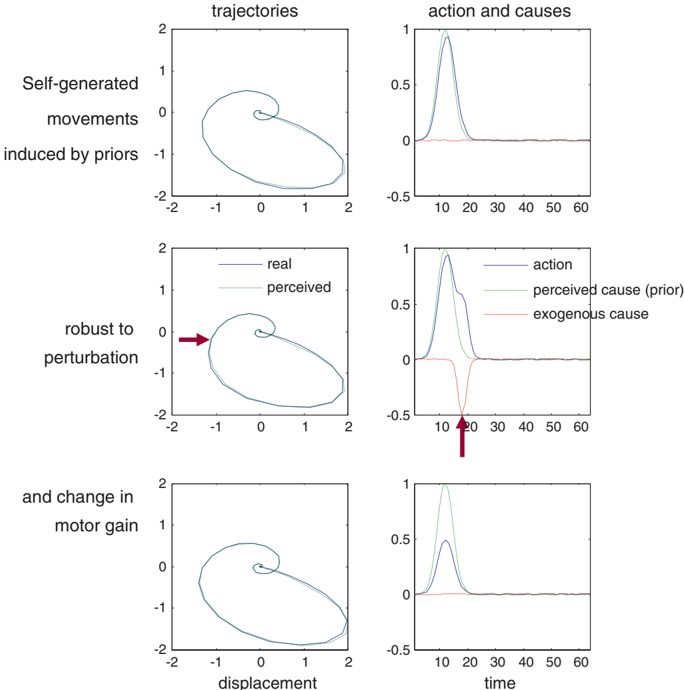
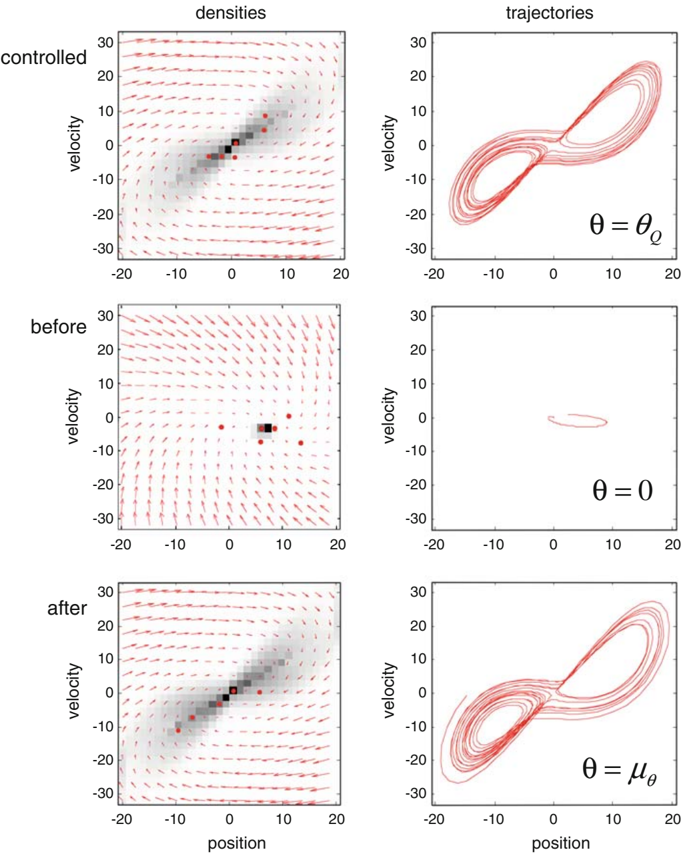
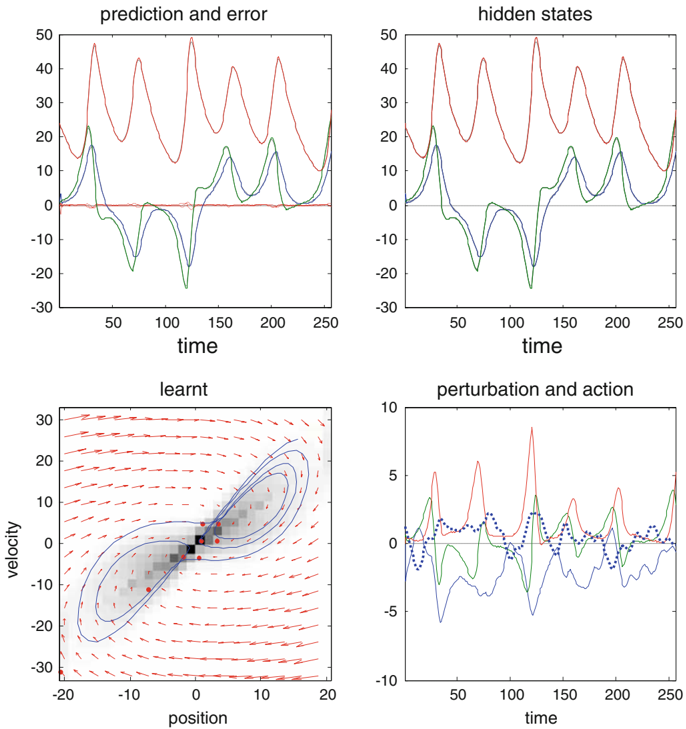
- In the autonomous-behavior simulation, after 16 trials of 512 time-bins, the agent learned to expect a Lorenz attractor and then continued to follow that learned trajectory even under perturbations, showing robustness to exogenous forces.
## Methods
- The paper is a theoretical and simulation study framed around the free-energy principle and active inference, with action and perception implemented through gradient descent on free energy under Gaussian/Laplace assumptions.
- It uses several toy dynamical systems: retinal stabilization/oculomotor control, two-joint arm reaching, the mountain-car problem, and a Lorenz-attractor learning task; one learning example uses 16 trials of 32 s time-bins, and another uses 16 trials of 512 time-bins.
- Analysis is based on generalized coordinates of motion, prediction errors, and variational (free-energy) updates of conditional expectations and precisions; the paper reports that all simulations were implemented with a single Matlab routine, `spm_ADEM.m`.
## Limitations
- The paper itself states that the simulations are simple and that many motor-control and sensorimotor issues are only addressed “superficially,” with the examples used mainly to “impart the intuitions behind active inference.”
- The text repeatedly says that some claims rely on simplifying assumptions, including Gaussian/Laplace approximations, generalized-state truncation, and assumptions about diffeomorphic sensory mappings (stated in the paper).
- Evident from the text: the results are based on idealized simulations and toy environments rather than empirical experiments on biological agents or neural recordings.
Model-written summary. Check it against the paper before relying on it.
Integrity signals
Registry
Cites
Statistics
Figures
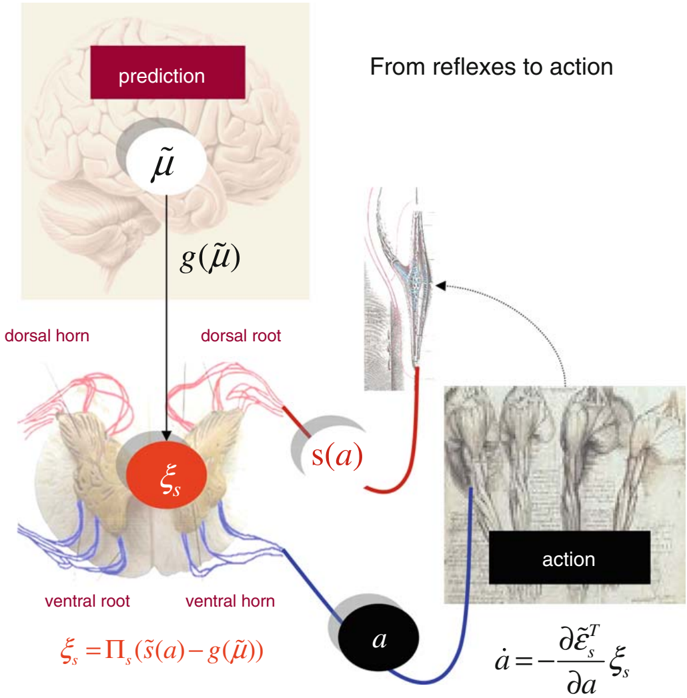
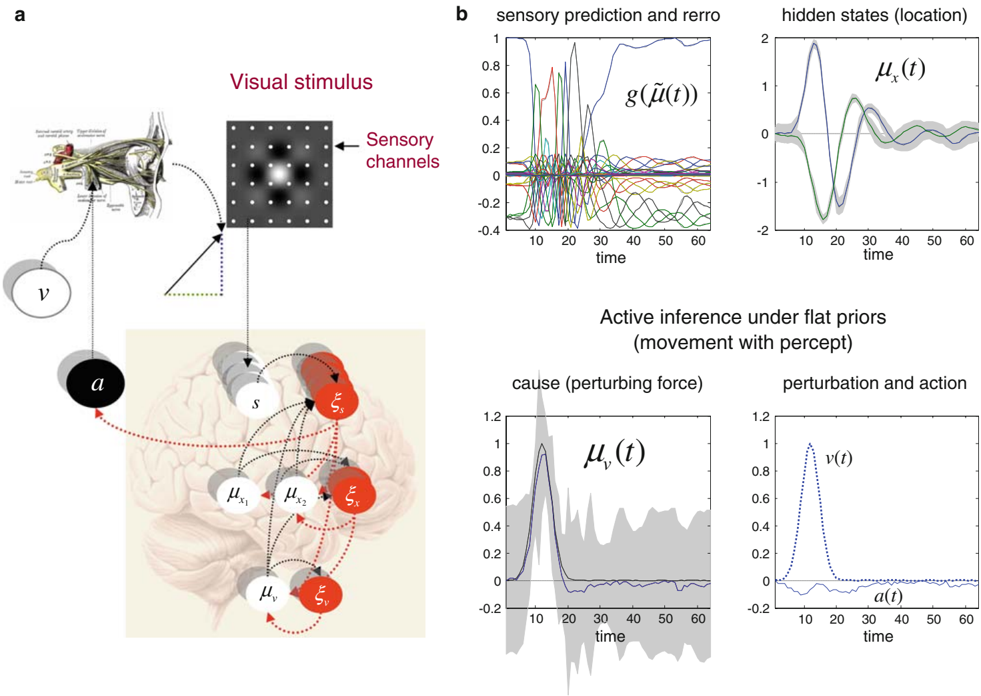
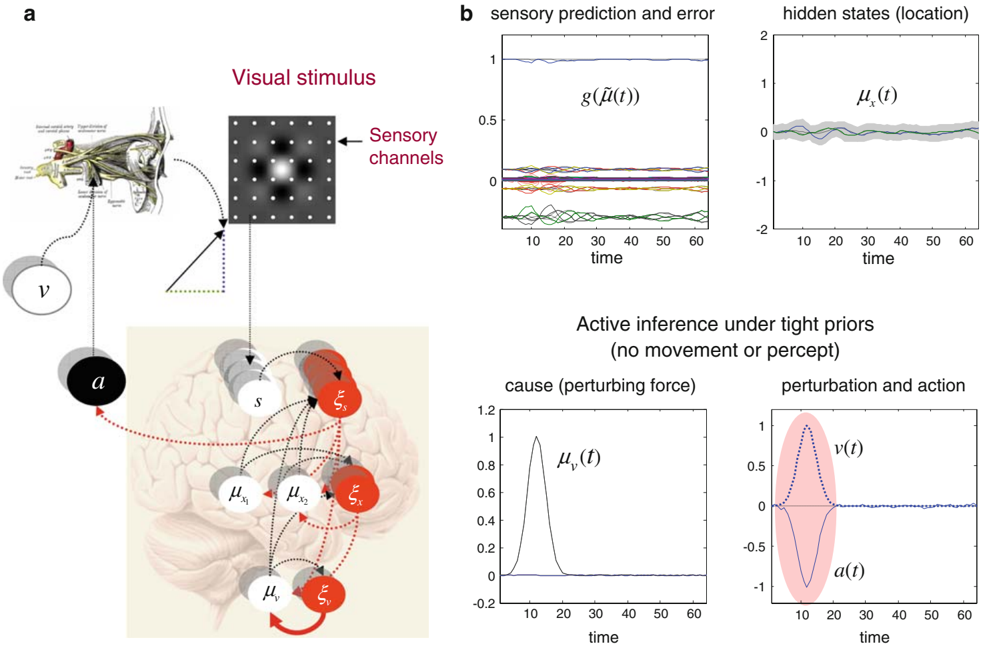
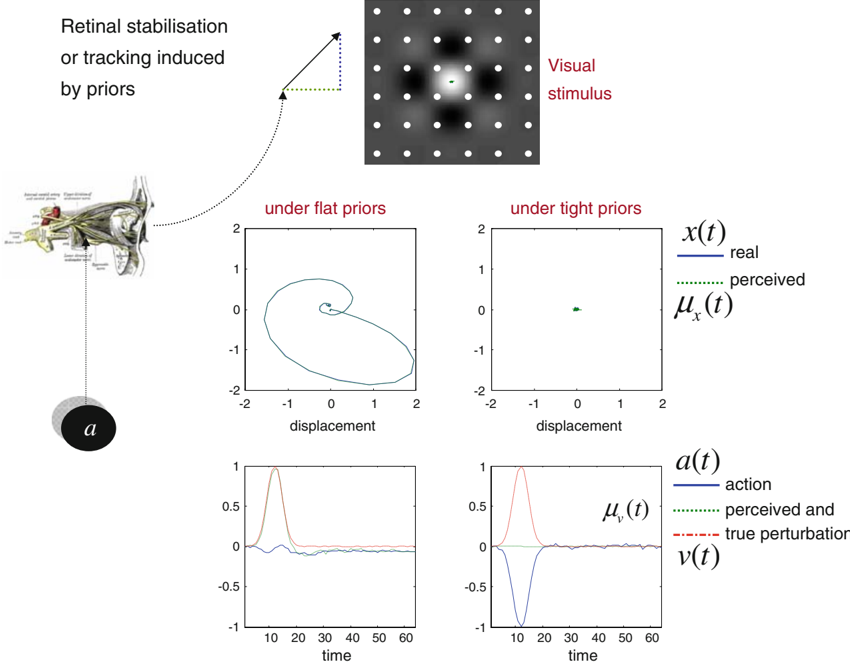
Verification
Claims the paper makes
10 Valid · 3 Not valid · 32 Not checked · 265 Own results and interpretations
The cited sources support only part of this claim — read each source’s verdict below.
In the paper
“This mixture of weighted error variance is related formally to phenomenological cost functions proposed to account for movement trajectories (cf.Todorov and Jordan 1998;Nakano et al. 1999;Berret et al. 2008).”
§ Action and behavior: a free-energy formulation > 3.1 Motor control and prediction errors
What the sources say
- Not checked — no full text of the sourcecites Todorov and Jordan 1998 matched to “Smoothness Maximization Along a Predefined Path Accurately Predicts the Speed Profiles of Complex Arm Movements” (1998) source
- Not checked — no full text of the sourcecites Nakano et al. 1999 matched to “Quantitative Examinations of Internal Representations for Arm Trajectory Planning: Minimum Commanded Torque Change Model” (1999) source
- Partly supportedcites Berret et al. 2008 matched to “The Inactivation Principle: Mathematical Solutions Minimizing the Absolute Work and Biological Implications for the Planning of Arm Movements” (2008) sourceExperimental — accuracy not yet measured
The Results (Theoretical Analysis; page unavailable) propose an integral cost combining absolute work with a weighted comfort term to model arm movements. The Introduction describes variance-based models separately, but our copy does not establish a formal relationship between weighted error variance and the paper’s cost function. (LLM, conf=0.82)
plainstates an association- Asserted: passes — The authors put it forward as true.
- Checkable: passes — It can be checked against evidence.
- Load-bearing: unclear — It is unclear whether the paper’s conclusions depend on it.
- Based: passes — The paper gives a reason why it holds.
The cited sources support only part of this claim — read each source’s verdict below.
In the paper
“Furthermore, this perspective on dopaminergic function fits comfortably with a gating role for dopamine (O'Reilly et al. 2002) in selecting the percepts that guide action (Redgrave et al. 1999).”
§ Action and behavior: a free-energy formulation > 7.1 Active inference and optimal control
What the sources say
- Not checked — no full text of the sourcecites O'Reilly et al. 2002 matched to “Prefrontal cortex and dynamic categorization tasks: representational organization and neuromodulatory control” (2002) source
- Partly supportedcites Redgrave et al. 1999 matched to “The basal ganglia: a vertebrate solution to the selection problem?” (1999) sourceExperimental — accuracy not yet measured
In “Dopaminergic regulation of switching” (pp. 13–14), the paper proposes that dopamine helps interrupt and reprioritize behavioral selections in response to salient stimuli. That supports a role in selecting actions guided by stimuli, but not the more specific claim that dopamine selects percepts. “NEW PERSPECTIVES” (p. 16) distinguishes selection for access to motor or cognitive resources from perception itself. (LLM, conf=0.84)
plainstates an association- Asserted: passes — The authors put it forward as true.
- Checkable: passes — It can be checked against evidence.
- Load-bearing: unclear — It is unclear whether the paper’s conclusions depend on it.
- Based: passes — The paper gives a reason why it holds.
The cited sources support only part of this claim — read each source’s verdict below.
In the paper
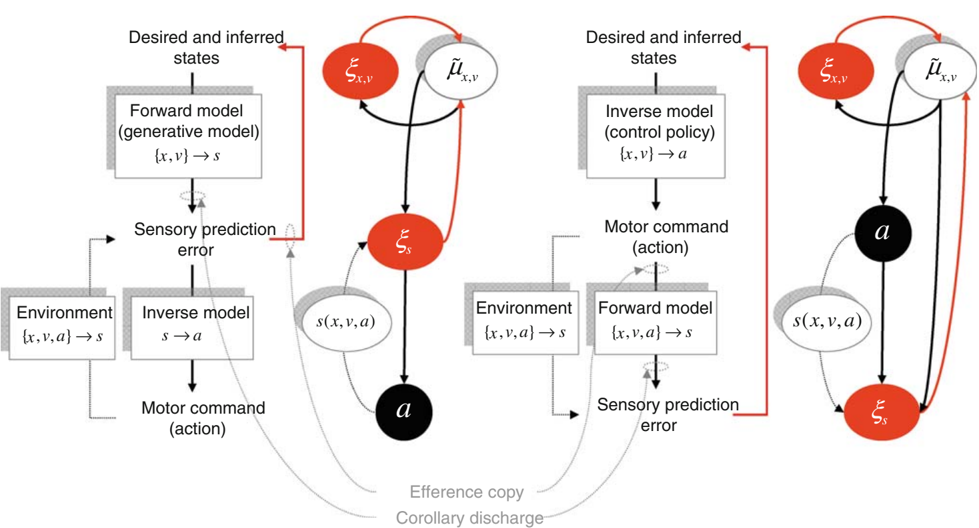
“Indeed, the motor plant is probably one of the most important aspects of the environment for predicting sensory input (see Grafton and Hamilton 2007).”
§ Action and behavior: a free-energy formulation > 7.3 Forward models in motor control
What the sources say
- Partly supportedcites Grafton and Hamilton 2007 matched to “Evidence for a distributed hierarchy of action representation in the brain” (2007) sourceExperimental — accuracy not yet measured
Section 4, “Computational models” (page unavailable), says forward models predict the motor plant’s state and turn motor commands into expected sensory consequences. It does not characterize the motor plant as an aspect of the environment or rank it among the most important factors for predicting sensory input. (LLM, conf=0.83)
hedgedstates an association- Asserted: passes — The authors put it forward as true.
- Checkable: passes — It can be checked against evidence.
- Load-bearing: unclear — It is unclear whether the paper’s conclusions depend on it.
- Based: passes — The paper gives a reason why it holds.
- Partly supported
A result the paper states — it cites no source for it, so there is none to check. The quote shows it is in the paper.
In the paper
“In other words, the image is stabilized in accordance with the prior expectation of no movement.”
§ Action and behavior: a free-energy formulation > 4.1.1 Retinal stabilization and oculomotor reflexes
plainstates a cause- Asserted: passes — The authors put it forward as true.
- Checkable: passes — It can be checked against evidence.
- Load-bearing: passes — The paper’s conclusions depend on it.
- Based: passes — The paper gives a reason why it holds.
- Rests on 3 assumptions not shown here.
A result the paper states — it cites no source for it, so there is none to check. The quote shows it is in the paper.
In the paper
“By manipulating its prior expectations on these perturbations, v(t), we can elicit very different behaviors from the agent.”
§ Action and behavior: a free-energy formulation > 4.1.1 Retinal stabilization and oculomotor reflexes
plainstates a cause- Asserted: passes — The authors put it forward as true.
- Checkable: passes — It can be checked against evidence.
- Load-bearing: passes — The paper’s conclusions depend on it.
- Based: passes — The paper gives a reason why it holds.
- Rests on 3 assumptions not shown here.
181 more claims
Create a free account to see all 310 claims and to verify the 1 reference still open.
- Probably not a substantial claim. 67
- It may state two separate claims as one. 67
- The quote only partly states this claim. 2
- Borderline: one of the tests for a substantial claim is unclear. 1
Claims other papers make about this one
Each is checked against this paper’s own text: does it say what the citing paper says it does?
The source backs part of the claim, not all of it — or backs it for a different population, condition or comparison.
In the citing paper
“The free energy principle (Friston et al. 2010; Badcock et al. 2019) thus casts control theoretic ‘essential variables’ in terms of high precision prior expectations.”
From Consciousness in active inference: Deep self-models, other minds, and the challenge of psychedelic-induced ego-dissolution (2021) · cites this paper as Friston et al. 2010
Experimental — accuracy not yet measuredThe source backs part of the claim, not all of it — or backs it for a different population, condition or comparison.
In the citing paper
“Given a chosen time window, accumulated log evidence could be approximated by the integral of free energy, a quantity known as “free action” (Friston K. et al., 2010).”
From Allostatic Self-efficacy: A Metacognitive Theory of Dyshomeostasis-Induced Fatigue and Depression (2016) · cites this paper as Friston K. et al., 2010
Experimental — accuracy not yet measuredThe cited source says what the claim attributes to it.
In the citing paper
“Also, if predictive models are continually probed by control signals that attempt to confirm the currently dominant model via active inference [21], the framework naturally accommodates the phasic physiological changes that accompany RHI induction [58,59] when these changes are taken to reflect altered autonomic control.”
From Interoceptive inference, emotion, and the embodied self (2013) · cites this paper as [21]
Experimental — accuracy not yet measuredThe cited source says what the claim attributes to it.
In the citing paper
“Thus, perception and action operate synergistically to minimise prediction errors and optimise our internal representations of the environment.”
From The depressed brain: an evolutionary systems theory (2017) · cites this paper as [11]
The cited source says what the claim attributes to it.
In the citing paper
“In the neurosciences, this is known as active inference [60, 61, 62].”
From The free energy principle made simpler but not too simple (2023) · cites this paper as [60]
4 more claims about this paper
Create a free account to see every claim other papers make about this one.
Citations
Cites
Rescorla, R. A. (1972) · Medical Entomology and Zoology · Cited by 9,661
A neural substrate of prediction and reward
Schultz, W., Dayan, P., & Montague, P. R. (1997) · Science · doi:10.1126/science.275.5306.1593 · Cited by 9,388 · cited 1×
“may call for a reappraisal of reinforcement learning as an explanation for behavior and, in particular, the role of dopamine in coding unpredicted reward (Montague et al. 1995; Schultz et al. 1997; Doya 2002): If dopamine encodes precision through its classical neuromodulatory effects (cf., Yu and Dayan 2005) how can…”
BackgroundWatkins, C. J. C. H., & Dayan, P. (1992) · Machine Learning · doi:10.1007/bf00992698 · Cited by 9,083
The free-energy principle: a unified brain theory?
Friston, K. (2010) · Nature Reviews Neuroscience · doi:10.1038/nrn2787 · Cited by 8,120
Self-citationAutopoiesis and Cognition: The Realization of the Living
Maturana, H. R., & Varela, F. J. (1980) · Boston Studies in the Philosophy and History of Science · doi:10.1007/978-94-009-8947-4 · Cited by 5,815
Emergence of simple-cell receptive field properties by learning a sparse code for natural images
Olshausen, B. A., & Field, D. J. (1996) · Nature · doi:10.1038/381607a0 · Cited by 5,694 · cited 1×
“This appeals to the principle of maximum information transfer (Linsker 1990), which has been very useful in understanding the emergence of things like receptive fields (e.g., Olshausen and Field 1996 ).”
BackgroundRao, R. P. N., & Ballard, D. H. (1999) · Nature Neuroscience · doi:10.1038/4580 · Cited by 5,483 · cited 4×
“The idea that the brain uses hierarchical inference has been established for years (Mumford 1992; Rao and Ballard 1998; Friston 2005; Friston et al. 2006) and provides a nice explanation for the hierarchical organization of cortical systems.”
BackgroundInfluentialA theory of cortical responses.
Friston, K. (2005) · Philosophical Transactions of the Royal Society B: Biological Sciences · doi:10.1098/rstb.2005.1622 · Cited by 4,578 · cited 6×
“Please see Friston et al. (2008) for a fuller description of the scheme implied by these circuit diagrams.”
BackgroundMethodInfluentialSelf-citationClassical conditioning II: Current research and theory.
Black, A. H., & Prokasy, W. F. (1972) · Appleton-Century-Crofts eBooks · Cited by 4,449
Watkins, C. J. C. H., & Dayan, P. (1992) · Machine Learning · doi:10.1023/a:1022676722315 · Cited by 3,907
Research works printed but not linked: 2
- 55. MacKay DJC (1995) Free-energy minimization algorithm for decoding and cryptoanalysis. Electron Lett 31:445-447
- 89. Watkins CJCH, Dayan P (1992) Q-learning. Mach Learn 8:279-292
Cited by
Items 701–800 of 847
A 400 micro W Tx/380 microW Rx 2.4GHz super-regenerative GaAs transceiver
McGregor, I. A., Whyte, G., Elgaid, K., Wasige, E., & Thayne, I. (2006) · Cited by 1
Adaptive discrimination of antigen risk by predictive coding in immune systemPreprint
Yoshido, K., & Naoki, H. (2021) · bioRxiv (Cold Spring Harbor Laboratory) · doi:10.1101/2021.12.12.472285
Auletta, G. (2011) · Oxford University Press eBooks · doi:10.1093/acprof:oso/9780199608485.003.0016
Auletta, G. (2011) · Oxford University Press eBooks · doi:10.1093/acprof:oso/9780199608485.003.0012
Auletta, G. (2011) · Oxford University Press eBooks · doi:10.1093/acprof:oso/9780199608485.003.0018
(2021) · Elsevier eBooks · doi:10.1016/b978-0-12-821343-8.00030-7
Massotte, P., & Corsi, P. (2015) · Wiley eBooks · doi:10.1002/9781119145356.biblio
Massotte, P., & Corsi, P. (2015) · Wiley eBooks · doi:10.1002/9781119232476.biblio
The Bayesian Brain hypothesis: an evolutionary approach to cognition?Preprint
Daunizeau, J. (2022) · PsyArXiv (OSF Preprints) · doi:10.31234/osf.io/vgw6q
Contextual expectancy, prior belief, and prediction error in early stage visual processing
Overell, A. M. (2022) · Queensland University of Technology · doi:10.5204/thesis.eprints.229732
Auletta, G. (2011) · Oxford University Press eBooks · doi:10.1093/acprof:oso/9780199608485.003.0001
Bader, R. (2013) · Springer eBooks · doi:10.1007/978-3-642-36098-5_11
Retrospective surprise: A computational component for active inferencePreprint
Katahira, K., Kunisato, Y., Okimura, T., et al. (2019) · doi:10.31234/osf.io/jtnqg
Auletta, G. (2011) · Oxford University Press eBooks · doi:10.1093/acprof:oso/9780199608485.003.0010
Auletta, G. (2011) · Oxford University Press eBooks · doi:10.1093/acprof:oso/9780199608485.003.0024
Auletta, G. (2011) · Oxford University Press eBooks · doi:10.1093/acprof:oso/9780199608485.003.0017
Auletta, G. (2011) · Oxford University Press eBooks · doi:10.1093/acprof:oso/9780199608485.003.0022
Auletta, G. (2011) · Oxford University Press eBooks · doi:10.1093/acprof:oso/9780199608485.003.0005
Auletta, G. (2011) · Oxford University Press eBooks · doi:10.1093/acprof:oso/9780199608485.003.0013
Auletta, G. (2011) · Oxford University Press eBooks · doi:10.1093/acprof:oso/9780199608485.003.0011
Thornton, C. (2022) · Neuropsychologia · doi:10.1016/j.neuropsychologia.2022.108281 · Cited by 1
Connecting movement and cognition through different modes of learning
Torres, E. B. (2022) · The Psychology of learning and motivation/The psychology of learning and motivation · doi:10.1016/bs.plm.2022.03.006 · Cited by 1
Harrison, A., Christensen, B. K., & Whitford, T. J. (2022) · doi:10.31234/osf.io/t2bwk
(2011) · Oxford University Press eBooks · doi:10.1093/acprof:oso/9780199608485.002.0003
(2011) · Oxford University Press eBooks · doi:10.1093/acprof:oso/9780199608485.002.0006
(2011) · Oxford University Press eBooks · doi:10.1093/acprof:oso/9780199608485.002.0009
(2011) · Oxford University Press eBooks · doi:10.1093/acprof:oso/9780199608485.002.0004
(2011) · Oxford University Press eBooks · doi:10.1093/acprof:oso/9780199608485.002.0007
(2011) · Oxford University Press eBooks · doi:10.1093/acprof:oso/9780199608485.002.0005
Ellis, R. (2018) · Cambridge University Press eBooks · doi:10.1017/9781107446809.006
Ellis, R. (2018) · Cambridge University Press eBooks · doi:10.1017/9781107446809.001
Ellis, R. (2018) · Cambridge University Press eBooks · doi:10.1017/9781107446809.009
Ellis, R. (2018) · Cambridge University Press eBooks · doi:10.1017/9781107446809.002
Ellis, R. (2018) · Cambridge University Press eBooks · doi:10.1017/9781107446809.007
Ellis, R. (2018) · Cambridge University Press eBooks · doi:10.1017/9781107446809.010
The Curious Incident of Indistinguishable Selves A Reply to Nešić
Beni, M. D. (2022) · International Studies in the Philosophy of Science · doi:10.1080/02698595.2022.2153215 · Cited by 1
“FEP, which is developed by Karl Friston and colleagues (Friston 2010; Friston et al. 2010; Moutoussis et al. 2014; Palacios et al. 2020) accounts for the self-organising systems’ cognition, perception, and adaptive action in”
BackgroundWorlds Apart: Are We Enclosed Inside Our Heads?
Sepúlveda-Pedro, M. A. (2023) · Springer eBooks · doi:10.1007/978-3-031-20282-7_2
Malekzadeh, P., & Plataniotis, K. N. (2022) · SSRN Electronic Journal · doi:10.2139/ssrn.4229967
Casting inference to the best explanation's lot with active inference
Beni, M. D. (2023) · Theoria · doi:10.1111/theo.12455 · Cited by 2
On-off synecdoche: a just good enough model of subjective experiencePreprint
Martinez‐Saito, M. (2023) · PsyArXiv (OSF Preprints) · doi:10.31234/osf.io/2b4nc · Cited by 1
Motor control as the control of perception
Parker, M. G. (2023) · Elsevier eBooks · doi:10.1016/b978-0-323-91165-8.00015-9 · Cited by 3
A Derived Functional Framework for Cognitive Computational Learning System
Feng, J., Zhang, & Luo (2026) · Cognitive Computation · doi:10.1007/s12559-026-10575-w · Cited by 1
“Predictive coding [6, 7] holds that our subjective experience is not a direct reflection of external reality.”
InfluentialSynergizing habits and goals with variational BayesPreprint
Han, D., Doya, K., Li, D., & Tani, J. (2023) · doi:10.31234/osf.io/v63yj
Habits and goals in synergy: a variational Bayesian framework for behaviorPreprint
Han, D., Doya, K., Li, D., & Tani, J. (2023) · arXiv (Cornell University) · doi:10.48550/arxiv.2304.05008
“On the other hand, goal-directed behavior is well captured by active inference (AIf) theory 11,12 .”
BackgroundFriston, K. J. (2023) · Behavioral and Brain Sciences · doi:10.1017/s0140525x2200276x
Self-citation刘, 翔. (2023) · Modern Linguistics · doi:10.12677/ml.2023.114221
de Vasconcelos, M. L. I. (2023) · Digital Library of Theses and Dissertations (Universidade de São Paulo) · doi:10.11606/d.8.2023.tde-17052023-114613 · Cited by 1
Harris, D., Arthur, T., Wilson, M., Gallais, B. L., Parsons, T. D., Dill, A., & Vine, S. J. (2023) · doi:10.31234/osf.io/654h3
Reinvigorating the Nineteenth Century Scientific Method: A Peirce-pective on Science
Pietarinen, A., & Beni, M. D. (2023) · Perspectives on Science · doi:10.1162/posc_a_00605 · Cited by 1
“Both proprioceptive and visual signaling mechanisms and the respective feedback loops work together to suppress sensory prediction errors, while sensory prediction errors are inhibited by changing sensory inputs through action (Friston et al. 2010).”
BackgroundMotor systems in developmental coordination disorder/dyspraxia
Gomez, A., & Huron, C. (2023) · Elsevier eBooks · doi:10.1016/b978-0-12-820480-1.00037-1 · Cited by 2
The Cruel and Unusual Phenomenologies of Torture and Solitary Confinement
Gallagher, S. (2023) · Oxford University Press eBooks · doi:10.1093/oso/9780198873068.003.0011
Autonomy in the Self-pattern: Implications for Deep Brain Stimulation and Affordance-based Therapies
Gallagher, S. (2023) · Oxford University Press eBooks · doi:10.1093/oso/9780198873068.003.0008
Disorder, Dissociation, and Disruption in Self-narrative
Gallagher, S. (2023) · Oxford University Press eBooks · doi:10.1093/oso/9780198873068.003.0006
Gallagher, S. (2023) · Oxford University Press eBooks · doi:10.1093/oso/9780198873068.003.0003
Mindfulness in the Self-pattern
Gallagher, S. (2023) · Oxford University Press eBooks · doi:10.1093/oso/9780198873068.003.0010
Gallagher, S. (2023) · Oxford University Press eBooks · doi:10.1093/oso/9780198873068.002.0004
Dynamical Relations in the Self-pattern and Psychopathology
Gallagher, S. (2023) · Oxford University Press eBooks · doi:10.1093/oso/9780198873068.003.0005
Gallagher, S. (2023) · Oxford University Press eBooks · doi:10.1093/oso/9780198873068.002.0007
Gallagher, S. (2023) · Oxford University Press eBooks · doi:10.1093/oso/9780198873068.002.0008
Artificial Transformations of the Self-pattern
Gallagher, S. (2023) · Oxford University Press eBooks · doi:10.1093/oso/9780198873068.003.0009
A Threefold Method for Studying Self-pattern Dynamics
Gallagher, S. (2023) · Oxford University Press eBooks · doi:10.1093/oso/9780198873068.003.0004 · Cited by 1
Gallagher, S. (2023) · Oxford University Press eBooks · doi:10.1093/oso/9780198873068.003.0002 · Cited by 1
Gallagher, S. (2023) · Oxford University Press eBooks · doi:10.1093/oso/9780198873068.002.0003
Fornal, M. (2023) · Językoznawstwo · doi:10.25312/j.6248
The Meltdown Pathway: A Multidisciplinary Account of Autistic MeltdownsPreprint
Soden, P. A., Bhat, A., Anderson, A. K., et al. (2024) · doi:10.31234/osf.io/27w9p
Self-citationPittroff, F. (2024) · Digitale Soziologie · doi:10.1515/9783839471814 · Cited by 1
Pittroff, F. (2024) · Digitale Soziologie · doi:10.1515/9783839471814-007
Processamento Preditivo: uma introdução à proposta de unificação da cognição humana
de Vasconcelos, M. L. I., Maia, T., & Sayeg, P. D. A. (2023) · Principia an international journal of epistemology · doi:10.5007/1808-1711.2023.e90891 · Cited by 5
Understanding Music and Aging through the lens of Bayesian InferencePreprint
Heng, G. J., Zhang, J., Bonneti, L., et al. (2024) · doi:10.31219/osf.io/aetbg
Prediction-Based False Memory: Predictions Alone Can Result in Robust False MemoriesPreprint
Bulatova, O., & Fukuda, K. (2024) · doi:10.31234/osf.io/5fb9q
From falling keys to dreams—Dynamic reorganization
Northoff, G. (2024) · Elsevier eBooks · doi:10.1016/b978-0-12-821935-5.00009-0
From Salvador Dali to dreams—topographic reorganization model of dreams
Northoff, G. (2024) · Elsevier eBooks · doi:10.1016/b978-0-12-821935-5.00019-3
Contextuality, Cognitive Engagement, and Active InferencePreprint
GUÉNIN--CARLUT, A. (2024) · doi:10.31219/osf.io/wtrgh
Measure for Measure: Operationalising Cognitive Realism
Beni, M. D. (2024) · Minds and Machines · doi:10.1007/s11023-024-09690-0
“Relying on generic equations that model the minimisation of free energy, FEP draws unificatory links between various fields in psychology, life science, computational neuroscience, and even social cognition (Friston, 2010; Hesp et al., 2019; Vasil et al., 2020).”
BackgroundZimmermann, M., & Lingnau, A. (2024) · Elsevier eBooks · doi:10.1016/b978-0-12-820480-1.00205-9
Prabakaran, M. (2024) · SSRN Electronic Journal · doi:10.2139/ssrn.4925036
DETERMINANTS OF ZAKAT PAYMENT: THE VIEWPOINT OF STAKEHOLDERS IN SEREMBAN
Thani, A. M., Muhammad, A., RAZAK, N. Y., Fatah, M. M. A., & bin Shaharudin, S. (2024) · Information Management and Business Review · doi:10.22610/imbr.v16i3(i)s.3910
“According to (Friston et al., 2010), perception is an active process that involves minimizing prediction errors by integrating sensory information with prior knowledge.”
BackgroundEmbodiment und Sense of Agency
Rieger, M., & Wenke, D. (2024) · Springer eBooks · doi:10.1007/978-3-662-68476-4_22
Refining the Allostatic Self-Efficacy Theory of Fatigue and Depression Using Causal Inference
Hess, A. J., von Werder, D., Harrison, O. K., Heinzle, J., & Stephan, K. E. (2024) · Entropy · doi:10.3390/e26121127 · Cited by 5
Contextuality, Cognitive Engagement, and Active Inference
GUÉNIN--CARLUT, A. (2024) · Communications in computer and information science · doi:10.1007/978-3-031-77138-5_17 · Cited by 5
Klein, A. M. (2025) · Oxford University Press eBooks · doi:10.1093/9780190085872.002.0007
Klein, A. M. (2025) · Oxford University Press eBooks · doi:10.1093/9780190085872.003.0009
Klein, A. M. (2025) · Oxford University Press eBooks · doi:10.1093/9780190085872.002.0006
Klein, A. M. (2025) · Oxford University Press eBooks · doi:10.1093/9780190085872.003.0010
Klein, A. M. (2025) · Oxford University Press eBooks · doi:10.1093/9780190085872.003.0011
Klein, A. M. (2025) · Oxford University Press eBooks · doi:10.1093/9780190085872.003.0006
Introduction: Warp and Weft in William James
Klein, A. M. (2025) · Oxford University Press eBooks · doi:10.1093/9780190085872.003.0001
Klein, A. M. (2025) · Oxford University Press eBooks · doi:10.1093/9780190085872.003.0005
Klein, A. M. (2025) · Oxford University Press eBooks · doi:10.1093/9780190085872.003.0003
Biographical & Historical Preliminaries
Klein, A. M. (2025) · Oxford University Press eBooks · doi:10.1093/9780190085872.003.0002
Klein, A. M. (2025) · Oxford University Press eBooks · doi:10.1093/9780190085872.003.0007
Klein, A. M. (2025) · Oxford University Press eBooks · doi:10.1093/9780190085872.003.0008
Klein, A. M. (2025) · Oxford University Press eBooks · doi:10.1093/9780190085872.003.0004
Metasensor: A Proposal for Sensor Evolution in Robotics
Braccini, M. (2025) · Sensors · doi:10.3390/s25030725 · Cited by 3
From unconscious inference to the beholder's share: predictive perception and human experiencePreprint
Seth, A. K. (2017) · PsyArXiv (OSF Preprints) · doi:10.31234/osf.io/zvbkp_v1
The Neuroanatomical Correlates of Visceral Pain: An Activation Likelihood Estimation Meta-Analysis
Müller, C. F., & Maxeiner, H. (2025) · Brain Sciences · doi:10.3390/brainsci15060651 · Cited by 1
“This process of neuronal adaptation referred to as predictive coding could be related to the activation of both the insula and cingulate cortex, which provide homeostatic set-points against which the feedback of visceral afferents is compared [13].”
Metadata
- Authors
- Friston, K. J., Daunizeau, J., Kilner, J., & Kiebel, S. J.
- Affiliations
- Wellcome Centre for Human Neuroimaging (GB)
- Corresponding author
- Friston, Karl J.
- Venue
- Biological Cybernetics
- Published
- 2010-02-11
- Volume
- 102
- Issue
- 3
- Pages
- 227-260
- ISSN
- 0340-1200 (ISSN-L)
- 1432-0770
- OpenAlex
- W2130195834
- Semantic Scholar
- 407bb3034daac0fb4fba3d4c09ef3a26dfbfcf5f
- Cited by
- 866
- References
- 100
- Citations by year
- 2026: 32 · 2025: 65 · 2024: 64 · 2023: 77 · 2022: 63 · 2021: 79 · 2020: 67 · 2019: 56 · 2018: 67 · 2017: 51 · 2016: 36 · 2015: 39 · 2014: 34 · 2013: 33 · 2012: 29
- FWCI
- 18.62
- Type
- journal article
- Language
- en
- Open access
- hybrid
- doi.org
- Licence
- cc-by-nc
- Locations
- Biological Cybernetics (publishedVersion, cc-by-nc)
- PubMed (publishedVersion)
- UCL Discovery (University College London) (submittedVersion)
- Max Planck Digital Library (submittedVersion)
- MPG.PuRe (Max Planck Society) (submittedVersion)
- Topics
- Life Sciences › Neuroscience › Cognitive Neuroscience › Embodied and Extended Cognition
- Social Sciences › Psychology › Social Psychology › Action Observation and Synchronization
- Life Sciences › Neuroscience › Cognitive Neuroscience › Motor Control and Adaptation
- Keywords
- free energy principle, active sampling, perceptual inference, motor control, oculomotor control, goal-directed movement, proprioception, perceptual learning
- MeSH terms
- Afferent Pathways, Animals, Bayes Theorem, Behavior, Brain, Computer Simulation, Humans, Learning, Models, Neurological
About these checks
Registry, retraction, Cites and statistics results are computed, not judged, with one exception: a printed reference that no index lists is read once by a model before it counts as a citation error. Claims are extracted by a model and kept only when their quote appears verbatim in the text; each cited source is then checked, with a model’s help, for whether it says what the claim relies on. Those verdicts can be wrong — read the claim’s quote and the cited source before relying on one.
The claim verdicts this report counts are experimental: their accuracy is not yet measured.
A language model drew the claims from the paper on 2026-10-10, under version 3 of the claim definition (model deepseek-v4.1-flash, prompt extract-v3).
A second model labelled each claim on 2026-10-10 (model jev-1.13-20260917, definition revision gold-guideline-v0.2).
Cited sources are checked with a language model’s help (gpt-6-sol).
Statistics and arithmetic are recomputed, not judged.
Confidence bands are shown only for fields calibrated on our annotated test set. None is calibrated yet, so no band is shown.
What counts as a claim ›How we measure confidence ›How we check this ›
Are you an author, or do you see a problem with this page? Request a review
Data sources
Bibliographic data: Semantic Scholar, OpenAlex, Crossref.
Contains information from the Semantic Scholar Academic Graph Datasets, made available under the ODC Attribution License (ODC-BY 1.0).
Semantic Scholar’s data is described in: Kinney, R., et al. (2023). The Semantic Scholar Open Data Platform. arXiv:2301.10140.
