

Action and behavior: a free-energy formulation
Open accessThe DOI matches its Crossref record; 102 of the 102 references it cites were found in a registry or an index; 10 of the 63 sources its claims cite were checked for support.
Abstract
We have previously tried to explain perceptual inference and learning under a free-energy principle that pursues Helmholtz's agenda to understand the brain in terms of energy minimization. It is fairly easy to show that making inferences about the causes of sensory data can be cast as the minimization of a free-energy bound on the likelihood of sensory inputs, given an internal model of how they were caused. In this article, we consider what would happen if the data themselves were sampled to minimize this bound. It transpires that the ensuing active sampling or inference is mandated by ergodic arguments based on the very existence of adaptive agents. Furthermore, it accounts for many aspects of motor behavior; from retinal stabilization to goal-seeking. In particular, it suggests that motor control can be understood as fulfilling prior expectations about proprioceptive sensations. This formulation can explain why adaptive behavior emerges in biological agents and suggests a simple alternative to optimal control theory. We illustrate these points using simulations of oculomotor control and then apply to same principles to cued and goal-directed movements. In short, the free-energy formulation may provide an alternative perspective on the motor control that places it in an intimate relationship with perception.
Overview
CoChat Summary
## TL;DR
This paper argues that action, like perception, can be understood as minimizing free energy: agents do not select actions by reward maximization, but by fulfilling prior expectations about the sensory consequences of movement. Through simple simulations, it shows that this framework can produce retinal stabilization, intended movements, multimodal reaching, goal-directed behavior, and learned autonomous trajectories.
## Key findings
- Action can be cast as the suppression of sensory prediction error: the paper states that “the only thing that action can affect is the prediction error at the sensory level,” and that movement is driven by sensory prediction errors rather than explicit motor commands.
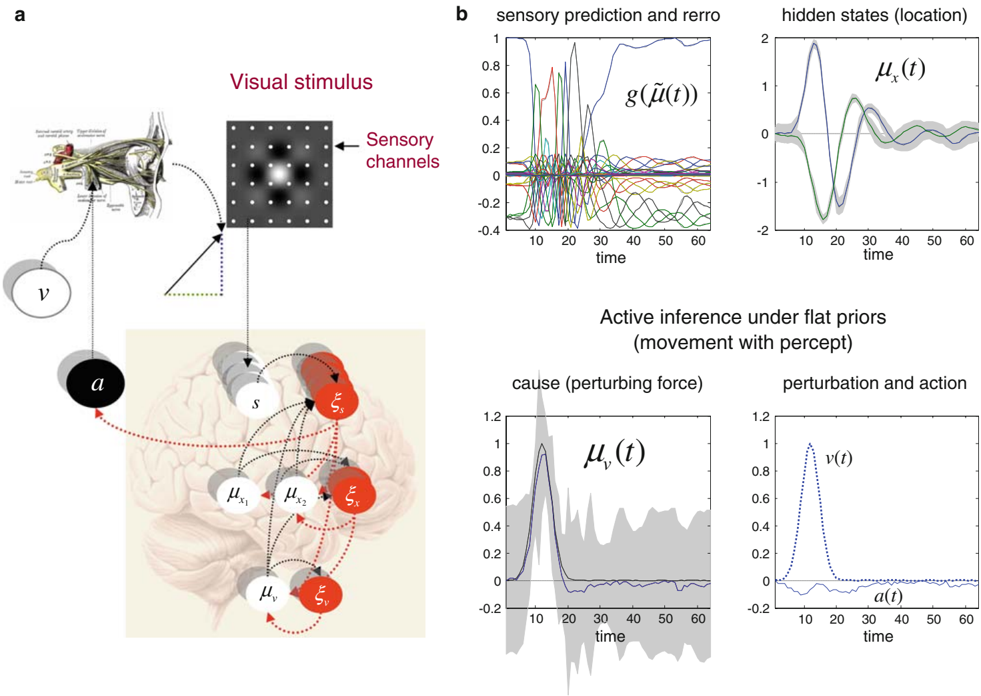
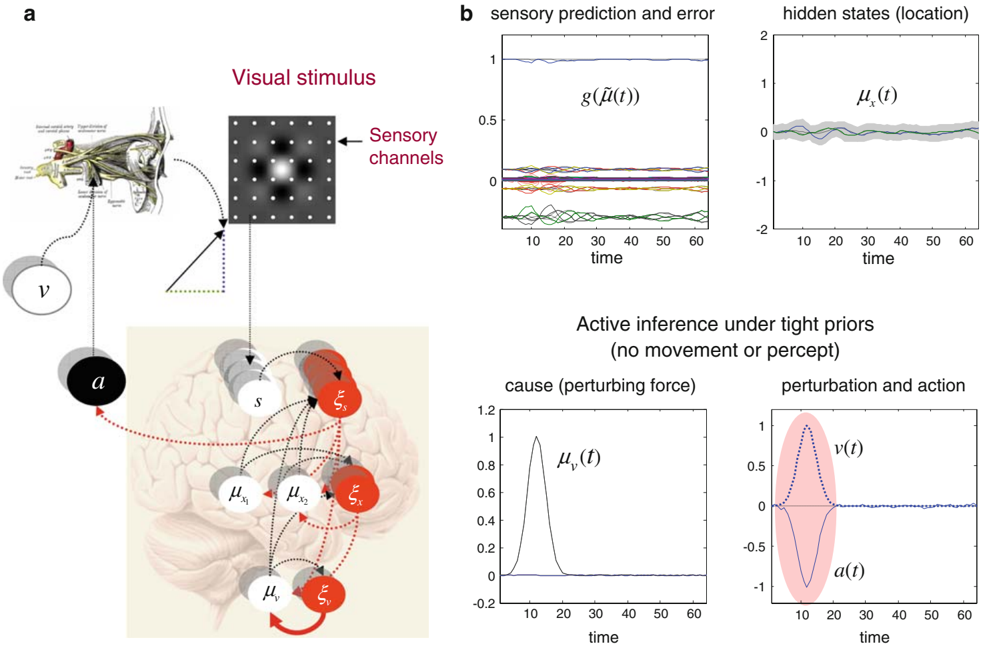
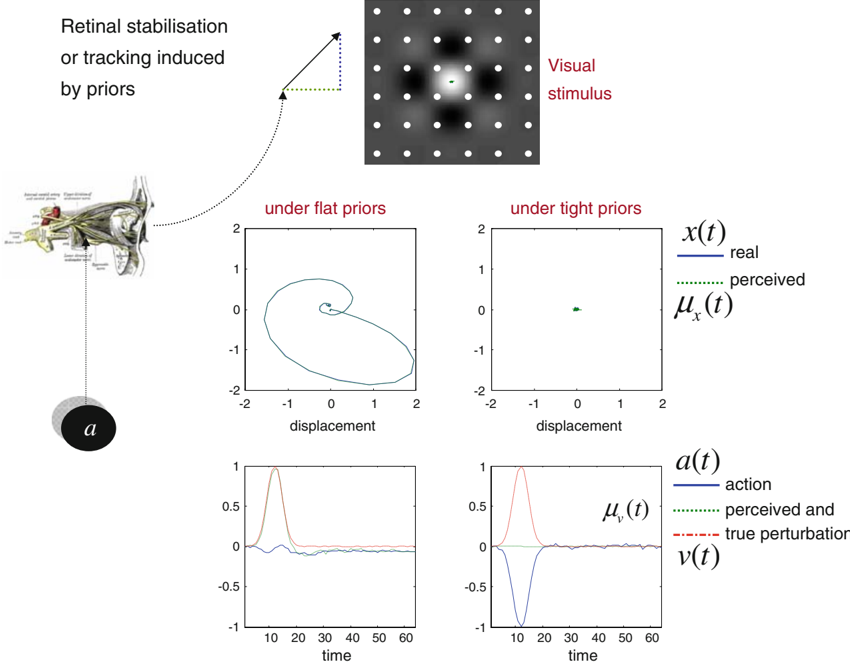
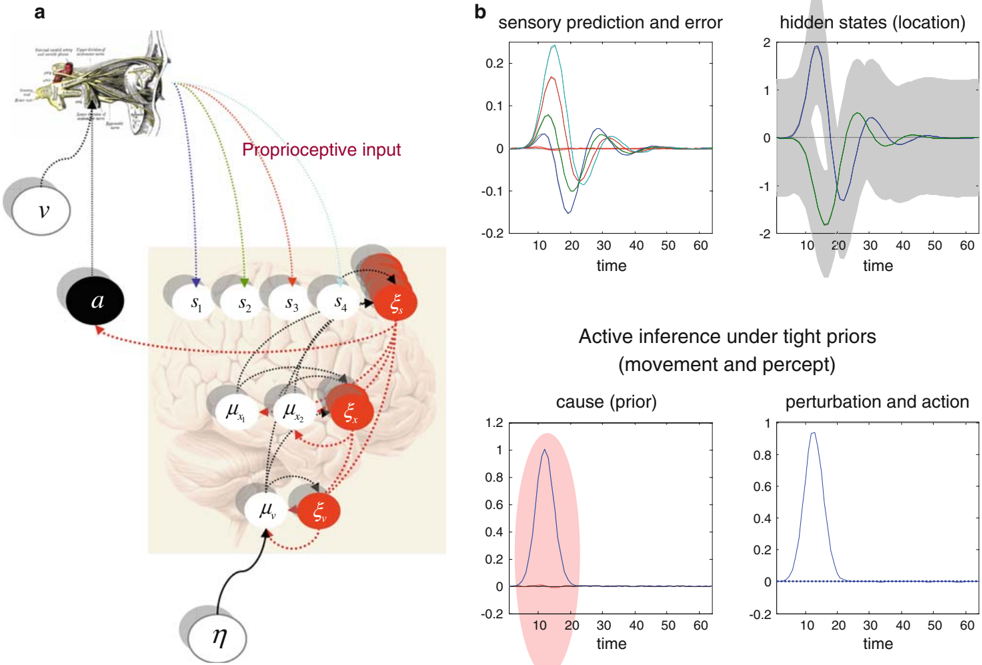
- In oculomotor simulations, tight priors on perturbations led to action that “countered almost immediately” the stimulus motion, while flat priors produced perceived motion; the paper reports a 6×6 = 36-channel sensory array in one retinal simulation.
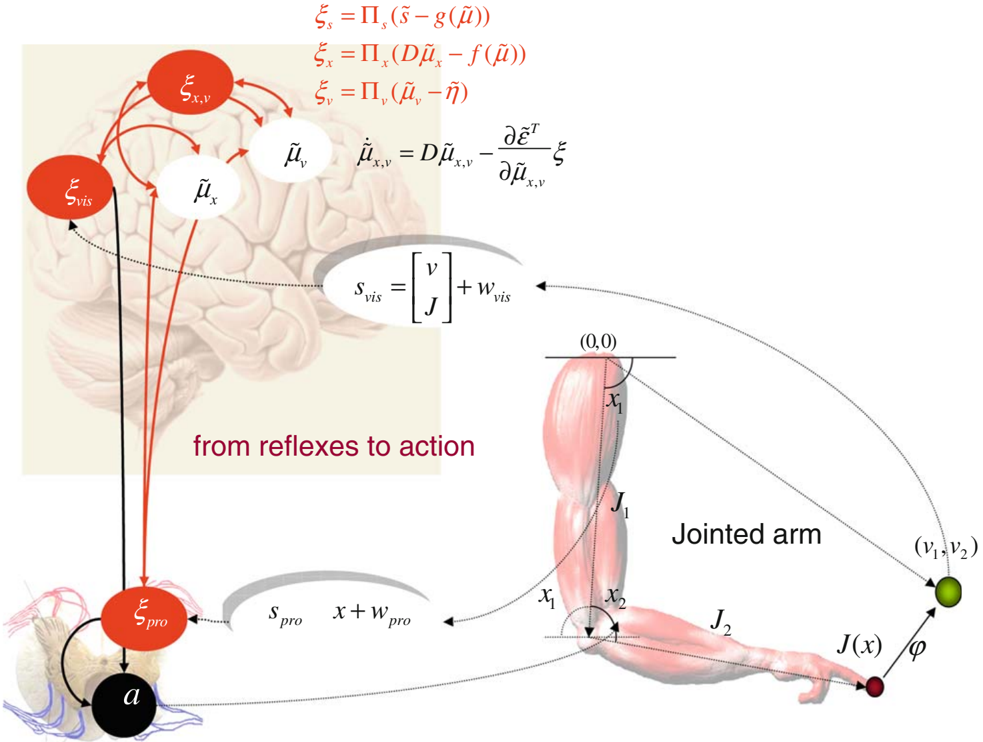
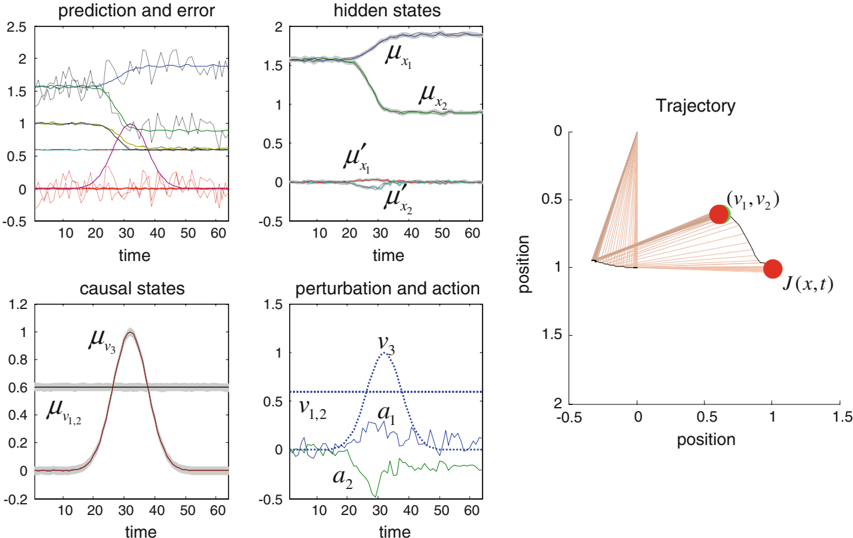
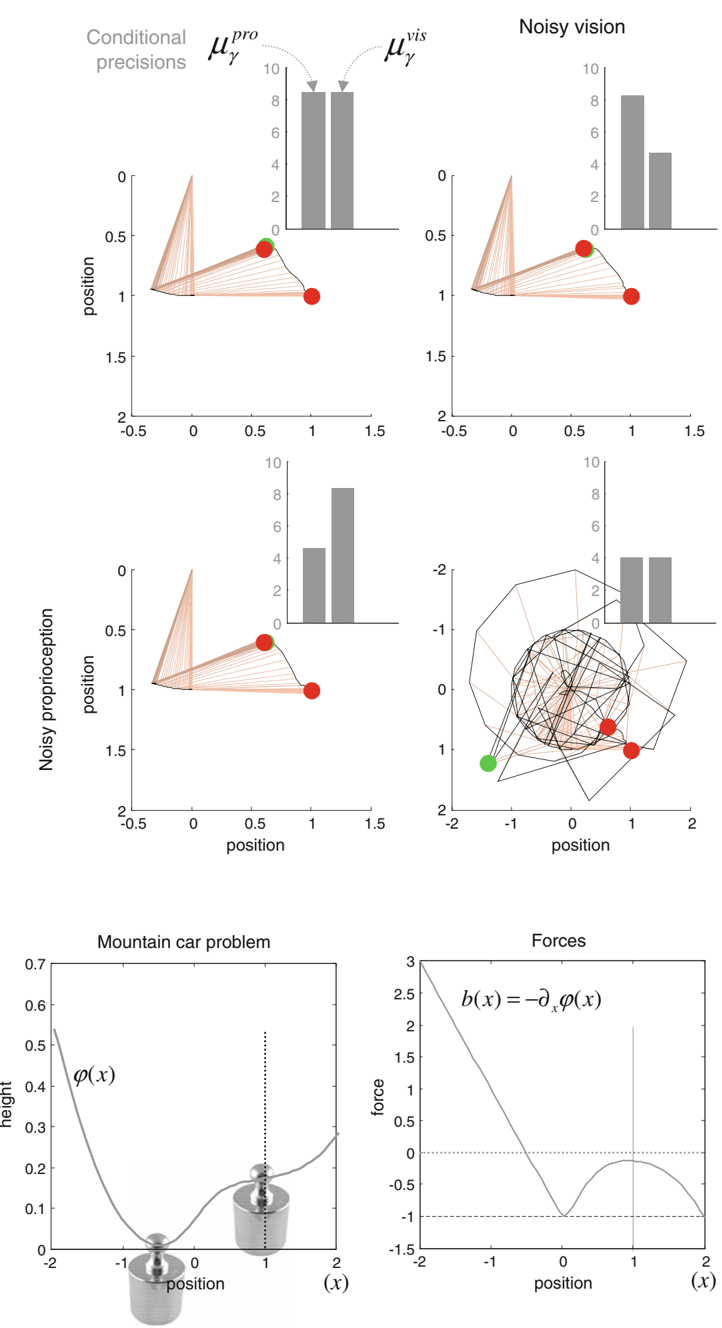
- In the cued reaching simulations, behavior was robust to sensory noise: proprioceptive noise alone could be compensated by vision, visual noise alone by proprioception, but when both modalities were noisy, reaching was compromised.
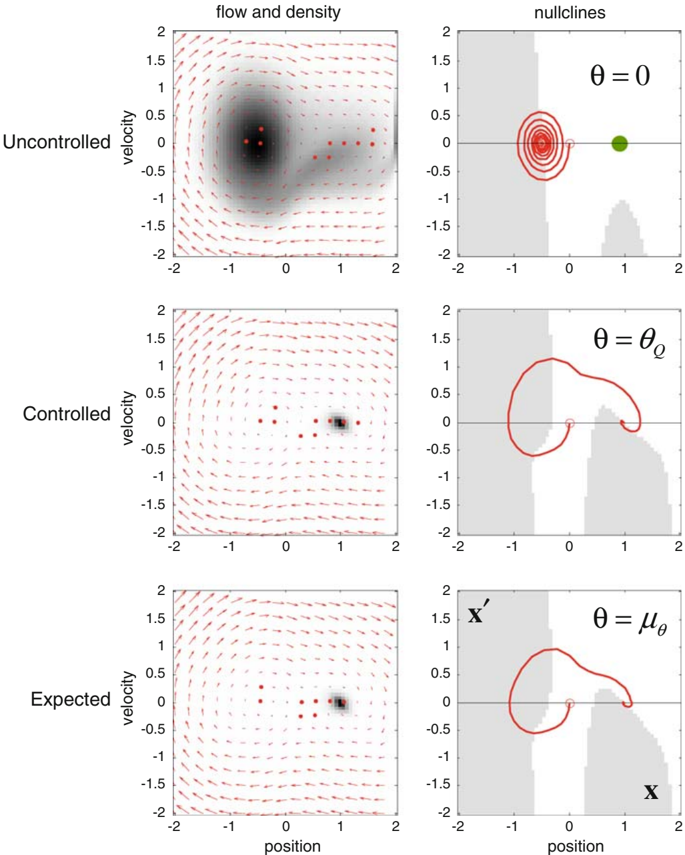
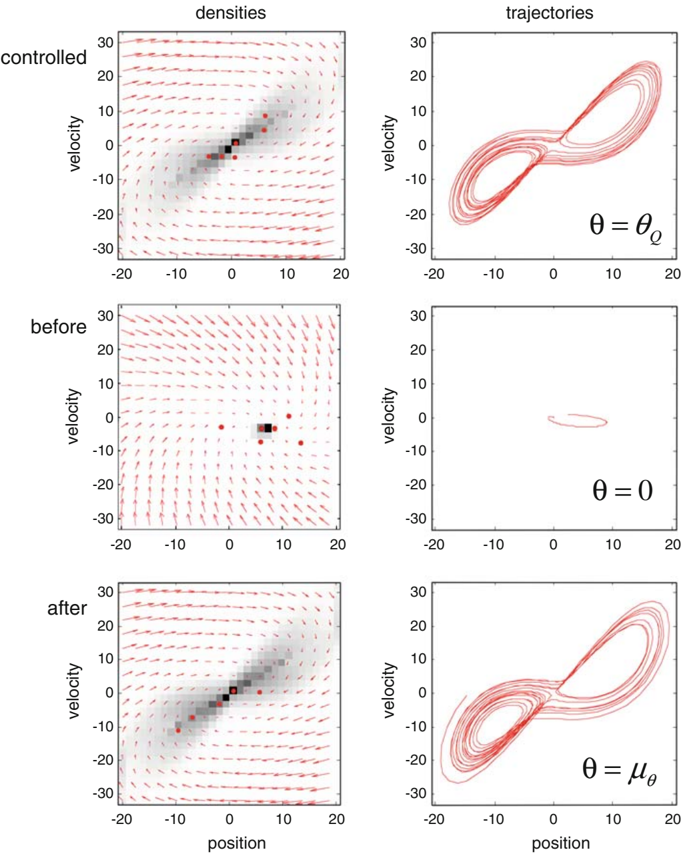
- In the goal-directed “mountain-car” simulation, the agent learned the controlled dynamics over 16 trials, and after learning it produced the required circuitous trajectory to the target; the paper notes that after 16 trials the parameters “converged roughly” to the control environment.
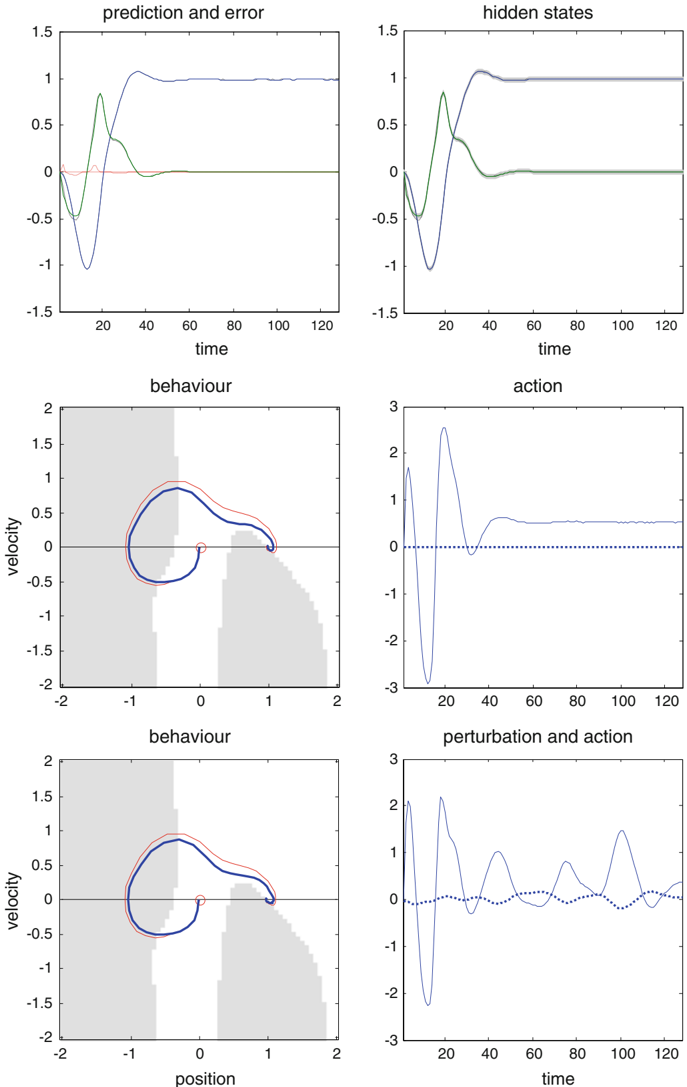
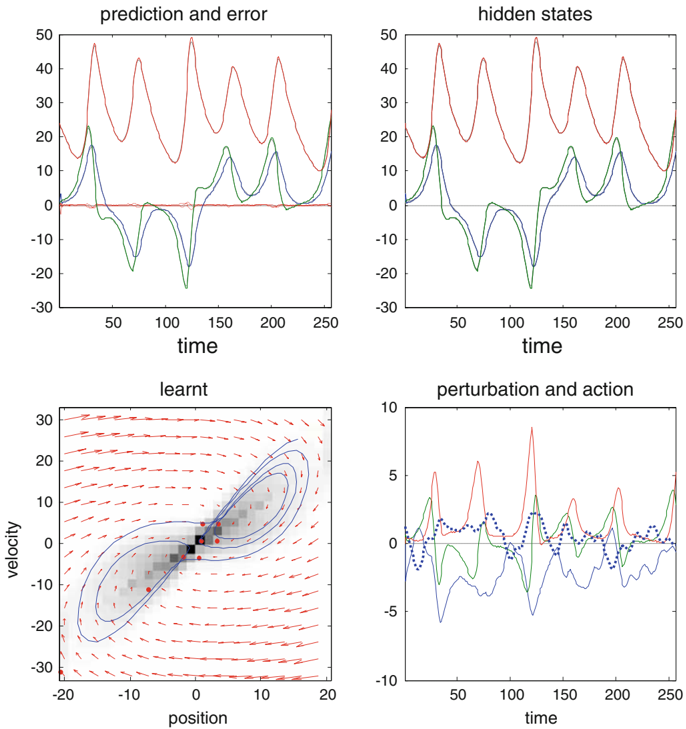
- In the autonomous-behavior simulation, after 16 trials of 512 time-bins, the agent learned to expect a Lorenz attractor and then continued to follow that learned trajectory even under perturbations, showing robustness to exogenous forces.
## Methods
- The paper is a theoretical and simulation study framed around the free-energy principle and active inference, with action and perception implemented through gradient descent on free energy under Gaussian/Laplace assumptions.
- It uses several toy dynamical systems: retinal stabilization/oculomotor control, two-joint arm reaching, the mountain-car problem, and a Lorenz-attractor learning task; one learning example uses 16 trials of 32 s time-bins, and another uses 16 trials of 512 time-bins.
- Analysis is based on generalized coordinates of motion, prediction errors, and variational (free-energy) updates of conditional expectations and precisions; the paper reports that all simulations were implemented with a single Matlab routine, `spm_ADEM.m`.
## Limitations
- The paper itself states that the simulations are simple and that many motor-control and sensorimotor issues are only addressed “superficially,” with the examples used mainly to “impart the intuitions behind active inference.”
- The text repeatedly says that some claims rely on simplifying assumptions, including Gaussian/Laplace approximations, generalized-state truncation, and assumptions about diffeomorphic sensory mappings (stated in the paper).
- Evident from the text: the results are based on idealized simulations and toy environments rather than empirical experiments on biological agents or neural recordings.
Model-written summary. Check it against the paper before relying on it.
Integrity signals
Registry
Cites
Statistics
Figures
Verification
Claims the paper makes
10 Valid · 3 Not valid · 32 Not checked · 265 Own results and interpretations
The cited sources support only part of this claim — read each source’s verdict below.
In the paper
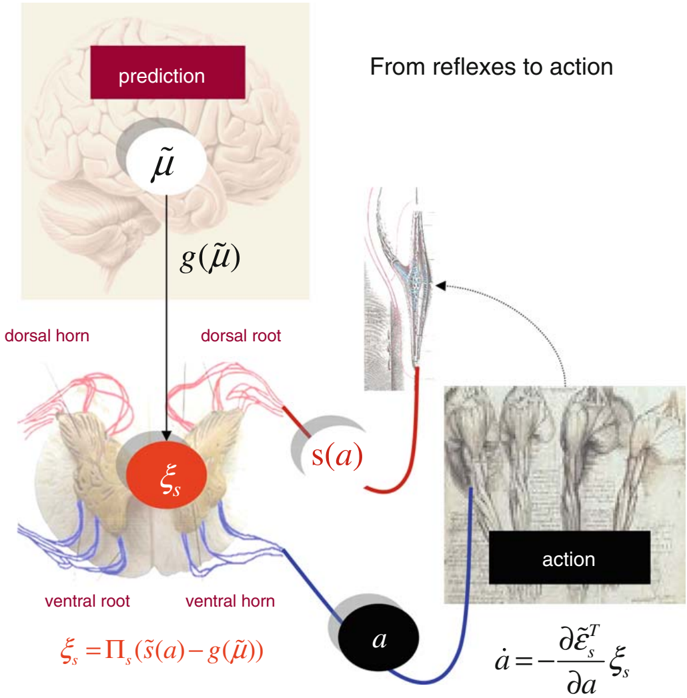
“This mixture of weighted error variance is related formally to phenomenological cost functions proposed to account for movement trajectories (cf.Todorov and Jordan 1998;Nakano et al. 1999;Berret et al. 2008).”
§ Action and behavior: a free-energy formulation > 3.1 Motor control and prediction errors
What the sources say
- Not checked — no full text of the sourcecites Todorov and Jordan 1998 matched to “Smoothness Maximization Along a Predefined Path Accurately Predicts the Speed Profiles of Complex Arm Movements” (1998) source
- Not checked — no full text of the sourcecites Nakano et al. 1999 matched to “Quantitative Examinations of Internal Representations for Arm Trajectory Planning: Minimum Commanded Torque Change Model” (1999) source
- Partly supportedcites Berret et al. 2008 matched to “The Inactivation Principle: Mathematical Solutions Minimizing the Absolute Work and Biological Implications for the Planning of Arm Movements” (2008) sourceExperimental — accuracy not yet measured
The Results (Theoretical Analysis; page unavailable) propose an integral cost combining absolute work with a weighted comfort term to model arm movements. The Introduction describes variance-based models separately, but our copy does not establish a formal relationship between weighted error variance and the paper’s cost function. (LLM, conf=0.82)
plainstates an association- Asserted: passes — The authors put it forward as true.
- Checkable: passes — It can be checked against evidence.
- Load-bearing: unclear — It is unclear whether the paper’s conclusions depend on it.
- Based: passes — The paper gives a reason why it holds.
The cited sources support only part of this claim — read each source’s verdict below.
In the paper
“Furthermore, this perspective on dopaminergic function fits comfortably with a gating role for dopamine (O'Reilly et al. 2002) in selecting the percepts that guide action (Redgrave et al. 1999).”
§ Action and behavior: a free-energy formulation > 7.1 Active inference and optimal control
What the sources say
- Not checked — no full text of the sourcecites O'Reilly et al. 2002 matched to “Prefrontal cortex and dynamic categorization tasks: representational organization and neuromodulatory control” (2002) source
- Partly supportedcites Redgrave et al. 1999 matched to “The basal ganglia: a vertebrate solution to the selection problem?” (1999) sourceExperimental — accuracy not yet measured
In “Dopaminergic regulation of switching” (pp. 13–14), the paper proposes that dopamine helps interrupt and reprioritize behavioral selections in response to salient stimuli. That supports a role in selecting actions guided by stimuli, but not the more specific claim that dopamine selects percepts. “NEW PERSPECTIVES” (p. 16) distinguishes selection for access to motor or cognitive resources from perception itself. (LLM, conf=0.84)
plainstates an association- Asserted: passes — The authors put it forward as true.
- Checkable: passes — It can be checked against evidence.
- Load-bearing: unclear — It is unclear whether the paper’s conclusions depend on it.
- Based: passes — The paper gives a reason why it holds.
The cited sources support only part of this claim — read each source’s verdict below.
In the paper
“Indeed, the motor plant is probably one of the most important aspects of the environment for predicting sensory input (see Grafton and Hamilton 2007).”
§ Action and behavior: a free-energy formulation > 7.3 Forward models in motor control
What the sources say
- Partly supportedcites Grafton and Hamilton 2007 matched to “Evidence for a distributed hierarchy of action representation in the brain” (2007) sourceExperimental — accuracy not yet measured
Section 4, “Computational models” (page unavailable), says forward models predict the motor plant’s state and turn motor commands into expected sensory consequences. It does not characterize the motor plant as an aspect of the environment or rank it among the most important factors for predicting sensory input. (LLM, conf=0.83)
hedgedstates an association- Asserted: passes — The authors put it forward as true.
- Checkable: passes — It can be checked against evidence.
- Load-bearing: unclear — It is unclear whether the paper’s conclusions depend on it.
- Based: passes — The paper gives a reason why it holds.
- Partly supported
A result the paper states — it cites no source for it, so there is none to check. The quote shows it is in the paper.
In the paper
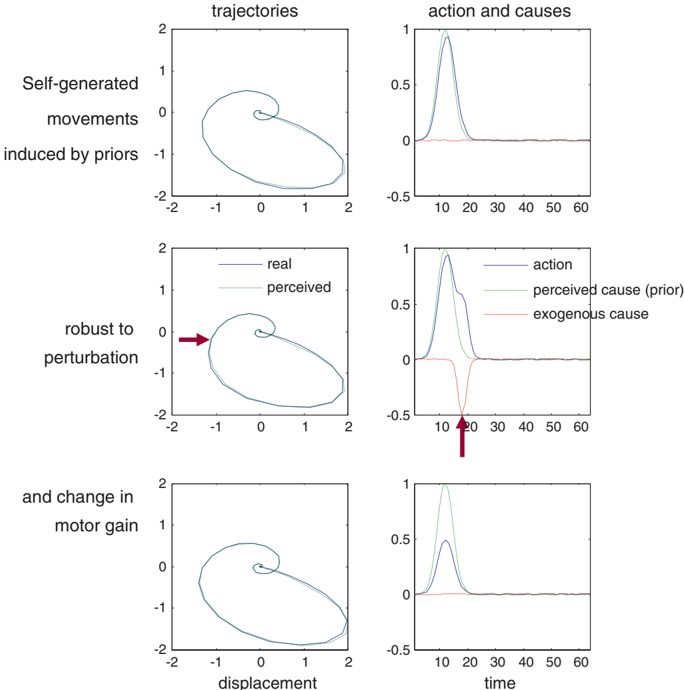
“In other words, the image is stabilized in accordance with the prior expectation of no movement.”
§ Action and behavior: a free-energy formulation > 4.1.1 Retinal stabilization and oculomotor reflexes
plainstates a cause- Asserted: passes — The authors put it forward as true.
- Checkable: passes — It can be checked against evidence.
- Load-bearing: passes — The paper’s conclusions depend on it.
- Based: passes — The paper gives a reason why it holds.
- Rests on 3 assumptions not shown here.
A result the paper states — it cites no source for it, so there is none to check. The quote shows it is in the paper.
In the paper
“By manipulating its prior expectations on these perturbations, v(t), we can elicit very different behaviors from the agent.”
§ Action and behavior: a free-energy formulation > 4.1.1 Retinal stabilization and oculomotor reflexes
plainstates a cause- Asserted: passes — The authors put it forward as true.
- Checkable: passes — It can be checked against evidence.
- Load-bearing: passes — The paper’s conclusions depend on it.
- Based: passes — The paper gives a reason why it holds.
- Rests on 3 assumptions not shown here.
181 more claims
Create a free account to see all 310 claims and to verify the 1 reference still open.
- Probably not a substantial claim. 67
- It may state two separate claims as one. 67
- The quote only partly states this claim. 2
- Borderline: one of the tests for a substantial claim is unclear. 1
Claims other papers make about this one
Each is checked against this paper’s own text: does it say what the citing paper says it does?
The source backs part of the claim, not all of it — or backs it for a different population, condition or comparison.
In the citing paper
“The free energy principle (Friston et al. 2010; Badcock et al. 2019) thus casts control theoretic ‘essential variables’ in terms of high precision prior expectations.”
From Consciousness in active inference: Deep self-models, other minds, and the challenge of psychedelic-induced ego-dissolution (2021) · cites this paper as Friston et al. 2010
Experimental — accuracy not yet measuredThe source backs part of the claim, not all of it — or backs it for a different population, condition or comparison.
In the citing paper
“Given a chosen time window, accumulated log evidence could be approximated by the integral of free energy, a quantity known as “free action” (Friston K. et al., 2010).”
From Allostatic Self-efficacy: A Metacognitive Theory of Dyshomeostasis-Induced Fatigue and Depression (2016) · cites this paper as Friston K. et al., 2010
Experimental — accuracy not yet measuredThe cited source says what the claim attributes to it.
In the citing paper
“Also, if predictive models are continually probed by control signals that attempt to confirm the currently dominant model via active inference [21], the framework naturally accommodates the phasic physiological changes that accompany RHI induction [58,59] when these changes are taken to reflect altered autonomic control.”
From Interoceptive inference, emotion, and the embodied self (2013) · cites this paper as [21]
Experimental — accuracy not yet measuredThe cited source says what the claim attributes to it.
In the citing paper
“Thus, perception and action operate synergistically to minimise prediction errors and optimise our internal representations of the environment.”
From The depressed brain: an evolutionary systems theory (2017) · cites this paper as [11]
The cited source says what the claim attributes to it.
In the citing paper
“In the neurosciences, this is known as active inference [60, 61, 62].”
From The free energy principle made simpler but not too simple (2023) · cites this paper as [60]
4 more claims about this paper
Create a free account to see every claim other papers make about this one.
Citations
Cites
Rescorla, R. A. (1972) · Medical Entomology and Zoology · Cited by 9,661
A neural substrate of prediction and reward
Schultz, W., Dayan, P., & Montague, P. R. (1997) · Science · doi:10.1126/science.275.5306.1593 · Cited by 9,388 · cited 1×
“may call for a reappraisal of reinforcement learning as an explanation for behavior and, in particular, the role of dopamine in coding unpredicted reward (Montague et al. 1995; Schultz et al. 1997; Doya 2002): If dopamine encodes precision through its classical neuromodulatory effects (cf., Yu and Dayan 2005) how can…”
BackgroundWatkins, C. J. C. H., & Dayan, P. (1992) · Machine Learning · doi:10.1007/bf00992698 · Cited by 9,083
The free-energy principle: a unified brain theory?
Friston, K. (2010) · Nature Reviews Neuroscience · doi:10.1038/nrn2787 · Cited by 8,120
Self-citationAutopoiesis and Cognition: The Realization of the Living
Maturana, H. R., & Varela, F. J. (1980) · Boston Studies in the Philosophy and History of Science · doi:10.1007/978-94-009-8947-4 · Cited by 5,815
Emergence of simple-cell receptive field properties by learning a sparse code for natural images
Olshausen, B. A., & Field, D. J. (1996) · Nature · doi:10.1038/381607a0 · Cited by 5,694 · cited 1×
“This appeals to the principle of maximum information transfer (Linsker 1990), which has been very useful in understanding the emergence of things like receptive fields (e.g., Olshausen and Field 1996 ).”
BackgroundRao, R. P. N., & Ballard, D. H. (1999) · Nature Neuroscience · doi:10.1038/4580 · Cited by 5,483 · cited 4×
“The idea that the brain uses hierarchical inference has been established for years (Mumford 1992; Rao and Ballard 1998; Friston 2005; Friston et al. 2006) and provides a nice explanation for the hierarchical organization of cortical systems.”
BackgroundInfluentialA theory of cortical responses.
Friston, K. (2005) · Philosophical Transactions of the Royal Society B: Biological Sciences · doi:10.1098/rstb.2005.1622 · Cited by 4,578 · cited 6×
“Please see Friston et al. (2008) for a fuller description of the scheme implied by these circuit diagrams.”
BackgroundMethodInfluentialSelf-citationClassical conditioning II: Current research and theory.
Black, A. H., & Prokasy, W. F. (1972) · Appleton-Century-Crofts eBooks · Cited by 4,449
Watkins, C. J. C. H., & Dayan, P. (1992) · Machine Learning · doi:10.1023/a:1022676722315 · Cited by 3,907
Research works printed but not linked: 2
- 55. MacKay DJC (1995) Free-energy minimization algorithm for decoding and cryptoanalysis. Electron Lett 31:445-447
- 89. Watkins CJCH, Dayan P (1992) Q-learning. Mach Learn 8:279-292
Cited by
Items 501–600 of 847
Levin, M. G. (2024) · doi:10.31219/osf.io/yq9xe · Cited by 5
Beechey, T., & Naylor, G. (2025) · Trends in Hearing · doi:10.1177/23312165251317010 · Cited by 5
“…for example, aim to replicate low-level neural explanations of adaptation that can be found in the neuroscience literature (e.g., Friston, 2010; Friston et al., 2010, 2017), nor do we aim to account for all the complexities of interactive communication between people or the details of how…”
Forced Friends: Why the Free Energy Principle Is Not the New Hamilton’s Principle
Radomski, B. M., & Dołęga, K. (2024) · Entropy · doi:10.3390/e26090797 · Cited by 4
“The second claim and perhaps the main innovation brought about by the FEP is the application of the same kind of inference to action, thus giving rise to what is commonly referred to as active inference [24].”
BackgroundIDyOMpy: A new Python-based model for the statistical analysis of musical expectations
Marion, G., Gao, F., Gold, B. P., Liberto, G. M. D., & Shamma, S. (2024) · Journal of Neuroscience Methods · doi:10.1016/j.jneumeth.2024.110347 · Cited by 9
Giannini, G., Nierhaus, T., & Blankenburg, F. (2025) · Scientific Reports · doi:10.1038/s41598-025-87244-9 · Cited by 8
Anticipation, memory, and top-down causation in living systems
Dodig-Crnković, G. (2025) · Biosystems · doi:10.1016/j.biosystems.2025.105640 · Cited by 6
Intention Modulation for Multi-step Tasks in Continuous Time Active Inference
Priorelli, M., & Stoianov, I. P. (2023) · Communications in computer and information science · doi:10.1007/978-3-031-28719-0_19 · Cited by 5
Peng, Z., Xu, L., Lian, J., An, X., Chen, S., Shao, Y., Jiao, F., & Lv, J. (2024) · Cognitive Neurodynamics · doi:10.1007/s11571-024-10171-4 · Cited by 5
“After overlearning or some experience, the perception process is more like a prediction-matching process (Friston 2009; Friston et al. 2010), or more precisely, it involves the parts of our brain that try to guess what is out there, using incoming signals more as a means of adjusting and…”
The role of action in verbal communication and shared reality
Echterhoff, G. (2013) · Behavioral and Brain Sciences · doi:10.1017/s0140525x12002567 · Cited by 5
Auletta, G. (2011) · Oxford University Press eBooks · doi:10.1093/acprof:oso/9780199608485.003.0023
Infer yourself: Interoception and internal “action” in conscious selfhood
Seth, A. K. (2016) · Behavioral and Brain Sciences · doi:10.1017/s0140525x15002265 · Cited by 5
Smith, R. S., Alkozei, A., & Killgore, W. D. S. (2019) · Frontiers in Psychology · doi:10.3389/fpsyg.2019.00848 · Cited by 5
“This is the general basis for a large number of current probabilistic (Bayesian) models of brain function (Knill and Pouget, 2004; Friston, 2010).”
BackgroundInfluentialA heuristic perspective on non-variational free energy modulation at the sleep-like edge
Fernández-León, J. A., & Acosta, G. G. (2021) · Biosystems · doi:10.1016/j.biosystems.2021.104466 · Cited by 6
Beyond the frame problem: what (else) can Heidegger do for AI?
Chalita, M. A., & Sedzielarz, A. (2021) · AI & Society · doi:10.1007/s00146-021-01280-3 · Cited by 6
Organizational Neuroscience of Industrial Adaptive Behavior
Fox, S., & Kotelba, A. (2022) · Behavioral Sciences · doi:10.3390/bs12050131 · Cited by 6
Machine Learning for Cognitive Robotics
Ogata, T., Takahashi, K., Yamada, T., Murata, S., & Sasaki, K. (2022) · The MIT Press eBooks · doi:10.7551/mitpress/13780.003.0014 · Cited by 6
Start-Ups as Adaptable Stable Systems Based on Synchronous Business Models
Fox, S., & Vahala, P. (2022) · Systems · doi:10.3390/systems10030081 · Cited by 6
Active Exploration for Robotic Manipulation
Schneider, T., Belousov, B., Chalvatzaki, G., Romeres, D., Jha, D. K., & Peters, J. (2022) · IEEE/RSJ International Conference on Intelligent Robots and Systems (IROS) · doi:10.1109/iros47612.2022.9982061 · Cited by 17
“Mathematically, AI implements the FEP’s objective as follows: An agent maintains a generative model p of the world and avoids sensations o that are surprising, i.e., that have a low marginal log-probability lnp(o).”
BackgroundInfluentialFunctional Modulation of Primary Motor Cortex During Action Selection
Bestmann, S. (2012) · Springer eBooks · doi:10.1007/978-3-642-32767-4_10 · Cited by 11
Habitual and Reflective Control in Hierarchical Predictive Coding
Kinghorn, P., Millidge, B., & Buckley, C. L. (2021) · Communications in computer and information science · doi:10.1007/978-3-030-93736-2_59 · Cited by 7
“These drive motoneurons to eliminate any prediction error through reflex arcs [17,15,29].”
BackgroundWaade, P. T., Mikuš, N., & Mathys, C. D. (2021) · Communications in computer and information science · doi:10.1007/978-3-030-93736-2_57 · Cited by 7
Théorie multidimensionnelle et computationnelle de l’humeur
Bottemanne, H., Barberousse, A., & Fossati, P. (2022) · L Encéphale · doi:10.1016/j.encep.2022.02.002 · Cited by 10
McGregor, S. (2018) · Adaptive Behavior · doi:10.1177/1059712318756166 · Cited by 4
A probabilistic interpretation of PID controllers using active inferencePreprint
Baltieri, M., & Buckley, C. L. (2018) · bioRxiv (Cold Spring Harbor Laboratory) · doi:10.1101/284562 · Cited by 4
“As discussed previously [26], this step also highlights the fundamental differences between the FEP and the more traditional forward/inverse models formulation of control problems [39].”
BackgroundMethodInfluentialTaniguchi, T., Yamakawa, H., Nagai, T., Doya, K., Sakagami, M., Suzuki, M., Nakamura, T., & Taniguchi, A. (2021) · arXiv (Cornell University) · Cited by 4
A Predictive Processing Account of Bottom-Up Visual Saliency Using Cross-Predicting AutoencodersPreprint
Millidge, B., & Shillcock, R. C. (2018) · PsyArXiv (OSF Preprints) · doi:10.31234/osf.io/csmeb · Cited by 5
A mixed generative model of auditory word repetitionPreprint
Sajid, N., Holmes, E., Costa, L. D., Price, C. J., & Friston, K. J. (2022) · bioRxiv (Cold Spring Harbor Laboratory) · doi:10.1101/2022.01.20.477138 · Cited by 6
“This is equivalent to maximizing the sensory evidence (a.k.a., marginal likelihood) for the generative Pre-print under review model of how external (hidden) states or causes generate the sampled auditory signal (Friston et al., 2010).”
BackgroundSelf-citationLevin, M. G. (2023) · doi:10.31219/osf.io/p23se · Cited by 4
Parvizi-Wayne, D., Sandved-Smith, L., Pitliya, R. J., et al. (2023) · doi:10.31234/osf.io/bqf8c · Cited by 4
Self-citationThe many roles of precision in actionPreprint
Limanowski, J., Adams, R. A., Kilner, J. M., et al. (2024) · doi:10.31234/osf.io/9fqxg · Cited by 4
Self-citationChaparro, R. A. H. (2015) · theses.fr (ABES) · doi:10.70675/8060900czb02dz42fbzaabazffa4036e2e54 · Cited by 11
Evidence and implications of abnormal predictive coding in dementia
Kocagoncu, E., Klimovich-Gray, A., Hughes, L. E., & Rowe, J. B. (2021) · Brain · doi:10.1093/brain/awab254 · Cited by 3
“When the relative precision of the goal prior is low, it will fail to propagate through the hierarchy down to effector mechanisms, and the outcome is a lack of behaviour.(57,85,101) The failure of active inference thereby shifts from lack of movement (akinesia) to a lack of goal-directed behaviour (apathy) according t…”
BackgroundIncreasing Meditation Efficiency with Virtual Reality
Škola, F., & Liarokapis, F. (2024) · CHI Conference Extended Abstracts on Human Factors in Computing Systems (CHI EA) · doi:10.1145/3613905.3651003 · Cited by 4
“…are either updated and new hypotheses are formed based on the sense data (passive inference), or the hypotheses do not change and instead more sensory data are gathered (the situation is resampled), usually after performing some motor actions (the process called the active inference) [38, 56].”
BackgroundLi, W., Zhou, C., Chen, X., Mao, H., He, J., Li, Q., & Zhang, P. (2024) · Neurocomputing · doi:10.1016/j.neucom.2024.128597 · Cited by 3
Being a Beast Machine: An Interoceptive Basis for Conscious Selfhood
Seth, A. K. (2024) · Springer eBooks · doi:10.1007/978-3-031-68521-7_4 · Cited by 4
Robodiment, Self and Temporality:Phenomenological Insights for Cognitive Architectures in Robotics
Incao, S., Sciutti, A., & Gallagher, S. (2025) · Minds and Machines · doi:10.1007/s11023-025-09750-z · Cited by 6
“…focus on the specific congruency of predictions driven by efference (motor) processes and incoming sensory input (e.g., Brown et al., 2022 ; Friston et al., 2010 ; Frith, 1992 ), Apps and Tsakiris ( 2014 ) argue that the FEP framework “provides flexibility, with fewer constraints on what…”
Predictive coding in psychopathology: mechanistic model or metaphorical re-description?
Alotaibi, A. S. (2026) · Frontiers in Human Neuroscience · doi:10.3389/fnhum.2025.1743028 · Cited by 4
“Precision weighting refers to the system’s dynamic estimation of the reliability-or expected precision-of a given signal (Feldman and Friston, 2010).”
Synergizing habits and goals with variational Bayes
Han, D., Doya, K., Li, D., & Tani, J. (2024) · Nature Communications · doi:10.1038/s41467-024-48577-7 · Cited by 10
“On the other hand, goal-directed behavior is well captured by active inference (AIf) theory 11,12 .”
BackgroundAndani, M. E., Braga, M., Dalt, F. D., Piedimonte, A., Carlino, E., & Fiorio, M. (2025) · Social Cognitive and Affective Neuroscience · doi:10.1093/scan/nsaf014 · Cited by 5
“According to this framework, the brain uses priors, which can be defined as beliefs about future outcomes, to predict the consequence of an action, combining expectations with sensory input (Friston et al. 2010, Smith et al. 2022).”
Characterizing the sense of agency in human–robot interaction based on the free energy principle
Ohata, W., & Tani, J. (2025) · npj Complexity · doi:10.1038/s44260-024-00026-8 · Cited by 8
“We employed the free energy principle 1 – 4 , a prominent theory in neuroscience,asthetheoreticalunderpinningofthisstudy.”
Dodig-Crnković, G. (2025) · Synthese Library/Synthese library · doi:10.1007/978-3-031-96688-0_4 · Cited by 7
A plea for “variational neuroethology”
Jean Daunizeau, A. (2017) · Physics of Life Reviews · doi:10.1016/j.plrev.2017.11.019 · Cited by 3
“Rather, action is assumed to further minimize Free Energy, which makes the active brain a self-fulfilling prophecy machine (Friston et al., 2010).”
BackgroundAn Open-Ended Approach to Piagetian Development of Adaptive Behavior
Harvey, K. (2018) · OALib · doi:10.4236/oalib.1104434 · Cited by 3
“The latter of these is known as Active Inference [68].”
BackgroundCoster, L. D., Sánchez-Herrero, P., López‐Moreno, J., & Tajadura‐Jiménez, A. (2021) · Scientific Reports · doi:10.1038/s41598-021-93865-7 · Cited by 5
Mirror Self-Recognition: Five Decades of Primate Research
Anderson, J. R., & Butler, D. L. (2021) · Cambridge University Press eBooks · doi:10.1017/9781108564113.022 · Cited by 4
Yurchenko, S. B. (2021) · OBM Neurobiology · doi:10.21926/obm.neurobiol.2103103 · Cited by 4
“Another dominant theory, predictive processing theory (PPT) is more involved with studying cognition [58] and treats the brain to be a Bayesian machine that follows the free energy principle (FEP).”
BackgroundDiscrete scaling and criticality in a chain of adaptive excitable integrators
Martinez‐Saito, M. (2022) · Chaos Solitons & Fractals · doi:10.1016/j.chaos.2022.112574 · Cited by 3
Is Free Energy an Organizational Principle in Spiking Neural Networks?
Fernández-León, J. A., Arlego, M., & Acosta, G. G. (2022) · Lecture notes in computer science · doi:10.1007/978-3-031-16770-6_7 · Cited by 4
Embodied Interaction on Constrained Interfaces for Augmented Reality
Lee, L., Braud, T., & Hui, P. (2023) · Springer handbooks · doi:10.1007/978-3-030-67822-7_10 · Cited by 4
Velasco, P. F. (2023) · Synthese · doi:10.1007/s11229-023-04089-3 · Cited by 3
“Here, I will follow an action-oriented version of PP, according to which the same process –active inference– subsumes perception, cognition and action (Friston et al., 2010).”
BackgroundEfficient Motor Learning Through Action-Perception Cycles in Deep Kinematic Inference
Priorelli, M., & Stoianov, I. P. (2023) · Communications in computer and information science · doi:10.1007/978-3-031-47958-8_5 · Cited by 7
Probabilistic Computation and Emotion as Self-regulation
von Haugwitz, R., & Dodig-Crnković, G. (2015) · doi:10.1145/2797433.2797442 · Cited by 3
“Friston [18] relates the free-energy principle to reinforcement learning and shows that surprise is inversely proportional to value.”
BackgroundInfluentialBodies and Other Objects: The Sensorimotor Foundations of Cognition
Ellis, R. (2018) · Cited by 3
A Bayesian brain model of adaptive behavior: An application to the Wisconsin Card Sorting Task
D’Alessandro, M., Radev, S. T., Voß, A., & Lombardi, L. (2020) · PubMed · doi:10.48550/arxiv.2003.07394 · Cited by 3
“mechanisms, such as motor control (Friston et al., 2010), oculomotor dynamics (Friston et al.”
An integrative explanation of action
Beni, M. D. (2020) · Biosystems · doi:10.1016/j.biosystems.2020.104266 · Cited by 3
Deriving Time-Averaged Active Inference from Control Principles
Sennesh, E., Theriault, J. E., van de Meent, J.-W., Barrett, L. F., & Quigley, K. S. (2023) · Communications in computer and information science · doi:10.1007/978-3-031-28719-0_25 · Cited by 5
Tobia, M. J., Gläscher, J. P., & Sommer, T. (2016) · Neuroreport · doi:10.1097/wnr.0000000000000595 · Cited by 3
Puviani, L., Rama, S., & Vitetta, G. M. (2016) · Frontiers in Psychiatry · doi:10.3389/fpsyt.2016.00190 · Cited by 5
The Variational Principles of Action
Friston, K. J. (2017) · Springer tracts in advanced robotics · doi:10.1007/978-3-319-51547-2_10 · Cited by 5
Self-citationChallenging the Boundaries of the Physical Self: Distal Cues Impact Body Ownership
Grechuta, K., Costa, J. D. L. T., Ballester, B. R., & Verschure, P. F. M. J. (2021) · Frontiers in Human Neuroscience · doi:10.3389/fnhum.2021.704414 · Cited by 4
Jakob Hohwy: The Predictive Mind
Wiese, W. (2014) · Minds and Machines · doi:10.1007/s11023-014-9338-6 · Cited by 4
“…representations that directly cause action (in the sense that their activity is causally sufficient, given the whole system works as described by the formal model), according to PEM, are representations of low-level proprioceptive prediction errors (p. 83, cf. also Friston et al. 2010, p. 235).”
BackgroundMurata, S., Tomioka, S., Nakajo, R., Yamada, T., Arie, H., Ogata, T., & Sugano, S. (2015) · IEEE International Conference on Development and Learning (ICDL) · doi:10.1109/devlrn.2015.7346162 · Cited by 3
“Here, the negative log-likelihood is formally equivalent to free energy in the active inference scheme [19].”
BackgroundCritical Slowing and Perception
Friston, K. J., Breakspear, M. J., & Deco, G. (2014) · Wiley eBooks · doi:10.1002/9783527651009.ch9 · Cited by 3
Self-citationActive inference under visuo-proprioceptive conflict: Simulation and empirical resultsPreprint
Limanowski, J., & Friston, K. J. (2019) · bioRxiv (Cold Spring Harbor Laboratory) · doi:10.1101/795419 · Cited by 3
“Our results generally support a predictive coding formulation of active inference, where visual and proprioceptive cues affect multimodal beliefs that drive action— depending on the relative precision afforded to each modality (Friston et al., 2010; Brown et al., 2013).”
BackgroundMethodResultInfluentialSelf-citationWhite, B. P., & Miller, M. M. (2023) · PsyArXiv (OSF Preprints) · doi:10.31234/osf.io/k34ac · Cited by 2
Riva, G. (2022) · Springer eBooks · doi:10.1007/978-3-030-90913-0_34 · Cited by 5
Predictive Processing During Cue-Outcome Associative Learning in Autistic Children
Papastamou, F., Dumont, C., Destrebecqz, A., & Kissine, M. (2024) · Journal of Autism and Developmental Disorders · doi:10.1007/s10803-024-06448-6 · Cited by 3
“Predictive processing theories conceptualize perception as an active process that arises from the interplay between sensory input and predictions about the environment (Friston, 2010; Rao & Ballard, 1999).”
Realizing Synthetic Active Inference Agents, Part II: Variational Message Updates
van de Laar, T., Koudahl, M., & de Vries, B. (2024) · Neural Computation · doi:10.1162/neco_a_01713 · Cited by 10
“Early works describe AIF as a continuous-time process in terms of coupled differential equations (Friston et al., 2010; Kiebel et al., 2009).”
BackgroundPerf, G. L., Faity, G. V., Mottet, D., et al. (2024) · Neurorehabilitation and neural repair · doi:10.1177/15459683241303691 · Cited by 2
“52 Second, although the sensor-based approach used has shown that it can exclude non-functional arm swing movements during walking 22 and can effectively differentiate between healthy subjects and stroke patients based on 7-day home recordings, 23 no published study has yet validated this method…”
Oyama, H., Matsumoto, T., & Tani, J. (2025) · Frontiers in Computational Neuroscience · doi:10.3389/fncom.2025.1578135 · Cited by 5
“On the other hand, active inference (AIF) provides a theory for action generation by assuming that the brain is embodied deeply and embedded in the environment, such that acting on it changes future sensory observation.”
Possible Principles for Aligned Structure Learning Agents
Costa, L. D., Gavenčiak, T., Hyland, D., Samiei, M., Dragos-Manta, C., Pattisapu, C., Razi, A., & Friston, K. J. (2025) · Neural Computation · doi:10.1162/neco.a.39 · Cited by 8
Self-citationProprioceptive integration in motor control
Mortensen, E. S., & Christensen, M. S. (2026) · The Journal of Physiology · doi:10.1113/jp289835 · Cited by 1
Promoting perception–action coupling in sport: the role of preparation within coaching environments
Bobrownicki, R., Collins, D. J., Carson, H. J., & Macpherson, A. C. (2026) · Sports Coaching Review · doi:10.1080/21640629.2026.2657068 · Cited by 2
Preparing to be punched: Prediction may not always require inference of intentions
Kreysa, H. (2013) · Behavioral and Brain Sciences · doi:10.1017/s0140525x12002622 · Cited by 2
Implizites Wissen: Berufs- und wirtschaftspädagogische Annäherungen
Hermkes, R., Neuweg, G. H., Bonowski, T., & Verlag, W. B. (2020) · doi:10.3278/6004682w · Cited by 9
Sato, R. (2023) · Philosophical Psychology · doi:10.1080/09515089.2023.2210161 · Cited by 4
“Many applications of FEP remain subpersonal explanations of simple behavior, such as oculomotor control (Friston et al., 2010).”
BackgroundMethodBeni, M. D. (2024) · Biological Theory · doi:10.1007/s13752-024-00467-3 · Cited by 2
“The free energy principle is a variational principle from physics with wide applications in neuroscience and theo - retical biology (Friston and Stephan 2007; Friston 2010; Friston et al. 2010; Parr et al. 2022).”
Exploring action-oriented models via active inference for autonomous vehicles
Nozari, S., Krayani, A., Marin-Plaza, P., Marcenaro, L., Martín, D., & Regazzoni, C. S. (2024) · EURASIP Journal on Advances in Signal Processing · doi:10.1186/s13634-024-01173-9 · Cited by 4
“…the mentioned limitations, autonomous systems can employ a generalized model of the world and compute the FE to explain perception, action, and model learning in a Bayesian probabilistic way [34, 35], allowing to handle behavior learning and model teaching at the same time in a dynamic environment.”
BackgroundIntegration of Sense and Control for Uncertain Systems Based on Delayed Feedback Active Inference
Ji, M., Pan, K., Zhang, X., Pan, Q., Dai, X., & Lyu, Y. (2024) · Entropy · doi:10.3390/e26110990 · Cited by 4
“Variational free energy (VFE) can also be referred to as free energy and is defined by the KL divergence between the approximate distribution q ( z t ) and joint distribution p ( x t , y t ) [39].”
Modeling Sustainable Resource Management Using Active Inference
Albarracin, M., Hipólito, I., Raffa, M., & Kinghorn, P. (2024) · Communications in computer and information science · doi:10.1007/978-3-031-77138-5_16 · Cited by 10
Albarracin, M., de Jager, S., & Hyland, D. (2025) · Entropy · doi:10.3390/e27050522 · Cited by 4
“Under the AIF framework, autonomous agents select policies (sequences of actions) by minimizing expected free energy (EFE), which includes both epistemic (information-seeking) and pragmatic (goal-directed) terms [36,62].”
A Theory of Generalized Coordinates for Stochastic Differential Equations
Costa, L. D., Costa, N. D., Heins, C., Medrano, J., Pavliotis, G. A., Parr, T., Meera, A. A., & Friston, K. J. (2025) · Studies in Applied Mathematics · doi:10.1111/sapm.70062 · Cited by 8
“Perhaps the largest omission from this paper are the established methods for stochastic control via generalized coordinates, developed in the area of continuous active inference [99, 100].”
Self-citationIdeomotor feedback control in a recurrent neural network
Galtier, M. (2015) · Biological Cybernetics · doi:10.1007/s00422-015-0648-4 · Cited by 2
Lanzalaco, F., & Pissanetzky, S. (2013) · Journal of Artificial General Intelligence · doi:10.2478/jagi-2013-0006 · Cited by 2
Dor, D. (2015) · Oxford University Press eBooks · doi:10.1093/acprof:oso/9780190256623.003.0006 · Cited by 2
Embodiment und Sense of Agency
Rieger, M., & Wenke, D. (2016) · Springer eBooks · doi:10.1007/978-3-642-53898-8_21 · Cited by 5
The Variational Principles of Cognition
Friston, K. J. (2017) · Nonlinear systems and complexity · doi:10.1007/978-3-319-53673-6_12 · Cited by 3
Self-citationPiekarski, M. (2017) · Avant · doi:10.26913/80302017.0112.0001 · Cited by 4
Neuropsychanalyse de la fonction mnésique
Boulanger, J., & Robert, M. (2018) · In Analysis · doi:10.1016/j.inan.2018.10.003 · Cited by 3
Weissglass, D. E. (2019) · Philosophical Studies · doi:10.1007/s11098-019-01305-0 · Cited by 2
Britten-Neish, G. (2021) · Phenomenology and the Cognitive Sciences · doi:10.1007/s11097-021-09736-z · Cited by 2
FREE-ENERGY MODEL OF SENSE OF AGENCY FOR HUMAN-MACHINE INTERFACE DESIGN BASED ON COMPARATOR MODEL
TANIYAMA, K., & YANAGISAWA, H. (2023) · Proceedings of the Design Society · doi:10.1017/pds.2023.195 · Cited by 2
“The free energy is interpreted as prediction error, expected cost (Friston, 2010), novelty, uncertainty, or perceived complexity (Yanagisawa, 2021).”
BackgroundRobot self-recognition via facial expression sensorimotor learning
Shangguan, Z., Ding, M., Yu, C., Chen, C., & Tapus, A. (2023) · IEEE RO-MAN · doi:10.1109/ro-man57019.2023.10309548 · Cited by 2
“Free Energy Minimization (FEM) is used to keep updating this process in Friston’s theory [25].”
BackgroundMethodEllis, R. (2018) · Cambridge University Press eBooks · doi:10.1017/9781107446809.005 · Cited by 2
Iwashita, M., & Ishikawa, M. (2021) · IEEE Transactions on Cognitive and Developmental Systems · doi:10.1109/tcds.2021.3102993 · Cited by 3
“FEP is an account of how biological organisms adaptively perceive and interact with their environments [13], [14].”
BackgroundMethodOlasagasti, I., & Giraud, A. (2018) · bioRxiv (Cold Spring Harbor Laboratory) · doi:10.1101/479089 · Cited by 2
“…are consistent with theories that posit that the brain continuously recali-brates generative (forward) models to maintain self-consistency (e.g., Friston et al., 2010 ), and offers a neuro-computationally plausible implementation to resolve cognitive conflicts, which can sometimes appear as…”
BackgroundGrechuta, K., Torre, J. D. L., Ballester, B. R., & Verschure, P. F. M. J. (2019) · bioRxiv (Cold Spring Harbor Laboratory) · doi:10.1101/672139 · Cited by 1
Active Inference as a Framework for Brain-Computer InterfacesPreprint
Ather, S. H. (2021) · bioRxiv (Cold Spring Harbor Laboratory) · doi:10.1101/2021.02.02.429272 · Cited by 2
“Friston’s method of using the free energy principle and predictive coding, the method by which the brain generates and updates a mental model of the environment given sensory input[16][17], doesn’t achieve this, Schmindhuber wrote.”
MethodActive inference unifies intentional and conflict-resolution imperatives of motor controlPreprint
Maselli, A., Lanillos, P., & Pezzulo, G. (2021) · doi:10.31234/osf.io/9chs2 · Cited by 2
The dark room problem in predictive processing and active inference, a legacy of cognitivism?Preprint
Baltieri, M., & Buckley, C. (2019) · PsyArXiv (OSF Preprints) · doi:10.31234/osf.io/p4z8f · Cited by 3
Metadata
- Authors
- Friston, K. J., Daunizeau, J., Kilner, J., & Kiebel, S. J.
- Affiliations
- Wellcome Centre for Human Neuroimaging (GB)
- Corresponding author
- Friston, Karl J.
- Venue
- Biological Cybernetics
- Published
- 2010-02-11
- Volume
- 102
- Issue
- 3
- Pages
- 227-260
- ISSN
- 0340-1200 (ISSN-L)
- 1432-0770
- OpenAlex
- W2130195834
- Semantic Scholar
- 407bb3034daac0fb4fba3d4c09ef3a26dfbfcf5f
- Cited by
- 866
- References
- 100
- Citations by year
- 2026: 32 · 2025: 65 · 2024: 64 · 2023: 77 · 2022: 63 · 2021: 79 · 2020: 67 · 2019: 56 · 2018: 67 · 2017: 51 · 2016: 36 · 2015: 39 · 2014: 34 · 2013: 33 · 2012: 29
- FWCI
- 18.62
- Type
- journal article
- Language
- en
- Open access
- hybrid
- doi.org
- Licence
- cc-by-nc
- Locations
- Biological Cybernetics (publishedVersion, cc-by-nc)
- PubMed (publishedVersion)
- UCL Discovery (University College London) (submittedVersion)
- Max Planck Digital Library (submittedVersion)
- MPG.PuRe (Max Planck Society) (submittedVersion)
- Topics
- Life Sciences › Neuroscience › Cognitive Neuroscience › Embodied and Extended Cognition
- Social Sciences › Psychology › Social Psychology › Action Observation and Synchronization
- Life Sciences › Neuroscience › Cognitive Neuroscience › Motor Control and Adaptation
- Keywords
- free energy principle, active sampling, perceptual inference, motor control, oculomotor control, goal-directed movement, proprioception, perceptual learning
- MeSH terms
- Afferent Pathways, Animals, Bayes Theorem, Behavior, Brain, Computer Simulation, Humans, Learning, Models, Neurological
About these checks
Registry, retraction, Cites and statistics results are computed, not judged, with one exception: a printed reference that no index lists is read once by a model before it counts as a citation error. Claims are extracted by a model and kept only when their quote appears verbatim in the text; each cited source is then checked, with a model’s help, for whether it says what the claim relies on. Those verdicts can be wrong — read the claim’s quote and the cited source before relying on one.
The claim verdicts this report counts are experimental: their accuracy is not yet measured.
A language model drew the claims from the paper on 2026-10-10, under version 3 of the claim definition (model deepseek-v4.1-flash, prompt extract-v3).
A second model labelled each claim on 2026-10-10 (model jev-1.13-20260917, definition revision gold-guideline-v0.2).
Cited sources are checked with a language model’s help (gpt-6-sol).
Statistics and arithmetic are recomputed, not judged.
Confidence bands are shown only for fields calibrated on our annotated test set. None is calibrated yet, so no band is shown.
What counts as a claim ›How we measure confidence ›How we check this ›
Are you an author, or do you see a problem with this page? Request a review
Data sources
Bibliographic data: Semantic Scholar, OpenAlex, Crossref.
Contains information from the Semantic Scholar Academic Graph Datasets, made available under the ODC Attribution License (ODC-BY 1.0).
Semantic Scholar’s data is described in: Kinney, R., et al. (2023). The Semantic Scholar Open Data Platform. arXiv:2301.10140.
