

Action and behavior: a free-energy formulation
Open accessThe DOI matches its Crossref record; 102 of the 102 references it cites were found in a registry or an index; 10 of the 63 sources its claims cite were checked for support.
Abstract
We have previously tried to explain perceptual inference and learning under a free-energy principle that pursues Helmholtz's agenda to understand the brain in terms of energy minimization. It is fairly easy to show that making inferences about the causes of sensory data can be cast as the minimization of a free-energy bound on the likelihood of sensory inputs, given an internal model of how they were caused. In this article, we consider what would happen if the data themselves were sampled to minimize this bound. It transpires that the ensuing active sampling or inference is mandated by ergodic arguments based on the very existence of adaptive agents. Furthermore, it accounts for many aspects of motor behavior; from retinal stabilization to goal-seeking. In particular, it suggests that motor control can be understood as fulfilling prior expectations about proprioceptive sensations. This formulation can explain why adaptive behavior emerges in biological agents and suggests a simple alternative to optimal control theory. We illustrate these points using simulations of oculomotor control and then apply to same principles to cued and goal-directed movements. In short, the free-energy formulation may provide an alternative perspective on the motor control that places it in an intimate relationship with perception.
Overview
CoChat Summary
## TL;DR
This paper argues that action, like perception, can be understood as minimizing free energy: agents do not select actions by reward maximization, but by fulfilling prior expectations about the sensory consequences of movement. Through simple simulations, it shows that this framework can produce retinal stabilization, intended movements, multimodal reaching, goal-directed behavior, and learned autonomous trajectories.
## Key findings
- Action can be cast as the suppression of sensory prediction error: the paper states that “the only thing that action can affect is the prediction error at the sensory level,” and that movement is driven by sensory prediction errors rather than explicit motor commands.
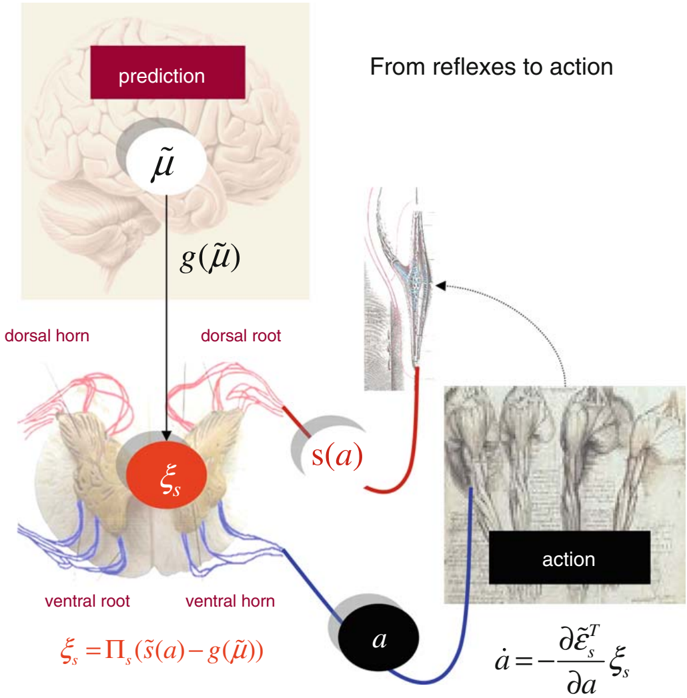
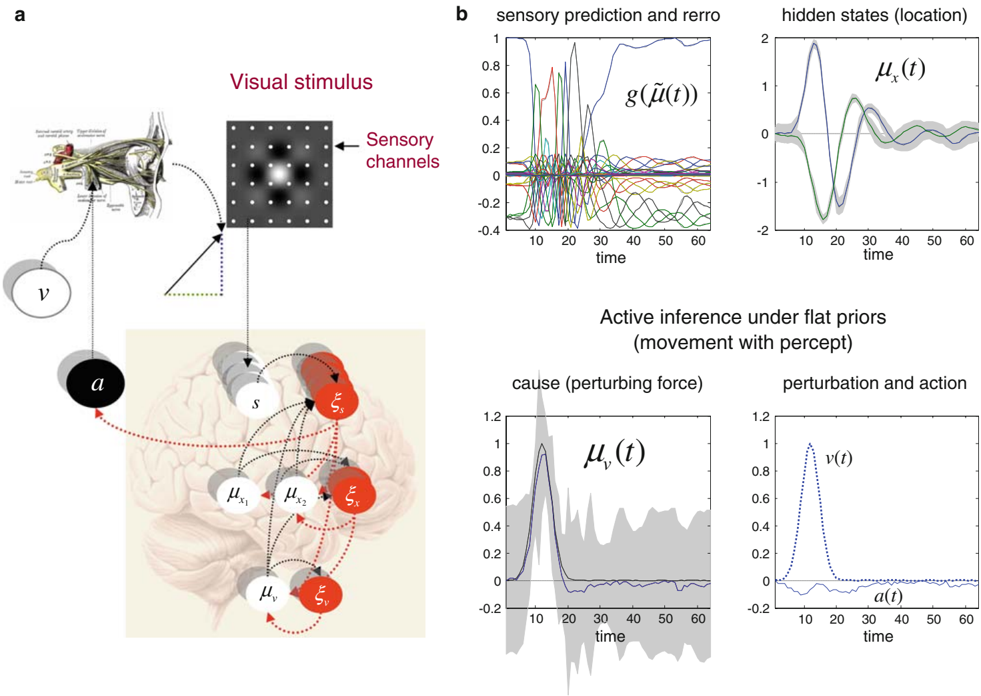
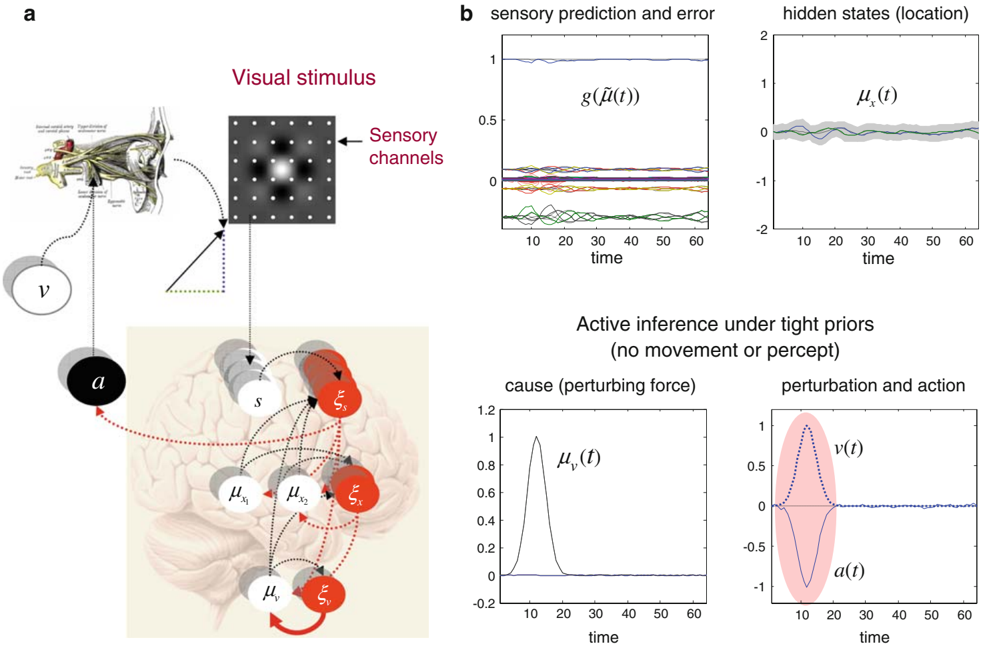
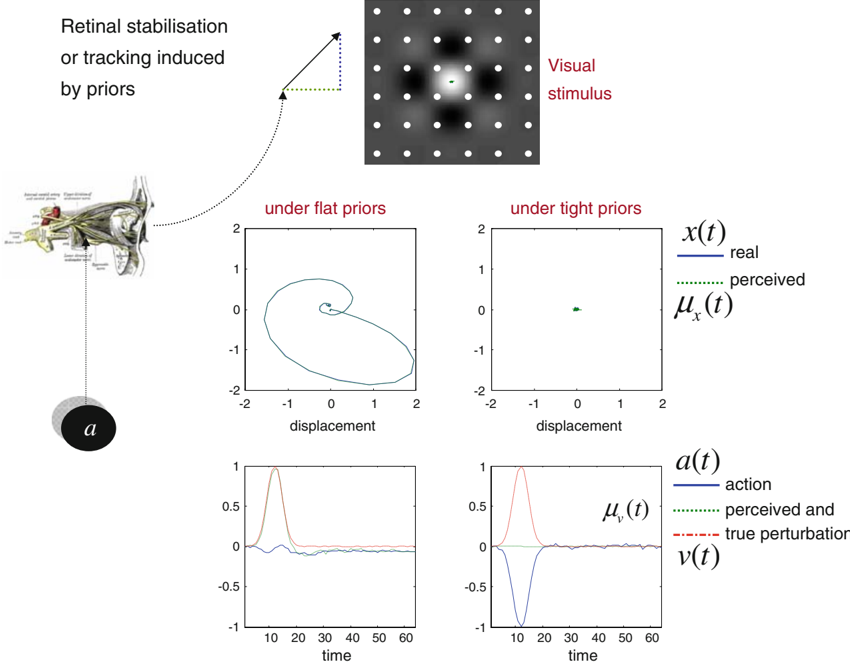
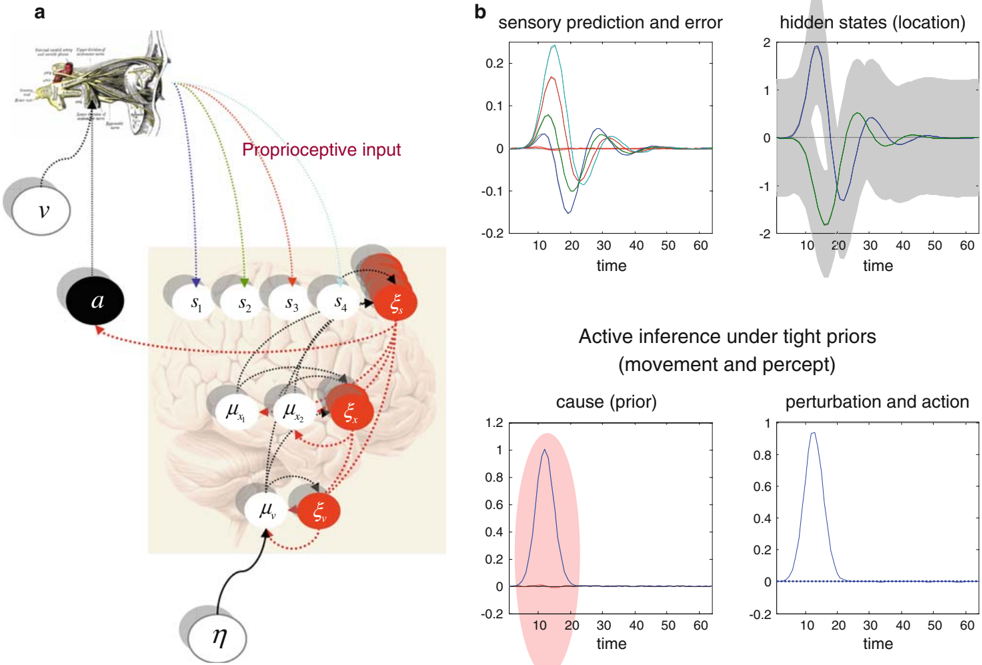
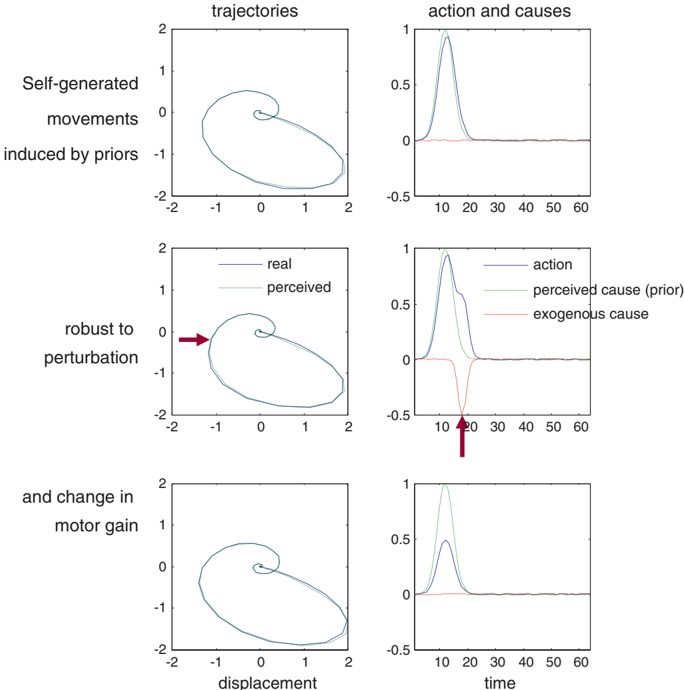
- In oculomotor simulations, tight priors on perturbations led to action that “countered almost immediately” the stimulus motion, while flat priors produced perceived motion; the paper reports a 6×6 = 36-channel sensory array in one retinal simulation.
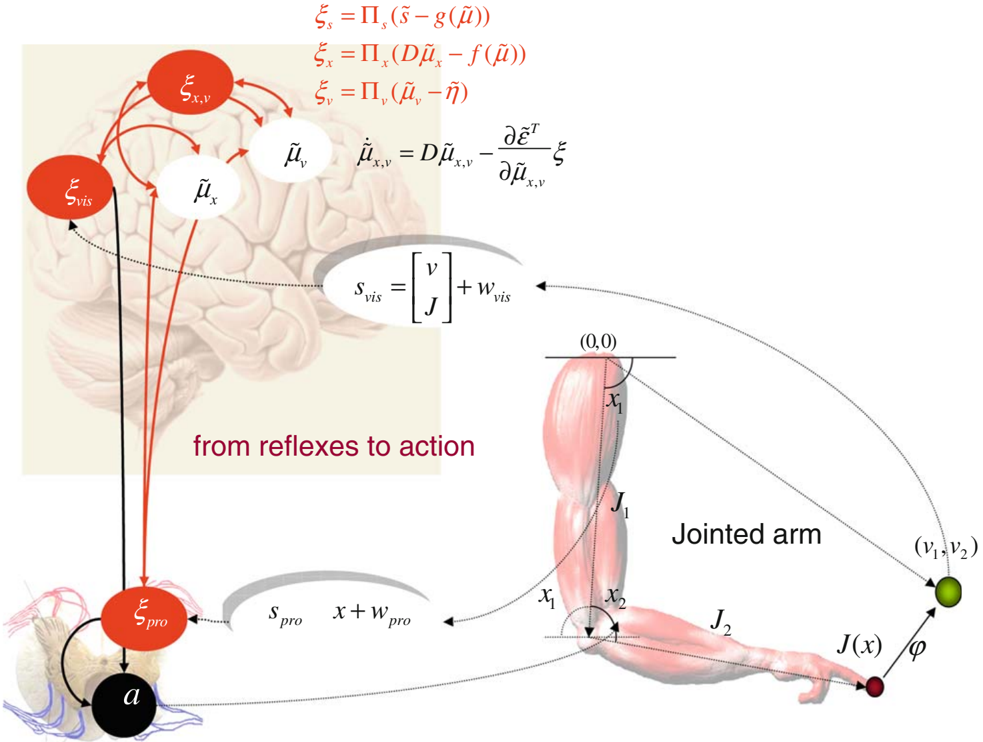
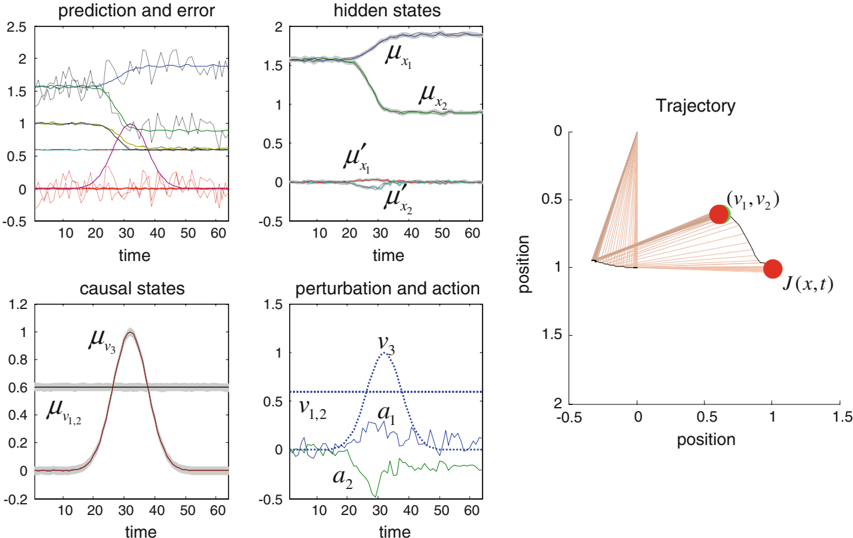
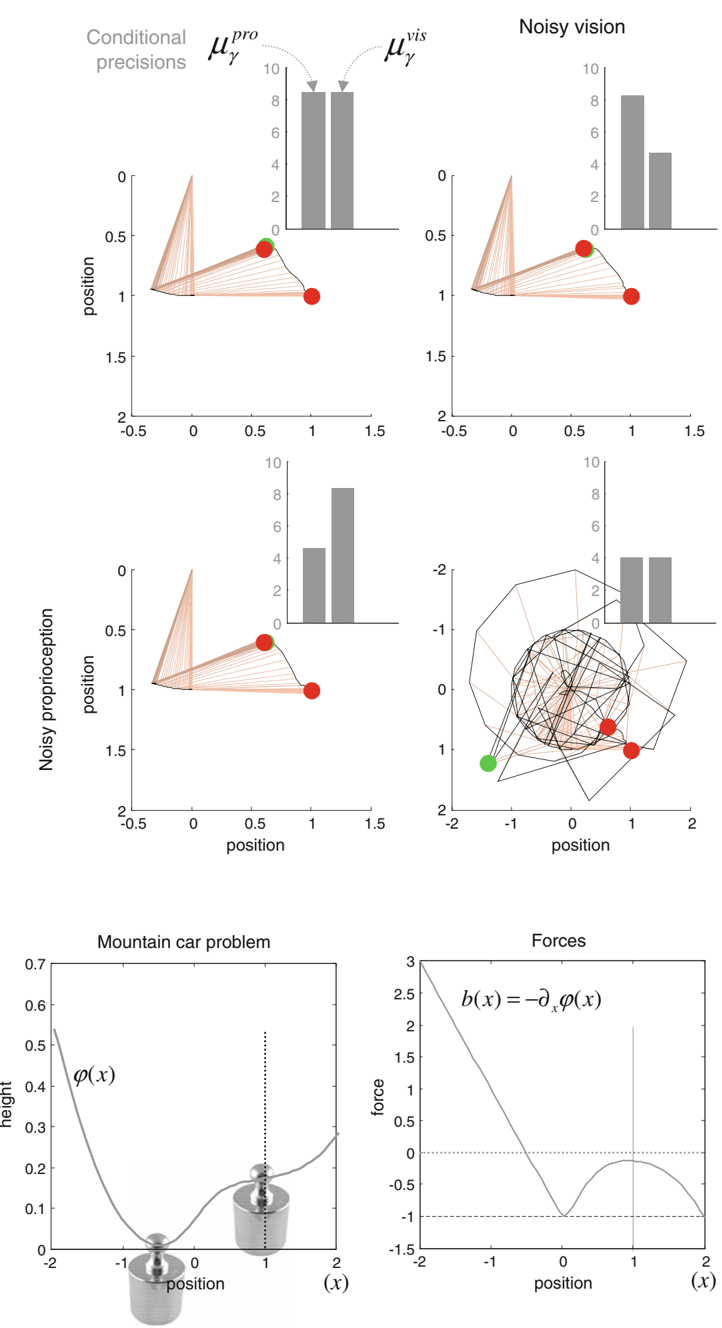
- In the cued reaching simulations, behavior was robust to sensory noise: proprioceptive noise alone could be compensated by vision, visual noise alone by proprioception, but when both modalities were noisy, reaching was compromised.
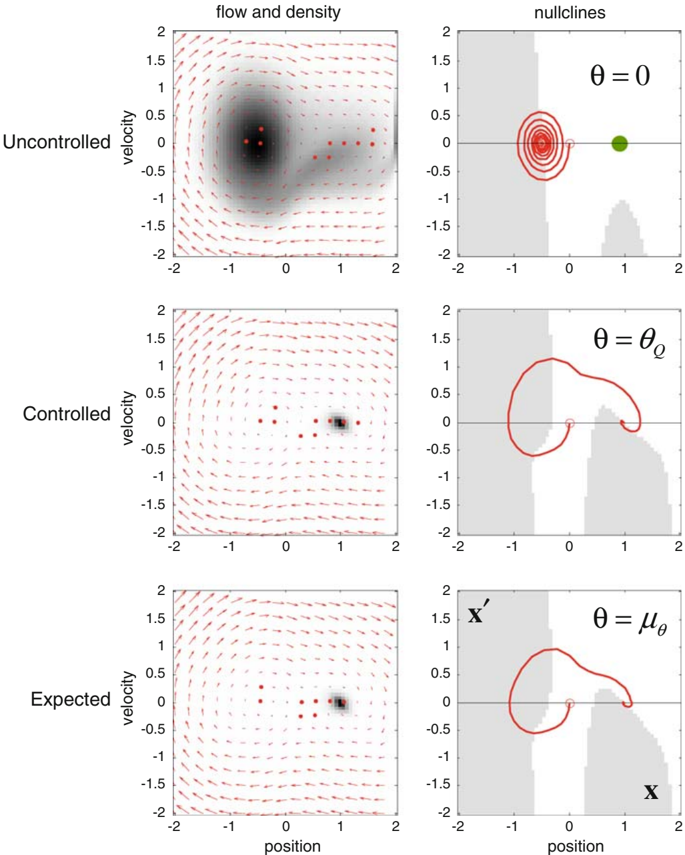
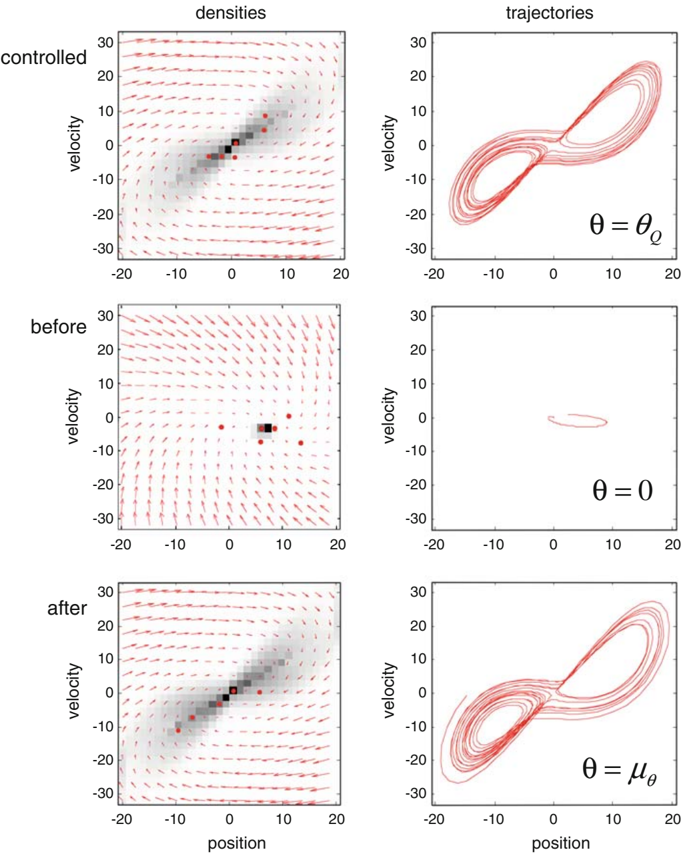
- In the goal-directed “mountain-car” simulation, the agent learned the controlled dynamics over 16 trials, and after learning it produced the required circuitous trajectory to the target; the paper notes that after 16 trials the parameters “converged roughly” to the control environment.
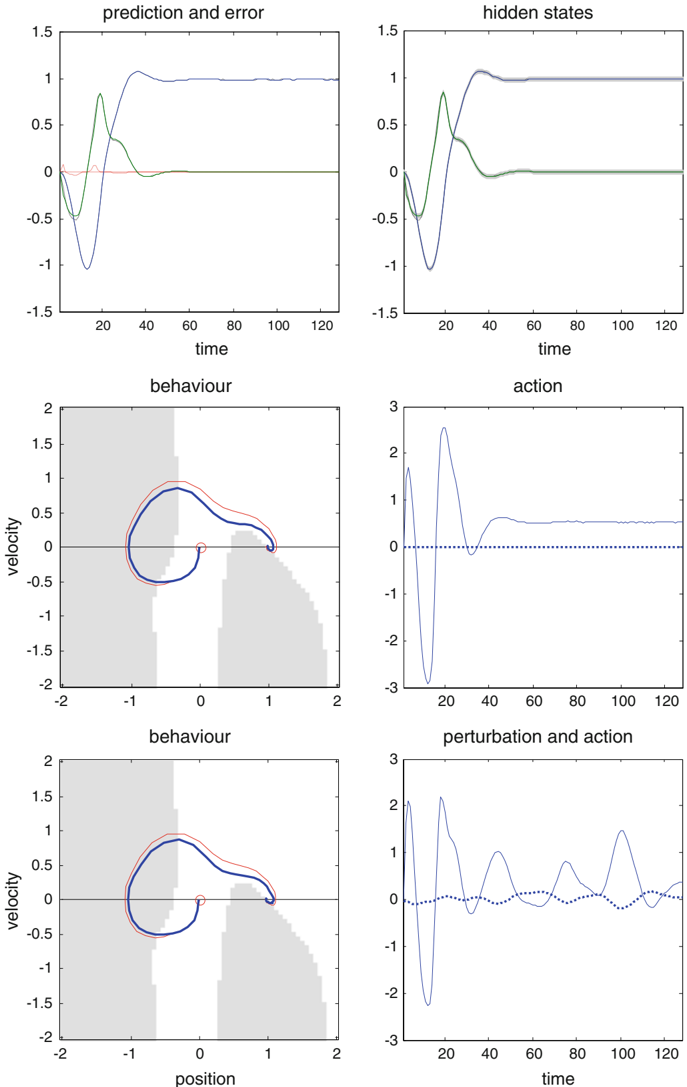
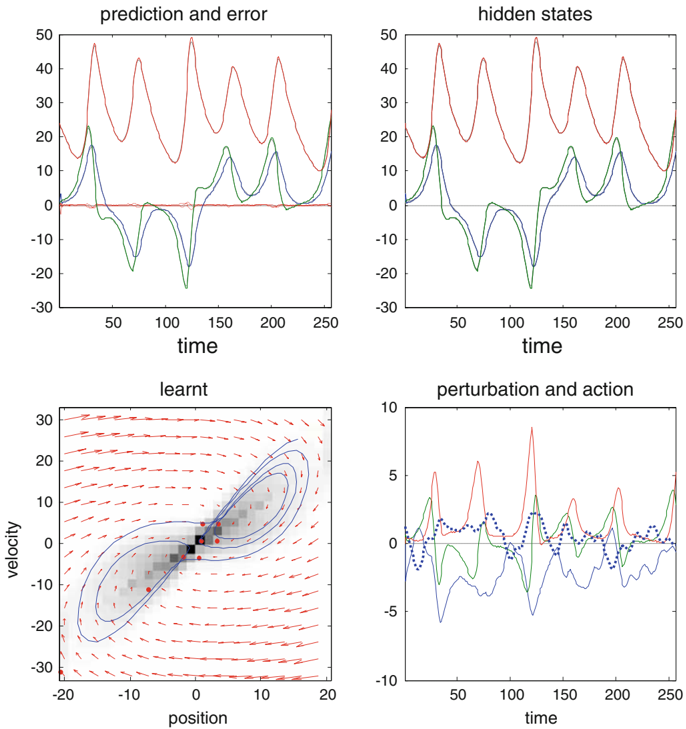
- In the autonomous-behavior simulation, after 16 trials of 512 time-bins, the agent learned to expect a Lorenz attractor and then continued to follow that learned trajectory even under perturbations, showing robustness to exogenous forces.
## Methods
- The paper is a theoretical and simulation study framed around the free-energy principle and active inference, with action and perception implemented through gradient descent on free energy under Gaussian/Laplace assumptions.
- It uses several toy dynamical systems: retinal stabilization/oculomotor control, two-joint arm reaching, the mountain-car problem, and a Lorenz-attractor learning task; one learning example uses 16 trials of 32 s time-bins, and another uses 16 trials of 512 time-bins.
- Analysis is based on generalized coordinates of motion, prediction errors, and variational (free-energy) updates of conditional expectations and precisions; the paper reports that all simulations were implemented with a single Matlab routine, `spm_ADEM.m`.
## Limitations
- The paper itself states that the simulations are simple and that many motor-control and sensorimotor issues are only addressed “superficially,” with the examples used mainly to “impart the intuitions behind active inference.”
- The text repeatedly says that some claims rely on simplifying assumptions, including Gaussian/Laplace approximations, generalized-state truncation, and assumptions about diffeomorphic sensory mappings (stated in the paper).
- Evident from the text: the results are based on idealized simulations and toy environments rather than empirical experiments on biological agents or neural recordings.
Model-written summary. Check it against the paper before relying on it.
Integrity signals
Registry
Cites
Statistics
Figures
Verification
Claims the paper makes
10 Valid · 3 Not valid · 32 Not checked · 265 Own results and interpretations
The cited sources support only part of this claim — read each source’s verdict below.
In the paper
“This mixture of weighted error variance is related formally to phenomenological cost functions proposed to account for movement trajectories (cf.Todorov and Jordan 1998;Nakano et al. 1999;Berret et al. 2008).”
§ Action and behavior: a free-energy formulation > 3.1 Motor control and prediction errors
What the sources say
- Not checked — no full text of the sourcecites Todorov and Jordan 1998 matched to “Smoothness Maximization Along a Predefined Path Accurately Predicts the Speed Profiles of Complex Arm Movements” (1998) source
- Not checked — no full text of the sourcecites Nakano et al. 1999 matched to “Quantitative Examinations of Internal Representations for Arm Trajectory Planning: Minimum Commanded Torque Change Model” (1999) source
- Partly supportedcites Berret et al. 2008 matched to “The Inactivation Principle: Mathematical Solutions Minimizing the Absolute Work and Biological Implications for the Planning of Arm Movements” (2008) sourceExperimental — accuracy not yet measured
The Results (Theoretical Analysis; page unavailable) propose an integral cost combining absolute work with a weighted comfort term to model arm movements. The Introduction describes variance-based models separately, but our copy does not establish a formal relationship between weighted error variance and the paper’s cost function. (LLM, conf=0.82)
plainstates an association- Asserted: passes — The authors put it forward as true.
- Checkable: passes — It can be checked against evidence.
- Load-bearing: unclear — It is unclear whether the paper’s conclusions depend on it.
- Based: passes — The paper gives a reason why it holds.
The cited sources support only part of this claim — read each source’s verdict below.
In the paper
“Furthermore, this perspective on dopaminergic function fits comfortably with a gating role for dopamine (O'Reilly et al. 2002) in selecting the percepts that guide action (Redgrave et al. 1999).”
§ Action and behavior: a free-energy formulation > 7.1 Active inference and optimal control
What the sources say
- Not checked — no full text of the sourcecites O'Reilly et al. 2002 matched to “Prefrontal cortex and dynamic categorization tasks: representational organization and neuromodulatory control” (2002) source
- Partly supportedcites Redgrave et al. 1999 matched to “The basal ganglia: a vertebrate solution to the selection problem?” (1999) sourceExperimental — accuracy not yet measured
In “Dopaminergic regulation of switching” (pp. 13–14), the paper proposes that dopamine helps interrupt and reprioritize behavioral selections in response to salient stimuli. That supports a role in selecting actions guided by stimuli, but not the more specific claim that dopamine selects percepts. “NEW PERSPECTIVES” (p. 16) distinguishes selection for access to motor or cognitive resources from perception itself. (LLM, conf=0.84)
plainstates an association- Asserted: passes — The authors put it forward as true.
- Checkable: passes — It can be checked against evidence.
- Load-bearing: unclear — It is unclear whether the paper’s conclusions depend on it.
- Based: passes — The paper gives a reason why it holds.
The cited sources support only part of this claim — read each source’s verdict below.
In the paper
“Indeed, the motor plant is probably one of the most important aspects of the environment for predicting sensory input (see Grafton and Hamilton 2007).”
§ Action and behavior: a free-energy formulation > 7.3 Forward models in motor control
What the sources say
- Partly supportedcites Grafton and Hamilton 2007 matched to “Evidence for a distributed hierarchy of action representation in the brain” (2007) sourceExperimental — accuracy not yet measured
Section 4, “Computational models” (page unavailable), says forward models predict the motor plant’s state and turn motor commands into expected sensory consequences. It does not characterize the motor plant as an aspect of the environment or rank it among the most important factors for predicting sensory input. (LLM, conf=0.83)
hedgedstates an association- Asserted: passes — The authors put it forward as true.
- Checkable: passes — It can be checked against evidence.
- Load-bearing: unclear — It is unclear whether the paper’s conclusions depend on it.
- Based: passes — The paper gives a reason why it holds.
- Partly supported
A result the paper states — it cites no source for it, so there is none to check. The quote shows it is in the paper.
In the paper
“In other words, the image is stabilized in accordance with the prior expectation of no movement.”
§ Action and behavior: a free-energy formulation > 4.1.1 Retinal stabilization and oculomotor reflexes
plainstates a cause- Asserted: passes — The authors put it forward as true.
- Checkable: passes — It can be checked against evidence.
- Load-bearing: passes — The paper’s conclusions depend on it.
- Based: passes — The paper gives a reason why it holds.
- Rests on 3 assumptions not shown here.
A result the paper states — it cites no source for it, so there is none to check. The quote shows it is in the paper.
In the paper
“By manipulating its prior expectations on these perturbations, v(t), we can elicit very different behaviors from the agent.”
§ Action and behavior: a free-energy formulation > 4.1.1 Retinal stabilization and oculomotor reflexes
plainstates a cause- Asserted: passes — The authors put it forward as true.
- Checkable: passes — It can be checked against evidence.
- Load-bearing: passes — The paper’s conclusions depend on it.
- Based: passes — The paper gives a reason why it holds.
- Rests on 3 assumptions not shown here.
181 more claims
Create a free account to see all 310 claims and to verify the 1 reference still open.
- Probably not a substantial claim. 67
- It may state two separate claims as one. 67
- The quote only partly states this claim. 2
- Borderline: one of the tests for a substantial claim is unclear. 1
Claims other papers make about this one
Each is checked against this paper’s own text: does it say what the citing paper says it does?
The source backs part of the claim, not all of it — or backs it for a different population, condition or comparison.
In the citing paper
“The free energy principle (Friston et al. 2010; Badcock et al. 2019) thus casts control theoretic ‘essential variables’ in terms of high precision prior expectations.”
From Consciousness in active inference: Deep self-models, other minds, and the challenge of psychedelic-induced ego-dissolution (2021) · cites this paper as Friston et al. 2010
Experimental — accuracy not yet measuredThe source backs part of the claim, not all of it — or backs it for a different population, condition or comparison.
In the citing paper
“Given a chosen time window, accumulated log evidence could be approximated by the integral of free energy, a quantity known as “free action” (Friston K. et al., 2010).”
From Allostatic Self-efficacy: A Metacognitive Theory of Dyshomeostasis-Induced Fatigue and Depression (2016) · cites this paper as Friston K. et al., 2010
Experimental — accuracy not yet measuredThe cited source says what the claim attributes to it.
In the citing paper
“Also, if predictive models are continually probed by control signals that attempt to confirm the currently dominant model via active inference [21], the framework naturally accommodates the phasic physiological changes that accompany RHI induction [58,59] when these changes are taken to reflect altered autonomic control.”
From Interoceptive inference, emotion, and the embodied self (2013) · cites this paper as [21]
Experimental — accuracy not yet measuredThe cited source says what the claim attributes to it.
In the citing paper
“Thus, perception and action operate synergistically to minimise prediction errors and optimise our internal representations of the environment.”
From The depressed brain: an evolutionary systems theory (2017) · cites this paper as [11]
The cited source says what the claim attributes to it.
In the citing paper
“In the neurosciences, this is known as active inference [60, 61, 62].”
From The free energy principle made simpler but not too simple (2023) · cites this paper as [60]
4 more claims about this paper
Create a free account to see every claim other papers make about this one.
Citations
Cites
Rescorla, R. A. (1972) · Medical Entomology and Zoology · Cited by 9,661
A neural substrate of prediction and reward
Schultz, W., Dayan, P., & Montague, P. R. (1997) · Science · doi:10.1126/science.275.5306.1593 · Cited by 9,388 · cited 1×
“may call for a reappraisal of reinforcement learning as an explanation for behavior and, in particular, the role of dopamine in coding unpredicted reward (Montague et al. 1995; Schultz et al. 1997; Doya 2002): If dopamine encodes precision through its classical neuromodulatory effects (cf., Yu and Dayan 2005) how can…”
BackgroundWatkins, C. J. C. H., & Dayan, P. (1992) · Machine Learning · doi:10.1007/bf00992698 · Cited by 9,083
The free-energy principle: a unified brain theory?
Friston, K. (2010) · Nature Reviews Neuroscience · doi:10.1038/nrn2787 · Cited by 8,120
Self-citationAutopoiesis and Cognition: The Realization of the Living
Maturana, H. R., & Varela, F. J. (1980) · Boston Studies in the Philosophy and History of Science · doi:10.1007/978-94-009-8947-4 · Cited by 5,815
Emergence of simple-cell receptive field properties by learning a sparse code for natural images
Olshausen, B. A., & Field, D. J. (1996) · Nature · doi:10.1038/381607a0 · Cited by 5,694 · cited 1×
“This appeals to the principle of maximum information transfer (Linsker 1990), which has been very useful in understanding the emergence of things like receptive fields (e.g., Olshausen and Field 1996 ).”
BackgroundRao, R. P. N., & Ballard, D. H. (1999) · Nature Neuroscience · doi:10.1038/4580 · Cited by 5,483 · cited 4×
“The idea that the brain uses hierarchical inference has been established for years (Mumford 1992; Rao and Ballard 1998; Friston 2005; Friston et al. 2006) and provides a nice explanation for the hierarchical organization of cortical systems.”
BackgroundInfluentialA theory of cortical responses.
Friston, K. (2005) · Philosophical Transactions of the Royal Society B: Biological Sciences · doi:10.1098/rstb.2005.1622 · Cited by 4,578 · cited 6×
“Please see Friston et al. (2008) for a fuller description of the scheme implied by these circuit diagrams.”
BackgroundMethodInfluentialSelf-citationClassical conditioning II: Current research and theory.
Black, A. H., & Prokasy, W. F. (1972) · Appleton-Century-Crofts eBooks · Cited by 4,449
Watkins, C. J. C. H., & Dayan, P. (1992) · Machine Learning · doi:10.1023/a:1022676722315 · Cited by 3,907
Research works printed but not linked: 2
- 55. MacKay DJC (1995) Free-energy minimization algorithm for decoding and cryptoanalysis. Electron Lett 31:445-447
- 89. Watkins CJCH, Dayan P (1992) Q-learning. Mach Learn 8:279-292
Cited by
Whatever next? Predictive brains, situated agents, and the future of cognitive science
Clark, A. (2013) · Behavioral and Brain Sciences · doi:10.1017/s0140525x12000477 · Cited by 5,924
Interoceptive inference, emotion, and the embodied self
Seth, A. K. (2013) · Trends in Cognitive Sciences · doi:10.1016/j.tics.2013.09.007 · Cited by 1,816
An integrated theory of language production and comprehension
Pickering, M. J., & Garrod, S. (2013) · Behavioral and Brain Sciences · doi:10.1017/s0140525x12001495 · Cited by 1,569
Attention, uncertainty, and free-energy
Feldman, H., & Friston, K. J. (2010) · Frontiers in Human Neuroscience · doi:10.3389/fnhum.2010.00215 · Cited by 1,365
“More mathematical details can be found in (Friston et al., 2010b).”
Self-citationActive interoceptive inference and the emotional brain
Seth, A. K., & Friston, K. J. (2016) · Philosophical Transactions of the Royal Society B: Biological Sciences · doi:10.1098/rstb.2016.0007 · Cited by 945
Self-citationPrecise minds in uncertain worlds: Predictive coding in autism.
Van de Cruys, S., Evers, K., Van der Hallen, R., Van Eylen, L., Boets, B., de-Wit, L., & Wagemans, J. (2014) · Psychological Review · doi:10.1037/a0037665 · Cited by 885
The Computational Anatomy of Psychosis
Adams, R. A., Stephan, K. E., Brown, H. R., Frith, C. D., & Friston, K. J. (2013) · Frontiers in Psychiatry · doi:10.3389/fpsyt.2013.00047 · Cited by 850
“The first assumption is the free energy principle, which leads to active inference in the embodied setting of action (Friston et al., 2010a).”
BackgroundMethodSelf-citationSeth, A. K., & Bayne, T. (2022) · Nature Reviews Neuroscience · doi:10.1038/s41583-022-00587-4 · Cited by 880
A Bayesian account of ‘hysteria’
Edwards, M. J., Adams, R. A., Brown, H., Parees, I., & Friston, K. J. (2012) · Brain · doi:10.1093/brain/aws129 · Cited by 825
“In other words, a movement is specified in terms of ‘what we want to see [or feel], rather than what we want to do’ (Friston et al., 2010).”
BackgroundMethodSelf-citationPredictions not commands: Active inference in the motor system
Adams, R. A., Shipp, S., & Friston, K. J. (2013) · Brain Structure and Function · doi:10.1007/s00429-012-0475-5 · Cited by 765
“The neuronal encoding of predictions—in terms of the activity of specific neuronal populations—and the transformations—mediated through synaptic connections—conform to the neurobiologically plausible schemes considered for predictive coding in the brain (for details, see Friston et al. 2010).”
BackgroundMethodInfluentialSelf-citationFormal theory of creativity, fun, and intrinsic motivation (1990–2010)
Schmidhuber, J. (2010) · IEEE Transactions on Autonomous Mental Development · doi:10.1109/tamd.2010.2056368 · Cited by 747
“[19] (2010) also propose an approach which, in many ways, seems similar to ours, based on free energy minimization and predictive coding.”
MethodNozaradan, S., Peretz, I., & Keller, P. E. (2016) · Scientific Reports · doi:10.1038/srep20612 · Cited by 662
Action understanding and active inference
Friston, K., Mattout, J., & Kilner, J. (2011) · Biological Cybernetics · doi:10.1007/s00422-011-0424-z · Cited by 665
“Furthermore , it is exactly the same scheme used in previous illustrations of perceptual inference (Kiebel et al. 2009a), perceptual learning (Friston 2008), reinforcement learning (Friston et al. 2009), active inference (Friston et al. 2010a) and attentional processing (Feldman and Friston 2010).”
InfluentialSelf-citationActive Inference, homeostatic regulation and adaptive behavioural control
Pezzulo, G., Rigoli, F., & Friston, K. (2015) · Progress in Neurobiology · doi:10.1016/j.pneurobio.2015.09.001 · Cited by 650
“Although there have been other proposals involving Bayesian inference and behavioural control (Friston et al., 2010; Pezzulo et al., 2013; Solway and Botvinick, 2012), none has simultaneously addressed all the controllers in the ontology of animal learning theories, as offered below.”
Self-citationNeuroscience of virtual reality: from virtual exposure to embodied medicine
Riva, G., Wiederhold, B. K., & Mantovani, F. (2019) · Cyberpsychology, Behavior, and Social Networking · doi:10.1089/cyber.2017.29099.gri · Cited by 608
“Specifically, the contents of the body matrix are defined by top-down predictive signals, integrating the multisensory (motor and visceromotor) simulations of the causes of perceived sensory events.(108) The different simulations are then ranked and included in the body matrix according to their relevance for the inte…”
BackgroundHohwy, J. (2016) · Noûs · doi:10.1111/nous.12062 · Cited by 578
Hallucinations and strong priors
Corlett, P. R., Horga, G., Fletcher, P. C., Alderson-Day, B., Schmack, K., & Powers, A. R. (2019) · Trends in Cognitive Sciences · doi:10.1016/j.tics.2018.12.001 · Cited by 534
“(Corollary discharges are predictions of the sensory consequences of our actions and are thought by some to underwrite our inference about agency for events [40], a type of prior [41]).”
The hierarchical basis of neurovisceral integration
Smith, R., Thayer, J. F., Khalsa, S. S., & Lane, R. D. (2017) · Neuroscience & Biobehavioral Reviews · doi:10.1016/j.neubiorev.2017.02.003 · Cited by 523
The free-energy self: a predictive coding account of self-recognition
Apps, M. A. J., & Tsakiris, M. (2014) · Neuroscience & Biobehavioral Reviews · doi:10.1016/j.neubiorev.2013.01.029 · Cited by 514
“Previously, Kilner and colleagues (Friston et al., 2010; Kilner, 2011; Kilner et al., 2007a, b) have offered a thorough account of how the free-energy framework can provide a compelling explanation of how the intentions and actions of others are learned within the mirror Page 25 of 43 Ac ce pt ed M…”
Active inference, sensory attenuation and illusions
Brown, H., Adams, R. A., Parees, I., Edwards, M., & Friston, K. (2013) · Cognitive Processing · doi:10.1007/s10339-013-0571-3 · Cited by 488
“In short, active inference can be regarded as equipping a generalised predictive coding scheme with classical reflex arcs: see (Friston et al. 2009, 2010) for details.”
BackgroundMethodInfluentialSelf-citationSuzuki, K., Garfinkel, S. N., Critchley, H. D., & Seth, A. K. (2013) · Neuropsychologia · doi:10.1016/j.neuropsychologia.2013.08.014 · Cited by 476
“…that predictive models are continually probed by control signals which attempt to confirm the currently dominant model [ " active inference " , Friston et al., 2010], the framework naturally accommodates the phasic physiological changes accompanying RHI induction (Barnsley et al., 2011;…”
Huang, Y., & Rao, R. P. N. (2011) · WIREs Cognitive Science · doi:10.1002/wcs.142 · Cited by 470
Perceptions as Hypotheses: Saccades as Experiments
Friston, K., Adams, R. A., Perrinet, L., & Breakspear, M. (2012) · Frontiers in Psychology · doi:10.3389/fpsyg.2012.00151 · Cited by 462
“In short, active inference can be regarded as equipping a generalized predictive coding scheme with classical reflex arcs: see (Friston et al., 2009, 2010a) for details.”
BackgroundSelf-citationAllostatic Self-efficacy: A Metacognitive Theory of Dyshomeostasis-Induced Fatigue and Depression
Stephan, K. E., Manjaly, Z. M., Mathys, C. D., Weber, L. A. E., Paliwal, S., Gard, T., Tittgemeyer, M., Fleming, S. M., Haker, H., Seth, A. K., et al. (2016) · Frontiers in Human Neuroscience · doi:10.3389/fnhum.2016.00550 · Cited by 437
Autism, oxytocin and interoception
Quattrocki, E., & Friston, K. (2014) · Neuroscience & Biobehavioral Reviews · doi:10.1016/j.neubiorev.2014.09.012 · Cited by 393
Self-citationToward a formalized account of attitudes: The Causal Attitude Network (CAN) model.
Dalege, J., Borsboom, D., van Harreveld, F., van den Berg, H., Conner, M., & van der Maas, H. L. J. (2016) · Psychological Review · doi:10.1037/a0039802 · Cited by 373
Buesing, L., Bill, J., Nessler, B., & Maass, W. (2011) · PLoS Computational Biology · doi:10.1371/journal.pcbi.1002211 · Cited by 384
“often consist not only of sensory and proprioceptive inputs to the brain, but also of specific goals and constraints for a planned movement”
BackgroundDopamine, affordance and active inference
Friston, K. J., Shiner, T., FitzGerald, T., Galea, J. M., Adams, R., Brown, H., Dolan, R. J., Moran, R., Stephan, K. E., & Bestmann, S. (2012) · PLoS Computational Biology · doi:10.1371/journal.pcbi.1002327 · Cited by 381
Self-citationA free energy principle for biological systems
Karl, F. (2012) · Entropy · doi:10.3390/e14112100 · Cited by 377
“Domain Process or paradigm Perception • Perceptual categorisation (bird songs) [18] • Novelty and omission-related responses [18] • Perceptual inference (speech) [19] Sensory learning • Perceptual learning (mismatch negativity) [33] Attention • Attention and the Posner paradigm [20] • Attention and biased competition…”
BackgroundThe free energy principle for action and perception: A mathematical review
Buckley, C. L., Kim, C. S., McGregor, S., & Seth, A. K. (2017) · Journal of Mathematical Psychology · doi:10.1016/j.jmp.2017.09.004 · Cited by 363
“…the FEP is claimed to provide a ‘‘mathematical specification of ‘what’ the brain is doing’’ (Friston, 2009 p.300), to unify perception and action (Friston et al., 2010), and to provide a basis for integrating several general brain theories including the Bayesian brain hypothesis, neural…”
BackgroundInfluentialAnswering Schrödinger's question: A free-energy formulation
Ramstead, M. J. D., Badcock, P. B., & Friston, K. J. (2018) · Physics of Life Reviews · doi:10.1016/j.plrev.2017.09.001 · Cited by 354
Self-citationSeth, A. K. (2014) · Cognitive Neuroscience · doi:10.1080/17588928.2013.877880 · Cited by 346
“Actions themselves can be considered as arising from the fulfilment of proprioceptive predictions (minimization of proprioceptive prediction error) via motor reflexes (Friston et al., 2010).”
BackgroundThe anatomy of choice: active inference and agency
Friston, K., Schwartenbeck, P., FitzGerald, T., Moutoussis, M., Behrens, T., & Dolan, R. J. (2013) · Frontiers in Human Neuroscience · doi:10.3389/fnhum.2013.00598 · Cited by 340
“This is active inference (Friston et al., 2010), which extends the minimization of free energy implicit in approximate Bayesian inference to include action.”
BackgroundSelf-citationBeing a Beast Machine: The Somatic Basis of Selfhood
Seth, A. K., & Tsakiris, M. (2018) · Trends in Cognitive Sciences · doi:10.1016/j.tics.2018.08.008 · Cited by 371
“prediction error, which means that schemes like predictive coding and active inference [18, 32] become process theories (implementations) under the FEP [44].”
InfluentialBayesian approaches to autism: Towards volatility, action, and behavior.
Palmer, C. J., Lawson, R. P., & Hohwy, J. (2017) · Psychological Bulletin · doi:10.1037/bul0000097 · Cited by 307
What is optimal about motor control?
Friston, K. (2011) · Neuron · doi:10.1016/j.neuron.2011.10.018 · Cited by 332
Self-citationEmotional Valence and the Free-Energy Principle
Joffily, M., & Coricelli, G. (2013) · PLoS Computational Biology · doi:10.1371/journal.pcbi.1003094 · Cited by 322
Big behavioral data: psychology, ethology and the foundations of neuroscience
Gomez-Marin, A., Paton, J. J., Kampff, A. R., Costa, R. M., & Mainen, Z. F. (2014) · Nature Neuroscience · doi:10.1038/nn.3812 · Cited by 301
Vuust, P., & Witek, M. A. G. (2014) · Frontiers in Psychology · doi:10.3389/fpsyg.2014.01111 · Cited by 296
“Advocating embodied approaches to cognition (Clark and Chalmers, 1998; Clark, 2008), PC appeals to Clark particularly due to the close relationship it posits between action and perception (Friston et al., 2010).”
BackgroundBotvinick, M., & Toussaint, M. (2012) · Trends in Cognitive Sciences · doi:10.1016/j.tics.2012.08.006 · Cited by 292
Waking and dreaming consciousness: neurobiological and functional considerations.
Hobson, J. A., & Friston, K. J. (2012) · Progress in Neurobiology · doi:10.1016/j.pneurobio.2012.05.003 · Cited by 287
“The resulting scheme is called active inference, in which action is seen as an attempt to minimize surprise by sampling predicted kinesthetic sensations (Friston et al., 2010).”
BackgroundSelf-citationWhittington, J. C. R., & Bogacz, R. (2017) · Neural Computation · doi:10.1162/neco_a_00949 · Cited by 278
“It has been shown in the past how networks in the predictive coding framework can perform unsupervised learning, attentional modulations, and action selection (Rao & Ballard, 1999; Feldman & Friston, 2010; Friston, Daunizeau, Kilner, & Kiebel, 2010).”
BackgroundHickok, G. (2012) · Journal of Communication Disorders · doi:10.1016/j.jcomdis.2012.06.004 · Cited by 260
Virtual Reality for Research in Social Neuroscience
Parsons, T., Gaggioli, A., & Riva, G. (2017) · Brain Sciences · doi:10.3390/brainsci7040042 · Cited by 244
The dopaminergic midbrain encodes the expected certainty about desired outcomes
Schwartenbeck, P., FitzGerald, T. H. B., Mathys, C., Dolan, R., & Friston, K. (2015) · Cerebral Cortex · doi:10.1093/cercor/bhu159 · Cited by 219
“Expected precision needs to be widely broadcast, since it plays a crucial role in hierarchical inference (Friston et al. 2010; Friston 2011).”
BackgroundSelf-citationPezzulo, G., & Levin, M. (2016) · Journal of The Royal Society Interface · doi:10.1098/rsif.2016.0555 · Cited by 233
The bioelectric code: An ancient computational medium for dynamic control of growth and form
Levin, M., & Martyniuk, C. J. (2018) · Biosystems · doi:10.1016/j.biosystems.2017.08.009 · Cited by 240
Active inference and agency: optimal control without cost functions
Friston, K., Samothrakis, S., & Montague, R. (2012) · Biological Cybernetics · doi:10.1007/s00422-012-0512-8 · Cited by 241
“In other words, active inference extends the minimisation of variational free energy that underlies (approximate) Bayesian inference to include action (Friston et al. 2010).”
BackgroundSelf-citationReflections on agranular architecture: predictive coding in the motor cortex
Shipp, S., Adams, R. A., & Friston, K. J. (2013) · Trends in Neurosciences · doi:10.1016/j.tins.2013.09.004 · Cited by 239
Self-citationThe cybernetic Bayesian brain : from interoceptive inference to sensorimotor contingencies
Seth, A. K. (2015) · MIND Group · doi:10.25358/openscience-84 · Cited by 239
The neuroscience of body memory: From the self through the space to the others
Riva, G. (2018) · Cortex · doi:10.1016/j.cortex.2017.07.013 · Cited by 229
“This is achieved through the predictive, multi-sensory integration activated by central topedown attentional processes (Clark, 2016a; Feldman & Friston, 2010; Samad et al., 2015; Talsma, 2015; Talsma et al., 2010).”
BackgroundMethodInfluentialActive inference, enactivism and the hermeneutics of social cognition
Gallagher, S., & Allen, M. (2018) · Synthese · doi:10.1007/s11229-016-1269-8 · Cited by 214
“10 Although the formalisms supporting the FEP are beyond the scope of this paper (see Feldman and Friston 2010; Friston 2010; Friston et al. 2010 for a formal treatment), we attempt to relate them here in a general fashion in order to better illuminate any potential overlap (or lack thereof)…”
MethodThe Anatomy of Inference: Generative Models and Brain Structure
Parr, T., & Friston, K. J. (2018) · Frontiers in Computational Neuroscience · doi:10.3389/fncom.2018.00090 · Cited by 204
“The capacity to estimate the precision of these conditional distributions is thought to underwrite attentional processing (Feldman and Friston, 2010).”
BackgroundSelf-citationThe hierarchically mechanistic mind: A free-energy formulation of the human psyche
Badcock, P. B., Friston, K. J., & Ramstead, M. J. D. (2019) · Physics of Life Reviews · doi:10.1016/j.plrev.2018.10.002 · Cited by 217
Self-citationIntrinsic Motivation and Reinforcement Learning
Barto, A. G. (2013) · Intrinsically Motivated Learning in Natural and Artificial Systems · doi:10.1007/978-3-642-32375-1_2 · Cited by 211
“Further, theories relevant to intrinsic motivation have been proposed that are not based on RL, e.g., Andry et al. (2004), Baranes and Oudeyer (2010), Friston et al. (2010), Hesse et al. (2009).”
BackgroundInfluentialSeth, A. K. (2015) · Figshare · doi:10.15502/9783958570108 · Cited by 211
“In most cases these processes are assumed to unfold continuously and simultaneously, underlining a deep continuity between perception and action (Friston et al. 2010; Verschure et al. 2003).”
BackgroundInfluentialError awareness and the insula: links to neurological and psychiatric diseases
Klein, T. A., Ullsperger, M., & Danielmeier, C. (2013) · Frontiers in Human Neuroscience · doi:10.3389/fnhum.2013.00014 · Cited by 210
“It should be noted that the evidence accumulation account outlined above is compatible with predictive coding accounts of awareness and motor action control (e.g., Friston et al., 2010; Seth et al., 2011).”
Clark, A. (2015) · The Southern Journal of Philosophy · doi:10.1111/sjp.12120 · Cited by 202
Mental imagery in music performance: underlying mechanisms and potential benefits
Keller, P. E. (2012) · Annals of the New York Academy of Sciences · doi:10.1111/j.1749-6632.2011.06439.x · Cited by 205
Bolis, D., Balsters, J., Wenderoth, N., Becchio, C., & Schilbach, L. (2017) · Psychopathology · doi:10.1159/000484353 · Cited by 204
The depressed brain: an evolutionary systems theory
Badcock, P. B., Davey, C. G., Whittle, S., Allen, N. B., & Friston, K. J. (2017) · Trends in Cognitive Sciences · doi:10.1016/j.tics.2017.01.005 · Cited by 190
Self-citationGetting ahead: forward models and their place in cognitive architecture
Pickering, M. J., & Clark, A. (2014) · Trends in Cognitive Sciences · doi:10.1016/j.tics.2014.05.006 · Cited by 190
The role of prediction in social neuroscience
Brown, E. C., & Brüne, M. (2012) · Frontiers in Human Neuroscience · doi:10.3389/fnhum.2012.00147 · Cited by 190
“…scheme has been applied to perceptual inference (Kiebel et al., 2009), perceptual learning (Friston, 2008), reinforcement learning (Friston et al., 2009), active inference (Friston et al., 2010), attentional processing (Feldman and Friston, 2010), and sensorimotor control (Wolpert and Miall, 1996).”
MethodPerception and self-organized instability
Friston, K., Breakspear, M., & Deco, G. (2012) · Frontiers in Computational Neuroscience · doi:10.3389/fncom.2012.00044 · Cited by 185
“The resulting scheme is called generalized filtering or predictive coding (Friston et al., 2010).”
BackgroundMethodInfluentialSelf-citationPetzschner, F. H., Weber, L. A. E., Gard, T., & Stephan, K. E. (2017) · Biological Psychiatry · doi:10.1016/j.biopsych.2017.05.012 · Cited by 181
“Different tasks require different types of (cortically represented) generative models and thus distinct circuits; compare proposed circuits for interoception/ allostasis (19,87) and vision/oculomotor control (42,72).”
InfluentialAction, agency and responsibility
Frith, C. D. (2014) · Neuropsychologia · doi:10.1016/j.neuropsychologia.2013.09.007 · Cited by 173
Regimes of Expectations: An Active Inference Model of Social Conformity and Human Decision Making
Constant, A., Ramstead, M. J. D., Veissière, S. P. L., & Friston, K. (2019) · Frontiers in Psychology · doi:10.3389/fpsyg.2019.00679 · Cited by 171
Self-citationPezzulo, G., & Levin, M. (2015) · Integrative Biology · doi:10.1039/c5ib00221d · Cited by 168
Badcock, P. B., Friston, K. J., Ramstead, M. J. D., Ploeger, A., & Hohwy, J. (2019) · Cognitive, Affective, & Behavioral Neuroscience · doi:10.3758/s13415-019-00721-3 · Cited by 167
Self-citationGallese, V., Gernsbacher, M. A., Heyes, C., Hickok, G., & Iacoboni, M. (2011) · Perspectives on Psychological Science · doi:10.1177/1745691611413392 · Cited by 170
Observing the observer (I): meta-bayesian models of learning and decision-making
Daunizeau, J., den Ouden, H. E. M., Pessiglione, M., Kiebel, S. J., Stephan, K. E., & Friston, K. J. (2010) · PLoS ONE · doi:10.1371/journal.pone.0015554 · Cited by 167
“Note that these theories also consider the role of neuromodulators [54– 55] and the nature of motor outputs; i.e. behavioural responses ([22,56,57,58,59]).”
Self-citationThe free energy principle made simpler but not too simple
Friston, K., Da Costa, L., Sajid, N., Heins, C., Ueltzhöffer, K., Pavliotis, G. A., & Parr, T. (2023) · Physics Reports · doi:10.1016/j.physrep.2023.07.001 · Cited by 163
“In the neurosciences, this is known as active inference [60–62].”
Self-citationActive Inference, Attention, and Motor Preparation
Brown, H., Friston, K., & Bestmann, S. (2011) · Frontiers in Psychology · doi:10.3389/fpsyg.2011.00218 · Cited by 165
“In this view, descending (corticospinal) signals are not motor commands per se but predictions of proprioceptive signals that the peripheral motor system fulfills (see Friston et al., 2010, 2011 for details).”
BackgroundMethodInfluentialSelf-citationCorcoran, A. W., Pezzulo, G., & Hohwy, J. (2020) · Biology & Philosophy · doi:10.1007/s10539-020-09746-2 · Cited by 161
“…in. Variational free energy is an information-theoretic quantity developed to finesse difficult integration problems in quantum statistical mechanics (Feynman 1972).5 In the present context, free energy serves as a proxy for the amount of surprise elicited by sensory inputs (Friston 2010, 2011).”
BackgroundMethodInfluentialA nice surprise? Predictive processing and the active pursuit of novelty
Clark, A. (2018) · Phenomenology and the Cognitive Sciences · doi:10.1007/s11097-017-9525-z · Cited by 156
“For discussion, see (Engel et al. 2001; Feldman and Friston 2010).”
BackgroundComputational Neuropsychology and Bayesian Inference
Parr, T., Rees, G., & Friston, K. J. (2018) · Frontiers in Human Neuroscience · doi:10.3389/fnhum.2018.00061 · Cited by 149
“If pathological priors relate to the properties of the musculoskeletal system, we might expect motor disorders such as tremors or paralysis (Friston et al., 2010; Adams et al., 2013a).”
BackgroundSelf-citationLimanowski, J., & Friston, K. (2018) · Frontiers in Psychology · doi:10.3389/fpsyg.2018.00643 · Cited by 154
“…of the sensory input expected to result from intended movement, and ‘fulfilling’ this prediction by executing the movement, thus effectively suppressing a prediction error signal that would otherwise emerge (Friston et al., 2010; Adams et al., 2013a; Brown et al., 2013; Seth and Friston, 2016).”
BackgroundSelf-citationFunctional interactions between intrinsic brain activity and behavior
Sadaghiani, S., & Kleinschmidt, A. (2013) · NeuroImage · doi:10.1016/j.neuroimage.2013.04.100 · Cited by 147
“tions about proprioceptive sensations (Friston et al., 2010).”
BackgroundCan Bayesian Theories of Autism Spectrum Disorder Help Improve Clinical Practice?
Haker, H., Schneebeli, M., & Stephan, K. E. (2016) · Frontiers in Psychiatry · doi:10.3389/fpsyt.2016.00107 · Cited by 130
Variational ecology and the physics of sentient systems
Ramstead, M. J. D., Constant, A., Badcock, P. B., & Friston, K. J. (2019) · Physics of Life Reviews · doi:10.1016/j.plrev.2018.12.002 · Cited by 141
“Active inference is the process whereby living systems act on the world – and update their internal states – so as to embody or encode the statistical structure of their local environment, leading to the adaptive control of behaviour [38,44].”
BackgroundSelf-citationFree Energy, Value, and Attractors
Friston, K., & Ao, P. (2012) · Computational and Mathematical Methods in Medicine · doi:10.1155/2012/937860 · Cited by 139
“We have shown recently that adaptive behaviour can be prescribed by prior expectations about sensory inputs, which action tries to fulfill [6].”
BackgroundInfluentialSelf-citationComputational psychiatry: from synapses to sentience
Friston, K. J. (2022) · Molecular Psychiatry · doi:10.1038/s41380-022-01743-z · Cited by 197
Self-citationSymmetry Breaking in Space-Time Hierarchies Shapes Brain Dynamics and Behavior
Pillai, A. S., & Jirsa, V. (2017) · Neuron · doi:10.1016/j.neuron.2017.05.013 · Cited by 141
Infants tailor their attention to maximize learning
Poli, F., Serino, G., Mars, R. B., & Hunnius, S. (2020) · Science Advances · doi:10.1126/sciadv.abb5053 · Cited by 119
Neuronal message passing using mean-field, bethe, and marginal approximations
Parr, T., Markovic, D., Kiebel, S. J., & Friston, K. J. (2019) · Scientific Reports · doi:10.1038/s41598-018-38246-3 · Cited by 128
“This is equivalent to minimising their variational free energy 3 .”
BackgroundMethodSelf-citationA social Bayesian brain: how social knowledge can shape visual perception
Otten, M., Seth, A. K., & Pinto, Y. (2017) · Brain and Cognition · doi:10.1016/j.bandc.2016.05.002 · Cited by 124
“Minimization of prediction error through action is called ‘active inference’ (Friston et al., 2010).”
BackgroundThe Emperor's New Markov Blankets
Bruineberg, J., Dołęga, K., Dewhurst, J., & Baltieri, M. (2022) · Behavioral and Brain Sciences · doi:10.1017/s0140525x21002351 · Cited by 124
Klein-Flügge, M. C., & Bestmann, S. (2012) · Journal of Neuroscience · doi:10.1523/jneurosci.0270-12.2012 · Cited by 133
“Although not directly tested here, this would be consistent with our data and current theory about hierarchical dynamical models of brain function (Friston et al., 2010).”
BackgroundResultFields, C., & Levin, M. (2022) · Entropy · doi:10.3390/e24060819 · Cited by 121
The reorganization of corticomuscular coherence during a transition between sensorimotor states
Mehrkanoon, S., Breakspear, M. J., & Boonstra, T. W. (2014) · NeuroImage · doi:10.1016/j.neuroimage.2014.06.050 · Cited by 124
“In this framework, dual-band synchrony could reflect the bilateral role of prediction errors joining sensory and motor processing (Friston et al., 2010).”
BackgroundPath integrals, particular kinds, and strange things
Friston, K., Da Costa, L., Sakthivadivel, D. A. R., Heins, C., Pavliotis, G. A., Ramstead, M., & Parr, T. (2023) · Physics of Life Reviews · doi:10.1016/j.plrev.2023.08.016 · Cited by 113
Self-citationDevelopmental coordination disorder: core sensori-motor deficits, neurobiology and etiology
Gomez, A., & Sirigu, A. (2015) · Neuropsychologia · doi:10.1016/j.neuropsychologia.2015.09.032 · Cited by 153
On markov blankets and hierarchical self-organisation
Palacios, E. R., Razi, A., Parr, T., Kirchhoff, M., & Friston, K. (2020) · Journal of Theoretical Biology · doi:10.1016/j.jtbi.2019.110089 · Cited by 115
Self-citationEmmons-Bell, M., Durant, F., Hammelman, J., Bessonov, N., Volpert, V., Morokuma, J., Pinet, K., Adams, D., Pietak, A., Lobo, D., et al. (2015) · International Journal of Molecular Sciences · doi:10.3390/ijms161126065 · Cited by 112
“junctions that demonstrate discrete attractors corresponding to global states [141,158], and stable re-occupation of large-scale states (memory) after perturbation [54,147].”
BackgroundPlay in predictive minds: A cognitive theory of play.
Andersen, M. M., Kiverstein, J., Miller, M., & Roepstorff, A. (2023) · Psychological Review · doi:10.1037/rev0000369 · Cited by 122
Happily entangled: prediction, emotion, and the embodied mind
Miller, M., & Clark, A. (2018) · Synthese · doi:10.1007/s11229-017-1399-7 · Cited by 114
“The core idea here (Friston et al, 2010) is that there are two ways for brains to match their predictions to the world.”
BackgroundSandved-Smith, L., Hesp, C., Mattout, J., Friston, K., Lutz, A., & Ramstead, M. J. D. (2021) · Neuroscience of Consciousness · doi:10.1093/nc/niab018 · Cited by 110
“…work on attention as likelihood precision (Parr and Friston 2017a,b; Parr et al. 2018) and attentional control as precision deployment (Feldman and Friston 2010; Brown et al. 2011; Kanai et al. 2015) by providing a generalizable computational scaffolding for policies that condition precision…”
BackgroundSelf-citationHuman auditory cortex is sensitive to the perceived clarity of speech
Wild, C. J., Davis, M. H., & Johnsrude, I. S. (2012) · NeuroImage · doi:10.1016/j.neuroimage.2012.01.035 · Cited by 121
“…, provide an elegant mechanism by which accurate interpretations of the environment can be constructed from variable and ambiguous input in way that is flexible and task dependent (Alink et al., 2010; Friston, 2005; Friston et al., 2010; Murray et al., 2002, 2004; Summerfield and Koechlin, 2008).”
Active inference as a theory of sentient behavior
Pezzulo, G., Parr, T., & Friston, K. (2024) · Biological Psychology · doi:10.1016/j.biopsycho.2023.108741 · Cited by 109
“Precision dynamics might correspond to the activity of neuromodulators, which finesse the inference at multiple levels, for example, by increasing the post-synaptic gain of sensory or prediction error-units (Feldman & Friston, 2010).”
BackgroundSelf-citationDynamical Relations in the Self-Pattern
Gallagher, S., & Daly, A. (2018) · Frontiers in Psychology · doi:10.3389/fpsyg.2018.00664 · Cited by 144
“Indeed, predictive processing accounts suggest that although self-recognition may involve the specific congruency of predictions driven by efference processes and incoming sensory input (e.g., Frith, 1992; Gallagher, 2000; Friston et al., 2010; Brown et al., 2013), the FEP framework “provides flexibility, with fewer c…”
Background
Metadata
- Authors
- Friston, K. J., Daunizeau, J., Kilner, J., & Kiebel, S. J.
- Affiliations
- Wellcome Centre for Human Neuroimaging (GB)
- Corresponding author
- Friston, Karl J.
- Venue
- Biological Cybernetics
- Published
- 2010-02-11
- Volume
- 102
- Issue
- 3
- Pages
- 227-260
- ISSN
- 0340-1200 (ISSN-L)
- 1432-0770
- OpenAlex
- W2130195834
- Semantic Scholar
- 407bb3034daac0fb4fba3d4c09ef3a26dfbfcf5f
- Cited by
- 866
- References
- 100
- Citations by year
- 2026: 32 · 2025: 65 · 2024: 64 · 2023: 77 · 2022: 63 · 2021: 79 · 2020: 67 · 2019: 56 · 2018: 67 · 2017: 51 · 2016: 36 · 2015: 39 · 2014: 34 · 2013: 33 · 2012: 29
- FWCI
- 18.62
- Type
- journal article
- Language
- en
- Open access
- hybrid
- doi.org
- Licence
- cc-by-nc
- Locations
- Biological Cybernetics (publishedVersion, cc-by-nc)
- PubMed (publishedVersion)
- UCL Discovery (University College London) (submittedVersion)
- Max Planck Digital Library (submittedVersion)
- MPG.PuRe (Max Planck Society) (submittedVersion)
- Topics
- Life Sciences › Neuroscience › Cognitive Neuroscience › Embodied and Extended Cognition
- Social Sciences › Psychology › Social Psychology › Action Observation and Synchronization
- Life Sciences › Neuroscience › Cognitive Neuroscience › Motor Control and Adaptation
- Keywords
- free energy principle, active sampling, perceptual inference, motor control, oculomotor control, goal-directed movement, proprioception, perceptual learning
- MeSH terms
- Afferent Pathways, Animals, Bayes Theorem, Behavior, Brain, Computer Simulation, Humans, Learning, Models, Neurological
About these checks
Registry, retraction, Cites and statistics results are computed, not judged, with one exception: a printed reference that no index lists is read once by a model before it counts as a citation error. Claims are extracted by a model and kept only when their quote appears verbatim in the text; each cited source is then checked, with a model’s help, for whether it says what the claim relies on. Those verdicts can be wrong — read the claim’s quote and the cited source before relying on one.
The claim verdicts this report counts are experimental: their accuracy is not yet measured.
A language model drew the claims from the paper on 2026-10-10, under version 3 of the claim definition (model deepseek-v4.1-flash, prompt extract-v3).
A second model labelled each claim on 2026-10-10 (model jev-1.13-20260917, definition revision gold-guideline-v0.2).
Cited sources are checked with a language model’s help (gpt-6-sol).
Statistics and arithmetic are recomputed, not judged.
Confidence bands are shown only for fields calibrated on our annotated test set. None is calibrated yet, so no band is shown.
What counts as a claim ›How we measure confidence ›How we check this ›
Are you an author, or do you see a problem with this page? Request a review
Data sources
Bibliographic data: Semantic Scholar, OpenAlex, Crossref.
Contains information from the Semantic Scholar Academic Graph Datasets, made available under the ODC Attribution License (ODC-BY 1.0).
Semantic Scholar’s data is described in: Kinney, R., et al. (2023). The Semantic Scholar Open Data Platform. arXiv:2301.10140.
