

Action and behavior: a free-energy formulation
Open accessThe DOI matches its Crossref record; 102 of the 102 references it cites were found in a registry or an index; 10 of the 63 sources its claims cite were checked for support.
Abstract
We have previously tried to explain perceptual inference and learning under a free-energy principle that pursues Helmholtz's agenda to understand the brain in terms of energy minimization. It is fairly easy to show that making inferences about the causes of sensory data can be cast as the minimization of a free-energy bound on the likelihood of sensory inputs, given an internal model of how they were caused. In this article, we consider what would happen if the data themselves were sampled to minimize this bound. It transpires that the ensuing active sampling or inference is mandated by ergodic arguments based on the very existence of adaptive agents. Furthermore, it accounts for many aspects of motor behavior; from retinal stabilization to goal-seeking. In particular, it suggests that motor control can be understood as fulfilling prior expectations about proprioceptive sensations. This formulation can explain why adaptive behavior emerges in biological agents and suggests a simple alternative to optimal control theory. We illustrate these points using simulations of oculomotor control and then apply to same principles to cued and goal-directed movements. In short, the free-energy formulation may provide an alternative perspective on the motor control that places it in an intimate relationship with perception.
Overview
CoChat Summary
## TL;DR
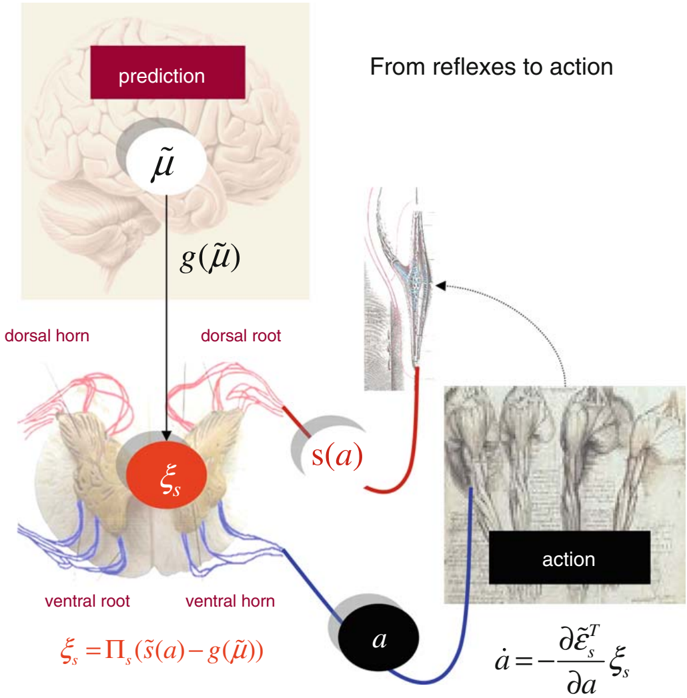
This paper argues that action, like perception, can be understood as minimizing free energy: agents do not select actions by reward maximization, but by fulfilling prior expectations about the sensory consequences of movement. Through simple simulations, it shows that this framework can produce retinal stabilization, intended movements, multimodal reaching, goal-directed behavior, and learned autonomous trajectories.
## Key findings
- Action can be cast as the suppression of sensory prediction error: the paper states that “the only thing that action can affect is the prediction error at the sensory level,” and that movement is driven by sensory prediction errors rather than explicit motor commands.
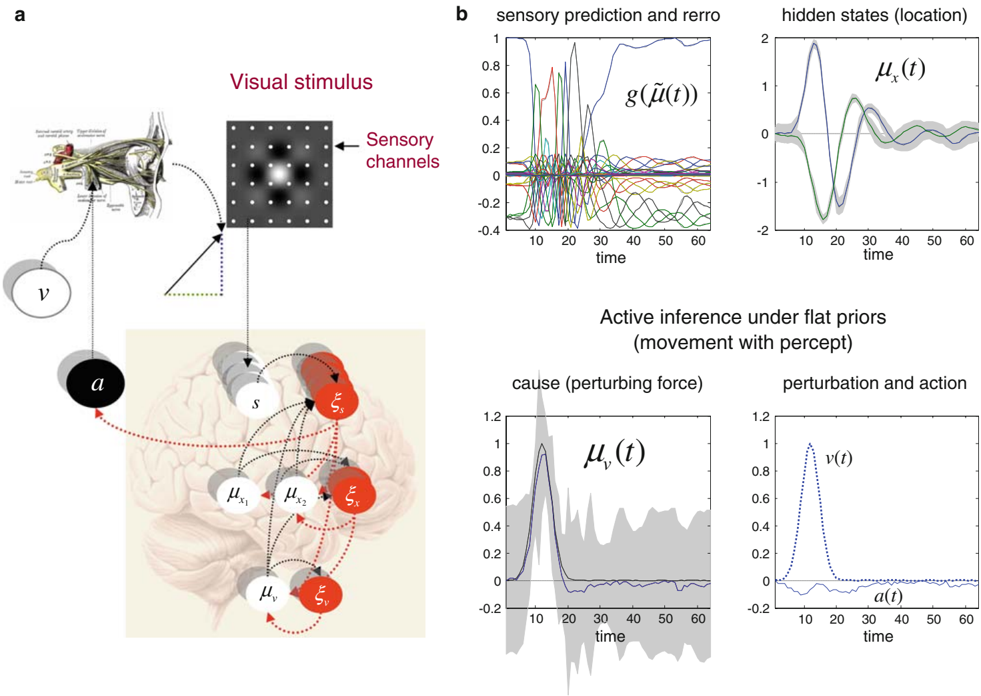
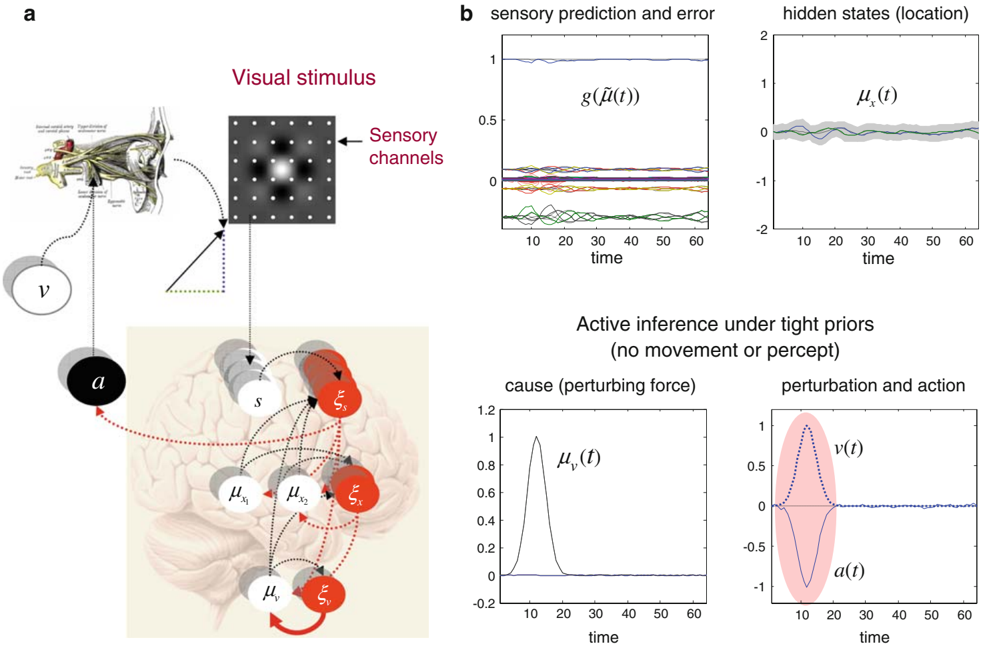
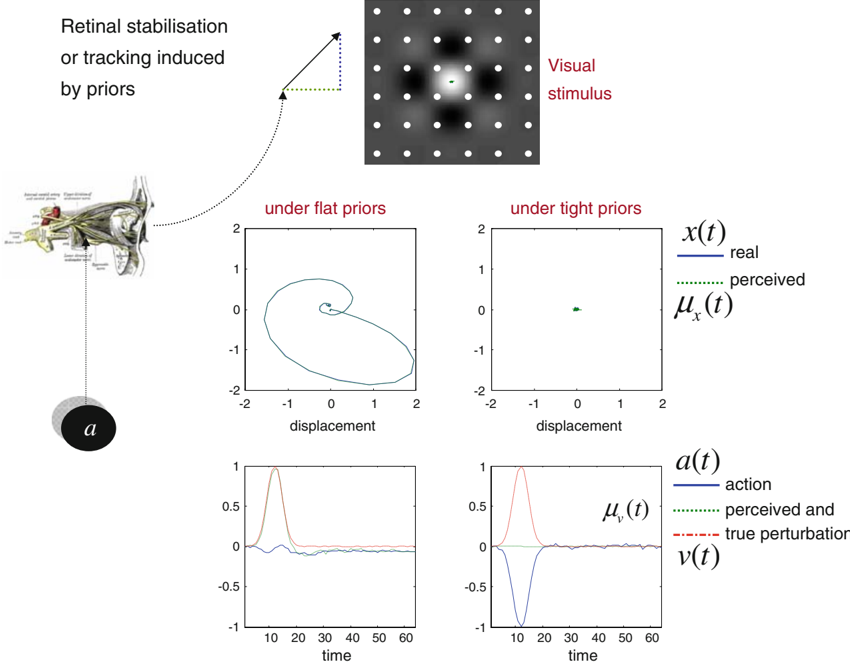
- In oculomotor simulations, tight priors on perturbations led to action that “countered almost immediately” the stimulus motion, while flat priors produced perceived motion; the paper reports a 6×6 = 36-channel sensory array in one retinal simulation.
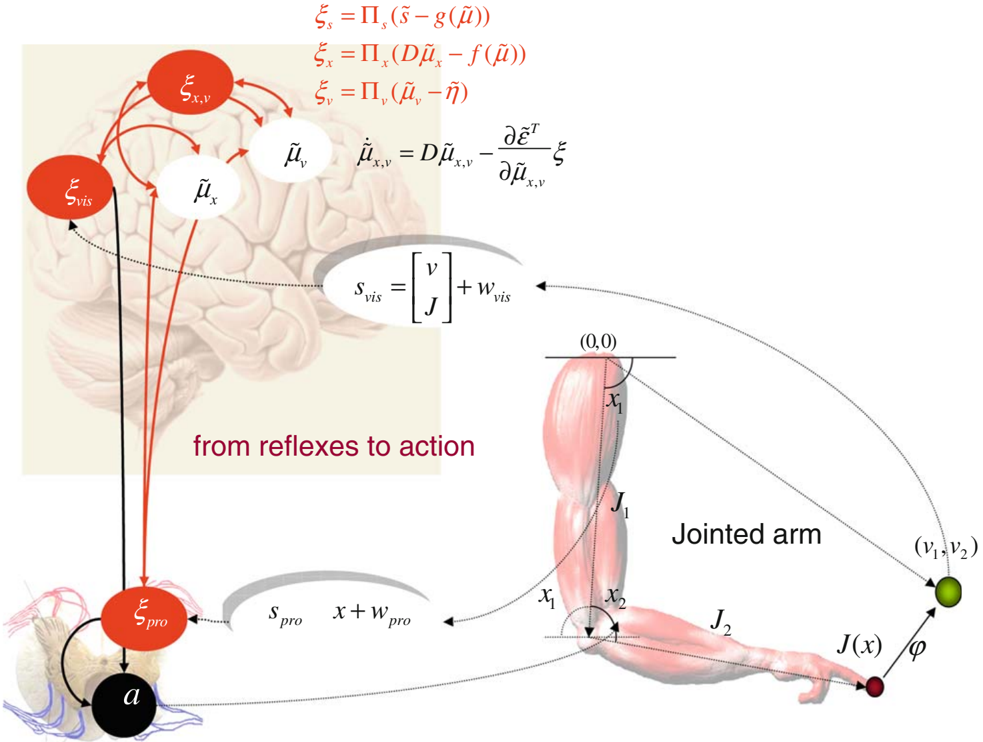
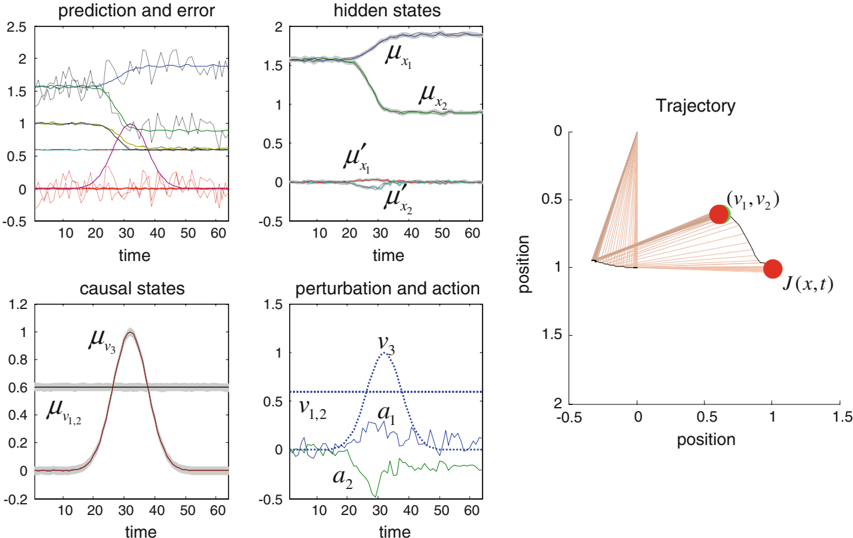
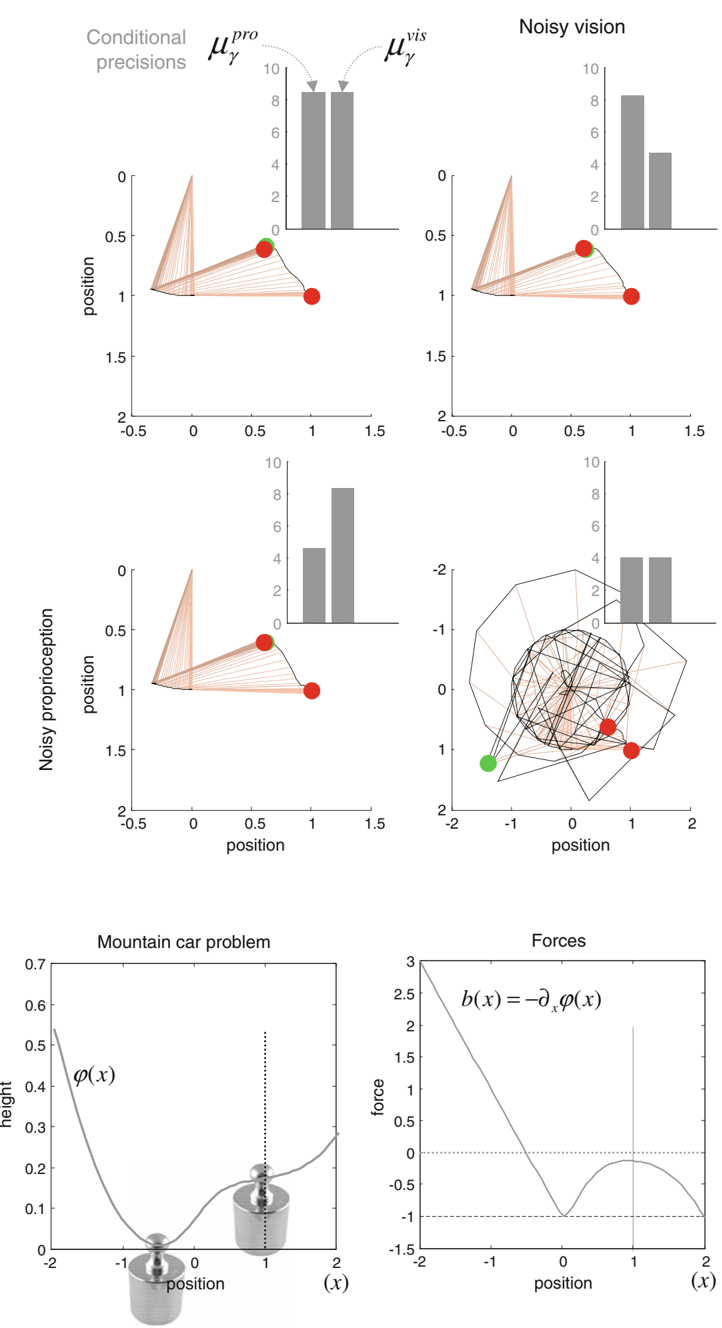
- In the cued reaching simulations, behavior was robust to sensory noise: proprioceptive noise alone could be compensated by vision, visual noise alone by proprioception, but when both modalities were noisy, reaching was compromised.
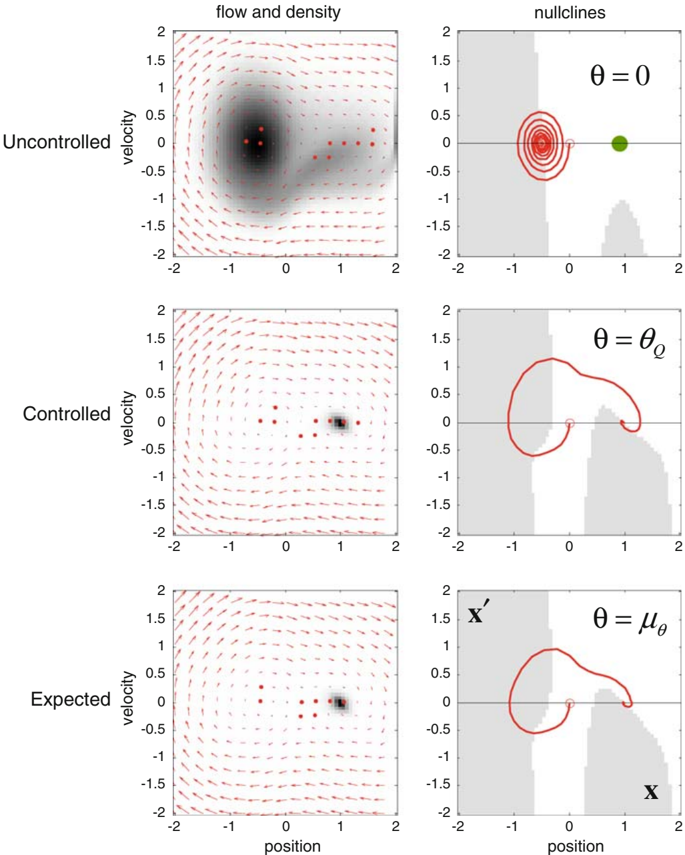
- In the goal-directed “mountain-car” simulation, the agent learned the controlled dynamics over 16 trials, and after learning it produced the required circuitous trajectory to the target; the paper notes that after 16 trials the parameters “converged roughly” to the control environment.
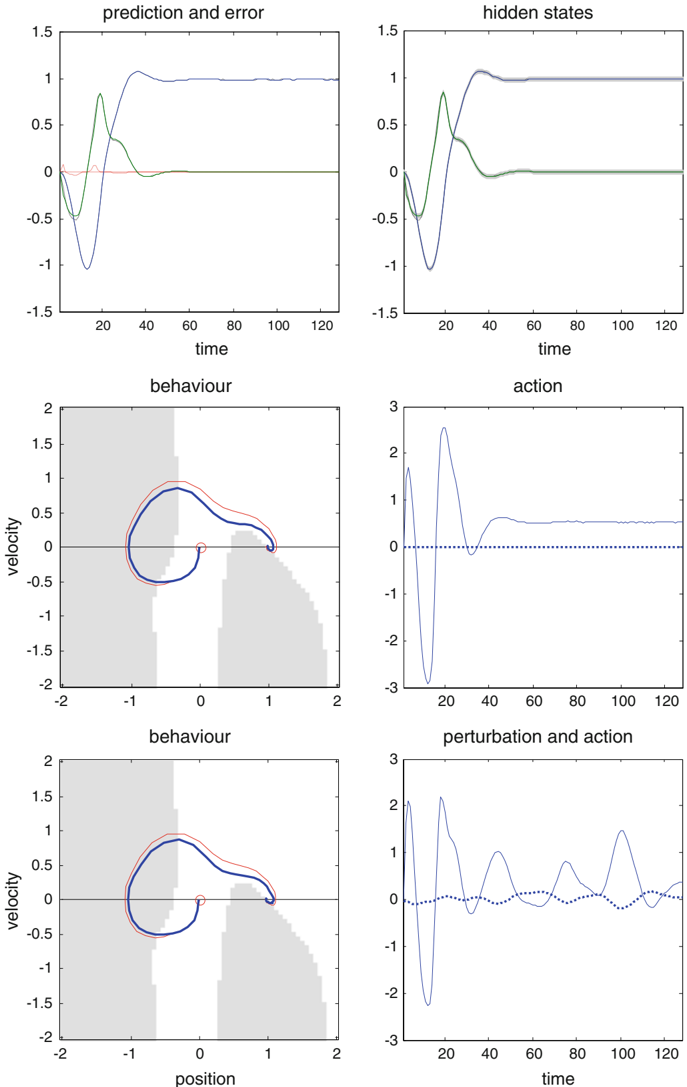
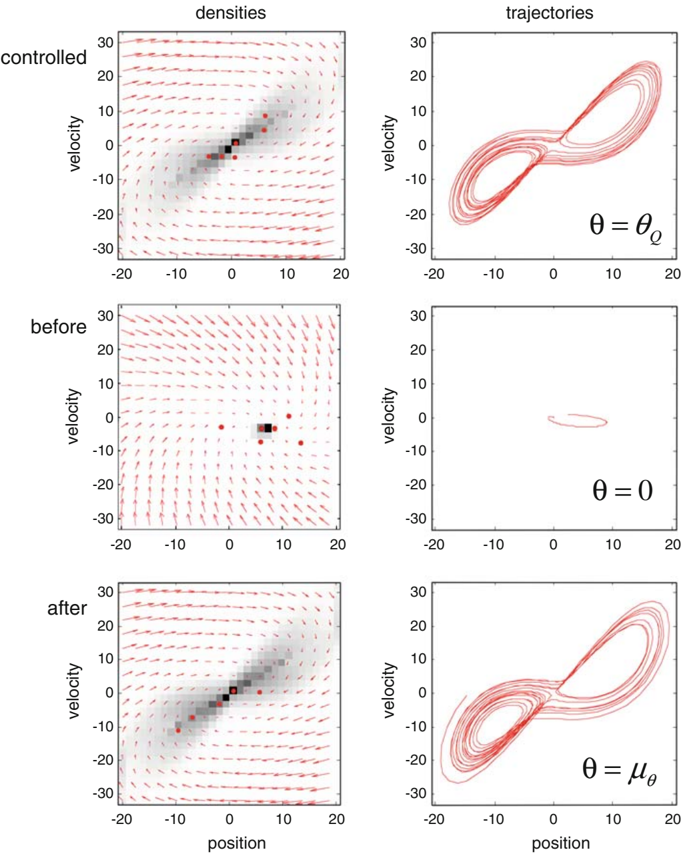
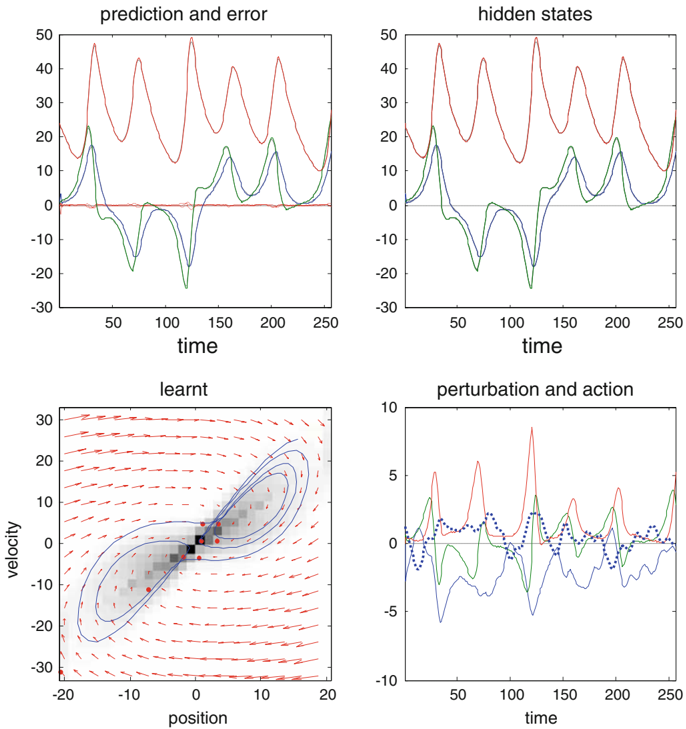
- In the autonomous-behavior simulation, after 16 trials of 512 time-bins, the agent learned to expect a Lorenz attractor and then continued to follow that learned trajectory even under perturbations, showing robustness to exogenous forces.
## Methods
- The paper is a theoretical and simulation study framed around the free-energy principle and active inference, with action and perception implemented through gradient descent on free energy under Gaussian/Laplace assumptions.
- It uses several toy dynamical systems: retinal stabilization/oculomotor control, two-joint arm reaching, the mountain-car problem, and a Lorenz-attractor learning task; one learning example uses 16 trials of 32 s time-bins, and another uses 16 trials of 512 time-bins.
- Analysis is based on generalized coordinates of motion, prediction errors, and variational (free-energy) updates of conditional expectations and precisions; the paper reports that all simulations were implemented with a single Matlab routine, `spm_ADEM.m`.
## Limitations
- The paper itself states that the simulations are simple and that many motor-control and sensorimotor issues are only addressed “superficially,” with the examples used mainly to “impart the intuitions behind active inference.”
- The text repeatedly says that some claims rely on simplifying assumptions, including Gaussian/Laplace approximations, generalized-state truncation, and assumptions about diffeomorphic sensory mappings (stated in the paper).
- Evident from the text: the results are based on idealized simulations and toy environments rather than empirical experiments on biological agents or neural recordings.
Model-written summary. Check it against the paper before relying on it.
Integrity signals
Registry
Cites
Statistics
Figures
Verification
Claims the paper makes
10 Valid · 3 Not valid · 32 Not checked · 265 Own results and interpretations
The cited sources support only part of this claim — read each source’s verdict below.
In the paper
“This mixture of weighted error variance is related formally to phenomenological cost functions proposed to account for movement trajectories (cf.Todorov and Jordan 1998;Nakano et al. 1999;Berret et al. 2008).”
§ Action and behavior: a free-energy formulation > 3.1 Motor control and prediction errors
What the sources say
- Not checked — no full text of the sourcecites Todorov and Jordan 1998 matched to “Smoothness Maximization Along a Predefined Path Accurately Predicts the Speed Profiles of Complex Arm Movements” (1998) source
- Not checked — no full text of the sourcecites Nakano et al. 1999 matched to “Quantitative Examinations of Internal Representations for Arm Trajectory Planning: Minimum Commanded Torque Change Model” (1999) source
- Partly supportedcites Berret et al. 2008 matched to “The Inactivation Principle: Mathematical Solutions Minimizing the Absolute Work and Biological Implications for the Planning of Arm Movements” (2008) sourceExperimental — accuracy not yet measured
The Results (Theoretical Analysis; page unavailable) propose an integral cost combining absolute work with a weighted comfort term to model arm movements. The Introduction describes variance-based models separately, but our copy does not establish a formal relationship between weighted error variance and the paper’s cost function. (LLM, conf=0.82)
plainstates an association- Asserted: passes — The authors put it forward as true.
- Checkable: passes — It can be checked against evidence.
- Load-bearing: unclear — It is unclear whether the paper’s conclusions depend on it.
- Based: passes — The paper gives a reason why it holds.
The cited sources support only part of this claim — read each source’s verdict below.
In the paper
“Furthermore, this perspective on dopaminergic function fits comfortably with a gating role for dopamine (O'Reilly et al. 2002) in selecting the percepts that guide action (Redgrave et al. 1999).”
§ Action and behavior: a free-energy formulation > 7.1 Active inference and optimal control
What the sources say
- Not checked — no full text of the sourcecites O'Reilly et al. 2002 matched to “Prefrontal cortex and dynamic categorization tasks: representational organization and neuromodulatory control” (2002) source
- Partly supportedcites Redgrave et al. 1999 matched to “The basal ganglia: a vertebrate solution to the selection problem?” (1999) sourceExperimental — accuracy not yet measured
In “Dopaminergic regulation of switching” (pp. 13–14), the paper proposes that dopamine helps interrupt and reprioritize behavioral selections in response to salient stimuli. That supports a role in selecting actions guided by stimuli, but not the more specific claim that dopamine selects percepts. “NEW PERSPECTIVES” (p. 16) distinguishes selection for access to motor or cognitive resources from perception itself. (LLM, conf=0.84)
plainstates an association- Asserted: passes — The authors put it forward as true.
- Checkable: passes — It can be checked against evidence.
- Load-bearing: unclear — It is unclear whether the paper’s conclusions depend on it.
- Based: passes — The paper gives a reason why it holds.
The cited sources support only part of this claim — read each source’s verdict below.
In the paper
“Indeed, the motor plant is probably one of the most important aspects of the environment for predicting sensory input (see Grafton and Hamilton 2007).”
§ Action and behavior: a free-energy formulation > 7.3 Forward models in motor control
What the sources say
- Partly supportedcites Grafton and Hamilton 2007 matched to “Evidence for a distributed hierarchy of action representation in the brain” (2007) sourceExperimental — accuracy not yet measured
Section 4, “Computational models” (page unavailable), says forward models predict the motor plant’s state and turn motor commands into expected sensory consequences. It does not characterize the motor plant as an aspect of the environment or rank it among the most important factors for predicting sensory input. (LLM, conf=0.83)
hedgedstates an association- Asserted: passes — The authors put it forward as true.
- Checkable: passes — It can be checked against evidence.
- Load-bearing: unclear — It is unclear whether the paper’s conclusions depend on it.
- Based: passes — The paper gives a reason why it holds.
- Partly supported
A result the paper states — it cites no source for it, so there is none to check. The quote shows it is in the paper.
In the paper
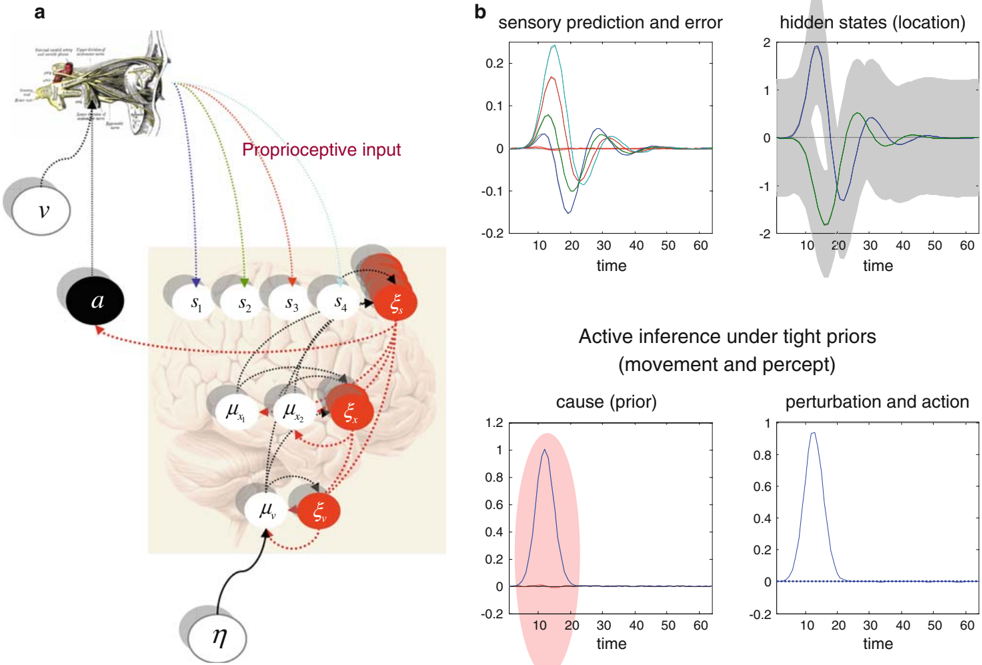
“In other words, the image is stabilized in accordance with the prior expectation of no movement.”
§ Action and behavior: a free-energy formulation > 4.1.1 Retinal stabilization and oculomotor reflexes
plainstates a cause- Asserted: passes — The authors put it forward as true.
- Checkable: passes — It can be checked against evidence.
- Load-bearing: passes — The paper’s conclusions depend on it.
- Based: passes — The paper gives a reason why it holds.
- Rests on 3 assumptions not shown here.
A result the paper states — it cites no source for it, so there is none to check. The quote shows it is in the paper.
In the paper
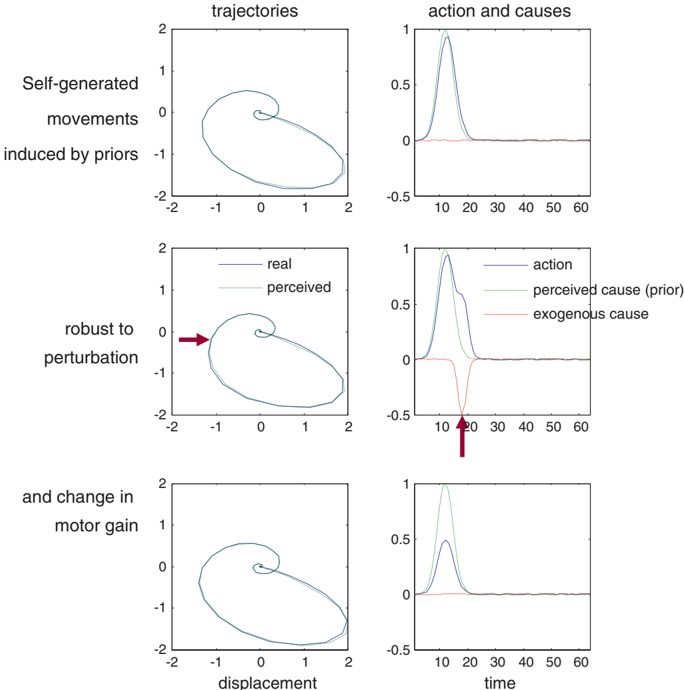
“By manipulating its prior expectations on these perturbations, v(t), we can elicit very different behaviors from the agent.”
§ Action and behavior: a free-energy formulation > 4.1.1 Retinal stabilization and oculomotor reflexes
plainstates a cause- Asserted: passes — The authors put it forward as true.
- Checkable: passes — It can be checked against evidence.
- Load-bearing: passes — The paper’s conclusions depend on it.
- Based: passes — The paper gives a reason why it holds.
- Rests on 3 assumptions not shown here.
181 more claims
Create a free account to see all 310 claims and to verify the 1 reference still open.
- Probably not a substantial claim. 67
- It may state two separate claims as one. 67
- The quote only partly states this claim. 2
- Borderline: one of the tests for a substantial claim is unclear. 1
Claims other papers make about this one
Each is checked against this paper’s own text: does it say what the citing paper says it does?
The source backs part of the claim, not all of it — or backs it for a different population, condition or comparison.
In the citing paper
“The free energy principle (Friston et al. 2010; Badcock et al. 2019) thus casts control theoretic ‘essential variables’ in terms of high precision prior expectations.”
From Consciousness in active inference: Deep self-models, other minds, and the challenge of psychedelic-induced ego-dissolution (2021) · cites this paper as Friston et al. 2010
Experimental — accuracy not yet measuredThe source backs part of the claim, not all of it — or backs it for a different population, condition or comparison.
In the citing paper
“Given a chosen time window, accumulated log evidence could be approximated by the integral of free energy, a quantity known as “free action” (Friston K. et al., 2010).”
From Allostatic Self-efficacy: A Metacognitive Theory of Dyshomeostasis-Induced Fatigue and Depression (2016) · cites this paper as Friston K. et al., 2010
Experimental — accuracy not yet measuredThe cited source says what the claim attributes to it.
In the citing paper
“Also, if predictive models are continually probed by control signals that attempt to confirm the currently dominant model via active inference [21], the framework naturally accommodates the phasic physiological changes that accompany RHI induction [58,59] when these changes are taken to reflect altered autonomic control.”
From Interoceptive inference, emotion, and the embodied self (2013) · cites this paper as [21]
Experimental — accuracy not yet measuredThe cited source says what the claim attributes to it.
In the citing paper
“Thus, perception and action operate synergistically to minimise prediction errors and optimise our internal representations of the environment.”
From The depressed brain: an evolutionary systems theory (2017) · cites this paper as [11]
The cited source says what the claim attributes to it.
In the citing paper
“In the neurosciences, this is known as active inference [60, 61, 62].”
From The free energy principle made simpler but not too simple (2023) · cites this paper as [60]
4 more claims about this paper
Create a free account to see every claim other papers make about this one.
Citations
Cites
Rescorla, R. A. (1972) · Medical Entomology and Zoology · Cited by 9,661
A neural substrate of prediction and reward
Schultz, W., Dayan, P., & Montague, P. R. (1997) · Science · doi:10.1126/science.275.5306.1593 · Cited by 9,388 · cited 1×
“may call for a reappraisal of reinforcement learning as an explanation for behavior and, in particular, the role of dopamine in coding unpredicted reward (Montague et al. 1995; Schultz et al. 1997; Doya 2002): If dopamine encodes precision through its classical neuromodulatory effects (cf., Yu and Dayan 2005) how can…”
BackgroundWatkins, C. J. C. H., & Dayan, P. (1992) · Machine Learning · doi:10.1007/bf00992698 · Cited by 9,083
The free-energy principle: a unified brain theory?
Friston, K. (2010) · Nature Reviews Neuroscience · doi:10.1038/nrn2787 · Cited by 8,120
Self-citationAutopoiesis and Cognition: The Realization of the Living
Maturana, H. R., & Varela, F. J. (1980) · Boston Studies in the Philosophy and History of Science · doi:10.1007/978-94-009-8947-4 · Cited by 5,815
Emergence of simple-cell receptive field properties by learning a sparse code for natural images
Olshausen, B. A., & Field, D. J. (1996) · Nature · doi:10.1038/381607a0 · Cited by 5,694 · cited 1×
“This appeals to the principle of maximum information transfer (Linsker 1990), which has been very useful in understanding the emergence of things like receptive fields (e.g., Olshausen and Field 1996 ).”
BackgroundRao, R. P. N., & Ballard, D. H. (1999) · Nature Neuroscience · doi:10.1038/4580 · Cited by 5,483 · cited 4×
“The idea that the brain uses hierarchical inference has been established for years (Mumford 1992; Rao and Ballard 1998; Friston 2005; Friston et al. 2006) and provides a nice explanation for the hierarchical organization of cortical systems.”
BackgroundInfluentialA theory of cortical responses.
Friston, K. (2005) · Philosophical Transactions of the Royal Society B: Biological Sciences · doi:10.1098/rstb.2005.1622 · Cited by 4,578 · cited 6×
“Please see Friston et al. (2008) for a fuller description of the scheme implied by these circuit diagrams.”
BackgroundMethodInfluentialSelf-citationClassical conditioning II: Current research and theory.
Black, A. H., & Prokasy, W. F. (1972) · Appleton-Century-Crofts eBooks · Cited by 4,449
Watkins, C. J. C. H., & Dayan, P. (1992) · Machine Learning · doi:10.1023/a:1022676722315 · Cited by 3,907
Research works printed but not linked: 2
- 55. MacKay DJC (1995) Free-energy minimization algorithm for decoding and cryptoanalysis. Electron Lett 31:445-447
- 89. Watkins CJCH, Dayan P (1992) Q-learning. Mach Learn 8:279-292
Cited by
Items 201–300 of 847
Affect-biased attention and predictive processing
Ransom, M., Fazelpour, S., Markovic, J., Kryklywy, J. H., Thompson, E. T., & Todd, R. M. (2020) · Cognition · doi:10.1016/j.cognition.2020.104370 · Cited by 50
Harris, D., Wilkinson, S., & Ellmers, T. J. (2023) · Neuroscience & Biobehavioral Reviews · doi:10.1016/j.neubiorev.2023.105115 · Cited by 60
“Predictive processing The Predictive Processing Framework (PPF) views the brain and central nervous system as a hierarchical prediction engine which continuously generates a cascade of top-down hypotheses about the state of the body and the world, and who‟s central, guiding imperative is to minimise prediction error o…”
BackgroundMethodInfluentialFrom Unconscious Inference to the Beholder’s Share: Predictive Perception and Human Experience
Seth, A. K. (2019) · European Review · doi:10.1017/s1062798719000061 · Cited by 53
Embodied skillful performance: where the action is
Hipólito, I., Baltieri, M., Friston, K. J., & Ramstead, M. J. D. (2021) · Synthese · doi:10.1007/s11229-020-02986-5 · Cited by 56
Self-citationA Predictive Processing Model of Perception and Action for Self-Other Distinction
Kahl, S., & Kopp, S. (2018) · Frontiers in Psychology · doi:10.3389/fpsyg.2018.02421 · Cited by 56
“Following the assumption in active inference that overt action is basically action-oriented predictive processing (Friston et al., 2010), we allow strongly predicted next actions of representations in the Sequence level to be acted out.”
BackgroundMethodEntropy, free energy, symmetry and dynamics in the brain
Jirsa, V., & Sheheitli, H. (2022) · Journal of Physics Complexity · doi:10.1088/2632-072x/ac4bec · Cited by 58
Active inference models do not contradict folk psychology
Smith, R. S., Ramstead, M. J. D., & Kiefer, A. B. (2022) · Synthese · doi:10.1007/s11229-022-03480-w · Cited by 62
“The major proposal put forward to solve this problem was called “active inference” (Adams et al., 2013; Brown et al., 2011; Friston et al., 2010).”
BackgroundNovel stable dendrimersome formulation for safe bioimaging applications
Filippi, M., Patrucco, D., Martinelli, J., Botta, M., Castro‐Hartmann, P., Tei, L., & Terreno, E. (2015) · Nanoscale · doi:10.1039/c5nr02695d · Cited by 44
Adams, R. A., Bauer, M., Pinotsis, D., & Friston, K. J. (2016) · NeuroImage · doi:10.1016/j.neuroimage.2016.02.055 · Cited by 43
Self-citationHow Active Inference Could Help Revolutionise Robotics
Da Costa, L., Lanillos, P., Sajid, N., Friston, K., & Khan, S. (2022) · Entropy · doi:10.3390/e24030361 · Cited by 43
Self-citationPhenomenal Variability and Introspective Reliability
HOHWY, J. (2011) · Mind & Language · doi:10.1111/j.1468-0017.2011.01418.x · Cited by 42
Markkula, G., Boer, E. R., Romano, R., & Merat, N. (2018) · White Rose Research Online (University of Leeds, The University of Sheffield, University of York) · Cited by 38
Embodied inference and spatial cognition
Friston, K. (2012) · Cognitive Processing · doi:10.1007/s10339-012-0519-z · Cited by 40
Self-citationClinical Applications of Stochastic Dynamic Models of the Brain, Part I: A Primer
Roberts, J. A., Friston, K. J., & Breakspear, M. J. (2017) · Biological Psychiatry Cognitive Neuroscience and Neuroimaging · doi:10.1016/j.bpsc.2017.01.010 · Cited by 44
“In machine learning, this leads to approximate Bayesian inference and variational schemes such as Kalman filtering, predictive coding, and free energy minimization (49).”
MethodSelf-citationEuler, M. J. (2018) · Neuroscience & Biobehavioral Reviews · doi:10.1016/j.neubiorev.2018.08.013 · Cited by 47
“…this also gives intelligence an intuitive meaning from a formal (information-theoretic) perspective: If intelligence is the ability to minimize expected free energy (i.e., expected self-information; Friston, 2010; Friston et al., 2017) then intelligence just is the ability to resolve uncertainty.”
InfluentialCortical beta oscillations reflect the contextual gating of visual action feedback
Limanowski, J., Litvak, V., & Friston, K. J. (2020) · NeuroImage · doi:10.1016/j.neuroimage.2020.117267 · Cited by 42
Self-citationManifold reaching paradigm: how do we handle target redundancy?
Berret, B., Chiovetto, E., Nori, F., & Pozzo, T. (2011) · Journal of Neurophysiology · doi:10.1152/jn.01063.2010 · Cited by 45
“This idea is actually formalized in the frame of the free-energy principle (Friston et al. 2010) suggesting that this prior would prescribe a small number of attractive states through sensory predictions and that, in turn, would drive movements.”
BackgroundA Neurorobotics Simulation of Autistic Behavior Induced by Unusual Sensory Precision
Idei, H., Murata, S., Chen, Y., Yamashita, Y., Tani, J., & Ogata, T. (2018) · Computational Psychiatry · doi:10.1162/cpsy_a_00019 · Cited by 37
“Minimizing this negative log-likelihoodcanberegardedasminimizingtheprecision-weighted(inversevariance–weighted) prediction error and is formally equivalent to minimizing free energy in the active inference scheme proposed by Friston et al. (2010).”
BackgroundInfluentialThe role of interaction and predictability in the spontaneous entrainment of movement.
Dotov, D. G., Cock, V. C. D., Gény, C., Ihalainen, P., Moens, B., Leman, M., Bardy, B. G., & Bella, S. D. (2019) · Journal of Experimental Psychology General · doi:10.1037/xge0000609 · Cited by 50
Active Inference and Behavior Trees for Reactive Action Planning and Execution in Robotics
Pezzato, C., Corbato, C. H., Bonhof, S., & Wisse, M. (2023) · IEEE Transactions on Robotics · doi:10.1109/tro.2022.3226144 · Cited by 44
“In other words, we, as humans, take actions in order to fulfill prior expectations about a desired prior sensation [18].”
BackgroundDeane, G. (2021) · Neuroscience of Consciousness · doi:10.1093/nc/niab024 · Cited by 38
“The free energy principle (Friston et al. 2010; Badcock et al. 2019) thus casts control theoretic ‘essential variables’ in terms of high precision prior expectations.”
BackgroundApathy is associated with reduced precision of prior beliefs about action outcomes.
Hezemans, F. H., Wolpe, N., & Rowe, J. B. (2020) · Journal of Experimental Psychology: General · doi:10.1037/xge0000739 · Cited by 37
Active Inference, Belief Propagation, and the Bethe Approximation
Schwöbel, S., Kiebel, S., & Marković, D. (2018) · Neural Computation · doi:10.1162/neco_a_01108 · Cited by 36
“For this reason, the concept of describing planning as an inference process has found increasing interest within the cognitive neuroscience community (Botvinick & Toussaint, 2012; Solway & Botvinick, 2012; Friston, Daunizeau, Kilner, & Kiebel, 2010).”
BackgroundMethodInfluentialSelf-citationFrom filters to fillers: an active inference approach to body image distortion in the selfie era
Tremblay, S. C., Tremblay, S. E., & Poirier, P. (2020) · AI & Society · doi:10.1007/s00146-020-01015-w · Cited by 50
“Footnote 5 (continued) 1 3 system that anticipates, or predicts,6 sensory signals by adjusting its current model of the environment or by acting on its current environment (Friston 2005, 2010; Clark 2016; Hohwy 2013).”
BackgroundAttention in the predictive mind
Ransom, M., Fazelpour, S., & Mole, C. (2016) · Consciousness and Cognition · doi:10.1016/j.concog.2016.06.011 · Cited by 45
Order and change in art: towards an active inference account of aesthetic experience
de Cruys, S. V., Frascaroli, J., & Friston, K. J. (2023) · Philosophical Transactions of the Royal Society B Biological Sciences · doi:10.1098/rstb.2022.0411 · Cited by 57
“…action) is assumed to be about reducing uncertainty, so even a mundane walk in the park is enabled by predictive models that minimize their uncertainty — relative to expected action programmes and associated predicted sensory consequences (for an overview on action as prediction, see [29]).”
BackgroundSelf-citationPerception, Action, and Utility: The Tangled Skein
Gershman, S. J., & Daw, N. D. (2012) · Principles of Brain Dynamics · doi:10.7551/mitpress/9108.003.0015 · Cited by 36
Matsumoto, T., & Tani, J. (2020) · Entropy · doi:10.3390/e22050564 · Cited by 36
“In this current paper, we propose a further development of the aforementioned model using the framework of PC and AIF to tackle the issue of learning-based goal-directed motor planning by expanding upon the variational Bayes approach.”
BackgroundInfluentialTravers, E., Friedemann, M., & Haggard, P. (2020) · Cognitive Neuroscience · doi:10.1080/17588928.2020.1824176 · Cited by 49
“Thus, self-initiated actions are events that the actor expects to occur (Friston et al., 2010), and which 40 50 60 represent a reduction in entropy, or the imposition of an internal model on the external world (Parr & Friston, 2019).”
BackgroundWiese, W., & Friston, K. J. (2021) · Philosophies · doi:10.3390/philosophies6010018 · Cited by 45
“[100] show that the notorious Watt governor can be described as if it implemented a form of active inference (more specifically, the version of active inference presented in [101]).”
BackgroundSelf-citationReward maximization through discrete active inference
Da Costa, L., Sajid, N., Parr, T., Friston, K., & Smith, R. (2023) · Neural Computation · doi:10.1162/neco_a_01574 · Cited by 35
“Active inference comprises a collection of algorithms for modeling perception, learning, and decision making in the context of both continuous and discrete state spaces (Barp et al., 2022; Da Costa et al., 2020; Friston et al., 2021, 2010; Friston, Parr, et al., 2017).”
BackgroundSelf-citationAn Active-Inference Approach to Second-Person Neuroscience
Lehmann, K., Bolis, D., Friston, K. J., Schilbach, L., Ramstead, M. J. D., & Kanske, P. (2023) · Perspectives on Psychological Science · doi:10.1177/17456916231188000 · Cited by 62
Self-citationTaniguchi, T., Yamakawa, H., Nagai, T., Doya, K., Sakagami, M., Suzuki, M., Nakamura, T., & Taniguchi, A. (2022) · Neural Networks · doi:10.1016/j.neunet.2022.02.026 · Cited by 54
Open-ended movements structure sensorimotor information in early human development
Kanazawa, H., Yamada, Y., Tanaka, K., Kawai, M., Niwa, F., Iwanaga, K., & Kuniyoshi, Y. (2022) · Proceedings of the National Academy of Sciences · doi:10.1073/pnas.2209953120 · Cited by 48
Robot self/other distinction: active inference meets neural networks learning in a mirror
Lanillos, P., Pages, J., & Cheng, G. (2020) · arXiv · doi:10.48550/arxiv.2004.05473 · Cited by 35
“Based on the active inference paradigm [11,27], we formalized body perception and action as an optimization problem that minimizes the prediction error, i.e., the error between the expected sensory effect and the observed one [10].”
MethodLevin, M. (2025) · BioEssays · doi:10.1002/bies.202400196 · Cited by 34
“The same approach does not work for a mouse on that landscape—what is salient there is its view (internal model) of the landscape and free energy minimization with respect to its priors and goals, not yours [25, 26].”
Smith, R. S., Weihs, K. L., Alkozei, A., Killgore, W. D. S., & Lane, R. D. (2018) · Psychosomatic Medicine · doi:10.1097/psy.0000000000000661 · Cited by 39
Seeking predictions from a predictive framework
Jaeger, T. F., & Ferreira, V. S. (2013) · Behavioral and Brain Sciences · doi:10.1017/s0140525x12002762 · Cited by 38
Biological Self-organisation and Markov blankets
Palacios, E. R., Razi, A., Parr, T., Kirchhoff, M., & Friston, K. (2017) · bioRxiv (Cold Spring Harbor Laboratory) · doi:10.1101/227181 · Cited by 34
“It follows that – by minimising free energy – biological systems place an upper bound to the entropy of their sensations, while inferring their causes; this is also known as active inference [17], and is closely related to other formulations of the perception-action cycle in other disciplines, like embodied cognition…”
BackgroundSelf-citationFast Inference Predictive Coding: A Novel Model for Constructing Deep Neural Networks
Song, Z., Zhang, J., Shi, G., & Liu, J. (2018) · IEEE Transactions on Neural Networks and Learning Systems · doi:10.1109/tnnls.2018.2862866 · Cited by 36
“Friston and Kiebel [24] proposed the Bayesian version of PC from the perspective of the free-energy principle, which can account for perceptual inference and complex cognitive phenomena such as decision making and motor control [27], [28].”
BackgroundKim, S.-Y., Park, H., Jung, M., & Kim, K. K. (2020) · Cyberpsychology Behavior and Social Networking · doi:10.1089/cyber.2019.0136 · Cited by 41
“38 Participants during the Sync condition seemed to unconsciously update proprioception, and it eventually resulted in more stable proprioception over time to the participants.”
Fingerhut, J. (2021) · Frontiers in Psychology · doi:10.3389/fpsyg.2021.635993 · Cited by 50
“The brain reduces uncertainty about its environment by engaging in “prediction error minimization” (Friston and Kiebel, 2009; Friston, 2010; Friston et al., 2010).”
BackgroundDissolving the self:Active inference, psychedelics, and ego-dissolution
Deane, G. (2020) · Philosophy and the Mind Sciences · doi:10.33735/phimisci.2020.i · Cited by 37
Aesthetics and predictive processing: grounds and prospects of a fruitful encounter
Frascaroli, J., Leder, H., Brattico, E., & de Cruys, S. V. (2023) · Philosophical Transactions of the Royal Society B Biological Sciences · doi:10.1098/rstb.2022.0410 · Cited by 54
“…last decade or so, the PP framework has in fact been expanded to account not just for perception and cognition but also action (which is seen as involving predictions about proprioceptive stimuli [36,37]) and emotion (which are seen as arising from predictions about interoceptive stimuli [38,39]).”
BackgroundAn active inference account of protective behaviours during the COVID-19 pandemic
Bottemanne, H., & Friston, K. J. (2021) · Cognitive Affective & Behavioral Neuroscience · doi:10.3758/s13415-021-00947-0 · Cited by 33
“It infers the hidden states that cause sensations, and chooses actions that minimize expected surprise in the future (Friston, 2010).”
BackgroundInfluentialSelf-citationJohnson, P. A., Blom, T., van Gaal, S., Feuerriegel, D., Bode, S., & Hogendoorn, H. (2023) · eLife · doi:10.7554/elife.82424 · Cited by 33
Emergent Aspects of the Integration of Sensory and Motor Functions
Florio, T. M. (2025) · Brain Sciences · doi:10.3390/brainsci15020162 · Cited by 49
“…the brain can be viewed as a Bayesian inference machine that continuously generates predictions about the external world and refines them based on sensory feedback, striving to minimize prediction errors at multiple hierarchical levels, has been formalized as predictive coding framework [158–161].”
Ohata, W., & Tani, J. (2020) · Frontiers in Neurorobotics · doi:10.3389/fnbot.2020.00061 · Cited by 40
“…(PC) (Rao and Ballard, 1999; Tani and Nolfi, 1999; Lee and Mumford, 2003; Friston, 2005, 2018; Hohwy, 2013; Clark, 2015) and active inference (AIF) (Friston et al., 2009, 2010; Baltieri and Buckley, 2017; Buckley et al., 2017; Pezzulo et al., 2018; Oliver et al., 2019) have recently attracted…”
InfluentialActive inference unifies intentional and conflict-resolution imperatives of motor control
Maselli, A., Lanillos, P., & Pezzulo, G. (2022) · PLoS Computational Biology · doi:10.1371/journal.pcbi.1010095 · Cited by 40
“The interested reader is also referred to other publications that provide a comprehensive treat-ment of active inference for motor control [14,29,30,37,48,49].”
InfluentialVisual face-movement sensitive cortex is relevant for auditory-only speech recognition
Riedel, P., Ragert, P., Schelinski, S., Kiebel, S. J., & von Kriegstein, K. (2014) · Cortex · doi:10.1016/j.cortex.2014.11.016 · Cited by 30
Self-citationA computationally informed distinction of interoception and exteroception
Toussaint, B., Heinzle, J., & Stephan, K. E. (2024) · Neuroscience & Biobehavioral Reviews · doi:10.1016/j.neubiorev.2024.105608 · Cited by 37
“However, they share the common notion of a predictive model to describe the interplay between the evolution of hidden states of the external environment, sensory inputs, and actions (e.g. see (Friston et al., 2010) for a juxtaposition of alternative models).”
InfluentialWheeler, N., Allidina, S., Long, E. U., Schneider, S. P., Haas, I. J., & Cunningham, W. A. (2020) · Current Opinion in Behavioral Sciences · doi:10.1016/j.cobeha.2020.05.002 · Cited by 49
Predictions in the eye of the beholder: an active inference account of Watt governors
Baltieri, M., Buckley, C. L., & Bruineberg, J. P. (2020) · Conference on Artificial Life (ALIFE) · doi:10.1162/isal_a_00288 · Cited by 43
“…case of a more general framework based on the minimisation of variational free energy under Gaussian assumptions and by 2) proposing a description of action and behaviour consistent with the minimisation of prediction error and variational (and expected) free energy (Friston et al., 2010, 2017).”
BackgroundMethodInfluentialActive inference body perception and action for humanoid robots
Oliver, G., Lanillos, P., & Cheng, G. (2019) · arXiv · doi:10.48550/arxiv.1906.03022 · Cited by 30
“Active inference Active inference [8], is the extension of perceptual inference to the relationship between sensors and actions, taking into account that actions can change the world to make sensory data more accurate with predictions made by the inner model.”
BackgroundInfluentialSynthesising boredom: a predictive processing approach
Darling, T. (2023) · Synthese · doi:10.1007/s11229-023-04380-3 · Cited by 31
“To this (integrative) end, I turn to predictive processing, which has been heralded as a potentially unifying theoretical and computational framework for mind, body and life (Friston, 2010; Clark, 2013; Hohwy, 2013).”
BackgroundBody-Borne Computers as Extensions of Self
Leigh, S.-W., Sareen, H. S., Kao, H.-L., Liu, X., & Maes, P. (2017) · Computers · doi:10.3390/computers6010012 · Cited by 31
“He rejects the idea of perception as passive reception of a stimuli, and sees that there is no perception without action; active perception being one of the core ideas in embodied cognition research [29].”
BackgroundHow the conception of control influences our understanding of actions
Floegel, M., Kasper, J., Perrier, P., & Kell, C. A. (2023) · Nature reviews. Neuroscience · doi:10.1038/s41583-023-00691-z · Cited by 39
Delusions and Prediction Error
Corlett, P. R. (2018) · Springer eBooks · doi:10.1007/978-3-319-97202-2_2 · Cited by 38
Minds and Brains, Sleep and Psychiatry
Hobson, J. A., Gott, J., & Friston, K. J. (2020) · Psychiatric Research and Clinical Practice · doi:10.1176/appi.prcp.20200023 · Cited by 29
“The theme of the brain as an organ of prediction now dominates much of cognitive neuroscience in the form of active inference or predictive processing (8, 70–72).”
Self-citationA critical analysis of Markovian monism
Beni, M. D. (2021) · Synthese · doi:10.1007/s11229-021-03075-x · Cited by 31
“Free energy is an upper bound on surprise—which is the negative log probability of an outcome— given a generative model—which is a model of probabilistic dependencies between causes and consequences (Friston 2010, pp. 1–3).”
BackgroundActive inference, morphogenesis, and computational psychiatry
Pio‐Lopez, L., Kuchling, F., Tung, A., Pezzulo, G., & Levin, M. G. (2022) · Frontiers in Computational Neuroscience · doi:10.3389/fncom.2022.988977 · Cited by 34
“Active inference is a general framework in theoretical neuroscience that proposes a unified account of perception, learning, and action (Friston et al., 2006; Friston, 2010).”
BackgroundMethodFluctuating Minds: Spontaneous Psychophysical Variability during Mind-Wandering
Henríquez-Ch, R., Chica, A. B., Billeke, P. B., & Bartolomeo, P. (2016) · PLoS ONE · doi:10.1371/journal.pone.0147174 · Cited by 33
“Our psychophysical evidence demonstrates how dynamical local changes in the attentional system level can trigger global cognitive changes [24], and supports the hypothesis that changes of the attentional state not only depend on the nature of the stimuli, such as their physical properties, but also on the variability…”
BackgroundMills, C., Zamani, A., White, R., & Christoff, K. (2021) · Philosophical Transactions of the Royal Society B Biological Sciences · doi:10.1098/rstb.2019.0692 · Cited by 27
“(d) Surprising thoughts: a glitch or a feature? Why do surprising transitions in thoughts occur at all? If the brain is principally concerned with reducing surprise and prediction errors, as some predictive processing accounts of brain function have proposed [18,38], it might appear maladaptive for the brain to produc…”
BackgroundConsciousness science: where are we, where are we going, and what if we get there?
Cleeremans, A., Mudrik, L., & Seth, A. K. (2025) · Frontiers in Science · doi:10.3389/fsci.2025.1546279 · Cited by 52
“…” (PP), the brain continually minimizes sensory “ prediction error ” signals, either by updating its predictions about the causes of sensory signals or by performing actions to bring about predicted or desired sensory inputs (the latter process being termed “ active inference ” ) (119 – 121).”
Psychoanalysis, representation, and neuroscience: The Freudian unconscious and the Bayesian brain
Hopkins, J. (2012) · Oxford University Press eBooks · doi:10.1093/med/9780199600526.003.0014 · Cited by 35
Understanding job satisfaction in the causal attitude network (CAN) model.
Carter, N. T., Lowery, M. R., Smith, R. W., Conley, K. M., Harris, A. M., Listyg, B. S., Maupin, C. K., King, R. T., & Carter, D. R. (2020) · Journal of Applied Psychology · doi:10.1037/apl0000469 · Cited by 31
A systematic evaluation of the evidence for perceptual control theory in tracking studies
Parker, M. G., Willett, A. B. S., Tyson, S. F., Weightman, A., & Mansell, W. (2020) · Neuroscience & Biobehavioral Reviews · doi:10.1016/j.neubiorev.2020.02.030 · Cited by 27
A model-based analysis of impulsivity using a slot-machine gambling paradigm
Paliwal, S., Petzschner, F. H., Schmitz, A. K., Tittgemeyer, M., & Stephan, K. E. (2014) · Frontiers in Human Neuroscience · doi:10.3389/fnhum.2014.00428 · Cited by 33
“From this perspective, humans employ a generative model of sensory inputs to update beliefs about the state of the world and choose actions in order to minimize prediction errors (Knill and Pouget, 2004; Daunizeau et al., 2010; Friston et al., 2010).”
BackgroundDeep Active Inference for Partially Observable MDPs
van der Himst, O., & Lanillos, P. (2020) · arXiv · doi:10.48550/arxiv.2009.03622 · Cited by 27
Predictive codes of interoception, emotion, and the self.
Sel, A. (2014) · Frontiers in Psychology · doi:10.3389/fpsyg.2014.00189 · Cited by 26
“Following the principles of PC, there is a constant attempt to minimize the discrepancy between the predicted and the actual sensory events, either through updating perceptual expectations or through active inference (Friston et al., 2010).”
MethodConsciousness Is Motor: William James on Mind and Action
Klein, A. M. (2025) · doi:10.1093/9780190085872.001.0001 · Cited by 29
After phrenology: Time for a paradigm shift in cognitive science
Badcock, P. B., Ploeger, A., & Allen, N. B. (2016) · Behavioral and Brain Sciences · doi:10.1017/s0140525x15001557 · Cited by 27
The perceptual shaping of anticipatory actions
Maffei, G., Herreros, I., Sánchez-Fibla, M., Friston, K. J., & Verschure, P. F. M. J. (2017) · Proceedings of the Royal Society B Biological Sciences · doi:10.1098/rspb.2017.1780 · Cited by 36
“In general, forward models of the environment have been acknowledged (48), but usually not considered specifically in the context of physiological motor control except, recently, within the domain of active inference (33,35,36,49).”
BackgroundMethodSelf-citationStrube, A., Horing, B., Rose, M., & Büchel, C. (2023) · Neuron · doi:10.1016/j.neuron.2023.01.002 · Cited by 35
Anticipation: Beyond synthetic biology and cognitive robotics
Nasuto, S. J., & Hayashi, Y. (2016) · Biosystems · doi:10.1016/j.biosystems.2016.07.011 · Cited by 26
A predictive coding account of psychotic symptoms in autism spectrum disorder
van Schalkwyk, G. I., Volkmar, F. R., & Corlett, P. R. (2017) · Journal of Autism and Developmental Disorders · doi:10.1007/s10803-017-3065-9 · Cited by 25
Parvizi-Wayne, D., Sandved-Smith, L., Pitliya, R. J., Limanowski, J., Tufft, M. R. A., & Friston, K. J. (2024) · Frontiers in Psychology · doi:10.3389/fpsyg.2024.1354719 · Cited by 43
“What’s more, the observation of such events is often not spatiotemporally contiguous with any underlying prediction, unlike actions of the self, which, according to active inference, are causally preceded by predictions (Friston et al., 2010; Friston, 2012a; Adams et al., 2013).”
BackgroundMethodInfluentialSelf-citationBeyond the Reward Principle: Consciousness as Precision Seeking
Fotopoulou, A. (2013) · Neuropsychoanalysis · doi:10.1080/15294145.2013.10773715 · Cited by 25
Friston, K. J. (2019) · Oxford University Press eBooks · doi:10.1093/oso/9780190662813.003.0014 · Cited by 33
Self-citationTrujillo, L. T. (2019) · Frontiers in Neuroscience · doi:10.3389/fnins.2019.01292 · Cited by 36
“According to the FEP, the brain seeks to minimize its free energy (and thus surprise) about the outcomes of its decisions.”
BackgroundMethodInfluentialFields, C., & Levin, M. G. (2022) · doi:10.31234/osf.io/87nzu · Cited by 22
Semantic and emotional content of imagined representations in human occipitotemporal cortex
Mitchell, D. J., & Cusack, R. (2016) · Scientific Reports · doi:10.1038/srep20232 · Cited by 27
Ahmadi, A., & Tani, J. (2017) · Neural Networks · doi:10.1016/j.neunet.2017.02.015 · Cited by 24
“Murata and colleagues [9, 10] have attempted to overcome this limitation with the stochastic RNN (S-RNN), inspired by the Bayesian predictive coding scheme proposed by Friston [2, 11, 12].”
MethodAn Active Inference Account of Touch and Verbal Communication in Therapy
Kim, J., Esteves, J. E., Cerritelli, F., & Friston, K. J. (2022) · Frontiers in Psychology · doi:10.3389/fpsyg.2022.828952 · Cited by 33
“At the highest level of hierarchically organized internal states, conscious processing may correspond to an image of the self that integrates inferences about the world with its own action (Friston et al., 2010).”
BackgroundSelf-citationDeep kinematic inference affords efficient and scalable control of bodily movements
Priorelli, M., Pezzulo, G., & Stoianov, I. P. (2023) · Proceedings of the National Academy of Sciences · doi:10.1073/pnas.2309058120 · Cited by 29
“Because the latter are perceived with delays that vary across and within sensory modalities[8, 9], they need to be compensated using a forward model, which could introduce additional errors [10].”
BackgroundMethodInfluentialInformation and Metabolism in Bacterial Chemotaxis
Auletta, G. (2013) · Entropy · doi:10.3390/e15010311 · Cited by 24
“A generic principle that describes how organisms deal with environmental information has been proposed in [5–8].”
BackgroundEmbodied decisions as active inference
Priorelli, M., Stoianov, I. P., & Pezzulo, G. (2025) · PLoS Computational Biology · doi:10.1371/journal.pcbi.1013180 · Cited by 25
Gatus, A., Jamieson, G. A., & Stevenson, B. J. (2022) · Frontiers in Human Neuroscience · doi:10.3389/fnhum.2022.744487 · Cited by 27
“Predictive coding in particular suggests that bottom-up sensory information is compared with top-down predictions (represented as Bayesian probability distributions) regarding the sources of sensory information (Feldman and Friston, 2010; Ainley et al., 2016).”
BackgroundPutting reins on the brain. How the body and environment use it
Dotov, D. G. (2014) · Frontiers in Human Neuroscience · doi:10.3389/fnhum.2014.00795 · Cited by 33
“Friston (2010; Friston et al., 2010) enriches the Bayesian statistical framework with self-organization driven by a concretely defined potential function.”
Prediction error minimization: Implications for Embodied Cognition and the Extended Mind Hypothesis
de Bruin, L., & Michael, J. (2016) · Brain and Cognition · doi:10.1016/j.bandc.2016.01.009 · Cited by 28
Structure learning in coupled dynamical systems and dynamic causal modelling
Jafarian, A., Zeidman, P., Litvak, V., & Friston, K. J. (2019) · Philosophical Transactions of the Royal Society A Mathematical Physical and Engineering Sciences · doi:10.1098/rsta.2019.0048 · Cited by 24
“More recently, DCM has motivated and contributed to the development of research in theoretical neuroscience such as predictive coding [35], active inference [36] and, interestingly, the Bayesian brain hypothesis, which aims to establish the mathematical foundations of how the brain interacts with—and understands—its e…”
BackgroundSelf-citationDeep Active Inference for Partially Observable MDPs
van der Himst, O., & Lanillos, P. (2020) · Communications in computer and information science · doi:10.1007/978-3-030-64919-7_8 · Cited by 38
Fox, S., & Rey, V. F. (2024) · Machine Learning and Knowledge Extraction · doi:10.3390/make6030071 · Cited by 22
Russo, A. G., Martino, M. D., Mancuso, A., İaconetta, G., Manara, R., Elia, A., Laudanna, A., Salle, F. D., & Esposito, F. (2020) · NeuroImage · doi:10.1016/j.neuroimage.2020.117281 · Cited by 26
“those brain regions that handle such errors and contribute to successful speech comprehension (Friston et al., 2010; Tuennerhoff and Noppeney, 2016).”
BackgroundPezzulo, G., D’Amato, L., Mannella, F., Priorelli, M., de Maele, T. V., Stoianov, I. P., & Friston, K. J. (2024) · Annals of the New York Academy of Sciences · doi:10.1111/nyas.15118 · Cited by 32
Self-citationA systematic examination of preoperative surgery warm-up routines
Pike, T., Pathak, S., Mushtaq, F., Wilkie, R. M., Mon-Williams, M. A., & Lodge, J. P. A. (2016) · Surgical Endoscopy · doi:10.1007/s00464-016-5218-x · Cited by 24
Curious Inferences: Reply to Sun and Firestone on the Dark Room Problem
Seth, A. K., Millidge, B., Buckley, C. L., & Tschantz, A. (2020) · Trends in Cognitive Sciences · doi:10.1016/j.tics.2020.05.011 · Cited by 23
Robot in the Mirror: Toward an Embodied Computational Model of Mirror Self-Recognition
Hoffmann, M., Wang, S., Outrata, V., Alzueta, E., & Lanillos, P. (2021) · Künstliche Intell. · doi:10.1007/s13218-020-00701-7 · Cited by 27
Dynamic Expectation Maximization Algorithm for Estimation of Linear Systems with Colored Noise
Meera, A. A., & Wisse, M. (2021) · Entropy · doi:10.3390/e23101306 · Cited by 28
“Similarities of FEP with reinforcement learning [26], neural networks [21,27], PID controller [28], Kalman Filter [2] and active learning [24] open up possibilities for biologically plausible parameter estimation algorithms.”
BackgroundMethodMillidge, B. (2019) · doi:10.31234/osf.io/kf6wc · Cited by 22
Metadata
- Authors
- Friston, K. J., Daunizeau, J., Kilner, J., & Kiebel, S. J.
- Affiliations
- Wellcome Centre for Human Neuroimaging (GB)
- Corresponding author
- Friston, Karl J.
- Venue
- Biological Cybernetics
- Published
- 2010-02-11
- Volume
- 102
- Issue
- 3
- Pages
- 227-260
- ISSN
- 0340-1200 (ISSN-L)
- 1432-0770
- OpenAlex
- W2130195834
- Semantic Scholar
- 407bb3034daac0fb4fba3d4c09ef3a26dfbfcf5f
- Cited by
- 866
- References
- 100
- Citations by year
- 2026: 32 · 2025: 65 · 2024: 64 · 2023: 77 · 2022: 63 · 2021: 79 · 2020: 67 · 2019: 56 · 2018: 67 · 2017: 51 · 2016: 36 · 2015: 39 · 2014: 34 · 2013: 33 · 2012: 29
- FWCI
- 18.62
- Type
- journal article
- Language
- en
- Open access
- hybrid
- doi.org
- Licence
- cc-by-nc
- Locations
- Biological Cybernetics (publishedVersion, cc-by-nc)
- PubMed (publishedVersion)
- UCL Discovery (University College London) (submittedVersion)
- Max Planck Digital Library (submittedVersion)
- MPG.PuRe (Max Planck Society) (submittedVersion)
- Topics
- Life Sciences › Neuroscience › Cognitive Neuroscience › Embodied and Extended Cognition
- Social Sciences › Psychology › Social Psychology › Action Observation and Synchronization
- Life Sciences › Neuroscience › Cognitive Neuroscience › Motor Control and Adaptation
- Keywords
- free energy principle, active sampling, perceptual inference, motor control, oculomotor control, goal-directed movement, proprioception, perceptual learning
- MeSH terms
- Afferent Pathways, Animals, Bayes Theorem, Behavior, Brain, Computer Simulation, Humans, Learning, Models, Neurological
About these checks
Registry, retraction, Cites and statistics results are computed, not judged, with one exception: a printed reference that no index lists is read once by a model before it counts as a citation error. Claims are extracted by a model and kept only when their quote appears verbatim in the text; each cited source is then checked, with a model’s help, for whether it says what the claim relies on. Those verdicts can be wrong — read the claim’s quote and the cited source before relying on one.
The claim verdicts this report counts are experimental: their accuracy is not yet measured.
A language model drew the claims from the paper on 2026-10-10, under version 3 of the claim definition (model deepseek-v4.1-flash, prompt extract-v3).
A second model labelled each claim on 2026-10-10 (model jev-1.13-20260917, definition revision gold-guideline-v0.2).
Cited sources are checked with a language model’s help (gpt-6-sol).
Statistics and arithmetic are recomputed, not judged.
Confidence bands are shown only for fields calibrated on our annotated test set. None is calibrated yet, so no band is shown.
What counts as a claim ›How we measure confidence ›How we check this ›
Are you an author, or do you see a problem with this page? Request a review
Data sources
Bibliographic data: Semantic Scholar, OpenAlex, Crossref.
Contains information from the Semantic Scholar Academic Graph Datasets, made available under the ODC Attribution License (ODC-BY 1.0).
Semantic Scholar’s data is described in: Kinney, R., et al. (2023). The Semantic Scholar Open Data Platform. arXiv:2301.10140.
