

Action and behavior: a free-energy formulation
Open accessThe DOI matches its Crossref record; 102 of the 102 references it cites were found in a registry or an index; 10 of the 63 sources its claims cite were checked for support.
Abstract
We have previously tried to explain perceptual inference and learning under a free-energy principle that pursues Helmholtz's agenda to understand the brain in terms of energy minimization. It is fairly easy to show that making inferences about the causes of sensory data can be cast as the minimization of a free-energy bound on the likelihood of sensory inputs, given an internal model of how they were caused. In this article, we consider what would happen if the data themselves were sampled to minimize this bound. It transpires that the ensuing active sampling or inference is mandated by ergodic arguments based on the very existence of adaptive agents. Furthermore, it accounts for many aspects of motor behavior; from retinal stabilization to goal-seeking. In particular, it suggests that motor control can be understood as fulfilling prior expectations about proprioceptive sensations. This formulation can explain why adaptive behavior emerges in biological agents and suggests a simple alternative to optimal control theory. We illustrate these points using simulations of oculomotor control and then apply to same principles to cued and goal-directed movements. In short, the free-energy formulation may provide an alternative perspective on the motor control that places it in an intimate relationship with perception.
Overview
CoChat Summary
## TL;DR
This paper argues that action, like perception, can be understood as minimizing free energy: agents do not select actions by reward maximization, but by fulfilling prior expectations about the sensory consequences of movement. Through simple simulations, it shows that this framework can produce retinal stabilization, intended movements, multimodal reaching, goal-directed behavior, and learned autonomous trajectories.
## Key findings
- Action can be cast as the suppression of sensory prediction error: the paper states that “the only thing that action can affect is the prediction error at the sensory level,” and that movement is driven by sensory prediction errors rather than explicit motor commands.
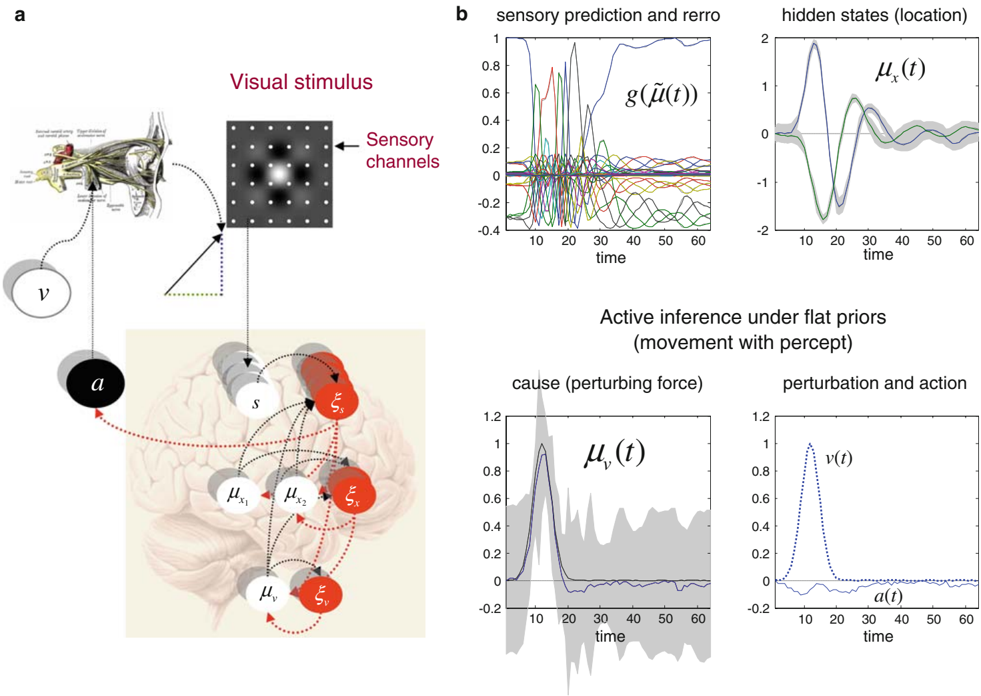
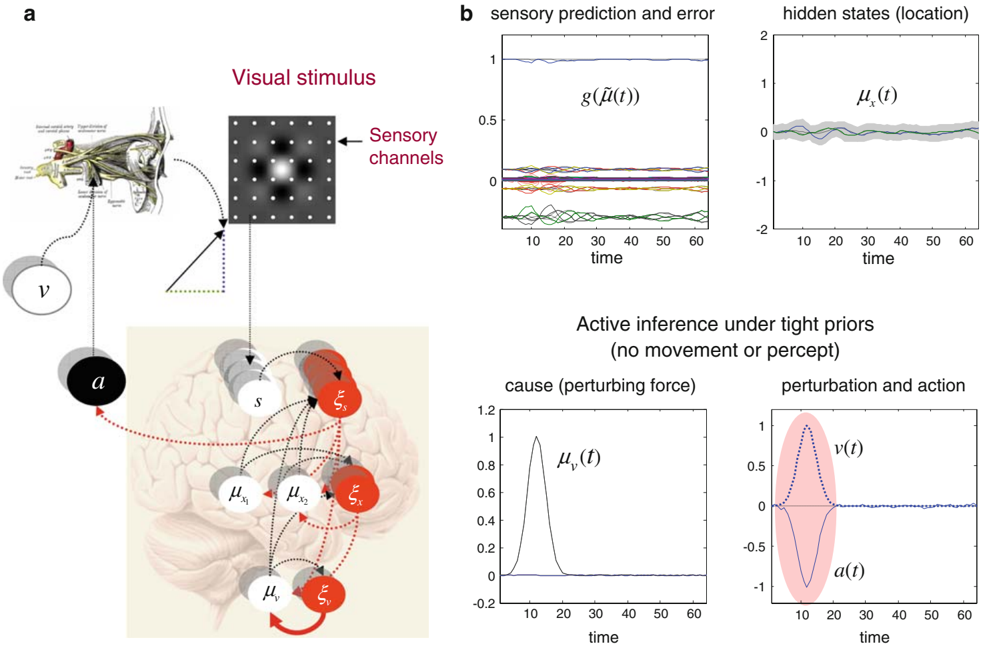
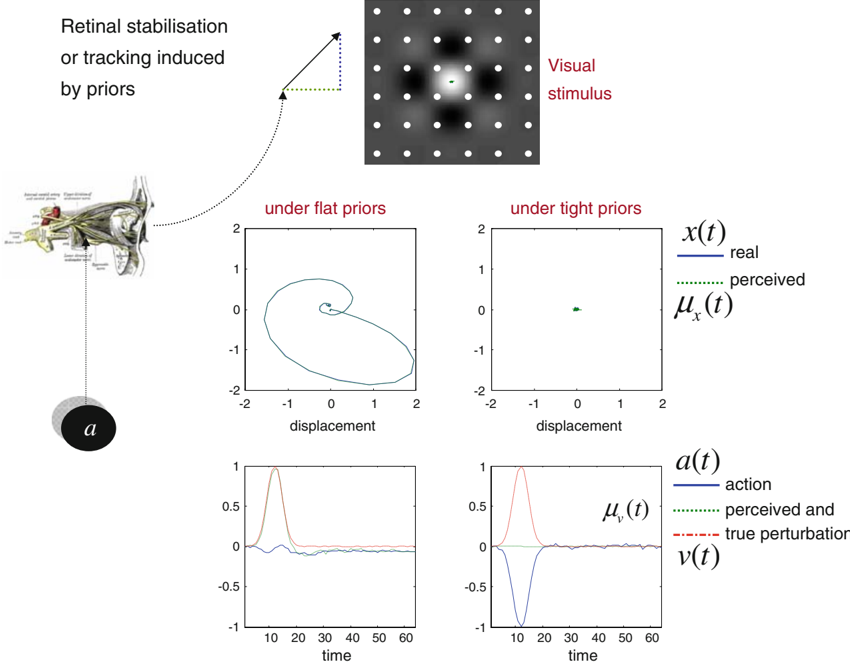
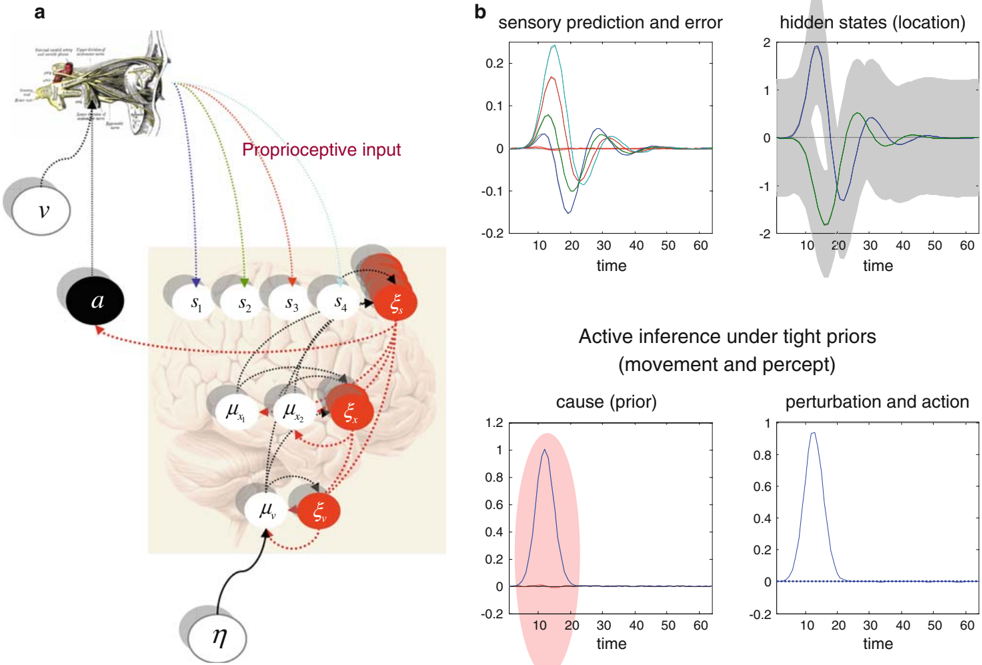
- In oculomotor simulations, tight priors on perturbations led to action that “countered almost immediately” the stimulus motion, while flat priors produced perceived motion; the paper reports a 6×6 = 36-channel sensory array in one retinal simulation.
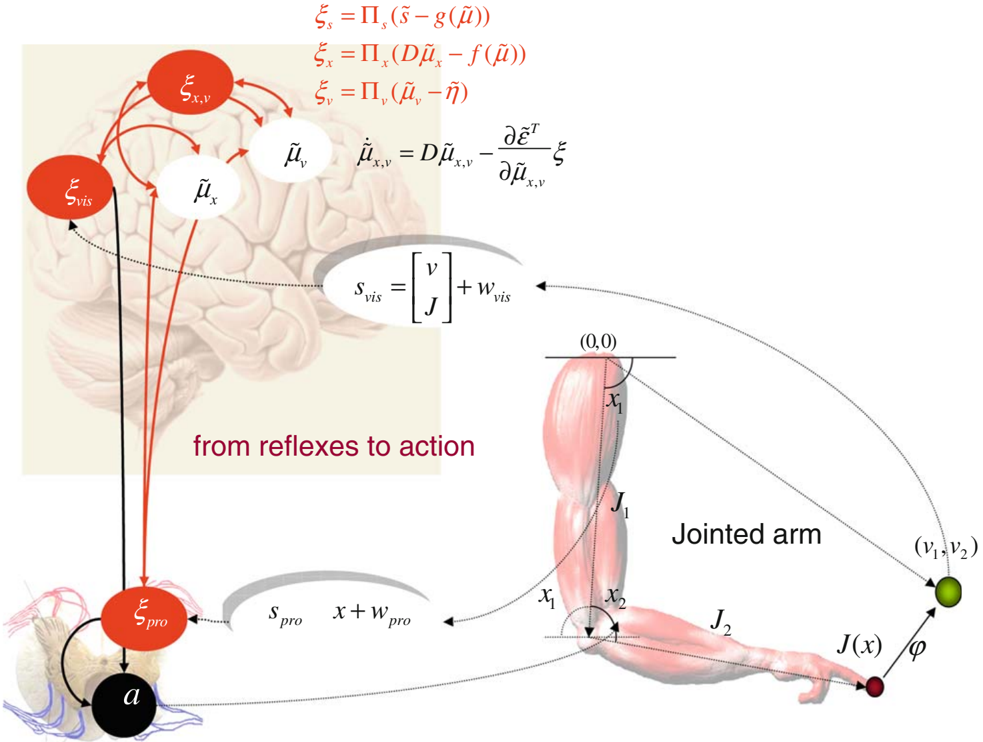
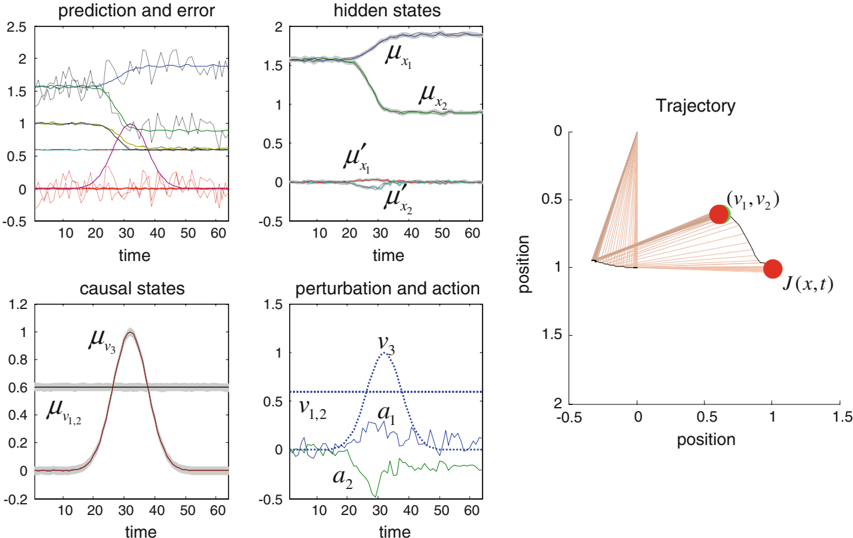
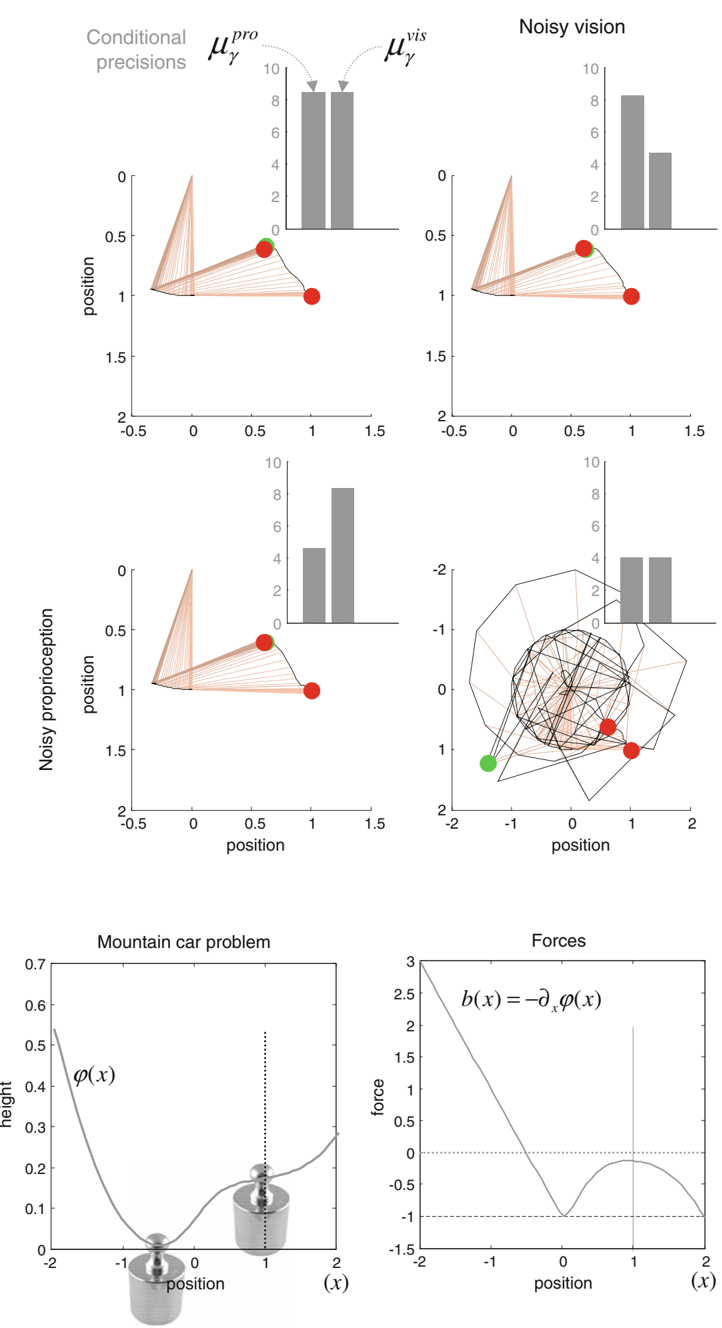
- In the cued reaching simulations, behavior was robust to sensory noise: proprioceptive noise alone could be compensated by vision, visual noise alone by proprioception, but when both modalities were noisy, reaching was compromised.
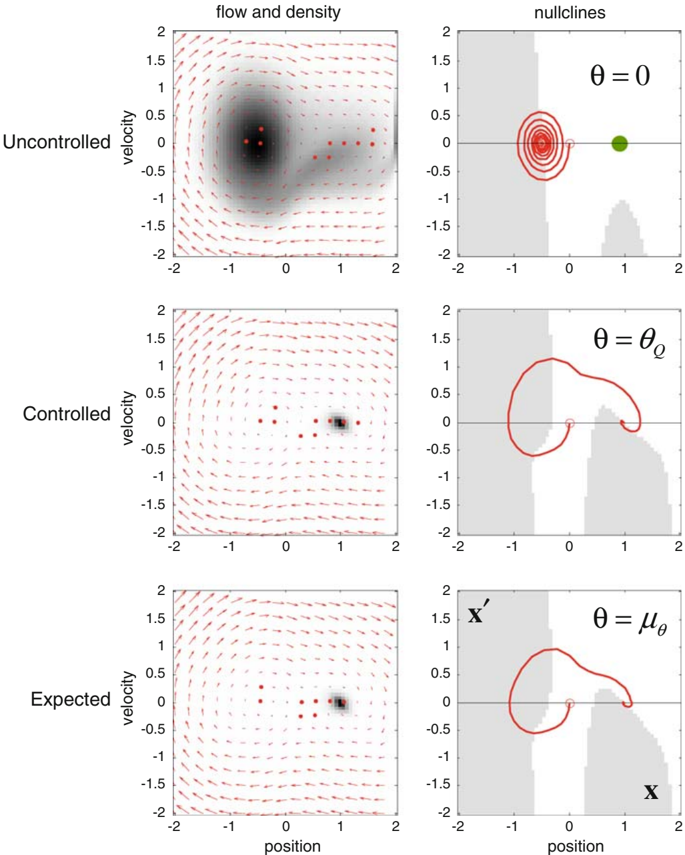
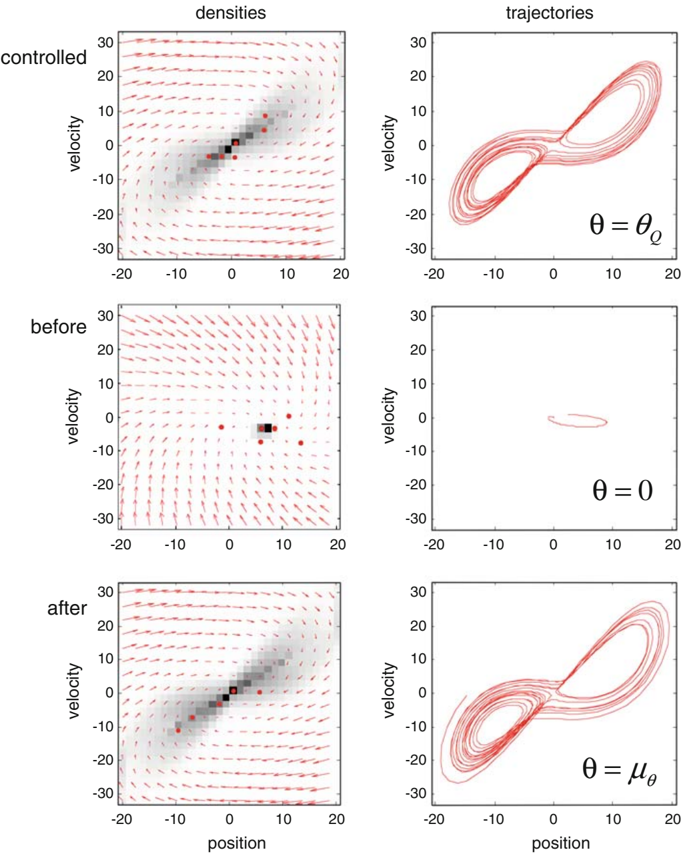
- In the goal-directed “mountain-car” simulation, the agent learned the controlled dynamics over 16 trials, and after learning it produced the required circuitous trajectory to the target; the paper notes that after 16 trials the parameters “converged roughly” to the control environment.
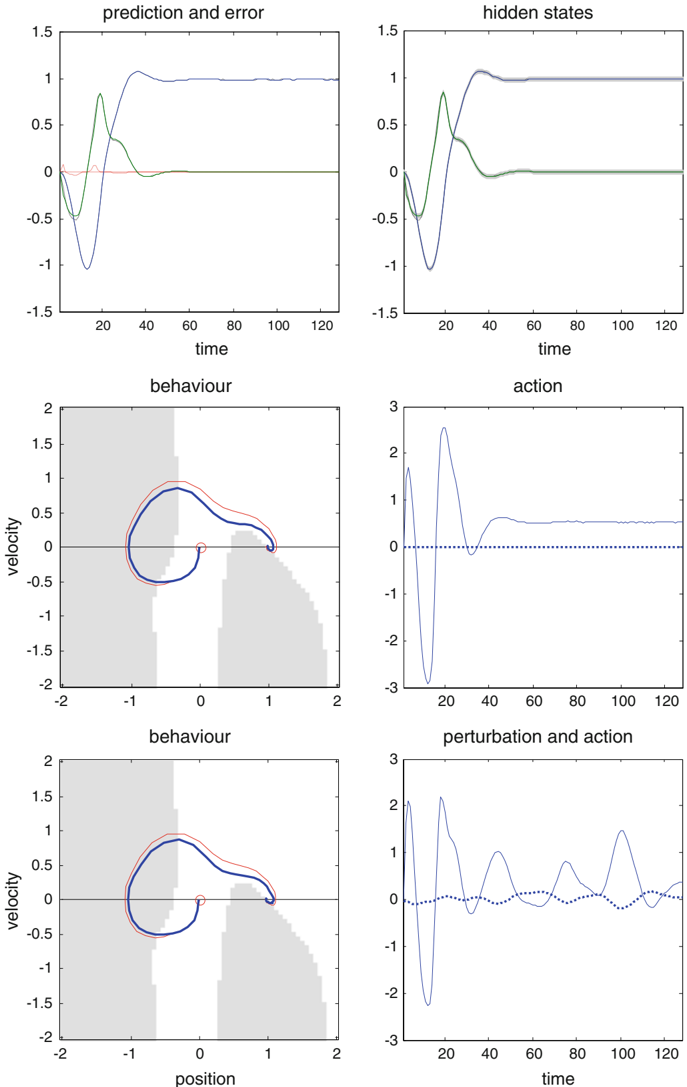
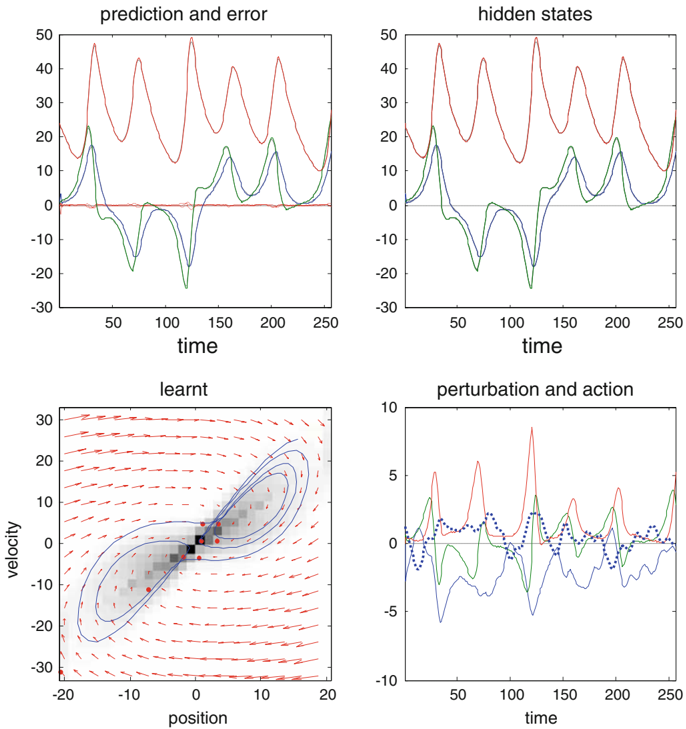
- In the autonomous-behavior simulation, after 16 trials of 512 time-bins, the agent learned to expect a Lorenz attractor and then continued to follow that learned trajectory even under perturbations, showing robustness to exogenous forces.
## Methods
- The paper is a theoretical and simulation study framed around the free-energy principle and active inference, with action and perception implemented through gradient descent on free energy under Gaussian/Laplace assumptions.
- It uses several toy dynamical systems: retinal stabilization/oculomotor control, two-joint arm reaching, the mountain-car problem, and a Lorenz-attractor learning task; one learning example uses 16 trials of 32 s time-bins, and another uses 16 trials of 512 time-bins.
- Analysis is based on generalized coordinates of motion, prediction errors, and variational (free-energy) updates of conditional expectations and precisions; the paper reports that all simulations were implemented with a single Matlab routine, `spm_ADEM.m`.
## Limitations
- The paper itself states that the simulations are simple and that many motor-control and sensorimotor issues are only addressed “superficially,” with the examples used mainly to “impart the intuitions behind active inference.”
- The text repeatedly says that some claims rely on simplifying assumptions, including Gaussian/Laplace approximations, generalized-state truncation, and assumptions about diffeomorphic sensory mappings (stated in the paper).
- Evident from the text: the results are based on idealized simulations and toy environments rather than empirical experiments on biological agents or neural recordings.
Model-written summary. Check it against the paper before relying on it.
Integrity signals
Registry
Cites
Statistics
Figures
Verification
Claims the paper makes
10 Valid · 3 Not valid · 32 Not checked · 265 Own results and interpretations
The cited sources support only part of this claim — read each source’s verdict below.
In the paper
“This mixture of weighted error variance is related formally to phenomenological cost functions proposed to account for movement trajectories (cf.Todorov and Jordan 1998;Nakano et al. 1999;Berret et al. 2008).”
§ Action and behavior: a free-energy formulation > 3.1 Motor control and prediction errors
What the sources say
- Not checked — no full text of the sourcecites Todorov and Jordan 1998 matched to “Smoothness Maximization Along a Predefined Path Accurately Predicts the Speed Profiles of Complex Arm Movements” (1998) source
- Not checked — no full text of the sourcecites Nakano et al. 1999 matched to “Quantitative Examinations of Internal Representations for Arm Trajectory Planning: Minimum Commanded Torque Change Model” (1999) source
- Partly supportedcites Berret et al. 2008 matched to “The Inactivation Principle: Mathematical Solutions Minimizing the Absolute Work and Biological Implications for the Planning of Arm Movements” (2008) sourceExperimental — accuracy not yet measured
The Results (Theoretical Analysis; page unavailable) propose an integral cost combining absolute work with a weighted comfort term to model arm movements. The Introduction describes variance-based models separately, but our copy does not establish a formal relationship between weighted error variance and the paper’s cost function. (LLM, conf=0.82)
plainstates an association- Asserted: passes — The authors put it forward as true.
- Checkable: passes — It can be checked against evidence.
- Load-bearing: unclear — It is unclear whether the paper’s conclusions depend on it.
- Based: passes — The paper gives a reason why it holds.
The cited sources support only part of this claim — read each source’s verdict below.
In the paper
“Furthermore, this perspective on dopaminergic function fits comfortably with a gating role for dopamine (O'Reilly et al. 2002) in selecting the percepts that guide action (Redgrave et al. 1999).”
§ Action and behavior: a free-energy formulation > 7.1 Active inference and optimal control
What the sources say
- Not checked — no full text of the sourcecites O'Reilly et al. 2002 matched to “Prefrontal cortex and dynamic categorization tasks: representational organization and neuromodulatory control” (2002) source
- Partly supportedcites Redgrave et al. 1999 matched to “The basal ganglia: a vertebrate solution to the selection problem?” (1999) sourceExperimental — accuracy not yet measured
In “Dopaminergic regulation of switching” (pp. 13–14), the paper proposes that dopamine helps interrupt and reprioritize behavioral selections in response to salient stimuli. That supports a role in selecting actions guided by stimuli, but not the more specific claim that dopamine selects percepts. “NEW PERSPECTIVES” (p. 16) distinguishes selection for access to motor or cognitive resources from perception itself. (LLM, conf=0.84)
plainstates an association- Asserted: passes — The authors put it forward as true.
- Checkable: passes — It can be checked against evidence.
- Load-bearing: unclear — It is unclear whether the paper’s conclusions depend on it.
- Based: passes — The paper gives a reason why it holds.
The cited sources support only part of this claim — read each source’s verdict below.
In the paper
“Indeed, the motor plant is probably one of the most important aspects of the environment for predicting sensory input (see Grafton and Hamilton 2007).”
§ Action and behavior: a free-energy formulation > 7.3 Forward models in motor control
What the sources say
- Partly supportedcites Grafton and Hamilton 2007 matched to “Evidence for a distributed hierarchy of action representation in the brain” (2007) sourceExperimental — accuracy not yet measured
Section 4, “Computational models” (page unavailable), says forward models predict the motor plant’s state and turn motor commands into expected sensory consequences. It does not characterize the motor plant as an aspect of the environment or rank it among the most important factors for predicting sensory input. (LLM, conf=0.83)
hedgedstates an association- Asserted: passes — The authors put it forward as true.
- Checkable: passes — It can be checked against evidence.
- Load-bearing: unclear — It is unclear whether the paper’s conclusions depend on it.
- Based: passes — The paper gives a reason why it holds.
- Partly supported
A result the paper states — it cites no source for it, so there is none to check. The quote shows it is in the paper.
In the paper
“In other words, the image is stabilized in accordance with the prior expectation of no movement.”
§ Action and behavior: a free-energy formulation > 4.1.1 Retinal stabilization and oculomotor reflexes
plainstates a cause- Asserted: passes — The authors put it forward as true.
- Checkable: passes — It can be checked against evidence.
- Load-bearing: passes — The paper’s conclusions depend on it.
- Based: passes — The paper gives a reason why it holds.
- Rests on 3 assumptions not shown here.
A result the paper states — it cites no source for it, so there is none to check. The quote shows it is in the paper.
In the paper
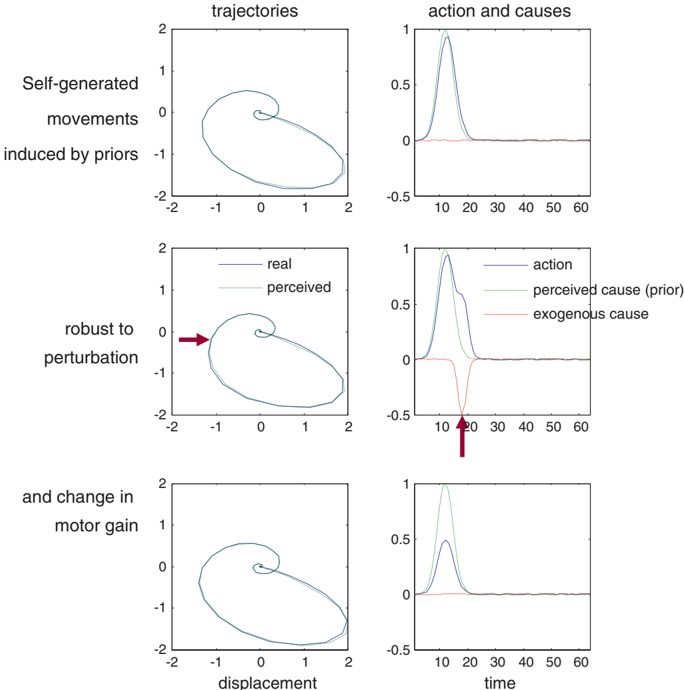
“By manipulating its prior expectations on these perturbations, v(t), we can elicit very different behaviors from the agent.”
§ Action and behavior: a free-energy formulation > 4.1.1 Retinal stabilization and oculomotor reflexes
plainstates a cause- Asserted: passes — The authors put it forward as true.
- Checkable: passes — It can be checked against evidence.
- Load-bearing: passes — The paper’s conclusions depend on it.
- Based: passes — The paper gives a reason why it holds.
- Rests on 3 assumptions not shown here.
181 more claims
Create a free account to see all 310 claims and to verify the 1 reference still open.
- Probably not a substantial claim. 67
- It may state two separate claims as one. 67
- The quote only partly states this claim. 2
- Borderline: one of the tests for a substantial claim is unclear. 1
Claims other papers make about this one
Each is checked against this paper’s own text: does it say what the citing paper says it does?
The source backs part of the claim, not all of it — or backs it for a different population, condition or comparison.
In the citing paper
“The free energy principle (Friston et al. 2010; Badcock et al. 2019) thus casts control theoretic ‘essential variables’ in terms of high precision prior expectations.”
From Consciousness in active inference: Deep self-models, other minds, and the challenge of psychedelic-induced ego-dissolution (2021) · cites this paper as Friston et al. 2010
Experimental — accuracy not yet measuredThe source backs part of the claim, not all of it — or backs it for a different population, condition or comparison.
In the citing paper
“Given a chosen time window, accumulated log evidence could be approximated by the integral of free energy, a quantity known as “free action” (Friston K. et al., 2010).”
From Allostatic Self-efficacy: A Metacognitive Theory of Dyshomeostasis-Induced Fatigue and Depression (2016) · cites this paper as Friston K. et al., 2010
Experimental — accuracy not yet measuredThe cited source says what the claim attributes to it.
In the citing paper
“Also, if predictive models are continually probed by control signals that attempt to confirm the currently dominant model via active inference [21], the framework naturally accommodates the phasic physiological changes that accompany RHI induction [58,59] when these changes are taken to reflect altered autonomic control.”
From Interoceptive inference, emotion, and the embodied self (2013) · cites this paper as [21]
Experimental — accuracy not yet measuredThe cited source says what the claim attributes to it.
In the citing paper
“Thus, perception and action operate synergistically to minimise prediction errors and optimise our internal representations of the environment.”
From The depressed brain: an evolutionary systems theory (2017) · cites this paper as [11]
The cited source says what the claim attributes to it.
In the citing paper
“In the neurosciences, this is known as active inference [60, 61, 62].”
From The free energy principle made simpler but not too simple (2023) · cites this paper as [60]
4 more claims about this paper
Create a free account to see every claim other papers make about this one.
Citations
Cites
Rescorla, R. A. (1972) · Medical Entomology and Zoology · Cited by 9,661
A neural substrate of prediction and reward
Schultz, W., Dayan, P., & Montague, P. R. (1997) · Science · doi:10.1126/science.275.5306.1593 · Cited by 9,388 · cited 1×
“may call for a reappraisal of reinforcement learning as an explanation for behavior and, in particular, the role of dopamine in coding unpredicted reward (Montague et al. 1995; Schultz et al. 1997; Doya 2002): If dopamine encodes precision through its classical neuromodulatory effects (cf., Yu and Dayan 2005) how can…”
BackgroundWatkins, C. J. C. H., & Dayan, P. (1992) · Machine Learning · doi:10.1007/bf00992698 · Cited by 9,083
The free-energy principle: a unified brain theory?
Friston, K. (2010) · Nature Reviews Neuroscience · doi:10.1038/nrn2787 · Cited by 8,120
Self-citationAutopoiesis and Cognition: The Realization of the Living
Maturana, H. R., & Varela, F. J. (1980) · Boston Studies in the Philosophy and History of Science · doi:10.1007/978-94-009-8947-4 · Cited by 5,815
Emergence of simple-cell receptive field properties by learning a sparse code for natural images
Olshausen, B. A., & Field, D. J. (1996) · Nature · doi:10.1038/381607a0 · Cited by 5,694 · cited 1×
“This appeals to the principle of maximum information transfer (Linsker 1990), which has been very useful in understanding the emergence of things like receptive fields (e.g., Olshausen and Field 1996 ).”
BackgroundRao, R. P. N., & Ballard, D. H. (1999) · Nature Neuroscience · doi:10.1038/4580 · Cited by 5,483 · cited 4×
“The idea that the brain uses hierarchical inference has been established for years (Mumford 1992; Rao and Ballard 1998; Friston 2005; Friston et al. 2006) and provides a nice explanation for the hierarchical organization of cortical systems.”
BackgroundInfluentialA theory of cortical responses.
Friston, K. (2005) · Philosophical Transactions of the Royal Society B: Biological Sciences · doi:10.1098/rstb.2005.1622 · Cited by 4,578 · cited 6×
“Please see Friston et al. (2008) for a fuller description of the scheme implied by these circuit diagrams.”
BackgroundMethodInfluentialSelf-citationClassical conditioning II: Current research and theory.
Black, A. H., & Prokasy, W. F. (1972) · Appleton-Century-Crofts eBooks · Cited by 4,449
Watkins, C. J. C. H., & Dayan, P. (1992) · Machine Learning · doi:10.1023/a:1022676722315 · Cited by 3,907
Research works printed but not linked: 2
- 55. MacKay DJC (1995) Free-energy minimization algorithm for decoding and cryptoanalysis. Electron Lett 31:445-447
- 89. Watkins CJCH, Dayan P (1992) Q-learning. Mach Learn 8:279-292
Cited by
Items 301–400 of 847
Free Energy Principle Based State and Input Observer Design for Linear Systems with Colored Noise
Meera, A. A., & Wisse, M. (2020) · Proceedings of the ... American Control Conference/Proceedings of the American Control Conference · doi:10.23919/acc45564.2020.9147581 · Cited by 27
“Similarities of FEP with reinforcement learning [12], neural networks [7, 13] and active learning [10] open up possibilities for biologically plausible control system techniques.”
BackgroundActive inference through whiskers
Mannella, F., Maggiore, F., Baltieri, M., & Pezzulo, G. (2021) · Neural Networks · doi:10.1016/j.neunet.2021.08.037 · Cited by 27
Olier, J. S., Barakova, E. I., Regazzoni, C. S., & Rauterberg, M. (2017) · Cognitive Systems Research · doi:10.1016/j.cogsys.2017.03.005 · Cited by 22
“It has been mentioned that Friston’s ideas on active inference (Friston, 2010; Friston et al., 2010; Friston et al., 2011) explain plausible mechanisms for empirical results concerning the role of simulation and active representations on cognitive processes.”
Najnin, S., & Banerjee, B. (2017) · Speech Communication · doi:10.1016/j.specom.2017.05.002 · Cited by 26
Clinical Applications of Stochastic Dynamic Models of the Brain, Part II: A Review
Roberts, J. A., Friston, K. J., & Breakspear, M. J. (2017) · Biological Psychiatry Cognitive Neuroscience and Neuroimaging · doi:10.1016/j.bpsc.2016.12.009 · Cited by 23
Self-citationTschantz, A., Barca, L., Maisto, D., Buckley, C. L., Seth, A. K., & Pezzulo, G. (2021) · bioRxiv (Cold Spring Harbor Laboratory) · doi:10.1101/2021.02.16.431365 · Cited by 18
“In recent years, this predictive coding scheme has been generalised to action (Friston et al., 2010; Friston, FitzGerald, et al., 2017).”
MethodBayesian brain theory: Computational neuroscience of belief
Bottemanne, H. (2024) · Neuroscience · doi:10.1016/j.neuroscience.2024.12.003 · Cited by 32
Jung, M., Sim, S., Kim, J., & Kim, K. K. (2022) · JMIR Serious Games · doi:10.2196/40119 · Cited by 32
“findings, proving that the integration of visual-motion synchronization, which fulfills proprioception [18], forms a feeling that “I am the only cause of the avatar’s body motion” [1].”
BackgroundFlexible intentions: An Active Inference theory
Priorelli, M., & Stoianov, I. P. (2023) · Frontiers in Computational Neuroscience · doi:10.3389/fncom.2023.1128694 · Cited by 28
Reconceiving rationality: situating rationality into radically enactive cognition
Rolla, G. (2019) · Synthese · doi:10.1007/s11229-019-02362-y · Cited by 28
“The notion of “active inference”, which plays a central role in PP’s integration of action and perception under the same set of rules (Friston et al. 2010), can also be understood in a deflationary, contentless way.”
BackgroundA deep active inference model of the rubber-hand illusion
Rood, T., van Gerven, M., & Lanillos, P. (2020) · Communications in Computer and Information Science · doi:10.1007/978-3-030-64919-7_10 · Cited by 19
“We formalise body perception and action as an inference problem [11,3,7,17].”
BackgroundTemporal prediction errors modulate task-switching performance
Limongi, R., Silva, A. M., & Góngora-Costa, B. (2015) · Frontiers in Psychology · doi:10.3389/fpsyg.2015.01185 · Cited by 19
“Predictive coding also proposes that “action” or, in general, “behavior” is another way to minimize PEs (Friston et al., 2006, 2010), and, in consequence, free energy.”
BackgroundIdei, H., Murata, S., Yamashita, Y., & Ogata, T. (2021) · Neural Networks · doi:10.1016/j.neunet.2021.01.033 · Cited by 19
Maier, M., Blume, F., Bideau, P., Hellwich, O., & Rahman, R. A. (2022) · Consciousness and Cognition · doi:10.1016/j.concog.2022.103301 · Cited by 23
Pio‐Lopez, L., Bischof, J., LaPalme, J. V., & Levin, M. G. (2023) · Interface Focus · doi:10.1098/rsfs.2022.0072 · Cited by 28
“…via bioelectrical networks underlie problem-solving in physiological space by bacterial communities [11,12] and plants [13,14]; navigation of morphospace by a wide range of embryonic and regenerative systems [15 – 17]; and classical behaviour by organisms with neurons and brains [18,19].”
BackgroundGonzález‐Herrero, B., Happe, F. G. E., Nicholson, T. R., Morgante, F., Pagonabarraga, J., Deeley, Q., & Edwards, M. J. (2024) · Brain and Behavior · doi:10.1002/brb3.70168 · Cited by 22
Ueyama, Y. (2014) · Frontiers in Computational Neuroscience · doi:10.3389/fncom.2014.00119 · Cited by 29
“Moreover, it has been reported that active inference could acquire complex and adaptive behaviors using a free-energy formulation of perception (Friston et al., 2009), and generate movement trajectories shown to be remarkably robust to perturbations on a limb (Friston et al., 2010).”
BackgroundBortolotti, L. (2018) · Springer eBooks · doi:10.1007/978-3-319-97202-2 · Cited by 32
Kimura, D., Kadota, K., & Kinoshita, H. (2015) · Frontiers in Aging Neuroscience · doi:10.3389/fnagi.2015.00182 · Cited by 19
“Recent studies have suggested an alternative computational model emphasizing the significance of processes by the peripheral somatosensory feedback system for online movement correction (Friston et al., 2010; Friston, 2011; Adams et al., 2012, 2013).”
BackgroundThe aetiopathogenesis of fatigue: unpredictable, complex and persistent
Clark, J. E., Ng, W., Watson, S., & Newton, J. L. (2016) · British Medical Bulletin · doi:10.1093/bmb/ldv057 · Cited by 22
“This selforganizing behaviour is fundamental to the persistence of the system over time and is thought to be achieved by adjusting internal and external states until they reach an equilibrium density of least entropy.(60,61) Interestingly, this principle entails that biological systems are thermodynamically open(62) w…”
BackgroundPuviani, L., Rama, S., & Vitetta, G. M. (2018) · IEEE Transactions on Affective Computing · doi:10.1109/taffc.2018.2887385 · Cited by 20
The Digital Phenotyping Project: A Psychoanalytical and Network Theory Perspective
Potier, R. (2020) · Frontiers in Psychology · doi:10.3389/fpsyg.2020.01218 · Cited by 24
“Friston and Carhart-Harris have indeed linked Freud’s theoretical propositions to data from neuropsychology, neuroimaging, and psychopharmacology (Carhart-Harris and Friston, 2010, 2019).”
BackgroundSchmidt, T. T., Schröder, P., Reinhardt, P., & Blankenburg, F. (2020) · Human Brain Mapping · doi:10.1002/hbm.25220 · Cited by 18
Khalil, E. L., & Amin, A. (2022) · Current Psychology · doi:10.1007/s12144-022-03554-5 · Cited by 26
Benyamini, M., & Zacksenhouse, M. (2015) · Frontiers in Systems Neuroscience · doi:10.3389/fnsys.2015.00071 · Cited by 21
Inferring Adaptive Goal-Directed Behavior Within Recurrent Neural Networks
Otte, S., Schmitt, T., Friston, K. J., & Butz, M. V. (2017) · Lecture notes in computer science · doi:10.1007/978-3-319-68600-4_27 · Cited by 19
“We show that dynamic active-inference-based processes, which are corollaries of the free-energy-based inference principle [3, 5], implemented within RNNs, can generate suitable control commands when trajectory redundancies need to be resolved on the fly and even when more complex trajectories need to be found.”
BackgroundSelf-citationPath Integral Control by Reproducing Kernel Hilbert Space EmbeddingPreprint
Rawlik, K., Toussaint, M., & Vijayakumar, S. (2012) · arXiv (Cornell University) · doi:10.48550/arxiv.1208.2523 · Cited by 18
“Numerical examples on test problems, which illustrate the sample efficiency, are provided.”
BackgroundThe Many Faces of Attention: Why Precision Optimization Is Not Attention
Ransom, M., & Fazelpour, S. (2020) · Bloomsbury Publishing Plc eBooks · doi:10.5040/9781350099784.ch-007 · Cited by 22
Skora, L. I., Seth, A. K., & Scott, R. B. Y. (2021) · Neuroscience of Consciousness · doi:10.1093/nc/niab003 · Cited by 17
“PE minimization through action is known as ‘active inference’ (Friston et al., 2010).”
BackgroundKaiser, T. K., & Hamann, H. (2022) · IEEE Transactions on Robotics · doi:10.1109/tro.2022.3181004 · Cited by 24
“Index Terms —Evolutionary swarm robotics, innate motivation, object manipulation, self-assembly.”
BackgroundInfluentialModeling Motor Control in Continuous Time Active Inference: A Survey
Priorelli, M., Maggiore, F., Maselli, A., Donnarumma, F., Maisto, D., Mannella, F., Stoianov, I. P., & Pezzulo, G. (2023) · IEEE Transactions on Cognitive and Developmental Systems · doi:10.1109/tcds.2023.3338491 · Cited by 21
“For example, the reaching model of [101] uses proprioceptive and visual sensory modalities for perception and action.”
BackgroundA Probabilistic Interpretation of PID Controllers Using Active Inference
Baltieri, M., & Buckley, C. L. (2018) · Lecture notes in computer science · doi:10.1007/978-3-319-97628-0_2 · Cited by 27
Embodied Cognitive Robotics and the learning of sensorimotor schemes
Lara, B., Astorga, D., Mendoza-Bock, E., Pardo, M., Escobar, E., & Ciria, A. (2018) · Adaptive Behavior · doi:10.1177/1059712318780679 · Cited by 24
Decoding expectation and surprise in dementia: the paradigm of music
Benhamou, E., Zhao, S., Sivasathiaseelan, H., Johnson, J. C. S., Requena‐Komuro, M., Bond, R. L., van Leeuwen, J. E. P., Russell, L. L., Greaves, C. V., Nelson, A., et al. (2021) · Brain Communications · doi:10.1093/braincomms/fcab173 · Cited by 23
“Predictive coding has gained wide currency as a paradigm of brain operation and in particular, the role of active neural inference in making and iteratively refining predictions about the environment, thereby minimizing error and optimizing neural representations of the world at large.(39,40) The probabilistic structu…”
BackgroundModeling the Evolution of Beliefs Using an Attentional Focus Mechanism
Marković, D., Gläscher, J. P., Bossaerts, P. L., O’Doherty, J. P., & Kiebel, S. J. (2015) · PLoS Computational Biology · doi:10.1371/journal.pcbi.1004558 · Cited by 20
Self-citationDevelopment of compositionality through interactive learning of language and action of robots
Vijayaraghavan, P., Queißer, J. F., Verduzco-Flores, S. O., & Tani, J. (2025) · Science Robotics · doi:10.1126/scirobotics.adp0751 · Cited by 29
Survey and perspective on social emotions in robotics
Hieida, C., & Nagai, T. (2022) · Advanced Robotics · doi:10.1080/01691864.2021.2012512 · Cited by 26
“The idea of active inference is also related to the body system, such as visual attention, which is related to the evaluation of external stimuli [27,28].”
BackgroundBudaev, S. V., Dumitru, M. L., Enberg, K., Handeland, S. O., Higginson, A. D., Kristiansen, T. S., Opdal, A. F., Railsback, S. F., Rønnestad, I., Vollset, K. W., et al. (2024) · Aquaculture Fish and Fisheries · doi:10.1002/aff2.153 · Cited by 19
Dynamical predictions of insular hubs for social cognition and their application to stroke
Limongi, R., Tomio, A., & Ibáñez, A. M. (2014) · Frontiers in Behavioral Neuroscience · doi:10.3389/fnbeh.2014.00380 · Cited by 17
“Top-down predictions work via feedback information that minimizes PEs (Friston and Kiebel, 2009; Friston et al., 2010).”
BackgroundActive Inference, Predictive Coding and Cortical Architecture
Adams, R. A., Friston, K. J., & Bastos, A. M. (2015) · Springer eBooks · doi:10.1007/978-94-017-9900-3_7 · Cited by 23
Self-citationAdaptation Through Prediction: Multisensory Active Inference Torque Control
Meo, C., Franzese, G., Pezzato, C., Spahn, M., & Lanillos, P. (2022) · IEEE Transactions on Cognitive and Developmental Systems · doi:10.1109/tcds.2022.3156664 · Cited by 23
“We combine state representation learning [19] with variational free energy (VFE) optimization in generalized coordinates [8], [22] to infer the torques needed to achieve goal-directed behaviors.”
BackgroundMethodInfluentialThe Many Roles of Precision in Action
Limanowski, J., Adams, R. A., Kilner, J. M., & Parr, T. (2024) · Entropy · doi:10.3390/e26090790 · Cited by 27
“This originates from active inference formulations based on an extension of predictive coding schemes with motor reflexes—specifically, from the key assumption of those formulations that movement is produced through the minimisation of proprioceptive prediction errors [34–36 ,47, 68].”
Self-citationThe reward of unification: A realist reading of the predictive processing theory
Beni, M. D. (2017) · New Ideas in Psychology · doi:10.1016/j.newideapsych.2017.10.001 · Cited by 16
Ohata, W., & Tani, J. (2020) · Institutional Repositories DataBase (IRDB) · Cited by 15
Rutar, D., Colizoli, O., Selen, L. P. J., Spieß, L., Kwisthout, J., & Hunnius, S. (2023) · PLoS ONE · doi:10.1371/journal.pone.0270619 · Cited by 15
“The predictive-processing framework aims to be a unifying framework for understanding the entirety of human cognition and behaviour from visual processing ([8–10]) and action [11] to mentalizing ([12, 13]).”
BackgroundMemory and cognitive control in an integrated theory of language processing
Slevc, L. R., & Novick, J. M. (2013) · Behavioral and Brain Sciences · doi:10.1017/s0140525x12002683 · Cited by 16
Predictive coding? Yes, but from what source?
Hickok, G. S. (2013) · Behavioral and Brain Sciences · doi:10.1017/s0140525x12002750 · Cited by 15
Preferences need inferences: Learning, valuation, and curiosity in aesthetic experiencePreprint
de Cruys, S. V., Bervoets, J., & Moors, A. (2021) · PsyArXiv (OSF Preprints) · doi:10.31234/osf.io/zh6nt · Cited by 23
Active Inference, Novelty and Neglect
Parr, T., & Friston, K. J. (2018) · Current Topics in Behavioral Neurosciences · doi:10.1007/7854_2018_61 · Cited by 15
Self-citationActive Inference for Fault Tolerant Control of Robot Manipulators with Sensory Faults
Pezzato, C., Baioumy, M., Corbato, C. H., Hawes, N., Wisse, M., & Ferrari, R. (2020) · Communications in Computer and Information Science · doi:10.1007/978-3-030-64919-7_3 · Cited by 14
Bistable perception, precision and neuromodulation
Novický, F., Parr, T., Friston, K. J., Mirza, M. B., & Sajid, N. (2023) · Cerebral Cortex · doi:10.1093/cercor/bhad401 · Cited by 21
“, maximising their (Bayesian) model evidence (Friston et al., 2010; Sajid, Da Costa, et al., 2021) or ‘selfevidencing’(Hohwy, 2016).”
Self-citationSensorimotor Coarticulation in the Execution and Recognition of Intentional Actions
Donnarumma, F., Dindo, H., & Pezzulo, G. (2017) · Frontiers in Psychology · doi:10.3389/fpsyg.2017.00237 · Cited by 17
“…control, it is widely assumed that action representations stem from (probabilistic) internal models (Wolpert et al., 2003; Jeannerod, 2006; Shadmehr and Krakauer, 2008; Friston et al., 2010, 2017; Pezzulo et al., 2015, in press; Donnarumma et al., 2016; Maisto et al., 2016; Stoianov et al., 2016).”
BackgroundIdei, H., Murata, S., Chen, Y., Yamashita, Y., Tani, J., & Ogata, T. (2017) · IEEE International Conference on Development and Learning (ICDL) · doi:10.1109/devlrn.2017.8329817 · Cited by 18
“Maximizing this log-likelihood can be seen as minimizing the precision-weighted (inverse variance-weighted) prediction error, and is formally equivalent to free energy minimization in the active inference scheme proposed by Friston [19].”
MethodBodies and Other Objects: The Sensorimotor Foundations of Cognition
Ellis, R. (2018) · Cambridge University Press eBooks · doi:10.1017/9781107446809 · Cited by 24
Inference on homeostatic belief precision
Unal, O., Eren, O. C., Alkan, G., Petzschner, F. H., Yao, Y., & Stephan, K. E. (2021) · Biological Psychology · doi:10.1016/j.biopsycho.2021.108190 · Cited by 19
“…BBI play a key role in theories of mental and psychosomatic disorders (e.g. Badoud & Tsakiris, 2017; Barca & Pezzulo, 2020; Bonaz et al., 2021; Garfinkel et al., 2016; Henningsen et al., 2018; Khalsa et al., 2018; Paulus, Feinstein, & Khalsa, 2019; Petzschner, Weber, Gard, & Stephan, 2017;…”
BackgroundWirkuttis, N., Ohata, W., & Tani, J. (2023) · Entropy · doi:10.3390/e25020263 · Cited by 15
“should be selected such that the error between the desired and predicted sensations can be minimized [19,20].”
BackgroundYou cannot speak and listen at the same time: a probabilistic model of turn-taking
Donnarumma, F., Dindo, H., Iodice, P., & Pezzulo, G. (2017) · Biological Cybernetics · doi:10.1007/s00422-017-0714-1 · Cited by 21
Recognition Dynamics in the Brain under the Free Energy Principle
Kim, C. S. (2018) · Neural Computation · doi:10.1162/neco_a_01115 · Cited by 18
“Second, the FEP employs the gradient-descent method for practically executing the minimization of the IFE (Friston et al., 2010), which is widely used in data analysis (e.”
MethodFriston, K. J. (2011) · Springer eBooks · doi:10.1007/978-1-4614-0751-5_9 · Cited by 22
Self-citationCiaunica, A., Seth, A. K., Limanowski, J., et al. (2021) · doi:10.31234/osf.io/k9d2n · Cited by 14
Self-citationAn active inference approach to second-person neurosciencePreprint
Lehmann, K., Bolis, D., Ramstead, M. J. D., Friston, K. J., & Kanske, P. (2022) · doi:10.31234/osf.io/6y5ve · Cited by 13
Self-citationLearning with Reinforcement: the Role of Immediate Feedback and the Internal Model of the Situation
Kozunova, G. L., Воронин, Н. А., Venediktov, V. V., & Stroganova, T. A. (2019) · Neuroscience and Behavioral Physiology · doi:10.1007/s11055-019-00852-7 · Cited by 351
Camponogara, I. (2023) · Neuroscience & Biobehavioral Reviews · doi:10.1016/j.neubiorev.2023.105228 · Cited by 15
Does Active Inference Provide a Comprehensive Theory of Placebo Analgesia?
Milde, C., Brinskelle, L. S., & Glombiewski, J. A. (2023) · Biological Psychiatry Cognitive Neuroscience and Neuroimaging · doi:10.1016/j.bpsc.2023.08.007 · Cited by 21
Markov chains as a proxy for the predictive memory representations underlying mismatch negativity
Schröger, E., Roeber, U., & Coy, N. (2023) · Frontiers in Human Neuroscience · doi:10.3389/fnhum.2023.1249413 · Cited by 18
“That is because actions induce active (sensorial) inference to minimize prediction error (Friston and Stephan, 2007; Friston et al., 2010; Brown et al., 2013; Clark, 2013, 2015).”
BackgroundResultReconstructing Probabilistic Realism: Re-enacting Syntactical Structures
Beni, M. D. (2018) · Journal for General Philosophy of Science · doi:10.1007/s10838-018-9426-z · Cited by 13
Castro, F., Osman, L., Pino, G. D., Vučković, A., Nowicky, A. V., & Bishop, D. T. (2021) · Experimental Brain Research · doi:10.1007/s00221-021-06069-w · Cited by 12
“The rationale for the combined use of sonification in conjunction with AOMI is that multisensory interaction improves perception and integration of sensory information into internal models of the body and the environment (D’Alonzo et al. 2020; Friston et al. 2010; Shams and Seitz 2008), thus enabling and improving the…”
BackgroundKahl, S., Wiese, S., Rußwinkel, N., & Kopp, S. (2021) · Cognitive Systems Research · doi:10.1016/j.cogsys.2021.11.005 · Cited by 23
“The generative process at each hierarchical layer is then inverted to predict next actions and to attenuate prediction errors (Friston et al., 2010).”
BackgroundDoes temporal irregularity drive prediction failure in schizophrenia? temporal modelling of ERPs
Karanikolaou, M., Limanowski, J., & Northoff, G. (2022) · Schizophrenia · doi:10.1038/s41537-022-00239-7 · Cited by 16
Geometric methods for sampling, optimization, inference, and adaptive agents
Barp, A., Costa, L. D., França, G., Friston, K. J., Girolami, M., Jordan, M. I., & Pavliotis, G. A. (2022) · Handbook of statistics · doi:10.1016/bs.host.2022.03.005 · Cited by 32
“The method frames perception and decision-making as variational inference, by simulating a gradient flow on free energy in an extended state space [82,226].”
MethodSelf-citationMaximizing Fun by Creating Data with Easily Reducible Subjective Complexity
Schmidhuber, J. (2012) · Springer eBooks · doi:10.1007/978-3-642-32375-1_5 · Cited by 16
The neural signature of information regularity in temporally extended event sequences
Zhang, J., & Rowe, J. B. (2014) · NeuroImage · doi:10.1016/j.neuroimage.2014.12.021 · Cited by 14
“This accommodates a normative account of action and perception based on the free-energy principle by which both action and perception minimize the long-term averaged surprise (note that this function is not the same as SUP as defined in this study) (Friston, 2010; Friston et al., 2010).”
Neural Coding: Rate and Time Codes Work Together
Seth, A. K. (2015) · Current Biology · doi:10.1016/j.cub.2014.12.043 · Cited by 17
“Such extensions could also provide new perspectives on the constitutive role of action in perception [13], which is particularly evident in whisker-based perceptual decision.”
Embodied Decisions and the Predictive Brain
Burr, C. (2017) · PhilPapers (PhilPapers Foundation) · doi:10.15502/9783958573086 · Cited by 19
“…of evidence with the purpose of reconstructing some detailed inner model of the world (Clark in press).3 Instead, perception is in the service of guiding actions that keep the organism within homeostatic bounds and maintain a stable grip upon its environment (Clark 2015; Friston et al. 2010).”
BackgroundThéories du complot et COVID-19 : comment naissent les croyances complotistes ?
Bottemanne, H. (2022) · L Encéphale · doi:10.1016/j.encep.2021.12.005 · Cited by 22
“[59] Friston KJ, Daunizeau J, Kilner J, et al.”
InfluentialAdversarial inference: predictive minds in the attention economy
Bruineberg, J. P. (2023) · Neuroscience of Consciousness · doi:10.1093/nc/niad019 · Cited by 19
“Although active inference models are sometimes introduced as a first principles theory of everything cognitive, they first emerged in cognitive science in the context of active vision: neural models underlying an agent’s capacity to actively probe and make sense of a continuously changing environment (Rao and Ballard…”
BackgroundMinimizing prediction errors in predictive processing: from inconsistency to non-representationalism
van Es, T. (2019) · Phenomenology and the Cognitive Sciences · doi:10.1007/s11097-019-09649-y · Cited by 19
“See Friston (2010, 2013) and Friston and Stephan (2007) for a mathematically informed introduction into the formalism and its use in FEP. blanket is a term that stems from machine learning, and is often used in the FEP literature as a mark of life or agency, but can be applied to many systems…”
BackgroundExploring disturbance as a force for good in motor learning
Brookes, J., Mushtaq, F., Jamieson, E., Fath, A. J., Bingham, G. P., Culmer, P., Wilkie, R. M., & Mon-Williams, M. A. (2020) · PLoS ONE · doi:10.1371/journal.pone.0224055 · Cited by 15
“In this conceptualisation, the brain behaves as an active inference 82 machine that formulates predictions about the environment [16]: the better the”
BackgroundA Bayesian brain model of adaptive behavior: an application to the Wisconsin Card Sorting Task
D’Alessandro, M., Radev, S. T., Voß, A., & Lombardi, L. (2020) · PeerJ · doi:10.7717/peerj.10316 · Cited by 20
“mechanisms, such as motor control (Friston et al., 2010), oculomotor dynamics (Friston et al.”
Human perception and neurocognitive development across the lifespan
Li, S., Muschter, E., Limanowski, J., & Hatzipanayioti, A. (2021) · Elsevier eBooks · doi:10.1016/b978-0-12-821343-8.00021-6 · Cited by 14
Structure Learning in Predictive Processing Needs Revision
Rutar, D., de Wolff, E., van Rooij, I., & Kwisthout, J. (2022) · Computational Brain & Behavior · doi:10.1007/s42113-022-00131-8 · Cited by 19
“This generative model is taken to represent a person’s beliefs about concepts, relations, and transitions in the world (Clark, 2013; Friston et al., 2010).”
Hartwig, M., Bhat, A., & Peters, A. (2022) · Frontiers in Psychology · doi:10.3389/fpsyg.2022.865203 · Cited by 12
“Friston (2010) frames goals as ‘prior expectations that an action is obliged to fulfil’.”
BackgroundInfluentialUnintentional synchronization with self-avatar for upper- and lower-body movements
Boban, L., Strauss, L., Decroix, H., Herbelin, B., & Boulic, R. (2023) · Frontiers in Virtual Reality · doi:10.3389/frvir.2023.1073549 · Cited by 13
“This hypothesis is grounded in the active inference theory, in which actions are understood as participating in the global goal of prediction error minimization (Friston et al., 2010; Sajid et al., 2021).”
BackgroundEmergence of interactive behaviors between two robots by prediction error minimization mechanism
Chen, Y., Murata, S., Arie, H., Ogata, T., Tani, J., & Sugano, S. (2016) · IEEE International Conference on Development and Learning (ICDL) · doi:10.1109/devlrn.2016.7846838 · Cited by 13
“Under the Gaussian assumption, we can write the following objective function of the negative log-likelihood by using the target ^ y t;i This negative log-likelihood is formally equivalent to the free energy employed in the active inference scheme [15].”
BackgroundMethodFree Energy Principle for State and Input Estimation of a Quadcopter Flying in Wind
Bos, F., Meera, A. A., Benders, D., & Wisse, M. (2022) · Proceedings - IEEE International Conference on Robotics and Automation/Proceedings · doi:10.1109/icra46639.2022.9812415 · Cited by 19
“FEP provides a mathematical formalism for the brain related functions [8], unifies action and perception [9], connects memory and attention [8] and explains Freudian ideas [10].”
BackgroundActive Inference, Bayesian Optimal Design, and Expected Utility
Sajid, N., Costa, L. D., Parr, T., & Friston, K. J. (2022) · Cambridge University Press eBooks · doi:10.1017/9781009026949.007 · Cited by 27
Self-citationWhittington, J. C. R., & Bogacz, R. (2015) · bioRxiv (Cold Spring Harbor Laboratory) · doi:10.1101/035451 · Cited by 12
“It has been shown in the past how networks in the predictive coding framework can perform unsupervised learning, attentional modulations, and action selection (Rao and Ballard, 1999; Feldman and Friston, 2010; Friston et al., 2010).”
BackgroundThe intentional stance as structure learning: a computational perspective on mindreading
Dindo, H., Donnarumma, F., Chersi, F., & Pezzulo, G. (2015) · Biological Cybernetics · doi:10.1007/s00422-015-0654-6 · Cited by 11
Emotion and Anticipation in an Enactive Framework for Cognition (Response to Andy Clark)
Roesch, E. B., Nasuto, S. J., & Bishop, J. M. (2012) · Frontiers in Psychology · doi:10.3389/fpsyg.2012.00398 · Cited by 13
“, 2011), and their most recent formulation using the free-energy principle borrowed from thermodynamics (Feldman and Friston, 2010; Friston, 2010; Friston et al., 2010).”
MethodCancer Niches and Their Kikuchi Free Energy
Sajid, N., Convertino, L., & Friston, K. J. (2021) · Entropy · doi:10.3390/e23050609 · Cited by 10
“The model restricts the simulations to a closed grid that is unable to interact with the “outside” or be affected by external forces [49].”
BackgroundSelf-citationDoes what you hear predict what you will do and say?
Pazzaglia, M. (2013) · Behavioral and Brain Sciences · doi:10.1017/s0140525x12002804 · Cited by 11
The relationship between consciousness, understanding, and rationality
Smith, R. S. (2016) · Philosophical Psychology · doi:10.1080/09515089.2016.1172700 · Cited by 13
Pezzulo, G., & Nolfi, S. (2019) · Entropy · doi:10.3390/e21040350 · Cited by 13
How, M.-L., & Hung, D. W. L. (2019) · Education Sciences · doi:10.3390/educsci9020158 · Cited by 13
“Following the First Law of Thermodynamics, and the concept of free energy [11,12], through the scholastic lens of entropy, when a component of the pedagogical system is observed to be losing “goal-oriented energy” (for example, the “energy” oriented toward achieving the goal of scoring well in the formative assessment…”
Challenges to the Modularity Thesis Under the Bayesian Brain Models
George, N., & Sunny, M. M. (2019) · Frontiers in Human Neuroscience · doi:10.3389/fnhum.2019.00353 · Cited by 11
“This is called active inference (Feldman and Friston, 2010).”
BackgroundHutchence, L., & Scott, C. L. (2021) · Cambridge Archaeological Journal · doi:10.1017/s0959774321000251 · Cited by 12
“…not develop by using a ‘mental template’, but through repeated experience of a task and acquiring an external memory, or repository, of the sensory consequences of behaviours (Degenaar & O’Regan 2017; Friston 2009; 2010; 2011; Friston et al. 2009; 2010; 2011; Iliopoulos 2019; O’Regan & Noë 2001).”
BackgroundMulti-Robot Searching with Sparse Binary Cues and Limited Space Perception
Zhang, S., Martinez, D., & Masson, J. (2015) · Frontiers in Robotics and AI · doi:10.3389/frobt.2015.00012 · Cited by 12
“Note that free energy has been previously used as a principle for linking action to perception (Friston et al., 2010, 2011) and that various functional can be used for the “work term.””
MethodDopamine and eye movement control in Parkinson’s disease: deficits in corollary discharge signals?
Railo, H., Olkoniemi, H., Eeronheimo, E., Pääkkönen, O., Joutsa, J., & Kaasinen, V. (2018) · PeerJ · doi:10.7717/peerj.6038 · Cited by 17
“Saccades (or any other actions) that are guided by external sensory stimuli are predictions which aim to minimize the discrepancy between the brain’s model of the world (predictions), and incoming sensory information (prediction error) (Friston et al., 2010).”
BackgroundActive inference models do not contradict folk psychologyPreprint
Smith, R. S., Ramstead, M. J. D., & Kiefer, A. B. (2021) · doi:10.31234/osf.io/kr5xf · Cited by 11
Sandved-Smith, L., Hesp, C., Lutz, A., Mattout, J., Friston, K. J., & Ramstead, M. J. D. (2020) · PsyArXiv (OSF Preprints) · doi:10.31234/osf.io/5jh3c · Cited by 11
Self-citation
Metadata
- Authors
- Friston, K. J., Daunizeau, J., Kilner, J., & Kiebel, S. J.
- Affiliations
- Wellcome Centre for Human Neuroimaging (GB)
- Corresponding author
- Friston, Karl J.
- Venue
- Biological Cybernetics
- Published
- 2010-02-11
- Volume
- 102
- Issue
- 3
- Pages
- 227-260
- ISSN
- 0340-1200 (ISSN-L)
- 1432-0770
- OpenAlex
- W2130195834
- Semantic Scholar
- 407bb3034daac0fb4fba3d4c09ef3a26dfbfcf5f
- Cited by
- 866
- References
- 100
- Citations by year
- 2026: 32 · 2025: 65 · 2024: 64 · 2023: 77 · 2022: 63 · 2021: 79 · 2020: 67 · 2019: 56 · 2018: 67 · 2017: 51 · 2016: 36 · 2015: 39 · 2014: 34 · 2013: 33 · 2012: 29
- FWCI
- 18.62
- Type
- journal article
- Language
- en
- Open access
- hybrid
- doi.org
- Licence
- cc-by-nc
- Locations
- Biological Cybernetics (publishedVersion, cc-by-nc)
- PubMed (publishedVersion)
- UCL Discovery (University College London) (submittedVersion)
- Max Planck Digital Library (submittedVersion)
- MPG.PuRe (Max Planck Society) (submittedVersion)
- Topics
- Life Sciences › Neuroscience › Cognitive Neuroscience › Embodied and Extended Cognition
- Social Sciences › Psychology › Social Psychology › Action Observation and Synchronization
- Life Sciences › Neuroscience › Cognitive Neuroscience › Motor Control and Adaptation
- Keywords
- free energy principle, active sampling, perceptual inference, motor control, oculomotor control, goal-directed movement, proprioception, perceptual learning
- MeSH terms
- Afferent Pathways, Animals, Bayes Theorem, Behavior, Brain, Computer Simulation, Humans, Learning, Models, Neurological
About these checks
Registry, retraction, Cites and statistics results are computed, not judged, with one exception: a printed reference that no index lists is read once by a model before it counts as a citation error. Claims are extracted by a model and kept only when their quote appears verbatim in the text; each cited source is then checked, with a model’s help, for whether it says what the claim relies on. Those verdicts can be wrong — read the claim’s quote and the cited source before relying on one.
The claim verdicts this report counts are experimental: their accuracy is not yet measured.
A language model drew the claims from the paper on 2026-10-10, under version 3 of the claim definition (model deepseek-v4.1-flash, prompt extract-v3).
A second model labelled each claim on 2026-10-10 (model jev-1.13-20260917, definition revision gold-guideline-v0.2).
Cited sources are checked with a language model’s help (gpt-6-sol).
Statistics and arithmetic are recomputed, not judged.
Confidence bands are shown only for fields calibrated on our annotated test set. None is calibrated yet, so no band is shown.
What counts as a claim ›How we measure confidence ›How we check this ›
Are you an author, or do you see a problem with this page? Request a review
Data sources
Bibliographic data: Semantic Scholar, OpenAlex, Crossref.
Contains information from the Semantic Scholar Academic Graph Datasets, made available under the ODC Attribution License (ODC-BY 1.0).
Semantic Scholar’s data is described in: Kinney, R., et al. (2023). The Semantic Scholar Open Data Platform. arXiv:2301.10140.
