

Action and behavior: a free-energy formulation
Open accessThe DOI matches its Crossref record; 102 of the 102 references it cites were found in a registry or an index; 10 of the 63 sources its claims cite were checked for support.
Abstract
We have previously tried to explain perceptual inference and learning under a free-energy principle that pursues Helmholtz's agenda to understand the brain in terms of energy minimization. It is fairly easy to show that making inferences about the causes of sensory data can be cast as the minimization of a free-energy bound on the likelihood of sensory inputs, given an internal model of how they were caused. In this article, we consider what would happen if the data themselves were sampled to minimize this bound. It transpires that the ensuing active sampling or inference is mandated by ergodic arguments based on the very existence of adaptive agents. Furthermore, it accounts for many aspects of motor behavior; from retinal stabilization to goal-seeking. In particular, it suggests that motor control can be understood as fulfilling prior expectations about proprioceptive sensations. This formulation can explain why adaptive behavior emerges in biological agents and suggests a simple alternative to optimal control theory. We illustrate these points using simulations of oculomotor control and then apply to same principles to cued and goal-directed movements. In short, the free-energy formulation may provide an alternative perspective on the motor control that places it in an intimate relationship with perception.
Overview
CoChat Summary
## TL;DR
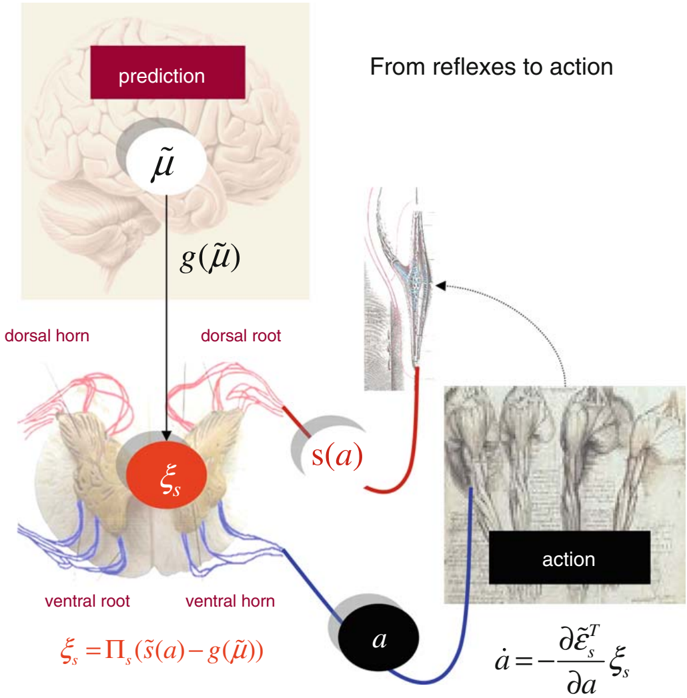
This paper argues that action, like perception, can be understood as minimizing free energy: agents do not select actions by reward maximization, but by fulfilling prior expectations about the sensory consequences of movement. Through simple simulations, it shows that this framework can produce retinal stabilization, intended movements, multimodal reaching, goal-directed behavior, and learned autonomous trajectories.
## Key findings
- Action can be cast as the suppression of sensory prediction error: the paper states that “the only thing that action can affect is the prediction error at the sensory level,” and that movement is driven by sensory prediction errors rather than explicit motor commands.
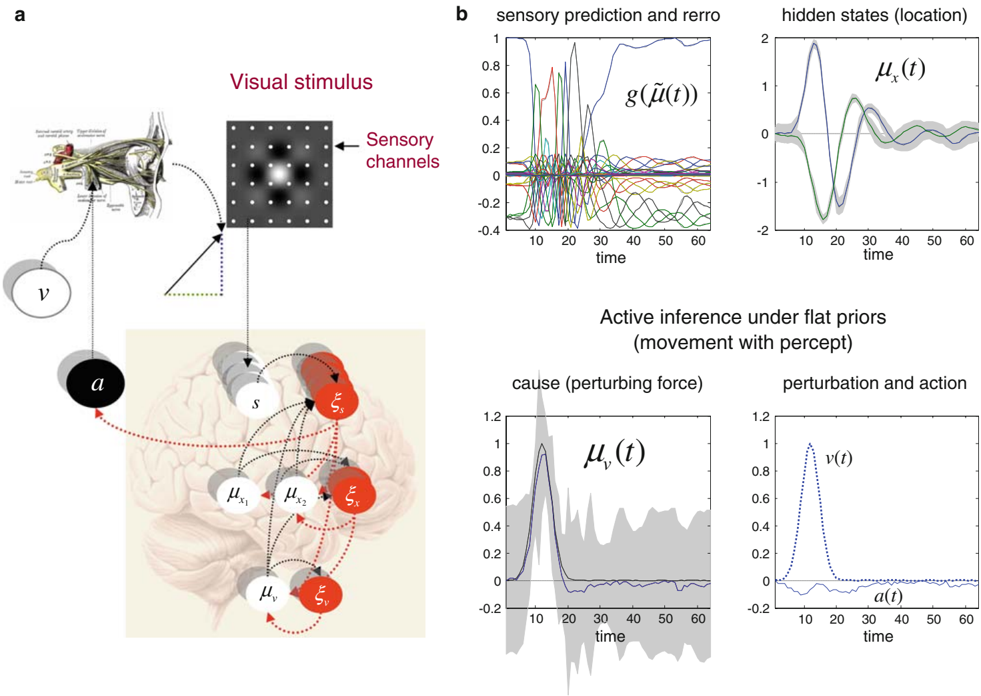
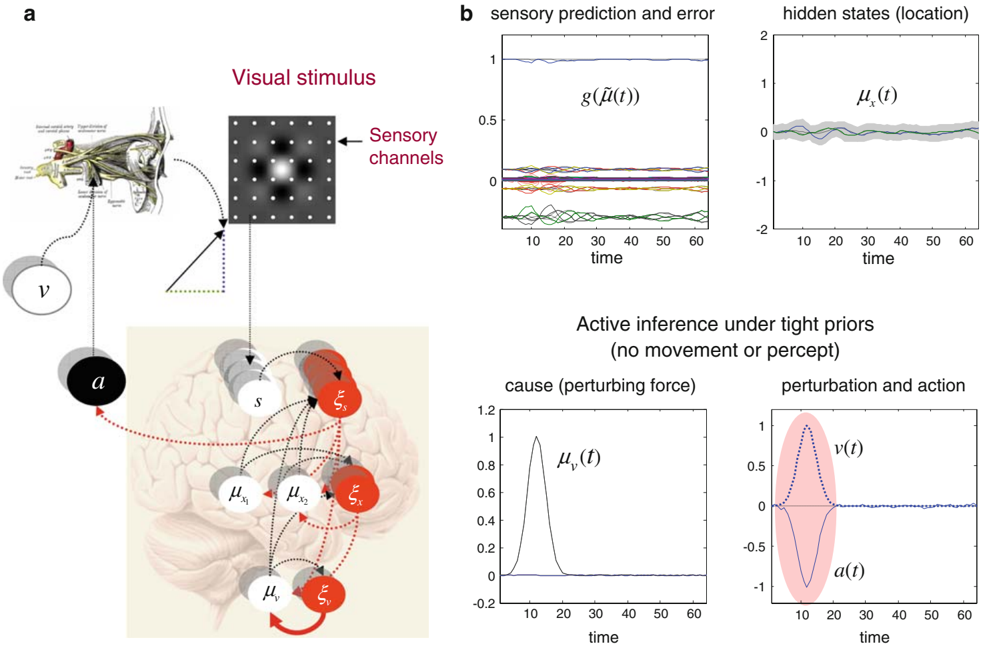
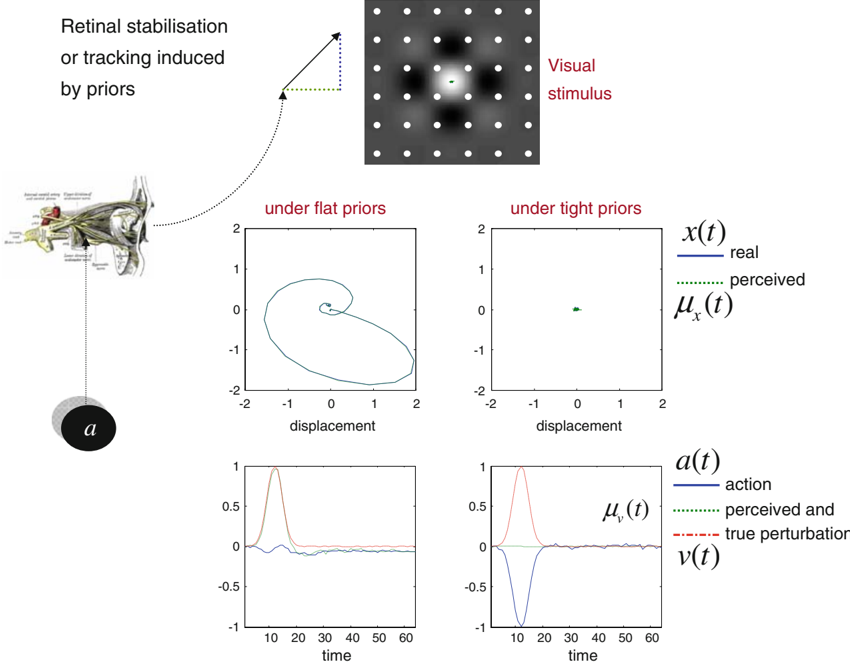
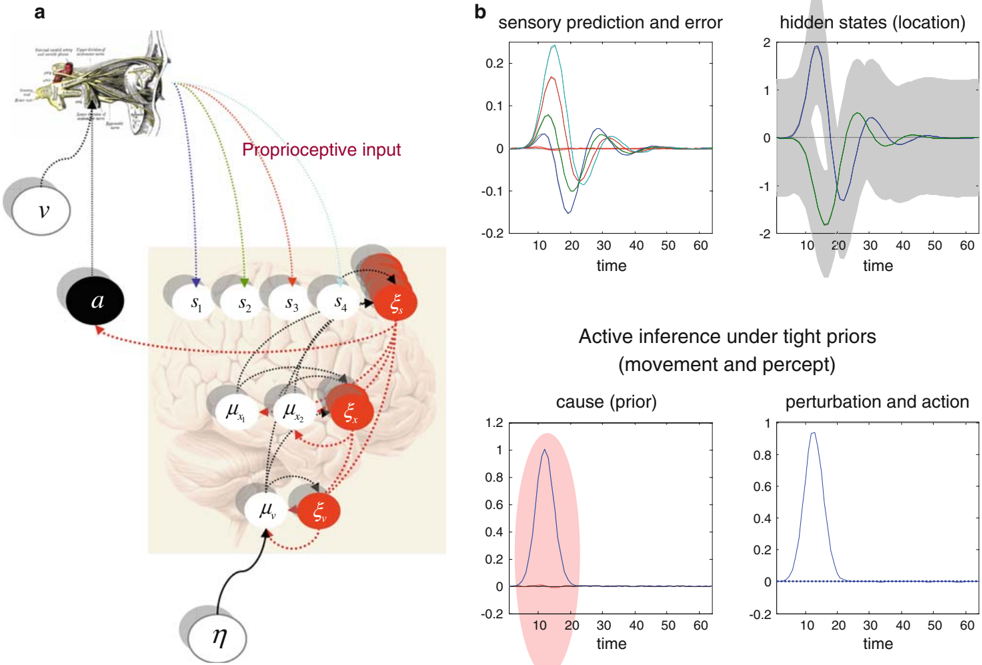
- In oculomotor simulations, tight priors on perturbations led to action that “countered almost immediately” the stimulus motion, while flat priors produced perceived motion; the paper reports a 6×6 = 36-channel sensory array in one retinal simulation.
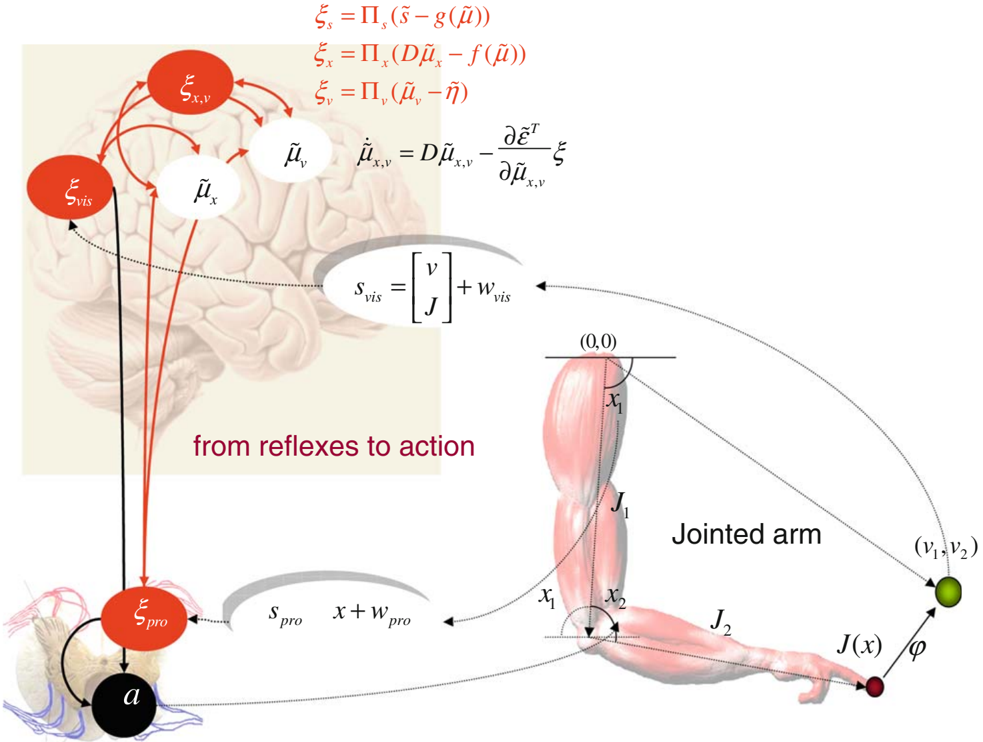
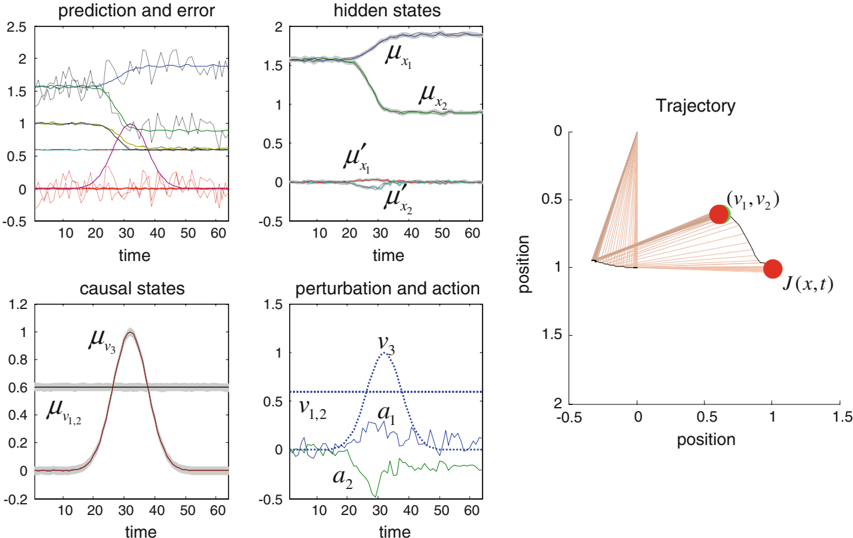
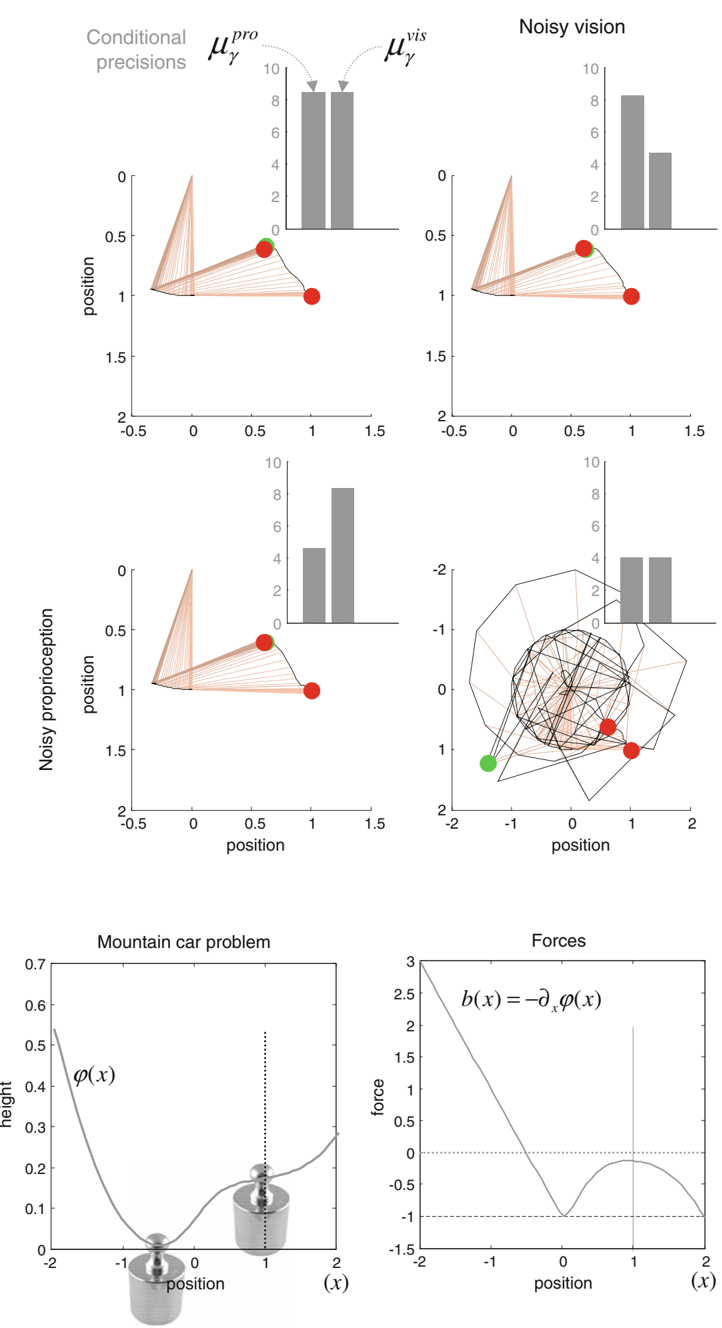
- In the cued reaching simulations, behavior was robust to sensory noise: proprioceptive noise alone could be compensated by vision, visual noise alone by proprioception, but when both modalities were noisy, reaching was compromised.
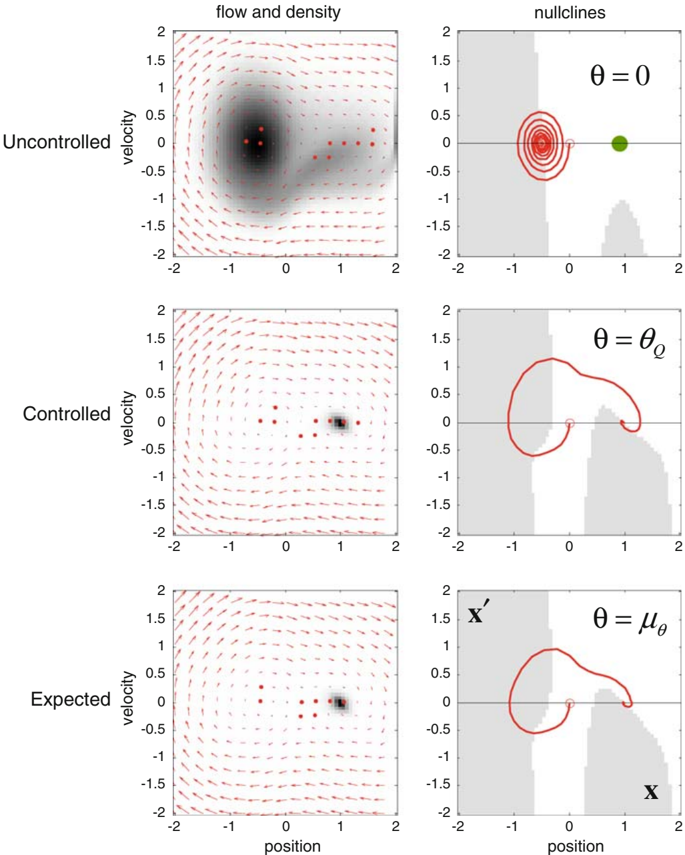
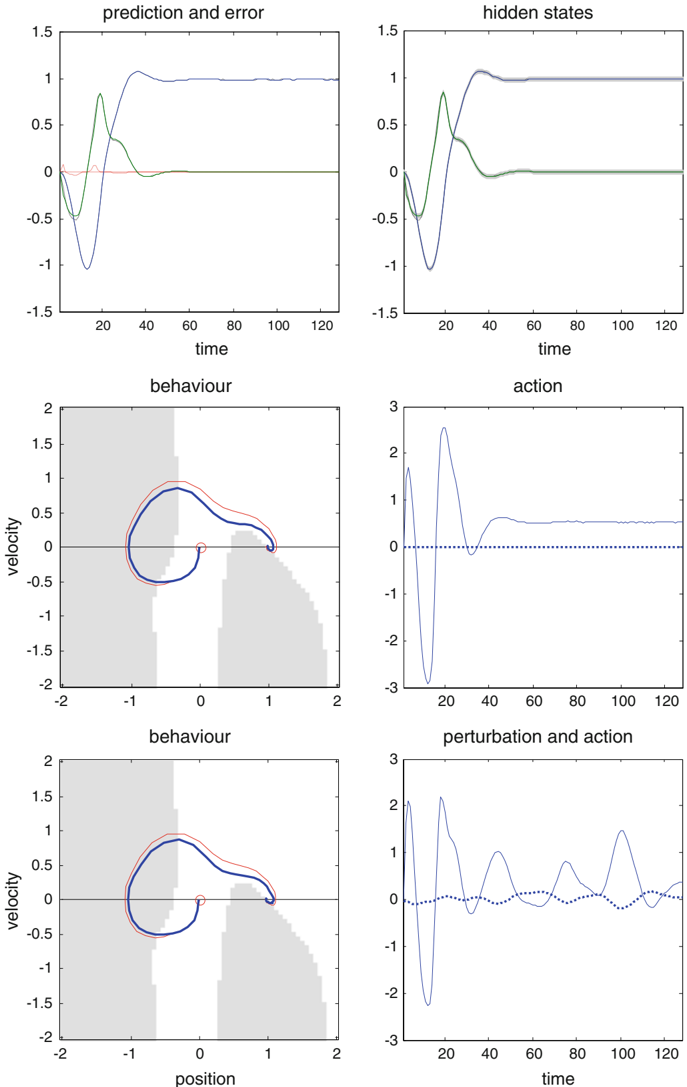
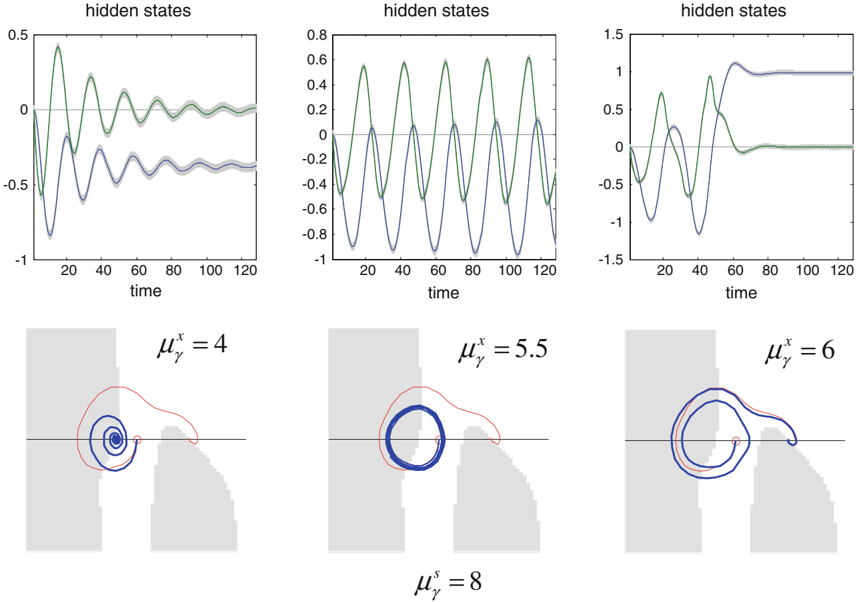
- In the goal-directed “mountain-car” simulation, the agent learned the controlled dynamics over 16 trials, and after learning it produced the required circuitous trajectory to the target; the paper notes that after 16 trials the parameters “converged roughly” to the control environment.
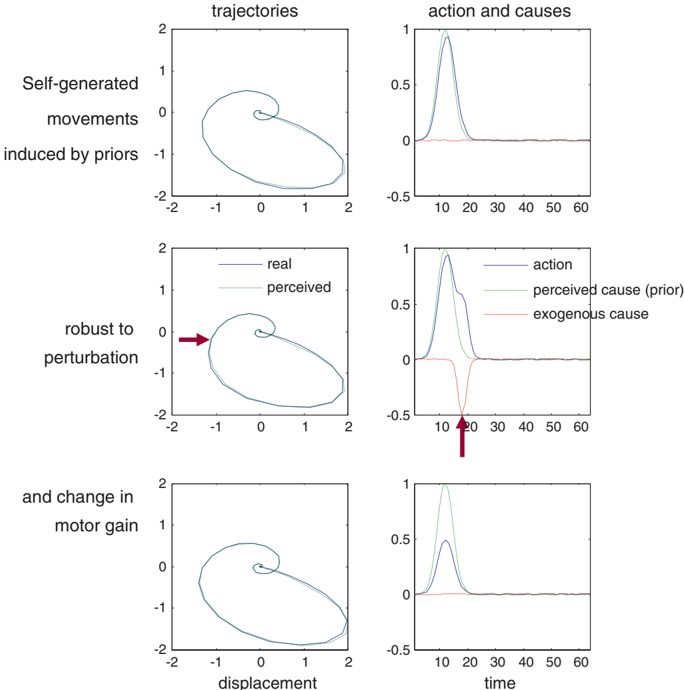
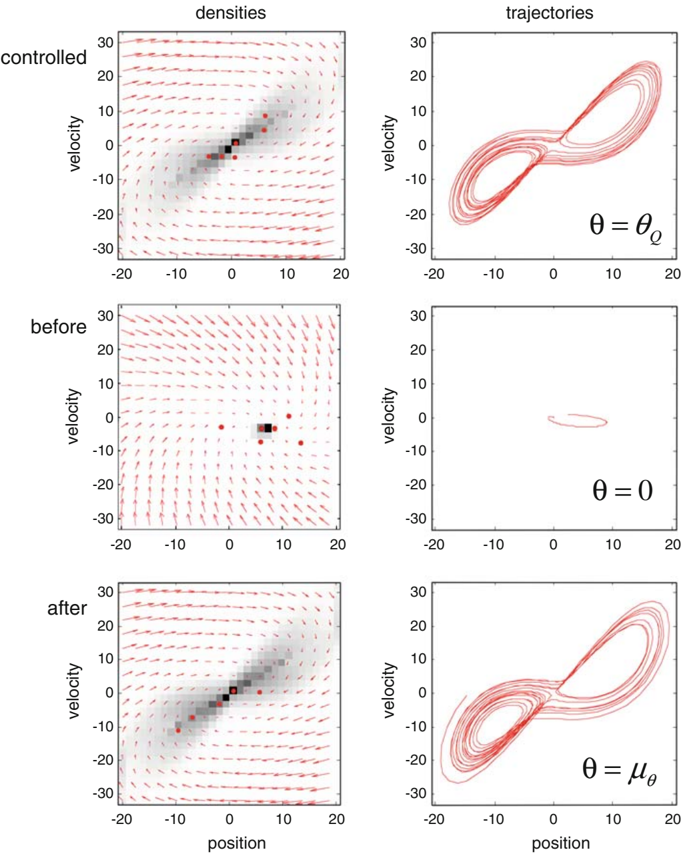
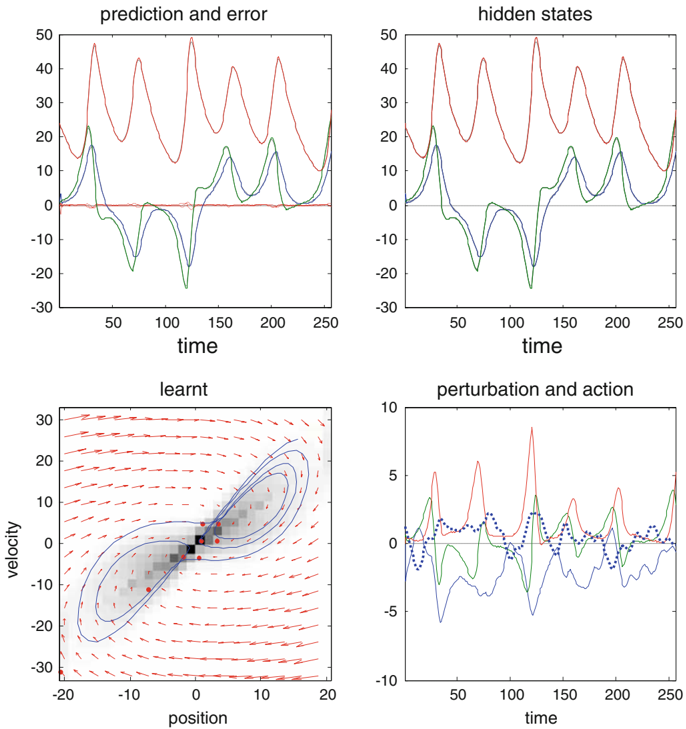
- In the autonomous-behavior simulation, after 16 trials of 512 time-bins, the agent learned to expect a Lorenz attractor and then continued to follow that learned trajectory even under perturbations, showing robustness to exogenous forces.
## Methods
- The paper is a theoretical and simulation study framed around the free-energy principle and active inference, with action and perception implemented through gradient descent on free energy under Gaussian/Laplace assumptions.
- It uses several toy dynamical systems: retinal stabilization/oculomotor control, two-joint arm reaching, the mountain-car problem, and a Lorenz-attractor learning task; one learning example uses 16 trials of 32 s time-bins, and another uses 16 trials of 512 time-bins.
- Analysis is based on generalized coordinates of motion, prediction errors, and variational (free-energy) updates of conditional expectations and precisions; the paper reports that all simulations were implemented with a single Matlab routine, `spm_ADEM.m`.
## Limitations
- The paper itself states that the simulations are simple and that many motor-control and sensorimotor issues are only addressed “superficially,” with the examples used mainly to “impart the intuitions behind active inference.”
- The text repeatedly says that some claims rely on simplifying assumptions, including Gaussian/Laplace approximations, generalized-state truncation, and assumptions about diffeomorphic sensory mappings (stated in the paper).
- Evident from the text: the results are based on idealized simulations and toy environments rather than empirical experiments on biological agents or neural recordings.
Model-written summary. Check it against the paper before relying on it.
Integrity signals
Registry
Cites
Statistics
Figures
Verification
Claims the paper makes
10 Valid · 3 Not valid · 32 Not checked · 265 Own results and interpretations
The cited sources support only part of this claim — read each source’s verdict below.
In the paper
“This mixture of weighted error variance is related formally to phenomenological cost functions proposed to account for movement trajectories (cf.Todorov and Jordan 1998;Nakano et al. 1999;Berret et al. 2008).”
§ Action and behavior: a free-energy formulation > 3.1 Motor control and prediction errors
What the sources say
- Not checked — no full text of the sourcecites Todorov and Jordan 1998 matched to “Smoothness Maximization Along a Predefined Path Accurately Predicts the Speed Profiles of Complex Arm Movements” (1998) source
- Not checked — no full text of the sourcecites Nakano et al. 1999 matched to “Quantitative Examinations of Internal Representations for Arm Trajectory Planning: Minimum Commanded Torque Change Model” (1999) source
- Partly supportedcites Berret et al. 2008 matched to “The Inactivation Principle: Mathematical Solutions Minimizing the Absolute Work and Biological Implications for the Planning of Arm Movements” (2008) sourceExperimental — accuracy not yet measured
The Results (Theoretical Analysis; page unavailable) propose an integral cost combining absolute work with a weighted comfort term to model arm movements. The Introduction describes variance-based models separately, but our copy does not establish a formal relationship between weighted error variance and the paper’s cost function. (LLM, conf=0.82)
plainstates an association- Asserted: passes — The authors put it forward as true.
- Checkable: passes — It can be checked against evidence.
- Load-bearing: unclear — It is unclear whether the paper’s conclusions depend on it.
- Based: passes — The paper gives a reason why it holds.
The cited sources support only part of this claim — read each source’s verdict below.
In the paper
“Furthermore, this perspective on dopaminergic function fits comfortably with a gating role for dopamine (O'Reilly et al. 2002) in selecting the percepts that guide action (Redgrave et al. 1999).”
§ Action and behavior: a free-energy formulation > 7.1 Active inference and optimal control
What the sources say
- Not checked — no full text of the sourcecites O'Reilly et al. 2002 matched to “Prefrontal cortex and dynamic categorization tasks: representational organization and neuromodulatory control” (2002) source
- Partly supportedcites Redgrave et al. 1999 matched to “The basal ganglia: a vertebrate solution to the selection problem?” (1999) sourceExperimental — accuracy not yet measured
In “Dopaminergic regulation of switching” (pp. 13–14), the paper proposes that dopamine helps interrupt and reprioritize behavioral selections in response to salient stimuli. That supports a role in selecting actions guided by stimuli, but not the more specific claim that dopamine selects percepts. “NEW PERSPECTIVES” (p. 16) distinguishes selection for access to motor or cognitive resources from perception itself. (LLM, conf=0.84)
plainstates an association- Asserted: passes — The authors put it forward as true.
- Checkable: passes — It can be checked against evidence.
- Load-bearing: unclear — It is unclear whether the paper’s conclusions depend on it.
- Based: passes — The paper gives a reason why it holds.
The cited sources support only part of this claim — read each source’s verdict below.
In the paper
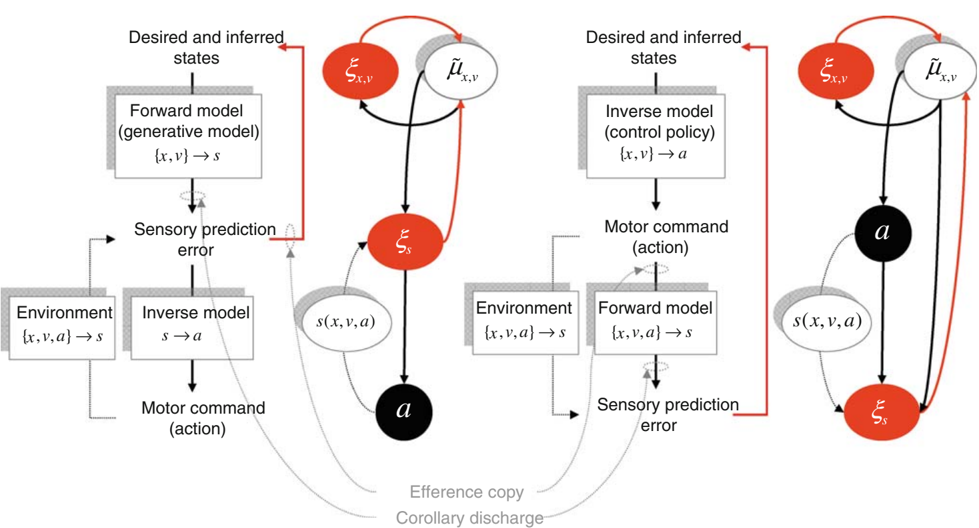
“Indeed, the motor plant is probably one of the most important aspects of the environment for predicting sensory input (see Grafton and Hamilton 2007).”
§ Action and behavior: a free-energy formulation > 7.3 Forward models in motor control
What the sources say
- Partly supportedcites Grafton and Hamilton 2007 matched to “Evidence for a distributed hierarchy of action representation in the brain” (2007) sourceExperimental — accuracy not yet measured
Section 4, “Computational models” (page unavailable), says forward models predict the motor plant’s state and turn motor commands into expected sensory consequences. It does not characterize the motor plant as an aspect of the environment or rank it among the most important factors for predicting sensory input. (LLM, conf=0.83)
hedgedstates an association- Asserted: passes — The authors put it forward as true.
- Checkable: passes — It can be checked against evidence.
- Load-bearing: unclear — It is unclear whether the paper’s conclusions depend on it.
- Based: passes — The paper gives a reason why it holds.
- Partly supported
A result the paper states — it cites no source for it, so there is none to check. The quote shows it is in the paper.
In the paper
“In other words, the image is stabilized in accordance with the prior expectation of no movement.”
§ Action and behavior: a free-energy formulation > 4.1.1 Retinal stabilization and oculomotor reflexes
plainstates a cause- Asserted: passes — The authors put it forward as true.
- Checkable: passes — It can be checked against evidence.
- Load-bearing: passes — The paper’s conclusions depend on it.
- Based: passes — The paper gives a reason why it holds.
- Rests on 3 assumptions not shown here.
A result the paper states — it cites no source for it, so there is none to check. The quote shows it is in the paper.
In the paper
“By manipulating its prior expectations on these perturbations, v(t), we can elicit very different behaviors from the agent.”
§ Action and behavior: a free-energy formulation > 4.1.1 Retinal stabilization and oculomotor reflexes
plainstates a cause- Asserted: passes — The authors put it forward as true.
- Checkable: passes — It can be checked against evidence.
- Load-bearing: passes — The paper’s conclusions depend on it.
- Based: passes — The paper gives a reason why it holds.
- Rests on 3 assumptions not shown here.
181 more claims
Create a free account to see all 310 claims and to verify the 1 reference still open.
- Probably not a substantial claim. 67
- It may state two separate claims as one. 67
- The quote only partly states this claim. 2
- Borderline: one of the tests for a substantial claim is unclear. 1
Claims other papers make about this one
Each is checked against this paper’s own text: does it say what the citing paper says it does?
The source backs part of the claim, not all of it — or backs it for a different population, condition or comparison.
In the citing paper
“The free energy principle (Friston et al. 2010; Badcock et al. 2019) thus casts control theoretic ‘essential variables’ in terms of high precision prior expectations.”
From Consciousness in active inference: Deep self-models, other minds, and the challenge of psychedelic-induced ego-dissolution (2021) · cites this paper as Friston et al. 2010
Experimental — accuracy not yet measuredThe source backs part of the claim, not all of it — or backs it for a different population, condition or comparison.
In the citing paper
“Given a chosen time window, accumulated log evidence could be approximated by the integral of free energy, a quantity known as “free action” (Friston K. et al., 2010).”
From Allostatic Self-efficacy: A Metacognitive Theory of Dyshomeostasis-Induced Fatigue and Depression (2016) · cites this paper as Friston K. et al., 2010
Experimental — accuracy not yet measuredThe cited source says what the claim attributes to it.
In the citing paper
“Also, if predictive models are continually probed by control signals that attempt to confirm the currently dominant model via active inference [21], the framework naturally accommodates the phasic physiological changes that accompany RHI induction [58,59] when these changes are taken to reflect altered autonomic control.”
From Interoceptive inference, emotion, and the embodied self (2013) · cites this paper as [21]
Experimental — accuracy not yet measuredThe cited source says what the claim attributes to it.
In the citing paper
“Thus, perception and action operate synergistically to minimise prediction errors and optimise our internal representations of the environment.”
From The depressed brain: an evolutionary systems theory (2017) · cites this paper as [11]
The cited source says what the claim attributes to it.
In the citing paper
“In the neurosciences, this is known as active inference [60, 61, 62].”
From The free energy principle made simpler but not too simple (2023) · cites this paper as [60]
4 more claims about this paper
Create a free account to see every claim other papers make about this one.
Citations
Cites
Rescorla, R. A. (1972) · Medical Entomology and Zoology · Cited by 9,661
A neural substrate of prediction and reward
Schultz, W., Dayan, P., & Montague, P. R. (1997) · Science · doi:10.1126/science.275.5306.1593 · Cited by 9,388 · cited 1×
“may call for a reappraisal of reinforcement learning as an explanation for behavior and, in particular, the role of dopamine in coding unpredicted reward (Montague et al. 1995; Schultz et al. 1997; Doya 2002): If dopamine encodes precision through its classical neuromodulatory effects (cf., Yu and Dayan 2005) how can…”
BackgroundWatkins, C. J. C. H., & Dayan, P. (1992) · Machine Learning · doi:10.1007/bf00992698 · Cited by 9,083
The free-energy principle: a unified brain theory?
Friston, K. (2010) · Nature Reviews Neuroscience · doi:10.1038/nrn2787 · Cited by 8,120
Self-citationAutopoiesis and Cognition: The Realization of the Living
Maturana, H. R., & Varela, F. J. (1980) · Boston Studies in the Philosophy and History of Science · doi:10.1007/978-94-009-8947-4 · Cited by 5,815
Emergence of simple-cell receptive field properties by learning a sparse code for natural images
Olshausen, B. A., & Field, D. J. (1996) · Nature · doi:10.1038/381607a0 · Cited by 5,694 · cited 1×
“This appeals to the principle of maximum information transfer (Linsker 1990), which has been very useful in understanding the emergence of things like receptive fields (e.g., Olshausen and Field 1996 ).”
BackgroundRao, R. P. N., & Ballard, D. H. (1999) · Nature Neuroscience · doi:10.1038/4580 · Cited by 5,483 · cited 4×
“The idea that the brain uses hierarchical inference has been established for years (Mumford 1992; Rao and Ballard 1998; Friston 2005; Friston et al. 2006) and provides a nice explanation for the hierarchical organization of cortical systems.”
BackgroundInfluentialA theory of cortical responses.
Friston, K. (2005) · Philosophical Transactions of the Royal Society B: Biological Sciences · doi:10.1098/rstb.2005.1622 · Cited by 4,578 · cited 6×
“Please see Friston et al. (2008) for a fuller description of the scheme implied by these circuit diagrams.”
BackgroundMethodInfluentialSelf-citationClassical conditioning II: Current research and theory.
Black, A. H., & Prokasy, W. F. (1972) · Appleton-Century-Crofts eBooks · Cited by 4,449
Watkins, C. J. C. H., & Dayan, P. (1992) · Machine Learning · doi:10.1023/a:1022676722315 · Cited by 3,907
Research works printed but not linked: 2
- 55. MacKay DJC (1995) Free-energy minimization algorithm for decoding and cryptoanalysis. Electron Lett 31:445-447
- 89. Watkins CJCH, Dayan P (1992) Q-learning. Mach Learn 8:279-292
Cited by
Items 101–200 of 847
Interoception as modeling, allostasis as control
Sennesh, E., Theriault, J., Brooks, D., van de Meent, J.-W., Barrett, L. F., & Quigley, K. S. (2022) · Biological Psychology · doi:10.1016/j.biopsycho.2021.108242 · Cited by 107
Busting Out: Predictive Brains, Embodied Minds, and the Puzzle of the Evidentiary Veil
Clark, A. (2017) · Noûs · doi:10.1111/nous.12140 · Cited by 106
Predictive Coding: a Theoretical and Experimental Review
Millidge, B., Seth, A., & Buckley, C. L. (2021) · arXiv · doi:10.48550/arxiv.2107.12979 · Cited by 106
“…in K. J. Friston et al. (2009), and has been developed in a number further works from both the theoretical (Adams, Shipp, & Friston, 2013; K. J. Friston et al., 2010; Pezzulo, Cartoni, Rigoli, Pio-Lopez, & Friston, 2016; Pezzulo, Rigoli, & Friston, 2018) and experimental (Baltieri & Buckley,…”
Gentsch, A., Weber, A. M., Synofzik, M., Vosgerau, G., & Schütz‐Bosbach, S. (2015) · Cognition · doi:10.1016/j.cognition.2015.09.010 · Cited by 124
A Novel Adaptive Controller for Robot Manipulators Based on Active Inference
Pezzato, C., Ferrari, R., & Corbato, C. H. (2020) · IEEE Robotics and Automation Letters · doi:10.1109/lra.2020.2974451 · Cited by 104
“In this view, the motor control of human body can be considered as the fulfillment of a prior expectation about proprioceptive sensations [11].”
BackgroundEmbodied Medicine: Mens Sana in Corpore Virtuale Sano
Riva, G., Serino, S., Di Lernia, D., Pavone, E. F., & Dakanalis, A. (2017) · Frontiers in Human Neuroscience · doi:10.3389/fnhum.2017.00120 · Cited by 104
Theory of Mind: Did Evolution Fool Us?
Devaine, M., Hollard, G., & Daunizeau, J. (2014) · PLoS ONE · doi:10.1371/journal.pone.0087619 · Cited by 101
“This has two implications: (i) one could relax this prior and effectively allow agents to adapt their effective ToM sophistication level, and (ii) one could think of evolution as selecting a very specific form of prior that defines classes of metaBayesian agents [42].”
BackgroundThe rTPJ’s overarching cognitive function in networks for attention and theory of mind
Schuwerk, T., Schurz, M., Müller, F., Rupprecht, R., & Sommer, M. (2017) · Social Cognitive and Affective Neuroscience · doi:10.1093/scan/nsw163 · Cited by 101
“Within subject factors were context (social vs non-social) and validity (invalid vs valid).”
BackgroundCognitive Dynamics: From Attractors to Active Inference
Friston, K., Sengupta, B., & Auletta, G. (2014) · Proceedings of the IEEE · doi:10.1109/jproc.2014.2306251 · Cited by 98
“[84] K.”
Self-citationFree-energy minimization in joint agent-environment systems: A niche construction perspective
Bruineberg, J., Rietveld, E., Parr, T., van Maanen, L., & Friston, K. J. (2018) · Journal of Theoretical Biology · doi:10.1016/j.jtbi.2018.07.002 · Cited by 99
Self-citationAffective Value in the Predictive Mind
Van De Cruys, S. (2017) · Theoretical Philosophy/MIND Group – JGU Mainz · doi:10.15502/9783958573253 · Cited by 100
“More specifically, they are induced by their expected exteroceptive and proprioceptive consequences (Friston et al. 2010), much in line with James’ “anticipatory image” (James 1890) and with the ideomotor principle (Hoffmann 2003).”
BackgroundUeltzhöffer, K. (2018) · Biological Cybernetics · doi:10.1007/s00422-018-0785-7 · Cited by 98
“Active Inference (Friston et al, 2006, 2010; Friston, 2012) is a normative theory of brain function derived from the properties required by active agents to survive in dynamic, changing environments.”
BackgroundMethodInfluentialThe human somatosensory system: From perception to decision making
Pleger, B., & Villringer, A. (2012) · Progress in Neurobiology · doi:10.1016/j.pneurobio.2012.10.002 · Cited by 108
A generative model of speech production in Broca’s and Wernicke’s areas
Price, C. (2011) · Frontiers in Psychology · doi:10.3389/fpsyg.2011.00237 · Cited by 97
“…motor commands in Guenther et al. (2006) is more consistent with predictive coding accounts in generative models of active inference (Friston, 2010; Friston et al., 2010) where higher-level representations (i.e., prior knowledge of movements and their associations) drive the motor commands and…”
BackgroundInfluentialVirtual Body Ownership Illusions for Mental Health: A Narrative Review
Matamala-Gomez, M., Maselli, A., Malighetti, C., Realdon, O., Mantovani, F., & Riva, G. (2021) · Journal of Clinical Medicine · doi:10.3390/jcm10010139 · Cited by 97
“(bottom-up) sensory signals, which then drives changes in the body behaviour during the interaction with the surrounding environment [1,32].”
BackgroundUnfolding Visual Lexical Decision in Time
Barca, L., & Pezzulo, G. (2012) · PLoS ONE · doi:10.1371/journal.pone.0035932 · Cited by 106
“[10,11], free energy, or with some approximation, prediction”
BackgroundBayesian Narrative: Probability, Plot and the Shape of the Fictional World
Kukkonen, K. (2014) · Anglia - Zeitschrift für englische Philologie · doi:10.1515/ang-2014-0075 · Cited by 128
Levin, M. (2023) · Cellular and Molecular Life Sciences · doi:10.1007/s00018-023-04790-z · Cited by 92
Tschantz, A., Barca, L., Maisto, D., Buckley, C. L., Seth, A. K., & Pezzulo, G. (2022) · Biological Psychology · doi:10.1016/j.biopsycho.2022.108266 · Cited by 124
Linson, A., Clark, A., Ramamoorthy, S., & Friston, K. (2018) · Frontiers in Robotics and AI · doi:10.3389/frobt.2018.00021 · Cited by 90
“Given the convergences between Freeman’s neurody-namics and AIF (Friston, 2008, 2010; De Ridder et al., 2014), it is not surprising that the latter should offer the robust response to the frame problem Dreyfus anticipated.”
BackgroundSelf-citationPerceptual awareness and active inference
Parr, T., Corcoran, A. W., Friston, K. J., & Hohwy, J. (2019) · Neuroscience of Consciousness · doi:10.1093/nc/niz012 · Cited by 91
“…to as the evidence lower bound or ‘ELBO’)] we can re-write Equation (2) in terms of a free energy functional (F) (Dayan et al. 1995; Beal 2003; Friston et al. 2010): u ¼ argmin u F F ¼ EQ ½lnQðs; pÞ lnPðo; s; pÞ ¼ EQ ½lnPðo; s; pÞ H½Qðs; pÞ ¼ lnPðoÞ þ DKL½Qðs;pÞjjPðs; pjoÞ lnPðoÞ () Qðs; pÞ…”
BackgroundSelf-citationSmooth pursuit and visual occlusion: active inference and oculomotor control in schizophrenia
Adams, R. A., Perrinet, L. U., & Friston, K. (2012) · PLoS ONE · doi:10.1371/journal.pone.0047502 · Cited by 91
Self-citationManicka, S., & Levin, M. (2019) · Philosophical Transactions of the Royal Society B: Biological Sciences · doi:10.1098/rstb.2018.0369 · Cited by 86
“The prediction error is then used to align predictions to the actual signals, whereas the action strives to align the actual signals received to the predictions [124].”
MethodA Novel Predictive-Coding-Inspired Variational RNN Model for Online Prediction and Recognition
Ahmadi, A., & Tani, J. (2019) · Neural Computation · doi:10.1162/neco_a_01228 · Cited by 102
Losing Ourselves: Active Inference, Depersonalization, and Meditation
Deane, G., Miller, M., & Wilkinson, S. (2020) · Frontiers in Psychology · doi:10.3389/fpsyg.2020.539726 · Cited by 87
“The free energy principle (FEP; Friston, 2010) is an ambitious unifying and overarching theory of life, according to which biological systems naturally strive to minimize free energy.”
BackgroundPrecision and False Perceptual Inference
Parr, T., Benrimoh, D. A., Vincent, P., & Friston, K. J. (2018) · Frontiers in Integrative Neuroscience · doi:10.3389/fnint.2018.00039 · Cited by 87
“Frontiers in Integrative Neuroscience | www.frontiersin.org 3 September 2018 | Volume 12 | Article 39 Second, ζ appears as a multiplicative factor, controlling the gain of messages derived from sensations (Feldman and Friston, 2010).”
BackgroundSelf-citationUnification by Fiat: Arrested Development of Predictive Processing
Litwin, P., & Miłkowski, M. (2020) · Cognitive Science · doi:10.1111/cogs.12867 · Cited by 86
Levin, M., Pietak, A. M., & Bischof, J. (2019) · Seminars in Cell & Developmental Biology · doi:10.1016/j.semcdb.2018.04.003 · Cited by 82
“It remains to be seen which type of paradigm for understanding pattern memory and its elaboration during regeneration will be the most effective; connectionist and Least Action/Active Inference ideas from neuroscience and physics [190–192], are possible candidates.”
BackgroundActive inference and robot control: a case study
Pio-Lopez, L., Nizard, A., Friston, K., & Pezzulo, G. (2016) · Journal of The Royal Society Interface · doi:10.1098/rsif.2016.0616 · Cited by 84
“Planning mechanisms have been described under the active inference scheme and can solve challenging problems such as the mountain– car problem [5], and can thus been seamlessly integrated in the model presented here—speaking to the scalability of the active inference scheme.”
BackgroundMethodSelf-citationHow particular is the physics of the free energy principle?
Millidge, B. (2022) · Sussex Research Online (University of Sussex) · Cited by 83
‘I Interact Therefore I Am’: The Self as a Historical Product of Dialectical Attunement
Bolis, D., & Schilbach, L. (2020) · Topoi · doi:10.1007/s11245-018-9574-0 · Cited by 81
Laminar fMRI and computational theories of brain function
Stephan, K. E., Petzschner, F. H., Kasper, L., Bayer, J., Wellstein, K. V., Stefanics, G., Pruessmann, K. P., & Heinzle, J. (2019) · NeuroImage · doi:10.1016/j.neuroimage.2017.11.001 · Cited by 82
“This theory is known as “active inference” (Adams et al., 2013a; Friston et al., 2010) and assumes the same type of objective function as predictive coding, i.e., the minimisation of prediction errors (and thus surprise) about sensory inputs.”
BackgroundNeuronal basis of speech comprehension
Specht, K. (2013) · Hearing Research · doi:10.1016/j.heares.2013.09.011 · Cited by 105
Unpacking the complexities of consciousness: Theories and reflections
Mudrik, L., Boly, M., Dehaene, S., Fleming, S. M., Lamme, V., Seth, A., & Melloni, L. (2025) · Neuroscience & Biobehavioral Reviews · doi:10.1016/j.neubiorev.2025.106053 · Cited by 81
“These constraints apply to all physical systems that maintain their organization over time in the face of external perturbations, with living systems being a particularly expressive example (Friston et al., 2010).”
InfluentialCiaunica, A., Seth, A. K., Limanowski, J., Hesp, C., & Friston, K. J. (2022) · Consciousness and Cognition · doi:10.1016/j.concog.2022.103320 · Cited by 100
Self-citationBeyond Desire? Agency, Choice, and the Predictive Mind
Clark, A. (2020) · Australasian Journal of Philosophy · doi:10.1080/00048402.2019.1602661 · Cited by 78
The Discrete and Continuous Brain: From Decisions to Movement—And Back Again
Parr, T., & Friston, K. J. (2018) · Neural Computation · doi:10.1162/neco_a_01102 · Cited by 71
Self-citationMultiscale memory and bioelectric error correction in the cytoplasm–cytoskeleton‐membrane system
Fields, C., & Levin, M. (2018) · WIREs Systems Biology and Medicine · doi:10.1002/wsbm.1410 · Cited by 76
“This formalism provides a natural model of interactions across the cell membrane,(46) in aggregates of cells,(47,48) and between functional regions of the brain.(49,50) In any network of nodes with well-behaved causal interactions (formally, any network with ergodic dynamics), the Markov blanket around any node X comp…”
BackgroundGiese, M. A., & Rizzolatti, G. (2015) · Neuron · doi:10.1016/j.neuron.2015.09.040 · Cited by 88
“Action control and recognition using this idea have been implemented for simple examples with a two-degree of freedom arm (Friston et al., 2010, 2011).”
MethodBoredom begets creativity: A solution to the exploitation–exploration trade-off in predictive coding
Gómez‐Ramírez, J., & Costa, T. (2017) · Biosystems · doi:10.1016/j.biosystems.2017.04.006 · Cited by 82
Embodied inference: or "I think therefore I am, if I am what I think"
Friston, K. J. (2011) · Cited by 172
Self-citationHuys, R., Perdikis, D., & Jirsa, V. K. (2014) · Psychological Review · doi:10.1037/a0037014 · Cited by 72
Kwisthout, J., Bekkering, H., & van Rooij, I. (2017) · Brain and Cognition · doi:10.1016/j.bandc.2016.02.008 · Cited by 73
A Bayesian Account of the Sensory-Motor Interactions Underlying Symptoms of Tourette Syndrome
Rae, C. L., Critchley, H. D., & Seth, A. K. (2019) · Frontiers in Psychiatry · doi:10.3389/fpsyt.2019.00029 · Cited by 71
“This latter process is termed active inference (59, 60) and applies to both perceptual and motor hierarchies.”
BackgroundUnderstanding Functional Neurological Disorder: Recent Insights and Diagnostic Challenges
Mavroudis, I. A., Kazis, D. A., Kamal, F. Z., Gurzu, I. L., Ciobica, A. S., Pădurariu, M., Novac, B., & Iordache, A. (2024) · International Journal of Molecular Sciences · doi:10.3390/ijms25084470 · Cited by 97
“In FND, there appears to be a disruption in this predictive processing [131].”
BackgroundGreat expectations: a predictive processing account of automobile driving
Engström, J., Bärgman, J., Nilsson, D., Seppelt, B., Markkula, G. M., Piccinini, G. B., & Victor, T. (2017) · Theoretical Issues in Ergonomics Science · doi:10.1080/1463922x.2017.1306148 · Cited by 97
Computational Foundations of Natural Intelligence
van Gerven, M. A. J. (2017) · Frontiers in Computational Neuroscience · doi:10.3389/fncom.2017.00112 · Cited by 93
“This process, known as active sensing, is crucial for understanding perceptual processing in biology (Yarbus, 1967; Regan and Noë, 2001; Schroeder et al., 2010; Friston et al., 2010; Schroeder et al., 2010; Gordon and Ahissar, 2012).”
BackgroundHughes, L. E., & Rowe, J. B. (2013) · Journal of Cognitive Neuroscience · doi:10.1162/jocn_a_00356 · Cited by 68
PID Control as a Process of Active Inference with Linear Generative Models
Baltieri, M., & Buckley, C. (2019) · Entropy · doi:10.3390/e21030257 · Cited by 70
“, [8,13,15], we will define ψ as proprioceptive observations, where proprioception is the sense of position and movement of different parts of one’s body.”
BackgroundMethodInfluentialActive inference under visuo-proprioceptive conflict: Simulation and empirical results
Limanowski, J., & Friston, K. (2020) · Scientific Reports · doi:10.1038/s41598-020-61097-w · Cited by 65
Self-citationFunctional (psychogenic) symptoms in Parkinson's disease
Pareés, I., Saifee, T. A., Kojovic, M., Kassavetis, P., Rubio‐Agusti, I., Sadnicka, A., Bhatia, K. P., & Edwards, M. J. (2013) · Movement Disorders · doi:10.1002/mds.25544 · Cited by 70
“minimize prediction error through interactions between multiple levels of a cortical hierarchy.(13) An”
BackgroundMarkkula, G. M., Boer, E. R., Romano, R., & Merat, N. (2018) · Biological Cybernetics · doi:10.1007/s00422-017-0743-9 · Cited by 92
“…could be modelled as competitions between accumulators (cf. e.g., Usher and McClelland 2001; Purcell et al 2012) representing the different adjustment types, or in the active inference framework (Friston et al 2012b) as competing predictions of what type of control will be carried out next.”
BackgroundMethodTowards a generalized theory comprising digital, neuromorphic and unconventional computing
Jaeger, H. (2021) · Neuromorphic Computing and Engineering · doi:10.1088/2634-4386/abf151 · Cited by 92
Dimensions of Musical Creativity
Schiavio, A., & Benedek, M. (2020) · Frontiers in Neuroscience · doi:10.3389/fnins.2020.578932 · Cited by 107
“Before we approach this insight from a perspective inspired by enactive cognition, we note that recent work in neuroscience has increasingly explored the neurocognitive dynamics involved in prediction and minimization of uncertainty (see Friston, 2010).”
BackgroundWhat is value—accumulated reward or evidence?
Friston, K., Adams, R., & Montague, R. (2012) · Frontiers in Neurorobotics · doi:10.3389/fnbot.2012.00011 · Cited by 67
“In brief, these simulations use differential equations that minimize the free energy of sensory input using a generalized gradient descent (Friston et al., 2010a).”
BackgroundMethodInfluentialSelf-citationExplanatory pluralism: An unrewarding prediction error for free energy theorists
Colombo, M., & Wright, C. (2017) · Brain and Cognition · doi:10.1016/j.bandc.2016.02.003 · Cited by 67
Active inference, eye movements and oculomotor delays
Perrinet, L. U., Adams, R. A., & Friston, K. J. (2014) · Biological Cybernetics · doi:10.1007/s00422-014-0620-8 · Cited by 65
“…second pair of equations), expressed in terms of action and internal states that encode conditional expectations about hidden states of the world (Friston et al. 2010b): For clarity, real-world states are written in boldface, while internal states of the agent are in italics: Here, ( s , x , ν,…”
InfluentialSelf-citationThe computational neurology of movement under active inference
Parr, T., Limanowski, J., Rawji, V., & Friston, K. (2021) · Brain · doi:10.1093/brain/awab085 · Cited by 60
Self-citationTaniguchi, T., Murata, S., Suzuki, M., Ognibene, D., Lanillos, P., Ugur, E., Jamone, L., Nakamura, T., Ciria, A., Lara, B., et al. (2023) · Advanced Robotics · doi:10.1080/01691864.2023.2225232 · Cited by 66
An Empirical Study of Active Inference on a Humanoid Robot
Oliver, G., Lanillos, P., & Cheng, G. (2022) · IEEE Transactions on Cognitive and Developmental Systems · doi:10.1109/tcds.2021.3049907 · Cited by 63
“According to this approach, the free-energy bound quan-tifies surprise and it can be optimized by changing current beliefs (perception) or by acting on the environment (action) to adjust the difference between reality and prediction [6].”
BackgroundMethodInfluentialTime Scale Hierarchies in the Functional Organization of Complex Behaviors
Perdikis, D., Huys, R., & Jirsa, V. K. (2011) · PLoS Computational Biology · doi:10.1371/journal.pcbi.1002198 · Cited by 62
“low-level) motor system [89] to fulfill them.”
BackgroundBayesian mechanics for stationary processes
Da Costa, L., Friston, K., Heins, C., & Pavliotis, G. A. (2021) · Proceedings of the Royal Society A: Mathematical, Physical and Engineering Sciences · doi:10.1098/rspa.2021.0518 · Cited by 63
Self-citationIs the free-energy principle neurocentric?
Friston, K. (2010) · Nature reviews. Neuroscience · doi:10.1038/nrn2787-c2 · Cited by 63
“Indeed, we have used chaotic exploration to illustrate active inference using free energ”
MethodSelf-citationLee, L., Braud, T., Hosio, S. J., & Hui, P. (2021) · ACM Computing Surveys · doi:10.1145/3467963 · Cited by 95
“Knowing that human users are very skillful at the physical world using their body [56], the users can become a part of the windows, icons, menus, and pointers (WIMP) [57].”
BackgroundBeyond the “urge to moveâ€: objective measures for the study of agency in the post-Libet era
Wolpe, N., & Rowe, J. B. (2014) · Frontiers in Human Neuroscience · doi:10.3389/fnhum.2014.00450 · Cited by 59
“In other words, movement is specified in terms of the expected sensation (Friston et al., 2010).”
Gallagher, S. (2023) · doi:10.1093/oso/9780198873068.001.0001 · Cited by 82
The metabolic costs of cognition
Jamadar, S. D., Behler, A., Deery, H. A., & Breakspear, M. J. (2025) · Trends in Cognitive Sciences · doi:10.1016/j.tics.2024.11.010 · Cited by 105
Explaining Delusions: Reducing Uncertainty Through Basic and Computational Neuroscience
Feeney, E. J., Groman, S. M., Taylor, J. R., & Corlett, P. R. (2017) · Schizophrenia Bulletin · doi:10.1093/schbul/sbw194 · Cited by 57
The contemplative exercise through the lenses of predictive processing: A promising approach
Pagnoni, G. (2019) · Progress in brain research · doi:10.1016/bs.pbr.2018.10.022 · Cited by 73
A neuro-cognitive process model of emotional intelligence
Smith, R., Killgore, W. D. S., Alkozei, A., & Lane, R. D. (2018) · Biological Psychology · doi:10.1016/j.biopsycho.2018.10.012 · Cited by 56
Stochastic Chaos and Markov Blankets
Friston, K., Heins, C., Ueltzhöffer, K., Da Costa, L., & Parr, T. (2021) · Entropy · doi:10.3390/e23091220 · Cited by 56
“This perspective emphasises the active part of self-evidencing, sometimes referred to as active inference [63].”
BackgroundSelf-citationvan Kemenade, B. M., Arikan, B. E., Kircher, T. T. J., & Straube, B. (2016) · Attention Perception & Psychophysics · doi:10.3758/s13414-016-1189-1 · Cited by 62
The emergence of synchrony in networks of mutually inferring neurons
Palacios, E. R., Isomura, T., Parr, T., & Friston, K. (2019) · Scientific Reports · doi:10.1038/s41598-019-42821-7 · Cited by 56
“Lastly, it is interesting to note that, in the same way the brain infers how to act upon the world 34,65 , a neuron exerts an influence on the network that leads to the realisation of its expectation.”
BackgroundSelf-citationThe motor system and its disorders
Rowe, J. B., & Siebner, H. R. (2011) · NeuroImage · doi:10.1016/j.neuroimage.2011.12.042 · Cited by 66
“This model supports a reciprocal rather than a hierarchical relationship between action and sensation, in which internal models of action explain how sensations arise, while perception enables the optimisation of movement and action (Friston and Kiebel, 2009; Friston et al., 2010).”
BackgroundPalmer, C. J., Paton, B., Hohwy, J., & Enticott, P. G. (2013) · Neuropsychologia · doi:10.1016/j.neuropsychologia.2013.06.020 · Cited by 55
“…relatively long time-scales they are encoded at higher cortical levels, consistent with the idea of more high-level, relatively global context modulation (in essence, trying to anticipate the overall smoothness of the movement given levels of expected uncertainty; cf. Friston et al., 2010, p.235).”
BackgroundAn Introduction to Predictive Processing Models of Perception and Decision‐Making
Sprevak, M. D., & Smith, R. S. (2023) · Topics in Cognitive Science · doi:10.1111/tops.12704 · Cited by 82
“Over a series of papers, Friston developed this idea further, arguing that broad swathes of action, perception, value-based decision-making, and learning could be characterized in similar terms (Friston, 2005; Friston, 2010; Friston, 2003; Friston, 2009).”
BackgroundMethodInfluentialWoolrich, M. W. (2011) · NeuroImage · doi:10.1016/j.neuroimage.2011.10.047 · Cited by 59
“A potential solution is the recent idea of post hoc Bayesianmodel comparison, in which the Bayesianmodel evidence for nested submodels can be approximated from the inference on the full model with all parameters being non-zero (Friston and Penny, 2011; Friston et al., 2010b).”
Dynamical Principles of Emotion-Cognition Interaction: Mathematical Images of Mental Disorders
Rabinovich, M. I., Muezzinoglu, M. K., Strigo, I. A., & Bystritsky, A. (2010) · PLoS ONE · doi:10.1371/journal.pone.0012547 · Cited by 56
Bayesian inference, predictive coding and delusions
Adams, R. A., Brown, H. R., & Friston, K. J. (2014) · AVANT. The Journal of the Philosophical-Interdisciplinary Vanguard · doi:10.26913/50302014.0112.0004 · Cited by 51
“The first assumption is the free energy principle, which leads to active inference in the embodied setting of action (Friston et al. 2010).”
BackgroundMethodInfluentialSelf-citationCavedoni, S., Cipresso, P., Mancuso, V., Bruni, F., & Pedroli, E. (2022) · Virtual Reality · doi:10.1007/s10055-022-00648-0 · Cited by 66
Active inference and oculomotor pursuit: The dynamic causal modelling of eye movements
Adams, R. A., Aponte, E. A., Marshall, L., & Friston, K. J. (2015) · Journal of Neuroscience Methods · doi:10.1016/j.jneumeth.2015.01.003 · Cited by 56
“A technical treatment of the material above is found in Friston et al. (2010), which provides the details of the generalised filtering used in subsequent sections.”
BackgroundMethodInfluentialSelf-citationToward a Unified Sub-symbolic Computational Theory of Cognition
Butz, M. V. (2016) · Frontiers in Psychology · doi:10.3389/fpsyg.2016.00925 · Cited by 51
Prefrontal Computation as Active Inference
Parr, T., Rikhye, R. V., Halassa, M. M., & Friston, K. J. (2020) · Cerebral Cortex · doi:10.1093/cercor/bhz118 · Cited by 48
“This mediates a form of context-dependent gain control (Parr and Friston 2017c) analogous to that used to account for endogenous attention (Feldman and Friston 2010).”
BackgroundMethodSelf-citationder Merwe, A. V. (2020) · Aphasiology · doi:10.1080/02687038.2020.1765306 · Cited by 73
“In this type of account there is no need for an efference copy and the predictions act as action commands (Friston et al., 2010; Pickering & Clark, 2014).”
BackgroundGalea, J. M., Bestmann, S., Beigi, M., Jahanshahi, M., & Rothwell, J. C. (2012) · The Journal of Neuroscience · doi:10.1523/jneurosci.3621-11.2012 · Cited by 52
“The latter result implies that the behavioral consequences of a prediction error, i.e., increased RT during AR, can be modulated by dopamine, which is strikingly similar to the theoretical consequences of the “active inference” framework of Friston et al. (2010, 2012).”
BackgroundMethodResultInfluentialCognitive Biology: Dealing with Information from Bacteria to Minds
Auletta, G. (2011) · doi:10.1093/acprof:oso/9780199608485.001.0001 · Cited by 99
Murata, S., Yamashita, Y., Arie, H., Ogata, T., Sugano, S., & Tani, J. (2015) · IEEE Transactions on Neural Networks and Learning Systems · doi:10.1109/tnnls.2015.2492140 · Cited by 61
“These results originating from the different parameter settings are in general agreement with simulations of active inference [10].”
BackgroundResultWheaton, L. A. (2017) · Journal of NeuroEngineering and Rehabilitation · doi:10.1186/s12984-017-0256-8 · Cited by 57
“In order for an accurate prediction of the action goal, predicted sensory information is compared to actual sensory information [34, 35].”
Functional Oxides for Photoneuromorphic Engineering: Toward a Solar Brain
Pérez‐Tomás, A. (2019) · Advanced Materials Interfaces · doi:10.1002/admi.201900471 · Cited by 52
Zweifel, N. O., & Hartmann, M. J. Z. (2020) · Journal of Neurophysiology · doi:10.1152/jn.00608.2019 · Cited by 63
Prefrontal contributions to the stability and variability of thought and conscious experience
Zamani, A., Carhart-Harris, R., & Christoff, K. (2021) · Neuropsychopharmacology · doi:10.1038/s41386-021-01147-7 · Cited by 39
“A related formulation, the free-energy principle, casts the brain as always striving to decrease the difference between its predictions and incoming information -- in other words, minimizing prediction error [82, 92].”
BackgroundSense of agency, associative learning, and schizotypy
Moore, J. W., Dickinson, A., & Fletcher, P. C. (2011) · Consciousness and Cognition · doi:10.1016/j.concog.2011.01.002 · Cited by 48
Bridging prediction and attention in current research on perception and action
Schröger, E., Kotz, S. A., & SanMiguel, I. (2015) · Brain Research · doi:10.1016/j.brainres.2015.08.037 · Cited by 61
“models have been formulated for motor behavior (Adams, Shipp, & Friston, 2013) and action (Friston et al., 2010), and suggested an approach towards a unified science of mind and action”
Hezemans, F. H., Wolpe, N., O’Callaghan, C., Ye, R., Rua, C., Jones, P. S., Murley, A. G., Holland, N., Regenthal, R., Tsvetanov, K. A., et al. (2022) · PLoS Computational Biology · doi:10.1371/journal.pcbi.1010079 · Cited by 53
“The implication for apathy is that the loss of prior precision relative to sensory evidence would lead to a failure of action, because imprecise priors that conflict with sensory evidence are passively revised rather than actively fulfilled [47,49].”
BackgroundTeleonomy: The Feedback Circuit Involving Information and Thermodynamic Processes
Auletta, G. (2011) · Journal of Modern Physics · doi:10.4236/jmp.2011.23021 · Cited by 50
“Therefore, minimizing the Equation (6) amounts to minimizing the negative log-probability of the sensory input (reducing the mismatch between the expectation and the input) [27].”
BackgroundImmunoceptive inference: why are psychiatric disorders and immune responses intertwined?
Bhat, A., Parr, T., Ramstead, M. J. D., & Friston, K. J. (2021) · Biology & Philosophy · doi:10.1007/s10539-021-09801-6 · Cited by 65
Self-citationAuletta, G. (2010) · Information · doi:10.3390/info1010028 · Cited by 49
“Therefore, minimizing the expression (13) amounts to minimizing the negative log-probability of the sensory input (reducing the mismatch between the expectation and the input) [50].”
BackgroundPredictive coding as a model of the V1 saliency map hypothesis
Spratling, M. (2011) · Neural Networks · doi:10.1016/j.neunet.2011.10.002 · Cited by 56
Matamala-Gomez, M., Malighetti, C., Cipresso, P., Pedroli, E., Realdon, O., Mantovani, F., & Riva, G. (2020) · Frontiers in Psychology · doi:10.3389/fpsyg.2020.01962 · Cited by 57
Obsessive–compulsive disorder as a disorder of attention
Levy, N. L. (2018) · Mind & Language · doi:10.1111/mila.12172 · Cited by 50
Metadata
- Authors
- Friston, K. J., Daunizeau, J., Kilner, J., & Kiebel, S. J.
- Affiliations
- Wellcome Centre for Human Neuroimaging (GB)
- Corresponding author
- Friston, Karl J.
- Venue
- Biological Cybernetics
- Published
- 2010-02-11
- Volume
- 102
- Issue
- 3
- Pages
- 227-260
- ISSN
- 0340-1200 (ISSN-L)
- 1432-0770
- OpenAlex
- W2130195834
- Semantic Scholar
- 407bb3034daac0fb4fba3d4c09ef3a26dfbfcf5f
- Cited by
- 866
- References
- 100
- Citations by year
- 2026: 32 · 2025: 65 · 2024: 64 · 2023: 77 · 2022: 63 · 2021: 79 · 2020: 67 · 2019: 56 · 2018: 67 · 2017: 51 · 2016: 36 · 2015: 39 · 2014: 34 · 2013: 33 · 2012: 29
- FWCI
- 18.62
- Type
- journal article
- Language
- en
- Open access
- hybrid
- doi.org
- Licence
- cc-by-nc
- Locations
- Biological Cybernetics (publishedVersion, cc-by-nc)
- PubMed (publishedVersion)
- UCL Discovery (University College London) (submittedVersion)
- Max Planck Digital Library (submittedVersion)
- MPG.PuRe (Max Planck Society) (submittedVersion)
- Topics
- Life Sciences › Neuroscience › Cognitive Neuroscience › Embodied and Extended Cognition
- Social Sciences › Psychology › Social Psychology › Action Observation and Synchronization
- Life Sciences › Neuroscience › Cognitive Neuroscience › Motor Control and Adaptation
- Keywords
- free energy principle, active sampling, perceptual inference, motor control, oculomotor control, goal-directed movement, proprioception, perceptual learning
- MeSH terms
- Afferent Pathways, Animals, Bayes Theorem, Behavior, Brain, Computer Simulation, Humans, Learning, Models, Neurological
About these checks
Registry, retraction, Cites and statistics results are computed, not judged, with one exception: a printed reference that no index lists is read once by a model before it counts as a citation error. Claims are extracted by a model and kept only when their quote appears verbatim in the text; each cited source is then checked, with a model’s help, for whether it says what the claim relies on. Those verdicts can be wrong — read the claim’s quote and the cited source before relying on one.
The claim verdicts this report counts are experimental: their accuracy is not yet measured.
A language model drew the claims from the paper on 2026-10-10, under version 3 of the claim definition (model deepseek-v4.1-flash, prompt extract-v3).
A second model labelled each claim on 2026-10-10 (model jev-1.13-20260917, definition revision gold-guideline-v0.2).
Cited sources are checked with a language model’s help (gpt-6-sol).
Statistics and arithmetic are recomputed, not judged.
Confidence bands are shown only for fields calibrated on our annotated test set. None is calibrated yet, so no band is shown.
What counts as a claim ›How we measure confidence ›How we check this ›
Are you an author, or do you see a problem with this page? Request a review
Data sources
Bibliographic data: Semantic Scholar, OpenAlex, Crossref.
Contains information from the Semantic Scholar Academic Graph Datasets, made available under the ODC Attribution License (ODC-BY 1.0).
Semantic Scholar’s data is described in: Kinney, R., et al. (2023). The Semantic Scholar Open Data Platform. arXiv:2301.10140.
