

What do parents perceive are the barriers and facilitators to accessing psychological treatment for mental health problems in children and adolescents? A systematic review of qualitative and quantitative studies
Open accessThe DOI matches its Crossref record; 81 of the 82 references it cites were found in a registry or an index.
Abstract
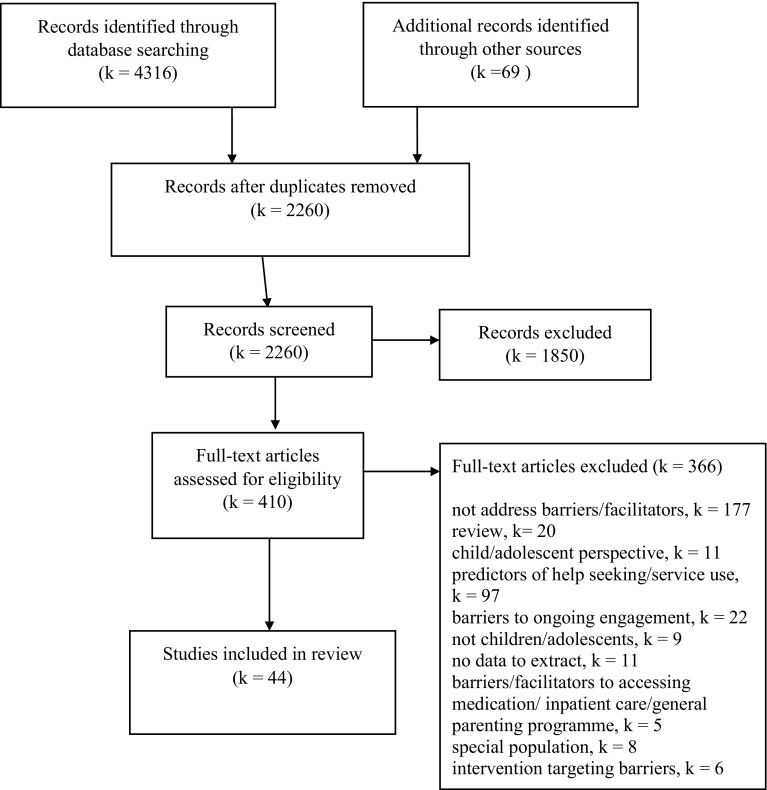
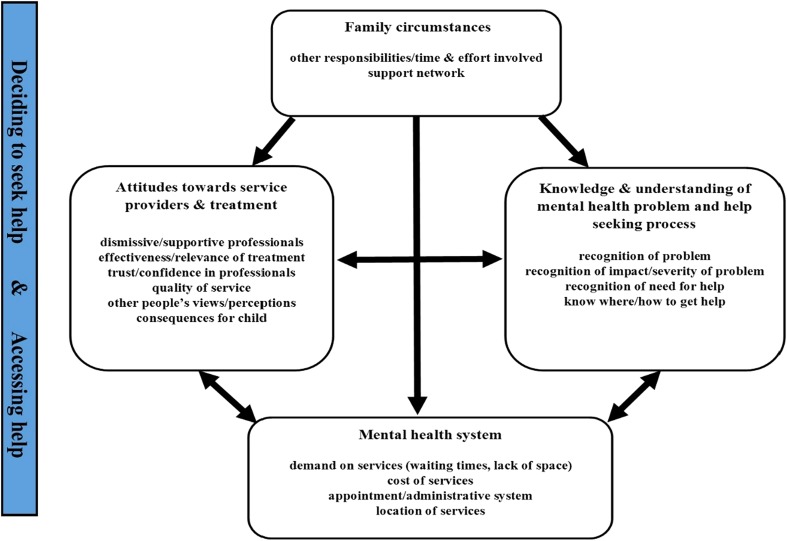
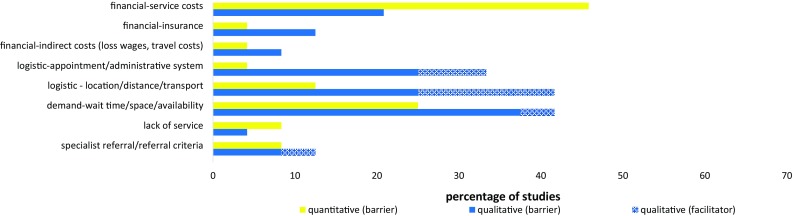
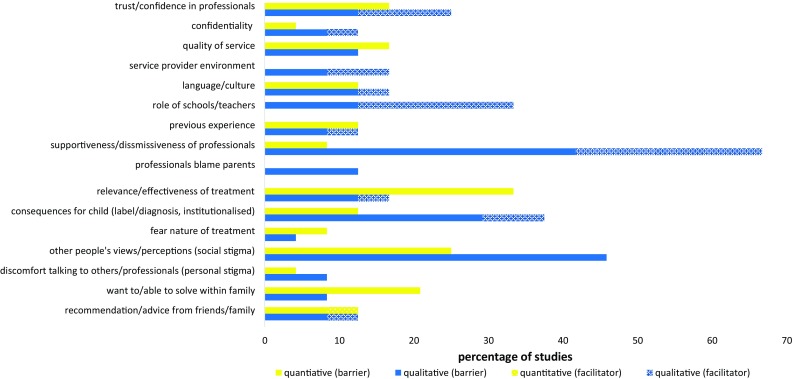
A minority of children and adolescents with mental health problems access treatment. The reasons for poor rates of treatment access are not well understood. As parents are a key gatekeeper to treatment access, it is important to establish parents' views of barriers/facilitators to accessing treatment. The aims of this study are to synthesise findings from qualitative and quantitative studies that report parents' perceptions of barriers/facilitators to accessing treatment for mental health problems in children/adolescents. A systematic review and narrative synthesis were conducted. Forty-four studies were included in the review and were assessed in detail. Parental perceived barriers/facilitators relating to (1) systemic/structural issues; (2) views and attitudes towards services and treatment; (3) knowledge and understanding of mental health problems and the help-seeking process; and (4) family circumstances were identified. Findings highlight avenues for improving access to child mental health services, including increased provision that is free to service users and flexible to their needs, with opportunities to develop trusting, supportive relationships with professionals. Furthermore, interventions are required to improve parents' identification of mental health problems, reduce stigma for parents, and increase awareness of how to access services.
Overview
The claims and statistics of this paper haven’t been checked yet.
Free: it reads the open-access text and checks the first 5 claims that cite a source we can check. Create a free account to check every claim.
Integrity signals
Registry
Cites
Statistics
Figures

Verification
Claims the paper makes
The claims and statistics of this paper haven’t been checked yet.
Free: it reads the open-access text and checks the first 5 claims that cite a source we can check. Create a free account to check every claim.
Claims other papers make about this one
Each is checked against this paper’s own text: does it say what the citing paper says it does?
The source backs part of the claim, not all of it — or backs it for a different population, condition or comparison.
In the citing paper
“These findings are also discrepant from prior studies examining barriers to EBP delivery in community-based settings for children (Reardon et al., 2017).”
From Stakeholder Perceptions of the Barriers to Receiving and Delivering Exposure-Based Cognitive Behavioral Therapy for Anxiety Disorders in Adult Community Mental Health Settings (2019) · cites this paper as Reardon et al., 2017
Experimental — accuracy not yet measuredThe source backs part of the claim, not all of it — or backs it for a different population, condition or comparison.
In the citing paper
“A previous review, which focused on the parents of children and adolescents, concluded that structural barriers were the most relevant [122].”
From What are the barriers, facilitators and interventions targeting help-seeking behaviours for common mental health problems in adolescents? A systematic review (2020) · cites this paper as [122]
Experimental — accuracy not yet measured
Self-check
Percentages, sums and reported differences re-computed from the paper’s own numbers.
The self-check needs the paper’s full text.
Citations
Cites
Preferred Reporting Items for Systematic Reviews and Meta-Analyses: the PRISMA statement
Moher, D., Liberati, A., Tetzlaff, J., Altman, D. G., & for the PRISMA Group (2009) · BMJ · doi:10.1136/bmj.b2535 · Cited by 83,823
Preferred reporting items for systematic reviews and meta-analyses: the PRISMA Statement.
(2009) · PubMed Central · Cited by 44,859
Kessler, R. C., Berglund, P., Demler, O., Jin, R., Merikangas, K. R., & Walters, E. E. (2005) · Archives of General Psychiatry · doi:10.1001/archpsyc.62.6.593 · Cited by 20,391 · cited 1×
“Youth is a time of heightened risk for mental health disorders, with half of all lifetime mental health disorders emerging before the age of 14 years [2].”
Polanczyk, G. V., Salum, G. A., Sugaya, L. S., Caye, A., & Rohde, L. A. (2015) · Journal of Child Psychology and Psychiatry · doi:10.1111/jcpp.12381 · Cited by 3,990
Gulliver, A., Griffiths, K. M., & Christensen, H. (2010) · BMC Psychiatry · doi:10.1186/1471-244x-10-113 · Cited by 3,292 · cited 1×
“A recent systematic review synthesised findings across studies that reported young people’s perceptions of barriers and facilitators to accessing mental health treatment [32].”
Popay, J., Roberts, H., Sowden, A., Petticrew, M., Arai, L., Rodgers, M., Britten, N., Roen, K., & Duffy, S. (2006) · Lancaster University · doi:10.13140/2.1.1018.4643 · Cited by 2,070
Pine, D. S., Cohen, P., Gurley, D., Brook, J., & Ma, Y. (1998) · Archives of General Psychiatry · doi:10.1001/archpsyc.55.1.56 · Cited by 1,753 · cited 1×
“Moreover, the negative impact of poor mental health early in life extends into adulthood, predicting poor academic outcomes [3], increasing the risk of subsequent mental health problems [4] and high rates of mental health service use [5], reducing life satisfaction [6], and creating a heavy economic burden for society…”
Merikangas, K. R., He, J.-P., Burstein, M., Swendsen, J., Avenevoli, S., Case, B., Georgiades, K., Heaton, L., Swanson, S., & Olfson, M. (2011) · Journal of the American Academy of Child & Adolescent Psychiatry · doi:10.1016/j.jaac.2010.10.006 · Cited by 1,579 · cited 2×
“1 3 studies suggest that being Caucasian [13, 14], having insurance coverage (in the USA) [15, 16], living in an urban area [17], and having a child with more severe mental health problems [12] increases the likelihood of a family accessing treatment.”
Unmet Need for Mental Health Care Among U.S. Children: Variation by Ethnicity and Insurance Status
Kataoka, S. H., Zhang, L., & Wells, K. B. (2002) · American Journal of Psychiatry · doi:10.1176/appi.ajp.159.9.1548 · Cited by 1,566 · cited 1×
“1 3 studies suggest that being Caucasian [13, 14], having insurance coverage (in the USA) [15, 16], living in an urban area [17], and having a child with more severe mental health problems [12] increases the likelihood of a family accessing treatment.”
Mental Health of Children and Young People in Great Britain, 2004: (557702010-001)
Green, H., McGinnity, A., Meltzer, H., Ford, T., & Goodman, R. (2005) · PsycEXTRA Dataset · doi:10.1037/e557702010-001 · Cited by 1,216 · cited 1×
“…and national surveys in the UK, Australia, and USA have estimated that only 25–56% of children and adolescents with mental health disorders access specialist mental health services [10–12], with particularly low rates of access for internalising compared with externalising problems [10, 12].”
Cited by
Items 401–500 of 653
Huikko, E., Santalahti, P., Aalto‐Setälä, T., Ahlgrén-Rimpiläinen, A., & Lämsä, R. (2024) · Community Mental Health Journal · doi:10.1007/s10597-024-01330-2 · Cited by 2
“At this stage of the mental health treat - ment process, a fear of social stigma and labeling of the child can be among parental barriers to accessing mental health treat - ment of a child (Reardon et al., 2017 ).”
Graves, J. M., Abshire, D. A., Mackelprang, J. L., Klein, T., González, C., Parrott, K., Eti, D. U., Ferris, J. G., Chacon, C. M., & Beck, A. D. (2024) · The Journal of Rural Health · doi:10.1111/jrh.12866 · Cited by 3
Choi, N. G., Longley, M., Smith, K. A., Goldstein, L., Corum, A., Poonawala, R., & Fingerman, K. L. (2023) · Children and Youth Services Review · doi:10.1016/j.childyouth.2024.107940 · Cited by 3
Allen, K., Trethewey, S. P., Mathews, F., Price, A., & Newlove‐Delgado, T. (2024) · BMJ Open · doi:10.1136/bmjopen-2024-086403 · Cited by 3
“31–33 The accounts of commissioners accord with the wider drive within ICS to change the focus of services to include lower intensity early interventions to support health and well-being in the population.”
Psychological difficulties and the needs for psychological services for high school students
Cong, L. M., Huynh, V.-S., Nguyen, V. H. A., Le, V. T., Luu-Thi, H.-T., & Tran-Chi, V.-L. (2024) · Discover Mental Health · doi:10.1007/s44192-024-00101-5 · Cited by 5
“According to Reardon, Harvey [44], trust and confidence in experts, as well as the presence or absence of a relationship of trust with professionals, were identified as a barriers/facilitator.”
BackgroundRyan, S., Ribenfors, F., Mikulak, M., & Coles, D. (2024) · Sociology of Health & Illness · doi:10.1111/1467-9566.13855 · Cited by 3
“Evidence suggests parents experience contributory injustice (Dotson, 2012) as professionals ignore their knowledge and understanding (Gill & Liamputtong, 2013; Lundeby & Tøssebro, 2008; Reardon et al., 2017).”
Stiles‐Shields, C., Bobadilla, G., Reyes, K. M., Gustafson, E. L., Lowther, M., Smith, D. L., Frisbie, C., Antognini, C., Dyer, G., MacCarthy, R., et al. (2025) · JMIR Research Protocols · doi:10.2196/65245 · Cited by 6
Carl, T., Tully, L. A., McLean, R. K., Dadds, M. R., Hawes, D. J., Mihalopoulos, C., Chatterton, M. L., Oberklaid, F., Waters, A. M., Shanley, D. C., et al. (2024) · Contemporary Clinical Trials · doi:10.1016/j.cct.2024.107801 · Cited by 2
Wu, P., Huang, W., Jiao, F., Chen, G., & Sun, Y. (2025) · BMC Public Health · doi:10.1186/s12889-025-21311-8 · Cited by 2
“It has been suggested that parental attitudes towards mental health services fundamentally influence service acceptance [19].”
Kan, J. M., Nowland, T., Tully, L. A., Liew, O., Gibbons, L., Hawes, D. J., & Dadds, M. R. (2025) · Australian Journal of Psychology · doi:10.1080/00049530.2025.2509649 · Cited by 4
“Much of the research highlighting problems in the system and possible contributing factors has involved parent’s perspectives (Boulter & Rickwood, 2013; Johnson et al., 2018; Lawrence et al., 2016; Reardon et al., 2017).”
Marriott, B. R., Hulvershorn, L. A., Oliver, J., Jones, C., O’Reilly, L. M., Wiehe, S. E., Monahan, P. O., Bearman, S. K., Saldana, L., & Aalsma, M. C. (2025) · Contemporary Clinical Trials Communications · doi:10.1016/j.conctc.2025.101518 · Cited by 3
“These problems highlight the need for innovative approaches for improving the accessibility and availability of evidence-based pediatric behavioral health services through novel delivery models [4,5].”
Webb, M. J., Richards, H., Lamblin, M., Kartal, D., Davies, P., Swingler, N., & Robinson, J. (2025) · BMC Health Services Research · doi:10.1186/s12913-025-13102-z · Cited by 3
Ibrahim, S. A. E.-S. (2021) · Journal of Southwest Jiaotong University · doi:10.35741/issn.0258-2724.56.2.27 · Cited by 4
Stephens, M. A., Spratling, R. G., & Holiday, D. (2023) · Journal of Pediatric Health Care · doi:10.1016/j.pedhc.2023.03.006 · Cited by 2
Exploring the Accessibility of Child-Centered Play Therapy for Australian Muslim Children
Casey, S., Moss, S. A., & Wicks, J. (2020) · Journal of Cross-Cultural Psychology · doi:10.1177/0022022120913117 · Cited by 2
“Reardon et al. (2017) conducted a systematic review of qualitative and quantitative studies that explored parent’s barriers in accessing mental health treatment for their children and adolescents.”
BackgroundNebraska Pediatric Integrated Care Training (NE-PICT) Model
Valleley, R. J., Clarke, B. L., Roberts, H. J., Burt, J., Grennan, A., & Evans, J. H. (2020) · Clinical Practice in Pediatric Psychology · doi:10.1037/cpp0000362 · Cited by 2
“…concern is the fact that only 10–50% of individuals with diagnosable conditions ever receive adequate treatment, and there continue to be racial and ethnic disparities in pediatric behavioral health treatment (Alegria, Vallas, & Pumariega, 2010; Knopf, Park, & Mulye, 2008; Reardon et al., 2017).”
Treier, A., Hautmann, C., Dose, C., Nordmann, L., Katzmann, J., Pinior, J., Scholz, K., & Döpfner, M. (2022) · Child Psychiatry & Human Development · doi:10.1007/s10578-022-01400-0 · Cited by 4
“, fear of stigma, lack of time, waiting time, or a lack of local treatment options [4], self-help interventions might be a viable treatment alternative [5].”
BackgroundHense, H., Ernst, S., Zscheppang, A., Schmitt, J. M., Roessner, V., Weniger, M., Beesdo‐Baum, K., & Knappe, S. (2024) · Zeitschrift für Evidenz Fortbildung und Qualität im Gesundheitswesen · doi:10.1016/j.zefq.2023.12.004 · Cited by 3
Using Participatory Action Research to Redirect Tinnitus Treatment and Research—An Interview Study
Kajüter, J., Schaap, G., Sools, A. M., & Simoes, J. P. (2024) · Journal of Clinical Medicine · doi:10.3390/jcm13113099 · Cited by 2
“Moreover, including disciplines such as psychology in these clinics can help at reducing physical barriers to seeking treatment that assists patients at emotionally coping with their condition [61].”
BackgroundAttachment, shame and empathy in dyadic family therapy
Amos, J., Jacobs, R., & Segal, L. (2024) · Australian and New Zealand Journal of Family Therapy · doi:10.1002/anzf.1612 · Cited by 2
Conceptualization and Validation of the Adolescent Barriers to Accessing Psychotherapy Questionnaire
Pfeiffer, S. (2026) · Child & Youth Care Forum · doi:10.1007/s10566-026-09974-9 · Cited by 4
“In addition, future studies should investigate parental perspectives and involvement, which were not directly assessed in the present research but are known to play a crucial role in adolescent help-seeking (Reardon et al., 2017).”
Designing a mobile AR application for improving pediatric psychological wellbeing
Montaner-Marco, J., Javier, J., & Pons, P. (2021) · International Conference on Human-Computer Interaction with Mobile Devices and Services (MobileHCI) · doi:10.1145/3447527.3474851 · Cited by 2
“In fact, it has been reported that the access rate to specialist therapy in the US, the UK and Australia ranges between 25-56% of those patients who would benefit from these treatments [17].”
BackgroundExecutive Function Development: The Mediating Role of Social and Environmental Context
Federico, F., & Mellone, M. (2022) · Advances in psychology, mental health, and behavioral studies (APMHBS) book series · doi:10.4018/978-1-7998-9075-1.ch002 · Cited by 3
Soltani, E., Bazrafshanb, A., Bahreini, F., & Zaremohazabiyeh, S. (2024) · Research Square · doi:10.21203/rs.3.rs-4583884/v1 · Cited by 3
A trainee nursing associate working in the eating disorders day service
Burns, N. (2021) · British Journal of Healthcare Assistants · doi:10.12968/bjha.2021.15.4.180 · Cited by 1
Single-session interventions for children and adolescents
Ahuvia, I. L., & Schleider, J. L. (2022) · Oxford University Press eBooks · doi:10.1093/med-psych/9780198867791.003.0023 · Cited by 1
Poole, L. B., Carlson, J. S., Batsche-McKenzie, K., Tate, J., & Shank, J. (2023) · International Journal of Environmental Research and Public Health · doi:10.3390/ijerph20146435 · Cited by 2
“, trust and confidence) may contribute to higher treatment completion rates and improved PSP training practices [14,28,44].”
BackgroundTripi, B. A., & Jones, A. S. (2023) · Child and Adolescent Social Work Journal · doi:10.1007/s10560-023-00945-w · Cited by 3
“…child’s mental health problem, attitudes and perceptions toward treatment, parent motivation level to engage in treatment, and the parents’ perception of their role and involvement in the treatment process (Drent et al., 2020 ; Haine-Schlagel et al., 2019; Oh & Bayer, 2015 ; Reardon et al., 2017 ).”
InfluentialStepped Care Cognitive Behavioral Therapy for Children after Trauma
Salloum, A., Ormhaug, S. M., Jensen, T. K., Skjærvø, I., & Storch, E. A. (2024) · Advances in Psychiatry and Behavioral Health · doi:10.1016/j.ypsc.2024.04.007 · Cited by 2
Hager, K., Calderon, M. M., Rothschild, A. W., & Luiselli, J. K. (2024) · Journal of Rare Diseases · doi:10.1007/s44162-024-00047-w · Cited by 1
Bosworth, C. E., Watsford, C. R., Buckmaster, D., & Rickwood, D. (2024) · Clinical Psychology & Psychotherapy · doi:10.1002/cpp.70027 · Cited by 3
Phenomenological Description of the Experiences of Teenagers With Critically Ill Parents
Barr, M., Thakur, A., THVAR, V. K., Dupee, D., & Vasan, N. (2025) · Journal of Nursing Research · doi:10.1097/jnr.0000000000000659 · Cited by 2
Caregiver Satisfaction with Anxiety Treatment for Autistic Youth: A Mixed Methods Examination
Norris, L. A., Rabner, J. C., Marklin, M., Crane, M. E., Renschler, K., Jenkins, E., Kemp, J. J., Storch, E. A., Wood, J. J., Kerns, C. M., et al. (2025) · Journal of Autism and Developmental Disorders · doi:10.1007/s10803-025-06725-y · Cited by 1
“Caregivers otherwise referenced difficulties with logistical aspects of participating in treatment more broadly as least-liked treatment features, consistent with studies of barriers to access of youth psychological treatments more broadly (Reardon et al., 2017).”
He, S., Zhang, Y., Zhang, J., Shang, C., Zhang, H., & Yan, F. (2025) · Journal of Psychosocial Nursing and Mental Health Services · doi:10.3928/02793695-20250320-02 · Cited by 1
Lavergne, C., Gagnon, H. P., Diaz, R. V., Dufour, S., & Robichaud, M. (2025) · Children & Society · doi:10.1111/chso.12966 · Cited by 2
Mersky, J. P., Lee, C. P., Bacalso, E., & Liu, X. (2025) · Implementation Science Communications · doi:10.1186/s43058-025-00702-3 · Cited by 2
“These disparities are compounded by systemic and structural barriers to screening, referral, and treatment, including shortages of clinical providers and gaps in insurance coverage [5–10].”
Umeh, K. F., & Adaji, S. (2025) · BMC Pediatrics · doi:10.1186/s12887-024-05265-1 · Cited by 1
“Research suggests that, for very young children, researchers rely on parental reports for detecting and/or managing mood disorders in children (Reardon et al. 2017).”
Jong, H. J. B.-D., Dejonckheere, E., Smeets, T., Lodder, P., & Karreman, A. (2025) · Cognition & Emotion · doi:10.1080/02699931.2025.2508400 · Cited by 1
“Being reluctant to undergo exposure is a considerable problem for patients – and especially youth – with an anxiety disorder, which is manifested through dropping out of therapy or avoidance of seeking professional help altogether (Radez et al., 2021; Reardon et al., 2017; Siegel & Peterson, 2025).”
Sociodemographic Factors Associated with Autistic Youth’s Psychotherapy Service Use
Smith, J. V., Nevill, R. E. A., DeGuzman, P. B., Menezes, M., & Mazurek, M. O. (2025) · Administration and Policy in Mental Health and Mental Health Services Research · doi:10.1007/s10488-025-01448-9 · Cited by 3
“Notably, these barriers are consistent with those reported in non-autistic samples (e.g., Anderson et al., 2017; Gulliver et al., 2010; Reardon et al., 2017).”
Eisenstadt, B. E., Chiaramonte, D. M., Ankrum, H., Bränström, R., Watson, R. J., & Pachankis, J. E. (2025) · Psychology of Sexual Orientation and Gender Diversity · doi:10.1037/sgd0000850 · Cited by 1
Zecchinato, F., Kreppner, J., Bullard, P., Kumar, M., Painter, S., & Lawrence, P. J. (2025) · Mental Health & Prevention · doi:10.1016/j.mhp.2025.200439 · Cited by 1
Tomasiello, M., Martin‐Storey, A., Déry, M., Latimer, E. A., & Temcheff, C. E. (2025) · Child Psychiatry & Human Development · doi:10.1007/s10578-025-01879-3 · Cited by 1
Chia, J. M. X., Choo, C., Vijayakumar, S., Fu, C. S. L., Chung, Y. J., & Lee, J. (2025) · Child & Youth Care Forum · doi:10.1007/s10566-025-09897-x · Cited by 2
“Parents often mediate children’s help-seeking attempts, and a lack of favourable attitudes towards mental health services and poor awareness and understanding of mental health issues are key barriers that may affect problem recognition and service utilisation (Reardon et al., 2017).”
Holly, L. E., Buchanan, M., & Bowling, A. R. (2025) · Evidence-Based Practice in Child and Adolescent Mental Health · doi:10.1080/23794925.2025.2609998 · Cited by 1
Affaticati, L. M., Giglio, E., Capuzzi, E., Riva, I., Tegola, D. L., Colmegna, F., Clerici, M., & Buoli, M. (2026) · CNS Spectrums · doi:10.1017/s1092852925100758 · Cited by 1
“44 This”
Peter, S., Bednarz, J., Sommer, P., & Taubner, S. (2026) · Frontiers in Psychology · doi:10.3389/fpsyg.2025.1658196 · Cited by 2
Stern, C., Valenzuela, C., Whitehorn, A., Pollock, D., Minooee, S., Gohil, D. A., Zhu, Z., Kirkpatrick, P., Loureiro, R. L., Davies, E., et al. (2026) · JBI Evidence Synthesis · doi:10.11124/jbies-25-00265 · Cited by 6
Hurley, J., Hutchinson, M., Bennett, B., Yoxall, J., Daguman, E. I., & Happell, B. (2026) · Issues in Mental Health Nursing · doi:10.1080/01612840.2025.2605642 · Cited by 1
“The lack of specialist services for those living in rural and regional Australia with mental health needs is widely acknowledged (Hoeft et al., 2018; Reardon et al., 2017).”
Wheeler, S., & King, T. R. (2026) · Advances in Mental Health · doi:10.1080/18387357.2026.2619693 · Cited by 1
Chu, W., Carney, J. R., Zax, A., Hudson, H. J., & Gustafson, E. L. (2026) · Journal of Racial and Ethnic Health Disparities · doi:10.1007/s40615-025-02841-8 · Cited by 1
Pfeiffer, S., Kircher, A., Bsdurrek, N., & Sürth, S. (2026) · Kindheit und Entwicklung · doi:10.1026/0942-5403/a000496 · Cited by 1
Zhong, S., Hou, C., Jia, F., Wang, S.-B., & Zhou, L. (2026) · Child and Adolescent Psychiatry and Mental Health · doi:10.1186/s13034-026-01056-x · Cited by 3
“The family factors examined in our study likely reflect underlying socioeconomic conditions and community-level resources such as access to mental health resources or educational opportunities, which are associated with both family knowledge patterns and psychological outcomes [31, 38].”
Senturk, H. N. C., & Bildik, T. (2026) · International Journal of Social Psychiatry · doi:10.1177/00207640261424410 · Cited by 1
“Family members may also internalize stigma associated with a child’s mental illness (associative/family stigma), with downstream effects on family functioning, service engagement and youth outcomes (Mak & Cheung, 2008; Mikami et al., 2015; Reardon et al., 2017).”
Oblath, R., Primm, A. B., Duncan, A. M., Herrera, C., Thompson, A., Ferguson, T., Won, J., Henderson, D. C., & Norris, D. M. (2026) · Psychiatric Services · doi:10.1176/appi.ps.20250446 · Cited by 1
Wright, L., Griffiths, J. L., Appleton, R., Begum, S., Clarke, C., Hunt, N. C., Lewis, H. K., Barnett, P., Bhutta, A., Driskell, E., et al. (2026) · PLoS ONE · doi:10.1371/journal.pone.0347789 · Cited by 2
Veenman, M., Janssen, L. H. C., van Houtum, L. A. E. M., Wentholt, W. G. M., Wever, M. C. M., Tollenaar, M. S., Verkuil, B., Fried, E. I., & Elzinga, B. M. (2026) · Child & Youth Care Forum · doi:10.1007/s10566-026-09953-0 · Cited by 1
McCallum, S. M., Kazan, D., Morse, A. R., Batterham, P. J., Werner‐Seidler, A., Torok, M. H., March, S., Chapman, C., Reardon, T. C., Perry, Y., et al. (2026) · Internet Interventions · doi:10.1016/j.invent.2026.100961 · Cited by 2
“These findings align with previous research identifying limited parental knowledge as a key barrier to help-seeking for children (Reardon et al., 2017; Salloum et al., 2016).”
Self-citationCalear, A. L., McCallum, S. M., Kazan, D., Torok, M. H., Werner‐Seidler, A., O’Dea, B., Morse, A. R., Farrer, L. M., Shand, F., & Batterham, P. J. (2026) · Journal of Child Psychology and Psychiatry · doi:10.1111/jcpp.70189 · Cited by 1
“…in times of distress, with parents often recognising changes in their child’s behaviour that may indicate a problem and initiating help-seeking to access mental health care and support (Platell, Cook, & Martin, 2023; Reardon et al., 2017; Villatoro, DuPont-Reyes, Phelan, Painter, & Link, 2018).”
Mallonee, J., Escalante, R., Robles, E. H., Kwon, K., Ochoa, B., Smith, M., Medrano, V., & Umucu, E. (2026) · Healthcare · doi:10.3390/healthcare14152240 · Cited by 1
“In this module, stigma is conceptualized as consisting of potential individual biases towards mental health and treatment, cultural stigma, and disparities related to access to information and treatments [35,36].”
The Role of Media in Promoting and Destigmatizing Mental Illness in Youth
Olson, C. K., & Kutner, L. A. (2018) · Elsevier eBooks · doi:10.1016/b978-0-323-54854-0.00013-8 · Cited by 2
Treatment Considerations for Youth Exposed to Interpersonal Violence
Berman, I. S., Seifert, H. T. P., & Briggs, E. C. (2021) · Springer eBooks · doi:10.1007/978-3-319-89999-2_328 · Cited by 1
Delivering computerized Cognitive Behavioral Therapy for child and adolescent depression and anxiety
Stallard, P. N. (2022) · Elsevier eBooks · doi:10.1016/b978-0-323-91709-4.00002-0 · Cited by 1
Examining Patterns of Psychotherapy Service Utilization Among Medicaid-Enrolled Adolescents
Dir, A. L., Pederson, C. A., Ouyang, F., Monahan, P. O., Schwartz, K., Wiehe, S. E., & Aalsma, M. C. (2023) · Psychiatric Services · doi:10.1176/appi.ps.202100513 · Cited by 1
Diaz‐Castro, L., & Suárez-Brito, P. (2023) · Modern Care Journal · doi:10.5812/modernc-130650 · Cited by 2
RETRACTED ARTICLE: Analysis of Factors Affecting Mental Health in College English Teaching Courses
An, R. (2023) · Journal of Autism and Developmental Disorders · doi:10.1007/s10803-023-06087-3 · Cited by 1
RetractedFocus Group With Parents of Children With Mental and Behavioral Health Concerns
Stevenson, B., Bolton, T., & Dare, N. R. (2023) · OTJR Occupational Therapy Journal of Research · doi:10.1177/15394492231200904 · Cited by 1
“Parents contribute to their child’s emotional competence and development through their own responses, expression of emotions, and guidance and discussion of the child’s emotions (Barfoot et al., 2023; Havighurst et al., 2010; Reardon et al., 2017).”
BackgroundWu, C., Xu, L., Chen, Y., & Gan, Y. (2024) · International Journal of Membrane Science and Technology · doi:10.15379/ijmst.v10i3.3377 · Cited by 1
Pierson, S. B., Dongarwar, D., Bini, T., Onwukwe, J. T., House, K., Rosiji, F. O., & Salihu, H. M. (2024) · Journal of the American Academy of Child & Adolescent Psychiatry · doi:10.1016/j.jaac.2023.09.554 · Cited by 2
Briggs, R. D., Carpenter, S., Krug, L. M., MacLaughlin, S., & Perez, S.-L. (2024) · Springer eBooks · doi:10.1007/978-3-031-48627-2_25 · Cited by 1
Kabembo, I. M. (2024) · Frontiers in Public Health · doi:10.3389/fpubh.2024.1250608 · Cited by 4
Putkuri, T., Latva-Korpela, I., & Häkkinen, M. (2023) · Kasvun tuki -aikakauslehti · doi:10.61259/kt.136587 · Cited by 1
Using the universal design for learning framework to improve child and adolescent mental health
Pereira, L. C., & Ith, D. A. (2024) · Psychology in the Schools · doi:10.1002/pits.23252 · Cited by 4
Archuleta, S., Allison‐Burbank, J. D., Ingalls, A., Begay, R., Begaye, V., Howe, L., Tsosie, A., Keryte, A. P., & Haroz, E. E. (2024) · Journal of School Health · doi:10.1111/josh.13487 · Cited by 2
Teixeira, M. C. T. V., Tafla, T. L., Carreiro, L. R. R., Bolsoni-Silva, A. T., & Paula, C. S. (2024) · Psicologia - Teoria e Prática · doi:10.5935/1980-6906/eptphd16204.en
“There is also the question of the general stigma regarding the treatment of children with MHP (Paula et al., 2022; Paula et al., 2014; Reardon et al., 2017) or even stigma among professionals or health service/institutions that prevents problems in childhood being seen as problems of mental health,…”
Ganie, A. U. R., Ammapattian, T., Jangam, K. V., & Sagar, K. J. V. (2024) · Clinical Child Psychology and Psychiatry · doi:10.1177/13591045241286106 · Cited by 1
“Children facing mental health issues struggle with transitioning into adulthood and face barriers in education and employment (Reardon et al., 2017).”
Sohn, S., Jeong, J., & Park, H. (2024) · Asian Social Work and Policy Review · doi:10.1111/aswp.70001 · Cited by 1
Reducing Wait Times in Child and Adolescent Ambulatory Mental Health
Murphy, J., & Banks, T. (2024) · Journal of Ambulatory Care Management · doi:10.1097/jac.0000000000000514 · Cited by 1
“However, barriers to access, including long wait times and financial costs, are associated with deterring families from proactively seeking help for their children (Reardon et al., 2017).”
Zhao, Y., Yuan, G. F., Sun, X., Cheng, X., Miao, J., & Lin, Z. (2024) · Child & Family Behavior Therapy · doi:10.1080/07317107.2024.2433981 · Cited by 1
“Furthermore, low participation rates due to practical requirements for participation such as time, work, and transportation may be key barriers to participation in face-to-face parenting interventions (Reardon et al., 2017; Tully et al., 2017a).”
Robinson, E., Chapman, C., Orchard, F., Dixon, C., & John, M. (2025) · British Journal of Clinical Psychology · doi:10.1111/bjc.12526 · Cited by 2
“This is proposed to be for a variety of reasons, including: lack of time and resources of services; low rates of help seeking in young people; and perception and experiences of services (O'Brien et al., 2016; Reardon et al., 2017).”
Effectiveness of School-Based Suicide Prevention Programs for Adolescents: A Systematic Review
Kweon, Y.-R., Kwon, Y.-M., & Ryu, H. (2025) · Journal of Korean Academy of Psychiatric and Mental Health Nursing · doi:10.12934/jkpmhn.2025.34.1.91 · Cited by 3
“Future research should adopt mixed-methods approaches that assess both quantitative outcomes and qualitative participant experiences to provide a comprehensive evaluation of intervention impact [22].”
Career Decision Confidence in Pakistani Youth: An Evaluation of General and Psychometric Counseling
Saya, A., Aslam, R., & Habib, Z. (2025) · Psychology in the Schools · doi:10.1002/pits.23552 · Cited by 2
Stapley, E., Labno, A., Ravaccia, G. G., Crease, M., Deighton, J., Brooks, H. L., Le, H., Atkinson-Ryan, C., & Edbrooke-Childs, J. H. (2025) · BMC Psychiatry · doi:10.1186/s12888-025-06923-z · Cited by 4
“Unfamiliarity with or lack of recognition of mental ill-health symptoms has frequently been reported as a barrier to young people seeking help for mental health difficulties (e.g., [38, 54]), and in turn for young people’s parents in seeking help on their behalves (e.g., [39, 40]).”
Nowicka‐Sauer, K., Karcz, B., Dymowska, A., & Siebert, J. (2018) · Family Medicine & Primary Care Review · doi:10.5114/fmpcr.2018.78259 · Cited by 1
“in general, youth itself is considered a risk factor for mental problems [6, 8].”
BackgroundMcHale, T. S., Gray, P. B., Hodges‐Simeon, C. R., Zava, D. T., Albert, G. O., Chan, K.-C., & Chee, W. (2020) · Adaptive Human Behavior and Physiology · doi:10.1007/s40750-020-00146-0 · Cited by 2
Fatores de risco e proteção e sintomas de depressão na adolescência
Santos-Vitti, L., Faro, A., & Baptista, M. N. (2020) · Psico · doi:10.15448/1980-8623.2020.4.34353 · Cited by 10
Bonder, R., Yonadam, A., Snider, A., Kassam-Lallani, D., & McPherson, A. C. (2021) · Developmental Neurorehabilitation · doi:10.1080/17518423.2021.1960921 · Cited by 1
“For example, parents have reported that not being listened to or being blamed, and feeling distrust during appointments with their children’s HCPs can prevent them from seeking and accessing mental health services for their children.(12) It is therefore crucial that HCPs know how to effectively communicate about menta…”
BackgroundCoble, M. R., & McDaniel, V. F. (2023) · Pacific Journal of Health · doi:10.56031/2576-215x.1022
Rast, C. E., Guzick, A. G., Soileau, K. J., Smárason, O., Berry, L. N., Goin‐Kochel, R. P., Goodman, W. K., Schneider, S. C., Salloum, A., & Storch, E. A. (2025) · American Journal on Intellectual and Developmental Disabilities · doi:10.1352/1944-7558-130.3.228 · Cited by 2
Gunasekaran, S., Shahwan, S., Ong, W. J., Lim, B. W. Z., Koh, H. N. J., Tan, Y. B., Koh, Y. S., Teo, M. S., Lim, C. S. E., & Subramaniam, M. (2026) · Health Promotion International · doi:10.1093/heapro/daaf236 · Cited by 2
“2014), while others have cited lack of knowledge about mental health and help-seeking avenues (Reardon et al .”
Gichimu, L. (2020) · Cited by 1
Families and child mental health treatment
Phillips, D. A., Woodard, G. S., Chen, W., & Jensen‐Doss, A. (2022) · Elsevier eBooks · doi:10.1016/b978-0-12-818872-9.00081-9 · Cited by 2
Wambua, G. N., Kumar, M., Falkenström, F., & Cuijpers, P. J. (2022) · Research Square · doi:10.21203/rs.3.rs-2157450/v1 · Cited by 1
Furst, M. A., Hartono, S., & Salvador‐Carulla, L. (2024) · doi:10.2196/preprints.59160 · Cited by 1
Polášková, M., Fišerová, M., & Kågström, A. (2024) · Research Square · doi:10.21203/rs.3.rs-4939035/v1 · Cited by 1
Snow, M. E., Salmon, A., Banjo, J., Morrow, M., & Varcoe, C. (2026) · PLOS One · doi:10.1371/journal.pone.0329049
Haack, L. M., & Jiménez, E. A. A. (2017) · Journal of Attention Disorders · doi:10.1177/1087054717730613 · Cited by 1
Experiences of parenting a child with an anxiety disorder : a secondary analysis of qualitative data
Evdoka-Burton, G. (2018) · ePrints Soton (University of Southampton) · Cited by 2
Providing Psychological Services to Immigrant Children: Challenges and Potential Solutions
Ahmad, S., & Dobson, K. S. (2019) · Clinical and Counselling Psychology Review · doi:10.32350/ccpr.12.04
“In summary, when one considers that therapy for children is often brokered by their parents or guardians, that language considerations and knowledge of services can be barriers to care, and that there are challenges of perceived stigma and parental acceptance of care (Reardon et al., 2017).”
BackgroundHurley, D. (2019) · Research Online (University of Wollongong)
DeBoer, J. L. (2019) · Louisiana State University · doi:10.31390/gradschool_theses.5116
“Past research has demonstrated various barriers associated with identifying appropriate mental health services (e.g., Bornheimer et al., 2018; Gallo et al., 2017; LeCloux et al., 2016; Reardon et al., 2017).”
Background
Metadata
- Authors
- Reardon, T., Harvey, K., Baranowska, M., O’Brien, D., Smith, L., & Creswell, C.
- Affiliations
- University of Reading (GB)
- Corresponding author
- Harvey, Kate
- Venue
- European Child & Adolescent Psychiatry
- Published
- 2017-01-04
- Volume
- 26
- Issue
- 6
- Pages
- 623-647
- ISSN
- 1018-8827 (ISSN-L)
- 1435-165X
- PMC
- PMC5446558
- OpenAlex
- W2567323169
- Cited by
- 653
- References
- 82
- Citations by year
- 2026: 74 · 2025: 98 · 2024: 105 · 2023: 89 · 2022: 91 · 2021: 71 · 2020: 61 · 2019: 34 · 2018: 24 · 2017: 6
- FWCI
- 5.38
- Type
- journal article
- Language
- en
- Open access
- hybrid
- doi.org
- Locations
- European Child & Adolescent Psychiatry (publishedVersion, cc-by)
- Europe PMC (PubMed Central) (publishedVersion, other-oa)
- PubMed Central (publishedVersion, cc-by)
- PubMed (publishedVersion)
- CentAUR (University of Reading) (acceptedVersion)
- Funders
- Research Trainees Coordinating Centre (NIHR-RP-2014-04-018)
- Topics
- Health Sciences › Medicine › Psychiatry and Mental health › Mental Health Treatment and Access
- Social Sciences › Psychology › Clinical Psychology › Child and Adolescent Psychosocial and Emotional Development
- Social Sciences › Psychology › Clinical Psychology › Psychology and Mental Health
- Keywords
- barriers to treatment access, child and adolescent mental health, parental attitudes, help-seeking, mental health service utilization, mental health stigma, family situation, child mental health services, parent-professional relationship
- MeSH terms
- Adolescent, Child, Child, Preschool, Evaluation Studies as Topic, Humans, Mental Health, Mental Health Services, Parents, Qualitative Research
About these checks
Registry, retraction, Cites and statistics results are computed, not judged, with one exception: a printed reference that no index lists is read once by a model before it counts as a citation error. Claims are extracted by a model and kept only when their quote appears verbatim in the text; each cited source is then checked, with a model’s help, for whether it says what the claim relies on. Those verdicts can be wrong — read the claim’s quote and the cited source before relying on one.
Statistics and arithmetic are recomputed, not judged.
Confidence bands are shown only for fields calibrated on our annotated test set. None is calibrated yet, so no band is shown.
What counts as a claim ›How we measure confidence ›How we check this ›
Are you an author, or do you see a problem with this page? Request a review
Data sources
Bibliographic data: Semantic Scholar, OpenAlex, Crossref.
Contains information from the Semantic Scholar Academic Graph Datasets, made available under the ODC Attribution License (ODC-BY 1.0).
Semantic Scholar’s data is described in: Kinney, R., et al. (2023). The Semantic Scholar Open Data Platform. arXiv:2301.10140.
