

What do parents perceive are the barriers and facilitators to accessing psychological treatment for mental health problems in children and adolescents? A systematic review of qualitative and quantitative studies
Open accessThe DOI matches its Crossref record; 81 of the 82 references it cites were found in a registry or an index.
Abstract
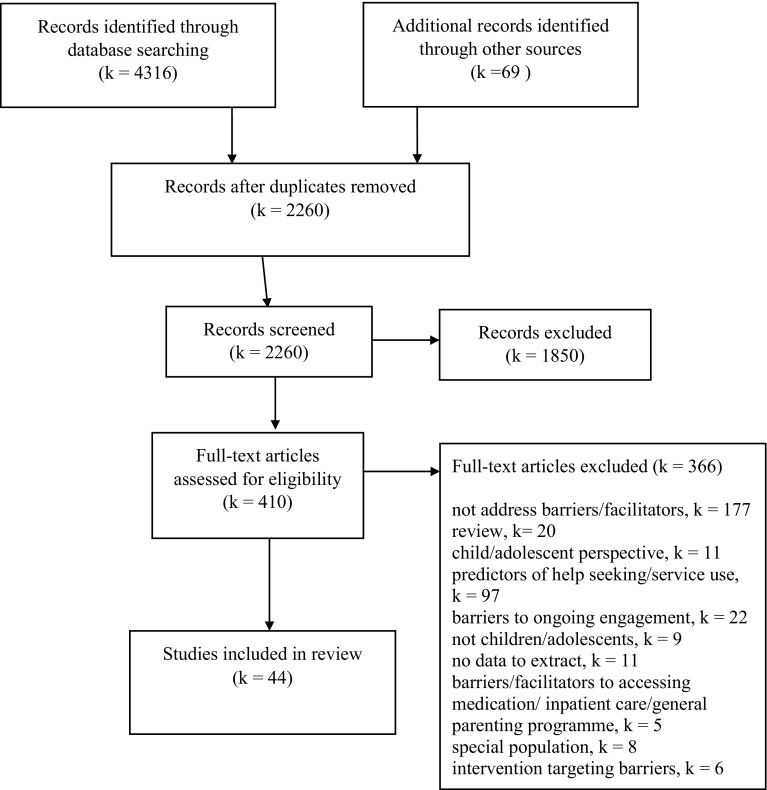
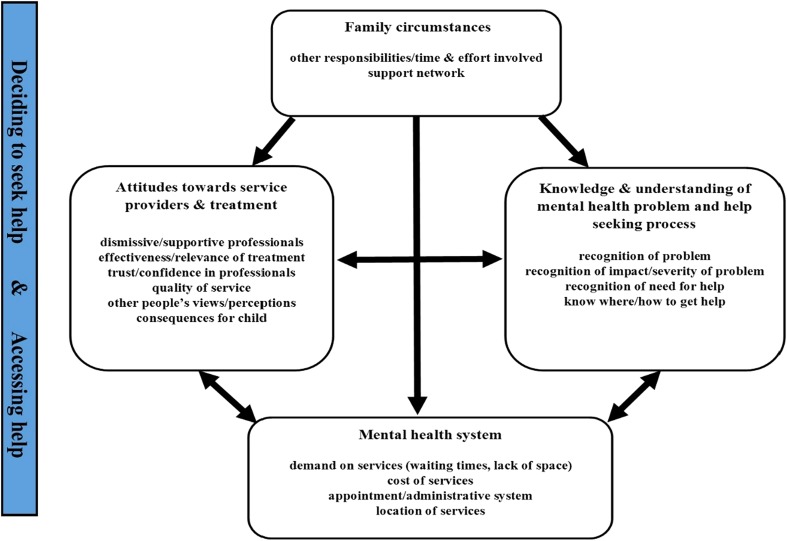
A minority of children and adolescents with mental health problems access treatment. The reasons for poor rates of treatment access are not well understood. As parents are a key gatekeeper to treatment access, it is important to establish parents' views of barriers/facilitators to accessing treatment. The aims of this study are to synthesise findings from qualitative and quantitative studies that report parents' perceptions of barriers/facilitators to accessing treatment for mental health problems in children/adolescents. A systematic review and narrative synthesis were conducted. Forty-four studies were included in the review and were assessed in detail. Parental perceived barriers/facilitators relating to (1) systemic/structural issues; (2) views and attitudes towards services and treatment; (3) knowledge and understanding of mental health problems and the help-seeking process; and (4) family circumstances were identified. Findings highlight avenues for improving access to child mental health services, including increased provision that is free to service users and flexible to their needs, with opportunities to develop trusting, supportive relationships with professionals. Furthermore, interventions are required to improve parents' identification of mental health problems, reduce stigma for parents, and increase awareness of how to access services.
Overview
The claims and statistics of this paper haven’t been checked yet.
Free: it reads the open-access text and checks the first 5 claims that cite a source we can check. Create a free account to check every claim.
Integrity signals
Registry
Cites
Statistics
Figures

Verification
Claims the paper makes
The claims and statistics of this paper haven’t been checked yet.
Free: it reads the open-access text and checks the first 5 claims that cite a source we can check. Create a free account to check every claim.
Claims other papers make about this one
Each is checked against this paper’s own text: does it say what the citing paper says it does?
The source backs part of the claim, not all of it — or backs it for a different population, condition or comparison.
In the citing paper
“These findings are also discrepant from prior studies examining barriers to EBP delivery in community-based settings for children (Reardon et al., 2017).”
From Stakeholder Perceptions of the Barriers to Receiving and Delivering Exposure-Based Cognitive Behavioral Therapy for Anxiety Disorders in Adult Community Mental Health Settings (2019) · cites this paper as Reardon et al., 2017
Experimental — accuracy not yet measuredThe source backs part of the claim, not all of it — or backs it for a different population, condition or comparison.
In the citing paper
“A previous review, which focused on the parents of children and adolescents, concluded that structural barriers were the most relevant [122].”
From What are the barriers, facilitators and interventions targeting help-seeking behaviours for common mental health problems in adolescents? A systematic review (2020) · cites this paper as [122]
Experimental — accuracy not yet measured
Self-check
Percentages, sums and reported differences re-computed from the paper’s own numbers.
The self-check needs the paper’s full text.
Citations
Cites
Preferred Reporting Items for Systematic Reviews and Meta-Analyses: the PRISMA statement
Moher, D., Liberati, A., Tetzlaff, J., Altman, D. G., & for the PRISMA Group (2009) · BMJ · doi:10.1136/bmj.b2535 · Cited by 83,823
Preferred reporting items for systematic reviews and meta-analyses: the PRISMA Statement.
(2009) · PubMed Central · Cited by 44,859
Kessler, R. C., Berglund, P., Demler, O., Jin, R., Merikangas, K. R., & Walters, E. E. (2005) · Archives of General Psychiatry · doi:10.1001/archpsyc.62.6.593 · Cited by 20,391 · cited 1×
“Youth is a time of heightened risk for mental health disorders, with half of all lifetime mental health disorders emerging before the age of 14 years [2].”
Polanczyk, G. V., Salum, G. A., Sugaya, L. S., Caye, A., & Rohde, L. A. (2015) · Journal of Child Psychology and Psychiatry · doi:10.1111/jcpp.12381 · Cited by 3,990
Gulliver, A., Griffiths, K. M., & Christensen, H. (2010) · BMC Psychiatry · doi:10.1186/1471-244x-10-113 · Cited by 3,292 · cited 1×
“A recent systematic review synthesised findings across studies that reported young people’s perceptions of barriers and facilitators to accessing mental health treatment [32].”
Popay, J., Roberts, H., Sowden, A., Petticrew, M., Arai, L., Rodgers, M., Britten, N., Roen, K., & Duffy, S. (2006) · Lancaster University · doi:10.13140/2.1.1018.4643 · Cited by 2,070
Pine, D. S., Cohen, P., Gurley, D., Brook, J., & Ma, Y. (1998) · Archives of General Psychiatry · doi:10.1001/archpsyc.55.1.56 · Cited by 1,753 · cited 1×
“Moreover, the negative impact of poor mental health early in life extends into adulthood, predicting poor academic outcomes [3], increasing the risk of subsequent mental health problems [4] and high rates of mental health service use [5], reducing life satisfaction [6], and creating a heavy economic burden for society…”
Merikangas, K. R., He, J.-P., Burstein, M., Swendsen, J., Avenevoli, S., Case, B., Georgiades, K., Heaton, L., Swanson, S., & Olfson, M. (2011) · Journal of the American Academy of Child & Adolescent Psychiatry · doi:10.1016/j.jaac.2010.10.006 · Cited by 1,579 · cited 2×
“1 3 studies suggest that being Caucasian [13, 14], having insurance coverage (in the USA) [15, 16], living in an urban area [17], and having a child with more severe mental health problems [12] increases the likelihood of a family accessing treatment.”
Unmet Need for Mental Health Care Among U.S. Children: Variation by Ethnicity and Insurance Status
Kataoka, S. H., Zhang, L., & Wells, K. B. (2002) · American Journal of Psychiatry · doi:10.1176/appi.ajp.159.9.1548 · Cited by 1,566 · cited 1×
“1 3 studies suggest that being Caucasian [13, 14], having insurance coverage (in the USA) [15, 16], living in an urban area [17], and having a child with more severe mental health problems [12] increases the likelihood of a family accessing treatment.”
Mental Health of Children and Young People in Great Britain, 2004: (557702010-001)
Green, H., McGinnity, A., Meltzer, H., Ford, T., & Goodman, R. (2005) · PsycEXTRA Dataset · doi:10.1037/e557702010-001 · Cited by 1,216 · cited 1×
“…and national surveys in the UK, Australia, and USA have estimated that only 25–56% of children and adolescents with mental health disorders access specialist mental health services [10–12], with particularly low rates of access for internalising compared with externalising problems [10, 12].”
Cited by
Items 501–600 of 653
A Theoretical Framework for Understanding Social Anxiety in the Context of Career Development
Yu, C. M. (2019) · The Journal of Macrodynamic Analysis (Memorial University of Newfoundland) · doi:10.82396/cjcd.v18i1.3142 · Cited by 2
Evidence-Based Therapies for Children and Adolescents: Where Are We, and How Did We Get Here?
Roberts, M. C., & Steele, R. G. (2020) · Issues in clinical child psychology · doi:10.1007/978-3-030-44226-2_1
Treatment Considerations for Youth Exposed to Interpersonal Violence
Berman, I. S., Seifert, H. T. P., & Briggs, E. C. (2020) · Springer eBooks · doi:10.1007/978-3-319-62122-7_328-1
Facilitators and Barriers to Psychiatric Treatment for Children:The Influence of Parental Factors
Kusaka, S., Yamaguchi, S., & Sasaki, T. (2020) · Anxiety Disorder Research · doi:10.14389/jsad.12.1_2 · Cited by 2
Middle and High School Staff and Students' Perceptions of QPR Training
Liebl, S. (2020) · Minds at UW (University of Wisconsin)
Tsamadou, E., Voultsos, P. P., Emmanouilidis, A., & Ampatzoglou, G. (2021) · Research Square · doi:10.21203/rs.3.rs-220519/v2
Global barriers to provision and utilization of mental health services: a systematic scope studyPreprint
Sarikhani, Y., Bastani, P., Karajizadeh, M., Kavosi, Z., & Ravangard, R. (2019) · Research Square · doi:10.21203/rs.2.14592/v1
Yang, Y., Reyes, B. L., & Jacob, E. (2022) · Journal of Child and Adolescent Psychiatric Nursing · doi:10.1111/jcap.12371
Doria, M. J. (2021) · Chapman University Digital Commons (Chapman University) · doi:10.36837/chapman.000255 · Cited by 1
Decke, S., Deckert, K., Lang, M., Laub, O., Loidl, V., Schwettmann, L., & Grill, E. (2020) · doi:10.21203/rs.3.rs-36700/v1
“In the literature, systemic and structural issues, views and attitudes towards services and treatment, the knowledge and understanding of MHP and the help-seeking process as well as the family circumstances were found to be crucial determinants for parents’ decision to seek help (12, 28).”
BackgroundTsamadou, E., Voultsos, P. P., Emmanouilidis, A., & Ampatzoglou, G. (2021) · doi:10.21203/rs.3.rs-234498/v1
Tsamadou, E., Voultsos, P. P., Emmanouilidis, A., & Ampatzoglou, G. (2021) · Research Square · doi:10.21203/rs.3.rs-220519/v1
“When parents perceive their children’s mental health problem to be serious, they are more likely to seek mental health therapy for their children [48,90].”
BackgroundChen, G. L. (2020) · Louisiana State University · doi:10.31390/gradschool_theses.5255 · Cited by 2
“In their meta-analysis, Reardon et al. (2017) studied perceived 13 barriers and facilitators related to treatment utilization, finding that a barrier to parental help seeking is the feeling of being dismissed or unsupported by professionals.”
BackgroundInfluentialBennett, S. D., Croucher, L., Hagell, A., Mertan, E., Minhinnett, W., & Shafran, R. (2022) · Oxford University Press eBooks · doi:10.1093/med-psych/9780198867791.003.0026
Reardon, T. C., Ukoumunne, O. C., Violato, M., Ball, S., Brown, P., Ford, T. J., Gray, A. M., Hill, C., Jasper, B., Larkin, M., et al. (2022) · Research Square · doi:10.21203/rs.3.rs-2021089/v1
Self-citationKelly, L. M., Correia, N., Kearns, M. D. H., Lang, S. G., Yermash, J., Guigayoma, J. P., Helseth, S. A., & Becker, S. J. (2022) · Drug and Alcohol Dependence Reports · doi:10.1016/j.dadr.2022.100110 · Cited by 2
Parenting Style and Help-Seeking for Child Anxiety and Depression: A Vignette Study
Pomerantz, H. (2022) · Digital Commons - URI (University of Rhode Island) · doi:10.23860/diss-pomerantz-hayley-2022
“that the cost of treatment and other logistical type factors such as inconvenient appointment times were commonly reported as barriers (Reardon et al., 2017).”
BackgroundLawrence, P. J. (2018) · PsyPag Quarterly · doi:10.53841/bpspag.2018.1.109.12 · Cited by 2
Suryaputri, I. Y., Mubasyiroh, R., & Rosha, B. C. (2023) · doi:10.2991/978-94-6463-112-8_42 · Cited by 2
Experience of Psychosocial Rehabilitation; Perspectives of Depressed AdolescentsPreprint
Kodzo, L. D., Danso, N. A. A., Budu, J. T., Kafle, A., & Zhang, R. (2023) · Research Square · doi:10.21203/rs.3.rs-2748090/v1
Akintunde, T. Y. (2023) · Global Health Journal · doi:10.1016/j.glohj.2023.04.002
ANALYSIS OF THE DEMANDS OF PATIENTS AT THE SERVICE OF APPLIED PSYCHOLOGY AT PUC-RIO
Coutinho, B. D. M. C. (2023) · doi:10.17771/pucrio.acad.62365
Pathways into Child and Adolescent Psychiatry
Hansen, A. S. (2021) · VBN Forskningsportal (Aalborg Universitet) · doi:10.54337/aau450851048
Factors Associated with Racial and Ethnic Minority Youths' Mental Health Help-Seeking at School
Allouche, S. F. (2021) · Louisiana State University · doi:10.31390/gradschool_dissertations.5901 · Cited by 1
Can We Screen Parents Around the World About the Mental Health of Their Children? Yes, Just Ask
Greydanus, D. E. (2023) · JAMA Network Open · doi:10.1001/jamanetworkopen.2023.18901
Nemlekar, S., Srivastava, V., Nair, S., Gaikwad, A., Chaudhari, A. P., & Ramadas, D. (2023) · Indian Journal of Behavioural Sciences · doi:10.55229/ijbs.v26i2.05
Stevenson, J. (2023) · Springer eBooks · doi:10.1007/978-3-031-45787-6_8
Choy, S. K. J., Vincent, A. M., Maesaka, T. J., & Nakamura, B. J. (2023) · Journal of Child and Family Studies · doi:10.1007/s10826-023-02699-6 · Cited by 1
“To illustrate, Reardon et al. (2017) conducted a review of 44 studies that assessed over 3,900 parents ’ perceived barriers to service participation, and found that stigma was the most frequently reported deterrent against seeking youth services.”
Antecedents of Depression among Undergraduates in Nigerian Private Universities
Ogunsanwo, M. A., & Akintola, O. A. (2023) · Journal of Education in Black Sea Region · doi:10.31578/jebs.v9i1.308 · Cited by 2
“However, support from parents can be inhibited by a lack of awareness of available services, stigma, time constraints, and financial costs (Patil et al., 2016; Reardon et al., 2017).”
BackgroundBartlett, J. D. (2023) · Springer series on child and family studies · doi:10.1007/978-3-031-47917-5_6 · Cited by 1
Equity in Engaging Families in Mental Health Interventions for Young Children
Nguyen, V. O., & Harden, B. J. (2023) · Springer series on child and family studies · doi:10.1007/978-3-031-47917-5_9
Shannon Archuleta, M. P. H., Allison‐Burbank, J. D., Allison Ingalls, M. P. H., Renae Begay, M. P. H., Grass, R., PhD, F. L., Begaye, V., Howe, L., Tsosie, A., Keryte, A. P., et al. (2024) · Journal of School Health · doi:10.1111/josh.13419
RetractedLevitt, E. E., Markoulakis, R., Weingust, S., Dobbin, K., & LEVITT, A. J. (2023) · Canadian Journal of Community Mental Health · doi:10.7870/cjcmh-2023-028
Diversidad en el neurodesarrollo
Leo-Jimenez, J. O. D., Rodríguez-Santillán, E., Valenzuela, C. C. C., Gomar, M. L. G., Alameda, A. J. C., Cortés, A. N., Moreno, M. B., Macedo, Z. B. N., Martínez, F. G., Carrillo, M. C., et al. (2024) · doi:10.52501/cc.143
sharifi, R. H., Keshavarz, S., & Kakavand, A. (2023) · Quarterly Journal of Child Mental Health · doi:10.61186/jcmh.10.1.3
Implicit Bias in School-Based Suicide Risk Assessment
Munson, J. A. G. (2023) · Louisiana State University · doi:10.31390/gradschool_dissertations.6248
"My Family Won't Let Me." Adolescent-Reported Barriers to Accessing Mental Health CarePreprint
Roulston, C. A., Chen, S., Ahuvia, I. L., Fassler, J., Fox, K. R., & Schleider, J. L. (2024) · PsyArXiv (OSF Preprints) · doi:10.31234/osf.io/yqgh3
Dose, C., Roschmann, T., Kinnen, C., Rademacher, C., Hautmann, C., & Döpfner, M. (2024) · Journal of Child and Family Studies · doi:10.1007/s10826-024-02831-0 · Cited by 1
“Moreover, besides this structural barrier, personal barriers like limited time resources or fear of stigmatization might prevent adolescents and their caregivers from treatment utilization (Kazdin et al., 1997; Reardon et al., 2017).”
Hedstrom, E., Kostyrka‐Allchorne, K., French, B., Glazebrook, C., Hall, C. L., Kovshoff, H., Lean, N., & Sonuga-Barke, E. J. S. (2024) · BMJ Open · doi:10.1136/bmjopen-2023-081563 · Cited by 1
Psychological Difficulties and the Needs for Counseling Services in High School StudentsPreprint
Le, C. M., Huynh, V.-S., Nguyen, V. H. A., Le, V. T., Luu-Thi, H.-T., & Tran-Chi, V.-L. (2024) · Research Square · doi:10.21203/rs.3.rs-4408006/v1
Wu, J., Zhang, R., Zhao, L., Yin, Y., Min, J., Ge, Y., Luo, Y., Li, P., Li, L., & Tong, Y. (2024) · Child and Adolescent Psychiatry and Mental Health · doi:10.1186/s13034-024-00765-5
Saunders, E. R., Pevie, N., Bedford, S., Gosselin, J., Harris, N., & Rash, J. A. (2024) · PLoS ONE · doi:10.1371/journal.pone.0304815 · Cited by 1
Khanal, G., mani, S., Ghimire, S., Thapa, S., & Dhital, R. (2024) · SSRN Electronic Journal · doi:10.2139/ssrn.4888129
Hagen, M. H., Hartvigsen, G., Jaccheri, L., & Papavlasopoulou, S. (2024) · Scandinavian Journal of Child and Adolescent Psychiatry and Psychology · doi:10.2478/sjcapp-2024-0006 · Cited by 1
“This resonates with literature reviews finding a medium effect size on minority status and cultural barriers as dropout predictors for psychosocial follow-up (35, 37).”
BackgroundParnes, M. F., Mehari, M., Sedlar, G. R., Trevino, C. O., Porter, R., & Walker, S. C. (2024) · Frontiers in Public Health · doi:10.3389/fpubh.2024.1348117 · Cited by 1
MacPherson, H. A., Chou, T., DeMartino, E., Velotta, S. K., Elwy, A. R., & Wolff, J. C. (2024) · Cognitive and Behavioral Practice · doi:10.1016/j.cbpra.2024.08.005 · Cited by 1
Lessons, Part II: Barriers to Care
Pop, O. (2024) · Springer eBooks · doi:10.1007/978-3-031-68294-0_9
Johnson, C. L., Kelly, C. M., Jorm, A. F., GARVEY, W., & Hart, L. (2025) · Health Expectations · doi:10.1111/hex.70126 · Cited by 3
Psychopharmacology Considerations for Children Aged under 6 Years
Romanowicz, M., Pease, E. R., Tarikogullari, I., PON, N. C., & Gleason, M. M. (2025) · Child and Adolescent Psychiatric Clinics of North America · doi:10.1016/j.chc.2024.08.003
Okul Psikolojik Danışmanlarının İnternet Tabanlı Müdahalelere İlişkin Görüşleri
Köksal, B., & Özer, Ö. (2025) · KIRŞEHİR EĞİTİM FAKÜLTESİ DERGİSİ · doi:10.29299/kefad.1513146
Key skills in working with children and young people
Grealish, A., & Trainor, G. (2025) · Oxford University Press eBooks · doi:10.1093/med/9780192864048.003.0017
Parent-only Interventions for Anxiety Disorders in Children and Adolescents
Peng, S., & Zhong, Y. (2025) · Journal of Contemporary Medical Practice · doi:10.53469/jcmp.2025.07(01).09
Wells, S. L., & Baillargeon, R. H. (2025) · OBM Integrative and Complementary Medicine · doi:10.21926/obm.icm.2501009
Parents' Challenges in Children's Psychotherapeutic Interventions: A Phenomenological Study
Chuah, H. M., & Sumari, M. B. (2025) · Counselling and Psychotherapy Research · doi:10.1002/capr.70003 · Cited by 1
Williamson, V., Larkin, M., Reardon, T. C., Stallard, P. N., Spence, S. H., Macdonald, I., Ukoumunne, O. C., Ford, T. J., Violato, M., Sniehotta, F. F., et al. (2025) · BMJ Open · doi:10.1136/bmjopen-2023-082691
Self-citationMcAlister, K. L., Lawrence‐Sidebottom, D., Roots, M., McCutchen, D., & Huberty, J. (2025) · doi:10.2196/preprints.72282
Reducing stigma and discriminatory behaviour
Gronholm, P. C., Gurung, D., Parry, S., Mehta, N., & Thornicroft, G. (2025) · Oxford University Press eBooks · doi:10.1093/med/9780198898818.003.0031
Potharst, E. S., Truijens, D., van Steensel, F. J. A., Killick, S., & Bögels, S. M. (2025) · International Journal of Environmental Research and Public Health · doi:10.3390/ijerph22040559
“A systematic review of barriers that parents experience in seeking mental health care for their children showed that the fear of stigma was reported as a barrier in studies from many different countries and cultures [29].”
GARVEY, W., Schembri, R., Oberklaid, F., & Hiscock, H. (2025) · Archives of Disease in Childhood · doi:10.1136/archdischild-2025-328728
“22 While most caregivers engaged with services, the numbers were small and require cautious interpretation.”
Mathews, F., Playford, C., Ukoumunne, O. C., Ford, T. J., & Newlove‐Delgado, T. (2025) · JCPP Advances · doi:10.1002/jcv2.70014
“There are likely multiple factors behind preference for service contact and help - seeking among different groups, and barriers including stigma (Hansen et al., 2021; Reardon et al., 2017).”
Shehu, F., & Orhani, Z. (2025) · British journal of Psychology Research · doi:10.37745/bjpr.2013/vol13n14275
A qualitative investigation of young people’s experiences and views of Early Support HubsPreprint
Wright, L., Griffiths, J., Appleton, R., Begum, S., Clarke, C., Hunt, N. C., Lewis, H. K., Barnett, P., Bhutta, A., Driskell, E., et al. (2025) · medRxiv · doi:10.1101/2025.09.05.25335175
Hildingsson, I., & Holmström, M. R. (2025) · Nordic Journal of Psychiatry · doi:10.1080/08039488.2025.2556923
“Previous studies have shown that long waiting times and problems with referral to mental health facilities are barriers to care for children with mental health problems [10,14].”
InfluentialMcAlister, K. L., Lawrence‐Sidebottom, D., Roots, M., McCutchen, D., & Huberty, J. (2025) · JMIR Pediatrics and Parenting · doi:10.2196/72282
Machingura, T., & Makomo, M. (2025) · BENTHAM SCIENCE PUBLISHERS eBooks · doi:10.2174/9789815313710125010019
Machingura, T., & Machingura, L. (2025) · BENTHAM SCIENCE PUBLISHERS eBooks · doi:10.2174/9789815313710125010015
Cunningham, P. B., Gilmore, J., Naar, S., Preston, S. D., Eubanks, C. F., Hubig, N., McClendon, J. L., Ghosh, S., & Ryan-Pettes, S. R. (2025) · Gezinstherapie Wereldwijd · doi:10.1007/s12440-025-00258-7
“…de werkzaamheid van deze EBT’s echter verre van optimaal (Curtis et al. 2019; Weisz et al. 2013, 2014), vooral bij moeilijk te behandelen, multi-probleem-en multi-stress gezinnen die kampen met ernstige mentale en medische problemen (Guerrero et al. 2013; Lu en Zhang 2021; Reardon et al. 2017).”
Jamison, J., Weiss, M., Adams, D. R., Young, S., Brady, M., Cummings, W., Karenchak, C., & Becker‐Haimes, E. M. (2025) · Journal of Child and Family Studies · doi:10.1007/s10826-025-03173-1
“Families seeking treatment for their child’s anxiety encounter significant barriers to accessing treatment (Crouch et al., 2019; Frank et al., 2020; Reardon et al., 2017, 2018; Salloum et al., 2016).”
LaVigne, T. W., Bujoreanu, S. I., Moldovanu, S. R., Hale, A. E., & Coakley, R. (2025) · Journal of Clinical Psychology in Medical Settings · doi:10.1007/s10880-025-10102-3 · Cited by 1
“…have a robust evidence base in the context of treating pain (Harrison et al., 2019; Nelson & Coakley, 2018), but families often face long waitlists, limited availability of trained providers, and logistical challenges that delay or prevent access to psychological care (Reardon et al., 2017).”
Investigation of a novel internet-based aggression prevention program for children
Heilman, M. E., Lochman, J. E., Bui, C., & White, B. C. (2025) · Journal of Applied Developmental Psychology · doi:10.1016/j.appdev.2025.101882
Gutzweiler, R., Backhaus, C., In‐Albon, T., & Kircher, A. (2026) · Zeitschrift für Klinische Psychologie und Psychotherapie · doi:10.1026/1616-3443/a000866
Cha, B. S., Kim, J., Borghouts, J. W., Eikey, E. V., Schneider, M. L., Schueller, S. M., Stadnick, N. A., Zheng, K., Mukamel, D. B., & Sorkin, D. H. (2025) · Psychiatric Quarterly · doi:10.1007/s11126-025-10225-8 · Cited by 1
A University Partnership Model for Equitable Mental Health Services in Public Schools
Villarreal, V., Sullivan, J. R., Castro‐Villarreal, F., Davis, J. L., & Meca, A. (2025) · Emerald Group Publishing Limited eBooks · doi:10.1108/978-1-80592-132-520251001
Dickson, K. S., Kennedy, S. M., Safer‐Lichtenstein, J., Brookman-Frazee, L. I., Roesch, S. C., & Anthony, L. G. (2025) · Implementation Science Communications · doi:10.1186/s43058-025-00799-6
Weber, A., Flanagan, T. J., & Darrow, S. M. (2025) · Evidence-Based Practice in Child and Adolescent Mental Health · doi:10.1080/23794925.2025.2592923
“…barriers to care, caregiver beliefs about mental health (e.g., viewing behavioral problems as intentional), limited awareness or problem recognition, and poor caregiver-child communication (Alonso & Little, 2019; Ohan et al., 2015; Platell et al., 2023; Reardon et al., 2017; Teagle, 2002).”
Mathew, P. C. (2025) · Journal of Clinical Insights and Research in Dentistry · doi:10.5005/jcird-11034-0030
Mubeen, Z., Fatmi, Z., Hameed, W., & Asim, M. (2024) · Figshare · doi:10.6084/m9.figshare.25132026
Iglhaut, L., Primbs, R., Kaubisch, S., Koppenhöfer, C., Piechaczek, C., Keim, P.-M., Kloek, M., Feldmann, L., Schulte‐Körne, G., & Greimel, E. (2024) · Figshare · doi:10.6084/m9.figshare.24995513
Kamali, M., Sivapalan, S., Kata, A., Kim, N., Shanmugalingam, N., Duku, E., Zwaigenbaum, L., & Georgiades, S. (2022) · Figshare · doi:10.6084/m9.figshare.19498170
Klinner, C., Glozier, N., Yeung, M., Conn, K., & Milton, A. C. (2023) · Figshare · doi:10.6084/m9.figshare.24309947
Koet, L. B. M., Bennenbroek, J. J. M., Bruggeman, A. Y. S., de Schepper, E. I. T., Bohnen, A. M., Bindels, P., & Gerger, H. (2022) · Figshare · doi:10.6084/m9.figshare.21087141
Hawke, L. D., Thabane, L., Iyer, S. N., Jaouich, A., Reaume‐Zimmer, P., & Henderson, J. L. (2021) · Figshare · doi:10.6084/m9.figshare.16725888
Reardon, T. C., Ukoumunne, O. C., Violato, M., Ball, S., Brown, P., Ford, T. J., Gray, A., Hill, C., Jasper, B., Larkin, M., et al. (2022) · Figshare · doi:10.6084/m9.figshare.21384481
Self-citationKlinner, C., Glozier, N., Yeung, M., Conn, K., & Milton, A. C. (2024) · Figshare · doi:10.6084/m9.figshare.24310015
Reardon, T. C., Dodd, H., Hill, C., Jasper, B., Lawrence, P. J., Morgan, F., Rapee, R. M., Ukoumunne, O. C., Violato, M., Davey, E., et al. (2022) · Figshare · doi:10.6084/m9.figshare.19220716
Self-citationNakamura‐Thomas, H., Sano, N., & Maciver, D. (2024) · Figshare · doi:10.6084/m9.figshare.26602027
Moreira, H., Skvarc, D., Gomes-Pereira, B., Albuquerque, A., Góis, A. C., Fonseca, A., Pereira, A. M., Caiado, B., Paulino, B., Santos, C., et al. (2024) · Figshare · doi:10.6084/m9.figshare.26678381
Nakamura‐Thomas, H., Sano, N., & Maciver, D. (2024) · Figshare · doi:10.6084/m9.figshare.26602024
Kamali, M., Sivapalan, S., Kata, A., Kim, N., Shanmugalingam, N., Duku, E., Zwaigenbaum, L., & Georgiades, S. (2022) · Figshare · doi:10.6084/m9.figshare.19498167
Koet, L. B. M., Bennenbroek, J. J. M., Bruggeman, A. Y. S., de Schepper, E. I. T., Bohnen, A. M., Bindels, P., & Gerger, H. (2022) · Figshare · doi:10.6084/m9.figshare.21087138
Vogel, A., Comteße, H., & Rosner, R. (2020) · Figshare · doi:10.6084/m9.figshare.12144618
Tsamadou, E., Voultsos, P., Emmanouilidis, A., & Ampatzoglou, G. (2021) · Figshare · doi:10.6084/m9.figshare.16655568
Kamali, M., Sivapalan, S., Kata, A., Kim, N., Shanmugalingam, N., Duku, E., Zwaigenbaum, L., & Georgiades, S. (2022) · Figshare · doi:10.6084/m9.figshare.19498164
Decke, S., Deckert, K., Lang, M., Laub, O., Loidl, V., Schwettmann, L., & Grill, E. (2020) · Figshare · doi:10.6084/m9.figshare.13467949
Reardon, T. C., Ukoumunne, O. C., Violato, M., Ball, S., Brown, P., Ford, T. J., Gray, A., Hill, C., Jasper, B., Larkin, M., et al. (2022) · Figshare · doi:10.6084/m9.figshare.21384475
Self-citationKamali, M., Sivapalan, S., Kata, A., Kim, N., Shanmugalingam, N., Duku, E., Zwaigenbaum, L., & Georgiades, S. (2022) · Figshare · doi:10.6084/m9.figshare.19498158
Kamali, M., Sivapalan, S., Kata, A., Kim, N., Shanmugalingam, N., Duku, E., Zwaigenbaum, L., & Georgiades, S. (2022) · Figshare · doi:10.6084/m9.figshare.19498161
Decke, S., Deckert, K., Lang, M., Laub, O., Loidl, V., Schwettmann, L., & Grill, E. (2020) · Figshare · doi:10.6084/m9.figshare.13467953
Metadata
- Authors
- Reardon, T., Harvey, K., Baranowska, M., O’Brien, D., Smith, L., & Creswell, C.
- Affiliations
- University of Reading (GB)
- Corresponding author
- Harvey, Kate
- Venue
- European Child & Adolescent Psychiatry
- Published
- 2017-01-04
- Volume
- 26
- Issue
- 6
- Pages
- 623-647
- ISSN
- 1018-8827 (ISSN-L)
- 1435-165X
- PMC
- PMC5446558
- OpenAlex
- W2567323169
- Cited by
- 653
- References
- 82
- Citations by year
- 2026: 74 · 2025: 98 · 2024: 105 · 2023: 89 · 2022: 91 · 2021: 71 · 2020: 61 · 2019: 34 · 2018: 24 · 2017: 6
- FWCI
- 5.38
- Type
- journal article
- Language
- en
- Open access
- hybrid
- doi.org
- Locations
- European Child & Adolescent Psychiatry (publishedVersion, cc-by)
- Europe PMC (PubMed Central) (publishedVersion, other-oa)
- PubMed Central (publishedVersion, cc-by)
- PubMed (publishedVersion)
- CentAUR (University of Reading) (acceptedVersion)
- Funders
- Research Trainees Coordinating Centre (NIHR-RP-2014-04-018)
- Topics
- Health Sciences › Medicine › Psychiatry and Mental health › Mental Health Treatment and Access
- Social Sciences › Psychology › Clinical Psychology › Child and Adolescent Psychosocial and Emotional Development
- Social Sciences › Psychology › Clinical Psychology › Psychology and Mental Health
- Keywords
- barriers to treatment access, child and adolescent mental health, parental attitudes, help-seeking, mental health service utilization, mental health stigma, family situation, child mental health services, parent-professional relationship
- MeSH terms
- Adolescent, Child, Child, Preschool, Evaluation Studies as Topic, Humans, Mental Health, Mental Health Services, Parents, Qualitative Research
About these checks
Registry, retraction, Cites and statistics results are computed, not judged, with one exception: a printed reference that no index lists is read once by a model before it counts as a citation error. Claims are extracted by a model and kept only when their quote appears verbatim in the text; each cited source is then checked, with a model’s help, for whether it says what the claim relies on. Those verdicts can be wrong — read the claim’s quote and the cited source before relying on one.
Statistics and arithmetic are recomputed, not judged.
Confidence bands are shown only for fields calibrated on our annotated test set. None is calibrated yet, so no band is shown.
What counts as a claim ›How we measure confidence ›How we check this ›
Are you an author, or do you see a problem with this page? Request a review
Data sources
Bibliographic data: Semantic Scholar, OpenAlex, Crossref.
Contains information from the Semantic Scholar Academic Graph Datasets, made available under the ODC Attribution License (ODC-BY 1.0).
Semantic Scholar’s data is described in: Kinney, R., et al. (2023). The Semantic Scholar Open Data Platform. arXiv:2301.10140.
