

Conversion of biomass to biofuels and life cycle assessment: a review
Open accessThe DOI matches its Crossref record; 242 of the 242 references it cites were found in a registry or an index; 6 of the 80 sources its claims cite were checked for support.
Abstract
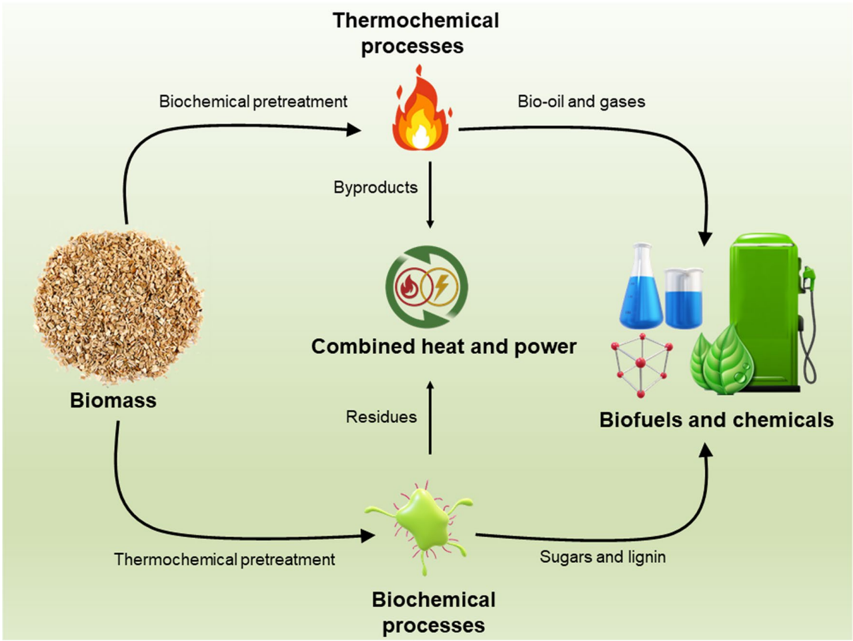
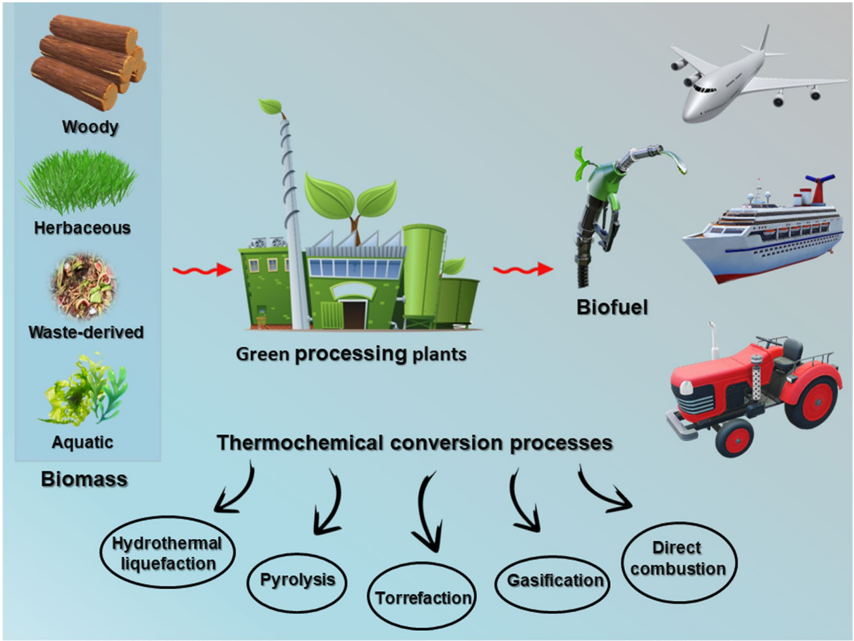
Thermochemical processes are classified into low temperature, below 300 °C, and high temperature, higher than 300 °C, i.e. gasification, combustion and pyrolysis.
Overview
CoChat Summary
TL;DR
This review surveys biomass-to-biofuel conversion routes and the life cycle assessment (LCA) literature, with a critical review of 40 LCA studies published from 2019–2021. It concludes that thermochemical routes are more researched than biochemical ones, and that integrating hydrothermal and biochemical routes is promising for a circular economy but still faces technical and cost challenges.
Key findings
- Biomass contributes about 9% (~51 EJ) of global primary energy supply, and the paper says global energy demand is projected to rise by almost 28% by 2040.
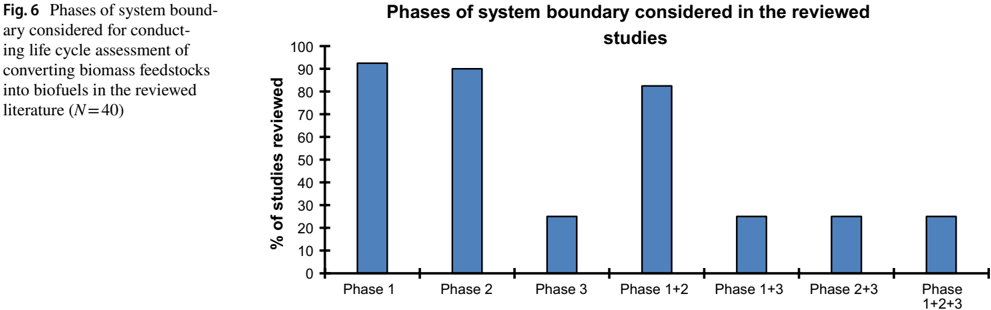
- The review analyzed 40 LCA studies from 2019–2021 and found that only 8 studies included all three phases of biofuel production; about 90% considered Phase 1 and Phase 2, but only 25% included Phase 3.
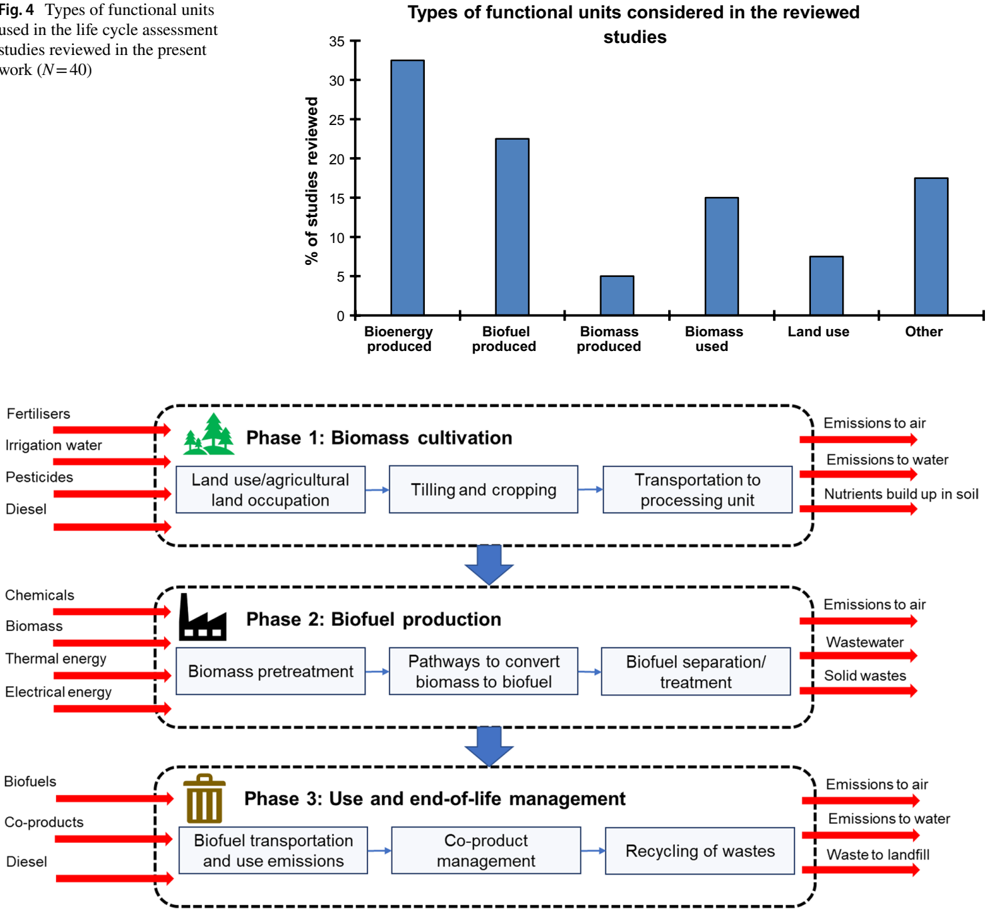
- About 32% of reviewed studies used “units of bioenergy in J or kWh” as the functional unit, while about 22% used “amount of biofuels produced” such as kg.
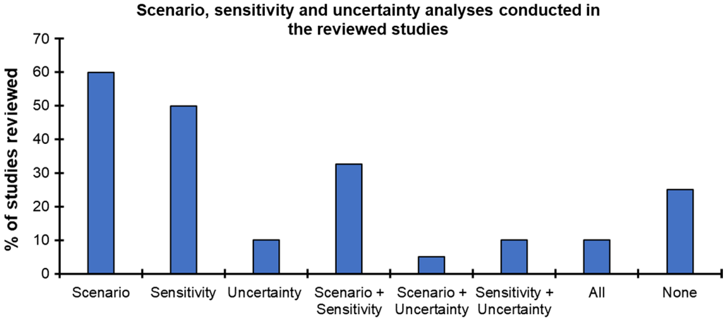
- The paper reports that 60% of the reviewed studies considered scenario analysis, 10% did uncertainty analysis, and 50% conducted sensitivity analysis; it also states that no study included all three phases of the biofuel production system boundary together with uncertainty, scenario, and sensitivity analyses.
- Across comparative LCA studies, thermochemical processes generally showed lower environmental impacts than biological processes for the same biomass and geographic/temporal span; one cited comparison found anaerobic digestion best for 14 out of 18 impacts.
Methods
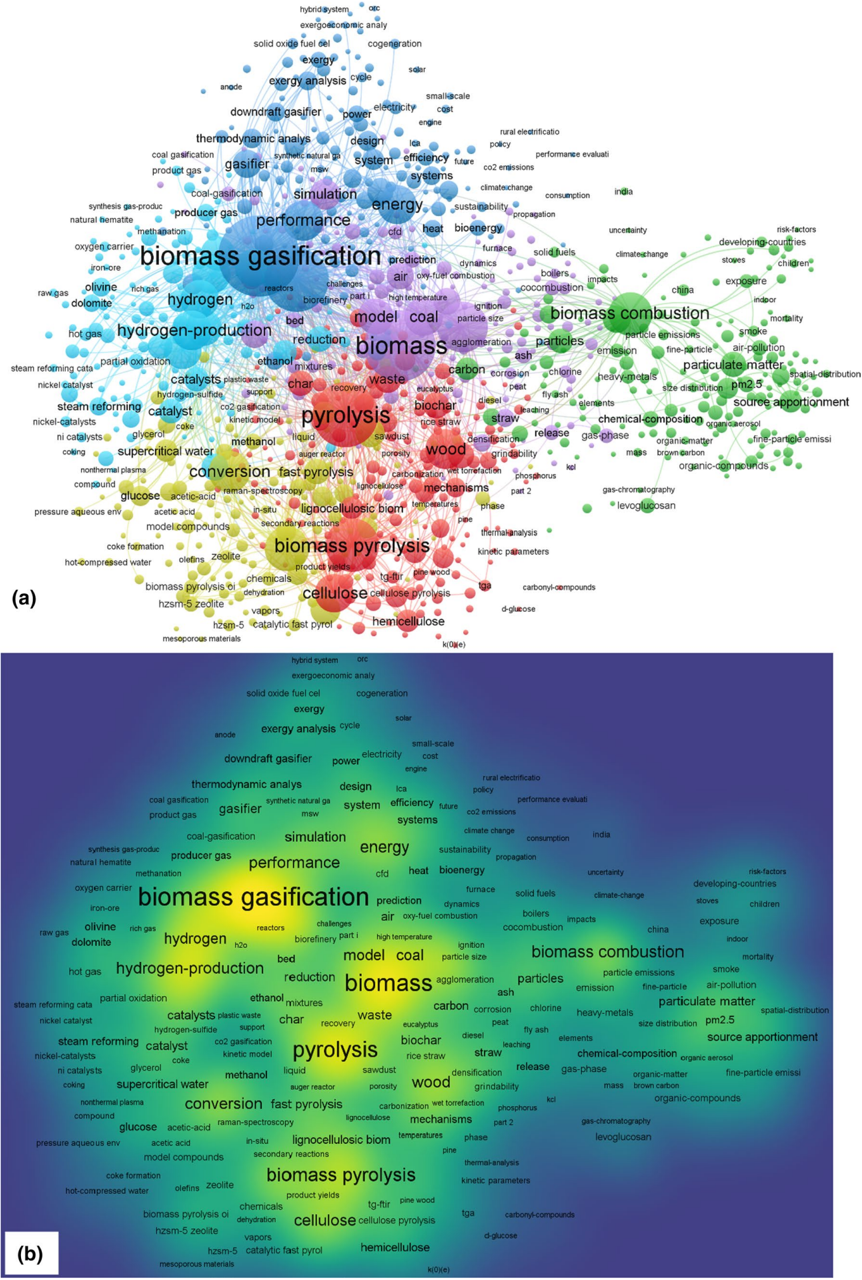
- Narrative review of biomass conversion technologies plus a bibliometric analysis using Web of Science data and VOSviewer; the bibliometric search returned 9,947 results, exported in batches of 500 entries.
- Critical review of 40 LCA studies published from 2019 to 2021 on biofuels, covering biomass feedstocks, geographical span, biofuels produced, life cycle tools, and inventories.
- The paper organizes analysis around ISO LCA stages: goal and scope, inventory analysis, impact assessment (mid-point and endpoint indicators), uncertainty/scenario/sensitivity analysis, and interpretation.
Limitations
- Stated in the paper: there was no study identified that included all three phases of biofuel production along with uncertainty, sensitivity, and scenario analyses.
- Stated in the paper: only 4 studies had all three of scenario, sensitivity, and uncertainty analyses, which “poses questions” about the applicability of findings for decision-making.
- Evident from the text: the review is limited to 40 studies from 2019–2021 for the LCA synthesis, so older or more recent studies are not part of that analysis.
Model-written summary. Check it against the paper before relying on it.
Integrity signals
Registry
Cites
Statistics
Figures
Verification
Claims the paper makes
3 Valid · 1 Not valid · 58 Not checked · 42 Own results and interpretations
The cited sources that could be checked couldn’t confirm or dispute this claim.
In the paper
“Biomass, unlike other sustainable energy sources such as wind, solar, geothermal, marine and hydropower, can directly produce fuel along with chemicals (Quereshi et al. 2021;Farrell et al. 2019;Farrell et al. 2020).”
§ Conversion of biomass to biofuels and life cycle assessment: a review > Introduction
What the sources say
- Not checked — no full text of the sourcecites Quereshi et al. 2021 matched to “Overview of sustainable fuel and energy technologies” (2021) source
- Could not verifycites Farrell et al. 2019 matched to “Assessment of the energy recovery potential of waste Photovoltaic (PV) modules” (2019) sourceExperimental — accuracy not yet measured
The Introduction (page unavailable) describes solar PV as producing electricity, and the Results and Discussion (page unavailable) compare PV polymers’ calorific value with energy crops. Neither passage addresses whether biomass can directly produce both fuels and chemicals, or makes the claimed comparison with other renewable sources. Searches for that comparison and for biomass, fuels, and chemicals found no supporting passage in our copy. (LLM, conf=0.76)
- Could not verifycites Farrell et al. 2020 matched to “Technical challenges and opportunities in realising a circular economy for waste photovoltaic modules” (2020) sourceExperimental — accuracy not yet measured
The Introduction (page unavailable) lists biomass alongside solar, wind, hydro, tidal and geothermal as renewable technologies, but does not compare what they produce. A search for biomass conversion into fuels and chemicals found discussion of pyrolysis in photovoltaic-module recycling, not a statement that biomass directly produces fuels and chemicals. (LLM, conf=0.76)
plain- Asserted: passes — The authors put it forward as true.
- Checkable: passes — It can be checked against evidence.
- Load-bearing: passes — The paper’s conclusions depend on it.
- Based: passes — The paper gives a reason why it holds.
The sources with a verdict support this claim; the rest weren’t checked yet, have no full text we could read, or their verdicts aren’t rated yet.
In the paper
“Some studies computed net energy ratio to evaluate the usability of biofuels as energy sources (Al-Mawali et al. 2021;Al-Muhtaseb et al. 2021;Dasan et al. 2019;Im-Orb and Arpornwichanop 2020;Reaño 2020;Saranya and Ramachandra 2020)”
§ Conversion of biomass to biofuels and life cycle assessment: a review > Mid-point indicators
What the sources say
- Could not verifycites Al-Mawali et al. 2021 matched to “Life cycle assessment of biodiesel production utilising waste date seed oil and a novel magnetic catalyst: A circular bioeconomy approach” (2021) sourceExperimental — accuracy not yet measured
Our copy of Al-Mawali et al. (2021) holds only the institutional-repository record: the title/author block, the keyword list (life cycle assessment, magnetic catalyst, circular bioeconomy, biodiesel, date seed oil) and the citation/RIS entries (Abstract section, no page numbers). Six searches ('net energy ratio', 'energy payback ratio fossil energy demand', 'energy efficiency ratio of energy output to input', transesterification/yield, and LCA functional-unit/GWP terms) returned only these metadata passages — no abstract body, methods, results or discussion text is present. Nothing in our copy therefore states or excludes that the authors computed a net energy ratio to assess biodiesel's usability as an energy source; the claim can be neither confirmed nor disputed. (LLM, conf=0.70)
- Supportedcites Al-Muhtaseb et al. 2021 matched to “Circular economy approach of enhanced bifunctional catalytic system of CaO/CeO2 for biodiesel production from waste loquat seed oil with life cycle assessment study” (2021) source
In the Figure 12 discussion, the paper calculates a net energy ratio of 2.23 using biodiesel energy output and fossil-resource savings. Section 3.6 identifies this as an LCA of biodiesel production from waste loquat seeds, supporting the citing sentence's characterization of the study. (LLM, conf=0.92)
- Not checked — no full text of the sourcecites Dasan et al. 2019 matched to “Life cycle evaluation of microalgae biofuels production: Effect of cultivation system on energy, carbon emission and cost balance analysis” (2019) source
plain- Asserted: passes — The authors put it forward as true.
- Checkable: passes — It can be checked against evidence.
- Load-bearing: unclear — It is unclear whether the paper’s conclusions depend on it.
- Based: passes — The paper gives a reason why it holds.
- Could not verify
Every source the paper cites for this claim was checked and supports it.
In the paper
“In fact, there was only one study identified that highlighted that for spent coffee grounds, incineration is a better route compared to biofuel production (Schmidt Rivera et al. 2020).”
§ Conversion of biomass to biofuels and life cycle assessment: a review > Key points observed in life cycle assessment studies
What the sources say
- Supportedcites Schmidt Rivera et al. 2020 matched to “Life cycle environmental sustainability of valorisation routes for spent coffee grounds: From waste to resources” (2020) source
Our copy states exactly what is attributed to it: the Abstract and Section 3.1 ('incineration is the most environmentally sustainable valorisation route, with net-negative impacts in 14 out of 16 categories') and the Conclusions rank biodiesel as 'the least preferred option with the highest impacts in 11 categories'. Section 3.2 reinforces this ('production of biodiesel from SCGs is not yet environmentally a competitive option, in particular when replacing incineration'). The 'only one study identified' framing is the citing authors' own review tally, not a statement attributed to this source. (LLM, conf=0.90)
plainSingle case- Asserted: passes — The authors put it forward as true.
- Checkable: passes — It can be checked against evidence.
- Load-bearing: unclear — It is unclear whether the paper’s conclusions depend on it.
- Based: passes — The paper gives a reason why it holds.
- Rests on an assumption not shown here.
- Supported
A result the paper reports from its own data — it cites no other source for it, so there is none to check. The quote shows it is in the paper.
In the paper
“There was no study identified that included all three phases of the life cycle of biofuel production system boundary (described in Fig. 5) and uncertainty, scenario and sensitivity analyses in the 40 reviewed studies.”
- Also stated in: § Key points observed in life cycle assessment studies · plain
“There was no study identified that included all the three phases of biofuel production along with uncertainty, sensitivity and scenario analyses.”
§ Conversion of biomass to biofuels and life cycle assessment: a review > Uncertainty, scenario and sensitivity analysis
plain- Asserted: passes — The authors put it forward as true.
- Checkable: passes — It can be checked against evidence.
- Load-bearing: passes — The paper’s conclusions depend on it.
- Based: passes — The paper gives a reason why it holds.
- Rests on an assumption not shown here.
- Also stated in: § Key points observed in life cycle assessment studies · plain
A result the paper reports from its own data — it cites no other source for it, so there is none to check. The quote shows it is in the paper.
In the paper
“Most of the studies focused on specific processes of the biofuel production chain, focusing on critical areas of concern rather than evaluating the overall impacts of the entire production chain.”
§ Conversion of biomass to biofuels and life cycle assessment: a review > Goal and scope definition
plain- Asserted: passes — The authors put it forward as true.
- Checkable: passes — It can be checked against evidence.
- Load-bearing: passes — The paper’s conclusions depend on it.
- Based: passes — The paper gives a reason why it holds.
56 more claims
Create a free account to see all 104 claims and to verify the 17 references still open.
- It may state two separate claims as one. 26
- Probably not a substantial claim. 19
- The quote only partly states this claim. 1
Citations
Cites
Review of fast pyrolysis of biomass and product upgrading
Bridgwater, A. V. (2012) · Biomass and Bioenergy · doi:10.1016/j.biombioe.2011.01.048 · Cited by 4,856 · cited 1×
“The primary product is liquid oil (Bridgwater, 2012a).”
Alvira, P., Tomás-Pejó, E., Ballesteros, M., & Negro, M. J. (2010) · Bioresource Technology · doi:10.1016/j.biortech.2009.11.093 · Cited by 3,912 · cited 1×
“Bioconversion of biomass to biofuel comprises of sequential stages: pretreatment, hydrolysis (acid/enzymatic) and fermentation (Alvira et al. 2010).”
BackgroundHydrothermal liquefaction of biomass: A review of subcritical water technologies
Toor, S. S., Rosendahl, L., & Rudolf, A. (2011) · Energy · doi:10.1016/j.energy.2011.03.013 · Cited by 1,840
Ethanol fermentation from biomass resources: current state and prospects
Lin, Y., & Tanaka, S. (2006) · Applied Microbiology and Biotechnology · doi:10.1007/s00253-005-0229-x · Cited by 1,621 · cited 1×
“In the consolidated bioprocessing scenario, only one microorganism is simultaneously utilised for hydrolysis and fermentation, which decreases the operation cost and enhances the process efficacy (Lin and Tanaka, 2006).”
BackgroundCombustion characteristics of different biomass fuels
Demirbas, A. (2004) · Progress in Energy and Combustion Science · doi:10.1016/j.pecs.2003.10.004 · Cited by 1,591
Strategies for mitigation of climate change: a review
Fawzy, S., Osman, A. I., Doran, J., & Rooney, D. W. (2020) · Environmental Chemistry Letters · doi:10.1007/s10311-020-01059-w · Cited by 1,522 · cited 1×
“The depletion of non-renewable fuel sources, accompanied with greenhouse gas emissions, has become a critical issue (Fawzy et al. 2020; Osman et al. 2021).”
BackgroundSelf-citationProgress in bioethanol processing
Balat, M., Balat, H., & Öz, C. (2008) · Progress in Energy and Combustion Science · doi:10.1016/j.pecs.2007.11.001 · Cited by 1,490 · cited 1×
“Under these subcritical conditions, physicochemical properties of water such as density, diffusivity, dielectric constant and viscosity alter and improve the biomass degradation process, which further upgrades the torrefaction process (Bach and Skreiberg 2016; Balat et al. 2008).”
BackgroundLignocellulosic biomass to bioethanol, a comprehensive review with a focus on pretreatment
Haghighi Mood, S., Hossein Golfeshan, A., Tabatabaei, M., Salehi Jouzani, G., Najafi, G. H., Gholami, M., & Ardjmand, M. (2013) · Renewable and Sustainable Energy Reviews · doi:10.1016/j.rser.2013.06.033 · Cited by 1,342 · cited 1×
“It can be classified into four main categories, including: (1) physical, e.g. grinding, (2) physicochemical, e.g. wet oxidation, (3) chemical, e.g. oxidising agents and organic solvents, and (4) biological or combination of them (Haghighi Mood et al. 2013).”
BackgroundCatalytic Conversion of Carbohydrates to Initial Platform Chemicals: Chemistry and Sustainability
Mika, L. T., Cséfalvay, E., & Németh, Á. (2018) · Chemical Reviews · doi:10.1021/acs.chemrev.7b00395 · Cited by 1,320 · cited 1×
“Based on the mode of operation, it can be divided into two main subclasses: (1) indirect liquefaction and (2) solvent liquefaction (Mika et al. 2018).”
BackgroundA review on hydrothermal liquefaction of biomass
Gollakota, A. R. K., Kishore, N., & Gu, S. (2018) · Renewable and Sustainable Energy Reviews · doi:10.1016/j.rser.2017.05.178 · Cited by 1,306 · cited 1×
“Solvent liquefaction has the priority to be implemented over the other scenario because of its remarkable merits, moderate operational conditions and higher yield of products (Gollakota et al. 2018).”
Background
Cited by
Items 601–700 of 714
Prospects and Challenges for Green Hydrogen as a Renewable Energy Source
Uttam, S. K., Bali, A., Negi, P., & Kumar, S. (2025) · IGI Global eBooks · doi:10.4018/979-8-3693-8980-5.ch022
Renewable Energy and Smart Technologies Integration for Adaptive and Sustainable Architecture
Islam, S. A. U., & Meyer, E. L. (2025) · Sustainable development · doi:10.5772/intechopen.1009931 · Cited by 2
Biofuel production with integrated pyrolysis and catalytic upgrading system
Zhou, Z. (2025) · Elsevier eBooks · doi:10.1016/b978-0-443-29291-0.00008-9
Han, Z., Shen, J., Guo, Y. R., et al. (2025) · SSRN Electronic Journal · doi:10.2139/ssrn.5263957
Kiran, S. H., Varuvel, E. G., & Martin, L. J. (2025) · Elsevier eBooks · doi:10.1016/b978-0-44-313219-3.00182-9
Motsa, L., Seedat, N., Mekuto, L., & Sekoai, P. (2026) · Biomass Conversion and Biorefinery · doi:10.1007/s13399-026-07177-9
Okon, E. D.-A., Raphael, O. O. R. O. O., & Chiemela, O. K. C. O. K. (2025) · International Journal of Advances in Engineering and Management · doi:10.35629/5252-0706407414
Mozas Santhose Kumar, J., Ramakrishnan, P., & Panneerselvam, P. (2025) · Results in Engineering · doi:10.1016/j.rineng.2025.105973
Design of a vertical reactor for pretreating woody biomass to extract cellulose biopolymer
Cárdenas‐Zapata, R., Ayala, J. C. H., Palma‐Ramírez, D., Paredes-Rojas, J. C., & Torres‐SanMiguel, C. R. (2025) · Journal of the Brazilian Society of Mechanical Sciences and Engineering · doi:10.1007/s40430-025-05760-1 · Cited by 1
Biorefining of Biocrude Oil: Current Status and Future Developments
Aziz, R., Rehman, K. U., Hussain, I., Mir, I. M., & Aslam, M. (2025) · Advances in sustainability science and technology · doi:10.1007/978-981-96-5198-6_13
Advanced Bioengineering Approaches for Energy Production from Waste Biomass
Sharma, A., Kumar, P., Wanale, S. G., Singh, S., & Ghazi, R. M. (2025) · Clean Energy Production Technologies · doi:10.1007/978-981-96-9282-8_2
Nanotechnological Intrusion for Transforming Biowaste to Energy: Recent Updates
Goswami, R., Mishra, A., Joshi, S., & Ranjana, R. (2025) · Clean Energy Production Technologies · doi:10.1007/978-981-96-9282-8_16
Metabolic Engineering for Bio-Methanol and Bio-Butanol Production from Wastes: Recent Progress
Kaur, H., Garg, K., Athwal, S., Chakroborty, S., Tiwari, K., Singh, S., Zaidi, N., & Kiran (2025) · Clean Energy Production Technologies · doi:10.1007/978-981-96-9282-8_15
Skrzypczak, D., Pstrowska, K., Niciejewska, A., Mazur-Nowacka, A., Wilk, Ł. J., & Chojnacka, K. (2025) · Applied Catalysis O Open · doi:10.1016/j.apcato.2025.207064 · Cited by 4
Sharma, M., Salhotra, M. S., Rathoure, R. K., et al. (2025) · SSRN Electronic Journal · doi:10.2139/ssrn.5433358
Wang, J., Ma, J., Wei, Y., & Liu, K. (2025) · Separation and Purification Technology · doi:10.1016/j.seppur.2025.135195
Processes Used in the Production of Methanol
Gharehghani, A., & Ahmadi, S. (2025) · Energy, environment, and sustainability · doi:10.1007/978-981-96-7384-1_4
Norberto, J., Benis, K. Z., Soltan, J., & McPhedran, K. N. (2025) · Lecture notes in civil engineering · doi:10.1007/978-3-031-97693-3_18
Biodiesel and Bioethanol Production
Akolkar, H. N., Haghi, A. K., Darekar, N. R., & Pawar, G. B. (2025) · Synthesis lectures on renewable energy technologies · doi:10.1007/978-3-032-03434-2_4
Gyawali, P., Shrestha, B., Posom, J., et al. (2025) · E3S Web of Conferences · doi:10.1051/e3sconf/202566104021
“Biomass combustion is widely promoted as a renewable alternative to fossil fuels, but its environmental footprint varies considerably depending on the feedstock composition and combustion efficiency[2].”
Recent advances in life cycle assessment studies of lignocellulosic biofuels
Kargupta, W., Gujjala, L. K. S., Varshney, P., & Gaffey, J. (2025) · Elsevier eBooks · doi:10.1016/b978-0-443-21527-8.00002-2
Sustainable biofuel production through thermochemical and biological conversion technologies
Zhang, Z., Liu, M.-Y., Zhang, B., Sun, Z., & Yuan, T. (2025) · Elsevier eBooks · doi:10.1016/b978-0-443-21527-8.00017-4 · Cited by 1
Liu, Y., Luo, L., Qian, J., et al. (2025) · Industrial & Engineering Chemistry Research · doi:10.1021/acs.iecr.5c03529
2G Ethanol Production from a Cellulose Derivative
Grossi, E. C., Andrade, R. D. A., Suarez, P. A. Z., et al. (2025) · Fermentation · doi:10.3390/fermentation11120676
“As well as adding value to the waste, this process would reduce its environmental impact [7,8].”
Agricultural biomass pyrolysis for energy production
Panicker, T. F., Sarkar, D., & Mishra, R. K. (2025) · Elsevier eBooks · doi:10.1016/b978-0-443-34015-4.00009-4 · Cited by 1
Commercialization and techno-economic analysis of agro waste-based biofuels
Mamtani, K., Sanwal, V., Singh, D. V., Singh, R., & Kumar, S. (2025) · Elsevier eBooks · doi:10.1016/b978-0-443-34015-4.00013-6 · Cited by 1
Practical guidelines for biochar implementation
Sivaramakrishnan, S., & Shrinithivihahshini, N. D. (2025) · Elsevier eBooks · doi:10.1016/b978-0-443-43794-6.00003-4
Supreetha, K., Patil, A. S., Ashoka, Shiralkar, S., Pururava, H., Hebbar, S., Rajeswari, N., & Priya, S. (2025) · Elsevier eBooks · doi:10.1016/b978-0-443-38325-0.00031-9
Sustainable Uses of Forest Bioresources
Kumari, P., Puri, S., & Kapoor, D. (2026) · Springer eBooks · doi:10.1007/978-981-97-9859-9_11
Zhao, Z., Zhang, Y., Xu, Y., & Jiang, S. (2025) · Chinese Journal of Population Resources and Environment · doi:10.1016/j.cjpre.2025.10.010 · Cited by 1
Sustainable Technologies for Biomass Conversion: Last Trends
Ouchitachne, N., Elboukhari, H., Aboulhrouz, S., Abourriche, A., & Oumam, M. (2026) · Springer eBooks · doi:10.1007/978-981-95-0991-1_3
Industrial Process Simulators Applied to the Study of Biomass Conversion
Bonfim-Rocha, L., Rodrigues, M. M., Nishiyama, F., Osipi, S. R., Costa, C. B. B., & Porta, F. A. L. (2026) · Engineering materials · doi:10.1007/978-3-032-09149-9_4
Steen, E. E. V., Featherstone, N. S., & Callanan, L. H. (2026) · Wiley eBooks · doi:10.1002/9783527849574.ch1
Amrullah, A., Alfiannur, M., Kusuma, R. B., Farobie, O., Fatrıasarı, W., Ismadi, Sari, N. H., & Aziz, M. (2026) · Results in Engineering · doi:10.1016/j.rineng.2026.109154 · Cited by 5
Marine waste-to-energy solutions
Patel, H., Mistry, S., Panchal, K., & Parmar, P. P. (2026) · Elsevier eBooks · doi:10.1016/b978-0-443-33182-4.00009-7
Sârbu, I., & Dorca, A. (2026) · Green energy and technology · doi:10.1007/978-3-032-12784-6_2
The effect of biomass solid loading on ethanol fermentation with an engineered yeast
Tan, Y., Peng, H., Zhang, M., Jia, L., & Zhao, J. (2026) · Process Biochemistry · doi:10.1016/j.procbio.2026.02.002 · Cited by 1
Vithalani, P. C., & Bhatt, N. S. (2026) · Springer eBooks · doi:10.1007/978-981-95-5378-5_2 · Cited by 1
Jiménez-Mendoza, J. A., Caballero-Caballero, M., Chiñas‐Castillo, F., Ramírez, R. A., Robledo–Taboada, L. H., & Bernabé, J. L. M. (2026) · International Journal of Hydrogen Energy · doi:10.1016/j.ijhydene.2026.154026 · Cited by 1
Chu, H., Li, M., Zhao, W., Yang, Q., Shen, C., & Tan, T. (2026) · Chemical Engineering and Processing - Process Intensification · doi:10.1016/j.cep.2026.110749
Low-Emissions and Energy-Efficient Alternatives for Shipping
Thangalakshmi, S., & Sivasami, K. (2026) · Journal of The Institution of Engineers (India) Series C · doi:10.1007/s40032-026-01317-w · Cited by 1
Kader, E. A., Osman, R. M., El-Araby, R., & Hawash, S. I. (2026) · BMC Chemistry · doi:10.1186/s13065-026-01751-y
d’Espiney, A., Verworner, B., Pinheiro, H. M., Marques, I. P. R., Oehmichen, K., Engler, N., Majer, S., Stinner, W., & Thrän, D. (2026) · The International Journal of Life Cycle Assessment · doi:10.1007/s11367-026-02590-8 · Cited by 1
“The use of biogenic residues, instead of energy crops, as feedstock for bioen - ergy has been gaining increasing attention, since it does not imply competition for land, fertilisers or water (Osman et al. 2021).”
Medina, J. C. L., Pino, C. A. M., Concepción, V. H., & ZERPA, F. L. (2026) · Bioresource Technology Reports · doi:10.1016/j.biteb.2026.102701
Rout, S., Tripathy, S., & Srivastav, P. P. (2026) · Elsevier eBooks · doi:10.1016/b978-0-443-33447-4.00015-4
Production of biofuels from biomass
Singh, R., Habibi, Y., & Sinha, A. K. (2026) · Elsevier eBooks · doi:10.1016/b978-0-443-33447-4.00007-5
Advanced thermochemical conversion of microalgal biomass to biofuels
Talebi, A. F. (2026) · Elsevier eBooks · doi:10.1016/b978-0-443-34082-6.00028-3
Optimizing biomass and electricity allocation through comparative advantage: A merit order frameworkPreprint
Jarin, J.-B., Hamwi, M., & Lizarralde, I. (2026) · SSRN Electronic Journal · doi:10.2139/ssrn.6516063
Yao, G., & Li, J. (2026) · Journal of the Energy Institute · doi:10.1016/j.joei.2026.102526 · Cited by 2
Dib, A. A. (2023) · theses.fr (ABES) · doi:10.70675/ff6c02acz82a7z4175z8305zde49ed7e3f76 · Cited by 1
Valorization of Sudanese biomass for the production of biocomposite and bioenergy.
Mohammed, W. (2023) · theses.fr (ABES) · doi:10.70675/95b8f55fze566z498bz8881z68db2db44cc1 · Cited by 4
Environmental Life Cycle Assessment of time dependent microalgal-based energy production systems
Rajaonison, A. (2024) · theses.fr (ABES) · doi:10.70675/a5119683zb651z48d1zb72czf67c60b87c4a
Evaluating effective road transport decarbonization strategies to remain below the 1.5°C limit
Bouramdane, A.-A. (2026) · Elsevier eBooks · doi:10.1016/b978-0-443-33600-3.00010-8
Lifecycle Assessment of Bioenergy Production from Waste Cooking Oil: A Review and Case Study
Siow, C. L., Istiyak, A. S., Chai, Y. H., et al. (2026) · E3S Web of Conferences · doi:10.1051/e3sconf/202670501001
“Assess impacts related to resource extraction, production, transportation, use, and end-of-life disposal [9].”
Quantum-Catalyst Conversion of Biomass into Value-Added Products
Usmani, F., Siddiqui, V. U., Ansari, M. T., Jabeen, S., Fakhar, N., Naaz, R., Akhter, S. M. H., Ansari, A., Sapuan, S. M., Farade, R. A., et al. (2026) · Sustainable materials and technology · doi:10.1007/978-981-95-6047-9_8
Machipisa, J., & Shaw, S. (2026) · Environmental Management · doi:10.1007/s00267-026-02460-x
“Endpoint indicators are fi nal measures of environmental impacts that re fl ect the damage or bene fi t to human health, natural resources, or biodiversity caused by emissions or resource use (Osman et al. 2021).”
InfluentialShaw, S., & Machipisa, J. (2026) · Elsevier eBooks · doi:10.1016/b978-0-443-27680-4.00007-x
Deep Eutectic Solvents: An Emerging Media for Biomass and Their Sustainability
Sharma, M., Jadhav, S., & Kundu, S. (2026) · Environmental footprints and eco-design of products and processes · doi:10.1007/978-3-032-15349-4_1
Halilu, A., Hadj-Kali, M. K., Mohammad, F., Mousa, R. Y. K., Bhargava, S. K., & Hashim, M. A. (2026) · ACS Sustainable Chemistry & Engineering · doi:10.1021/acssuschemeng.6c01823
Life Cycle and Environmental Assessment
Rani, Y. G., John, J. A., & Ethiraj, S. (2026) · Royal Society of Chemistry eBooks · doi:10.1039/9781837676781-00350
Hydrothermal Liquefaction and Pyrolysis for Biofuel Production
Maurya, A., Pradhan, N., & Yadav, M. (2026) · Royal Society of Chemistry eBooks · doi:10.1039/9781837676781-00161
Farooq, R., Quan, C., Cheng, X., Zhang, Y. S., Magdziarz, A., & Gao, N. (2026) · Biomass and Bioenergy · doi:10.1016/j.biombioe.2026.109469
Diversification of oil-bearing biomass sources for decarbonization and sustainability
Lopes, M. A., Laviola, B. G., & Favaro, S. P. (2026) · Pesquisa Agropecuária Brasileira · doi:10.1590/s1678-3921.pab2026.v61.04127
Akça, Ö., Aydin, F., & Oğuz, H. (2026) · Biomass Conversion and Biorefinery · doi:10.21203/rs.3.rs-9138713/v1 · Cited by 1
Penha, R. D. O., Martínez-Burgos, W. J., Gallardo, J. C. M., Gomes, W. P., da Silva, D. S., & Herrmann, L. W. (2026) · Biofuel and biorefinery technologies · doi:10.1007/978-3-032-19898-3_2
Fruits and Vegetable Waste: Harnessing Potential Toward Sustainable Bioenergy Production
Binhweel, F., Ahmad, M. I., Pyar, H., Kassim, M. A., & Shakir, M. A. (2026) · Green energy and technology · doi:10.1007/978-981-95-8181-8_7
Máthé, C., Póka, C., Zakar, M., Tóth, J., Gyimóthy, G., HORVATH, G., & TOTH, T. (2026) · Energy Conversion and Management X · doi:10.1016/j.ecmx.2026.101972 · Cited by 5
Life Cycle Analysis and Economic Evaluation of Bioethanol
Biswas, S., Patel, P., & Dutt, D. (2026) · Clean Energy Production Technologies · doi:10.1007/978-981-95-9690-4_14
Biomass to Energy: Eco-efficient Renewable Energy Technology Using New Bio-based Materials
Barua, A., Samantra, C., Pradhan, S., Priyadarshini, M., & Kumari, K. (2026) · Journal of Materials Engineering and Performance · doi:10.1007/s11665-026-14125-1 · Cited by 2
Ramos, F. D. O., Gonçalves, A., Serafini, L. F., Rey, J. R. C., Rosetti, M. K. D. P., Alves, H. J., & Boloy, R. A. M. (2026) · SSRN Electronic Journal · doi:10.2139/ssrn.6845140
Monge, E., & Kichonge, B. (2026) · Scientific African · doi:10.1016/j.sciaf.2026.e03449
Agro and forest wastes valorization: the challenges toward sustainability in biofuels production
Fit, C. G., Area, M. C., & Clauser, N. M. (2026) · Biofuels Bioproducts and Biorefining · doi:10.1002/bbb.70185
Oguntunde, O. A., Betiku, E., & Oyelakin, J. F. (2026) · Biomass Futures · doi:10.1016/j.bmf.2026.100054
M’baye, A., & Rodríguez-Aguilar, R. (2026) · EAI/Springer Innovations in Communication and Computing · doi:10.1007/978-3-031-94630-1_6
Khaitbaev, A., Karimov, Y., Umarov, M., et al. (2026) · E3S Web of Conferences · doi:10.1051/e3sconf/202671907006
Saidiganiyeva, N., YELİBAYEVA, G., Naukenova, A., et al. (2026) · E3S Web of Conferences · doi:10.1051/e3sconf/202671901002
Sustainable energy transitions through biomass pelleting: policy levers for carbon neutrality
Rahman, M. M., & Ciolkosz, D. E. (2026) · Frontiers in Sustainability · doi:10.3389/frsus.2026.1790793 · Cited by 2
Santibañez, A., González‐Morones, P., Flores‐Silva, P. C., Sifuentes‐Nieves, I., & Hernández‐Hernández, E. (2026) · Environmental Sustainability · doi:10.1007/s42398-026-00447-2
“…for resource optimization, eco-innovation, product differentiation, and regulatory com - pliance, while also contributing to the creation of effective public policies and responsible production (Seidel 2016; Hauschild 2019; Walker and Rothman 2020; Osman et al. 2021; Maalouf et al. 2023).”
Environmental and sustainability considerations in lignin valorization
Kadian, P., Kumar, R., Ahlawat, I., Ohlyan, H., Kumar, A., Saini, S., & Kuhad, R. C. (2026) · Elsevier eBooks · doi:10.1016/b978-0-443-27747-4.00002-4
Yusuf, M., Zaid, Z. A. A. A., Otaru, A. J., Almithn, A. S., & AlMuhaysh, K. A. (2026) · Energies · doi:10.3390/en19133024
Jarin, J.-B., Hamwi, M., & Lizarralde, I. (2026) · Energy Policy · doi:10.1016/j.enpol.2026.115477
Food-Waste Bio-refinery Implications of Carbon Nanostructure Synthesis and Fabrication
Sree, R., Mishra, B., Mandal, S. K., Panday, A., Agrawal, D. C., & Jha, R. K. (2026) · Nanotechnology in the life sciences · doi:10.1007/978-981-92-2405-0_9
Ma, P., Fu, L., Ma, Y., Li, B., Diao, R., Li, Y., Zha, Z., & Qi, F. (2026) · Fuel · doi:10.1016/j.fuel.2026.140684
Liu, C.-Y., Tseng, I.-H., Huang, Y., et al. (2026) · ACS Applied Nano Materials · doi:10.1021/acsanm.6c01903
Misran, E., Hadi, A., Sarah, M., Bani, O., & Pramananda, V. (2026) · Next Materials · doi:10.1016/j.nxmate.2026.102818
Pyrolysis and gasification of agricultural residues
Doolam, B., Charan, M. C. K., Mishra, B., Yadavalli, R., Mandal, S. K., Salla, S., & Reddy, C. N. (2026) · Elsevier eBooks · doi:10.1016/b978-0-443-24726-2.00009-2
Carbon materials for electrochemical biomass conversion
Das, J., Sharma, V., Prajapati, M. K., Kumari, P., Nagar, V., Awasthi, G., Pandey, H., Awasthi, K. K., & Sankhla, M. S. (2026) · Elsevier eBooks · doi:10.1016/b978-0-443-26757-4.00001-5
Jeyavani, V., & Pothu, R. (2026) · Elsevier eBooks · doi:10.1016/b978-0-443-26757-4.00003-9
Integrated microbial and electrochemical biomass conversion
Padhiary, M., Pothu, R., & Rajak, A. K. (2026) · Elsevier eBooks · doi:10.1016/b978-0-443-26757-4.00015-5
Emerging Significance of Life Cycle Analysis in Biofuels Towards Paving the Road to Sustainability
Jaithaliya, R., Soni, A., & Dutt, K. (2026) · Springer eBooks · doi:10.1007/978-3-032-22849-9_8
Microbial-Based Bioenergy Production: Sustainable Biofuels from Organic Waste and Biomass
Hussain, A., Irum, Tripathi, G., Saxena, A., Singh, M., Farooqui, A., & Ashfaque, M. (2026) · Springer eBooks · doi:10.1007/978-3-032-22849-9_4
Arshad, M. S., Ansari, K. S., Waghmare, C., Eyvaz, M., Alqahtani, D. A., & Alkhtani, N. A. (2026) · International Journal of Environmental Research · doi:10.1007/s41742-026-01205-2 · Cited by 3
Almousa, N. H., Almalahi, K. M., Abuhaimed, K. A., Alotaibi, M. S., Alotaibi, M. H., & Bagabas, A. (2026) · Catalysts · doi:10.3390/catal16080711
Renewable hydrocarbon production via PPh3/NaI photoredox catalysis from derivatized fatty acid
Lemos, T. L., Domingos, W. M. D. O., de Araujo, J. G. L., Silva, P. H. D. N., Silva, E. F., Ferreira, J., dos Anjos, A. S. D., dos Santos, E. V., Martínez-Huitle, C. A., Gondim, A. D., et al. (2026) · Renewable Energy · doi:10.1016/j.renene.2026.126257
Mohan, L., & Zhao, Y. (2026) · Frontiers in Chemistry · doi:10.3389/fchem.2026.1866827 · Cited by 1
“Cellulose makes up 35%–50% of the lignocellulosic biomass and represents an enormous natural resource for carbon-neutral, sustainable chemicals, fuels, and materials (Deng et al., 2023; Jing et al., 2019; Luterbacher et al., 2014; Osman et al., 2021; Robertson et al., 2017; Zhang et al., 2017a).”
Supercritical water gasification characteristics of sake residue
Yu, Q., & Matsumura, Y. (2026) · The Journal of Supercritical Fluids · doi:10.1016/j.supflu.2026.107122
Abioye, K. J., Falua, K. J., & Acharya, B. (2026) · Energy Conversion and Management X · doi:10.1016/j.ecmx.2026.102231 · Cited by 1
Innovative bio-based pathways for cleaner production of levan nanoparticles
Muradin, M., Łukaszewicz, M., Lewińska, A., & Kulczycka, J. (2026) · Clean Technologies and Environmental Policy · doi:10.1007/s10098-026-03573-x
“For bio-based materials, environmental indicators such as global warming potential, abiotic depletion of fossil fuels, ozone layer depletion, land use, eutrophication, and acidification, are most commonly used in LCA analysis (Moretti et al. 2020; Osman et al. 2021).”
Jahan, T., Verma, A. K., Dubey, A., Tandan, S., & Anjum, B. (2026) · Journal of Agricultural Engineering (India) · doi:10.52151/jae2026633.2037
Metadata
- Authors
- Osman, A. I., Mehta, N., Elgarahy, A. M., Al-Hinai, A., Al-Muhtaseb, A. H., & Rooney, D. W.
- Affiliations
- Queen's University Belfast (GB)
- Port Said University (EG)
- Sultan Qaboos University (OM)
- Corresponding author
- Osman, Ahmed I.
- Al-Muhtaseb, Ala’a H.
- Venue
- Environmental Chemistry Letters
- Published
- 2021-07-23
- Volume
- 19
- Issue
- 6
- Pages
- 4075-4118
- ISSN
- 1610-3653 (ISSN-L)
- 1610-3661
- OpenAlex
- W3186199070
- Cited by
- 761
- References
- 234
- Citations by year
- 2026: 134 · 2025: 182 · 2024: 180 · 2023: 150 · 2022: 101 · 2021: 14
- FWCI
- 30.36
- Type
- journal article
- Language
- en
- Open access
- hybrid
- doi.org
- Licence
- cc-by
- creativecommons.org/licenses/by/4.0 (tdm)
- creativecommons.org/licenses/by/4.0 (vor)
- Locations
- Environmental Chemistry Letters (publishedVersion, cc-by)
- University of Birmingham Research Portal (University of Birmingham) (publishedVersion, cc-by)
- Research Portal (Queen's University Belfast) (publishedVersion, cc-by)
- Funders
- OQ Oman (CR/DVC/SERC/19/01)
- European Union’s INTERREG VA Programme (Bryden Centre project (Project ID VA5048))
- Topics
- Physical Sciences › Engineering › Biomedical Engineering › Biofuel production and bioconversion
- Physical Sciences › Energy › Fuel Technology › Thermochemical Biomass Conversion Processes
- Physical Sciences › Environmental Science › Environmental Engineering › Environmental Impact and Sustainability
- Keywords
- biomass conversion, biofuels, life cycle assessment, thermochemical conversion, biochemical conversion, pyrolysis, gasification, combustion, enzymatic hydrolysis, fermentation, hydrothermal conversion, greenhouse gas emissions, circular economy
About these checks
Registry, retraction, Cites and statistics results are computed, not judged, with one exception: a printed reference that no index lists is read once by a model before it counts as a citation error. Claims are extracted by a model and kept only when their quote appears verbatim in the text; each cited source is then checked, with a model’s help, for whether it says what the claim relies on. Those verdicts can be wrong — read the claim’s quote and the cited source before relying on one.
The claim verdicts this report counts are experimental: their accuracy is not yet measured.
A language model drew the claims from the paper on 2026-10-10, under version 3 of the claim definition (model deepseek-v4.1-flash, prompt extract-v3).
A second model labelled each claim on 2026-10-10 (model jev-1.13-20260917, definition revision gold-guideline-v0.2).
Cited sources are checked with a language model’s help (gpt-6-sol and qwen3.8-omni-flash).
Statistics and arithmetic are recomputed, not judged.
Confidence bands are shown only for fields calibrated on our annotated test set. None is calibrated yet, so no band is shown.
What counts as a claim ›How we measure confidence ›How we check this ›
Are you an author, or do you see a problem with this page? Request a review
Data sources
Bibliographic data: Semantic Scholar, OpenAlex, Crossref.
Contains information from the Semantic Scholar Academic Graph Datasets, made available under the ODC Attribution License (ODC-BY 1.0).
Semantic Scholar’s data is described in: Kinney, R., et al. (2023). The Semantic Scholar Open Data Platform. arXiv:2301.10140.
