

Gamification of health professions education: a systematic review
Open accessThe DOI matches its Crossref record; 148 of the 149 references it cites were found in a registry or an index; none of the 15 sources its claims cite is checked for support yet.
Abstract
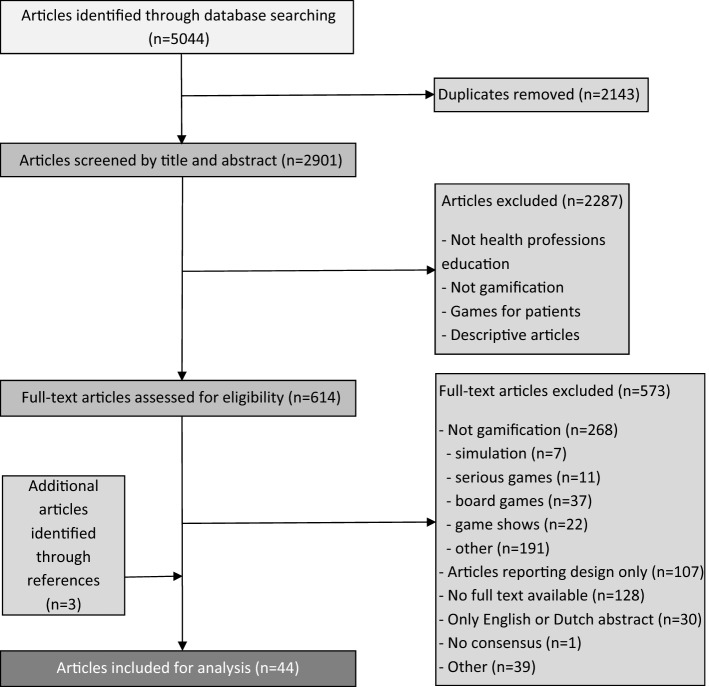
Gamification refers to using game attributes in a non-gaming context. Health professions educators increasingly turn to gamification to optimize students’ learning outcomes. However, little is known about the concept of gamification and its possible working mechanisms. This review focused on empirical evidence for the effectiveness of gamification approaches and theoretical rationales for applying the chosen game attributes. We systematically searched multiple databases, and included all empirical studies evaluating the use of game attributes in health professions education. Of 5044 articles initially identified, 44 met the inclusion criteria. Negative outcomes for using gamification were not reported. Almost all studies included assessment attributes (n = 40), mostly in combination with conflict/challenge attributes (n = 27). Eight studies revealed that this specific combination had increased the use of the learning material, sometimes leading to improved learning outcomes. A relatively small number of studies was performed to explain mechanisms underlying the use of game attributes (n = 7). Our findings suggest that it is possible to improve learning outcomes in health professions education by using gamification, especially when employing game attributes that improve learning behaviours and attitudes towards learning. However, most studies lacked well-defined control groups and did not apply and/or report theory to understand underlying processes. Future research should clarify mechanisms underlying gamified educational interventions and explore theories that could explain the effects of these interventions on learning outcomes, using well-defined control groups, in a longitudinal way. In doing so, we can build on existing theories and gain a practical and comprehensive understanding of how to select the right game elements for the right educational context and the right type of student.
Overview
CoChat Summary
TL;DR
This systematic review of 44 empirical studies found that gamification in health professions education was generally associated with positive or unchanged outcomes, with no negative outcomes reported. Assessment and conflict/challenge attributes were most common, but most studies were descriptive or lacked well-defined control groups and theory, limiting conclusions about mechanisms and effectiveness.
Key findings
- Of 5044 articles identified, 44 met inclusion criteria; no negative outcomes for gamification were reported. Almost all studies included assessment attributes (n = 40), often with conflict/challenge attributes (n = 27); this combination was linked to increased use of learning material in 8 studies and sometimes improved learning outcomes.
- Study quality varied: MERSQI scores ranged from 5 to 17 (mean 9.8, SD 3.1). Most studies were descriptive (n = 25; mean MERSQI 8.3, SD 2.3); 12 were justification studies and 7 were clarification studies. Only 8 well-controlled studies using assessment and conflict/challenge attributes were interpreted with more confidence.
- Contexts were predominantly USA (n = 20) or Canada (n = 8); digital gamified activities (n = 28) outnumbered analogue activities (n = 14). Most studies involved undergraduate (n = 15) and postgraduate medical students (n = 15), followed by nursing (n = 7).
- Theory use was limited: 7 clarification studies referenced theories including Experiential Learning Theory (3 studies), Reinforcement Learning Theory, Social Comparison Theory, Self-Directed Learning, and Deliberate Practice Theory; a common assumption was that gamification improves outcomes by changing learning behaviours or attitudes.
Methods
- Systematic review following AMEE guidelines; searched eight databases (Academic Search Premier, CINAHL, EMBASE, ERIC, Psychology and Behavior Sciences Collection, PsychINFO, PubMed, Cochrane Library) in April 2018, plus hand-searching references and citations.
- Included peer-reviewed journal articles on gamification or game elements in education for (future) health professionals, quantitative or mixed-method; excluded development-only studies, qualitative-only studies, serious games, patient education, simulations except gamified simulations, game-show/board-game contexts, and non-Dutch/English articles.
- Data extraction covered context, participants, intervention, outcomes, quality, and theory; quality was assessed with MERSQI, and studies were classified as description, justification, or clarification using Cook et al.’s framework. Double screening of a 10% excluded sample yielded 94% agreement.
Limitations
- Stated: the search may have missed articles because broad keywords were excluded; lack of consensus on definitions of game, gamification, and serious games made inclusion/exclusion subjective; only one researcher screened full texts; MERSQI does not assess qualitative parts of mixed-methods studies; the conceptual framework may over-generalize and lose information; only English and Dutch articles were included, risking language/culture bias.
- Stated/evident: most included studies lacked well-defined control groups and/or theory (36 of 44 were descriptive, confounded justification/clarification, or clarification without control groups), and combinations of game elements prevented disentangling individual effects; publication bias may have overreported positive results.
- Evident: the review reports no negative outcomes, but this may reflect underreporting; small-scale and pilot studies dominate, and the authors note gamification can have unexpected or unwanted effects (e.g., competition shifting attention from learning, over-justification effect).
Model-written summary. Check it against the paper before relying on it.
Integrity signals
Registry
Cites
Statistics
Figures
Verification
Claims the paper makes
0 Valid · 0 Not valid · 10 Not checked · 55 Own results and interpretations
A result the paper reports from its own data — it cites no other source for it, so there is none to check. The quote shows it is in the paper.
In the paper
“most of the included studies were descriptive in nature and rarely explained what was meant by gamification and how it worked in health professions education.”
§ Gamification of health professions education: a systematic review > Conclusion
plain- Asserted: passes — The authors put it forward as true.
- Checkable: passes — It can be checked against evidence.
- Load-bearing: passes — The paper’s conclusions depend on it.
- Based: passes — The paper gives a reason why it holds.
A result the paper reports from its own data — it cites no other source for it, so there is none to check. The quote shows it is in the paper.
In the paper
“Of 5044 articles initially identified, 44 met the inclusion criteria.”
- Also stated in: § Results · plain
“A total of 44 studies were eligible for inclusion in our systematic review (Table 1).”
§ Gamification of health professions education: a systematic review > Abstract
plain- Asserted: passes — The authors put it forward as true.
- Checkable: passes — It can be checked against evidence.
- Load-bearing: passes — The paper’s conclusions depend on it.
- Based: passes — The paper gives a reason why it holds.
- Also stated in: § Results · plain
A result the paper reports from its own data — it cites no other source for it, so there is none to check. The quote shows it is in the paper.
In the paper
“A combination of conflict and challenge attributes was also more often chosen by researchers from Europe (6 out of 8 European studies) and the USA (17 out of 21 USA studies) than by researchers from Canada (3 out of 8 Canadian studies).”
§ Gamification of health professions education: a systematic review > Results > Contextual differences and effects of game attributes
plainstates an association- Asserted: passes — The authors put it forward as true.
- Checkable: passes — It can be checked against evidence.
- Load-bearing: unclear — It is unclear whether the paper’s conclusions depend on it.
- Based: passes — The paper gives a reason why it holds.
A result the paper reports from its own data — it cites no other source for it, so there is none to check. The quote shows it is in the paper.
In the paper
“Most of the included studies (n = 25; Table 1) were descriptive in nature in such sense that they focused on observation and described what was done, without using comparison groups.”
§ Gamification of health professions education: a systematic review > Results > Quality of the current gamified learning research
plainn = 25- Asserted: passes — The authors put it forward as true.
- Checkable: passes — It can be checked against evidence.
- Load-bearing: passes — The paper’s conclusions depend on it.
- Based: passes — The paper gives a reason why it holds.
A result the paper reports from its own data — it cites no other source for it, so there is none to check. The quote shows it is in the paper.
In the paper
“A relatively small number of studies was performed to explain mechanisms underlying the use of game attributes (n = 7).”
§ Gamification of health professions education: a systematic review > Abstract
plainn = 7- Asserted: passes — The authors put it forward as true.
- Checkable: passes — It can be checked against evidence.
- Load-bearing: passes — The paper’s conclusions depend on it.
- Based: passes — The paper gives a reason why it holds.
30 more claims
Create a free account to see all 65 claims and to verify the 13 references still open.
- It may state two separate claims as one. 16
- Probably not a substantial claim. 21
Claims other papers make about this one
Each is checked against this paper’s own text: does it say what the citing paper says it does?
The source backs part of the claim, not all of it — or backs it for a different population, condition or comparison.
In the citing paper
“The enthusiastic participation and complexity and riskiness of strategies that emerged are consistent with the engagement observed in other gamified public health exercises, such as outbreak response simulations and health systems role-plays (78, 79).”
From Global Health Trade Summit: an AI-enhanced simulation of international trade and global health for undergraduate public health education (2025) · cites this paper as [79]
Experimental — accuracy not yet measuredThe source backs part of the claim, not all of it — or backs it for a different population, condition or comparison.
In the citing paper
“This aligns with research in health professions education demonstrating that gamification can substantially enhance learning outcomes and student motivation (79, 80).”
From Global Health Trade Summit: an AI-enhanced simulation of international trade and global health for undergraduate public health education (2025) · cites this paper as [79]
Experimental — accuracy not yet measured
Self-check
Percentages, sums and reported differences re-computed from the paper’s own numbers.
Each contradiction between two passages listed here was confirmed by an independent check.
Rated minor: it would not touch a result — a value no result rests on, a p-value that stays on the same side of the significance level, or a conflict that is clerical, resolved elsewhere in the paper, or outside its own findings.
In the paper
§ Gamification of health professions education: a systematic review > Discussion > Empirical evidence for using gamification
“The remaining eight studied included in our study were well-controlled studies using assessment and conflict/challenge attributes, so these study results could be interpreted with more confidence.”
§ Gamification of health professions education: a systematic review > Results
“| | Petrucci et al. (2015) | Residents (n = 14) | Conflict/challenge | Competition, progress, social network | Surgery (simulator) | 11 | Digital | Increased use, no difference in outcome |”
Rated minor: it would not touch a result — a value no result rests on, a p-value that stays on the same side of the significance level, or a conflict that is clerical, resolved elsewhere in the paper, or outside its own findings.
In the paper
§ Gamification of health professions education: a systematic review > Results > Educational context and student characteristics
“The majority of the studies were conducted in the USA (n = 20) or Canada (n = 8).”
§ Gamification of health professions education: a systematic review > Results > Contextual differences and effects of game attributes
“the USA (17 out of 21 USA studies)”
Cited works that were retracted
Works this paper cites that were later retracted, from the retraction notices publishers deposit. Major when the notice came out before this paper was published.
Rated major: it would touch a result — a value a result rests on, reported and recomputed p-values on opposite sides of the significance level, two passages that conflict with no sign which is right, or a cited work retracted before this paper was published.
In the paper
“…1999; Bligh and Prideaux 2002; Cook et al. 2008), which we felt should also apply to research on game-based learning in general and gamification in particular (Caponetto et al. 2014; De Sousa Borges et al. 2014; Faiella and Ricciardi 2015; Gentry et al. 2016; McCoy et al. 2016; Nah et al. 2014).”
Cited work 10.1002/14651858.cd012209 · retracted 2018-06-22 · notice 10.1002/14651858.cd012209.pub2 · this paper published 2020-10-31
Citations
Cites
1 retracted
Serious Gaming and Gamification interventions for health professional education
Gentry, S. V., Ehrstrom, B. L., Gauthier, A., Álvarez, J., Wortley, D. J., van Rijswijk, J., Car, J., Lilienthal, A., Car, L. T., Nikolaou, C. K., et al. (2016) · Cochrane Database of Systematic Reviews · doi:10.1002/14651858.cd012209 · Cited by 28 · cited 2×
“…1999; Bligh and Prideaux 2002; Cook et al. 2008), which we felt should also apply to research on game-based learning in general and gamification in particular (Caponetto et al. 2014; De Sousa Borges et al. 2014; Faiella and Ricciardi 2015; Gentry et al. 2016; McCoy et al. 2016; Nah et al. 2014).”
BackgroundRetractedRayyan-a web and mobile app for systematic reviews.
Ouzzani, M., Hammady, H., Fedorowicz, Z., & Elmagarmid, A. (2016) · Systematic Reviews · doi:10.1186/s13643-016-0384-4 · Cited by 26,092 · cited 1×
“After retrieving the search results from different databases, AvG removed the duplicates and uploaded the remaining articles to Rayyan, a mobile and web-based application developed for systematic reviews (Ouzzani et al. 2016).”
MethodA theory of social comparison processes
Festinger, L. (1954) · Human Relations · doi:10.1177/001872675400700202 · Cited by 20,926 · cited 1×
“According to the Social Comparison Theory, social comparison is a fundamental mechanism for modifying judgment and behaviour through the inner drive individuals have to gain accurate self-evaluations (Corcoran et al. 2011; Festinger 1954).”
MethodThe role of deliberate practice in the acquisition of expert performance
Ericsson, K. A., Krampe, R. T., & Tesch-Römer, C. (1993) · Psychological Review · doi:10.1037/0033-295x.100.3.363 · Cited by 9,564 · cited 1×
“Deliberate Practice Theory is based on engaging already motivated students to become experts via well-defined goals, real world tasks and immediate and informative feedback (Butt et al. 2018; Ericsson et al. 1993).”
BackgroundDeci, E. L., Koestner, R., & Ryan, R. M. (1999) · Psychological Bulletin · doi:10.1037/0033-2909.125.6.627 · Cited by 7,176 · cited 1×
“This is also called the over-justification effect (Deci et al. 1999, 2001; Hanus and Fox 2015; Landers et al. 2015; Lepper et al. 1973).”
BackgroundHomo Ludens: A Study of the Play-Element in Culture.
Gillin, J. L., & Huizinga, J. (1951) · American Sociological Review · doi:10.2307/2087716 · Cited by 6,560
Rules of Play: Game Design Fundamentals
Salen, K., & Zimmerman, E. (2003) · Medical Entomology and Zoology · Cited by 5,438
Does Gamification Work? -- A Literature Review of Empirical Studies on Gamification
Hamari, J., Koivisto, J., & Sarsa, H. (2014) · 2014 47th Hawaii International Conference on System Sciences · doi:10.1109/hicss.2014.377 · Cited by 5,201 · cited 1×
“…technology (Blohm and Leimeister 2013; Burke 2014; Burkey et al. 2013; De Sousa Borges et al. 2014; Domínguez et al. 2013; Gaggioli 2016; Hamari et al. 2014; Hsu et al. 2013; Huotari and Hamari 2012, 2017; Kumar 2013; Muntean 2011; Perrotta et al. 2013; Robson et al. 2015; Simões et al.…”
BackgroundThe Modern Practice of Adult Education: From Pedagogy to Andragogy
Knowles, M. S. (1970) · Cited by 3,905
(2020) · Journal of Medical Education · doi:10.5812/jme · Cited by 3,490
Research works printed but not linked: 8
- Caponetto, I., Earp, J., & Ott, M. (2014). Gamification and education: A literature review. In Proceedings of the European Conference on Games-Based Learning.
- Chia P Using a virtual game to enhance simulation based learning in nursing education Singapore Nurs J [Internet]. 2013 40 3 21 6
- Deterding S Khaled R Nacke L Dixon D Gamification: Toward a definition Chi 2011 2011 12 15
- Huotari, K., & Hamari, J. (2012). Defining gamification—A service marketing perspective. In Proceedings of the 16th International Academic MindTrek Conference 2012: “Envisioning Future Media Environments”, MindTrek 2012.
- Jacobs, J. W., & Dempsey, J. V. (1993). Simulation and gaming: Fidelity, feedback, and motivation. In: Dempsey, J.V. and Sales G.C. (Eds.). Interactive instruction and feedback. Englewood Cliffs, New Jersey: Educational Technology Publications
- Nemer LB Kalin D Fiorentino D Garcia JJ Estes CM The labor games Obstet Gynecol. 2016 128 1s 5s 27662001 · DOI
- Tilley, N., & Pawson, R. (2000). Realistic evaluation: An overview. The British Journal of Sociology.
- Zuk R Get in the game: How communicators can leverage gamification Public Relations Tactics 2012 19 7
Cited by
Krath, J., Schürmann, L., & von Korflesch, H. F. O. (2021) · Computers in Human Behavior · doi:10.1016/j.chb.2021.106963 · Cited by 943
Gamification of e-learning in higher education: a systematic literature review
Khaldi, A., Bouzidi, R., & Nader, F. (2023) · Smart Learning Environments · doi:10.1186/s40561-023-00227-z · Cited by 409
“More recently, van Gaalen et al. (2021) reviewed 44 research studies in the health professions education literature.”
BackgroundResultEnhancing Student Motivation and Engagement through a Gamified Learning Environment
Hellín, C. J., Calles-Esteban, F., Valledor, A., Gómez, J., Otón, S., & Tayebi, A. (2023) · Sustainability · doi:10.3390/su151914119 · Cited by 295
Using gamification to support learning in K‐12 education: A systematic literature review
Dehghanzadeh, H., Farrokhnia, M., Dehghanzadeh, H., Taghipour, K., & Noroozi, O. (2024) · British Journal of Educational Technology · doi:10.1111/bjet.13335 · Cited by 130
Tavares, N. (2022) · Nurse Education Today · doi:10.1016/j.nedt.2022.105484 · Cited by 185
Cascella, M., Cascella, A., Monaco, F., & Shariff, M. N. (2023) · Journal of Anesthesia Analgesia and Critical Care · doi:10.1186/s44158-023-00118-2 · Cited by 148
“In particular, AI has the potential to elevate personalized education, enrich learning content, streamline task automation within courses, support tutoring efforts, cultivate learner engagement, and assess training outcomes [6, 7, 20].”
BackgroundNadi-Ravandi, S., & Batooli, Z. (2022) · Education and Information Technologies · doi:10.1007/s10639-022-11048-x · Cited by 98
“As it is clear from Table 3, most of the studies in the field of gamified education were conducted in the US, Canada and Spain, respectively.”
BackgroundGamification in medical education: identifying and prioritizing key elements through Delphi method
Wang, Y.-F., Hsu, Y.-F., Fang, K., & Kuo, L. (2024) · Medical Education Online · doi:10.1080/10872981.2024.2302231 · Cited by 141
Twelve tips to enhance student engagement in synchronous online teaching and learning
Khan, R. A., Atta, K., Sajjad, M., & Jawaid, M. (2021) · Medical Teacher · doi:10.1080/0142159x.2021.1912310 · Cited by 110
“The leader board, up-levelling, awarding badges, and incentives are some of the elements that increase student engagement through gamification (van Gaalen et al. 2020).”
BackgroundGame on: immersive virtual laboratory simulation improves student learning outcomes & motivation
Tsirulnikov, D., Suart, C., Abdullah, R., Vulcu, F., & Mullarkey, C. E. (2023) · FEBS Open Bio · doi:10.1002/2211-5463.13567 · Cited by 106
Nylén‐Eriksen, M., Stojiljkovic, M., Lillekroken, D., Lindeflaten, K., Hessevaagbakke, E., Flølo, T. N., Hovland, O. J., Solberg, A. S., Hansen, S., Bjørnnes, A. K., et al. (2025) · BMC Medical Education · doi:10.1186/s12909-024-06531-7 · Cited by 102
“However, it is more nuanced [5] with contrasting views [5, 10, 12, 13, 15, 17, 116].”
InfluentialThe Role of AI in Serious Games and Gamification for Health: Scoping Review
Tolks, D., Schmidt, J. J., & Kuhn, S. (2024) · JMIR Serious Games · doi:10.2196/48258 · Cited by 72
Game-Based Learning in Pharmacy Education
Oestreich, J. H., & Guy, J. W. (2022) · Pharmacy · doi:10.3390/pharmacy10010011 · Cited by 99
Gamification in pharmacy education: a systematic quantitative literature review
Hope, D. L., Grant, G. D., Rogers, G. D., & King, M. A. (2022) · International Journal of Pharmacy Practice · doi:10.1093/ijpp/riac099 · Cited by 88
Arias‐Calderón, M., Castro, J., & Gayol, S. (2022) · Frontiers in Psychology · doi:10.3389/fpsyg.2022.889975 · Cited by 81
“…(Kalleny, 2020; Lobet et al., 2021), microbiology (Dustman et al., 2021), physiology (Moro et al., 2020; Hennekes et al., 2021; Herkes et al., 2021; Kane et al., 2022), and medical and nursing education (Gentry et al., 2019; Malicki et al., 2020; O’Connell et al., 2020; van Gaalen et al., 2021).”
BackgroundMoore, L., & Campbell, N. (2021) · BMC Medical Education · doi:10.1186/s12909-021-02666-z · Cited by 76
“The literature on escape rooms as educational environments, and the benefits of gamification where game elements are used in health education [12] is growing.”
BackgroundHuang, W. D., Loidl, V., & Sung, J. S. (2024) · BMC Medical Education · doi:10.1186/s12909-023-04955-1 · Cited by 74
Rosa-Castillo, A., García-Pañella, O., Maestre-González, E., Pulpón-Segura, A. M., Novella, A. R., & Solà‐Pola, M. (2022) · Nurse Education Today · doi:10.1016/j.nedt.2022.105533 · Cited by 66
Gamification in higher education: A review of the literature
Parra, B. F. C., Cajo, B. G. H., Vásconez-Barrera, M., & Oleas-Lopez, J. M. (2022) · World Journal on Educational Technology Current Issues · doi:10.18844/wjet.v14i3.7341 · Cited by 66
Ahmed, H. M. M., El-Sabagh, H. A., & Elbourhamy, D. M. (2025) · International Journal of Educational Technology in Higher Education · doi:10.1186/s41239-025-00541-1 · Cited by 68
“These elements are grounded in Self-Determination Theory (SDT), Flow Theory, and Goal-Setting Theory, which explain how gamified elements fulfill psychological needs, enhancing motivation and engagement (Deci & Ryan, 2000; Van Gaalen et al., 2021; Zainuddin et al., 2020).”
Redondo‐Rodríguez, C., Becerra-Mejías, J. A., Fernández, G. G., & Rodríguez-Velasco, F. J. (2022) · International Journal of Environmental Research and Public Health · doi:10.3390/ijerph20010547 · Cited by 62
“Although gamification-based educational interventions are becoming increasingly popular [2], there is still no clear understanding of when gamification can be an appropriate tool for instruction and learning [3].”
BackgroundEmerging trends in gamification for clinical reasoning education: a scoping review
Lee, C.-Y., Lee, C.-H., Lai, H.-Y., Chen, P.-J., Chen, M.-M., & Yau, S.-Y. (2025) · BMC Medical Education · doi:10.1186/s12909-025-07044-7 · Cited by 60
“The rapid advancement of digital technology has created unprecedented opportunities to integrate game-based elements into healthcare education [3, 9, 10].”
Maity, S., Nauhria, S., Nayak, N., Nauhria, S., Coffin, T., Wray, J., Haerianardakani, S., Sah, R., Spruce, A., Jeong, Y., et al. (2023) · Diagnostics · doi:10.3390/diagnostics13030558 · Cited by 59
A gameful blended-learning experience in nursing: A qualitative focus group study
Ropero‐Padilla, C., Rodríguez-Arrastia, M. J., Martinez‐Ortigosa, A., Salas‐Medina, P., Ayora, A. F., & Román, P. (2021) · Nurse Education Today · doi:10.1016/j.nedt.2021.105109 · Cited by 57
Masters, K., Correia, R., Nemethy, K., Benjamin, J. C., Carver, T. E., & MacNeill, H. (2023) · Medical Teacher · doi:10.1080/0142159x.2023.2259069 · Cited by 57
“Gamification , on the other hand, is the use of game-based elements to non-game contexts, and has been shown to improve engagement with educational content and learning outcomes (van Gaalen et al. 2021).”
BackgroundΓιαννούκου, Ι. (2024) · Technium Business and Management · doi:10.47577/business.v7i.10585 · Cited by 55
Mahrous, A., Botsko, D. L., Elgreatly, A., Tsujimoto, A., Qian, F., & Schneider, G. B. (2023) · Journal of Dental Education · doi:10.1002/jdd.13225 · Cited by 55
Çalık, A., Çakmak, B., Kapucu, S., & İnkaya, B. V. (2022) · American Journal of Infection Control · doi:10.1016/j.ajic.2022.02.025 · Cited by 53
“It is seen that the study results are compatible with the existing literature.(27,28) A greater understanding of the COVID-19 management and nursing activities in hospitals may help to increase awareness of nursing students of their occupation and encourage them to accomplish their roles.”
Evaluating self-directed learning competencies in digital learning environments: A meta-analysis
Lee, D., & Chang, C. (2024) · Education and Information Technologies · doi:10.1007/s10639-024-13083-2 · Cited by 55
“Further, van Gaalen et al. (2021) asserted that technology can offer interactive and engaging learning experiences through the use of multimedia, simulations, gamification, and online collaboration.”
Gamificación: lo que es no es siempre lo que ves
López, I. J. P., & Navarro-Mateos, C. (2022) · Sinéctica Revista Electrónica de Educación · doi:10.31391/s2007-7033(2022)0059-002 · Cited by 52
Rovati, L., Gary, P. J., Cubro, E., Dong, Y., Kılıçkaya, O., Schulte, P. J., Zhong, X., Woerster, M., Kelm, D. J., Gajic, O., et al. (2024) · Frontiers in Medicine · doi:10.3389/fmed.2023.1336897 · Cited by 52
Nguyen‐Viet, B., Nguyen-Duy, C., & Nguyen-Viet, B. (2024) · Interactive Learning Environments · doi:10.1080/10494820.2024.2414356 · Cited by 55
“The challenges in previous studies included gamifi-cation elements that positively affect intrinsic motivation (Van Gaalen et al., 2021; Zainuddin et al., 2020), satisfaction (Aparicio et al., 2019; Wirani et al., 2022), and engagement.”
Effectiveness of “Escape Room” Educational Technology in Nurses’ Education: A Systematic Review
la Torre, H. G., Luis, M.-N. H.-D., Mies-Padilla, S., Camacho‐Bejarano, R., Soriano, J. V., & Rodríguez-Suárez, C.-A. (2024) · Nursing Reports · doi:10.3390/nursrep14020091 · Cited by 50
“One of the educational technologies that has piqued the most interest in recent years has been gamification [4,5].”
BackgroundInfluentialCortés‐Pérez, I., Zagalaz‐Anula, N., López‐Ruiz, M. D. C., Díaz‐Fernández, Á., Obrero‐Gaitán, E., & Osuna‐Pérez, M. C. (2023) · Healthcare · doi:10.3390/healthcare11040578 · Cited by 50
“At present, we live with technological and creative resources that are increasingly complete, attractive, easy to use and highly useful for almost all aspects of life, including education [1].”
BackgroundRising gamification in health education: A bibliometric study
Yıldız, M., Yıldız, M., & Kayacık, A. D. (2024) · Nurse Education in Practice · doi:10.1016/j.nepr.2024.103993 · Cited by 50
Chatzea, V., Logothetis, I., Kalogiannakis, M., Rovithis, M., & Vidakis, N. (2024) · Information · doi:10.3390/info15070410 · Cited by 52
“To this end, a tenfold increase in gamified tools and interventions for healthcare education was observed a quinquennium before the COVID-19 healthcare crisis [11].”
BackgroundRadiography education in 2022 and beyond - Writing the history of the present: A narrative review
Tay, Y. X., & McNulty, J. P. (2023) · Radiography · doi:10.1016/j.radi.2023.01.014 · Cited by 47
Combining intelligent tutoring systems and gamification: a systematic literature review
Ramadhan, A., Warnars, H. L. H. S., & Razak, F. H. A. (2023) · Education and Information Technologies · doi:10.1007/s10639-023-12092-x · Cited by 47
Molina‐Torres, G., Sandoval-Hernández, I., Ropero‐Padilla, C., Rodríguez-Arrastia, M. J., Martínez-Cal, J., & González‐Sánchez, M. (2021) · International Journal of Environmental Research and Public Health · doi:10.3390/ijerph182312778 · Cited by 45
“There are several resources to encourage student participation and active learning in higher education, such as problem-based learning [2], flipped learning [3] and gamification [4], which place the needs of the students at the center of the teaching-learning process.”
Marcos-Pablos, S., & García‐Peñalvo, F. J. (2022) · Advances in Health Sciences Education · doi:10.1007/s10459-022-10118-6 · Cited by 45
Developing an interactive PBL environment via persuasive gamify elements: a scoping review
Ghani, A. S. A., Rahim, A. F. A., Yusoff, M. S. B., & Hadie, S. N. H. (2022) · Research and Practice in Technology Enhanced Learning · doi:10.1186/s41039-022-00193-z · Cited by 44
“Learners also need to consider other instructional elements, namely the context of instruction that is gamified (Hamari et al., 2014), and the theoretical application that is suitable for that context (Van Gaalen et al., 2021).”
BackgroundGamification in Health Care Management: Systematic Review of the Literature and Research Agenda
Sánchez, A., Murillo‐Zamorano, L. R., Sánchez, J. Á. L., & Muñoz, C. B. (2023) · SAGE Open · doi:10.1177/21582440231218834 · Cited by 45
“Moreover, in the literature we can even find reviews about the employment of gamification in health professions education (S. V. Gentry et al., 2019; van Gaalen et al., 2021).”
BackgroundCrossword puzzle as a learning tool to enhance learning about anticoagulant therapeutics
Bawazeer, G. A., Sales, I., Albogami, H., Aldemerdash, A. M., Mahmoud, M. A., Aljohani, M. A., & Alhammad, A. (2022) · BMC Medical Education · doi:10.1186/s12909-022-03348-0 · Cited by 42
Chang, S. J., Kim, G. M., & Kim, J. A. (2024) · Heliyon · doi:10.1016/j.heliyon.2024.e29538 · Cited by 43
“Additional research is needed as some studies showed that learning motivation reduced significantly after flipped learning [48], and using a control group was rare in gamification studies [13].”
BackgroundArtificial Intelligence in Health Professions Education
Shankar, P. R. (2022) · Archives of Medicine and Health Sciences · doi:10.4103/amhs.amhs_234_22 · Cited by 40
La gamificación educativa y sus desafíos actuales desde la perspectiva pedagógica
Mendoza, G. M. M., & Bermúdez, I. E. C. (2021) · Revista Cognosis · doi:10.33936/cognosis.v6i2.2902 · Cited by 42
Artificial intelligence-driven serious games in health care: scoping review
Abd-alrazaq, A., Abuelezz, I., Hassan, A., AlSammarraie, A., Alhuwail, D., Irshaidat, S., Abu Serhan, H., Ahmed, A., Alabed Alrazak, S., & Househ, M. (2022) · JMIR Serious Games · doi:10.2196/39840 · Cited by 39
“Typically, gamification relies on the use of points, badges, leader boards, or timed performance [21,22].”
BackgroundGaalen, A. E. J. V., Schönrock-Adema, J., Renken, R. J., Jaarsma, D. A. D. C., & Georgiadis, J. R. (2022) · JMIR Serious Games · doi:10.2196/30464 · Cited by 40
“Systematic reviews indicate that, often, game-based learning strategies are selected based on researchers’ personal opinions rather than theory or a conceptual framework [1,2,61].”
BackgroundResultInfluentialSelf-citationManzanares, M. C. S., Martin, C. F., Martínez, L. A., & Almeida, L. S. (2021) · International Journal of Environmental Research and Public Health · doi:10.3390/ijerph182211757 · Cited by 38
Much ado about gaming: An educator's guide to serious games and gamification in medical education
Watsjold, B. K., Cosimini, M., Mui, P., & Chan, T. (2022) · AEM Education and Training · doi:10.1002/aet2.10794 · Cited by 27
Models of Instructional Design in Gamification: A Systematic Review of the Literature
González-Fernández, A., Revuelta-Domínguez, F.-I., & Fernández-Sánchez, M. R. (2022) · Education Sciences · doi:10.3390/educsci12010044 · Cited by 37
Edwards, S. L., Gantwerker, E. A., Cosimini, M. J., Christy, A. L., Kaur, A. W., Helms, A. K., Stiver, M. L., & London, Z. N. (2023) · Neurology Education · doi:10.1212/ne9.0000000000200103 · Cited by 38
Game-Based Learning Outcomes Among Physiotherapy Students: Comparative Study
Molina‐Torres, G., Rodríguez-Arrastia, M. J., Alarcón, R., Sánchez‐Labraca, N., Sánchez‐Joya, M. D. M., Román, P., & Requena, M. (2021) · JMIR Serious Games · doi:10.2196/26007 · Cited by 37
“While gamification refers to the implementation of game mechanics in day-to-day processes or nongaming contexts, including the use of game components in different scenarios with no intention of creating a game [3,4], serious games are defined as games where the main goal is learning (not entertainment) and where desig…”
BackgroundRudolphi‐Solero, T., Lorenzo-Álvarez, R., Ruiz-Gomez, M. J., & Sendra‐Portero, F. (2021) · Anatomical Sciences Education · doi:10.1002/ase.2134 · Cited by 38
Cheng, K. M., Koo, A. C., Nasir, J. S. M., & Wong, S. Y. (2022) · Scientific Reports · doi:10.1038/s41598-022-15709-2 · Cited by 37
Cohen, T., Anger, J. T., Kanji, F. F., Zamudio, J., DeForest, E., Lusk, C., Avenido, R., Yoshizawa, C., Bartkowicz, S., Nemeth, L. S., et al. (2022) · Journal of Patient Safety · doi:10.1097/pts.0000000000001056 · Cited by 36
“There is also a nascent interest in “serious games” in healthcare, in which real-world topics are addressed in the context of gameplay.(22) The popularity of escape rooms as entertainment, where teams of individuals work together to solve puzzles has also provided inspiration(23) with a promising evidence base of enha…”
BackgroundInfluentialCavioni, V., Conte, E., & Ornaghi, V. (2024) · Frontiers in Psychology · doi:10.3389/fpsyg.2024.1339242 · Cited by 37
Efficacy of Virtual Reality Simulation in Teaching Basic Life Support and Its Retention at 6 Months
Castillo, J., Rodríguez-Higueras, E., Vico, R. B., Rodríguez, C., López, A., & Fernández-Puebla, A. G. (2023) · International Journal of Environmental Research and Public Health · doi:10.3390/ijerph20054095 · Cited by 36
O ENSINO DE GESTÃO DE CONFLITOS E A GAMIFICAÇÃO NA GRADUAÇÃO DE ENFERMAGEM NO CONTEXTO DA COVID-19
Marcuzzo, R., Gonçalves, G. C. D. S., & Draganov, P. B. (2023) · Saberes Plurais Educação na Saúde · doi:10.54909/sp.v7i2.131210 · Cited by 35
Gamification in the Transport and Mobility Sector: A Systematic Review
Avril, E., Picco, A., Lescarret, C., Lemercier, C., Arguel, A., & Caroux, L. (2024) · Transportation Research Part F Traffic Psychology and Behaviour · doi:10.1016/j.trf.2024.06.004 · Cited by 36
“…and collective behaviour of people: It is indeed applied in many areas of human activity, such as the medical context (Sardi et al., 2017; Van Gaalen et al., 2021), education (Kalogiannakis et al., 2021), e-commerce (Behl et al., 2020), transportation safety (Klock et al., 2021) or…”
Sambo, K. U., Shishah, W., & Isiaku, L. (2025) · Information Development · doi:10.1177/02666669251331268 · Cited by 35
Outcomes of the implementation of game-based anatomy teaching approaches: An overview
Chytas, D., Piagkou, M., & Natsis, K. S. (2021) · Morphologie · doi:10.1016/j.morpho.2021.02.001 · Cited by 35
Burlacu, M., Coman, C., & Bularca, M. C. (2023) · Sustainability · doi:10.3390/su15086476 · Cited by 35
Gamification as an educational tool to address antimicrobial resistance: a systematic review
Nowbuth, A. A., Asombang, A. W., Alaboud, K., Souque, C., Dahu, B. M., Pather, K., Mwanza, M. M., Lotfi, S., & Parmar, V. S. (2023) · JAC-Antimicrobial Resistance · doi:10.1093/jacamr/dlad130 · Cited by 35
Preiksaitis, C. M., Dayton, J. R., Kabeer, R., Bunney, G., & Boukhman, M. (2023) · JMIR Medical Education · doi:10.2196/43916 · Cited by 34
Khanna, A., Ravindran, A., Ewing, B., Zinnerstrom, K. H., Grabowski, C., Mishra, A., & Makdissi, R. (2021) · Cureus · doi:10.7759/cureus.18314 · Cited by 33
“"Gamification," defined as the use of game design elements in a non-game context, has become a popular instructional method in K-12 and higher education [1].”
BackgroundDo, M., Sanford, K., Roseff, S. D., Hovaguimian, A., Besche, H. C., & Fischer, K. (2023) · BMC Medical Education · doi:10.1186/s12909-023-04951-5 · Cited by 34
“For example, some learners do not appreciate activities that overempha-size competition or employ extrinsic rewards without a link to learning objectives [29, 30, 32, 33].”
BackgroundAmir, L. R., Leonardy, I. C., Dewatmoko, S. N., Yanuar, R., Suniarti, D. F., Idrus, E., Sipiyaruk, K., & Puspitawati, R. (2023) · BMC Oral Health · doi:10.1186/s12903-023-03286-3 · Cited by 32
Gamification in Education: Its Impact on Engagement, Motivation, and Learning Outcomes
Ukgoda, H. (2025) · Journal of Educational Technology Development and Exchange · doi:10.18785/jetde.1803.03 · Cited by 31
Lohitharajah, J., & Youhasan, P. (2022) · PubMed Central · doi:10.30476/jamp.2022.93731.1548 · Cited by 32
“Gamification refers to the use of game design elements to traditionally non-game contexts, and it emerged a decade ago (2, 3).”
BackgroundSandoval-Hernández, I., Molina‐Torres, G., León-Morillas, F., Ropero‐Padilla, C., González‐Sánchez, M., & Martínez-Cal, J. (2023) · BMC Medical Education · doi:10.1186/s12909-023-04576-8 · Cited by 31
“For health professionals, gamification is a new teaching method that has achieved an important role in recent years, with excellent results in learning and knowledge acquisition [3].”
BackgroundMethodInfluentialClinical virtual simulation: predictors of user acceptance in nursing education
Padilha, J. M., Costa, P., Sousa, P., & Ferreira, A. C. E. (2024) · BMC Medical Education · doi:10.1186/s12909-024-05154-2 · Cited by 31
“…results demonstrate that the use of CVS creates a playful context that helps students learn actively in a friendly environment, bringing aspects of gamification that help them set goals, get scores, and compare results between students [44, 45] while simultaneously anticipating clinical challenges.”
BackgroundGaalen, A. E. J. V., Jaarsma, D. A. D. C., & Georgiadis, J. R. (2021) · JMIR Serious Games · doi:10.2196/25637 · Cited by 31
“Longer periods of time spent at GBL might indicate increased repetition of the learning material which, in turn, will lead to improved learning outcomes and retention [4,110-113].”
BackgroundMethodInfluentialSelf-citationScreen-based digital learning methods in radiation oncology and medical education
Kok, D. L., Dushyanthen, S., Peters, G. W., Sapkaroski, D., Barrett, M., Sim, J. H. H., & Eriksen, J. G. (2022) · Technical Innovations & Patient Support in Radiation Oncology · doi:10.1016/j.tipsro.2022.10.003 · Cited by 34
“There are many examples of the successful implementation of gamification in a variety of fields [85] including medical education [83,86,87] with the most successful being that of the game ‘Foldit ’ , a game released by the University of Washington [88,89].”
BackgroundWalker, J. B., Heudebert, J. P., Patel, M., Cleveland, J. D., Westfall, A. O., Dempsey, D. M., Guzmán, A., Zinski, A., Agarwal, M., Long, D. M., et al. (2022) · Medical Science Educator · doi:10.1007/s40670-022-01552-7 · Cited by 30
“A critique of prior studies has been the limitation in comparative groups, driven in part by the need for an equal experience for students within their core curriculum [6, 13].”
BackgroundLarsen, J. D., Jensen, R. O., Pietersen, P. I., Jacobsen, N., Falster, C., Nielsen, A. B., Laursen, C. B., Konge, L., & Graumann, O. (2022) · Ultrasound in Medicine & Biology · doi:10.1016/j.ultrasmedbio.2022.11.011 · Cited by 29
de Almeida, R. S. (2023) · Advances in medical education, research, and ethics (AMERE) book series · doi:10.4018/978-1-6684-7164-7.ch001 · Cited by 30
Gamification in Critical Care Education and Practice
Bass, G. A., Chang, C. W. J., Sorce, L. R., Subramanian, S., Laytin, A. D., Somodi, R., Gray, J. R., Lane-Fall, M. B., & Kaplan, L. J. (2024) · Critical Care Explorations · doi:10.1097/cce.0000000000001034 · Cited by 29
“In addition, gamification can provide a safe and controlled environment for learners to practice and apply knowledge in realistic scenarios, without risk of patient harm, thereby complementing simulation-based training (5, 25).”
BackgroundMedel, D., Bonet, A., Herrera, M., Sevilla, F., Vilaplana, J., Cemeli, T., & Roca, J. (2024) · Teaching and learning in nursing · doi:10.1016/j.teln.2024.08.002 · Cited by 28
Kotp, M. H., Bassyouny, H. A. A., Aly, M. A., Ibrahim, R. K., Hendy, A. S., Mekdad, A. K., Hafez, A. A., Hafez, A. A., Abdelaliem, S. M. F., Baghdadi, N. A., et al. (2025) · BMC Nursing · doi:10.1186/s12912-025-03253-z · Cited by 27
“This tool was developed based on a comprehensive review of previous literature on gamification adoption and instructional innovation, with particular focus on common obstacles faced in academic and institutional environments [41].”
Ning, Y., Jia, Z., Zhu, R., Ding, Y., Wang, Q., & Han, S. (2022) · Supportive Care in Cancer · doi:10.1007/s00520-022-07550-0 · Cited by 28
Gamification, Serious Games, and Simulation in Health Professions Education
Davis, K., Gowda, A. S., Thompson-Newell, N., Maloney, C., Fayyaz, J., & Chang, T. P. (2024) · Pediatric Annals · doi:10.3928/19382359-20240908-06 · Cited by 27
Roure, C., & Pasco, D. (2022) · Journal of Teaching in Physical Education · doi:10.1123/jtpe.2021-0283 · Cited by 26
La gamificación en la educación superior. Teoría, práctica y experiencias didácticas
Ripoll, O., & Pujolà, J.-T. (2024) · doi:10.36006/15226-1 · Cited by 27
Escaping the ordinary: a review of escape rooms in medical and veterinary education
Nowbuth, A. A., & Parmar, V. S. (2024) · BMC Medical Education · doi:10.1186/s12909-024-06512-w · Cited by 26
Gamification in midwifery education: a systematic review
Najafi, T. F., Andaroon, N., Bolghanabadi, N., Sharifi, N., & Dashti, S. (2025) · BMC Medical Education · doi:10.1186/s12909-025-06880-x · Cited by 26
Potter, A., Munsch, C., Watson, E., Hopkins, E., Kitromili, S., O'Neill, I. C., Larbie, J., Niittymaki, E., Ramsay, C., Burke, J., et al. (2025) · Journal of Medical Internet Research · doi:10.2196/66157 · Cited by 25
“Many of the included studies recommended more randomized controlled trials [37,38,62,81,100,105,115,124,140,188,195,214,222,236,241], although one paper supports the suggestion provided by Tudor Car et al [211] that quasi-experimental designs may be better suited to educational research [144] and…”
Serious Games and Gamification: Health Care Workers’ Experience, Attitudes, and Knowledge
Katonai, Z., Gupta, R. K., Heuss, S., Fehr, T. H., Ebneter, M., Maier, T., Meier, T., Bux, D. A., Thackaberry, J., & Schneeberger, A. R. (2023) · Academic Psychiatry · doi:10.1007/s40596-023-01747-z · Cited by 25
Moffett, J., Cassidy, D., Collins, N., Illing, J. C., Filho, C., & Bok, H. G. J. (2023) · Perspectives on Medical Education · doi:10.5334/pme.844 · Cited by 25
Bhatia, M., Manani, P., Garg, A., Bhatia, S., & Adlakha, R. (2023) · Revue d intelligence artificielle · doi:10.18280/ria.370107 · Cited by 25
“[17].”
Pineros, N., Tenaillon, K., Marin, J., Berry, V., Jauréguy, F., Ghelfenstein-Ferreira, T., Carbonnelle, É., & Lescat, M. (2023) · FEMS Microbiology Letters · doi:10.1093/femsle/fnad034 · Cited by 25
Taghipour, E., Vizeshfar, F., & Zarifsanaiey, N. (2023) · BMC Medical Education · doi:10.1186/s12909-023-04858-1 · Cited by 26
Evaluation of a digital game for teaching behavioral aspects of clinical communication in dentistry
Lin, C., & Yang, C. (2023) · BMC Medical Education · doi:10.1186/s12909-023-04040-7 · Cited by 24
Gómez, O., García-Manzanares, M., Chicharro, D., Juárez, M., Llamazares-Martín, C., Soriano, E., & Terrado, J. (2023) · Animals · doi:10.3390/ani13101666 · Cited by 15
An Interuniversity Competition for Medical Students to Learn Radiology in the Second Life Metaverse
Rudolphi‐Solero, T., Lorenzo-Álvarez, R., Domínguez-Pinos, D., Ruiz-Gomez, M. J., & Sendra‐Portero, F. (2023) · Journal of the American College of Radiology · doi:10.1016/j.jacr.2023.09.012 · Cited by 23
ESCAPE the Boring Lecture: Tips and Tricks on Building Puzzles for Medical Education Escape Rooms
Shah, A. S., Pitt, M. B., & Norton, L. E. (2023) · Journal of Medical Education and Curricular Development · doi:10.1177/23821205231211200 · Cited by 23
Integrity games: an online teaching tool on academic integrity for undergraduate students
Goddiksen, M. P., Allard, A., Armond, A. C. V., Clavien, C., Loor, H., Schöpfer, C., Varga, O., & Johansen, M. W. (2024) · International Journal for Educational Integrity · doi:10.1007/s40979-024-00154-7 · Cited by 23
Malhotra, R., & Iyer, A. (2024) · Global Journal of Medical Terminology Research and Informatics · Cited by 22
Howard, N.-J. (2023) · Advances in medical education, research, and ethics (AMERE) book series · doi:10.4018/978-1-6684-7164-7.ch009 · Cited by 22
Salehi, A. M., Mohammadi, H. A., Jenabi, E., Khanlarzadeh, E., & Ashtari, K. (2023) · Simulation & Gaming · doi:10.1177/10468781231195903 · Cited by 22
Metadata
- Authors
- van Gaalen, A. E. J., Brouwer, J., Schönrock-Adema, J., Bouwkamp-Timmer, T., Jaarsma, A. D. C., & Georgiadis, J. R.
- Affiliations
- University of Groningen (NL)
- University Medical Center Groningen (NL)
- Venue
- Advances in Health Sciences Education
- Published
- 2020-10-31
- Volume
- 26
- Issue
- 2
- Pages
- 683-711
- ISSN
- 1382-4996 (ISSN-L)
- 1573-1677
- PMC
- PMC8041684
- OpenAlex
- W3094919143
- Cited by
- 625
- References
- 149
- Citations by year
- 2026: 108 · 2025: 126 · 2024: 160 · 2023: 121 · 2022: 80 · 2021: 29
- FWCI
- 12.14
- Type
- journal article
- Language
- en
- Open access
- hybrid
- doi.org
- Licence
- cc-by
- creativecommons.org/licenses/by/4.0 (tdm)
- creativecommons.org/licenses/by/4.0 (vor)
- Locations
- Advances in Health Sciences Education (publishedVersion, cc-by)
- PubMed Central (publishedVersion, cc-by)
- PubMed (publishedVersion)
- University of Groningen research database (University of Groningen / Centre for Information Technology) (publishedVersion, cc-by)
- Utrecht University Repository (Utrecht University) (submittedVersion, other-oa)
- University of Groningen research database (University of Groningen / Centre for Information Technology) (submittedVersion, cc-by)
- Funders
- University of Groningen
- Topics
- Social Sciences › Psychology › Developmental and Educational Psychology › Educational Games and Gamification
- Social Sciences › Education › Innovations in Medical Education
- Physical Sciences › Engineering › Biomedical Engineering › Biomedical and Engineering Education
- Keywords
- gamification, health professions education, game attributes, learning outcomes, learning behavior, learning attitude, educational intervention
- MeSH terms
- Health Occupations, Humans, Learning, Students
About these checks
Registry, retraction, Cites and statistics results are computed, not judged, with one exception: a printed reference that no index lists is read once by a model before it counts as a citation error. Claims are extracted by a model and kept only when their quote appears verbatim in the text; each cited source is then checked, with a model’s help, for whether it says what the claim relies on. Those verdicts can be wrong — read the claim’s quote and the cited source before relying on one.
A language model drew the claims from the paper on 2026-11-23, under version 3 of the claim definition (model deepseek-v4.1-flash, prompt extract-v3).
A second model labelled each claim on 2026-11-23 (model jev-1.13-20260917, definition revision gold-guideline-v0.2).
Statistics and arithmetic are recomputed, not judged.
Confidence bands are shown only for fields calibrated on our annotated test set. None is calibrated yet, so no band is shown.
What counts as a claim ›How we measure confidence ›How we check this ›
Are you an author, or do you see a problem with this page? Request a review
Data sources
Bibliographic data: Semantic Scholar, OpenAlex, Crossref.
Contains information from the Semantic Scholar Academic Graph Datasets, made available under the ODC Attribution License (ODC-BY 1.0).
Semantic Scholar’s data is described in: Kinney, R., et al. (2023). The Semantic Scholar Open Data Platform. arXiv:2301.10140.
