

Gamification of health professions education: a systematic review
Open accessThe DOI matches its Crossref record; 148 of the 149 references it cites were found in a registry or an index; none of the 15 sources its claims cite is checked for support yet.
Abstract
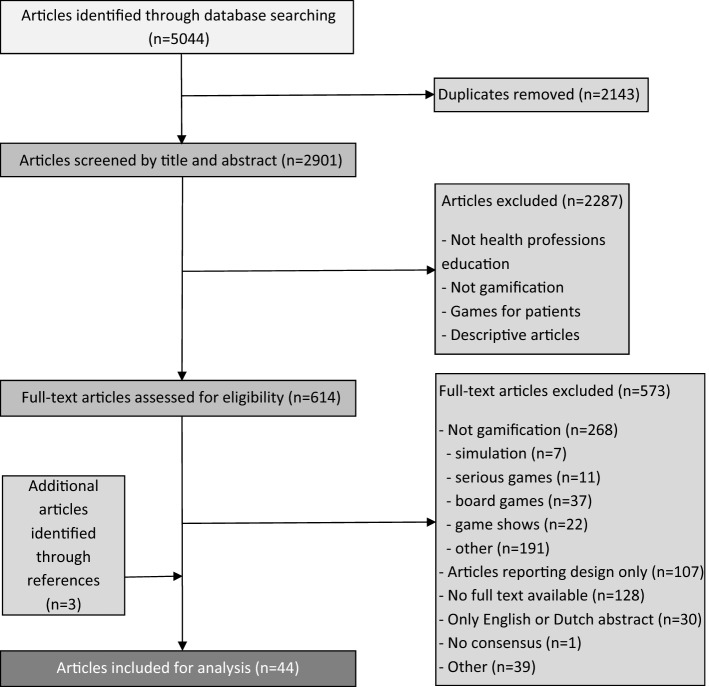
Gamification refers to using game attributes in a non-gaming context. Health professions educators increasingly turn to gamification to optimize students’ learning outcomes. However, little is known about the concept of gamification and its possible working mechanisms. This review focused on empirical evidence for the effectiveness of gamification approaches and theoretical rationales for applying the chosen game attributes. We systematically searched multiple databases, and included all empirical studies evaluating the use of game attributes in health professions education. Of 5044 articles initially identified, 44 met the inclusion criteria. Negative outcomes for using gamification were not reported. Almost all studies included assessment attributes (n = 40), mostly in combination with conflict/challenge attributes (n = 27). Eight studies revealed that this specific combination had increased the use of the learning material, sometimes leading to improved learning outcomes. A relatively small number of studies was performed to explain mechanisms underlying the use of game attributes (n = 7). Our findings suggest that it is possible to improve learning outcomes in health professions education by using gamification, especially when employing game attributes that improve learning behaviours and attitudes towards learning. However, most studies lacked well-defined control groups and did not apply and/or report theory to understand underlying processes. Future research should clarify mechanisms underlying gamified educational interventions and explore theories that could explain the effects of these interventions on learning outcomes, using well-defined control groups, in a longitudinal way. In doing so, we can build on existing theories and gain a practical and comprehensive understanding of how to select the right game elements for the right educational context and the right type of student.
Overview
CoChat Summary
TL;DR
This systematic review of 44 empirical studies found that gamification in health professions education was generally associated with positive or unchanged outcomes, with no negative outcomes reported. Assessment and conflict/challenge attributes were most common, but most studies were descriptive or lacked well-defined control groups and theory, limiting conclusions about mechanisms and effectiveness.
Key findings
- Of 5044 articles identified, 44 met inclusion criteria; no negative outcomes for gamification were reported. Almost all studies included assessment attributes (n = 40), often with conflict/challenge attributes (n = 27); this combination was linked to increased use of learning material in 8 studies and sometimes improved learning outcomes.
- Study quality varied: MERSQI scores ranged from 5 to 17 (mean 9.8, SD 3.1). Most studies were descriptive (n = 25; mean MERSQI 8.3, SD 2.3); 12 were justification studies and 7 were clarification studies. Only 8 well-controlled studies using assessment and conflict/challenge attributes were interpreted with more confidence.
- Contexts were predominantly USA (n = 20) or Canada (n = 8); digital gamified activities (n = 28) outnumbered analogue activities (n = 14). Most studies involved undergraduate (n = 15) and postgraduate medical students (n = 15), followed by nursing (n = 7).
- Theory use was limited: 7 clarification studies referenced theories including Experiential Learning Theory (3 studies), Reinforcement Learning Theory, Social Comparison Theory, Self-Directed Learning, and Deliberate Practice Theory; a common assumption was that gamification improves outcomes by changing learning behaviours or attitudes.
Methods
- Systematic review following AMEE guidelines; searched eight databases (Academic Search Premier, CINAHL, EMBASE, ERIC, Psychology and Behavior Sciences Collection, PsychINFO, PubMed, Cochrane Library) in April 2018, plus hand-searching references and citations.
- Included peer-reviewed journal articles on gamification or game elements in education for (future) health professionals, quantitative or mixed-method; excluded development-only studies, qualitative-only studies, serious games, patient education, simulations except gamified simulations, game-show/board-game contexts, and non-Dutch/English articles.
- Data extraction covered context, participants, intervention, outcomes, quality, and theory; quality was assessed with MERSQI, and studies were classified as description, justification, or clarification using Cook et al.’s framework. Double screening of a 10% excluded sample yielded 94% agreement.
Limitations
- Stated: the search may have missed articles because broad keywords were excluded; lack of consensus on definitions of game, gamification, and serious games made inclusion/exclusion subjective; only one researcher screened full texts; MERSQI does not assess qualitative parts of mixed-methods studies; the conceptual framework may over-generalize and lose information; only English and Dutch articles were included, risking language/culture bias.
- Stated/evident: most included studies lacked well-defined control groups and/or theory (36 of 44 were descriptive, confounded justification/clarification, or clarification without control groups), and combinations of game elements prevented disentangling individual effects; publication bias may have overreported positive results.
- Evident: the review reports no negative outcomes, but this may reflect underreporting; small-scale and pilot studies dominate, and the authors note gamification can have unexpected or unwanted effects (e.g., competition shifting attention from learning, over-justification effect).
Model-written summary. Check it against the paper before relying on it.
Integrity signals
Registry
Cites
Statistics
Figures
Verification
Claims the paper makes
0 Valid · 0 Not valid · 10 Not checked · 55 Own results and interpretations
A result the paper reports from its own data — it cites no other source for it, so there is none to check. The quote shows it is in the paper.
In the paper
“most of the included studies were descriptive in nature and rarely explained what was meant by gamification and how it worked in health professions education.”
§ Gamification of health professions education: a systematic review > Conclusion
plain- Asserted: passes — The authors put it forward as true.
- Checkable: passes — It can be checked against evidence.
- Load-bearing: passes — The paper’s conclusions depend on it.
- Based: passes — The paper gives a reason why it holds.
A result the paper reports from its own data — it cites no other source for it, so there is none to check. The quote shows it is in the paper.
In the paper
“Of 5044 articles initially identified, 44 met the inclusion criteria.”
- Also stated in: § Results · plain
“A total of 44 studies were eligible for inclusion in our systematic review (Table 1).”
§ Gamification of health professions education: a systematic review > Abstract
plain- Asserted: passes — The authors put it forward as true.
- Checkable: passes — It can be checked against evidence.
- Load-bearing: passes — The paper’s conclusions depend on it.
- Based: passes — The paper gives a reason why it holds.
- Also stated in: § Results · plain
A result the paper reports from its own data — it cites no other source for it, so there is none to check. The quote shows it is in the paper.
In the paper
“A combination of conflict and challenge attributes was also more often chosen by researchers from Europe (6 out of 8 European studies) and the USA (17 out of 21 USA studies) than by researchers from Canada (3 out of 8 Canadian studies).”
§ Gamification of health professions education: a systematic review > Results > Contextual differences and effects of game attributes
plainstates an association- Asserted: passes — The authors put it forward as true.
- Checkable: passes — It can be checked against evidence.
- Load-bearing: unclear — It is unclear whether the paper’s conclusions depend on it.
- Based: passes — The paper gives a reason why it holds.
A result the paper reports from its own data — it cites no other source for it, so there is none to check. The quote shows it is in the paper.
In the paper
“Most of the included studies (n = 25; Table 1) were descriptive in nature in such sense that they focused on observation and described what was done, without using comparison groups.”
§ Gamification of health professions education: a systematic review > Results > Quality of the current gamified learning research
plainn = 25- Asserted: passes — The authors put it forward as true.
- Checkable: passes — It can be checked against evidence.
- Load-bearing: passes — The paper’s conclusions depend on it.
- Based: passes — The paper gives a reason why it holds.
A result the paper reports from its own data — it cites no other source for it, so there is none to check. The quote shows it is in the paper.
In the paper
“A relatively small number of studies was performed to explain mechanisms underlying the use of game attributes (n = 7).”
§ Gamification of health professions education: a systematic review > Abstract
plainn = 7- Asserted: passes — The authors put it forward as true.
- Checkable: passes — It can be checked against evidence.
- Load-bearing: passes — The paper’s conclusions depend on it.
- Based: passes — The paper gives a reason why it holds.
30 more claims
Create a free account to see all 65 claims and to verify the 13 references still open.
- It may state two separate claims as one. 16
- Probably not a substantial claim. 21
Claims other papers make about this one
Each is checked against this paper’s own text: does it say what the citing paper says it does?
The source backs part of the claim, not all of it — or backs it for a different population, condition or comparison.
In the citing paper
“The enthusiastic participation and complexity and riskiness of strategies that emerged are consistent with the engagement observed in other gamified public health exercises, such as outbreak response simulations and health systems role-plays (78, 79).”
From Global Health Trade Summit: an AI-enhanced simulation of international trade and global health for undergraduate public health education (2025) · cites this paper as [79]
Experimental — accuracy not yet measuredThe source backs part of the claim, not all of it — or backs it for a different population, condition or comparison.
In the citing paper
“This aligns with research in health professions education demonstrating that gamification can substantially enhance learning outcomes and student motivation (79, 80).”
From Global Health Trade Summit: an AI-enhanced simulation of international trade and global health for undergraduate public health education (2025) · cites this paper as [79]
Experimental — accuracy not yet measured
Self-check
Percentages, sums and reported differences re-computed from the paper’s own numbers.
Each contradiction between two passages listed here was confirmed by an independent check.
Rated minor: it would not touch a result — a value no result rests on, a p-value that stays on the same side of the significance level, or a conflict that is clerical, resolved elsewhere in the paper, or outside its own findings.
In the paper
§ Gamification of health professions education: a systematic review > Discussion > Empirical evidence for using gamification
“The remaining eight studied included in our study were well-controlled studies using assessment and conflict/challenge attributes, so these study results could be interpreted with more confidence.”
§ Gamification of health professions education: a systematic review > Results
“| | Petrucci et al. (2015) | Residents (n = 14) | Conflict/challenge | Competition, progress, social network | Surgery (simulator) | 11 | Digital | Increased use, no difference in outcome |”
Rated minor: it would not touch a result — a value no result rests on, a p-value that stays on the same side of the significance level, or a conflict that is clerical, resolved elsewhere in the paper, or outside its own findings.
In the paper
§ Gamification of health professions education: a systematic review > Results > Educational context and student characteristics
“The majority of the studies were conducted in the USA (n = 20) or Canada (n = 8).”
§ Gamification of health professions education: a systematic review > Results > Contextual differences and effects of game attributes
“the USA (17 out of 21 USA studies)”
Cited works that were retracted
Works this paper cites that were later retracted, from the retraction notices publishers deposit. Major when the notice came out before this paper was published.
Rated major: it would touch a result — a value a result rests on, reported and recomputed p-values on opposite sides of the significance level, two passages that conflict with no sign which is right, or a cited work retracted before this paper was published.
In the paper
“…1999; Bligh and Prideaux 2002; Cook et al. 2008), which we felt should also apply to research on game-based learning in general and gamification in particular (Caponetto et al. 2014; De Sousa Borges et al. 2014; Faiella and Ricciardi 2015; Gentry et al. 2016; McCoy et al. 2016; Nah et al. 2014).”
Cited work 10.1002/14651858.cd012209 · retracted 2018-06-22 · notice 10.1002/14651858.cd012209.pub2 · this paper published 2020-10-31
Citations
Cites
1 retracted
Serious Gaming and Gamification interventions for health professional education
Gentry, S. V., Ehrstrom, B. L., Gauthier, A., Álvarez, J., Wortley, D. J., van Rijswijk, J., Car, J., Lilienthal, A., Car, L. T., Nikolaou, C. K., et al. (2016) · Cochrane Database of Systematic Reviews · doi:10.1002/14651858.cd012209 · Cited by 28 · cited 2×
“…1999; Bligh and Prideaux 2002; Cook et al. 2008), which we felt should also apply to research on game-based learning in general and gamification in particular (Caponetto et al. 2014; De Sousa Borges et al. 2014; Faiella and Ricciardi 2015; Gentry et al. 2016; McCoy et al. 2016; Nah et al. 2014).”
BackgroundRetractedRayyan-a web and mobile app for systematic reviews.
Ouzzani, M., Hammady, H., Fedorowicz, Z., & Elmagarmid, A. (2016) · Systematic Reviews · doi:10.1186/s13643-016-0384-4 · Cited by 26,092 · cited 1×
“After retrieving the search results from different databases, AvG removed the duplicates and uploaded the remaining articles to Rayyan, a mobile and web-based application developed for systematic reviews (Ouzzani et al. 2016).”
MethodA theory of social comparison processes
Festinger, L. (1954) · Human Relations · doi:10.1177/001872675400700202 · Cited by 20,926 · cited 1×
“According to the Social Comparison Theory, social comparison is a fundamental mechanism for modifying judgment and behaviour through the inner drive individuals have to gain accurate self-evaluations (Corcoran et al. 2011; Festinger 1954).”
MethodThe role of deliberate practice in the acquisition of expert performance
Ericsson, K. A., Krampe, R. T., & Tesch-Römer, C. (1993) · Psychological Review · doi:10.1037/0033-295x.100.3.363 · Cited by 9,564 · cited 1×
“Deliberate Practice Theory is based on engaging already motivated students to become experts via well-defined goals, real world tasks and immediate and informative feedback (Butt et al. 2018; Ericsson et al. 1993).”
BackgroundDeci, E. L., Koestner, R., & Ryan, R. M. (1999) · Psychological Bulletin · doi:10.1037/0033-2909.125.6.627 · Cited by 7,176 · cited 1×
“This is also called the over-justification effect (Deci et al. 1999, 2001; Hanus and Fox 2015; Landers et al. 2015; Lepper et al. 1973).”
BackgroundHomo Ludens: A Study of the Play-Element in Culture.
Gillin, J. L., & Huizinga, J. (1951) · American Sociological Review · doi:10.2307/2087716 · Cited by 6,560
Rules of Play: Game Design Fundamentals
Salen, K., & Zimmerman, E. (2003) · Medical Entomology and Zoology · Cited by 5,438
Does Gamification Work? -- A Literature Review of Empirical Studies on Gamification
Hamari, J., Koivisto, J., & Sarsa, H. (2014) · 2014 47th Hawaii International Conference on System Sciences · doi:10.1109/hicss.2014.377 · Cited by 5,201 · cited 1×
“…technology (Blohm and Leimeister 2013; Burke 2014; Burkey et al. 2013; De Sousa Borges et al. 2014; Domínguez et al. 2013; Gaggioli 2016; Hamari et al. 2014; Hsu et al. 2013; Huotari and Hamari 2012, 2017; Kumar 2013; Muntean 2011; Perrotta et al. 2013; Robson et al. 2015; Simões et al.…”
BackgroundThe Modern Practice of Adult Education: From Pedagogy to Andragogy
Knowles, M. S. (1970) · Cited by 3,905
(2020) · Journal of Medical Education · doi:10.5812/jme · Cited by 3,490
Research works printed but not linked: 8
- Caponetto, I., Earp, J., & Ott, M. (2014). Gamification and education: A literature review. In Proceedings of the European Conference on Games-Based Learning.
- Chia P Using a virtual game to enhance simulation based learning in nursing education Singapore Nurs J [Internet]. 2013 40 3 21 6
- Deterding S Khaled R Nacke L Dixon D Gamification: Toward a definition Chi 2011 2011 12 15
- Huotari, K., & Hamari, J. (2012). Defining gamification—A service marketing perspective. In Proceedings of the 16th International Academic MindTrek Conference 2012: “Envisioning Future Media Environments”, MindTrek 2012.
- Jacobs, J. W., & Dempsey, J. V. (1993). Simulation and gaming: Fidelity, feedback, and motivation. In: Dempsey, J.V. and Sales G.C. (Eds.). Interactive instruction and feedback. Englewood Cliffs, New Jersey: Educational Technology Publications
- Nemer LB Kalin D Fiorentino D Garcia JJ Estes CM The labor games Obstet Gynecol. 2016 128 1s 5s 27662001 · DOI
- Tilley, N., & Pawson, R. (2000). Realistic evaluation: An overview. The British Journal of Sociology.
- Zuk R Get in the game: How communicators can leverage gamification Public Relations Tactics 2012 19 7
Cited by
Items 701–800 of 861
Willson, L. (2025) · Scholar Commons (University of South Carolina)
BARBOSA, A. M. (2026) · Editora Poisson eBooks · doi:10.36229/978-65-5866-663-9.cap.10
Estudo da propagação eletromagnética em meios materiais na perspectiva do efeito pelicular
Paulo, P. H. S., dos Santos, R. F., de Aragão, I. M., & Sá, R. L. (2026) · Editora Poisson eBooks · doi:10.36229/978-65-5866-663-9.cap.12
Educação: Reflexões e Experiências – Volume 15
Gonçalves, M. C. D. S., & de Oliveira, M. R. N. (2026) · Editora Poisson eBooks · doi:10.36229/978-65-5866-663-9
Aprimoramento da fluência em Língua Inglesa com uso de Podcasts
do Amaral, A. F. A. (2026) · Editora Poisson eBooks · doi:10.36229/978-65-5866-663-9.cap.08
Utilização de um jogo eletrônico de RPG em sala de aula: uma proposta para o ensino de ciências
Paschoal, M. R., dos Santos, W. R. S., Soares, L. F., & de Oliveira, M. R. N. (2026) · Editora Poisson eBooks · doi:10.36229/978-65-5866-663-9.cap.02
A importância da leitura no desenvolvimentos dos anos iniciais do ensino fundamental
Guimarães, J. A. (2026) · Editora Poisson eBooks · doi:10.36229/978-65-5866-663-9.cap.07
Gamificação no ensino de matemática: uma experiência com porcentagens no ensino fundamental e médio
Schettino, M. A. D. S., Santos, É. M. D. S., Alcon, S. N., & Pereira, T. H. (2026) · Editora Poisson eBooks · doi:10.36229/978-65-5866-663-9.cap.03
Pinheiro, A. P. A., Bezerra, A. D. N., SALES, Y. F., Monteiro, M. C., & Alves, J. T. C. (2026) · Editora Poisson eBooks · doi:10.36229/978-65-5866-663-9.cap.05
Ferrarezi, J. C., Ferro, G. N., de Medeiros, L. R., Micali, J. V. M., Machado, B. C., Silva, D. T. D. G., Ferreira, M. D. C., & Urbanjos, R. P. A. (2026) · Editora Poisson eBooks · doi:10.36229/978-65-5866-663-9.cap.01
Sumario introdutório de 3000 anos de civilização egípcia
Junior, H. C. (2026) · Editora Poisson eBooks · doi:10.36229/978-65-5866-663-9.cap.11
História em quadrinhos: “3:1 Genética”
de Souza, M. E. B., & Guimarães, R. A. (2026) · Editora Poisson eBooks · doi:10.36229/978-65-5866-663-9.cap.06
Rojas, J. C. A., Silva, A. L. L., & Leguizamón, J. F. Q. (2026) · Editora Poisson eBooks · doi:10.36229/978-65-5866-663-9.cap.09
Programação e matemática: estratégias lúdicas para aprendizagem na educação básica
Tonet, L. G., Mateus, A. L. S. S., & de Souza, A. M. (2026) · Editora Poisson eBooks · doi:10.36229/978-65-5866-663-9.cap.04
Taype, D. R., Carabelli, G., & Barla, J. (2026) · Elsevier eBooks · doi:10.1016/b978-0-443-34264-6.00029-0
Agra, L. V., VEIGA, G. D. C., Amorim, G. A. G., de Freitas, S. D. S. F., de Araújo, L. E. O. M., Lang, M., & da Silva, M. A. E. (2026) · Derecho y cambio social. · doi:10.54899/dcs.v23i90.5626
Kim, E., Pelletier, A. J., Bartz, D., & Johnson, N. (2026) · Journal of surgical education · doi:10.1016/j.jsurg.2026.104007
Duong, N. H., Tran, T.-M.-N., Huynh, T.-T., Loc-Tan-Nguyen, Doan, T.-T.-T., & Nguyen, M.-K.-K. (2026) · EAI/Springer Innovations in Communication and Computing · doi:10.1007/978-3-032-21944-2_10
Reynel, J. L. E., Lugo, R. T., Castellanos, C., Nisperuza, E. O., Correa, K. A. A., & Cardona, Z. F. O. (2026) · Revista Docencia Universitaria/Revista docencia universitaria · doi:10.18273/revdu.v27n1-2026002
Young, L., Ning, X., Pan, Y., Jackson, T., & Troutman‐Jordan, M. (2026) · Nursing Reports · doi:10.3390/nursrep16060189
“Studies vary widely in design, implementation, and outcome measures, making it difficult to draw consistent conclusions about effectiveness [7,18].”
Pelillistäminen kliinisten taitojen digitaalisessa oppimisessa : kuvaileva kirjallisuuskatsaus
Ruhanen, M. (2026) · Theseus (Ammattikorkeakoulujen)
Perez, A. (2026) · Revista Española de Educación Médica · doi:10.6018/edumed.713281
Zand, V., Bazi, R., & Keshmiri, F. (2026) · BMC Medical Education · doi:10.1186/s12909-026-09628-3
“Although gamification and active learning strategies are generally associated with improved learner engagement and higher-order cognitive outcomes, several studies and systematic reviews have reported inconsistent or limited effects on lower-order knowledge acquisition and factual recall [39, 40].”
Learning and Teaching Methods to Develop Clinical Skills in Pharmacy
Ngadimon, I. W., Shamsuddin, N., Said, N. A. M., & Wahab, I. A. (2026) · Elsevier eBooks · doi:10.1016/b978-0-443-26472-6.00095-4
Paper-based gamification to enhance competency-based education in an obstetrics clerkship
Umezaki, Y., Shinto, A., Yamashita, N., Kobayashi, M., Fujii, M., Tsuruhisa, A., & Okugawa, K. (2026) · BMC Medical Education · doi:10.1186/s12909-026-09725-3
“Although recent reviews have addressed gamification in health professions education and midwifery education, the role of low-resource paper-based tools in undergraduate clinical clerkships remains underexplored [7, 8, 14].”
The influence of gamification on the teaching assessment of human anatomy
Barrios, A. G., Gimeno, A. I. C., Benito-Rodríguez, J., Whyte, J., & Aranda, E. R. (2026) · GMS journal for medical education · doi:10.3205/zma001860
Halim, A., Asiyah, R., Andyastanti, T. M., Susanti, A., Robbani, I. F., Althafsyah, N., Nurdiar, S., Mahdi, M. Y., Nugroho, O. E. A., Salsabila, A. N., et al. (2026) · Jurnal SOLMA · doi:10.22236/solma.v15i1.21139
“Pendekatan ini terbukti mampu meningkatkan motivasi belajar, partisipasi aktif, serta retensi pengetahuan pada berbagai konteks pendidikan, termasuk pendidikan kesehatan (Kim & Castelli, 2021; van Gaalen et al., 2021).”
Caggianelli, G., Iacono, I. D., Nassi, M., Tomasin, R. P., Pilloni, M., Anzini, A., Sortino, G., Petrelli, F., Palomares, S. M., Vanzi, V., et al. (2026) · Journal of Professional Nursing · doi:10.1016/j.profnurs.2026.06.006
Ruiz, A. T., Murillo, J. I., Doncel, M. P. M., & Barrantes, L. M. R. (2026) · Revista Herediana de Rehabilitación · doi:10.20453/rhr.v9i1.7276
Yılmaz, N. A., & CANER, İ. (2026) · BMC Medical Education · doi:10.1186/s12909-026-09782-8
“Studies involving health sciences students report that gamified and interactive teaching methods improve academic performance and promote meaningful learning experiences [14, 41].”
Damirova, A. N., & Golikova, N. S. (2026) · Medical Technologies Assessment and Choice · doi:10.17116/medtech20264802188
Chang, C., Hwang, G., Lee, H.-F., & Li, C.-J. (2026) · Interactive Learning Environments · doi:10.1080/10494820.2026.2689114
A workflow-based, digitally gamified teaching model for pathology education: a pilot study
ERTENER, Ö. (2026) · BMC Medical Education · doi:10.1186/s12909-026-09786-4
“While previous studies in medical education have explored active learning and gamification [7] and digital approaches to pathology education [12], fewer have integrated these approaches within a structured representation of the complete diagnostic pathway.”
Patient Safety in Pharmacy Education
Shebl, N. A., & Ali, M. (2026) · Elsevier eBooks · doi:10.1016/b978-0-443-26472-6.00015-2
Flipped classroom showdown: game-based vs. case-based learning in pharmacy education
Amini, M., Amini, S., & Alizadeh, M. (2026) · BMC Medical Education · doi:10.1186/s12909-026-09754-y
“Furthermore, much of the existing research on active learning in pharmacy focuses on the effectiveness of a single modality compared to lectures, rather than a direct comparison between two active learning methods in a complete virtual environment [6, 19, 27].”
InfluentialUse of a Gamification Platform to Teach Tropical Medicine: A Pilot Study
Petersen, K., Willig, J., Walker, J. B., Dempsey, D. M., Yun, D. H., Gleeson, T., & Taylor, K. (2026) · American Journal of Tropical Medicine and Hygiene · doi:10.4269/ajtmh.26-0132
Quinchalef, G. D. P. V., Carrasco, A. P. P., & Morales, S. T. T. (2026) · Investigación en Educación Médica · doi:10.22201/fm.20075057e.2026.59.25737
“La incorporación de métodos digitales basados en la interacción y la competencia, como el aprendizaje mediante juegos, aumenta la participación, el interés por los contenidos, la atrac-ción de la experiencia educativa y la retención del conocimiento 8 .”
Matteo, A. B.-D., Magaña, M. R., Martín-García, M., Baeza-Ros, J., Castellano-Verdasco, A., Martínez-Fernández, M., Gayoso-Cantero, D., Vázquez-Blanquillo, A., & Morante‐Ruiz, M. (2026) · Research Square · doi:10.21203/rs.3.rs-10059635/v1
Gamification: An Approach in Developing Social Skills of Kindergarten Learners
Argueza, L. A. (2026) · International Journal of Sustainability and Advanced Integrated Research · doi:10.65339/ijsair.v2.i3.711
“Flow Theory explains that learners become engaged when activities balance challenge and ability (Patterson et al., 2022), while gamified tasks that match learners’ capabilities may improve engagement and social skill practice (Gaalen et al., 2020; Baah et al., 2024; Fu et al., 2024).”
Mohan, P., Siddiqui, S. H., & Singh, A. P. (2026) · SSR Institute of International Journal of Life Sciences · doi:10.21276/ssr-iijls.2026.12.3.43
GAMIFICAÇÃO COMO ESTRATÉGIA EDUCATIVA NO GERENCIAMENTO DE RESÍDUOS HOSPITALARES
Namura, I. B., Pasqual, A. A. I. D. R., Ferreira, M. E. F. D. U. F., & Nesio, C. C. (2026) · Revista Tópicos. · doi:10.70773/revistatopicos/783699986
Hargreaves, F., Antinucci, R., Mak, M. S. B., Sliekers, S., Hassan, A. N., Sockalingam, S., & Abdool, P. S. (2026) · Journal of Medical Education and Curricular Development · doi:10.1177/23821205261466383
Quah, B., Ang, N. C. Y., Islam, I., & Yong, C. W. (2026) · doi:10.2196/preprints.107118
HALLIRU, A., & Ahmad, S. S. (2026) · Elicit Journal of Education Studies · doi:10.65820/ejes-7vol2-issue1-2026
Exploring empathy revitalization in nursing education: A game-based study
Lu, C., Okoli, C. T. C., & Tung, C.-C. (2026) · Nurse Education Today · doi:10.1016/j.nedt.2026.107296
Teo, W., Ee, A. Z. Q., Lim, J., & Lim, J. S. W. (2026) · Next research. · doi:10.1016/j.nexres.2026.102195
Kapun, M. M., Smolander, N., Masotta, V., Caples, M., & Kamenšek, T. (2026) · Nurse Education Today · doi:10.1016/j.nedt.2026.107299
Hsu, T.-C., Lin, Y.-C., & Hsu, T.-P. (2026) · Springer international handbooks of education · doi:10.1007/978-981-96-3901-4_4-1
Imani, M. H., & Imani, A. H. (2026) · doi:10.2196/preprints.107535
Asokan, K. L., Sadiq, M., Singh, T., & Kumaravel, M. (2026) · doi:10.2196/preprints.106862
Santono, J. W., Widjaja, K. G., & Harvianto (2026) · International Conference on Enterprise and Industrial System (ICOEINS) · doi:10.1109/icoeins69996.2026.11605865
“The commonly used game elements include points, levels, leaderboards, and achievements [14] [15].”
Kulkarni, S. L., Daragad, M., & Kour, H. (2026) · Medical Journal of Dr D Y Patil Vidyapeeth · doi:10.4103/mjdrdypu.mjdrdypu_567_25
Alhasani, M., & Orji, R. (2026) · User Modeling and User-Adapted Interaction · doi:10.1007/s11257-026-09447-7
“It has become a powerful approach for developing interactive systems that facilitate habit formation and promote overall well-being across domains such as education (Van Gaalen et al. 2021), healthcare (Sardi et al. 2017), and workplace productivity (Gerdenitsch et al. 2020).”
Petrushenko, V., CHORNA, V., Матусевич, Л., & Siusko, M. (2026) · Professional Education Methodology Theory and Technologies · doi:10.69587/pemtt/1.2026.62
Kaipuzha, R. R., Pulimoottil, D. T., Moideen, S. P., Mohan, N., Padickal, B., Cheenadath, A. P., & Saji, J. M. (2026) · International Journal of Otorhinolaryngology and Head and Neck Surgery · doi:10.18203/issn.2454-5929.ijohns20262386
Hin, L. T. (2026) · The Asian Conference on the Arts, Humanities and Social Sciences Conference proceedings/Asian Conference on the Social Sciences official conference proceedings/Asian Conference on Arts & Humanities official conference proceedings · doi:10.22492/issn.2186-229x.2026.23
Education passports: customised roadmaps for different learners in the cardiac ICU
Cory, M. J., Green, M., Patel, S., & Bhaskar, P. (2026) · Cardiology in the Young · doi:10.1017/s1047951126123713
Escaping The Cyberstorm: A Gamified Social Engineering Training Program
McClanahan, N., Abu-Amara, F., Khattab, A., Jett, T., & Jackson, A. (2026) · Journal of Cybersecurity Education Research and Practice · doi:10.62915/2472-2707.1295
Maia, M. R., & Gregório, J. (2026) · Frontiers in Public Health · doi:10.3389/fpubh.2026.1888486 · Cited by 1
Posner, J., Kardan, R., Godbole, M., Lei, J., Moran, B., & Dallal, R. M. (2026) · Global Surgical Education - Journal of the Association for Surgical Education · doi:10.1007/s44186-026-00569-5
“Gamification has been used to promote engagement in health-professions education, and competition and performance metrics are familiar elements of surgical culture [20, 21].”
Puerta-Martínez, F., Hannan, J., Winterton, D., Dirini, N., Sinai, Y. B., Hess, P. E., Li, Y., Weiniger, C. F., Matyal, R., & Levy, N. (2026) · International Journal of Obstetric Anesthesia · doi:10.1016/j.ijoa.2026.105259
Chang, Y.-C., & Yang, C. (2026) · BMC Medical Education · doi:10.1186/s12909-026-10067-3
“Traditional health education methods, such as lectures, printed teaching materials, and 2D videos, while accessible, often fail to engage learners’ learning motivation and emotional involvement [14].”
Different Delivery Modalities of Virtual Reality Training in Emergency Medicine: Systematic Review
Costa, M., CODATO, M., Brugnera, G., Galiazzo, S., Cantele, E., Chang, T. P., & Bressan, S. (2026) · JMIR XR and spatial computing. · doi:10.2196/84310
“…evidence suggests that AI-or machine-guided VR systems may offer scalable and accessible alternatives to traditional facilitator-dependent simulation by supporting autonomous, repeatable, and remotely accessible training experiences without substantial reductions in educational effectiveness [31].”
EKG Bootcamp—A Novel Emergency Medicine Small Group Session
Sokol, K. A., Lucero, A., Kemp, M., Singh, N., & Sprouse, I. (2026) · Journal of Education and Teaching in Emergency Medicine · doi:10.5070/m5.52155
The significance of new technologies in modernising the teaching process in medical study programmes
Ślęzak, D. (2026) · Humanities & Social Sciences Reviews · doi:10.18510/hssr.2026.1429
“W kontekście kształcenia medycznego, gdzie studenci muszą przyswajać ogromne ilości materiału w warunkach chronicznego stresu, gamifikacja staje się narzędziem zarządzania motywacją i zapobiegania wypaleniu akademickiemu (van Gaalen et al., 2021).”
Top Five Infectious Diseases Card Games for Medical Learners
Butt, S., & Sohail, N. (2026) · Cureus · doi:10.7759/cureus.113860
“…reviews of game-based learning in health professions education report generally positive but heterogeneous effects on knowledge and engagement, and several authors have called for more rigorous, comparative evaluation of individual products rather than the game-based approach in general [2,3].”
Ojo, O. F. (2026) · Research Square · doi:10.21203/rs.3.rs-10395168/v1
Lara, C. R., Marques, C. V. Q., Pereira, I. C. M., da Silva, J. D. C. M., Santos, L. C., Malta, M. M., de Almeida, T. B., Butafava, E. P. D. A., Cardozo, L. T., Palanch, A. C., et al. (2026) · Pensar Acadêmico · doi:10.21576/pensaracadmico.2026v24i2.4622
An Educator’s Experience with Gamification as a Teaching Learning Strategy in Physiology
Paul, P., & Jaleel, I. (2026) · International Journal of Science and Healthcare Research · doi:10.52403/ijshr.20260318
ІнтелектуальнІ підходи до забезпечення адаптивної складності у відеоіграх
Сокол, Д. В. (2026) · eNTUKhPIIR Repository (Kharkiv Polytechnic Institute)
GAMIFYING OCCUPATIONAL THERAPY EDUCATION: ENHANCING STUDENT ENGAGEMENT AND OUTCOMES
Baumann, P. (2026) · UND Scholarly Commons (University of North Dakota)
Punja, D., & Tomar, A. (2026) · Medical Education Online · doi:10.1080/10872981.2026.2715862
Lost in k-space: an open-source MR-physics escape room
Räuber, S., Maggioni, M., & Santini, F. (2026) · Magnetic Resonance Materials in Physics Biology and Medicine · doi:10.1007/s10334-026-01421-z
“The implementation of escape room methodologies has been observed across various academic disciplines, including STEM (Science, Technology, Engineering and Mathematics) [3] and health professional education [4, 5].”
Gamification in Biology Teacher Education: Bibliometric Analysis and Student Perceptions
Azhibekova, A., Izbassarova, R., Nurgaliyeva, A., Bissenov, U., Abdullah, L. N., & Сапарова, Г. С. (2026) · Qubahan Academic Journal · doi:10.48161/qaj.v6n3a2567
“One of the key researchers of game-based learning in Kazakhstan is Akhmetov, author of the book "Technology for Creating Educational Games", which examines in detail the development and application of educational games in the learning process [34].”
Gaming in Medical Education: Promise, Pitfalls, and Practice
Singh, A., & Rajput, V. K. (2026) · Cureus · doi:10.7759/cureus.114737
“However, Sailer and Cook [4,6,8] argue that these benefits are modest and highly dependent on the instructional design used on the gaming platforms.”
InfluentialRodríguez, A. R., Cabrera, M. V. L., Coca, L. S. V., Fuentevilla, R. R., & Figueroa-García, J. (2026) · Archivos en Medicina Familiar · doi:10.62514/amf.v28i3.255
Pharmacy Education Conference Abstracts 2026
Adsley, R., & Solanki, V. (2026) · Pharmacy Education · doi:10.46542/pe.2026.263.143
Li, K., Pan, X., & Fang, X. (2026) · Medical Teacher · doi:10.1080/0142159x.2026.2710216
Contribuições das metodologias ativas para o ensino em saúde: reflexões e desafios contemporâneos
dos Santos, A. M., Locatelli, C., & Favarin, J. C. (2026) · Brazilian Journal of Business · doi:10.34140/bjbv8n3-078
O’Connell, A. C., Leith, R., & Olegário, I. C. (2026) · Dental Traumatology · doi:10.1111/edt.70117
Dalman, M. R. (2026) · BMC Medical Education · doi:10.1186/s12909-026-10222-w
Mansoor, A., Farrukh, F., Mansoor, E., & Ali, S. (2026) · Pakistan Journal of Medical Sciences · doi:10.12669/pjms.42.9.16319
“8 This increased the importance of Kahoot as an aid of learning in the Learner Centered Approach learning style that can help learners to perform better in test, especially quizzes, instead of using only formal assessment that is carried out through the system.”
Rivas, Y. M. P., Muriel, R. E. C., Teran, P. G. B., & Pardo, L. M. A. (2026) · Salud Medicina e Innovación Journal · doi:10.70577/yghkv767
An Adaptive Game-Based Educational Tool for Maternal and Neonatal Health: A Proof-of-Concept Study
Chemiat, S. M. (2026) · International Conference on Education and Training Technologies (ICETT) · doi:10.1109/icett70124.2026.11666319
Hahn, S., & Ryu, Y. M. (2026) · The Journal of Korean Academic Society of Nursing Education · doi:10.5977/jkasne.2026.32.3.288
Liu, Q., Cheng, L., Liu, G., Peng, J., & Wang, Z. (2026) · JMIR Serious Games · doi:10.2196/95114
Innovative teaching-learning methods of pandemic module: A qualitative needs assessment in India
Krishnamoorthy, Y., Barathi, A., Govindan, D., Kannan, S., Elangovan, V., & Kuberan, D. (2026) · The Asia Pacific Scholar · doi:10.29060/taps.2026-11-4/oa4042
Alberti, P. (2026) · Italian Journal of Anatomy and Embryology · doi:10.36253/ijae-17095
Immersive virtual reality serious game adaptation for upper limb rehabilitation after strokePreprint
da Silva, D., da Cunha, V. L., Farias, L. B. A., Carlos, L. C. D. A., de Vieira³, E. R., Barbosa³, P. E. E. S., & Cavalcanti, F. A. D. C. (2026) · Research Square · doi:10.21203/rs.3.rs-10525899/v1
Ferreira, R. L., de Souza, K. B., Baggio, M. R. V., Fumagalli, F. C., Favaro, C. Z., Machado, G. C., Benke, V. C. M., & dos Santos, R. M. (2026) · The journal of college science teaching · doi:10.1080/0047231x.2026.2726343
Nøhr, A., Mikkelsen, P. T., Sørensen, M. S., & Andersen, S. A. W. (2026) · Simulation in Healthcare The Journal of the Society for Simulation in Healthcare · doi:10.1097/sih.0000000000000966
ENHANCING 6TH-YEAR MEDICAL STUDENTS' KNOWLEDGE ACQUISITION THROUGH GAMIFICATION
Pervak, M. P., Onyshchenko, V., Прокопчук, Ю. В., & Lunko, S. (2026) · doi:10.70286/isu-09.09.2026.019
G-CCEP: A Gamified Education Program to Improve HPV Vaccination Knowledge and Attitudes
Wati, P. M. K., Maulida, L. F., Nurhidayati, S., Novika, R. G. H., & Kusmawati, I. I. (2026) · Jurnal PROMKES · doi:10.20473/jpk.v14.isi2.2026.31-40
“Gamification has emerged as a promising educational approach that integrates game elements such as points, challenges, and leaderboards into non-game contexts to enhance motivation, engagement, and learning effectiveness (van Gaalen et al. , 2021).”
TRILHANDO A CIRURGIA SEGURA: COMO MELHORAR A TRANSFERÊNCIA DO CUIDADO DE FORMA LÚDICA
Neves, C. D. M., Fagundes, M. A. B. G., Sudbrack, A. W., & Millão, L. F. (2026) · Revista Ibero-Americana de Humanidades, Ciências e Educação · doi:10.51891/rease.v12i9.30175
Прогресивні технології навчання в НУШ
М., К. О., П., К. М., І., Я. О., & С., Я. О. (2026) · doi:10.70286/isu-09.09.2026
Nephron Flow Lab: Vibe Coding a Visual Nephrology Learning App
Calderwood, I., & Bland, T. (2026) · Multimodal Technologies and Interaction · doi:10.3390/mti10090093
Rial, M. (2026) · University of Hertfordshire Research Archive (University of Hertfordshire) · doi:10.18745/00027352
Kristensen, S. I. P., Ternov, N. K., Nervil, G. G., Andersen, S. A. W., Guitera, P., Braun, R. P., Konge, L., Navarrete‐Dechent, C., Hölmich, L. R., & Frendø, M. (2026) · Clinical and Experimental Dermatology · doi:10.1093/ced/llag384
Bajracharya, S., Shrestha, A., Ghale, A., & Regmi, S. (2026) · Research Square · doi:10.21203/rs.3.rs-10754180/v1
Serreau, R., Demuth, S., Perche, O., Guiraud, M., Guemroud, L., & Desgrouas, M. (2026) · Applied Studies in Innovative Learning and Teaching · doi:10.2139/ssrn.7454681
Metadata
- Authors
- van Gaalen, A. E. J., Brouwer, J., Schönrock-Adema, J., Bouwkamp-Timmer, T., Jaarsma, A. D. C., & Georgiadis, J. R.
- Affiliations
- University of Groningen (NL)
- University Medical Center Groningen (NL)
- Venue
- Advances in Health Sciences Education
- Published
- 2020-10-31
- Volume
- 26
- Issue
- 2
- Pages
- 683-711
- ISSN
- 1382-4996 (ISSN-L)
- 1573-1677
- PMC
- PMC8041684
- OpenAlex
- W3094919143
- Cited by
- 625
- References
- 149
- Citations by year
- 2026: 108 · 2025: 126 · 2024: 160 · 2023: 121 · 2022: 80 · 2021: 29
- FWCI
- 12.14
- Type
- journal article
- Language
- en
- Open access
- hybrid
- doi.org
- Licence
- cc-by
- creativecommons.org/licenses/by/4.0 (tdm)
- creativecommons.org/licenses/by/4.0 (vor)
- Locations
- Advances in Health Sciences Education (publishedVersion, cc-by)
- PubMed Central (publishedVersion, cc-by)
- PubMed (publishedVersion)
- University of Groningen research database (University of Groningen / Centre for Information Technology) (publishedVersion, cc-by)
- Utrecht University Repository (Utrecht University) (submittedVersion, other-oa)
- University of Groningen research database (University of Groningen / Centre for Information Technology) (submittedVersion, cc-by)
- Funders
- University of Groningen
- Topics
- Social Sciences › Psychology › Developmental and Educational Psychology › Educational Games and Gamification
- Social Sciences › Education › Innovations in Medical Education
- Physical Sciences › Engineering › Biomedical Engineering › Biomedical and Engineering Education
- Keywords
- gamification, health professions education, game attributes, learning outcomes, learning behavior, learning attitude, educational intervention
- MeSH terms
- Health Occupations, Humans, Learning, Students
About these checks
Registry, retraction, Cites and statistics results are computed, not judged, with one exception: a printed reference that no index lists is read once by a model before it counts as a citation error. Claims are extracted by a model and kept only when their quote appears verbatim in the text; each cited source is then checked, with a model’s help, for whether it says what the claim relies on. Those verdicts can be wrong — read the claim’s quote and the cited source before relying on one.
A language model drew the claims from the paper on 2026-11-23, under version 3 of the claim definition (model deepseek-v4.1-flash, prompt extract-v3).
A second model labelled each claim on 2026-11-23 (model jev-1.13-20260917, definition revision gold-guideline-v0.2).
Statistics and arithmetic are recomputed, not judged.
Confidence bands are shown only for fields calibrated on our annotated test set. None is calibrated yet, so no band is shown.
What counts as a claim ›How we measure confidence ›How we check this ›
Are you an author, or do you see a problem with this page? Request a review
Data sources
Bibliographic data: Semantic Scholar, OpenAlex, Crossref.
Contains information from the Semantic Scholar Academic Graph Datasets, made available under the ODC Attribution License (ODC-BY 1.0).
Semantic Scholar’s data is described in: Kinney, R., et al. (2023). The Semantic Scholar Open Data Platform. arXiv:2301.10140.
