

Gamification of health professions education: a systematic review
Open accessThe DOI matches its Crossref record; 148 of the 149 references it cites were found in a registry or an index; none of the 15 sources its claims cite is checked for support yet.
Abstract
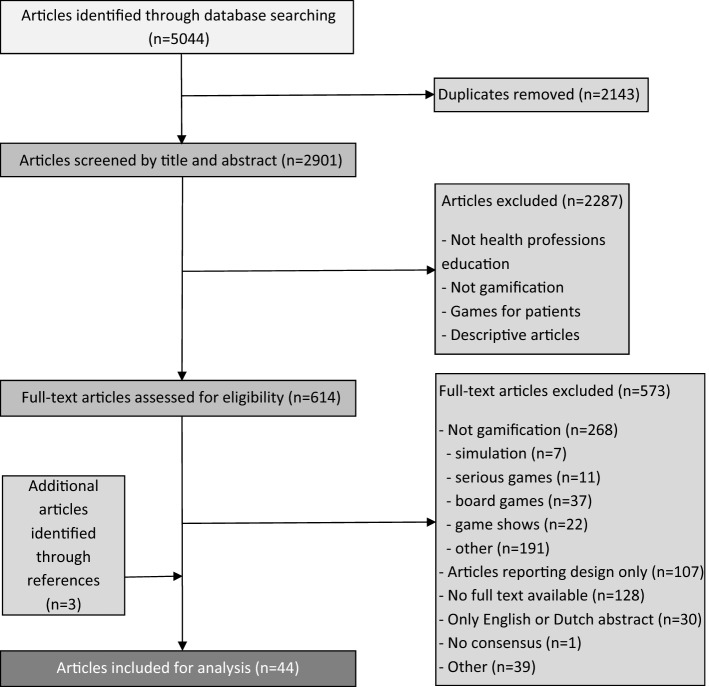
Gamification refers to using game attributes in a non-gaming context. Health professions educators increasingly turn to gamification to optimize students’ learning outcomes. However, little is known about the concept of gamification and its possible working mechanisms. This review focused on empirical evidence for the effectiveness of gamification approaches and theoretical rationales for applying the chosen game attributes. We systematically searched multiple databases, and included all empirical studies evaluating the use of game attributes in health professions education. Of 5044 articles initially identified, 44 met the inclusion criteria. Negative outcomes for using gamification were not reported. Almost all studies included assessment attributes (n = 40), mostly in combination with conflict/challenge attributes (n = 27). Eight studies revealed that this specific combination had increased the use of the learning material, sometimes leading to improved learning outcomes. A relatively small number of studies was performed to explain mechanisms underlying the use of game attributes (n = 7). Our findings suggest that it is possible to improve learning outcomes in health professions education by using gamification, especially when employing game attributes that improve learning behaviours and attitudes towards learning. However, most studies lacked well-defined control groups and did not apply and/or report theory to understand underlying processes. Future research should clarify mechanisms underlying gamified educational interventions and explore theories that could explain the effects of these interventions on learning outcomes, using well-defined control groups, in a longitudinal way. In doing so, we can build on existing theories and gain a practical and comprehensive understanding of how to select the right game elements for the right educational context and the right type of student.
Overview
CoChat Summary
TL;DR
This systematic review of 44 empirical studies found that gamification in health professions education was generally associated with positive or unchanged outcomes, with no negative outcomes reported. Assessment and conflict/challenge attributes were most common, but most studies were descriptive or lacked well-defined control groups and theory, limiting conclusions about mechanisms and effectiveness.
Key findings
- Of 5044 articles identified, 44 met inclusion criteria; no negative outcomes for gamification were reported. Almost all studies included assessment attributes (n = 40), often with conflict/challenge attributes (n = 27); this combination was linked to increased use of learning material in 8 studies and sometimes improved learning outcomes.
- Study quality varied: MERSQI scores ranged from 5 to 17 (mean 9.8, SD 3.1). Most studies were descriptive (n = 25; mean MERSQI 8.3, SD 2.3); 12 were justification studies and 7 were clarification studies. Only 8 well-controlled studies using assessment and conflict/challenge attributes were interpreted with more confidence.
- Contexts were predominantly USA (n = 20) or Canada (n = 8); digital gamified activities (n = 28) outnumbered analogue activities (n = 14). Most studies involved undergraduate (n = 15) and postgraduate medical students (n = 15), followed by nursing (n = 7).
- Theory use was limited: 7 clarification studies referenced theories including Experiential Learning Theory (3 studies), Reinforcement Learning Theory, Social Comparison Theory, Self-Directed Learning, and Deliberate Practice Theory; a common assumption was that gamification improves outcomes by changing learning behaviours or attitudes.
Methods
- Systematic review following AMEE guidelines; searched eight databases (Academic Search Premier, CINAHL, EMBASE, ERIC, Psychology and Behavior Sciences Collection, PsychINFO, PubMed, Cochrane Library) in April 2018, plus hand-searching references and citations.
- Included peer-reviewed journal articles on gamification or game elements in education for (future) health professionals, quantitative or mixed-method; excluded development-only studies, qualitative-only studies, serious games, patient education, simulations except gamified simulations, game-show/board-game contexts, and non-Dutch/English articles.
- Data extraction covered context, participants, intervention, outcomes, quality, and theory; quality was assessed with MERSQI, and studies were classified as description, justification, or clarification using Cook et al.’s framework. Double screening of a 10% excluded sample yielded 94% agreement.
Limitations
- Stated: the search may have missed articles because broad keywords were excluded; lack of consensus on definitions of game, gamification, and serious games made inclusion/exclusion subjective; only one researcher screened full texts; MERSQI does not assess qualitative parts of mixed-methods studies; the conceptual framework may over-generalize and lose information; only English and Dutch articles were included, risking language/culture bias.
- Stated/evident: most included studies lacked well-defined control groups and/or theory (36 of 44 were descriptive, confounded justification/clarification, or clarification without control groups), and combinations of game elements prevented disentangling individual effects; publication bias may have overreported positive results.
- Evident: the review reports no negative outcomes, but this may reflect underreporting; small-scale and pilot studies dominate, and the authors note gamification can have unexpected or unwanted effects (e.g., competition shifting attention from learning, over-justification effect).
Model-written summary. Check it against the paper before relying on it.
Integrity signals
Registry
Cites
Statistics
Figures
Verification
Claims the paper makes
0 Valid · 0 Not valid · 10 Not checked · 55 Own results and interpretations
A result the paper reports from its own data — it cites no other source for it, so there is none to check. The quote shows it is in the paper.
In the paper
“most of the included studies were descriptive in nature and rarely explained what was meant by gamification and how it worked in health professions education.”
§ Gamification of health professions education: a systematic review > Conclusion
plain- Asserted: passes — The authors put it forward as true.
- Checkable: passes — It can be checked against evidence.
- Load-bearing: passes — The paper’s conclusions depend on it.
- Based: passes — The paper gives a reason why it holds.
A result the paper reports from its own data — it cites no other source for it, so there is none to check. The quote shows it is in the paper.
In the paper
“Of 5044 articles initially identified, 44 met the inclusion criteria.”
- Also stated in: § Results · plain
“A total of 44 studies were eligible for inclusion in our systematic review (Table 1).”
§ Gamification of health professions education: a systematic review > Abstract
plain- Asserted: passes — The authors put it forward as true.
- Checkable: passes — It can be checked against evidence.
- Load-bearing: passes — The paper’s conclusions depend on it.
- Based: passes — The paper gives a reason why it holds.
- Also stated in: § Results · plain
A result the paper reports from its own data — it cites no other source for it, so there is none to check. The quote shows it is in the paper.
In the paper
“A combination of conflict and challenge attributes was also more often chosen by researchers from Europe (6 out of 8 European studies) and the USA (17 out of 21 USA studies) than by researchers from Canada (3 out of 8 Canadian studies).”
§ Gamification of health professions education: a systematic review > Results > Contextual differences and effects of game attributes
plainstates an association- Asserted: passes — The authors put it forward as true.
- Checkable: passes — It can be checked against evidence.
- Load-bearing: unclear — It is unclear whether the paper’s conclusions depend on it.
- Based: passes — The paper gives a reason why it holds.
A result the paper reports from its own data — it cites no other source for it, so there is none to check. The quote shows it is in the paper.
In the paper
“Most of the included studies (n = 25; Table 1) were descriptive in nature in such sense that they focused on observation and described what was done, without using comparison groups.”
§ Gamification of health professions education: a systematic review > Results > Quality of the current gamified learning research
plainn = 25- Asserted: passes — The authors put it forward as true.
- Checkable: passes — It can be checked against evidence.
- Load-bearing: passes — The paper’s conclusions depend on it.
- Based: passes — The paper gives a reason why it holds.
A result the paper reports from its own data — it cites no other source for it, so there is none to check. The quote shows it is in the paper.
In the paper
“A relatively small number of studies was performed to explain mechanisms underlying the use of game attributes (n = 7).”
§ Gamification of health professions education: a systematic review > Abstract
plainn = 7- Asserted: passes — The authors put it forward as true.
- Checkable: passes — It can be checked against evidence.
- Load-bearing: passes — The paper’s conclusions depend on it.
- Based: passes — The paper gives a reason why it holds.
30 more claims
Create a free account to see all 65 claims and to verify the 13 references still open.
- It may state two separate claims as one. 16
- Probably not a substantial claim. 21
Claims other papers make about this one
Each is checked against this paper’s own text: does it say what the citing paper says it does?
The source backs part of the claim, not all of it — or backs it for a different population, condition or comparison.
In the citing paper
“The enthusiastic participation and complexity and riskiness of strategies that emerged are consistent with the engagement observed in other gamified public health exercises, such as outbreak response simulations and health systems role-plays (78, 79).”
From Global Health Trade Summit: an AI-enhanced simulation of international trade and global health for undergraduate public health education (2025) · cites this paper as [79]
Experimental — accuracy not yet measuredThe source backs part of the claim, not all of it — or backs it for a different population, condition or comparison.
In the citing paper
“This aligns with research in health professions education demonstrating that gamification can substantially enhance learning outcomes and student motivation (79, 80).”
From Global Health Trade Summit: an AI-enhanced simulation of international trade and global health for undergraduate public health education (2025) · cites this paper as [79]
Experimental — accuracy not yet measured
Self-check
Percentages, sums and reported differences re-computed from the paper’s own numbers.
Each contradiction between two passages listed here was confirmed by an independent check.
Rated minor: it would not touch a result — a value no result rests on, a p-value that stays on the same side of the significance level, or a conflict that is clerical, resolved elsewhere in the paper, or outside its own findings.
In the paper
§ Gamification of health professions education: a systematic review > Discussion > Empirical evidence for using gamification
“The remaining eight studied included in our study were well-controlled studies using assessment and conflict/challenge attributes, so these study results could be interpreted with more confidence.”
§ Gamification of health professions education: a systematic review > Results
“| | Petrucci et al. (2015) | Residents (n = 14) | Conflict/challenge | Competition, progress, social network | Surgery (simulator) | 11 | Digital | Increased use, no difference in outcome |”
Rated minor: it would not touch a result — a value no result rests on, a p-value that stays on the same side of the significance level, or a conflict that is clerical, resolved elsewhere in the paper, or outside its own findings.
In the paper
§ Gamification of health professions education: a systematic review > Results > Educational context and student characteristics
“The majority of the studies were conducted in the USA (n = 20) or Canada (n = 8).”
§ Gamification of health professions education: a systematic review > Results > Contextual differences and effects of game attributes
“the USA (17 out of 21 USA studies)”
Cited works that were retracted
Works this paper cites that were later retracted, from the retraction notices publishers deposit. Major when the notice came out before this paper was published.
Rated major: it would touch a result — a value a result rests on, reported and recomputed p-values on opposite sides of the significance level, two passages that conflict with no sign which is right, or a cited work retracted before this paper was published.
In the paper
“…1999; Bligh and Prideaux 2002; Cook et al. 2008), which we felt should also apply to research on game-based learning in general and gamification in particular (Caponetto et al. 2014; De Sousa Borges et al. 2014; Faiella and Ricciardi 2015; Gentry et al. 2016; McCoy et al. 2016; Nah et al. 2014).”
Cited work 10.1002/14651858.cd012209 · retracted 2018-06-22 · notice 10.1002/14651858.cd012209.pub2 · this paper published 2020-10-31
Citations
Cites
1 retracted
Serious Gaming and Gamification interventions for health professional education
Gentry, S. V., Ehrstrom, B. L., Gauthier, A., Álvarez, J., Wortley, D. J., van Rijswijk, J., Car, J., Lilienthal, A., Car, L. T., Nikolaou, C. K., et al. (2016) · Cochrane Database of Systematic Reviews · doi:10.1002/14651858.cd012209 · Cited by 28 · cited 2×
“…1999; Bligh and Prideaux 2002; Cook et al. 2008), which we felt should also apply to research on game-based learning in general and gamification in particular (Caponetto et al. 2014; De Sousa Borges et al. 2014; Faiella and Ricciardi 2015; Gentry et al. 2016; McCoy et al. 2016; Nah et al. 2014).”
BackgroundRetractedRayyan-a web and mobile app for systematic reviews.
Ouzzani, M., Hammady, H., Fedorowicz, Z., & Elmagarmid, A. (2016) · Systematic Reviews · doi:10.1186/s13643-016-0384-4 · Cited by 26,092 · cited 1×
“After retrieving the search results from different databases, AvG removed the duplicates and uploaded the remaining articles to Rayyan, a mobile and web-based application developed for systematic reviews (Ouzzani et al. 2016).”
MethodA theory of social comparison processes
Festinger, L. (1954) · Human Relations · doi:10.1177/001872675400700202 · Cited by 20,926 · cited 1×
“According to the Social Comparison Theory, social comparison is a fundamental mechanism for modifying judgment and behaviour through the inner drive individuals have to gain accurate self-evaluations (Corcoran et al. 2011; Festinger 1954).”
MethodThe role of deliberate practice in the acquisition of expert performance
Ericsson, K. A., Krampe, R. T., & Tesch-Römer, C. (1993) · Psychological Review · doi:10.1037/0033-295x.100.3.363 · Cited by 9,564 · cited 1×
“Deliberate Practice Theory is based on engaging already motivated students to become experts via well-defined goals, real world tasks and immediate and informative feedback (Butt et al. 2018; Ericsson et al. 1993).”
BackgroundDeci, E. L., Koestner, R., & Ryan, R. M. (1999) · Psychological Bulletin · doi:10.1037/0033-2909.125.6.627 · Cited by 7,176 · cited 1×
“This is also called the over-justification effect (Deci et al. 1999, 2001; Hanus and Fox 2015; Landers et al. 2015; Lepper et al. 1973).”
BackgroundHomo Ludens: A Study of the Play-Element in Culture.
Gillin, J. L., & Huizinga, J. (1951) · American Sociological Review · doi:10.2307/2087716 · Cited by 6,560
Rules of Play: Game Design Fundamentals
Salen, K., & Zimmerman, E. (2003) · Medical Entomology and Zoology · Cited by 5,438
Does Gamification Work? -- A Literature Review of Empirical Studies on Gamification
Hamari, J., Koivisto, J., & Sarsa, H. (2014) · 2014 47th Hawaii International Conference on System Sciences · doi:10.1109/hicss.2014.377 · Cited by 5,201 · cited 1×
“…technology (Blohm and Leimeister 2013; Burke 2014; Burkey et al. 2013; De Sousa Borges et al. 2014; Domínguez et al. 2013; Gaggioli 2016; Hamari et al. 2014; Hsu et al. 2013; Huotari and Hamari 2012, 2017; Kumar 2013; Muntean 2011; Perrotta et al. 2013; Robson et al. 2015; Simões et al.…”
BackgroundThe Modern Practice of Adult Education: From Pedagogy to Andragogy
Knowles, M. S. (1970) · Cited by 3,905
(2020) · Journal of Medical Education · doi:10.5812/jme · Cited by 3,490
Research works printed but not linked: 8
- Caponetto, I., Earp, J., & Ott, M. (2014). Gamification and education: A literature review. In Proceedings of the European Conference on Games-Based Learning.
- Chia P Using a virtual game to enhance simulation based learning in nursing education Singapore Nurs J [Internet]. 2013 40 3 21 6
- Deterding S Khaled R Nacke L Dixon D Gamification: Toward a definition Chi 2011 2011 12 15
- Huotari, K., & Hamari, J. (2012). Defining gamification—A service marketing perspective. In Proceedings of the 16th International Academic MindTrek Conference 2012: “Envisioning Future Media Environments”, MindTrek 2012.
- Jacobs, J. W., & Dempsey, J. V. (1993). Simulation and gaming: Fidelity, feedback, and motivation. In: Dempsey, J.V. and Sales G.C. (Eds.). Interactive instruction and feedback. Englewood Cliffs, New Jersey: Educational Technology Publications
- Nemer LB Kalin D Fiorentino D Garcia JJ Estes CM The labor games Obstet Gynecol. 2016 128 1s 5s 27662001 · DOI
- Tilley, N., & Pawson, R. (2000). Realistic evaluation: An overview. The British Journal of Sociology.
- Zuk R Get in the game: How communicators can leverage gamification Public Relations Tactics 2012 19 7
Cited by
Items 401–500 of 861
Shakoor, A., Mohansingh, C., el Osrouti, A., Borleffs, J. W. C., van Houwelingen, G. K., van de Swaluw, J. E. C., van Kimmenade, R. R. J., den Besten, M., Pisters, R., van Ofwegen-Hanekamp, C. E. E., et al. (2024) · European Heart Journal - Digital Health · doi:10.1093/ehjdh/ztae052 · Cited by 2
“…term referring to the use of game design elements such as challenges and rewards (e.g. points or badges) in contexts other than gaming (e.g. 7–9 With the rapid increase in available medical knowledge and the ever-increasing demand for healthcare professionals, a gamified learning environment…”
BackgroundWisniewski, C. S., Wisniewski, J. N., Whitney, R., & Jones, E. P. (2024) · INNOVATIONS in pharmacy · doi:10.24926/iip.v15i3.5873 · Cited by 2
Jogos Sérios como ferramenta de capacitação da Atenção Primária
Gustmann, K., Figueirêdo, M. M. D., Cano, M. D., & Queiroz, J. E. D. A. (2024) · Journal of Health Informatics · doi:10.59681/2175-4411.v16.iespecial.2024.1265 · Cited by 2
“The Mystery of the Cell Kingdom”: an online game to improve the learning of thyroid physiology
Cardinali, C. A. E. F., Martins, Y. A., Prates, R. P., de Araújo, E. V., Viana, F. J. C., de Sousa, M. E., Bombardi, E. D. C., Baldo, M. V. C., & Nunes, M. T. (2024) · AJP Advances in Physiology Education · doi:10.1152/advan.00219.2024 · Cited by 2
Uso da estratégia de gamificação na educação em saúde de cuidados paliativos - revisão de escopo
Rocha, I. M., Pires, I. A., de Andrade, D. P., BORGES, B. E., de Almeida, M. J., & Bellani, W. A. G. D. O. (2024) · Caderno Pedagógico · doi:10.54033/cadpedv21n13-526 · Cited by 2
Prevención de la adicción a la tecnología e internet en adolescentes vulnerables
Andrés, A. P., Gómez, D. J. R., & Benito, A. V. M. (2024) · Garnata 91 · doi:10.58807/garnata20246991 · Cited by 2
The Future Tools for Medical Training, Assessment, and Certification
Aldossari, M., & Ammar, A. S. (2022) · Springer eBooks · doi:10.1007/978-3-031-02078-0_34 · Cited by 2
Gamification as a method of preventing childhood obesity
Самойлова, Ю. Г., Матвеева, М. В., Vachadze, T. D., Tolmachev, I. V., & Захарчук, П. И. (2022) · Russian Journal of Preventive Medicine · doi:10.17116/profmed202225091117 · Cited by 2
LET’S GO! ANATOMY GAME: UMA METODOLOGIA ATIVA PARA O APRIMORAMENTO DO ENSINO DA ANATOMIA
Farias, G. D., Soares, J. B., de Sena, J. R., de Lucena, L. B. S., de Sousa, E. M. D., & Paiva, M. D. E. B. (2023) · Arquivos do Mudi · doi:10.4025/arqmudi.v27i2.68905 · Cited by 2
Введенская, О. Ю., Orujova, A., Sokolovskaya, L., Kondratenkova, E. A., Kubrikova, Y., & Olsufeva, A. V. (2023) · Современные проблемы науки и образования · doi:10.17513/spno.33144 · Cited by 2
The use of artificial intelligence in crafting a novel method for teaching normal human gait
Lowe, S. W. (2024) · European Journal of Physiotherapy · doi:10.1080/21679169.2024.2393136 · Cited by 2
Sophark, P., Limratchapong, C., & Liabsuetrakul, T. (2023) · Research Square · doi:10.21203/rs.3.rs-3197032/v1 · Cited by 2
Evaluating gamified interventions in healthcarepractice
Tera, T., Kelvin, K., & Tobiloba, B. (2024) · doi:10.31234/osf.io/z94eh · Cited by 2
Bourgeois, C. (2022) · HAL · Cited by 2
Teaching health equity through gaming
Copenhaver, K. A., Randall, P. S., & Gagne, J. C. D. (2023) · Teaching and learning in nursing · doi:10.1016/j.teln.2023.05.014 · Cited by 1
Gamification in Language Education: Reinforcement-Assessment Development Theory
Tapales, E. C. (2023) · Zenodo (CERN European Organization for Nuclear Research) · doi:10.5281/zenodo.8233887 · Cited by 1
¿Cómo aprender a prevenir y detectar plagio? Comparación de dos métodos de enseñanza
Padilla-Santamaría, F., Ferman-Cano, F., & Maya-Franco, L. (2024) · Investigación en Educación Médica · doi:10.22201/fm.20075057e.2024.51.23570 · Cited by 1
Мотуз, Т. В., Dynovych, A., Бабельчук, О., BYKASOVA, S., & Gulevets, D. (2024) · Multidisciplinary Reviews · doi:10.31893/multirev.2024spe011 · Cited by 1
“These competencies cover a wide range of knowledge, skills, experience and other personal qualities that determine learning outcomes (Gaalen et al., 2021).”
BackgroundDas, S., & Lim, L. H. I. (2024) · IEEE Global Engineering Education Conference (EDUCON) · doi:10.1109/educon60312.2024.10578619 · Cited by 1
de Lima, L. V., Pavinati, G., Dias, J. R., Bernardo, P. H. P., de Almeida, E. C., Baldissera, V. D. A., & Magnabosco, G. T. (2024) · Enfermagem em Foco · doi:10.21675/2357-707x.2024.v15.e-202417supl2 · Cited by 1
Kanofsky, S., Hodwitz, K., Tzakas, P., Nyhof-Young, J. M., & Walsh, C. M. (2024) · Simulation in Healthcare The Journal of the Society for Simulation in Healthcare · doi:10.1097/sih.0000000000000823 · Cited by 1
App-based first aid learning: what applications do we have now?
Kashtanov, A. D., Молоток, Е. В., Yavorovskiy, A. G., Алиев, В. А., Галата, А. А., Vasil’ev, Y. L., Volel, B. A., Kytko, O. V., & Ma, V. (2024) · Russian Journal of Anesthesiology and Reanimatology · doi:10.17116/anaesthesiology202406189 · Cited by 1
Park, S., Hwang, Y. J., & Chung, C. (2025) · Journal for Specialists in Pediatric Nursing · doi:10.1111/jspn.70003 · Cited by 1
Effectiveness of Crossword Puzzles in Dental Education: A Scoping Review
Mehta, V., Tripathy, S., Aggarwal, S. D., Mathur, A. S., & Meto, A. (2025) · Journal of Research in Dental and Maxillofacial Sciences · doi:10.61186/jrdms.10.1.73 · Cited by 1
Hylander, J., Gyllencreutz, L., Haney, M., & Westman, A. (2025) · JMIR Formative Research · doi:10.2196/58542 · Cited by 1
Corradi, T. N. S., Bayer, N. E. K., Marchiorato, A. A. L., & Prado, M. R. M. (2025) · Caderno Pedagógico · doi:10.54033/cadpedv22n6-084 · Cited by 1
Li, K., Zhang, T., Yu, S., Pan, Y., & Wang, Y. (2025) · Military Medicine · doi:10.1093/milmed/usaf130 · Cited by 1
Lin, C., Han, C.-Y. S., Huang, Y., Ku, H., & Chen, L. (2025) · Nurse Education in Practice · doi:10.1016/j.nepr.2025.104384 · Cited by 1
Gutierrez, A. P. (2025) · Odontología Activa Revista Científica · doi:10.31984/oactiva.v10i1.1105 · Cited by 1
Okoli, D., Schnabel, N. E., Haas, M. R. C., Santen, S. A., & Wolff, M. (2025) · AEM Education and Training · doi:10.1002/aet2.70038 · Cited by 1
Revitalizing Scientific Poster Sessions: A Gamification Approach at an Academic Conference
Rissmiller, B., Thammasitboon, S., & Benjamin, J. C. (2025) · Academic Medicine · doi:10.1097/acm.0000000000006094 · Cited by 1
Impact of Junk Food Consumption on Menstrual Health and Circadian Rhythms: A Comprehensive Review
Chakraborty, J., Kumar, M., Nawar, K. A., Purkait, M. P., Chalissery, B., Vinodkumar, A., Bhattacharjee, A., & Syamal, A. K. (2025) · Chronobiology in Medicine · doi:10.33069/cim.2025.0034 · Cited by 1
The Effectiveness of a Gamified Lesson Plan Using the TOY Gamification Model in Nursing Education
Atasever, İ., & Duran, E. T. (2025) · CIN Computers Informatics Nursing · doi:10.1097/cin.0000000000001327 · Cited by 2
Hussaini, N., Al-Haddad, U., Hussaini, N., Hussaini, A., & Abdlaziz, I. (2025) · Cureus · doi:10.7759/cureus.91934 · Cited by 1
“This is supported by previous studies[17], which emphasise aligning escape room game design with educational goals to maximise value while maintaining engagement.”
Kira, A., Pontes, R. G., de Lima, A. K. P., de Araújo, L. V., Monteiro, C. B. D. M., Valenzuela, E. D. J., da Silva, V. Y. H., Weingartner, J. H., de Moraes, Í. A. P., Uribe-Quevedo, Á., et al. (2026) · Games for Health Journal · doi:10.1177/2161783x251378518 · Cited by 2
Mobile Learning and Assessment: Expanding Access and Engagement
Rosmayanti, V., Rusli, K., & Fara, G. R. (2025) · IGI Global eBooks · doi:10.4018/979-8-3373-2130-1.ch005 · Cited by 1
Escape Room in Nursing Fundamentals Course: Students’ Opinions, Engagement, and Gameful Experience
Simin, D., Đurić, A. P., Aranđelović, B., Živković, D., & Milutinović, D. (2025) · Nursing Reports · doi:10.3390/nursrep15090343 · Cited by 1
“Over the last five years, GBL has become a trend in health professions education, suggested by an almost tenfold increase in scientific publications [5].”
ViroGame: a serious game for medical virology education – a feedback report
Sulla, V. P., Marot, S., Dutkiewicz, M., Berti, V., Grimal, A., Ghelfenstein-Ferreira, T., Solis, M., Charre, C., Salmona, M., Thibault, V., et al. (2025) · BMC Medical Education · doi:10.1186/s12909-025-08086-7 · Cited by 1
“Games that combine assessment features such as scoring or feedback with challenge elements like competition or limited resources are particularly effective in sustaining attention and improving learning outcomes [8].”
Sánchez‐Sánchez, F. J., & Sánchez, A. M. S. (2025) · Journal of Tourism Futures · doi:10.1108/jtf-06-2025-0169 · Cited by 3
Educational Environment in Improving the Quality of Learning
Manurung, A. S. (2025) · IGI Global eBooks · doi:10.4018/979-8-3373-0030-6.ch003 · Cited by 1
Evaluation of a Hypertension Therapeutics Board Game
Kelsh, S. E., Mcwain, C., & Ding, Q. (2025) · American Journal of Pharmaceutical Education · doi:10.1016/j.ajpe.2025.101909 · Cited by 1
The Role of Games and Social Media in Medical Education: A Narrative Review
Smith, C. L. (2025) · Journal of Medical Education and Curricular Development · doi:10.1177/23821205251408646 · Cited by 1
Ghozali, M. T. (2025) · Science, Engineering and Health Studies · doi:10.69598/sehs.19.25050015 · Cited by 1
Using an Escape Room for Teaching Patient Safety
Beardsley, T., Sevigny, T., & Kalynych, C. J. (2025) · Journal of Graduate Medical Education · doi:10.4300/jgme-d-24-01022.1 · Cited by 1
Venter, M., & Wet, L. D. (2026) · Communications in computer and information science · doi:10.1007/978-3-032-12457-9_6 · Cited by 1
Educational Escape Room for Psychology Students: Exploring Design Structure and Effectiveness
Valls-Serrano, C., Moore, H. T. A., Rabadán-Pardo, M. J., Egea-Cariñanos, P., & Vélez-Coto, M. (2026) · Psicología Educativa · doi:10.5093/psed2026a2 · Cited by 1
Bases teóricas da gamificação no ensino médico: interface com metodologias ativas
da Silva, M. P. R. (2026) · Revista Eletrônica Acervo Saúde · doi:10.25248/reas.e22929.2026 · Cited by 1
“…conteúdos quando elementos de jogos são integrados com intencionalidade pedagógica, como pontos, níveis de progressão, desafios e feedback imediato (VAN Outro ponto crítico destacado pela revisão é a falta de padronização para medir constructos como motivação, engajamento e experiência do usuário,…”
InfluentialShoaib, H., Hussain, Y. K., Shoaib, S., Hussain, S., Chaudhary, H. A., Ali, M. S., Jennings, C., & Smith, T. (2026) · Journal of Education and Teaching in Emergency Medicine · doi:10.5070/m5.52351 · Cited by 1
Liao, L.-L., Chang, L., Lai, I., Lo, Y.-P., & Hsu, C.-C. (2026) · Innovations in Education and Teaching International · doi:10.1080/14703297.2026.2628009 · Cited by 1
Cueva, K. A. S., Matamoros, M. X. Z., Dioses, L. P. A., & García, J. S. Y. (2026) · RECIAMUC · doi:10.26820/reciamuc/10.(1).oct.2026.152-166 · Cited by 1
Saltos, J. M. P., Gavilanes, J. A. Q., Macias, L. D. P. V., & Montenegro, D. E. M. (2026) · RECIAMUC · doi:10.26820/reciamuc/10.(1).oct.2026.224-240 · Cited by 1
Auz, A. J. V., Jácome, K. V. J., Guerra, M. G. C., & González, J. L. A. (2026) · Nursing Reports · doi:10.3390/nursrep16040105 · Cited by 1
“From another perspective, there is debate about whether gamification can be applied to all groups and contexts [19–21].”
Mohiyeddini, C. (2026) · Frontiers in Medicine · doi:10.3389/fmed.2026.1810141 · Cited by 2
Vernier, T., Chong, M., Tan, J., Gardiner, J., Bogdanovych, A., & Chuan, A. (2026) · Journal of Clinical Anesthesia · doi:10.1016/j.jclinane.2026.112199 · Cited by 1
Game-Based Education Improves Stunting Knowledge And Healthy Behaviors Among Primary Students
Subratha, H. F. A., Sari, I. A. D. P., Purnamayanti, N. K. D., Cahyoko, F. D., & Martin, N. M. (2026) · Gaster | Jurnal Ilmu Kesehatan · doi:10.30787/gaster.v24i1.2403 · Cited by 1
Matkovic, J. (2026) · Frontiers in Public Health · doi:10.3389/fpubh.2026.1816727 · Cited by 2
From Points to Insight: Gamifying Reflective Thinking in Design Education
Larsen, O., & Al-Farsi, A. (2026) · International Journal of Graphic Design · doi:10.51903/ijgd.v4i1.3206 · Cited by 1
Shakoor, A., Scholte, N. T. B., van de Kamp, R., Derks, L., Borleffs, C. J. W., van Houwelingen, G. K., van de Swaluw, J. E. C., van Kimmenade, R. R. J., Otten, A. M., Pisters, R., et al. (2026) · European Journal of Cardiovascular Nursing · doi:10.1093/eurjcn/zvag097 · Cited by 1
Escape Intern Orientation! — A Capstone and Team Building Activity for New EM Interns
Rivera, M. J., & Thompson, M. (2026) · Journal of Education and Teaching in Emergency Medicine · doi:10.5070/m5.52158 · Cited by 1
A bibliometric analysis of gamification and intrinsic motivation in learning technologies
Pustikayasa, I. M., Kuswandi, D., Farida, I. A., Setyosarı, P., Degeng, M. D. K., & Praherdhiono, H. (2026) · Discover Education · doi:10.1007/s44217-026-01597-5 · Cited by 1
“This interpretation aligns with prior literature reviews and meta-analytic work showing that the effects of gamification are not uniformly positive but depend on the quality of implementation, the learning context, and the alignment between design choices and learner needs [8, 11, 13, 16].”
Digitalization and Gamification to Improve Pathology Education: The SIAPeC Quiz Experience
Caputo, A., Cima, L., L’Imperio, V., Alecci, G., Ascione, A., Facchetti, M., Eren, Ö. C., Baskovich, B., Mirza, K. M., Bonert, M., et al. (2026) · Pathologica · doi:10.32074/1591-951x-n980 · Cited by 1
Zhao, C., & Jamaludin, K. A. (2026) · International Journal of Education and Practice · doi:10.18488/61.v14i2.4897 · Cited by 1
“These resources have been advantageous in diverse fields, including education and health students (van Gaalen et al., 2021).”
Zamora, J. D., Pérez, R. B., Maravert, R. F., & Narváez, J. A. M. (2026) · RED Visual Revista Especializada en Discapacidad Visual · doi:10.53094/bgsy6379 · Cited by 1
More Than Just Game Elements—A Taxonomy of Considerations for Gamification Projects and Research
Kölln, K., Weigand, A. C., Meiser, L., Rauschenberger, M., & Escalona, M. J. (2026) · Journal of Software Evolution and Process · doi:10.1002/smr.70142 · Cited by 1
“…theory 8 Guidelines Some form of gamification approach 6 Process Some form of gamification approach 4 Model Some form of gamification approach 20 [69] Theory Explain the processes that underlie observed effects 5 [13] Underpinning theory Theoretical models or theories that underpin the design of…”
Avcı, A., Serin, E. K., & Kahraman, S. (2026) · European Journal of Cardiovascular Nursing · doi:10.1093/eurjcn/zvag160 · Cited by 1
Role of gamification and game-based learning in continuing nursing education: Systematic review
Bosch-Nadal, J., Fernández, I. D. M., Córdoba, M. G. D. Q., Malumbres-Talavera, J., Vives-Espelta, J., & Cuesta-Martínez, R. (2026) · Collegian Journal of the Royal College of Nursing Australia · doi:10.1016/j.colegn.2026.07.005 · Cited by 1
The use of voiceovers and review games in teaching immunology
Chou, E., Cooper, D., Goel, P., Tang, J., Henkle, G., Zemeida, S., Wolfson, H., Shyu, Y., Chang, E., Abram, A., et al. (2026) · ImmunoHorizons · doi:10.1093/immhor/vlag042 · Cited by 1
“14 15–17 Students competing as teams can collaboratively create learning communities that boost motivation, encourage continued involvement, and enhance learning.”
Silva, A. L., Carvalho, N. D. L., Silva, H. G. R., de Almeida, G. F., Andrade, J. N., Lima, M. V. D. A., de Oliveira, S. N. P., & de Oliveira, R. N. L. (2026) · Revista de Geopolítica · doi:10.56238/revgeov17n7-182 · Cited by 1
Gamification in radiography education: Impressions and perceptions from a european survey
Iosca, N., Lastrucci, A., Votta, C., Bernabucci, L., Maran, I., Monaco, I. P., Francioni, S., Marrazzo, L., Wandael, Y., Ricci, R., et al. (2026) · Radiography · doi:10.1016/j.radi.2026.103548 · Cited by 1
Defining Game-Based Learning: Addressing Terminological Variations
Grāvelsiņa, E., & Daniela, L. (2026) · International Journal of Game-Based Learning · doi:10.4018/ijgbl.420202 · Cited by 1
Chamouard, V., Freyssenge, J., Clairaz, B., Bibas, F. F., & Fraticelli, L. (2024) · JMIR Formative Research · doi:10.2196/54656 · Cited by 1
Endoscopic Education, Training, and Simulation
Waschke, K. A., & Sedlack, R. E. (2024) · Gastroenterology Clinics of North America · doi:10.1016/j.gtc.2024.08.003 · Cited by 1
How to Gamify E-Government Services? A Taxonomy of Game Elements
Contreras-Espinosa, R. S., & Eguia-Gómez, J. L. (2022) · Advances in business strategy and competitive advantage book series · doi:10.4018/978-1-7998-9223-6.ch004 · Cited by 1
Healthcare in the 4.0 Era of Digitization
Toni, M., & Mattia, G. (2022) · Springer eBooks · doi:10.1007/978-3-031-16340-1_2 · Cited by 2
Evaluation of a prototype for early active patient mobilization
Asadov, A., Boiko, A., Gaiduk, M., Scherz, W. D., Seepold, R., & Madrid, N. M. (2022) · Procedia Computer Science · doi:10.1016/j.procs.2022.09.282 · Cited by 1
Cultural-Oriented Mobile Game Application and the Gamification of Tourism
Rallis, I., Kopsiaftis, G., Kalisperakis, I., Stentoumis, C., Koutsomitsos, D., & Riga, V. (2022) · Communications in computer and information science · doi:10.1007/978-3-031-20253-7_20 · Cited by 1
How to design and deliver a successful paediatric placement for medical students
Vallabhaneni, P., & Thankachan, D. (2023) · Archives of Disease in Childhood Education & Practice · doi:10.1136/archdischild-2020-321419 · Cited by 1
ГЕЙМІФІКАЦІЯ В СИСТЕМІ ПІДГОТОВКИ МЕДИЧНИХ ПРАЦІВНИКІВ
Шмалєй, С. В., & Redka, I. V. (2022) · ПЕДАГОГІЧНИЙ АЛЬМАНАХ · doi:10.37915/pa.vi52.395 · Cited by 2
Endrayadi, A., & Renaldi, F. (2023) · International Conference on Industrial Engineering and Operations Management (IEOM) · doi:10.46254/ap03.20220089 · Cited by 1
Implementation of longitudinal thematic course design across four institutions
Tran, D., Benitez, R. M., Garcia-Stout, M., Horlen, C. K., DeRemer, C. E., & Donohoe, K. L. (2023) · Currents in Pharmacy Teaching and Learning · doi:10.1016/j.cptl.2023.07.007 · Cited by 1
Allon, S. A., Baggett, A., Hayes, B., Glosemeyer, K., Cavo, J., Pacha, R., Zurko, J. C., Patel, N., & Kraemer, R. R. (2023) · Journal of Graduate Medical Education · doi:10.4300/jgme-d-22-00812.1 · Cited by 1
Media Literacy and Assistive Technologies for Empowerment in Autism
Tkaczyk, A. H. (2023) · Edições Universitárias Lusófonas eBooks · doi:10.24140/asdigital.v1 · Cited by 1
Salehinia, R., Derakhshan, H. B., Safaei, A., & Sangari, M. N. (2023) · Avicenna journal of Care and Health in Operating Room · doi:10.34172/ajchor.17 · Cited by 1
Gamification in Point of Care Ultrasound Education
Liu, E. L., & Helland, G. (2023) · Intersections The Health Education Journal of the Woodruff Health Sciences Center · doi:10.59450/oywd6862 · Cited by 1
Noël, F., Xexeo, G. B., Martins, M. A., Silva, E. J. R., Pupo, A. S., Magalhães, P. J. C., Lima‐Júnior, R. C. P., Gadelha, K. K. L., Lima‐Silva, K., Raimundo, J. M., et al. (2024) · Brazilian Journal of Medical and Biological Research · doi:10.1590/1414-431x2023e13258 · Cited by 1
Game-Based Learning: A Strategy for Teaching Curriculum Content in the Classroom Context
Batista, J. (2023) · International Symposium on Computers in Education · doi:10.1109/siie59826.2023.10423699 · Cited by 1
“In recent years, the generalized lack of motivation of students towards the learning system has led to several studies on gamification in learning environments [9, 10, 11, 12, 13] that have shown to be promising, with mostly positive results [14, 15, 16].”
BackgroundSatorres, A. M., Saumell, C. R., Escalé-Besa, A., Arcarons-Marti, M., Segura, F. J. F., Wagner, C. A., Pires-Nuñez, P., Tristán, N. T., Diez-Garcia, L., Maron-Lopez, A., et al. (2024) · BMC Medical Education · doi:10.1186/s12909-024-05903-3 · Cited by 1
“…with healthcare professionals also concluded that it is possible to improve learning outcomes in health profession education through gamification, especially when using game attributes that improve learning behaviours and attitudes towards learning (Van Gaalen et al. (Van Gaalen et al. [16])).”
BackgroundGamification approach to addiction education for internal medicine residents
Falleni, A., & Brienza, R. S. (2024) · Education for Health · doi:10.62694/efh.2024.95 · Cited by 1
“12 Facilitators should prepare to reorient learners to the main goal of gamification as needed.”
BackgroundThe Experience of Virtual Reality in Gerontological Nursing Education among Nursing Students
Liao, Y. Q., & Hsu, M. H. K. (2024) · International Conference on Education and Multimedia Technology (ICEMT) · doi:10.1145/3678726.3678743 · Cited by 1
“The use of VR pedagogical approaches in GN education can promote effective and active learning among nursing students[9].”
Nøhr, A., Mikkelsen, P. T., Sørensen, M. S., & Andersen, S. A. W. (2024) · Lecture notes in computer science · doi:10.1007/978-3-031-71704-8_24 · Cited by 1
A Pilot Longitudinal Clinical Reasoning Curriculum for Pediatric Residents
Bowen, J., Polak, C. A., Thomson, J. E., & Herrmann, L. E. (2024) · MedEdPORTAL · doi:10.15766/mep_2374-8265.11447 · Cited by 1
Bugs and drugs – what do pharmacists need to know and what’s the best way to learn it?
MacDougall, C., & Jeffres, M. N. (2024) · American Journal of Health-System Pharmacy · doi:10.1093/ajhp/zxae258 · Cited by 1
Eggers, N.-G. (2024) · AINS - Anästhesiologie · Intensivmedizin · Notfallmedizin · Schmerztherapie · doi:10.1055/a-2219-0024 · Cited by 1
Fisher, M., & Nolan, H. A. (2024) · The Clinical Teacher · doi:10.1111/tct.13813 · Cited by 1
INNOVATIVE METHODOLOGIES AS A FACTOR PROMOTING QUALITY OF MEDICAL HIGHER EDUCATION
Крайненко, О. В., Petrova, O., Korneyko, I. V., & Ovsiannikova, H. (2024) · Вісник науки та освіти · doi:10.52058/2786-6165-2024-11(29)-758-772 · Cited by 1
Research on Gamification of Diabetes Education
Luo, N., & Meng, X. (2024) · International Conference on Information Technology in Medicine and Education · doi:10.1109/itme63426.2024.00126 · Cited by 1
“…virtual operation opportunities in high-risk areas like surgery, mental health promotion, lifestyle intervention, chronic disease management, and nursing education, this gamified education effectively makes up for the shortcomings of traditional education while also being highly enjoyable[7].”
The Role of Gamification in Medical Education: Experience Report and Integrative Review
Nascimento, F. M. D. S., Rebouças, Y. C., Filho, J. L. M., Barreto, V. R. B., Luna, P. D. A., & de Albuquerque, A. V. (2025) · International Journal of Health Science · doi:10.22533/at.ed.1595152518031 · Cited by 1
Tuchtenhagen, P. H., Düllius, A. I. D. S., Turchetti, R. C., Ceolin, S. R., & Filho, W. P. (2025) · Recital - Revista de Educação Ciência e Tecnologia de Almenara/MG · doi:10.46636/recital.v6i3.612 · Cited by 1
Current Trends, Innovations and Issues in Nursing Practice and Education
Martínez‐Sabater, A., Chover‐Sierra, E., & Saus‐Ortega, C. (2025) · MDPI eBooks · doi:10.3390/books978-3-7258-3995-7 · Cited by 1
Gamified learning enhances psychiatric symptom knowledge in nursing students
Moonchai, K., Vatanasin, D., Pramnoi, P., & Thamruangrit, S. (2025) · Teaching and learning in nursing · doi:10.1016/j.teln.2025.07.028 · Cited by 1
Metadata
- Authors
- van Gaalen, A. E. J., Brouwer, J., Schönrock-Adema, J., Bouwkamp-Timmer, T., Jaarsma, A. D. C., & Georgiadis, J. R.
- Affiliations
- University of Groningen (NL)
- University Medical Center Groningen (NL)
- Venue
- Advances in Health Sciences Education
- Published
- 2020-10-31
- Volume
- 26
- Issue
- 2
- Pages
- 683-711
- ISSN
- 1382-4996 (ISSN-L)
- 1573-1677
- PMC
- PMC8041684
- OpenAlex
- W3094919143
- Cited by
- 625
- References
- 149
- Citations by year
- 2026: 108 · 2025: 126 · 2024: 160 · 2023: 121 · 2022: 80 · 2021: 29
- FWCI
- 12.14
- Type
- journal article
- Language
- en
- Open access
- hybrid
- doi.org
- Licence
- cc-by
- creativecommons.org/licenses/by/4.0 (tdm)
- creativecommons.org/licenses/by/4.0 (vor)
- Locations
- Advances in Health Sciences Education (publishedVersion, cc-by)
- PubMed Central (publishedVersion, cc-by)
- PubMed (publishedVersion)
- University of Groningen research database (University of Groningen / Centre for Information Technology) (publishedVersion, cc-by)
- Utrecht University Repository (Utrecht University) (submittedVersion, other-oa)
- University of Groningen research database (University of Groningen / Centre for Information Technology) (submittedVersion, cc-by)
- Funders
- University of Groningen
- Topics
- Social Sciences › Psychology › Developmental and Educational Psychology › Educational Games and Gamification
- Social Sciences › Education › Innovations in Medical Education
- Physical Sciences › Engineering › Biomedical Engineering › Biomedical and Engineering Education
- Keywords
- gamification, health professions education, game attributes, learning outcomes, learning behavior, learning attitude, educational intervention
- MeSH terms
- Health Occupations, Humans, Learning, Students
About these checks
Registry, retraction, Cites and statistics results are computed, not judged, with one exception: a printed reference that no index lists is read once by a model before it counts as a citation error. Claims are extracted by a model and kept only when their quote appears verbatim in the text; each cited source is then checked, with a model’s help, for whether it says what the claim relies on. Those verdicts can be wrong — read the claim’s quote and the cited source before relying on one.
A language model drew the claims from the paper on 2026-11-23, under version 3 of the claim definition (model deepseek-v4.1-flash, prompt extract-v3).
A second model labelled each claim on 2026-11-23 (model jev-1.13-20260917, definition revision gold-guideline-v0.2).
Statistics and arithmetic are recomputed, not judged.
Confidence bands are shown only for fields calibrated on our annotated test set. None is calibrated yet, so no band is shown.
What counts as a claim ›How we measure confidence ›How we check this ›
Are you an author, or do you see a problem with this page? Request a review
Data sources
Bibliographic data: Semantic Scholar, OpenAlex, Crossref.
Contains information from the Semantic Scholar Academic Graph Datasets, made available under the ODC Attribution License (ODC-BY 1.0).
Semantic Scholar’s data is described in: Kinney, R., et al. (2023). The Semantic Scholar Open Data Platform. arXiv:2301.10140.
