

Gamification of health professions education: a systematic review
Open accessThe DOI matches its Crossref record; 148 of the 149 references it cites were found in a registry or an index; none of the 15 sources its claims cite is checked for support yet.
Abstract
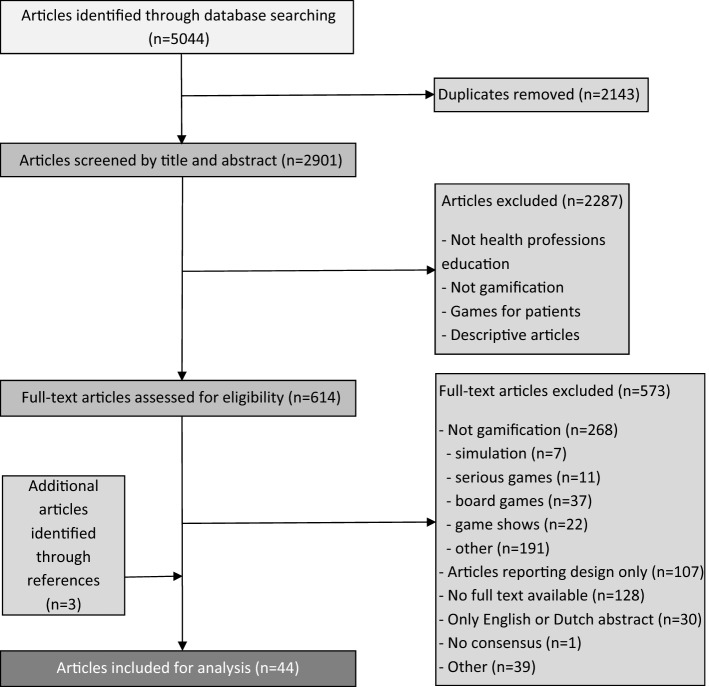
Gamification refers to using game attributes in a non-gaming context. Health professions educators increasingly turn to gamification to optimize students’ learning outcomes. However, little is known about the concept of gamification and its possible working mechanisms. This review focused on empirical evidence for the effectiveness of gamification approaches and theoretical rationales for applying the chosen game attributes. We systematically searched multiple databases, and included all empirical studies evaluating the use of game attributes in health professions education. Of 5044 articles initially identified, 44 met the inclusion criteria. Negative outcomes for using gamification were not reported. Almost all studies included assessment attributes (n = 40), mostly in combination with conflict/challenge attributes (n = 27). Eight studies revealed that this specific combination had increased the use of the learning material, sometimes leading to improved learning outcomes. A relatively small number of studies was performed to explain mechanisms underlying the use of game attributes (n = 7). Our findings suggest that it is possible to improve learning outcomes in health professions education by using gamification, especially when employing game attributes that improve learning behaviours and attitudes towards learning. However, most studies lacked well-defined control groups and did not apply and/or report theory to understand underlying processes. Future research should clarify mechanisms underlying gamified educational interventions and explore theories that could explain the effects of these interventions on learning outcomes, using well-defined control groups, in a longitudinal way. In doing so, we can build on existing theories and gain a practical and comprehensive understanding of how to select the right game elements for the right educational context and the right type of student.
Overview
CoChat Summary
TL;DR
This systematic review of 44 empirical studies found that gamification in health professions education was generally associated with positive or unchanged outcomes, with no negative outcomes reported. Assessment and conflict/challenge attributes were most common, but most studies were descriptive or lacked well-defined control groups and theory, limiting conclusions about mechanisms and effectiveness.
Key findings
- Of 5044 articles identified, 44 met inclusion criteria; no negative outcomes for gamification were reported. Almost all studies included assessment attributes (n = 40), often with conflict/challenge attributes (n = 27); this combination was linked to increased use of learning material in 8 studies and sometimes improved learning outcomes.
- Study quality varied: MERSQI scores ranged from 5 to 17 (mean 9.8, SD 3.1). Most studies were descriptive (n = 25; mean MERSQI 8.3, SD 2.3); 12 were justification studies and 7 were clarification studies. Only 8 well-controlled studies using assessment and conflict/challenge attributes were interpreted with more confidence.
- Contexts were predominantly USA (n = 20) or Canada (n = 8); digital gamified activities (n = 28) outnumbered analogue activities (n = 14). Most studies involved undergraduate (n = 15) and postgraduate medical students (n = 15), followed by nursing (n = 7).
- Theory use was limited: 7 clarification studies referenced theories including Experiential Learning Theory (3 studies), Reinforcement Learning Theory, Social Comparison Theory, Self-Directed Learning, and Deliberate Practice Theory; a common assumption was that gamification improves outcomes by changing learning behaviours or attitudes.
Methods
- Systematic review following AMEE guidelines; searched eight databases (Academic Search Premier, CINAHL, EMBASE, ERIC, Psychology and Behavior Sciences Collection, PsychINFO, PubMed, Cochrane Library) in April 2018, plus hand-searching references and citations.
- Included peer-reviewed journal articles on gamification or game elements in education for (future) health professionals, quantitative or mixed-method; excluded development-only studies, qualitative-only studies, serious games, patient education, simulations except gamified simulations, game-show/board-game contexts, and non-Dutch/English articles.
- Data extraction covered context, participants, intervention, outcomes, quality, and theory; quality was assessed with MERSQI, and studies were classified as description, justification, or clarification using Cook et al.’s framework. Double screening of a 10% excluded sample yielded 94% agreement.
Limitations
- Stated: the search may have missed articles because broad keywords were excluded; lack of consensus on definitions of game, gamification, and serious games made inclusion/exclusion subjective; only one researcher screened full texts; MERSQI does not assess qualitative parts of mixed-methods studies; the conceptual framework may over-generalize and lose information; only English and Dutch articles were included, risking language/culture bias.
- Stated/evident: most included studies lacked well-defined control groups and/or theory (36 of 44 were descriptive, confounded justification/clarification, or clarification without control groups), and combinations of game elements prevented disentangling individual effects; publication bias may have overreported positive results.
- Evident: the review reports no negative outcomes, but this may reflect underreporting; small-scale and pilot studies dominate, and the authors note gamification can have unexpected or unwanted effects (e.g., competition shifting attention from learning, over-justification effect).
Model-written summary. Check it against the paper before relying on it.
Integrity signals
Registry
Cites
Statistics
Figures
Verification
Claims the paper makes
0 Valid · 0 Not valid · 10 Not checked · 55 Own results and interpretations
A result the paper reports from its own data — it cites no other source for it, so there is none to check. The quote shows it is in the paper.
In the paper
“most of the included studies were descriptive in nature and rarely explained what was meant by gamification and how it worked in health professions education.”
§ Gamification of health professions education: a systematic review > Conclusion
plain- Asserted: passes — The authors put it forward as true.
- Checkable: passes — It can be checked against evidence.
- Load-bearing: passes — The paper’s conclusions depend on it.
- Based: passes — The paper gives a reason why it holds.
A result the paper reports from its own data — it cites no other source for it, so there is none to check. The quote shows it is in the paper.
In the paper
“Of 5044 articles initially identified, 44 met the inclusion criteria.”
- Also stated in: § Results · plain
“A total of 44 studies were eligible for inclusion in our systematic review (Table 1).”
§ Gamification of health professions education: a systematic review > Abstract
plain- Asserted: passes — The authors put it forward as true.
- Checkable: passes — It can be checked against evidence.
- Load-bearing: passes — The paper’s conclusions depend on it.
- Based: passes — The paper gives a reason why it holds.
- Also stated in: § Results · plain
A result the paper reports from its own data — it cites no other source for it, so there is none to check. The quote shows it is in the paper.
In the paper
“A combination of conflict and challenge attributes was also more often chosen by researchers from Europe (6 out of 8 European studies) and the USA (17 out of 21 USA studies) than by researchers from Canada (3 out of 8 Canadian studies).”
§ Gamification of health professions education: a systematic review > Results > Contextual differences and effects of game attributes
plainstates an association- Asserted: passes — The authors put it forward as true.
- Checkable: passes — It can be checked against evidence.
- Load-bearing: unclear — It is unclear whether the paper’s conclusions depend on it.
- Based: passes — The paper gives a reason why it holds.
A result the paper reports from its own data — it cites no other source for it, so there is none to check. The quote shows it is in the paper.
In the paper
“Most of the included studies (n = 25; Table 1) were descriptive in nature in such sense that they focused on observation and described what was done, without using comparison groups.”
§ Gamification of health professions education: a systematic review > Results > Quality of the current gamified learning research
plainn = 25- Asserted: passes — The authors put it forward as true.
- Checkable: passes — It can be checked against evidence.
- Load-bearing: passes — The paper’s conclusions depend on it.
- Based: passes — The paper gives a reason why it holds.
A result the paper reports from its own data — it cites no other source for it, so there is none to check. The quote shows it is in the paper.
In the paper
“A relatively small number of studies was performed to explain mechanisms underlying the use of game attributes (n = 7).”
§ Gamification of health professions education: a systematic review > Abstract
plainn = 7- Asserted: passes — The authors put it forward as true.
- Checkable: passes — It can be checked against evidence.
- Load-bearing: passes — The paper’s conclusions depend on it.
- Based: passes — The paper gives a reason why it holds.
30 more claims
Create a free account to see all 65 claims and to verify the 13 references still open.
- It may state two separate claims as one. 16
- Probably not a substantial claim. 21
Claims other papers make about this one
Each is checked against this paper’s own text: does it say what the citing paper says it does?
The source backs part of the claim, not all of it — or backs it for a different population, condition or comparison.
In the citing paper
“The enthusiastic participation and complexity and riskiness of strategies that emerged are consistent with the engagement observed in other gamified public health exercises, such as outbreak response simulations and health systems role-plays (78, 79).”
From Global Health Trade Summit: an AI-enhanced simulation of international trade and global health for undergraduate public health education (2025) · cites this paper as [79]
Experimental — accuracy not yet measuredThe source backs part of the claim, not all of it — or backs it for a different population, condition or comparison.
In the citing paper
“This aligns with research in health professions education demonstrating that gamification can substantially enhance learning outcomes and student motivation (79, 80).”
From Global Health Trade Summit: an AI-enhanced simulation of international trade and global health for undergraduate public health education (2025) · cites this paper as [79]
Experimental — accuracy not yet measured
Self-check
Percentages, sums and reported differences re-computed from the paper’s own numbers.
Each contradiction between two passages listed here was confirmed by an independent check.
Rated minor: it would not touch a result — a value no result rests on, a p-value that stays on the same side of the significance level, or a conflict that is clerical, resolved elsewhere in the paper, or outside its own findings.
In the paper
§ Gamification of health professions education: a systematic review > Discussion > Empirical evidence for using gamification
“The remaining eight studied included in our study were well-controlled studies using assessment and conflict/challenge attributes, so these study results could be interpreted with more confidence.”
§ Gamification of health professions education: a systematic review > Results
“| | Petrucci et al. (2015) | Residents (n = 14) | Conflict/challenge | Competition, progress, social network | Surgery (simulator) | 11 | Digital | Increased use, no difference in outcome |”
Rated minor: it would not touch a result — a value no result rests on, a p-value that stays on the same side of the significance level, or a conflict that is clerical, resolved elsewhere in the paper, or outside its own findings.
In the paper
§ Gamification of health professions education: a systematic review > Results > Educational context and student characteristics
“The majority of the studies were conducted in the USA (n = 20) or Canada (n = 8).”
§ Gamification of health professions education: a systematic review > Results > Contextual differences and effects of game attributes
“the USA (17 out of 21 USA studies)”
Cited works that were retracted
Works this paper cites that were later retracted, from the retraction notices publishers deposit. Major when the notice came out before this paper was published.
Rated major: it would touch a result — a value a result rests on, reported and recomputed p-values on opposite sides of the significance level, two passages that conflict with no sign which is right, or a cited work retracted before this paper was published.
In the paper
“…1999; Bligh and Prideaux 2002; Cook et al. 2008), which we felt should also apply to research on game-based learning in general and gamification in particular (Caponetto et al. 2014; De Sousa Borges et al. 2014; Faiella and Ricciardi 2015; Gentry et al. 2016; McCoy et al. 2016; Nah et al. 2014).”
Cited work 10.1002/14651858.cd012209 · retracted 2018-06-22 · notice 10.1002/14651858.cd012209.pub2 · this paper published 2020-10-31
Citations
Cites
1 retracted
Serious Gaming and Gamification interventions for health professional education
Gentry, S. V., Ehrstrom, B. L., Gauthier, A., Álvarez, J., Wortley, D. J., van Rijswijk, J., Car, J., Lilienthal, A., Car, L. T., Nikolaou, C. K., et al. (2016) · Cochrane Database of Systematic Reviews · doi:10.1002/14651858.cd012209 · Cited by 28 · cited 2×
“…1999; Bligh and Prideaux 2002; Cook et al. 2008), which we felt should also apply to research on game-based learning in general and gamification in particular (Caponetto et al. 2014; De Sousa Borges et al. 2014; Faiella and Ricciardi 2015; Gentry et al. 2016; McCoy et al. 2016; Nah et al. 2014).”
BackgroundRetractedRayyan-a web and mobile app for systematic reviews.
Ouzzani, M., Hammady, H., Fedorowicz, Z., & Elmagarmid, A. (2016) · Systematic Reviews · doi:10.1186/s13643-016-0384-4 · Cited by 26,092 · cited 1×
“After retrieving the search results from different databases, AvG removed the duplicates and uploaded the remaining articles to Rayyan, a mobile and web-based application developed for systematic reviews (Ouzzani et al. 2016).”
MethodA theory of social comparison processes
Festinger, L. (1954) · Human Relations · doi:10.1177/001872675400700202 · Cited by 20,926 · cited 1×
“According to the Social Comparison Theory, social comparison is a fundamental mechanism for modifying judgment and behaviour through the inner drive individuals have to gain accurate self-evaluations (Corcoran et al. 2011; Festinger 1954).”
MethodThe role of deliberate practice in the acquisition of expert performance
Ericsson, K. A., Krampe, R. T., & Tesch-Römer, C. (1993) · Psychological Review · doi:10.1037/0033-295x.100.3.363 · Cited by 9,564 · cited 1×
“Deliberate Practice Theory is based on engaging already motivated students to become experts via well-defined goals, real world tasks and immediate and informative feedback (Butt et al. 2018; Ericsson et al. 1993).”
BackgroundDeci, E. L., Koestner, R., & Ryan, R. M. (1999) · Psychological Bulletin · doi:10.1037/0033-2909.125.6.627 · Cited by 7,176 · cited 1×
“This is also called the over-justification effect (Deci et al. 1999, 2001; Hanus and Fox 2015; Landers et al. 2015; Lepper et al. 1973).”
BackgroundHomo Ludens: A Study of the Play-Element in Culture.
Gillin, J. L., & Huizinga, J. (1951) · American Sociological Review · doi:10.2307/2087716 · Cited by 6,560
Rules of Play: Game Design Fundamentals
Salen, K., & Zimmerman, E. (2003) · Medical Entomology and Zoology · Cited by 5,438
Does Gamification Work? -- A Literature Review of Empirical Studies on Gamification
Hamari, J., Koivisto, J., & Sarsa, H. (2014) · 2014 47th Hawaii International Conference on System Sciences · doi:10.1109/hicss.2014.377 · Cited by 5,201 · cited 1×
“…technology (Blohm and Leimeister 2013; Burke 2014; Burkey et al. 2013; De Sousa Borges et al. 2014; Domínguez et al. 2013; Gaggioli 2016; Hamari et al. 2014; Hsu et al. 2013; Huotari and Hamari 2012, 2017; Kumar 2013; Muntean 2011; Perrotta et al. 2013; Robson et al. 2015; Simões et al.…”
BackgroundThe Modern Practice of Adult Education: From Pedagogy to Andragogy
Knowles, M. S. (1970) · Cited by 3,905
(2020) · Journal of Medical Education · doi:10.5812/jme · Cited by 3,490
Research works printed but not linked: 8
- Caponetto, I., Earp, J., & Ott, M. (2014). Gamification and education: A literature review. In Proceedings of the European Conference on Games-Based Learning.
- Chia P Using a virtual game to enhance simulation based learning in nursing education Singapore Nurs J [Internet]. 2013 40 3 21 6
- Deterding S Khaled R Nacke L Dixon D Gamification: Toward a definition Chi 2011 2011 12 15
- Huotari, K., & Hamari, J. (2012). Defining gamification—A service marketing perspective. In Proceedings of the 16th International Academic MindTrek Conference 2012: “Envisioning Future Media Environments”, MindTrek 2012.
- Jacobs, J. W., & Dempsey, J. V. (1993). Simulation and gaming: Fidelity, feedback, and motivation. In: Dempsey, J.V. and Sales G.C. (Eds.). Interactive instruction and feedback. Englewood Cliffs, New Jersey: Educational Technology Publications
- Nemer LB Kalin D Fiorentino D Garcia JJ Estes CM The labor games Obstet Gynecol. 2016 128 1s 5s 27662001 · DOI
- Tilley, N., & Pawson, R. (2000). Realistic evaluation: An overview. The British Journal of Sociology.
- Zuk R Get in the game: How communicators can leverage gamification Public Relations Tactics 2012 19 7
Cited by
Items 801–861 of 861
Wen-Ling, C. H. E. N., Winitchayothin, S., CHENG, C.-H., Tonapa, S. I., Chou, F., & Zimmerman, P.-A. (2026) · Journal of Nursing Research · doi:10.1097/jnr.0000000000000772
Kinne, E., & Nowrangi, R. (2026) · Clinical Imaging · doi:10.1016/j.clinimag.2026.110963
Alharbi, S. R. (2026) · BMC Medical Education · doi:10.1186/s12909-026-10460-y
“…score; this study’s item-level comparison shows that even one gamified activity can elicit systematically different ratings across its components [4], though it does not establish which underlying item property causes the differences observed, since the items differ in wording and construct.”
Alefragkis, D. (2026) · Dione (University of Piraeus)
Oram, S. H. (2026) · Research Portal (King's College London)
Learning beyond the lab: A gamified approach to anatomy education in a museum‐based experience
da Silva, W. N., Cury, D. P., Lacchini, S., & Takano, A. P. C. (2026) · Anatomical Sciences Education · doi:10.1002/ase.70360
Cabello, A. Q., Contero, J. (. O., Jiménez, M. V. (. B. B., & Bolinches, R. T. (2026) · Deposito de Investigacion Universidad de Sevilla (University of Seville)
Atluri (2026) · Journal of Education in Perioperative Medicine · doi:10.46374/volxxviii_issue3_jackson
Nurjamin, A. A., Nugraha, F., & Mahendra, H. H. (2026) · caXra Jurnal Pendidikan Sekolah Dasar · doi:10.31980/caxra.v6i3.4063
An Adaptive game-based educational tool for maternal and neonatal health
Chemiat, S. M. (2025) · SU+ Digital Repository (Strathmore University)
Wati, W. P., Wahid, M. H., & Felaza, E. (2026) · Education in Medicine Journal · doi:10.21315/eimj2026.18.3.6
“In other words, GBL appears to benefit students equally across genders and age groups, while those with higher academic readiness or prior achievement, as reflected in GPA, may gain a greater advantage from the interactive, feedback-driven learning environment (17,21).”
Díaz-López, M. M., Gómez, L. A., Ordoñez, P. D., & Bustos, R. (2026) · Computers · doi:10.3390/computers15100664
Gongô, I. R., Bueno, G. D. S., & Silva, F. A. (2024) · Cadernos de Docência e Inovação no Ensino Superior
Agostino, S. (n.d.) · Institutional Research Information System University of Turin (University of Turin)
Hansen, C. E. (2024) · K-State Research Exchange (Kansas State University)
Medical Olympiads Through Interdisciplinary Simulation: Didactic Strategy And Student Perception
Thiago Andrés Navarro Álvarez, S. L. N. P., Navarro-Parra, S. L., González-Casagua, M. S., Álvarez, R. A. N., Caballero, A. F., Serrano, C. G., Martínez, C. A. G., & Cabrera, A. Q. (2025) · Cultura
Artificial Intelligence Augmented Gamification in Pharmacology Education: A Narrative Review
Sangishetti, V. P., & Bharatha, A. (2025) · International Journal of Current Research in Physiology and Pharmacology (IJCRPP)
Virtual Rehabilitation and its Impact on Drug-Addicted Patients
Niaz Mohaideen. C, S. S. (2023) · Journal for ReAttach Therapy and Developmental Diversities
Safira, J., Veriza, E., & Abbasiah, A. (2026) · Proceeding International Conference Health Polytechnic of Jambi · doi:10.35910/icohpj.v7i0.1346
Munhoz, B. F. D. O., Manganelli, J. T., Ferrareto, L. F., de Lima, M. B. D. P., Krik, N. H. M., & Simioni, P. U. (2026) · Cadernos Acadêmicos
Pemberdayaan Kader Melalui Kartu Kuartet Dispareunia Menopause pada Wanita Premenopause
Iryanti, I., Lestari, F. S., Karmini, M., & Rosita, N. A. (2026) · Poltekita Jurnal Pengabdian Masyarakat · doi:10.33860/pjpm.v7i3.4497
Prakobchai, S., Chobarunsitti, C., Kwanyuen, R., & Sangiamkulthavorn, P. (2024) · Journal of Nursing and Public Health Research
Cantillo-Acosta, L., de Castro, V. C. F., Dominguez, A., & Ortíz, D. A. A. (2025) · VISION SY Journal
Current Approaches in Medical Pharmacology Education
Çamaş, D. E. (2024) · Journal of Inclusive Educational Research
The effectiveness of serious games in healthcare education: An umbrella review
Binladen, B. S., Porter, S., & Wilson, C. B. (2026) · Nurse Education Today · doi:10.1016/j.nedt.2026.107458
Sharma, S., Sharma, M., & Dabas, A. (2026) · Discover Public Health · doi:10.1186/s12982-026-03040-4
“Gamification is increasingly recognized as a complementary strategy that supports diverse learning styles by offering interactive, engaging experiences that improve motivation and retention [10–12 , 15].”
Bonneau, A., Cann, S., Louisy, A., Bodard, A., Hascoët, E., Lesclous, P., & Cloître, A. (2026) · European Journal Of Dental Education · doi:10.1111/eje.70315
Sayat, R. A. (2026) · OpenMETU (Middle East Technical University)
Garrón, R. L., Rodríguez, A. A., Moreno, G. M., & Peña, R. D. C. G. (2026) · Comillas Repository (Comillas Pontifical University)
Kalhori, Z., Varnaseri, M., Sabeghi, H., Javadzadeh, P., & Gholami, A. (2026) · Advances in Medical Education and Practice · doi:10.2147/amep.s646247
“11,35 Their educational value appears greatest when game mechanics are deliberately aligned with clearly defined learning objectives and interprofessional competencies, and when opportunities for reflection and debriefing are incorporated into the learning process.”
An Evaluation of the Effectiveness of Gamified Virtual Reality on Food Preparation Literacy
Li, Y. (. (2024) · Kwantlen Psychology Student Journal
Escape rooms give healthcare students a safe place to get things wrong
Carter, R. (2026) · The Conversation · doi:10.64628/ab.q5cfy5wms
Ralio, V. R. Z., Oliveira, W., Jericó, M. D. C., Scrochio, D. B., Nardi, G. C., & Poli, C. C. D. S. (2026) · IEEE International Conference on Advanced Learning Technologies (ICALT) · doi:10.1109/icalt68022.2026.00029
“Unlike other reviews that address gamification and learning in healthcare [13], [14] or that address patient safety without the application of gamification [15], or even those that deal with gamification and indirectly with one of the international patient safety goals [16]”
Head to head searching: the Search&Destroy card game in the health sciences classroom
Bohman, L., Vitiello, R., Keinath, C. M., Maixner, G., & Kermit-Canfield, M. (2026) · Journal of the Medical Library Association JMLA · doi:10.5195/jmla.2026.2299
“Game based learning presents an alternative and an opportunity to use games for the same benefits they provide outside of an educational setting [10].”
Toftaker, I., Berggren, K., & Tamminen, L. (2026) · Frontiers in Veterinary Science · doi:10.3389/fvets.2026.1929108
(2026) · The Clinical Teacher · doi:10.1111/tct.70515
Mashida, Y., Fukahori, H., Takaoka, M., Suzuki, H., Matsumoto, H., Yamamoto‐Mitani, N., & Igarashi, A. (2026) · Educational Gerontology · doi:10.1080/03601277.2026.2745674
ГЕЙМИФИКАЦИЯ В МЕДИЦИНСКОМ ОБРАЗОВАНИИ, ОБЗОР ЛИТЕРАТУРЫ
Турсунбаев, А., & Динмухаммадиев, Н. (2026) · Бюллетень педагогов нового Узбекистана · doi:10.70413/yopa-v04-i10-s59551
Development of a gamification application for dental students.
Román, A. V. (2026) · Docta Complutense (Universidad Complutense de Madrid)
Ethics of Medical Students as Embedded Simulation Participants in Ultrasound Education
Chao, S. K., Kropf, C., Hopson, L. R., Boulger, C., LIU, R., Feeney, M., Huang, R. D., Theyyunni, N., Koehler, J., & Haidar, D. A. (2026) · Western Journal of Emergency Medicine · doi:10.5811/westjem.68197
Викторовна, Л. А., Сергеевич, М. Н., Очировна, Д. Я., Владимировна, Д. М., & Юрьевич, Р. А. (2025) · Sibirskiy psikhologicheskiy zhurnal
Ogot, J. A., Mengich, G. J., & Chepkeitany, H. C. (2026) · African Journal of Empirical Research · doi:10.51867/ajernet.7.4.62
“…that simulation strengthens clinical competence and confidence (Cant & Cooper, 2017), CBE promotes understanding of community health and social determinants (Strasser et al., 2015), and gamification enhances motivation and knowledge retention (Dichev & Dicheva, 2017; van Gaalen et al., 2021).”
Gamificación con plataforma Kahoot y Odontología
Centeno, M. O., Centeno, J. E. O., Castillo, V. M., Díaz, J. E. L., Aguilar, M. E. H., Espinoza, V. A. R., & Mascarua, A. E. A. (2026) · Revista de la Asociación Dental Mexicana · doi:10.35366/124530
Ambika Bai, J. N., Shanthakumari, R., & Begum, M. (2026) · Asian Journal of Medical Sciences · doi:10.71152/ajms.v17i11.5602
Sweet Success: Using Candy Land to Explore Gamification in Medical Education
Baez, J. R., & Hajdu, S. (2026) · Journal of Education and Teaching in Emergency Medicine · doi:10.5070/m5.53816
Lyver, B., Shapiro, G. K., Kennedy, M., Archambault‐Grenier, M., Scime, S., Chen, Y., Nimako, J., Croke, J. M., & Schulz-Quach, C. (2026) · Research Square · doi:10.21203/rs.3.rs-11404854/v1
La docencia en salud como objeto de investigación y apoyo al proceso formativo
Díaz, J. R., Flores, R. P., Arancibia, M. G., & Pérez, A. M. (2026) · Revista cubana de medicina militar
Zhou, X., Lv, Y., Liu, R., Gao, W., & Zhou, L. (2026) · JMIR Serious Games · doi:10.2196/96250
Lastrucci, A., Iosca, N., Gualtieri, N., Cossu, C., Matteoli, S., Bastida, C., Wandael, Y., Belloni, L., Ricci, R., & Miele, V. (2026) · Radiography · doi:10.1016/j.radi.2026.103625
Edukasi Bahaya Rokok Melalui Media Monopoli dan Lilin Aromaterapi pada Masyarakat Banjarbaru
Kartinah, N., Khairunnisa, A., Sutomo, Arnida, Fadlilaturrahmah, Viogenta, P., Rasyidi, A., Fatimatuzzahra, A., Limandjaja, L. M., Rahman, M. D., et al. (2026) · Jurnal Pengabdian Masyarakat (Jupemas) · doi:10.36465/jupemas.v7i2.1993
Gamification in Emergency Medicine Residency Education: A Scoping Review
Soleimani, M., Kalantarion, M., & Khoshnoodifar, M. (2026) · Archives of Academic Emergency Medicine · doi:10.22037/aaem.v14i1.3059
Chokshi, R. K., Bautista, L. E., Brown, L. S., & Ramachandran, S. (2026) · Pediatric Research · doi:10.1038/s41390-026-05610-3
Ersheidat, R. (2026) · Journal of Medicine and Surgical Nursing · doi:10.33545/30790506.2026.v3.i2a.90013
Patil, D. (2026) · International Journal on Science and Technology · doi:10.71097/ijsat.v17.i4.11672
Strey, R. F., Falcão, M. D. F., da Silva, A. P. C., Pagel, L. V., Pedrosa, M. T., Valim, A. R. D. M., & Paz, I. (2026) · Research Society and Development · doi:10.33448/rsd-v15i11.52004
Systems thinking to break down interprofessional silos through a serious game intervention
Delany, K., Wood, A., Mayr, H. L., Phillips, R., Nicholls, L., Thomson, B., Nevin, M., Cheng, V., & Stoikov, S. (2026) · Journal of Interprofessional Care · doi:10.1080/13561820.2026.2744686
Nuevas realidades en la innovación docente universitaria
Toledo, S. V., Escoriaza, J. (. ). C., Marco, J. L. A., & Gracia, P. R. (2026) · Zaguan (Universidad de Zaragoza) · doi:10.26754/uz.978-84-09-94884-0
Rovati, L., Gary, P. J., Cubro, E., Dong, Y., Kilickaya, O., Schulte, P. J., Zhong, X., Wörster, M., Kelm, D. J., Gajic, O., et al. (2024) · doi:10.3389/fmed.2023.1336897.s001
dos Santos, T. T., Ríos, M. P., de Medeiros, G. C. B. S., Mata, Á. N. D. S., Junior, D. D. N. S., Guillen, D. M., & Piuvezam, G. (2023) · doi:10.1371/journal.pone.0294894.r002
Kratochvil, T., Vaculik, M., & Macak, M. (2023) · doi:10.3389/feduc.2023.1051227.s003
Metadata
- Authors
- van Gaalen, A. E. J., Brouwer, J., Schönrock-Adema, J., Bouwkamp-Timmer, T., Jaarsma, A. D. C., & Georgiadis, J. R.
- Affiliations
- University of Groningen (NL)
- University Medical Center Groningen (NL)
- Venue
- Advances in Health Sciences Education
- Published
- 2020-10-31
- Volume
- 26
- Issue
- 2
- Pages
- 683-711
- ISSN
- 1382-4996 (ISSN-L)
- 1573-1677
- PMC
- PMC8041684
- OpenAlex
- W3094919143
- Cited by
- 625
- References
- 149
- Citations by year
- 2026: 108 · 2025: 126 · 2024: 160 · 2023: 121 · 2022: 80 · 2021: 29
- FWCI
- 12.14
- Type
- journal article
- Language
- en
- Open access
- hybrid
- doi.org
- Licence
- cc-by
- creativecommons.org/licenses/by/4.0 (tdm)
- creativecommons.org/licenses/by/4.0 (vor)
- Locations
- Advances in Health Sciences Education (publishedVersion, cc-by)
- PubMed Central (publishedVersion, cc-by)
- PubMed (publishedVersion)
- University of Groningen research database (University of Groningen / Centre for Information Technology) (publishedVersion, cc-by)
- Utrecht University Repository (Utrecht University) (submittedVersion, other-oa)
- University of Groningen research database (University of Groningen / Centre for Information Technology) (submittedVersion, cc-by)
- Funders
- University of Groningen
- Topics
- Social Sciences › Psychology › Developmental and Educational Psychology › Educational Games and Gamification
- Social Sciences › Education › Innovations in Medical Education
- Physical Sciences › Engineering › Biomedical Engineering › Biomedical and Engineering Education
- Keywords
- gamification, health professions education, game attributes, learning outcomes, learning behavior, learning attitude, educational intervention
- MeSH terms
- Health Occupations, Humans, Learning, Students
About these checks
Registry, retraction, Cites and statistics results are computed, not judged, with one exception: a printed reference that no index lists is read once by a model before it counts as a citation error. Claims are extracted by a model and kept only when their quote appears verbatim in the text; each cited source is then checked, with a model’s help, for whether it says what the claim relies on. Those verdicts can be wrong — read the claim’s quote and the cited source before relying on one.
A language model drew the claims from the paper on 2026-11-23, under version 3 of the claim definition (model deepseek-v4.1-flash, prompt extract-v3).
A second model labelled each claim on 2026-11-23 (model jev-1.13-20260917, definition revision gold-guideline-v0.2).
Statistics and arithmetic are recomputed, not judged.
Confidence bands are shown only for fields calibrated on our annotated test set. None is calibrated yet, so no band is shown.
What counts as a claim ›How we measure confidence ›How we check this ›
Are you an author, or do you see a problem with this page? Request a review
Data sources
Bibliographic data: Semantic Scholar, OpenAlex, Crossref.
Contains information from the Semantic Scholar Academic Graph Datasets, made available under the ODC Attribution License (ODC-BY 1.0).
Semantic Scholar’s data is described in: Kinney, R., et al. (2023). The Semantic Scholar Open Data Platform. arXiv:2301.10140.
