

Gamification of health professions education: a systematic review
Open accessThe DOI matches its Crossref record; 148 of the 149 references it cites were found in a registry or an index; none of the 15 sources its claims cite is checked for support yet.
Abstract
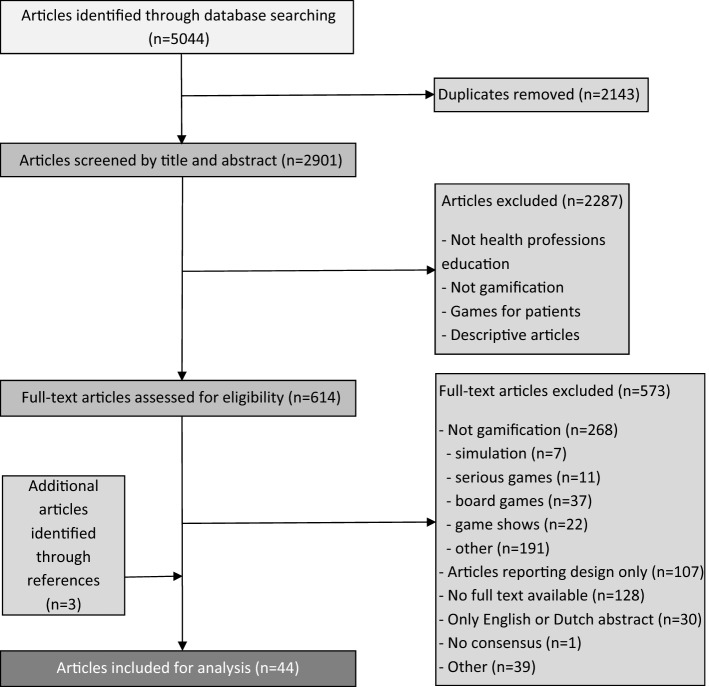
Gamification refers to using game attributes in a non-gaming context. Health professions educators increasingly turn to gamification to optimize students’ learning outcomes. However, little is known about the concept of gamification and its possible working mechanisms. This review focused on empirical evidence for the effectiveness of gamification approaches and theoretical rationales for applying the chosen game attributes. We systematically searched multiple databases, and included all empirical studies evaluating the use of game attributes in health professions education. Of 5044 articles initially identified, 44 met the inclusion criteria. Negative outcomes for using gamification were not reported. Almost all studies included assessment attributes (n = 40), mostly in combination with conflict/challenge attributes (n = 27). Eight studies revealed that this specific combination had increased the use of the learning material, sometimes leading to improved learning outcomes. A relatively small number of studies was performed to explain mechanisms underlying the use of game attributes (n = 7). Our findings suggest that it is possible to improve learning outcomes in health professions education by using gamification, especially when employing game attributes that improve learning behaviours and attitudes towards learning. However, most studies lacked well-defined control groups and did not apply and/or report theory to understand underlying processes. Future research should clarify mechanisms underlying gamified educational interventions and explore theories that could explain the effects of these interventions on learning outcomes, using well-defined control groups, in a longitudinal way. In doing so, we can build on existing theories and gain a practical and comprehensive understanding of how to select the right game elements for the right educational context and the right type of student.
Overview
CoChat Summary
TL;DR
This systematic review of 44 empirical studies found that gamification in health professions education was generally associated with positive or unchanged outcomes, with no negative outcomes reported. Assessment and conflict/challenge attributes were most common, but most studies were descriptive or lacked well-defined control groups and theory, limiting conclusions about mechanisms and effectiveness.
Key findings
- Of 5044 articles identified, 44 met inclusion criteria; no negative outcomes for gamification were reported. Almost all studies included assessment attributes (n = 40), often with conflict/challenge attributes (n = 27); this combination was linked to increased use of learning material in 8 studies and sometimes improved learning outcomes.
- Study quality varied: MERSQI scores ranged from 5 to 17 (mean 9.8, SD 3.1). Most studies were descriptive (n = 25; mean MERSQI 8.3, SD 2.3); 12 were justification studies and 7 were clarification studies. Only 8 well-controlled studies using assessment and conflict/challenge attributes were interpreted with more confidence.
- Contexts were predominantly USA (n = 20) or Canada (n = 8); digital gamified activities (n = 28) outnumbered analogue activities (n = 14). Most studies involved undergraduate (n = 15) and postgraduate medical students (n = 15), followed by nursing (n = 7).
- Theory use was limited: 7 clarification studies referenced theories including Experiential Learning Theory (3 studies), Reinforcement Learning Theory, Social Comparison Theory, Self-Directed Learning, and Deliberate Practice Theory; a common assumption was that gamification improves outcomes by changing learning behaviours or attitudes.
Methods
- Systematic review following AMEE guidelines; searched eight databases (Academic Search Premier, CINAHL, EMBASE, ERIC, Psychology and Behavior Sciences Collection, PsychINFO, PubMed, Cochrane Library) in April 2018, plus hand-searching references and citations.
- Included peer-reviewed journal articles on gamification or game elements in education for (future) health professionals, quantitative or mixed-method; excluded development-only studies, qualitative-only studies, serious games, patient education, simulations except gamified simulations, game-show/board-game contexts, and non-Dutch/English articles.
- Data extraction covered context, participants, intervention, outcomes, quality, and theory; quality was assessed with MERSQI, and studies were classified as description, justification, or clarification using Cook et al.’s framework. Double screening of a 10% excluded sample yielded 94% agreement.
Limitations
- Stated: the search may have missed articles because broad keywords were excluded; lack of consensus on definitions of game, gamification, and serious games made inclusion/exclusion subjective; only one researcher screened full texts; MERSQI does not assess qualitative parts of mixed-methods studies; the conceptual framework may over-generalize and lose information; only English and Dutch articles were included, risking language/culture bias.
- Stated/evident: most included studies lacked well-defined control groups and/or theory (36 of 44 were descriptive, confounded justification/clarification, or clarification without control groups), and combinations of game elements prevented disentangling individual effects; publication bias may have overreported positive results.
- Evident: the review reports no negative outcomes, but this may reflect underreporting; small-scale and pilot studies dominate, and the authors note gamification can have unexpected or unwanted effects (e.g., competition shifting attention from learning, over-justification effect).
Model-written summary. Check it against the paper before relying on it.
Integrity signals
Registry
Cites
Statistics
Figures
Verification
Claims the paper makes
0 Valid · 0 Not valid · 10 Not checked · 55 Own results and interpretations
A result the paper reports from its own data — it cites no other source for it, so there is none to check. The quote shows it is in the paper.
In the paper
“most of the included studies were descriptive in nature and rarely explained what was meant by gamification and how it worked in health professions education.”
§ Gamification of health professions education: a systematic review > Conclusion
plain- Asserted: passes — The authors put it forward as true.
- Checkable: passes — It can be checked against evidence.
- Load-bearing: passes — The paper’s conclusions depend on it.
- Based: passes — The paper gives a reason why it holds.
A result the paper reports from its own data — it cites no other source for it, so there is none to check. The quote shows it is in the paper.
In the paper
“Of 5044 articles initially identified, 44 met the inclusion criteria.”
- Also stated in: § Results · plain
“A total of 44 studies were eligible for inclusion in our systematic review (Table 1).”
§ Gamification of health professions education: a systematic review > Abstract
plain- Asserted: passes — The authors put it forward as true.
- Checkable: passes — It can be checked against evidence.
- Load-bearing: passes — The paper’s conclusions depend on it.
- Based: passes — The paper gives a reason why it holds.
- Also stated in: § Results · plain
A result the paper reports from its own data — it cites no other source for it, so there is none to check. The quote shows it is in the paper.
In the paper
“A combination of conflict and challenge attributes was also more often chosen by researchers from Europe (6 out of 8 European studies) and the USA (17 out of 21 USA studies) than by researchers from Canada (3 out of 8 Canadian studies).”
§ Gamification of health professions education: a systematic review > Results > Contextual differences and effects of game attributes
plainstates an association- Asserted: passes — The authors put it forward as true.
- Checkable: passes — It can be checked against evidence.
- Load-bearing: unclear — It is unclear whether the paper’s conclusions depend on it.
- Based: passes — The paper gives a reason why it holds.
A result the paper reports from its own data — it cites no other source for it, so there is none to check. The quote shows it is in the paper.
In the paper
“Most of the included studies (n = 25; Table 1) were descriptive in nature in such sense that they focused on observation and described what was done, without using comparison groups.”
§ Gamification of health professions education: a systematic review > Results > Quality of the current gamified learning research
plainn = 25- Asserted: passes — The authors put it forward as true.
- Checkable: passes — It can be checked against evidence.
- Load-bearing: passes — The paper’s conclusions depend on it.
- Based: passes — The paper gives a reason why it holds.
A result the paper reports from its own data — it cites no other source for it, so there is none to check. The quote shows it is in the paper.
In the paper
“A relatively small number of studies was performed to explain mechanisms underlying the use of game attributes (n = 7).”
§ Gamification of health professions education: a systematic review > Abstract
plainn = 7- Asserted: passes — The authors put it forward as true.
- Checkable: passes — It can be checked against evidence.
- Load-bearing: passes — The paper’s conclusions depend on it.
- Based: passes — The paper gives a reason why it holds.
30 more claims
Create a free account to see all 65 claims and to verify the 13 references still open.
- It may state two separate claims as one. 16
- Probably not a substantial claim. 21
Claims other papers make about this one
Each is checked against this paper’s own text: does it say what the citing paper says it does?
The source backs part of the claim, not all of it — or backs it for a different population, condition or comparison.
In the citing paper
“The enthusiastic participation and complexity and riskiness of strategies that emerged are consistent with the engagement observed in other gamified public health exercises, such as outbreak response simulations and health systems role-plays (78, 79).”
From Global Health Trade Summit: an AI-enhanced simulation of international trade and global health for undergraduate public health education (2025) · cites this paper as [79]
Experimental — accuracy not yet measuredThe source backs part of the claim, not all of it — or backs it for a different population, condition or comparison.
In the citing paper
“This aligns with research in health professions education demonstrating that gamification can substantially enhance learning outcomes and student motivation (79, 80).”
From Global Health Trade Summit: an AI-enhanced simulation of international trade and global health for undergraduate public health education (2025) · cites this paper as [79]
Experimental — accuracy not yet measured
Self-check
Percentages, sums and reported differences re-computed from the paper’s own numbers.
Each contradiction between two passages listed here was confirmed by an independent check.
Rated minor: it would not touch a result — a value no result rests on, a p-value that stays on the same side of the significance level, or a conflict that is clerical, resolved elsewhere in the paper, or outside its own findings.
In the paper
§ Gamification of health professions education: a systematic review > Discussion > Empirical evidence for using gamification
“The remaining eight studied included in our study were well-controlled studies using assessment and conflict/challenge attributes, so these study results could be interpreted with more confidence.”
§ Gamification of health professions education: a systematic review > Results
“| | Petrucci et al. (2015) | Residents (n = 14) | Conflict/challenge | Competition, progress, social network | Surgery (simulator) | 11 | Digital | Increased use, no difference in outcome |”
Rated minor: it would not touch a result — a value no result rests on, a p-value that stays on the same side of the significance level, or a conflict that is clerical, resolved elsewhere in the paper, or outside its own findings.
In the paper
§ Gamification of health professions education: a systematic review > Results > Educational context and student characteristics
“The majority of the studies were conducted in the USA (n = 20) or Canada (n = 8).”
§ Gamification of health professions education: a systematic review > Results > Contextual differences and effects of game attributes
“the USA (17 out of 21 USA studies)”
Cited works that were retracted
Works this paper cites that were later retracted, from the retraction notices publishers deposit. Major when the notice came out before this paper was published.
Rated major: it would touch a result — a value a result rests on, reported and recomputed p-values on opposite sides of the significance level, two passages that conflict with no sign which is right, or a cited work retracted before this paper was published.
In the paper
“…1999; Bligh and Prideaux 2002; Cook et al. 2008), which we felt should also apply to research on game-based learning in general and gamification in particular (Caponetto et al. 2014; De Sousa Borges et al. 2014; Faiella and Ricciardi 2015; Gentry et al. 2016; McCoy et al. 2016; Nah et al. 2014).”
Cited work 10.1002/14651858.cd012209 · retracted 2018-06-22 · notice 10.1002/14651858.cd012209.pub2 · this paper published 2020-10-31
Citations
Cites
1 retracted
Serious Gaming and Gamification interventions for health professional education
Gentry, S. V., Ehrstrom, B. L., Gauthier, A., Álvarez, J., Wortley, D. J., van Rijswijk, J., Car, J., Lilienthal, A., Car, L. T., Nikolaou, C. K., et al. (2016) · Cochrane Database of Systematic Reviews · doi:10.1002/14651858.cd012209 · Cited by 28 · cited 2×
“…1999; Bligh and Prideaux 2002; Cook et al. 2008), which we felt should also apply to research on game-based learning in general and gamification in particular (Caponetto et al. 2014; De Sousa Borges et al. 2014; Faiella and Ricciardi 2015; Gentry et al. 2016; McCoy et al. 2016; Nah et al. 2014).”
BackgroundRetractedRayyan-a web and mobile app for systematic reviews.
Ouzzani, M., Hammady, H., Fedorowicz, Z., & Elmagarmid, A. (2016) · Systematic Reviews · doi:10.1186/s13643-016-0384-4 · Cited by 26,092 · cited 1×
“After retrieving the search results from different databases, AvG removed the duplicates and uploaded the remaining articles to Rayyan, a mobile and web-based application developed for systematic reviews (Ouzzani et al. 2016).”
MethodA theory of social comparison processes
Festinger, L. (1954) · Human Relations · doi:10.1177/001872675400700202 · Cited by 20,926 · cited 1×
“According to the Social Comparison Theory, social comparison is a fundamental mechanism for modifying judgment and behaviour through the inner drive individuals have to gain accurate self-evaluations (Corcoran et al. 2011; Festinger 1954).”
MethodThe role of deliberate practice in the acquisition of expert performance
Ericsson, K. A., Krampe, R. T., & Tesch-Römer, C. (1993) · Psychological Review · doi:10.1037/0033-295x.100.3.363 · Cited by 9,564 · cited 1×
“Deliberate Practice Theory is based on engaging already motivated students to become experts via well-defined goals, real world tasks and immediate and informative feedback (Butt et al. 2018; Ericsson et al. 1993).”
BackgroundDeci, E. L., Koestner, R., & Ryan, R. M. (1999) · Psychological Bulletin · doi:10.1037/0033-2909.125.6.627 · Cited by 7,176 · cited 1×
“This is also called the over-justification effect (Deci et al. 1999, 2001; Hanus and Fox 2015; Landers et al. 2015; Lepper et al. 1973).”
BackgroundHomo Ludens: A Study of the Play-Element in Culture.
Gillin, J. L., & Huizinga, J. (1951) · American Sociological Review · doi:10.2307/2087716 · Cited by 6,560
Rules of Play: Game Design Fundamentals
Salen, K., & Zimmerman, E. (2003) · Medical Entomology and Zoology · Cited by 5,438
Does Gamification Work? -- A Literature Review of Empirical Studies on Gamification
Hamari, J., Koivisto, J., & Sarsa, H. (2014) · 2014 47th Hawaii International Conference on System Sciences · doi:10.1109/hicss.2014.377 · Cited by 5,201 · cited 1×
“…technology (Blohm and Leimeister 2013; Burke 2014; Burkey et al. 2013; De Sousa Borges et al. 2014; Domínguez et al. 2013; Gaggioli 2016; Hamari et al. 2014; Hsu et al. 2013; Huotari and Hamari 2012, 2017; Kumar 2013; Muntean 2011; Perrotta et al. 2013; Robson et al. 2015; Simões et al.…”
BackgroundThe Modern Practice of Adult Education: From Pedagogy to Andragogy
Knowles, M. S. (1970) · Cited by 3,905
(2020) · Journal of Medical Education · doi:10.5812/jme · Cited by 3,490
Research works printed but not linked: 8
- Caponetto, I., Earp, J., & Ott, M. (2014). Gamification and education: A literature review. In Proceedings of the European Conference on Games-Based Learning.
- Chia P Using a virtual game to enhance simulation based learning in nursing education Singapore Nurs J [Internet]. 2013 40 3 21 6
- Deterding S Khaled R Nacke L Dixon D Gamification: Toward a definition Chi 2011 2011 12 15
- Huotari, K., & Hamari, J. (2012). Defining gamification—A service marketing perspective. In Proceedings of the 16th International Academic MindTrek Conference 2012: “Envisioning Future Media Environments”, MindTrek 2012.
- Jacobs, J. W., & Dempsey, J. V. (1993). Simulation and gaming: Fidelity, feedback, and motivation. In: Dempsey, J.V. and Sales G.C. (Eds.). Interactive instruction and feedback. Englewood Cliffs, New Jersey: Educational Technology Publications
- Nemer LB Kalin D Fiorentino D Garcia JJ Estes CM The labor games Obstet Gynecol. 2016 128 1s 5s 27662001 · DOI
- Tilley, N., & Pawson, R. (2000). Realistic evaluation: An overview. The British Journal of Sociology.
- Zuk R Get in the game: How communicators can leverage gamification Public Relations Tactics 2012 19 7
Cited by
Items 601–700 of 861
Unlocking Engagement: The Power of Gamification in Anatomy Education
Buksh, H. A., Panhwar, M., Shaikh, P., & Kashif, S. (2023) · Pakistan Journal of Medical and Health Sciences · doi:10.53350/pjmhs20231710384
Balán, I. C., Brewer, O., Kutner, B. A., & Giguere, R. (2026) · JMIR Research Protocols · doi:10.2196/82241
Can-Sim schistosomiasis simulation for nurses: A Dutch, Tanzanian and Canadian co-creation
Habes, E. V., Migire, M. K., Bakker, A., & Hagenbeek, E. (2025) · International Journal of Africa Nursing Sciences · doi:10.1016/j.ijans.2025.100922
Leveling up surgical feedback: The power of gamification and a competitive edgePreprint
Wu, C. C., Smink, D. S., Sandhu, G., Alexander, E. K., & Nitzschke, S. L. (2025) · Research Square · doi:10.21203/rs.3.rs-7559950/v1
da Silva, S. L., & Christino, D. (2025) · Revista Contemporânea · doi:10.56083/rcv5n11-150
Modern approaches in teaching nursing fundamentals course: Türkiye perspective
AKYÜZ, H. Ö., & Gülsoy, H. (2025) · Medicine Science | International Medical Journal · doi:10.5455/medscience.2025.04.107
РОЗВИТОК АНАТОМІЧНОЇ ПАМ’ЯТІ СТУДЕНТІВ ШЛЯХОМ ВИКОРИСТАННЯ ВПРАВИ “ТЕРМІНОЛОГІЧНИЙ СПРИНТ”
Процак, Т., Сергійович, З. І., Мазур, О., & Yasinskyi, M. (2025) · Перспективи та інновації науки · doi:10.52058/2786-4952-2025-11(57)-3546-3557
Farag, A. M. E., Lamadah, S. M., Badr, O. E.-S., & Abdellah, M. M. M. (2025) · Alexandria Scientific Nursing Journal · doi:10.21608/asalexu.2025.469005
Ruta Clínica para la infección respiratoria en Niños
de Santander, U. I., Vecino, L. L. C., Niederbacher-Velásquez, J., & de Santander, U. I. (2025) · Revista Docencia Universitaria/Revista docencia universitaria · doi:10.18273/revdu.vesp1-20250012
(2025) · The Clinical Teacher · doi:10.1111/tct.70268
Impact of a Modular Escape Game on Undergraduate and Continuing Dental Education
Bergman, S., Smail, Y., Fasham, T., Izart, M., Brukarz, Y., Berès, F., Loré, V., Jannot, M., Troizier-Cheyne, M., Goff, S. O. L., et al. (2025) · Journal of Dental Education · doi:10.1002/jdd.70123
“Although the five-to six-person team size used in this study is close to the recommended upper limit for PEGs [ 7, 18 ], smaller teams could enhance active participation and perceived comfort, particularly for more reserved participants, since smaller teams would discourage the emergence of a…”
InfluentialWeb-based interventions to promote health in adolescents
Sousa, D. M. D. (2021) · Portuguese National Funding Agency for Science, Research and Technology (RCAAP Project by FCT) · doi:10.34626/ema3-nc55
Burr, C. (2024) · Oxford University Research Archive (ORA) (University of Oxford) · doi:10.5287/ora-erqmnvxvk
Hu, H., Lai, X., & Yan, L. (2024) · Figshare · doi:10.6084/m9.figshare.26709887
Lin, C.-S., & Yang, C.-C. (2023) · Figshare · doi:10.6084/m9.figshare.22603928
Molina‐Rodríguez, A., Suárez-Cortés, M., Leal‐Costa, C., Ruzafa‐Martínez, M., Díaz-Agea, J. L., Ramos‐Morcillo, A. J., & Jiménez‐Ruiz, I. (2024) · Figshare · doi:10.6084/m9.figshare.26622553
Goddiksen, M. P., Allard, A., Armond, A. C. V., Clavien, C., Loor, H., Schöpfer, C., Varga, O., & Johansen, M. W. (2024) · Figshare · doi:10.6084/m9.figshare.26698319
Additional file 1 of Clinical virtual simulation: predictors of user acceptance in nursing education
Padilha, J. M., Costa, P., Sousa, P., & Ferreira, A. C. E. (2024) · Figshare · doi:10.6084/m9.figshare.26694384
Additional file 4 of Serious game for radiotherapy training
Kayed, J. E., Akl, T., Massoud, C., Margossian, C., Fayad, H., Fares, G., Felefly, T., & Rihana, S. A. (2024) · Figshare · doi:10.6084/m9.figshare.26713145
Additional file 5 of Serious game for radiotherapy training
Kayed, J. E., Akl, T., Massoud, C., Margossian, C., Fayad, H., Fares, G., Felefly, T., & Rihana, S. A. (2024) · Figshare · doi:10.6084/m9.figshare.26713148
Additional file 1 of Serious game for radiotherapy training
Kayed, J. E., Akl, T., Massoud, C., Margossian, C., Fayad, H. J., Fares, G., Felefly, T., & Rihana, S. A. (2024) · Figshare · doi:10.6084/m9.figshare.26713136
Goddiksen, M. P., Allard, A., Armond, A. C. V., Clavien, C., Loor, H., Schöpfer, C., Varga, O., & Johansen, M. W. (2024) · Figshare · doi:10.6084/m9.figshare.26698322
Taghipour, E., Vizeshfar, F., & Zarifsanaiey, N. (2024) · Figshare · doi:10.6084/m9.figshare.26639082
Amir, L. R., Leonardy, I. C., Dewatmoko, S. N., Yanuar, R., Suniarti, D., Idrus, E., Sipiyaruk, K., & Puspitawati, R. (2024) · Figshare · doi:10.6084/m9.figshare.26612384
Sandoval-Hernández, I., Molina‐Torres, G., León-Morillas, F., Ropero‐Padilla, C., González‐Sánchez, M., & Martínez-Cal, J. (2023) · Figshare · doi:10.6084/m9.figshare.24159229
Additional file 6 of Serious game for radiotherapy training
Kayed, J. E., Akl, T., Massoud, C., Margossian, C., Fayad, H., Fares, G., Felefly, T., & Rihana, S. A. (2024) · Figshare · doi:10.6084/m9.figshare.26713151
Taghipour, E., Vizeshfar, F., & Zarifsanaiey, N. (2024) · Figshare · doi:10.6084/m9.figshare.26639079
Amir, L. R., Leonardy, I. C., Dewatmoko, S. N., Yanuar, R., Suniarti, D., Idrus, E., Sipiyaruk, K., & Puspitawati, R. (2024) · Figshare · doi:10.6084/m9.figshare.26612387
Additional file 3 of Serious game for radiotherapy training
Kayed, J. E., Akl, T., Massoud, C., Margossian, C., Fayad, H., Fares, G., Felefly, T., & Rihana, S. A. (2024) · Figshare · doi:10.6084/m9.figshare.26713142
Do, M., Sanford, K., Roseff, S. D., Hovaguimian, A., Besche, H. C., & Fischer, K. (2023) · Figshare · doi:10.6084/m9.figshare.24819638
Goddiksen, M. P., Allard, A., Armond, A. C. V., Clavien, C., Loor, H., Schöpfer, C., Varga, O., & Johansen, M. W. (2024) · Figshare · doi:10.6084/m9.figshare.26698316
Molina‐Rodríguez, A., Suárez-Cortés, M., Leal‐Costa, C., Ruzafa‐Martínez, M., Díaz-Agea, J. L., Ramos‐Morcillo, A. J., & Jiménez‐Ruiz, I. (2024) · Figshare · doi:10.6084/m9.figshare.26622556
Additional file 2 of Serious game for radiotherapy training
Kayed, J. E., Akl, T., Massoud, C., Margossian, C., Fayad, H., Fares, G., Felefly, T., & Rihana, S. A. (2024) · Figshare · doi:10.6084/m9.figshare.26713139
Speck, I. K., Merk, A., Burkhardt, V., Flayyih, O., Huber, C., Widder, A., Everad, F., & Offergeld, C. (2024) · Figshare · doi:10.6084/m9.figshare.25231255
Delage, C., Palayer, M., Lerouet, D., & Besson, V. C. (2024) · Figshare · doi:10.6084/m9.figshare.26687744
Leirós Rodríguez, R., Álvarez del Barrio, L., González Castro, A., Alba-Pérez, E., & Gómez, E. A. (2024) · Buleria (Universidad de León)
Mohd Hazim Afiq, K. (2024) · Unimas Institutional Repository (Universiti Malaysia Sarawak)
Haukipuro, A., & Göös, J. (2024) · Theseus (Ammattikorkeakoulujen)
Almeida, A. I. S. F. L. D. S. (2023) · Portuguese National Funding Agency for Science, Research and Technology (RCAAP Project by FCT)
Alves, C. C. R. B. (2023) · Portuguese National Funding Agency for Science, Research and Technology (RCAAP Project by FCT)
Conception et évaluation d'un jeu sérieux sur la santé sexuelle masculine
Foly, B. (2024) · HAL
Immunoloogia teemalise kaardimängu koostamine ja selle mõju hindamine
Irina, G. (2025) · DSpace repository (University of Tartu)
Fagundo-Rivera, J., Romero‐Castillo, R., Garrido-Bueno, M., Fernández León, P., Contero, J. (. O., & Cabello, A. Q. (2024) · Deposito de Investigacion Universidad de Sevilla (University of Seville)
Exploradores en diabetes: aprender jugando
Pomares, M. L. (2024) · Revista de la Sociedad Argentina de Diabetes
Ensihoitajaopiskelijoiden kokemuksia pelillisestä oppimisesta
Timonen, T., & Ålander, J. (2025) · Theseus (Ammattikorkeakoulujen)
Yahizan, S. N., Zain, N. H. M., Abdul Razak, F. H., Ismail, I., & Mohamed Noh, N. A. (2023) · UiTM Institutional Repositories (Universiti Teknologi MARA)
(2024) · Theseus (Ammattikorkeakoulujen)
Motivation et apprentissage des étudiants en ostéopathie : création de jeux de société
Laurent, C., & Potier, L. (2023) · HAL
VR som pedagogisk prinsipp på medisinstudier – en visjon
Zimmermann, M. (2021) · NORA - Norwegian Open Research Archives
Papa, G. (2025) · The Journal of AMD · doi:10.36171/jamd25.28.3.3
Strija, J. (2025) · University of Zagreb University Computing Centre (SRCE)
Do, M. C. (2023) · Digital Access to Scholarship at Harvard (DASH) (Harvard University)
Uporaba simulacij za pridobivanje mikrodokazil v zdravstveni negi
Renko, J. (2024) · Repository of the University of Primorsk (University of Primorska)
An evaluation of gamification in nursing education: “The amazing patient journey race”
Pitts, T. L., Ackroyd, L., & Fray, S. A. (2025) · Teaching and learning in nursing · doi:10.1016/j.teln.2025.11.027
Cardiologia – Teoria e Prática Ed. XXIV
Pereira, A. C. M., de Oliveira, K. L., Silva, D. C. E., Lobato, G. C., Lopes, J. F. L., Freitas, G. B. L. D., & de Almeida, C. C. (2026) · Editora Pasteur eBooks · doi:10.59290/978-65-6029-308-3
A efetividade do ensino de suporte básico de vida para crianças e adolescentes leigos
Strelow, M. L. Z., REIMANN, M. C., Telöken, T. F., Lau, M. E. S., BRUN, G. D., Hoefling, A. J. S., Hoernig, A. F., FACHINI, C. B., Timm, M., REDEL, M. D., et al. (2026) · Editora Pasteur eBooks · doi:10.59290/2201000725
Oar-iginal: a serious game for health improvement
Λιάγκα, Μ. Ε. (2025) · University of Thessaly Institutional Repository (University of Thessaly)
Alvarez, A. G., Barra, D. C. C., Knihs, N. D. S., & Lorenzini, E. (2024) · LA Referencia (Red Federada de Repositorios Institucionales de Publicaciones Científicas)
How to Leverage Insights From Games and Gamification – the Road Ahead
Schijven, M. P., & Kikkawa, T. (2026) · Simulation & Gaming · doi:10.1177/10468781261416577
Sidhu, A., Ojha, A. C., Sharma, R., Kulanthaivel, M., Premananthan, G., & Kumar, R. T. (2025) · doi:10.1109/iceei68459.2025.11330418
GAMIFICAÇÃO COMO ESTRATÉGIA INOVADORA NA FORMAÇÃO EM FISIOTERAPIA: UM RELATO DE EXPERIÊNCIA
Neves, I. D., da Silva, L. R., Moraes, T. V. S., Cerqueira, L. C. D. S., & Medrado, A. R. A. P. (2026) · Derecho y cambio social. · doi:10.54899/dcs.v23i86.4165
Bay, N. T., Linh, N. T., & Phuong, N. T. N. (2026) · International journal of research and scientific innovation · doi:10.51244/ijrsi.2026.13010038
Grich, L., Dursun, E., Goff, S. O. L., Abdel-Gawad, S., Gouze, H., D’Agostino, M.-A., Attal, J., Hamdan, S., & François, P. (2026) · Journal of Dental Education · doi:10.1002/jdd.70170
Gamification Approaches in Undergraduate Histology Learning
Hasan, N. A., & Savirani, R. (2026) · Academia Open · doi:10.21070/acopen.11.2026.13493
Howe, H., Sovobada-Powel, S., Bordeaux, C., Ferguson, E., Coad, J., & Bland, T. (2026) · Education Sciences · doi:10.3390/educsci16020269
Barber, N. (2026) · South African Journal of Physiotherapy · doi:10.4102/sajp.v82i2.2285
“Escape rooms are increasingly being used in health professions education as an innovative tool to promote authentic clinical reasoning, collaboration, and learner engagement (Moore & Campbell 2021; Van Gaalen et al. 2021).”
Wolfe, J., Wolfe, M., Williams, D., & Raukar, N. P. (2026) · AEM Education and Training · doi:10.1002/aet2.70127
“Gamification, the application of game-based elements to nongame contexts, has been shown to enhance engagement, motivation, and knowledge retention [16].”
Kaljo, K., & Kruper, A. (2026) · Medical Science Educator · doi:10.1007/s40670-026-02685-9
Martínez, N. D. B., Gómez, A. B., Clavijo, J. P. U., & Contreras, V. E. S. (2021) · Repositorio Institucional - IBERO
Argus‐Calvo, B., Autrey, J., Tullius, Z. S., Cenan, A., & Leiner, M. A. (2026) · Medical Science Educator · doi:10.1007/s40670-026-02682-y
Amanda, M. D., & Nurhasanah, N. (2026) · International Journal of Islamic Education Research and Multiculturalism (IJIERM) · doi:10.47006/ijierm.v8i1.685
Gamified Learning among Medical Undergraduates using Digital Platforms: A Quasiexperimental Study
Mohta, A., Prajapathi, S., & Rastogi, S. (2026) · Indian Journal of Community Medicine · doi:10.4103/ijcm.ijcm_773_25
Mekni, S., & Mghirbi, A. (2026) · La Tunisie Médicale · doi:10.62438/tunismed.v104i01.6211
Halfwerk, F. R., Duinmeijer, W. C., Swol, J., Riera, J., Obreja, V., Puślecki, M., & Arens, J. (2024) · University of Twente Research Information
Harjoitteluympäristöjen nykytilan kartoitus
Vuojärvi, H., & Airola, E. (2021) · LaCRIS (University of Lapland)
Menekşeoğlu, A. K., Sezikli, S., Bilget, S., Yilmaz, U., & Şahbaz, T. (2025) · Turkish Journal of Physical Medicine and Rehabilitation · doi:10.5606/tftrd.2026.16467
“[33] Despite the availability of disease-specific or function-specific software, there remains a lack of consensus on the features that most effectively support functional recovery.”
Desarrollo de un Laboratorio Remoto Interactivo: Calorimetría Animal
Robello, E. (2023) · Repositorio Digital Institucional de la Universidad de Buenos Aires (Universidad de Buenos Aires)
Gaming the Simulation to Assess DPT Student Learning
Stephens, L., & Prather, G. (2026) · Journal of Innovation in Health Sciences Education · doi:10.46409/003.trdn2620
Keintz, M. R., Cichon, C. J., Marcelin, J. R., & Arbeiter, B. (2026) · Open Forum Infectious Diseases · doi:10.1093/ofid/ofag561
“In medical education, the goal of GBL is to stimulate learners, improve in - formation retention, and increase enjoyment overall with the learning process [6].”
Lifelong Learning for Mongolia: Occupational Health & Safety project (3L4MHOS)
Falzone, Y., & Marca, A. L. (2025) · ATEE Spring Conference · doi:10.62336/unibg.978-88-97253-27-3_p.25
Gamification Used in Anatomy and Physiology in Nursing
Piñera, A. R., & Rosario, M. S. D. (2026) · International Journal of Sustainability and Advanced Integrated Research · doi:10.65339/ijsair.v2.i2.160
Mohammedi, S. B. (2024) · theses.fr (ABES) · doi:10.70675/6c2a1d9ez5e01z4080zb816zf113884ba28d
Povezivanje teorije i prakse u zdravstvenoj njezi uz pomoć virtualnih alata
Maceković, M., & Hardi, I. (2026) · Sestrinski glasnik · doi:10.11608/sgnj.31.1.8
Vieira, P. J. S., Menezes, E. G., & Barros, J. B. F. (2026) · Revista de Gestão e Secretariado (Management and Administrative Professional Review) · doi:10.7769/gesec.v17i4.5582
Trejo, D. C., Zamitiz, J. R., Góngora, V. I. V., Flores, K. G. M., & Alba, S. Q. D. (2026) · MENTOR revista de investigación educativa y deportiva · doi:10.56200/mentor.v5i2.12353
Shao, F., Han, Z., Su, Q., & Fang, Y. (2026) · JMIR Serious Games · doi:10.2196/86092
“In practice, these elements are often operationalized through points, badges, leaderboards, and milestone schedules that structure engagement and perceived progress [12].”
The Use of Gamification in Occupational Therapy Education
Mulligan, C., Bennett, L., & Graves, D. F. (2026) · The Open Journal of Occupational Therapy · doi:10.15453/2168-6408.2457
Borckardt, J. J., Henninger, D., Barth, K. S., Annan‐Coultas, D., Langdale, L., Kascak, K., Pelic, C., DeArellano, M., & Brady, K. T. (2026) · JMIR Nursing · doi:10.2196/98700
“Flipped classroom models likewise produce higher achievement, greater engagement, and improved retention compared to traditional didactic instruction [15], and gamified and game-based approaches have been associated with increased motivation and engagement in health professions learners [16].”
Aalaei, S., Mastour, H., Amiri, F., Emadzadeh, A., & Mehdipour‐Rabori, R. (2026) · BMC Medical Education · doi:10.1186/s12909-026-09138-2
da Silva, D., da Cunha, V. L., Farias, L. B. A., Carlos, L. C. D. A., Barbosa³, P. E. E. S., & Cavalcanti, F. A. D. C. (2026) · Research Square · doi:10.21203/rs.3.rs-9152421/v1
Physiotherapy education and game-based learning: developing the SPINE framework
Bernardo, D. F. S., Paquete, M., & Rosa, M. (2026) · International Journal of Evaluation and Research in Education (IJERE) · doi:10.11591/ijere.v15i2.37549
“This finding reflects a strong awareness among students of the potential of games to enhance learning engagement, motivation, and the integration of both cognitive and practical skills in healthcare contexts [9], [16], [17].”
Hansotte, V., Charleux, O., Hartmann, A., Braud, A., & Mocquot, C. (2026) · European Journal Of Dental Education · doi:10.1111/eje.70172
Shao, F., Fang, Y., Han, Z., & Su, Q. (2025) · doi:10.2196/preprints.86092
An Information Systems Success Model for Explaining Cultural Learning Outcomes via an RPG
Ratchatawetchakul, Y., Ratchatawetchakul, K., Wandee, J., & Eampoonga, I. (2025) · Technology Innovation Management and Engineering Science International Conference (TIMES-iCON) · doi:10.1109/times-icon67125.2025.11488104
How to Use Games to Teach in the Clinical Setting
Lindsley, T., Keller, R., & Hogan, M. B. (2026) · Springer eBooks · doi:10.1007/978-3-031-83753-1_24
Metadata
- Authors
- van Gaalen, A. E. J., Brouwer, J., Schönrock-Adema, J., Bouwkamp-Timmer, T., Jaarsma, A. D. C., & Georgiadis, J. R.
- Affiliations
- University of Groningen (NL)
- University Medical Center Groningen (NL)
- Venue
- Advances in Health Sciences Education
- Published
- 2020-10-31
- Volume
- 26
- Issue
- 2
- Pages
- 683-711
- ISSN
- 1382-4996 (ISSN-L)
- 1573-1677
- PMC
- PMC8041684
- OpenAlex
- W3094919143
- Cited by
- 625
- References
- 149
- Citations by year
- 2026: 108 · 2025: 126 · 2024: 160 · 2023: 121 · 2022: 80 · 2021: 29
- FWCI
- 12.14
- Type
- journal article
- Language
- en
- Open access
- hybrid
- doi.org
- Licence
- cc-by
- creativecommons.org/licenses/by/4.0 (tdm)
- creativecommons.org/licenses/by/4.0 (vor)
- Locations
- Advances in Health Sciences Education (publishedVersion, cc-by)
- PubMed Central (publishedVersion, cc-by)
- PubMed (publishedVersion)
- University of Groningen research database (University of Groningen / Centre for Information Technology) (publishedVersion, cc-by)
- Utrecht University Repository (Utrecht University) (submittedVersion, other-oa)
- University of Groningen research database (University of Groningen / Centre for Information Technology) (submittedVersion, cc-by)
- Funders
- University of Groningen
- Topics
- Social Sciences › Psychology › Developmental and Educational Psychology › Educational Games and Gamification
- Social Sciences › Education › Innovations in Medical Education
- Physical Sciences › Engineering › Biomedical Engineering › Biomedical and Engineering Education
- Keywords
- gamification, health professions education, game attributes, learning outcomes, learning behavior, learning attitude, educational intervention
- MeSH terms
- Health Occupations, Humans, Learning, Students
About these checks
Registry, retraction, Cites and statistics results are computed, not judged, with one exception: a printed reference that no index lists is read once by a model before it counts as a citation error. Claims are extracted by a model and kept only when their quote appears verbatim in the text; each cited source is then checked, with a model’s help, for whether it says what the claim relies on. Those verdicts can be wrong — read the claim’s quote and the cited source before relying on one.
A language model drew the claims from the paper on 2026-11-23, under version 3 of the claim definition (model deepseek-v4.1-flash, prompt extract-v3).
A second model labelled each claim on 2026-11-23 (model jev-1.13-20260917, definition revision gold-guideline-v0.2).
Statistics and arithmetic are recomputed, not judged.
Confidence bands are shown only for fields calibrated on our annotated test set. None is calibrated yet, so no band is shown.
What counts as a claim ›How we measure confidence ›How we check this ›
Are you an author, or do you see a problem with this page? Request a review
Data sources
Bibliographic data: Semantic Scholar, OpenAlex, Crossref.
Contains information from the Semantic Scholar Academic Graph Datasets, made available under the ODC Attribution License (ODC-BY 1.0).
Semantic Scholar’s data is described in: Kinney, R., et al. (2023). The Semantic Scholar Open Data Platform. arXiv:2301.10140.
